

- Industry Size (2026)
- USD 2.68 Bn
- Forecast (2036)
- USD 16.54 Bn
- CAGR (2026 to 2036)
- 19.9%
At Home Beauty Device Subscriptions Market Size, Market Forecast and Outlook By FMI
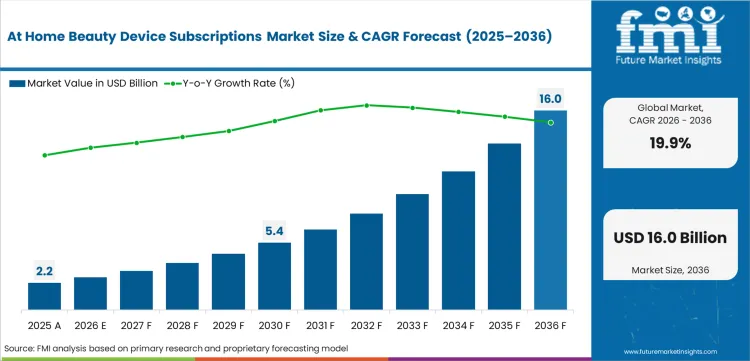
The At Home Beauty Device Subscriptions Market registered USD 2.14 billion in 2025, and is estimated to reach USD 2.68 billion in 2026 at a CAGR of 19.9%. Forward projections indicate a surge to USD 16.54 billion by 2036 as IoT-enabled skin diagnostics transform aesthetic hardware into real-time data interfaces.
According to FMI's estimates, D2C platform operators are respecifying application programming interfaces to support complex beauty subscription tiers that unlock premium treatment algorithms based on monthly fee structures. This architectural pivot eliminates the static functionality of older aesthetic tools. Biometric software architects who secure medical validation for their connected vanity applications dictate the baseline features that all subsequent entrants must match to achieve platform visibility. Suppliers that fail to establish native connected capabilities surrender recurring revenue to digitally native disruptors before the Q4 retention cycle opens.
Summary of At Home Beauty Device Subscriptions Market
- At Home Beauty Device Subscriptions Market Definition
- At Home Beauty Device Subscriptions represent a recurring revenue business model where consumers pay periodic fees to access dermatological hardware, proprietary consumable replenishments, and integrated diagnostic software. The ecosystem includes IoT-enabled skin scanners, app-locked microcurrent tools, and serialized LED therapy masks that require active digital memberships to function at professional clinical modes. Medical-grade data encryption and personalized treatment algorithms form the core functional parameters defining these closed-loop vanity systems.
- Demand Drivers in the Market
- Strict biometric data privacy frameworks compel biometric software architects to replace legacy unsecured Bluetooth connections with cryptographically secure, app-tethered subscription platforms.
- Retail category managers seeking high lifetime-value consumer cohorts reject standalone aesthetic hardware that fragments post-purchase diagnostic visibility and brand engagement.
- High initial capital costs for clinical-grade laser and radio frequency tools force D2C platform operators to deploy lease-to-own models that spread expenditures over multi-year software contracts.
- Key Segments Analyzed in the FMI Report
- Replenishment-linked Device Kits: 46.8% share in 2026, reflecting the absolute requirement for specialized conductive gels and active serums to execute safe electrical stimulation protocols.
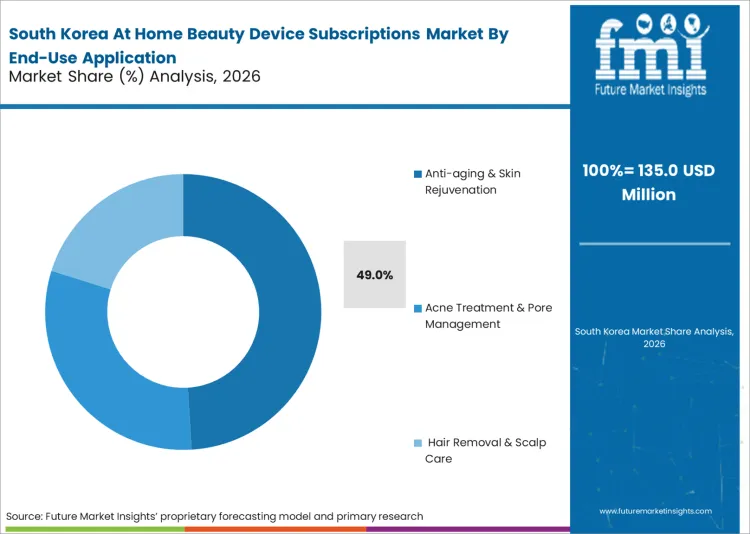
- Anti-aging & Skin Rejuvenation: 51.2% share in 2026, as older demographic cohorts standardize on continuous, high-frequency home treatments to sustain collagen production between clinical visits.
- China: 22.5% compound growth driven by greenfield e-commerce integrations that embed localized AI diagnostic scanners directly into established social payment ecosystems.
- Analyst Opinion at FMI
- Ronak Shah, Principal Consultant for Consumer Product, opines: "During the research we have observed that the true bottleneck in the aesthetic technology transition is not sensor hardware miniaturization, but the algorithmic precision required to safely automate treatment intensities without clinical supervision. Platforms attempting to run high-energy therapy modalities over uncalibrated open-loop software face unavoidable user compliance failures that trigger immediate membership churn. Cosmetic dermatologists who continue endorsing disconnected consumer tools will find themselves unable to deliver the personalized, data-backed efficacy tracking required for next-generation virtual care integration."
- Strategic Implications / Executive Takeaways
- Biometric software architects must secure third-party interoperability certification to qualify for impending smart-home vanity integration contracts.
- D2C platform operators should phase out standalone device dependency and mandate native IoT-connected diagnostic support in all new product development pipelines.
- Beauty tech integration engineers must develop specialized verification competencies to prove diagnostic accuracy and longitudinal data continuity during the platform commissioning phase.
- At Home Beauty Device Subscriptions Market Research Methodology
- Primary Research: FMI conducted detailed technical interviews with digital transformation leads, biometric software architects, and cosmetic dermatologists across 40 countries to validate subscription adoption timelines.
- Desk Research: Analysts aggregated public standards documentation from global digital health registries, corporate software launch sheets, and national cosmetic infrastructure guidelines.
- Market-Sizing and Forecasting: The baseline value derives from a bottom-up aggregation of active subscription accounts, applying region-specific adoption curves to project future membership velocity and average revenue per user.
- Data Validation and Update Cycle: Projections are rigorously tested against publicly reported recurring revenue guidance from the leading aesthetic technology conglomerates and verified consumer spending indices.
At Home Beauty Device Subscriptions Market Key Takeaways
| Metric | Details |
|---|---|
| Industry Size (2026) | USD 2.68 Billion |
| Industry Value (2036) | USD 16.54 Billion |
| CAGR (2026-2036) | 19.9% |
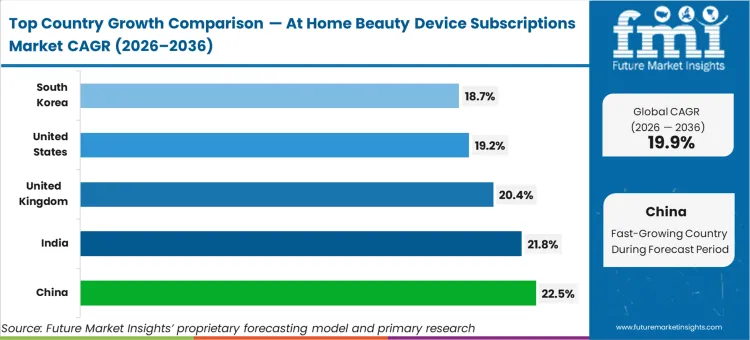
Emerging Asian markets navigate this transition with unprecedented speed, as China sets the pace with a 22.5% CAGR, followed closely by India at 21.8%, with both nations utilizing greenfield e-commerce integrations to bypass traditional physical retail distribution entirely. The United Kingdom advances at a 20.4% rate, supported by structural backlogs in public dermatology pathways that force consumers toward private clinical-grade digital interventions. The United States registers a 19.2% expansion driven by the FDA's software precertification frameworks, while South Korea tracks at 18.7% as established dermatology conglomerates extend their physical clinic presence into the home via SaaS-locked premium hardware.
At Home Beauty Device Subscriptions Market Definition
At Home Beauty Device Subscriptions represent the recurring revenue business model and digital infrastructure where consumers pay periodic fees to access connected dermatological hardware and integrated biometric software. The ecosystem encompasses specialized diagnostic scanners, app-locked microcurrent tools, and serialized LED therapy masks that rely on active digital memberships to unlock professional treatment parameters. A core inclusion is the closed-loop delivery of proprietary consumables, such as conductive serums, which are algorithmically tracked and automatically replenished to ensure optimal device conductivity. Regulatory frameworks such as the FDA's Digital Health Software Precertification Program define the operational parameters for the software-as-a-medical-device platforms governing these precise treatment regimens.
At Home Beauty Device Subscriptions Market Inclusions
The market scope includes IoT-enabled aesthetic hardware, network interface applications, software-as-a-service platforms, and embedded communication modules featuring native diagnostic capabilities designed for home use. Replenishment-linked serum cartridges, lease-to-own medical-grade laser memberships, and subscription-gated personalized treatment algorithms fall entirely within the boundaries. A concrete inclusion is a connected light-therapy mask that functions physically but requires a paid monthly app membership to activate specific wavelength sequences for acne management; both the hardware contract and the recurring software revenue are fully incorporated into the valuation.
At Home Beauty Device Subscriptions Market Exclusions
Standard commercial aesthetic hardware lacking consumer-facing mobile synchronization or diagnostic tracking capabilities is excluded. Purely cosmetic topical products, standalone clinical machines designed solely for professional medical-spa deployment, and unlinked consumer gadgets fall outside the defined parameters. A borderline example explicitly omitted is a high-end microcurrent device sold with a one-time purchase model that includes a free, static instructional app; because it lacks a recurring payment structure or software-locked functionality, it does not qualify as a subscription ecosystem.
At Home Beauty Device Subscriptions Market Research Methodology
- Primary Research: Analysts engaged with digital transformation leads, biometric software architects, and cosmetic dermatologists across 40 countries to map the specific decision gates triggering subscription conversions.
- Desk Research: The data collection phase aggregated compliance roadmaps from global digital health registries, patent filings for IoT-enabled aesthetic hardware, and recurring revenue guidance from major aesthetic technology conglomerates.
- Market-Sizing and Forecasting: The baseline value derives from a bottom-up aggregation of active subscription accounts, applying region-specific adoption curves and digital payment maturity indices to project future membership velocity and average revenue per user.
- Data Validation and Update Cycle: Segment forecasts undergo rigorous cross-validation against quarterly recurring revenue reports and verifiable consumer health spending indices from the leading aesthetic technology platforms.
At Home Beauty Device Subscriptions Market Analysis by Segments
At Home Beauty Device Subscriptions Market Analysis by Subscription Model Type
Subsidized Hardware Models Dictate the Migration Timeline for Premium Therapeutics
With high upfront capital costs proving inadequate for mass-market clinical tool adoption, D2C platform operators execute full-scale subsidized hardware deployment programs. Replenishment-linked Device Kits capture a dominant 46.8% share in 2026, reflecting the absolute requirement for specialized consumable serums to operate advanced wearable beauty masks safely. As per FMI's projection, this commercial integration eliminates the friction of large initial investments while locking the user into a proprietary subscription economy loop. Platform architects specifying these bundled ecosystems streamline their logistics networks and significantly reduce customer acquisition costs over the device lifetime. Diagnostic software designers failing to demonstrate seamless consumable tracking algorithms lose priority status in critical retail pharmacy upgrade cycles.
- Consumable lock-in: RFID-tagged serum cartridges enforce strict usage compliance, ensuring electrical conductivity parameters remain optimal while preventing unauthorized third-party formulations from damaging the sensor arrays.
- Margin realization: Distributing the hardware cost across a twelve-month mandatory consumable contract shifts the profitability locus from the initial retail transaction to the predictable recurring fulfillment schedule.
- Efficacy validation: Automated tracking of active ingredient depletion allows the companion application to correlate specific product volumes with observed skin improvements, reinforcing the value proposition of the continuous payment structure.
At Home Beauty Device Subscriptions Market Analysis by Device Technology
Light and Energy Delivery Systems Force Rigorous Software Safety Gates
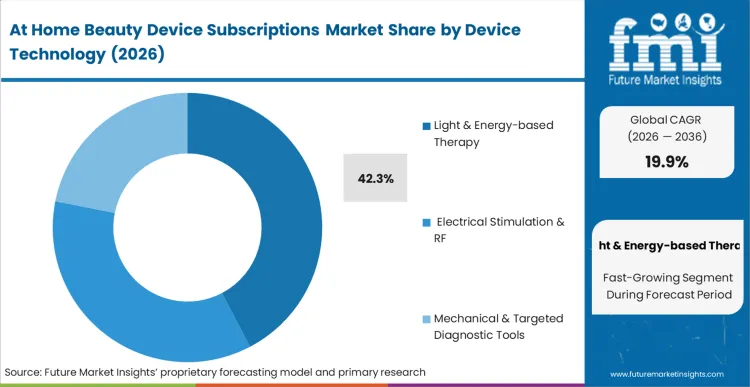
Every biometric software architect bidding on connected vanity platforms now faces strict adherence criteria for clinical energy dispersion limits. Based on FMI's assessment, Light & Energy-based Therapy modules command 42.3% share in 2026. Cosmetic dermatologists advising remote patients reject at home laser device designs that introduce uncalibrated pulse variations into the treatment protocol. Incorporating certified optical control modules guarantees that high-intensity photonic commands arrive exactly as specified by the app-based algorithmic guide. The convergence of smartphone camera diagnostics with core microcurrent facial calibration amplifies the demand for high-bandwidth deterministic links between phone and tool. Device engineers unable to supply robust biometric feedback safety switches risk exclusion from the next wave of greenfield telemedicine integration requests for proposals.
- Dosage control: Active software gates prevent users from exceeding maximum daily joule outputs, neutralizing the liability risks historically associated with unmonitored consumer laser deployments.
- Wavelength sequencing: Membership-unlocked treatment modes dynamically alternate between red, blue, and near-infrared spectrums based on the daily facial scan analysis rather than relying on static user selection.
- Thermal regulation: Continuous temperature telemetry feeds back to the central processing unit, automatically reducing power output if epidermal heat thresholds are approached during extended rejuvenation sessions.
At Home Beauty Device Subscriptions Market Analysis by End-Use Application
Continuous Cellular Maintenance Outpaces Episodic Acne Intervention Models
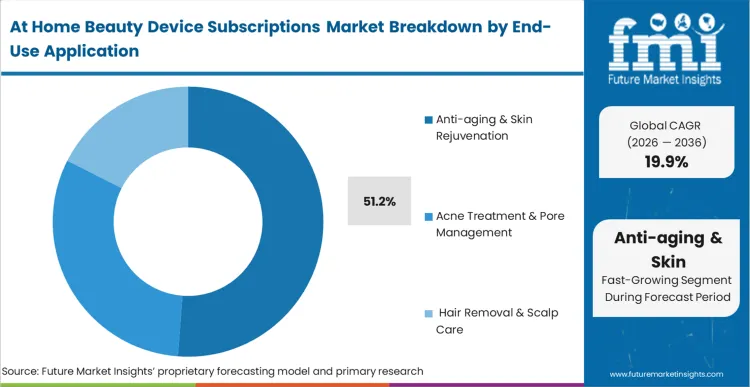
Anti-aging & Skin Rejuvenation emerges as the dominant application area, expected to represent 51.2% of total market share in 2026, as older demographic cohorts recognize the biological necessity of continuous stimulus. FMI's analysis indicates that flattening the clinical architecture directly enables real-time personalized beauty devices to manage collagen degradation on a daily rather than quarterly basis. Cosmetic dermatologists validate these continuous anti aging devices to authorize final post-procedure maintenance sign-offs. The integration of high-frequency home routines across isolated clinical procedures forces retail category managers to rethink traditional episodic skincare sales. Contract manufacturers that fail to develop precision micro-pulsation capabilities forfeit clinical validation credibility in the hyper-competitive connected vanity space.
- Protocol adherence: Gamified application interfaces reward users for completing daily preventative routines, establishing the behavioral consistency required to achieve measurable dermal thickening.
- Outcome benchmarking: Standardized photographic logging models reduce the subjective bias previously inherent in self-reported results, providing empirical proof of the subscription's value retention.
- Intervention timing: Predictive algorithms alert users to micro-changes in skin elasticity before visible sagging occurs, shifting the treatment paradigm from corrective response to proactive structural defense.
At Home Beauty Device Subscriptions Market Drivers, Restraints, and Opportunities
Diagnostic Software Architectures Remove Clinical Ambiguity
The convergence of mobile camera diagnostics and therapeutic at home therapeutic beauty devices forces beauty tech integration engineers to extract actionable biometric data directly from the user's bathroom. This architectural requirement renders fragmented, unlinked aesthetic gadgets obsolete. D2C platform operators upgrading digital interfaces face a strict binary choice between deploying complex custom computer vision models or licensing established AI dermatologist engines. Transitioning to a unified diagnostic backbone simplifies the treatment recommendation engine and enables direct cloud connectivity for advanced longitudinal analytics. Facilities that fail to modernize their core evaluation layers risk structural margin collapse as hardware commoditizes.
Data Portability and Cross-Platform Integration Frictions Limit Velocity
The intricate configuration parameters required to optimize secure personal health information flows create steep learning curves for traditional cosmetic brands. FMI analysts opine that designing conflict-free data transmission architectures across multi-vendor hardware demands specialized cryptographic expertise that most beauty conglomerates lack internally. Retail category managers attempting to orchestrate unified consumer profiles discover that competing subscription ecosystems actively block API sharing, fragmenting the user's diagnostic history. To mitigate this skill gap, capital project directors increasingly rely on advanced middleware providers that automate the compliance process and validate data privacy designs before physical product deployment.
Opportunities in the At Home Beauty Device Subscriptions Market
- Edge Compute Consolidation: Next-generation deterministic endpoints enable biometric software architects to run complex skin analysis logic directly on the device processor. This consolidation eliminates total reliance on cloud latency and drastically improves the real-time responsiveness of automated treatment tools.
- High-Bandwidth Multi-Modal Scanners: Upgraded sensory arrays permit clinical developers to deploy inline hydration and sebum inspection without impacting the primary microcurrent delivery mechanism. This capability prevents users from applying inappropriate intensities to compromised epidermal barriers.
- Teledermatology API Synchronization: Digital health network planners integrating distributed patient monitoring resources require precise, daily photographic data. Subscription-linked imaging tools provide the consistent lighting and angle accuracy necessary to balance volatile clinical assessment inputs across the remote care network.
Regional Analysis
Based on the regional analysis, the At Home Beauty Device Subscriptions market is segmented into North America, Latin America, Europe, East Asia, South Asia, Oceania and Middle East & Africa across 40+ countries. The full report also offers market attractiveness analysis based on regional trends.
.webp "Top Country Growth Comparison At Home Beauty Device Subscriptions Market Cagr (2026 2036)")
| Country | CAGR (2026 to 2036) |
|---|---|
| China | 22.5% |
| India | 21.8% |
| United Kingdom | 20.4% |
| United States | 19.2% |
| South Korea | 18.7% |
Source: Future Market Insights (FMI) analysis, based on proprietary forecasting model and primary research
Asia Pacific At Home Beauty Device Subscriptions Market Analysis
Greenfield digital infrastructure development across the Asia Pacific region accelerates the bypass of legacy retail cosmetic constraints. D2C platform operators constructing new super-app ecosystems specify unified diagnostic algorithms in their initial consumer funnels. As FMI's research confirms, this clean-slate approach entirely eliminates the costly physical footprint phase that plagues older western beauty distribution models. By building native AI capabilities into the foundation, regional brands establish highly flexible engagement environments capable of rapid algorithm retooling.
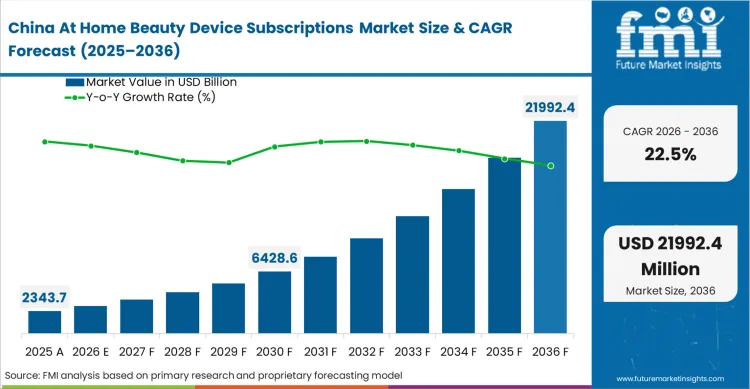
- China: Total integration of consumer wellness portals into dominant social messaging platforms effectively mandates that all new aesthetic hardware possess native mini-program compatibility. Hardware costs are heavily subsidized by the platform in exchange for strict algorithmic lock-in, creating a closed loop where the tool only functions with approved local serum deliveries. Tencent and Alibaba's published facial scanning SDKs set the de facto baseline for acceptable diagnostic accuracy across the mainland. This structural reality drives a 22.5% CAGR for connected personal care appliances in China through 2036. Foreign D2C brand directors who cannot secure whitelist approval for their proprietary data architectures relinquish algorithmic prioritization on major e-commerce platforms.
- India: Penetration of unified payment interfaces into tier-2 and tier-3 urban centers unlocks micro-subscription mechanics for demographics previously excluded from premium clinical modalities. The fractional payment infrastructure allows cosmetic dermatologists to deploy high-cost laser systems into the home via daily-use digital metering rather than requiring prohibitive lump-sum purchases. The national Digital Public Infrastructure actively supports the automated mandate processing required to sustain these high-frequency, low-value recurring billing cycles without massive collection overhead. This financial architecture anchors India's 21.8% compound expansion of connected aesthetic memberships to 2036. International hardware OEMs must partner with local fintech payment gateways to establish viable lease-to-own models before the 2027 regulatory compliance window closes.
- South Korea: Extreme saturation of physical medical aesthetic clinics in major metropolitan zones forces premier dermatology conglomerates to pivot aggressively toward home-based continuity care to capture additional lifetime value. These established clinic brands leverage their existing clinical credibility to launch SaaS-locked premium hardware, effectively extending the physical treatment room into the consumer's daily routine. High-speed 5G residential networks facilitate the zero-latency transmission of massive 3D facial topological maps back to the clinic's central diagnostic servers. This dynamic positions South Korea's connected device segment at a 18.7% compound growth rate through 2036. Product developers must integrate flawless biometric API handoffs to established clinical electronic health records to qualify for the next wave of hospital-backed commercialization efforts.
FMI's report includes detailed analysis and country-wise assessment for the Asia Pacific region. The coverage spans Japan, Indonesia, and Australia. A primary structural condition across these nations involves the rapid deployment of cross-border data privacy localization mandates, forcing cosmetic companies to establish distinct national cloud infrastructures to legally process biometric facial scans.
North America At Home Beauty Device Subscriptions Market Analysis
Stringent medical device classifications across North America target the systematic eradication of unsubstantiated clinical claims in the consumer vanity sector. Biometric software architects leading platform overhauls face strict directives to unify their diagnostic software under regulated software-as-a-medical-device frameworks. FMI's proprietary forecasting model projects that venture-backed digital health entities actively drive this consolidation to secure their recurring revenue streams against sudden regulatory reclassification. Implementing a standardized, FDA-cleared backend enables brands to deploy advanced prescriptive algorithms without compromising legal compliance.
- United States: The FDA's Digital Health Software Precertification Program fundamentally alters the time-to-market calculus for advanced AI diagnostic tools by shifting approval from the physical non medical grade aesthetic device hardware to the underlying software organization. D2C platform operators pivot from fighting multi-year 510(k) clearance battles for single devices toward clearing their continuous-update software engines, allowing them to push new premium treatment protocols to subscribers instantly. The legal framework surrounding biometric data capture under individual state privacy laws necessitates highly robust, explicit consent architectures built directly into the subscription onboarding flow. The United States advances at a 19.2% compound rate across the forecast decade as clinical directors unify their remote patient monitoring models. Independent device manufacturers lacking documented compliance with these evolving software precertification standards are locked out of the FDA precertification fast-track.
FMI's report includes comprehensive evaluation of the North American digital wellness sector. It features specific analysis of the Canadian and Mexican subscription markets. A defining dynamic in these countries involves the alignment of digital health reimbursement codes, which increasingly dictate whether specific connected therapeutic memberships can be subsidized through consumer health savings accounts.
Europe At Home Beauty Device Subscriptions Market Analysis
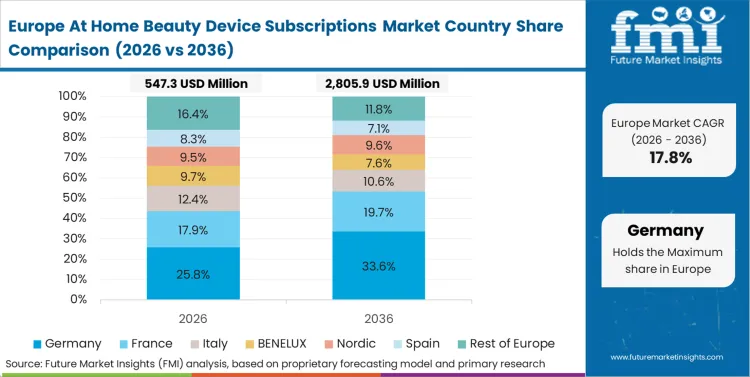
European digital health policy actively penalizes the unauthorized cross-border transmission of unanonymized facial diagnostic data. Biometric software architects redesigning app infrastructures must integrate continuous local-device processing capabilities to satisfy the General Data Protection Regulation requirements for biometric information. This compliance requirement forces the rapid adoption of edge-computing chips within the subscription hardware itself to guarantee analysis stability without relying on external cloud processing. The transition requires a complete overhaul of existing communication topologies, shifting from centralized servers to decentralized, app-based architectures.
- United Kingdom: Severe operational backlogs within the National Health Service dermatology pathways force consumers to seek private, clinical-grade interventions for chronic conditions like severe acne and rosacea. Retail category managers rapidly deploy medical-grade blue light and radio frequency subscriptions to fill this structural care void, positioning the memberships as immediate, accessible alternatives to twelve-month specialist waiting lists. The Medicines and Healthcare products Regulatory Agency provides clear fast-track guidance for software-as-a-medical-device tools, actively encouraging the domestic development of these connected therapeutic platforms. This critical care gap sustains a 20.4% compound rate for advanced aesthetic memberships in the UK to 2036. Hardware distributors unable to clear the UKCA medical software certification gates lose primary diagnostic access to the highest-LTV consumer demographic.
FMI's report includes thorough investigation of the European connected aesthetic framework. The analysis encompasses Germany, France, Italy, and the Nordics. A prevailing structural condition across these nations is the mandatory compliance with the EU Artificial Intelligence Act, forcing biometric software architects to expose the decision-making logic of their skin-analysis algorithms to independent third-party regulatory audits.
Competitive Aligners for Market Players
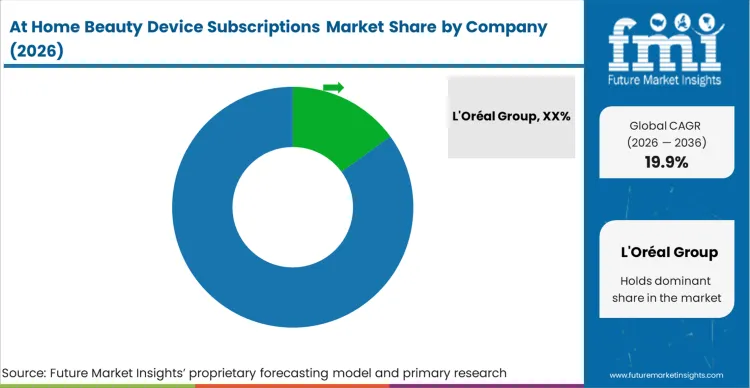
The introduction of unified biometric privacy standards under the European Artificial Intelligence Act forces D2C platform operators to completely restructure their algorithmic data pipelines. Independent device manufacturers that previously relied on black-box diagnostic engines must now implement transparent, verifiable logic chains that explain exactly why a specific treatment intensity was recommended to the subscriber. This compliance burden structurally advantages massive clinical conglomerates possessing the capital to re-engineer their software from the ground up, effectively pricing out smaller hardware startups from launching competitive diagnostic tiers. Biometric software architects who fail to secure algorithmic transparency certifications lose primary placement in heavily regulated retail pharmacy ecosystems before the 2027 enforcement deadlines.
Most venture capital firms evaluate beauty technology by measuring physical hardware unit economics, but the deployment of over-the-air firmware updates proves the actual competitive moat resides entirely in software upgrade cycles. The capacity to push newly discovered radio frequency beauty equipment modulation patterns to existing subscriber devices instantly depreciates the value of static, non-connected competitor tools sitting on retail shelves. This architectural superiority allows connected brands to launch "new" products via digital updates rather than manufacturing new plastic, radically compressing innovation timelines. Retail category managers without active SaaS-enabled hardware portfolios surrender recurring revenue to digitally native disruptors before the Q4 retention cycle.
The normalization of health savings account eligibility for FDA-cleared aesthetic software dictates a mandatory pivot toward clinical interoperability standards across the subscription ecosystem. Establishing direct API connections with regional electronic health record networks enables connected beauty platforms to export verified dermatological progress imagery directly to the user's primary care physician. This institutional integration converts vanity applications into legitimate telehealth nodes, dramatically lowering user churn rates as the subscription becomes a recognized component of formal medical treatment plans. Cosmetic dermatologists who ignore these unified API protocols face structural margin collapse as hardware commoditizes into unlinked, low-margin retail products.
Key Players in At Home Beauty Device Subscriptions Market
- L'Oréal Group
- Nu Skin Enterprises, Inc.
- Carol Cole Company (NuFACE)
- FOREO AB
- Perfect Corp.
- CurrentBody
- Koninklijke Philips N.V.
- Home Skinovations Ltd (Silk’n)
- YA-MAN Ltd.
- LYMA Life
Scope of the Report
| Metric | Value |
|---|---|
| Quantitative Units | USD 2.68 Billion to USD 16.54 Billion, at a CAGR of 19.9% |
| Market Definition | At Home Beauty Device Subscriptions represent a recurring revenue business model where consumers pay periodic fees to access dermatological hardware, proprietary consumable replenishments, and integrated diagnostic software. |
| Subscription Model Type Segmentation | Replenishment-linked Device Kits, Lease-to-Own / Rental Memberships, Software-as-a-Service (SaaS) Connected Subscriptions |
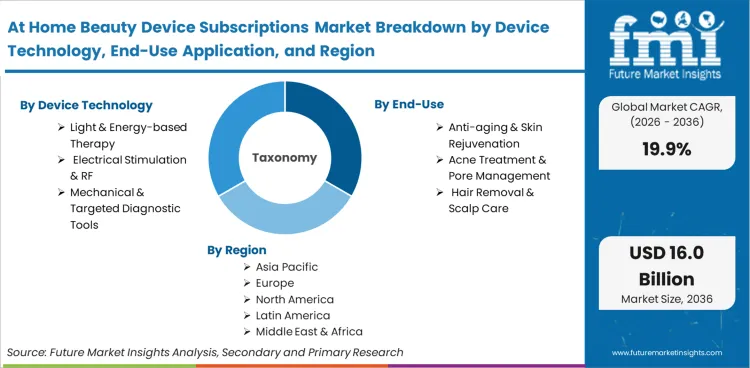
| Device Technology Segmentation | Light & Energy-based Therapy, Electrical Stimulation & RF, Mechanical & Targeted Diagnostic Tools |
| End-Use Application Segmentation | Anti-aging & Skin Rejuvenation, Acne Treatment & Pore Management, Hair Removal & Scalp Care |
| Regions Covered | North America, Latin America, Europe, East Asia, South Asia, Oceania, Middle East & Africa |
| Countries Covered | China, India, United Kingdom, United States, South Korea, and 40 plus countries |
| Key Companies Profiled | L'Oréal Group, Nu Skin Enterprises, Inc., Carol Cole Company (NuFACE), FOREO AB, Perfect Corp., CurrentBody, Koninklijke Philips N.V., Home Skinovations Ltd (Silk’n), YA-MAN Ltd., LYMA Life |
| Forecast Period | 2026 to 2036 |
| Approach | The baseline value derives from a bottom-up aggregation of active subscription accounts, applying region-specific adoption curves to project future membership velocity and average revenue per user. |
At Home Beauty Device Subscriptions Market Analysis by Segments
Subscription Model Type:
- Replenishment-linked Device Kits
- Lease-to-Own / Rental Memberships
- Software-as-a-Service (SaaS) Connected Subscriptions
Device Technology:
- Light & Energy-based Therapy
- Electrical Stimulation & RF
- Mechanical & Targeted Diagnostic Tools
End-Use Application:
- Anti-aging & Skin Rejuvenation
- Acne Treatment & Pore Management
- Hair Removal & Scalp Care
Region:
- Asia Pacific
- India
- China
- Japan
- South Korea
- Indonesia
- Australia & New Zealand
- ASEAN
- Rest of Asia Pacific
- Europe
- Germany
- Italy
- France
- United Kingdom
- Spain
- Benelux
- Nordics
- Central & Eastern Europe
- Rest of Europe
- North America
- United States
- Canada
- Mexico
- Latin America
- Brazil
- Argentina
- Chile
- Rest of Latin America
- Middle East & Africa
- Kingdom of Saudi Arabia
- United Arab Emirates
- South Africa
- Turkey
- Rest of Middle East & Africa
Bibliography
- International Medical Device Regulators Forum. (2024, June 27). Good machine learning practice for medical device development: Guiding principles (Draft for consultation).
- National Institute of Standards and Technology. (2024, October). Internet of Things (IoT) Advisory Board (IoTAB) report. USA Department of Commerce.
- European Commission, Medical Device Coordination Group. (2025). MDCG 2025-6: Interplay between the Medical Devices Regulation and In Vitro Diagnostic Medical Devices Regulation requirements and the Artificial Intelligence Act.
- Personal Information Protection Commission. (2025). 2025 policy direction for personal information protection. Government of South Korea.
- Ministry of Electronics and Information Technology. (2025). Estimation and measurement of India’s digital economy. Government of India.
- Health Canada. (2025, February 5). Pre-market guidance for machine learning-enabled medical devices. Government of Canada.
- Therapeutic Goods Administration. (2024, September 27). Classifying active medical devices in Australia (including software-based medical devices). Australian Government, Department of Health and Aged Care.
- Health Sciences Authority. (2024, December). Guidance on change management program (CMP) for software as a medical device, including machine learning-enabled software as a medical device. Government of Singapore.
This bibliography is provided for reader reference. The full FMI report contains the complete reference list with primary research documentation.
This Report Addresses
- Market sizing intelligence quantifying the precise capital expenditure directed toward subscription-linked beauty hardware across consumer demographics through 2036.
- Segmentation analysis mapping the specific adoption velocity of replenishment models versus lease-to-own architectures across major global retail networks.
- Regional deployment evaluation comparing the aggressive e-commerce ecosystem integration in Asia Pacific against the strict medical regulatory compliance hurdles prevalent in North American markets.
- Regulatory compliance assessment analyzing how the European Artificial Intelligence Act and FDA precertification frameworks force the adoption of unified biometric software architectures.
- Competitive posture evaluation tracking the mandatory shift toward API interoperability certification and the resulting algorithmic prioritization required for market entry.
- D2C capital strategy guidance defining the exact procurement specifications and sensor tolerances required to support next-generation automated treatment adjustments.
- Supply chain vulnerability analysis identifying the specific consumable RFID integration bottlenecks that extend connected hardware commissioning timelines.
- Custom data delivery formats encompassing interactive dashboards, raw Excel datasets, and comprehensive PDF narrative reports.
Frequently Asked Questions
How large is the demand for At Home Beauty Device Subscriptions in the global market in 2026?
Demand for At Home Beauty Device Subscriptions in the global market is estimated to be valued at USD 2.68 Billion in 2026.
What will be the market size of At Home Beauty Device Subscriptions in the global market by 2036?
Market size for At Home Beauty Device Subscriptions is projected to reach USD 16.54 Billion by 2036.
What is the expected demand growth for At Home Beauty Device Subscriptions in the global market between 2026 and 2036?
Demand for At Home Beauty Device Subscriptions is expected to grow at a CAGR of 19.9% between 2026 and 2036.
Which Subscription Model Type is poised to lead global sales by 2026?
Replenishment-linked Device Kits commands 46.8% in 2026 as D2C platform operators execute full-scale subsidized hardware deployment programs to lock in consumable retention.
How significant is the role of Anti-aging & Skin Rejuvenation in driving At Home Beauty Device Subscriptions adoption in 2026?
Anti-aging & Skin Rejuvenation represents 51.2% of segment share as older demographic cohorts standardize on continuous, high-frequency home treatments to sustain collagen production.
What is driving demand in China?
Total integration of consumer wellness portals into dominant social messaging platforms effectively mandates that all new aesthetic hardware possess native mini-program compatibility.
What compliance standards or regulations are referenced for China?
Tencent and Alibaba's published facial scanning SDKs set the de facto baseline for acceptable diagnostic accuracy across the mainland digital ecosystem.
What is the China growth outlook in this report?
China is projected to grow at a CAGR of 22.5% during 2026 to 2036.
Why is North America described as a priority region in this report?
Stringent medical device classifications across North America target the systematic eradication of unsubstantiated clinical claims in the consumer vanity sector.
What type of demand dominates in North America?
Demand heavily focuses on replacing unlinked aesthetic gadgets with standardized, FDA-cleared software-as-a-medical-device architectures that comply with strict biometric data mandates.
What is India's growth outlook in this report?
India is projected to expand at a CAGR of 21.8% during 2026 to 2036.
Does the report cover the United States in its regional analysis?
Yes, the United States is included within North America under the regional scope of analysis.
What are the sources referred to for analyzing the United States?
FDA Digital Health Software Precertification Program guidelines and national biometric privacy regulations form the analytical basis.
What is the main demand theme linked to the United States in its region coverage?
The shift from fighting physical hardware clearance battles toward clearing continuous-update software engines compels the adoption of unified algorithmic ecosystems.
Does the report cover the United Kingdom in its regional analysis?
Yes, the United Kingdom is included within Europe under the regional coverage framework.
What is the main United Kingdom related demand theme in its region coverage?
Severe operational backlogs within public dermatology pathways force consumers to adopt private, clinical-grade digital interventions for chronic conditions.
Which product formats or configurations are strategically important for Asia Pacific supply chains?
Subsidized diagnostic scanners embedded with localized AI algorithms directly linked to established e-commerce payment ecosystems are critical.
What is At Home Beauty Device Subscriptions and what is it mainly used for?
At Home Beauty Device Subscriptions represent hardware connected to specialized diagnostic apps via recurring payments. They are primarily used to execute and monitor clinical-grade skincare routines, such as microcurrent toning and LED therapy, directly from the home.
What does At Home Beauty Device Subscriptions mean in this report?
The scope encompasses aesthetic hardware, proprietary active serums, and the integrated biometric software required to unlock professional clinical treatment modes.
What is included in the scope of this At Home Beauty Device Subscriptions report?
The market covers IoT-enabled skin scanners, app-locked electrical stimulation tools, and replenishment-linked mask systems featuring native deterministic diagnostic capabilities.
What is excluded from the scope of this report?
Standard commercial aesthetic hardware without consumer-facing mobile synchronization, standalone clinic machines, and downstream finished cosmetics not bundled into a device mechanism are explicitly excluded.
What does market forecast mean on this page?
The market forecast represents a model-based projection built on defined technology integration and digital payment adoption assumptions for strategic planning purposes.
How does FMI build and validate the At Home Beauty Device Subscriptions forecast?
The model applies a bottom-up methodology starting with global active subscriber metrics and cross-validates projections against publicly reported recurring revenue guidance.
What does zero reliance on speculative third-party market research mean here?
Primary interviews, verified FDA regulatory filings, and official digital health compliance registries are used exclusively instead of unverified syndicated estimates.
Preview the report firsthand - request a free sample
Get SampleGet the brochure for pricing and purchase details.
Get PDFTable of Content
- Executive Summary
- Global Market Outlook
- Demand-side Trends
- Supply-side Trends
- Technology Roadmap Analysis
- Analysis and Recommendations
- Market Overview
- Market Coverage / Taxonomy
- Market Definition / Scope / Limitations
- Research Methodology
- Chapter Orientation
- Analytical Lens and Working Hypotheses
- Market Structure, Signals, and Trend Drivers
- Benchmarking and Cross-market Comparability
- Market Sizing, Forecasting, and Opportunity Mapping
- Research Design and Evidence Framework
- Desk Research Programme (Secondary Evidence)
- Company Annual and Sustainability Reports
- Peer-reviewed Journals and Academic Literature
- Corporate Websites, Product Literature, and Technical Notes
- Earnings Decks and Investor Briefings
- Statutory Filings and Regulatory Disclosures
- Technical White Papers and Standards Notes
- Trade Journals, Industry Magazines, and Analyst Briefs
- Conference Proceedings, Webinars, and Seminar Materials
- Government Statistics Portals and Public Data Releases
- Press Releases and Reputable Media Coverage
- Specialist Newsletters and Curated Briefings
- Sector Databases and Reference Repositories
- FMI Internal Proprietary Databases and Historical Market Datasets
- Subscription Datasets and Paid Sources
- Social Channels, Communities, and Digital Listening Inputs
- Additional Desk Sources
- Expert Input and Fieldwork (Primary Evidence)
- Primary Modes
- Qualitative Interviews and Expert Elicitation
- Quantitative Surveys and Structured Data Capture
- Blended Approach
- Why Primary Evidence is Used
- Field Techniques
- Interviews
- Surveys
- Focus Groups
- Observational and In-context Research
- Social and Community Interactions
- Stakeholder Universe Engaged
- C-suite Leaders
- Board Members
- Presidents and Vice Presidents
- R&D and Innovation Heads
- Technical Specialists
- Domain Subject-matter Experts
- Scientists
- Physicians and Other Healthcare Professionals
- Governance, Ethics, and Data Stewardship
- Research Ethics
- Data Integrity and Handling
- Primary Modes
- Tooling, Models, and Reference Databases
- Desk Research Programme (Secondary Evidence)
- Data Engineering and Model Build
- Data Acquisition and Ingestion
- Cleaning, Normalisation, and Verification
- Synthesis, Triangulation, and Analysis
- Quality Assurance and Audit Trail
- Market Background
- Market Dynamics
- Drivers
- Restraints
- Opportunity
- Trends
- Scenario Forecast
- Demand in Optimistic Scenario
- Demand in Likely Scenario
- Demand in Conservative Scenario
- Opportunity Map Analysis
- Product Life Cycle Analysis
- Supply Chain Analysis
- Investment Feasibility Matrix
- Value Chain Analysis
- PESTLE and Porter’s Analysis
- Regulatory Landscape
- Regional Parent Market Outlook
- Production and Consumption Statistics
- Import and Export Statistics
- Market Dynamics
- Global Market Analysis 2021 to 2025 and Forecast, 2026 to 2036
- Historical Market Size Value (USD Million) Analysis, 2021 to 2025
- Current and Future Market Size Value (USD Million) Projections, 2026 to 2036
- Y-o-Y Growth Trend Analysis
- Absolute $ Opportunity Analysis
- Global Market Pricing Analysis 2021 to 2025 and Forecast 2026 to 2036
- Global Market Analysis 2021 to 2025 and Forecast 2026 to 2036, By Device Technology
- Introduction / Key Findings
- Historical Market Size Value (USD Million) Analysis By Device Technology , 2021 to 2025
- Current and Future Market Size Value (USD Million) Analysis and Forecast By Device Technology , 2026 to 2036
- Light & Energy-based Therapy
- Electrical Stimulation & RF
- Mechanical & Targeted Diagnostic Tools
- Light & Energy-based Therapy
- Y-o-Y Growth Trend Analysis By Device Technology , 2021 to 2025
- Absolute $ Opportunity Analysis By Device Technology , 2026 to 2036
- Global Market Analysis 2021 to 2025 and Forecast 2026 to 2036, By End-Use Application
- Introduction / Key Findings
- Historical Market Size Value (USD Million) Analysis By End-Use Application, 2021 to 2025
- Current and Future Market Size Value (USD Million) Analysis and Forecast By End-Use Application, 2026 to 2036
- Anti-aging & Skin Rejuvenation
- Acne Treatment & Pore Management
- Hair Removal & Scalp Care
- Anti-aging & Skin Rejuvenation
- Y-o-Y Growth Trend Analysis By End-Use Application, 2021 to 2025
- Absolute $ Opportunity Analysis By End-Use Application, 2026 to 2036
- Global Market Analysis 2021 to 2025 and Forecast 2026 to 2036, By Region
- Introduction
- Historical Market Size Value (USD Million) Analysis By Region, 2021 to 2025
- Current Market Size Value (USD Million) Analysis and Forecast By Region, 2026 to 2036
- North America
- Latin America
- Western Europe
- Eastern Europe
- East Asia
- South Asia and Pacific
- Middle East & Africa
- Market Attractiveness Analysis By Region
- North America Market Analysis 2021 to 2025 and Forecast 2026 to 2036, By Country
- Historical Market Size Value (USD Million) Trend Analysis By Market Taxonomy, 2021 to 2025
- Market Size Value (USD Million) Forecast By Market Taxonomy, 2026 to 2036
- By Country
- USA
- Canada
- Mexico
- By Device Technology
- By End-Use Application
- By Country
- Market Attractiveness Analysis
- By Country
- By Device Technology
- By End-Use Application
- Key Takeaways
- Latin America Market Analysis 2021 to 2025 and Forecast 2026 to 2036, By Country
- Historical Market Size Value (USD Million) Trend Analysis By Market Taxonomy, 2021 to 2025
- Market Size Value (USD Million) Forecast By Market Taxonomy, 2026 to 2036
- By Country
- Brazil
- Chile
- Rest of Latin America
- By Device Technology
- By End-Use Application
- By Country
- Market Attractiveness Analysis
- By Country
- By Device Technology
- By End-Use Application
- Key Takeaways
- Western Europe Market Analysis 2021 to 2025 and Forecast 2026 to 2036, By Country
- Historical Market Size Value (USD Million) Trend Analysis By Market Taxonomy, 2021 to 2025
- Market Size Value (USD Million) Forecast By Market Taxonomy, 2026 to 2036
- By Country
- Germany
- UK
- Italy
- Spain
- France
- Nordic
- BENELUX
- Rest of Western Europe
- By Device Technology
- By End-Use Application
- By Country
- Market Attractiveness Analysis
- By Country
- By Device Technology
- By End-Use Application
- Key Takeaways
- Eastern Europe Market Analysis 2021 to 2025 and Forecast 2026 to 2036, By Country
- Historical Market Size Value (USD Million) Trend Analysis By Market Taxonomy, 2021 to 2025
- Market Size Value (USD Million) Forecast By Market Taxonomy, 2026 to 2036
- By Country
- Russia
- Poland
- Hungary
- Balkan & Baltic
- Rest of Eastern Europe
- By Device Technology
- By End-Use Application
- By Country
- Market Attractiveness Analysis
- By Country
- By Device Technology
- By End-Use Application
- Key Takeaways
- East Asia Market Analysis 2021 to 2025 and Forecast 2026 to 2036, By Country
- Historical Market Size Value (USD Million) Trend Analysis By Market Taxonomy, 2021 to 2025
- Market Size Value (USD Million) Forecast By Market Taxonomy, 2026 to 2036
- By Country
- China
- Japan
- South Korea
- By Device Technology
- By End-Use Application
- By Country
- Market Attractiveness Analysis
- By Country
- By Device Technology
- By End-Use Application
- Key Takeaways
- South Asia and Pacific Market Analysis 2021 to 2025 and Forecast 2026 to 2036, By Country
- Historical Market Size Value (USD Million) Trend Analysis By Market Taxonomy, 2021 to 2025
- Market Size Value (USD Million) Forecast By Market Taxonomy, 2026 to 2036
- By Country
- India
- ASEAN
- Australia & New Zealand
- Rest of South Asia and Pacific
- By Device Technology
- By End-Use Application
- By Country
- Market Attractiveness Analysis
- By Country
- By Device Technology
- By End-Use Application
- Key Takeaways
- Middle East & Africa Market Analysis 2021 to 2025 and Forecast 2026 to 2036, By Country
- Historical Market Size Value (USD Million) Trend Analysis By Market Taxonomy, 2021 to 2025
- Market Size Value (USD Million) Forecast By Market Taxonomy, 2026 to 2036
- By Country
- Kingdom of Saudi Arabia
- Other GCC Countries
- Turkiye
- South Africa
- Other African Union
- Rest of Middle East & Africa
- By Device Technology
- By End-Use Application
- By Country
- Market Attractiveness Analysis
- By Country
- By Device Technology
- By End-Use Application
- Key Takeaways
- Key Countries Market Analysis
- USA
- Pricing Analysis
- Market Share Analysis, 2025
- By Device Technology
- By End-Use Application
- Canada
- Pricing Analysis
- Market Share Analysis, 2025
- By Device Technology
- By End-Use Application
- Mexico
- Pricing Analysis
- Market Share Analysis, 2025
- By Device Technology
- By End-Use Application
- Brazil
- Pricing Analysis
- Market Share Analysis, 2025
- By Device Technology
- By End-Use Application
- Chile
- Pricing Analysis
- Market Share Analysis, 2025
- By Device Technology
- By End-Use Application
- Germany
- Pricing Analysis
- Market Share Analysis, 2025
- By Device Technology
- By End-Use Application
- UK
- Pricing Analysis
- Market Share Analysis, 2025
- By Device Technology
- By End-Use Application
- Italy
- Pricing Analysis
- Market Share Analysis, 2025
- By Device Technology
- By End-Use Application
- Spain
- Pricing Analysis
- Market Share Analysis, 2025
- By Device Technology
- By End-Use Application
- France
- Pricing Analysis
- Market Share Analysis, 2025
- By Device Technology
- By End-Use Application
- India
- Pricing Analysis
- Market Share Analysis, 2025
- By Device Technology
- By End-Use Application
- ASEAN
- Pricing Analysis
- Market Share Analysis, 2025
- By Device Technology
- By End-Use Application
- Australia & New Zealand
- Pricing Analysis
- Market Share Analysis, 2025
- By Device Technology
- By End-Use Application
- China
- Pricing Analysis
- Market Share Analysis, 2025
- By Device Technology
- By End-Use Application
- Japan
- Pricing Analysis
- Market Share Analysis, 2025
- By Device Technology
- By End-Use Application
- South Korea
- Pricing Analysis
- Market Share Analysis, 2025
- By Device Technology
- By End-Use Application
- Russia
- Pricing Analysis
- Market Share Analysis, 2025
- By Device Technology
- By End-Use Application
- Poland
- Pricing Analysis
- Market Share Analysis, 2025
- By Device Technology
- By End-Use Application
- Hungary
- Pricing Analysis
- Market Share Analysis, 2025
- By Device Technology
- By End-Use Application
- Kingdom of Saudi Arabia
- Pricing Analysis
- Market Share Analysis, 2025
- By Device Technology
- By End-Use Application
- Turkiye
- Pricing Analysis
- Market Share Analysis, 2025
- By Device Technology
- By End-Use Application
- South Africa
- Pricing Analysis
- Market Share Analysis, 2025
- By Device Technology
- By End-Use Application
- USA
- Market Structure Analysis
- Competition Dashboard
- Competition Benchmarking
- Market Share Analysis of Top Players
- By Regional
- By Device Technology
- By End-Use Application
- Competition Analysis
- Competition Deep Dive
- L'Oréal Group
- Overview
- Product Portfolio
- Profitability by Market Segments (Product/Age /Sales Channel/Region)
- Sales Footprint
- Strategy Overview
- Marketing Strategy
- Product Strategy
- Channel Strategy
- Nu Skin Enterprises, Inc.
- Carol Cole Company (NuFACE)
- FOREO AB
- Perfect Corp.
- CurrentBody
- Koninklijke Philips N.V.
- Home Skinovations Ltd (Silk’n)
- L'Oréal Group
- Competition Deep Dive
- Assumptions & Acronyms Used


