

- Industry Size (2026)
- USD 0.9 Bn
- Forecast (2036)
- USD 2.1 Bn
- CAGR (2026 to 2036)
- 8.9%
Child Presence Detection Market Size, Market Forecast and Outlook By FMI
The child presence detection market crossed a valuation of USD 0.8 billion in 2025. Demand analysis suggests industry to cross USD 0.9 billion in 2026 and USD 2.1 billion by 2036. The industry is projected to register an 8.9% CAGR over the forecast timeframe. Child presence detection systems are gaining strong traction as automotive safety regulations continue to tighten across major vehicle markets. Governments and road safety authorities are introducing mandates that require vehicles to include systems capable of detecting unattended occupants, particularly children. These technologies are designed to alert drivers if a child is left inside a parked vehicle, addressing rising concerns about heatstroke fatalities and accidental entrapment incidents.
Automotive manufacturers are incorporating radar sensors, infrared detection systems, and in-cabin monitoring cameras to meet regulatory expectations and improve overall vehicle safety ratings. The integration of such systems has become increasingly common in new passenger vehicle platforms, especially as safety evaluation programs encourage manufacturers to deploy occupant monitoring features. Growing consumer awareness about vehicle safety technologies is another factor encouraging the adoption of child presence detection systems. Parents and caregivers are prioritizing vehicles equipped with advanced occupant monitoring technologies that enhance protection for young passengers.
Summary of Child Presence Detection Market
- Child Presence Detection Market Definition
- The industry encompasses sensor-integrated safety systems designed for automated monitoring of child occupants within passenger cars, commercial vehicle fleets, and ride-sharing transportation services.
- Demand Drivers in the Market
- Vehicle safety regulations introduce compliance requirements for integrated child detection systems.
- Growing awareness initiatives highlight risks of unattended children inside vehicles, increasing technology adoption.
- Improvements in sensing accuracy support reliable occupant identification with lower error margins.
- Key Segments Analyzed in the Report
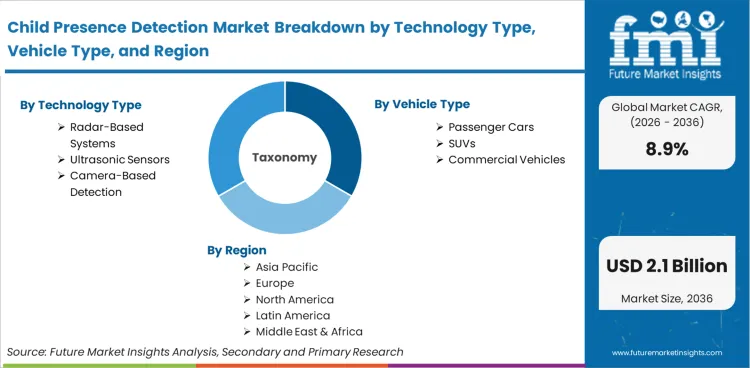
- Technology Type: Radar-Based Systems (45%) versus ultrasonic sensors and camera-based detection alternatives.
- Vehicle Type: Passenger Cars (52%) versus SUVs and commercial vehicle applications.
- Geography: High-growth Asia Pacific versus mature North American and European markets.
- Analyst Opinion at FMI
- Nikhil Kaitwade, Senior Consultant for Automotive at Future Market Insights, states, "In the updated version of the Child Presence Detection Market Report for 2026 to 2036, industry participants will identify key insights on sensor integration requirements that support compatibility with multiple vehicle architectures. My assessment indicates that evolving safety compliance timelines influence product engineering schedules, while validation and testing requirements may limit entry opportunities for manufacturers targeting lower-cost vehicle categories."
- Strategic Implications/Executive Takeaways
- Move development priorities from standalone alert solutions to embedded vehicle cabin safety systems.
Adopt OEM partnership programs as the central approach for entering automotive supply chains.
Strengthen sensor detection accuracy to lower false alert events and sustain regulatory approval requirements.
- Move development priorities from standalone alert solutions to embedded vehicle cabin safety systems.
- Methodology
- Validated through direct OEM installation data and vehicle safety adoption tracking.
- Zero reliance on speculative automotive trend forecasting.
- Based on verifiable manufacturer performance metrics and confirmed regulatory implementation schedules.
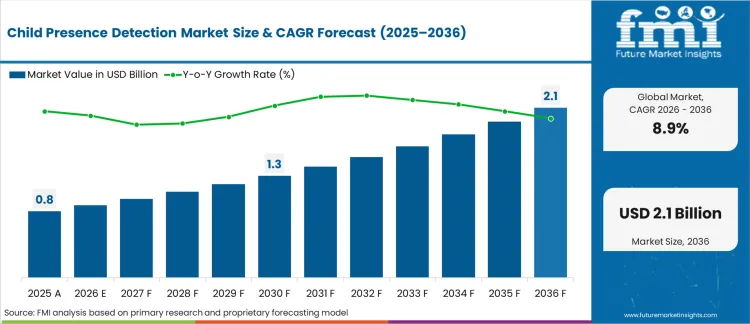
Child Presence Detection Market Key Takeaways
| Metric | Value |
|---|---|
| Market Value (2026) | USD 0.9 billion |
| Market Forecast Value (2036) | USD 2.1 billion |
| Forecast CAGR (2026-2036) | 8.9% |
Source: Analysis based on proprietary forecasting model and primary research
Automotive brands are responding by positioning these systems as key safety features within driver assistance packages and interior monitoring platforms. As vehicles become more connected and intelligent, manufacturers are deploying cabin sensors capable of identifying breathing patterns, body movement, and seat occupancy. These capabilities support reliable detection even when a child remains motionless or is hidden under blankets or child seats.
Advancements in sensing technologies and in-cabin electronics are further accelerating market expansion. Radar-based detection modules, thermal sensors, and artificial intelligence driven monitoring software are becoming more compact and cost efficient for vehicle integration. Automotive suppliers are developing edge processing solutions that analyze cabin activity without relying heavily on central vehicle processors. This allows manufacturers to install occupant detection systems across multiple vehicle segments, including mid range passenger cars.
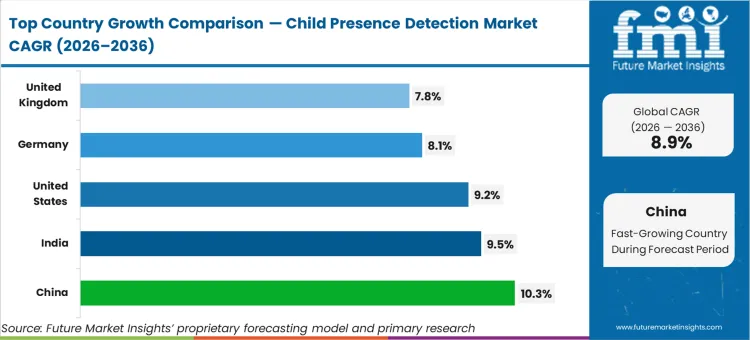
As automotive interiors evolve into intelligent monitoring environments, child presence detection systems are becoming a standard component within broader occupant safety architectures. Sector is projected to witness robust global expansion through 2036, supported by strong country‑level growth trajectories, with the United States advancing at a CAGR of 9.2%, Germany progressing at 8.1%, China leading with a rapid 10.3% growth rate, India following closely at 9.5%, and the United Kingdom expanding steadily at 7.8% over the forecast period.
Child Presence Detection Market Definition
Child presence detection systems form an important automotive safety category focused on preventing incidents involving children left inside vehicles. The child presence detection market covers the worldwide production, engineering, and commercialization of sensor-integrated safety technologies that enable occupant detection, warning alerts, and automated safety responses within vehicle cabins across passenger and commercial transportation segments.
Child Presence Detection Market Inclusions
The report presents a detailed assessment of market dynamics, including global and regional market size evaluation in both volume and value terms, supported by a ten-year forecast spanning 2026 to 2036. The analysis includes segmentation by technology type such as ultrasonic sensors, radar-based systems, weight-based sensors, and camera-based detection. Market assessment is also structured by vehicle categories including passenger cars, SUVs, commercial vehicles, and electric vehicles, along with distribution channels covering OEM integration, aftermarket retail, automotive dealerships, and online sales platforms.
Child Presence Detection Market Exclusions
The report excludes simple reminder alert mechanisms, manual child lock features, traditional seatbelt sensors, and broad vehicle security technologies. Coverage does not extend to sensor component manufacturers, software engineering vendors, or emergency response organizations. The study focuses only on finished detection systems built for child safety monitoring in vehicles and distributed through recognized automotive retail and dealership networks. Services related to vehicle modification and secondary markets selling previously used detection equipment with limited product distinction are not included.
Child Presence Detection Market Research Methodology
- Primary Research: Interviews were conducted with automotive safety equipment manufacturers, vehicle OEM representatives, automotive parts distributors, regulatory compliance consultants, and child safety advocacy organizations across major markets. Vehicle safety engineers clarified detection accuracy standards and integration requirements.
- Desk Research: Vehicle production data from automotive industry analytics platforms, child safety incident reports from regulatory agencies, and import/export statistics from trade organizations supported market benchmarking.
- Market-Sizing and Forecasting: A hybrid top-down and bottom-up model was developed. Demand was reconstructed from OEM installation figures, aftermarket sales data, and new vehicle safety feature adoption rates, then validated against manufacturing capacity and regulatory implementation timelines.
- Data Validation and Update Cycle: Outputs undergo variance checks across OEM and aftermarket datasets, cross-verification with automotive safety associations, and structured expert review prior to release.
Segmental Analysis
Child Presence Detection Market Analysis by Technology Type
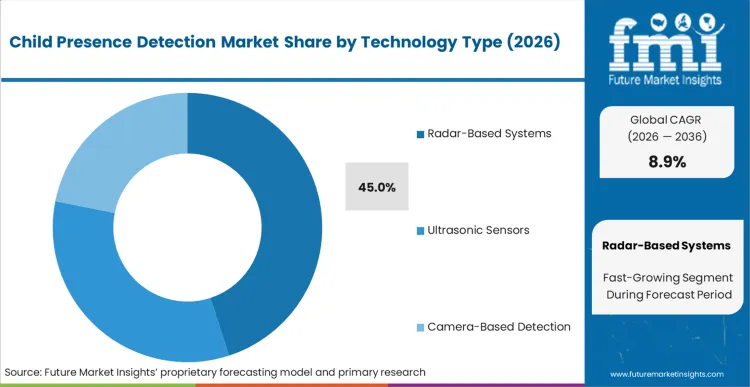
The radar-based systems segment is estimated to capture 45% share in 2026. Demand for radar-based child presence detection systems is increasing as automotive safety regulations expand across major vehicle markets. Government authorities and vehicle safety organizations are introducing rules that require reliable in-cabin monitoring technologies capable of detecting unattended occupants. Radar sensing technology has gained attention among automakers as it supports compliance with these regulatory requirements.
- Regulatory Compliance Alignment: Automotive manufacturers are incorporating radar-based cabin sensing modules to support compliance with emerging vehicle safety regulations that require unattended occupant detection. This system category assists automakers in aligning vehicle architectures with evolving regulatory frameworks introduced by transport safety authorities, encouraging OEM adoption as part of mandatory in-cabin monitoring integration strategies across passenger vehicle platforms.
- Cabin Safety Monitoring Expansion: Radar sensing platforms are being integrated within vehicle interior monitoring architectures to address growing safety oversight requirements from automotive assessment programs and regulatory agencies. This integration supports large-scale deployment across new vehicle models, enabling manufacturers to incorporate occupant monitoring capabilities during vehicle development cycles while maintaining compatibility with existing electronic control unit frameworks.
Child Presence Detection Market Analysis by Vehicle Type
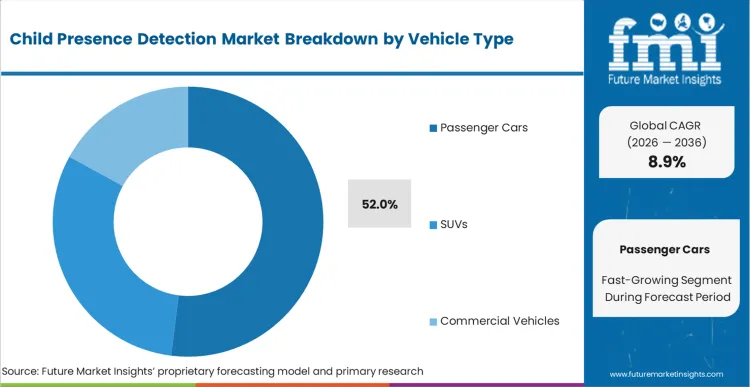
The passenger cars segment is slated to obtain a 52% market share in 2026. The growing number of passenger cars is fostering demand for child presence detection. Demand for child presence detection systems is rising significantly in passenger cars as automotive safety regulations increasingly focus on occupant monitoring requirements. Governments and transport safety authorities are introducing policies that encourage the installation of technologies capable of identifying unattended occupants inside vehicles. Passenger cars account for a large share of global vehicle production, which places greater regulatory attention on this segment when implementing new safety standards. Automakers are incorporating child presence detection technologies during vehicle development to align with these evolving compliance requirements.
- Passenger Vehicle Safety Compliance: Automakers are incorporating child presence detection systems within passenger car platforms to address expanding safety regulations focused on unattended occupant monitoring. Passenger vehicles represent a major share of global automobile production, prompting manufacturers to integrate cabin monitoring technologies during vehicle development programs to maintain compliance with emerging safety certification requirements across major automotive markets.
- Interior Monitoring Platform Expansion: Automotive companies are embedding child presence detection capabilities within broader in-cabin sensing architectures installed in passenger cars. These platforms combine driver monitoring, occupant classification, and interior awareness technologies, enabling manufacturers to standardize safety monitoring infrastructure across multiple passenger vehicle models while supporting evolving electronic cockpit and sensor integration strategies.
Child Presence Detection Market Drivers, Restraints, and Opportunities
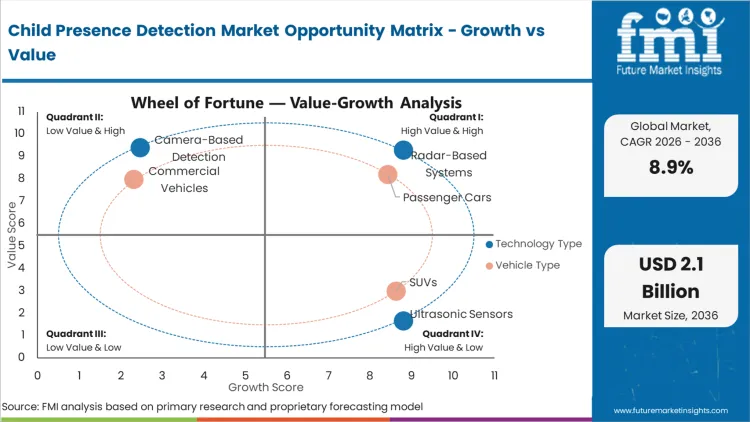
Rising regulatory focus on in-vehicle occupant safety is accelerating the deployment of child presence detection technologies. Transport safety authorities in North America, Europe, and Asia are introducing policies that encourage the installation of unattended occupant detection systems in passenger vehicles. Automakers are incorporating cabin monitoring technologies during vehicle development programs to align with evolving safety requirements and certification frameworks. Vehicle assessment programs are strengthening safety evaluation criteria related to interior monitoring capabilities, pushing manufacturers to integrate sensing technologies that track cabin occupancy conditions. Increasing collaboration between automotive OEMs and sensor technology developers is further supporting the integration of child presence detection systems across new vehicle platforms.
High integration complexity within vehicle electronic architectures can limit the widespread deployment of child presence detection systems in certain vehicle segments. Automotive manufacturers must coordinate multiple sensors, electronic control units, and software platforms to support reliable occupant monitoring capabilities. This integration requires significant engineering validation and system testing to ensure compatibility with existing vehicle safety frameworks. Smaller vehicle models and cost-sensitive segments often face constraints when incorporating additional sensing hardware and software infrastructure. In certain markets, limited standardization of interior monitoring technologies across automotive manufacturers can create challenges for large-scale system adoption and slow the pace of implementation across diverse vehicle platforms.
- Intelligent Interiors Driving Adoption: The shift toward intelligent vehicle interiors is creating new growth opportunities for child presence detection technologies as automakers enhance cabin monitoring capabilities.
- Integration of Advanced Sensing Architectures: Automotive companies are combining radar sensors, cameras, and AI‑driven monitoring software to build multi‑application occupant awareness platforms within a single vehicle architecture.
- Connected Ecosystem Enablement: Expansion of connected vehicle platforms is enabling child presence detection systems to link with mobile apps and remote alert solutions, positioning them as standard features in next‑generation intelligent cockpit systems.
Regional Analysis
Based on regional analysis, the child presence detection market is segmented into North America, Latin America, Europe, East Asia, South Asia, Oceania and Middle East & Africa across 40 countries. The full report also offers market attractiveness analysis based on regional trends.
.webp "Top Country Growth Comparison Child Presence Detection Market Cagr (2026 2036)")
| Country | CAGR (2026 to 2036) |
|---|---|
| United States | 9.2% |
| Germany | 8.1% |
| China | 10.3% |
| India | 9.5% |
| United Kingdom | 7.8% |
Source: Market analysis based on proprietary forecasting model and primary research
North America Child Presence Detection Market Analysis
Automotive manufacturers in North America are prioritizing advanced interior monitoring technologies as part of broader vehicle safety strategies. Many new passenger vehicles introduced in North America include integrated driver monitoring and occupant detection platforms within digital cockpit architectures. Child presence detection systems are increasingly being installed within these cabin sensing frameworks to enhance vehicle interior awareness capabilities. Automakers are incorporating such technologies during vehicle development cycles to support safety compliance and strengthen product differentiation in competitive automotive markets.
- United States: The USA child presence detection sector is projected to grow at 9.2% CAGR during the study period. Safety agencies are encouraging automakers to integrate interior monitoring systems capable of identifying unattended children inside vehicles. These initiatives are influenced by rising awareness surrounding heatstroke incidents involving children left inside parked vehicles. Automotive manufacturers operating in the United States are responding by incorporating child presence detection technologies into passenger vehicle platforms during product development. This regulatory focus is accelerating the deployment of radar sensing modules and cabin monitoring systems across new vehicle models introduced in the country.
The study presents comprehensive analysis of market growth in North America with country-specific assessment for the United States and Canada. Readers can examine regulatory policy developments, changes in distribution networks, and market progression based on technology segments and installation strategies.
Asia Pacific Child Presence Detection Market Analysis
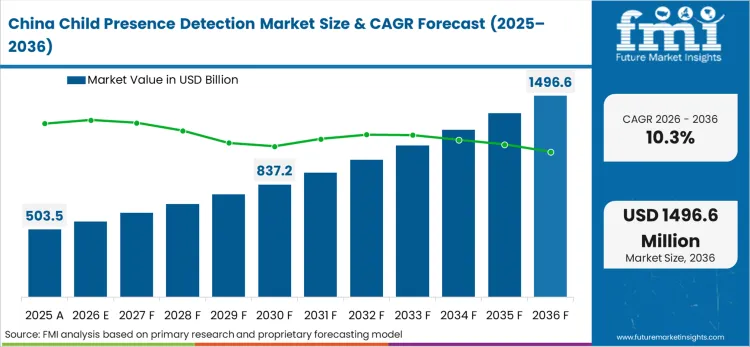
Strong growth in passenger vehicle production across major automotive manufacturing hubs is supporting the expansion of child presence detection systems. Countries such as China, Japan, South Korea, and India account for a large share of global automobile production, encouraging automotive companies to integrate advanced safety technologies during vehicle development programs. Interior monitoring technologies are increasingly being incorporated within intelligent cockpit architectures and connected vehicle platforms. Automotive suppliers across the region are collaborating with vehicle manufacturers to deploy radar sensors, cameras, and software-based occupant monitoring solutions across multiple passenger vehicle categories.
- China: Demand for child presence detection systems in China is anticipated to expand at 10.3% CAGR from 2026 to 2036. The country’s large passenger vehicle production base is further supporting the deployment of child presence detection technologies. The country is one of the largest automotive manufacturing hubs globally, with high annual vehicle production volumes across passenger cars and sport utility vehicles. Automotive manufacturers operating in China are integrating interior sensing technologies during vehicle design and development cycles to strengthen safety offerings.
- India: India child presence detection sector is slated to grow at 9.5% CAGR during the study period. Vehicle buyers are showing greater interest in safety technologies while purchasing new passenger cars, especially within family oriented vehicle categories. Automotive companies are responding by expanding the availability of advanced monitoring technologies across mid range and premium vehicle segments.
The report presents a comprehensive analysis of the child presence detection market across East and South Asia covering the period from 2021 to 2036. It assesses regulatory implementation trends, expansion of distribution networks, and technology standard developments across China, Japan, South Korea, India, Singapore, and Australia. The evaluation highlights pricing approaches that support market penetration across regional automotive sectors.
Europe Child Presence Detection Market Analysis
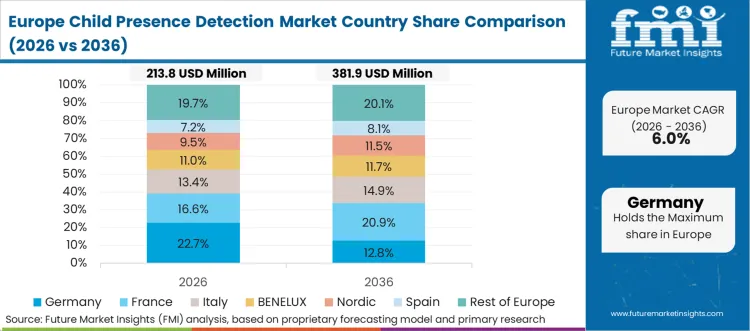
The strong presence of leading automotive manufacturers and technology suppliers in Europe is supporting market expansion. Major automakers across the region are investing in intelligent cockpit systems and advanced electronic architectures that enable integration of interior sensing technologies. Child presence detection systems are being embedded within broader cabin monitoring platforms that support occupant awareness and safety monitoring functions.
- Germany: Demand for child presence detection systems in Germany is slated to expand at 8.1% CAGR during the study period. The country’s strong automotive research and development ecosystem is supporting the deployment of child presence detection technologies. Automotive technology suppliers such as Robert Bosch GmbH and Continental AG are developing radar sensors, camera-based monitoring systems, and interior sensing platforms that support cabin monitoring functions.
- UK: The UK child presence detection industry is estimated to grow at 7.8% CAGR during the study period. Transport safety authorities and automotive regulators are encouraging the adoption of interior monitoring systems capable of identifying unattended occupants inside vehicles. Automakers operating in the United Kingdom are incorporating child presence detection technologies within passenger vehicle platforms to align with evolving safety expectations.
The European child presence detection market assessment includes detailed country-wise analysis across the United Kingdom, Germany, France, Italy, Spain, the Netherlands, and Scandinavia. Readers can review regulatory compliance frameworks and adoption trends related to vehicle safety monitoring technologies across the European region.
Competitive Landscape for Child Presence Detection Market Players
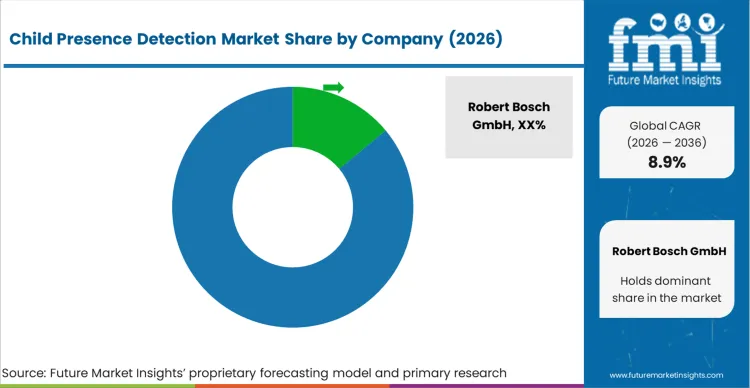
The competitive landscape of the child presence detection market is shaped by the participation of automotive technology suppliers, sensor developers, and vehicle electronics companies focusing on advanced cabin monitoring solutions. Key industry participants include Robert Bosch GmbH, Continental AG, Valeo SA, Aptiv PLC, and Denso Corporation. These companies are focusing on the development of radar-based cabin sensing platforms, interior monitoring software, and integrated occupant detection systems that support child presence detection requirements. Their product strategies emphasize compatibility with modern vehicle electronic architectures and digital cockpit platforms used in passenger vehicles.
Technology providers specializing in driver and occupant monitoring solutions such as Seeing Machines Ltd., Smart Eye AB, and Tobii Technology AB are expanding their software capabilities to support advanced cabin sensing frameworks. These companies are collaborating with automotive manufacturers to integrate artificial intelligence based monitoring systems within vehicle interiors.
Automotive component suppliers such as Magna International Inc. and Visteon Corporation are also strengthening their presence through partnerships with OEMs to supply integrated interior monitoring technologies. Industry participants are investing in radar sensors, camera-based monitoring platforms, and software-driven occupant detection systems to strengthen their position within the expanding global child presence detection market.
Key Players in Child Presence Detection Market
- Robert Bosch GmbH
- Continental AG
- Denso Corporation
- Valeo SA
- Aptiv PLC
- Hella GmbH & Co. KGaA
- Aisin Seiki Co., Ltd.
- Hyundai Mobis Co., Ltd.
- ZF Friedrichshafen AG
- Magna International Inc.
Scope of the Report
| Metric | Value |
|---|---|
| Quantitative Units | USD 0.9 billion (2026) to USD 2.1 billion (2036), at a CAGR of 8.9% |
| Market Definition | The child presence detection market comprises the global development, production, and distribution of sensor-enabled safety devices including radar systems, ultrasonic sensors, and camera-based detection designed for automated child occupant monitoring across passenger and commercial vehicle applications. |
| Technology Type Segmentation | Ultrasonic Sensors, Radar-Based Systems, Weight-Based Sensors, Camera-Based Detection |
| Vehicle Type Coverage | Passenger Cars, SUVs, Commercial Vehicles, Electric Vehicles |
| Distribution Channel Segmentation | OEM Integration, Aftermarket Retail, Automotive Dealerships, Online Platforms |
| Regions Covered | North America, Latin America, Europe, East Asia, South Asia, Oceania, Middle East and Africa |
| Countries Covered | United States, Canada, United Kingdom, Germany, France, China, Japan, India, Brazil, UAE and 40 countries |
| Key Companies Profiled | Robert Bosch GmbH, Continental AG, Denso Corporation, Valeo SA, Aptiv PLC, Hella GmbH & Co. KGaA, Aisin Seiki Co. Ltd., Hyundai Mobis Co. Ltd., ZF Friedrichshafen AG, Magna International Inc. |
| Forecast Period | 2026 to 2036 |
| Approach | Hybrid top down and bottom up market modeling validated through OEM installation tracking and regulatory compliance monitoring, supported by aftermarket sales verification and vehicle safety adoption analysis |
Child Presence Detection Market Analysis by Segments
Technology Type:
- Ultrasonic Sensors
- Radar-Based Systems
- Weight-Based Sensors
- Camera-Based Detection
Vehicle Type:
- Passenger Cars
- SUVs
- Commercial Vehicles
- Electric Vehicles
Distribution Channel:
- OEM Integration
- Aftermarket Retail
- Automotive Dealerships
- Online Platforms
- Others (fleet management partnerships, insurance programs)
Region:
- Asia Pacific
- China
- Japan
- South Korea
- India
- Australia
- Singapore
- Thailand
- Rest of Asia Pacific
- Europe
- United Kingdom
- Germany
- France
- Italy
- Spain
- Netherlands
- Scandinavia
- Switzerland
- Rest of Europe
- North America
- United States
- Canada
- Latin America
- Brazil
- Mexico
- Argentina
- Rest of Latin America
- Middle East & Africa
- United Arab Emirates
- Saudi Arabia
- South Africa
- Israel
- Rest of Middle East & Africa
Bibliography
- ANCAP Safety. (2025). Child presence detection evaluation technical bulletin SD-102 v2.0.
- United Nations Economic Commission for Europe. (2025). Proposal for amendments related to children left in vehicles.
- National Highway Traffic Safety Administration. (2024). Testing rear-door-logic based unattended child reminder systems.
- Federal Register. (2025). Federal Motor Vehicle Safety Standards: Occupant crash protection, seat belt reminder systems, controls and displays, and ejection mitigation.
This bibliography is provided for reader reference and is not exhaustive. The full report contains the complete reference list and detailed citations.
This Report Addresses
- Market intelligence to enable strategic decision making across established and emerging automotive safety markets
- Market size estimation and 10-year revenue forecasts from 2026 to 2036, supported by validated OEM installation data and regulatory compliance tracking
- Growth opportunity mapping across technology types and vehicle segments with emphasis on detection accuracy optimization
- Segment and regional revenue forecasts covering radar systems, ultrasonic sensors, camera-based detection, and automotive distribution networks
- Competition strategy assessment including OEM partnership requirements, regulatory compliance positioning, and sensor technology adoption
- Product development tracking including detection accuracy innovations, false alarm reduction trends, and multi-zone monitoring capabilities
- Market access analysis covering OEM integration agreements, aftermarket distribution partnerships, and regulatory compliance programs
- Market report delivery in PDF, Excel, PPT, and interactive dashboard formats for executive and operational use
Frequently Asked Questions
How large is the demand for Child Presence Detection in the global market in 2026?
Demand for Child Presence Detection in the global market is estimated to be valued at USD 0.9 billion in 2026.
What will be the market size of Child Presence Detection in the global market by 2036?
Market size for Child Presence Detection is projected to reach USD 2.1 billion by 2036.
What is the expected demand growth for Child Presence Detection in the global market between 2026 and 2036?
Demand for Child Presence Detection in the global market is expected to grow at a CAGR of 8.9% between 2026 and 2036.
Which Technology Type is poised to lead global sales by 2026?
Radar-Based Systems is expected to be the dominant technology type, capturing approximately 45.0% of global market share in 2026 due to motion sensing capabilities and environmental condition tolerance.
How significant is the role of Passenger Cars in driving Child Presence Detection adoption in 2026?
Passenger cars represent a primary vehicle category, projected to hold approximately 52% share of the total market in 2026 as safety feature integration and established installation procedures maintain segment relevance.
What is Driving Child Presence Detection Demand in the United States?
Federal safety mandate proposals and increased equipment integration requirements across passenger vehicle categories are driving growth.
What Consumer Trends are Referenced for the United States?
Vehicle safety regulation enforcement and child advocacy awareness campaigns are referenced as key consumer behavior shifts.
What is the United States Growth Outlook in this Report?
The United States is projected to grow at a CAGR of 9.2% during 2026 to 2036.
Why is Europe described as Important for Safety Technology Development in this Report?
Growth is driven by regulatory compliance requirements and vehicle safety standard enforcement that establish standardized equipment specifications.
What Type of Product Development Dominates in Europe?
Advanced sensor systems with vehicle platform integration and automated alert capabilities dominate regional market segments.
What is Germany Growth Outlook in this Report?
Germany is projected to expand at a CAGR of 8.1% during 2026 to 2036.
Does the Report Cover China in its Regional Analysis?
China is included within East Asia under the regional scope of analysis.
What are the Sources referred to for analyzing the Market in China?
Regulatory implementation data, vehicle production statistics, and domestic sensor manufacturer tracking covering installation patterns, compliance timeline analysis, and technology preference evolution are cited as primary reference sources.
What is the Main Development Theme Linked to China in Asia Coverage?
Asia Pacific development is associated with mandatory installation regulations enabling technology standardization across vehicle manufacturing centers.
Does the Report Cover India in its Regional Analysis?
India is included within South Asia under the regional coverage framework.
What is the Main India Related Development Theme in Asia Coverage?
Rising vehicle ownership creating foundation for child safety equipment adoption and local manufacturing using cost-effective production methods is emphasized.
Which Distribution Strategies are Strategically Important for Asia Pacific Market Entry?
OEM integration programs and aftermarket distributor partnerships are prioritized for cost-effective market penetration across regional vehicle categories.
What is Child Presence Detection and What is It Mainly Used For?
Child presence detection involves sensor-enabled safety devices primarily used for automated child occupant monitoring including passenger vehicles, commercial fleets, and ride-sharing operations.
What does Child Presence Detection Market Mean in this Report?
Child presence detection market refers to global development, manufacturing, and distribution of sensor-based safety equipment across various vehicle categories and application segments.
What is Included in the Scope of this Child Presence Detection Market Report?
Scope covers detection systems by technology type, key distribution channels such as OEM integration and aftermarket retail, and vehicle segments including passenger cars, SUVs, and commercial vehicles.
What is Excluded from the Scope of this Report?
Basic reminder alert systems, manual child safety locks, standard seatbelt sensors, and general vehicle security systems are excluded unless part of advanced detection product offerings.
What does Market Forecast Mean on this Page?
Market forecast represents model-based projections built on OEM installation trends and regulatory compliance assumptions for strategic planning purposes.
How is the Child Presence Detection Market Forecast Built and Validated?
Forecast is developed using hybrid modeling validated through OEM installation data, regulatory implementation tracking, and aftermarket sales verification.
What does Zero Reliance on Speculative Third Party Market Research Mean Here?
Market analysis is based on verifiable installation figures, regulatory compliance data, and vehicle safety adoption patterns rather than speculative automotive trend predictions.
Preview the report firsthand - request a free sample
Get SampleGet the brochure for pricing and purchase details.
Get PDFTable of Content
- Key Takeaways
- Market Size and CAGR
- Top Growth Driver
- Fastest Growing Segment
- Leading Region
- Key Companies
- Emerging Opportunities
- Executive Summary
- Global Market Outlook
- Demand-side Trends
- Supply-side Trends
- Technology Roadmap Analysis
- Analysis and Recommendations
- Analyst Perspective (What is happening? Why now? What should investors know?)
- Key Questions Answered
- How large is the market?
- What is the CAGR?
- What are key trends?
- Which region dominates?
- Who are the leaders?
- Market Overview
- Market Coverage / Taxonomy
- Market Definition / Scope / Limitations
- Research Methodology
- Chapter Orientation
- Analytical Lens and Working Hypotheses
- Market Structure, Signals, and Trend Drivers
- Benchmarking and Cross-market Comparability
- Market Sizing, Forecasting, and Opportunity Mapping
- Research Design and Evidence Framework
- Desk Research Programme (Secondary Evidence)
- Expert Input and Fieldwork (Primary Evidence)
- Tooling, Models, and Reference Databases
- Data Engineering and Model Build
- Quality Assurance and Audit Trail
- Market Background
- Market Dynamics (Drivers, Restraints, Opportunity, Trends)
- Scenario Forecast (Optimistic, Likely, Conservative)
- Impact Analysis
- AI Impact
- Sustainability Impact
- Regulatory Impact
- Technology Impact
- Consumer / Buyer Analysis
- Purchase Drivers
- Adoption Barriers
- Buyer Journey
- Opportunity Map Analysis
- Product Life Cycle Analysis
- Supply Chain Analysis
- Investment Feasibility Matrix
- Value Chain Analysis
- PESTLE and Porter's Analysis
- Regulatory Landscape
- Regional Parent Market Outlook
- Production and Consumption Statistics
- Import and Export Statistics
- Global Market Analysis and Forecast, 2021 to 2036
- Historical Market Size Value (USD Billion) & Volume (Unit) Analysis, 2021 to 2025
- Current and Future Market Size Value (USD Billion) & Volume (Unit) Projections, 2026 to 2036
- Y-o-Y Growth Trend Analysis
- Absolute $ Opportunity Analysis
- Global Market Pricing Analysis, 2021 to 2036
- Global Market Analysis and Forecast, By Technology Type, 2021 to 2036
- Introduction / Key Findings
- Historical Market Size Value (USD Billion) & Volume (Unit) Analysis By Technology Type, 2021 to 2025
- Current and Future Market Size Value (USD Billion) & Volume (Unit) Analysis and Forecast By Technology Type, 2026 to 2036
- Radar-Based Systems
- Weight-Based Sensors
- Camera-Based Detection
- Ultrasonic Sensors
- Radar-Based Systems
- Y-o-Y Growth Trend Analysis By Technology Type, 2021 to 2025
- Absolute $ Opportunity Analysis By Technology Type, 2026 to 2036
- Global Market Analysis and Forecast, By Vehicle Type, 2021 to 2036
- Introduction / Key Findings
- Historical Market Size Value (USD Billion) & Volume (Unit) Analysis By Vehicle Type, 2021 to 2025
- Current and Future Market Size Value (USD Billion) & Volume (Unit) Analysis and Forecast By Vehicle Type, 2026 to 2036
- Passenger Cars
- SUVs
- Commercial Vehicles
- Electric Vehicles
- Passenger Cars
- Y-o-Y Growth Trend Analysis By Vehicle Type, 2021 to 2025
- Absolute $ Opportunity Analysis By Vehicle Type, 2026 to 2036
- Global Market Analysis and Forecast, By Distribution Channel, 2021 to 2036
- Introduction / Key Findings
- Historical Market Size Value (USD Billion) & Volume (Unit) Analysis By Distribution Channel, 2021 to 2025
- Current and Future Market Size Value (USD Billion) & Volume (Unit) Analysis and Forecast By Distribution Channel, 2026 to 2036
- OEM Integration
- Aftermarket Retail
- Automotive Dealerships
- Online Platforms
- Others (fleet management partnerships, insurance programs)
- OEM Integration
- Y-o-Y Growth Trend Analysis By Distribution Channel, 2021 to 2025
- Absolute $ Opportunity Analysis By Distribution Channel, 2026 to 2036
- Global Market Analysis and Forecast, By Region, 2021 to 2036
- Introduction
- Historical Market Size Value (USD Billion) & Volume (Unit) Analysis By Region, 2021 to 2025
- Current Market Size Value (USD Billion) & Volume (Unit) Analysis and Forecast By Region, 2026 to 2036
- North America
- Latin America
- Western Europe
- Eastern Europe
- East Asia
- South Asia and Pacific
- Middle East & Africa
- Market Attractiveness Analysis By Region
- North America Market Analysis and Forecast, By Country, 2021 to 2036
- Historical Market Size Value (USD Billion) & Volume (Unit) Trend Analysis By Market Taxonomy, 2021 to 2025
- Market Size Value (USD Billion) & Volume (Unit) Forecast By Market Taxonomy, 2026 to 2036
- By Country
- USA
- Canada
- Mexico
- By Technology Type
- By Vehicle Type
- By Distribution Channel
- By Country
- Market Attractiveness Analysis
- By Country
- By Technology Type
- By Vehicle Type
- By Distribution Channel
- Key Takeaways
- Latin America Market Analysis and Forecast, By Country
- Historical Market Size Value (USD Billion) & Volume (Unit) Trend Analysis By Market Taxonomy, 2021 to 2025
- Market Size Value (USD Billion) & Volume (Unit) Forecast By Market Taxonomy, 2026 to 2036
- By Country
- Brazil
- Chile
- Rest of Latin America
- By Technology Type
- By Vehicle Type
- By Distribution Channel
- By Country
- Market Attractiveness Analysis
- By Country
- By Technology Type
- By Vehicle Type
- By Distribution Channel
- Key Takeaways
- Western Europe Market Analysis and Forecast, By Country
- Historical Market Size Value (USD Billion) & Volume (Unit) Trend Analysis By Market Taxonomy, 2021 to 2025
- Market Size Value (USD Billion) & Volume (Unit) Forecast By Market Taxonomy, 2026 to 2036
- By Country
- Germany
- UK
- Italy
- Spain
- France
- Nordic
- BENELUX
- Rest of Western Europe
- By Technology Type
- By Vehicle Type
- By Distribution Channel
- By Country
- Market Attractiveness Analysis
- By Country
- By Technology Type
- By Vehicle Type
- By Distribution Channel
- Key Takeaways
- Eastern Europe Market Analysis and Forecast, By Country
- Historical Market Size Value (USD Billion) & Volume (Unit) Trend Analysis By Market Taxonomy, 2021 to 2025
- Market Size Value (USD Billion) & Volume (Unit) Forecast By Market Taxonomy, 2026 to 2036
- By Country
- Russia
- Poland
- Hungary
- Balkan & Baltic
- Rest of Eastern Europe
- By Technology Type
- By Vehicle Type
- By Distribution Channel
- By Country
- Market Attractiveness Analysis
- By Country
- By Technology Type
- By Vehicle Type
- By Distribution Channel
- Key Takeaways
- East Asia Market Analysis and Forecast, By Country
- Historical Market Size Value (USD Billion) & Volume (Unit) Trend Analysis By Market Taxonomy, 2021 to 2025
- Market Size Value (USD Billion) & Volume (Unit) Forecast By Market Taxonomy, 2026 to 2036
- By Country
- China
- Japan
- South Korea
- By Technology Type
- By Vehicle Type
- By Distribution Channel
- By Country
- Market Attractiveness Analysis
- By Country
- By Technology Type
- By Vehicle Type
- By Distribution Channel
- Key Takeaways
- South Asia and Pacific Market Analysis and Forecast, By Country
- Historical Market Size Value (USD Billion) & Volume (Unit) Trend Analysis By Market Taxonomy, 2021 to 2025
- Market Size Value (USD Billion) & Volume (Unit) Forecast By Market Taxonomy, 2026 to 2036
- By Country
- India
- ASEAN
- Australia & New Zealand
- Rest of South Asia and Pacific
- By Technology Type
- By Vehicle Type
- By Distribution Channel
- By Country
- Market Attractiveness Analysis
- By Country
- By Technology Type
- By Vehicle Type
- By Distribution Channel
- Key Takeaways
- Middle East & Africa Market Analysis and Forecast, By Country
- Historical Market Size Value (USD Billion) & Volume (Unit) Trend Analysis By Market Taxonomy, 2021 to 2025
- Market Size Value (USD Billion) & Volume (Unit) Forecast By Market Taxonomy, 2026 to 2036
- By Country
- Kingdom of Saudi Arabia
- Other GCC Countries
- Türkiye
- South Africa
- Other African Union
- Rest of Middle East & Africa
- By Technology Type
- By Vehicle Type
- By Distribution Channel
- By Country
- Market Attractiveness Analysis
- By Country
- By Technology Type
- By Vehicle Type
- By Distribution Channel
- Key Takeaways
- Key Countries Market Analysis
- USA
- Pricing Analysis
- Market Share Analysis, 2025
- By Technology Type
- By Vehicle Type
- By Distribution Channel
- Canada
- Pricing Analysis
- Market Share Analysis, 2025
- By Technology Type
- By Vehicle Type
- By Distribution Channel
- Mexico
- Pricing Analysis
- Market Share Analysis, 2025
- By Technology Type
- By Vehicle Type
- By Distribution Channel
- Brazil
- Pricing Analysis
- Market Share Analysis, 2025
- By Technology Type
- By Vehicle Type
- By Distribution Channel
- Chile
- Pricing Analysis
- Market Share Analysis, 2025
- By Technology Type
- By Vehicle Type
- By Distribution Channel
- Germany
- Pricing Analysis
- Market Share Analysis, 2025
- By Technology Type
- By Vehicle Type
- By Distribution Channel
- UK
- Pricing Analysis
- Market Share Analysis, 2025
- By Technology Type
- By Vehicle Type
- By Distribution Channel
- Italy
- Pricing Analysis
- Market Share Analysis, 2025
- By Technology Type
- By Vehicle Type
- By Distribution Channel
- Spain
- Pricing Analysis
- Market Share Analysis, 2025
- By Technology Type
- By Vehicle Type
- By Distribution Channel
- France
- Pricing Analysis
- Market Share Analysis, 2025
- By Technology Type
- By Vehicle Type
- By Distribution Channel
- India
- Pricing Analysis
- Market Share Analysis, 2025
- By Technology Type
- By Vehicle Type
- By Distribution Channel
- ASEAN
- Pricing Analysis
- Market Share Analysis, 2025
- By Technology Type
- By Vehicle Type
- By Distribution Channel
- Australia & New Zealand
- Pricing Analysis
- Market Share Analysis, 2025
- By Technology Type
- By Vehicle Type
- By Distribution Channel
- China
- Pricing Analysis
- Market Share Analysis, 2025
- By Technology Type
- By Vehicle Type
- By Distribution Channel
- Japan
- Pricing Analysis
- Market Share Analysis, 2025
- By Technology Type
- By Vehicle Type
- By Distribution Channel
- South Korea
- Pricing Analysis
- Market Share Analysis, 2025
- By Technology Type
- By Vehicle Type
- By Distribution Channel
- Russia
- Pricing Analysis
- Market Share Analysis, 2025
- By Technology Type
- By Vehicle Type
- By Distribution Channel
- Poland
- Pricing Analysis
- Market Share Analysis, 2025
- By Technology Type
- By Vehicle Type
- By Distribution Channel
- Hungary
- Pricing Analysis
- Market Share Analysis, 2025
- By Technology Type
- By Vehicle Type
- By Distribution Channel
- Kingdom of Saudi Arabia
- Pricing Analysis
- Market Share Analysis, 2025
- By Technology Type
- By Vehicle Type
- By Distribution Channel
- Türkiye
- Pricing Analysis
- Market Share Analysis, 2025
- By Technology Type
- By Vehicle Type
- By Distribution Channel
- South Africa
- Pricing Analysis
- Market Share Analysis, 2025
- By Technology Type
- By Vehicle Type
- By Distribution Channel
- USA
- Market Structure Analysis
- Competition Dashboard
- Competition Benchmarking
- Market Share Analysis of Top Players
- By Regional
- By Technology Type
- By Vehicle Type
- By Distribution Channel
- Emerging Startups
- Innovation Benchmarking
- Competition Analysis
- Competition Deep Dive
- Robert Bosch GmbH
- Overview
- Product Portfolio
- Profitability by Market Segments (Product/Region/Sales Channel)
- Sales Footprint
- Strategy Overview
- Marketing Strategy
- Product Strategy
- Channel Strategy
- Continental AG
- Denso Corporation
- Valeo SA
- Aptiv PLC
- Hella GmbH & Co. KGaA
- Aisin Seiki Co., Ltd.
- Hyundai Mobis Co., Ltd.
- ZF Friedrichshafen AG
- Magna International Inc.
- Robert Bosch GmbH
- Case Studies
- Success Stories
- Recent Developments
- Competition Deep Dive
- Assumptions & Acronyms Used


