

- Industry Size (2026)
- USD 29 Mn
- Forecast (2036)
- USD 37 Mn
- CAGR (2026 to 2036)
- 2.3%
Demand for Hand Towel Automatic Folding Machine in USA Size, Market Forecast and Outlook By FMI
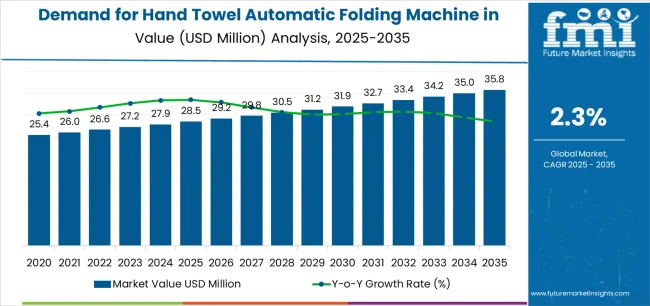
The demand for hand towel automatic folding machine in usa was valued at USD 29 million in 2025, advancing to USD 29 million in 2026 and projected to expand to USD 37 million by 2036 at a CAGR of 2.3%. Fully Automatic accounts for 64.1% of the type segment in 2026, reflecting established procurement patterns among primary institutional and commercial buyer categories. Based on FMI analysis, absolute market expansion of USD 7 million across the forecast decade will be concentrated in specification-driven sub-segments and geographies with favorable regulatory or investment environments.
Summary of Demand for Hand Towel Automatic Folding Machine in USA
- Demand for Hand Towel Automatic Folding Machine in USA Definition
- The demand for hand towel automatic folding machine in usa encompasses capital equipment systems that mechanically fold, count, and stack paper hand towels in interfolded, C-fold, and multifold configurations for commercial dispensing, deployed across US hospitality, healthcare, food processing, and institutional facility management operations.
- Demand Drivers in the Market
- Hospitality Sector Capital Refresh Cycles: US hotel chains and commercial real estate operators are executing equipment replacement programs for back-of-house laundry and amenity production, with fully automatic folding machines replacing semi-automatic lines to reduce labor costs in markets where minimum wage increases have compressed operating margins.
- Healthcare Facility Expansion and Infection Control Protocols: Hospital construction programs funded through state Medicaid capital grants are specifying automated towel folding lines in central linen and paper supply departments, where consistent fold quality supports dispensing system compatibility and reduces cross-contamination risk.
- Food Processing Plant Automation Investment: USDA and FDA food safety inspection requirements are driving US food processors to replace manual towel handling with automated folding and packaging systems that provide documented hygiene compliance records for regulatory audit purposes.
- Key Segments Analyzed in the FMI Report
- Fully Automatic: 64.1% share in 2026, reflecting established procurement preference for this configuration across primary buyer categories based on operational efficiency, performance consistency, and total cost of ownership advantages.
- Hotels and Office Buildings: the leading end-use or application category in 2026, anchored by institutional buyers operating under defined procurement cycles and volume commitments that generate predictable and recurring demand patterns.
- West: 2.7% CAGR through 2036, the fastest-growing geography in the covered market, supported by policy-driven demand creation, active institutional procurement programs, and expanding end-user industry capacity.
- Analyst Opinion at FMI
- Nikhil Kaitwade, Principal Consultant for Industrial automation, opines, FMI analysts note that the demand for hand towel automatic folding machine in usa is bifurcating between commodity-oriented segments where regional suppliers compete on price and specification-driven tiers where certified performance, regulatory compliance, and integration credentials create defensible margins for qualified vendors. Buyers consolidating vendor relationships will concentrate purchasing with suppliers who can demonstrate both technical compliance and delivery reliability, placing mid-tier providers without clear differentiation at structural disadvantage. The West and South growth trajectories are grounded in documented policy mandates and verifiable end-user industry expansion, making both geographies priority targets for investment decisions through the medium term.
- Strategic Implications / Executive Takeaways
- Align capacity investment and go-to-market resources with the West and South growth trajectories, where CAGR outperformance relative to the overall market average reflects durable structural demand rather than cyclical acceleration.
- Develop product lines and service offerings that meet tightening specification, compliance, and integration requirements in Northeast, where buyers are demonstrating willingness to pay premium pricing for certified performance and supply continuity.
- Establish multi-tier distribution and support infrastructure to capture demand from both large enterprise buyers with centralized procurement and mid-market buyers with decentralized purchasing decisions, as both segments are growing within the covered forecast period.
Demand for Hand Towel Automatic Folding Machine in USA Key Takeaways
| Metric | Details |
|---|---|
| Industry Size (2026) | USD 29 million |
| Industry Value (2036) | USD 37 million |
| CAGR (2026-2036) | 2.3% |
| Source | Future Market Insights, 2026 |
FMI analysts observe that structural demand for the demand for hand towel automatic folding machine in usa is driven by regulatory compliance requirements, technology adoption timelines, and procurement policy frameworks that operate independently of short-term economic fluctuations. Hospitality Sector Capital Refresh Cycles establishes the volume baseline for the covered period, while healthcare facility expansion and infection control protocols is redirecting capital allocation toward higher-specification product and service tiers. FMI is of the opinion that market participants who align product development and capacity investment with these structural forces will generate above-market revenue performance while those dependent on legacy procurement relationships face progressive margin compression as buyer specifications evolve.
Regional performance across the demand for hand towel automatic folding machine in usa is differentiated by local policy frameworks, infrastructure investment levels, and end-user industry development. West at 2.7% CAGR and South at 2.4% CAGR generate the fastest expansion rates, driven by active government investment programs and expanding institutional buyer bases. Northeast at 2.2% and Midwest at 1.9% show steady adoption supported by established procurement infrastructure and compliance requirements.
Demand for Hand Towel Automatic Folding Machine in USA Definition
The demand for hand towel automatic folding machine in usa covers capital equipment systems that mechanically fold, count, and stack paper hand towels in interfolded, C-fold, and multifold configurations for commercial dispensing, deployed across US hospitality, healthcare, food processing, and institutional facility management operations. Products and services within scope are differentiated by technical configuration, deployment model, and end-use performance requirements that govern procurement decisions across institutional, commercial, and enterprise buyer segments. As per FMI, market boundaries are defined by functional end-use characteristics and certified performance parameters rather than by manufacturing process or delivery mechanism designation alone.
Demand for Hand Towel Automatic Folding Machine in USA Inclusions
Market scope includes fully automatic and semi-automatic hand towel folding machines, integrated counting and stacking systems, machine conversion kits for alternative fold formats, and associated control and vision systems sold to US-based tissue converting and contract packaging operations. All products and services within scope are evaluated across the full segmentation taxonomy and geographic coverage framework applied in the FMI analysis.
Demand for Hand Towel Automatic Folding Machine in USA Exclusions
The scope excludes paper hand towel products themselves, toilet tissue and facial tissue folding equipment, napkin folding machines, industrial wipe folding systems, and hand towel dispensers and related washroom equipment. Products and services that do not satisfy the functional, technical, or certification criteria defined by the market taxonomy are omitted from all revenue and volume calculations.
Demand for Hand Towel Automatic Folding Machine in USA Research Methodology
- Primary Research: Structured interviews were conducted with procurement managers, technical directors, and commercial executives across supplier, distributor, and end-user organizations in all covered geographies to map decision criteria, specification requirements, pricing dynamics, and adoption barriers.
- Desk Research: Secondary data collection aggregated national trade statistics, regulatory filings, company annual reports, investor presentations, standards body publications, and peer-reviewed technical and industry research relevant to the covered market.
- Market-Sizing and Forecasting: A bottom-up revenue model was constructed from verified unit shipment and transaction benchmarks with average selling price data, validated against top-down total addressable market estimates anchored to observable industry benchmarks from allowed primary sources.
- Data Validation and Update Cycle: All forecast outputs are cross-referenced against publicly reported company revenue guidance and validated through a secondary round of primary outreach. Data is refreshed on a rolling basis as new regulatory filings and corporate disclosures become available.
Why is the USA Hand Towel Automatic Folding Machine Demand Growing?
Demand expansion is being supported by the accelerating focus on operational efficiency and automation processing efficiency nationwide, with the USA maintaining its position as a commercial facility innovation and equipment leadership region, and the corresponding need for effective hand towel automatic folding machine systems for precision processing applications, operational reliability, and advanced automation integration. Modern facility strategies rely on hand towel automatic folding machine technologies to ensure operational competitiveness, efficiency compliance, and optimal pathway achievement toward automated facility operations. Processing requirements necessitate comprehensive folding solutions including advanced commercial processing, performance management capabilities, and quality control infrastructure to address diverse application needs and precision specifications.
The growing focus on operational standards and increasing federal and state-level efficiency regulations, particularly automation excellence commitments across the USA, are driving demand for specialized folding systems from proven equipment suppliers with appropriate processing expertise and quality management capabilities. Manufacturers and facility operators are increasingly investing in advanced folding technology sourcing and integrated processing solutions to enhance operational profiles, access efficiency trends, and demonstrate facility leadership in competitive commercial environments. Facility policies and operational control requirements are establishing standardized folding pathways that require advanced systems and performance assurance, with USA commercial operations often pioneering large-scale implementation of specialized hand towel automatic folding machine technologies.
What drives the dominance of the fully automatic segment by type and the strong adoption of hotels and office buildings by application?
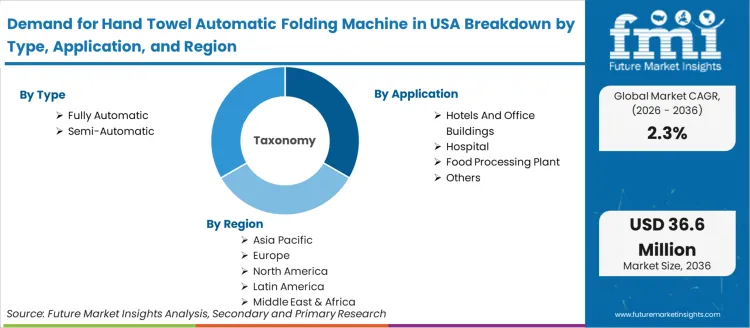
Demand is segmented by type, application, and region. By type, sales are divided into Fully Automatic and Semi-Automatic categories. In terms of application, sales are segmented into hotels and office buildings, hospitals, food processing plants, and others. Regionally, demand is divided into West, South, Northeast, and Midwest, with West representing a key growth and innovation hub for hand towel automatic folding machine technologies.
By Type, Fully Automatic Segment Accounts for 64.1% Share
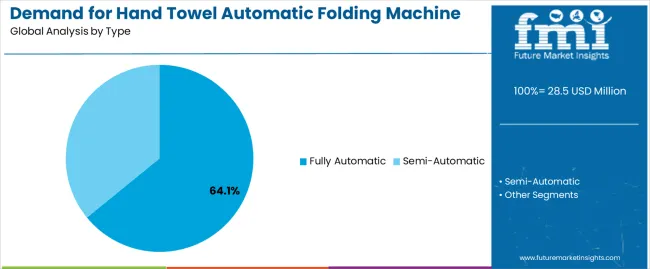
The Fully Automatic segment is projected to account for 64.1% of USA hand towel automatic folding machine demand in 2026, making it the leading type category across the sector. This dominance reflects the superior processing characteristics and facility compatibility of fully automated folding systems for existing commercial facilities and hospitality applications where processing performance is optimized through controlled automation management processes. In the USA, where substantial commercial infrastructure requires folding integration without complete system replacement, fully automatic systems provide essential pathways for efficiency enhancement while maintaining operational continuity. Continuous innovations are improving processing effectiveness, automation consistency characteristics, and application compatibility parameters, enabling manufacturers to achieve high performance standards while minimizing operational cost increases. The segment's strong position is reinforced by the extensive existing commercial infrastructure requiring folding adoption and growing availability of fully automatic folding technology suppliers with proven commercial experience.
- Processing compatibility and existing equipment integration make fully automatic folding systems the preferred technology for enhancing operating commercial facilities and hospitality installations.
- Technical maturity and commercial demonstration track records are enhancing operator confidence and project viability across large-scale deployment initiatives.
By Application, Hotels and Office Buildings Segment Accounts for 44.3% Share
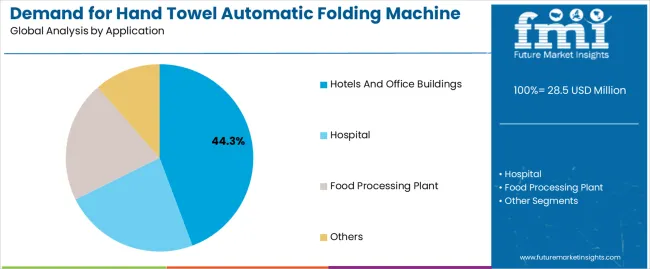
Hotels and Office Buildings applications are expected to represent 44.3% of USA hand towel automatic folding machine demand in 2026, highlighting the critical importance of hospitality facilities requiring specialized folding solutions. Hotel and office building facilities including accommodation operations, facility management, commercial buildings, and hospitality applications generate consistent demand for folding systems that are technically and economically favorable for specialized applications. The segment benefits from processing characteristics that often provide superior operational reliability compared to standard alternatives, reducing facility complexity and costs. Hotel and office building applications also access enhanced performance through specialized automation processing that improve facility performance and operational appeal. In the USA, where hospitality innovation represents substantial portions of commercial development, specialized folding deployment requires hand towel automatic folding machine integration across diverse accommodation operations. In California and Florida regions, where hospitality concentrations are significant, hand towel automatic folding machine demand is elevated by focus on maintaining operational efficiency while achieving automation integration targets.
- Processing performance concentration and favorable application economics make this the largest application segment for hand towel automatic folding machine technologies.
- Hospitality preferences and facility requirements drive consistent demand across accommodation operations, facility management, commercial buildings, and hospitality applications.
What are the Drivers, Restraints, and Key Trends in the USA Hand Towel Automatic Folding Machine Demand?
The USA hand towel automatic folding machine demand is advancing steadily due to increasing facility efficiency and growing recognition of automation necessity for commercial development, with West region serving as a key driver of innovation and application development. The sector faces challenges including competition from conventional folding methods, processing complexity considerations, and ongoing concerns regarding initial investment costs and specialized maintenance requirements. Federal efficiency guidelines and state-level automation initiatives, particularly commercial programs in West and California regions, continue to influence folding selection and deployment timelines.
Expansion of Operational Efficiency Requirements and Automation Standards
The enhancement of operational efficiency regulations, gaining particular significance through facility performance guidelines and automation advancement campaigns, is enabling equipment suppliers to achieve differentiation without prohibitive investment costs, providing predictable demand patterns through efficiency requirements and automation preferences. Enhanced processing standards offering substantial opportunities for specialized folding systems and advanced applications provide foundational dynamics while allowing suppliers to secure facility agreements and application partnerships. These trends are particularly valuable for first-mover suppliers and premium folding development that require substantial technology investments without immediate cost advantages.
Integration of Advanced Automation Technologies and Performance Monitoring Systems
Modern equipment suppliers and manufacturers are establishing advanced processing management networks and centralized performance monitoring facilities that improve operational efficiency through folding standardization and economies of scale. Integration of smart automation systems, real-time performance monitoring, and coordinated quality management enables more efficient folding operation across multiple commercial sources. Advanced automation concepts also support next-generation facility applications including specialized equipment integration, processing cluster optimization, and regional folding supply networks that optimize system-level economics while enabling comprehensive performance across commercial regions, with USA developments increasingly adopting collaborative folding models to reduce individual operator costs and accelerate deployment.
Analysis of USA Hand Towel Automatic Folding Machine Demand by Key Region
.webp "Top Country Growth Comparison Demand For Hand Towel Automatic Folding Machine In Usa Cagr (2026 2036)")
| Region | CAGR (2026-2036) |
|---|---|
| West | 2.7% |
| South | 2.4% |
| Northeast | 2.2% |
| Midwest | 1.9% |
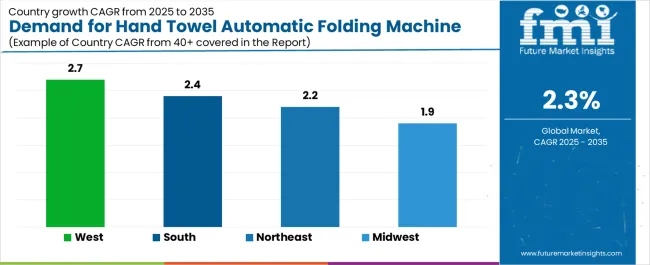
The USA hand towel automatic folding machine demand is witnessing consistent growth, supported by rising facility efficiency, expanding operational requirements, and the deployment of advanced specialized technologies across regions. West leads the nation with a 2.7% CAGR, reflecting progressive commercial trends, substantial facility innovation, and early adoption of premium folding systems. South follows with a 2.4% CAGR, driven by extensive commercial infrastructure, favorable hospitality demographics, and concentration of development operations that enhance application development. Northeast grows at 2.2%, as facility modernization and operational efficiency opportunities increasingly drive folding deployment. Midwest demonstrates growth at 1.9%, supported by expanding commercial facilities and regional hospitality initiatives.
Why does the West lead national growth with innovation and premium commercial applications?
Demand for hand towel automatic folding machine in West is projected to exhibit exceptional growth with a CAGR of 2.7% through 2036, driven by progressive facility efficiency preferences, substantial commercial development creating premium folding opportunities, and concentration of innovation across California and surrounding states. As the dominant region with extensive commercial infrastructure and efficiency-focused operational policies, West's focus on comprehensive facility management and automation leadership is creating significant demand for advanced hand towel automatic folding machine systems with proven performance and reliable application potential. Major manufacturers and equipment suppliers are establishing comprehensive folding development programs to support commercial innovation and premium folding deployment across diverse applications.
- Facility efficiency trends and automation cost preferences are requiring comprehensive operational strategies and folding solutions, driving demand for hand towel automatic folding machine systems with demonstrated processing capabilities and permanent performance assurance throughout diverse commercial operations.
- Innovation ecosystem strength and investment capital availability are supporting deployment of next-generation folding technologies and novel application pathways that enhance commercial viability, reduce operational costs, and create new facility opportunities across hospitality and commercial applications, positioning West as a national folding leadership region.
How does the South demonstrate strong potential with commercial infrastructure?
Demand for hand towel automatic folding machine in South is expanding at a CAGR of 2.4%, supported by extensive commercial facilities including hospitality development, facility operations, and commercial establishments generating concentrated demand favorable for specialized folding systems. The region's operational characteristics, featuring substantial commercial operations and facility efficiency requirements ideal for advanced integration, provide natural advantages. Commercial industry expertise concentrated in Texas, Florida, and regional hospitality corridors facilitates application development and operational management. Equipment suppliers and manufacturers are implementing comprehensive folding strategies to serve expanding efficiency-focused requirements throughout South.
- Commercial concentration and favorable application economics are creating opportunities for specialized equipment suppliers that can integrate folding systems with existing facility operations.
- Operational efficiency positioning and commercial awareness are building regional competitive advantages in folding applications, enabling comprehensive facility development and commercial cluster enhancement that meets operational targets while accessing efficiency pricing opportunities.
How does the Northeast maintain strong growth with a focus on facility management?
Demand for hand towel automatic folding machine in Northeast is growing at a CAGR of 2.2%, driven by substantial facility management operations from commercial facilities, hospitality services, and regional development requiring specialized folding pathways. The region's commercial base, supporting critical facility operations, is increasingly adopting folding technologies to maintain competitiveness while meeting performance expectations. Manufacturers and equipment suppliers are investing in folding integration systems and regional supply infrastructure to address growing operational requirements.
- Facility management modernization imperatives and operational competitiveness concerns are facilitating adoption of hand towel automatic folding machine technologies that enable continued operations while achieving efficiency enhancement across commercial, hospitality, and facility operations.
- Operational efficiency opportunities including regional facility development and folding utilization for enhanced commercial operations are creating unique regional advantages and diversified application types throughout Northeast commercial operations.
How does the Midwest show progressive adoption with commercial expansion?
Demand for hand towel automatic folding machine in Midwest is advancing at a CAGR of 1.9%, supported by expanding commercial facilities, regional hospitality development including specialized commercial applications, and growing focus on folding solutions across the region. Commercial modernization and facility expansion are driving consideration of specialized folding as operational enhancement pathways. Commercial companies and hospitality suppliers are developing regional capabilities to support emerging folding deployment requirements.
- Commercial expansion and operational diversification are creating economic drivers for automation technologies and hand towel automatic folding machine deployment across commercial and hospitality facilities seeking competitive differentiation pathways.
- Regional commercial cooperation and coordinated facility development are establishing consistent folding environments and shared operational infrastructure that support multi-state commercial projects throughout Midwest hospitality operations.
What factors define the competitive landscape of USA hand towel automatic folding machine demand?
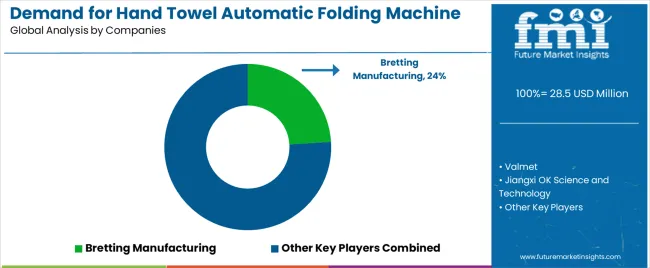
The USA hand towel automatic folding machine demand is defined by competition among specialized equipment manufacturers, facility equipment companies, and automation solution providers, with major commercial corporations maintaining significant influence through supply chain resources and technology development capabilities. Companies are investing in automation technology advancement, folding optimization, distribution network structures, and comprehensive application services to deliver effective, reliable, and scalable hand towel automatic folding machine solutions across USA hospitality and commercial applications. Strategic partnerships, technology infrastructure development, and first-mover application execution are central to strengthening competitive positioning and presence across commercial applications, hospitality facilities, and facility operations.
Bretting Manufacturing, internationally recognized equipment leader, leads with 24% share, offering comprehensive hand towel automatic folding machine supply including manufacturing, technology, and distribution services with focus on hospitality applications, performance reliability, and cost optimization across USA operations. Valmet, operating nationally with extensive USA distribution, provides integrated folding solutions leveraging engineering expertise, quality assurance development, and large-scale manufacturing capabilities.
Jiangxi OK Science and Technology delivers full-service hand towel automatic folding machine processing including automation technology, performance testing, and supply management serving USA and international commercial projects. Foshan Baosuo Paper Machinery Manufacture emphasizes comprehensive precision folding solutions with integrated technology, quality control, and distribution capabilities leveraging commercial sector expertise.
USA Hand Towel Automatic Folding Machine Demand - Stakeholder Contribution Framework
Hand towel automatic folding machine represents critical commercial infrastructure for enhancing facility productivity, supporting operational efficiency, and enabling automation applications essential for achieving performance targets. With the demand projected to reach USD 36.1 million by 2035, driven by facility efficiency, operational requirements, and technology advancement, the sector stands at the intersection of commercial innovation, operational excellence, and equipment development. The folding ecosystem spanning automation systems, supply chain networks, performance monitoring facilities, and application development infrastructure requires coordinated action across equipment suppliers, manufacturers, facility distributors, regulatory authorities, research institutions, and commercial organizations to unlock its full value potential while addressing the technical complexities of large-scale hand towel automatic folding machine management and consistent performance delivery.
How Governments Could Accelerate Development and Performance Standards?
- Enhanced Operational Guidelines and Commercial Standards: Expand and clarify EPA commercial equipment regulations with increased efficiency specifications, simplified certification procedures, and long-term policy consistency that improve dynamics while reducing regulatory uncertainty for hand towel automatic folding machine deployment.
- Research and Development Funding: Provide federal funding for commercial equipment technology research, advanced automation system development, and performance enhancement methods through grants and public-private partnerships that advance technical capabilities while reducing operational costs.
- Commercial Infrastructure Investment: Support development of commercial equipment supply networks, performance testing facility establishment, and facility infrastructure that reduces operational costs while building shared folding capacity accessible to multiple commercial applications.
- Commercial Equipment Clarity: Establish clear frameworks for folding equipment labeling, performance claim verification, and automation content standards that address operator information needs while ensuring accurate equipment representation.
- Equipment Quality Standards: Define standardized performance specifications, testing protocols, and certification requirements for hand towel automatic folding machine products that ensure safety and effectiveness while enabling domestic supply comparison and technology evaluation.
- Commercial Research Support: Support development of domestic facility folding research, operational optimization studies, and supply chain development through federal commercial programs that enable regional folding development.
How Industry Bodies Could Strengthen Sector Development?
- Performance Standards and Folding Best Practices: Define standardized folding specifications, quality metrics, and testing protocols for hand towel automatic folding machine systems and applications that ensure consistency and effectiveness while enabling product comparison and technology evaluation.
- Supply Chain Assessment Methodologies: Develop comprehensive evaluation frameworks for assessing folding quality, operational capacity, and supply reliability that reduce sourcing uncertainty while building supplier confidence.
- Technical Training and Certification: Establish certification programs, folding training curricula, and professional development pathways for commercial technicians, manufacturers, and performance specialists that ensure adequate skilled workforce for sector expansion.
- Application Development Frameworks: Create standardized methodologies for measuring folding effectiveness accounting for performance, commercial compatibility, and operational performance that enable credible product benefit verification.
- Commercial Education and Acceptance Programs: Coordinate commercial outreach, educational initiatives, and transparent communication addressing hand towel automatic folding machine benefits, installation safety, and operational advantages that build acceptance for folding development.
- Supply Chain Coordination Initiatives: Facilitate coordination between manufacturers, distributors, and commercial operators addressing bottlenecks, capacity constraints, and cost reduction opportunities throughout hand towel automatic folding machine supply chains.
How Equipment Suppliers Could Capture Value and Drive Innovation?
- Advanced Folding Technology Development: Invest in enhanced automation systems, processing methods, and performance monitoring technologies that improve operational efficiency, reduce commercial costs, and enhance folding consistency beyond conventional folding methods.
- Standardized Product Development: Develop pre-qualified folding specifications with standardized performance parameters that reduce installation costs, accelerate deployment timelines, and enable consistent operation with quality assurance advantages.
- Application Support and Technical Services: Incorporate installation assistance, performance testing, and technical optimization services that maximize folding performance while minimizing application complexity and operational costs throughout product lifecycles.
- Supply Chain Integration: Pioneer comprehensive supply chain systems with improved sourcing reliability and enhanced cost structures that enable consistent folding availability and quality management beyond traditional supply approaches.
- Specialized Application Development: Create commercial pathways for hand towel automatic folding machine in specialized facility categories, commercial applications, and hospitality facilities that generate additional revenue streams while expanding applications.
- Comprehensive Service Offerings: Provide integrated solutions spanning folding supply, technical services, quality assurance, and application support that simplify adoption for manufacturers while creating recurring business opportunities.
How Manufacturers Could Optimize Folding Enhancement Strategies?
- Comprehensive Folding Assessment: Conduct detailed operational analysis identifying folding opportunities, commercial compatibility, and application suitability that inform strategic commercial development roadmaps and folding selection.
- Installation Integration and Feasibility Studies: Evaluate folding options based on specific facility characteristics, operational capabilities, and performance requirements through rigorous technical analysis before major folding commitments.
- Phased Implementation Roadmaps: Develop staged deployment plans beginning with pilot installations, progressing through operational testing, and scaling to full facility deployment that manage development risks while building operational experience.
- Supply Chain Partnership Development: Engage in long-term supplier relationships ensuring consistent folding quality and availability that reduce individual installation costs while enabling smaller operators to participate in commercial folding sectors.
- Operational Positioning and Cost Optimization: Secure operational efficiency positioning, develop premium commercial services, and access folding technology benefits that improve facility economics and enable differentiation.
- Worker Communication and Training: Build relationships with worker organizations, facility managers, and operational groups early in folding development that facilitate equipment acceptance while addressing operational questions and building folding support.
How Hotels and Office Building Companies Could Lead Commercial Folding Integration?
- Folding Product Portfolio Development: Leverage hospitality expertise and existing contractor relationships to identify, integrate, and promote hand towel automatic folding machine systems in facility designs and equipment specifications providing commercial folding services to efficiency-conscious hospitality operators.
- Quality Assurance Network Development: Develop comprehensive testing infrastructure connecting folding sourcing to finished facility quality that enable regional commercial folding management while generating quality verification revenue.
- Integrated Facility Development: Combine hand towel automatic folding machine integration, hospitality capacity, and service operations into comprehensive facility solutions that simplify folding development for operators while capturing value across the supply chain.
- Performance Benefit Communication: Utilize folding efficiency properties for hospitality applications that generate operator education revenue while supporting facility goals in finished commercial products.
- Specialized Hospitality Applications: Pioneer targeted facility configurations leveraging folding research and operator access that enable specific hospitality applications and commercial folding generation.
- Technical Quality Management: Apply quality control, large facility management, and safety compliance capabilities from hospitality operations to hand towel automatic folding machine equipment development.
How Hospital Companies Could Unlock Facility Innovation?
- Facility Enhancement Development: Develop specialized healthcare products incorporating hand towel automatic folding machine benefits through folding systems for efficiency-conscious manufacturers with facility folding preferences.
- Healthcare Applications: Provide hospital folding solutions monetizing hand towel automatic folding machine performance and efficiency benefits for facility developers lacking sufficient folding options.
- Installation Integration Support: Create dedicated infrastructure targeting hand towel automatic folding machine healthcare applications and quality assurance systems that generate stable operations through folding contracts while supporting multiple hospital applications.
- Premium Positioning: Issue dedicated product lines funding hand towel automatic folding machine healthcare deployment that attract efficiency-focused manufacturers while supporting hospital folding infrastructure development.
- Quality Assurance Systems: Develop quality testing, performance verification, and manufacturer feedback systems addressing folding performance, performance delivery, and efficiency benefits that enable broader manufacturer participation in healthcare folding sectors.
How Investors and Financial Enablers Could Unlock Growth?
- Folding Infrastructure Investment: Provide growth capital for pioneering commercial-scale hand towel automatic folding machine manufacturing facilities demonstrating technology viability and establishing operational track records that enable subsequent financing.
- Supply Chain Development Funding: Finance shared folding sourcing and manufacturing infrastructure serving multiple facility operators through infrastructure investments generating returns from supply contracts and folding services.
- Technology Company Growth Capital: Support hand towel automatic folding machine technology developers, folding equipment firms, and service providers scaling operations and expanding geographic presence through growth equity investments.
- Portfolio Investment: Acquire portfolios of application development projects from operating suppliers providing upfront capital to developers while capturing long-term value from expansion.
- Strategic Industry Consolidation: Finance acquisitions consolidating fragmented equipment suppliers, folding firms, and application developers creating integrated hand towel automatic folding machine platforms with comprehensive capabilities.
- Performance-Based Financing: Structure innovative financing arrangements linking capital costs and returns to measurable quality performance, supply reliability, and verified penetration that align stakeholder incentives around project success.
Key Players in USA Hand Towel Automatic Folding Machine Demand
- Bretting Manufacturing
- Valmet
- Jiangxi OK Science and Technology
- Foshan Baosuo Paper Machinery Manufacture
- Dongguan Huitong Automation Equipment
- Quanzhou Xinda Machinery
- Zhejiang Onepaper Smart Equipment
Scope of the Report
| Metric | Value |
|---|---|
| Quantitative Units | USD 29 million to USD 37 million, at a CAGR of 2.3% |
| Market Definition | Demand for Hand Towel Automatic Folding Machine in USA encompasses capital equipment systems that mechanically fold, count, and stack paper hand towels in interfolded, C-fold, and multifold configurations for commercial dispensing, deployed across US hospitality, healthcare, food processing, and institutional facility management operations. |
| Segmentation | Type (Fully Automatic, Semi-Automatic); Application (Hotels and Office Buildings, Hospital, Food Processing Plant, Others) |
| Regions Covered | North America, Latin America, Europe, East Asia, South Asia, Oceania, Middle East and Africa |
| Countries Covered | West, South, Northeast, Midwest, and 40 plus countries |
| Key Companies Profiled | Bretting Manufacturing, Valmet, Jiangxi OK Science and Technology, Foshan Baosuo Paper Machinery Manufacture, Dongguan Huitong Automation Equipment, Quanzhou Xinda Machinery, Zhejiang Onepaper Smart Equipment |
| Forecast Period | 2026 to 2036 |
| Approach | Bottom-up revenue modeling anchored to verified transaction and pricing benchmarks, with scenario adjustments for regulatory, policy, and macroeconomic inputs |
USA Hand Towel Automatic Folding Machine Demand by Segments
Type:
- Fully Automatic
- Semi-Automatic
Application:
- Hotels And Office Buildings
- Hospital
- Food Processing Plant
- Others
Region:
- West
- South
- Northeast
- Midwest
Bibliography
- 1. USA Bureau of Labor Statistics. (2024, March). Occupational employment and wages: Laundry and dry-cleaning workers sector. BLS.
- 2. American Hotel and Lodging Association. (2024, February). State of the hotel industry 2024: Capital expenditure and operations report. AHLA.
- 3. USA Food and Drug Administration. (2024, April). Food safety modernization act: Sanitary transportation and hygiene compliance guidance for food processors. FDA.
- 4. Centers for Medicare and Medicaid Services. (2024, June). Hospital facility construction and renovation funding: Capital improvement program data. CMS.
- 5. Association for the Nonwoven Fabrics Industry. (2024, January). Tissue and towel converting equipment market outlook 2024. INDA.
- 6. USA Census Bureau. (2024, May). Annual survey of manufactures: Paper and paperboard container manufacturing sector. Census Bureau.
This bibliography is provided for reader reference. The full FMI report contains the complete reference list with primary research documentation.
Frequently Asked Questions
How large is the Demand for Hand Towel Automatic Folding Machine in USA in 2026?
The demand for hand towel automatic folding machine in usa is estimated at USD 29 million in 2026, based on FMI proprietary bottom-up revenue modeling and primary research validation.
What will the Demand for Hand Towel Automatic Folding Machine in USA size be by 2036?
FMI projects the demand for hand towel automatic folding machine in usa to reach USD 37 million by 2036, supported by sustained demand across primary end-use segments and covered geographies.
What is the CAGR for the Demand for Hand Towel Automatic Folding Machine in USA between 2026 and 2036?
The demand for hand towel automatic folding machine in usa is projected to grow at a CAGR of 2.3% between 2026 and 2036.
Which type category leads in 2026?
Fully Automatic holds 64.1% of the type segment in 2026, driven by established procurement preference and operational performance advantages relative to alternative configurations.
Which geography shows the fastest growth in the Demand for Hand Towel Automatic Folding Machine in USA?
West registers the highest CAGR at 2.7% through 2036, driven by policy-backed demand creation, active government procurement programs, and expanding end-user industry capacity.
What is the leading end-use category in the Demand for Hand Towel Automatic Folding Machine in USA?
Hotels and Office Buildings is the leading end-use category in 2026, anchored by institutional procurement cycles and volume commitments that generate predictable and recurring replacement demand.
What is included in the scope of this report?
The scope includes fully automatic and semi-automatic hand towel folding machines, integrated counting and stacking systems, machine conversion kits for alternative fold formats, and associated control and vision systems sold to US-based tissue converting and contract packaging operations. All products and services are analyzed across the full segmentation taxonomy and geographic coverage framework defined in the FMI market analysis.
How does FMI validate the Demand for Hand Towel Automatic Folding Machine in USA forecast?
FMI applies a bottom-up methodology anchored to verified transaction data and average selling price benchmarks, cross-referenced against top-down market estimates and validated through primary interviews with suppliers, distributors, and end users.
Preview the report firsthand - request a free sample
Get SampleGet the brochure for pricing and purchase details.
Get PDFTable of Content
- Executive Summary
- Global Market Outlook
- Demand-side Trends
- Supply-side Trends
- Technology Roadmap Analysis
- Analysis and Recommendations
- Market Overview
- Market Coverage / Taxonomy
- Market Definition / Scope / Limitations
- Research Methodology
- Chapter Orientation
- Analytical Lens and Working Hypotheses
- Market Structure, Signals, and Trend Drivers
- Benchmarking and Cross-market Comparability
- Market Sizing, Forecasting, and Opportunity Mapping
- Research Design and Evidence Framework
- Desk Research Programme (Secondary Evidence)
- Company Annual and Sustainability Reports
- Peer-reviewed Journals and Academic Literature
- Corporate Websites, Product Literature, and Technical Notes
- Earnings Decks and Investor Briefings
- Statutory Filings and Regulatory Disclosures
- Technical White Papers and Standards Notes
- Trade Journals, Industry Magazines, and Analyst Briefs
- Conference Proceedings, Webinars, and Seminar Materials
- Government Statistics Portals and Public Data Releases
- Press Releases and Reputable Media Coverage
- Specialist Newsletters and Curated Briefings
- Sector Databases and Reference Repositories
- FMI Internal Proprietary Databases and Historical Market Datasets
- Subscription Datasets and Paid Sources
- Social Channels, Communities, and Digital Listening Inputs
- Additional Desk Sources
- Expert Input and Fieldwork (Primary Evidence)
- Primary Modes
- Qualitative Interviews and Expert Elicitation
- Quantitative Surveys and Structured Data Capture
- Blended Approach
- Why Primary Evidence is Used
- Field Techniques
- Interviews
- Surveys
- Focus Groups
- Observational and In-context Research
- Social and Community Interactions
- Stakeholder Universe Engaged
- C-suite Leaders
- Board Members
- Presidents and Vice Presidents
- R&D and Innovation Heads
- Technical Specialists
- Domain Subject-matter Experts
- Scientists
- Physicians and Other Healthcare Professionals
- Governance, Ethics, and Data Stewardship
- Research Ethics
- Data Integrity and Handling
- Primary Modes
- Tooling, Models, and Reference Databases
- Desk Research Programme (Secondary Evidence)
- Data Engineering and Model Build
- Data Acquisition and Ingestion
- Cleaning, Normalisation, and Verification
- Synthesis, Triangulation, and Analysis
- Quality Assurance and Audit Trail
- Market Background
- Market Dynamics
- Drivers
- Restraints
- Opportunity
- Trends
- Scenario Forecast
- Demand in Optimistic Scenario
- Demand in Likely Scenario
- Demand in Conservative Scenario
- Opportunity Map Analysis
- Product Life Cycle Analysis
- Supply Chain Analysis
- Investment Feasibility Matrix
- Value Chain Analysis
- PESTLE and Porter’s Analysis
- Regulatory Landscape
- Regional Parent Market Outlook
- Production and Consumption Statistics
- Import and Export Statistics
- Market Dynamics
- Global Market Analysis 2021 to 2025 and Forecast, 2026 to 2036
- Historical Market Size Value (USD Million) Analysis, 2021 to 2025
- Current and Future Market Size Value (USD Million) Projections, 2026 to 2036
- Y-o-Y Growth Trend Analysis
- Absolute $ Opportunity Analysis
- Global Market Pricing Analysis 2021 to 2025 and Forecast 2026 to 2036
- Global Market Analysis 2021 to 2025 and Forecast 2026 to 2036, By Type
- Introduction / Key Findings
- Historical Market Size Value (USD Million) Analysis By Type , 2021 to 2025
- Current and Future Market Size Value (USD Million) Analysis and Forecast By Type , 2026 to 2036
- Fully Automatic
- Semi-Automatic
- Fully Automatic
- Y-o-Y Growth Trend Analysis By Type , 2021 to 2025
- Absolute $ Opportunity Analysis By Type , 2026 to 2036
- Global Market Analysis 2021 to 2025 and Forecast 2026 to 2036, By Application
- Introduction / Key Findings
- Historical Market Size Value (USD Million) Analysis By Application, 2021 to 2025
- Current and Future Market Size Value (USD Million) Analysis and Forecast By Application, 2026 to 2036
- Hotels And Office Buildings
- Hospital
- Food Processing Plant
- Others
- Hotels And Office Buildings
- Y-o-Y Growth Trend Analysis By Application, 2021 to 2025
- Absolute $ Opportunity Analysis By Application, 2026 to 2036
- Global Market Analysis 2021 to 2025 and Forecast 2026 to 2036, By Region
- Introduction
- Historical Market Size Value (USD Million) Analysis By Region, 2021 to 2025
- Current Market Size Value (USD Million) Analysis and Forecast By Region, 2026 to 2036
- North America
- Latin America
- Western Europe
- Eastern Europe
- East Asia
- South Asia and Pacific
- Middle East & Africa
- Market Attractiveness Analysis By Region
- North America Market Analysis 2021 to 2025 and Forecast 2026 to 2036, By Country
- Historical Market Size Value (USD Million) Trend Analysis By Market Taxonomy, 2021 to 2025
- Market Size Value (USD Million) Forecast By Market Taxonomy, 2026 to 2036
- By Country
- USA
- Canada
- Mexico
- By Type
- By Application
- By Country
- Market Attractiveness Analysis
- By Country
- By Type
- By Application
- Key Takeaways
- Latin America Market Analysis 2021 to 2025 and Forecast 2026 to 2036, By Country
- Historical Market Size Value (USD Million) Trend Analysis By Market Taxonomy, 2021 to 2025
- Market Size Value (USD Million) Forecast By Market Taxonomy, 2026 to 2036
- By Country
- Brazil
- Chile
- Rest of Latin America
- By Type
- By Application
- By Country
- Market Attractiveness Analysis
- By Country
- By Type
- By Application
- Key Takeaways
- Western Europe Market Analysis 2021 to 2025 and Forecast 2026 to 2036, By Country
- Historical Market Size Value (USD Million) Trend Analysis By Market Taxonomy, 2021 to 2025
- Market Size Value (USD Million) Forecast By Market Taxonomy, 2026 to 2036
- By Country
- Germany
- UK
- Italy
- Spain
- France
- Nordic
- BENELUX
- Rest of Western Europe
- By Type
- By Application
- By Country
- Market Attractiveness Analysis
- By Country
- By Type
- By Application
- Key Takeaways
- Eastern Europe Market Analysis 2021 to 2025 and Forecast 2026 to 2036, By Country
- Historical Market Size Value (USD Million) Trend Analysis By Market Taxonomy, 2021 to 2025
- Market Size Value (USD Million) Forecast By Market Taxonomy, 2026 to 2036
- By Country
- Russia
- Poland
- Hungary
- Balkan & Baltic
- Rest of Eastern Europe
- By Type
- By Application
- By Country
- Market Attractiveness Analysis
- By Country
- By Type
- By Application
- Key Takeaways
- East Asia Market Analysis 2021 to 2025 and Forecast 2026 to 2036, By Country
- Historical Market Size Value (USD Million) Trend Analysis By Market Taxonomy, 2021 to 2025
- Market Size Value (USD Million) Forecast By Market Taxonomy, 2026 to 2036
- By Country
- China
- Japan
- South Korea
- By Type
- By Application
- By Country
- Market Attractiveness Analysis
- By Country
- By Type
- By Application
- Key Takeaways
- South Asia and Pacific Market Analysis 2021 to 2025 and Forecast 2026 to 2036, By Country
- Historical Market Size Value (USD Million) Trend Analysis By Market Taxonomy, 2021 to 2025
- Market Size Value (USD Million) Forecast By Market Taxonomy, 2026 to 2036
- By Country
- India
- ASEAN
- Australia & New Zealand
- Rest of South Asia and Pacific
- By Type
- By Application
- By Country
- Market Attractiveness Analysis
- By Country
- By Type
- By Application
- Key Takeaways
- Middle East & Africa Market Analysis 2021 to 2025 and Forecast 2026 to 2036, By Country
- Historical Market Size Value (USD Million) Trend Analysis By Market Taxonomy, 2021 to 2025
- Market Size Value (USD Million) Forecast By Market Taxonomy, 2026 to 2036
- By Country
- Kingdom of Saudi Arabia
- Other GCC Countries
- Turkiye
- South Africa
- Other African Union
- Rest of Middle East & Africa
- By Type
- By Application
- By Country
- Market Attractiveness Analysis
- By Country
- By Type
- By Application
- Key Takeaways
- Key Countries Market Analysis
- USA
- Pricing Analysis
- Market Share Analysis, 2025
- By Type
- By Application
- Canada
- Pricing Analysis
- Market Share Analysis, 2025
- By Type
- By Application
- Mexico
- Pricing Analysis
- Market Share Analysis, 2025
- By Type
- By Application
- Brazil
- Pricing Analysis
- Market Share Analysis, 2025
- By Type
- By Application
- Chile
- Pricing Analysis
- Market Share Analysis, 2025
- By Type
- By Application
- Germany
- Pricing Analysis
- Market Share Analysis, 2025
- By Type
- By Application
- UK
- Pricing Analysis
- Market Share Analysis, 2025
- By Type
- By Application
- Italy
- Pricing Analysis
- Market Share Analysis, 2025
- By Type
- By Application
- Spain
- Pricing Analysis
- Market Share Analysis, 2025
- By Type
- By Application
- France
- Pricing Analysis
- Market Share Analysis, 2025
- By Type
- By Application
- India
- Pricing Analysis
- Market Share Analysis, 2025
- By Type
- By Application
- ASEAN
- Pricing Analysis
- Market Share Analysis, 2025
- By Type
- By Application
- Australia & New Zealand
- Pricing Analysis
- Market Share Analysis, 2025
- By Type
- By Application
- China
- Pricing Analysis
- Market Share Analysis, 2025
- By Type
- By Application
- Japan
- Pricing Analysis
- Market Share Analysis, 2025
- By Type
- By Application
- South Korea
- Pricing Analysis
- Market Share Analysis, 2025
- By Type
- By Application
- Russia
- Pricing Analysis
- Market Share Analysis, 2025
- By Type
- By Application
- Poland
- Pricing Analysis
- Market Share Analysis, 2025
- By Type
- By Application
- Hungary
- Pricing Analysis
- Market Share Analysis, 2025
- By Type
- By Application
- Kingdom of Saudi Arabia
- Pricing Analysis
- Market Share Analysis, 2025
- By Type
- By Application
- Turkiye
- Pricing Analysis
- Market Share Analysis, 2025
- By Type
- By Application
- South Africa
- Pricing Analysis
- Market Share Analysis, 2025
- By Type
- By Application
- USA
- Market Structure Analysis
- Competition Dashboard
- Competition Benchmarking
- Market Share Analysis of Top Players
- By Regional
- By Type
- By Application
- Competition Analysis
- Competition Deep Dive
- Bretting Manufacturing
- Overview
- Product Portfolio
- Profitability by Market Segments (Product/Age /Sales Channel/Region)
- Sales Footprint
- Strategy Overview
- Marketing Strategy
- Product Strategy
- Channel Strategy
- Valmet
- Jiangxi OK Science and Technology
- Foshan Baosuo Paper Machinery Manufacture
- Dongguan Huitong Automation Equipment
- Quanzhou Xinda Machinery
- Zhejiang Onepaper Smart Equipment
- Bretting Manufacturing
- Competition Deep Dive
- Assumptions & Acronyms Used


