

- Industry Size (2026)
- USD 2.5 Bn
- Forecast (2036)
- USD 7.9 Bn
- CAGR (2026 to 2036)
- 12.2%
Bio-based Laminate Packaging Materials Market Forecast and Outlook 2026 to 2036
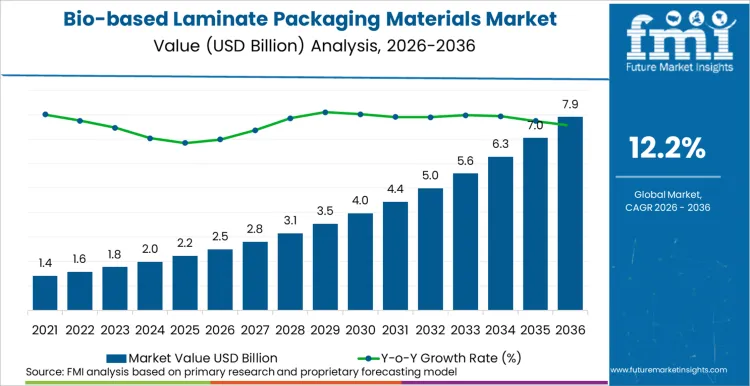
Spending on bio-based laminate packaging materials reaches USD 2.5 billion in 2026 and is expected to rise to USD 7.9 billion by 2036 at a 12.20% CAGR. Demand is defined by brand commitments to renewable content, barrier performance targets, and pack integrity requirements across food, beverage, and personal care formats.
Packaging teams set layer functions, seal windows, and print receptivity during structure definition. Once a laminate enters an approved claim scope, later material changes require renewed conformity testing and label authorization. Volume growth follows conversion of high-volume packs where shelf life, appearance stability, and disposal guidance remain tightly specified.
Participation in the bio-based laminate packaging materials market depends on inclusion within approved pack architectures maintained by brand owners and retailers. Entry requires evidence covering renewable content claims, performance consistency, and compatibility with existing converting and filling lines. Approved constructions remain in use across extended cycles because on-pack statements and compliance files attach to complete structures. Supplier changes occur during platform redesign windows rather than routine sourcing.
Revenue development reflects the number of packaging programs converted to bio-based laminates. Competitive position depends on early involvement in pack design programs and continued acceptance within governed material frameworks used across multiple product categories.
Bio-based Laminate Packaging Materials Market Quick Stats
- Bio-based Laminate Packaging Materials Market Value (2026): USD 2.5 billion
- Bio-based Laminate Packaging Materials Market Forecast Value (2036): USD 7.9 billion
- Bio-based Laminate Packaging Materials Market Forecast CAGR 2026 to 2036: 12.2%
- Leading End Use in Bio-based Laminate Packaging Materials Market: Food and beverage packaging
- Key Growth Regions in Bio-based Laminate Packaging Materials Market: India, China, USA, Germany, Japan
- Top Players in Bio-based Laminate Packaging Materials Market: Mondi, Walki, Amcor, Sealed Air, Greatview Aseptic Packaging, Zijiang Enterprise Group, Futamura Chemical, Toppan
What is the Growth Forecast for the Bio based Laminate Packaging Materials Market through 2036?
Package engineering in this category starts with barrier targets, sealing windows, and shelf life requirements rather than with resin substitution alone. The bio based laminate packaging materials market in 2026 stands near USD 2.5 billion, supported by food, beverage, and personal care formats that depend on multilayer structures for performance. Material approval depends on oxygen and moisture transmission rates, heat seal range, print anchorage, and layer adhesion after forming and filling. Converters validate structures through line trials that measure waste rates and run speed stability. Brand owners fix these laminates at the platform level, not at the promotion level. The value path reaches USD 4.0 billion in 2030 and moves to USD 7.9 billion in 2036, matching a 12.20% growth profile.
Production planning and specification control define commercial behavior in the bio based laminate packaging materials market. Volumes move under multi year packaging programs linked to tooling sets, artwork libraries, and approved structure lists. Stock policy favors continuity of certified constructions and predictable lot behavior. Cost structure reflects bio polymer supply, adhesive systems, coating steps, conversion yield, and quality screening. Plants monitor seal integrity, scrap, and line uptime as operating measures. Annual values pass USD 5.6 billion in 2033 and USD 7.0 billion in 2035 as more categories convert base packs. The rise to USD 7.9 billion in 2036 comes from wider category coverage, thicker functional stacks in some formats, and longer contracts that place these laminates into fixed packaging specifications across large product portfolios.
Bio-based Laminate Packaging Materials Market Key Takeaways
| Metric | Value |
|---|---|
| Market Value (2026) | USD 2.5 billion |
| Forecast Value (2036) | USD 7.9 billion |
| Forecast CAGR 2026 to 2036 | 12.2% |
Source: Future Market Insights’ proprietary forecasting model and primary research
How Is the Bio Based Laminate Packaging Materials Market Being Used to Control Barrier Performance, Sourcing Governance, and Conversion Stability?
Packaging producers treat the bio based laminate packaging materials market as part of sourcing governance and performance risk management rather than as a simple branding change. Programs specify bio based flexible packaging laminates and renewable content multilayer packaging films to meet material origin targets while keeping oxygen and moisture barriers within specification. Qualification teams rely on bio based packaging material certification systems and supply chain traceability for packaging resins to confirm that adhesive layers, coatings, and tie layers remain compliant. Engineering groups evaluate plant derived polymer barrier coatings and bio based adhesive systems for laminates to maintain seal strength and delamination resistance. The focus stays on bond integrity, curl control, and aging behavior because packaging that performs in distribution but fails origin audits creates compliance exposure and claim withdrawal risk.
Release governance places renewable packaging compliance documentation frameworks inside shipment approval rather than inside marketing review. Selection criteria for bio based packaging material suppliers include feedstock consistency, conversion stability, and lot to lot performance repeatability. Life cycle assessment for bio based packaging systems is used to verify that sourcing and processing steps do not undermine declared claims. Waste stream compatibility for bio based laminate structures shapes material choice because misrouted constructions complicate recovery programs. Shelf life performance testing for bio based laminates defines acceptance gates for seal aging, barrier drift, and print adhesion. Audit readiness for renewable content packaging claims sets ongoing surveillance requirements. This makes laminate specification a certification and risk management decision rather than a short term cost or design optimization exercise.
How Do Supply Chain Disclosure Rules and Shelf Presentation Standards Shape Demand in the Bio-based Laminate Packaging Materials Market by End Use and Laminate Structure in 2026?
In the Bio-based Laminate Packaging Materials Market, specification decisions are shaped by material origin disclosure, barrier performance targets, and converting line stability rather than by substitution cost alone. Brand owners managing food packaging portfolios, retail private label programs, and bio-based materials strategies require laminates that document renewable content while preserving seal integrity, print quality, and transport durability. By end use, demand spans food and beverage packaging, FMCG and retail, mass packaged foods, premium food packs, and other uses. By laminate structure, usage covers paper biofilm laminates, flexible laminates, multi-layer bio-laminates, thin bio-laminates, and other constructions. Portfolio choices reflect claim substantiation effort, scrap risk, and line uptime.
Why Does Food and Beverage Packaging Set Most Qualification Requirements?
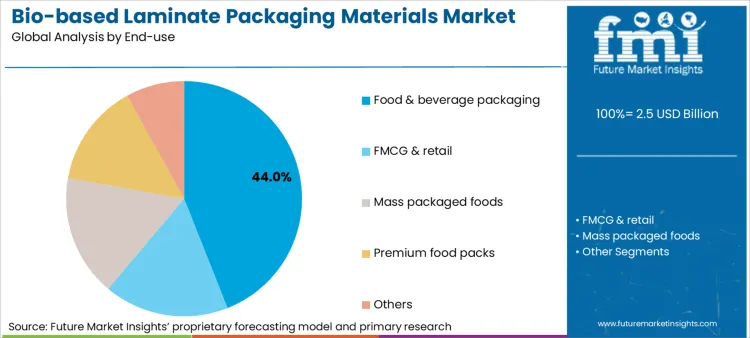
Food and beverage packaging represents about 44% share, placing this segment at the center of most bio-based laminate qualification programs. High volume turnover, regulatory scrutiny, and direct food contact impose strict control over barrier stability and migration behavior. FMCG and retail follow, driven by private label sourcing policies and harmonized pack formats. Mass packaged foods emphasize machinability and seal consistency, while premium food packs prioritize surface finish and shelf appearance. Other uses remain fragmented. Packaging engineers approve end uses through seal strength, drop testing, and barrier consistency. Operations teams approve through line speed and waste rates. Quality teams approve through shelf-life performance and complaint patterns.
Target application selection fixes filling temperatures, sealing profiles, and inspection criteria. Entering a new end-use class requires new machinability trials and revised shelf-life validation. Procurement aligns sourcing to secure continuity of the approved laminate family. Certification files and on-pack claims follow the same application mapping. Commercial planning expands SKU counts within the same end-use group rather than rotating categories. Demand therefore concentrates in food and beverage applications where compliance exposure, volume scale, and product loss risk intersect.
Why Do Paper-Based and Flexible Structures Dominate Laminate Choices?
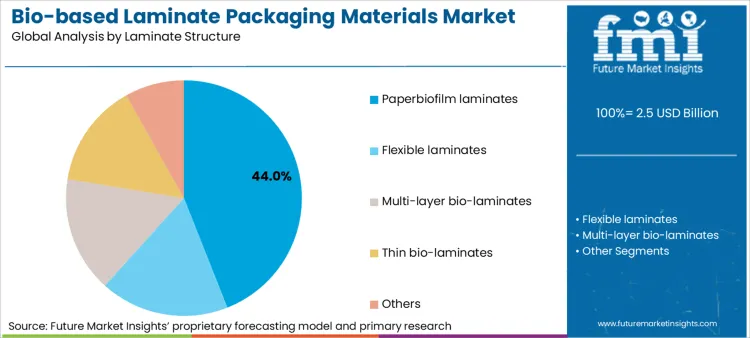
Paper biofilm laminates account for about 44% share, reflecting their ability to combine stiffness, printability, and renewable-content signaling in one structure. This format integrates well with existing converting and filling equipment. Flexible laminates follow where pack shapes and fold behavior require higher flex crack resistance. Multi-layer bio-laminates address higher barrier needs, though they increase structure complexity and validation workload. Thin bio-laminates serve lightweight packs with short distribution cycles. Other structures remain niche. Materials teams evaluate structures through oxygen and moisture transmission, seal window, and fold endurance. Operations teams evaluate through run stability and scrap generation. Compliance teams evaluate through bio-content traceability and claim documentation.
Structure selection fixes adhesive systems, surface treatments, and sealing conditions. Any change requires new tooling trials and updated documentation. Production scheduling aligns roll widths and storage conditions to the selected family. Supplier quality plans and incoming inspection follow. Field performance tracking assumes the same mechanical and barrier behavior. Growth comes from extending approved structures across more products and regions rather than introducing new constructions. Demand therefore concentrates in paper-based and flexible laminate structures that balance line compatibility, claim stability, and predictable performance across large packaging portfolios.
Why Are Converting Reliability and Pack Performance Requirements Driving Bio-based Laminate Adoption?
Packaging converters depend on laminate structures that run at line speed, seal consistently, and protect contents during distribution. At the same time, food packaging operations and personal care packaging formats are tightening material acceptance rules tied to origin and disposal pathways. These two pressures meet in bio-based laminate constructions, where alternative films and coatings must still behave like conventional multilayer structures during slitting, printing, and sealing. Packaging certification programs and material compliance frameworks evaluate performance at the finished laminate level rather than at single film level. Demand grows because converters need drop-in laminate systems that preserve throughput, limit scrap, and avoid equipment changes.
What Is Slowing Standardization of Bio-based Laminate Structures Across Applications?
Raw material supply from biopolymer resin producers and formulation work inside adhesive and tie-layer compounding operations create wide variation in stiffness, heat response, and bond strength. Barrier needs for snack packaging differ from those for home and personal care packs, which prevents reuse of a single laminate design. Qualification must also pass through package testing laboratories and customer line trials, which extends approval cycles. These dependencies keep laminate recipes application specific. Converters manage multiple structures, longer validation timelines, and limited ability to consolidate platforms even when pack shapes and machines are similar.
How Are Platform Material Strategies Changing Bio-based Laminate Development?
Material suppliers and converters are building families of compatible films, coatings, and adhesives designed to work across pouch, wrap, and sachet equipment. Packaging machinery teams and process engineering groups now join projects earlier to define sealing windows, stiffness limits, and unwind behavior. Testing and validation partners are engaged upstream to lock laminate constructions before scale production. Development is moving toward repeatable laminate systems supported by shared performance data and defined operating ranges. Competitive advantage comes from offering proven material stacks that reduce line risk, shorten customer trials, and stabilize production planning.
What is the Demand for Bio Based Laminate Packaging Materials by Country?
| Country | CAGR (%) |
|---|---|
| Germany | 11.4% |
| USA | 11.8% |
| China | 14.6% |
| Japan | 9.8% |
| India | 15.2% |
Source: Future Market Insights’ proprietary forecasting model and primary research
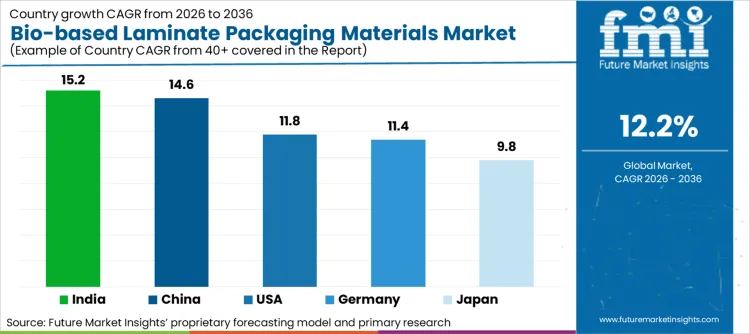
The demand for bio based laminate packaging materials is increasing across food, beverage, and consumer goods packaging where renewable content, sustainability, and regulatory compliance are critical. India leads at 15.2% CAGR, supported by growing packaged goods consumption, government support for eco-friendly materials, and adoption of bio based laminates by domestic brands. China follows at 14.6%, driven by large scale packaging production and incorporation of bio based laminates into domestic and export oriented products.
The USA grows at 11.8%, shaped by corporate sustainability initiatives and rising consumer preference for environmentally responsible packaging. Germany records 11.4%, reflecting strict environmental regulations and demand for certified bio based packaging. Japan posts 9.8%, within a mature packaging market emphasizing quality, compliance, and material traceability.
How Retail and Industrial Packaging Programs Shape the Bio-based Laminate Packaging Materials Market in Germany
The bio-based laminate packaging materials market in Germany is expanding at an 11.4% CAGR as retailers and industrial packaging lines increasingly require sustainable, high-performance films. Materials are evaluated for barrier properties, mechanical strength, heat-seal integrity, and certified compostability. Technical teams assess dimensional stability, moisture and oxygen resistance, and compatibility with automated laminating and filling equipment.
Once validated, films are deployed across multiple production lines and packaging formats. Volume growth aligns with adoption by retail chains, foodservice operations, and institutional programs focused on eco-friendly packaging. Supplier participation depends on certification verification, quality audits, and technical support. Commercial success relies on reproducible barrier performance, operational reliability, and consistency across manufacturing facilities.
How E-Commerce and Distribution Demand Drive the Bio-based Laminate Packaging Materials Market in the USA
In the United States, the bio-based laminate packaging materials market is growing at an 11.8% CAGR due to high-volume packaging demand from e-commerce, retail, and food distribution networks. Material selection emphasizes tensile strength, seal durability, moisture and oxygen barrier performance, and certified compostability. Engineers evaluate dimensional stability, heat-seal reliability, and compatibility with automated laminating and filling lines. Once approved, films are adopted across multiple production lines and packaging applications. Supplier access depends on audit compliance, certification documentation, and technical support. Volume growth tracks expansion of e-commerce logistics, large-scale retail packaging programs, and institutional adoption. Commercial success relies on reproducible performance, operational reliability, and consistent quality across production environments.
How Urban Delivery Programs Shape the Bio-based Laminate Packaging Materials Market in China
Rapid growth in urban e-commerce and logistics is accelerating the bio-based laminate packaging materials market in China at a 14.6% CAGR. Materials are selected based on barrier efficiency, tensile strength, heat-seal performance, and certified compostability suitable for high-speed automated production lines. Technical evaluation includes dimensional stability, moisture and oxygen transmission, and compatibility with laminating and filling machines. Once validated, films are deployed across multiple production lines and product categories. Supplier participation requires audit compliance, documentation accuracy, and operational support. Volume growth corresponds with urban delivery networks, retail programs, and large-scale e-commerce adoption. Commercial advantage relies on reproducible material performance, operational reliability, and process consistency across manufacturing sites.
How Product Safety and Certification Standards Guide the Bio-based Laminate Packaging Materials Market in Japan
In Japan, the bio-based laminate packaging materials market is growing at a 9.8% CAGR due to strict safety standards, food contact regulations, and performance verification requirements. Materials are assessed for mechanical strength, barrier efficiency, heat-seal durability, and certified compostability. Engineers evaluate dimensional stability, print adhesion, and process compatibility with automated laminating and filling operations. Once validated, films are deployed across multiple production lines for retail, foodservice, and institutional applications. Supplier participation depends on certification completeness, audit compliance, and technical support. Volume growth follows adoption by packaged food programs, retail chains, and sustainability-focused initiatives. Commercial success relies on reproducible performance, operational reliability, and consistent quality.
How Platform Expansion and High-Volume Production Drive the Bio-based Laminate Packaging Materials Market in India
India’s bio-based laminate packaging materials market is expanding at a 15.2% CAGR due to large-scale production and increasing adoption by e-commerce, retail, and foodservice packaging programs. Materials are selected for tensile strength, barrier performance, seal integrity, and certified compostability. Technical teams evaluate dimensional stability, thermal performance, and compatibility with high-speed laminating and filling lines. Once approved, films are deployed across multiple production lines and logistics programs. Supplier access relies on certification documentation, audit compliance, and technical support. Volume growth aligns with platform expansion, retail packaging initiatives, and high-volume production programs. Commercial advantage depends on reproducible performance, operational reliability, and process consistency across manufacturing facilities.
What Approaches Are Companies Taking in the Bio-Based Laminate Packaging Materials Market?
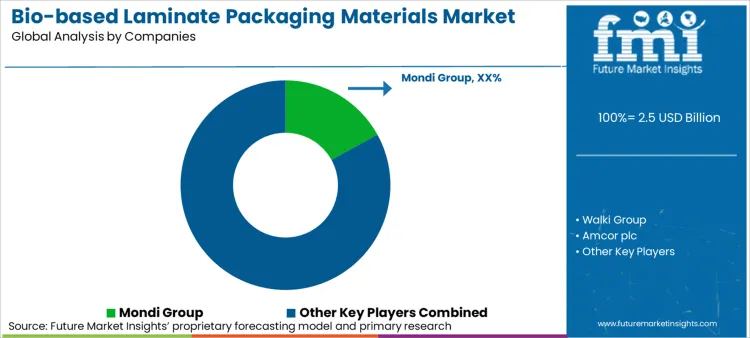
Barrier performance, fiber composition, and production scalability determine adoption in the Bio-Based Laminate Packaging Materials Market. Mondi, Walki, Amcor, Sealed Air, Greatview Aseptic Packaging, Zijiang Enterprise Group, Futamura Chemical, and Toppan compete during pilot lamination, mechanical and barrier testing, and industrial validation. Once incorporated into food, beverage, or consumer packaging, tensile strength, moisture and gas barrier properties, and bio-based content verification anchor supplier selection. Mondi emphasizes industrial-scale laminate solutions with verified bio-based composition.
Walki delivers flexible laminates optimized for protective and sustainable packaging. Amcor targets consumer goods packaging requiring high barrier performance. Sealed Air provides solutions compatible with automated packaging lines. Greatview Aseptic Packaging focuses on aseptic applications with bio-based layers. Zijiang Enterprise Group and Futamura Chemical supply cellulose- or polymer-based laminates. Toppan provides functional laminates combining bio-content with scalable industrial processing.
Film durability, processing reliability, and certification support shape competitive positioning in the Bio-Based Laminate Packaging Materials Market. Engineers assess tensile strength, seal integrity, barrier efficiency, and verified bio-content during trials. Production teams favor suppliers able to provide reproducible lots, scalable output, and technical guidance for integration into automated lines. Mondi maintains adoption through process validation and technical support. Walki secures placements in flexible packaging applications requiring bio-based content.
Amcor captures adoption in high-barrier consumer products. Sealed Air competes where automated line integration is critical. Greatview Aseptic Packaging supports aseptic and liquid packaging programs. Zijiang Enterprise Group and Futamura Chemical provide regionally scaled solutions. Toppan delivers functional laminate solutions with consistent bio-based verification. Market positions vary by laminate composition, production scale, end-use application, and regional environmental regulations.
Key Players in Bio-based Laminate Packaging Materials Market
- Mondi Group
- Walki Group
- Amcor plc
- Sealed Air Corporation
- Greatview Aseptic Packaging Co., Ltd.
- Zijiang Enterprise Group Co., Ltd.
- Futamura Chemical Co., Ltd.
- Toppan Inc.
Scope of the Report
| Items | Values |
|---|---|
| Quantitative Units (2026) | USD billion |
| End-use | Food and beverage packaging, FMCG and retail, mass packaged foods, premium food packs, others |
| Laminate Structure | Paper biofilm laminates, flexible laminates, multi-layer bio-laminates, thin bio-laminates, others |
| Material | PLA or bio-PE or cellulose films, bio-PE or starch blends, PLA or PBS, cellulose films, others |
| Processing or Technology | Solvent-free lamination and barrier coatings, low-temperature lamination, high-speed coating and lamination, precision coating, others |
| Regions Covered | Asia Pacific, Europe, North America, Latin America, Middle East & Africa |
| Countries Covered | United States, Canada, Mexico, Germany, United Kingdom, France, Italy, Spain, Nordics, BENELUX, China, Japan, South Korea, India, Australia & New Zealand, ASEAN, Brazil, Chile, Saudi Arabia, Turkey, South Africa, and other regional markets |
| Key Companies Profiled | Mondi Group, Walki Group, Amcor, Sealed Air, Greatview Aseptic Packaging, Zijiang Enterprise Group, Futamura Chemical, Toppan |
| Additional Attributes | Dollar sales by end-use, laminate structure, material, and processing technology, renewable content and sourcing governance, barrier performance and seal integrity benchmarks, line speed stability and scrap rate tracking, adhesive and tie-layer qualification cycles, machinability and filling line compatibility, shelf-life and print durability testing, multi-year packaging platform contracts, and regional adoption patterns across food, beverage, and FMCG packaging programs |
Bio-based Laminate Packaging Materials Market Segmentation
End-use:
- Food & beverage packaging
- FMCG & retail
- Mass packaged foods
- Premium food packs
- Others
Laminate Structure:
- Paperbiofilm laminates
- Flexible laminates
- Multi-layer bio-laminates
- Thin bio-laminates
- Others
Material:
- PLA or bio-PE or cellulose films
- Bio-PE or starch blends
- PLA or PBS
- Cellulose films
- Others
Processing or Technology:
- Solvent-free lamination & barrier coatings
- Low-temperature lamination
- High-speed coating & lamination
- Precision coating
- Others
Region
Asia Pacific
- China
- Japan
- South Korea
- India
- Australia & New Zealand
- ASEAN
- Rest of Asia Pacific
Europe
- Germany
- United Kingdom
- France
- Italy
- Spain
- Nordic
- BENELUX
- Rest of Europe
North America
- United States
- Canada
- Mexico
Latin America
- Brazil
- Chile
- Rest of Latin America
Middle East & Africa
- Kingdom of Saudi Arabia
- Other GCC Countries
- Turkey
- South Africa
- Other African Union
- Rest of Middle East & Africa
Bibliography
- European Commission. (2024). Packaging and packaging waste. European Commission.
- European Commission. (2024). Policy framework on biobased, biodegradable and compostable plastics. European Commission.
- European Commission. (2024). Substantiating green claims (Green Claims Directive). European Commission.
- European Committee for Standardization. (2024). EN 16640: Bio-based products - Determination of the bio-based carbon content using the radiocarbon method. CEN.
-
Frequently Asked Questions
- How big is the bio-based laminate packaging materials market in 2026? The bio-based laminate packaging materials market is projected to be valued at USD 2.5 billion in 2026.
- What will be the size of the bio-based laminate packaging materials market in 2036? The market size for bio-based laminate packaging materials is projected to reach USD 7.9 billion by 2036.
- How fast will the bio-based laminate packaging materials market grow between 2026 and 2036? Demand for bio-based laminate packaging materials is projected to grow at a 12.2% CAGR between 2026 and 2036.
- Which end-use segment holds a significant share in the bio-based laminate packaging materials market in 2026? In terms of end use, food and beverage packaging are expected to account for a 44% share in 2026.
- Which laminate structure category contributes a major share in the bio-based laminate packaging materials market in 2026? Paper biofilm laminates are expected to represent a 44% share in the bio-based laminate packaging materials market in 2026.
Frequently Asked Questions
How big is the bio-based laminate packaging materials market in 2026?
The global bio-based laminate packaging materials market is estimated to be valued at USD 2.5 billion in 2026.
What will be the size of bio-based laminate packaging materials market in 2036?
The market size for the bio-based laminate packaging materials market is projected to reach USD 7.9 billion by 2036.
How much will be the bio-based laminate packaging materials market growth between 2026 and 2036?
The bio-based laminate packaging materials market is expected to grow at a 12.2% CAGR between 2026 and 2036.
What are the key product types in the bio-based laminate packaging materials market?
The key product types in bio-based laminate packaging materials market are food & beverage packaging, fmcg & retail, mass packaged foods, premium food packs and others.
Which laminate structure segment to contribute significant share in the bio-based laminate packaging materials market in 2026?
In terms of laminate structure, paperbiofilm laminates segment to command 44.0% share in the bio-based laminate packaging materials market in 2026.
Preview the report firsthand - request a free sample
Get SampleGet the brochure for pricing and purchase details.
Get PDFTable of Content
- Executive Summary
- Global Market Outlook
- Demand-side Trends
- Supply-side Trends
- Technology Roadmap Analysis
- Analysis and Recommendations
- Market Overview
- Market Coverage / Taxonomy
- Market Definition / Scope / Limitations
- Market Background
- Market Dynamics
- Drivers
- Restraints
- Opportunity
- Trends
- Scenario Forecast
- Demand in Optimistic Scenario
- Demand in Likely Scenario
- Demand in Conservative Scenario
- Opportunity Map Analysis
- Product Life Cycle Analysis
- Supply Chain Analysis
- Investment Feasibility Matrix
- Value Chain Analysis
- PESTLE and Porter’s Analysis
- Regulatory Landscape
- Regional Parent Market Outlook
- Production and Consumption Statistics
- Import and Export Statistics
- Market Dynamics
- Global Market Analysis 2021 to 2025 and Forecast, 2026 to 2036
- Historical Market Size Value (USD Million) Analysis, 2021 to 2025
- Current and Future Market Size Value (USD Million) Projections, 2026 to 2036
- Y-o-Y Growth Trend Analysis
- Absolute $ Opportunity Analysis
- Global Market Pricing Analysis 2021 to 2025 and Forecast 2026 to 2036
- Global Market Analysis 2021 to 2025 and Forecast 2026 to 2036, By End-use
- Introduction / Key Findings
- Historical Market Size Value (USD Million) Analysis By End-use , 2021 to 2025
- Current and Future Market Size Value (USD Million) Analysis and Forecast By End-use , 2026 to 2036
- Food & beverage packaging
- FMCG & retail
- Mass packaged foods
- Premium food packs
- Others
- Food & beverage packaging
- Y-o-Y Growth Trend Analysis By End-use , 2021 to 2025
- Absolute $ Opportunity Analysis By End-use , 2026 to 2036
- Global Market Analysis 2021 to 2025 and Forecast 2026 to 2036, By Laminate Structure
- Introduction / Key Findings
- Historical Market Size Value (USD Million) Analysis By Laminate Structure, 2021 to 2025
- Current and Future Market Size Value (USD Million) Analysis and Forecast By Laminate Structure, 2026 to 2036
- Paperbiofilm laminates
- Flexible laminates
- Multi-layer bio-laminates
- Thin bio-laminates
- Others
- Paperbiofilm laminates
- Y-o-Y Growth Trend Analysis By Laminate Structure, 2021 to 2025
- Absolute $ Opportunity Analysis By Laminate Structure, 2026 to 2036
- Global Market Analysis 2021 to 2025 and Forecast 2026 to 2036, By Material
- Introduction / Key Findings
- Historical Market Size Value (USD Million) Analysis By Material, 2021 to 2025
- Current and Future Market Size Value (USD Million) Analysis and Forecast By Material, 2026 to 2036
- PLA or bio-PE or cellulose films
- Bio-PE or starch blends
- PLA or PBS
- Cellulose films
- Others
- PLA or bio-PE or cellulose films
- Y-o-Y Growth Trend Analysis By Material, 2021 to 2025
- Absolute $ Opportunity Analysis By Material, 2026 to 2036
- Global Market Analysis 2021 to 2025 and Forecast 2026 to 2036, By Processing or Technology
- Introduction / Key Findings
- Historical Market Size Value (USD Million) Analysis By Processing or Technology, 2021 to 2025
- Current and Future Market Size Value (USD Million) Analysis and Forecast By Processing or Technology, 2026 to 2036
- Solvent-free lamination & barrier coatings
- Low-temperature lamination
- High-speed coating & lamination
- Precision coating
- Others
- Solvent-free lamination & barrier coatings
- Y-o-Y Growth Trend Analysis By Processing or Technology, 2021 to 2025
- Absolute $ Opportunity Analysis By Processing or Technology, 2026 to 2036
- Global Market Analysis 2021 to 2025 and Forecast 2026 to 2036, By Region
- Introduction
- Historical Market Size Value (USD Million) Analysis By Region, 2021 to 2025
- Current Market Size Value (USD Million) Analysis and Forecast By Region, 2026 to 2036
- North America
- Latin America
- Western Europe
- Eastern Europe
- East Asia
- South Asia and Pacific
- Middle East & Africa
- Market Attractiveness Analysis By Region
- North America Market Analysis 2021 to 2025 and Forecast 2026 to 2036, By Country
- Historical Market Size Value (USD Million) Trend Analysis By Market Taxonomy, 2021 to 2025
- Market Size Value (USD Million) Forecast By Market Taxonomy, 2026 to 2036
- By Country
- USA
- Canada
- Mexico
- By End-use
- By Laminate Structure
- By Material
- By Processing or Technology
- By Country
- Market Attractiveness Analysis
- By Country
- By End-use
- By Laminate Structure
- By Material
- By Processing or Technology
- Key Takeaways
- Latin America Market Analysis 2021 to 2025 and Forecast 2026 to 2036, By Country
- Historical Market Size Value (USD Million) Trend Analysis By Market Taxonomy, 2021 to 2025
- Market Size Value (USD Million) Forecast By Market Taxonomy, 2026 to 2036
- By Country
- Brazil
- Chile
- Rest of Latin America
- By End-use
- By Laminate Structure
- By Material
- By Processing or Technology
- By Country
- Market Attractiveness Analysis
- By Country
- By End-use
- By Laminate Structure
- By Material
- By Processing or Technology
- Key Takeaways
- Western Europe Market Analysis 2021 to 2025 and Forecast 2026 to 2036, By Country
- Historical Market Size Value (USD Million) Trend Analysis By Market Taxonomy, 2021 to 2025
- Market Size Value (USD Million) Forecast By Market Taxonomy, 2026 to 2036
- By Country
- Germany
- UK
- Italy
- Spain
- France
- Nordic
- BENELUX
- Rest of Western Europe
- By End-use
- By Laminate Structure
- By Material
- By Processing or Technology
- By Country
- Market Attractiveness Analysis
- By Country
- By End-use
- By Laminate Structure
- By Material
- By Processing or Technology
- Key Takeaways
- Eastern Europe Market Analysis 2021 to 2025 and Forecast 2026 to 2036, By Country
- Historical Market Size Value (USD Million) Trend Analysis By Market Taxonomy, 2021 to 2025
- Market Size Value (USD Million) Forecast By Market Taxonomy, 2026 to 2036
- By Country
- Russia
- Poland
- Hungary
- Balkan & Baltic
- Rest of Eastern Europe
- By End-use
- By Laminate Structure
- By Material
- By Processing or Technology
- By Country
- Market Attractiveness Analysis
- By Country
- By End-use
- By Laminate Structure
- By Material
- By Processing or Technology
- Key Takeaways
- East Asia Market Analysis 2021 to 2025 and Forecast 2026 to 2036, By Country
- Historical Market Size Value (USD Million) Trend Analysis By Market Taxonomy, 2021 to 2025
- Market Size Value (USD Million) Forecast By Market Taxonomy, 2026 to 2036
- By Country
- China
- Japan
- South Korea
- By End-use
- By Laminate Structure
- By Material
- By Processing or Technology
- By Country
- Market Attractiveness Analysis
- By Country
- By End-use
- By Laminate Structure
- By Material
- By Processing or Technology
- Key Takeaways
- South Asia and Pacific Market Analysis 2021 to 2025 and Forecast 2026 to 2036, By Country
- Historical Market Size Value (USD Million) Trend Analysis By Market Taxonomy, 2021 to 2025
- Market Size Value (USD Million) Forecast By Market Taxonomy, 2026 to 2036
- By Country
- India
- ASEAN
- Australia & New Zealand
- Rest of South Asia and Pacific
- By End-use
- By Laminate Structure
- By Material
- By Processing or Technology
- By Country
- Market Attractiveness Analysis
- By Country
- By End-use
- By Laminate Structure
- By Material
- By Processing or Technology
- Key Takeaways
- Middle East & Africa Market Analysis 2021 to 2025 and Forecast 2026 to 2036, By Country
- Historical Market Size Value (USD Million) Trend Analysis By Market Taxonomy, 2021 to 2025
- Market Size Value (USD Million) Forecast By Market Taxonomy, 2026 to 2036
- By Country
- Kingdom of Saudi Arabia
- Other GCC Countries
- Turkiye
- South Africa
- Other African Union
- Rest of Middle East & Africa
- By End-use
- By Laminate Structure
- By Material
- By Processing or Technology
- By Country
- Market Attractiveness Analysis
- By Country
- By End-use
- By Laminate Structure
- By Material
- By Processing or Technology
- Key Takeaways
- Key Countries Market Analysis
- USA
- Pricing Analysis
- Market Share Analysis, 2025
- By End-use
- By Laminate Structure
- By Material
- By Processing or Technology
- Canada
- Pricing Analysis
- Market Share Analysis, 2025
- By End-use
- By Laminate Structure
- By Material
- By Processing or Technology
- Mexico
- Pricing Analysis
- Market Share Analysis, 2025
- By End-use
- By Laminate Structure
- By Material
- By Processing or Technology
- Brazil
- Pricing Analysis
- Market Share Analysis, 2025
- By End-use
- By Laminate Structure
- By Material
- By Processing or Technology
- Chile
- Pricing Analysis
- Market Share Analysis, 2025
- By End-use
- By Laminate Structure
- By Material
- By Processing or Technology
- Germany
- Pricing Analysis
- Market Share Analysis, 2025
- By End-use
- By Laminate Structure
- By Material
- By Processing or Technology
- UK
- Pricing Analysis
- Market Share Analysis, 2025
- By End-use
- By Laminate Structure
- By Material
- By Processing or Technology
- Italy
- Pricing Analysis
- Market Share Analysis, 2025
- By End-use
- By Laminate Structure
- By Material
- By Processing or Technology
- Spain
- Pricing Analysis
- Market Share Analysis, 2025
- By End-use
- By Laminate Structure
- By Material
- By Processing or Technology
- France
- Pricing Analysis
- Market Share Analysis, 2025
- By End-use
- By Laminate Structure
- By Material
- By Processing or Technology
- India
- Pricing Analysis
- Market Share Analysis, 2025
- By End-use
- By Laminate Structure
- By Material
- By Processing or Technology
- ASEAN
- Pricing Analysis
- Market Share Analysis, 2025
- By End-use
- By Laminate Structure
- By Material
- By Processing or Technology
- Australia & New Zealand
- Pricing Analysis
- Market Share Analysis, 2025
- By End-use
- By Laminate Structure
- By Material
- By Processing or Technology
- China
- Pricing Analysis
- Market Share Analysis, 2025
- By End-use
- By Laminate Structure
- By Material
- By Processing or Technology
- Japan
- Pricing Analysis
- Market Share Analysis, 2025
- By End-use
- By Laminate Structure
- By Material
- By Processing or Technology
- South Korea
- Pricing Analysis
- Market Share Analysis, 2025
- By End-use
- By Laminate Structure
- By Material
- By Processing or Technology
- Russia
- Pricing Analysis
- Market Share Analysis, 2025
- By End-use
- By Laminate Structure
- By Material
- By Processing or Technology
- Poland
- Pricing Analysis
- Market Share Analysis, 2025
- By End-use
- By Laminate Structure
- By Material
- By Processing or Technology
- Hungary
- Pricing Analysis
- Market Share Analysis, 2025
- By End-use
- By Laminate Structure
- By Material
- By Processing or Technology
- Kingdom of Saudi Arabia
- Pricing Analysis
- Market Share Analysis, 2025
- By End-use
- By Laminate Structure
- By Material
- By Processing or Technology
- Turkiye
- Pricing Analysis
- Market Share Analysis, 2025
- By End-use
- By Laminate Structure
- By Material
- By Processing or Technology
- South Africa
- Pricing Analysis
- Market Share Analysis, 2025
- By End-use
- By Laminate Structure
- By Material
- By Processing or Technology
- USA
- Market Structure Analysis
- Competition Dashboard
- Competition Benchmarking
- Market Share Analysis of Top Players
- By Regional
- By End-use
- By Laminate Structure
- By Material
- By Processing or Technology
- Competition Analysis
- Competition Deep Dive
- Mondi Group
- Overview
- Product Portfolio
- Profitability by Market Segments (Product/Age /Sales Channel/Region)
- Sales Footprint
- Strategy Overview
- Marketing Strategy
- Product Strategy
- Channel Strategy
- Walki Group
- Amcor plc
- Sealed Air Corporation
- Greatview Aseptic Packaging Co., Ltd.
- Zijiang Enterprise Group Co., Ltd.
- Futamura Chemical Co., Ltd.
- Toppan Inc.
- Mondi Group
- Competition Deep Dive
- Assumptions & Acronyms Used
- Research Methodology


