

- Industry Size (2025)
- USD 302.8 Mn
- Forecast (2035)
- USD 460.2 Mn
- CAGR (2025 to 2035)
- 4.3%
Demand for MDO-PE Films in USA 2025 to 2035
The demand for MDO-PE films in the USA is valued at USD 302.8 million in 2025 and is expected to reach USD 460.2 million by 2035, reflecting a CAGR of 4.3%. Growth is driven by the transition toward lightweight, recyclable flexible packaging and the shift away from multi-material laminates that complicate waste recovery. Food, personal care, and household product brands continue to adopt MDO-PE structures to improve sustainability credentials while maintaining shelf performance.
Liners and lidding films lead USAge due to their strength, clarity, and sealing performance across modified atmosphere packaging and high-volume retail packs. Advancements in machine direction orientation improve puncture resistance and material stiffness, enabling downgauging without compromising product protection. Compatibility with mono-PE recycling streams strengthens customer preference as regulatory frameworks place pressure on packaging circularity.
The West, South, and Northeast regions show strong adoption due to concentrated flexible packaging converting operations and greater sustainability investments from brand owners. Key suppliers include Coveris Holdings Inc., Avery Dennison Corporation, SAES Coated Films S.p.A., Lenzing Plastics GmbH & Co. KG, and RKW Group. Their strategies focus on high-barrier coatings, improved heat-seal layers, and scalable supply to meet converter requirements for recyclable film structures.
Quick Stats for USA MDO-PE Films Demand
- USA MDO-PE Films Sales Value (2025): USD 302.8 million
- USA MDO-PE Films Forecast Value (2035): USD 460.2 million
- USA MDO-PE Films Forecast CAGR (2025–2035): 4.3%
- Leading Packaging Format in USA MDO-PE Films Demand: Liners and Lidding Films
- Key Growth Regions in USA MDO-PE Films Demand: West USA, South USA, Northeast USA
- Top Players in USA MDO-PE Films Demand: Coveris Holdings Inc., Avery Dennison Corporation, SAES Coated Films S.p.A., Lenzing Plastics GmbH & Co. KG, RKW Group
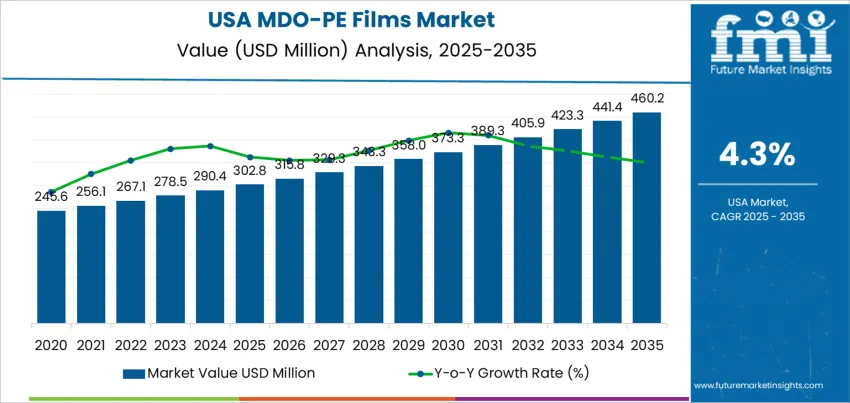
What is the Growth Forecast for MDO-PE Films Industry in USA through 2035?
Demand for MDO-PE films in the United States moves through distinct performance phases shaped by packaging sustainability goals and resin supply consistency. The peak phase aligns with strong industry focus on recyclable mono-material flexible packaging. Brand owners seek to replace multilayer laminates with MDO-PE constructions to meet recyclability targets and reduce environmental impact. This creates a high adoption trajectory in key packaging categories such as food pouches, e-commerce mailers, and personal care products, where downgauging and print clarity offer functional advantages.
The trough phase appears when supply constraints and processing limitations affect downstream converters. Variability in mechanical properties, sealing performance, and long qualification cycles at major packaging users can temporarily restrict growth. Price sensitivity in commodity packaging and dependence on extrusion alignment technology introduce further dips in momentum. During these periods, converters may revert to familiar film structures with established performance profiles.
Recovery typically follows as resin quality improves and film production lines are optimized for consistent orientation outputs. The development of recyclable barrier coatings also supports upward movement after a trough. This produces a cyclical pattern in the United States where peaks reflect sustainability-driven investments and troughs reflect operational and performance adjustments before renewed scaling.
USA MDO-PE Films Key Takeaways
| Metric | Value |
|---|---|
| USA MDO-PE Films Sales Value (2025) | USD 302.8 million |
| USA MDO-PE Films Forecast Value (2035) | USD 460.2 million |
| USA MDO-PE Films Forecast CAGR (2025-2035) | 4.3% |
Why is the Demand for MDO-PE Films in the USA Growing?
Demand for machine direction oriented polyethylene films in the USA is increasing because consumer goods companies and packaging producers require lightweight and recyclable flexible packaging. MDO PE films provide enhanced strength, clarity and stiffness while using less raw material compared with standard polyethylene films. This supports cost efficiency and sustainability objectives for food packaging, personal care items and household products.
Retail brands incorporate MDO PE films into stand up pouches, form fill seal packaging and lidding applications where durability and shelf presence are important. Many packaging buyers prefer mono material structures because they simplify recycling processes and align with circular economy goals. E commerce shipping and warehouse distribution trends also support films that withstand handling without adding package weight. Manufacturers improve performance by optimizing orientation processes that enhance sealing properties and print quality. Constraints include capital investment for equipment upgrades and limited barrier performance for highly sensitive products. Some applications still require multilayer structures to maintain product quality.
Which Packaging Formats, Processes, and Materials Lead Demand for MDO-PE Films in the USA?
Demand for machine-direction-oriented polyethylene (MDO-PE) films in the United States is driven by sustainability initiatives replacing multi-layer plastics with recyclable mono-material structures. These films support high printability, stiffness, and downgauging benefits for food and personal care packaging. Major brand owners adopt MDO-PE to comply with extended producer responsibility (EPR) laws and retailer sustainability criteria. Growth reflects alignment with recyclable PE stream compatibility, improved barrier performance, and operational efficiency within North America’s converting infrastructure.
By Packaging Format, Liners and Lidding Films Lead Demand
Liners and lidding films represent 28.0%, driven by their widespread use in fresh food, dairy, and ready-meal packaging requiring durability and sealing integrity. Pouches hold 27.7%, supported by lightweight flexible alternatives replacing rigid packaging formats. Tubes account for 26.0%, especially in personal care and household categories seeking recyclable mono-PE structures. Bags and sacks contribute 12.3%, mainly for dry foods and consumer goods. Sachets and stick packs hold 6.0%, limited by barrier constraints in small-portion packaging. Packaging selection correlates with lightweighting strategies, improved oxygen/moisture protection, and shelf presentation across large retail chains in the USA.
Key Points:
- Lidding formats gain traction in food-grade sealing applications
- Pouches and tubes drive mono-material flexible packaging adoption
- Value growth tied to replacement of multi-material laminates
By Manufacturing Process, Blown Films Dominate
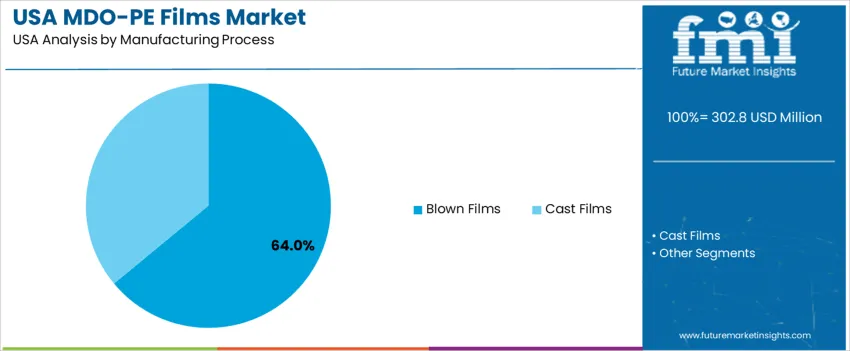
Blown film processing captures 64.0%, reflecting its efficiency in producing high-strength, downgauged films suitable for heavy-duty packaging. Cast film accounts for 36.0%, mainly used for premium appearance, clarity, and tight gauge control in label and hygiene packaging. U.S. converters prefer blown film lines due to compatibility with recycled and bio-based PE grades, process flexibility, and alignment with mass-market food packaging requirements.
Key Points:
- Blown films lead due to high strength-to-weight performance
- Cast films support consistency in appearance-sensitive product lines
- Process selection driven by application durability and barrier needs
By Material, HDPE Leads Use
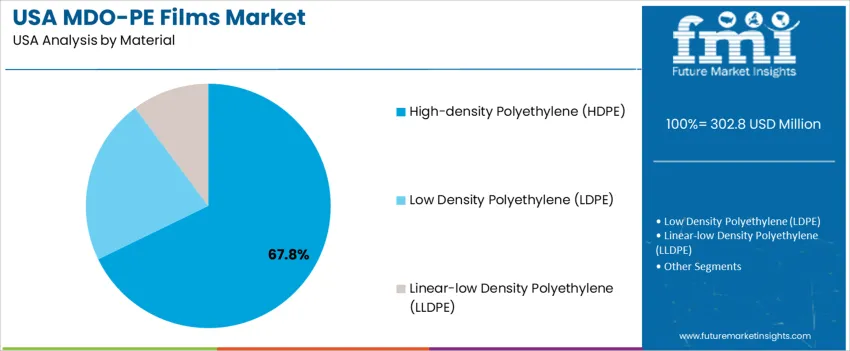
High-density polyethylene (HDPE) holds 67.8%, favored for mechanical toughness, puncture resistance, and recyclability in Store Drop-off programs. Low-density polyethylene (LDPE) represents 22.0%, valued for flexibility and sealing behavior. Linear-low-density polyethylene (LLDPE) accounts for 10.2%, providing enhanced stretch and impact strength in selective packaging loads. Material USAge reflects U.S. efforts to scale mono-PE solutions meeting circular economy requirements and reduce dependency on mixed polymer laminates.
Key Points:
- HDPE supports durability and recycling integration
- LDPE improves sealing and forming performance
- LLDPE enhances toughness in downgauged films
What are the Drivers, Restraints, and Key Trends of the Demand for MDO-PE Films in the USA?
Growth of recyclable packaging adoption, increased focus on downgauging and strong demand from food and consumer goods packaging drive demand.
In the United States, machine-direction-oriented polyethylene films are gaining traction as brands and retailers transition away from multi-material laminates toward structures that support recyclable packaging goals. MDO-PE films deliver improved stiffness, transparency and print quality, making them suitable for pouches, snack packaging and personal-care products traditionally dominated by oriented polypropylene or polyester. Food manufacturers value their sealability and durability for frozen, bakery and dry-food formats. Major retail chains request mono-material packaging to meet sustainability commitments, reinforcing procurement of MDO-PE films in national supply networks. Growth in e-commerce and consumer convenience packaging also contributes to rising consumption.
Higher processing cost, compatibility challenges in existing converting lines and performance limitations in high-barrier applications restrain demand.
Production of MDO-PE films requires specialized stretching and precise process control, which increases initial investment and limits participation to converters with advanced equipment. Some packaging lines require modification to manage film shrinkage and maintain seal performance, creating hesitation among converters focused on stability in high-speed operations. In moisture-sensitive or oxygen-sensitive food categories, MDO-PE structures may still require additional barrier layers, limiting conversion from established laminates where barrier requirements remain stringent. These operational and performance considerations moderate rapid adoption across all end-use packaging segments.
Shift toward mono-PE laminates, increased demand for recyclable stand-up pouches and rising focus on advanced barrier coatings define key trends.
Packaging developers replace multilayer plastics with MDO-PE based designs compatible with polyethylene recycling streams, aligning with retail sustainability scorecards and voluntary recycling initiatives. Stand-up pouches continue to grow in snacks, pet food and household essentials, increasing trial of MDO-PE films for improved stiffness and shelf presentation. Research and commercialization of coatings such as EVOH-enhanced layers or plasma-applied surfaces aim to improve barrier protection while preserving recyclability. Printability improvements support branding flexibility in premium consumer goods. These developments indicate strong, sustainability-driven demand for MDO-PE films across the United States flexible packaging sector.
Analysis of the Demand for MDO-PE Films in the USA by Region
Demand for mono-oriented polyethylene (MDO-PE) films in the United States is rising due to sustainability mandates, downgauging strategies, and brand transitions toward recyclable flexible packaging formats. Adoption is driven by food packaging innovation, heat-resistant properties for label stock, and improved print performance compared with traditional PE film structures. Regional converters increasingly substitute multilayer laminates with recyclable MDO-PE solutions to comply with packaging circularity goals. West USA leads with 4.9% CAGR, followed by South USA at 4.4%, Northeast USA at 3.9%, and Midwest USA at 3.4%. Growth strength aligns with infrastructure for food processing, packaging automation investments, and regional resin availability for extrusion operations supporting major flexible packaging buyers.
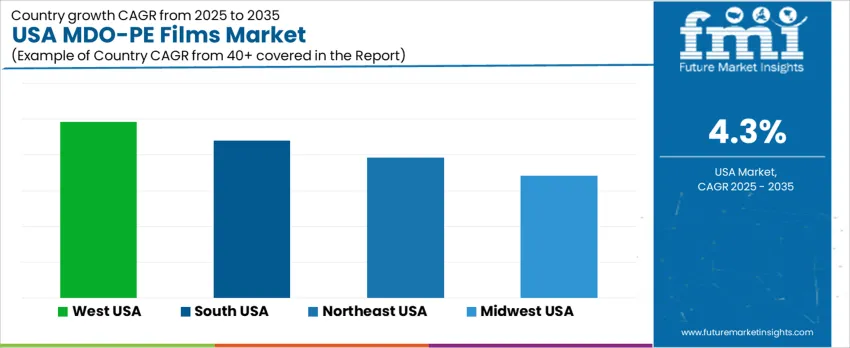
| Region | CAGR (2025-2035) |
|---|---|
| West USA | 4.9% |
| South USA | 4.4% |
| Northeast USA | 3.9% |
| Midwest USA | 3.4% |
How is the West USA driving demand for MDO-PE films?
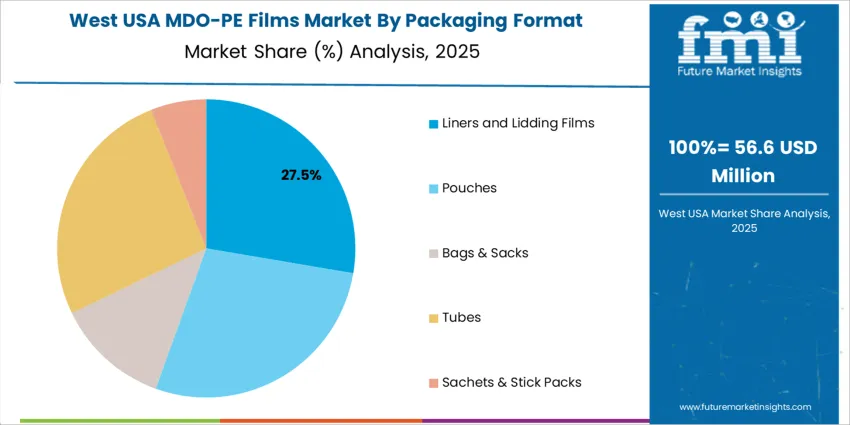
West USA grows at 4.9% CAGR, supported by advanced packaging-converter clusters in California, Washington, and Oregon that integrate MDO production into recyclable flexible packaging supply chains. Consumer packaged goods brands in the region continue converting snack, produce, and frozen-food formats into mono-material designs for circular-economy compliance. Retailers active in private-label expansions seek films compatible with high-graphics printing and excellent stiffness-to-thickness ratio. Access to port-driven logistics strengthens resin sourcing for extrusion. Sustainability laws such as California’s EPR framework push procurement teams to replace complex multilayer films with recyclable alternatives. Automated filling lines in food plants demand consistent film mechanical strength, clarity, and sealability.
- Packaging-converter upgrades supporting recyclability alignment
- Private-label adoption improving mono-material penetration
- Port logistics enabling optimized resin movement
- EPR regulations accelerating film-structure substitution
How is the South USA shaping MDO-PE film consumption?
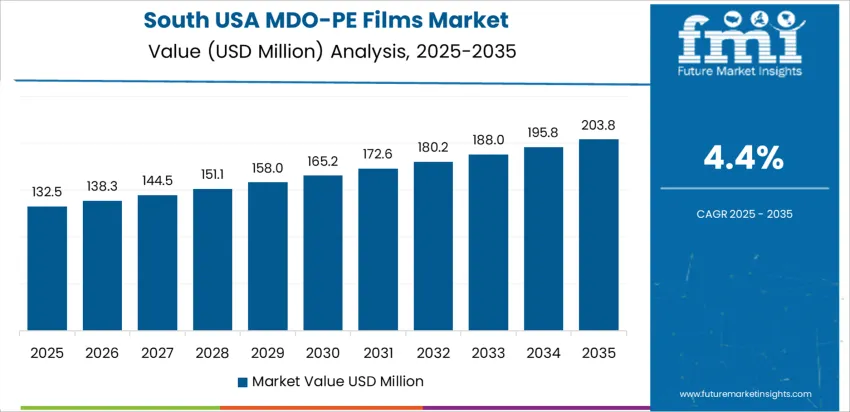
South USA records 4.4% CAGR, driven by large-scale flexible-packaging manufacturing and food-processing facilities across Texas, Georgia, and North Carolina. Growth stems from increased consumption of packaged poultry, snacks, sauces, and bakery products requiring strong seal-performance films. Resin production and supply-chain proximity in Gulf Coast states provide cost-competitive access to extrusion raw material. Convertors emphasize downgauging and energy-efficient orientation equipment to support cost-reduction targets. Consumer-goods producers deploy MDO-PE film for pouches and wrap applications, requiring barrier-coating compatibility. Retail distribution expansion across Southeastern metros creates larger buying volumes, enabling longer production runs and improved procurement visibility.
- High-volume food processors expanding film intake
- Resin proximity reducing supply cost volatility
- Shelf-stable food growth reinforcing pouch demand
- Distribution-center expansion widening packaging throughput
What is driving demand in the Northeast USA?
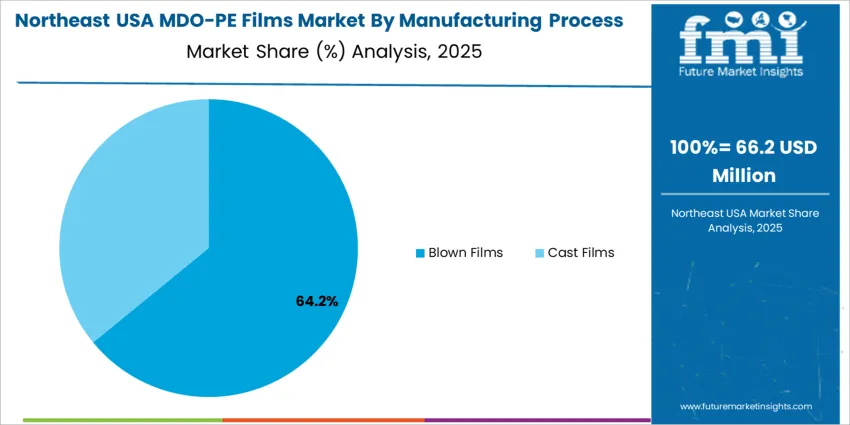
Northeast USA expands at 3.9% CAGR, supported by high-density retail environments and standardized packaging used across frozen-food and ready-meal categories. CPG brands focused on sustainability commit to transitioning key SKUs into MDO-PE film to meet retailer scorecard requirements. Healthcare and personal-care manufacturers adopt film structures with enhanced printability and tear resistance, suitable for labeled or over-wrap formats. Compact production facilities emphasize quick-changeover capability in extrusion and printing to accommodate multiple design SKUs. Cost considerations and storage-capacity limits encourage procurement of optimized roll sizes aligned with space-restricted warehousing typical in the region.
- Sustainability-aligned procurement in urban retail channels
- Personal-care and healthcare over-wrap USAge increasing
- Flexible production set-ups enabling SKU agility
- Packaging scorecards pushing recyclable formats
How is the Midwest USA contributing to demand growth?
Midwest USA grows at 3.4% CAGR, shaped by established frozen-food manufacturing clusters, processed meat packaging, and cereal/snack distribution. Film buyers rely on durable seal-integrity and puncture resistance for heavy packaging loads transported across long hauls to national retail networks. Procurement teams evaluate recyclability claims, ensuring compatibility with store-drop or PE-stream recycling participation programs where available. Existing converters operate large-footprint extrusion and printing sites geared toward cost-efficient runs rather than rapid expansion. Buyers emphasize consistent supply availability and resin-price stability over novel feature introductions.
- Frozen and processed food packers underpin base demand
- Cost-efficiency central to converter procurement decisions
- Long-haul distribution shaping material-strength requirements
- Recyclability compliance influencing supplier qualification
How is competitive positioning distributed among suppliers of MDO-PE films in the United States, and which firms lead supply?
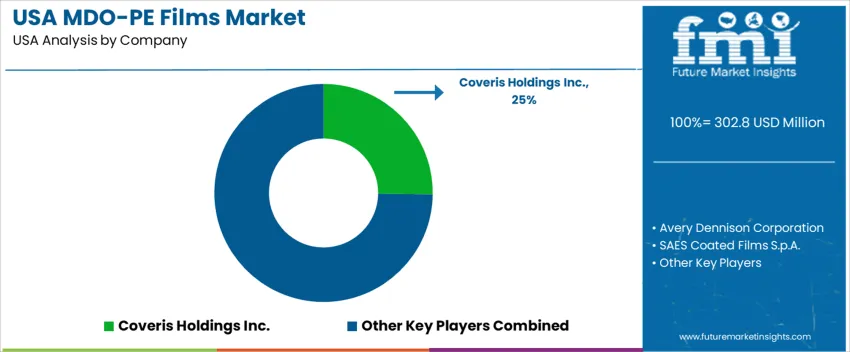
In the United States, demand for MDO-PE (machine-direction oriented polyethylene) film is driven by packaging needs requiring high clarity, tear resistance, puncture resistance, and controlled barrier properties such as snack bags, food pouches, and flexible packaging for perishable goods. Suppliers must ensure consistent film stretching quality, standard-grade resins, and compliance with FDA food-contact regulations. Volume buyers, co-packers and brand owners prioritize suppliers with stable supply chains, technical support, and scalability.
Coveris Holdings Inc. is estimated to hold around 25.2% share, supported by its broad North American manufacturing footprint, ability to offer custom gauge and barrier grades, and long-term relationships with major food and consumer-goods companies. Its scale and product range give it a clear advantage for high-volume contract manufacturing and private-label packaging.
Avery Dennison Corporation competes through specialty film products focusing on added functionality such as label integration, printability, or enhanced sealing favored by brands requiring high shelf appeal. Its global logistics and strong R&D support retention among mid-to-high tier clients. SAES Coated Films S.p.A. positions itself in performance-sensitive niches requiring metallized or coated MDO-PE for oxygen/moisture barrier enhancement. Its adoption increases where brands balance cost and barrier performance demands.
Lenzing Plastics GmbH & Co. KG and RKW Group serve industries requiring custom film constructions and European-grade processing standards; they remain relevant for specialty products, small-batch runs, or clients sourcing globally. Competitive advantage depends on consistent film mechanical properties, barrier performance, supply stability, and regulatory compliance for food contact. Suppliers that combine these with flexible ordering and strong technical service maintain durable positioning in the U.S. MDO-PE film packaging sector.
Key Players in USA MDO-PE Films Demand
- Coveris Holdings Inc.
- Avery Dennison Corporation
- SAES Coated Films S.p.A.
- Lenzing Plastics GmbH & Co. KG
- RKW Group
Scope of the Report
| Items | Values |
|---|---|
| Quantitative Units | USD million |
| Packaging Format | Liners and Lidding Films, Pouches, Bags & Sacks, Tubes, Sachets & Stick Packs |
| Manufacturing Process | Blown Films, Cast Films |
| Material | High-density Polyethylene (HDPE), Low Density Polyethylene (LDPE), Linear-low Density Polyethylene (LLDPE) |
| End Use | Beverages, Food, Hygiene, Homecare, Personal Care |
| Regions Covered | West USA, South USA, Northeast USA, Midwest USA |
| Key Companies Profiled | Coveris Holdings Inc., Avery Dennison Corporation, SAES Coated Films S.p.A., Lenzing Plastics GmbH & Co. KG, RKW Group |
| Additional Attributes | Dollar sales by packaging format, material, and end-use; adoption shift toward recyclable mono-material structures; regional growth driven by food and hygiene packaging; increasing demand for downgauging and high-stiffness films; sustainability compliance with extended producer responsibility (EPR) programs; advancements in orientation processes improving clarity and barrier performance. |
USA MDO-PE Films Demand by Segments
Packaging Format:
- Liners and Lidding Films
- Pouches
- Bags & Sacks
- Tubes
- Sachets & Stick Packs
Manufacturing Process:
- Blown Films
- Cast Films
Material:
- High-density Polyethylene (HDPE)
- Low Density Polyethylene (LDPE)
- Linear-low Density Polyethylene (LLDPE)
End Use:
- Beverages
- Food
- Hygiene
- Homecare
- Personal Care
Region:
- West USA
- South USA
- Northeast USA
- Midwest USA
Frequently Asked Questions
How big is the demand for MDO-PE films in USA in 2025?
The demand for MDO-PE films in USA is estimated to be valued at USD 302.8 million in 2025.
What will be the size of MDO-PE films in USA in 2035?
The market size for the MDO-PE films in USA is projected to reach USD 460.2 million by 2035.
How much will be the demand for MDO-PE films in USA growth between 2025 and 2035?
The demand for MDO-PE films in USA is expected to grow at a 4.3% CAGR between 2025 and 2035.
What are the key product types in the MDO-PE films in USA?
The key product types in MDO-PE films in USA are liners and lidding films, pouches, bags & sacks, tubes and sachets & stick packs.
Which manufacturing process segment is expected to contribute significant share in the MDO-PE films in USA in 2025?
In terms of manufacturing process, blown films segment is expected to command 64.0% share in the MDO-PE films in USA in 2025.
Preview the report firsthand - request a free sample
Get SampleGet the brochure for pricing and purchase details.
Get PDFTable of Content
- Executive Summary
- USA Market Outlook
- Demand-side Trends
- Supply-side Trends
- Technology Roadmap Analysis
- Analysis and Recommendations
- Market Overview
- Market Coverage / Taxonomy
- Market Definition / Scope / Limitations
- Market Background
- Market Dynamics
- Drivers
- Restraints
- Opportunity
- Trends
- Scenario Forecast
- Demand in Optimistic Scenario
- Demand in Likely Scenario
- Demand in Conservative Scenario
- Opportunity Map Analysis
- Product Life Cycle Analysis
- Supply Chain Analysis
- Investment Feasibility Matrix
- Value Chain Analysis
- PESTLE and Porter’s Analysis
- Regulatory Landscape
- Regional Parent Market Outlook
- Production and Consumption Statistics
- Import and Export Statistics
- Market Dynamics
- USA Market Analysis 2020 to 2024 and Forecast, 2025 to 2035
- Historical Market Size Value (USD Million) Analysis, 2020 to 2024
- Current and Future Market Size Value (USD Million) Projections, 2025 to 2035
- Y-o-Y Growth Trend Analysis
- Absolute $ Opportunity Analysis
- USA Market Pricing Analysis 2020 to 2024 and Forecast 2025 to 2035
- USA Market Analysis 2020 to 2024 and Forecast 2025 to 2035, By Packaging Format
- Introduction / Key Findings
- Historical Market Size Value (USD Million) Analysis By Packaging Format , 2020 to 2024
- Current and Future Market Size Value (USD Million) Analysis and Forecast By Packaging Format , 2025 to 2035
- Liners and Lidding Films
- Pouches
- Bags & Sacks
- Tubes
- Sachets & Stick Packs
- Y-o-Y Growth Trend Analysis By Packaging Format , 2020 to 2024
- Absolute $ Opportunity Analysis By Packaging Format , 2025 to 2035
- USA Market Analysis 2020 to 2024 and Forecast 2025 to 2035, By Manufacturing Process
- Introduction / Key Findings
- Historical Market Size Value (USD Million) Analysis By Manufacturing Process, 2020 to 2024
- Current and Future Market Size Value (USD Million) Analysis and Forecast By Manufacturing Process, 2025 to 2035
- Blown Films
- Cast Films
- Y-o-Y Growth Trend Analysis By Manufacturing Process, 2020 to 2024
- Absolute $ Opportunity Analysis By Manufacturing Process, 2025 to 2035
- USA Market Analysis 2020 to 2024 and Forecast 2025 to 2035, By Material
- Introduction / Key Findings
- Historical Market Size Value (USD Million) Analysis By Material, 2020 to 2024
- Current and Future Market Size Value (USD Million) Analysis and Forecast By Material, 2025 to 2035
- High-density Polyethylene (HDPE)
- Low Density Polyethylene (LDPE)
- Linear-low Density Polyethylene (LLDPE)
- Y-o-Y Growth Trend Analysis By Material, 2020 to 2024
- Absolute $ Opportunity Analysis By Material, 2025 to 2035
- USA Market Analysis 2020 to 2024 and Forecast 2025 to 2035, By End Use
- Introduction / Key Findings
- Historical Market Size Value (USD Million) Analysis By End Use, 2020 to 2024
- Current and Future Market Size Value (USD Million) Analysis and Forecast By End Use, 2025 to 2035
- Beverages
- Food
- Hygiene
- Homecare
- Personal Care
- Y-o-Y Growth Trend Analysis By End Use, 2020 to 2024
- Absolute $ Opportunity Analysis By End Use, 2025 to 2035
- Market Structure Analysis
- Competition Dashboard
- Competition Benchmarking
- Market Share Analysis of Top Players
- By Regional
- By Packaging Format
- By Manufacturing Process
- By Material
- By End Use
- Competition Analysis
- Competition Deep Dive
- Coveris Holdings Inc.
- Overview
- Product Portfolio
- Profitability by Market Segments (Product/Age /Sales Channel/Region)
- Sales Footprint
- Strategy Overview
- Marketing Strategy
- Product Strategy
- Channel Strategy
- Avery Dennison Corporation
- SAES Coated Films S.p.A.
- Lenzing Plastics GmbH & Co. KG
- RKW Group
- Coveris Holdings Inc.
- Competition Deep Dive
- Assumptions & Acronyms Used
- Research Methodology


