

- Industry Size (2026)
- USD 1.5 Bn
- Forecast (2036)
- USD 4.3 Bn
- CAGR (2026 to 2036)
- 11.1%
PET Depolymerization Technology Market Forecast and Outlook 2026 to 2036
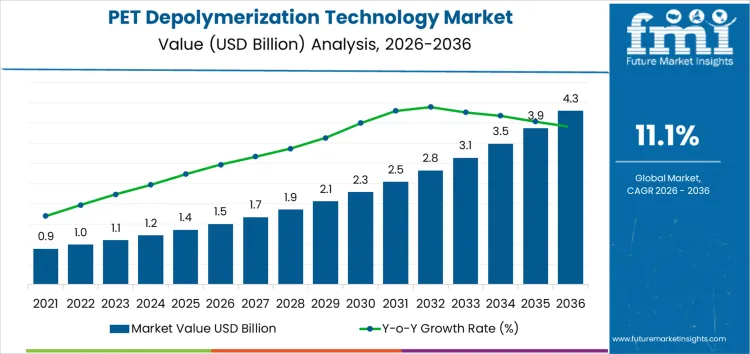
The PET depolymerization technology market is valued at USD 1.5 billion in 2026 and is projected to reach USD 4.3 billion by 2036, reflecting a CAGR of 11.1%. Adoption across this period is shaped by regulatory oversight governing chemical recycling outputs, feedstock traceability, and end use approvals. Compliance costs related to permitting, emissions control, and waste handling raise capital thresholds for new entrants. Certification requirements for food grade and industrial reuse constrain rapid scale up. Vendors with early regulatory alignment achieve faster customer acceptance. Smaller developers face longer validation cycles, increasing financing risk. As a result, deployment favors firms with regulatory experience and balance sheet capacity to absorb approval delays.
From 2026 to 2036, vendor positioning increasingly reflects the ability to navigate certification complexity rather than processing efficiency alone. Buyers favor suppliers with approved pathways across multiple jurisdictions, reducing compliance exposure in downstream applications. Regulatory audits and documentation standards elevate operating costs but also limit supplier substitution. Firms offering certified outputs gain pricing resilience despite higher production expenses. Compliance readiness becomes a competitive filter, concentrating adoption among established operators. Technology differentiation narrows as regulatory frameworks standardize evaluation criteria. Value accrues to vendors integrating regulatory management into commercial offerings, allowing customers to externalize approval risk while securing long term supply agreements under predictable compliance conditions.
Quick Stats for PET Depolymerization Technology Market
- PET Depolymerization Technology Market Value (2026): USD 1.5 billion
- PET Depolymerization Technology Market Forecast Value (2036): USD 4.3 billion
- PET Depolymerization Technology Market Forecast CAGR (2026 to 2036): 11.1%
- Leading Type in PET Depolymerization Technology Market: Glycolysis systems
- Key Growth Regions in PET Depolymerization Technology Market: Asia Pacific, Europe, North America
- Top Players in PET Depolymerization Technology Market: Eastman, BASF, Zhejiang Wankai, Reliance Industries, Teijin, Loop Industries, Carbios
What Is the Growth Forecast for PET Depolymerization Technology Market through 2036?
From 2026 to 2031, the PET depolymerization technology market increases from USD 1.5 billion to USD 2.2 billion, reflecting a measured rolling CAGR supported by gradual scale up of commercial operations. Annual values progress steadily from USD 1.0 billion to USD 1.5 billion, indicating controlled year over year compounding rather than rapid acceleration. Historical growth was limited by high processing costs, pilot scale deployment, and narrow downstream integration. In this phase, rolling growth is driven by incremental capacity additions, validation of chemical recycling pathways, and early adoption by packaging and polyester producers seeking stable feedstock recovery options.
Between 2031 and 2036, the market expands from USD 2.2 billion to USD 4.3 billion, resulting in a noticeably higher rolling CAGR. Annual values rise from USD 2.4 billion to USD 4.3 billion, reflecting stronger compounding effects over successive years. Earlier growth focused on technical feasibility and limited commercialization, while future expansion is shaped by larger scale facilities, improved process efficiency, and deeper integration into PET resin supply chains. Rising utilization rates, shorter commissioning timelines, and broader adoption across packaging, textiles, and industrial polymers support faster rolling CAGR progression during the latter period.
PET Depolymerization Technology Market Key Takeaways
| Metric | Value |
|---|---|
| Market Value (2026) | USD 1.5 billion |
| Forecast Value (2036) | USD 4.3 billion |
| Forecast CAGR (2026 to 2036) | 11.1% |
What Is Driving the Growth of the PET Depolymerization Technology Market?
Growth in the PET depolymerization technology market reflects a convergence of material quality demands and regulatory pressure rather than incremental recycling improvements alone. Traditional mechanical recycling of polyethylene terephthalate (PET) produces downgraded resin with lower molecular weight and inferior clarity, limiting its reuse in high-performance applications such as food and beverage packaging. Depolymerization technologies chemically break PET into monomers or oligomers that can be repolymerised into high-quality PET with properties close to virgin material. This capability addresses a fundamental supply chain gap: recycled PET that meets stringent quality and safety standards.
Market growth is also driven by policy frameworks that establish defined recycled content targets and restrict landfill disposal of plastics. Governments in Europe, North America, and parts of Asia have introduced or are finalising mandates requiring minimum recycled PET content in packaging within specific timelines. Compliance with these mandates creates a structural requirement for scalable depolymerization capacity that can deliver feedstock suitable for direct use in closed-loop applications. Industrial stakeholders face pressure to demonstrate compliance through documented material tracing and quality assurance programmes, reinforcing investment in technologies that produce chemically recycled PET with traceable purity. Advances in catalyst systems, reactor design, and feedstock preconditioning are improving process efficiency and lowering operational costs, making depolymerization more competitive with virgin resin production.
What Factors Are Affecting the Demand for PET Depolymerization Technology Market in Terms of Technology Type and Feedstock?
The PET depolymerization technology market is driven by regulatory pressure on plastic waste, brand commitments to recycled content, and limitations of mechanical recycling for food grade applications. Demand focuses on chemical recycling routes that restore polymer quality and enable closed loop recycling. Market leadership reflects technical maturity, feedstock compatibility, and scalability rather than experimental yield performance. Adoption patterns are shaped by availability of PET waste streams and integration with downstream polymerization infrastructure.
What Is Driving Leadership by Technology Type in the PET Depolymerization Technology Market?
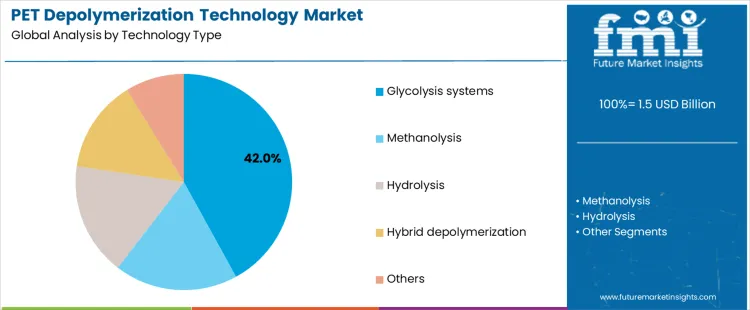
Glycolysis systems account for about 42% of demand because they represent the most commercially mature and operationally flexible depolymerization route for PET. These systems operate under moderate temperature and pressure conditions, reducing capital intensity and operational complexity. Glycolysis produces BHET intermediates that can be purified and repolymerized into high quality PET suitable for packaging and textiles. Process tolerance to variable contamination levels makes glycolysis suitable for mixed post-consumer streams. Existing pilot and commercial plants reinforce confidence among investors and brand owners. Integration with established PET manufacturing infrastructure further supports adoption. These factors position glycolysis as the preferred entry point for chemical recycling of PET at scale.
Methanolysis, hydrolysis, hybrid systems, and other approaches expand the technology landscape but remain less dominant. Methanolysis delivers high purity monomers but requires higher pressure and solvent recovery systems, increasing cost. Hydrolysis offers flexibility but faces corrosion and energy challenges. Hybrid approaches aim to optimize yield across feedstocks but add process complexity. These alternatives are applied selectively where feedstock composition or product purity requirements justify higher investment. Technology leadership therefore reflects balance between scalability, cost, and operational robustness rather than theoretical conversion efficiency.
What Is Driving Leadership by Feedstock in the PET Depolymerization Technology Market?
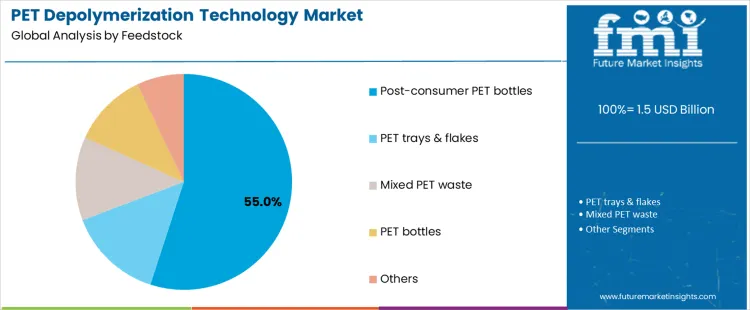
Post-consumer PET bottles represent about 55% of feedstock demand because they offer the most consistent and abundant waste stream. Bottle grade PET has relatively uniform polymer composition, established collection systems, and high recycling incentives driven by beverage brand commitments. This predictability simplifies process design and product quality control. Depolymerization plants prioritize bottle feedstock to secure stable input volumes and reduce preprocessing costs. Regulatory frameworks supporting bottle collection further reinforce feedstock leadership. As a result, most commercial projects are designed around bottle based supply chains.
PET trays, flakes, and mixed PET waste contribute secondary feedstock volumes. Trays and thermoforms introduce additives and multilayer structures that complicate depolymerization. Mixed PET waste requires extensive sorting and pretreatment, increasing operational cost. While these streams offer long term growth potential, they remain less attractive for early commercial scale projects. Feedstock leadership therefore reflects availability, consistency, and economic viability rather than total PET waste generation.
How Is the PET Depolymerization Technology Market Being Applied Across Recycling and Polymer Production?
Use appears in facilities processing post-consumer polyethylene terephthalate (PET) bottles, trays, and packaging to recover monomers such as terephthalic acid (TPA) and ethylene glycol (EG) for circular recycling. Chemical recycling plants adopt depolymerization technologies including glycolysis, methanolysis, hydrolysis, and enzymatic methods to convert PET waste into feedstock for new bottles, fibers, and films. Brand owners and converters integrate depolymerized PET (dPET) to achieve recycled content targets while maintaining mechanical and barrier properties. These applications reflect operational and sustainability priorities rather than aesthetic objectives, with adoption driven by recyclate quality, process efficiency, and regulatory compliance.
What Operational and Material Conditions Support Adoption of PET Depolymerization Technologies?
Selection aligns with facilities capable of handling mixed PET waste streams, controlling reaction conditions, and managing byproducts. Process parameters such as temperature, pressure, catalysts, and reaction time are optimized for monomer yield and purity. Plant operators monitor feedstock composition, contamination levels, and downstream purification to ensure dPET meets performance standards. Integration with extrusion, polymerization, and compounding lines supports seamless circular production. These conditions emerge from operational efficiency, material recovery, and product quality priorities in structured recycling workflows.
Which Practical Considerations Limit Wider Use of PET Depolymerization Technologies?
High capital expenditure, energy consumption, and specialized equipment can restrict adoption to large-scale facilities. Feedstock contamination and variability affect reaction efficiency and product quality. Regulatory approvals for food-contact recycled PET vary by region. Process complexity requires skilled operators and continuous monitoring. These factors lead to selective deployment where recyclate quality, circular economy objectives, and operational feasibility justify incremental cost and technological investment.
What is the Demand for PET Depolymerization Technology by Country?
| Country | CAGR (%) |
|---|---|
| USA | 10.2% |
| Germany | 9.0% |
| China | 12.8% |
| India | 13.8% |
| Brazil | 9.0% |
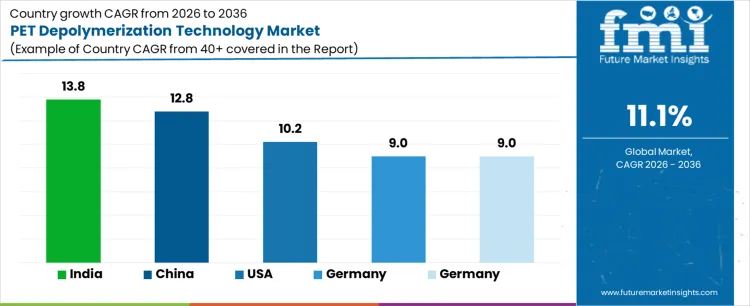
The demand for PET depolymerization technology varies across countries, driven by recycling initiatives, circular economy adoption, and sustainable packaging requirements. India leads with a 13.8% CAGR, supported by growing PET consumption, expanding recycling infrastructure, and rising adoption of chemical recycling technologies. China follows at 12.8%, driven by large scale plastic recycling operations, regulatory compliance, and industrial demand for high quality recycled PET. The USA grows at 10.2%, reflecting adoption in packaging and consumer goods industries. Germany records 9.0%, shaped by established recycling systems and strict environmental regulations. Brazil posts 9.0%, supported by developing recycling infrastructure and growing awareness of sustainable PET management.
How Is PET Depolymerization Technology Expanding Recycling Capabilities in the United States?
In the United States, the PET Depolymerization Technology Market is growing at a CAGR of 10.2% through 2036, driven by increasing demand for chemical recycling of post-consumer PET bottles and packaging materials. Recycling facilities and polymer manufacturers are integrating depolymerization systems to recover monomers, reduce landfill dependence, and meet sustainability targets. Demand is concentrated in urban recycling hubs, large-scale processing plants, and industrial polymer facilities. Compared to Germany, where regulatory frameworks primarily guide adoption, USA growth balances environmental goals with commercial recycling scale. Domestic suppliers provide high-performance, modular depolymerization systems supporting recurring feedstock processing and monomer recovery.
- Urban recycling hubs, industrial polymer facilities, and processing plants drive adoption
- Depolymerization systems recover PET monomers and reduce landfill waste
- Recurring feedstock processing sustains long-term adoption
How Are Regulatory Standards and Circular Economy Initiatives Driving Growth in Germany?
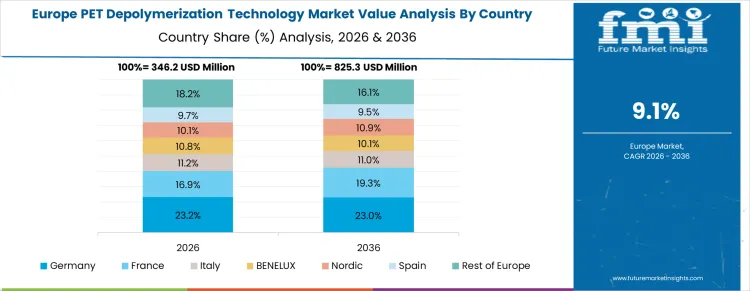
Germany is witnessing growth at a CAGR of 9% through 2036, supported by strict EU recycling mandates and circular economy policies. PET depolymerization technologies are being adopted in chemical recycling facilities, beverage packaging plants, and industrial polymer manufacturers to recover monomers, reduce plastic waste, and comply with regulatory targets. Compared to the USA, Germany emphasizes regulatory compliance and audit-driven adoption over large-scale commercial deployment. Domestic suppliers focus on modular, high-efficiency depolymerization units compatible with existing recycling infrastructure. Recurring polymer feedstock processing, environmental compliance monitoring, and government incentives are sustaining steady adoption nationwide.
- Chemical recycling facilities, packaging plants, and polymer manufacturers drive adoption
- Depolymerization reduces plastic waste and recovers monomers
- Domestic suppliers provide high-efficiency, modular systems
How Is Industrial Scale and Plastic Waste Growth Driving Adoption in China?
In China, the market is expanding at a CAGR of 12.8% through 2036, fueled by large volumes of post-consumer PET waste, rapid industrial growth, and government recycling targets. Manufacturers and recycling facilities are deploying depolymerization technologies to recover monomers, reduce environmental impact, and produce high-value recycled PET for packaging and textiles. Demand is concentrated in urban recycling hubs, industrial polymer clusters, and packaging manufacturing zones. Domestic suppliers are scaling modular, high-capacity depolymerization systems. Compared to Brazil, adoption focuses on large-scale integration and urban waste management efficiency. Recurring feedstock availability and policy support sustain rapid adoption nationwide.
- Urban recycling hubs, polymer clusters, and packaging manufacturing zones drive adoption
- Depolymerization recovers monomers and reduces environmental impact
- Domestic suppliers scale high-capacity, modular systems
How Are Industrialization and Sustainability Goals Driving Growth in India?
In India, revenue is growing at a CAGR of 13.8% through 2036, supported by increasing PET consumption, emerging recycling infrastructure, and government initiatives promoting chemical recycling. Recycling plants, polymer manufacturers, and packaging units are adopting depolymerization technologies to recover monomers, reduce landfill dependence, and produce high-quality recycled PET. Demand is concentrated in industrial clusters, urban recycling hubs, and beverage packaging facilities. Domestic suppliers provide cost-effective, high-performance depolymerization systems compatible with existing polymer processing lines. Compared to China, India’s growth is more influenced by emerging industrial zones and government incentives. Recurring feedstock processing cycles are sustaining robust adoption nationwide.
- Industrial clusters, urban recycling hubs, and packaging facilities drive adoption
- Depolymerization recovers PET monomers and reduces landfill waste
- Recurring feedstock processing sustains robust adoption
How Are Chemical Recycling Hubs Supporting Market Expansion in Brazil?
In Brazil, the market is growing at a CAGR of 9% through 2036, driven by adoption of PET depolymerization in established chemical recycling hubs, beverage packaging plants, and polymer manufacturing facilities. Companies are deploying depolymerization technologies to recover monomers, reduce plastic waste, and comply with environmental regulations. Demand is concentrated in industrial zones, urban recycling facilities, and large-scale processing plants. Domestic suppliers provide modular, high-performance depolymerization systems compatible with varying feedstock qualities. Compared to India and China, adoption focuses on established hubs rather than rapid industrial expansion. Recurring PET feedstock availability and compliance requirements sustain steady adoption nationwide.
- Industrial zones, recycling facilities, and packaging plants drive adoption
- Depolymerization recovers monomers and reduces plastic waste
- Domestic suppliers provide modular, high-performance systems
Which Strategic Approaches Define Competition in the PET Depolymerization Technology Market across Circular Polymer Pathways?
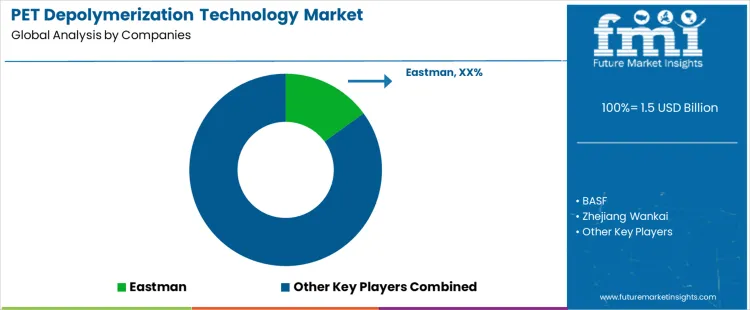
Competition in the PET depolymerization technology market is shaped by how companies align chemistry choice with feedstock variability, scale economics, and downstream polymer quality requirements. Eastman and BASF pursue strategies centered on integrating depolymerization into existing chemical and polymer value chains, prioritizing process robustness and compatibility with mixed or contaminated PET waste. Reliance Industries and Zhejiang Wankai approach the market from a scale driven perspective, focusing on securing large, consistent waste streams and aligning recycled monomers with high volume polyester production. Teijin emphasizes closed loop textile and packaging pathways, where depolymerization supports controlled material recovery rather than broad waste intake. Strategic focus across these player’s rests on yield stability, impurity tolerance, and the ability to deliver monomers that meet virgin equivalent specifications.
Technology differentiation and commercialization pathways define secondary competitive dynamics. Loop Industries and Carbios position themselves through proprietary processes designed to address hard to recycle PET fractions, including colored, multilayer, or degraded materials. Their strategies rely on licensing, partnerships, and phased scale up rather than immediate integration into large chemical complexes. Across the market, companies balance capital intensity, regulatory acceptance, and brand owner commitments when selecting commercialization routes. Competitive advantage depends on proving long term process reliability, securing feedstock access, and aligning output quality with existing polymer applications. Adoption is driven by risk management, supply assurance, and compatibility with established PET markets rather than by technology novelty alone.
Key Players in the PET Depolymerization Technology Market
- Eastman
- BASF
- Zhejiang Wankai
- Reliance Industries
- Teijin
- Loop Industries
- Carbios
Scope of the Report
| Items | Values |
|---|---|
| Quantitative Units (2026) | USD billion |
| Type | Glycolysis Systems, Methanolysis, Hydrolysis, Hybrid Depolymerization, Other Technologies |
| Application | Bottle to Bottle Recycling, Food Grade rPET Production, Textile and Packaging Recycling, Packaging Resin Recovery, High Purity Recycling |
| End User | Packaging Manufacturers, Beverage Brand Owners, Polymer and Resin Producers, Textile Producers, Chemical Recycling Operators |
| Regions Covered | Asia Pacific, Europe, North America, Latin America, Middle East & Africa |
| Countries Covered | USA, Germany, China, India, Japan, South Korea, Brazil, United Kingdom, France, Italy, Canada, Mexico, ASEAN countries, GCC countries, and other global regions |
| Key Companies Profiled | Eastman, BASF, Zhejiang Wankai, Reliance Industries, Teijin, Loop Industries, Carbios |
| Additional Attributes | Dollar sales by technology type and feedstock categories, regional adoption trends across Asia Pacific, Europe, and North America, competitive landscape across chemical recycling technology providers, regulatory approval and certification requirements for food grade and industrial PET reuse, integration with polymer production and closed loop recycling infrastructure |
PET Depolymerization Technology Market Segmentation
End-use:
- Bottle-to-bottle recycling
- Food-grade rPET production
- Textile & packaging recycling
- Packaging resin recovery
- Beverage packaging
- High-purity recycling
Technology Type:
- Glycolysis systems
- Methanolysis
- Hydrolysis
- Hybrid depolymerization
- Others
Feedstock:
- Post-consumer PET bottles
- PET trays & flakes
- Mixed PET waste
- PET bottles
- Others
Technology:
- Chemical depolymerization reactors
- Closed-loop depolymerization
- Large-scale chemical recycling
- Cost-efficient depolymerisation
- Others
Region
- Asia Pacific
- China
- Japan
- South Korea
- India
- Australia & New Zealand
- ASEAN
- Rest of Asia Pacific
- Europe
- Germany
- United Kingdom
- France
- Italy
- Spain
- Nordic
- BENELUX
- Rest of Europe
- North America
- United States
- Canada
- Mexico
- Latin America
- Brazil
- Chile
- Rest of Latin America
- Middle East & Africa
- Kingdom of Saudi Arabia
- Other GCC Countries
- Turkey
- South Africa
- Other African Union
- Rest of Middle East & Africa
Frequently Asked Questions
How big is the PET depolymerization technology market in 2026?
The global PET depolymerization technology market is estimated to be valued at USD 1.5 billion in 2026.
What will be the size of PET depolymerization technology market in 2036?
The market size for the PET depolymerization technology market is projected to reach USD 4.3 billion by 2036.
How much will be the PET depolymerization technology market growth between 2026 and 2036?
The PET depolymerization technology market is expected to grow at a 11.1% CAGR between 2026 and 2036.
What are the key product types in the PET depolymerization technology market?
The key product types in PET depolymerization technology market are bottle-to-bottle recycling, food-grade rPET production, textile & packaging recycling, packaging resin recovery, bEVerage packaging and high-purity recycling.
Which technology type segment to contribute significant share in the PET depolymerization technology market in 2026?
In terms of technology type, glycolysis systems segment to command 42.0% share in the PET depolymerization technology market in 2026.
Preview the report firsthand - request a free sample
Get SampleGet the brochure for pricing and purchase details.
Get PDFTable of Content
- Executive Summary
- Global Market Outlook
- Demand-side Trends
- Supply-side Trends
- Technology Roadmap Analysis
- Analysis and Recommendations
- Market Overview
- Market Coverage / Taxonomy
- Market Definition / Scope / Limitations
- Market Background
- Market Dynamics
- Drivers
- Restraints
- Opportunity
- Trends
- Scenario Forecast
- Demand in Optimistic Scenario
- Demand in Likely Scenario
- Demand in Conservative Scenario
- Opportunity Map Analysis
- Product Life Cycle Analysis
- Supply Chain Analysis
- Investment Feasibility Matrix
- Value Chain Analysis
- PESTLE and Porter’s Analysis
- Regulatory Landscape
- Regional Parent Market Outlook
- Production and Consumption Statistics
- Import and Export Statistics
- Market Dynamics
- Global Market Analysis 2021 to 2025 and Forecast, 2026 to 2036
- Historical Market Size Value (USD Million) Analysis, 2021 to 2025
- Current and Future Market Size Value (USD Million) Projections, 2026 to 2036
- Y-o-Y Growth Trend Analysis
- Absolute $ Opportunity Analysis
- Global Market Pricing Analysis 2021 to 2025 and Forecast 2026 to 2036
- Global Market Analysis 2021 to 2025 and Forecast 2026 to 2036, By End-use
- Introduction / Key Findings
- Historical Market Size Value (USD Million) Analysis By End-use , 2021 to 2025
- Current and Future Market Size Value (USD Million) Analysis and Forecast By End-use , 2026 to 2036
- Bottle-to-bottle recycling
- Food-grade rPET production
- Textile & packaging recycling
- Packaging resin recovery
- Beverage packaging
- High-purity recycling
- Bottle-to-bottle recycling
- Y-o-Y Growth Trend Analysis By End-use , 2021 to 2025
- Absolute $ Opportunity Analysis By End-use , 2026 to 2036
- Global Market Analysis 2021 to 2025 and Forecast 2026 to 2036, By Technology Type
- Introduction / Key Findings
- Historical Market Size Value (USD Million) Analysis By Technology Type, 2021 to 2025
- Current and Future Market Size Value (USD Million) Analysis and Forecast By Technology Type, 2026 to 2036
- Glycolysis systems
- Methanolysis
- Hydrolysis
- Hybrid depolymerization
- Others
- Glycolysis systems
- Y-o-Y Growth Trend Analysis By Technology Type, 2021 to 2025
- Absolute $ Opportunity Analysis By Technology Type, 2026 to 2036
- Global Market Analysis 2021 to 2025 and Forecast 2026 to 2036, By Feedstock
- Introduction / Key Findings
- Historical Market Size Value (USD Million) Analysis By Feedstock, 2021 to 2025
- Current and Future Market Size Value (USD Million) Analysis and Forecast By Feedstock, 2026 to 2036
- Post-consumer PET bottles
- PET trays & flakes
- Mixed PET waste
- PET bottles
- Others
- Post-consumer PET bottles
- Y-o-Y Growth Trend Analysis By Feedstock, 2021 to 2025
- Absolute $ Opportunity Analysis By Feedstock, 2026 to 2036
- Global Market Analysis 2021 to 2025 and Forecast 2026 to 2036, By Technology
- Introduction / Key Findings
- Historical Market Size Value (USD Million) Analysis By Technology, 2021 to 2025
- Current and Future Market Size Value (USD Million) Analysis and Forecast By Technology, 2026 to 2036
- Chemical depolymerization reactors
- Closed-loop depolymerization
- Large-scale chemical recycling
- Cost-efficient depolymerisation
- Others
- Chemical depolymerization reactors
- Y-o-Y Growth Trend Analysis By Technology, 2021 to 2025
- Absolute $ Opportunity Analysis By Technology, 2026 to 2036
- Global Market Analysis 2021 to 2025 and Forecast 2026 to 2036, By Region
- Introduction
- Historical Market Size Value (USD Million) Analysis By Region, 2021 to 2025
- Current Market Size Value (USD Million) Analysis and Forecast By Region, 2026 to 2036
- North America
- Latin America
- Western Europe
- Eastern Europe
- East Asia
- South Asia and Pacific
- Middle East & Africa
- Market Attractiveness Analysis By Region
- North America Market Analysis 2021 to 2025 and Forecast 2026 to 2036, By Country
- Historical Market Size Value (USD Million) Trend Analysis By Market Taxonomy, 2021 to 2025
- Market Size Value (USD Million) Forecast By Market Taxonomy, 2026 to 2036
- By Country
- USA
- Canada
- Mexico
- By End-use
- By Technology Type
- By Feedstock
- By Technology
- By Country
- Market Attractiveness Analysis
- By Country
- By End-use
- By Technology Type
- By Feedstock
- By Technology
- Key Takeaways
- Latin America Market Analysis 2021 to 2025 and Forecast 2026 to 2036, By Country
- Historical Market Size Value (USD Million) Trend Analysis By Market Taxonomy, 2021 to 2025
- Market Size Value (USD Million) Forecast By Market Taxonomy, 2026 to 2036
- By Country
- Brazil
- Chile
- Rest of Latin America
- By End-use
- By Technology Type
- By Feedstock
- By Technology
- By Country
- Market Attractiveness Analysis
- By Country
- By End-use
- By Technology Type
- By Feedstock
- By Technology
- Key Takeaways
- Western Europe Market Analysis 2021 to 2025 and Forecast 2026 to 2036, By Country
- Historical Market Size Value (USD Million) Trend Analysis By Market Taxonomy, 2021 to 2025
- Market Size Value (USD Million) Forecast By Market Taxonomy, 2026 to 2036
- By Country
- Germany
- UK
- Italy
- Spain
- France
- Nordic
- BENELUX
- Rest of Western Europe
- By End-use
- By Technology Type
- By Feedstock
- By Technology
- By Country
- Market Attractiveness Analysis
- By Country
- By End-use
- By Technology Type
- By Feedstock
- By Technology
- Key Takeaways
- Eastern Europe Market Analysis 2021 to 2025 and Forecast 2026 to 2036, By Country
- Historical Market Size Value (USD Million) Trend Analysis By Market Taxonomy, 2021 to 2025
- Market Size Value (USD Million) Forecast By Market Taxonomy, 2026 to 2036
- By Country
- Russia
- Poland
- Hungary
- Balkan & Baltic
- Rest of Eastern Europe
- By End-use
- By Technology Type
- By Feedstock
- By Technology
- By Country
- Market Attractiveness Analysis
- By Country
- By End-use
- By Technology Type
- By Feedstock
- By Technology
- Key Takeaways
- East Asia Market Analysis 2021 to 2025 and Forecast 2026 to 2036, By Country
- Historical Market Size Value (USD Million) Trend Analysis By Market Taxonomy, 2021 to 2025
- Market Size Value (USD Million) Forecast By Market Taxonomy, 2026 to 2036
- By Country
- China
- Japan
- South Korea
- By End-use
- By Technology Type
- By Feedstock
- By Technology
- By Country
- Market Attractiveness Analysis
- By Country
- By End-use
- By Technology Type
- By Feedstock
- By Technology
- Key Takeaways
- South Asia and Pacific Market Analysis 2021 to 2025 and Forecast 2026 to 2036, By Country
- Historical Market Size Value (USD Million) Trend Analysis By Market Taxonomy, 2021 to 2025
- Market Size Value (USD Million) Forecast By Market Taxonomy, 2026 to 2036
- By Country
- India
- ASEAN
- Australia & New Zealand
- Rest of South Asia and Pacific
- By End-use
- By Technology Type
- By Feedstock
- By Technology
- By Country
- Market Attractiveness Analysis
- By Country
- By End-use
- By Technology Type
- By Feedstock
- By Technology
- Key Takeaways
- Middle East & Africa Market Analysis 2021 to 2025 and Forecast 2026 to 2036, By Country
- Historical Market Size Value (USD Million) Trend Analysis By Market Taxonomy, 2021 to 2025
- Market Size Value (USD Million) Forecast By Market Taxonomy, 2026 to 2036
- By Country
- Kingdom of Saudi Arabia
- Other GCC Countries
- Turkiye
- South Africa
- Other African Union
- Rest of Middle East & Africa
- By End-use
- By Technology Type
- By Feedstock
- By Technology
- By Country
- Market Attractiveness Analysis
- By Country
- By End-use
- By Technology Type
- By Feedstock
- By Technology
- Key Takeaways
- Key Countries Market Analysis
- USA
- Pricing Analysis
- Market Share Analysis, 2025
- By End-use
- By Technology Type
- By Feedstock
- By Technology
- Canada
- Pricing Analysis
- Market Share Analysis, 2025
- By End-use
- By Technology Type
- By Feedstock
- By Technology
- Mexico
- Pricing Analysis
- Market Share Analysis, 2025
- By End-use
- By Technology Type
- By Feedstock
- By Technology
- Brazil
- Pricing Analysis
- Market Share Analysis, 2025
- By End-use
- By Technology Type
- By Feedstock
- By Technology
- Chile
- Pricing Analysis
- Market Share Analysis, 2025
- By End-use
- By Technology Type
- By Feedstock
- By Technology
- Germany
- Pricing Analysis
- Market Share Analysis, 2025
- By End-use
- By Technology Type
- By Feedstock
- By Technology
- UK
- Pricing Analysis
- Market Share Analysis, 2025
- By End-use
- By Technology Type
- By Feedstock
- By Technology
- Italy
- Pricing Analysis
- Market Share Analysis, 2025
- By End-use
- By Technology Type
- By Feedstock
- By Technology
- Spain
- Pricing Analysis
- Market Share Analysis, 2025
- By End-use
- By Technology Type
- By Feedstock
- By Technology
- France
- Pricing Analysis
- Market Share Analysis, 2025
- By End-use
- By Technology Type
- By Feedstock
- By Technology
- India
- Pricing Analysis
- Market Share Analysis, 2025
- By End-use
- By Technology Type
- By Feedstock
- By Technology
- ASEAN
- Pricing Analysis
- Market Share Analysis, 2025
- By End-use
- By Technology Type
- By Feedstock
- By Technology
- Australia & New Zealand
- Pricing Analysis
- Market Share Analysis, 2025
- By End-use
- By Technology Type
- By Feedstock
- By Technology
- China
- Pricing Analysis
- Market Share Analysis, 2025
- By End-use
- By Technology Type
- By Feedstock
- By Technology
- Japan
- Pricing Analysis
- Market Share Analysis, 2025
- By End-use
- By Technology Type
- By Feedstock
- By Technology
- South Korea
- Pricing Analysis
- Market Share Analysis, 2025
- By End-use
- By Technology Type
- By Feedstock
- By Technology
- Russia
- Pricing Analysis
- Market Share Analysis, 2025
- By End-use
- By Technology Type
- By Feedstock
- By Technology
- Poland
- Pricing Analysis
- Market Share Analysis, 2025
- By End-use
- By Technology Type
- By Feedstock
- By Technology
- Hungary
- Pricing Analysis
- Market Share Analysis, 2025
- By End-use
- By Technology Type
- By Feedstock
- By Technology
- Kingdom of Saudi Arabia
- Pricing Analysis
- Market Share Analysis, 2025
- By End-use
- By Technology Type
- By Feedstock
- By Technology
- Turkiye
- Pricing Analysis
- Market Share Analysis, 2025
- By End-use
- By Technology Type
- By Feedstock
- By Technology
- South Africa
- Pricing Analysis
- Market Share Analysis, 2025
- By End-use
- By Technology Type
- By Feedstock
- By Technology
- USA
- Market Structure Analysis
- Competition Dashboard
- Competition Benchmarking
- Market Share Analysis of Top Players
- By Regional
- By End-use
- By Technology Type
- By Feedstock
- By Technology
- Competition Analysis
- Competition Deep Dive
- Eastman
- Overview
- Product Portfolio
- Profitability by Market Segments (Product/Age /Sales Channel/Region)
- Sales Footprint
- Strategy Overview
- Marketing Strategy
- Product Strategy
- Channel Strategy
- BASF
- Zhejiang Wankai
- Reliance Industries
- Teijin
- Loop Industries
- Carbios
- Eastman
- Competition Deep Dive
- Assumptions & Acronyms Used
- Research Methodology


