

- Industry Size (2026)
- USD 2.6 Bn
- Forecast (2036)
- USD 4.8 Bn
- CAGR (2026 to 2036)
- 6.4%
Automotive Torque Tools Market Forecast and Outlook 2026 to 2036
The automotive torque tools market is projected to reach USD 4.8 billion by 2036, growing at a CAGR of 6.4% from its 2026 size of USD 2.6 billion. While the market presents a promising growth trajectory, execution risks persist, particularly in meeting stringent quality standards and maintaining consistent performance under evolving automotive manufacturing requirements. Adoption friction may arise as manufacturers evaluate the upfront investment in advanced torque tools versus their long-term benefits, potentially slowing uptake. Economic sensitivity is also a key factor, as fluctuations in the automotive industry-driven by factors such as production cycles and material costs-can affect demand stability. Companies will need to navigate these risks by ensuring scalability and reliability in their product offerings. As the market expands, the focus will shift to balancing technological innovation with operational efficiency, addressing both short-term challenges and long-term sustainability in an increasingly competitive landscape.
Quick Stats for the Automotive Torque Tools Market
- Automotive Torque Tools Market Value (2026): USD 2.6 billion
- Automotive Torque Tools Market Forecast Value (2036): USD 4.8 billion
- Automotive Torque Tools Market Global Forecast CAGR 2026 to 2036: 6.4%
- Automotive Torque Tools Market Leading Segment: Automotive OEM Assembly (48%)
- Key Growth Regions in Automotive Torque Tools Market: India
- Top Players in Automotive Torque Tools Market: Snap-on Inc., Stanley Black & Decker, Bosch Automotive Service Solutions, Makita Corporation, Ingersoll Rand (now part of Lincoln Electric), Atlas Copco Industrial Tools, Techtronic Industries (TTI), Hazet-Werk GmbH & Co. KG, Apex Tool Group LLC, Norbar Torque Tools
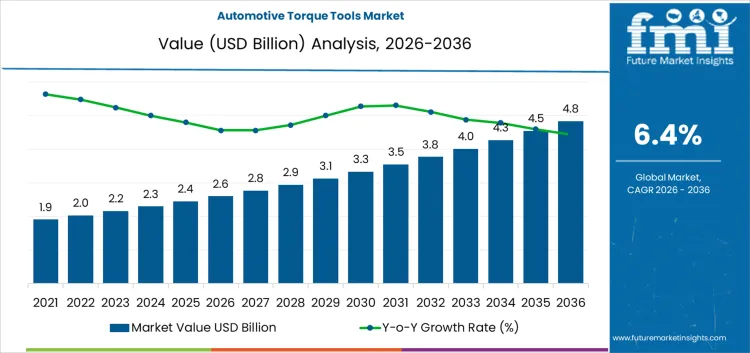
What is the Inflection Point Mapping for the Automotive Torque Tools Market through 2036?
The inflection point mapping for the automotive torque tools market identifies key periods where the market growth rate changes direction, reflecting shifts in industry demand and technological advancements. From 2026 to 2028, the market will experience gradual growth, rising from USD 2.6 billion to USD 2.9 billion. This early phase reflects steady increases in demand for torque tools due to continued automotive production, with growth driven by the standardization of torque tool technologies and the increasing need for precision in vehicle assembly.
The first significant inflection point will occur around 2029, when the market will begin to accelerate, growing from USD 3.1 billion in 2029 to USD 3.7 billion by 2032. This acceleration will be driven by increasing adoption of electric vehicles (EVs), which require specialized torque tools for battery and motor assembly, as well as advancements in automation and robotics in automotive manufacturing. The growing demand for more sophisticated, digital, and connected torque tools will also contribute to this inflection point.
From 2032 to 2036, the market will continue to expand, reaching USD 4.8 billion by 2036. However, growth will stabilize as the technology matures and becomes widely adopted, marking the market’s approach to saturation. The inflection point mapping highlights both the initial steady growth driven by traditional automotive production and the later acceleration fueled by innovations in vehicle technology and manufacturing processes.
Automotive Torque Tools Market Key Takeaways
| Metric | Value |
|---|---|
| Industry Sales Value (2026) | USD 2.6 billion |
| Industry Forecast Value (2036) | USD 4.8 billion |
| Industry Forecast CAGR 2026 to 2036 | 6.4% |
What Is Driving the Automotive Torque Tools Market?
Historically, the automotive torque tools market developed from the fundamental need to tighten fasteners to precise specifications to ensure safety, reliability, and assembly consistency in vehicle production and maintenance. Early torque tools were simple mechanical wrenches and basic beam torque wrenches that provided approximate force measurements but lacked high accuracy and repeatability. As automotive engineering advanced throughout the 20th century, vehicles incorporated more critical bolted joints in engine assemblies, chassis components, and safety systems, elevating the importance of accurate torque control. Manual torque tools evolved to include micrometer adjustable click wrenches and dial indicators, giving technicians improved feedback and consistency over earlier methods. Adoption in assembly plants and repair shops grew as manufacturers recognized that under or over torqued fasteners could lead to part failure, poor performance, and increased warranty claims. This phase established performance expectations for torque tools in delivering measurable, reproducible results while improving workflow efficiency in repetitive tightening tasks.
Future demand for the automotive torque tools market is expected to be shaped by continued growth in both vehicle production and aftersales service activity, rising complexity of automotive assemblies, and emphasis on digital quality assurance. Growth drivers will include advanced internal combustion engine designs, hybrid powertrains, electric vehicle drivetrains, and lightweight structural components that require precise torqueing to maintain structural integrity and performance. Digital torque tools with integrated sensors, data logging, and connectivity for traceability in production line quality management will gain preference over purely mechanical devices as manufacturers and service providers adopt Industry 4.0 practices. Smart torque wrenches and electronic screwdrivers that provide guided tightening sequences, reject warnings, and wireless data transfer will support technician productivity and reduce human error. Barriers include higher costs for advanced digital solutions compared with basic manual torque wrenches and the need for training technicians on new tool interfaces and calibration maintenance. Long term market expansion will depend on how effectively suppliers provide scalable, rugged torque tools that balance accuracy, traceability, and integration with automotive quality systems across OEM and aftermarket applications.
What are the Key Segments in the Automotive Torque Tools Market?
The Automotive Torque Tools market is segmented by product type and end-use application. Product types include cordless or battery torque tools, electric or pneumatic torque tools, manual torque tools, and others, with cordless or battery torque tools leading the market at 44%. End-use applications include automotive OEM assembly, automotive aftermarket repairs, heavy commercial vehicles, and specialty & motorsport, with automotive OEM assembly representing the largest share at 48%. The market is driven by the growing demand for high-performance, precise, and efficient torque tools used in automotive manufacturing, repair, and maintenance. The increasing focus on quality control and automation in the automotive industry is also contributing to the growth of the market.
What is Driving Growth in the Cordless or Battery Torque Tools Segment?
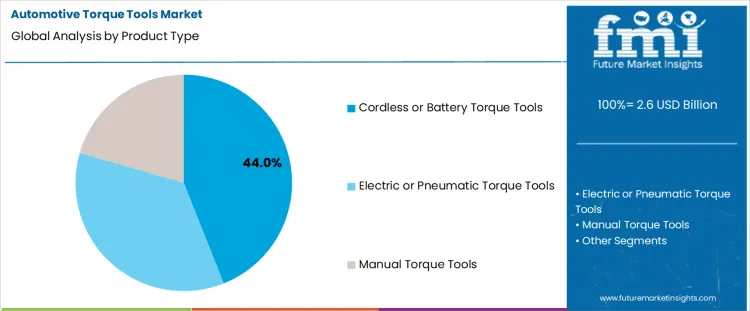
Cordless or battery torque tools are the dominant product type in the Automotive Torque Tools market, holding 44% of the market share. This growth is primarily driven by the convenience, portability, and ease of use offered by cordless tools. Cordless torque tools provide the flexibility to work in a wide range of automotive applications, from assembly lines to repair and maintenance tasks, without the need for an external power source or complex setup. These tools are especially popular in automotive OEM assembly and aftermarket repairs, where mobility and quick setup are essential. The increasing shift towards battery-powered tools, driven by advancements in battery technology, allows for longer operating times, faster charging, and improved efficiency. Additionally, the demand for cordless tools is growing as industries prioritize safety, ergonomics, and reduced downtime, all of which are enhanced by cordless torque tools. The trend towards electric and eco-friendly tools is further supporting the growth of this segment, particularly in regions with high automotive production and repair activities, such as North America, Europe, and Asia Pacific.
What is Driving the Demand for Automotive OEM Assembly in the End-Use Application Segment?
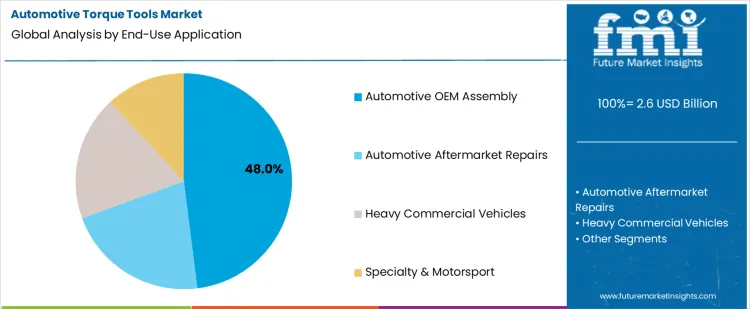
Automotive OEM assembly is the largest end-use application segment in the Automotive Torque Tools market, accounting for 48% of the market share. This growth is driven by the increasing need for precision and efficiency in automotive manufacturing, where torque tools are critical for ensuring that fasteners are tightened to the correct specifications during assembly. Proper torque application is essential for the safety, performance, and longevity of automotive components, which is why OEMs invest heavily in advanced torque tools to maintain high manufacturing standards. The rise of automated assembly lines, which rely on torque tools for consistent and accurate torque application, is also contributing to the growth of this segment. As global automotive production continues to grow, particularly in regions like Asia Pacific, North America, and Europe, the demand for torque tools in OEM assembly processes is expected to remain strong. Additionally, the increasing focus on improving production efficiency, reducing defects, and meeting regulatory standards in automotive manufacturing is driving the adoption of advanced torque tools in OEM applications.
What are the Key Dynamics in the Automotive Torque Tools Market?
The automotive torque tools market is expanding as the automotive industry continues to demand high-precision, reliable, and efficient tools for assembly, maintenance, and repair tasks. Torque tools are essential for ensuring proper fastening of components, such as bolts and nuts, to the required specifications, preventing over-tightening or under-tightening, which could affect the vehicle's performance and safety. The market is driven by the increasing complexity of modern vehicles, which require advanced torque solutions for precise and consistent assembly. Additionally, the growing focus on safety, quality control, and automation in the automotive manufacturing process is fueling demand for high-quality torque tools. Furthermore, the rise of electric vehicles (EVs) and the trend toward lightweight materials in vehicle construction are influencing the development and adoption of specialized torque tools.
What are the Key Drivers of Growth in the Automotive Torque Tools Market?
The growth of the automotive torque tools market is driven by several key factors. First, the increasing complexity of vehicle designs, including advanced engines, transmission systems, and suspension components, requires precise torque control during manufacturing and assembly. The rise in automation and smart manufacturing in the automotive industry is also a significant driver, as modern torque tools are integrated into automated systems that enhance efficiency, consistency, and safety in the production process. Additionally, the shift toward electric vehicles is creating new demands for torque tools to handle specific components, such as high-voltage battery packs, electric drivetrains, and lightweight materials. The growing emphasis on quality control and regulatory compliance in automotive manufacturing is another driver, as torque tools ensure that components are properly secured to meet safety standards. Moreover, the increasing trend of vehicle customization and repair services, particularly in the aftermarket, is contributing to the demand for portable and versatile torque tools for maintenance and repair purposes.
What are the Key Restraints in the Automotive Torque Tools Market?
Despite its growth prospects, the automotive torque tools market faces several challenges. One of the primary restraints is the high cost of advanced torque tools, particularly for specialized or automated systems. The initial investment in high-quality torque tools can be prohibitive for smaller automotive manufacturers, repair shops, or individual users. Additionally, the need for regular calibration and maintenance of torque tools can add to their overall cost and operational complexity. Another challenge is the availability of alternative fastening methods that may be more cost-effective or less complex, particularly in regions where traditional hand tools or basic power tools are still prevalent. The adoption of new torque tools may also be limited by a lack of technical knowledge and training among users, as specialized torque equipment often requires expertise to ensure optimal performance. Finally, while automation and smart technologies are driving innovation, the integration of advanced torque tools into existing production lines can require significant upfront costs and operational adjustments, particularly for companies with older infrastructure.
What are the Key Trends in the Automotive Torque Tools Market?
Several key trends are shaping the automotive torque tools market. One significant trend is the increasing use of digital and smart torque tools, which provide real-time data on torque settings, performance, and calibration, improving precision and reducing human error. These tools are integrated with sensors, software, and cloud-based platforms to provide advanced analytics, predictive maintenance, and remote monitoring, making them essential for modern manufacturing environments. Another trend is the growing demand for cordless and battery-powered torque tools, which offer greater portability and flexibility in automotive repair and assembly. The emphasis on lightweight materials and electric vehicle components is also driving innovation in torque tools, as manufacturers develop specialized tools designed to handle lightweight, high-strength materials such as carbon fiber and aluminum. The trend toward automation and robotic systems in automotive production is pushing the development of automated torque tools that can perform tasks with higher speed, accuracy, and consistency. Additionally, there is an increasing focus on sustainability, with manufacturers designing torque tools that are energy-efficient, have longer lifecycles, and use recyclable materials, aligning with the automotive industry's broader environmental goals. These trends indicate that the automotive torque tools market will continue to evolve, driven by technological advancements, new materials, and the increasing focus on precision and automation in vehicle manufacturing.
What is the Country-Wise Analysis of the Automotive Torque Tools Market?
The automotive torque tools market is growing as the demand for precise and efficient fastening tools increases in the automotive industry. Torque tools are essential for ensuring the correct application of torque to fasteners, such as bolts and nuts, which is critical for maintaining vehicle safety and performance. The market is driven by the rising production of vehicles, advancements in automotive manufacturing technologies, and the increasing focus on safety standards in the automotive industry. Countries like the USA, China, Germany, Japan, and India are experiencing growth in this market, fueled by the expansion of automotive production, technological innovations, and the rising demand for high-performance tools.
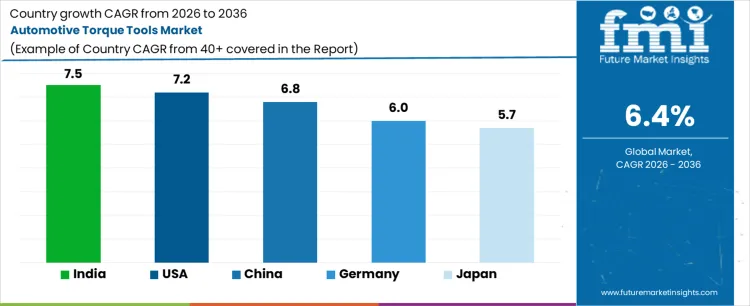
| Country | CAGR (%) |
|---|---|
| USA | 7.2 |
| China | 6.8 |
| Germany | 6 |
| Japan | 5.7 |
| India | 7.5 |
What is Driving the Growth of the Automotive Torque Tools Market in India?
India’s automotive torque tools market is growing at a CAGR of 7.5%, the highest among the countries analyzed. The growth is driven by India’s rapidly expanding automotive industry, which includes both domestic production and export. As the demand for vehicles rises, the need for efficient and accurate fastening tools that ensure safety and quality is increasing. Additionally, India’s focus on improving manufacturing processes and adopting international safety standards is contributing to the growth of the torque tools market. As the automotive sector continues to grow and modernize, the demand for advanced automotive torque tools in India is expected to continue to rise.
How is the Automotive Torque Tools Market Performing in the USA?
The automotive torque tools market in the USA is growing at a CAGR of 7.2%. The growth is supported by the USA’s large automotive manufacturing sector, where torque tools are used to ensure that fasteners are tightened to the correct specifications. The increasing demand for high-quality and reliable vehicles, coupled with the need for improved manufacturing precision, is driving the market for automotive torque tools. The rise of electric vehicle (EV) production, along with stricter regulations for vehicle safety, is also contributing to the demand for advanced torque tools. As the automotive industry in the USA continues to focus on quality control and automation, the market for automotive torque tools is expected to grow steadily.
What Factors are Shaping the Automotive Torque Tools Market in China?
China’s automotive torque tools market is growing at a CAGR of 6.8%. China’s automotive industry is the largest in the world, and the country’s expanding production capacity is driving the demand for torque tools. The growing focus on safety, quality control, and manufacturing efficiency in China’s automotive sector is contributing to the adoption of advanced torque tools. Additionally, the rising production of electric vehicles (EVs) and the shift towards more automated manufacturing processes are driving the demand for high-precision tools. As China continues to increase its automotive production and embraces new technologies, the demand for automotive torque tools is expected to continue growing.
How is the Automotive Torque Tools Market Evolving in Germany?
Germany’s automotive torque tools market is growing at a CAGR of 6%. Germany, known for its automotive manufacturing excellence, is experiencing increasing demand for high-precision torque tools due to its emphasis on quality control and safety standards. The growing production of both conventional and electric vehicles, along with Germany’s focus on advanced automotive manufacturing technologies, is contributing to the market’s growth. The country’s automotive industry continues to invest in automation and precision tools to ensure the reliability and safety of vehicles. As the demand for high-performance vehicles increases, the need for efficient torque tools in Germany’s automotive sector is expected to grow steadily.
What is Contributing to the Growth of the Automotive Torque Tools Market in Japan?
Japan’s automotive torque tools market is growing at a CAGR of 5.7%. The market is driven by Japan’s strong automotive industry, which is increasingly adopting advanced manufacturing technologies to improve production efficiency and vehicle safety. As Japanese automotive manufacturers focus on producing high-quality vehicles, the demand for reliable and accurate torque tools is rising. Additionally, Japan’s commitment to the production of electric vehicles (EVs) and the increasing automation of manufacturing processes are contributing to the demand for advanced torque tools. As Japan’s automotive sector continues to innovate and modernize, the demand for automotive torque tools is expected to continue growing, although at a slightly slower pace compared to other regions.
What is the Competitive Landscape for the Automotive Torque Tools Market?
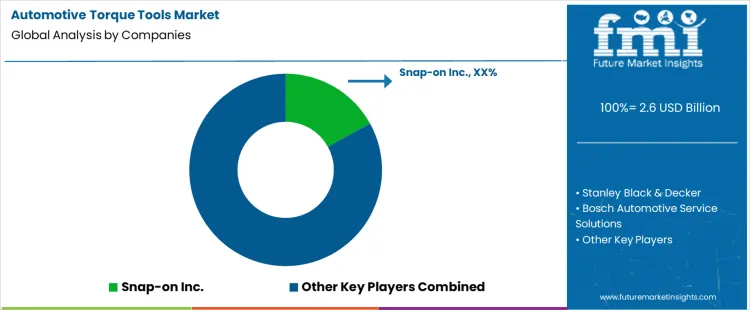
The automotive torque tools market is expanding as the demand for precision and reliability in vehicle maintenance and assembly increases. Snap-on Inc. leads the market, offering a wide range of high-performance torque tools known for their accuracy, durability, and innovative technology. Snap-on’s strong brand reputation in the automotive service industry positions it as a dominant player in the torque tools market. Stanley Black & Decker is another key competitor, providing automotive torque tools with advanced features like electronic torque control and high durability, ensuring consistent performance in professional settings. Bosch Automotive Service Solutions is involved in the market with its torque tools designed for efficiency and precision, focusing on meeting the demands of both repair shops and original equipment manufacturers (OEMs). Makita Corporation is a significant player, offering torque tools known for their ergonomic design, ease of use, and reliable performance in automotive applications. Ingersoll Rand, now part of Lincoln Electric, provides a comprehensive range of torque tools that cater to industrial and automotive sectors, with a focus on power, precision, and durability. Atlas Copco Industrial Tools offers torque solutions that combine high torque output with energy-efficient technology, catering to the growing needs of automotive repair and manufacturing sectors. Techtronic Industries (TTI) contributes with its advanced torque tools, focusing on user-friendly designs and high performance, ensuring they meet the diverse requirements of automotive professionals. Hazet-Werk GmbH & Co. KG specializes in high-precision torque tools used in automotive repairs and maintenance, known for their durability and innovative technology. Apex Tool Group LLC offers a wide range of torque tools, emphasizing high accuracy and reliability for automotive assembly and repair work. Norbar Torque Tools focuses on providing precision torque wrenches and tools, offering solutions that ensure accuracy and quality in automotive maintenance and production environments.
To remain competitive in the automotive torque tools market, companies focus on innovation, precision, and reliability. Snap-on Inc. continues to lead by enhancing its product offerings with digital torque measurement and control technologies, improving the precision and ease of use in automotive applications. Stanley Black & Decker is investing in smart torque tools with advanced features like real-time data feedback and electronic torque management, catering to both DIY and professional users. Bosch Automotive Service Solutions is advancing its torque tools by incorporating more efficient and compact designs, ensuring higher performance in tight automotive spaces. Makita Corporation is refining its torque tools to offer higher energy efficiency, lightweight designs, and better ergonomics for automotive professionals. Ingersoll Rand (now part of Lincoln Electric) continues to innovate with high-torque, low-maintenance tools designed to improve workflow efficiency in automotive service environments. Atlas Copco Industrial Tools focuses on developing energy-efficient torque solutions with precise control, ensuring optimal performance in automotive production lines. Techtronic Industries (TTI) enhances its torque tool offerings by focusing on battery-powered, cordless solutions that provide greater flexibility and portability. Hazet-Werk GmbH & Co. KG continues to lead in offering high-precision torque tools, catering to the needs of high-end automotive service professionals. Apex Tool Group LLC focuses on delivering reliable, accurate torque tools that offer consistent performance across various automotive applications. Norbar Torque Tools remains competitive by providing high-precision, durable torque wrenches that cater to both repair shops and manufacturing operations. These strategies ensure that these companies remain leaders in the growing automotive torque tools market, which is driven by increasing demand for high-quality, accurate, and efficient tools in the automotive industry.
Key Players of the Automotive Torque Tools Market
- Snap-on Inc.
- Stanley Black & Decker
- Bosch Automotive Service Solutions
- Makita Corporation
- Ingersoll Rand (now part of Lincoln Electric)
- Atlas Copco Industrial Tools
- Techtronic Industries (TTI)
- Hazet-Werk GmbH & Co. KG
- Apex Tool Group LLC
- Norbar Torque Tools
Scope of the Report
| Items | Values |
|---|---|
| Quantitative Units (2026) | USD Billion |
| Product Type | Cordless or Battery Torque Tools, Electric or Pneumatic Torque Tools, Manual Torque Tools |
| End-Use Application | Automotive OEM Assembly, Automotive Aftermarket Repairs, Heavy Commercial Vehicles, Specialty & Motorsport |
| Distribution Channel | Direct OEM Supply, Industrial Distributors, Online Retail / E-Commerce, Specialty Tool Dealers |
| Companies | Snap-on Inc., Stanley Black & Decker, Bosch Automotive Service Solutions, Makita Corporation, Ingersoll Rand (now part of Lincoln Electric), Atlas Copco Industrial Tools, Techtronic Industries (TTI), Hazet-Werk GmbH & Co. KG, Apex Tool Group LLC, Norbar Torque Tools |
| Regions Covered | North America, Latin America, Western Europe, Eastern Europe, South Asia and Pacific, East Asia, Middle East & Africa |
| Countries Covered | United States, Canada, Mexico, Brazil, Argentina, Germany, France, United Kingdom, Italy, Spain, Netherlands, China, India, Japan, South Korea, ANZ, GCC Countries, South Africa |
| Additional Attributes | Dollar by sales by product type, end-use application, and distribution channel. Includes market trends towards automation, precision, cost-effectiveness, and the role of torque tools in enhancing vehicle assembly and repair processes. |
Automotive Torque Tools Market Segmentation
Product Type:
- Cordless or Battery Torque Tools
- Electric or Pneumatic Torque Tools
- Manual Torque Tools
- Other
End-Use Application:
- Automotive OEM Assembly
- Automotive Aftermarket Repairs
- Heavy Commercial Vehicles
- Specialty & Motorsport
- Other
Distribution Channel:
- Direct OEM Supply
- Industrial Distributors
- Online Retail / E-Commerce
- Specialty Tool Dealers
- Other
Region:
- Asia Pacific
- China
- Japan
- India
- Australia & New Zealand
- ASEAN
- Rest of Asia Pacific
- Europe
- Germany
- United Kingdom
- France
- Italy
- Spain
- Nordic
- BENELUX
- Rest of Europe
- North America
- United States
- Canada
- Mexico
- Latin America
- Brazil
- Argentina
- Rest of Latin America
- Middle East & Africa
- Kingdom of Saudi Arabia
- Other GCC Countries
- South Africa
- Rest of Middle East & Africa
Bibliography
- International Organization for Standardization (ISO). (2024). ISO 6789-2:2024 - Torque tools - Part 2: Requirements for design, testing, and calibration of manual torque tools. International Organization for Standardization.
- Society of Automotive Engineers (SAE). (2023). The impact of torque tools on automotive assembly precision: A review. SAE Technical Papers.
- USA Department of Energy (DOE). (2024). Automotive manufacturing and energy efficiency: The role of precision tools in sustainable automotive assembly. USA Department of Energy.
- National Institute for Standards and Technology (NIST). (2023). Measurement science for automotive torque tools and fastening technologies. NIST Special Publication 1234.
- European Commission. (2024). Innovation and digitalization in automotive manufacturing: Focus on torque control technologies. European Commission, Directorate-General for Internal Market, Industry, Entrepreneurship, and SMEs.
Frequently Asked Questions
How big is the automotive torque tools market in 2026?
The global automotive torque tools market is estimated to be valued at USD 2.6 billion in 2026.
What will be the size of automotive torque tools market in 2036?
The market size for the automotive torque tools market is projected to reach USD 4.8 billion by 2036.
How much will be the automotive torque tools market growth between 2026 and 2036?
The automotive torque tools market is expected to grow at a 6.4% CAGR between 2026 and 2036.
What are the key product types in the automotive torque tools market?
The key product types in automotive torque tools market are cordless or battery torque tools, electric or pneumatic torque tools and manual torque tools.
Which end-use application segment to contribute significant share in the automotive torque tools market in 2026?
In terms of end-use application, automotive oem assembly segment to command 48.0% share in the automotive torque tools market in 2026.
Preview the report firsthand - request a free sample
Get SampleGet the brochure for pricing and purchase details.
Get PDFTable of Content
- Executive Summary
- Global Market Outlook
- Demand-side Trends
- Supply-side Trends
- Technology Roadmap Analysis
- Analysis and Recommendations
- Market Overview
- Market Coverage / Taxonomy
- Market Definition / Scope / Limitations
- Market Background
- Market Dynamics
- Drivers
- Restraints
- Opportunity
- Trends
- Scenario Forecast
- Demand in Optimistic Scenario
- Demand in Likely Scenario
- Demand in Conservative Scenario
- Opportunity Map Analysis
- Product Life Cycle Analysis
- Supply Chain Analysis
- Investment Feasibility Matrix
- Value Chain Analysis
- PESTLE and Porter’s Analysis
- Regulatory Landscape
- Regional Parent Market Outlook
- Production and Consumption Statistics
- Import and Export Statistics
- Market Dynamics
- Global Market Analysis 2021 to 2025 and Forecast, 2026 to 2036
- Historical Market Size Value (USD Million) Analysis, 2021 to 2025
- Current and Future Market Size Value (USD Million) Projections, 2026 to 2036
- Y-o-Y Growth Trend Analysis
- Absolute $ Opportunity Analysis
- Global Market Pricing Analysis 2021 to 2025 and Forecast 2026 to 2036
- Global Market Analysis 2021 to 2025 and Forecast 2026 to 2036, By Product Type
- Introduction / Key Findings
- Historical Market Size Value (USD Million) Analysis By Product Type, 2021 to 2025
- Current and Future Market Size Value (USD Million) Analysis and Forecast By Product Type, 2026 to 2036
- Cordless or Battery Torque Tools
- Electric or Pneumatic Torque Tools
- Manual Torque Tools
- Cordless or Battery Torque Tools
- Y-o-Y Growth Trend Analysis By Product Type, 2021 to 2025
- Absolute $ Opportunity Analysis By Product Type, 2026 to 2036
- Global Market Analysis 2021 to 2025 and Forecast 2026 to 2036, By End-Use Application
- Introduction / Key Findings
- Historical Market Size Value (USD Million) Analysis By End-Use Application, 2021 to 2025
- Current and Future Market Size Value (USD Million) Analysis and Forecast By End-Use Application, 2026 to 2036
- Automotive OEM Assembly
- Automotive Aftermarket Repairs
- Heavy Commercial Vehicles
- Specialty & Motorsport
- Automotive OEM Assembly
- Y-o-Y Growth Trend Analysis By End-Use Application, 2021 to 2025
- Absolute $ Opportunity Analysis By End-Use Application, 2026 to 2036
- Global Market Analysis 2021 to 2025 and Forecast 2026 to 2036, By Distribution Channel
- Introduction / Key Findings
- Historical Market Size Value (USD Million) Analysis By Distribution Channel, 2021 to 2025
- Current and Future Market Size Value (USD Million) Analysis and Forecast By Distribution Channel, 2026 to 2036
- Direct OEM Supply
- Industrial Distributors
- Online Retail / E-Commerce
- Specialty Tool Dealers
- Direct OEM Supply
- Y-o-Y Growth Trend Analysis By Distribution Channel, 2021 to 2025
- Absolute $ Opportunity Analysis By Distribution Channel, 2026 to 2036
- Global Market Analysis 2021 to 2025 and Forecast 2026 to 2036, By Region
- Introduction
- Historical Market Size Value (USD Million) Analysis By Region, 2021 to 2025
- Current Market Size Value (USD Million) Analysis and Forecast By Region, 2026 to 2036
- North America
- Latin America
- Western Europe
- Eastern Europe
- East Asia
- South Asia and Pacific
- Middle East & Africa
- Market Attractiveness Analysis By Region
- North America Market Analysis 2021 to 2025 and Forecast 2026 to 2036, By Country
- Historical Market Size Value (USD Million) Trend Analysis By Market Taxonomy, 2021 to 2025
- Market Size Value (USD Million) Forecast By Market Taxonomy, 2026 to 2036
- By Country
- USA
- Canada
- Mexico
- By Product Type
- By End-Use Application
- By Distribution Channel
- By Country
- Market Attractiveness Analysis
- By Country
- By Product Type
- By End-Use Application
- By Distribution Channel
- Key Takeaways
- Latin America Market Analysis 2021 to 2025 and Forecast 2026 to 2036, By Country
- Historical Market Size Value (USD Million) Trend Analysis By Market Taxonomy, 2021 to 2025
- Market Size Value (USD Million) Forecast By Market Taxonomy, 2026 to 2036
- By Country
- Brazil
- Chile
- Rest of Latin America
- By Product Type
- By End-Use Application
- By Distribution Channel
- By Country
- Market Attractiveness Analysis
- By Country
- By Product Type
- By End-Use Application
- By Distribution Channel
- Key Takeaways
- Western Europe Market Analysis 2021 to 2025 and Forecast 2026 to 2036, By Country
- Historical Market Size Value (USD Million) Trend Analysis By Market Taxonomy, 2021 to 2025
- Market Size Value (USD Million) Forecast By Market Taxonomy, 2026 to 2036
- By Country
- Germany
- UK
- Italy
- Spain
- France
- Nordic
- BENELUX
- Rest of Western Europe
- By Product Type
- By End-Use Application
- By Distribution Channel
- By Country
- Market Attractiveness Analysis
- By Country
- By Product Type
- By End-Use Application
- By Distribution Channel
- Key Takeaways
- Eastern Europe Market Analysis 2021 to 2025 and Forecast 2026 to 2036, By Country
- Historical Market Size Value (USD Million) Trend Analysis By Market Taxonomy, 2021 to 2025
- Market Size Value (USD Million) Forecast By Market Taxonomy, 2026 to 2036
- By Country
- Russia
- Poland
- Hungary
- Balkan & Baltic
- Rest of Eastern Europe
- By Product Type
- By End-Use Application
- By Distribution Channel
- By Country
- Market Attractiveness Analysis
- By Country
- By Product Type
- By End-Use Application
- By Distribution Channel
- Key Takeaways
- East Asia Market Analysis 2021 to 2025 and Forecast 2026 to 2036, By Country
- Historical Market Size Value (USD Million) Trend Analysis By Market Taxonomy, 2021 to 2025
- Market Size Value (USD Million) Forecast By Market Taxonomy, 2026 to 2036
- By Country
- China
- Japan
- South Korea
- By Product Type
- By End-Use Application
- By Distribution Channel
- By Country
- Market Attractiveness Analysis
- By Country
- By Product Type
- By End-Use Application
- By Distribution Channel
- Key Takeaways
- South Asia and Pacific Market Analysis 2021 to 2025 and Forecast 2026 to 2036, By Country
- Historical Market Size Value (USD Million) Trend Analysis By Market Taxonomy, 2021 to 2025
- Market Size Value (USD Million) Forecast By Market Taxonomy, 2026 to 2036
- By Country
- India
- ASEAN
- Australia & New Zealand
- Rest of South Asia and Pacific
- By Product Type
- By End-Use Application
- By Distribution Channel
- By Country
- Market Attractiveness Analysis
- By Country
- By Product Type
- By End-Use Application
- By Distribution Channel
- Key Takeaways
- Middle East & Africa Market Analysis 2021 to 2025 and Forecast 2026 to 2036, By Country
- Historical Market Size Value (USD Million) Trend Analysis By Market Taxonomy, 2021 to 2025
- Market Size Value (USD Million) Forecast By Market Taxonomy, 2026 to 2036
- By Country
- Kingdom of Saudi Arabia
- Other GCC Countries
- Turkiye
- South Africa
- Other African Union
- Rest of Middle East & Africa
- By Product Type
- By End-Use Application
- By Distribution Channel
- By Country
- Market Attractiveness Analysis
- By Country
- By Product Type
- By End-Use Application
- By Distribution Channel
- Key Takeaways
- Key Countries Market Analysis
- USA
- Pricing Analysis
- Market Share Analysis, 2025
- By Product Type
- By End-Use Application
- By Distribution Channel
- Canada
- Pricing Analysis
- Market Share Analysis, 2025
- By Product Type
- By End-Use Application
- By Distribution Channel
- Mexico
- Pricing Analysis
- Market Share Analysis, 2025
- By Product Type
- By End-Use Application
- By Distribution Channel
- Brazil
- Pricing Analysis
- Market Share Analysis, 2025
- By Product Type
- By End-Use Application
- By Distribution Channel
- Chile
- Pricing Analysis
- Market Share Analysis, 2025
- By Product Type
- By End-Use Application
- By Distribution Channel
- Germany
- Pricing Analysis
- Market Share Analysis, 2025
- By Product Type
- By End-Use Application
- By Distribution Channel
- UK
- Pricing Analysis
- Market Share Analysis, 2025
- By Product Type
- By End-Use Application
- By Distribution Channel
- Italy
- Pricing Analysis
- Market Share Analysis, 2025
- By Product Type
- By End-Use Application
- By Distribution Channel
- Spain
- Pricing Analysis
- Market Share Analysis, 2025
- By Product Type
- By End-Use Application
- By Distribution Channel
- France
- Pricing Analysis
- Market Share Analysis, 2025
- By Product Type
- By End-Use Application
- By Distribution Channel
- India
- Pricing Analysis
- Market Share Analysis, 2025
- By Product Type
- By End-Use Application
- By Distribution Channel
- ASEAN
- Pricing Analysis
- Market Share Analysis, 2025
- By Product Type
- By End-Use Application
- By Distribution Channel
- Australia & New Zealand
- Pricing Analysis
- Market Share Analysis, 2025
- By Product Type
- By End-Use Application
- By Distribution Channel
- China
- Pricing Analysis
- Market Share Analysis, 2025
- By Product Type
- By End-Use Application
- By Distribution Channel
- Japan
- Pricing Analysis
- Market Share Analysis, 2025
- By Product Type
- By End-Use Application
- By Distribution Channel
- South Korea
- Pricing Analysis
- Market Share Analysis, 2025
- By Product Type
- By End-Use Application
- By Distribution Channel
- Russia
- Pricing Analysis
- Market Share Analysis, 2025
- By Product Type
- By End-Use Application
- By Distribution Channel
- Poland
- Pricing Analysis
- Market Share Analysis, 2025
- By Product Type
- By End-Use Application
- By Distribution Channel
- Hungary
- Pricing Analysis
- Market Share Analysis, 2025
- By Product Type
- By End-Use Application
- By Distribution Channel
- Kingdom of Saudi Arabia
- Pricing Analysis
- Market Share Analysis, 2025
- By Product Type
- By End-Use Application
- By Distribution Channel
- Turkiye
- Pricing Analysis
- Market Share Analysis, 2025
- By Product Type
- By End-Use Application
- By Distribution Channel
- South Africa
- Pricing Analysis
- Market Share Analysis, 2025
- By Product Type
- By End-Use Application
- By Distribution Channel
- USA
- Market Structure Analysis
- Competition Dashboard
- Competition Benchmarking
- Market Share Analysis of Top Players
- By Regional
- By Product Type
- By End-Use Application
- By Distribution Channel
- Competition Analysis
- Competition Deep Dive
- Snap-on Inc.
- Overview
- Product Portfolio
- Profitability by Market Segments (Product/Age /Sales Channel/Region)
- Sales Footprint
- Strategy Overview
- Marketing Strategy
- Product Strategy
- Channel Strategy
- Stanley Black & Decker
- Bosch Automotive Service Solutions
- Makita Corporation
- Ingersoll Rand (now part of Lincoln Electric)
- Atlas Copco Industrial Tools
- Techtronic Industries (TTI)
- Hazet-Werk GmbH & Co. KG
- Apex Tool Group LLC
- Norbar Torque Tools
- Snap-on Inc.
- Competition Deep Dive
- Assumptions & Acronyms Used
- Research Methodology


