

- Industry Size (2026)
- USD 48.1 Bn
- Forecast (2036)
- USD 76.9 Bn
- CAGR (2026 to 2036)
- 4.8%
Industrial Diagnostic Tools Market Forecast and Outlook 2026 to 2036
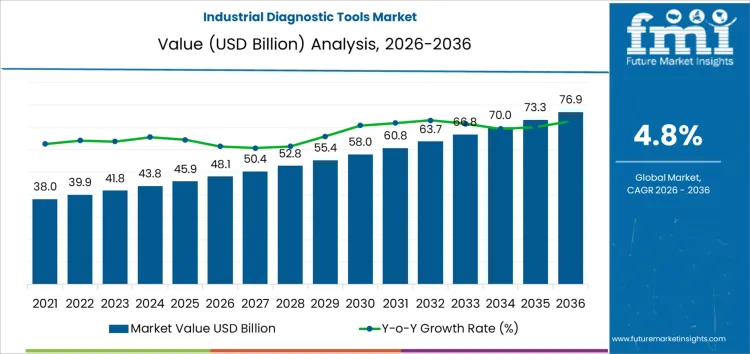
The industrial diagnostic tools market is projected to expand from USD 48.1 billion in 2026 to USD 76.9 billion by 2036, reflecting a compound annual growth rate (CAGR) of 4.8%. The economic significance of these tools is increasingly influenced by how industrial organizations manage knowledge, skills, and decision-making authority.
As experienced technicians retire and maintenance teams become more centralized, plants are relying more on instruments that capture standardized and reviewable evidence rather than subjective judgment. This shift in focus changes spending priorities toward tools that enhance documentation, traceability, and cross-site comparability, moving beyond mere local fault finding. Measurement is increasingly becoming a fundamental part of governance and reporting structures, extending beyond merely addressing technical troubleshooting.
Deployment patterns are evolving in response to the changing organization of maintenance and reliability functions. Large organizations are establishing central engineering teams that analyze data from multiple sites, which increases the importance of having compatible formats, repeatable procedures, and long-term data continuity. Therefore, the effectiveness of tool ecosystems is becoming more significant than that of individual devices.
Smaller facilities tend to adopt tools selectively, often to satisfy audit, customer, or insurer requirements. In this regard, training, certification, and method standardization heavily influence purchasing decisions, just as much as hardware capabilities do. Ultimately, the growth of the industrial diagnostic tools market is driven by organizational restructuring and the formalization of asset oversight, rather than by simple increases in inspection frequency or the expansion of tool inventories.
Quick Stats for Industrial Diagnostic Tools Market
- Industrial Diagnostic Tools Market Value (2026): USD 48.1 billion
- Industrial Diagnostic Tools Market Forecast Value (2036): USD 76.9 billion
- Industrial Diagnostic Tools Market Forecast CAGR 2026 to 2036: 4.8%
- Leading Tool Type in Industrial Diagnostic Tools Market: Vibration analyzers
- Leading End-Use Industry in Industrial Diagnostic Tools Market: Manufacturing
- Key Growth Regions in Industrial Diagnostic Tools Market: Asia Pacific, North America, Europe
- Top Players in Industrial Diagnostic Tools Market: Fluke Corporation, SKF, Honeywell International, Siemens, Emerson
What is the Growth Forecast for the Industrial Diagnostic Tools Market through 2036?
The industrial diagnostic tools market is being reshaped by changes in how industrial organizations manage decision making, skills, and operational accountability. In 2020, when the industrial diagnostic tools market is around USD 38.0 billion, diagnostic activity is still concentrated in specialist teams and used mainly for failure analysis and commissioning. As the industrial diagnostic tools market moves through roughly USD 41.8 billion in 2023 and approaches USD 48.1 billion by 2026, instruments are increasingly placed in the hands of plant engineers, reliability teams, and maintenance supervisors. This shift is driven by skills shortages, flatter organizations, and the need to shorten decision cycles during abnormal operating conditions. Diagnostic tools are therefore purchased not only to locate faults but to support routine operational judgment and daily technical decisions.
As the industrial diagnostic tools market advances to approximately USD 55.4 billion by 2030 and around USD 60.8 billion by 2032, growth is increasingly carried by wider internal distribution of instruments within the same facilities rather than by expansion in the number of sites. By the time the industrial diagnostic tools market approaches about USD 70.0 billion in 2034 and reaches roughly USD 76.9 billion by 2036, diagnostic measurement has become embedded in standard work instructions, operating procedures, and audit routines. More functions rely on measurement data for everyday decisions, not only for major incidents. Purchasing behavior is therefore shaped by ease of use, training requirements, and decision support value as much as by technical performance, accuracy, or measurement range.
Industrial Diagnostic Tools Market Key Takeaways
| Metric | Value |
|---|---|
| Market Value (2026) | USD 48.1 billion |
| Forecast Value (2036) | USD 76.9 billion |
| Forecast CAGR 2026 to 2036 | 4.8% |
How Are Industrial Diagnostic Tools Improving Equipment Reliability and Operational Insights?
Industrial diagnostic tools are increasingly deployed to monitor machinery condition, detect faults, and optimize maintenance schedules across manufacturing, energy, and processing facilities. Traditional inspection methods relied on manual measurements and periodic visual checks, which often missed early-stage failures and resulted in unexpected downtime. Modern diagnostic tools integrate vibration analysis, thermal imaging, ultrasonic sensors, and real-time data analytics to provide actionable insights, predictive maintenance alerts, and accurate equipment health assessments. Equipment manufacturers, plant operators, and maintenance service providers prioritize tool precision, data integration, and ease of use. Early adoption focused on critical machinery in high-value industrial processes, while current demand spans manufacturing plants, power generation facilities, and heavy machinery operations, driven by cost control, safety requirements, and operational efficiency. Sensor accuracy, data processing capability, and portability influence supplier selection.
Operational predictability, cost reduction, and asset performance optimization are shaping market dynamics. Compared with conventional inspection approaches, modern diagnostic tools provide earlier detection of anomalies, detailed condition reports, and reduced unplanned downtime. Cost considerations include sensor quality, software analytics, and calibration services, concentrating margins among suppliers delivering reliable, integrated solutions. Industrial operators adopt these tools to enhance machine uptime, extend equipment lifespan, and optimize maintenance planning. In the coming years, industrial diagnostic tools are expected to become a core component of predictive maintenance strategies, enabling data-driven decision-making, improved operational safety, and measurable reductions in production interruptions.
What Factors Are Shaping the Demand for Industrial Diagnostic Tools Market, Segment wise by Tool Type and End Use Industry, in 2026?
The Industrial Diagnostic Tools Market is driven by how different organizations experience failure, how they are audited, and how risk is financially assigned inside the company. In many plants, diagnostic tools are not purchased as part of a technology roadmap. They are purchased after an incident, a near miss, an insurance audit, or a production loss event. By tool type, the Industrial Diagnostic Tools Market includes vibration analyzers, thermal imagers, ultrasonic testers, and portable spectrum analyzers. By end-use, the Industrial Diagnostic Tools Market serves manufacturing, oil and gas, power generation, and automotive and aerospace. These segments differ mainly in how failure is discovered, who is blamed, and how quickly spending is approved.
How Do Incident Pathways, Not Technology Strategy, Shape Tool Type Demand in the Industrial Diagnostic Tools Market?

Vibration analyzers represent about 40% of demand in the Industrial Diagnostic Tools Market, but not because companies rationally design condition monitoring systems. In practice, vibration analyzers are most often purchased after bearing failures, gearbox failures, or repeated unplanned shutdowns. These events are easy to quantify financially and easy to explain to management. The tool is justified as a direct response to a known loss mechanism.
Thermal imagers enter plants through a different path. They are frequently driven by electrical safety programs, insurance inspections, and fire-risk audits rather than by maintenance engineering. Ultrasonic tools are often purchased following compressed air losses, steam trap failures, or leak audits. Portable spectrum analyzers are acquired mainly by specialists and reliability engineers after complex root-cause investigations. The Industrial Diagnostic Tools Market is therefore not segmented by sophistication. It is segmented by which type of failure has recently caused pain, scrutiny, or external pressure. Each tool category corresponds to a different institutional trigger for spending.
Why Does Manufacturing Generate the Broadest and Most Continuous Demand in the Industrial Diagnostic Tools Market?
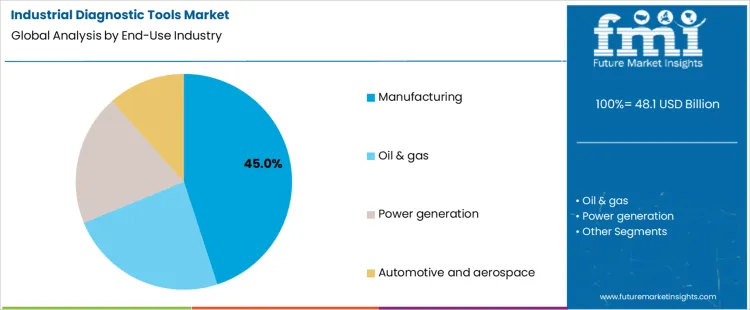
Manufacturing represents about 45% of demand in the Industrial Diagnostic Tools Market because manufacturing sites experience frequent, small, and medium-scale failures rather than rare, catastrophic ones. This creates a continuous stream of incident-driven, audit-driven, and improvement-driven tool purchases across thousands of plants. Spending is fragmented, local, and recurring.
In oil and gas and power generation, failures are rarer but far more expensive, and diagnostic spending is often bundled into large shutdown or integrity programs rather than into individual tool purchases. Automotive and aerospace plants are fewer, larger, and more centralized, with tighter corporate control over tool procurement. Manufacturing, by contrast, is organizationally decentralized. This produces many independent buying centers, each responding to its own incidents, audits, and operational pressures. This fragmentation, not asset criticality, is what makes manufacturing the largest demand pool in the Industrial Diagnostic Tools Market.
How Are the Key Dynamics Reshaping the Industrial Diagnostic Tools Market?
The Industrial Diagnostic Tools Market grows when uncertainty becomes expensive. Plants can tolerate inefficiency for years, but they cannot tolerate invisible failure modes. Diagnostic instruments gain attention when downtime investigations turn into management problems or when quality escapes start crossing company boundaries. In some organizations, the Industrial Diagnostic Tools Market is treated as a source of optional troubleshooting aids. In others, it becomes part of daily operating rhythm. The difference is not technology. It is how seriously evidence is used. The Industrial Diagnostic Tools Market expands through changes in how factories explain problems, not through routine instrument replacement cycles.
Why the Industrial Diagnostic Tools Market Is Failure Investigation Driven?
Most purchases in the Industrial Diagnostic Tools Market begin after something breaks and nobody can agree why. A bearing fails early, a motor overheats, or vibration destroys alignment. At that point, management wants answer that opinions cannot provide. Tools enter as forensic instruments first. When they shorten root cause debates, they stay. When they do not, they return to storage. Demand in the Industrial Diagnostic Tools Market follows the cost of unresolved arguments and repeated incidents, not the age of existing instruments or the arrival of new product generations.
Why the Industrial Diagnostic Tools Market Often Becomes Underused?
Many factories own capable instruments and still operate blindly. The Industrial Diagnostic Tools Market depends on time, trained staff, and permission to stop equipment based on what data shows. Without that authority, measurements become ceremonial. Reports are written, then ignored. Over time, operators stop measuring unless a failure already happened. This turns the Industrial Diagnostic Tools Market into post failure documentation rather than prevention infrastructure. The constraint is not budget. It is whether management allows measured evidence to interrupt production plans.
Why the Industrial Diagnostic Tools Market Follows Management Maturity?
The Industrial Diagnostic Tools Market thrives where factories run on disciplined routines. In plants with reliability programs and formal investigation processes, diagnostics become infrastructure. In plants run by experience and improvisation, diagnostics remain optional. As companies centralize maintenance standards and compare sites, measured evidence becomes more valuable than anecdote. That shift, not sensor quality, expands the Industrial Diagnostic Tools Market. Growth follows how organizations govern operations, not how many machines they own.
What is the Demand for Industrial Diagnostic Tools by Country?
| Country | CAGR (%) |
|---|---|
| USA | 4.5% |
| UK | 4.2% |
| China | 5.2% |
| India | 5.5% |
| Brazil | 4.8% |
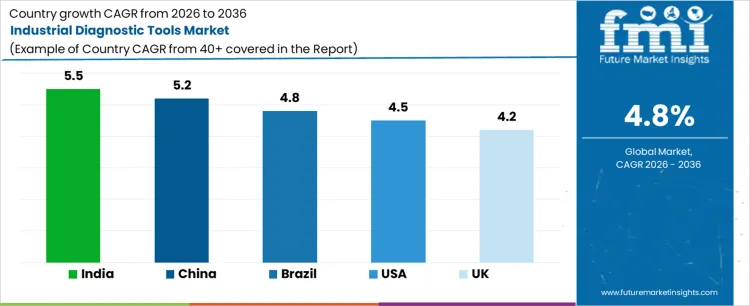
Demand for industrial diagnostic tools is rising as manufacturing, energy, and process industries adopt equipment for predictive maintenance, process monitoring, and quality assurance. India leads with a 5.5% CAGR, driven by growing industrial production, increasing maintenance requirements, and adoption of diagnostic solutions in manufacturing facilities. China follows at 5.2%, supported by expanding industrial operations and equipment monitoring needs. Brazil records 4.8% growth, shaped by adoption in energy and process industries. The USA grows at 4.5%, influenced by replacement demand and integration in industrial operations. The UK shows 4.2% CAGR, reflecting steady adoption of diagnostic tools across manufacturing and industrial sectors.
Where does commercial control sit in the United States industrial diagnostic tools business?
Spending in United States industrial maintenance and reliability programs follows plant uptime targets and asset life management plans, with industrial diagnostic tools demand advancing at a 4.5% CAGR. Order flow comes mainly from condition monitoring upgrades, safety audits, and predictive maintenance rollouts. Large asset owners and MRO contractors influence specification choices more than individual plant engineers. Installed base compatibility shapes repeat purchases across vibration, thermal, and electrical testing categories. Distribution networks and service coverage affect brand presence inside multi-site groups. Software integration capability influences system level wins. Procurement cycles align with annual maintenance budgets and shutdown planning. Certification scope affects acceptance in regulated plants. Revenue timing follows maintenance campaign schedules rather than capital project approvals. Commercial success depends on framework inclusion and fleet wide deployment programs rather than single plant equipment tenders.
How do compliance and maintenance regimes shape demand in the United Kingdom?
Maintenance planning in United Kingdom industrial facilities remains tied to inspection schedules and compliance programs, with industrial diagnostic tools purchases expanding at a 4.2% CAGR. A large share of spending comes from power generation, process industries, and infrastructure operators. Framework agreements and service contractors control much of the sourcing activity. Tool selection emphasizes documentation output, audit readiness, and calibration support. Distribution partners play a strong role in brand placement across multi-site operators. Software reporting compatibility influences fleet standardization decisions. New plant construction contributes limited volume compared with inspection driven replacement and upgrade cycles. Procurement timing follows outage planning and regulatory inspection windows. Inventory stocking programs influence recurring orders. Commercial visibility depends on positioning inside maintenance service ecosystems rather than competitive bidding on individual plant requirements.
What structural factors govern scale in China?
Industrial modernization programs and centralized asset management policies keep China on a 5.2% growth track for industrial diagnostic tools procurement. Volume concentrates in power generation, chemicals, heavy manufacturing, and transport infrastructure. State owned groups and large industrial operators influence standardization decisions. Domestic manufacturers dominate basic diagnostic categories through pricing and distribution reach. International brands retain positions in advanced analytics and high accuracy instruments. Order timing follows multi-year equipment upgrade programs rather than short maintenance cycles. Distributor networks control access to regional buyers. Training and certification support affect brand selection. Margin structure depends on mix between advanced systems and routine instruments. Commercial success depends on inclusion in group level standard tool lists rather than repeated pursuit of individual plant orders.
Why does channel strategy matter more than product range in India?
Plant reliability programs and industrial capacity expansion keep India on a 5.5% growth path for industrial diagnostic tools spending. Most purchasing decisions pass through maintenance contractors, plant service companies, and distributor networks. Entry barriers sit in service coverage, training support, and calibration capability. Import brands serve high specification applications while domestic suppliers cover volume tools. A large share of revenue comes from bundled maintenance contracts rather than stand-alone tool sales. Payment terms and service responsiveness influence brand preference. Procurement timing follows shutdown schedules and annual maintenance planning. Regional distributor strength shapes market access. Sales performance depends on preferred supplier status and service ecosystem positioning. Expansion follows growth in installed industrial base rather than short cycle capital investment waves or isolated factory projects.
How do service drive buy patterns shape Brazil demand?
Maintenance outsourcing and reliability improvement programs shape Brazil purchasing behavior, with industrial diagnostic tools demand advancing at a 4.8% CAGR. Volume concentrates in mining, energy, pulp and paper, and process industries. Service providers and plant maintenance contractors control a large share of tool selection. Import dependence affects pricing, delivery schedules, and calibration planning. Distributor coverage influences regional access. Tool choice emphasizes robustness, service support, and audit acceptance. New plant projects contribute limited incremental volume compared with ongoing maintenance needs. Procurement timing aligns with shutdown schedules and contract renewals. Inventory programs support recurring orders. Revenue visibility depends on positioning inside maintenance service frameworks and contractor supply chains rather than direct selling to individual plant operators.
How Are Leading Companies Shaping the Industrial Diagnostic Tools Market?

Fluke Corporation supplies handheld and networked diagnostic instruments that emphasize accuracy, ruggedness, and ease of use for electrical, thermal, and vibration analysis across industrial environments. SKF provides condition monitoring and predictive maintenance tools that integrate bearing and vibration data to signal early equipment distress. Honeywell International delivers diagnostic solutions tied to process control systems, with sensors and analytics that support uptime in chemical, energy, and manufacturing facilities.
Siemens offers diagnostic software and hardware within broader automation portfolios, enabling integration of machine health data with plant control layers. Emerson provides tools that combine sensor interfaces with analytics engines, focusing on process instrumentation diagnostics and early fault detection. These offerings address industrial needs for measurable condition data that supports maintenance decisions.
Providers differentiate through accuracy, interoperability with existing systems, and analytical depth. Fluke’s instruments are chosen for field diagnostics where portability and robustness matter. SKF’s condition monitoring platforms extend analytics into long term trend tracking for rotating equipment. Honeywell and Siemens integrate diagnostics into control and automation frameworks that support broader asset management strategies. Emerson focuses on process instrumentation diagnostics that tie sensor health to operational performance.
Other regional and specialized suppliers contribute niche tools for specific measurement tasks, such as infrared inspection or acoustic emissions. Adoption reflects priorities for reducing unplanned downtime, optimizing maintenance schedules, and consolidating diagnostic data across asset types. Companies with broad tool ecosystems, strong service support, and clear performance documentation remain relevant as industrial operators pursue data driven maintenance strategies that enhance reliability, safety, and cost control.
Key Players in the Industrial Diagnostic Tools Market
- Fluke Corporation
- SKF
- Honeywell International
- Siemens
- Emerson
Scope of the Report
| Items | Values |
|---|---|
| Quantitative Units (2026) | USD billion |
| Tool Type | Vibration analyzers, Thermal imagers, Ultrasonic testers, Portable spectrum analyzers |
| End-Use Industry | Manufacturing, Oil & gas, Power generation, Automotive and aerospace |
| Region | Asia Pacific, Europe, North America, Latin America, Middle East & Africa |
| Countries Covered | China, Japan, South Korea, India, Australia & New Zealand, ASEAN, Germany, United Kingdom, France, Italy, Spain, Nordic, BENELUX, United States, Canada, Mexico, Brazil, Chile, Saudi Arabia, Turkey, South Africa, and other regional markets |
| Key Companies Profiled | Fluke Corporation, SKF, Honeywell International, Siemens, Emerson |
| Additional Attributes | Dollar by sales by tool type and end-use; demand driven by incident investigation, audits, and reliability programs; growth led by wider internal deployment and predictive maintenance use; ecosystem compatibility and training matter; purchasing shaped by documentation, traceability, calibration, and decision-support value rather than hardware novelty. |
Industrial Diagnostic Tools Market Segmentation
Tool Type:
- Vibration analyzers
- Thermal imagers
- Ultrasonic testers
- Portable spectrum analyzers
End-Use Industry:
- Manufacturing
- Oil & gas
- Power generation
- Automotive and aerospace
Region:
- Asia Pacific
- China
- Japan
- South Korea
- India
- Australia & New Zealand
- ASEAN
- Rest of Asia Pacific
- Europe
- Germany
- United Kingdom
- France
- Italy
- Spain
- Nordic
- BENELUX
- Rest of Europe
- North America
- United States
- Canada
- Mexico
- Latin America
- Brazil
- Chile
- Rest of Latin America
- Middle East & Africa
- Kingdom of Saudi Arabia
- Other GCC Countries
- Turkey
- South Africa
- Other African Union
- Rest of Middle East & Africa
Bibliography
- National Institute of Standards and Technology. (2024). Smart manufacturing systems and condition monitoring research. U.S. Department of Commerce.
- National Institute of Standards and Technology. (2024). Condition monitoring and diagnostics for advanced manufacturing systems. U.S. Department of Commerce.
- International Energy Agency. (2024). Digitalisation and energy efficiency in industry. International Energy Agency.
- European Commission. (2024). Digitalising European industry: Data-driven manufacturing, monitoring, and inspection policy. European Union.
- Occupational Safety and Health Administration. (2024). Process safety management and mechanical integrity. U.S. Department of Labor.
Frequently Asked Questions
How big is the industrial diagnostic tools market in 2026?
The global industrial diagnostic tools market is estimated to be valued at USD 48.1 billion in 2026.
What will be the size of industrial diagnostic tools market in 2036?
The market size for the industrial diagnostic tools market is projected to reach USD 76.9 billion by 2036.
How much will be the industrial diagnostic tools market growth between 2026 and 2036?
The industrial diagnostic tools market is expected to grow at a 4.8% CAGR between 2026 and 2036.
What are the key product types in the industrial diagnostic tools market?
The key product types in industrial diagnostic tools market are vibration analyzers , thermal imagers, ultrasonic testers and portable spectrum analyzers.
Which end‑use industry segment to contribute significant share in the industrial diagnostic tools market in 2026?
In terms of end‑use industry, manufacturing segment to command 45.0% share in the industrial diagnostic tools market in 2026.
Preview the report firsthand - request a free sample
Get SampleGet the brochure for pricing and purchase details.
Get PDFTable of Content
- Executive Summary
- Global Market Outlook
- Demand-side Trends
- Supply-side Trends
- Technology Roadmap Analysis
- Analysis and Recommendations
- Market Overview
- Market Coverage / Taxonomy
- Market Definition / Scope / Limitations
- Market Background
- Market Dynamics
- Drivers
- Restraints
- Opportunity
- Trends
- Scenario Forecast
- Demand in Optimistic Scenario
- Demand in Likely Scenario
- Demand in Conservative Scenario
- Opportunity Map Analysis
- Product Life Cycle Analysis
- Supply Chain Analysis
- Investment Feasibility Matrix
- Value Chain Analysis
- PESTLE and Porter’s Analysis
- Regulatory Landscape
- Regional Parent Market Outlook
- Production and Consumption Statistics
- Import and Export Statistics
- Market Dynamics
- Global Market Analysis 2021 to 2025 and Forecast, 2026 to 2036
- Historical Market Size Value (USD Million) Analysis, 2021 to 2025
- Current and Future Market Size Value (USD Million) Projections, 2026 to 2036
- Y-o-Y Growth Trend Analysis
- Absolute $ Opportunity Analysis
- Global Market Pricing Analysis 2021 to 2025 and Forecast 2026 to 2036
- Global Market Analysis 2021 to 2025 and Forecast 2026 to 2036, By Tool Type
- Introduction / Key Findings
- Historical Market Size Value (USD Million) Analysis By Tool Type , 2021 to 2025
- Current and Future Market Size Value (USD Million) Analysis and Forecast By Tool Type , 2026 to 2036
- Vibration analyzers
- Thermal imagers
- Ultrasonic testers
- Portable spectrum analyzers
- Vibration analyzers
- Y-o-Y Growth Trend Analysis By Tool Type , 2021 to 2025
- Absolute $ Opportunity Analysis By Tool Type , 2026 to 2036
- Global Market Analysis 2021 to 2025 and Forecast 2026 to 2036, By End‑Use Industry
- Introduction / Key Findings
- Historical Market Size Value (USD Million) Analysis By End‑Use Industry, 2021 to 2025
- Current and Future Market Size Value (USD Million) Analysis and Forecast By End‑Use Industry, 2026 to 2036
- Manufacturing
- Oil & gas
- Power generation
- Automotive and aerospace
- Manufacturing
- Y-o-Y Growth Trend Analysis By End‑Use Industry, 2021 to 2025
- Absolute $ Opportunity Analysis By End‑Use Industry, 2026 to 2036
- Global Market Analysis 2021 to 2025 and Forecast 2026 to 2036, By Region
- Introduction
- Historical Market Size Value (USD Million) Analysis By Region, 2021 to 2025
- Current Market Size Value (USD Million) Analysis and Forecast By Region, 2026 to 2036
- North America
- Latin America
- Western Europe
- Eastern Europe
- East Asia
- South Asia and Pacific
- Middle East & Africa
- Market Attractiveness Analysis By Region
- North America Market Analysis 2021 to 2025 and Forecast 2026 to 2036, By Country
- Historical Market Size Value (USD Million) Trend Analysis By Market Taxonomy, 2021 to 2025
- Market Size Value (USD Million) Forecast By Market Taxonomy, 2026 to 2036
- By Country
- USA
- Canada
- Mexico
- By Tool Type
- By End‑Use Industry
- By Country
- Market Attractiveness Analysis
- By Country
- By Tool Type
- By End‑Use Industry
- Key Takeaways
- Latin America Market Analysis 2021 to 2025 and Forecast 2026 to 2036, By Country
- Historical Market Size Value (USD Million) Trend Analysis By Market Taxonomy, 2021 to 2025
- Market Size Value (USD Million) Forecast By Market Taxonomy, 2026 to 2036
- By Country
- Brazil
- Chile
- Rest of Latin America
- By Tool Type
- By End‑Use Industry
- By Country
- Market Attractiveness Analysis
- By Country
- By Tool Type
- By End‑Use Industry
- Key Takeaways
- Western Europe Market Analysis 2021 to 2025 and Forecast 2026 to 2036, By Country
- Historical Market Size Value (USD Million) Trend Analysis By Market Taxonomy, 2021 to 2025
- Market Size Value (USD Million) Forecast By Market Taxonomy, 2026 to 2036
- By Country
- Germany
- UK
- Italy
- Spain
- France
- Nordic
- BENELUX
- Rest of Western Europe
- By Tool Type
- By End‑Use Industry
- By Country
- Market Attractiveness Analysis
- By Country
- By Tool Type
- By End‑Use Industry
- Key Takeaways
- Eastern Europe Market Analysis 2021 to 2025 and Forecast 2026 to 2036, By Country
- Historical Market Size Value (USD Million) Trend Analysis By Market Taxonomy, 2021 to 2025
- Market Size Value (USD Million) Forecast By Market Taxonomy, 2026 to 2036
- By Country
- Russia
- Poland
- Hungary
- Balkan & Baltic
- Rest of Eastern Europe
- By Tool Type
- By End‑Use Industry
- By Country
- Market Attractiveness Analysis
- By Country
- By Tool Type
- By End‑Use Industry
- Key Takeaways
- East Asia Market Analysis 2021 to 2025 and Forecast 2026 to 2036, By Country
- Historical Market Size Value (USD Million) Trend Analysis By Market Taxonomy, 2021 to 2025
- Market Size Value (USD Million) Forecast By Market Taxonomy, 2026 to 2036
- By Country
- China
- Japan
- South Korea
- By Tool Type
- By End‑Use Industry
- By Country
- Market Attractiveness Analysis
- By Country
- By Tool Type
- By End‑Use Industry
- Key Takeaways
- South Asia and Pacific Market Analysis 2021 to 2025 and Forecast 2026 to 2036, By Country
- Historical Market Size Value (USD Million) Trend Analysis By Market Taxonomy, 2021 to 2025
- Market Size Value (USD Million) Forecast By Market Taxonomy, 2026 to 2036
- By Country
- India
- ASEAN
- Australia & New Zealand
- Rest of South Asia and Pacific
- By Tool Type
- By End‑Use Industry
- By Country
- Market Attractiveness Analysis
- By Country
- By Tool Type
- By End‑Use Industry
- Key Takeaways
- Middle East & Africa Market Analysis 2021 to 2025 and Forecast 2026 to 2036, By Country
- Historical Market Size Value (USD Million) Trend Analysis By Market Taxonomy, 2021 to 2025
- Market Size Value (USD Million) Forecast By Market Taxonomy, 2026 to 2036
- By Country
- Kingdom of Saudi Arabia
- Other GCC Countries
- Turkiye
- South Africa
- Other African Union
- Rest of Middle East & Africa
- By Tool Type
- By End‑Use Industry
- By Country
- Market Attractiveness Analysis
- By Country
- By Tool Type
- By End‑Use Industry
- Key Takeaways
- Key Countries Market Analysis
- USA
- Pricing Analysis
- Market Share Analysis, 2025
- By Tool Type
- By End‑Use Industry
- Canada
- Pricing Analysis
- Market Share Analysis, 2025
- By Tool Type
- By End‑Use Industry
- Mexico
- Pricing Analysis
- Market Share Analysis, 2025
- By Tool Type
- By End‑Use Industry
- Brazil
- Pricing Analysis
- Market Share Analysis, 2025
- By Tool Type
- By End‑Use Industry
- Chile
- Pricing Analysis
- Market Share Analysis, 2025
- By Tool Type
- By End‑Use Industry
- Germany
- Pricing Analysis
- Market Share Analysis, 2025
- By Tool Type
- By End‑Use Industry
- UK
- Pricing Analysis
- Market Share Analysis, 2025
- By Tool Type
- By End‑Use Industry
- Italy
- Pricing Analysis
- Market Share Analysis, 2025
- By Tool Type
- By End‑Use Industry
- Spain
- Pricing Analysis
- Market Share Analysis, 2025
- By Tool Type
- By End‑Use Industry
- France
- Pricing Analysis
- Market Share Analysis, 2025
- By Tool Type
- By End‑Use Industry
- India
- Pricing Analysis
- Market Share Analysis, 2025
- By Tool Type
- By End‑Use Industry
- ASEAN
- Pricing Analysis
- Market Share Analysis, 2025
- By Tool Type
- By End‑Use Industry
- Australia & New Zealand
- Pricing Analysis
- Market Share Analysis, 2025
- By Tool Type
- By End‑Use Industry
- China
- Pricing Analysis
- Market Share Analysis, 2025
- By Tool Type
- By End‑Use Industry
- Japan
- Pricing Analysis
- Market Share Analysis, 2025
- By Tool Type
- By End‑Use Industry
- South Korea
- Pricing Analysis
- Market Share Analysis, 2025
- By Tool Type
- By End‑Use Industry
- Russia
- Pricing Analysis
- Market Share Analysis, 2025
- By Tool Type
- By End‑Use Industry
- Poland
- Pricing Analysis
- Market Share Analysis, 2025
- By Tool Type
- By End‑Use Industry
- Hungary
- Pricing Analysis
- Market Share Analysis, 2025
- By Tool Type
- By End‑Use Industry
- Kingdom of Saudi Arabia
- Pricing Analysis
- Market Share Analysis, 2025
- By Tool Type
- By End‑Use Industry
- Turkiye
- Pricing Analysis
- Market Share Analysis, 2025
- By Tool Type
- By End‑Use Industry
- South Africa
- Pricing Analysis
- Market Share Analysis, 2025
- By Tool Type
- By End‑Use Industry
- USA
- Market Structure Analysis
- Competition Dashboard
- Competition Benchmarking
- Market Share Analysis of Top Players
- By Regional
- By Tool Type
- By End‑Use Industry
- Competition Analysis
- Competition Deep Dive
- Fluke Corporation
- Overview
- Product Portfolio
- Profitability by Market Segments (Product/Age /Sales Channel/Region)
- Sales Footprint
- Strategy Overview
- Marketing Strategy
- Product Strategy
- Channel Strategy
- SKF
- Honeywell International
- Siemens
- Emerson
- Fluke Corporation
- Competition Deep Dive
- Assumptions & Acronyms Used
- Research Methodology


