

- Industry Size (2026)
- USD 298 Mn
- Forecast (2036)
- USD 597.3 Mn
- CAGR (2026 to 2036)
- 7.2%
Green Corrosion Inhibitors for District Heating Systems Market Forecast and Outlook 2026 to 2036
The global green corrosion inhibitors for district heating systems market is expected to grow from USD 298 million in 2026 to USD 597.3 million by 2036, with a forecasted CAGR of 7.2%. The market’s expansion is driven by the increasing demand for ecological and environmentally friendly solutions in the maintenance of district heating systems. These systems, which are susceptible to corrosion due to constant water flow and temperature fluctuations, benefit from green corrosion inhibitors, which protect metal surfaces without harming the environment. Organic film-forming inhibitors (amines, fatty imidazolines) lead the market, holding a 28% share due to their high efficiency in preventing corrosion in central boiler plants, which dominate the market with a 32% share.
Quick Stats for Green Corrosion Inhibitors for District Heating Systems Market
- Green Corrosion Inhibitors for District Heating Systems Market Value (2026): USD 298 million
- Green Corrosion Inhibitors for District Heating Systems Market Forecast Value (2036): USD 597.3 million
- Green Corrosion Inhibitors for District Heating Systems Market Forecast CAGR (2026-2036): 7.2%
- Leading Chemistry Type in Green Corrosion Inhibitors for District Heating Systems Market: Organic Film-Forming Inhibitors (Amines, Fatty Imidazolines) (28%)
- Key Growth Regions in Green Corrosion Inhibitors for District Heating Systems Market: Asia Pacific
- Top Players in Green Corrosion Inhibitors for District Heating Systems Market: Kurita Water Industries, Solenis, Ecolab, Veolia Water Technologies, Accepta / EnviroChem, ChemTreat
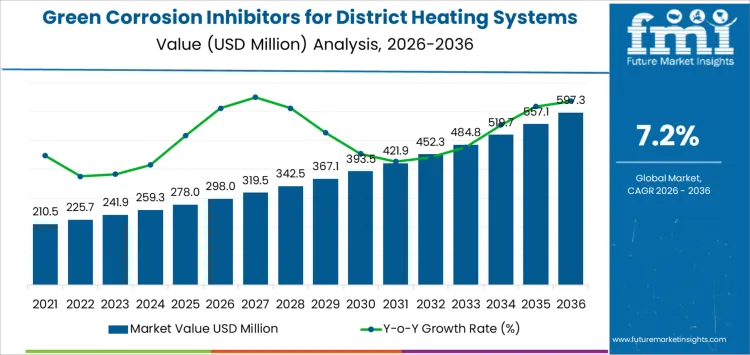
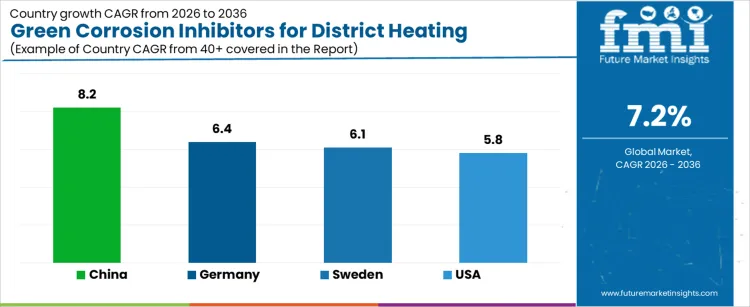
Regional growth is notable in China, with the market growing at an 8.2% CAGR, driven by rapid urbanization and infrastructure development. Germany follows with a 6.4% growth rate, supported by strong environmental regulations and a commitment to ecological heating technologies. Sweden’s market grows at 6.1%, influenced by its renewable energy focus, while the USA shows moderate growth at 5.8%, fueled by increased adoption of energy-efficient heating technologies. The market is driven by regulatory pressures, rising demand for energy efficiency, and a growing focus on durability. Challenges such as cost, performance consistency, and adoption barriers need to be addressed. As the shift towards greener alternatives continues, the market for green corrosion inhibitors is poised for steady expansion globally.
Green Corrosion Inhibitors for District Heating Systems Market Key Takeaways
| Metric | Value |
|---|---|
| Industry Value (2026) | USD 298 million |
| Forecast Value (2036) | USD 597.3 million |
| Forecast CAGR (2026-2036) | 7.2% |
How is the Global Green Corrosion Inhibitors for District Heating Systems Sector Advancing?
The global green corrosion inhibitors for district heating systems market is growing as the demand for ecological and environmentally friendly solutions in infrastructure maintenance rises. District heating systems, which distribute heat from a central source to residential and commercial buildings, are particularly susceptible to corrosion due to constant water flow and temperature fluctuations. Green corrosion inhibitors are designed to prevent rust and deterioration in these systems while offering minimal environmental impact, unlike traditional inhibitors that may contain harmful chemicals.
With stricter environmental regulations and the increasing emphasis on durability, green corrosion inhibitors are becoming an attractive solution for district heating network operators. These inhibitors not only reduce maintenance costs and extend the life of the system but also help operators meet regulatory requirements for reducing chemical pollutants. Innovations in inhibitor formulations have improved their performance, providing better protection against corrosion in high‑temperature environments commonly found in district heating systems.
Looking forward, the market is expected to continue growing as energy efficiency and durability become more central to global heating infrastructure. The adoption of green corrosion inhibitors will likely increase, driven by both government policies and rising consumer demand for eco‑friendly solutions. Challenges such as cost and the need for widespread industry adoption may influence the growth rate. Nonetheless, as the focus on reducing the environmental footprint of industrial operations intensifies, the green corrosion inhibitors market for district heating systems will continue to thrive.
What is the Segment-Wise Analysis for the Global Green Corrosion Inhibitors for District Heating Systems Market?
The global green corrosion inhibitors for district heating systems market is segmented by chemistry type and application point. Organic film-forming inhibitors (amines, fatty imidazolines) lead the market with a 28% share due to their effectiveness in protecting metal surfaces from corrosion. Other significant chemistry types include bio-based/plant-derived inhibitors, phosphate-free polymeric inhibitors, volatile corrosion inhibitors (VCI), and multifunctional inhibitors that control both corrosion and scaling. In terms of application points, central boiler plants hold the largest share at 32%, followed by distribution pipeline networks, heat exchangers, substation components, and other critical parts like storage tanks, circulation pumps, and valves.
How Do Organic Film-Forming Inhibitors Lead the Global Green Corrosion Inhibitors Market?
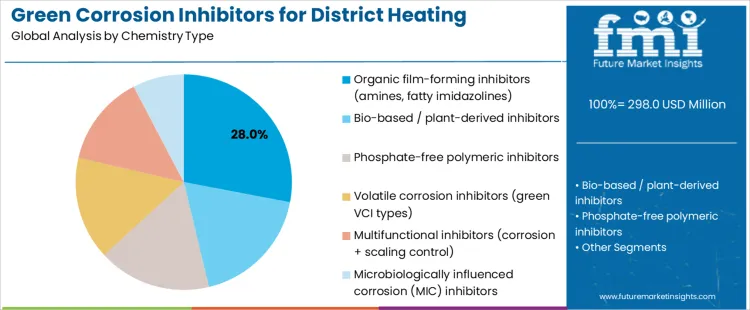
Organic film-forming inhibitors (amines, fatty imidazolines) lead the global green corrosion inhibitors for district heating systems market with a 28% share due to their high efficiency in creating protective films on metal surfaces, preventing corrosion. These inhibitors are especially valued for their ability to protect both ferrous and non-ferrous metals, which are widely used in district heating systems. Their use in central boiler plants, where high temperatures and pressure conditions require robust protection, makes them a preferred choice. As the demand for ecological, eco-friendly solutions grows, organic film-forming inhibitors continue to dominate the market due to their reliable performance and environmental benefits.
Why Do Central Boiler Plants Hold the Largest Market Share?
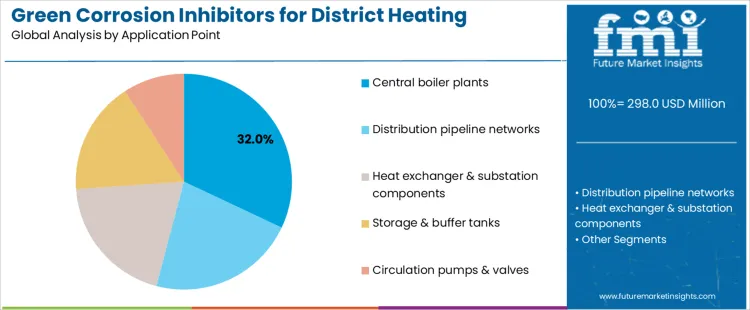
Central boiler plants hold the largest share of 32% in the global green corrosion inhibitors for district heating systems market due to their essential role in providing heat across a network of buildings. These plants operate under high pressure and temperature, making corrosion a significant issue for maintaining efficiency and longevity. Green corrosion inhibitors, particularly organic film-forming types, are crucial in preventing corrosion in the boiler components, extending the operational lifespan and reducing maintenance costs. As energy efficiency and durability become increasingly important, the adoption of environmentally friendly corrosion inhibitors in central boiler plants continues to drive market growth.
What Is Driving the Green Corrosion Inhibitors for District Heating Systems Market?
The green corrosion inhibitors for district heating systems market is driven by the growing global focus on energy efficiency, durability, and infrastructure longevity. District heating networks, which circulate hot water or steam to multiple buildings, are susceptible to corrosion that can lead to leaks, energy loss, and costly repairs. Traditional inhibitors often contain toxic chemicals that pose environmental and health risks. Increasing regulatory pressure to reduce hazardous substance use and the demand for eco friendly alternatives are pushing utilities and plant operators to adopt green corrosion inhibitors that protect infrastructure while minimizing environmental impact.
What Challenges Are Limiting Adoption of Green Corrosion Inhibitors in District Heating Systems?
Adoption of green corrosion inhibitors is sometimes constrained by concerns over performance consistency and cost. Some operators perceive conventional inhibitors as more effective or familiar, especially in extreme temperature and pressure conditions found in large networks. Eco friendly formulations may carry higher upfront costs, which can deter budget sensitive utility providers or retrofitting projects. Compatibility with existing system materials and optimization of dosing protocols require careful evaluation. Limited awareness or lack of standardized performance benchmarks for “green” classifications in certain regions can slow wider uptake.
How Are Innovations Shaping the Green Corrosion Inhibitors for District Heating Systems Market?
Innovations in this market are focused on developing ecological chemistries that deliver effective corrosion protection while reducing toxicity and environmental impact. Novel inhibitor formulations often use biodegradable, non toxic organic compounds, plant based additives, and advanced inhibitor blends tailored for varying water qualities and operating conditions. There is increasing integration of digital monitoring tools that track corrosion rates and optimize dosing in real time, enhancing chemical efficiency and reducing waste. Collaboration between inhibitor manufacturers and utility operators is accelerating customized solutions that meet performance and durability targets.
What is the Growth Outlook for the Green Corrosion Inhibitors for District Heating Systems Market by Country?
| Country | CAGR (%) |
|---|---|
| Germany | 6.4% |
| Sweden | 6.1% |
| China | 8.2% |
| USA | 5.8% |
The green corrosion inhibitors for district heating systems market is witnessing steady growth, with China leading at an 8.2% CAGR, driven by rapid infrastructure development and growing demand for ecological solutions. Germany follows with a 6.4% growth rate, supported by stringent environmental regulations and a commitment to reducing the environmental impact of district heating. Sweden shows a 6.1% growth rate, fueled by its strong focus on ecological energy and efficient heating systems. The USA shows moderate growth at 5.8%, driven by increased adoption of energy-efficient heating technologies and environmental regulations.
Why is China Leading in the Green Corrosion Inhibitors for District Heating Systems Market?
China’s green corrosion inhibitors for district heating systems market is growing at 8.2%, driven by the country’s rapid urbanization, infrastructure expansion, and increasing focus on durability. As China continues to build out its district heating networks to meet the rising demand for energy-efficient solutions, there is a growing need for corrosion inhibitors that can protect these systems while minimizing environmental impact. The government’s push for greener technologies and stricter environmental standards is further accelerating the adoption of eco-friendly corrosion inhibitors in heating systems. With increasing industrial activity and infrastructure development, China is adopting green alternatives to ensure that its heating systems are both efficient and environmentally responsible, leading to strong growth in this market.
What is Contributing to the Growth of the Green Corrosion Inhibitors for District Heating Systems Market in Germany?
Germany’s green corrosion inhibitors for district heating systems market is growing at 6.4%, driven by the country’s strict environmental regulations and commitment to ecological heating technologies. As Germany continues to expand its district heating infrastructure to meet the demands of a growing population and the need for energy-efficient solutions, the demand for environmentally safe corrosion inhibitors is rising. The focus on reducing environmental impacts from heating systems, particularly in urban areas, is encouraging the adoption of green alternatives that protect the systems while minimizing harm to the environment. With the continued push for energy-efficient solutions and the implementation of stricter regulations, Germany’s market for green corrosion inhibitors is expected to continue its steady growth.
How is the Green Corrosion Inhibitors for District Heating Systems Market Expanding in Sweden?
Sweden’s green corrosion inhibitors for district heating systems market is growing at 6.1%, supported by the country’s strong commitment to renewable energy and durability in the heating sector. Sweden has a well-developed district heating system that covers a significant portion of its population, and there is increasing demand for eco-friendly corrosion inhibitors to ensure system longevity while minimizing environmental impact. The Swedish government’s focus on reducing carbon emissions and improving energy efficiency in heating systems is driving the adoption of green corrosion inhibitors. As Sweden continues to innovate and prioritize durability in its heating systems, the market for these products is expected to grow steadily.
What is Driving the Green Corrosion Inhibitors for District Heating Systems Market in the USA?
The USA’s green corrosion inhibitors for district heating systems market is growing at 5.8%, fueled by the increasing adoption of energy-efficient and environmentally friendly technologies in the heating sector. As more cities and regions focus on reducing energy consumption and improving heating system performance, the demand for corrosion inhibitors that are both effective and eco-friendly is rising. Stricter environmental regulations and a growing emphasis on durability in the energy sector are encouraging the adoption of green alternatives. Although the market is growing more slowly than in some other regions, continued investments in renewable energy and energy-efficient heating systems are expected to drive further growth in the USA’s green corrosion inhibitor market.
How Are Companies Competing in the Green Corrosion Inhibitors for District Heating Systems Market?
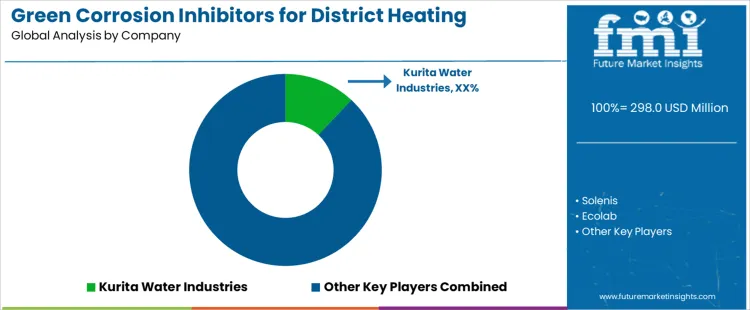
Green corrosion inhibitors for district heating systems are offered by Kurita Water Industries Solenis Ecolab Veolia Water Technologies Accepta EnviroChem and ChemTreat. These players are positioned as providers of environmentally friendly inhibitor technologies that protect metal surfaces in closed heating loops. Product brochures are used to communicate inhibitor chemistry application guidelines dosage recommendations and performance data. Brochures from Kurita are presented with multi‑metal protection profiles and lifecycle service options. Solenis product literature is showcased with patented green formulations and deployment case studies. Ecolab brochures are focused on integrated water treatment services paired with green inhibitor blends. Veolia Water Technologies catalogs highlight tailored inhibitor packages supported by system diagnostics. Accepta EnviroChem brochures emphasize low toxicity profiles and compliance with regulatory standards. ChemTreat product guides are detailed with corrosion rate charts and field service support options.
Competition is shaped by efficacy durability and service support. Inhibitor performance claims are backed by field trial data and compatibility statements in brochures. Kurita is perceived as strong in custom solutions for large district systems. Solenis is positioned on innovation and green chemistry advancement. Ecolab is favored where holistic water management services are required. Veolia Water Technologies is chosen for integrated infrastructure expertise. Accepta EnviroChem is referenced for focused green chemistry portfolios. ChemTreat is recognized for application flexibility and local support. Product brochures are used to educate facility managers on selection criteria inhibitor stability handling protocols and expected outcomes. Information on inhibitor interactions with heat exchanger materials is provided. Technical specification sheets featuring pH control ranges and corrosion inhibition efficiency are included.
Key Players in Green Corrosion Inhibitors for District Heating Systems Market
- Kurita Water Industries
- Solenis
- Ecolab
- Veolia Water Technologies
- Accepta / EnviroChem
- ChemTreat
Scope of Report
| Items | Values |
|---|---|
| Quantitative Units (2026) | USD million |
| Application Point | Central Boiler Plants, Distribution Pipeline Networks, Heat Exchanger & Substation Components, Storage & Buffer Tanks, Circulation Pumps & Valves |
| Chemistry Type | Organic Film-Forming Inhibitors (Amines, Fatty Imidazolines), Bio-Based / Plant-Derived Inhibitors, Phosphate-Free Polymeric Inhibitors, Volatile Corrosion Inhibitors (Green VCI Types), Multifunctional Inhibitors (Corrosion + Scaling Control), Microbiologically Influenced Corrosion (MIC) Inhibitors |
| Regions Covered | Asia Pacific, Europe, North America, Latin America, Middle East & Africa |
| Countries Covered | USA, China, Japan, South Korea, India, Australia & New Zealand, ASEAN, Germany, UK, France, Italy, Spain, Nordic, BENELUX, Brazil, Chile, Mexico, Saudi Arabia, Other GCC Countries, Turkey, South Africa, Other African Union |
| Key Companies Profiled | Kurita Water Industries, Solenis, Ecolab, Veolia Water Technologies, Accepta / EnviroChem, ChemTreat |
| Additional Attributes | Dollar sales by chemistry type, application point, and region; regional CAGR and growth outlook; distribution channels including utilities, contractors, and service providers; innovation trends in green chemistry formulations; competitive positioning of global vs regional suppliers. |
Green Corrosion Inhibitors for District Heating Systems Market by Segments
Chemistry Type
- Organic film-forming inhibitors (amines, fatty imidazolines)
- Bio-based / plant-derived inhibitors
- Phosphate-free polymeric inhibitors
- Volatile corrosion inhibitors (green VCI types)
- Multifunctional inhibitors (corrosion + scaling control)
- Microbiologically influenced corrosion (MIC) inhibitors
Application Point
- Central boiler plants
- Distribution pipeline networks
- Heat exchanger & substation components
- Storage & buffer tanks
- Circulation pumps & valves
Region
- Asia Pacific
- China
- Japan
- South Korea
- India
- Australia & New Zealand
- ASEAN
- Rest of Asia Pacific
- Europe
- Germany
- United Kingdom
- France
- Italy
- Spain
- Nordic
- BENELUX
- Rest of Europe
- North America
- United States
- Canada
- Mexico
- Latin America
- Brazil
- Chile
- Rest of Latin America
- Middle East & Africa
- Kingdom of Saudi Arabia
- Other GCC Countries
- Turkey
- South Africa
- Other African Union
- Rest of Middle East & Africa
Frequently Asked Questions
How big is the green corrosion inhibitors for district heating systems market in 2026?
The global green corrosion inhibitors for district heating systems market is estimated to be valued at USD 298.0 million in 2026.
What will be the size of green corrosion inhibitors for district heating systems market in 2036?
The market size for the green corrosion inhibitors for district heating systems market is projected to reach USD 597.3 million by 2036.
How much will be the green corrosion inhibitors for district heating systems market growth between 2026 and 2036?
The green corrosion inhibitors for district heating systems market is expected to grow at a 7.2% CAGR between 2026 and 2036.
What are the key product types in the green corrosion inhibitors for district heating systems market?
The key product types in green corrosion inhibitors for district heating systems market are organic film-forming inhibitors (amines, fatty imidazolines), bio-based / plant-derived inhibitors, phosphate-free polymeric inhibitors, volatile corrosion inhibitors (green vci types), multifunctional inhibitors (corrosion + scaling control) and microbiologically influenced corrosion (mic) inhibitors.
Which application point segment to contribute significant share in the green corrosion inhibitors for district heating systems market in 2026?
In terms of application point, central boiler plants segment to command 32.0% share in the green corrosion inhibitors for district heating systems market in 2026.
Preview the report firsthand - request a free sample
Get SampleGet the brochure for pricing and purchase details.
Get PDFTable of Content
- Executive Summary
- Global Market Outlook
- Demand-side Trends
- Supply-side Trends
- Technology Roadmap Analysis
- Analysis and Recommendations
- Market Overview
- Market Coverage / Taxonomy
- Market Definition / Scope / Limitations
- Market Background
- Market Dynamics
- Drivers
- Restraints
- Opportunity
- Trends
- Scenario Forecast
- Demand in Optimistic Scenario
- Demand in Likely Scenario
- Demand in Conservative Scenario
- Opportunity Map Analysis
- Product Life Cycle Analysis
- Supply Chain Analysis
- Investment Feasibility Matrix
- Value Chain Analysis
- PESTLE and Porter’s Analysis
- Regulatory Landscape
- Regional Parent Market Outlook
- Production and Consumption Statistics
- Import and Export Statistics
- Market Dynamics
- Global Market Analysis 2021 to 2025 and Forecast, 2026 to 2036
- Historical Market Size Value (USD Million) Analysis, 2021 to 2025
- Current and Future Market Size Value (USD Million) Projections, 2026 to 2036
- Y-o-Y Growth Trend Analysis
- Absolute $ Opportunity Analysis
- Global Market Pricing Analysis 2021 to 2025 and Forecast 2026 to 2036
- Global Market Analysis 2021 to 2025 and Forecast 2026 to 2036, By Chemistry Type
- Introduction / Key Findings
- Historical Market Size Value (USD Million) Analysis By Chemistry Type , 2021 to 2025
- Current and Future Market Size Value (USD Million) Analysis and Forecast By Chemistry Type , 2026 to 2036
- Organic film-forming inhibitors (amines, fatty imidazolines)
- Bio-based / plant-derived inhibitors
- Phosphate-free polymeric inhibitors
- Volatile corrosion inhibitors (green VCI types)
- Multifunctional inhibitors (corrosion + scaling control)
- Microbiologically influenced corrosion (MIC) inhibitors
- Y-o-Y Growth Trend Analysis By Chemistry Type , 2021 to 2025
- Absolute $ Opportunity Analysis By Chemistry Type , 2026 to 2036
- Global Market Analysis 2021 to 2025 and Forecast 2026 to 2036, By Application Point
- Introduction / Key Findings
- Historical Market Size Value (USD Million) Analysis By Application Point, 2021 to 2025
- Current and Future Market Size Value (USD Million) Analysis and Forecast By Application Point, 2026 to 2036
- Central boiler plants
- Distribution pipeline networks
- Heat exchanger & substation components
- Storage & buffer tanks
- Circulation pumps & valves
- Y-o-Y Growth Trend Analysis By Application Point, 2021 to 2025
- Absolute $ Opportunity Analysis By Application Point, 2026 to 2036
- Global Market Analysis 2021 to 2025 and Forecast 2026 to 2036, By Region
- Introduction
- Historical Market Size Value (USD Million) Analysis By Region, 2021 to 2025
- Current Market Size Value (USD Million) Analysis and Forecast By Region, 2026 to 2036
- North America
- Latin America
- Western Europe
- Eastern Europe
- East Asia
- South Asia and Pacific
- Middle East & Africa
- Market Attractiveness Analysis By Region
- North America Market Analysis 2021 to 2025 and Forecast 2026 to 2036, By Country
- Historical Market Size Value (USD Million) Trend Analysis By Market Taxonomy, 2021 to 2025
- Market Size Value (USD Million) Forecast By Market Taxonomy, 2026 to 2036
- By Country
- USA
- Canada
- Mexico
- By Chemistry Type
- By Application Point
- By Country
- Market Attractiveness Analysis
- By Country
- By Chemistry Type
- By Application Point
- Key Takeaways
- Latin America Market Analysis 2021 to 2025 and Forecast 2026 to 2036, By Country
- Historical Market Size Value (USD Million) Trend Analysis By Market Taxonomy, 2021 to 2025
- Market Size Value (USD Million) Forecast By Market Taxonomy, 2026 to 2036
- By Country
- Brazil
- Chile
- Rest of Latin America
- By Chemistry Type
- By Application Point
- By Country
- Market Attractiveness Analysis
- By Country
- By Chemistry Type
- By Application Point
- Key Takeaways
- Western Europe Market Analysis 2021 to 2025 and Forecast 2026 to 2036, By Country
- Historical Market Size Value (USD Million) Trend Analysis By Market Taxonomy, 2021 to 2025
- Market Size Value (USD Million) Forecast By Market Taxonomy, 2026 to 2036
- By Country
- Germany
- UK
- Italy
- Spain
- France
- Nordic
- BENELUX
- Rest of Western Europe
- By Chemistry Type
- By Application Point
- By Country
- Market Attractiveness Analysis
- By Country
- By Chemistry Type
- By Application Point
- Key Takeaways
- Eastern Europe Market Analysis 2021 to 2025 and Forecast 2026 to 2036, By Country
- Historical Market Size Value (USD Million) Trend Analysis By Market Taxonomy, 2021 to 2025
- Market Size Value (USD Million) Forecast By Market Taxonomy, 2026 to 2036
- By Country
- Russia
- Poland
- Hungary
- Balkan & Baltic
- Rest of Eastern Europe
- By Chemistry Type
- By Application Point
- By Country
- Market Attractiveness Analysis
- By Country
- By Chemistry Type
- By Application Point
- Key Takeaways
- East Asia Market Analysis 2021 to 2025 and Forecast 2026 to 2036, By Country
- Historical Market Size Value (USD Million) Trend Analysis By Market Taxonomy, 2021 to 2025
- Market Size Value (USD Million) Forecast By Market Taxonomy, 2026 to 2036
- By Country
- China
- Japan
- South Korea
- By Chemistry Type
- By Application Point
- By Country
- Market Attractiveness Analysis
- By Country
- By Chemistry Type
- By Application Point
- Key Takeaways
- South Asia and Pacific Market Analysis 2021 to 2025 and Forecast 2026 to 2036, By Country
- Historical Market Size Value (USD Million) Trend Analysis By Market Taxonomy, 2021 to 2025
- Market Size Value (USD Million) Forecast By Market Taxonomy, 2026 to 2036
- By Country
- India
- ASEAN
- Australia & New Zealand
- Rest of South Asia and Pacific
- By Chemistry Type
- By Application Point
- By Country
- Market Attractiveness Analysis
- By Country
- By Chemistry Type
- By Application Point
- Key Takeaways
- Middle East & Africa Market Analysis 2021 to 2025 and Forecast 2026 to 2036, By Country
- Historical Market Size Value (USD Million) Trend Analysis By Market Taxonomy, 2021 to 2025
- Market Size Value (USD Million) Forecast By Market Taxonomy, 2026 to 2036
- By Country
- Kingdom of Saudi Arabia
- Other GCC Countries
- Turkiye
- South Africa
- Other African Union
- Rest of Middle East & Africa
- By Chemistry Type
- By Application Point
- By Country
- Market Attractiveness Analysis
- By Country
- By Chemistry Type
- By Application Point
- Key Takeaways
- Key Countries Market Analysis
- USA
- Pricing Analysis
- Market Share Analysis, 2025
- By Chemistry Type
- By Application Point
- Canada
- Pricing Analysis
- Market Share Analysis, 2025
- By Chemistry Type
- By Application Point
- Mexico
- Pricing Analysis
- Market Share Analysis, 2025
- By Chemistry Type
- By Application Point
- Brazil
- Pricing Analysis
- Market Share Analysis, 2025
- By Chemistry Type
- By Application Point
- Chile
- Pricing Analysis
- Market Share Analysis, 2025
- By Chemistry Type
- By Application Point
- Germany
- Pricing Analysis
- Market Share Analysis, 2025
- By Chemistry Type
- By Application Point
- UK
- Pricing Analysis
- Market Share Analysis, 2025
- By Chemistry Type
- By Application Point
- Italy
- Pricing Analysis
- Market Share Analysis, 2025
- By Chemistry Type
- By Application Point
- Spain
- Pricing Analysis
- Market Share Analysis, 2025
- By Chemistry Type
- By Application Point
- France
- Pricing Analysis
- Market Share Analysis, 2025
- By Chemistry Type
- By Application Point
- India
- Pricing Analysis
- Market Share Analysis, 2025
- By Chemistry Type
- By Application Point
- ASEAN
- Pricing Analysis
- Market Share Analysis, 2025
- By Chemistry Type
- By Application Point
- Australia & New Zealand
- Pricing Analysis
- Market Share Analysis, 2025
- By Chemistry Type
- By Application Point
- China
- Pricing Analysis
- Market Share Analysis, 2025
- By Chemistry Type
- By Application Point
- Japan
- Pricing Analysis
- Market Share Analysis, 2025
- By Chemistry Type
- By Application Point
- South Korea
- Pricing Analysis
- Market Share Analysis, 2025
- By Chemistry Type
- By Application Point
- Russia
- Pricing Analysis
- Market Share Analysis, 2025
- By Chemistry Type
- By Application Point
- Poland
- Pricing Analysis
- Market Share Analysis, 2025
- By Chemistry Type
- By Application Point
- Hungary
- Pricing Analysis
- Market Share Analysis, 2025
- By Chemistry Type
- By Application Point
- Kingdom of Saudi Arabia
- Pricing Analysis
- Market Share Analysis, 2025
- By Chemistry Type
- By Application Point
- Turkiye
- Pricing Analysis
- Market Share Analysis, 2025
- By Chemistry Type
- By Application Point
- South Africa
- Pricing Analysis
- Market Share Analysis, 2025
- By Chemistry Type
- By Application Point
- USA
- Market Structure Analysis
- Competition Dashboard
- Competition Benchmarking
- Market Share Analysis of Top Players
- By Regional
- By Chemistry Type
- By Application Point
- Competition Analysis
- Competition Deep Dive
- Kurita Water Industries
- Overview
- Product Portfolio
- Profitability by Market Segments (Product/Age /Sales Channel/Region)
- Sales Footprint
- Strategy Overview
- Marketing Strategy
- Product Strategy
- Channel Strategy
- Solenis
- Ecolab
- Veolia Water Technologies
- Accepta / EnviroChem
- ChemTreat
- Kurita Water Industries
- Competition Deep Dive
- Assumptions & Acronyms Used
- Research Methodology


