

- Industry Size (2026)
- USD 601.2 Mn
- Forecast (2036)
- USD 907.2 Mn
- CAGR (2026 to 2036)
- 4.2%
Trigger Sprayer Market Size and Share Forecast Outlook 2026 to 2036
The global trigger sprayer sector is on track to achieve a valuation of USD 907.2 million by 2036, accelerating from USD 601.2 million in 2026 at a CAGR of 4.2%. As per Future Market Insights, expansion is structurally underpinned by the sustained demand for manual dispensing solutions in household cleaning, personal care, and industrial maintenance applications. The European Parliament's Packaging and Packaging Waste Regulation (PPWR) adopted in April 2024 introduced binding targets to increase recycled content in plastic packaging, which directly affects trigger sprayer specifications. This regulatory framework compels sprayer manufacturers to reformulate resin blends to incorporate post-consumer recycled materials while maintaining chemical resistance and spray pattern consistency. Simultaneously, brand owners are tightening their supplier requirements for lightweighted dispensing systems that reduce per-unit plastic consumption.
Luigi Garofalo, Global Category Director at Aptar, stated: 'TSP is more than a trigger, it is a strategic addition to Aptar Beauty's dispensing portfolio that reflects our commitment.' In February 2026, Canyon Europe initiated a GBP 3.1 million investment in its Mallusk manufacturing facility to establish a high-speed production line for the Minerva T22, a trigger sprayer engineered to reduce plastic weight while maintaining industrial-grade durability. FMI opines that Canyon's investment in a dedicated lightweight sprayer production line is indicative of the broader trend where trigger sprayer manufacturing is shifting from general-purpose molding to precision-engineered, application-specific formats.
The operational reality for trigger sprayer suppliers is defined by the need to balance recyclability with chemical compatibility across diverse product formulations. As per FMI, the trigger sprayer market is entering a phase where brand owners in household cleaning and personal care are requiring suppliers to provide full lifecycle assessments and EPDs for dispensing components. FMI is of the opinion that the competitive landscape will increasingly favor integrated dispensing solution providers who can offer both the trigger mechanism and the bottle in a single recyclable mono-material system, simplifying the recycling stream for end consumers.
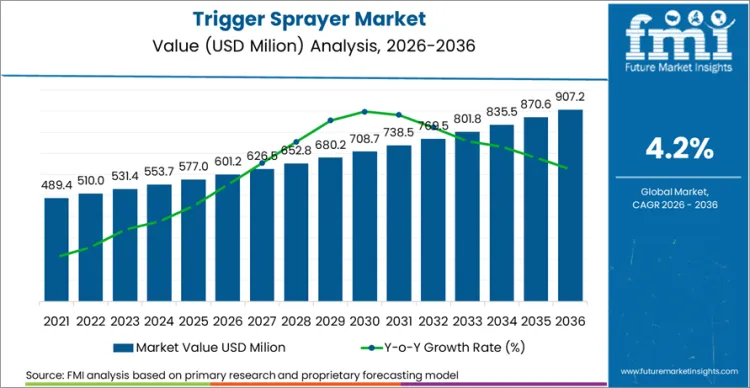
Summary of Trigger Sprayer Market
What Is Growth Outlook for Trigger Sprayer Market as per Future Market Insights Projection?
Future Market Insights projects the trigger sprayer market to expand at a CAGR of 4.2% from 2026 to 2036, increasing from USD 601.2 Million in 2026 to USD 907.2 Million by 2036.
FMI Research Approach: FMI forecasting model based on household cleaning product volumes and PPWR recycled content mandates.
How Do FMI Analysts Perceive Trigger Sprayer Market to Evolve?
FMI analysts perceive the market evolving toward PCR-resin based, lightweighted trigger sprayers where sustainability certification becomes a procurement requirement from FMCG brand owners.
FMI Research Approach: Canyon Minerva T22 investment (February 2026) and EU PPWR recycled content targets.
Which Country Holds Largest Share in Global Trigger Sprayer Market?
The United States holds a significant share, supported by the largest household cleaning product market and major sprayer manufacturer presence.
FMI Research Approach: FMI modeling by household cleaning product volumes and dispensing component procurement.
How Large Will Trigger Sprayer Market Be by 2036?
The market is projected to reach USD 907.2 Million by 2036.
FMI Research Approach: FMI forecast from FMCG packaging specification trends and PPWR compliance timelines.
What Is Definition of Trigger Sprayer Market?
The market includes revenue from manual trigger-actuated dispensing sprayers sold as components to household cleaning, personal care, automotive care, and industrial maintenance product manufacturers.
FMI Research Approach: FMI taxonomy aligned with dispensing packaging classifications.
What Are Globally Unique Trends Shaping Trigger Sprayer Market?
Trends include PCR resin adoption mandated by EU PPWR, lightweight precision-engineered sprayer designs, and mono-material trigger-bottle systems for simplified recycling.
FMI Research Approach: Canyon Minerva T22 (February 2026) and Aptar TSP portfolio addition.
Trigger Sprayer Market Key Takeaways
| Metric | Details |
|---|---|
| Industry Size (2026) | USD 601.2 Million |
| Industry Value (2036) | USD 907.2 Million |
| CAGR (2026 to 2036) | 4.2% |
Source: Future Market Insights (FMI) analysis, based on proprietary forecasting model and primary research
Semi-annual Update
The table below presents a comparative assessment of the variation in CAGR over six months for the base year (2025) and current year (2026) for the trigger sprayer market. This analysis reveals crucial shifts in market performance and indicates revenue realization patterns, thus providing stakeholders with a better vision of the market growth trajectory over the year. The first half of the year, or H1, spans from January to June. The second half, H2, includes the months from July to December.
In the first half (H1) from 2025 to 2035, the business is predicted to surge at a CAGR of 3.7%, followed by a slightly higher growth rate of 4.1% in the second half (H2).
| Particular | Value CAGR |
|---|---|
| H1 | 3.7% (2025 to 2035) |
| H2 | 4.1% (2025 to 2035) |
| H1 | 4.0% (2026 to 2036) |
| H2 | 4.4% (2026 to 2036) |
Moving into the subsequent period, from H1 2026 to H2 2026, the CAGR is projected to increase slightly to 4.0% in the first half and remain relatively moderate at 4.4% in the second half. In the first half (H1) the market witnessed an increase of 30 BPS while in the second half (H2), the market witnessed an increase of 30 BPS.
Key Industry Highlights
E-Commerce Growth Driving Trigger Sprayer Demand through Online Platforms and Efficient Delivery Models
Growth in e-commerce is the most significant opportunity for the trigger sprayer market, primarily through online retailing. With more and more consumers preferring to buy home care products online, the demand for trigger sprayers that can efficiently facilitate small parcel shipping is increasing.
Such demand arises due to the requirements of cost-effective packaging, shorter shipping times, and customer convenience. Online retailing goliaths are packaging trigger sprayers as a part of larger product lines, selling everything from household cleaning supplies to personal care products and thereby enhancing their visibility and sales.
The development of online marketplaces has forced manufacturers to create packaging and distribution strategies relevant to the digital world. Today, trigger sprayers are sold through the major channels like Amazon, Flipkart, and Walmart along with other consumer goods. Subscription models and exclusive online offers also provide a basis for sustainable growth and wide access to customers.
Customized Trigger Sprayers are tapping into niche market opportunities across pharmaceuticals, cosmetics, food, and industrial sectors
One of the significant market opportunities is customized trigger sprayers for industries with specialty applications. Specialty industries like pharmaceuticals, cosmetics, and food and beverage manufacturers all require fine spray or foam applicators for delivering specific liquid formulas.
For those industries, spray or foam has to be accurately dispensed in order not to waste any amount of the formula. Highly specialized sprayers such as these represent an opportunity for manufacturers to cater to bespoke demand, giving them entry to high-margin sub-markets.
As a result, companies like Nitto Denko Corporation have brought forth sprayers with adjustable nozzles based on various customer requirements. Manufacturers are also concentrating on sprayers that provide tighter control over the spray patterns, offering more usability in applications like skin care, hair care, and specialized cleaning formulations. Such customizing innovativeness is likely to enhance niche application-based growth in the trigger sprayer market.
Growing Demand for Eco-Friendly Trigger Sprayers Drives Innovation with Sustainable Materials and Designs
The trigger sprayer market is shifting towards sustainability nowadays, as most consumers are focusing on eco-friendly solutions. They are using recyclable plastics and biodegradable components and reducing the plastic content used in their final products to abide by the changing environmental concerns of the consumers.
This trend is notable in the areas of household and personal care industries, where increasing numbers of people are opting for products that advance green practices. As such, companies react by developing creative designs that achieve reduced environmental effects while maintaining performance.
For instance, Urbis created a brand of eco-friendly trigger sprayers made from recycled plastic, thereby reducing its carbon footprint. This other company, ECO Sprayer, is dedicated to developing sustainable products. Among them is its renewable material-based sprayers.
The company helps consumers and industries in their quest to reduce damage to the environment without sacrificing performance. All these developments underscore that the industry has gone on an upward trend regarding sustainability and increasingly opting for more eco-friendly designs.
2021 to 2025 Global Trigger Sprayer Sales Outlook Compared to Demand Forecast from 2026 to 2036
The global trigger sprayer system market recorded a CAGR of 3.6% during the historical period between 2021 and 2025. The growth of trigger sprayer market was positive as it reached a value of USD 553.7 million in 2025 from USD 479.8 million in 2021.
Between 2021 and 2025, a great deal changed for the market of trigger sprayers. Not only did challenges rise, most were mainly fuelled by COVID-19 in disrupting supply lines and raw materials. With massive increases in plastic resins causing shortages in them, it saw increased demand from cleaning products coupled with this effect of the pandemic.
Also, there were significant environmental impacts becoming more pressing since single-use plastics in packaging have attracted most sustainability-focused groups. These factors led many companies to invest in alternative materials, including bioplastics, and also look into the possibility of refilling packaging.
For instance, many producers began incorporating post-consumable plastics in their production thus cutting back on virgin supplies. Difficulties facing distribution were also minimised with adoption of online platforms for selling since it helped them directly connect with the consumers who can significantly change their shopping habits.
The trigger sprayer market is further projected to grow exponentially in the period 2026 to 2036, more so due to innovation and changing consumer preferences. With the increasing demand for eco-friendly solutions, trigger sprayers will be made of more sustainable materials, such as recycled PET and biodegradable plastics, and there will be a growing interest in reusable and refillable systems.
The market will also see the increasing demand for ergonomic and customizable spray mechanisms, especially in personal care and industrial uses. The drivers of growth will include improving the efficiency of sprays, reducing waste, and enhanced user experience. The likelihood of an increasing use of smart sprayer technologies among them is sprayers with adjustable spray patterns and sensors optimizing fluid usage in the personal care sector. The market would undergo further geographical growth by 2035. Due to its steady increase, high disposable incomes within developing countries ensure a growing market.
Market Concentration
Tier 1 companies comprise market leaders with a market revenue of above USD 20 million capturing a significant market share of 30-35% in the trigger sprayer market. These market leaders are characterized by extensive expertise in manufacturing across a range of packaging formats and have a wide geographic reach, with a strong foundation of consumers.
They offer an extensive range of series, which includes recycling and manufacturing with the latest technology to meet regulatory requirements and deliver quality. Prominent companies within Tier 1 include Berry Global Inc., Silgan Dispensing Systems, AptarGroup, Inc., Mr. Nozzle Inc. and Cole-Parmer Instrument Company, LLC.
Tier 2 and other includes the majority of small-scale companies operating at the local presence and serving niche markets having revenue below USD 20 million. These companies are notably oriented towards fulfilling local market demands and are consequently classified within the tier 2 share segment. They are small-scale players and have limited geographical reach.
Tier 2, within this context, is recognized as an unorganized market, denoting a sector characterized by a lack of extensive structure and formalization when compared to organized competitors.
Country-wise Insights
The section below covers the industry analysis for the trigger sprayer market for different countries. Market demand analysis on key countries is provided. The USA is anticipated to remain at the forefront in North America, with a value share of 62.3% through 2036. In East Asia, China is projected to witness a CAGR of 3.7% by 2036.
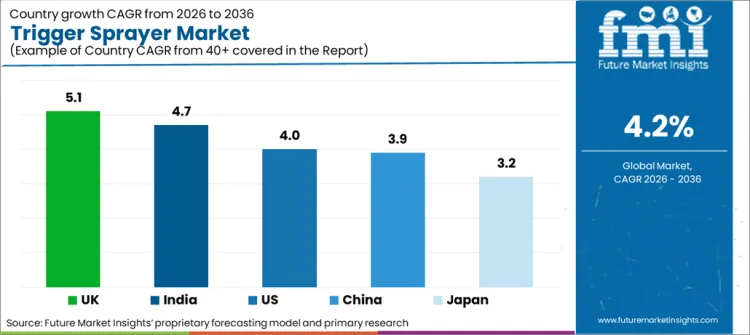
| Country | Value CAGR (2026 to 2036) |
|---|---|
| USA | 4.0% |
| UK | 5.1% |
| China | 3.9% |
| Japan | 3.2% |
| India | 4.7% |
Innovative Features and Hygiene Focus Drive Growth in USA Trigger Sprayer Market with Advancements in Anti-Clog Mechanisms and Smart Technologies
Increased awareness regarding hygiene and sanitation in the USA has fuelled the huge growth of the use of trigger sprayers, especially for household cleaning and personal care products. Greater attention to disinfecting and sanitizing practices in the wake of the pandemic has boosted usage of cleaning products based on the dispensing systems of trigger sprayers. Additionally, the increased trend of DIY home improvement activities has led to the demand for spray paints and garden care products, which is increasing the market for durable and precise sprayer solutions.
Companies in the USA trigger sprayer market innovate to respond to increased demand for more sophisticated features such as anti-clog mechanisms and greater durability. For example, Rieke Packaging, a TriMas company, has created the Ultimate-E trigger sprayer that is leak-proof during shipping of small parcels in e-commerce. While examples of trigger sprayers with digital tracking systems are scarce, the industry is gradually moving toward integrating smart technologies. 2D barcodes, according to GS1 guidelines, provide better tracking and data management for products such as trigger sprayers.
China Leads Global Trigger Sprayer Production with Massive Output in Plastics and Glass, Driven by Advanced Manufacturing and Competitive Pricing
China has enormous production capacities in plastics and glass, which enhances its position as a leading manufacturer of trigger sprayers. The country produced approximately 7.23 million metric tons of plastic products in November 2024 alone, which proves its ability to supply the required components for trigger sprayer production.
China's glass production exceeded one billion weight cases in 2021, indicating a massive volume of material for other industries. A robust manufacturing sector enables China to meet its domestic as well as overseas requirements for trigger sprayers effectively. Given the availability of raw materials, combined with better production facilities, China is now the most vital hub in the world for the production of trigger sprayers. Such mass production enables not only an uninterrupted supply chain but also cost-effectiveness. All these facts and figures make China a leader in this industry.
India's Strong Plastic Manufacturing Capacity Drives Growth in Spray Trigger Manufacturing for the Agricultural Sector
India's large-scale production capabilities in plastics are essential to its development as a prominent producer of trigger sprayers. In the fiscal year 2022, India consumed 19.3 million tons of thermoplastics, and polypropylene (PP) made up 32% of the total. Such high production levels of thermoplastics ensure the availability of all the raw materials required for making strong and efficient trigger sprayers. Availability of such materials at competitive prices helps Indian manufacturers produce spray triggers of superior quality, to be used in cleaning products, agricultural sprays, and automotive products, among others.
Champion Polymer and Vitrag Corporation, among others, are producing special spray triggers for diverse sectors. For instance, in the cleaning product industry, triggers are designed with features such as adjustable spray patterns, leak resistance, and ergonomic handles to ensure that they meet both functional and consumer comfort needs. With the rising need for effective pest control and crop protection, Indian market is bound to face an increase in the agricultural sprayer market and expansion in manufacturing capacity to become one of the major players in the global spray trigger market. Currently, Indian manufacturers are also shifting to more eco-friendly options in keeping pace with increasing consumer demand for sustainable products.
Category-wise Insights
The section contains information about the leading segments in the industry. By product type, conventional trigger sprayers segment is estimated to grow at a CAGR of 35.6% throughout 2036. Additionally, Home Care end use is projected to expand at 24.6% by 2036.
Conventional Trigger Sprayers Dominate Market Due to Versatility, Reliability, and Broad Application Reach
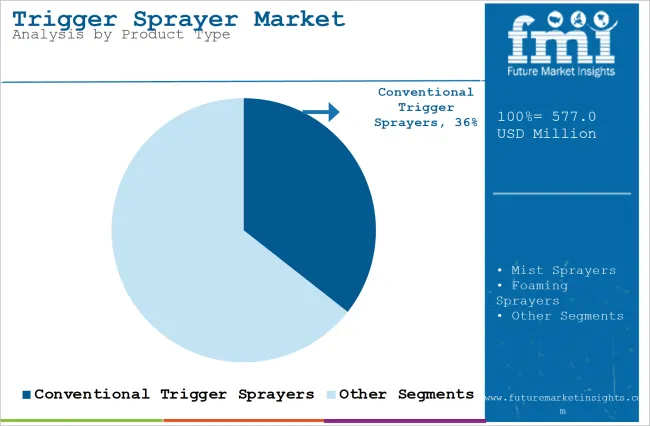
| Product Type | Conventional Trigger Sprayers |
|---|---|
| Value Share (2035) | 35.6% |
The Conventional Trigger Sprayers segment is quite versatile and has various applications. The wide application of conventional trigger sprayers in the industries like household cleaning, industrial cleaning, personal care, gardening, automotive, and food processing tells the adaptability story. They are cost-effective and user-friendly in design, so conventional trigger sprayers find widespread applications in several sectors. Therefore, they are market leaders because they can meet different needs with consistent performance in various liquid formulations and applications. Their popularity has made them have a steady demand that forces the stores to stock trigger sprayers in their shelves, making them one of the most used sprayer types.
Mist Sprayers, Foaming Sprayers, and Fine Mist Sprayers are used for more specific purposes. They are mainly used in personal care and gardening since they can dispense a finer and more uniform spray. On the other hand, the applications in cases where a foam-based product is needed, such as cleaners and shampoos, are best equipped by the Foaming Sprayers. Though these have some niche applications, market-wise, the majority of the market share will be cornered by Conventional Trigger Sprayers given their adaptability, cost-effectiveness, and unlimited availability across various industries.
Home Care Segment Leads Trigger Sprayer Market with High Demand for Household Cleaning and Disinfection Products
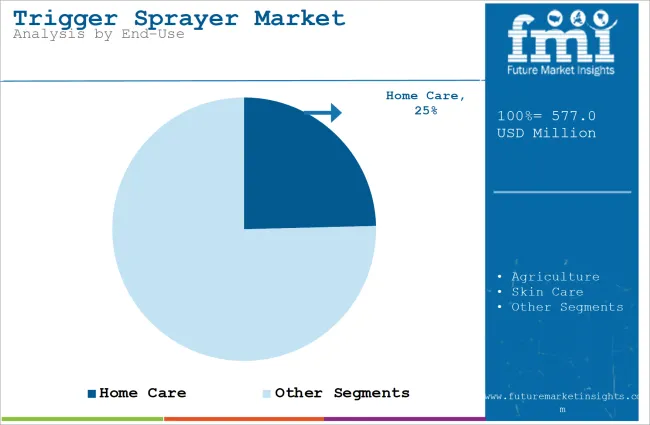
| End-Use | Home Care |
|---|---|
| Value Share (2035) | 24.6% |
Home care is a substantial growth driver of the trigger sprayer market and is highly well-positioned for everyday household use. Trigger sprayers are important in dispensing various home care products, which are diversified, including surface cleaners, glass cleaners, degreasers, air fresheners, and disinfectants. Due to their easy design and well-controlled, steady spray, these are best for cleaning countertops and floors. Being versatile and not very expensive to use in the home care arena, the trigger sprayers can be found easily in most houses, which accounts for their overall dominance in the market.
The other end-use segments include Agriculture, Skin Care, Hair Care, Toiletries, Chemicals, and Industrial applications, which also use trigger sprayers, but their demand is niche. For example, in Agriculture, sprayers are used for dispensing fertilizers and pesticides, and in Industrial sectors, they are used for cleaning and lubrication. Even though trigger sprayers are still in demand in these markets, the Home Care segment is the biggest market driver as it is the most commonly used in mass consumer products that cater to a wide range of consumers. The Home Care segment remains at the top of market share among all end-use segments because of constant demand for effective cleaning agents in households.
Competitive Landscape
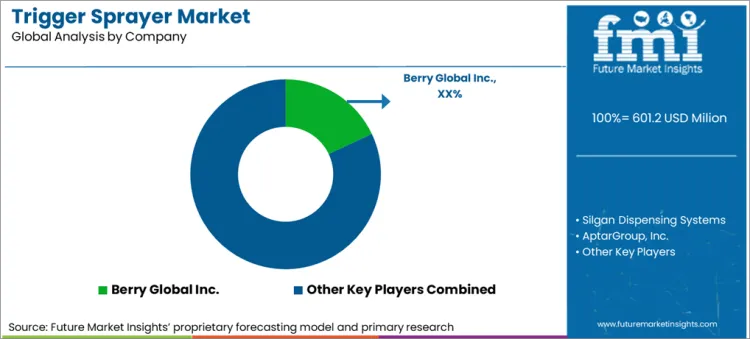
The trigger sprayer is witnessing high growth with new dispensing technologies and evolving consumer preferences. The market is growing due to increasing demand for user-friendly, eco-friendly, and aesthetically pleasing packaging solutions. Innovation in materials like recyclable plastics and sustainable designs have helped manufacturers enhance functionality and minimize environmental impact, thereby changing the industry landscape.
The leading market players are advancing the performance and durability of trigger sprayers by applying advanced technologies. Such innovations would improve spray precision, reduce leakage, and deliver ergonomic comfort. Increasing demand for sustainable products and developing sprayers that will minimize waste and support refillable packaging systems will drive the future growth of the market.
Geographic expansion happens to be a mainstream strategy adopted in big firms; this is with special emphasis when it comes to emerging markets due to the rapidly increasing sales volumes of consumer goods and household product sales. New entries and smaller corporations are also supporting growth in competitiveness and innovation; this dynamic is pushing companies always to introduce the new and superior products that better meet the distinct needs of many industries, both personal care, home, and even industrial sectors.
Recent Developments
- In February 2026, Canyon Europe initiated a GBP 3.1 million investment in its Mallusk facility for a high-speed Minerva T22 trigger sprayer production line.
- AptarGroup expanded its Beauty dispensing portfolio with the TSP trigger sprayer platform designed for sustainability-focused brand owners.
Key Players
- Berry Global Inc.
- Silgan Dispensing Systems
- AptarGroup, Inc.
- Mr. Nozzle Inc.
- Cole-Parmer Instrument Company, LLC.
- Frapak
- CL Smith
- Impact Products, LLC.
- W.B. Bottle
- The Cary Company
Market Definition
The trigger sprayer market represents revenue from manual trigger-actuated dispensing mechanisms sold as packaging components to product manufacturers in household cleaning, personal care, automotive care, and industrial maintenance.
Inclusions cover standard trigger sprayers, foaming trigger sprayers, heavy-duty industrial triggers, and mini trigger sprayers. It includes both PP and PE resin triggers and PCR-content variants. Dip tubes and closure systems integrated with triggers are included.
Exclusions include aerosol dispensing systems, pump dispensers without trigger actuation, and spray nozzles for agricultural and irrigation applications. Standalone spray bottles without trigger mechanisms are outside scope.
Scope of Report
| Items | Values |
|---|---|
| Quantitative Units (2026) | USD 601.2 Million |
| Product Type | Standard Triggers, Foaming Triggers, Heavy-Duty Industrial, Mini Triggers |
| Material | PP, PE, PCR-Content Resins |
| End User | Household Cleaning, Personal Care, Automotive Care, Industrial Maintenance |
| Regions Covered | North America, Europe, Asia Pacific, Latin America, Middle East and Africa |
| Key Companies Profiled | AptarGroup, Canyon Europe, Guala Closures, Rieke Packaging, Berry Global |
Key Segmentation
By Product type:
In terms of product type, the industry is divided into conventional trigger sprayers, mist sprayers, foaming sprayers and fine mist sprayers.
By Neck Size:
In terms of vehicle type, the industry is divided into 28/400, 28/410, 20/410, 24/410, 24/415, 38/400 and others.
By Material type:
In terms of material type, the industry is divided into polyethylene, polypropylene, polyethylene terephthalate, polyvinyl chloride, glass and other material type.
By End-Use:
In terms of end-use, the industry is divided into agriculture, skin care, hair care, toiletries, home care, chemicals, industrial and other end use.
By Region:
Key regions of North America, Latin America, Western Europe, Eastern Europe, East Asia, South Asia Pacific and Middle East & Africa have been covered in the report.
Bibliography
- Canyon Europe. (2026, February). Mallusk facility Minerva T22 investment. Canyon Press Releases.
- AptarGroup, Inc. (2025). TSP trigger sprayer platform launch. Aptar Press Releases.
- European Parliament. (2024, April). Packaging and Packaging Waste Regulation (PPWR). EU.
Frequently Asked Questions
What is the current global market size for Trigger Sprayer?
The global market is valued at USD 601.2 Million in 2026, driven by sustained demand for manual dispensing solutions in household cleaning and personal care and the EU PPWR recycled content mandates affecting sprayer specifications.
What is the projected Compound Annual Growth Rate (CAGR) for the market over the next 10 years?
The market is projected to grow at a CAGR of 4.2% from 2026 to 2036.
Which regions are experiencing the fastest expansion?
Europe leads driven by EU PPWR compliance requirements forcing PCR resin adoption, followed by North America where FMCG brand owners are tightening sustainability specifications for dispensing components.
What are the primary market drivers?
EU PPWR binding recycled content targets for plastic packaging and brand owner lightweighting requirements for dispensing components are the primary growth drivers.
Who are the leading suppliers in the industry?
AptarGroup, Canyon Europe, Guala Closures, Rieke Packaging, and Berry Global are key players, differentiating through PCR-compatible trigger designs, lightweight precision engineering, and integrated mono-material dispensing systems.
Preview the report firsthand - request a free sample
Get SampleGet the brochure for pricing and purchase details.
Get PDFTable of Content
- Executive Summary
- Global Market Outlook
- Demand-side Trends
- Supply-side Trends
- Technology Roadmap Analysis
- Analysis and Recommendations
- Market Overview
- Market Coverage / Taxonomy
- Market Definition / Scope / Limitations
- Research Methodology
- Chapter Orientation
- Analytical Lens and Working Hypotheses
- Market Structure, Signals, and Trend Drivers
- Benchmarking and Cross-market Comparability
- Market Sizing, Forecasting, and Opportunity Mapping
- Research Design and Evidence Framework
- Desk Research Programme (Secondary Evidence)
- Company Annual and Sustainability Reports
- Peer-reviewed Journals and Academic Literature
- Corporate Websites, Product Literature, and Technical Notes
- Earnings Decks and Investor Briefings
- Statutory Filings and Regulatory Disclosures
- Technical White Papers and Standards Notes
- Trade Journals, Industry Magazines, and Analyst Briefs
- Conference Proceedings, Webinars, and Seminar Materials
- Government Statistics Portals and Public Data Releases
- Press Releases and Reputable Media Coverage
- Specialist Newsletters and Curated Briefings
- Sector Databases and Reference Repositories
- FMI Internal Proprietary Databases and Historical Market Datasets
- Subscription Datasets and Paid Sources
- Social Channels, Communities, and Digital Listening Inputs
- Additional Desk Sources
- Expert Input and Fieldwork (Primary Evidence)
- Primary Modes
- Qualitative Interviews and Expert Elicitation
- Quantitative Surveys and Structured Data Capture
- Blended Approach
- Why Primary Evidence is Used
- Field Techniques
- Interviews
- Surveys
- Focus Groups
- Observational and In-context Research
- Social and Community Interactions
- Stakeholder Universe Engaged
- C-suite Leaders
- Board Members
- Presidents and Vice Presidents
- R&D and Innovation Heads
- Technical Specialists
- Domain Subject-matter Experts
- Scientists
- Physicians and Other Healthcare Professionals
- Governance, Ethics, and Data Stewardship
- Research Ethics
- Data Integrity and Handling
- Primary Modes
- Tooling, Models, and Reference Databases
- Desk Research Programme (Secondary Evidence)
- Data Engineering and Model Build
- Data Acquisition and Ingestion
- Cleaning, Normalisation, and Verification
- Synthesis, Triangulation, and Analysis
- Quality Assurance and Audit Trail
- Market Background
- Market Dynamics
- Drivers
- Restraints
- Opportunity
- Trends
- Scenario Forecast
- Demand in Optimistic Scenario
- Demand in Likely Scenario
- Demand in Conservative Scenario
- Opportunity Map Analysis
- Product Life Cycle Analysis
- Supply Chain Analysis
- Investment Feasibility Matrix
- Value Chain Analysis
- PESTLE and Porter’s Analysis
- Regulatory Landscape
- Regional Parent Market Outlook
- Production and Consumption Statistics
- Import and Export Statistics
- Market Dynamics
- Global Market Analysis 2021 to 2025 and Forecast, 2026 to 2036
- Historical Market Size Value (USD Million) Analysis, 2021 to 2025
- Current and Future Market Size Value (USD Million) Projections, 2026 to 2036
- Y-o-Y Growth Trend Analysis
- Absolute $ Opportunity Analysis
- Global Market Pricing Analysis 2021 to 2025 and Forecast 2026 to 2036
- Global Market Analysis 2021 to 2025 and Forecast 2026 to 2036, By Product Type
- Introduction / Key Findings
- Historical Market Size Value (USD Million) Analysis By Product Type , 2021 to 2025
- Current and Future Market Size Value (USD Million) Analysis and Forecast By Product Type , 2026 to 2036
- Conventional Trigger Sprayers
- Mist Sprayers
- Foaming Sprayers
- Fine Mist Sprayers
- Conventional Trigger Sprayers
- Y-o-Y Growth Trend Analysis By Product Type , 2021 to 2025
- Absolute $ Opportunity Analysis By Product Type , 2026 to 2036
- Global Market Analysis 2021 to 2025 and Forecast 2026 to 2036, By End Use
- Introduction / Key Findings
- Historical Market Size Value (USD Million) Analysis By End Use, 2021 to 2025
- Current and Future Market Size Value (USD Million) Analysis and Forecast By End Use, 2026 to 2036
- Home Care
- Agriculture
- Skin Care
- Hair Care
- Toiletries
- Home Care
- Y-o-Y Growth Trend Analysis By End Use, 2021 to 2025
- Absolute $ Opportunity Analysis By End Use, 2026 to 2036
- Global Market Analysis 2021 to 2025 and Forecast 2026 to 2036, By Region
- Introduction
- Historical Market Size Value (USD Million) Analysis By Region, 2021 to 2025
- Current Market Size Value (USD Million) Analysis and Forecast By Region, 2026 to 2036
- North America
- Latin America
- Western Europe
- Eastern Europe
- East Asia
- South Asia and Pacific
- Middle East & Africa
- Market Attractiveness Analysis By Region
- North America Market Analysis 2021 to 2025 and Forecast 2026 to 2036, By Country
- Historical Market Size Value (USD Million) Trend Analysis By Market Taxonomy, 2021 to 2025
- Market Size Value (USD Million) Forecast By Market Taxonomy, 2026 to 2036
- By Country
- USA
- Canada
- Mexico
- By Product Type
- By End Use
- By Country
- Market Attractiveness Analysis
- By Country
- By Product Type
- By End Use
- Key Takeaways
- Latin America Market Analysis 2021 to 2025 and Forecast 2026 to 2036, By Country
- Historical Market Size Value (USD Million) Trend Analysis By Market Taxonomy, 2021 to 2025
- Market Size Value (USD Million) Forecast By Market Taxonomy, 2026 to 2036
- By Country
- Brazil
- Chile
- Rest of Latin America
- By Product Type
- By End Use
- By Country
- Market Attractiveness Analysis
- By Country
- By Product Type
- By End Use
- Key Takeaways
- Western Europe Market Analysis 2021 to 2025 and Forecast 2026 to 2036, By Country
- Historical Market Size Value (USD Million) Trend Analysis By Market Taxonomy, 2021 to 2025
- Market Size Value (USD Million) Forecast By Market Taxonomy, 2026 to 2036
- By Country
- Germany
- UK
- Italy
- Spain
- France
- Nordic
- BENELUX
- Rest of Western Europe
- By Product Type
- By End Use
- By Country
- Market Attractiveness Analysis
- By Country
- By Product Type
- By End Use
- Key Takeaways
- Eastern Europe Market Analysis 2021 to 2025 and Forecast 2026 to 2036, By Country
- Historical Market Size Value (USD Million) Trend Analysis By Market Taxonomy, 2021 to 2025
- Market Size Value (USD Million) Forecast By Market Taxonomy, 2026 to 2036
- By Country
- Russia
- Poland
- Hungary
- Balkan & Baltic
- Rest of Eastern Europe
- By Product Type
- By End Use
- By Country
- Market Attractiveness Analysis
- By Country
- By Product Type
- By End Use
- Key Takeaways
- East Asia Market Analysis 2021 to 2025 and Forecast 2026 to 2036, By Country
- Historical Market Size Value (USD Million) Trend Analysis By Market Taxonomy, 2021 to 2025
- Market Size Value (USD Million) Forecast By Market Taxonomy, 2026 to 2036
- By Country
- China
- Japan
- South Korea
- By Product Type
- By End Use
- By Country
- Market Attractiveness Analysis
- By Country
- By Product Type
- By End Use
- Key Takeaways
- South Asia and Pacific Market Analysis 2021 to 2025 and Forecast 2026 to 2036, By Country
- Historical Market Size Value (USD Million) Trend Analysis By Market Taxonomy, 2021 to 2025
- Market Size Value (USD Million) Forecast By Market Taxonomy, 2026 to 2036
- By Country
- India
- ASEAN
- Australia & New Zealand
- Rest of South Asia and Pacific
- By Product Type
- By End Use
- By Country
- Market Attractiveness Analysis
- By Country
- By Product Type
- By End Use
- Key Takeaways
- Middle East & Africa Market Analysis 2021 to 2025 and Forecast 2026 to 2036, By Country
- Historical Market Size Value (USD Million) Trend Analysis By Market Taxonomy, 2021 to 2025
- Market Size Value (USD Million) Forecast By Market Taxonomy, 2026 to 2036
- By Country
- Kingdom of Saudi Arabia
- Other GCC Countries
- Turkiye
- South Africa
- Other African Union
- Rest of Middle East & Africa
- By Product Type
- By End Use
- By Country
- Market Attractiveness Analysis
- By Country
- By Product Type
- By End Use
- Key Takeaways
- Key Countries Market Analysis
- USA
- Pricing Analysis
- Market Share Analysis, 2025
- By Product Type
- By End Use
- Canada
- Pricing Analysis
- Market Share Analysis, 2025
- By Product Type
- By End Use
- Mexico
- Pricing Analysis
- Market Share Analysis, 2025
- By Product Type
- By End Use
- Brazil
- Pricing Analysis
- Market Share Analysis, 2025
- By Product Type
- By End Use
- Chile
- Pricing Analysis
- Market Share Analysis, 2025
- By Product Type
- By End Use
- Germany
- Pricing Analysis
- Market Share Analysis, 2025
- By Product Type
- By End Use
- UK
- Pricing Analysis
- Market Share Analysis, 2025
- By Product Type
- By End Use
- Italy
- Pricing Analysis
- Market Share Analysis, 2025
- By Product Type
- By End Use
- Spain
- Pricing Analysis
- Market Share Analysis, 2025
- By Product Type
- By End Use
- France
- Pricing Analysis
- Market Share Analysis, 2025
- By Product Type
- By End Use
- India
- Pricing Analysis
- Market Share Analysis, 2025
- By Product Type
- By End Use
- ASEAN
- Pricing Analysis
- Market Share Analysis, 2025
- By Product Type
- By End Use
- Australia & New Zealand
- Pricing Analysis
- Market Share Analysis, 2025
- By Product Type
- By End Use
- China
- Pricing Analysis
- Market Share Analysis, 2025
- By Product Type
- By End Use
- Japan
- Pricing Analysis
- Market Share Analysis, 2025
- By Product Type
- By End Use
- South Korea
- Pricing Analysis
- Market Share Analysis, 2025
- By Product Type
- By End Use
- Russia
- Pricing Analysis
- Market Share Analysis, 2025
- By Product Type
- By End Use
- Poland
- Pricing Analysis
- Market Share Analysis, 2025
- By Product Type
- By End Use
- Hungary
- Pricing Analysis
- Market Share Analysis, 2025
- By Product Type
- By End Use
- Kingdom of Saudi Arabia
- Pricing Analysis
- Market Share Analysis, 2025
- By Product Type
- By End Use
- Turkiye
- Pricing Analysis
- Market Share Analysis, 2025
- By Product Type
- By End Use
- South Africa
- Pricing Analysis
- Market Share Analysis, 2025
- By Product Type
- By End Use
- USA
- Market Structure Analysis
- Competition Dashboard
- Competition Benchmarking
- Market Share Analysis of Top Players
- By Regional
- By Product Type
- By End Use
- Competition Analysis
- Competition Deep Dive
- Berry Global Inc.
- Overview
- Product Portfolio
- Profitability by Market Segments (Product/Age /Sales Channel/Region)
- Sales Footprint
- Strategy Overview
- Marketing Strategy
- Product Strategy
- Channel Strategy
- Silgan Dispensing Systems
- AptarGroup, Inc.
- Mr. Nozzle Inc.
- Cole-Parmer Instrument Company, LLC.
- Berry Global Inc.
- Competition Deep Dive
- Assumptions & Acronyms Used


