

- Industry Size (2026)
- USD 1773.0 Mn
- Forecast (2036)
- USD 3863.0 Mn
- CAGR (2026 to 2036)
- 8.1%
Industrial Ultrasonic Humidifier Cooler Sprayer Market Forecast and Outlook 2026 to 2036
The industrial ultrasonic humidifier cooler sprayer market is valued at USD 1,773.0 million in 2026 and is projected to reach USD 3,863.0 million by 2036 at a CAGR of 8.1%. Value behavior reflects capital allocation toward non-thermal humidity and cooling systems deployed where conventional HVAC solutions cannot manage localized heat, static, or moisture imbalance.
Ultrasonic sprayers convert electrical energy into micron-scale droplets, enabling rapid evaporation and precise environmental control with low water and power intensity. Adoption is concentrated in facilities where product integrity, worker safety, and process stability depend on narrow humidity and temperature thresholds. Spending decisions prioritize droplet consistency, transducer durability, and integration with sensor-driven control platforms rather than airflow capacity alone.
Quick Stats for Industrial Ultrasonic Humidifier Cooler Sprayer Market
- Industrial Ultrasonic Humidifier Cooler Sprayer Market Value (2026): USD 1,773.0 million
- Industrial Ultrasonic Humidifier Cooler Sprayer Market Forecast Value (2036): USD 3,863.0 million
- Industrial Ultrasonic Humidifier Cooler Sprayer Market Forecast CAGR 2026 to 2036: 8.1%
- Leading System Type by Demand Share: Ultrasonic Misting Systems
- Fastest-Growing Countries: India, China, Vietnam, Indonesia, United Arab Emirates
- Top Players in Global Demand: CAREL, Condair, Munters, MeeFog, Smart Fog, Fogco, HygroMatik, DriSteem, Parker Hannifin, Lechler
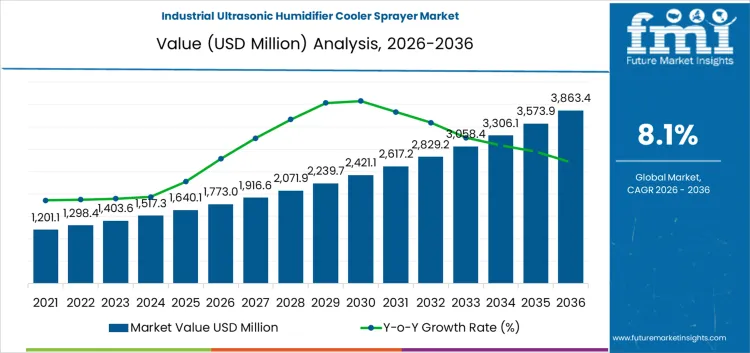
Expansion through the forecast period is constrained and shaped by operating discipline, water quality management, and component lifecycle economics. Ultrasonic systems require treated water to prevent scaling and transducer degradation, introducing recurring operating costs that influence deployment scale. Continuous-duty environments accelerate wear cycles, making maintenance predictability central to procurement evaluation. Dependence on piezoelectric components exposes supply continuity risks during demand surges. Installation economics favor large open industrial spaces and process-critical zones where utilization remains high. Regional growth aligns with manufacturing density and climatic exposure, supporting sustained value increase linked to utilization intensity and operational necessity rather than discretionary facility upgrades.
Industrial Ultrasonic Humidifier Cooler Sprayer Market Key Takeaways
| Metric | Value |
|---|---|
| Market Value (2026) | USD 1,773.0 million |
| Market Forecast Value (2036) | USD 3,863.0 million |
| Forecast CAGR 2026 to 2036 | 8.1% |
Source: FMI analysis based on primary research and proprietary forecasting model
Why is the Demand for Industrial Ultrasonic Humidifier Cooler Sprayer Growing?
Demand for industrial ultrasonic humidifier cooler sprayers is increasing as manufacturing, warehousing, and processing facilities require precise humidity and evaporative cooling control to protect products and stabilize environmental conditions. Facilities handling textiles, paper goods, and wood products specify ultrasonic spray systems because fine droplets deliver rapid humidification without wetting surfaces, supporting dimensional stability and reducing static buildup. In food processing and cold storage environments, ultrasonic humidification supports moisture retention that preserves product quality during handling and storage. Operations with heat generating equipment and dense occupant loads require evaporative cooling that reduces ambient temperatures without excessive energy draw from central HVAC systems.
Engineers prioritize system designs that deliver uniform droplet distribution, minimal maintenance complexity, and reliable performance under sustained duty cycles. Procurement teams evaluate unit capacity, control integration with building automation, and maintenance accessibility to ensure solutions align with operational objectives for uptime and environmental consistency. Growth in automated production lines and high precision processing reinforces adoption of ultrasonic cool sprayers that support both humidity control and localized cooling. Technical advancements in transducer durability and nozzle materials improve service life and reduce downtime associated with wear in harsh industrial atmospheres. Facility planners coordinate installation with air movement patterns to optimize coverage in large open spaces and confined zones where traditional humidifiers fail to deliver consistent results. These application driven needs are contributing to sustained uptake of industrial ultrasonic humidifier cooler sprayers across diverse sectors.
How Are the Segments Classified in the Industrial Ultrasonic Humidifier Cooler Sprayer Market?
Demand for industrial ultrasonic humidifier cooler sprayer systems is shaped by process humidity control, temperature moderation, and particulate suppression requirements. Industrial operators deploy these systems to stabilize environmental conditions affecting product quality and operational efficiency. Adoption aligns with growth of controlled-environment facilities, automation of climate regulation, and energy optimization priorities. System selection emphasizes droplet size control, coverage uniformity, and integration with facility infrastructure. Segment classification reflects differentiation by system configuration, industrial usage context, and procurement pathway. Structure highlights how humidification technology, operating environment, and sales model influence specification priorities, deployment scale, and utilization intensity across industrial facilities.
Which System Type Represents the Largest Share of Demand?
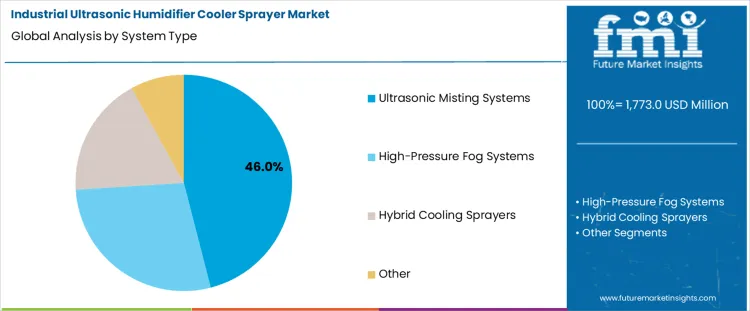
Ultrasonic misting systems hold 46.0%, representing the largest share among system types due to fine droplet generation capability. These systems produce micron-level mist supporting rapid evaporation and uniform humidity distribution. Low water consumption and energy efficiency suit continuous industrial operation. Precise control supports applications sensitive to moisture variation and surface wetting. High-pressure fog systems deliver higher throw distance with increased pump complexity. Hybrid cooling sprayers combine misting and airflow for targeted cooling zones. System type segmentation reflects preference for solutions delivering controlled humidification with minimal residue and consistent environmental regulation.
Key Points
- Ultrasonic misting enables fine and uniform humidity control.
- Low energy use supports continuous industrial operation.
- Other systems address extended reach or combined cooling needs.
Which Sales Channel Drives the Largest Share of Demand?
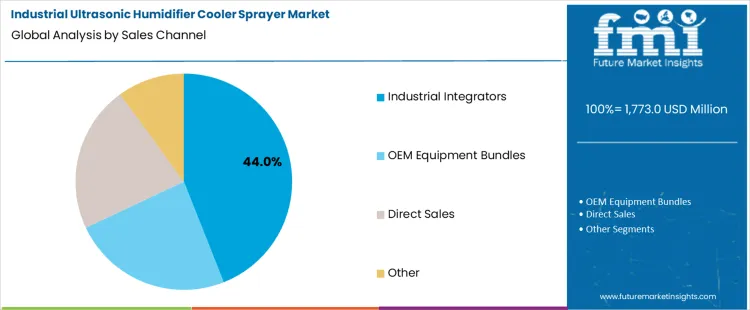
Industrial integrators hold 44.0%, representing the largest share among sales channels due to system customization requirements. These providers design solutions aligned with facility layout, airflow behavior, and process humidity targets. Integration capability supports coordination with existing HVAC, control software, and automation infrastructure. Turnkey delivery reduces commissioning risk and ensures performance alignment with operational specifications. OEM equipment bundles provide standardized integration within machinery with limited flexibility. Direct sales serve facilities with in-house engineering capacity and simpler deployment needs. Sales channel structure reflects preference for integrator-led delivery where system accuracy, reliability, and long-term performance accountability remain essential.
Key Points
- Integrators deliver customized, facility-specific humidification solutions.
- Turnkey deployment supports commissioning accuracy and control integration.
- Other channels address standardized or internally managed installations.
What are the Key Dynamics in the Industrial Ultrasonic Humidifier Cooler Sprayer Market?
Demand for industrial ultrasonic humidifier cooler sprayers reflects process-driven need for fine mist generation to control humidity, temperature, and airborne particulates in industrial environments. Adoption concentrates in textile manufacturing, food processing, electronics assembly, warehousing, greenhouses, and livestock facilities. Global scope aligns with low-energy moisture control requirements and non-thermal cooling applications. Usage centers on ultrasonic transducer-based systems producing micron-scale droplets for rapid evaporation and uniform dispersion.
How do process control accuracy and non-thermal cooling requirements shape adoption?
Industrial operations require precise humidity control to prevent static discharge, material shrinkage, and product defects. Demand increases where ultrasonic systems deliver consistent mist output without raising ambient temperature. Electronics and semiconductor facilities rely on fine droplet size to avoid surface wetting while maintaining electrostatic control. Agricultural and greenhouse operations adopt sprayers to regulate microclimates and reduce heat stress without excessive water runoff. Warehouses and logistics hubs use ultrasonic cooling to improve worker comfort during peak heat conditions. Low noise operation supports use in occupied environments. Integration with sensors enables responsive output adjustment based on real-time humidity and temperature levels. Adoption reflects operational need for precision moisture delivery with minimal energy input.
How do water quality sensitivity and maintenance exposure influence market scalability?
Ultrasonic systems remain highly sensitive to water quality, particularly dissolved minerals that cause scaling and transducer degradation. Demand sensitivity rises where water treatment infrastructure increases operating cost. Transducer wear and membrane fouling affect mist consistency and system uptime. High humidity environments elevate corrosion risk for electronic components. Maintenance frequency increases in continuous operation settings. Capital cost justification depends on sustained utilization in process-critical environments. Bioaerosol control requirements add compliance burden in food and healthcare-adjacent facilities. Supply chain dependence on piezoelectric components constrains scalability during demand surges.
How Is Demand for Industrial Ultrasonic Humidifier Cooler Sprayers Evolving Globally?
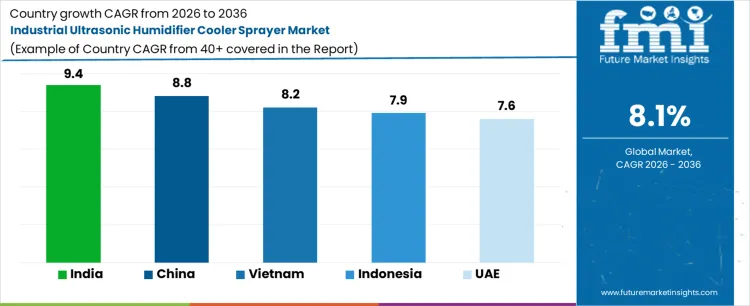
Demand for industrial ultrasonic humidifier cooler sprayers is expanding globally due to rising need for precision humidity control, evaporative cooling, and dust suppression across industrial facilities. Adoption aligns with temperature management, product quality preservation, and energy-efficient climate control under high ambient heat conditions. Manufacturing plants, warehouses, agriculture storage, and textile facilities increase deployment. Growth rates in India at 9.4%, China at 8.8%, Vietnam at 8.2%, Indonesia at 7.9%, and UAE at 7.6% indicate strong expansion driven by industrial activity intensity, hot climate exposure, and operational efficiency requirements rather than discretionary facility upgrades.
| Country | CAGR (%) |
|---|---|
| India | 9.4% |
| China | 8.8% |
| Vietnam | 8.2% |
| Indonesia | 7.9% |
| UAE | 7.6% |
Source: FMI analysis based on primary research and proprietary forecasting model
What Is Driving Strong Growth of Ultrasonic Cooler Sprayers in India?
Industrial ultrasonic humidifier cooler sprayer demand in India is growing at a CAGR of 9.4%, supported by high ambient temperatures and expanding manufacturing capacity. Textile processing, food storage, and electronics assembly require controlled humidity and localized cooling. Heat stress management in warehouses and production floors increases adoption of ultrasonic misting systems. Power efficiency priorities favor low-energy ultrasonic technologies over traditional cooling. Rapid industrialization across Tier-2 and Tier-3 cities expands installation base. Demand growth reflects climate-driven operational necessity and industrial expansion rather than comfort-focused applications.
- High ambient heat affecting industrial workspaces
- Textile and food processing humidity control needs
- Energy-efficient evaporative cooling preference
- Industrial expansion beyond major metros
Why Is China Sustaining Elevated Demand for Ultrasonic Humidifier Cooler Sprayers?
China is expanding at a CAGR of 8.8%, driven by dense manufacturing clusters and thermal load management needs. Electronics, packaging, and precision manufacturing require stable humidity to reduce defects and static buildup. Large factory floors deploy ultrasonic sprayers for zone-based cooling. Automation and smart factory initiatives integrate humidity control into process monitoring. Strong domestic manufacturing enables wide availability and rapid deployment. Demand growth reflects manufacturing scale and process stability requirements rather than seasonal usage.
- Precision manufacturing humidity stabilization needs
- Large-scale factory floor cooling requirements
- Integration with automated process controls
- Strong domestic equipment manufacturing base
How Is Vietnam Influencing Growth of Ultrasonic Cooler Sprayer Demand?
Vietnam is growing at a CAGR of 8.2%, shaped by rapid growth in export-oriented manufacturing. Apparel, footwear, and electronics assembly plants require humidity control to maintain material quality. High temperatures and dense factory layouts increase need for localized cooling. Cost-sensitive operations favor ultrasonic systems with low water and energy consumption. Expansion of industrial parks sustains new installations. Demand growth reflects manufacturing relocation and climate exposure rather than replacement of legacy systems.
- Expansion of export-oriented manufacturing facilities
- Apparel and electronics humidity control requirements
- Hot factory environments requiring localized cooling
- Cost-efficient ultrasonic technology adoption
What Factors Are Supporting Ultrasonic Cooler Sprayer Demand in Indonesia?
Industrial ultrasonic humidifier cooler sprayer demand in Indonesia is expanding at a CAGR of 7.9%, influenced by tropical climate conditions and industrial development. High humidity and heat affect worker productivity and material handling. Food processing, warehousing, and wood-based industries use ultrasonic sprayers for temperature moderation and dust control. Industrial zone development increases installation base. Energy efficiency considerations support ultrasonic adoption over mechanical cooling. Growth reflects environmental conditions and industrial usage patterns rather than regulatory mandates.
- Tropical heat affecting industrial productivity
- Food and warehousing temperature management needs
- Dust suppression in material handling operations
- Energy-efficient cooling system preference
Why Is the UAE Showing Strong Adoption of Ultrasonic Cooler Sprayers?
Industrial ultrasonic humidifier cooler sprayer demand in United Arab Emirates is growing at a CAGR of 7.6%, driven by extreme heat and indoor climate control requirements. Warehouses, logistics hubs, and industrial facilities require evaporative cooling to manage thermal loads. High energy costs favor low-power ultrasonic misting over traditional cooling. Construction materials storage and industrial workshops use sprayers to reduce heat stress. Infrastructure and logistics expansion sustain installations. Demand growth reflects climatic necessity and operational cost management rather than manufacturing volume expansion.
- Extreme ambient heat increasing cooling demand
- Energy cost sensitivity favoring ultrasonic systems
- Logistics and warehouse climate control needs
- Infrastructure-driven industrial facility growth
What is the competitive landscape of demand for the industrial ultrasonic humidifier cooler sprayer market globally?
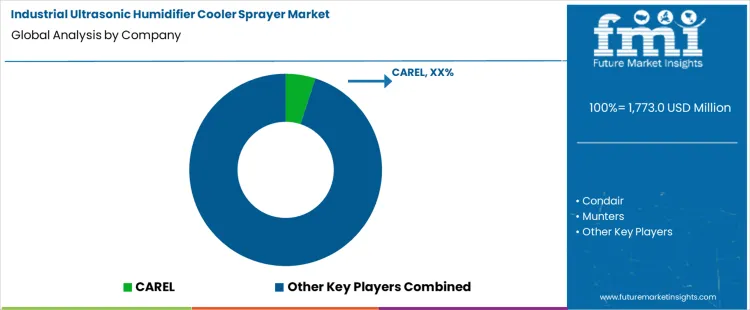
Demand for industrial ultrasonic humidifier cooler sprayer systems is driven by requirements for precise humidity control, evaporative cooling, and fine misting across manufacturing, warehousing, food processing, cleanrooms, and agricultural environments. Buyers evaluate droplet size uniformity, ultrasonic transducer durability, water quality handling, energy efficiency, and integration with facility automation and air handling systems. Procurement teams prioritize suppliers with robust industrial-grade solutions, global service networks, compliance with safety and hygiene standards, and ability to support complex installation and maintenance needs. Trend in the global market reflects increased emphasis on indoor environmental quality, thermal comfort in large spaces, and process-specific humidity requirements without wetting sensitive surfaces.
CAREL holds leading positioning through advanced ultrasonic humidifier and cool sprayer platforms supported by integrated control systems and global technical support. Condair supports demand with comprehensive humidification and misting solutions catering to large-scale industrial and commercial applications. Munters participates with tailored evaporative cooling and precise humidity control technologies engineered for industrial environments. MeeFog supplies high-pressure and ultrasonic misting technologies used in cooling, dust suppression, and humidity regulation in diverse industrial sectors. Smart Fog contributes ultrasonic and fine-mist systems optimized for localized cooling and humidity applications. Competitive differentiation depends on spray uniformity, transducer reliability, integration flexibility, water quality tolerance, and ability to meet demanding operational requirements.
Key Players in the Industrial Ultrasonic Humidifier Cooler Sprayer Market
- CAREL
- Condair
- Munters
- MeeFog
- Smart Fog
- Fogco
- HygroMatik
- DriSteem
- Parker Hannifin
- Lechler
Scope of the Report
| Items | Values |
|---|---|
| Quantitative Units | USD million |
| System Type | Ultrasonic Misting Systems; High-Pressure Fog Systems; Hybrid Cooling Sprayers; Other |
| End Use Industry | Food Processing & Cold Rooms; Textiles & Printing; Warehousing & Logistics; Other |
| Output Class | Fine Mist (≤10 μm); Medium Mist (10-20 μm); High Output Lines; Other |
| Sales Channel | Industrial Integrators; OEM Equipment Bundles; Direct Sales; Other |
| Regions Covered | Asia Pacific, Europe, North America, Latin America, Middle East & Africa |
| Countries Covered | India, China, Vietnam, Indonesia, UAE, and 40+ countries |
| Key Companies Profiled | CAREL; Condair; Munters; MeeFog; Smart Fog; Fogco; HygroMatik; DriSteem; Parker Hannifin; Lechler |
| Additional Attributes | Dollar sales by system type and output class; adoption trends for ultrasonic and high-pressure fog solutions in temperature-sensitive industrial environments; droplet size distribution, evaporation efficiency, and cooling effectiveness performance metrics; water quality tolerance, nozzle clogging resistance, and maintenance requirements; integration with process control and environmental monitoring systems; energy consumption, pump durability, and lifecycle cost considerations; project-based procurement through integrators and OEM bundles; compliance with workplace humidity standards, food safety hygiene requirements, and industrial safety regulations influencing cooler sprayer system selection. |
Industrial Ultrasonic Humidifier Cooler Sprayer Market by Segment
System Type:
- Ultrasonic Misting Systems
- High-Pressure Fog Systems
- Hybrid Cooling Sprayers
- Other
End Use Industry:
- Food Processing & Cold Rooms
- Textiles & Printing
- Warehousing & Logistics
- Other
Output Class:
- Fine Mist (≤10 μm)
- Medium Mist (10-20 μm)
- High Output Lines
- Other
Sales Channel:
- Industrial Integrators
- OEM Equipment Bundles
- Direct Sales
- Other
Region:
- Asia Pacific
- China
- Japan
- South Korea
- India
- Australia & New Zealand
- ASEAN
- Rest of Asia Pacific
- Europe
- Germany
- United Kingdom
- France
- Italy
- Spain
- Nordic
- BENELUX
- Rest of Europe
- North America
- United States
- Canada
- Mexico
- Latin America
- Brazil
- Chile
- Rest of Latin America
- Middle East & Africa
- Kingdom of Saudi Arabia
- Other GCC Countries
- Turkey
- South Africa
- Other African Union
- Rest of Middle East & Africa
Bibliography
- International Organization for Standardization. (2023). ISO 16890: Air filters for general ventilation - Performance requirements related to indoor air quality, relevant to misting and humidification systems. International Organization for Standardization.
- ASHRAE. (2023). ASHRAE Handbook - HVAC Applications: Industrial humidification, evaporative cooling, and process air moisture control. American Society of Heating, Refrigerating and Air-Conditioning Engineers.
- ASHRAE. (2024). ASHRAE Standard 62.1: Ventilation for acceptable indoor air quality, industrial humidity and misting considerations. American Society of Heating, Refrigerating and Air-Conditioning Engineers.
- World Health Organization. (2023). Indoor air quality and aerosol generation in industrial environments: Guidance for humidity and mist control. World Health Organization.
- European Committee for Standardization. (2024). EN 16798: Energy performance of buildings - Ventilation and indoor environmental parameters, humidity and evaporative cooling considerations. CEN.
Frequently Asked Questions
How big is the industrial ultrasonic humidifier cooler sprayer market in 2026?
The global industrial ultrasonic humidifier cooler sprayer market is estimated to be valued at USD 1,773.0 million in 2026.
What will be the size of industrial ultrasonic humidifier cooler sprayer market in 2036?
The market size for the industrial ultrasonic humidifier cooler sprayer market is projected to reach USD 3,863.4 million by 2036.
How much will be the industrial ultrasonic humidifier cooler sprayer market growth between 2026 and 2036?
The industrial ultrasonic humidifier cooler sprayer market is expected to grow at a 8.1% CAGR between 2026 and 2036.
What are the key product types in the industrial ultrasonic humidifier cooler sprayer market?
The key product types in industrial ultrasonic humidifier cooler sprayer market are ultrasonic misting systems, high-pressure fog systems, hybrid cooling sprayers and other.
Which output class segment to contribute significant share in the industrial ultrasonic humidifier cooler sprayer market in 2026?
In terms of output class, fine mist (≤10 μm) segment to command 38.0% share in the industrial ultrasonic humidifier cooler sprayer market in 2026.
Preview the report firsthand - request a free sample
Get SampleGet the brochure for pricing and purchase details.
Get PDFTable of Content
- Executive Summary
- Global Market Outlook
- Demand-side Trends
- Supply-side Trends
- Technology Roadmap Analysis
- Analysis and Recommendations
- Market Overview
- Market Coverage / Taxonomy
- Market Definition / Scope / Limitations
- Market Background
- Market Dynamics
- Drivers
- Restraints
- Opportunity
- Trends
- Scenario Forecast
- Demand in Optimistic Scenario
- Demand in Likely Scenario
- Demand in Conservative Scenario
- Opportunity Map Analysis
- Product Life Cycle Analysis
- Supply Chain Analysis
- Investment Feasibility Matrix
- Value Chain Analysis
- PESTLE and Porter’s Analysis
- Regulatory Landscape
- Regional Parent Market Outlook
- Production and Consumption Statistics
- Import and Export Statistics
- Market Dynamics
- Global Market Analysis 2021 to 2025 and Forecast, 2026 to 2036
- Historical Market Size Value (USD Million) Analysis, 2021 to 2025
- Current and Future Market Size Value (USD Million) Projections, 2026 to 2036
- Y-o-Y Growth Trend Analysis
- Absolute $ Opportunity Analysis
- Global Market Pricing Analysis 2021 to 2025 and Forecast 2026 to 2036
- Global Market Analysis 2021 to 2025 and Forecast 2026 to 2036, By System Type
- Introduction / Key Findings
- Historical Market Size Value (USD Million) Analysis By System Type , 2021 to 2025
- Current and Future Market Size Value (USD Million) Analysis and Forecast By System Type , 2026 to 2036
- Ultrasonic Misting Systems
- High-Pressure Fog Systems
- Hybrid Cooling Sprayers
- Other
- Ultrasonic Misting Systems
- Y-o-Y Growth Trend Analysis By System Type , 2021 to 2025
- Absolute $ Opportunity Analysis By System Type , 2026 to 2036
- Global Market Analysis 2021 to 2025 and Forecast 2026 to 2036, By Output Class
- Introduction / Key Findings
- Historical Market Size Value (USD Million) Analysis By Output Class, 2021 to 2025
- Current and Future Market Size Value (USD Million) Analysis and Forecast By Output Class, 2026 to 2036
- Fine Mist (≤10 μm)
- Medium Mist (10-20 μm)
- High Output Lines
- Other
- Fine Mist (≤10 μm)
- Y-o-Y Growth Trend Analysis By Output Class, 2021 to 2025
- Absolute $ Opportunity Analysis By Output Class, 2026 to 2036
- Global Market Analysis 2021 to 2025 and Forecast 2026 to 2036, By Sales Channel
- Introduction / Key Findings
- Historical Market Size Value (USD Million) Analysis By Sales Channel, 2021 to 2025
- Current and Future Market Size Value (USD Million) Analysis and Forecast By Sales Channel, 2026 to 2036
- Industrial Integrators
- OEM Equipment Bundles
- Direct Sales
- Other
- Industrial Integrators
- Y-o-Y Growth Trend Analysis By Sales Channel, 2021 to 2025
- Absolute $ Opportunity Analysis By Sales Channel, 2026 to 2036
- Global Market Analysis 2021 to 2025 and Forecast 2026 to 2036, By Region
- Introduction
- Historical Market Size Value (USD Million) Analysis By Region, 2021 to 2025
- Current Market Size Value (USD Million) Analysis and Forecast By Region, 2026 to 2036
- North America
- Latin America
- Western Europe
- Eastern Europe
- East Asia
- South Asia and Pacific
- Middle East & Africa
- Market Attractiveness Analysis By Region
- North America Market Analysis 2021 to 2025 and Forecast 2026 to 2036, By Country
- Historical Market Size Value (USD Million) Trend Analysis By Market Taxonomy, 2021 to 2025
- Market Size Value (USD Million) Forecast By Market Taxonomy, 2026 to 2036
- By Country
- USA
- Canada
- Mexico
- By System Type
- By Output Class
- By Sales Channel
- By Country
- Market Attractiveness Analysis
- By Country
- By System Type
- By Output Class
- By Sales Channel
- Key Takeaways
- Latin America Market Analysis 2021 to 2025 and Forecast 2026 to 2036, By Country
- Historical Market Size Value (USD Million) Trend Analysis By Market Taxonomy, 2021 to 2025
- Market Size Value (USD Million) Forecast By Market Taxonomy, 2026 to 2036
- By Country
- Brazil
- Chile
- Rest of Latin America
- By System Type
- By Output Class
- By Sales Channel
- By Country
- Market Attractiveness Analysis
- By Country
- By System Type
- By Output Class
- By Sales Channel
- Key Takeaways
- Western Europe Market Analysis 2021 to 2025 and Forecast 2026 to 2036, By Country
- Historical Market Size Value (USD Million) Trend Analysis By Market Taxonomy, 2021 to 2025
- Market Size Value (USD Million) Forecast By Market Taxonomy, 2026 to 2036
- By Country
- Germany
- UK
- Italy
- Spain
- France
- Nordic
- BENELUX
- Rest of Western Europe
- By System Type
- By Output Class
- By Sales Channel
- By Country
- Market Attractiveness Analysis
- By Country
- By System Type
- By Output Class
- By Sales Channel
- Key Takeaways
- Eastern Europe Market Analysis 2021 to 2025 and Forecast 2026 to 2036, By Country
- Historical Market Size Value (USD Million) Trend Analysis By Market Taxonomy, 2021 to 2025
- Market Size Value (USD Million) Forecast By Market Taxonomy, 2026 to 2036
- By Country
- Russia
- Poland
- Hungary
- Balkan & Baltic
- Rest of Eastern Europe
- By System Type
- By Output Class
- By Sales Channel
- By Country
- Market Attractiveness Analysis
- By Country
- By System Type
- By Output Class
- By Sales Channel
- Key Takeaways
- East Asia Market Analysis 2021 to 2025 and Forecast 2026 to 2036, By Country
- Historical Market Size Value (USD Million) Trend Analysis By Market Taxonomy, 2021 to 2025
- Market Size Value (USD Million) Forecast By Market Taxonomy, 2026 to 2036
- By Country
- China
- Japan
- South Korea
- By System Type
- By Output Class
- By Sales Channel
- By Country
- Market Attractiveness Analysis
- By Country
- By System Type
- By Output Class
- By Sales Channel
- Key Takeaways
- South Asia and Pacific Market Analysis 2021 to 2025 and Forecast 2026 to 2036, By Country
- Historical Market Size Value (USD Million) Trend Analysis By Market Taxonomy, 2021 to 2025
- Market Size Value (USD Million) Forecast By Market Taxonomy, 2026 to 2036
- By Country
- India
- ASEAN
- Australia & New Zealand
- Rest of South Asia and Pacific
- By System Type
- By Output Class
- By Sales Channel
- By Country
- Market Attractiveness Analysis
- By Country
- By System Type
- By Output Class
- By Sales Channel
- Key Takeaways
- Middle East & Africa Market Analysis 2021 to 2025 and Forecast 2026 to 2036, By Country
- Historical Market Size Value (USD Million) Trend Analysis By Market Taxonomy, 2021 to 2025
- Market Size Value (USD Million) Forecast By Market Taxonomy, 2026 to 2036
- By Country
- Kingdom of Saudi Arabia
- Other GCC Countries
- Turkiye
- South Africa
- Other African Union
- Rest of Middle East & Africa
- By System Type
- By Output Class
- By Sales Channel
- By Country
- Market Attractiveness Analysis
- By Country
- By System Type
- By Output Class
- By Sales Channel
- Key Takeaways
- Key Countries Market Analysis
- USA
- Pricing Analysis
- Market Share Analysis, 2025
- By System Type
- By Output Class
- By Sales Channel
- Canada
- Pricing Analysis
- Market Share Analysis, 2025
- By System Type
- By Output Class
- By Sales Channel
- Mexico
- Pricing Analysis
- Market Share Analysis, 2025
- By System Type
- By Output Class
- By Sales Channel
- Brazil
- Pricing Analysis
- Market Share Analysis, 2025
- By System Type
- By Output Class
- By Sales Channel
- Chile
- Pricing Analysis
- Market Share Analysis, 2025
- By System Type
- By Output Class
- By Sales Channel
- Germany
- Pricing Analysis
- Market Share Analysis, 2025
- By System Type
- By Output Class
- By Sales Channel
- UK
- Pricing Analysis
- Market Share Analysis, 2025
- By System Type
- By Output Class
- By Sales Channel
- Italy
- Pricing Analysis
- Market Share Analysis, 2025
- By System Type
- By Output Class
- By Sales Channel
- Spain
- Pricing Analysis
- Market Share Analysis, 2025
- By System Type
- By Output Class
- By Sales Channel
- France
- Pricing Analysis
- Market Share Analysis, 2025
- By System Type
- By Output Class
- By Sales Channel
- India
- Pricing Analysis
- Market Share Analysis, 2025
- By System Type
- By Output Class
- By Sales Channel
- ASEAN
- Pricing Analysis
- Market Share Analysis, 2025
- By System Type
- By Output Class
- By Sales Channel
- Australia & New Zealand
- Pricing Analysis
- Market Share Analysis, 2025
- By System Type
- By Output Class
- By Sales Channel
- China
- Pricing Analysis
- Market Share Analysis, 2025
- By System Type
- By Output Class
- By Sales Channel
- Japan
- Pricing Analysis
- Market Share Analysis, 2025
- By System Type
- By Output Class
- By Sales Channel
- South Korea
- Pricing Analysis
- Market Share Analysis, 2025
- By System Type
- By Output Class
- By Sales Channel
- Russia
- Pricing Analysis
- Market Share Analysis, 2025
- By System Type
- By Output Class
- By Sales Channel
- Poland
- Pricing Analysis
- Market Share Analysis, 2025
- By System Type
- By Output Class
- By Sales Channel
- Hungary
- Pricing Analysis
- Market Share Analysis, 2025
- By System Type
- By Output Class
- By Sales Channel
- Kingdom of Saudi Arabia
- Pricing Analysis
- Market Share Analysis, 2025
- By System Type
- By Output Class
- By Sales Channel
- Turkiye
- Pricing Analysis
- Market Share Analysis, 2025
- By System Type
- By Output Class
- By Sales Channel
- South Africa
- Pricing Analysis
- Market Share Analysis, 2025
- By System Type
- By Output Class
- By Sales Channel
- USA
- Market Structure Analysis
- Competition Dashboard
- Competition Benchmarking
- Market Share Analysis of Top Players
- By Regional
- By System Type
- By Output Class
- By Sales Channel
- Competition Analysis
- Competition Deep Dive
- CAREL
- Overview
- Product Portfolio
- Profitability by Market Segments (Product/Age /Sales Channel/Region)
- Sales Footprint
- Strategy Overview
- Marketing Strategy
- Product Strategy
- Channel Strategy
- Condair
- Munters
- MeeFog
- Smart Fog
- Fogco
- HygroMatik
- DriSteem
- Parker Hannifin
- Lechler
- CAREL
- Competition Deep Dive
- Assumptions & Acronyms Used
- Research Methodology


