

- Industry Size (2026)
- USD 1.6 Bn
- Forecast (2036)
- USD 4.0 Bn
- CAGR (2026 to 2036)
- 9.6%
Contactless Trigger Market Forecast and Outlook 2026 to 2036
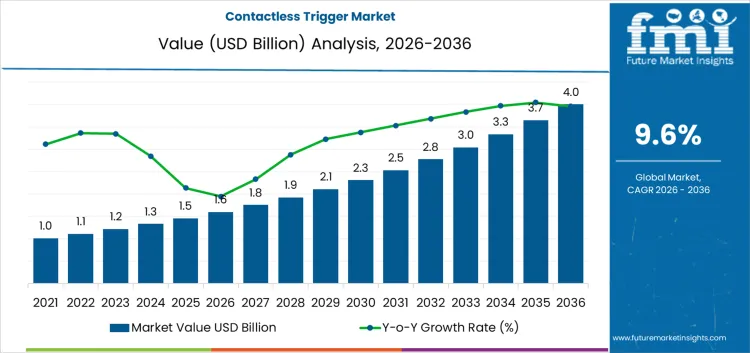
The contactless trigger market is projected to grow from USD 1.6 billion in 2026 to USD 4.0 billion by 2036, achieving a CAGR of 9.6%. The technology is selected primarily where physical contact introduces wear, contamination, or hygiene risk, which explains its concentration in medical equipment, industrial automation, public access devices, and selected consumer appliances. Adoption remains uneven because many products still operate within duty cycles that mechanical switches can handle at lower cost. Demand clusters in regions with strong equipment manufacturing bases and stricter safety or cleanliness requirements, while sourcing advantages follow established sensor and control electronics supply chains.
Product architects, rather than purchasing departments, usually determine trigger selection because the choice affects enclosure design, sealing strategy, and certification scope. Once a sensing approach is validated within a device platform, it tends to remain fixed for the entire product generation due to tooling and approval costs. In healthcare and public use equipment, cleaning protocols and liability exposure raise the relative value of non-contact actuation. In industrial settings, resistance to dust and moisture drives similar decisions. The market expands through platform level design shifts and compliance driven upgrades, not through routine replacement of simple mechanical triggers.
Quick Stats for Contactless Trigger Market
- Contactless Trigger Market Value (2026): USD 1.6 billion
- Contactless Trigger Market Forecast Value (2036): USD 4.0 billion
- Contactless Trigger Market Forecast CAGR 2026 to 2036: 9.6%
- Leading Type in Contactless Trigger Market: RFID-based contactless triggers
- Key Growth Regions in Contactless Trigger Market: Asia Pacific, North America, Europe
- Top Players in Contactless Trigger Market: TE Connectivity, Schneider Electric, Honeywell International, ABB, Panasonic, Omron Corporation, Eaton Corporation
What is the Growth Forecast for Contactless Trigger Market through 2036?
The contactless trigger market has been expanding as touch-free interaction moves from being a hygiene-driven add-on to a default interface choice in many environments. At around USD 0.9 billion, the category is still largely concentrated in basic sensor-based switches for public washrooms, industrial equipment, and access points, but it moves to roughly USD 1.1 billion and then USD 1.3 billion as touchless actuation spreads into retail fixtures, medical devices, and light industrial controls. When the market reaches about USD 1.6 billion, contactless triggers are no longer treated as niche safety components. They begin to appear as standard interface options in new equipment designs, driven by reliability, wear reduction, and contamination control rather than by short-term behavioral shifts.
As deployment broadens, value climbs through approximately USD 2.0 billion, USD 2.5 billion, and then USD 3.1 billion, supported by higher device density per site and wider use in doors, dispensers, machinery controls, and kiosks. By the time the market passes around USD 3.4 billion and then USD 3.7 billion, replacement and upgrade demand becomes as important as first-time installations, especially where mechanical switches are being phased out for durability reasons. Approaching roughly USD 4.0 billion, growth is driven by standardization of touch-free interfaces and by integration into broader control systems rather than by any single application boom. The economics remain volume-led and application-diverse, with buyers prioritizing reliability, response consistency, and ease of integration over sophisticated feature sets.
Contactless Trigger Market Key Takeaways
| Metric | Value |
|---|---|
| Market Value (2026) | USD 1.6 billion |
| Forecast Value (2036) | USD 4.0 billion |
| Forecast CAGR 2026 to 2036 | 9.6% |
How Is the Contactless Trigger Market Advancing Automated and Hygienic Operations?
Contactless triggers are increasingly adopted to enable touch-free operation in consumer electronics, industrial machinery, and medical devices, improving hygiene, safety, and operational efficiency. Historically, mechanical triggers required physical contact, which introduced wear, contamination risk, and higher maintenance requirements. Modern contactless triggers use capacitive, optical, or magnetic sensing technologies to detect user input without direct contact, providing rapid response, durability, and integration with automated systems.
Device manufacturers, industrial equipment suppliers, and healthcare product developers prioritize sensitivity, reliability, and environmental resistance. Early adoption focused on medical equipment and high-touch public interfaces, while current demand spans household appliances, industrial controls, and automotive applications, driven by user convenience, infection control, and seamless automation. Detection accuracy, response time, and material resilience influence supplier selection.
Operational safety, user convenience, and process efficiency are shaping market expansion. Compared with conventional mechanical triggers, contactless solutions emphasize minimal wear, rapid activation, and integration with electronic control systems. Cost structures depend on sensor technology, signal processing, and enclosure design, concentrating margins among suppliers capable of delivering reliable, high-performance components. Manufacturers adopt these triggers to reduce maintenance, improve user experience, and ensure long-term reliability. By 2036, contactless triggers are expected to become standard across consumer, industrial, and healthcare applications, supporting hygienic operation, enhanced responsiveness, and durable performance.
What Factors Are Shaping the Demand for Contactless Triggers, Segment wise by Activation Type and Application, in 2026?
The contactless trigger market in 2026 is segmented by activation type and by application. By sensing method, demand is divided into RFID based, infrared, capacitive, and ultrasonic contactless triggers, each offering different trade offs between detection range, response speed, and resistance to environmental interference. By application, demand is organized around consumer electronics, automotive systems, home automation and IoT, and industrial controls, which differ in usage frequency, reliability expectations, and integration complexity. These segments reflect how designers choose between simple proximity functions and more robust non-contact activation methods depending on product context.
Why Do RFID Based Contactless Triggers Lead Technology Adoption?
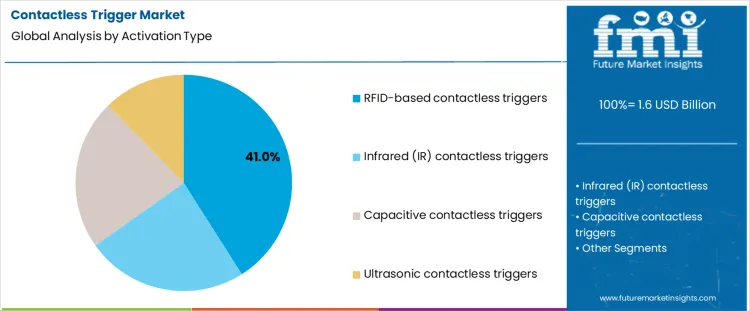
RFID based contactless triggers account for about 41% of demand in 2026, largely because they combine identification and activation in a single interaction. In many consumer and access related devices, the ability to confirm presence and trigger a function at the same time simplifies system design. RFID systems are also well established, with mature component ecosystems and clear integration practices. They work reliably through plastics and other non-metallic materials, which suits enclosed devices. Once a design is qualified, the same architecture can be reused across multiple product generations. This installed base and dual function capability keep RFID based triggers as the most widely adopted activation method.
Infrared, capacitive, and ultrasonic triggers address more specific needs. Infrared is sensitive to line of sight and ambient light. Capacitive sensing depends on stable grounding and can be affected by moisture. Ultrasonic works in harsher environments but adds cost and complexity. These technologies are selected where their particular strengths match the application, yet they do not displace the broad, general purpose role of RFID in many products.
Why Does Consumer Electronics Dominate Application Demand?
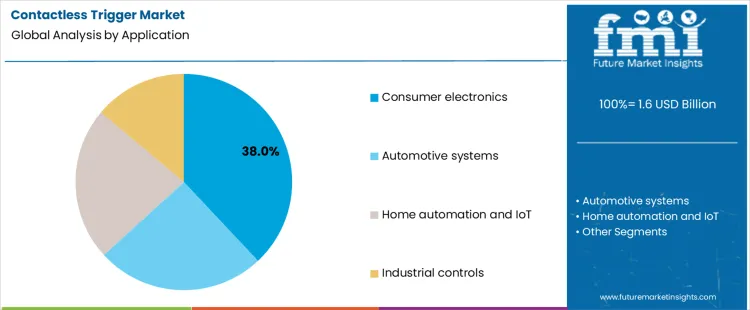
Consumer electronics represent about 38% of demand in 2026 because contactless interaction has become a standard expectation in everyday devices. Smartphones, wearables, small appliances, and personal gadgets increasingly use non-contact activation for hygiene, convenience, and design differentiation. Volumes in this sector are also very large, so even a single trigger per device translates into substantial component demand. Product refresh cycles are short, which keeps ordering activity continuous. Once a trigger design is adopted in a platform, it is often replicated across several models, further multiplying volume.
Automotive, home automation, and industrial uses follow different patterns. Automotive systems have longer validation cycles and lower unit volumes per platform. Home automation grows steadily but remains fragmented across many device types. Industrial controls prioritize robustness and safety, which limits the number of contactless interfaces per machine. These segments are important for value and technical development, but the sheer scale and refresh speed of consumer electronics keep it as the largest application base for contactless triggers.
How Are the Key Dynamics Reshaping the Contactless Trigger Market?
The category is being shaped by hygiene expectations, reliability requirements, and the push to standardize input devices across equipment platforms. Contactless triggers reduce wear, contamination risk, and mechanical failure points, which makes them attractive in medical, industrial, and public facing equipment. At the same time, adoption is moderated by redesign cost and conservative qualification practices. Many buyers also want fewer input device variants to simplify spares and certification. This creates a market where growth comes from being designed into new platforms and standardized modules rather than from mass retrofit. Scale follows OEM design decisions and platform governance more than end user accessory purchases.
Why Are Hygiene and Reliability Driving Contactless Triggers?
Demand is anchored in use environments where touch points are liabilities. In medical devices, food processing equipment, kiosks, and industrial controls, physical buttons collect contaminants and fail through wear. Contactless triggers remove both problems while also enabling sealed housings and easier cleaning. In high cycle applications, the absence of mechanical contact improves lifetime predictability and reduces maintenance. Once an OEM qualifies a contactless input method, it becomes part of the core interface design and is reused across models. Volume then follows production of equipment platforms and replicated machine designs rather than discretionary upgrades or consumer preference shifts.
What Is Slowing Wider Adoption of Contactless Triggers?
The main barrier is redesign and validation cost. Switching from mechanical to contactless triggers often requires changes in housings, electronics, software logic, and safety certifications. In regulated equipment, this can trigger full requalification cycles. Some users also worry about false triggering, sensitivity tuning, and operator acceptance, especially in harsh or noisy environments. For existing products, the business case to change a working interface is weak unless other redesigns are already planned. These factors keep adoption concentrated in new product generations and limit rapid penetration into the large installed base of legacy equipment.
How Are Platform Standards Changing Trigger Selection?
The trend is toward interface standardization. Equipment makers increasingly define standard input modules that can be reused across product families and sites. Contactless triggers that are qualified within these modules gain access to larger, repeatable volumes without being reselected each time. Procurement shifts toward long term agreements with a smaller set of component suppliers. Documentation, long term availability, and stable performance become as important as sensor type. Over time, competition moves from selling individual triggers to being embedded in approved interface platforms used across multiple machines and multi-year product roadmaps.
What is the Demand for Contactless Triggers by Country?
| Country | CAGR (%) |
|---|---|
| USA | 8.9% |
| UK | 8.5% |
| China | 10.2% |
| India | 10.8% |
| Brazil | 9.2% |
Demand for contactless triggers is rising as manufacturers and consumers adopt touch-free control solutions for industrial equipment, consumer electronics, and automation systems. India leads with a 10.8% CAGR, driven by growing adoption of hygiene-focused interfaces, industrial automation, and smart devices. China follows at 10.2%, supported by electronics manufacturing, automation deployment, and demand for touchless user interfaces. Brazil records 9.2% growth, shaped by adoption in commercial and industrial applications. The US grows at 8.9%, influenced by integration in smart devices and automated systems. The UK shows 8.5% CAGR, reflecting steady adoption of contactless trigger technologies across consumer, commercial, and industrial sectors.
How is the United States experiencing growth in the contactless trigger market?
United States is experiencing growth at a CAGR of 8.9%, driven by rising adoption in consumer electronics, home appliances, and industrial automation across California, Texas, and New York. Installed base size and replacement cycles in high-volume electronics support steady demand for reliable contactless triggers. Industry concentration among electronics OEMs and industrial automation firms anchors adoption. Investments focus on accuracy, responsiveness, and integration with smart systems. Growth reflects increasing interest in touchless interfaces, hygiene-conscious devices, and seamless automation solutions.
- Consumer electronics and industrial automation drive adoption.
- High-volume manufacturing hubs concentrate demand.
- Accuracy and responsiveness guide investment.
- Installed base and replacement cycles support growth.
How is the United Kingdom witnessing growth in the contactless trigger market?
United Kingdom is witnessing growth at a CAGR of 8.5%, supported by labor cost structure and productivity pressures in industrial and commercial sectors in London, Manchester, and Birmingham. Contactless triggers reduce manual handling, enhance efficiency, and support automated processes. Industry concentration among industrial OEMs and appliance manufacturers anchors demand. Investments focus on durability, integration with existing automation systems, and ease of maintenance. Growth reflects operational efficiency needs and adoption of touchless interfaces in workplace and commercial applications.
- Industrial and commercial automation drives adoption.
- Urban industrial centers concentrate demand.
- Durability and maintenance guide investment.
- Productivity pressures influence adoption.
How is China experiencing growth in the contactless trigger market?
China is experiencing growth at a CAGR of 10.2%, fueled by large-scale manufacturing and electronics production in Shanghai, Shenzhen, and Guangzhou. Market concentration in industrial clusters drives high-volume adoption of contactless triggers for consumer devices and factory automation. Investments prioritize low-cost, high-reliability solutions and seamless integration with production lines. Growth reflects rapid industrial expansion, growing electronics export demand, and adoption of touchless technology for operational efficiency.
- Electronics and manufacturing clusters drive adoption.
- Urban industrial zones concentrate demand.
- Low-cost, high-reliability solutions guide investment.
- High-volume production accelerates adoption.
How is India witnessing growth in the contactless trigger market?
India is experiencing growth at a CAGR of 10.8%, supported by exposure to export markets and global supply chain cycles in Mumbai, Bengaluru, and Delhi. Demand is concentrated in electronics manufacturing hubs and industrial automation facilities. Investments focus on high-performance, durable triggers capable of supporting diverse product lines. Growth reflects increasing global competitiveness, adoption of touchless devices in consumer electronics, and modernization of manufacturing processes.
- Electronics manufacturing and industrial automation drive adoption.
- Urban industrial centers attract a high demand.
- Durability and performance guide investment.
- Export exposure influences procurement.
How is Brazil experiencing growth in the contactless trigger market?
Brazil is experiencing growth at a CAGR of 9.2%, driven by sensitivity to downtime and operational risk in industrial and commercial applications in São Paulo, Rio de Janeiro, and Paraná. Contactless triggers reduce failure risk, support operational continuity, and enhance automation reliability. Market concentration exists in urban industrial zones, with regional adoption in manufacturing and appliance sectors. Investments focus on system reliability, compatibility with existing equipment, and ease of maintenance. Growth reflects demand for dependable touchless technology that minimizes operational disruptions.
- Industrial and commercial applications drive adoption.
- Urban industrial centers create a high demand.
- Reliability and maintenance guide investment.
- Downtime sensitivity influences procurement.
How Are Manufacturers Enhancing Reliability and Integration in the Contactless Trigger Market?
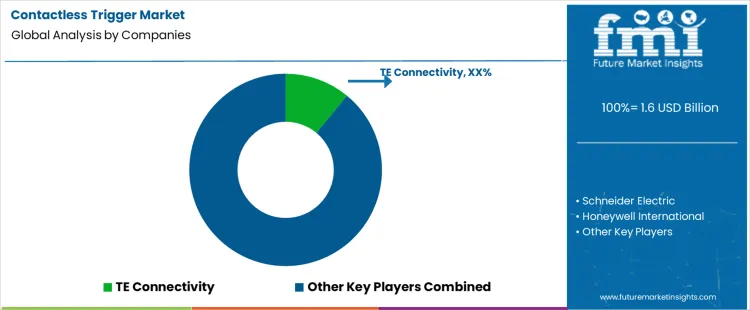
Suppliers emphasize sensing precision and durability when designing contactless triggers for industrial automation. TE Connectivity provides devices engineered to maintain accurate actuation without mechanical wear, enabling integration with complex control and safety systems. Schneider Electric offers triggers compatible with broader automation platforms, featuring diagnostic feedback to support operational reliability and system monitoring.
Honeywell International designs products that perform consistently across temperature extremes and vibration exposure, making them suitable for OEM and industrial applications. ABB focuses on contactless actuation devices that meet stringent machine safety standards while offering compatibility with programmable logic controllers. Panasonic delivers compact solutions optimized for confined installations without sacrificing repeatability or response time.
Omron Corporation develops a portfolio of triggers designed for precision sensing in robotics and factory automation, emphasizing signal stability and long operational life. Eaton Corporation provides devices that enhance uptime by reducing maintenance requirements in electrical and mechanical control environments. Regional and niche suppliers offer sensors tailored to specific applications such as embedded systems or harsh industrial conditions. Key differentiators include environmental sealing, EMI/RFI resistance, output signal type, and ease of integration with control networks. Providers that combine documented reliability, technical support, and adaptability across automation systems are best positioned to meet growing demand for efficient, maintenance free, and highly responsive contactless triggering solutions.
Key Players in the Contactless Trigger Market
- TE Connectivity
- Schneider Electric
- Honeywell International
- ABB
- Panasonic
- Omron Corporation
- Eaton Corporation
Scope of the Report
| Items | Values |
|---|---|
| Quantitative Units (2026) | USD billion |
| Activation Type | RFID-based Contactless Triggers, Infrared (IR) Contactless Triggers, Capacitive Contactless Triggers, Ultrasonic Contactless Triggers |
| Application | Consumer Electronics, Automotive Systems, Home Automation and IoT, Industrial Controls |
| Regions Covered | Asia Pacific, Europe, North America, Latin America, Middle East & Africa |
| Countries Covered | China, Japan, South Korea, India, Australia & New Zealand, ASEAN, Germany, United Kingdom, France, Italy, Spain, Nordic, BENELUX, United States, Canada, Mexico, Brazil, Chile, Saudi Arabia, Turkey, South Africa, and other regional markets |
| Key Companies Profiled | TE Connectivity, Schneider Electric, Honeywell International, ABB, Panasonic, Omron Corporation, Eaton Corporation |
| Additional Attributes | Dollar sales by activation type and application; RFID-based triggers and consumer electronics as leading segments; demand driven by hygiene, durability, and sealing requirements; adoption led by OEM platform designs and interface standardization; growth shaped by replacement of mechanical switches, reliability needs, and integration into automation and smart device platforms. |
Contactless Trigger Market Segmentation
Activation Type:
- RFID-based contactless triggers
- Infrared (IR) contactless triggers
- Capacitive contactless triggers
- Ultrasonic contactless triggers
Application:
- Consumer electronics
- Automotive systems
- Home automation and IoT
- Industrial controls
Region
- Asia Pacific
- China
- Japan
- South Korea
- India
- Australia & New Zealand
- ASEAN
- Rest of Asia Pacific
- Europe
- Germany
- United Kingdom
- France
- Italy
- Spain
- Nordic
- BENELUX
- Rest of Europe
- North America
- United States
- Canada
- Mexico
- Latin America
- Brazil
- Chile
- Rest of Latin America
- Middle East & Africa
- Kingdom of Saudi Arabia
- Other GCC Countries
- Turkey
- South Africa
- Other African Union
- Rest of Middle East & Africa
Bibliography
- International Electrotechnical Commission. (2023). IEC 60529: Degrees of protection provided by enclosures (IP code). IEC.
- International Organization for Standardization. (2023). ISO 13849-1: Safety of machinery - Safety-related parts of control systems - Part 1. ISO.
- International Electrotechnical Commission. (2022). IEC 60947-5-2: Low-voltage switchgear and controlgear - Proximity switches. IEC.
- European Commission. (2023). Machinery Regulation (EU) 2023/1230. Official Journal of the European Union.
- U.S. Food and Drug Administration. (2023). Reprocessing medical devices in health care settings: Validation methods and labeling. FDA.
Frequently Asked Questions
How big is the contactless trigger market in 2026?
The global contactless trigger market is estimated to be valued at USD 1.6 billion in 2026.
What will be the size of contactless trigger market in 2036?
The market size for the contactless trigger market is projected to reach USD 4.0 billion by 2036.
How much will be the contactless trigger market growth between 2026 and 2036?
The contactless trigger market is expected to grow at a 9.6% CAGR between 2026 and 2036.
What are the key product types in the contactless trigger market?
The key product types in contactless trigger market are rfid‑based contactless triggers , infrared (ir) contactless triggers, capacitive contactless triggers and ultrasonic contactless triggers.
Which application segment to contribute significant share in the contactless trigger market in 2026?
In terms of application, consumer electronics segment to command 38.0% share in the contactless trigger market in 2026.
Preview the report firsthand - request a free sample
Get SampleGet the brochure for pricing and purchase details.
Get PDFTable of Content
- Executive Summary
- Global Market Outlook
- Demand-side Trends
- Supply-side Trends
- Technology Roadmap Analysis
- Analysis and Recommendations
- Market Overview
- Market Coverage / Taxonomy
- Market Definition / Scope / Limitations
- Market Background
- Market Dynamics
- Drivers
- Restraints
- Opportunity
- Trends
- Scenario Forecast
- Demand in Optimistic Scenario
- Demand in Likely Scenario
- Demand in Conservative Scenario
- Opportunity Map Analysis
- Product Life Cycle Analysis
- Supply Chain Analysis
- Investment Feasibility Matrix
- Value Chain Analysis
- PESTLE and Porter’s Analysis
- Regulatory Landscape
- Regional Parent Market Outlook
- Production and Consumption Statistics
- Import and Export Statistics
- Market Dynamics
- Global Market Analysis 2021 to 2025 and Forecast, 2026 to 2036
- Historical Market Size Value (USD Million) Analysis, 2021 to 2025
- Current and Future Market Size Value (USD Million) Projections, 2026 to 2036
- Y-o-Y Growth Trend Analysis
- Absolute $ Opportunity Analysis
- Global Market Pricing Analysis 2021 to 2025 and Forecast 2026 to 2036
- Global Market Analysis 2021 to 2025 and Forecast 2026 to 2036, By Activation Type
- Introduction / Key Findings
- Historical Market Size Value (USD Million) Analysis By Activation Type, 2021 to 2025
- Current and Future Market Size Value (USD Million) Analysis and Forecast By Activation Type, 2026 to 2036
- RFID‑based contactless triggers
- Infrared (IR) contactless triggers
- Capacitive contactless triggers
- Ultrasonic contactless triggers
- RFID‑based contactless triggers
- Y-o-Y Growth Trend Analysis By Activation Type, 2021 to 2025
- Absolute $ Opportunity Analysis By Activation Type, 2026 to 2036
- Global Market Analysis 2021 to 2025 and Forecast 2026 to 2036, By Application
- Introduction / Key Findings
- Historical Market Size Value (USD Million) Analysis By Application, 2021 to 2025
- Current and Future Market Size Value (USD Million) Analysis and Forecast By Application, 2026 to 2036
- Consumer electronics
- Automotive systems
- Home automation and IoT
- Industrial controls
- Consumer electronics
- Y-o-Y Growth Trend Analysis By Application, 2021 to 2025
- Absolute $ Opportunity Analysis By Application, 2026 to 2036
- Global Market Analysis 2021 to 2025 and Forecast 2026 to 2036, By Region
- Introduction
- Historical Market Size Value (USD Million) Analysis By Region, 2021 to 2025
- Current Market Size Value (USD Million) Analysis and Forecast By Region, 2026 to 2036
- North America
- Latin America
- Western Europe
- Eastern Europe
- East Asia
- South Asia and Pacific
- Middle East & Africa
- Market Attractiveness Analysis By Region
- North America Market Analysis 2021 to 2025 and Forecast 2026 to 2036, By Country
- Historical Market Size Value (USD Million) Trend Analysis By Market Taxonomy, 2021 to 2025
- Market Size Value (USD Million) Forecast By Market Taxonomy, 2026 to 2036
- By Country
- USA
- Canada
- Mexico
- By Activation Type
- By Application
- By Country
- Market Attractiveness Analysis
- By Country
- By Activation Type
- By Application
- Key Takeaways
- Latin America Market Analysis 2021 to 2025 and Forecast 2026 to 2036, By Country
- Historical Market Size Value (USD Million) Trend Analysis By Market Taxonomy, 2021 to 2025
- Market Size Value (USD Million) Forecast By Market Taxonomy, 2026 to 2036
- By Country
- Brazil
- Chile
- Rest of Latin America
- By Activation Type
- By Application
- By Country
- Market Attractiveness Analysis
- By Country
- By Activation Type
- By Application
- Key Takeaways
- Western Europe Market Analysis 2021 to 2025 and Forecast 2026 to 2036, By Country
- Historical Market Size Value (USD Million) Trend Analysis By Market Taxonomy, 2021 to 2025
- Market Size Value (USD Million) Forecast By Market Taxonomy, 2026 to 2036
- By Country
- Germany
- UK
- Italy
- Spain
- France
- Nordic
- BENELUX
- Rest of Western Europe
- By Activation Type
- By Application
- By Country
- Market Attractiveness Analysis
- By Country
- By Activation Type
- By Application
- Key Takeaways
- Eastern Europe Market Analysis 2021 to 2025 and Forecast 2026 to 2036, By Country
- Historical Market Size Value (USD Million) Trend Analysis By Market Taxonomy, 2021 to 2025
- Market Size Value (USD Million) Forecast By Market Taxonomy, 2026 to 2036
- By Country
- Russia
- Poland
- Hungary
- Balkan & Baltic
- Rest of Eastern Europe
- By Activation Type
- By Application
- By Country
- Market Attractiveness Analysis
- By Country
- By Activation Type
- By Application
- Key Takeaways
- East Asia Market Analysis 2021 to 2025 and Forecast 2026 to 2036, By Country
- Historical Market Size Value (USD Million) Trend Analysis By Market Taxonomy, 2021 to 2025
- Market Size Value (USD Million) Forecast By Market Taxonomy, 2026 to 2036
- By Country
- China
- Japan
- South Korea
- By Activation Type
- By Application
- By Country
- Market Attractiveness Analysis
- By Country
- By Activation Type
- By Application
- Key Takeaways
- South Asia and Pacific Market Analysis 2021 to 2025 and Forecast 2026 to 2036, By Country
- Historical Market Size Value (USD Million) Trend Analysis By Market Taxonomy, 2021 to 2025
- Market Size Value (USD Million) Forecast By Market Taxonomy, 2026 to 2036
- By Country
- India
- ASEAN
- Australia & New Zealand
- Rest of South Asia and Pacific
- By Activation Type
- By Application
- By Country
- Market Attractiveness Analysis
- By Country
- By Activation Type
- By Application
- Key Takeaways
- Middle East & Africa Market Analysis 2021 to 2025 and Forecast 2026 to 2036, By Country
- Historical Market Size Value (USD Million) Trend Analysis By Market Taxonomy, 2021 to 2025
- Market Size Value (USD Million) Forecast By Market Taxonomy, 2026 to 2036
- By Country
- Kingdom of Saudi Arabia
- Other GCC Countries
- Turkiye
- South Africa
- Other African Union
- Rest of Middle East & Africa
- By Activation Type
- By Application
- By Country
- Market Attractiveness Analysis
- By Country
- By Activation Type
- By Application
- Key Takeaways
- Key Countries Market Analysis
- USA
- Pricing Analysis
- Market Share Analysis, 2025
- By Activation Type
- By Application
- Canada
- Pricing Analysis
- Market Share Analysis, 2025
- By Activation Type
- By Application
- Mexico
- Pricing Analysis
- Market Share Analysis, 2025
- By Activation Type
- By Application
- Brazil
- Pricing Analysis
- Market Share Analysis, 2025
- By Activation Type
- By Application
- Chile
- Pricing Analysis
- Market Share Analysis, 2025
- By Activation Type
- By Application
- Germany
- Pricing Analysis
- Market Share Analysis, 2025
- By Activation Type
- By Application
- UK
- Pricing Analysis
- Market Share Analysis, 2025
- By Activation Type
- By Application
- Italy
- Pricing Analysis
- Market Share Analysis, 2025
- By Activation Type
- By Application
- Spain
- Pricing Analysis
- Market Share Analysis, 2025
- By Activation Type
- By Application
- France
- Pricing Analysis
- Market Share Analysis, 2025
- By Activation Type
- By Application
- India
- Pricing Analysis
- Market Share Analysis, 2025
- By Activation Type
- By Application
- ASEAN
- Pricing Analysis
- Market Share Analysis, 2025
- By Activation Type
- By Application
- Australia & New Zealand
- Pricing Analysis
- Market Share Analysis, 2025
- By Activation Type
- By Application
- China
- Pricing Analysis
- Market Share Analysis, 2025
- By Activation Type
- By Application
- Japan
- Pricing Analysis
- Market Share Analysis, 2025
- By Activation Type
- By Application
- South Korea
- Pricing Analysis
- Market Share Analysis, 2025
- By Activation Type
- By Application
- Russia
- Pricing Analysis
- Market Share Analysis, 2025
- By Activation Type
- By Application
- Poland
- Pricing Analysis
- Market Share Analysis, 2025
- By Activation Type
- By Application
- Hungary
- Pricing Analysis
- Market Share Analysis, 2025
- By Activation Type
- By Application
- Kingdom of Saudi Arabia
- Pricing Analysis
- Market Share Analysis, 2025
- By Activation Type
- By Application
- Turkiye
- Pricing Analysis
- Market Share Analysis, 2025
- By Activation Type
- By Application
- South Africa
- Pricing Analysis
- Market Share Analysis, 2025
- By Activation Type
- By Application
- USA
- Market Structure Analysis
- Competition Dashboard
- Competition Benchmarking
- Market Share Analysis of Top Players
- By Regional
- By Activation Type
- By Application
- Competition Analysis
- Competition Deep Dive
- TE Connectivity
- Overview
- Product Portfolio
- Profitability by Market Segments (Product/Age /Sales Channel/Region)
- Sales Footprint
- Strategy Overview
- Marketing Strategy
- Product Strategy
- Channel Strategy
- Schneider Electric
- Honeywell International
- ABB
- Panasonic
- Omron Corporation
- Eaton Corporation
- TE Connectivity
- Competition Deep Dive
- Assumptions & Acronyms Used
- Research Methodology


