

- Industry Size (2026)
- USD 13.67 Bn
- Forecast (2036)
- USD 50.23 Bn
- CAGR (2026 to 2036)
- 13.9%
Contactless Ticketing Market Market Size, Market Forecast and Outlook By FMI
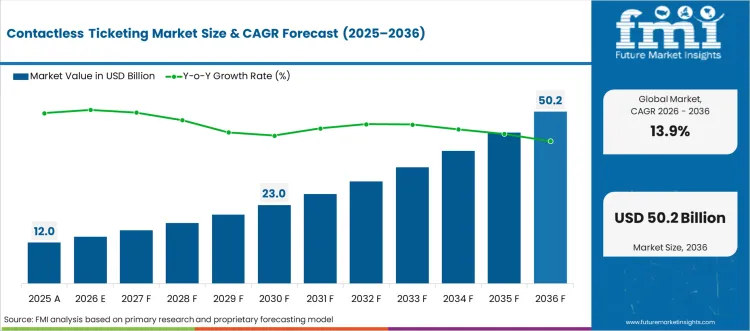
The Contactless Ticketing market was valued at USD 12.00 billion in 2025, projected to reach USD 13.67 billion in 2026, and is forecast to expand to USD 50.23 billion by 2036 at a 13.9% CAGR. FMI opines that the global transition from magnetic stripe and barcode ticketing to NFC-enabled smart cards and mobile handset-based ticketing platforms is accelerating across public transit, live entertainment, and event access management sectors. As per FMI, city transit authorities implementing open-loop payment acceptance on metro and bus networks are driving infrastructure procurement for contactless validators, backend processing systems, and account-based ticketing platforms that eliminate proprietary closed-loop fare card ecosystems.
Summary of Contactless Ticketing Market Market
- Market Overview
- The Contactless Ticketing market is valued at USD 12.00 billion in 2025 and is projected to reach USD 50.23 billion by 2036.
- The industry is expected to grow at a 13.9% CAGR from 2026 to 2036, creating an incremental opportunity of USD 36.56 billion.
- The market is a transit-modernisation-driven digital payments category where open-loop payment acceptance mandates, NFC smartphone penetration, and per-transaction cost reduction economics define competitive positioning among contactless ticketing platform suppliers globally.
- Demand and Growth Drivers
- Demand is accelerating as transit authorities globally migrate from proprietary closed-loop fare cards to open-loop NFC contactless payment acceptance.
- India's National Common Mobility Card programme is mandating interoperable contactless ticketing across all urban transit systems.
- Open-loop contactless systems deliver 30% to 40% per-transaction processing cost reductions compared to proprietary fare card infrastructure.
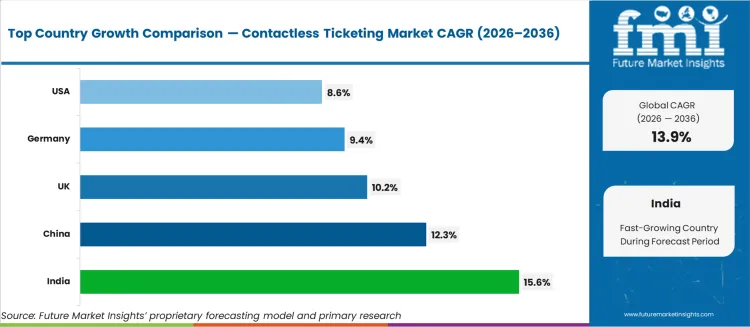
- India leads at 15.6% CAGR, followed by China at 12.3%, UK at 10.2%, Germany at 9.4%, and USA at 8.6%.
- Product and Segment View
- The market includes device, vertical as primary segmentation dimensions.
- Smart Cards leads by Device with 32.8% share in 2026.
- Media and Entertainment leads by Vertical with 15.3% share in 2026.
- Geography and Competitive Outlook
- India is the fastest-growing region at 15.6% CAGR, while China anchors the second-largest demand base.
- Competition is shaped by manufacturing scale, certification compliance, and distribution reach, with key players including Cubic Corporation, Thales Group, Masabi, Vix Technology, Ximedes.
- Analyst Opinion at FMI
- Sudip saha, Principal Consultant for Technology observe that: 'FMI's analysis reveals that the contactless ticketing market is entering a phase where procurement decisions are increasingly shaped by regulatory compliance timelines and measurable performance thresholds. Organisations that delay investment risk falling behind competitors actively securing next-generation positions.'
- Strategic Implications / Executive Takeaways
- Solution providers must secure certified pathways with tier-1 systems to qualify for forthcoming procurement contracts.
- Capital project directors should mandate native platform compatibility in all new procurement specifications.
- Technical teams must develop specialised competencies in device validation to demonstrate compliance parameters.
Contactless Ticketing Market Market Key Takeaways
| Metric | Details |
|---|---|
| Industry Size (2026) | USD 13.67 billion |
| Industry Value (2036) | USD 50.23 billion |
| CAGR (2026 to 2036) | 13.9% |
Source: Future Market Insights, 2026
FMI is of the opinion that regional growth trajectories reflect varying transit modernisation timelines and smartphone payment penetration rates. India leads at 15.6% CAGR, driven by the National Common Mobility Card programme mandating interoperable contactless ticketing across urban transit systems. China follows at 12.3%, supported by the scale of WeChat Pay and Alipay transit integration across tier-1 and tier-2 city metro networks. The UK registers 10.2% growth anchored by the expansion of Transport for London's contactless payment model to regional transit operators. Germany maintains 9.4% growth as Deutsche Bahn and regional transit authorities deploy open-loop contactless acceptance. The USA registers 8.6% growth reflecting OMNY deployment in New York and similar programmes in Los Angeles and Chicago. Based on FMI's report, smart cards maintain 32.8% device share due to their reliability in high-throughput transit gate environments, though mobile handset share is growing as NFC payment acceptance infrastructure scales. Future Market Insights analysis indicates that transit authorities implementing open-loop contactless systems report per-transaction processing cost reductions of 30% to 40% compared to proprietary fare card infrastructure.
Contactless Ticketing Market Market Definition
Based on FMI's report, the Contactless Ticketing market covers smart cards, NFC chips, mobile handset-based ticketing solutions, and supporting backend platforms used for contactless fare collection and event access across media and entertainment, transportation, and other verticals globally.
Contactless Ticketing Market Market Inclusions
Future Market Insights analysis covers contactless ticketing devices across all major form factors and vertical applications. The scope encompasses regional market sizes across five key countries, forecast projections from 2026 to 2036, and segmentation by device type and vertical.
Contactless Ticketing Market Market Exclusions
The scope excludes traditional magnetic stripe ticketing systems, QR code-only ticketing without NFC capability, and physical cash fare collection equipment.
Contactless Ticketing Market Market Research Methodology
- Primary Research: Analysts engaged with transit authority technology directors, event venue access control managers, and NFC chipset manufacturers to map deployment timelines and open-loop migration strategies.
- Desk Research: Data collection aggregated national transit authority contactless deployment statistics, EMVCo contactless transaction volume reports, and published smart card shipment data from chipset manufacturers.
- Market-Sizing and Forecasting: Baseline values derive from a bottom-up aggregation of contactless ticketing infrastructure and device revenues across five key countries, applying transit network expansion curves and open-loop migration adoption rates.
- Data Validation and Update Cycle: Projections are cross-validated against quarterly NFC chipset revenue guidance from major semiconductor manufacturers and transit authority capital expenditure budget disclosures.
Key Industry Highlights
Rising Adoption of Advanced Technologies and Smart Ticketing in Transportation Fuels Market Growth
In industries, such as entertainment, transit, and sports, contactless ticketing is gradually emerging as a cutting-edge system. These tickets are considered to be an efficient and affordable way for passengers to manage their travel via public transportation. They can easily pre-load credits into their tickets for traveling in the future. They can also transfer or recover money from another ticketing system if their contactless ticket is lost or stolen.
In addition to that, the increasing adoption of various advanced technologies in tourism and travel businesses, such as Artificial Intelligence (AI), variables, virtual philanthropy, and smart cards is expected to boost the sales of contactless ticketing systems in both developed and developing countries. Transportation authorities in countries, such as Asia Pacific and Europe are anticipated to launch ambitious schemes, including smart ticketing systems to expand their tourism industry.
Rising Adoption of Digital Wallets Simplify Ticket Management and Boost User Convenience
The implementation of mobile wallets is on high rise as many individuals choose to store and accomplish their contactless tickets digitally. Mobile wallets, such as Apple Pay, Google Wallet and Samsung Pay, deliver a suitable way for users to carry and use their tickets without demanding physical cards or paper. This trend is determined by the rising need on smartphones for daily deeds and the desire for more efficient, efficient ticketing solutions.
Mobile wallets offer features like easy ticket access, quick transactions and improved security, which demand to both consumers and service providers. As more transportation and event services incorporate with mobile wallet platforms, the use of these digital tools for contactless ticketing is predictable to develop, streamlining the ticketing process and enlightening user experience. This trend imitates a wider shift towards digital and contactless solutions in various sectors.
Development of Multi-Modal Ticketing Solutions Benefits the Business Growth
Creating multi-modal ticketing solutions offers a valuable prospect in the contactless ticketing industry. These solutions assimilate different types of transportation, such as buses, trains and bikes, into a single ticketing system. This creates it easier for users to portable across various transport modes with just one contactless ticket. By relating these services into one seamless platform, users can get a more convenient and streamlined travel experience.
For example, a single ticket could cover a bus ride a train journey and a bike rental all in one go. This approach streamlines travel planning and payment for users, making their overall understanding smoother and more efficient. As more cities and transit establishments adopt this combined approach, there will be rising demand for advanced contactless ticketing solutions that provision multi-modal travel.
Complex Stakeholder Engagement and Security Concerns Pose Hinders Contactless Ticketing Industry Growth
The deployment of contactless ticketing systems in the public transportation network requires the engagement of multiple stakeholders, such as user groups, service providers, infrastructure suppliers, the public sector, and component manufacturers. It thus leads to the development of a complicated structure, which demands a vital financial commitment.
Besides, rising concerns of security and safety risks associated with the usage of this type of ticketing system may hinder the global contactless ticketing market growth in the evaluation period. A few credentials, including secret cryptographic keys for authentication purposes, are required to avail tickets. When these credentials are stored in mobile devices that lack security, hackers can try to break into the system and steal confidential data.
Market Concentration
Tier 1 vendors, which include industry players such as Cubic Corporation, Thales Group, NXP Semiconductors, Gemalto (Thales Group) dominating the market with extensive global networks, advanced service portfolios and significant investments in technology and infrastructure. Tier 1 vendors caters around 45%-50% market share in contactless ticketing and which will leverage scale and resources to offer contactless ticketing across different industries.
Tier 2 vendors are mid-sized companies offers competitive contactless ticketing with strong regional or niche market presence. Tier 2 vendors such as Masabi, Vix Technology and IDEMIA. Tier 2 vendors focused on specialized services, strategic partnerships and caters to specific sectors and holds around 10%-15% of the market share. They are very crucial for driving innovation and provide tailored product portfolios to various industries requires focused contactless ticketing offerings.
Tier 3 vendors consist of smaller regional players catering to localized markets. Tier 2 vendors include niche service providers and emerging vendors 30%-35% of the market. This vendor focus on delivering customized or cost-effective Contactless Ticketing capitalizing on regional demands or underserved markets. Despite their smaller market share Tier 3 vendors play very crucial role by offering flexible and specialized services that larger vendors may not prioritize.
Country-wise Insights
The section highlights the CAGRs of countries experiencing growth in the contactless ticketing market, along with the latest advancements contributing to overall market development. Based on current estimates, USA, Japan, UK, China and Germany are expected to see steady growth during the forecast period.
.webp "Top Country Growth Comparison Contactless Ticketing Market Cagr (2026 2036)")
| Countries | CAGR from 2026 to 2036 |
|---|---|
| India | 15.6% |
| China | 12.3% |
| Germany | 9.4% |
| UK | 10.2% |
| United States | 8.6% |
China's Strategic Investments and Vendor Partnerships Fuel Rapid Growth in Contactless Ticketing Market
In China, the rapid urbanization and strong government efforts to streamline public transportation systems are expressively boosting the demand for contactless ticketing solutions. For example, the country’s government has owed substantial funds for advancement public transport infrastructure, with over USD 20 billion invested in smart transit technologies in recent years.
This investment includes the deployment of progressive contactless ticketing systems across major cities like Beijing and Shanghai. Additionally, partnerships between local governments and technology vendors are rushing this shift. In 2023, the Beijing Municipal Transportation Commission joined with tech giants such as Huawei to renovation the capital’s contactless payment and ticketing functions in a bid to encourage take-up of public transport by making it more suitable.
This grouping of government spending on infrastructure and strategic vendor partnerships is driving important growth in the contactless ticketing industry in China which led to one of the fastest-growing regions internationally.
USA Market Flourishes by Technological Advancements and Government Initiatives in Contactless Ticketing Solutions
In the USA, developments in technology are inspiring the growth of the contactless ticketing industry due to its high adoption of digital payment technologies and progressions in other advanced technologies such as NFC, and RFID are generating an increasing demand for modern contactless ticketing solutions. For instance, the government has pumped in billions into revamping the public transportation infrastructure by incorporating smart ticketing systems.
Recent collaborations among technology developers such as Cubic Corporation with transit establishments have led to the introduction of new age ticketing that is saw launched implemented across major cities such as New York and San Francisco to improve user experience and system efficiency. Governments across various cities have also introduced policies replacing traditional methods with contactless technologies. These factors have boosted rapid growth in these markers due to significant financial investments especially in North America.
Funding and Strategic Collaborations Accelerate Growth of Contactless Ticketing Solutions in India’s Expanding Public Transit Systems
In India, contactless ticketing is gaining traction due to the rising government funding in improving public transportation infrastructure and the increasing focus on digitalization. The Indian government has allocated nearly USD 19 billion for overhauling urban transit systems to enhance the connection between cities and suburbs, which includes expanding metro networks in cities such as Delhi and Mumbai.
The Delhi Metro Rail Corporation (DMRC) has deployed a significant amount of capital into implementing contactless payment solutions to integrate its multiple transport modes. Strong relationships of local vendors with global providers are also expected to help drive market growth in this region.
In terms of sales acquisition, some system developers partner with specific card or component manufacturers contributing some portion of their existing customers, which would facilitate their entry into new markets. Moreover, other Indian enterprises like coesys solution, andeos services are enhancing the growth of contactless innovations by adopting partnerships with foreign companies.
Category-wise Insights
Smart Cards Dominates the Contactless Ticketing Market with Advanced Solutions and Widespread Adoption
Smart cards are the dominant player in the contactless ticketing market mainly due to their usage in multiple applications. These cards are being utilized increasingly for public transportation, event management, and access control activities and to avail several other services. Many prominent organizations have already adopted smart cards for their operations.
For instance, the New York Metropolitan Transportation Authority (MTA) has integrated fare payment with numerous transit mediums through smart card systems that allow commuters to simply swipe these cards for making payments. Also, Transport for London (TfL) has implemented this strategy successfully years ago by using a similar card-swiping system on all its transit mediums including taxis.
The renewable solution provider firm also appreciated one of our recent reports where we highlighted the prolific initiatives taken by NXP Semiconductors to develop new-gen smart card solutions that enhance security protocols and ease of fare payment systems’ operations for network operators.
Moreover, a global leader in digital security solutions firm currently known as Gemalto (recently acquired by Thales Group) commented on study enlisting current trends in contactless ticketing industry by stating that they have recently launched an enhanced version of these digital cards with additional encryption facilities.
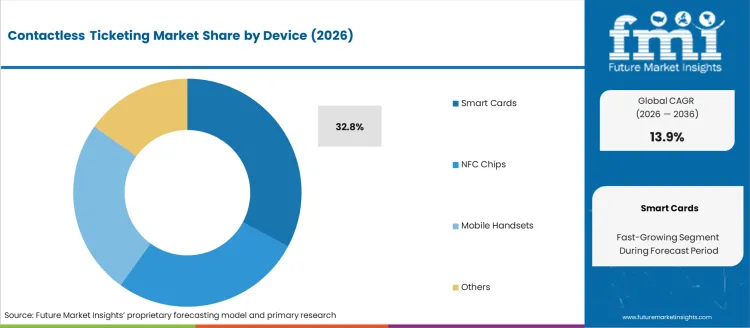
| Segment | Smart Cards (Device Type) |
|---|---|
| Value Share (2026) | 32.8% |
Media and Entertainment Application is Dominating the Contactless Ticketing Market in terms of Growth
The Media and Entertainment sector is witnessing the highest growth in the contactless ticketing market as there is a rise in demand for easy and fast entry to events. Concerts, sports matches, and trade fairs are adopting digital or mobile tickets to improve customer satisfaction.
Also, majority bookings happen at box office counters which has high potential to turn toward self-service kiosks or vending machines using contactless technology. For example, Ticketmaster announced an increase of 25% in the sale of online tickets for major live events; this shows that people have started preferring going ticketless.
Even Eventbrite introduced more ways to go contactless at popular music festivals through their platform which resulted in a growth of around 30% in its mobile ticket sales during the past year.
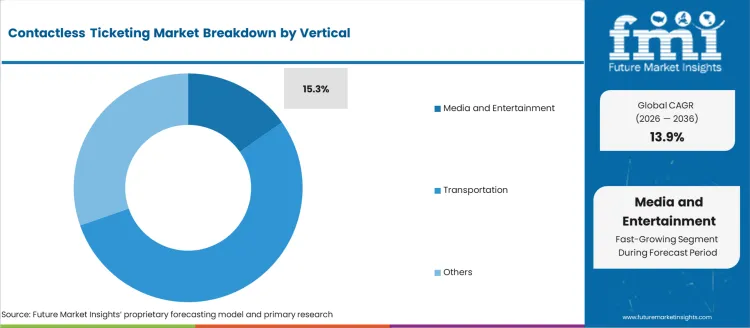
| Segment | Media and Entertainment (Vertical) |
|---|---|
| CAGR (2024 to 2036) | 15.3% |
Competition Outlook
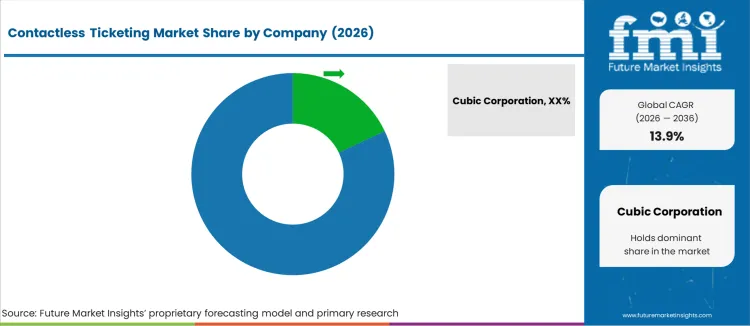
Key players ruling the contactless ticketing market are focusing on making partnerships with content creators. The companies are also expanding their global reach for tapping the market that has yet to be dominated by other vendors.
Scope of the Report
| Metric | Value |
|---|---|
| Quantitative Units | USD 13.67 billion to USD 50.23 billion, at a CAGR of 13.9% |
| Market Definition | Based on FMI's report, the Contactless Ticketing market covers smart cards, NFC chips, mobile handset-based ticketing solutions, and supporting backend platforms used for contactless fare collection and event access across media and entertainment, transportation, and other verticals globally. |
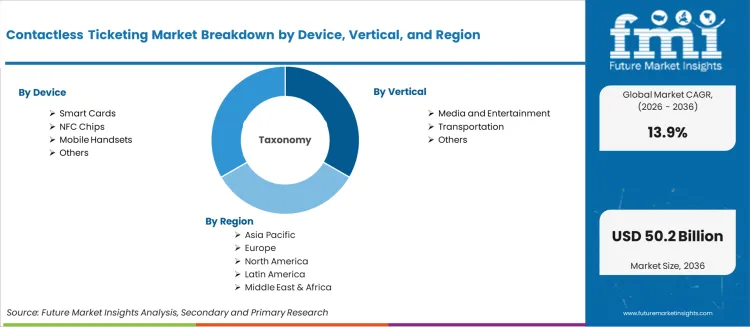
| Segmentation | Device: Smart Cards, NFC Chips, Mobile Handsets, Others; Vertical: Media and Entertainment, Transportation, Others |
| Regions Covered | India, China, UK, Germany, USA |
| Key Companies Profiled | Cubic Corporation, Thales Group, Masabi, Vix Technology, Ximedes, Indra Sistemas, Conduent, Inc., Rambus, Confidex Ltd., HID Global |
| Forecast Period | 2026 to 2036 |
| Approach | Hybrid bottom-up methodology combining installed base metrics with regulatory compliance adoption curves and primary research validation. |
Contactless Ticketing Market Segmentation
By Device Type:
In terms of service type, the segment is divided into smart cards, NFC chips, mobile handsets and others.
By Vertical:
In terms of Vertical, the industry is segregated into transportation, media and entertainment and others.
By Region:
A regional analysis has been carried out in key countries of North America, Latin America, Asia Pacific, Middle East and Africa (MEA), and Europe.
Bibliography
- 1. EMVCo. (2025). EMV Contactless Specifications: Annual Transaction Volume Report. EMVCo.
- 2. International Organization for Standardization. (2024). ISO/IEC 14443: Identification Cards, Contactless Integrated Circuit Cards. ISO.
- 3. Ministry of Housing and Urban Affairs, India. (2025). National Common Mobility Card: Implementation Progress Report. MoHUA.
- 4. Transport for London. (2025). Annual Report on Contactless Payment and Open Loop Ticketing. TfL.
- 5. Organisation for Economic Co-operation and Development. (2025). Urban Transport Digitalisation Indicators. OECD Publishing.
- 6. World Bank Group. (2024). Digital Payments for Urban Transport: Global Best Practices. World Bank.
This bibliography is provided for reader reference. The full Future Market Insights report contains the complete reference list with primary research documentation.
Frequently Asked Questions
How large is the Contactless Ticketing market in 2026?
The Contactless Ticketing market is estimated to be valued at USD 13.67 billion in 2026.
What will be the market size of Contactless Ticketing by 2036?
Market size for Contactless Ticketing is projected to reach USD 50.23 billion by 2036.
What is the expected CAGR for Contactless Ticketing between 2026 and 2036?
The Contactless Ticketing market is expected to grow at a CAGR of 13.9% between 2026 and 2036.
Which Device leads the Contactless Ticketing market in 2026?
Smart Cards accounts for 32.8% share in 2026 by Device.
Which region is projected to grow fastest?
India is projected to grow at a CAGR of 15.6% during 2026 to 2036.
What does this report include in its scope?
The report covers market sizing, segmentation analysis, regional forecasts, competitive landscape evaluation, and forecast projections from 2026 to 2036.
How does FMI build and validate the Contactless Ticketing forecast?
Forecasting models apply a bottom-up methodology starting with installed base metrics and cross-validate projections against quarterly revenue volumes and industry data.
Preview the report firsthand - request a free sample
Get SampleGet the brochure for pricing and purchase details.
Get PDFTable of Content
- Executive Summary
- Global Market Outlook
- Demand-side Trends
- Supply-side Trends
- Technology Roadmap Analysis
- Analysis and Recommendations
- Market Overview
- Market Coverage / Taxonomy
- Market Definition / Scope / Limitations
- Research Methodology
- Chapter Orientation
- Analytical Lens and Working Hypotheses
- Market Structure, Signals, and Trend Drivers
- Benchmarking and Cross-market Comparability
- Market Sizing, Forecasting, and Opportunity Mapping
- Research Design and Evidence Framework
- Desk Research Programme (Secondary Evidence)
- Company Annual and Sustainability Reports
- Peer-reviewed Journals and Academic Literature
- Corporate Websites, Product Literature, and Technical Notes
- Earnings Decks and Investor Briefings
- Statutory Filings and Regulatory Disclosures
- Technical White Papers and Standards Notes
- Trade Journals, Industry Magazines, and Analyst Briefs
- Conference Proceedings, Webinars, and Seminar Materials
- Government Statistics Portals and Public Data Releases
- Press Releases and Reputable Media Coverage
- Specialist Newsletters and Curated Briefings
- Sector Databases and Reference Repositories
- FMI Internal Proprietary Databases and Historical Market Datasets
- Subscription Datasets and Paid Sources
- Social Channels, Communities, and Digital Listening Inputs
- Additional Desk Sources
- Expert Input and Fieldwork (Primary Evidence)
- Primary Modes
- Qualitative Interviews and Expert Elicitation
- Quantitative Surveys and Structured Data Capture
- Blended Approach
- Why Primary Evidence is Used
- Field Techniques
- Interviews
- Surveys
- Focus Groups
- Observational and In-context Research
- Social and Community Interactions
- Stakeholder Universe Engaged
- C-suite Leaders
- Board Members
- Presidents and Vice Presidents
- R&D and Innovation Heads
- Technical Specialists
- Domain Subject-matter Experts
- Scientists
- Physicians and Other Healthcare Professionals
- Governance, Ethics, and Data Stewardship
- Research Ethics
- Data Integrity and Handling
- Primary Modes
- Tooling, Models, and Reference Databases
- Desk Research Programme (Secondary Evidence)
- Data Engineering and Model Build
- Data Acquisition and Ingestion
- Cleaning, Normalisation, and Verification
- Synthesis, Triangulation, and Analysis
- Quality Assurance and Audit Trail
- Market Background
- Market Dynamics
- Drivers
- Restraints
- Opportunity
- Trends
- Scenario Forecast
- Demand in Optimistic Scenario
- Demand in Likely Scenario
- Demand in Conservative Scenario
- Opportunity Map Analysis
- Product Life Cycle Analysis
- Supply Chain Analysis
- Investment Feasibility Matrix
- Value Chain Analysis
- PESTLE and Porter’s Analysis
- Regulatory Landscape
- Regional Parent Market Outlook
- Production and Consumption Statistics
- Import and Export Statistics
- Market Dynamics
- Global Market Analysis 2021 to 2025 and Forecast, 2026 to 2036
- Historical Market Size Value (USD Million) Analysis, 2021 to 2025
- Current and Future Market Size Value (USD Million) Projections, 2026 to 2036
- Y-o-Y Growth Trend Analysis
- Absolute $ Opportunity Analysis
- Global Market Pricing Analysis 2021 to 2025 and Forecast 2026 to 2036
- Global Market Analysis 2021 to 2025 and Forecast 2026 to 2036, By Device
- Introduction / Key Findings
- Historical Market Size Value (USD Million) Analysis By Device , 2021 to 2025
- Current and Future Market Size Value (USD Million) Analysis and Forecast By Device , 2026 to 2036
- Smart Cards
- NFC Chips
- Mobile Handsets
- Others
- Smart Cards
- Y-o-Y Growth Trend Analysis By Device , 2021 to 2025
- Absolute $ Opportunity Analysis By Device , 2026 to 2036
- Global Market Analysis 2021 to 2025 and Forecast 2026 to 2036, By Vertical
- Introduction / Key Findings
- Historical Market Size Value (USD Million) Analysis By Vertical, 2021 to 2025
- Current and Future Market Size Value (USD Million) Analysis and Forecast By Vertical, 2026 to 2036
- Media and Entertainment
- Transportation
- Others
- Media and Entertainment
- Y-o-Y Growth Trend Analysis By Vertical, 2021 to 2025
- Absolute $ Opportunity Analysis By Vertical, 2026 to 2036
- Global Market Analysis 2021 to 2025 and Forecast 2026 to 2036, By Region
- Introduction
- Historical Market Size Value (USD Million) Analysis By Region, 2021 to 2025
- Current Market Size Value (USD Million) Analysis and Forecast By Region, 2026 to 2036
- North America
- Latin America
- Western Europe
- Eastern Europe
- East Asia
- South Asia and Pacific
- Middle East & Africa
- Market Attractiveness Analysis By Region
- North America Market Analysis 2021 to 2025 and Forecast 2026 to 2036, By Country
- Historical Market Size Value (USD Million) Trend Analysis By Market Taxonomy, 2021 to 2025
- Market Size Value (USD Million) Forecast By Market Taxonomy, 2026 to 2036
- By Country
- USA
- Canada
- Mexico
- By Device
- By Vertical
- By Country
- Market Attractiveness Analysis
- By Country
- By Device
- By Vertical
- Key Takeaways
- Latin America Market Analysis 2021 to 2025 and Forecast 2026 to 2036, By Country
- Historical Market Size Value (USD Million) Trend Analysis By Market Taxonomy, 2021 to 2025
- Market Size Value (USD Million) Forecast By Market Taxonomy, 2026 to 2036
- By Country
- Brazil
- Chile
- Rest of Latin America
- By Device
- By Vertical
- By Country
- Market Attractiveness Analysis
- By Country
- By Device
- By Vertical
- Key Takeaways
- Western Europe Market Analysis 2021 to 2025 and Forecast 2026 to 2036, By Country
- Historical Market Size Value (USD Million) Trend Analysis By Market Taxonomy, 2021 to 2025
- Market Size Value (USD Million) Forecast By Market Taxonomy, 2026 to 2036
- By Country
- Germany
- UK
- Italy
- Spain
- France
- Nordic
- BENELUX
- Rest of Western Europe
- By Device
- By Vertical
- By Country
- Market Attractiveness Analysis
- By Country
- By Device
- By Vertical
- Key Takeaways
- Eastern Europe Market Analysis 2021 to 2025 and Forecast 2026 to 2036, By Country
- Historical Market Size Value (USD Million) Trend Analysis By Market Taxonomy, 2021 to 2025
- Market Size Value (USD Million) Forecast By Market Taxonomy, 2026 to 2036
- By Country
- Russia
- Poland
- Hungary
- Balkan & Baltic
- Rest of Eastern Europe
- By Device
- By Vertical
- By Country
- Market Attractiveness Analysis
- By Country
- By Device
- By Vertical
- Key Takeaways
- East Asia Market Analysis 2021 to 2025 and Forecast 2026 to 2036, By Country
- Historical Market Size Value (USD Million) Trend Analysis By Market Taxonomy, 2021 to 2025
- Market Size Value (USD Million) Forecast By Market Taxonomy, 2026 to 2036
- By Country
- China
- Japan
- South Korea
- By Device
- By Vertical
- By Country
- Market Attractiveness Analysis
- By Country
- By Device
- By Vertical
- Key Takeaways
- South Asia and Pacific Market Analysis 2021 to 2025 and Forecast 2026 to 2036, By Country
- Historical Market Size Value (USD Million) Trend Analysis By Market Taxonomy, 2021 to 2025
- Market Size Value (USD Million) Forecast By Market Taxonomy, 2026 to 2036
- By Country
- India
- ASEAN
- Australia & New Zealand
- Rest of South Asia and Pacific
- By Device
- By Vertical
- By Country
- Market Attractiveness Analysis
- By Country
- By Device
- By Vertical
- Key Takeaways
- Middle East & Africa Market Analysis 2021 to 2025 and Forecast 2026 to 2036, By Country
- Historical Market Size Value (USD Million) Trend Analysis By Market Taxonomy, 2021 to 2025
- Market Size Value (USD Million) Forecast By Market Taxonomy, 2026 to 2036
- By Country
- Kingdom of Saudi Arabia
- Other GCC Countries
- Turkiye
- South Africa
- Other African Union
- Rest of Middle East & Africa
- By Device
- By Vertical
- By Country
- Market Attractiveness Analysis
- By Country
- By Device
- By Vertical
- Key Takeaways
- Key Countries Market Analysis
- USA
- Pricing Analysis
- Market Share Analysis, 2025
- By Device
- By Vertical
- Canada
- Pricing Analysis
- Market Share Analysis, 2025
- By Device
- By Vertical
- Mexico
- Pricing Analysis
- Market Share Analysis, 2025
- By Device
- By Vertical
- Brazil
- Pricing Analysis
- Market Share Analysis, 2025
- By Device
- By Vertical
- Chile
- Pricing Analysis
- Market Share Analysis, 2025
- By Device
- By Vertical
- Germany
- Pricing Analysis
- Market Share Analysis, 2025
- By Device
- By Vertical
- UK
- Pricing Analysis
- Market Share Analysis, 2025
- By Device
- By Vertical
- Italy
- Pricing Analysis
- Market Share Analysis, 2025
- By Device
- By Vertical
- Spain
- Pricing Analysis
- Market Share Analysis, 2025
- By Device
- By Vertical
- France
- Pricing Analysis
- Market Share Analysis, 2025
- By Device
- By Vertical
- India
- Pricing Analysis
- Market Share Analysis, 2025
- By Device
- By Vertical
- ASEAN
- Pricing Analysis
- Market Share Analysis, 2025
- By Device
- By Vertical
- Australia & New Zealand
- Pricing Analysis
- Market Share Analysis, 2025
- By Device
- By Vertical
- China
- Pricing Analysis
- Market Share Analysis, 2025
- By Device
- By Vertical
- Japan
- Pricing Analysis
- Market Share Analysis, 2025
- By Device
- By Vertical
- South Korea
- Pricing Analysis
- Market Share Analysis, 2025
- By Device
- By Vertical
- Russia
- Pricing Analysis
- Market Share Analysis, 2025
- By Device
- By Vertical
- Poland
- Pricing Analysis
- Market Share Analysis, 2025
- By Device
- By Vertical
- Hungary
- Pricing Analysis
- Market Share Analysis, 2025
- By Device
- By Vertical
- Kingdom of Saudi Arabia
- Pricing Analysis
- Market Share Analysis, 2025
- By Device
- By Vertical
- Turkiye
- Pricing Analysis
- Market Share Analysis, 2025
- By Device
- By Vertical
- South Africa
- Pricing Analysis
- Market Share Analysis, 2025
- By Device
- By Vertical
- USA
- Market Structure Analysis
- Competition Dashboard
- Competition Benchmarking
- Market Share Analysis of Top Players
- By Regional
- By Device
- By Vertical
- Competition Analysis
- Competition Deep Dive
- Cubic Corporation
- Overview
- Product Portfolio
- Profitability by Market Segments (Product/Age /Sales Channel/Region)
- Sales Footprint
- Strategy Overview
- Marketing Strategy
- Product Strategy
- Channel Strategy
- Thales Group
- Masabi
- Vix Technology
- Ximedes
- Indra Sistemas
- Conduent, Inc.
- Rambus
- Confidex Ltd.
- HID Global
- IDEMIA
- Giesecke+Devrient
- NXP Semiconductors
- Infineon Technologies
- Gemalto (Thales Group)
- Cubic Corporation
- Competition Deep Dive
- Assumptions & Acronyms Used


