

- Industry Size (2025)
- USD 1695.3 Mn
- Forecast (2035)
- USD 275.3 USD 2907.6 Mn
- CAGR (2025 to 2035)
- 5.5%
Contactless Respiratory Measurement Market Forecast and Outlook 2025 to 2035
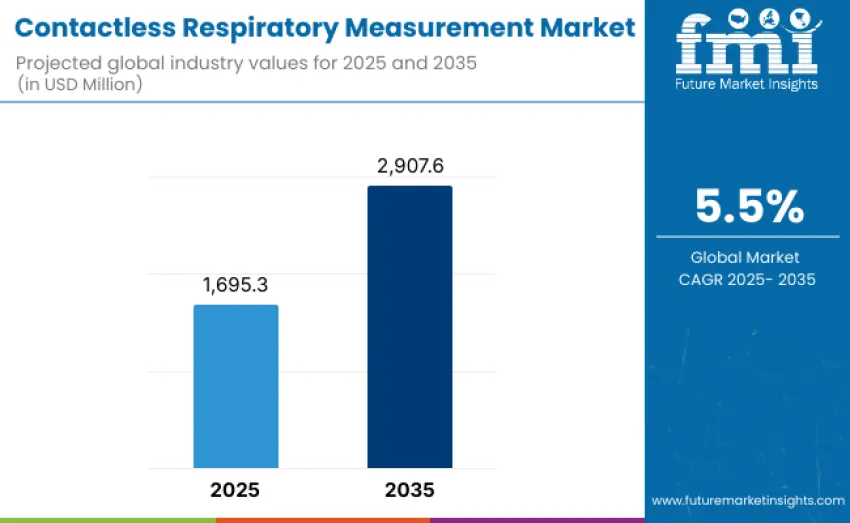
Global contactless respiratory measurement market is projected to reach USD 2,907.6 million by 2035, recording an absolute increase of USD 1,212.3 million over the forecast period. Value stands at USD 1,695.3 million in 2025 and is set to rise at a CAGR of 5.5% during the forecast period 2025 to 2035. Overall size is anticipated to grow by nearly 1.5 times, driven by rising demand for non-invasive, real-time respiratory monitoring solutions, expanding telehealth ecosystems, and growing adoption of advanced sensing technologies across healthcare, wellness, and medical research sectors.
Expansion reflects fundamental changes in clinical monitoring practices and patient management workflows, where contactless respiratory measurement systems enable healthcare professionals to obtain accurate, continuous respiratory data without direct patient contact. This evolution reduces infection risk, enhances patient comfort, and supports long-term observation in hospitals, home care, and remote monitoring settings.
Quick Stats for Contactless Respiratory Measurement Market
- Contactless Respiratory Measurement MarketValue (2025): USD 1,695.3 million
- Contactless Respiratory Measurement MarketForecast Value (2035): USD 2,907.6 million
- Contactless Respiratory Measurement MarketForecast CAGR: 5.5%
- Leading Technology in Contactless Respiratory Measurement Market: Radar & Microwave Sensors (34.7% share)
- Key Growth Regions in Contactless Respiratory Measurement Market: Asia Pacific, Europe, and North America
- Top Players in Contactless Respiratory Measurement Market: XandarKardian, Neteera, Sleepiz, Oxehealth, Vayyar
Technological advancements in sensor fusion, automated signal processing, and data visualization are reshaping contactless respiratory measurement landscape. Modern solutions integrate machine learning algorithms capable of differentiating respiratory patterns, detecting abnormalities such as apnea or irregular breathing, and correlating respiratory rate fluctuations with other vital parameters. These systems offer seamless compatibility with electronic health record (EHR) platforms, telemedicine networks, and remote patient monitoring (RPM) ecosystems, supporting healthcare providers in predictive diagnosis and personalized treatment planning.
Contactless Respiratory Measurement Market Year-over-Year Forecast (2025 to 2035)
Between 2025 and 2030, contactless respiratory measurement market is projected to expand from USD 1,695.3 million to USD 2,220.2 million, resulting in a value increase of USD 524.9 million, representing 43.3% of total forecast growth for the decade. This phase of development will be driven by growing need for contact-free respiratory monitoring technologies across hospitals, long-term care facilities, and home healthcare environments. Increasing awareness of infection control, growing prevalence of chronic respiratory diseases, and acceleration of telehealth adoption will contribute significantly to expansion during this period.
From 2030 to 2035, growth continues from USD 2,220.2 million to USD 2,907.6 million, adding another USD 687.4 million, constituting 56.7% of overall ten-year expansion. This period will be characterized by widespread deployment of automated multimodal monitoring platforms capable of integrating respiratory rate measurement with other vital signs such as heart rate, oxygen saturation, and sleep patterns.
Contactless Respiratory Measurement Market Key Takeaways
| Metric | Value |
|---|---|
| Market Value (2025) | USD 1,695.3 million |
| Market Forecast Value (2035) | USD 2,907.6 million |
| Forecast CAGR (2025 to 2035) | 5.5% |
Why Is the Contactless Respiratory Measurement Market Growing Worldwide?
Contactless respiratory measurement market is expanding globally due to rising demand for non-invasive, hygienic, and continuous respiratory monitoring solutions across healthcare and wellness settings. These technologies enable clinicians to accurately track breathing patterns without the need for physical contact, reducing risk of cross-contamination and improving patient comfort, especially in intensive care units, neonatal care, and home-based monitoring environments. Growing awareness of respiratory health issues such as chronic obstructive pulmonary disease (COPD), asthma, and sleep apnea is driving adoption, as hospitals and diagnostic centers seek advanced tools capable of delivering precise, real-time respiratory data.
Technological advancements, including automated motion detection, radar-based sensors, and camera-based monitoring systems, are enhancing accuracy, enabling early detection of abnormalities, and supporting integration with telemedicine and remote patient monitoring platforms. These innovations are especially valuable in post-acute care and elderly populations where continuous, unobtrusive tracking is critical. Government initiatives promoting digital health transformation, increased healthcare spending, and growing emphasis on preventive and home-based care are fueling growth.
How Are the Contactless Respiratory Measurement Market Segmented by Technology, Application, and Region?
Contactless respiratory measurement market is segmented by technology, application, and region. By technology, it is divided into radar & microwave sensors, camera & computer vision, thermal imaging sensors, and acoustic/automated sound analysis. Based on application, it is categorized into clinical & hospital monitoring, homecare & remote patient monitoring, automotive & driver safety, and research, defense & wellness. Regionally, it is divided into Asia Pacific, Europe, North America, Latin America, and Middle East & Africa. Each segment demonstrates distinct growth patterns driven by clinical requirements, technology adoption rates, and healthcare infrastructure development across diverse medical environments worldwide. (118 words)
By Technology, Radar & Microwave Sensors Segment Accounts for 34.7% Share
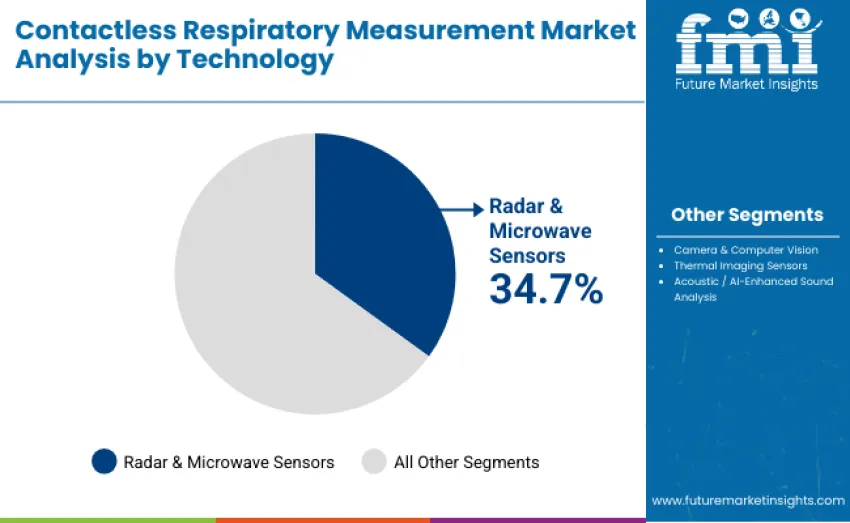
Radar and microwave sensors lead the contactless respiratory measurement market with a 34.7% share in 2025, driven by their high precision, long-range detection, and ability to deliver accurate, real-time respiratory data in clinical, homecare, automotive, and wellness environments. Camera and computer vision systems hold 29.6%, leveraging optical sensing and advanced algorithms for non-invasive monitoring in hospitals, telehealth, and research. Thermal imaging accounts for 22.1%, supporting temperature-based respiratory detection, while acoustic and automated sound analysis represents 13.6%. Radar’s reliability, non-contact capability, and environmental versatility underpin its continued leadership.
By Application, Homecare & Remote Patient Monitoring Accounts for 37.4% Share
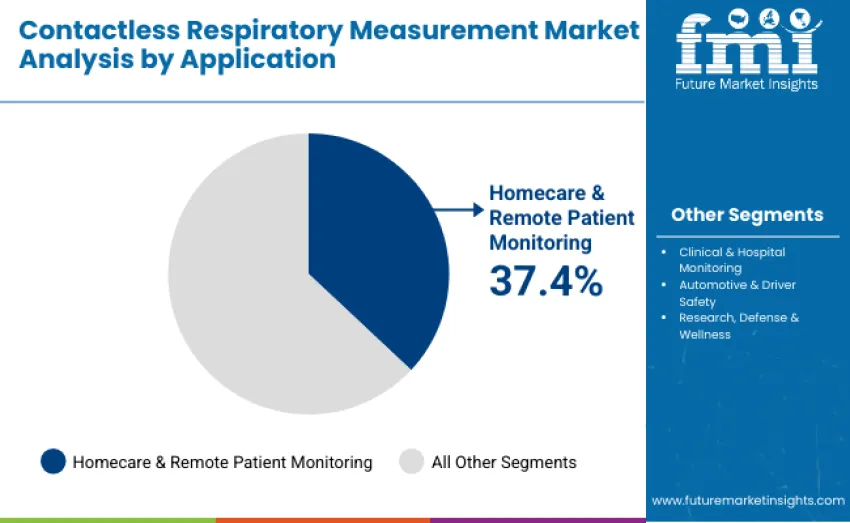
Homecare and remote patient monitoring dominate with a 37.4% share in 2025, supported by telehealth expansion, aging populations, and rising demand for continuous, contactless monitoring for chronic respiratory conditions and post-operative recovery. Clinical and hospital monitoring follows at 32.8%, driven by integration with advanced monitoring systems and EHR platforms for accurate, real-time respiratory assessment. Automotive and driver safety applications hold 16.3%, enabling alertness and fatigue detection. Research, defense, and wellness contribute 13.5%, supporting specialized monitoring needs. Growing home-based care and clinical reliability requirements shape application preferences.
What Are the Major Drivers, Restraints, and Emerging Trends Influencing the Contactless Respiratory Measurement Market?
Market growth is driven by three major factors. First, rising global prevalence of respiratory disorders is increasing demand for continuous, non-invasive monitoring to support early detection, reduce hospitalizations, and improve patient management. Second, infection control priorities in hospitals are accelerating adoption of contactless systems, as radar, optical, and thermal sensors eliminate the need for physical contact and improve comfort in ICU, neonatal, and surgical settings. Third, rapid telehealth expansion and growth of home-based care are boosting demand for portable, camera-based respiratory monitoring tools that enable remote tracking of breathing patterns and chronic conditions.
What Are the Key Restraints Affecting Adoption in the Contactless Respiratory Measurement Market?
High acquisition and integration costs remain major barriers, as advanced radar, optical, and infrared systems require specialized hardware, calibration, and workflow integration. Environmental and motion-related signal variability can affect measurement consistency, requiring sophisticated algorithms to meet clinical accuracy standards. These limitations can slow adoption in cost-sensitive healthcare settings and prevent widespread deployment in uncontrolled environments.
What Key Trends Are Shaping the Future of Contactless Respiratory Measurement?
Key trends include rapid adoption in Asia-Pacific, supported by government-backed healthcare innovation programs, clinical validation initiatives, and growing investment in digital health infrastructure. Advancements in imaging, radar sensing, and AI-based signal interpretation are strengthening clinical reliability. Expansion of remote monitoring, telehealth platforms, and smart home health technologies is expected to further accelerate global market growth.
How Are Leading Countries Driving Growth in the Contactless Respiratory Measurement Market?
| Country/Region | CAGR (2025 to 2035) |
|---|---|
| India | 7.0% |
| China | 6.8% |
| Brazil | 6.3% |
| United States | 5.9% |
| Europe | 5.4% |
| United Kingdom | 5.2% |
| Germany | 5.1% |
| France | 5.0% |
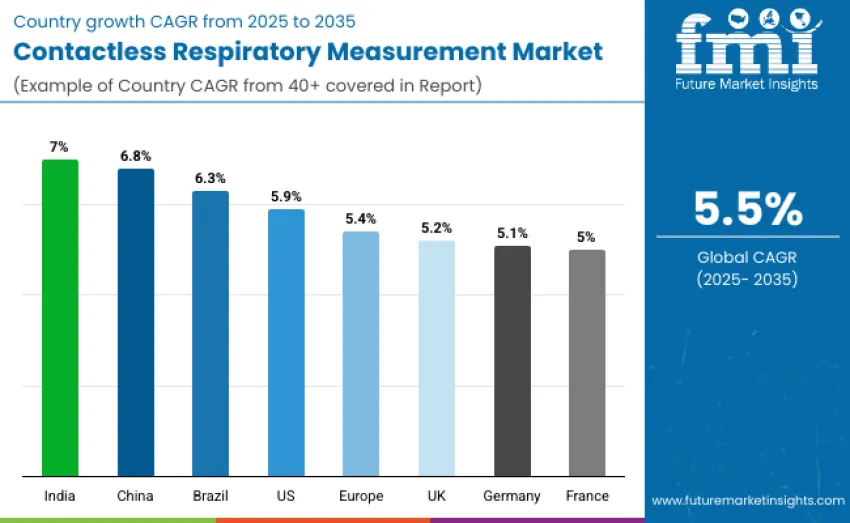
India leads the contactless respiratory measurement market with a 7.0% CAGR, driven by digital health expansion and strong government support. China follows at 6.8%, supported by major investments in telemedicine infrastructure and domestic sensor manufacturing. Brazil grows at 6.3% as home-based monitoring adoption rises. The United States advances at 5.9% due to its mature healthcare ecosystem and strong remote monitoring networks. Europe grows at 5.4%, with the UK at 5.2%, Germany at 5.1%, and France at 5.0%, supported by precision engineering and expanding telehealth initiatives.
How Is Digital Health Infrastructure Accelerating Growth in China?
China’s contactless respiratory measurement market is projected to grow at a 6.8% CAGR through 2035, driven by rapid digital health expansion, telemedicine infrastructure, and domestic sensor manufacturing. Hospitals and research institutes in Beijing, Shanghai, Guangzhou, and Shenzhen are adopting radar, optical, and camera-based respiratory monitoring systems for clinical care, chronic disease management, and home-based programs. National initiatives such as Healthy China 2030 and Made in China 2025 provide subsidies for telehealth equipment and workforce training.
Why Are Healthcare Technology Development Programs Enhancing Growth in India?
India’s contactless respiratory measurement market is expected to grow at a 7.0% CAGR through 2035, strengthened by Digital India initiatives, healthcare technology programs, and IT sector expansion into clinical monitoring. Adoption is rising in major hubs such as Bengaluru, Hyderabad, Mumbai, and Pune across hospitals, diagnostics labs, and telemedicine providers. National programs support remote patient care and advanced monitoring technologies. Government incentives offer training subsidies and equipment financing, while collaborations between global manufacturers, domestic suppliers, and healthcare institutions accelerate accessibility. Increasing telehealth use and digital patient management systems further reinforce nationwide adoption.
How Does Healthcare Technology Excellence Sustain Leadership in Germany?
Germany’s contactless respiratory measurement market is projected to grow at a 5.1% CAGR through 2035, supported by precision engineering, strong regulatory standards, and integration of advanced monitoring systems in Berlin, Munich, Hamburg, and Frankfurt. Hospitals and ICUs are adopting radar and optical respiratory systems with structured staff training. Academic–industry collaborations enhance system validation and clinical proficiency. Integration with hospital IT, telehealth networks, and EHR platforms strengthens real-time monitoring. Reliable distributor networks ensure consistent device availability, while strict EU regulations maintain high-quality adoption across clinical, research, and homecare environments.
Why Is Expanding Telehealth and Homecare Adoption Fueling Growth in Brazil?
Brazil’s contactless respiratory measurement market is projected to grow at a 6.3% CAGR through 2035, driven by rising respiratory disease prevalence, telehealth expansion, and increasing homecare adoption. Major regions such as São Paulo, Rio de Janeiro, Brasília, and Porto Alegre are deploying contactless monitoring systems across hospitals, clinics, and home-based care. Partnerships with international distributors improve accessibility, training, and financing support. Telemedicine networks are integrating respiratory monitoring for chronic disease follow-up, while growing digital health awareness accelerates adoption.
How Are Advanced Healthcare Infrastructure and Telehealth Strengthening Performance in the United States?
The USA contactless respiratory measurement market is projected to grow at a 5.9% CAGR through 2035, supported by advanced healthcare infrastructure and strong telemedicine adoption. Hospitals and remote monitoring networks in New York, California, Texas, and Washington use contactless systems for chronic care, post-discharge monitoring, and ICU workflows. Integration with EHR platforms ensures accurate data capture. Established distribution networks provide broad device access and technical support. Collaborations between healthcare associations, technology providers, and manufacturers enhance product development and clinical training, reinforcing widespread adoption across hospitals, clinics, and homecare programs.
How Is Healthcare Services Expansion Supporting Growth in the United Kingdom?
The UK’s contactless respiratory measurement market is projected to grow at a 5.2% CAGR through 2035, driven by telehealth expansion, digital health integration, and homecare monitoring initiatives. Healthcare clusters in London, Manchester, Bristol, and Edinburgh are deploying contactless systems to improve early detection and reduce readmissions. NHS-supported digital health programs facilitate standardized workflows and structured training. Partnerships between universities, hospitals, and device suppliers strengthen workforce readiness and system interoperability. Broader adoption in homecare networks and institutional settings supports national goals for remote patient management and continuous monitoring.
How Are Digital Health Integration and Pan-European Programs Driving Growth in Europe?
Europe’s contactless respiratory measurement market is projected to grow at a 5.4% CAGR through 2035, supported by widespread digital health adoption, expanding telehealth infrastructure, and strong regulatory frameworks under EU medical device standards. Healthcare systems in Germany, France, the UK, and the Nordics are integrating radar, optical, and camera-based respiratory monitoring tools into hospitals, homecare networks, and remote patient management platforms. EU-funded innovation programs and cross-border research collaborations are accelerating validation of contactless technologies. Integration with EHR systems, clinical monitoring platforms, and national telehealth networks enhances workflow efficiency and strengthens clinical adoption across Europe.
Why Are Clinical Research Capacity and Telehealth Expansion Supporting Growth in France?
France’s contactless respiratory measurement market is projected to grow at a 5.0% CAGR through 2035, driven by modernized healthcare infrastructure, strong clinical research networks, and expanding telehealth adoption. Major centers in Paris, Lyon, Marseille, and Toulouse are implementing contactless respiratory systems for chronic disease management, early detection, and post-hospital monitoring. National digital health programs and regulatory support through HAS and ANSM facilitate deployment of validated monitoring solutions. Partnerships between academic hospitals, research institutes, and device manufacturers strengthen workforce training and technology integration. Growing emphasis on home-based care and remote monitoring accelerates nationwide adoption of advanced respiratory systems.
How Competitive Is the Global Contactless Respiratory Measurement Market and What Defines Its Structure?
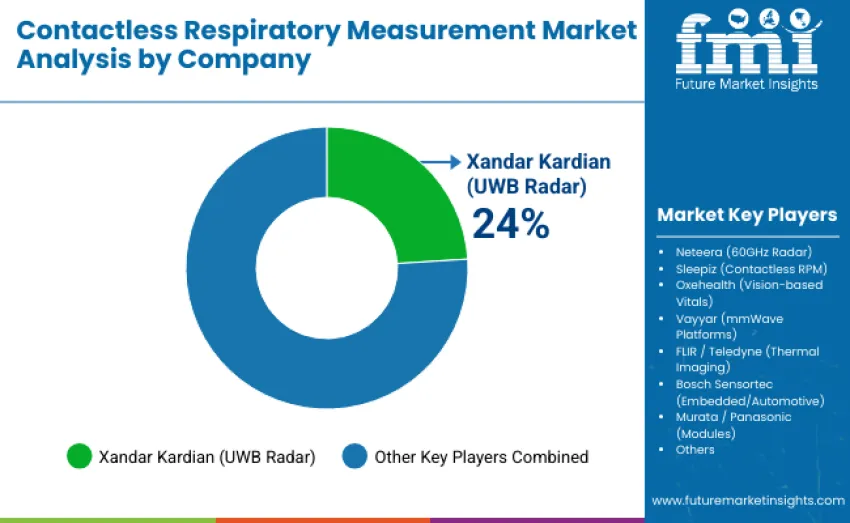
The global contactless respiratory measurement market is moderately concentrated, with 10–12 players and the top five companies controlling 55–60% of global revenue through advanced sensing platforms and strong healthcare integration capabilities. XandarKardian (UWB Radar) now leads with a significantly larger 24% share, supported by its proprietary ultra-wideband radar technology, validated clinical accuracy, and broad deployment across hospitals, long-term care centers, and home-based monitoring programs.
Alongside Xandar Kardian, key leaders such as Neteera, Sleepiz, Oxehealth, and Vayyar maintain competitive strength through extensive intellectual property portfolios, clinically validated performance, and partnerships with health systems and telehealth networks. These companies invest heavily in mmWave radar, advanced optics, computer vision analytics, and automated signal-processing algorithms to improve precision and workflow integration.
Challenger companies including FLIR/Teledyne, Bosch Sensortec, Murata/Panasonic, and Nanotronics compete by offering embedded sensing modules, thermal imaging capabilities, and specialized monitoring solutions tailored to niche applications. Emerging manufacturers in Asia-Pacific and Europe intensify competition through fast development cycles and cost-efficient deployment strategies.
Overall, market dynamics favor companies able to combine high-accuracy sensing, robust AI-driven analytics, EHR and telehealth interoperability, and strong clinical validation supporting continuous respiratory monitoring in diverse care environments.
Key Players in the Contactless Respiratory Measurement Market
- XandarKardian (UWB Radar)
- Neteera (60GHz Radar)
- Sleepiz (Contactless RPM)
- Oxehealth (Vision-based Vitals)
- Vayyar (mmWave Platforms)
- FLIR / Teledyne (Thermal Imaging)
- Bosch Sensortec (Embedded/Automotive)
- Murata / Panasonic (Modules)
- Nanotronics / Emerging Vision AI
- Others
Scope of the Report
| Item | Value |
|---|---|
| Quantitative Units | USD 1,695.3 million |
| Technology | Radar & Microwave Sensors, Camera & Computer Vision, Thermal Imaging Sensors, Acoustic/Automated Sound Analysis |
| Application | Clinical & Hospital Monitoring, Homecare & Remote Patient Monitoring, Automotive & Driver Safety, Research, Defense & Wellness |
| Regions Covered | Asia Pacific, Europe, North America, Latin America, Middle East & Africa |
| Country Covered | USA, Brazil, China, India, Europe, Germany, France, UK |
| Key Companies Profiled | Xandar Kardian (UWB Radar), Neteera (60 GHz Radar), Sleepiz (Contactless RPM), Oxehealth (Vision-based Vitals), Vayyar ( mmWave Platforms), FLIR / Teledyne (Thermal Imaging), Bosch Sensortec (Embedded/Automotive Sensors), Murata / Panasonic (Sensing Modules), Nanotronics (Vision AI), and others |
| Additional Attributes | Dollar sales vary by technology and application, shaped by adoption across Asia Pacific, Europe, and North America. Competition centers on global and regional providers, performance specifications, HIS and telehealth integration, AI-driven signal processing, and advanced radar, optical, infrared, and mmWave systems offering higher accuracy and real-time respiratory monitoring |
Contactless Respiratory Measurement Market by Segments
By Technology:
- Radar & Microwave Sensors
- Camera & Computer Vision
- Thermal Imaging Sensors
- Acoustic / AI-Enhanced Sound Analysis
By Application:
- Clinical & Hospital Monitoring
- Homecare & Remote Patient Monitoring
- Automotive & Driver Safety
- Research, Defense & Wellness
By Region:
- Asia Pacific
- China
- India
- Japan
- South Korea
- Vietnam
- Australia & New Zealand
- ASEAN
- Rest of Asia Pacific
- Europe
- Germany
- United Kingdom
- France
- Italy
- Spain
- Netherlands
- Nordic
- BENELUX
- Rest of Europe
- North America
- United States
- Canada
- Mexico
- Latin America
- Brazil
- Argentina
- Rest of Latin America
- Middle East & Africa
- Kingdom of Saudi Arabia
- Other GCC Countries
- Turkey
- South Africa
- Other African Union
- Rest of Middle East & Africa
Frequently Asked Questions
How big is the contactless respiratory measurement market in 2025?
The global contactless respiratory measurement market is estimated to be valued at USD 1,695.3 million in 2025.
What will be the size of the contactless respiratory measurement market in 2035?
The contactless respiratory measurement market is projected to reach USD 2,907.6 million by 2035.
How much will be the contactless respiratory measurement market growth between 2025 and 2035?
The contactless respiratory measurement market is expected to grow at a 5.5% CAGR between 2025 and 2035.
What are the key technology types in the contactless respiratory measurement market?
The key technology types include radar & microwave sensors, camera & computer vision, thermal imaging sensors, and acoustic/automated sound analysis.
Which application segment will contribute significant share in the contactless respiratory measurement market in 2025?
The homecare and remote patient monitoring segment is expected to lead with a 37.4% share in 2025.
Preview the report firsthand - request a free sample
Get SampleGet the brochure for pricing and purchase details.
Get PDFTable of Content
- Executive Summary
- Regional Level Market Outlook
- Demand-side Trends
- Supply-side Trends
- Technology Roadmap Analysis
- Analysis and Recommendations
- Market Overview
- Market Coverage / Taxonomy
- Market Definition / Scope / Limitations
- Market Background
- Market Dynamics
- Drivers
- Restraints
- Opportunity
- Trends
- Scenario Forecast
- Demand in Optimistic Scenario
- Demand in Likely Scenario
- Demand in Conservative Scenario
- Opportunity Assessment
- Market Trade Assessment
- Value Chain Analysis
- Participants and their Roles
- Raw Material Suppliers
- Manufacturers
- Mid-Level Participants
- Wholesalers and Distributors
- Profit Margin Analysis
- Operating Margins By Region
- Notes on Value Added at Each Node in the Value Chain
- Participants and their Roles
- Strategic Divestments/ Investments
- Products Market Assessment
- PESTLE and Porter’s Analysis
- Regulatory Landscape
- By Key Regions
- By Key Countries
- Regional Parent Market Outlook
- Product Launches & Development
- Technological Innovation
- Market Dynamics
- Regional Level Market Analysis 2020 to 2024 and Forecast, 2025 to 2035
- Historical Market Size USD Million Analysis, 2020 to 2024
- Current and Future Market Size USD Million Projections, 2025 to 2035
- Y-o-Y Growth Trend Analysis
- Absolute $ Opportunity Analysis
- Regional Level Market Analysis 2020 to 2024 and Forecast 2025 to 2035, By Technology
- Introduction / Key Findings
- Historical Market Size USD Million Analysis By Technology, 2020 to 2024
- Current and Future Market Size USD Million Analysis and Forecast By Technology, 2025 to 2035
- Radar & Microwave Sensors (mmWave, UWB)
- Camera & Computer Vision (RGB/IR/Depth)
- Thermal Imaging Sensors
- Acoustic / AI-Enhanced Sound Analysis
- Y-o-Y Growth Trend Analysis By Technology, 2020 to 2024
- Absolute $ Opportunity Analysis By Technology, 2025 to 2035
- Regional Level Market Analysis 2020 to 2024 and Forecast 2025 to 2035, By Application
- Introduction / Key Findings
- Historical Market Size USD Million Analysis By Application, 2020 to 2024
- Current and Future Market Size USD Million Analysis and Forecast By Application, 2025 to 2035
- Clinical & Hospital Monitoring
- Homecare & Remote Patient Monitoring
- Automotive & Driver Safety
- Research, Defense & Wellness
- Y-o-Y Growth Trend Analysis By Application, 2020 to 2024
- Absolute $ Opportunity Analysis By Application, 2025 to 2035
- Regional Level Market Analysis 2020 to 2024 and Forecast 2025 to 2035, By End User
- Introduction / Key Findings
- Historical Market Size USD Million Analysis By End User, 2020 to 2024
- Current and Future Market Size USD Million Analysis and Forecast By End User, 2025 to 2035
- Hospitals & Diagnostic Centers
- Homecare & Telehealth Providers
- Automotive OEMs & Tier-1s
- Academic & Research Institutes
- Y-o-Y Growth Trend Analysis By End User, 2020 to 2024
- Absolute $ Opportunity Analysis By End User, 2025 to 2035
- Regional Level Market Analysis 2020 to 2024 and Forecast 2025 to 2035, By Region
- Introduction
- Historical Market Size USD Million Analysis By Region, 2020 to 2024
- Current Market Size USD Million Analysis and Forecast By Region, 2025 to 2035
- North America
- Latin America
- East Asia
- South Asia
- Western Europe
- Eastern Europe
- Middle East & Africa
- Market Attractiveness Analysis By Region
- North America Market Analysis 2020 to 2024 and Forecast 2025 to 2035, By Country
- Historical Market Size USD Million Trend Analysis By Market Taxonomy, 2020 to 2024
- Market Size USD Million Forecast By Market Taxonomy, 2025 to 2035
- By Country
- USA
- Canada
- Mexico
- By Technology
- By Application
- By End User
- By Country
- Market Attractiveness Analysis
- By Country
- By Technology
- By Application
- By End User
- Key Takeaways
- Latin America Market Analysis 2020 to 2024 and Forecast 2025 to 2035, By Country
- Historical Market Size USD Million Trend Analysis By Market Taxonomy, 2020 to 2024
- Market Size USD Million Forecast By Market Taxonomy, 2025 to 2035
- By Country
- Brazil
- Argentina
- Rest of Latin America
- By Technology
- By Application
- By End User
- By Country
- Market Attractiveness Analysis
- By Country
- By Technology
- By Application
- By End User
- Key Takeaways
- East Asia Market Analysis 2020 to 2024 and Forecast 2025 to 2035, By Country
- Historical Market Size USD Million Trend Analysis By Market Taxonomy, 2020 to 2024
- Market Size USD Million Forecast By Market Taxonomy, 2025 to 2035
- By Country
- China
- Japan
- South Korea
- By Technology
- By Application
- By End User
- By Country
- Market Attractiveness Analysis
- By Country
- By Technology
- By Application
- By End User
- Key Takeaways
- South Asia Market Analysis 2020 to 2024 and Forecast 2025 to 2035, By Country
- Historical Market Size USD Million Trend Analysis By Market Taxonomy, 2020 to 2024
- Market Size USD Million Forecast By Market Taxonomy, 2025 to 2035
- By Country
- India
- ASEAN Countries
- Australia & New Zealand
- Rest of South Asia
- By Technology
- By Application
- By End User
- By Country
- Market Attractiveness Analysis
- By Country
- By Technology
- By Application
- By End User
- Key Takeaways
- Western Europe Market Analysis 2020 to 2024 and Forecast 2025 to 2035, By Country
- Historical Market Size USD Million Trend Analysis By Market Taxonomy, 2020 to 2024
- Market Size USD Million Forecast By Market Taxonomy, 2025 to 2035
- By Country
- Germany
- UK
- France
- Italy
- Spain
- BENELUX
- Nordic Countries
- Rest of Western Europe
- By Technology
- By Application
- By End User
- By Country
- Market Attractiveness Analysis
- By Country
- By Technology
- By Application
- By End User
- Key Takeaways
- Eastern Europe Market Analysis 2020 to 2024 and Forecast 2025 to 2035, By Country
- Historical Market Size USD Million Trend Analysis By Market Taxonomy, 2020 to 2024
- Market Size USD Million Forecast By Market Taxonomy, 2025 to 2035
- By Country
- Russia
- Hungary
- Poland
- Rest of Eastern Europe
- By Technology
- By Application
- By End User
- By Country
- Market Attractiveness Analysis
- By Country
- By Technology
- By Application
- By End User
- Key Takeaways
- Middle East & Africa Market Analysis 2020 to 2024 and Forecast 2025 to 2035, By Country
- Historical Market Size USD Million Trend Analysis By Market Taxonomy, 2020 to 2024
- Market Size USD Million Forecast By Market Taxonomy, 2025 to 2035
- By Country
- Saudi Arabia
- Other GCC Countries
- Türkiye
- South Africa
- Rest of MEA
- By Technology
- By Application
- By End User
- By Country
- Market Attractiveness Analysis
- By Country
- By Technology
- By Application
- By End User
- Key Takeaways
- Market Structure Analysis
- Competition Dashboard
- Competition Benchmarking
- Market Share Analysis of Top Players
- By Regional
- By Technology
- By Application
- By End User
- Competition Analysis
- Competition Deep Dive
- Xandar Kardian (UWB Radar)
- Overview
- Product Portfolio
- Key Financials
- Key Developments
- Global/Regional Footprint
- Strategy Overview
- Marketing Strategy
- SWOT
- Analyst Comment
- Neteera (60GHz Radar)
- Overview
- Product Portfolio
- Key Financials
- Key Developments
- Global/Regional Footprint
- Strategy Overview
- Marketing Strategy
- SWOT
- Analyst Comment
- Sleepiz (Contactless RPM)
- Overview
- Product Portfolio
- Key Financials
- Key Developments
- Global/Regional Footprint
- Strategy Overview
- Marketing Strategy
- SWOT
- Analyst Comment
- Oxehealth (Vision-based Vitals)
- Overview
- Product Portfolio
- Key Financials
- Key Developments
- Global/Regional Footprint
- Strategy Overview
- Marketing Strategy
- SWOT
- Analyst Comment
- Vayyar (mmWave Platforms)
- Overview
- Product Portfolio
- Key Financials
- Key Developments
- Global/Regional Footprint
- Strategy Overview
- Marketing Strategy
- SWOT
- Analyst Comment
- FLIR / Teledyne (Thermal Imaging)
- Overview
- Product Portfolio
- Key Financials
- Key Developments
- Global/Regional Footprint
- Strategy Overview
- Marketing Strategy
- SWOT
- Analyst Comment
- Bosch Sensortec (Embedded/Automotive)
- Overview
- Product Portfolio
- Key Financials
- Key Developments
- Global/Regional Footprint
- Strategy Overview
- Marketing Strategy
- SWOT
- Analyst Comment
- Murata / Panasonic (Modules)
- Overview
- Product Portfolio
- Key Financials
- Key Developments
- Global/Regional Footprint
- Strategy Overview
- Marketing Strategy
- SWOT
- Analyst Comment
- Nanotronics / Emerging Vision AI
- Overview
- Product Portfolio
- Key Financials
- Key Developments
- Global/Regional Footprint
- Strategy Overview
- Marketing Strategy
- SWOT
- Analyst Comment
- Xandar Kardian (UWB Radar)
- Competition Deep Dive
- Assumptions & Acronyms Used
- Research Methodology


