

- Market Size (2026)
- USD 0.9 Bn
- Forecast (2036)
- USD 1.3 Bn
- CAGR (2026 to 2036)
- 4.4%
Corrosion Inhibiting Compounds for Aircraft Cavities Market Size, Market Forecast and Outlook By FMI
Summary of the Corrosion Inhibiting Compounds for Aircraft Cavities Market
- Demand and Growth Drivers
- Aircraft delivery delays are expected to lift demand for cavity compounds as operators keep older airframes in service during longer replacement cycles.
- Heavy check activity creates product use because hidden fuselage and wing spaces are accessible only during selected maintenance events.
- Non-chrome chemistry is drawing attention as MRO teams reduce hazardous material handling during aircraft protection work.
- Product and Segment View
- Water displacing compounds are expected to lead compound type demand because they reach seams and lap joints after cleaning.
- Wax film products are likely to see higher use in deeper structural work since they provide longer barrier protection after application.
- Commercial aircraft create the clearest demand base as high utilization keeps scheduled inspection and cavity treatment cycles active.
- Geography and Competitive Outlook
- India is expected to lead country-level expansion as airline fleet expansion raises scheduled MRO activity and approved consumable use. China is likely to sustain faster demand due to fleet scale and growing domestic maintenance capacity.
- Suppliers with aircraft approvals, application guidance, and reliable MRO supply access are better placed to win repeat orders.
- Analyst Opinion
- Nikhil Kaitwade, Principal Consultant at FMI says, “I view this market as a maintenance discipline rather than a simple chemical supply business. Airlines and defense operators choose cavity compounds after assessing approvals, film behavior and technician familiarity. Expansion comes from older aircraft staying in service and coastal exposure increasing corrosion risk. Suppliers win when they support approved materials across mixed fleets and help MRO teams reduce rework. Cost pressure is real because cavity treatment products are consumables. Repair findings during inspection cost far more than preventive treatment.”
- Corrosion Inhibiting Compounds for Aircraft Cavities Market Value Analysis
- Aircraft cavity protection creates value by reducing corrosion findings before hidden airframe spaces need structural repair.
- Water displacing compounds help technicians protect seams and lap joints that are hard to reach after panels are closed.
- Commercial aircraft create repeat product use as heavy checks expose fuselage cavities and wing spaces for treatment.
- MRO supply stays the main delivery route because approved compounds are used during scheduled inspection work.
- Supplier advantage depends on aviation approvals, application guidance, and reliable pack availability for time-sensitive maintenance jobs.
Key Takeaways
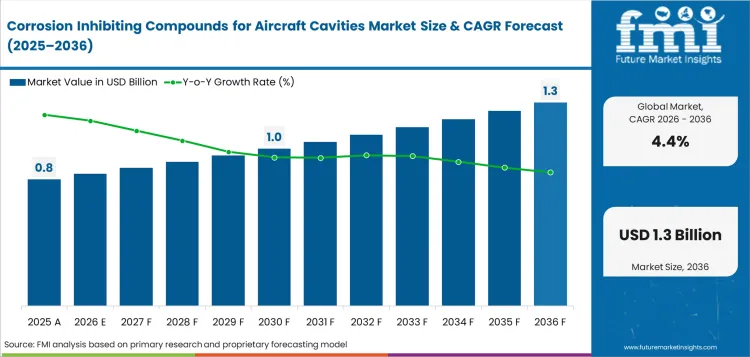
- The corrosion inhibiting compounds for aircraft cavities market held a valuation of USD 0.8 billion in 2025.
- Operators protecting older airframes during heavy checks are projected to push market value to USD 1.3 billion by 2036.
- During the assessment period, corrosion control in fuselage and wing cavities is forecast to support 4.4% CAGR.
- Between 2026 and 2036, the market is estimated to create an incremental opportunity of USD 0.4 billion.
- Water displacing compounds are projected to hold 38.0% of compound type demand in 2026 as they reach lap joints and hidden cavity surfaces.
- High fleet utilization is expected to reinforce commercial aircraft demand, with the segment representing 62.0% of aircraft type use in 2026.
- Recurring inspections are anticipated to keep MRO supply ahead of other sales channels at 47.0% share in 2026.
- Country-level expansion is led by India (6.1% CAGR) and China (5.7% CAGR) as fleet expansion and domestic MRO activity increase cavity protection work.
Corrosion Inhibiting Compounds for Aircraft Cavities Market Definition
The corrosion inhibiting compounds for aircraft cavities market covers protective compounds applied inside aircraft cavities to reduce moisture-driven corrosion.
Corrosion Inhibiting Compounds for Aircraft Cavities Market Inclusions
Market scope covers aircraft cavity corrosion inhibiting compounds by product, aircraft use, application area, sales channel, and main regional demand centers. Stakeholders include aircraft OEMs, airline MRO providers, defense maintenance units, specialty chemical suppliers, aviation distributors, and approved repair stations.
Corrosion Inhibiting Compounds for Aircraft Cavities Market Exclusions
The scope excludes exterior aircraft coatings, structural adhesives, and fuel tank sealants. Runway chemicals, marine corrosion inhibitors, and general industrial rust preventive products are outside the scope.
Corrosion Inhibiting Compounds for Aircraft Cavities Market Research Methodology
- Primary Research: FMI reviewed input from aircraft MRO engineers and airline maintenance planners. Defense maintenance teams and specialty chemical distributors were assessed for channel validation.
- Desk Research: The study used aviation safety references and company product portfolios. Aircraft delivery data and public airworthiness information supported demand checks.
- Market Sizing and Forecasting: The model combined aircraft fleet exposure with heavy check intervals and average cavity treatment volume. Pricing was adjusted for aerosol packs and bulk drums used in approved maintenance work.
- Data Validation: Forecast assumptions were cross-checked against airline maintenance pressure and supplier product availability. Supplier positioning was reviewed through specification coverage and aviation channel access.
Why is the Corrosion Inhibiting Compounds for Aircraft Cavities Market Growing?
- Delayed aircraft deliveries keep older airframes flying longer, which increases cavity treatment during heavy checks.
- Coastal operations increase moisture and salt exposure, so MRO teams apply protective compounds in fuselage cavities.
- Defense fleets need corrosion control to protect readiness across aircraft stored or operated in humid conditions.
- Non-chrome product demand is rising as operators reduce hazardous materials in maintenance workflows.
Aircraft operators are using more preventive treatments as delivery delays keep airframes in service longer than planned. The International Air Transport Association reported in October 2025 that supply chain pressure added USD 3.1 billion in higher airline maintenance costs in 2025. The figure supports cavity compound demand because older aircraft need more frequent inspection and protection work. Cavity compounds help maintenance teams protect hidden airframe spaces that are hard to inspect after reassembly. Product use increases when airlines extend aircraft service life and try to reduce structural repair risk during heavy checks.
General aviation and business aircraft add a second demand base because private operators often store aircraft across mixed climate conditions. Higher-value aircraft support approved cavity products during annual inspections and repaint cycles. Smaller treatment volumes can carry higher unit value when the compound is specified for aerospace use. MRO teams prefer products with clear approvals because cavity areas are difficult to revisit after panels are closed.
Market Segmentation Analysis
- By 2026, Water Displacing compounds are forecast at 38.0% of Compound Type demand as they reach seams and lap joints after cleaning.
- Higher heavy check volume is anticipated to place Commercial Aircraft ahead in Aircraft Type with 62.0% share in 2026.
- A 36.0% share places Fuselage Cavities first in Cavity Area for 2026 since lower airframe zones collect moisture.
- Aerosol Spray leads Application Method during the 2026 assessment at 44.0% because technicians need controlled application in tight spaces.
- Repeat inspection cycles are expected to keep MRO Supply ahead of other Sales Channels, with the channel holding 47.0% in 2026.
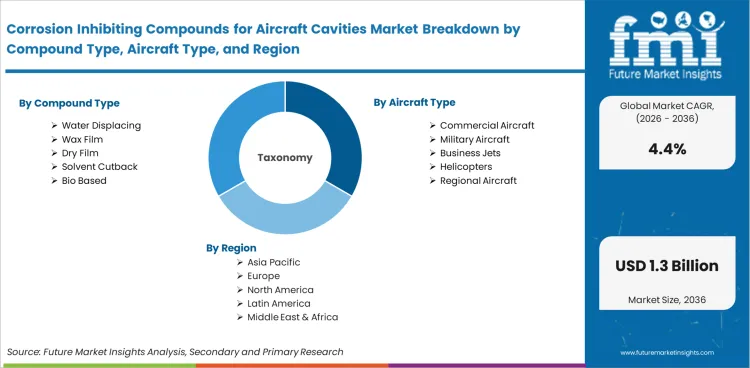
The market is segmented by compound type, aircraft type, cavity area, application method, and sales channel. Compound type includes Water Displacing, Wax Film, Dry Film, Solvent Cutback, and Bio Based. Aircraft type includes Commercial Aircraft, Military Aircraft, Business Jets, Helicopters, and Regional Aircraft. Cavity area includes Fuselage Cavities, Wing Cavities, Tail Sections, Avionics Bays, and Landing Gear. Application method includes Aerosol Spray, Bulk Spray, Brush Application, Fogging Systems, and Cartridge Packs. Sales channel includes OEM Supply, MRO Supply, Distributor Supply, Defense Contracts, and Online Supply.
Insights into the Water Displacing Compound Type Segment
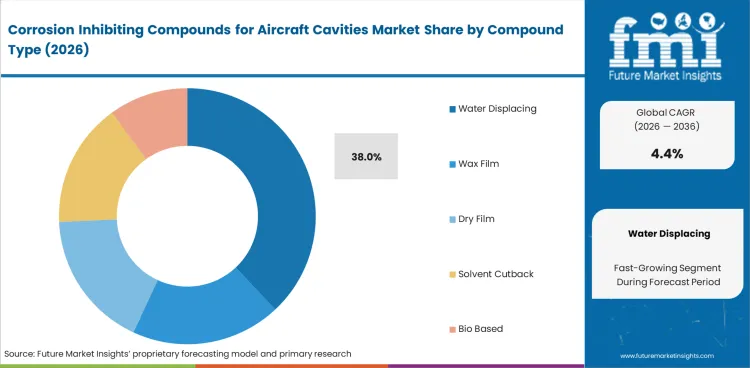
- By 2036, Water Displacing compounds are forecast at 38.0% of Compound Type demand as low-viscosity formulas reach seams and lap joints after cleaning. MRO teams use these compounds when aircraft cavities need fast moisture displacement before panels are closed.
- Wax Film products serve deeper structural checks because longer barrier life suits aircraft that return to heavy maintenance less often.
Insights into the Commercial Aircraft Segment
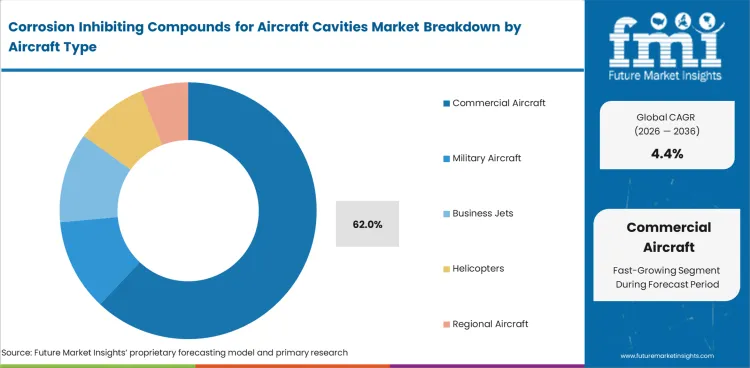
- Commercial Aircraft leads Aircraft Type during the 2026 assessment with 62.0% share. The segment holds the broadest base because airlines run frequent inspection cycles and treat cavity zones during scheduled checks.
- Military Aircraft creates steadier demand through readiness programs and Business Jets support higher-value use during annual inspections.
Insights into the Fuselage Cavities Segment
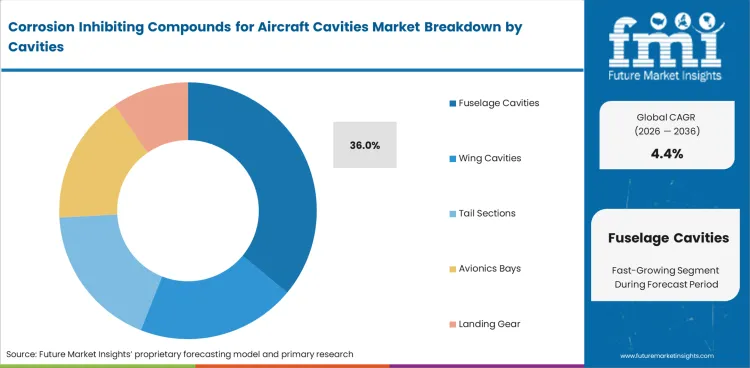
- A 36.0% share places Fuselage Cavities ahead in Cavity Area for 2026. Lower fuselage spaces face repeated moisture exposure, so technicians apply cavity compounds after inspection access is opened.
- Wing Cavities create the next demand base because drainage paths and lap joints need controlled application during heavy checks.
Insights into the Aerosol Spray Segment
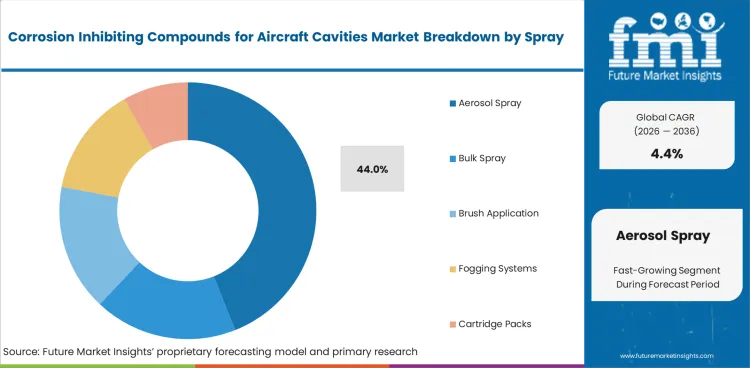
- Aerosol Spray is expected to form the broadest application method base at 44.0% during the forecast period. Technicians prefer aerosols when access is limited and product control is needed inside tight aircraft spaces.
- Bulk Spray gains use in hangar work because it lowers packaging cost during larger cavity treatment jobs.
Insights into the MRO Supply Segment
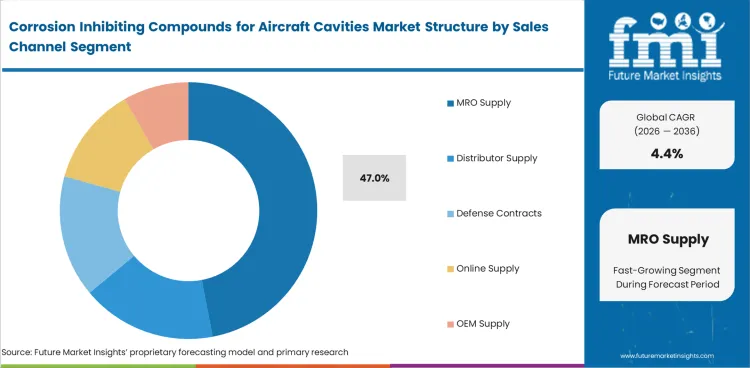
- Within Sales Channel, MRO Supply is projected at 47.0% by 2026. Approved maintenance work creates repeat compound use because product selection must align with aircraft manuals and inspection routines.
- OEM Supply supports new aircraft protection and Distributor Supply stays useful when repair stations need small pack formats quickly.
Corrosion Inhibiting Compounds for Aircraft Cavities Market Drivers, Restraints, and Opportunities
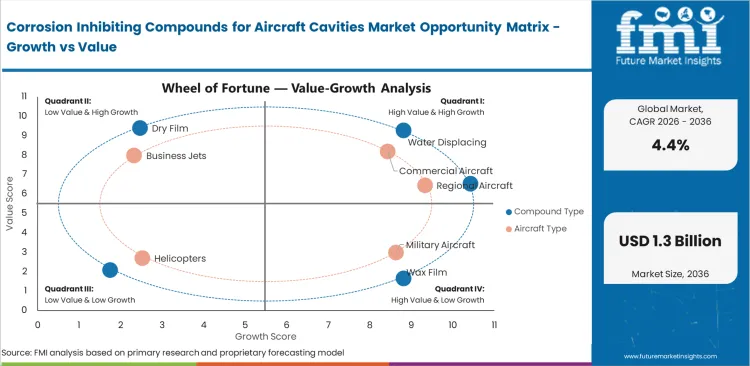
- Heavy check exposure increases demand because cavity areas are accessible only during selected maintenance events.
- Non-chrome chemistry creates opportunity as aerospace suppliers reduce hazardous additives in corrosion protection systems.
- Approval complexity limits supplier switching because airlines cannot change cavity compounds without maintenance manual acceptance.
- Distributor stock gaps can delay use when MRO teams need aircraft-specific approvals and small-pack formats.
Heavy Check Cavity Access
Aircraft cavity treatment demand rises when heavy checks expose hidden airframe spaces. Airbus reported in January 2026 that it delivered 793 commercial aircraft to 91 customers in 2025 and ended the year with a backlog of 8,754 aircraft. The backlog supports preventive cavity treatment because operators need existing aircraft to stay serviceable until replacement capacity arrives. Technicians apply cavity compounds during these checks before panels are closed again. Suppliers with fast product release and clear application guidance can protect repeat MRO orders.
Non-Chrome Chemistry Shift
Maintenance teams are reducing older chemistries that raise worker safety and disposal concerns. PPG Aerospace lists corrosion inhibitive sealants across Class A, Class B and Class C products, with safer alternatives to traditional additives. This also supports lower-hazard aircraft protection material selection. Cavity compound suppliers benefit when their products meet aerospace approval needs and reduce handling burden during maintenance. Chemistry change stays gradual because airlines must verify compatibility before specification updates.
Approval and Stocking Barrier
Aircraft cavity compounds face a tighter approval path than general corrosion products. Zip-Chem Products lists Cor-Ban® corrosion inhibiting compounds formulated for demanding aviation maintenance specifications. The official product range covers large structural components and avionics areas, which makes approval documentation important for MRO teams. Limited stock can slow maintenance work when an aircraft enters inspection. Suppliers with local inventory and technical documents reduce that risk for airlines.
Analysis of Corrosion Inhibiting Compounds for Aircraft Cavities Market by Key Countries
.webp "Top Country Growth Comparison Corrosion Inhibiting Compounds For Aircraft Cavities Market Cagr (2026 2036)")
| Country | CAGR |
|---|---|
| India | 6.1% |
| China | 5.7% |
| United Arab Emirates | 5.4% |
| United States | 4.7% |
| France | 4.4% |
| Germany | 4.2% |
| Japan | 3.8% |
Source: FMI analysis based on primary research and proprietary forecasting model.
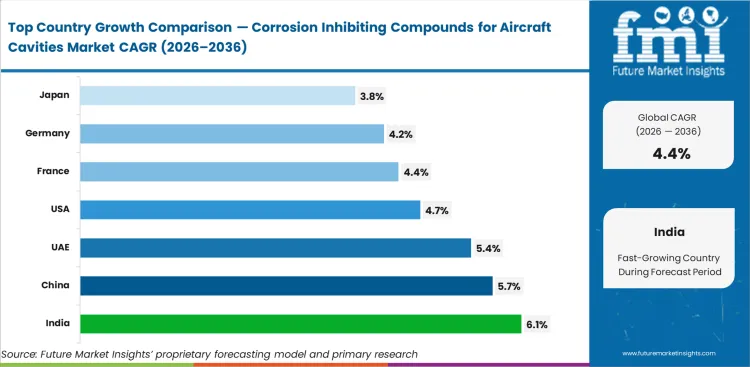
Corrosion Inhibiting Compounds for Aircraft Cavities Market CAGR Analysis by Country
- India’s airline fleet expansion and MRO hub growth place the country at 6.1% CAGR for 2026 to 2036.
- At 5.7% CAGR, China tracks above the global average in the forecast timeframe as local fleet size increases scheduled cavity protection work.
- United Arab Emirates demand reaches 5.4% CAGR by 2036, with long-haul aircraft cycles raising approved consumable use.
- The United States records 4.7% CAGR in the assessment period because airline MRO and general aviation fleets create repeat inspection demand.
- France’s 4.4% CAGR reflects Airbus-linked aerospace activity and established maintenance networks across the forecast period.
- Germany is forecast at 4.2% CAGR through 2036 as engineering-led maintenance practices keep corrosion control work disciplined.
- Japan records 3.8% CAGR for 2026 to 2036 as slower fleet growth keeps product use steady across careful inspection programs.
Demand Outlook for Corrosion Inhibiting Compounds for Aircraft Cavities Market in India
India’s demand base is rising as airline fleets expand and safety reviews increase maintenance discipline. The country is forecast to record 6.1% CAGR for 2026 to 2036 as scheduled checks increase across main aviation hubs. DGCA reported in June 2025 that enhanced safety inspection covered Air India’s 33 Boeing 787-8/9 aircraft after a mandated review. The inspection figure shows how widebody checks can pull approved consumables into scheduled and unscheduled maintenance work. Corrosion inhibiting compounds gain use when panels and cavity zones are opened for inspection. Suppliers with India-ready documentation and local stock can serve airlines faster as MRO work expands.
- Delhi and Mumbai airline bases support repeat cavity treatment as widebody checks move through large maintenance networks.
- Hyderabad and Bengaluru aerospace clusters improve access to approved consumables for private MRO providers.
- DGCA surveillance programs increase the value of traceable product paperwork during aircraft maintenance audits.
Sales Analysis of Corrosion Inhibiting Compounds for Aircraft Cavities Market in China
China’s market is shaped by large airline activity and domestic maintenance capability. CAAC’s March 2026 civil aviation KPI release showed daily aircraft use at 9.1 hours per day. Higher aircraft use increases inspection frequency, which gives MRO teams more occasions to apply cavity compounds. A 5.7% CAGR outlook in the forecast timeframe reflects deeper scheduled maintenance activity across local airline fleets. Local maintenance facilities gain more influence as operators keep more checks within China. Approved corrosion products benefit from faster turnaround needs and closer access to technical documentation.
- Beijing Capital and Shanghai Pudong airline activity supports recurring cavity treatment across large narrowbody fleets.
- Guangzhou Baiyun maintenance activity creates demand for bulk spray formats during scheduled structural checks.
- CAAC airworthiness oversight keeps approved product documentation important for aviation chemical suppliers.
Demand Analysis of Corrosion Inhibiting Compounds for Aircraft Cavities Market in the United Arab Emirates
United Arab Emirates demand is shaped by long-haul fleets and harsh operating exposure. Demand is forecast to move at 5.4% CAGR by 2036 as widebody aircraft cycles raise approved consumable use. Desert dust and coastal humidity increase the need for protection inside hidden airframe spaces. Widebody aircraft create higher compound value per aircraft because cavity treatment often takes place during deeper checks. Suppliers with Dubai and Abu Dhabi access can reduce lead times for approved MRO consumables.
- Dubai International Airport operations support corrosion compound use during widebody heavy checks and line maintenance.
- Abu Dhabi’s aviation services base creates openings for commercial and defense fleet maintenance supply.
- GCAA oversight raises the need for traceable labels and product documents during approved maintenance work.
Opportunity Analysis of Corrosion Inhibiting Compounds for Aircraft Cavities Market in the United States
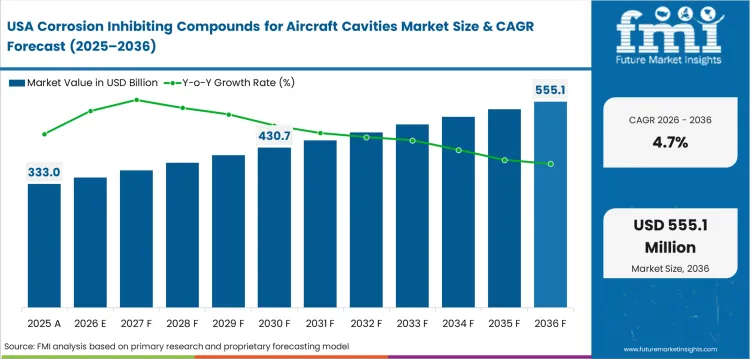
The United States has a wide demand base across airline maintenance and general aviation. FAA forecasts show the active general aviation fleet growing at 0.5% annually between 2023 and 2045. Even modest fleet growth supports recurring cavity protection because aircraft inspections repeat across long ownership cycles. Across the assessment period, the country records 4.7% CAGR as repair stations and airline MRO networks maintain steady use of approved packs. Business aircraft and helicopters add higher-value use cases because corrosion findings can reduce asset value quickly. Suppliers benefit when they serve airline MRO and general aviation repair stations.
- Florida coastal operations raise corrosion prevention needs for aircraft exposed to salt air and high humidity.
- Arizona and Texas storage locations support protective treatment for aircraft parked between operating cycles.
- FAA-certified repair stations create channel demand for approved aerosols and bulk cavity compounds.
Future Outlook for Corrosion Inhibiting Compounds for Aircraft Cavities Market in France
France benefits from aircraft production depth and a mature aerospace maintenance base. France is assessed at 4.4% CAGR for 2026 to 2036 as OEM workflows and airline maintenance programs sustain approved chemical use. Corrosion inhibiting compounds gain value when structural protection is specified before delivery or during later heavy checks. French suppliers and distributors can benefit from steady activity around production and service operations.
- Toulouse supports aerospace chemical demand through aircraft production and supplier activity.
- Paris-area MRO operations support cavity treatment for narrowbody and widebody airline fleets.
- Bordeaux aerospace activity adds a service base for aviation materials used across maintenance programs.
Demand Outlook for Corrosion Inhibiting Compounds for Aircraft Cavities Market in Germany
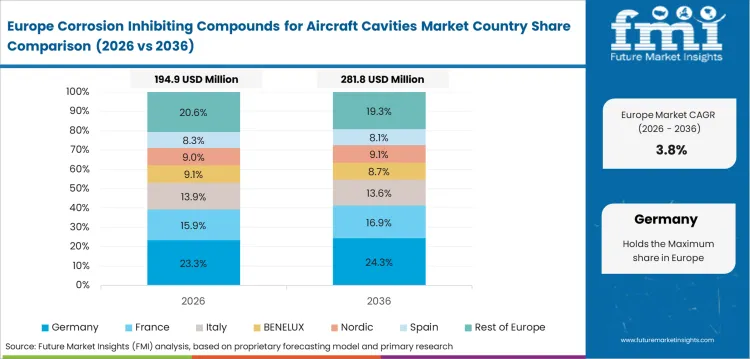
Germany’s market develops through disciplined maintenance practice and aerospace supplier capability. A 4.2% CAGR outlook through 2036 reflects steady corrosion control demand rather than fast fleet expansion. German demand is shaped by documentation standards and repeatable product performance. Suppliers that combine approvals with reliable availability can defend positions in OEM-linked and MRO work.
- Hamburg aerospace activity supports corrosion protection demand tied to aircraft production and maintenance work.
- Frankfurt airline maintenance flows create repeat use for approved cavity compounds during scheduled checks.
- Lufthansa Technik’s German maintenance network reinforces demand for documented aviation-grade consumables.
In-depth Analysis of Corrosion Inhibiting Compounds for Aircraft Cavities Market in Japan
Japan records slower growth than India and China, with a 3.8% CAGR for 2026 to 2036, reflecting a disciplined, inspection‑led maintenance approach and steady product use across airline and government fleets rather than rapid fleet expansion. MLIT’s CARATS 2040 document notes that Japan is restructuring domestic controlled airspace and introducing new air navigation methods. Safer aircraft operations support disciplined maintenance planning across airline fleets. Coastal exposure around large airports creates practical need for corrosion control inside aircraft cavities. Suppliers can gain through approved products that reduce inspection rework and suit careful maintenance routines.
- Tokyo Haneda traffic intensity supports scheduled maintenance demand for corrosion protection products.
- Okinawa’s humid marine exposure increases cavity treatment needs for military and civil aircraft.
- MLIT Civil Aviation Bureau oversight keeps approved application methods central to supplier qualification.
Competitive Landscape and Strategic Positioning
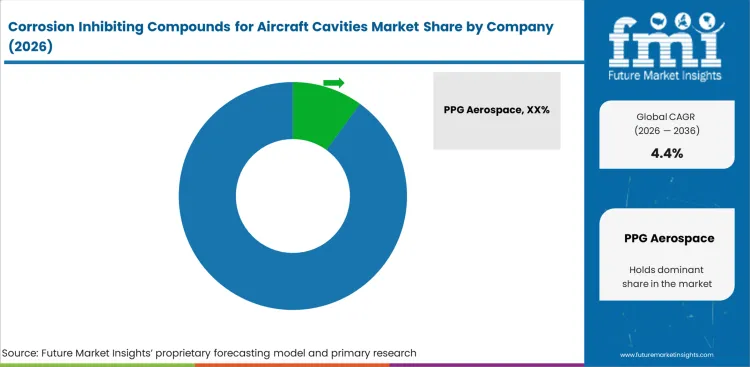
- The market is moderately concentrated, with global coating suppliers competing against aviation-focused specialty chemical firms.
- PPG and Henkel hold scale advantages through aerospace materials portfolios and specification familiarity.
- Zip-Chem and SOCOMORE compete through aviation-specific product lines and close MRO channel reach.
- Entry barriers come from OEM approvals, product testing, and maintenance manual acceptance.
Competition centers on approvals and shop-floor use rather than chemical claims. PPG’s May 2025 plan to invest USD 0.38 billion in a Shelby, North Carolina aerospace coatings and sealants facility places capacity closer to aerospace customers. The site is expected to include manufacturing and warehousing units. Aviation consumables need steady supply because maintenance slots are difficult to move. Cavity compound suppliers gain an advantage when they meet specification needs and reduce delivery risk.
Specialist suppliers compete through application knowledge and product formats that suit maintenance work. Zip-Chem positions Cor-Ban corrosion inhibiting products for aviation maintenance specifications and use across structural components. The product range includes support for avionics and cable areas. Focused application support helps smaller suppliers win MRO accounts that need quick answers on use and removal.
Distribution reach is becoming more important as aircraft maintenance expands across Asia. Chemetall and Azelis expanded their strategic distribution agreement for Southeast Asia in September 2025, covering surface treatment and aerospace-related applications. Wider distribution improves product availability for MRO operators that cannot wait for long lead times. Regional partnerships can protect repeat orders when aircraft checks follow tight slot schedules.
Key Companies in the Corrosion Inhibiting Compounds for Aircraft Cavities Market
- Global Leaders: PPG Aerospace and Henkel hold broad aerospace materials positions. Chemetall and AkzoNobel Aerospace Coatings support the same category through approved aerospace product lines.
- Aviation Specialists: Zip-Chem Products and SOCOMORE compete through corrosion prevention products made for aircraft maintenance workflows. AV-DEC adds value through moisture barrier products for aircraft structures.
- Channel and Niche Suppliers: Corrosion Technologies and LPS Laboratories serve smaller fleet operators and general aviation channels. Dinitrol aviation distributors support regional corrosion protection demand.
Competitive Benchmarking: Corrosion Inhibiting Compounds for Aircraft Cavities Market
| Company | Aircraft Approval Depth | Cavity Product Breadth | MRO Channel Reach | Geographic Footprint |
|---|---|---|---|---|
| PPG Aerospace | High | High | Strong | Global |
| Henkel | High | Medium | Strong | Global |
| Chemetall | High | Medium | Strong | Global |
| AkzoNobel Aerospace Coatings | High | Medium | Strong | Global |
| Zip-Chem Products | High | High | Strong | North America and Europe |
| SOCOMORE | High | High | Strong | Europe and North America |
| AV-DEC | Medium | High | Moderate | North America |
| Corrosion Technologies | Medium | Medium | Moderate | North America |
| LPS Laboratories | Medium | Medium | Moderate | Global |
| Dinitrol Aviation Distributors | Medium | Medium | Moderate | Europe |
Source: Future Market Insights competitive analysis, 2026.
Key Developments in Corrosion Inhibiting Compounds for Aircraft Cavities Market
- In June 2025, STS Aviation Services secured expanded UK CAA Part 21J Design Organisation Approval.
- In January 2026, Boeing reported 600 commercial aircraft deliveries for 2025. Higher aircraft deliveries support approved consumable use across production and maintenance cycles.
Key Players in the Corrosion Inhibiting Compounds for Aircraft Cavities Market
Global Leaders
- PPG Aerospace
- Henkel
- Chemetall
- AkzoNobel Aerospace Coatings
Aviation Specialists
- Zip-Chem Products
- SOCOMORE
- AV-DEC
Channel and Niche Suppliers
- Corrosion Technologies
- LPS Laboratories
- Dinitrol Aviation Distributors
Report Scope and Coverage
| Details | Parameter |
|---|---|
| Quantitative Units | USD 0.9 billion to USD 1.3 billion, at 4.4% CAGR |
| Market Definition | Protective compounds applied inside aircraft cavities to reduce moisture-driven corrosion across airframe and component spaces. |
| Regions Covered | North America, Latin America, Europe, East Asia, South Asia and Pacific, Middle East and Africa |
| Countries Covered | United States, China, India, United Arab Emirates, France, Germany, Japan, and 30+ countries |
| Key Companies Profiled | PPG Aerospace, Henkel, Chemetall, AkzoNobel Aerospace Coatings, Zip-Chem Products, SOCOMORE, AV-DEC |
| Forecast Period | 2026 to 2036 |
| Approach | Hybrid bottom-up and top-down methodology using aircraft maintenance cycles, cavity treatment volume, and regional MRO activity |
Corrosion Inhibiting Compounds for Aircraft Cavities Market by Segments
Corrosion Inhibiting Compounds for Aircraft Cavities Market Segmented by Compound Type
- Water Displacing
- Wax Film
- Dry Film
- Solvent Cutback
- Bio Based
Corrosion Inhibiting Compounds for Aircraft Cavities Market Segmented by Aircraft Type
- Commercial Aircraft
- Military Aircraft
- Business Jets
- Helicopters
- Regional Aircraft
Corrosion Inhibiting Compounds for Aircraft Cavities Market Segmented by Cavity Area
- Fuselage Cavities
- Wing Cavities
- Tail Sections
- Avionics Bays
- Landing Gear
Corrosion Inhibiting Compounds for Aircraft Cavities Market Segmented by Application Method
- Aerosol Spray
- Bulk Spray
- Brush Application
- Fogging Systems
- Cartridge Packs
Corrosion Inhibiting Compounds for Aircraft Cavities Market Segmented by Sales Channel
- OEM Supply
- MRO Supply
- Distributor Supply
- Defense Contracts
- Online Supply
Corrosion Inhibiting Compounds for Aircraft Cavities Market by Region
- North America
- United States
- Canada
- Mexico
- Latin America
- Brazil
- Chile
- Rest of Latin America
- Western Europe
- Germany
- UK
- Italy
- Spain
- France
- Nordic
- BENELUX
- Rest of Western Europe
- Eastern Europe
- Russia
- Poland
- Hungary
- Balkan & Baltic
- Rest of Eastern Europe
- East Asia
- China
- Japan
- South Korea
- South Asia and Pacific
- India
- ASEAN
- Australia & New Zealand
- Rest of South Asia and Pacific
- Middle East & Africa
- Kingdom of Saudi Arabia
- Other GCC Countries
- Turkiye
- South Africa
- Other African Union
- Rest of Middle East & Africa
Research Sources and Bibliography
- Council for Promotion of the Future Air Traffic System. (2025, June). Collaborative actions for renovation of air traffic systems 2040 (CARATS 2040). Ministry of Land, Infrastructure, Transport and Tourism.
- Federal Aviation Administration. (2025, June). FAA aerospace forecast fiscal years 2025–2045. FAA.
- STS Aviation Group. (2025, June 12). STS Aviation Services secures CAA approval to expand Part 21J design capabilities. STS Aviation Group.
- Airbus. (2026, January 12). Airbus reports 793 commercial aircraft deliveries in 2025. Airbus.
- The Boeing Company. (2026, January 13). Boeing announces fourth quarter deliveries. Boeing.
- PPG. (2025, May 8). PPG to invest $380 million to build new USA manufacturing facility in Shelby, N.C. for aerospace coatings and sealants. PPG Newsroom.
- Zip-Chem Products. (2024). Zip-Chem corrosion inhibitors, lubricants, surface preps, cleaners and specialty products. Zip-Chem Products.
- Chemetall. (2025, September 30). Azelis and Chemetall expand strategic distribution agreement for surface treatment market in Southeast Asia. Chemetall.
- Civil Aviation Administration of China. (2026, April 22). Statistics of key performance indicators for China’s civil aviation industry in March 2026. CAAC.
- Ministry of Civil Aviation. (2025, June 17). DGCA reviews operations of Air India and Air India Express. Press Information Bureau.
This Report Answers
- What is the 2026 and 2036 value of the corrosion inhibiting compounds for aircraft cavities market?
- What CAGR is forecast for corrosion inhibiting compounds for aircraft cavities during the assessment period?
- Which compound type is projected to lead aircraft cavity corrosion protection demand in 2026?
- Which aircraft type is expected to create the leading cavity compound consumption in 2026?
- What aircraft maintenance factors support demand for cavity corrosion inhibiting compounds?
- How do non-chrome chemistry trends affect supplier selection in aircraft cavity protection?
- Which countries are forecast to grow fastest in corrosion inhibiting compounds for aircraft cavities?
- Which companies compete across approved aircraft cavity corrosion protection products?
- How does FMI define the corrosion inhibiting compounds for aircraft cavities market scope?
- What methodology was used to estimate corrosion inhibiting compound demand through 2036?
Frequently Asked Questions
What is the global market demand for corrosion inhibiting compounds for aircraft cavities in 2026?
In 2026, the global corrosion inhibiting compounds for aircraft cavities market is expected to be worth USD 0.9 billion.
How large will the corrosion inhibiting compounds for aircraft cavities market be by 2036?
By 2036, the market is forecast to reach USD 1.3 billion as heavy check activity supports repeat product use.
What CAGR is projected for corrosion inhibiting compounds for aircraft cavities?
Demand is projected to grow at 4.4% CAGR during the forecast timeframe as operators protect older aircraft cavities.
Which compound type is projected to lead demand in 2026?
Water displacing compounds are projected to lead with 38.0% share in 2026 due to seam penetration and moisture displacement.
Which sales channel is expected to lead demand in 2026?
MRO supply is anticipated to hold 47.0% share in 2026 as scheduled inspections drive repeat compound use.
Why is India the fastest-growing country in this market?
India is forecast to record 6.1% CAGR through 2036 as airline fleet expansion increases MRO and cavity protection demand.
What does the corrosion inhibiting compounds for aircraft cavities market include?
The market includes approved compounds applied inside aircraft cavities to reduce corrosion across airframe and component spaces.
How does FMI estimate demand for aircraft cavity corrosion inhibiting compounds?
FMI uses aircraft fleet exposure, heavy check frequency, treatment volume, product pricing, and regional MRO activity to validate forecasts
Preview the report firsthand - request a free sample
Get SampleGet the brochure for pricing and purchase details.
Get PDFTable of Content
- Key Takeaways
- Market Size and CAGR
- Top Growth Driver
- Fastest Growing Segment
- Leading Region
- Key Companies
- Emerging Opportunities
- Executive Summary
- Global Market Outlook
- Demand-side Trends
- Supply-side Trends
- Technology Roadmap Analysis
- Analysis and Recommendations
- Analyst Perspective (What is happening? Why now? What should investors know?)
- Key Questions Answered
- How large is the market?
- What is the CAGR?
- What are key trends?
- Which region dominates?
- Who are the leaders?
- Market Overview
- Market Coverage / Taxonomy
- Market Definition / Scope / Limitations
- Research Methodology
- Chapter Orientation
- Analytical Lens and Working Hypotheses
- Market Structure, Signals, and Trend Drivers
- Benchmarking and Cross-market Comparability
- Market Sizing, Forecasting, and Opportunity Mapping
- Research Design and Evidence Framework
- Desk Research Programme (Secondary Evidence)
- Expert Input and Fieldwork (Primary Evidence)
- Tooling, Models, and Reference Databases
- Data Engineering and Model Build
- Quality Assurance and Audit Trail
- Market Background
- Market Dynamics (Drivers, Restraints, Opportunity, Trends)
- Scenario Forecast (Optimistic, Likely, Conservative)
- Impact Analysis
- AI Impact
- Sustainability Impact
- Regulatory Impact
- Technology Impact
- Consumer / Buyer Analysis
- Purchase Drivers
- Adoption Barriers
- Buyer Journey
- Opportunity Map Analysis
- Product Life Cycle Analysis
- Supply Chain Analysis
- Investment Feasibility Matrix
- Value Chain Analysis
- PESTLE and Porter's Analysis
- Regulatory Landscape
- Regional Parent Market Outlook
- Production and Consumption Statistics
- Import and Export Statistics
- Global Market Analysis and Forecast, 2021 to 2036
- Historical Market Size Value (USD Billion) Analysis, 2021 to 2025
- Current and Future Market Size Value (USD Billion) Projections, 2026 to 2036
- Y-o-Y Growth Trend Analysis
- Absolute $ Opportunity Analysis
- Global Market Pricing Analysis, 2021 to 2036
- Global Market Analysis and Forecast, By Compound Type, 2021 to 2036
- Introduction / Key Findings
- Historical Market Size Value (USD Billion) Analysis By Compound Type, 2021 to 2025
- Current and Future Market Size Value (USD Billion) Analysis and Forecast By Compound Type, 2026 to 2036
- Water Displacing
- Wax Film
- Dry Film
- Solvent Cutback
- Bio Based
- Water Displacing
- Y-o-Y Growth Trend Analysis By Compound Type, 2021 to 2025
- Absolute $ Opportunity Analysis By Compound Type, 2026 to 2036
- Global Market Analysis and Forecast, By Aircraft Type, 2021 to 2036
- Introduction / Key Findings
- Historical Market Size Value (USD Billion) Analysis By Aircraft Type, 2021 to 2025
- Current and Future Market Size Value (USD Billion) Analysis and Forecast By Aircraft Type, 2026 to 2036
- Commercial Aircraft
- Military Aircraft
- Business Jets
- Helicopters
- Regional Aircraft
- Commercial Aircraft
- Y-o-Y Growth Trend Analysis By Aircraft Type, 2021 to 2025
- Absolute $ Opportunity Analysis By Aircraft Type, 2026 to 2036
- Global Market Analysis and Forecast, By Cavity Area, 2021 to 2036
- Introduction / Key Findings
- Historical Market Size Value (USD Billion) Analysis By Cavity Area, 2021 to 2025
- Current and Future Market Size Value (USD Billion) Analysis and Forecast By Cavity Area, 2026 to 2036
- Fuselage Cavities
- Wing Cavities
- Tail Sections
- Avionics Bays
- Landing Gear
- Fuselage Cavities
- Y-o-Y Growth Trend Analysis By Cavity Area, 2021 to 2025
- Absolute $ Opportunity Analysis By Cavity Area, 2026 to 2036
- Global Market Analysis and Forecast, By Application Method, 2021 to 2036
- Introduction / Key Findings
- Historical Market Size Value (USD Billion) Analysis By Application Method, 2021 to 2025
- Current and Future Market Size Value (USD Billion) Analysis and Forecast By Application Method, 2026 to 2036
- Aerosol Spray
- Bulk Spray
- Brush Application
- Fogging Systems
- Cartridge Packs
- Aerosol Spray
- Y-o-Y Growth Trend Analysis By Application Method, 2021 to 2025
- Absolute $ Opportunity Analysis By Application Method, 2026 to 2036
- Global Market Analysis and Forecast, By Sales Channel, 2021 to 2036
- Introduction / Key Findings
- Historical Market Size Value (USD Billion) Analysis By Sales Channel, 2021 to 2025
- Current and Future Market Size Value (USD Billion) Analysis and Forecast By Sales Channel, 2026 to 2036
- MRO Supply
- OEM Supply
- Distributor Supply
- Defense Contracts
- Online Supply
- MRO Supply
- Y-o-Y Growth Trend Analysis By Sales Channel, 2021 to 2025
- Absolute $ Opportunity Analysis By Sales Channel, 2026 to 2036
- Global Market Analysis and Forecast, By Region, 2021 to 2036
- Introduction
- Historical Market Size Value (USD Billion) Analysis By Region, 2021 to 2025
- Current Market Size Value (USD Billion) Analysis and Forecast By Region, 2026 to 2036
- North America
- Latin America
- Western Europe
- Eastern Europe
- East Asia
- South Asia and Pacific
- Middle East & Africa
- Market Attractiveness Analysis By Region
- North America Market Analysis and Forecast, By Country, 2021 to 2036
- Historical Market Size Value (USD Billion) Trend Analysis By Market Taxonomy, 2021 to 2025
- Market Size Value (USD Billion) Forecast By Market Taxonomy, 2026 to 2036
- By Country
- USA
- Canada
- By Compound Type
- By Aircraft Type
- By Cavity Area
- By Application Method
- By Sales Channel
- By Country
- Market Attractiveness Analysis
- By Country
- By Compound Type
- By Aircraft Type
- By Cavity Area
- By Application Method
- By Sales Channel
- Key Takeaways
- Latin America Market Analysis and Forecast, By Country
- Historical Market Size Value (USD Billion) Trend Analysis By Market Taxonomy, 2021 to 2025
- Market Size Value (USD Billion) Forecast By Market Taxonomy, 2026 to 2036
- By Country
- Brazil
- Mexico
- Chile
- Rest of Latin America
- By Compound Type
- By Aircraft Type
- By Cavity Area
- By Application Method
- By Sales Channel
- By Country
- Market Attractiveness Analysis
- By Country
- By Compound Type
- By Aircraft Type
- By Cavity Area
- By Application Method
- By Sales Channel
- Key Takeaways
- Western Europe Market Analysis and Forecast, By Country
- Historical Market Size Value (USD Billion) Trend Analysis By Market Taxonomy, 2021 to 2025
- Market Size Value (USD Billion) Forecast By Market Taxonomy, 2026 to 2036
- By Country
- Germany
- UK
- Italy
- Spain
- France
- Nordic
- BENELUX
- Rest of Western Europe
- By Compound Type
- By Aircraft Type
- By Cavity Area
- By Application Method
- By Sales Channel
- By Country
- Market Attractiveness Analysis
- By Country
- By Compound Type
- By Aircraft Type
- By Cavity Area
- By Application Method
- By Sales Channel
- Key Takeaways
- Eastern Europe Market Analysis and Forecast, By Country
- Historical Market Size Value (USD Billion) Trend Analysis By Market Taxonomy, 2021 to 2025
- Market Size Value (USD Billion) Forecast By Market Taxonomy, 2026 to 2036
- By Country
- Russia
- Poland
- Hungary
- Balkan & Baltic
- Rest of Eastern Europe
- By Compound Type
- By Aircraft Type
- By Cavity Area
- By Application Method
- By Sales Channel
- By Country
- Market Attractiveness Analysis
- By Country
- By Compound Type
- By Aircraft Type
- By Cavity Area
- By Application Method
- By Sales Channel
- Key Takeaways
- East Asia Market Analysis and Forecast, By Country
- Historical Market Size Value (USD Billion) Trend Analysis By Market Taxonomy, 2021 to 2025
- Market Size Value (USD Billion) Forecast By Market Taxonomy, 2026 to 2036
- By Country
- China
- Japan
- South Korea
- By Compound Type
- By Aircraft Type
- By Cavity Area
- By Application Method
- By Sales Channel
- By Country
- Market Attractiveness Analysis
- By Country
- By Compound Type
- By Aircraft Type
- By Cavity Area
- By Application Method
- By Sales Channel
- Key Takeaways
- South Asia and Pacific Market Analysis and Forecast, By Country
- Historical Market Size Value (USD Billion) Trend Analysis By Market Taxonomy, 2021 to 2025
- Market Size Value (USD Billion) Forecast By Market Taxonomy, 2026 to 2036
- By Country
- India
- ASEAN
- Australia & New Zealand
- Rest of South Asia and Pacific
- By Compound Type
- By Aircraft Type
- By Cavity Area
- By Application Method
- By Sales Channel
- By Country
- Market Attractiveness Analysis
- By Country
- By Compound Type
- By Aircraft Type
- By Cavity Area
- By Application Method
- By Sales Channel
- Key Takeaways
- Middle East & Africa Market Analysis and Forecast, By Country
- Historical Market Size Value (USD Billion) Trend Analysis By Market Taxonomy, 2021 to 2025
- Market Size Value (USD Billion) Forecast By Market Taxonomy, 2026 to 2036
- By Country
- Kingdom of Saudi Arabia
- Other GCC Countries
- Türkiye
- South Africa
- Other African Union
- Rest of Middle East & Africa
- By Compound Type
- By Aircraft Type
- By Cavity Area
- By Application Method
- By Sales Channel
- By Country
- Market Attractiveness Analysis
- By Country
- By Compound Type
- By Aircraft Type
- By Cavity Area
- By Application Method
- By Sales Channel
- Key Takeaways
- Key Countries Market Analysis
- USA
- Pricing Analysis
- Market Share Analysis, 2025
- By Compound Type
- By Aircraft Type
- By Cavity Area
- By Application Method
- By Sales Channel
- Canada
- Pricing Analysis
- Market Share Analysis, 2025
- By Compound Type
- By Aircraft Type
- By Cavity Area
- By Application Method
- By Sales Channel
- Mexico
- Pricing Analysis
- Market Share Analysis, 2025
- By Compound Type
- By Aircraft Type
- By Cavity Area
- By Application Method
- By Sales Channel
- Brazil
- Pricing Analysis
- Market Share Analysis, 2025
- By Compound Type
- By Aircraft Type
- By Cavity Area
- By Application Method
- By Sales Channel
- Chile
- Pricing Analysis
- Market Share Analysis, 2025
- By Compound Type
- By Aircraft Type
- By Cavity Area
- By Application Method
- By Sales Channel
- Germany
- Pricing Analysis
- Market Share Analysis, 2025
- By Compound Type
- By Aircraft Type
- By Cavity Area
- By Application Method
- By Sales Channel
- UK
- Pricing Analysis
- Market Share Analysis, 2025
- By Compound Type
- By Aircraft Type
- By Cavity Area
- By Application Method
- By Sales Channel
- Italy
- Pricing Analysis
- Market Share Analysis, 2025
- By Compound Type
- By Aircraft Type
- By Cavity Area
- By Application Method
- By Sales Channel
- Spain
- Pricing Analysis
- Market Share Analysis, 2025
- By Compound Type
- By Aircraft Type
- By Cavity Area
- By Application Method
- By Sales Channel
- France
- Pricing Analysis
- Market Share Analysis, 2025
- By Compound Type
- By Aircraft Type
- By Cavity Area
- By Application Method
- By Sales Channel
- India
- Pricing Analysis
- Market Share Analysis, 2025
- By Compound Type
- By Aircraft Type
- By Cavity Area
- By Application Method
- By Sales Channel
- ASEAN
- Pricing Analysis
- Market Share Analysis, 2025
- By Compound Type
- By Aircraft Type
- By Cavity Area
- By Application Method
- By Sales Channel
- Australia & New Zealand
- Pricing Analysis
- Market Share Analysis, 2025
- By Compound Type
- By Aircraft Type
- By Cavity Area
- By Application Method
- By Sales Channel
- China
- Pricing Analysis
- Market Share Analysis, 2025
- By Compound Type
- By Aircraft Type
- By Cavity Area
- By Application Method
- By Sales Channel
- Japan
- Pricing Analysis
- Market Share Analysis, 2025
- By Compound Type
- By Aircraft Type
- By Cavity Area
- By Application Method
- By Sales Channel
- South Korea
- Pricing Analysis
- Market Share Analysis, 2025
- By Compound Type
- By Aircraft Type
- By Cavity Area
- By Application Method
- By Sales Channel
- Russia
- Pricing Analysis
- Market Share Analysis, 2025
- By Compound Type
- By Aircraft Type
- By Cavity Area
- By Application Method
- By Sales Channel
- Poland
- Pricing Analysis
- Market Share Analysis, 2025
- By Compound Type
- By Aircraft Type
- By Cavity Area
- By Application Method
- By Sales Channel
- Hungary
- Pricing Analysis
- Market Share Analysis, 2025
- By Compound Type
- By Aircraft Type
- By Cavity Area
- By Application Method
- By Sales Channel
- Kingdom of Saudi Arabia
- Pricing Analysis
- Market Share Analysis, 2025
- By Compound Type
- By Aircraft Type
- By Cavity Area
- By Application Method
- By Sales Channel
- Türkiye
- Pricing Analysis
- Market Share Analysis, 2025
- By Compound Type
- By Aircraft Type
- By Cavity Area
- By Application Method
- By Sales Channel
- South Africa
- Pricing Analysis
- Market Share Analysis, 2025
- By Compound Type
- By Aircraft Type
- By Cavity Area
- By Application Method
- By Sales Channel
- USA
- Market Structure Analysis
- Competition Dashboard
- Competition Benchmarking
- Market Share Analysis of Top Players
- By Regional
- By Compound Type
- By Aircraft Type
- By Cavity Area
- By Application Method
- By Sales Channel
- Emerging Startups
- Innovation Benchmarking
- Competition Analysis
- Competition Deep Dive
- PPG Aerospace
- Overview
- Product Portfolio
- Profitability by Market Segments
- Sales Footprint
- Strategy Overview
- Marketing Strategy
- Product Strategy
- Channel Strategy
- Henkel
- Chemetall
- AkzoNobel Aerospace Coatings
- PPG Aerospace
- Case Studies
- Success Stories
- Recent Developments
- Competition Deep Dive
- Assumptions & Acronyms Used


