

- Industry Size (2026)
- USD 19.4 Mn
- Forecast (2036)
- USD 34.7 Mn
- CAGR (2026 to 2036)
- 6.0%
CO2-Based Polycarbonate Polyols for Flexible PU Foam Market Size, Market Forecast and Outlook By FMI
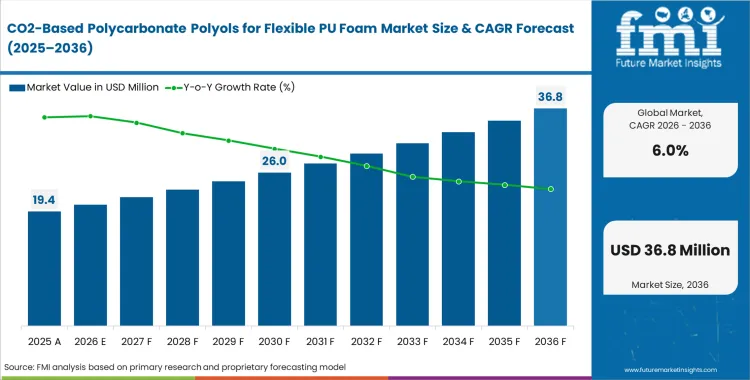
The CO2-based polycarbonate polyols for flexible PU foam market was valued at USD 18.3 million in 2025. Persistent rise in sales set to surpass USD 19.4 million in 2026 at a CAGR of 6.0% during the forecast period. Steady industry expansion lifts total valuation to USD 34.7 million through 2036 as furniture and automotive foam producers replace petroleum-derived feedstocks with captured carbon alternatives to meet strict corporate emission reduction targets.
Summary of CO2-Based Polycarbonate Polyols for Flexible PU Foam Market
- The market is forecast to reach USD 34.7 million by 2036.
- The market is expected to grow at a CAGR of 6.0% from 2026 to 2036.
- The market was estimated at USD 18.3 million in 2025.
- The forecast period represents an incremental opportunity of USD 15.3 million.
- The market is a niche segment within the foam industry, where performance consistency, process compatibility, and proven carbon reduction benefits are critical.
- Growth is driven by increasing pressure on mattress, furniture, and automotive manufacturers to reduce petroleum dependence while maintaining foam performance.
- Commercial adoption is expanding as carbon-capture-based chemicals move from pilot testing to early-stage industrial production.
- China, Germany, and the United States are among the fastest-growing markets, with China leading at a 7.4% CAGR through 2036.
- Liquid formats dominate due to ease of integration into existing manufacturing processes, while polycarbonate ether leads for balanced performance and sustainability.
- Mattresses and upholstery remain the primary application, supported by large-scale foam consumption.
- Key players in the market include Changhua Chemical, Monument Chemical, Econic Technologies, Saudi Aramco Technologies Company, Chimcomplex, and Covestro.
Furniture stores are heavily pressuring the factories that make their seat cushions to switch to greener chemicals and cut carbon emissions. If a flexible foam supplier fails to secure these sustainable raw materials, they risk losing their biggest retail contracts entirely. Many suppliers mistakenly believe that simply matching the price of older chemicals is enough to win business. In reality, bringing new polyols into a factory requires more than just swapping one liquid for another. The new mixture must flow perfectly through the existing pumps and pipes. Chemists who figure out how to make these sustainable ingredients work flawlessly on standard production lines easily beat competitors who are still experimenting with complex mixtures.
As soon as governments finalize new carbon taxes on traditional petroleum chemicals, the heavy financial penalties will force an immediate shift in the industry. The cost advantage will quickly flip toward captured CO2 polyurethane foam materials. Right now, large-scale chemical buyers are simply waiting for these specific tax rules to take effect before they sign any massive, long-term supply agreements for carbon dioxide polyols.
China is set to project a CAGR of 7.4% as domestic foam producers scale operations to meet export compliance standards for sustainable comfort foam raw materials. Germany likely to follow at 6.4% due to stringent European emission mandates impacting automotive interior manufacturing. The United States poised to track at 5.8% supported by rising corporate pledges to buy sustainable polyols for flexible foam. South Korea and Japan anticipated to register 5.7% and 5.4% respectively on the back of advanced chemical infrastructure. The United Kingdom forecasted to expand at 5.1% while Italy set to see a scale of 4.9% growth, reflecting localized shifts in bedding supply chains seeking furniture foam low carbon materials.
Segmental Analysis
CO2-Based Polycarbonate Polyols for Flexible PU Foam Market Analysis by Type
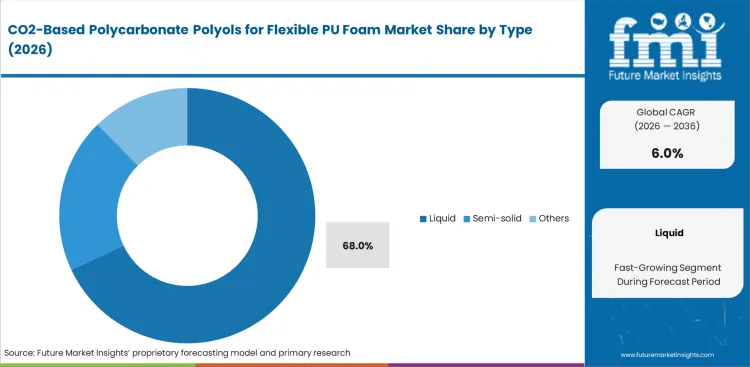
Factory floor setup dictates preference for specific material states. Liquid forms dominate due to direct compatibility with existing pumping and mixing equipment. Manufacturers avoid purchasing new heating machines solely to accommodate greener chemical inputs, leading the liquid segment to estimate a 68.0% share in 2026. Custom blends often perform better thermally, yet liquid variants prevail due to flow compatibility with current pipes. Ignoring polycarbonate polyol viscosity flexible foam flow dynamics causes expensive production delays. Reliable supply of flexible foam inputs relies entirely on pumpability.
- Initial Evaluation: Pumping viscosity tests determine whether a new material enters the trial phase. Production lines reject any batch risking clogs in standard metering equipment.
- Qualification Criteria: Consistency across multiple temperature ranges validates material for continuous use. Bulk contracts require strict tolerance data before finalizing CO2 polyol hydroxyl value foam formulation metrics.
- Volume Expansion: Successful drop-in performance without machine recalibration drives facility-wide rollout. Orders consolidate quickly around the most compatible liquid supplier.
CO2-Based Polycarbonate Polyols for Flexible PU Foam Market Analysis by Polyol Chemistry
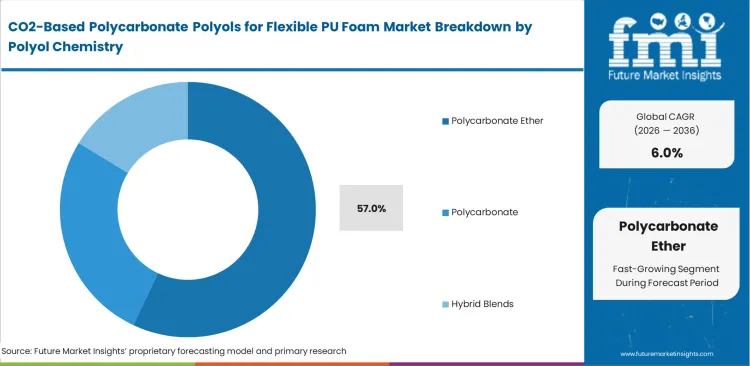
Balancing carbon utilization with mechanical performance remains central to this category. As it matches the reactivity profile of conventional chemical inputs without reducing cushion bounce, the polycarbonate ether segment is estimated to account for 57.0% share in 2026. Pure polycarbonate grades tend to produce firmer foam, which makes ether modification important for soft seating applications. Manufacturers evaluating CO2 polyols against polyether polyols often underestimate the narrow processing window needed to avoid cell collapse during expansion. Ignoring that curing sensitivity leads to higher scrap on the production line. Access to reliable green polyol materials still depends on strict supplier screening.
- Baseline Expectation: Material performance must remain in line with petroleum-based equivalents. Manufacturers reject formulations that weaken final cushion durability or reduce tensile strength.
- Edge Conditions: High-humidity production settings expose curing weaknesses in certain hybrid blends. Manufacturers assessing polycarbonate polyol versus polyester polyol flexible foam options need to adjust catalyst ratios carefully to keep foam expansion consistent.
- Acceptability Standard: Compression set testing remains the key measure of long-term furniture suitability. Fatigue results are used to confirm whether the material can support expected warranty performance.
CO2-Based Polycarbonate Polyols for Flexible PU Foam Market Analysis by Foam Process
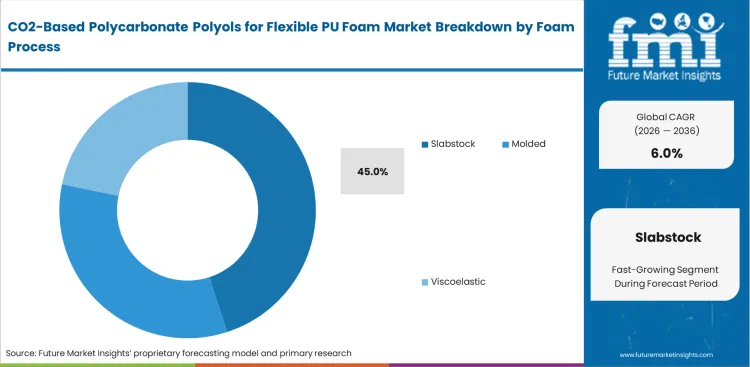
High-volume continuous manufacturing shapes material selection very differently from batch pouring. Manufacturers favor slabstock continuous pouring for mattresses and long furniture cushions because it delivers stronger throughput across large production lines. Heat management across a large reacting foam block remains the main operating challenge. Molded processes provide better shape precision for molded flexible foam captured carbon polyols, yet continuous pouring continues to lead bulk-volume demand because scrap foam can be rebonded into fresh products. That recovery advantage keeps the slabstock segment commercially attractive, and it is estimated to account for 45.0% share in 2026. Manufacturers still need precise timing control when introducing new chemical inputs to avoid production losses.
- Cost Reductions: Large-volume procurement for continuous pouring lowers unit production costs. Manufacturers secure better pricing when monthly offtake volumes remain predictable.
- Hidden Operational Costs: Unstable block temperatures can cause center scorching and material loss. Manufacturers often add core monitoring systems to reduce waste and protect batch consistency.
- Lifecycle Comparison: Scrap rebonding improves overall yield across the production cycle. Recovery performance often influences vendor approval when manufacturers assess new chemical inputs.
CO2-Based Polycarbonate Polyols for Flexible PU Foam Market Analysis by End Use
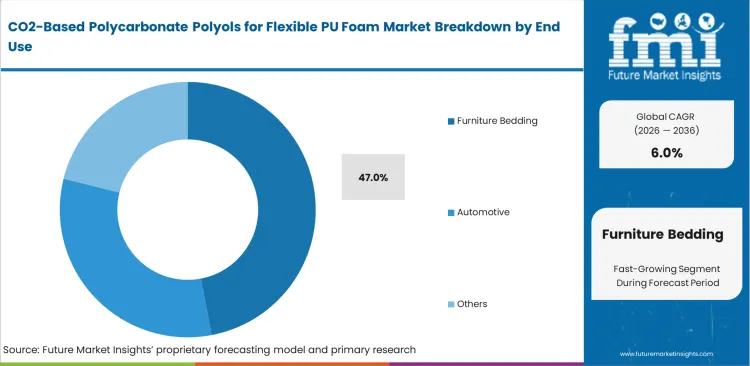
Retail consumer pressure shapes raw material selection very differently across end-use sectors. Furniture and bedding brands face close scrutiny on indoor air quality and material sustainability at the point of sale. As retailers continue to position sustainable sleep products more aggressively, the furniture bedding category is estimated to account for 47.0% share in 2026. CO2-derived polyols give mattress manufacturers a clear merchandising advantage without changing comfort performance for the end user. Automotive seating may become a larger volume outlet over time, though safety validation cycles in vehicles still slow material substitution. Manufacturers that delay the shift in furniture bedding foam polyols risk losing shelf presence to faster-moving competitors. Moving toward bio-based polyol structures also helps preserve long-term retail relationships.
- Odor Prevention: Proper curing is necessary to eliminate residual off-gassing in the finished mattress. Manufacturers maintain strict emission testing before any product reaches consumers.
- Residual Risk: Even small formulation adjustments can affect long-term cushion resilience. Manufacturers assess accelerated aging results carefully when judging potential return exposure.
- Full Benefit Capture: Carbon-reduction value must be communicated clearly to consumers for the material shift to support product positioning. Manufacturers rely on verified supply chain data to support those claims.
CO2-Based Polycarbonate Polyols for Flexible PU Foam Market Drivers, Restraints, and Opportunities
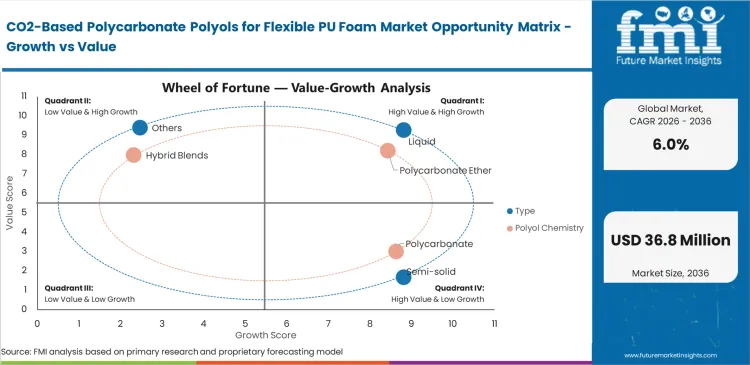
Consumer brands are pushing lower-carbon requirements deeper into the supply chain. Large furniture retailers now expect sustainable material inputs as part of their own emissions commitments. Foam suppliers that fail to respond face a real risk of replacement. That pressure is forcing manufacturers to secure alternative feedstocks that can meet both commercial and technical expectations. Chemical plants with carbon capture capability are supplying the inputs needed for that transition. Early adopters of these materials are in a stronger position to secure supply agreements and defend retail relationships.
Factory execution remains the main barrier to wider adoption. Replacing a base ingredient in continuous foam pouring calls for pump recalibration, heat adjustments, and catalyst changes across a line that is built for consistency and speed. Manufacturers are often reluctant to interrupt a productive line to test a greener input, even when raw material pricing is competitive with conventional options. Adoption slows for that reason. Many manufacturers searching for a dependable polyurethane precursor partner also find that supplier support during plant trials is limited. Concern over block loss and production waste continues to delay conversion decisions.
- Automotive Qualification: Early approval from vehicle manufacturers can open durable supply channels with longer program visibility. Manufacturers that clear foam safety validation gain access to more stable revenue streams over time.
- Catalyst Optimization: Specialized polyurethane catalysts can improve process stability for newer formulations. Suppliers that solve curing sensitivity issues are better placed to support faster factory adoption.
- Localized Production: Chemical production located near major foam manufacturing clusters reduces transport delays and supply uncertainty. Manufacturers often prefer domestic polyol sources when inbound reliability matters.
Regional Analysis
Based on regional analysis, CO2-based polycarbonate polyols for flexible PU foam market is segmented into North America, Europe, Asia Pacific, and Rest of World across 40 plus countries. Environmental policies and retail brand pressures dictate how quickly different parts of the world adopt these new chemical inputs.
.webp "Top Country Growth Comparison Co2 Based Polycarbonate Polyols For Flexible Pu Foam Market Cagr (2026 2036)")
| Country | CAGR (2026 to 2036) |
|---|---|
| China | 7.4% |
| Germany | 6.4% |
| United States | 5.8% |
| South Korea | 5.7% |
| Japan | 5.4% |
| United Kingdom | 5.1% |
| Italy | 4.9% |
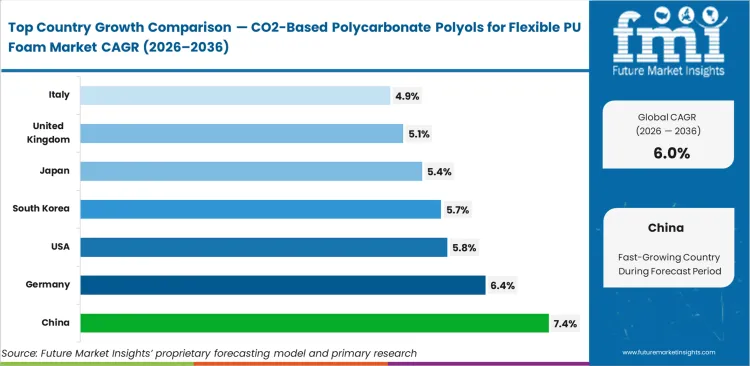
Source: Future Market Insights (FMI) analysis, based on proprietary forecasting model and primary research
Asia Pacific CO2-Based Polycarbonate Polyols for Flexible PU Foam Market Analysis
Massive export manufacturing volumes decide the adoption speed of new chemical inputs in this area. Factory officers face mounting pressure to align their output with international environmental standards. The shift comes directly from the strict requirements of Western retail buyers rather than local consumer demand. Foam producers must integrate lower-carbon materials or risk losing their status as primary global suppliers. The availability of local chemical infrastructure accelerates this transition.
- China: Export-facing compliance requirements are pushing domestic foam manufacturers toward greener input materials. Demand for CO2 polyols in China is anticipated to rise at a CAGR of 7.4% through 2036. Manufacturers are upgrading production lines to strengthen their position in international retail supply programs. Formulators working on Carnol polyols flexible foam applications also benefit from scale that many traditional competitors cannot match.
- South Korea: Advanced chemical processing infrastructure supports faster scale-up of newer formulations. Manufacturers are using that base to expand sustainable foam polyol production in South Korea. Sales of sustainable foam polyols in South Korea are expected to increase at a CAGR of 5.7% during the forecast period. That technical depth helps local suppliers maintain a stronger position in higher-value export segments.
- Japan: Corporate decarbonization mandates across large industrial groups are influencing raw material selection in foam applications. Demand for flexible PU foam sustainable polyols in Japan is expected to grow at a CAGR of 5.4% through 2036. Manufacturers favor materials that can demonstrate verified carbon reduction with consistent supporting documentation. Domestic supply contracts usually depend on tight product consistency and strong technical validation.
FMI's report includes India and Southeast Asian nations. Cost competitiveness determines the exact timing of adoption across these emerging manufacturing hubs.
Europe CO2-Based Polycarbonate Polyols for Flexible PU Foam Market Analysis
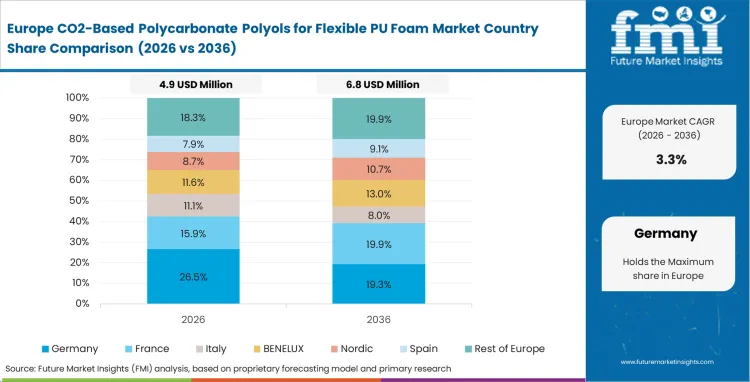
Regulatory frameworks actively penalize the continued use of purely fossil-derived industrial materials. Chemical buyers operate under the constant threat of escalating carbon taxation. This legislative environment makes alternative feedstocks financially viable much earlier than in other geographies. Sourcing teams prioritize compliance security over minor unit cost differences. This dynamic creates a highly receptive environment for novel carbon utilization technologies.
- Germany: Tight automotive emissions requirements are pushing interior suppliers to reassess material selection across foam applications. The CO2-based polycarbonate polyol market in Germany is forecast to expand at a CAGR of 6.4% through 2036. Manufacturers require clear documentation on carbon origin before qualification moves forward. Progress in this market also helps shape wider automotive foam approval practices.
- United Kingdom: Retail positioning in bedding and furniture is shifting toward products with verified sustainability claims. Demand for green polyols in furniture foam applications across the United Kingdom is expected to increase at a CAGR of 5.1% through 2036. Brands that move slowly risk losing shelf visibility as retailers give more space to validated alternatives. Consumer-facing categories are making that shift more visible.
- Italy: Premium furniture manufacturing in Italy continues to favor sustainable materials that do not weaken structural performance. Demand for sustainable materials in Italy’s mattress foam segment is likely to rise at a CAGR of 4.9% through 2036. Manufacturers specify exact performance standards before adopting newer formulations. Willingness to pay for verified green and bio-based polyols keeps demand concentrated in higher-value applications.
FMI's report includes France and the Nordic countries. Strict regional eco-labeling requirements heavily influence chemical specifications in these markets.
North America CO2-Based Polycarbonate Polyols for Flexible PU Foam Market Analysis
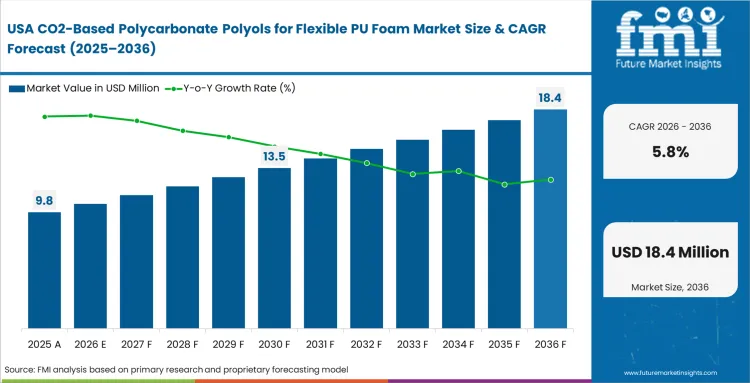
Voluntary corporate pledges currently outpace federal environmental regulations regarding chemical sourcing. Major consumer brands dictate the material requirements for their downstream suppliers. Foam producers face intense pressure to demonstrate tangible progress on greenhouse gas reductions. Facility officers seek materials that provide an immediate marketing benefit without requiring massive capital equipment expenditures. This preference favors highly compatible chemical replacements.
- United States: Large retail chains are pushing stricter sustainability requirements onto mattress suppliers. Demand across the U.S. CO2 polyols flexible foam market is set to rise at a CAGR of 5.8% through 2036. Manufacturers assess alternative foam inputs largely on how easily they can be integrated into existing production lines. Trials involving Poly-CO2 polyols in furniture mattresses still face resistance on the factory floor, which remains a key adoption hurdle for chemical suppliers.
FMI's report includes Canada and Mexico. Cross-border automotive supply chains necessitate unified material standards across the continent.
Competitive Aligners for Market Players
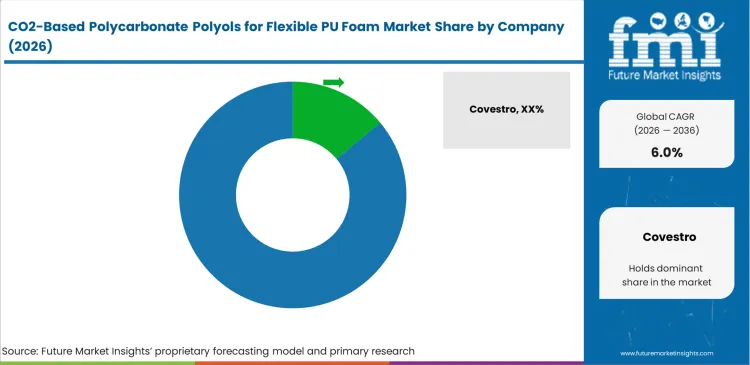
Success in this sector depends on proprietary formulation capability and the ability to incorporate captured carbon without disrupting performance. Established suppliers hold an advantage when they can translate that chemistry into reliable commercial output of polyurethane precursors. Manufacturers choose chemical partners based on consistent product quality and direct support during plant trials, not on price alone. A formulation that performs reliably in large daily production runs does more to strengthen supplier credibility than one proven only at laboratory scale.
Established chemical producers also benefit from a longer record of safety and performance validation. That testing history helps shorten approval cycles for manufacturers that are cautious about changing core inputs on active foam lines. New entrants seeking recognition as CO2-derived foam polyol manufacturers need to prove that their materials can run under actual production conditions, which usually requires in-house testing capability and practical support during early trials. Replacing traditional polyester polyol demands a clear understanding of day-to-day foam plant operations, including curing behavior, line timing, and process stability.
Large automotive and furniture manufacturers usually reduce supply risk by dividing volumes across several qualified suppliers. In mattress foam applications, that approach helps maintain price discipline and lowers exposure to sudden material shortages. Smaller chemical startups often rely on upstream partnerships to secure captured carbon and expand output more steadily. Tighter environmental requirements are likely to push more conventional chemical manufacturers toward carbon-capture-based feedstocks, especially where customer retention and supply continuity matter.
Key Players in CO2-Based Polycarbonate Polyols for Flexible PU Foam Market
- Covestro
- Changhua Chemical
- Monument Chemical
- Econic Technologies
- Saudi Aramco Technologies Company
- Chimcomplex
Scope of the Report
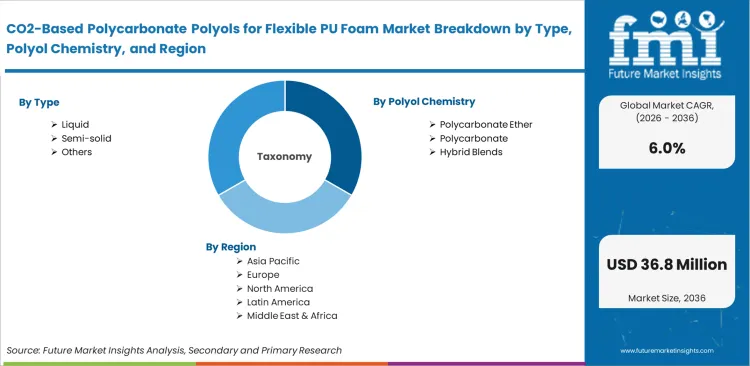
| Metric | Value |
|---|---|
| Quantitative Units | USD 19.4 million to USD 34.7 million, at a CAGR of 6.0% |
| Market Definition | CO2-Based Polycarbonate Polyols for Flexible PU Foam represent chemical precursors manufactured by reacting carbon dioxide with epoxides, substituting conventional polyether compounds in the production of flexible foam to lower overall fossil fuel reliance. |
| Segmentation | Type, Polyol Chemistry, Foam Process, End Use, Region |
| Regions Covered | North America, Latin America, Europe, Asia Pacific, Middle East and Africa |
| Countries Covered | United States, Canada, Brazil, Mexico, Germany, United Kingdom, France, Italy, Spain, China, Japan, South Korea, India, GCC Countries, South Africa |
| Key Companies Profiled | Covestro, Changhua Chemical, Monument Chemical, Econic Technologies, Saudi Aramco Technologies Company, Chimcomplex |
| Forecast Period | 2026 to 2036 |
| Approach | Production volumes of flexible foam manufacturing facilities adopting alternative feedstocks, triangulated with captured CO2 availability. |
Source: Future Market Insights (FMI) analysis, based on proprietary forecasting model and primary research
Segments
Type
- Liquid
- Semi-solid
- Custom blends
Polyol Chemistry
- Polycarbonate ether
- Polycarbonate
- Hybrid blends
Foam Process
- Slabstock
- Molded
- Viscoelastic
End Use
- Furniture bedding
- Automotive
- Consumer goods
- Specialty packaging
Regions:
- Asia Pacific
- India
- China
- Japan
- South Korea
- Indonesia
- Australia & New Zealand
- ASEAN
- Rest of Asia Pacific
- Europe
- Germany
- Italy
- France
- United Kingdom
- Spain
- Benelux
- Nordics
- Central & Eastern Europe
- Rest of Europe
- North America
- United States
- Canada
- Mexico
- Latin America
- Brazil
- Argentina
- Chile
- Rest of Latin America
- Middle East & Africa
- Kingdom of Saudi Arabia
- United Arab Emirates
- South Africa
- Turkey
- Rest of Middle East & Africa
Bibliography
- Karulf, L., Singh, B., Singh, R., & Repo, T. (2025). Carbon dioxide utilization: CO2-based polyurethane foam. Journal of CO2 Utilization, 91, 103000.
- Jung, S. M., Chae, J., Hwang, J., Kim, H., Kim, N.-K., & Baik, J. H. (2025). Sustainable synthesis of CO2-based polyols via pentaerythritol derivatives for high-performance rigid polyurethane foams. EcoMat, 7(7), e70021.
- Maamoun, A. A., Arafa, M., & Esawi, A. M. K. (2025). Flexible polyurethane foam: Materials, synthesis, recycling, and applications in energy harvesting – A review. Materials Advances, 6(6), 1842–1858.
- Omisol, C. J. M., Aguinid, B. J. M., Abilay, G. Y., Asequia, D. M., Tomon, T. R., Sabulbero, K. X., Erjeno, D. J., Osorio, C. K., Usop, S., Malaluan, R., Dumancas, G., Resurreccion, E. P., Lubguban, A., Apostol, G., Siy, H., Alguno, A. C., & Lubguban, A. (2024). Flexible polyurethane foams modified with novel coconut monoglycerides-based polyester polyols. ACS Omega, 9(4), 4497–4512.
- Mo, Y., Huang, X., & Hu, C. (2024). Recent advances in the preparation and application of bio-based polyurethanes. Polymers, 16(15), 2155.
This bibliography is provided for reader reference. The full FMI report contains the complete reference list with primary source documentation.
This Report Addresses
- The specific factory floor qualification barriers delaying adoption of sustainable polyols.
- Structural differences between liquid and semi-solid chemical integration for continuous foam pouring.
- Why polycarbonate ether formulations dominate traditional rigid polycarbonate alternatives.
- The precise curing sensitivities associated with high-humidity hybrid blend processing.
- How furniture retail mandates force upstream chemical sourcing shifts.
- The technical constraints preventing rapid material swaps in automotive seating.
- Why continuous slabstock manufacturing dictates strict bulk flow requirements.
- The commercial impact of upcoming carbon taxation on raw material pricing.
Frequently Asked Questions
What are CO2-based polycarbonate polyols?
These materials are chemical precursors manufactured by reacting carbon dioxide with epoxides to substitute conventional polyether compounds.
How big is the CO2-based polycarbonate polyols for flexible PU foam market?
The sector was valued at USD 18.3 million in 2025, establishing a baseline for sustainable chemical adoption.
How fast is demand growing in this sector?
Sales are set to increase at a CAGR of 6.0% from 2026 to 2036.
What valuation will the industry reach by the end of the forecast period?
Revenue expansion lifts the total opportunity to USD 34.7 million by 2036.
Which product type dominates the sector?
Liquid variants are expected to hold 68.0% share in 2026 due to their compatibility with existing pumping equipment.
Why do buyers prefer liquid formulations over custom blends?
Operations officers select liquids to avoid costly retrofits to their heating and handling infrastructure.
What is polycarbonate ether polyol?
Polycarbonate ether commands 57.0% share because it closely mimics the reactivity of standard petroleum polyethers while integrating carbon.
Are CO2 polyols better than petrochemical polyols?
Pure polycarbonate versions produce stiffer foams, but hybrid ethers successfully match petrochemical compression requirements for soft seating.
How are CO2 polyols used in flexible PU foam?
Slabstock continuous pouring accounts for 45.0% of process volume in 2026 as manufacturers mix the polyols with isocyanates to form large foam blocks.
Why does slabstock outperform molded processing in volume?
Slabstock dominates bulk production for mattresses and allows manufacturers to easily rebond defective scrap foam.
Why use CO2-derived polyols in mattress foam?
Furniture bedding captures 47.0% share as retail brands aggressively market sustainable mattresses to consumers without altering sleep comfort.
Why does automotive adoption trail furniture bedding?
Stringent crash safety and long-term durability testing delay rapid material swaps in vehicle seating.
Which region leads global production?
Asia Pacific represents 38.0% of the total share in 2026.
Why does China post the highest growth rate?
Strict export compliance forces Chinese facility officers to integrate greener inputs to maintain international contracts.
What drives adoption in Germany?
Stringent European emission mandates compel local automotive interior suppliers to overhaul their material choices.
How does the United States perform?
Demand across the United States is set to rise at a 5.8% CAGR through 2036.
Can captured carbon polyols reduce foam carbon footprint?
Voluntary corporate pledges confirm that replacing petroleum feedstocks with CO2-derived alternatives significantly lowers the final product's carbon intensity.
Why are foam producers hesitant to switch chemical inputs?
Changing the base formulation requires risky factory floor recalibrations that threaten profitable continuous production lines.
What is the primary operational consequence of choosing an incompatible blend?
Unstable block temperatures lead to center scorching and create massive quantities of defective inventory.
Who makes CO2-based polyols for flexible foam?
Key companies commercializing this technology include Covestro, Changhua Chemical, Monument Chemical, Econic Technologies, and Saudi Aramco Technologies Company.
What share does the top supplier hold?
Covestro commands a 24.0% position based on their established commercial synthesis capabilities.
How do new entrants compete against established chemical giants?
Challengers must provide extensive on-site technical assistance during factory trials to prove their material reliability.
What structural change will define this market toward 2036?
The implementation of carbon taxes will flip the financial advantage, making captured-carbon inputs cheaper than petroleum derivatives.
Preview the report firsthand - request a free sample
Get SampleGet the brochure for pricing and purchase details.
Get PDFTable of Content
- Executive Summary
- Global Market Outlook
- Demand-side Trends
- Supply-side Trends
- Technology Roadmap Analysis
- Analysis and Recommendations
- Market Overview
- Market Coverage / Taxonomy
- Market Definition / Scope / Limitations
- Research Methodology
- Chapter Orientation
- Analytical Lens and Working Hypotheses
- Market Sizing, Forecasting, and Opportunity Mapping
- Research Design and Evidence Framework
- Desk Research Programme (Secondary Evidence)
- Company Annual and Sustainability Reports
- Peer-reviewed Journals and Academic Literature
- Corporate Websites, Product Literature, and Technical Notes
- Earnings Decks and Investor Briefings
- Statutory Filings and Regulatory Disclosures
- Technical White Papers and Standards Notes
- Trade Journals, Industry Magazines, and Analyst Briefs
- Conference Proceedings, Webinars, and Seminar Materials
- Government Statistics Portals and Public Data Releases
- Press Releases and Reputable Media Coverage
- Specialist Newsletters and Curated Briefings
- Sector Databases and Reference Repositories
- FMI Internal Proprietary Databases and Historical Market Datasets
- Subscription Datasets and Paid Sources
- Social Channels, Communities, and Digital Listening Inputs
- Additional Desk Sources
- Expert Input and Fieldwork (Primary Evidence)
- Primary Modes
- Qualitative Interviews and Expert Elicitation
- Quantitative Surveys and Structured Data Capture
- Blended Approach
- Why Primary Evidence is Used
- Observational and In-context Research
- Social and Community Interactions
- Primary Modes
- Stakeholder Universe Engaged
- C-suite Leaders
- Board Members
- Presidents and Vice Presidents
- R&D and Innovation Heads
- Technical Specialists
- Domain Subject-matter Experts
- Scientists
- Physicians and Other Healthcare Professionals
- Governance, Ethics, and Data Stewardship
- Research Ethics
- Data Integrity and Handling
- Desk Research Programme (Secondary Evidence)
- Tooling, Models, and Reference Databases
- Data Engineering and Model Build
- Data Acquisition and Ingestion
- Cleaning, Normalisation, and Verification
- Synthesis, Triangulation, and Analysis
- Quality Assurance and Audit Trail
- Market Background
- Market Dynamics
- Drivers
- Restraints
- Opportunity
- Trends
- Scenario Forecast
- Demand in Optimistic Scenario
- Demand in Likely Scenario
- Demand in Conservative Scenario
- Opportunity Map Analysis
- Product Life Cycle Analysis
- Supply Chain Analysis
- Investment Feasibility Matrix
- Value Chain Analysis
- PESTLE and Porter’s Analysis
- Regulatory Landscape
- Regional Parent Market Outlook
- Production and Consumption Statistics
- Import and Export Statistics
- Market Dynamics
- Global Market Analysis 2021 to 2025 and Forecast, 2026 to 2036
- Historical Market Size Value (USD Million) Analysis, 2021 to 2025
- Current and Future Market Size Value (USD Million) Projections, 2026 to 2036
- Y-o-Y Growth Trend Analysis
- Absolute $ Opportunity Analysis
- Global Market Pricing Analysis 2021 to 2025 and Forecast 2026 to 2036
- Global Market Analysis 2021 to 2025 and Forecast 2026 to 2036, By Type
- Introduction / Key Findings
- Historical Market Size Value (USD Million) Analysis By Type , 2021 to 2025
- Current and Future Market Size Value (USD Million) Analysis and Forecast By Type , 2026 to 2036
- Liquid
- Semi-solid
- Others
- Liquid
- Y-o-Y Growth Trend Analysis By Type , 2021 to 2025
- Absolute $ Opportunity Analysis By Type , 2026 to 2036
- Global Market Analysis 2021 to 2025 and Forecast 2026 to 2036, By Polyol Chemistry
- Introduction / Key Findings
- Historical Market Size Value (USD Million) Analysis By Polyol Chemistry, 2021 to 2025
- Current and Future Market Size Value (USD Million) Analysis and Forecast By Polyol Chemistry, 2026 to 2036
- Polycarbonate Ether
- Polycarbonate
- Hybrid Blends
- Polycarbonate Ether
- Y-o-Y Growth Trend Analysis By Polyol Chemistry, 2021 to 2025
- Absolute $ Opportunity Analysis By Polyol Chemistry, 2026 to 2036
- Global Market Analysis 2021 to 2025 and Forecast 2026 to 2036, By Foam Process
- Introduction / Key Findings
- Historical Market Size Value (USD Million) Analysis By Foam Process, 2021 to 2025
- Current and Future Market Size Value (USD Million) Analysis and Forecast By Foam Process, 2026 to 2036
- Slabstock
- Molded
- Viscoelastic
- Slabstock
- Y-o-Y Growth Trend Analysis By Foam Process, 2021 to 2025
- Absolute $ Opportunity Analysis By Foam Process, 2026 to 2036
- Global Market Analysis 2021 to 2025 and Forecast 2026 to 2036, By End Use
- Introduction / Key Findings
- Historical Market Size Value (USD Million) Analysis By End Use, 2021 to 2025
- Current and Future Market Size Value (USD Million) Analysis and Forecast By End Use, 2026 to 2036
- Furniture Bedding
- Automotive
- Others
- Furniture Bedding
- Y-o-Y Growth Trend Analysis By End Use, 2021 to 2025
- Absolute $ Opportunity Analysis By End Use, 2026 to 2036
- Global Market Analysis 2021 to 2025 and Forecast 2026 to 2036, By Region
- Introduction
- Historical Market Size Value (USD Million) Analysis By Region, 2021 to 2025
- Current Market Size Value (USD Million) Analysis and Forecast By Region, 2026 to 2036
- North America
- Latin America
- Western Europe
- Eastern Europe
- East Asia
- South Asia and Pacific
- Middle East & Africa
- Market Attractiveness Analysis By Region
- North America Market Analysis 2021 to 2025 and Forecast 2026 to 2036, By Country
- Historical Market Size Value (USD Million) Trend Analysis By Market Taxonomy, 2021 to 2025
- Market Size Value (USD Million) Forecast By Market Taxonomy, 2026 to 2036
- By Country
- USA
- Canada
- Mexico
- By Type
- By Polyol Chemistry
- By Foam Process
- By End Use
- By Country
- Market Attractiveness Analysis
- By Country
- By Type
- By Polyol Chemistry
- By Foam Process
- By End Use
- Key Takeaways
- Latin America Market Analysis 2021 to 2025 and Forecast 2026 to 2036, By Country
- Historical Market Size Value (USD Million) Trend Analysis By Market Taxonomy, 2021 to 2025
- Market Size Value (USD Million) Forecast By Market Taxonomy, 2026 to 2036
- By Country
- Brazil
- Chile
- Rest of Latin America
- By Type
- By Polyol Chemistry
- By Foam Process
- By End Use
- By Country
- Market Attractiveness Analysis
- By Country
- By Type
- By Polyol Chemistry
- By Foam Process
- By End Use
- Key Takeaways
- Western Europe Market Analysis 2021 to 2025 and Forecast 2026 to 2036, By Country
- Historical Market Size Value (USD Million) Trend Analysis By Market Taxonomy, 2021 to 2025
- Market Size Value (USD Million) Forecast By Market Taxonomy, 2026 to 2036
- By Country
- Germany
- UK
- Italy
- Spain
- France
- Nordic
- BENELUX
- Rest of Western Europe
- By Type
- By Polyol Chemistry
- By Foam Process
- By End Use
- By Country
- Market Attractiveness Analysis
- By Country
- By Type
- By Polyol Chemistry
- By Foam Process
- By End Use
- Key Takeaways
- Eastern Europe Market Analysis 2021 to 2025 and Forecast 2026 to 2036, By Country
- Historical Market Size Value (USD Million) Trend Analysis By Market Taxonomy, 2021 to 2025
- Market Size Value (USD Million) Forecast By Market Taxonomy, 2026 to 2036
- By Country
- Russia
- Poland
- Hungary
- Balkan & Baltic
- Rest of Eastern Europe
- By Type
- By Polyol Chemistry
- By Foam Process
- By End Use
- By Country
- Market Attractiveness Analysis
- By Country
- By Type
- By Polyol Chemistry
- By Foam Process
- By End Use
- Key Takeaways
- East Asia Market Analysis 2021 to 2025 and Forecast 2026 to 2036, By Country
- Historical Market Size Value (USD Million) Trend Analysis By Market Taxonomy, 2021 to 2025
- Market Size Value (USD Million) Forecast By Market Taxonomy, 2026 to 2036
- By Country
- China
- Japan
- South Korea
- By Type
- By Polyol Chemistry
- By Foam Process
- By End Use
- By Country
- Market Attractiveness Analysis
- By Country
- By Type
- By Polyol Chemistry
- By Foam Process
- By End Use
- Key Takeaways
- South Asia and Pacific Market Analysis 2021 to 2025 and Forecast 2026 to 2036, By Country
- Historical Market Size Value (USD Million) Trend Analysis By Market Taxonomy, 2021 to 2025
- Market Size Value (USD Million) Forecast By Market Taxonomy, 2026 to 2036
- By Country
- India
- ASEAN
- Australia & New Zealand
- Rest of South Asia and Pacific
- By Type
- By Polyol Chemistry
- By Foam Process
- By End Use
- By Country
- Market Attractiveness Analysis
- By Country
- By Type
- By Polyol Chemistry
- By Foam Process
- By End Use
- Key Takeaways
- Middle East & Africa Market Analysis 2021 to 2025 and Forecast 2026 to 2036, By Country
- Historical Market Size Value (USD Million) Trend Analysis By Market Taxonomy, 2021 to 2025
- Market Size Value (USD Million) Forecast By Market Taxonomy, 2026 to 2036
- By Country
- Kingdom of Saudi Arabia
- Other GCC Countries
- Turkiye
- South Africa
- Other African Union
- Rest of Middle East & Africa
- By Type
- By Polyol Chemistry
- By Foam Process
- By End Use
- By Country
- Market Attractiveness Analysis
- By Country
- By Type
- By Polyol Chemistry
- By Foam Process
- By End Use
- Key Takeaways
- Key Countries Market Analysis
- USA
- Pricing Analysis
- Market Share Analysis, 2025
- By Type
- By Polyol Chemistry
- By Foam Process
- By End Use
- Canada
- Pricing Analysis
- Market Share Analysis, 2025
- By Type
- By Polyol Chemistry
- By Foam Process
- By End Use
- Mexico
- Pricing Analysis
- Market Share Analysis, 2025
- By Type
- By Polyol Chemistry
- By Foam Process
- By End Use
- Brazil
- Pricing Analysis
- Market Share Analysis, 2025
- By Type
- By Polyol Chemistry
- By Foam Process
- By End Use
- Chile
- Pricing Analysis
- Market Share Analysis, 2025
- By Type
- By Polyol Chemistry
- By Foam Process
- By End Use
- Germany
- Pricing Analysis
- Market Share Analysis, 2025
- By Type
- By Polyol Chemistry
- By Foam Process
- By End Use
- UK
- Pricing Analysis
- Market Share Analysis, 2025
- By Type
- By Polyol Chemistry
- By Foam Process
- By End Use
- Italy
- Pricing Analysis
- Market Share Analysis, 2025
- By Type
- By Polyol Chemistry
- By Foam Process
- By End Use
- Spain
- Pricing Analysis
- Market Share Analysis, 2025
- By Type
- By Polyol Chemistry
- By Foam Process
- By End Use
- France
- Pricing Analysis
- Market Share Analysis, 2025
- By Type
- By Polyol Chemistry
- By Foam Process
- By End Use
- India
- Pricing Analysis
- Market Share Analysis, 2025
- By Type
- By Polyol Chemistry
- By Foam Process
- By End Use
- ASEAN
- Pricing Analysis
- Market Share Analysis, 2025
- By Type
- By Polyol Chemistry
- By Foam Process
- By End Use
- Australia & New Zealand
- Pricing Analysis
- Market Share Analysis, 2025
- By Type
- By Polyol Chemistry
- By Foam Process
- By End Use
- China
- Pricing Analysis
- Market Share Analysis, 2025
- By Type
- By Polyol Chemistry
- By Foam Process
- By End Use
- Japan
- Pricing Analysis
- Market Share Analysis, 2025
- By Type
- By Polyol Chemistry
- By Foam Process
- By End Use
- South Korea
- Pricing Analysis
- Market Share Analysis, 2025
- By Type
- By Polyol Chemistry
- By Foam Process
- By End Use
- Russia
- Pricing Analysis
- Market Share Analysis, 2025
- By Type
- By Polyol Chemistry
- By Foam Process
- By End Use
- Poland
- Pricing Analysis
- Market Share Analysis, 2025
- By Type
- By Polyol Chemistry
- By Foam Process
- By End Use
- Hungary
- Pricing Analysis
- Market Share Analysis, 2025
- By Type
- By Polyol Chemistry
- By Foam Process
- By End Use
- Kingdom of Saudi Arabia
- Pricing Analysis
- Market Share Analysis, 2025
- By Type
- By Polyol Chemistry
- By Foam Process
- By End Use
- Turkiye
- Pricing Analysis
- Market Share Analysis, 2025
- By Type
- By Polyol Chemistry
- By Foam Process
- By End Use
- South Africa
- Pricing Analysis
- Market Share Analysis, 2025
- By Type
- By Polyol Chemistry
- By Foam Process
- By End Use
- USA
- Market Structure Analysis
- Competition Dashboard
- Competition Benchmarking
- Market Share Analysis of Top Players
- By Region
- By Type
- By Polyol Chemistry
- By Foam Process
- By End Use
- Competition Analysis
- Competition Deep Dive
- Covestro
- Overview
- Product Portfolio
- Profitability by Market Segments (Product/Age /Sales Channel/Region)
- Sales Footprint
- Strategy Overview
- Marketing Strategy
- Product Strategy
- Channel Strategy
- Changhua Chemical
- Monument Chemical
- Econic Technologies
- Saudi Aramco Technologies Company
- Chimcomplex
- Covestro
- Competition Deep Dive
- Assumptions & Acronyms Used


