

- Industry Size (2026)
- USD 151.2 Mn
- Forecast (2036)
- USD 305.9 Mn
- CAGR (2026 to 2036)
- 31.0%
Pulse-Enriched Mediterranean Pasta Ingredient Systems Industry Size, Forecast and Outlook By FMI
The pulse-enriched Mediterranean pasta ingredient systems market was valued at USD 140.9 million in 2025 and is projected to reach USD 151.2 million in 2026, expanding at a CAGR of 7.3% during the forecast period. By 2036, the sector is expected to rise to USD 305.9 million.
Summary of Pulse-Enriched Mediterranean Pasta Ingredient Systems Industry
- The market is forecast to reach USD 305.9 million by 2036.
- The market is expected to grow at a CAGR of 7.3% from 2026 to 2036.
- The market was estimated at USD 140.9 million in 2025.
- The forecast period represents an incremental opportunity of USD 154.7 million.
- Demand is driven by increasing preference for protein- and fiber-enriched pasta aligned with rising legume consumption trends across Europe.
- Chickpea is projected to lead the pulse source segment with a 33% share due to its balance of taste and functional compatibility in pasta formulations.
- Pulse flours are expected to dominate the ingredient type segment with a 47% share, supported by clean-label positioning and cost efficiency.
- High-protein claims are anticipated to account for 36% of the claim platform segment, reflecting strong consumer demand for protein-rich foods.
- Dry pasta is expected to hold a 67% share due to its scalability, shelf stability, and export suitability.
- Spain, France, and Italy are key markets, with Spain leading growth, while the broader Mediterranean region supports steady demand expansion.
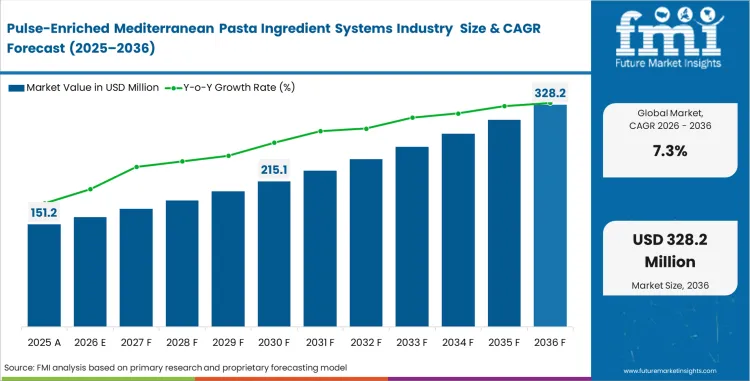
Key Takeaways, Market Size, and Forecast
- Pulse-Enriched Mediterranean Pasta Ingredient Systems Industry is projected to grow from USD 151.2 million in 2026 to USD 305.9 million by 2036, at a CAGR of 7.3%.
- The pulse-enriched Mediterranean pasta ingredient systems industry was valued at USD 140.9 million in 2025.
- By 2036, the Pulse-Enriched Mediterranean Pasta Ingredient Systems Industry is expected to be worth USD 305.9 million.
- From 2026 to 2036, the industry is projected to expand at a CAGR of 7.3%.
- The industry is projected to create an incremental opportunity of USD 154.7 million between 2026 and 2036.
- In 2026, Chickpea is expected to account for 33.0% of the pulse source segment.
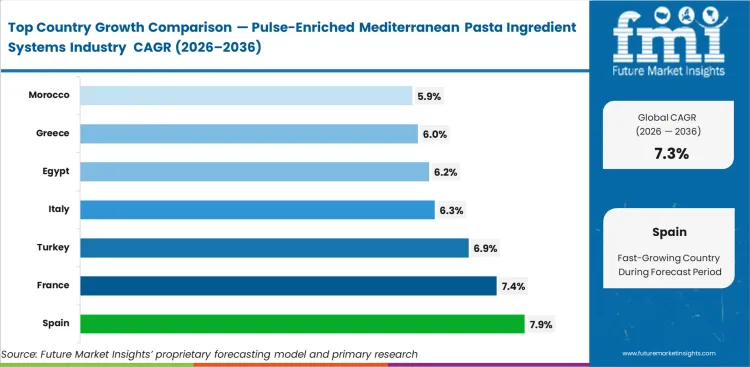
- Spain (7.9%) and France (7.4%) are two of the fastest growing markets.
Pulse-Enriched Mediterranean Pasta Ingredient Systems Industry Key Takeaways
| Metric | Details |
|---|---|
| Industry Size (2026) | USD 151.2 million |
| Industry Value (2036) | USD 305.9 million |
| CAGR (2026-2036) | 7.3% |
Source: Future Market Insights (FMI) analysis, based on proprietary forecasting model and primary research
For most industrial pasta programs, pulse flours remain the preferred starting point because they preserve cleaner labels and lower formulation cost, while isolate-heavy systems are usually reserved for premium launches where stronger protein claims can justify higher validation and ingredient spend.
Industrial food brands are under immediate pressure to meet front-of-pack protein targets without disrupting established semolina supply chains. Traditional semolina lines do not handle pulse inputs well when particle size is not tightly calibrated, which makes raw commodity sourcing harder to manage in commercial production. Market does not scale simply on consumer interest in legumes; it scales only when suppliers can help processors hold extrusion stability, post-boil texture, and drying performance within commercially acceptable limits on existing semolina-based lines. Delayed action leaves branded portfolios more exposed to private-label competition built around functional nutrition claims. Blended systems also change the operating model by moving more of the rheological performance burden upstream to ingredient processors.
Adoption becomes easier once equipment specifications for legume-heavy dough are standardized across die plates and related line settings. High protein isolate content can create severe die-swell problems when moisture control drifts out of range, and line reliability quickly becomes a primary operating concern. Standardized hardware lowers the barrier for mid-tier manufacturers and improves confidence in using more complex isolate-starch blends. Lower downtime risk makes broader commercial rollout more practical.
United States is set to advance at 8.4% CAGR through 2036, giving it the strongest industry outlook as legume-based pasta formats move deeper into mainstream retail. Spain follows closely, supported by a solid domestic processing base and Mediterranean export orientation, with the sector expected to post 7.9% over the same period. Clean-label preference keeps France on a steady upward path, and demand for Pulse-Enriched Mediterranean Pasta Ingredient Systems in the country is likely to register 7.4% CAGR through 2036. Germany remains tied to plant-based product development priorities, where the industry outlook points to 7.1% during the forecast period. Italy moves at a more measured pace as established pasta producers bring functional blends into export-focused lines, while Greece and Tunisia are projected at 6.0% and 5.8%, respectively. Formulation strategy also varies by geography, with export-oriented manufacturing hubs leaning more toward isolate systems and domestic-consumption countries showing a clearer preference for whole legume flours.
Segmental Analysis
Pulse-Enriched Mediterranean Pasta Ingredient Systems Industry Analysis by Pulse Source
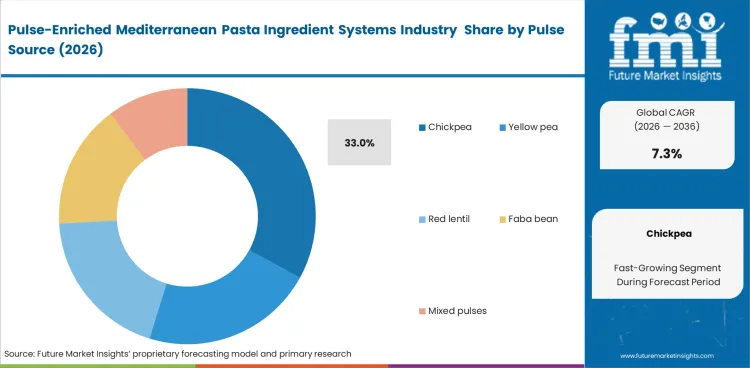
Traditional semolina formulations no longer meet current nutritional positioning requirements on their own, which is pushing manufacturers toward pulse-based enrichment systems. Chickpea derivatives are expected to account for 33% share of the Pulse source segment in 2026. Chickpea remains the most commercially workable option because it fits Mediterranean taste expectations, performs more smoothly in extrusion, and usually requires less flavor correction than stronger-tasting alternatives. Color also supports its lead position, as chickpea helps deliver a warmer yellow appearance that aligns more closely with premium pasta presentation. Lentil-based inputs still hold relevance, but poorly calibrated grades can create darker tones during high-temperature drying and increase finish-quality risk on industrial lines.
- Initial blending validation: Technical teams favor pulse sources that hydrate at rates closer to durum semolina, since better hydration alignment improves dough consistency and lowers fracture risk inside extruders.
- Extrusion pressure testing: Production teams monitor die-plate pressure when new pulse matrices enter the line, and starch ratios are adjusted where needed to keep thermal load and equipment stress within workable limits.
- Sensory approval cycles: Post-boil firmness, color stability, and flavor retention remain central to final validation, as successful batch performance usually determines which pulse systems move into long-term use.
Pulse-Enriched Mediterranean Pasta Ingredient Systems Industry Analysis by Ingredient type
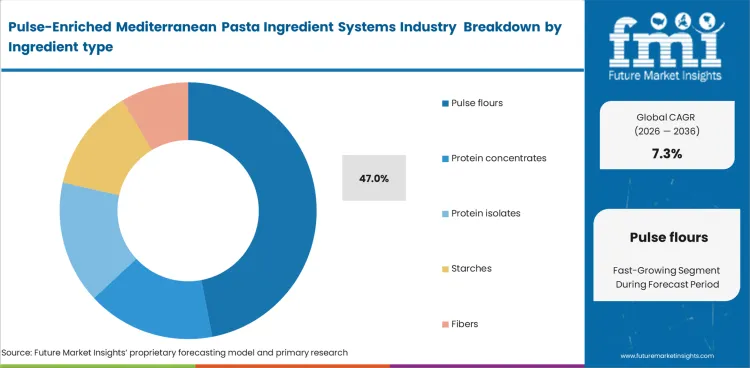
Functional blending economics keep pulse flours in the lead, especially where manufacturers need broad semolina displacement without pushing formulation cost too high. Whole-flour systems remain the most practical option for mid-tier pasta programs because they support bulk substitution at a lower input cost than isolated protein formats. Pulse flours are projected to secure 47% share of the Ingredient type segment in 2026. Cost advantage, though, does not remove formulation pressure. Flour-based systems can introduce earthy notes and raise the burden on flavor correction, which means apparent savings at the input stage often narrow once masking agents and functional support ingredients are added. Poorly optimized flour systems also tend to create more quality variation, leaving processors exposed to repeat sensory complaints and weaker batch consistency.
- Bulk displacement savings: Production economics improve when pulse flours replace a portion of premium semolina in high-volume runs, making flour-based systems the first option for cost-sensitive product lines.
- Processing loss burdens: Quality teams often encounter higher starch release during cooking when basic flour blends are not well balanced which may weaken product performance at consumer level.
- Lifecycle cost normalization: Finance teams usually assess total formulation cost across maskers, binders, and correction steps, and modified flour systems can prove more economical than basic blends over longer manufacturing cycles.
Pulse-Enriched Mediterranean Pasta Ingredient Systems Industry Analysis by Claim platform
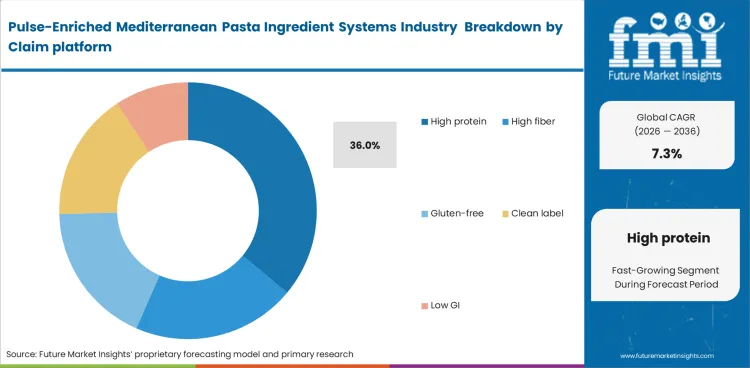
Protein-led claim strategies create a constant trade-off between label ambition and workable pasta performance. Category teams keep pushing formulations above threshold levels needed for premium shelf placement, which is why high protein is expected to represent 36% share of the Claim platform segment in 2026. Retail pull remains strongest where protein claims are clear and processing losses stay under control. Raw protein content alone does not settle the issue, since digestibility and post-drying retention still shape final compliance. High heat can reduce usable protein quality, so formulators often raise isolate loading to protect the declared claim after processing. Missed validation targets after production can delay launches, force relabeling, and raise testing costs.
- Matrix breakdown risk: Extrusion teams monitor dough stability closely once protein concentration moves beyond starch-binding capacity, since weak matrix formation can disrupt line consistency and reduce finished-product quality.
- Digestibility shortfalls: Quality teams still manage anti-nutritional risks in poorly processed legume systems, which is why controlled thermal treatment remains necessary before full-scale use.
- Claim validation burdens: Regulatory and quality teams run repeated retention checks on final output, and full commercial return depends on keeping protein levels intact under validated drying conditions.
Pulse-Enriched Mediterranean Pasta Ingredient Systems Industry Analysis by Pasta format
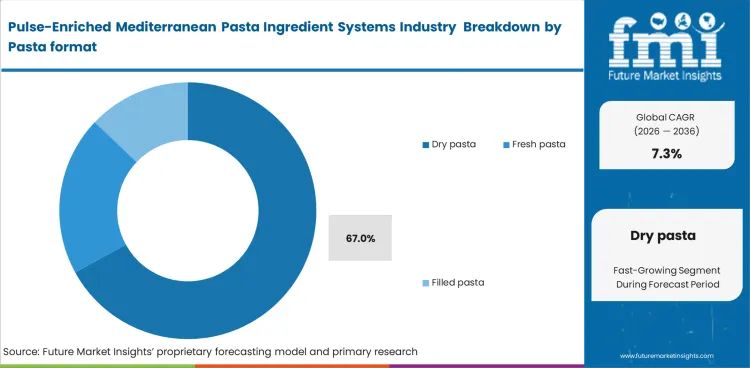
Industrial throughput keeps dry pasta at the center of enriched-system adoption because shelf-stable formats offer the scale needed for large production runs and wider export movement. Dry pasta is expected to account for 67% share of the Pasta format segment in 2026. Plant managers continue to favor dry lines because they move through longer distribution cycles without refrigeration cost, but that operating advantage brings tighter formulation demands. High-temperature drying can weaken sensitive vegan protein inputs, which is why starch-protein systems built for roughly 85°C drying conditions carry a pricing premium over standard pulse ingredients. Poorly matched pulse systems raise the risk of brittleness, breakage, and visible product damage before packs reach retail shelves.
- Standard extrusion tolerance: Pre-gelatinized systems support faster dough stabilization, allowing extrusion teams to stay closer to target line speeds without reworking existing die settings.
- Thermal stress fracturing: Product geometry often begins to fail during post-drying cooling when ingredient balance is not calibrated for heat exposure, and brittleness can interrupt packaging efficiency.
- Moisture content compliance: Quality assurance directors set narrow hydration limits for finished packs because moisture drift can lead either to mold risk or to mechanical shattering during handling and transport.
Pulse-Enriched Mediterranean Pasta Ingredient Systems Industry Analysis by Buyer type
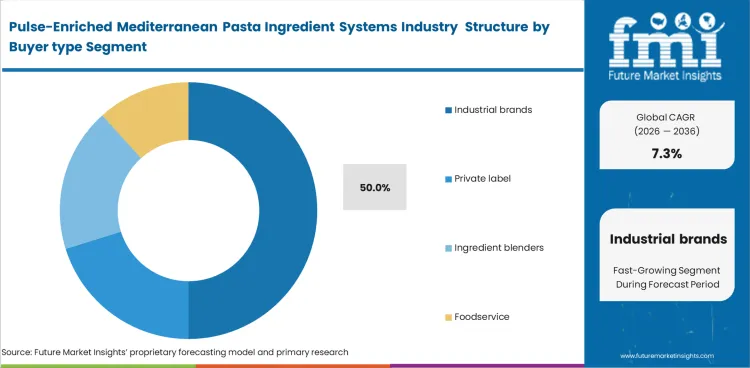
Industrial brands remain the main volume center because they have the technical depth and product-development capacity required to manage complex dough behavior at scale. Industrial brands are expected to account for 50% share of the Buyer type segment in 2026. Larger processors usually run longer renovation cycles, but they are better equipped to absorb validation work, reformulation cost, and line-adjustment requirements across broad product portfolios. Private label programs can move faster when external blending expertise is already available, especially where sensory matching and line performance have been pre-validated. Established processors that move slowly risk losing shelf relevance in segments where nutritional claims are becoming harder to overlook.
- Premium brand pioneers: Health-focused labels tend to adopt more complex isolate-led systems earlier, using stronger nutritional differentiation to support higher price points.
- Industrial brand followers: Large processors usually scale standardized flour-based systems across mainstream product lines, with more attention on repeatability and cost control than on maximum enrichment.
- Private label execution: Retail programs usually move once contract manufacturers can match branded sensory performance with reliable batch consistency where volume conversion becomes more visible.
Pulse-Enriched Mediterranean Pasta Ingredient Systems Industry Drivers, Restraints, and Opportunities
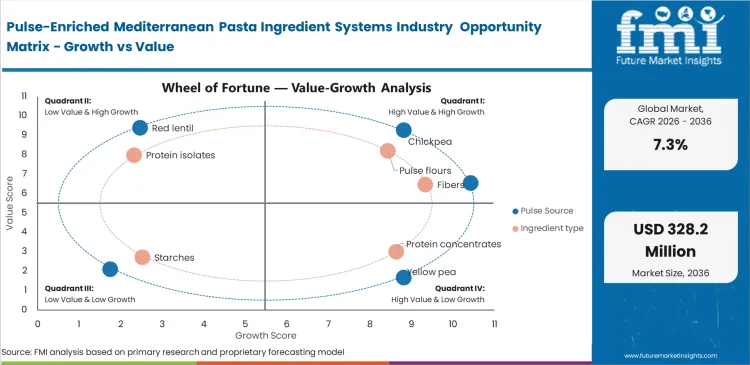
Manufacturers are facing higher exposure to durum wheat price swings and supply disruption, which is pushing raw material diversification further into routine formulation planning. Partial replacement of durum with yellow pea protein gives pasta processors a more flexible cost model while reducing dependence on one volatile grain stream. Margin protection matters, but line continuity matters just as much when poor harvest conditions tighten semolina availability. Heavy reliance on a single wheat base leaves large-scale pasta operations more exposed to raw material shocks than many processors can comfortably absorb.
Die-expansion inconsistency remains a serious operating barrier to wider adoption. Legume starch systems respond to extrusion shear differently from wheat-gluten doughs, and that mismatch can distort shape as pasta exits the die. Formulation teams often use pre-gelatinized blends to improve stability, but those systems raise input cost and can weaken the commercial case for mass-market lines. Plant managers remain cautious until hardware settings and dough behavior align more reliably for hybrid formulations.
Opportunities in the Pulse-Enriched Mediterranean Pasta Ingredient Systems Industry
- Clean-label starch development: Formulation chemists deploy novel pulse-derived starches to eliminate synthetic binders entirely. Premium pricing becomes easier to defend when label declarations stay short and product quality remains reliable.
- Gluten-free cross-pollination: Operations teams adapt pulse isolates first developed for conventional applications into dedicated celiac-safe product lines. Shared ingredient use across multiple portfolios improves purchasing efficiency and reduces duplication in validation work.
- Local sourcing integration: Manufacturing groups build supply links with regional legume processors to shorten lead times and reduce freight complexity. Dependence on imported specialty systems, including prepared flour mixes, tends to fall when nearby processing capacity can support consistent quality and formulation needs.
Regional Analysis
Based on regional analysis, Pulse-Enriched Mediterranean Pasta Ingredient Systems is segmented into North America, Western Europe, and Southern Europe and North Africa across 40 plus countries.
.webp "Top Country Growth Comparison Pulse Enriched Mediterranean Pasta Ingredient Systems Industry Cagr (2026 2036)")
| Country | CAGR (2026 to 2036) |
|---|---|
| Spain | 7.9% |
| France | 7.4% |
| Turkey | 6.9% |
| Italy | 6.3% |
| Egypt | 6.2% |
| Greece | 6.0% |
| Morocco | 5.9% |
| Tunisia | 5.8% |
Source: Future Market Insights (FMI) analysis, based on proprietary forecasting model and primary research
Western Europe demand analysis for Pulse-Enriched Mediterranean Pasta Ingredient Systems
Western Europe remains shaped by clean-label discipline and tighter scrutiny around ingredient declarations. Quality teams prefer solutions that can maintain dough performance without creating label complications, which keeps physically treated legume flours and similar systems in a stronger position than more heavily modified inputs. Ingredient suppliers operating in the region must solve functionality through processing precision and thermal control rather than through label-sensitive additions. Short ingredient lists still matter, so nutritional improvement must fit within those limits.
- France: At 7.4% CAGR through 2036, France reflects steady expansion in the sector. Foodservice and institutional channels keep plant-forward pasta applications relevant, especially where menu development must balance familiarity with nutritional improvement. Mild pulse inputs remain important because finished products still need to align with established taste expectations. Technical success in fresh and premium applications here often shapes how similar concepts move into nearby higher-value countries.
FMI's report includes Benelux and Nordic regions. Processing facilities in these areas function as primary European hubs for raw legume fractionation and ingredient isolation.
Southern Europe and North Africa sector analysis for Pulse-Enriched Mediterranean Pasta Ingredient Systems
Southern Europe and North Africa present a more measured adoption path because traditional durum pasta remains deeply rooted in everyday consumption. Flavor familiarity and cooking quality matter more in the region, which keeps inclusion strategies restrained and often favors whole-flour systems over heavier isolate loading. Export-oriented lines move faster than domestic mainstream products because they can absorb more formulation adjustment and carry clearer functional differentiation. Local chickpea and lentil supply also supports authenticity claims while helping processors manage wheat-related input pressure.
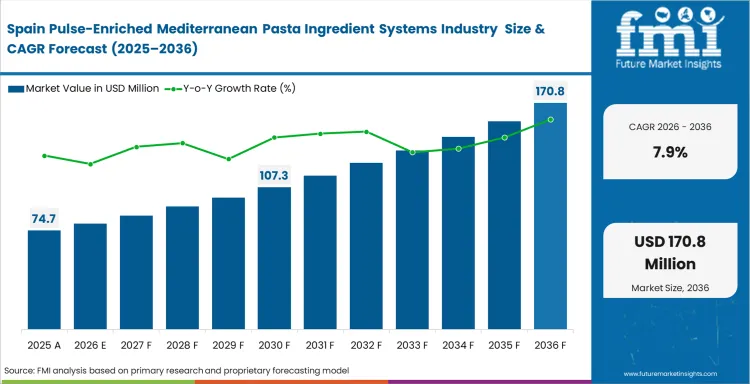
- Spain: Export manufacturing gives Spain a stronger commercial base for pulse-enriched pasta than many nearby countries. Regional processors integrate chickpea-based systems into international contract production where Mediterranean provenance still carries product value. Spain is forecast to register 7.9% CAGR from 2026 to 2036. Stronger scale on export lines also improves unit economics in adjacent premium destinations.
- Italy: Legacy pasta producers move more carefully because sensory standards remain high and deviations from expected texture are less tolerated. Formulation work stays highly calibrated, especially when starch balance and bite quality have to remain close to established al dente expectations. Industry outlook in Italy suggests 6.3% CAGR through 2036. Acceptance in Italy carries wider commercial weight because it signals whether an ingredient system can work in demanding pasta programs.
- Greece: Greece is projected to record a 6.0% CAGR from 2026 to 2036, reflecting a steady industry outlook over the forecast period. Local processors rely more on regionally available pulse derivatives to improve nutritional profiles without overcomplicating cost break-down. Domestic supply links help keep formulations commercially workable, particularly where imported isolate-heavy systems would add pressure to finished-product pricing. Compatibility with familiar regional formats remains central to wider adoption.
- Turkey: Turkey remains relevant because local milling capacity, pasta manufacturing depth, and broad cereal-processing experience create a workable base for pulse-enriched product development. Regional producers are more likely to adopt systems that preserve throughput and cost discipline while improving nutritional positioning. Demand for Pulse-Enriched Mediterranean Pasta Ingredient Systems in Turkey is expected to advance at a CAGR of 6.9% through 2036. Commercial uptake should remain tied to applications that fit existing large-scale dry pasta operations.
- Tunisia: Milling and pasta operations in Tunisia are incorporating regional legume supply more gradually, with greater emphasis on basic fortification than on premium product architecture. Commercial logic remains tied to extending carbohydrate availability and improving input flexibility under tighter processing conditions. Demand for Pulse-Enriched Mediterranean Pasta Ingredient Systems in Tunisia is anticipated to move ahead at 5.8% CAGR during the assessment period. Cost discipline and operating simplicity still carry more weight here than premium claim development.
- Egypt: Cost sensitivity remains more pronounced in Egypt, which keeps adoption centered on practical fortification rather than premium claim-led product architecture. Domestic processors are more likely to work with simpler flour-led systems where formulation economics remain manageable. Egypt is likely to post 6.2% CAGR during the forecast period. Wider acceptance will depend on keeping enrichment compatible with mainstream consumption patterns.
- Morocco: Morocco is gradually expanding its role in pulse-based pasta applications as regional ingredient availability and Mediterranean food familiarity support adoption. Processors in the country are likely to favor systems that balance nutritional uplift with manageable operating costs. Industry outlook in Morocco points to 5.9% CAGR from 2026 to 2036. Progress is expected to remain tied to products that can move through existing dry-format channels without major line adjustment.
FMI's report includes broader Mediterranean basin dynamics remain relevant across this geography. Expanding drought pressure is making pulse cultivation more commercially important where wheat supply becomes harder to rely on over time.
Competitive Aligners for Industry Players
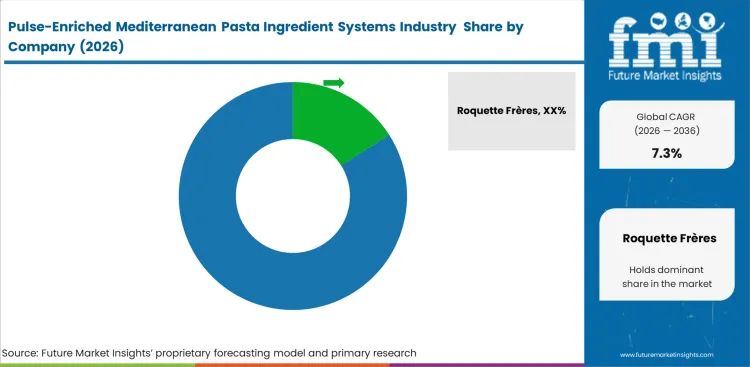
Suppliers compete on portfolio depth and technical control of dough behavior more than on simple ingredient pricing. Functional pasta programs rarely succeed with one input alone, since proteins, starches, fibers, and pea fiber have to work together under commercial extrusion conditions. Food manufacturers usually prefer vendors offering integrated systems already tested for line performance over stand-alone ingredients with no processing support. Single-product suppliers focused only on pea protein often struggle to secure industrial programs when they cannot demonstrate full-blend behavior under production conditions. Commercial advantage stays with companies investing in pilot-scale extrusion work and proving performance before full-volume supply begins.
Established suppliers retain their edge through deeper application data and broader formulation libraries. Roquette Frères and Ingredion, for example, are better positioned when they can show how fibers, proteins, and supporting starches respond under specific drying and hydration conditions. Major food brands place little value on a lower-cost isolate when operating data is missing or extrusion stability remains uncertain. Challengers need comparable validation capability to be viewed as credible partners in larger programs.
Large manufacturers also try to avoid long-term dependence on one formulation source. Internal technical teams break proprietary systems into modular protein, starch, fiber, and Pea Fiber components once baseline functionality is understood. Regional suppliers such as Vestkorn or COSUCRA become more relevant at that stage, especially where individual elements can be sourced more flexibly after initial validation. Control over dough rheology remains central because processors want greater leverage over formulation cost without giving up line reliability.
Key Players in Pulse-Enriched Mediterranean Pasta Ingredient Systems Industry
- Roquette Frères
- Ingredion
- COSUCRA
- BENEO
- Vestkorn
- ADM
Scope of the Report
| Metric | Value |
|---|---|
| Quantitative Units | USD 151.2 million to USD 305.9 million, at a CAGR of 7.3% |
| Industry Definition | It tracks B2B sales of specialized legume derivatives formulated for pasta manufacturing. Systems span flours, concentrates, isolates, starches, and fibers engineered to maintain extrusion integrity while elevating nutritional profiles. |
| Segmentation | Pulse source, Ingredient type, Claim platform, Pasta format, Buyer type, and Region |
| Regions Covered | North America, Latin America, Europe, Asia Pacific, Middle East and Africa |
| Countries Covered | Spain, France, Turkey, Italy, Egypt, Greece, Morocco, and Tunisia |
| Key Companies Profiled | Roquette Frères, Ingredion, COSUCRA, BENEO, Vestkorn, ADM |
| Forecast Period | 2026 to 2036 |
| Approach | B2B ingredient sales volumes anchor projections against total regional pasta manufacturing output. |
Source: Future Market Insights (FMI) analysis, based on proprietary forecasting model and primary research
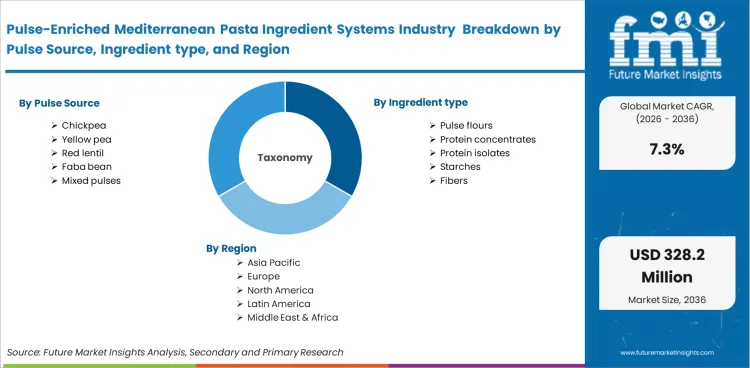
Pulse-Enriched Mediterranean Pasta Ingredient Systems Industry Analysis by Segments
Pulse source:
- Chickpea
- Yellow pea
- Red lentil
- Faba bean
- Mixed pulses
Ingredient type:
- Pulse flours
- Protein concentrates
- Protein isolates
- Starches
- Fibers
Claim platform:
- High protein
- High fiber
- Gluten-free
- Clean label
- Low GI
Pasta format:
- Dry pasta
- Fresh pasta
- Filled pasta
Buyer type:
- Industrial brands
- Private label
- Ingredient blenders
- Foodservice
Region:
- North America
- Latin America
- Europe
- Asia Pacific
- Middle East and Africa
Bibliography
- Food and Agriculture Organization of the United Nations. (2024). World food and agriculture: Statistical yearbook 2024.
- International Pasta Organization. (2024). World Pasta Day 2024: A billion plates of pasta in 10 years to feed the planet.
- United States Department of Agriculture, Foreign Agricultural Service. (2025). Food processing ingredients annual: Italy (IT2025-0002).
- Carlini, B., Lucini, C., & Velázquez, J. (2024). The role of legumes in the sustainable Mediterranean diet: Analysis of the consumption of legumes in the Mediterranean population over the last ten years a PRISMA statement methodology. Sustainability, 16(7), 3081.
This bibliography is provided for reader reference. The full FMI report contains the complete reference list with primary source documentation.
This Report Addresses
- Input constraints faced by industrial food brands adopting pulse isolates.
- Extrusion performance gaps between raw legume flours and optimized functional systems.
- Competitive differences between broad-portfolio suppliers such as Ingredion and regional specialists.
- Country-level industry shifts across Spain, France, Germany, and Tunisia.
- Technical trade-offs between protein yield and final pasta bite geometry.
- Regulatory pressures shaping clean-label formulation strategies across Western Europe.
- Rheological barriers limiting immediate private-label execution without external technical support.
- Starch-protein interactions needed to stabilize dough under 85°C drying cycles.
Frequently Asked Questions
How large is the pulse-enriched Mediterranean pasta ingredient systems sector in 2026?
Sales are expected to reach USD 151.2 million in 2026. This baseline confirms manufacturers are actively financing formulation upgrades rather than treating legume pasta strictly as a niche specialty experiment.
What is the forecast for chickpea and pea ingredients in pasta?
Valuations are expected to lift to USD 305.9 million by 2036. Sustained demand depends partly on better standardization of die-plate hardware so processors can handle different legume hydration profiles with less line disruption.
Which pulse source leads this sector?
Chickpea is expected to account for 33% share in 2026. Its lead reflects stronger sensory familiarity and lower flavor-correction pressure in Mediterranean pasta formulations.
Why does chickpea lead over pea, lentil, and faba bean in Mediterranean pasta concepts?
Formulators often favor chickpea because its natural yellow tone fits familiar pasta expectations and reduces the need for additional color correction.
Which ingredient type is used most in pasta enrichment systems?
Pulse flours are anticipated to hold 47% share in 2026. Pulse flours are used most because they allow broader semolina displacement at lower cost than highly refined protein isolates.
What protein and fiber claims are driving demand?
High protein is positioning to capture 36% share in 2026. Retailers demand front-of-pack macro-nutrient claims to justify premium pricing strategies inside conventional carbohydrate aisles.
How do pulse proteins affect pasta texture and protein claims?
High-protein formulations can lose usable protein quality during processing, so formulators often raise isolate loading to protect final claim performance after drying.
Which pasta format utilizes these ingredients most?
Dry pasta production is expected to account for 67% share in 2026. Dry pasta leads because shelf-stable formats support longer distribution cycles without refrigeration cost.
Which countries lead Mediterranean pulse pasta demand?
Spain leads the Mediterranean set, with demand for Pulse-Enriched Mediterranean Pasta Ingredient Systems projected to advance at a 7.9% CAGR through 2036. France follows at 7.4%, while Turkey is expected to post 6.9% over the same period.
Why does Spain outpace Italy in this niche?
Spain is projected to expand at 7.9% CAGR through 2036, ahead of Italy at 6.3%. Spanish processors are more active in export-led functional pasta programs, while Italian producers remain more careful about texture and semolina authenticity.
What segments matter most in pulse enriched pasta ingredients?
Industrial brands are predicted to command 50% share in 2026. Industrial brands matter most because they can absorb reformulation cost, manage validation work, and scale enriched pasta programs across larger product portfolios.
Who supplies pulse ingredient systems for pasta manufacturers?
Major portfolio suppliers like Roquette Frères and Ingredion compete directly against specialists like Vestkorn. Sourcing directors split contracts to prevent single-vendor lock-in on critical binders.
What are pulse-enriched pasta ingredient systems?
These systems include legume-derived ingredients formulated to partially replace durum wheat in pasta. They combine starches, proteins, and related functional components designed to hold performance under industrial extrusion conditions.
How much pulse flour or protein is typically used in pasta formulation?
Inclusion rates are often capped around practical process limits because excessive pulse loading can distort dough behavior and raise the risk of breakage during cooling and handling.
What are the main formulation challenges in pulse-enriched pasta?
Inconsistent die-expansion forces operators to continuously adjust line speeds. Legume starches hydrate differently than gluten, deforming product shapes immediately upon exiting high-pressure extruder heads.
How is Mediterranean pasta enriched with pulses?
Mediterranean pasta is often enriched by blending pre-treated pulse concentrates or flours into semolina streams to improve dispersion and reduce moisture-management problems during mixing.
Which pulse works best in semolina pasta?
Chickpea inputs integrate most efficiently into durum matrices. Extrusion engineers observe fewer pressure spikes when utilizing chickpea blends compared to unpredictable faba bean isolates.
Are pulse pasta ingredients clean label?
Physically treated flours satisfy clean-label mandates easily. Chemically modified legume starches frequently trigger regulatory rejection across strict European grocery chains.
How do clean label vs high protein pasta premixes compare?
Maximizing protein requires refined isolates that complicate ingredient declarations. Retaining simple packaging labels forces brands to accept lower total protein yields utilizing whole flours.
What limits dry pasta enrichment ingredients?
High-temperature drying stages destroy heat-sensitive legume components. Quality managers dictate exact thermal curves to prevent products from developing unacceptable burnt flavor notes.
Why is pea protein supplier selection critical for pasta?
Differing extraction methods alter specific hydration kinetics. Switching suppliers mid-production can disrupt line performance unless R&D teams recalibrate moisture settings and extrusion conditions.
How does faba bean pasta enrichment perform?
Faba derivatives offer exceptionally neutral flavor profiles. Formulation officers deploy these specific proteins when targeting children's product lines where earthy legume tastes face immediate rejection.
Preview the report firsthand - request a free sample
Get SampleGet the brochure for pricing and purchase details.
Get PDFTable of Content
- Executive Summary
- Global Market Outlook
- Demand-side Trends
- Supply-side Trends
- Technology Roadmap Analysis
- Analysis and Recommendations
- Market Overview
- Market Coverage / Taxonomy
- Market Definition / Scope / Limitations
- Research Methodology
- Chapter Orientation
- Analytical Lens and Working Hypotheses
- Market Structure, Signals, and Trend Drivers
- Benchmarking and Cross-market Comparability
- Market Sizing, Forecasting, and Opportunity Mapping
- Research Design and Evidence Framework
- Desk Research Programme (Secondary Evidence)
- Company Annual and Sustainability Reports
- Peer-reviewed Journals and Academic Literature
- Corporate Websites, Product Literature, and Technical Notes
- Earnings Decks and Investor Briefings
- Statutory Filings and Regulatory Disclosures
- Technical White Papers and Standards Notes
- Trade Journals, Industry Magazines, and Analyst Briefs
- Conference Proceedings, Webinars, and Seminar Materials
- Government Statistics Portals and Public Data Releases
- Press Releases and Reputable Media Coverage
- Specialist Newsletters and Curated Briefings
- Sector Databases and Reference Repositories
- FMI Internal Proprietary Databases and Historical Market Datasets
- Subscription Datasets and Paid Sources
- Social Channels, Communities, and Digital Listening Inputs
- Additional Desk Sources
- Expert Input and Fieldwork (Primary Evidence)
- Primary Modes
- Qualitative Interviews and Expert Elicitation
- Quantitative Surveys and Structured Data Capture
- Blended Approach
- Why Primary Evidence is Used
- Field Techniques
- Interviews
- Surveys
- Focus Groups
- Observational and In-context Research
- Social and Community Interactions
- Stakeholder Universe Engaged
- C-suite Leaders
- Board Members
- Presidents and Vice Presidents
- R&D and Innovation Heads
- Technical Specialists
- Domain Subject-matter Experts
- Scientists
- Physicians and Other Healthcare Professionals
- Governance, Ethics, and Data Stewardship
- Research Ethics
- Data Integrity and Handling
- Primary Modes
- Tooling, Models, and Reference Databases
- Desk Research Programme (Secondary Evidence)
- Data Engineering and Model Build
- Data Acquisition and Ingestion
- Cleaning, Normalisation, and Verification
- Synthesis, Triangulation, and Analysis
- Quality Assurance and Audit Trail
- Market Background
- Market Dynamics
- Drivers
- Restraints
- Opportunity
- Trends
- Scenario Forecast
- Demand in Optimistic Scenario
- Demand in Likely Scenario
- Demand in Conservative Scenario
- Opportunity Map Analysis
- Product Life Cycle Analysis
- Supply Chain Analysis
- Investment Feasibility Matrix
- Value Chain Analysis
- PESTLE and Porter’s Analysis
- Regulatory Landscape
- Regional Parent Market Outlook
- Production and Consumption Statistics
- Import and Export Statistics
- Market Dynamics
- Global Market Analysis 2021 to 2025 and Forecast, 2026 to 2036
- Historical Market Size Value (USD Million) Analysis, 2021 to 2025
- Current and Future Market Size Value (USD Million) Projections, 2026 to 2036
- Y-o-Y Growth Trend Analysis
- Absolute $ Opportunity Analysis
- Global Market Pricing Analysis 2021 to 2025 and Forecast 2026 to 2036
- Global Market Analysis 2021 to 2025 and Forecast 2026 to 2036, By Pulse Source
- Introduction / Key Findings
- Historical Market Size Value (USD Million) Analysis By Pulse Source , 2021 to 2025
- Current and Future Market Size Value (USD Million) Analysis and Forecast By Pulse Source , 2026 to 2036
- Chickpea
- Yellow pea
- Red lentil
- Faba bean
- Mixed pulses
- Chickpea
- Y-o-Y Growth Trend Analysis By Pulse Source , 2021 to 2025
- Absolute $ Opportunity Analysis By Pulse Source , 2026 to 2036
- Global Market Analysis 2021 to 2025 and Forecast 2026 to 2036, By Ingredient type
- Introduction / Key Findings
- Historical Market Size Value (USD Million) Analysis By Ingredient type, 2021 to 2025
- Current and Future Market Size Value (USD Million) Analysis and Forecast By Ingredient type, 2026 to 2036
- Pulse flours
- Protein concentrates
- Protein isolates
- Starches
- Fibers
- Pulse flours
- Y-o-Y Growth Trend Analysis By Ingredient type, 2021 to 2025
- Absolute $ Opportunity Analysis By Ingredient type, 2026 to 2036
- Global Market Analysis 2021 to 2025 and Forecast 2026 to 2036, By Claim platform
- Introduction / Key Findings
- Historical Market Size Value (USD Million) Analysis By Claim platform, 2021 to 2025
- Current and Future Market Size Value (USD Million) Analysis and Forecast By Claim platform, 2026 to 2036
- High protein
- High fiber
- Gluten-free
- Clean label
- Low GI
- High protein
- Y-o-Y Growth Trend Analysis By Claim platform, 2021 to 2025
- Absolute $ Opportunity Analysis By Claim platform, 2026 to 2036
- Global Market Analysis 2021 to 2025 and Forecast 2026 to 2036, By Pasta format
- Introduction / Key Findings
- Historical Market Size Value (USD Million) Analysis By Pasta format, 2021 to 2025
- Current and Future Market Size Value (USD Million) Analysis and Forecast By Pasta format, 2026 to 2036
- Dry pasta
- Fresh pasta
- Filled pasta
- Dry pasta
- Y-o-Y Growth Trend Analysis By Pasta format, 2021 to 2025
- Absolute $ Opportunity Analysis By Pasta format, 2026 to 2036
- Global Market Analysis 2021 to 2025 and Forecast 2026 to 2036, By Buyer type
- Introduction / Key Findings
- Historical Market Size Value (USD Million) Analysis By Buyer type, 2021 to 2025
- Current and Future Market Size Value (USD Million) Analysis and Forecast By Buyer type, 2026 to 2036
- Industrial brands
- Private label
- Ingredient blenders
- Foodservice
- Industrial brands
- Y-o-Y Growth Trend Analysis By Buyer type, 2021 to 2025
- Absolute $ Opportunity Analysis By Buyer type, 2026 to 2036
- Global Market Analysis 2021 to 2025 and Forecast 2026 to 2036, By Region
- Introduction
- Historical Market Size Value (USD Million) Analysis By Region, 2021 to 2025
- Current Market Size Value (USD Million) Analysis and Forecast By Region, 2026 to 2036
- North America
- Latin America
- Western Europe
- Eastern Europe
- East Asia
- South Asia and Pacific
- Middle East & Africa
- Market Attractiveness Analysis By Region
- North America Market Analysis 2021 to 2025 and Forecast 2026 to 2036, By Country
- Historical Market Size Value (USD Million) Trend Analysis By Market Taxonomy, 2021 to 2025
- Market Size Value (USD Million) Forecast By Market Taxonomy, 2026 to 2036
- By Country
- USA
- Canada
- Mexico
- By Pulse Source
- By Ingredient type
- By Claim platform
- By Pasta format
- By Buyer type
- By Country
- Market Attractiveness Analysis
- By Country
- By Pulse Source
- By Ingredient type
- By Claim platform
- By Pasta format
- By Buyer type
- Key Takeaways
- Latin America Market Analysis 2021 to 2025 and Forecast 2026 to 2036, By Country
- Historical Market Size Value (USD Million) Trend Analysis By Market Taxonomy, 2021 to 2025
- Market Size Value (USD Million) Forecast By Market Taxonomy, 2026 to 2036
- By Country
- Brazil
- Chile
- Rest of Latin America
- By Pulse Source
- By Ingredient type
- By Claim platform
- By Pasta format
- By Buyer type
- By Country
- Market Attractiveness Analysis
- By Country
- By Pulse Source
- By Ingredient type
- By Claim platform
- By Pasta format
- By Buyer type
- Key Takeaways
- Western Europe Market Analysis 2021 to 2025 and Forecast 2026 to 2036, By Country
- Historical Market Size Value (USD Million) Trend Analysis By Market Taxonomy, 2021 to 2025
- Market Size Value (USD Million) Forecast By Market Taxonomy, 2026 to 2036
- By Country
- Germany
- UK
- Italy
- Spain
- France
- Nordic
- BENELUX
- Rest of Western Europe
- By Pulse Source
- By Ingredient type
- By Claim platform
- By Pasta format
- By Buyer type
- By Country
- Market Attractiveness Analysis
- By Country
- By Pulse Source
- By Ingredient type
- By Claim platform
- By Pasta format
- By Buyer type
- Key Takeaways
- Eastern Europe Market Analysis 2021 to 2025 and Forecast 2026 to 2036, By Country
- Historical Market Size Value (USD Million) Trend Analysis By Market Taxonomy, 2021 to 2025
- Market Size Value (USD Million) Forecast By Market Taxonomy, 2026 to 2036
- By Country
- Russia
- Poland
- Hungary
- Balkan & Baltic
- Rest of Eastern Europe
- By Pulse Source
- By Ingredient type
- By Claim platform
- By Pasta format
- By Buyer type
- By Country
- Market Attractiveness Analysis
- By Country
- By Pulse Source
- By Ingredient type
- By Claim platform
- By Pasta format
- By Buyer type
- Key Takeaways
- East Asia Market Analysis 2021 to 2025 and Forecast 2026 to 2036, By Country
- Historical Market Size Value (USD Million) Trend Analysis By Market Taxonomy, 2021 to 2025
- Market Size Value (USD Million) Forecast By Market Taxonomy, 2026 to 2036
- By Country
- China
- Japan
- South Korea
- By Pulse Source
- By Ingredient type
- By Claim platform
- By Pasta format
- By Buyer type
- By Country
- Market Attractiveness Analysis
- By Country
- By Pulse Source
- By Ingredient type
- By Claim platform
- By Pasta format
- By Buyer type
- Key Takeaways
- South Asia and Pacific Market Analysis 2021 to 2025 and Forecast 2026 to 2036, By Country
- Historical Market Size Value (USD Million) Trend Analysis By Market Taxonomy, 2021 to 2025
- Market Size Value (USD Million) Forecast By Market Taxonomy, 2026 to 2036
- By Country
- India
- ASEAN
- Australia & New Zealand
- Rest of South Asia and Pacific
- By Pulse Source
- By Ingredient type
- By Claim platform
- By Pasta format
- By Buyer type
- By Country
- Market Attractiveness Analysis
- By Country
- By Pulse Source
- By Ingredient type
- By Claim platform
- By Pasta format
- By Buyer type
- Key Takeaways
- Middle East & Africa Market Analysis 2021 to 2025 and Forecast 2026 to 2036, By Country
- Historical Market Size Value (USD Million) Trend Analysis By Market Taxonomy, 2021 to 2025
- Market Size Value (USD Million) Forecast By Market Taxonomy, 2026 to 2036
- By Country
- Kingdom of Saudi Arabia
- Other GCC Countries
- Turkiye
- South Africa
- Other African Union
- Rest of Middle East & Africa
- By Pulse Source
- By Ingredient type
- By Claim platform
- By Pasta format
- By Buyer type
- By Country
- Market Attractiveness Analysis
- By Country
- By Pulse Source
- By Ingredient type
- By Claim platform
- By Pasta format
- By Buyer type
- Key Takeaways
- Key Countries Market Analysis
- USA
- Pricing Analysis
- Market Share Analysis, 2025
- By Pulse Source
- By Ingredient type
- By Claim platform
- By Pasta format
- By Buyer type
- Canada
- Pricing Analysis
- Market Share Analysis, 2025
- By Pulse Source
- By Ingredient type
- By Claim platform
- By Pasta format
- By Buyer type
- Mexico
- Pricing Analysis
- Market Share Analysis, 2025
- By Pulse Source
- By Ingredient type
- By Claim platform
- By Pasta format
- By Buyer type
- Brazil
- Pricing Analysis
- Market Share Analysis, 2025
- By Pulse Source
- By Ingredient type
- By Claim platform
- By Pasta format
- By Buyer type
- Chile
- Pricing Analysis
- Market Share Analysis, 2025
- By Pulse Source
- By Ingredient type
- By Claim platform
- By Pasta format
- By Buyer type
- Germany
- Pricing Analysis
- Market Share Analysis, 2025
- By Pulse Source
- By Ingredient type
- By Claim platform
- By Pasta format
- By Buyer type
- UK
- Pricing Analysis
- Market Share Analysis, 2025
- By Pulse Source
- By Ingredient type
- By Claim platform
- By Pasta format
- By Buyer type
- Italy
- Pricing Analysis
- Market Share Analysis, 2025
- By Pulse Source
- By Ingredient type
- By Claim platform
- By Pasta format
- By Buyer type
- Spain
- Pricing Analysis
- Market Share Analysis, 2025
- By Pulse Source
- By Ingredient type
- By Claim platform
- By Pasta format
- By Buyer type
- France
- Pricing Analysis
- Market Share Analysis, 2025
- By Pulse Source
- By Ingredient type
- By Claim platform
- By Pasta format
- By Buyer type
- India
- Pricing Analysis
- Market Share Analysis, 2025
- By Pulse Source
- By Ingredient type
- By Claim platform
- By Pasta format
- By Buyer type
- ASEAN
- Pricing Analysis
- Market Share Analysis, 2025
- By Pulse Source
- By Ingredient type
- By Claim platform
- By Pasta format
- By Buyer type
- Australia & New Zealand
- Pricing Analysis
- Market Share Analysis, 2025
- By Pulse Source
- By Ingredient type
- By Claim platform
- By Pasta format
- By Buyer type
- China
- Pricing Analysis
- Market Share Analysis, 2025
- By Pulse Source
- By Ingredient type
- By Claim platform
- By Pasta format
- By Buyer type
- Japan
- Pricing Analysis
- Market Share Analysis, 2025
- By Pulse Source
- By Ingredient type
- By Claim platform
- By Pasta format
- By Buyer type
- South Korea
- Pricing Analysis
- Market Share Analysis, 2025
- By Pulse Source
- By Ingredient type
- By Claim platform
- By Pasta format
- By Buyer type
- Russia
- Pricing Analysis
- Market Share Analysis, 2025
- By Pulse Source
- By Ingredient type
- By Claim platform
- By Pasta format
- By Buyer type
- Poland
- Pricing Analysis
- Market Share Analysis, 2025
- By Pulse Source
- By Ingredient type
- By Claim platform
- By Pasta format
- By Buyer type
- Hungary
- Pricing Analysis
- Market Share Analysis, 2025
- By Pulse Source
- By Ingredient type
- By Claim platform
- By Pasta format
- By Buyer type
- Kingdom of Saudi Arabia
- Pricing Analysis
- Market Share Analysis, 2025
- By Pulse Source
- By Ingredient type
- By Claim platform
- By Pasta format
- By Buyer type
- Turkiye
- Pricing Analysis
- Market Share Analysis, 2025
- By Pulse Source
- By Ingredient type
- By Claim platform
- By Pasta format
- By Buyer type
- South Africa
- Pricing Analysis
- Market Share Analysis, 2025
- By Pulse Source
- By Ingredient type
- By Claim platform
- By Pasta format
- By Buyer type
- USA
- Market Structure Analysis
- Competition Dashboard
- Competition Benchmarking
- Market Share Analysis of Top Players
- By Regional
- By Pulse Source
- By Ingredient type
- By Claim platform
- By Pasta format
- By Buyer type
- Competition Analysis
- Competition Deep Dive
- Roquette Frères
- Overview
- Product Portfolio
- Profitability by Market Segments (Product/Age /Sales Channel/Region)
- Sales Footprint
- Strategy Overview
- Marketing Strategy
- Product Strategy
- Channel Strategy
- Ingredion
- COSUCRA
- BENEO
- Vestkorn
- ADM
- Roquette Frères
- Competition Deep Dive
- Assumptions & Acronyms Used


