

- Market Size (2026)
- USD 1100.0 Mn
- Forecast (2036)
- USD 3266.9 Mn
- CAGR (2026 to 2036)
- 11.5%
High-Nickel Binders Market Forecast and Outlook 2026 to 2036
The high-nickel binders market stands as a specialized yet rapidly expanding segment within the lithium-ion battery value chain, projected to surge from USD 1,100.0 million in 2026 to USD 3,267.0 million by 2036, achieving a compound annual growth rate of 11.5% throughout the forecast period. This market encompasses advanced polymer formulations specifically engineered to address the unique challenges posed by high-nickel cathode materials, which while delivering exceptional energy density, create unprecedented demands on electrode binding systems due to their aggressive surface chemistry and structural instability during cycling. The growth trajectory reflects the battery industry's aggressive migration toward nickel-rich cathodes that enable electric vehicles to achieve competitive driving ranges while maintaining acceptable battery costs.
The strategic importance of high-nickel binders extends beyond immediate performance considerations to encompass the fundamental viability of next-generation battery technologies that enable mass-market electric vehicle adoption. Battery manufacturers investing billions in high-nickel cathode technologies depend on advanced binder systems to deliver the cycle life, safety, and manufacturing reliability required for automotive applications. The market's robust growth reflects the successful commercialization of binder technologies that transform high-nickel cathodes from laboratory curiosities to practical commercial solutions supporting the global transition toward sustainable transportation.
Quick Stats for High-Nickel Binders Market
- High-Nickel Binders Market Value (2026): USD 1,100.0 million
- High-Nickel Binders Market Forecast Value (2036): USD 3,267.0 million
- High-Nickel Binders Market Forecast CAGR: 11.5%
- Leading Binder Chemistry in High-Nickel Binders Market: PVDF-based (38%)
- Leading Customer in High-Nickel Binders Market: Cell OEMs (62%)
- Key Growth Countries in High-Nickel Binders Market: China, USA., UK, Germany, Japan
- Key Players in High-Nickel Binders Market: Kureha, Arkema, Solvay, Zeon Corporation, LG Chem
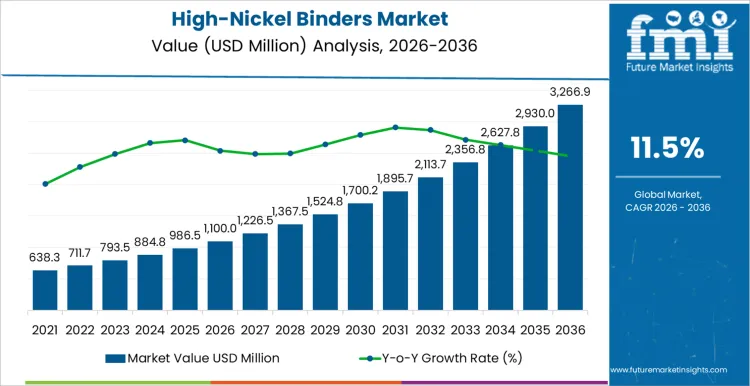
High-Nickel Binders Market Key Takeaways
| Metric | Value |
|---|---|
| Market Value (2026) | USD 1,100.0 million |
| Market Forecast Value (2036) | USD 3,267.0 million |
| Forecast CAGR 2026 to 2036 | 11.5% |
Why Are High-Nickel Cathodes Revolutionizing Binder Requirements?
The fundamental transformation occurring in lithium-ion battery chemistry through high-nickel cathode adoption creates revolutionary challenges for electrode binder systems that traditional polymer formulations cannot address effectively.
High-nickel cathodes deliver energy densities approaching 250 Wh/kg while reducing dependence on scarce cobalt resources, but they generate aggressive chemical environments that attack conventional binders through hydrofluoric acid formation, oxygen release, and surface decomposition products.
These cathode materials undergo dramatic structural changes during operation, including phase transitions, particle cracking, and surface reconstruction that create mechanical stress exceeding the capabilities of standard PVDF binder systems.
Battery manufacturers pursuing high-nickel cathode technologies face critical decisions regarding binder selection that directly impact product performance, safety characteristics, and commercial viability.
The wrong binder choice can result in rapid capacity fade, safety risks, and manufacturing yield problems that undermine the economic advantages of high-nickel chemistry. Successful binder systems enable high-nickel cathodes to achieve their theoretical performance potential while maintaining the reliability and safety standards essential for consumer acceptance and regulatory approval in transportation applications.
How Is the Market Structured Across Binder Technology Platforms?
The high-nickel binders market exhibits sophisticated segmentation reflecting diverse approaches to addressing the unique challenges posed by nickel-rich cathode materials through varying polymer chemistries, processing methodologies, and application strategies. Market structure encompasses binder chemistry categories representing different molecular approaches to high-nickel compatibility, cathode type classifications addressing specific material challenges, and processing system categories enabling different manufacturing strategies. This multidimensional segmentation reflects the experimental nature of high-nickel binder technology where multiple approaches compete for optimal performance across diverse application requirements.
Which Binder Chemistry Platform Dominates Commercial Applications?
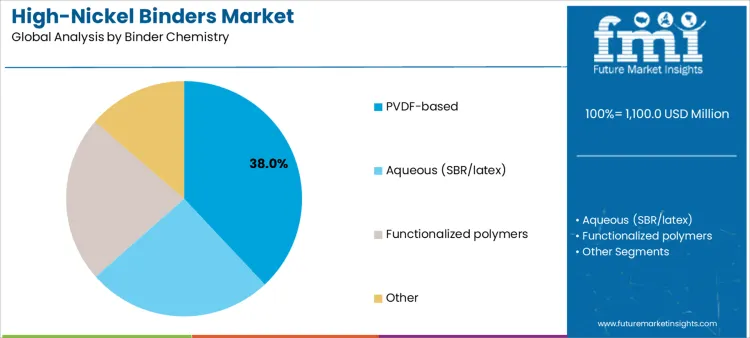
PVDF-based binders command 38.0% market share despite their inherent limitations with high-nickel cathodes, reflecting the battery industry's preference for proven chemistries with established manufacturing processes and regulatory approvals. Modified PVDF formulations incorporate additives, crosslinking agents, and surface treatments that enhance compatibility with high-nickel cathodes while maintaining the processing advantages and electrochemical stability that made PVDF the industry standard. These enhanced PVDF systems enable incremental improvements in high-nickel cathode performance while minimizing manufacturing disruption and qualification requirements.
Which Cathode Technology Drives Market Demand?
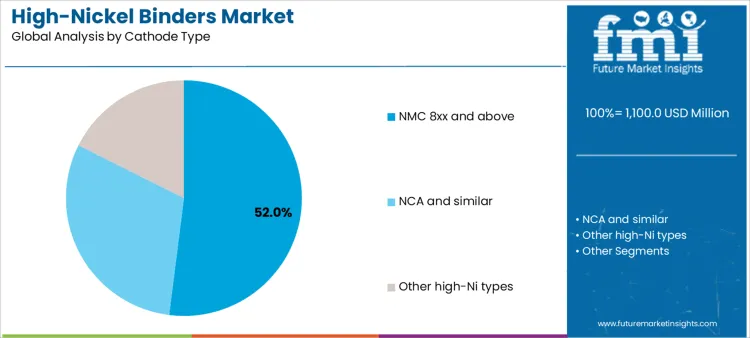
NMC 8xx and above formulations dominate with 52.0% market share, representing the most aggressive high-nickel chemistries that demand the most advanced binder solutions due to their extreme structural instability and surface reactivity. These cathodes, including NMC 811, NMC 911, and emerging NMC 955 formulations, present the greatest challenges for binder systems while offering maximum energy density benefits that justify advanced binder investments. The segment drives innovation in binder chemistry as manufacturers seek solutions that enable stable cycling of these materials while maintaining safety and manufacturing viability.
Which Processing Platform Enables Optimal Manufacturing?
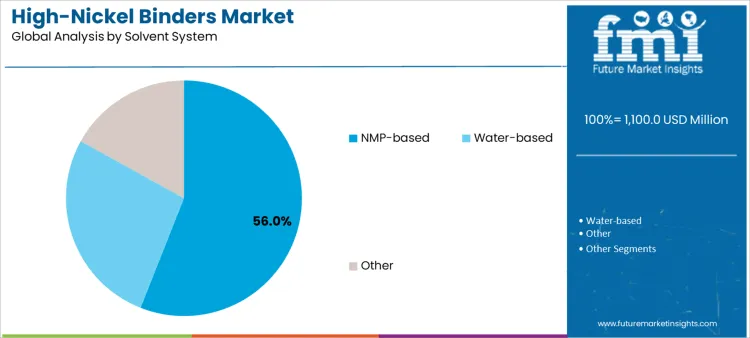
NMP-based solvent systems dominate with 56.0% market share, reflecting the superior solubility characteristics and processing advantages that N-methyl-2-pyrrolidone provides for high-performance binder formulations despite environmental and cost concerns. NMP enables dissolution of advanced polymer systems including functionalized PVDF variants and specialty chemistries that cannot be processed effectively in alternative solvents. The solvent's unique properties including high boiling point, excellent polymer solubility, and thermal stability make it essential for processing high-nickel binder formulations that require elevated processing temperatures.
NMP-based processing provides manufacturing advantages including uniform coating quality, controlled drying kinetics, and compatibility with existing electrode manufacturing equipment that minimize production disruption during high-nickel cathode adoption. Advanced NMP systems incorporate solvent recovery equipment, emission control technology, and specialized handling procedures that address environmental concerns while maintaining processing advantages. The segment benefits from established manufacturing infrastructure and proven processing methods that support large-scale production while meeting environmental regulations.
Which Customer Category Leads Technology Adoption?
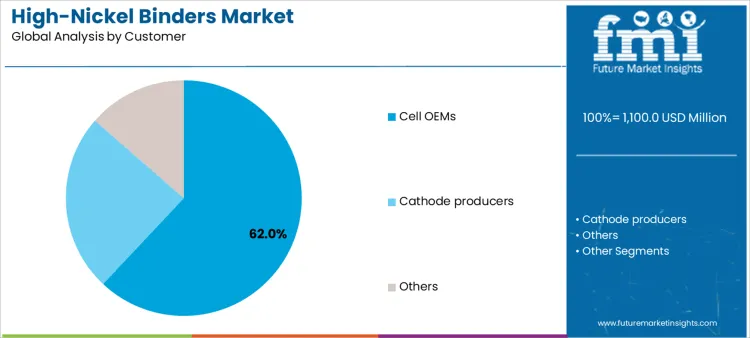
Cell OEMs command 62.0% market share, reflecting their direct responsibility for battery performance and their substantial investments in optimizing electrode formulations for specific high-nickel cathode applications. Battery manufacturers maintain comprehensive technical capabilities for evaluating binder performance while possessing the market influence necessary to drive customized binder development for their specific requirements. These customers typically operate at the forefront of high-nickel technology adoption while maintaining close relationships with binder suppliers throughout development and commercialization phases.
Cell OEM customers drive binder innovation through demanding performance requirements, extensive testing capabilities, and willingness to invest in advanced binder technologies that provide competitive advantages. Their manufacturing volumes support economic justification for specialized binder development while their technical expertise enables sophisticated evaluation of binder performance across multiple metrics including adhesion, flexibility, chemical resistance, and electrochemical compatibility. The segment benefits from long-term technology roadmaps that enable strategic binder development aligned with future cathode technology evolution.
How Is Battery Safety Evolution Reshaping Binder Requirements?
The increasing emphasis on battery safety driven by high-profile thermal runaway incidents and stringent automotive safety regulations creates additional performance requirements for high-nickel binders that extend beyond traditional electrochemical and mechanical considerations. High-nickel cathodes present elevated safety risks due to their thermal instability and oxygen release characteristics that demand binder formulations capable of maintaining electrode integrity under thermal abuse conditions while potentially contributing to thermal runaway mitigation. Advanced binder systems incorporate flame retardant additives, thermal shutdown mechanisms, and gas generation control that enhance overall battery safety performance.
Safety validation requirements for automotive applications include comprehensive thermal characterization, abuse testing, and failure mode analysis that evaluate binder performance under extreme conditions including overcharging, overheating, and mechanical damage scenarios. Binder suppliers must demonstrate not only normal operating performance but also behavior during emergency conditions that affect passenger safety and emergency responder protocols. These requirements drive development of multifunctional binder systems that provide safety benefits while maintaining electrochemical performance essential for competitive battery operation.
Do Environmental Regulations Drive Technology Innovation?
Environmental regulations targeting organic solvent emissions and workplace safety create significant pressure for high-nickel binder technology evolution toward water-based processing systems and environmentally sustainable chemistry platforms. Traditional NMP-based processing faces increasing regulatory scrutiny due to reproductive health concerns and environmental impact while water-based alternatives require sophisticated formulation development to achieve comparable performance with high-nickel cathodes. This regulatory environment drives innovation in aqueous binder chemistry while creating competitive advantages for companies developing effective water-based solutions.
How do Cost Pressures Influence Technology Selection?
The intense cost pressure facing battery manufacturers as they pursue mass-market electric vehicle adoption creates complex trade-offs between binder performance optimization and cost minimization that influence technology development and market adoption patterns. High-nickel binders often command premium pricing due to their specialized chemistry and development costs while enabling cathode technologies that provide system-level cost benefits through improved energy density and reduced material costs. Battery manufacturers must evaluate total cost implications including binder costs, processing requirements, yield impacts, and performance benefits to optimize their technology selections.
Advanced binder technologies that enable superior high-nickel cathode performance can justify higher material costs through improved battery characteristics including extended cycle life, enhanced safety, and reduced manufacturing complexity. However, cost-sensitive applications may favor lower-performance binder solutions that provide acceptable functionality at reduced material costs. This dynamic creates market segmentation opportunities for binder suppliers who can offer technology platforms addressing different cost-performance requirements across diverse application segments.
How Is the High-Nickel Binders Market Expected to Evolve Across Major Nations?
The global high-nickel binders market demonstrates distinct regional development patterns reflecting varying approaches to battery technology advancement, manufacturing strategies, and regulatory environments that influence binder technology adoption and development priorities.
Regional market evolution encompasses both established battery manufacturing centers implementing advanced high-nickel technologies and emerging markets developing domestic capabilities for strategic technology independence and economic development. The geographic distribution reflects complex interactions between research capabilities, manufacturing infrastructure, government policies, and access to advanced material technologies.
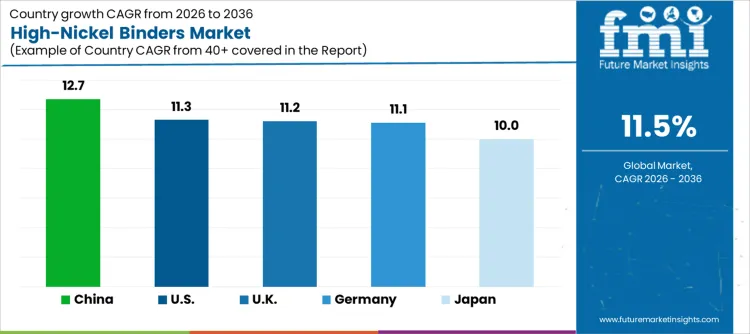
| Country | CAGR (%) |
|---|---|
| China | 12.7% |
| USA. | 11.3% |
| UK | 11.2% |
| Germany | 11.1% |
| Japan | 10.0% |
What Drives China's Market Leadership?
China's high-nickel binders market is projected to achieve a CAGR of 12.7%, representing the highest growth rate globally and reflecting the country's dominant position in lithium-ion battery manufacturing combined with aggressive adoption of high-nickel cathode technologies across major battery producers.
Chinese companies including CATL, BYD, and others lead global high-nickel cathode implementation while driving demand for advanced binder solutions that enable competitive battery performance. The market expansion benefits from substantial government support for electric vehicle adoption, comprehensive battery supply chain development, and strategic investments in advanced battery material technologies.
Chinese binder development leverages the country's extensive chemical manufacturing capabilities, established polymer production infrastructure, and close integration between material suppliers and battery manufacturers that enable rapid technology optimization and commercialization.
Government initiatives supporting new energy vehicle development include specific performance targets that drive adoption of high-nickel cathodes while creating sustained demand for compatible binder technologies. Chinese manufacturers benefit from economies of scale, vertical integration opportunities, and access to diverse raw material sources that support cost-effective binder production.
How are US Innovation Ecosystems Advancing Technology?
The USA’s high-nickel binders market is projected to record a CAGR of 11.3%, reflecting the country's leadership in advanced polymer chemistry research and substantial investments in domestic battery manufacturing capabilities through government incentives and private sector commitments.
American chemical companies including established suppliers and innovative startups lead development of next-generation binder technologies through advanced molecular design, specialty chemistry expertise, and comprehensive application development programs. The market benefits from strong research university partnerships, government funding for battery technology development, and venture capital investments supporting innovative material technologies.
US binder development emphasizes proprietary technology development, intellectual property protection, and premium performance characteristics that provide competitive advantages in high-value applications including automotive and aerospace batteries. American companies leverage expertise in specialty polymers, advanced materials science, and precision chemistry to develop sophisticated binder formulations addressing specific high-nickel cathode challenges. Government support for domestic battery supply chain development creates opportunities for US binder suppliers while addressing strategic technology independence objectives.
Why does the UK Emphasize Research Excellence?
The UK's high-nickel binders market is estimated to expand at a CAGR of 11.2%, supported by world-class research capabilities in polymer science, electrochemistry, and advanced materials through leading universities and research institutions. British companies and research organizations contribute fundamental advances in binder chemistry while developing commercial applications addressing specific high-nickel cathode challenges. The market benefits from government funding for battery technology research, automotive industry transformation initiatives, and strategic partnerships between academic institutions and international battery companies.
UK binder development emphasizes fundamental research, molecular design innovation, and sustainable chemistry approaches that address both performance requirements and environmental considerations. Research institutions including universities and the Faraday Institution advance understanding of binder-cathode interactions while developing practical solutions for commercial battery applications. The country's focus on intellectual property development and technology licensing creates opportunities for commercializing advanced binder technologies through partnerships with international manufacturers.
How does Germany's Chemical Excellence Support Market Growth?
Germany's high-nickel binders market is likely to rise at a CAGR of 11.1%, reflecting the country's leadership in chemical manufacturing, automotive engineering, and systematic technology development that creates demand for premium binder solutions addressing automotive battery requirements. German chemical companies including BASF and others maintain extensive expertise in specialty polymers while developing high-nickel specific formulations that meet stringent automotive performance and safety standards. The market benefits from close collaboration between chemical suppliers, automotive manufacturers, and battery companies developing integrated solutions for electric vehicle applications.
German binder development emphasizes systematic optimization, comprehensive characterization, and quality assurance approaches that support automotive application requirements including long-term reliability, safety performance, and manufacturing consistency. The country's automotive industry transformation toward electrification drives sustained investment in battery technology while creating demanding performance requirements for binder suppliers. Research institutions and corporate laboratories advance binder science through fundamental research combined with practical application development.
What drives Japan's Precision Approach?
Japan's high-nickel binders market is likely to expand at a CAGR of 10.0%, reflecting the country's emphasis on precision manufacturing, quality excellence, and systematic technology refinement that creates demand for premium binder solutions meeting exceptional performance standards. Japanese chemical companies and battery manufacturers maintain rigorous quality requirements while developing high-nickel binder technologies that address specific technical challenges through careful optimization and continuous improvement approaches. The market benefits from Japan's leadership in materials science, established chemical manufacturing capabilities, and commitment to long-term technology development.
Japanese binder development emphasizes fundamental understanding, systematic optimization, and incremental improvement approaches that create technological foundations for superior commercial performance. Companies including traditional chemical suppliers and electronics manufacturers invest in high-nickel binder research while building capabilities for high-quality production meeting automotive and electronics application requirements. The focus on precision manufacturing and quality control creates opportunities for binder technologies that provide exceptional consistency and reliability.
How are Manufacturers Securing Market Share?
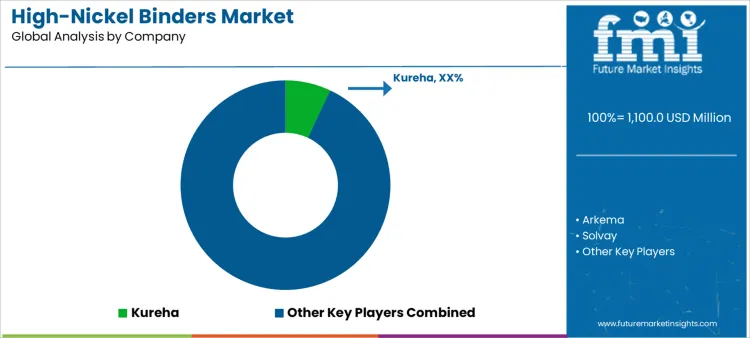
The competitive landscape for high-nickel binders is characterized by intense technological competition among established chemical companies, specialty polymer suppliers, and emerging technology companies developing innovative solutions for high-nickel cathode applications. Market participants compete based on binder performance characteristics, technical support capabilities, manufacturing scalability, and ability to develop customized solutions addressing specific customer requirements and application challenges. Strategic partnerships between binder suppliers and battery manufacturers become essential for technology validation, commercial scaling, and market penetration in rapidly evolving high-nickel cathode markets.
Innovation cycles in high-nickel binders accelerate as companies develop solutions addressing emerging cathode technologies including ultra-high nickel formulations, novel dopant strategies, and advanced cathode architectures that present unique binder challenges. Leading companies invest heavily in research facilities, application laboratories, and pilot production capabilities that demonstrate technology readiness for commercial battery manufacturing. Intellectual property development becomes critical for establishing competitive positioning while merger and acquisition activities provide access to complementary technologies and market opportunities.
Key Players in the High-Nickel Binders Market
- Kureha
- Arkema
- Solvay
- Zeon Corporation
- LG Chem
- Dow
- Shin-Etsu Chemical
- Wacker Chemie
- BASF
- JSR Corporation
Scope of Report
| Items | Values |
|---|---|
| Quantitative Units | USD Million |
| Binder Chemistry Segments | PVDF-based; Aqueous (SBR/Latex); Functionalized Polymers; Other |
| Cathode Type Categories | NMC 8xx and Above; NCA and Similar; Other High-Ni Types |
| Solvent System Types | NMP-based; Water-based; Other |
| Customer Categories | Cell OEMs; Cathode Producers; Others |
| Regions Covered | North America, Europe, Asia Pacific, Latin America, Middle East & Africa |
| Key Countries | USA, Germany, China, UK, Japan |
| Key Companies Profiled | Kureha, Arkema, Solvay, Zeon Corporation, LG Chem, and others |
High-Nickel Binders Market by Segments
By Binder Chemistry:
- PVDF-based
- Aqueous (SBR/Latex)
- Functionalized Polymers
- Other
By Cathode Type:
- NMC 8xx and Above
- NCA and Similar
- Other High-Ni Types
By Solvent System:
- NMP-based
- Water-based
- Other
By Customer:
- Cell OEMs
- Cathode Producers
- Others
Bibliography
- World Health Organization. (2024). Global environmental health report 2024. WHO Press.
- United Nations Environment Programme. (2024). Chemicals and sustainable development: Global assessment report. UNEP Publishing.
- National Institute of Standards and Technology. (2024). Battery materials and standards: Annual review 2024. USA. Department of Commerce.
- European Commission. (2024). Energy storage and battery material policy guidelines. Publications Office of the European Union.
Frequently Asked Questions
How big is the high-nickel binders market in 2026?
The global high-nickel binders market is estimated to be valued at USD 1,100.0 million in 2026.
What will be the size of high-nickel binders market in 2036?
The market size for the high-nickel binders market is projected to reach USD 3,266.9 million by 2036.
How much will be the high-nickel binders market growth between 2026 and 2036?
The high-nickel binders market is expected to grow at a 11.5% CAGR between 2026 and 2036.
What are the key product types in the high-nickel binders market?
The key product types in high-nickel binders market are pvdf-based, aqueous (sbr/latex), functionalized polymers and other.
Which cathode type segment to contribute significant share in the high-nickel binders market in 2026?
In terms of cathode type, nmc 8xx and above segment to command 52.0% share in the high-nickel binders market in 2026.
Preview the report firsthand - request a free sample
Get SampleGet the brochure for pricing and purchase details.
Get PDFTable of Content
- Executive Summary
- Global Market Outlook
- Demand-side Trends
- Supply-side Trends
- Technology Roadmap Analysis
- Analysis and Recommendations
- Market Overview
- Market Coverage / Taxonomy
- Market Definition / Scope / Limitations
- Market Background
- Market Dynamics
- Drivers
- Restraints
- Opportunity
- Trends
- Scenario Forecast
- Demand in Optimistic Scenario
- Demand in Likely Scenario
- Demand in Conservative Scenario
- Opportunity Map Analysis
- Product Life Cycle Analysis
- Supply Chain Analysis
- Investment Feasibility Matrix
- Value Chain Analysis
- PESTLE and Porter’s Analysis
- Regulatory Landscape
- Regional Parent Market Outlook
- Production and Consumption Statistics
- Import and Export Statistics
- Market Dynamics
- Global Market Analysis 2021 to 2025 and Forecast, 2026 to 2036
- Historical Market Size Value (USD Million) Analysis, 2021 to 2025
- Current and Future Market Size Value (USD Million) Projections, 2026 to 2036
- Y-o-Y Growth Trend Analysis
- Absolute $ Opportunity Analysis
- Global Market Pricing Analysis 2021 to 2025 and Forecast 2026 to 2036
- Global Market Analysis 2021 to 2025 and Forecast 2026 to 2036, By Binder Chemistry
- Introduction / Key Findings
- Historical Market Size Value (USD Million) Analysis By Binder Chemistry , 2021 to 2025
- Current and Future Market Size Value (USD Million) Analysis and Forecast By Binder Chemistry , 2026 to 2036
- PVDF-based
- Aqueous (SBR/latex)
- Functionalized polymers
- Other
- PVDF-based
- Y-o-Y Growth Trend Analysis By Binder Chemistry , 2021 to 2025
- Absolute $ Opportunity Analysis By Binder Chemistry , 2026 to 2036
- Global Market Analysis 2021 to 2025 and Forecast 2026 to 2036, By Cathode Type
- Introduction / Key Findings
- Historical Market Size Value (USD Million) Analysis By Cathode Type, 2021 to 2025
- Current and Future Market Size Value (USD Million) Analysis and Forecast By Cathode Type, 2026 to 2036
- NMC 8xx and above
- NCA and similar
- Other high-Ni types
- NMC 8xx and above
- Y-o-Y Growth Trend Analysis By Cathode Type, 2021 to 2025
- Absolute $ Opportunity Analysis By Cathode Type, 2026 to 2036
- Global Market Analysis 2021 to 2025 and Forecast 2026 to 2036, By Solvent System
- Introduction / Key Findings
- Historical Market Size Value (USD Million) Analysis By Solvent System, 2021 to 2025
- Current and Future Market Size Value (USD Million) Analysis and Forecast By Solvent System, 2026 to 2036
- NMP-based
- Water-based
- Other
- NMP-based
- Y-o-Y Growth Trend Analysis By Solvent System, 2021 to 2025
- Absolute $ Opportunity Analysis By Solvent System, 2026 to 2036
- Global Market Analysis 2021 to 2025 and Forecast 2026 to 2036, By Customer
- Introduction / Key Findings
- Historical Market Size Value (USD Million) Analysis By Customer, 2021 to 2025
- Current and Future Market Size Value (USD Million) Analysis and Forecast By Customer, 2026 to 2036
- Cell OEMs
- Cathode producers
- Others
- Cell OEMs
- Y-o-Y Growth Trend Analysis By Customer, 2021 to 2025
- Absolute $ Opportunity Analysis By Customer, 2026 to 2036
- Global Market Analysis 2021 to 2025 and Forecast 2026 to 2036, By Region
- Introduction
- Historical Market Size Value (USD Million) Analysis By Region, 2021 to 2025
- Current Market Size Value (USD Million) Analysis and Forecast By Region, 2026 to 2036
- North America
- Latin America
- Western Europe
- Eastern Europe
- East Asia
- South Asia and Pacific
- Middle East & Africa
- Market Attractiveness Analysis By Region
- North America Market Analysis 2021 to 2025 and Forecast 2026 to 2036, By Country
- Historical Market Size Value (USD Million) Trend Analysis By Market Taxonomy, 2021 to 2025
- Market Size Value (USD Million) Forecast By Market Taxonomy, 2026 to 2036
- By Country
- USA
- Canada
- Mexico
- By Binder Chemistry
- By Cathode Type
- By Solvent System
- By Customer
- By Country
- Market Attractiveness Analysis
- By Country
- By Binder Chemistry
- By Cathode Type
- By Solvent System
- By Customer
- Key Takeaways
- Latin America Market Analysis 2021 to 2025 and Forecast 2026 to 2036, By Country
- Historical Market Size Value (USD Million) Trend Analysis By Market Taxonomy, 2021 to 2025
- Market Size Value (USD Million) Forecast By Market Taxonomy, 2026 to 2036
- By Country
- Brazil
- Chile
- Rest of Latin America
- By Binder Chemistry
- By Cathode Type
- By Solvent System
- By Customer
- By Country
- Market Attractiveness Analysis
- By Country
- By Binder Chemistry
- By Cathode Type
- By Solvent System
- By Customer
- Key Takeaways
- Western Europe Market Analysis 2021 to 2025 and Forecast 2026 to 2036, By Country
- Historical Market Size Value (USD Million) Trend Analysis By Market Taxonomy, 2021 to 2025
- Market Size Value (USD Million) Forecast By Market Taxonomy, 2026 to 2036
- By Country
- Germany
- UK
- Italy
- Spain
- France
- Nordic
- BENELUX
- Rest of Western Europe
- By Binder Chemistry
- By Cathode Type
- By Solvent System
- By Customer
- By Country
- Market Attractiveness Analysis
- By Country
- By Binder Chemistry
- By Cathode Type
- By Solvent System
- By Customer
- Key Takeaways
- Eastern Europe Market Analysis 2021 to 2025 and Forecast 2026 to 2036, By Country
- Historical Market Size Value (USD Million) Trend Analysis By Market Taxonomy, 2021 to 2025
- Market Size Value (USD Million) Forecast By Market Taxonomy, 2026 to 2036
- By Country
- Russia
- Poland
- Hungary
- Balkan & Baltic
- Rest of Eastern Europe
- By Binder Chemistry
- By Cathode Type
- By Solvent System
- By Customer
- By Country
- Market Attractiveness Analysis
- By Country
- By Binder Chemistry
- By Cathode Type
- By Solvent System
- By Customer
- Key Takeaways
- East Asia Market Analysis 2021 to 2025 and Forecast 2026 to 2036, By Country
- Historical Market Size Value (USD Million) Trend Analysis By Market Taxonomy, 2021 to 2025
- Market Size Value (USD Million) Forecast By Market Taxonomy, 2026 to 2036
- By Country
- China
- Japan
- South Korea
- By Binder Chemistry
- By Cathode Type
- By Solvent System
- By Customer
- By Country
- Market Attractiveness Analysis
- By Country
- By Binder Chemistry
- By Cathode Type
- By Solvent System
- By Customer
- Key Takeaways
- South Asia and Pacific Market Analysis 2021 to 2025 and Forecast 2026 to 2036, By Country
- Historical Market Size Value (USD Million) Trend Analysis By Market Taxonomy, 2021 to 2025
- Market Size Value (USD Million) Forecast By Market Taxonomy, 2026 to 2036
- By Country
- India
- ASEAN
- Australia & New Zealand
- Rest of South Asia and Pacific
- By Binder Chemistry
- By Cathode Type
- By Solvent System
- By Customer
- By Country
- Market Attractiveness Analysis
- By Country
- By Binder Chemistry
- By Cathode Type
- By Solvent System
- By Customer
- Key Takeaways
- Middle East & Africa Market Analysis 2021 to 2025 and Forecast 2026 to 2036, By Country
- Historical Market Size Value (USD Million) Trend Analysis By Market Taxonomy, 2021 to 2025
- Market Size Value (USD Million) Forecast By Market Taxonomy, 2026 to 2036
- By Country
- Kingdom of Saudi Arabia
- Other GCC Countries
- Turkiye
- South Africa
- Other African Union
- Rest of Middle East & Africa
- By Binder Chemistry
- By Cathode Type
- By Solvent System
- By Customer
- By Country
- Market Attractiveness Analysis
- By Country
- By Binder Chemistry
- By Cathode Type
- By Solvent System
- By Customer
- Key Takeaways
- Key Countries Market Analysis
- USA
- Pricing Analysis
- Market Share Analysis, 2025
- By Binder Chemistry
- By Cathode Type
- By Solvent System
- By Customer
- Canada
- Pricing Analysis
- Market Share Analysis, 2025
- By Binder Chemistry
- By Cathode Type
- By Solvent System
- By Customer
- Mexico
- Pricing Analysis
- Market Share Analysis, 2025
- By Binder Chemistry
- By Cathode Type
- By Solvent System
- By Customer
- Brazil
- Pricing Analysis
- Market Share Analysis, 2025
- By Binder Chemistry
- By Cathode Type
- By Solvent System
- By Customer
- Chile
- Pricing Analysis
- Market Share Analysis, 2025
- By Binder Chemistry
- By Cathode Type
- By Solvent System
- By Customer
- Germany
- Pricing Analysis
- Market Share Analysis, 2025
- By Binder Chemistry
- By Cathode Type
- By Solvent System
- By Customer
- UK
- Pricing Analysis
- Market Share Analysis, 2025
- By Binder Chemistry
- By Cathode Type
- By Solvent System
- By Customer
- Italy
- Pricing Analysis
- Market Share Analysis, 2025
- By Binder Chemistry
- By Cathode Type
- By Solvent System
- By Customer
- Spain
- Pricing Analysis
- Market Share Analysis, 2025
- By Binder Chemistry
- By Cathode Type
- By Solvent System
- By Customer
- France
- Pricing Analysis
- Market Share Analysis, 2025
- By Binder Chemistry
- By Cathode Type
- By Solvent System
- By Customer
- India
- Pricing Analysis
- Market Share Analysis, 2025
- By Binder Chemistry
- By Cathode Type
- By Solvent System
- By Customer
- ASEAN
- Pricing Analysis
- Market Share Analysis, 2025
- By Binder Chemistry
- By Cathode Type
- By Solvent System
- By Customer
- Australia & New Zealand
- Pricing Analysis
- Market Share Analysis, 2025
- By Binder Chemistry
- By Cathode Type
- By Solvent System
- By Customer
- China
- Pricing Analysis
- Market Share Analysis, 2025
- By Binder Chemistry
- By Cathode Type
- By Solvent System
- By Customer
- Japan
- Pricing Analysis
- Market Share Analysis, 2025
- By Binder Chemistry
- By Cathode Type
- By Solvent System
- By Customer
- South Korea
- Pricing Analysis
- Market Share Analysis, 2025
- By Binder Chemistry
- By Cathode Type
- By Solvent System
- By Customer
- Russia
- Pricing Analysis
- Market Share Analysis, 2025
- By Binder Chemistry
- By Cathode Type
- By Solvent System
- By Customer
- Poland
- Pricing Analysis
- Market Share Analysis, 2025
- By Binder Chemistry
- By Cathode Type
- By Solvent System
- By Customer
- Hungary
- Pricing Analysis
- Market Share Analysis, 2025
- By Binder Chemistry
- By Cathode Type
- By Solvent System
- By Customer
- Kingdom of Saudi Arabia
- Pricing Analysis
- Market Share Analysis, 2025
- By Binder Chemistry
- By Cathode Type
- By Solvent System
- By Customer
- Turkiye
- Pricing Analysis
- Market Share Analysis, 2025
- By Binder Chemistry
- By Cathode Type
- By Solvent System
- By Customer
- South Africa
- Pricing Analysis
- Market Share Analysis, 2025
- By Binder Chemistry
- By Cathode Type
- By Solvent System
- By Customer
- USA
- Market Structure Analysis
- Competition Dashboard
- Competition Benchmarking
- Market Share Analysis of Top Players
- By Regional
- By Binder Chemistry
- By Cathode Type
- By Solvent System
- By Customer
- Competition Analysis
- Competition Deep Dive
- Kureha
- Overview
- Product Portfolio
- Profitability by Market Segments (Product/Age /Sales Channel/Region)
- Sales Footprint
- Strategy Overview
- Marketing Strategy
- Product Strategy
- Channel Strategy
- Arkema
- Solvay
- Zeon Corporation
- LG Chem
- Dow
- Shin-Etsu Chemical
- Wacker Chemie
- BASF
- JSR Corporation
- Kureha
- Competition Deep Dive
- Assumptions & Acronyms Used
- Research Methodology


