

- Industry Size (2026)
- USD 0.5 Bn
- Forecast (2036)
- USD 1.5 Bn
- CAGR (2026 to 2036)
- 12.50%
High-Power Battery Cyclers for Fast-Charging Protocol Validation Market Size, Market Forecast and Outlook By FMI
The High-Power Battery Cyclers for Fast-Charging Protocol Validation crossed a valuation of USD 0.4 billion in 2025. Revenue is poised to reach USD 0.5 billion in 2026 at a CAGR of 12.50% during forecast years. Persistent capital deployment investment propels cumulative buildup to USD 1.5 billion through 2036 as powertrain architects require synchronized thermal profiling under continuous 500A loads to prevent commercial warranty liabilities.
EV platform engineers face closing windows to validate 800V architectures against converging interoperability standards. Relying on legacy low-voltage setups no longer satisfies tier-one procurement mandates regarding vehicle-to-grid capabilities. Failing to execute full-pack emulation delays homologation by months, stripping commercial manufacturers of early-mover advantages. Procurement directors now prioritize integrated EV battery fast charging test equipment to catch pulse-cooling delays during battery testing equipment qualification. Facilities lacking proper high-power battery cycler systems bleed capital attempting manual workarounds.
Summary of High-Power Battery Cyclers for Fast-Charging Protocol Validation Market
- High-Power Battery Cyclers for Fast-Charging Protocol Validation Market Definition
- Specialized industrial testing ecosystems applying continuous high-current electrical loads to energy storage units. Platforms verify communication handshakes and thermal management under extreme fast-charging conditions.
- Demand Drivers in the Market
- Converging interoperability standards force validation laboratory directors to procure hardware capable of natively executing multiple competing protocols.
- Warranty liability risks push powertrain architects to simulate destructive continuous transients before approving packs for commercial production.
- Grid capacity constraints require test facility managers to adopt regenerative sink technologies.
- Key Segments Analyzed in the FMI Report
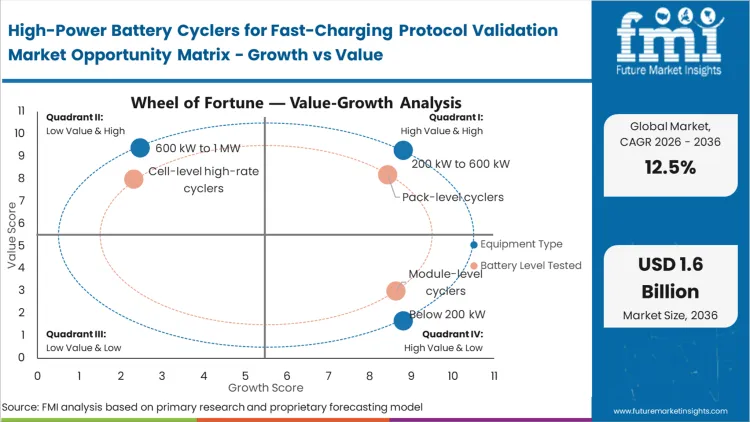
- Equipment Type: 200 kW to 600 kW is expected to record 41.0% share in 2026, matching emerging medium-duty commercial platform specifications.
- Deployment Stage: CCS / ISO 15118 validation is anticipated to hold 48.0% share in 2026, established by widespread automotive adoption across Western hemisphere OEMs.
- End User: Regenerative cyclers are poised to garner 71.0% share in 2026, mandated by utility grid limitations confronting continuous high-drain testing.
- India: 15.6% compound growth, driven by domestic electric bus homologation upgrades.
- Analyst Opinion at FMI
- Ronak Shah, Principal Analyst for Consumer Product at Future Market Insights, points out, "Validation laboratory directors focus heavily on peak power ratings. FMI observes that this specific metric often obscures a more punishing reality: software handshake latency during protocol transitions. A 1 MW cycler provides zero utility if its control software cannot mimic timing faults of degraded public chargers. True bottlenecks for OEMs involve proving vehicle control modules will not catastrophically disconnect when megawatt stations drop communication for 50 milliseconds. Hardware capability has outpaced simulation fidelity, creating vulnerabilities where packs pass electrical bench validation but fail real-world interoperability trials."
- Strategic Implications / Executive Takeaways
- Validation directors must transition toward regenerative battery cyclers to avoid utility penalty charges during continuous high-rate cycling.
- Procurement managers investing in non-regenerative architecture face stranded assets as local grid limits cap testing throughput.
- R&D architects securing hybrid cycler-simulator platforms gain months of schedule advantage over competitors running distinct sequential tests.
- Methodology
- Primary Research: Direct consultation with hardware procurement managers.
- Desk Research: Reviewing grid interconnection approvals for large testing facilities.
- Market-Sizing and Forecasting: Capital expenditure tracking across major automotive hubs.
- Data Validation and Update Cycle: Independent facility expansion announcements verifying procurement trends.
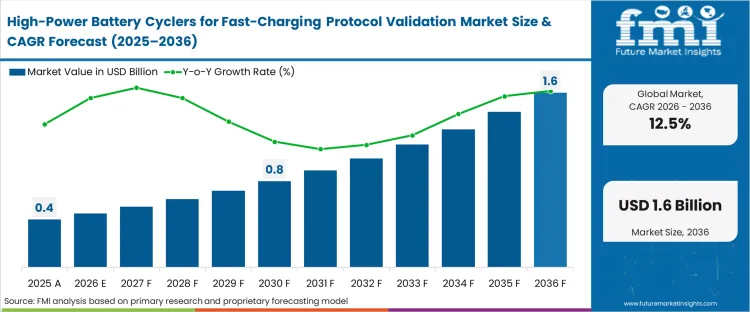
High-Power Battery Cyclers for Fast-Charging Protocol Validation Market Key Takeaways
| Metric | Details |
|---|---|
| Industry Size (2026) | USD 0.5 billion |
| Industry Value (2036) | USD 1.5 billion |
| CAGR (2026 to 2036) | 12.50% |
Source: Future Market Insights (FMI) analysis, based on proprietary forecasting model and primary research
Mandates for heavy-duty fleet electrification trigger immediate overhauls in validation laboratories. Once operators enforce 15-minute replenishment guarantees, qualification bottlenecks shift from cell chemistry toward pack-level heat rejection. Hardware deployed for continuous 1.2 MW transients transforms isolated R&D labs into mission-critical certification hubs.
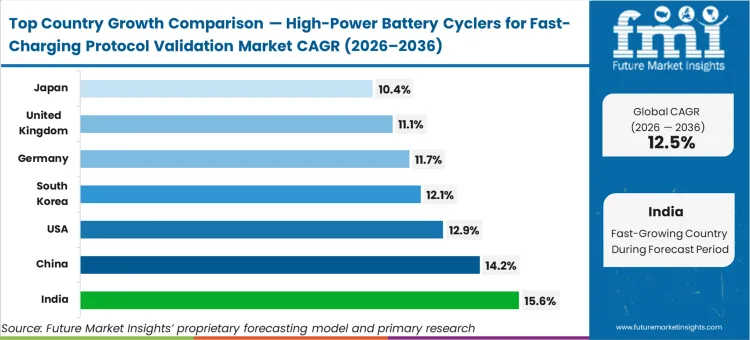
India leads at 15.6% as localized electric bus manufacturing forces domestic homologation centers to upgrade aging testing infrastructure. China follows at 14.2% driven by aggressive standard iterations requiring rapid compliance shifts. United States infrastructure advances at 12.9% pushed by federally funded highway corridor projects demanding heavy-duty validation. South Korea tracks at 12.1% through cell manufacturer vertical integration, while Germany expands at 11.7% as legacy automakers redesign 800V platforms. United Kingdom grows at 11.1%. Japan trails at 10.4%. Structural divergence across these geographic hubs hinges entirely on whether local grid operators permit bidirectional discharge during continuous validation cycles.
High-Power Battery Cyclers for Fast-Charging Protocol Validation Market Definition
High-power battery cyclers represent specialized industrial hardware ecosystems designed to apply extreme electrical loads and simulate dynamic profiles on high-voltage energy storage systems. These platforms synchronize power electronics with environmental chambers to verify communication handshakes, thermal management efficacy, and cycle life under prolonged extreme fast-charging conditions. Systems execute automated control software capable of nanosecond sampling to catch protocol faults.
High-Power Battery Cyclers for Fast-Charging Protocol Validation Market Inclusions
Hardware specifications cover bidirectional DC power supplies, regenerative sink capabilities, and automated software executing automotive handshakes. Systems explicitly integrating electric vehicle battery formation and testing capabilities within 800V architectures qualify. Modules engineered for synchronized thermal loop control and hardware-in-the-loop emulation fall within this category. Analysis incorporates equipment specifically deployed at tier-one validation sites.
High-Power Battery Cyclers for Fast-Charging Protocol Validation Market Exclusions
Standard low-voltage cell formation cyclers fall outside our scope because they lack high-voltage isolation required for pack-level qualification. General-purpose programmable power supplies face exclusion since they cannot natively execute specific ISO 15118 parameters. Passive load banks are omitted due to their inability to return discharged energy back to local grids, rendering them commercially unviable for continuous multi-megawatt testing.
High-Power Battery Cyclers for Fast-Charging Protocol Validation Market Research Methodology
- Primary Research: R&D validation engineers and EV powertrain architects embedded within Tier 1 OEMs.
- Desk Research: ISO 15118 certification registries and patent filings detailing regenerative load management architectures.
- Market-Sizing and Forecasting: Capital expenditure deployed toward validation infrastructure by top-tier cell manufacturers.
- Data Validation and Update Cycle: Hardware procurement contracts cross-referenced against commercial EV platform launch schedules.
Segmental Analysis
High-Power Battery Cyclers for Fast-Charging Protocol Validation Market Analysis by Power rating
Test laboratory managers prioritize voltage bandwidths mirroring emerging commercial platform outputs. 200 kW to 600 kW holds 41.0% share in 2026 as procurement directors at major passenger vehicle manufacturers standardize internal electric vehicle test equipment specifications around this exact range. According to FMI's estimates, these systems provide optimal flexibility for qualifying both premium passenger cars and initial medium-duty truck platforms without triggering massive facility transformer upgrades. Hardware choices dictate testing cadence. Validation teams deploying equipment below 200 kW must mathematically extrapolate thermal behaviors for larger packs, introducing unacceptable warranty risks. What capital expenditure projections miss entirely is that 600 kW units routinely operate at half capacity simply because grid operators refuse to authorize full load draws during daylight hours. Powertrain architects refusing to adopt modular scalable power electronics face hard ceilings on their testing throughput. Securing a high C-rate battery testing system remains constrained by local utility policies rather than hardware limitations. Validation teams utilizing dedicated EV charger tester units catch anomalies early.
- Initial screening: Procurement directors target 200 kW platforms initially to validate standard passenger configurations without incurring massive installation delays. Validation laboratory managers gain immediate testing capacity.
- Capability validation: Protocol verification at 600 kW proves crucial during extreme temperature testing. R&D directors verify contactor performance under maximum rated current.
- Expansion triggers: Upgrading beyond 600 kW occurs only when commercial vehicle platforms enter prototype phases. Facilities face significant transformer replacement costs if expansion is mishandled.
High-Power Battery Cyclers for Fast-Charging Protocol Validation Market Analysis by Battery level tested
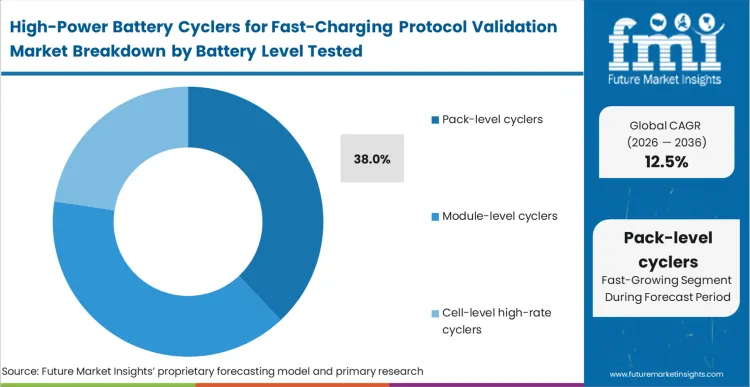
Complete system verification reveals thermal cascading failures invisible during isolated module trials. Pack-level cyclers command 38.0% share in 2026, driven directly by homologation standards requiring full-assembly certification. FMI analysts note that EV powertrain architects cannot sign off on production designs using only module-level EV charging tester results. Full-pack tests expose cooling loop deficiencies and software communication dropouts occurring under extended fast-charge loads. Testing complete packs necessitates integrating massive environmental chambers with heavy-duty power electronics, dramatically complicating facility layouts. Generalists assume pack-level testing simply requires larger cables; practitioners know true complexity lies in tricking vehicle control units into believing they are connected to functioning ultra fast charging EV battery dispensers rather than laboratory simulators. R&D directors attempting to bypass this step by relying strictly on module and pack battery test systems without full system integration inevitably discover fatal software handshake errors during early vehicle fleet deployments. Investing in a dedicated pack-level fast charge cycling system eliminates this risk.
- Thermal fault detection: Pack-level systems identify coolant flow restrictions invisible during module testing. Thermal integration engineers prevent catastrophic overheating scenarios.
- Software synchronization limits: Protocol emulators must fool battery management controllers flawlessly. Software validation leads face project delays if emulation timing drifts.
- Compliance minimums: Regulatory bodies demand full-assembly thermal runaway data. Certification managers must submit complete pack test results to secure sales approvals.
High-Power Battery Cyclers for Fast-Charging Protocol Validation Market Analysis by Protocol validation focus
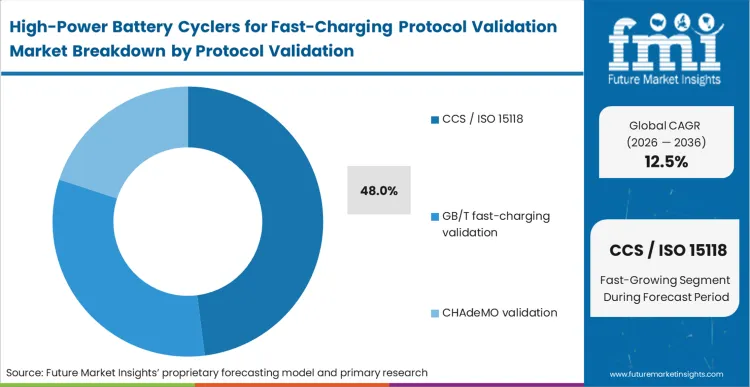
Global standardization efforts mandate hardware capable of executing specific digital handshakes. CCS / ISO 15118 validation accounts for 48.0% share in 2026 because major Western automakers adopted this specific software communication standard for bidirectional power transfer. Engineers use CCS fast charge validation equipment to simulate corrupted encrypted certificates, ensuring vehicle systems fail safely when encountering compromised public dispensers. Securing functional EV charge cable and connector durability test equipment requires exhaustive edge-case software testing alongside an electric vehicle charging station emulator. Hardware share figures overlook an operational reality, cyclers frequently possess flawless ISO 15118 physical layers but ship with immature software stacks that struggle to replicate real-world timing jitters. Validation laboratory directors purchasing hardware based solely on physical power specs often spend months writing custom software patches to force compliance. Demand for MCS battery validation for electric trucks accelerates this software complexity further.
- Early adopters: Premium passenger vehicle manufacturers standardized CCS protocols years ago. Homologation directors secure compliance across legacy platforms.
- Secondary integration: Commercial truck developers integrate Megawatt Charging System protocols alongside CCS. Systems architects face complex dual-protocol emulation challenges.
- Late-stage convergence: NACS interoperability forces facilities to upgrade existing test benches. Validation managers must purchase software license keys to unlock new physical connectors.
High-Power Battery Cyclers for Fast-Charging Protocol Validation Market Analysis by System architecture
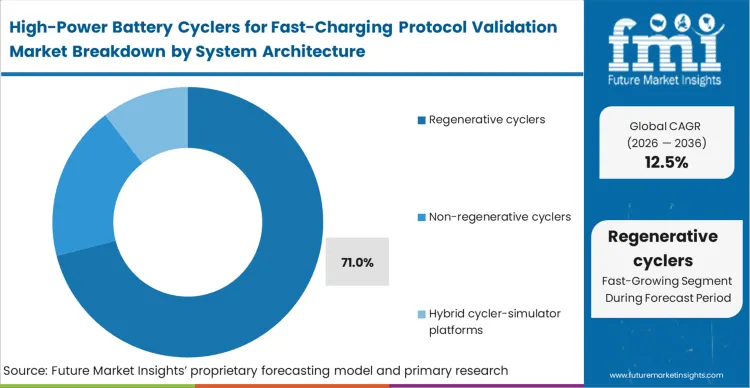
Utility grid restrictions effectively outlaw continuous multi-megawatt resistive load testing. Regenerative cyclers represent 71.0% share in 2026, serving as the only viable technical solution for laboratories running 24-hour validation profiles. This architecture drastically reduces facility HVAC requirements by eliminating massive resistive heat dissipation banks. Operating electric vehicle on board charger units continuously at 500 kW without regeneration generates enough ambient heat to overwhelm standard industrial cooling infrastructure. While generalists view regenerative features as sustainability initiatives, facility operators view them strictly as thermal survival mechanisms: without regeneration, running three concurrent pack tests would melt facility wiring. Procurement directors ignoring regenerative battery cyclers face exorbitant utility demand charges that quickly eclipse initial hardware savings.
- HVAC elimination savings: Regenerative systems remove requirements for external load bank cooling towers. Facility directors avoid millions in construction capital.
- Grid synchronization risks: Returning unstable power to local utilities triggers automatic disconnects. Electrical engineers must implement specialized filtering hardware.
- Total lifecycle calculation: Regenerative efficiency pays for capital differences within eighteen months. Procurement managers justify higher upfront costs through verified utility bill reductions.
High-Power Battery Cyclers for Fast-Charging Protocol Validation Market Drivers, Restraints, and Opportunities
Warranty liability risks compel powertrain architects to simulate destructive continuous transients before approving packs for commercial production. If EV platform engineers release vehicles with unverified thermal management loops, real-world battery energy storage system fast-charging scenarios will degrade cells prematurely, triggering massive recall expenditures. Tier-one procurement mandates demand verifiable ISO 15118 protocol compliance, forcing internal test facility managers to abandon obsolete low-voltage equipment. Operating heavy-duty platforms without an EV battery cycler for protocol validation guarantees communication dropouts at public dispensers. Delaying cycler procurement directly pauses vehicle homologation, allowing competitors to capture fleet electrification contracts.
Grid capacity bottlenecks stall high-power cycler installations even when validation directors secure capital budgets. Local utilities frequently deny permits for multi-megawatt bidirectional systems due to localized substation limitations. Test facility managers cannot easily circumvent these physical infrastructure deficits. While integrating onsite energy storage buffers mitigates peak draws, these solutions double footprint requirements and introduce complex synchronization issues. Facilities wait months for utility grid upgrades, severely limiting localized testing throughput and delaying vehicle launch schedules globally.
Opportunities in the High-Power Battery Cyclers for Fast-Charging Protocol Validation Market
- Modular power electronics expansion: Engineers scale testing capacity without replacing core control systems. Validation directors reduce future capital expenditure requirements.
- Hardware-in-the-loop software integration: Developers synchronize physical advanced energy storage system loading with virtual vehicle emulation. Software leads catch protocol timing faults earlier.
- Bidirectional grid support algorithms: Test facilities sell regulated power back to utilities during idle periods. Facility managers generate auxiliary revenue streams using automotive battery validation equipment.
Regional Analysis
Based on regional analysis, High-Power Battery Cyclers for Fast-Charging Protocol Validation is segmented into North America, Latin America, Europe, East Asia, South Asia & Pacific, and Middle East & Africa across 40 plus countries.
.webp "Top Country Growth Comparison High Power Battery Cyclers For Fast Charging Protocol Validation Market Cagr (2026 2036)")
| Country | CAGR (2026 to 2036) |
|---|---|
| India | 15.6% |
| China | 14.2% |
| United States | 12.9% |
| South Korea | 12.1% |
| Germany | 11.7% |
| United Kingdom | 11.1% |
| Japan | 10.4% |
Source: Future Market Insights (FMI) analysis, based on proprietary forecasting model and primary research
South Asia & Pacific High-Power Battery Cyclers for Fast-Charging Protocol Validation Market Analysis
Homologation centers scramble to qualify high-capacity bus platforms against emerging bidirectional standards. Without proper pack-level compliance tools, domestic manufacturers cannot export commercial vehicles to neighboring regulated territories. FMI's analysis indicates validation laboratory directors face immediate pressure to procure battery cyclers for fast charging validation, as aging grid infrastructure cannot support continuous megawatt-level resistive dissipation. Localized public transit electrification mandates push domestic testing infrastructure far beyond current capacities.
- India: Expanding at a 15.6% CAGR, revenue growth reflects how domestic electric bus homologation upgrades force facility managers to abandon passive load banks. Powertrain architects validating high-temperature stationary battery storage platforms require continuous 500 kW testing. Indian OEMs secure crucial early-mover advantages in tropical-climate commercial fleet deployments.
FMI's report includes Australia and ASEAN nations. Evolving interoperability standards across these developing transit hubs require flexible software emulation stacks capable of pivoting between competing regional communication protocols.
East Asia High-Power Battery Cyclers for Fast-Charging Protocol Validation Market Analysis
Test facility managers must validate massive production volumes against rapidly changing state-mandated safety thresholds. Facilities unable to test multi-level synchronized architectures lose lucrative government supply contracts. Aggressive GB/T protocol iterations force continuous hardware replacement cycles across major manufacturing hubs. According to FMI's estimates, cell manufacturer vertical integration drives demand for integrated cycler-chamber solutions, bypassing standalone component purchases.
- China: State-backed heavy-duty truck electrification programs require immediate Megawatt Charging System compliance. Demand grows at a 14.2% CAGR as R&D directors linking industrial battery lines with end-of-line testing face intense throughput pressures. Chinese test facilities dictate global fast-charging baseline standards by sheer testing volume alone.
- South Korea: Tier-one cell producers integrate software protocol verification directly into their primary R&D campuses. South Korean cell manufacturers leverage their internal testing supremacy to command premium pricing from Western automotive clients. Validation engineers prioritize high-fidelity ISO 15118 timing emulation using specialized battery pack cyclers, helping revenue advance at a 12.1% CAGR.
- Japan: Demand increases at a 10.4% CAGR while legacy automakers pivot toward 800V architectures, demanding retroactive protocol verification. Homologation managers update CHAdeMO testing benches to accommodate higher transient loads. What single-digit growth figures miss is the intense complexity involved in Japanese facilities simultaneously validating both legacy CHAdeMO and emerging global standards on single hardware platforms.
FMI's report includes Taiwan. Export-focused electronics manufacturers invest heavily in modular validation platforms to ensure component compatibility across fragmented global EV supply chains.
North America High-Power Battery Cyclers for Fast-Charging Protocol Validation Market Analysis
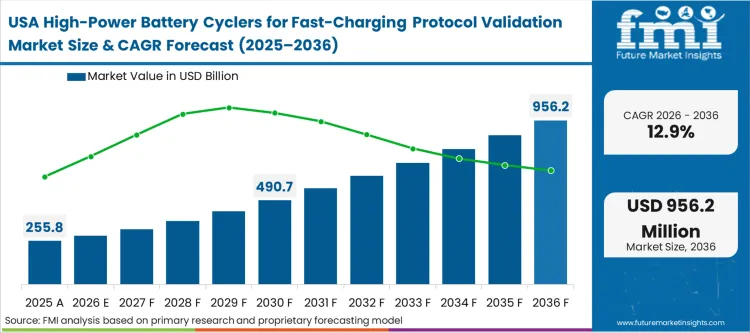
EV platform engineers must guarantee flawless NACS communication under extreme environmental conditions to qualify for lucrative commercial fleet subsidies. Falling behind regional homologation schedules effectively locks OEMs out of major municipal transit contracts. Federally funded highway corridor projects stipulate strict interoperability requirements for public infrastructure. In FMI's view, validation laboratory directors aggressively procure hybrid cycler-simulator platforms to test software edge-cases before physical prototypes hit test tracks.
- United States: National charging network reliability mandates force automakers to conduct exhaustive communication fault testing. Revenue scales at a 12.9% CAGR as procurement directors replace aging test benches with fully automated grid-tied units supporting battery technology advances. Facilities mastering NACS interoperability validation win exclusive testing contracts from emerging commercial vehicle startups.
FMI's report includes Canada. Cold-weather performance requirements drive test facilities to procure cyclers specifically engineered to interface flawlessly with extreme-temperature environmental chambers.
Europe High-Power Battery Cyclers for Fast-Charging Protocol Validation Market Analysis
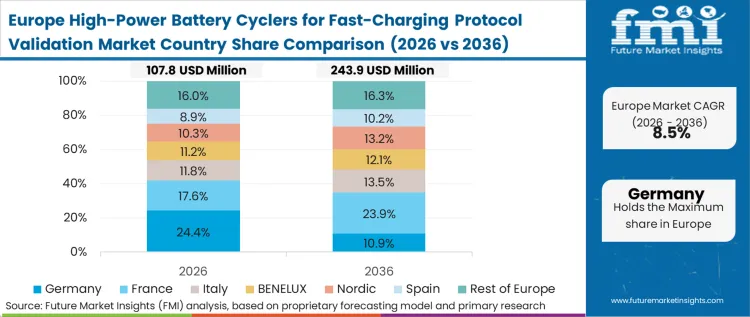
Validation laboratory directors upgrade legacy test benches to support continuous megawatt-level outputs without triggering utility grid penalties. Falling behind in CCS validation leaves premium brands exposed to significant commercial delays. Automakers across the continent accelerate the transition to 800V architectures to maintain competitiveness against imported EV platforms. FMI observes that stringent European interoperability mandates require precise synchronization between power electronics and local charging networks.
- Germany: Legacy automakers redesign their premium 800V vehicle platforms to comply with emerging pan-European bidirectional charging regulations. Powertrain architects demand integrated cycler-chamber platforms to validate software timing loops natively. Facilities capturing these advanced capabilities secure massive internal validation budgets, driving revenue to expand at an 11.7% CAGR.
- United Kingdom: Growing at an 11.1% CAGR, the market is pushed by aggressive national targets for zero-emission commercial fleet deployments. Homologation managers prioritize hardware capable of mimicking degraded public dispenser timing faults to prevent catastrophic disconnects. Test facilities upgrading to multi-megawatt regenerative systems win lucrative validation contracts from emerging local EV startups.
FMI's report includes France and Italy. Rapid deployment of high-power charging corridors across these nations necessitates scalable validation equipment that natively supports cross-border interoperability testing.
Competitive Aligners for Market Players
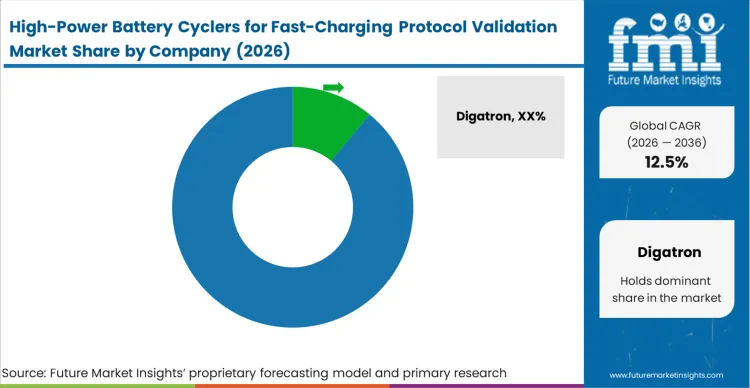
Legacy hardware dominance relies entirely on proprietary software libraries simulating thousands of specific charging station failure modes. Digatron, Keysight Technologies, and Chroma ATE do not compete on pure amperage delivery, they compete on how accurately their digital twin environments replicate real-world protocol glitches. EV powertrain architects evaluate suppliers based on battery manufacturing machines emulation fidelity, demanding nanosecond-level synchronization between power electronics and communication controllers. Supplying a functional megawatt charging battery test platform requires bridging power density with software agility.
Incumbent test equipment manufacturers possess massive libraries of validated compliance scripts that new entrants cannot easily replicate. Creating an 800V bidirectional power supply is straightforward engineering; writing software that perfectly mimics a degraded ISO 15118 public charger dropping packets requires years of accumulated field data. Challengers attempting to break into Tier-1 validation labs frequently fail because their hardware lacks these extensive pre-configured fault simulation libraries covering EV charger converter module interactions.
Procurement directors actively resist software ecosystem lock-in by demanding open-API architecture. When validation managers attempt to integrate distinct EV battery heating system hardware into continuous test loops, proprietary communication protocols create massive integration delays. Consequently, major automotive buyers increasingly penalize suppliers refusing to support third-party automation software, fundamentally altering hardware selection criteria for fast-charging protocol validation systems.
Key Players in High-Power Battery Cyclers for Fast-Charging Protocol Validation Market
- Digatron
- Keysight Technologies (Scienlab)
- NH Research / NI
- Chroma ATE
- Arbin Instruments
- AVL
- PEC
Scope of the Report
| Metric | Value |
|---|---|
| Quantitative Units | USD 0.5 billion to USD 1.5 billion, at a CAGR of 12.50% |
| Market Definition | Specialized industrial testing ecosystems applying continuous high-current electrical loads to verify communication handshakes and thermal management under extreme fast-charging conditions. |
| Segmentation | Power rating, Battery level tested, Protocol validation focus, System architecture, End use, Region |
| Regions Covered | North America, Latin America, Europe, East Asia, South Asia & Pacific, Middle East & Africa |
| Countries Covered | United States, Canada, Brazil, Mexico, Germany, United Kingdom, France, Italy, Spain, China, Japan, South Korea, India, ASEAN, ANZ, GCC, South Africa |
| Key Companies Profiled | Digatron, Keysight Technologies (Scienlab), NH Research / NI, Chroma ATE, Arbin Instruments, AVL, PEC |
| Forecast Period | 2026 to 2036 |
| Approach | Capital expenditure tracking across major automotive hubs cross-referenced with commercial EV platform launch schedules. |
Source: Future Market Insights (FMI) analysis, based on proprietary forecasting model and primary research
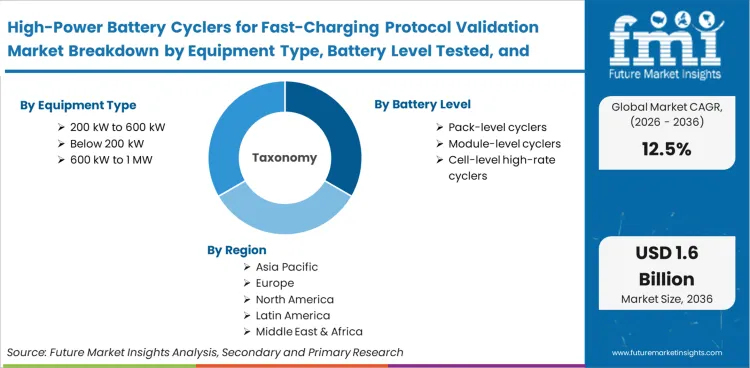
High-Power Battery Cyclers for Fast-Charging Protocol Validation Market Analysis by Segments
Power rating:
- 200 kW to 600 kW
- Below 200 kW
- 600 kW to 1 MW
- Above 1 MW
Battery level tested:
- Pack-level cyclers
- Module-level cyclers
- Cell-level high-rate cyclers
- Multi-level synchronized test benches
Protocol validation focus:
- CCS / ISO 15118 validation
- GB/T fast-charging validation
- CHAdeMO validation
- NACS / combined interoperability validation
- MCS / megawatt charging validation
System architecture:
- Regenerative cyclers
- Non-regenerative cyclers
- Hybrid cycler-simulator platforms
- Cycler plus chamber integrated platforms
End use:
- EV OEM and Tier 1 validation labs
- Battery cell manufacturers
- Independent testing laboratories
- Charging hardware developers
- Heavy-duty and commercial EV developers
Cooling / thermal control integration:
- Air-cooled system cyclers
- Liquid-cooled synchronized platforms
- Immersion cooling compatible cyclers
Software and automation stack:
- Closed-loop OEM proprietary software
- Open-API automation compatible
- Cloud-connected analytics platforms
Application phase:
- R&D and chemistry characterization
- Design validation and homologation
- End-of-line production testing
- Failure analysis and warranty tear-down
Region:
- North America
- United States
- Canada
- Latin America
- Brazil
- Mexico
- Rest of Latin America
- Europe
- Germany
- United Kingdom
- France
- Italy
- Spain
- Rest of Europe
- East Asia
- China
- Japan
- South Korea
- Taiwan
- South Asia & Pacific
- India
- ASEAN
- ANZ
- Rest of South Asia & Pacific
- Middle East & Africa
- GCC Countries
- South Africa
- North Africa
- Rest of Middle East & Africa
Bibliography
- International Energy Agency. (2025, May 14). Global EV Outlook 2025. IEA.
- Argonne National Laboratory. (2024, March). Quantification of Commercially Planned Battery Component Supply in the United States through 2035. U.S. Department of Energy.
- National Renewable Energy Laboratory. (2024). 2024 Electric Vehicles at Scale Semiannual Stakeholder Meeting Proceedings. NREL.
- SAE International. (2025). SAE J3271™: The Megawatt Charging System (MCS) Technical Information Report Officially Published. SAE International.
- Charging Interface Initiative e. V. (2025, October 28). White Paper of Charging Interface Initiative eV. CharIN.
This bibliography is provided for reader reference. The full FMI report contains the complete reference list with primary source documentation.
This Report Addresses
- Validation laboratory directors seeking capital justification for regenerative testing infrastructure.
- EV powertrain architects navigating conflicting megawatt charging communication protocols.
- Procurement managers establishing technical specifications for multi-megawatt facility upgrades.
- R&D directors linking isolated hardware test benches with virtual vehicle emulation platforms.
- Independent testing facility managers evaluating NACS interoperability equipment requirements.
- Homologation specialists tracking geographic divergence in bidirectional grid compliance mandates.
- Utility infrastructure planners forecasting continuous heavy-duty industrial test loads.
- Software validation leads isolating handshake timing faults during extreme temperature cycling.
Frequently Asked Questions
What is a high-power battery cycler and how is it different from a standard battery tester?
Standard battery testers manage low-voltage cell characterization and basic capacity checks. High-power cyclers operate at extreme voltage and current thresholds, specifically applying multi-megawatt transient loads while simultaneously emulating complex digital communication handshakes between vehicles and public dispensers.
Why is fast-charging protocol validation becoming a separate equipment market?
Basic power delivery testing no longer guarantees commercial success. Powertrain architects discovered that packs passing simple electrical bench tests routinely fail in real-world environments because standard equipment cannot emulate the microsecond communication faults inherent in degraded public charging networks.
Which standards matter most for battery validation in CCS, GB/T, and MCS environments?
Automakers mandate strict adherence to ISO 15118 for secure bidirectional communication across Western platforms. Heavy-duty developers simultaneously validate against SAE J3271 for Megawatt Charging Systems, while Asian facilities prioritize rapid iterations of the GB/T standard for domestic compliance.
Why are regenerative cyclers preferred in EV battery labs?
Dissipating multi-megawatt loads resistively generates enough heat to melt facility wiring while incurring massive utility penalty charges. Regenerative systems return up to 95% of discharged power back to the local grid, effectively eliminating catastrophic HVAC requirements and lowering total operating costs.
What power range is needed for module-level versus pack-level fast-charging validation?
Module testing typically utilizes 50 kW to 150 kW cyclers to characterize isolated sub-assembly behavior. Pack-level validation requires continuous 200 kW to 600 kW bandwidths to evaluate system-wide thermal cascading faults and integrated coolant loop deficiencies under sustained extreme fast-charging sessions.
Which companies currently supply high-power battery cyclers for EV validation labs?
Tier-one validation laboratories primarily rely on established engineering firms possessing vast proprietary software fault libraries. Major suppliers dictating testing standards include Digatron, Keysight Technologies (Scienlab), NH Research / NI, Chroma ATE, Arbin Instruments, AVL, and PEC.
How is megawatt charging changing battery test lab requirements?
Heavy-duty electrification forces facilities to abandon legacy 500 kW benches. Testing commercial truck packs mandates immediate procurement of highly specialized hardware capable of sustaining continuous 3000A loads safely without triggering localized substation disconnects or overheating laboratory infrastructure.
What are the biggest failure modes that fast-charge validation must detect?
Physical melting represents only a secondary concern. True validation focuses on identifying software handshake latency, detecting localized lithium plating caused by uneven cooling distribution, and catching communication dropouts that cause battery management systems to abort charging sessions prematurely.
How do OEM labs differ from battery maker labs in cycler selection?
Battery cell manufacturers procure high-throughput, multi-channel cyclers optimized for massive end-of-line production verification. OEM validation labs prioritize complex hybrid cycler-simulator platforms designed specifically to test proprietary software edge-cases and precise vehicle control module timing faults.
What regions are investing fastest in high-power battery validation infrastructure?
India expands testing capacity aggressively to support state-mandated electric bus homologation. China upgrades facilities to handle massive heavy-duty vehicle production volumes. The United States modernizes laboratories to comply with federally funded charging network reliability standards and NACS interoperability requirements.
What limits cycler throughput currently?
Grid interconnection policies restrict testing volumes far more than hardware limitations. Validation laboratories frequently possess equipment capable of continuous multi-megawatt testing but cannot operate at full capacity because local utilities refuse to approve maximum bidirectional loads during peak regional hours.
How does software latency impact hardware selection?
Physical power delivery represents only baseline functionality. True value lies in executing corrupted or delayed digital handshakes seamlessly. Hardware incapable of mimicking degraded public dispenser timing faults fails to identify critical vehicle control module vulnerabilities before commercial launch.
Why is pack-level validation strictly required?
Module-level data extrapolation cannot accurately predict fluid dynamics within complex cooling loops under continuous load. Attempting to bypass full-assembly testing guarantees undiscovered thermal cascading faults, exposing manufacturers to severe warranty liabilities during real-world fleet deployments.
How do automakers avoid third-party testing delays?
Tier-one manufacturers build massive captive testing annexes explicitly avoiding external queues. Controlling proprietary physical hardware prevents sensitive intellectual property leaks while allowing software engineers to iterate protocol fixes instantly without fighting independent laboratory scheduling constraints.
What technical capability defines tier-one suppliers?
Leading suppliers differentiate through extensive pre-configured fault simulation libraries. Creating raw bidirectional power supplies remains simple engineering compared to developing software capable of perfectly replicating thousands of specific real-world charging station glitches and packet drops.
Why do OEMs penalize proprietary communication environments?
Closed-loop architectures prevent validation teams from linking environmental chambers directly to load controllers. Procurement directors demand open-API systems to ensure diverse hardware components synchronize flawlessly within customized continuous testing automation scripts.
How does NACS adoption alter testing requirements?
Interoperability forces laboratories to qualify existing vehicle platforms against entirely new physical layers. Validation managers must procure specialized adapters and software license keys to emulate Tesla-specific handshakes alongside legacy CCS protocols on identical hardware benches.
What creates hardware stranded assets?
Purchasing massive power supplies without securing corresponding utility upgrade approvals renders equipment useless. Facilities routinely spend millions on cyclers only to wait eighteen months for utility substation transformers capable of supporting requested bidirectional draws.
Where does cost savings originate during procurement?
Regenerative system efficiency drastically reduces monthly operational expenditures. Procurement managers easily justify higher upfront capital costs by calculating specific utility demand charge reductions achieved when discharging validation energy directly back into local facility grids.
How do engineers identify protocol timing faults?
Testing teams synchronize physical power electronics explicitly with virtual vehicle emulators. Catching nanosecond-level communication drops requires integrating cyclers directly into comprehensive hardware-in-the-loop validation networks rather than running isolated standalone electrical bench tests.
What happens when emulation timing drifts?
Battery management controllers automatically disconnect when detecting faulty communication packets. If laboratory simulators cannot maintain flawless timing synchronization, tests abort prematurely, destroying weeks of continuous thermal cycling data and requiring complete sequence restarts.
Why is cycle life testing commercially critical?
Fleet operators demand ironclad degradation warranties before signing massive procurement contracts. Failing to simulate thousands of extreme fast-charging sessions accurately leaves manufacturers guessing regarding actual pack longevity, risking devastating financial exposure when commercial batteries fail prematurely.
Preview the report firsthand - request a free sample
Get SampleGet the brochure for pricing and purchase details.
Get PDFTable of Content
- Executive Summary
- Global Market Outlook
- Demand-side Trends
- Supply-side Trends
- Technology Roadmap Analysis
- Analysis and Recommendations
- Market Overview
- Market Coverage / Taxonomy
- Market Definition / Scope / Limitations
- Research Methodology
- Chapter Orientation
- Analytical Lens and Working Hypotheses
- Market Sizing, Forecasting, and Opportunity Mapping
- Research Design and Evidence Framework
- Desk Research Programme (Secondary Evidence)
- Company Annual and Sustainability Reports
- Peer-reviewed Journals and Academic Literature
- Corporate Websites, Product Literature, and Technical Notes
- Earnings Decks and Investor Briefings
- Statutory Filings and Regulatory Disclosures
- Technical White Papers and Standards Notes
- Trade Journals, Industry Magazines, and Analyst Briefs
- Conference Proceedings, Webinars, and Seminar Materials
- Government Statistics Portals and Public Data Releases
- Press Releases and Reputable Media Coverage
- Specialist Newsletters and Curated Briefings
- Sector Databases and Reference Repositories
- FMI Internal Proprietary Databases and Historical Market Datasets
- Subscription Datasets and Paid Sources
- Social Channels, Communities, and Digital Listening Inputs
- Additional Desk Sources
- Expert Input and Fieldwork (Primary Evidence)
- Primary Modes
- Qualitative Interviews and Expert Elicitation
- Quantitative Surveys and Structured Data Capture
- Blended Approach
- Why Primary Evidence is Used
- Observational and In-context Research
- Social and Community Interactions
- Primary Modes
- Stakeholder Universe Engaged
- C-suite Leaders
- Board Members
- Presidents and Vice Presidents
- R&D and Innovation Heads
- Technical Specialists
- Domain Subject-matter Experts
- Scientists
- Physicians and Other Healthcare Professionals
- Governance, Ethics, and Data Stewardship
- Research Ethics
- Data Integrity and Handling
- Desk Research Programme (Secondary Evidence)
- Tooling, Models, and Reference Databases
- Data Engineering and Model Build
- Data Acquisition and Ingestion
- Cleaning, Normalisation, and Verification
- Synthesis, Triangulation, and Analysis
- Quality Assurance and Audit Trail
- Market Background
- Market Dynamics
- Drivers
- Restraints
- Opportunity
- Trends
- Scenario Forecast
- Demand in Optimistic Scenario
- Demand in Likely Scenario
- Demand in Conservative Scenario
- Opportunity Map Analysis
- Product Life Cycle Analysis
- Supply Chain Analysis
- Investment Feasibility Matrix
- Value Chain Analysis
- PESTLE and Porter’s Analysis
- Regulatory Landscape
- Regional Parent Market Outlook
- Production and Consumption Statistics
- Import and Export Statistics
- Market Dynamics
- Global Market Analysis 2021 to 2025 and Forecast, 2026 to 2036
- Historical Market Size Value (USD Million) Analysis, 2021 to 2025
- Current and Future Market Size Value (USD Million) Projections, 2026 to 2036
- Y-o-Y Growth Trend Analysis
- Absolute $ Opportunity Analysis
- Global Market Pricing Analysis 2021 to 2025 and Forecast 2026 to 2036
- Global Market Analysis 2021 to 2025 and Forecast 2026 to 2036, By Equipment Type
- Introduction / Key Findings
- Historical Market Size Value (USD Million) Analysis By Equipment Type , 2021 to 2025
- Current and Future Market Size Value (USD Million) Analysis and Forecast By Equipment Type , 2026 to 2036
- 200 kW to 600 kW
- Below 200 kW
- 600 kW to 1 MW
- 200 kW to 600 kW
- Y-o-Y Growth Trend Analysis By Equipment Type , 2021 to 2025
- Absolute $ Opportunity Analysis By Equipment Type , 2026 to 2036
- Global Market Analysis 2021 to 2025 and Forecast 2026 to 2036, By Battery Level Tested
- Introduction / Key Findings
- Historical Market Size Value (USD Million) Analysis By Battery Level Tested, 2021 to 2025
- Current and Future Market Size Value (USD Million) Analysis and Forecast By Battery Level Tested, 2026 to 2036
- Pack-level cyclers
- Module-level cyclers
- Cell-level high-rate cyclers
- Pack-level cyclers
- Y-o-Y Growth Trend Analysis By Battery Level Tested, 2021 to 2025
- Absolute $ Opportunity Analysis By Battery Level Tested, 2026 to 2036
- Global Market Analysis 2021 to 2025 and Forecast 2026 to 2036, By Protocol Validation
- Introduction / Key Findings
- Historical Market Size Value (USD Million) Analysis By Protocol Validation, 2021 to 2025
- Current and Future Market Size Value (USD Million) Analysis and Forecast By Protocol Validation, 2026 to 2036
- CCS / ISO 15118
- GB/T fast-charging validation
- CHAdeMO validation
- CCS / ISO 15118
- Y-o-Y Growth Trend Analysis By Protocol Validation, 2021 to 2025
- Absolute $ Opportunity Analysis By Protocol Validation, 2026 to 2036
- Global Market Analysis 2021 to 2025 and Forecast 2026 to 2036, By System Architecture
- Introduction / Key Findings
- Historical Market Size Value (USD Million) Analysis By System Architecture, 2021 to 2025
- Current and Future Market Size Value (USD Million) Analysis and Forecast By System Architecture, 2026 to 2036
- Regenerative cyclers
- Non-regenerative cyclers
- Hybrid cycler-simulator platforms
- Regenerative cyclers
- Y-o-Y Growth Trend Analysis By System Architecture, 2021 to 2025
- Absolute $ Opportunity Analysis By System Architecture, 2026 to 2036
- Global Market Analysis 2021 to 2025 and Forecast 2026 to 2036, By Region
- Introduction
- Historical Market Size Value (USD Million) Analysis By Region, 2021 to 2025
- Current Market Size Value (USD Million) Analysis and Forecast By Region, 2026 to 2036
- North America
- Latin America
- Western Europe
- Eastern Europe
- East Asia
- South Asia and Pacific
- Middle East & Africa
- Market Attractiveness Analysis By Region
- North America Market Analysis 2021 to 2025 and Forecast 2026 to 2036, By Country
- Historical Market Size Value (USD Million) Trend Analysis By Market Taxonomy, 2021 to 2025
- Market Size Value (USD Million) Forecast By Market Taxonomy, 2026 to 2036
- By Country
- USA
- Canada
- Mexico
- By Equipment Type
- By Battery Level Tested
- By Protocol Validation
- By System Architecture
- By Country
- Market Attractiveness Analysis
- By Country
- By Equipment Type
- By Battery Level Tested
- By Protocol Validation
- By System Architecture
- Key Takeaways
- Latin America Market Analysis 2021 to 2025 and Forecast 2026 to 2036, By Country
- Historical Market Size Value (USD Million) Trend Analysis By Market Taxonomy, 2021 to 2025
- Market Size Value (USD Million) Forecast By Market Taxonomy, 2026 to 2036
- By Country
- Brazil
- Chile
- Rest of Latin America
- By Equipment Type
- By Battery Level Tested
- By Protocol Validation
- By System Architecture
- By Country
- Market Attractiveness Analysis
- By Country
- By Equipment Type
- By Battery Level Tested
- By Protocol Validation
- By System Architecture
- Key Takeaways
- Western Europe Market Analysis 2021 to 2025 and Forecast 2026 to 2036, By Country
- Historical Market Size Value (USD Million) Trend Analysis By Market Taxonomy, 2021 to 2025
- Market Size Value (USD Million) Forecast By Market Taxonomy, 2026 to 2036
- By Country
- Germany
- UK
- Italy
- Spain
- France
- Nordic
- BENELUX
- Rest of Western Europe
- By Equipment Type
- By Battery Level Tested
- By Protocol Validation
- By System Architecture
- By Country
- Market Attractiveness Analysis
- By Country
- By Equipment Type
- By Battery Level Tested
- By Protocol Validation
- By System Architecture
- Key Takeaways
- Eastern Europe Market Analysis 2021 to 2025 and Forecast 2026 to 2036, By Country
- Historical Market Size Value (USD Million) Trend Analysis By Market Taxonomy, 2021 to 2025
- Market Size Value (USD Million) Forecast By Market Taxonomy, 2026 to 2036
- By Country
- Russia
- Poland
- Hungary
- Balkan & Baltic
- Rest of Eastern Europe
- By Equipment Type
- By Battery Level Tested
- By Protocol Validation
- By System Architecture
- By Country
- Market Attractiveness Analysis
- By Country
- By Equipment Type
- By Battery Level Tested
- By Protocol Validation
- By System Architecture
- Key Takeaways
- East Asia Market Analysis 2021 to 2025 and Forecast 2026 to 2036, By Country
- Historical Market Size Value (USD Million) Trend Analysis By Market Taxonomy, 2021 to 2025
- Market Size Value (USD Million) Forecast By Market Taxonomy, 2026 to 2036
- By Country
- China
- Japan
- South Korea
- By Equipment Type
- By Battery Level Tested
- By Protocol Validation
- By System Architecture
- By Country
- Market Attractiveness Analysis
- By Country
- By Equipment Type
- By Battery Level Tested
- By Protocol Validation
- By System Architecture
- Key Takeaways
- South Asia and Pacific Market Analysis 2021 to 2025 and Forecast 2026 to 2036, By Country
- Historical Market Size Value (USD Million) Trend Analysis By Market Taxonomy, 2021 to 2025
- Market Size Value (USD Million) Forecast By Market Taxonomy, 2026 to 2036
- By Country
- India
- ASEAN
- Australia & New Zealand
- Rest of South Asia and Pacific
- By Equipment Type
- By Battery Level Tested
- By Protocol Validation
- By System Architecture
- By Country
- Market Attractiveness Analysis
- By Country
- By Equipment Type
- By Battery Level Tested
- By Protocol Validation
- By System Architecture
- Key Takeaways
- Middle East & Africa Market Analysis 2021 to 2025 and Forecast 2026 to 2036, By Country
- Historical Market Size Value (USD Million) Trend Analysis By Market Taxonomy, 2021 to 2025
- Market Size Value (USD Million) Forecast By Market Taxonomy, 2026 to 2036
- By Country
- Kingdom of Saudi Arabia
- Other GCC Countries
- Turkiye
- South Africa
- Other African Union
- Rest of Middle East & Africa
- By Equipment Type
- By Battery Level Tested
- By Protocol Validation
- By System Architecture
- By Country
- Market Attractiveness Analysis
- By Country
- By Equipment Type
- By Battery Level Tested
- By Protocol Validation
- By System Architecture
- Key Takeaways
- Key Countries Market Analysis
- USA
- Pricing Analysis
- Market Share Analysis, 2025
- By Equipment Type
- By Battery Level Tested
- By Protocol Validation
- By System Architecture
- Canada
- Pricing Analysis
- Market Share Analysis, 2025
- By Equipment Type
- By Battery Level Tested
- By Protocol Validation
- By System Architecture
- Mexico
- Pricing Analysis
- Market Share Analysis, 2025
- By Equipment Type
- By Battery Level Tested
- By Protocol Validation
- By System Architecture
- Brazil
- Pricing Analysis
- Market Share Analysis, 2025
- By Equipment Type
- By Battery Level Tested
- By Protocol Validation
- By System Architecture
- Chile
- Pricing Analysis
- Market Share Analysis, 2025
- By Equipment Type
- By Battery Level Tested
- By Protocol Validation
- By System Architecture
- Germany
- Pricing Analysis
- Market Share Analysis, 2025
- By Equipment Type
- By Battery Level Tested
- By Protocol Validation
- By System Architecture
- UK
- Pricing Analysis
- Market Share Analysis, 2025
- By Equipment Type
- By Battery Level Tested
- By Protocol Validation
- By System Architecture
- Italy
- Pricing Analysis
- Market Share Analysis, 2025
- By Equipment Type
- By Battery Level Tested
- By Protocol Validation
- By System Architecture
- Spain
- Pricing Analysis
- Market Share Analysis, 2025
- By Equipment Type
- By Battery Level Tested
- By Protocol Validation
- By System Architecture
- France
- Pricing Analysis
- Market Share Analysis, 2025
- By Equipment Type
- By Battery Level Tested
- By Protocol Validation
- By System Architecture
- India
- Pricing Analysis
- Market Share Analysis, 2025
- By Equipment Type
- By Battery Level Tested
- By Protocol Validation
- By System Architecture
- ASEAN
- Pricing Analysis
- Market Share Analysis, 2025
- By Equipment Type
- By Battery Level Tested
- By Protocol Validation
- By System Architecture
- Australia & New Zealand
- Pricing Analysis
- Market Share Analysis, 2025
- By Equipment Type
- By Battery Level Tested
- By Protocol Validation
- By System Architecture
- China
- Pricing Analysis
- Market Share Analysis, 2025
- By Equipment Type
- By Battery Level Tested
- By Protocol Validation
- By System Architecture
- Japan
- Pricing Analysis
- Market Share Analysis, 2025
- By Equipment Type
- By Battery Level Tested
- By Protocol Validation
- By System Architecture
- South Korea
- Pricing Analysis
- Market Share Analysis, 2025
- By Equipment Type
- By Battery Level Tested
- By Protocol Validation
- By System Architecture
- Russia
- Pricing Analysis
- Market Share Analysis, 2025
- By Equipment Type
- By Battery Level Tested
- By Protocol Validation
- By System Architecture
- Poland
- Pricing Analysis
- Market Share Analysis, 2025
- By Equipment Type
- By Battery Level Tested
- By Protocol Validation
- By System Architecture
- Hungary
- Pricing Analysis
- Market Share Analysis, 2025
- By Equipment Type
- By Battery Level Tested
- By Protocol Validation
- By System Architecture
- Kingdom of Saudi Arabia
- Pricing Analysis
- Market Share Analysis, 2025
- By Equipment Type
- By Battery Level Tested
- By Protocol Validation
- By System Architecture
- Turkiye
- Pricing Analysis
- Market Share Analysis, 2025
- By Equipment Type
- By Battery Level Tested
- By Protocol Validation
- By System Architecture
- South Africa
- Pricing Analysis
- Market Share Analysis, 2025
- By Equipment Type
- By Battery Level Tested
- By Protocol Validation
- By System Architecture
- USA
- Market Structure Analysis
- Competition Dashboard
- Competition Benchmarking
- Market Share Analysis of Top Players
- By Regional
- By Equipment Type
- By Battery Level Tested
- By Protocol Validation
- By System Architecture
- Competition Analysis
- Competition Deep Dive
- Digatron
- Overview
- Product Portfolio
- Profitability by Market Segments (Product/Age /Sales Channel/Region)
- Sales Footprint
- Strategy Overview
- Marketing Strategy
- Product Strategy
- Channel Strategy
- Keysight Technologies (Scienlab)
- NH Research / NI
- Chroma ATE
- Arbin Instruments
- Digatron
- Competition Deep Dive
- Assumptions & Acronyms Used


