

- Industry Size (2026)
- USD 2.1 Bn
- Forecast (2036)
- USD 4.8 Bn
- CAGR (2026 to 2036)
- 8.6%
PCR-Based Industrial Nonwoven Textile Market Forecast and Outlook 2026 to 2036
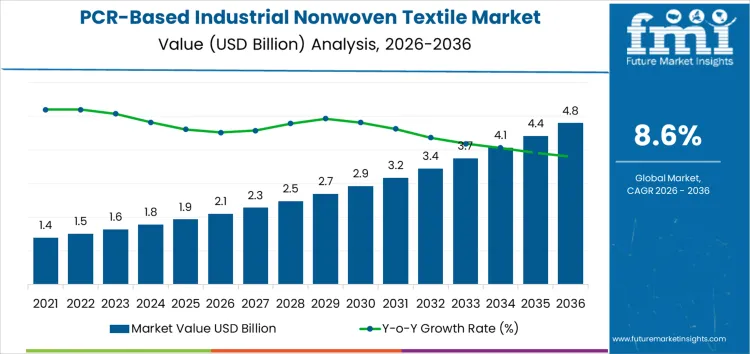
The PCR-based industrial nonwoven textile market is valued at USD 2.1 billion in 2026 and is projected to reach USD 4.8 billion by 2036, reflecting a CAGR of 8.6%. Market behavior during this period is shaped by fiber consistency, processing yield, and mechanical performance requirements across industrial applications. Cost structures depend on resin sourcing quality, fiber conversion efficiency, and waste rates during web formation. Producers with stable PCR feedstock access achieve tighter cost control and more predictable output. Pricing leverage improves where performance specifications limit substitution. Margin outcomes reflect the ability to balance recycled content targets with durability and tensile strength requirements demanded by end users.
From 2026 to 2036, value capture increasingly favors suppliers embedded in industrial qualification processes rather than high volume producers. Buyers prioritize reliability, repeatable performance, and supply continuity over short term price advantages. Dependency on approved formulations and production lines raises switching costs once materials are qualified. Strategic tradeoffs emerge between expanding capacity and maintaining consistent fiber quality. Firms integrating sourcing, fiber processing, and application testing retain stronger positioning. Profit concentration remains with operators aligning production discipline to long term industrial contracts, supporting margin stability across varied demand cycles.
Quick Stats for PCR-Based Industrial Nonwoven Textile Market
- PCR-Based Industrial Nonwoven Textile Market Value (2026): USD 2.1 billion
- PCR-Based Industrial Nonwoven Textile Market Forecast Value (2036): USD 4.8 billion
- PCR-Based Industrial Nonwoven Textile Market Forecast CAGR (2026 to 2036): 8.6%
- Leading Type in PCR-Based Industrial Nonwoven Textile Market: Spunbond and meltblown nonwovens
- Key Growth Regions in PCR-Based Industrial Nonwoven Textile Market: Asia Pacific, Europe, North America
- Top Players in PCR-Based Industrial Nonwoven Textile Market: Berry Global, Freudenberg, Kingsafe Nonwovens, Welspun, Fitesa, Toray, Ahlstrom
What Is the Growth Forecast for PCR Based Industrial Nonwoven Textile Market through 2036?
End use diversification and performance specification requirements shape the early growth phase of the PCR based industrial nonwoven textile market between 2026 and 2031. During this period, the market expands from USD 2.1 billion to USD 2.9 billion, adding USD 0.8 billion in value. Annual progression from USD 1.5 billion to USD 2.1 billion reflects gradual penetration across filtration media, hygiene substrates, and industrial wipes. Historical growth was limited by variability in recycled fiber quality and process consistency. Future expansion in this phase is supported by improved fiber sorting, better compatibility with spunbond and needle punch processes, and rising adoption in applications where durability and cost stability are prioritized.
Process standardization and scale efficiency define the growth trajectory from 2031 to 2036. Over this period, the market increases from USD 2.9 billion to USD 4.8 billion, adding USD 1.9 billion and representing the faster expansion phase. Annual values rise from USD 3.1 billion to USD 4.8 billion, indicating stronger year over year compounding. Earlier demand focused on selective industrial uses, while future growth reflects broader substitution of virgin fibers across automotive interiors, geotextiles, and construction fabrics. Higher line speeds, stable input supply, and expanding acceptance by industrial buyers support sustained growth across mature and emerging manufacturing regions.
PCR Based Industrial Nonwoven Textile Market Key Takeaways
| Metric | Value |
|---|---|
| Market Value (2026) | USD 2.1 billion |
| Forecast Value (2036) | USD 4.8 billion |
| Forecast CAGR (2026 to 2036) | 8.6% |
What Is Driving Growth in the PCR-Based Industrial Nonwoven Textile Market?
Growth in the post-consumer recycled (PCR) industrial nonwoven textile market reflects structural shifts in material sourcing, regulatory pressure, and performance expectations specific to industrial applications. Industrial nonwoven textiles are used in products such as filtration media, geotextiles, automotive liners, and protective covers where mechanical strength, durability, and dimensional stability are paramount. Historically, nonwoven production relied heavily on virgin polymers because PCR feedstocks were inconsistent in melt flow, contamination levels, and fibre formation behaviour. These inconsistencies limited the ability to produce uniform nonwoven webs with predictable tensile and abrasion resistance, confining early PCR use to low-load or secondary applications where performance compromises were tolerable.
Future demand for PCR-based industrial nonwoven textiles is being shaped by evolving procurement criteria, extended producer responsibility frameworks, and supply chain commitments to material circularity rather than by incremental sustainability preferences alone. Regulatory recycled content targets in key regions are increasing pressure on industrial goods producers to incorporate PCR materials into high-use applications. Advances in feedstock preparation, contaminant removal, and compatibilisation enable more reliable conversion of mixed PCR polymers into uniform nonwoven fibres. Processing innovations such as spunbond-meltblown hybrids and engineered fibre blends are improving mechanical performance to meet specified industry standards without reliance on high percentages of virgin resin. Industrial purchasers are increasingly evaluating materials based on documented lifecycle benefits, durability metrics, and alignment with environmental reporting requirements.
What Factors Are Affecting the Demand for PCR Based Industrial Nonwoven Textile Market in Terms of End Use and Nonwoven Type?
The PCR based industrial nonwoven textile market is driven by recycled content mandates, industrial decarbonization targets, and growing acceptance of post-consumer resin in functional textiles. Demand concentrates on applications where performance tolerance allows PCR integration without compromising filtration efficiency, durability, or safety. Adoption is shaped by end-use exposure conditions, regulatory specifications, and compatibility with established nonwoven manufacturing lines. Market leadership reflects scalability and reliability rather than experimental material substitution.
What Is Driving Leadership by End Use in the PCR Based Industrial Nonwoven Textile Market?
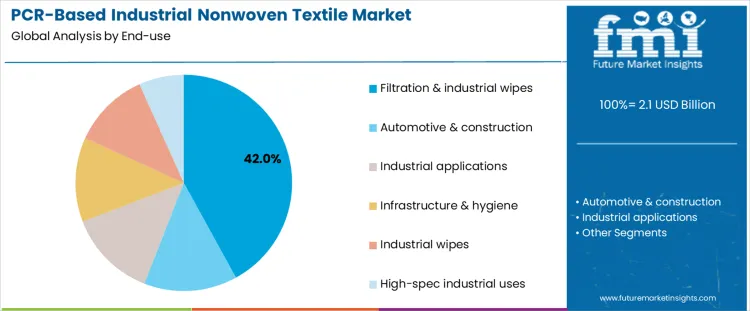
Filtration and industrial wipes account for about 42% of demand because these applications combine high volume consumption with tolerance for controlled material variability. Industrial wipes are used across manufacturing, maintenance, and clean-up operations, creating steady replacement demand. Filtration media in air, liquid, and dust control systems prioritize fiber structure and basis weight over aesthetic properties, making PCR incorporation more feasible. Regulatory pressure to reduce waste and improve circularity in industrial operations reinforces adoption. Large buyers also prefer standardized recycled content products to meet procurement sustainability goals. These factors position filtration and wipes as anchor applications for PCR nonwovens.
Automotive, construction, and broader industrial applications contribute secondary demand but face tighter performance thresholds. Automotive interiors require consistency in strength and thermal behavior. Construction applications emphasize durability under load and exposure. Infrastructure and hygiene segments apply PCR selectively where specifications allow. High-spec industrial uses remain cautious due to liability and certification constraints. End-use leadership therefore reflects volume intensity and functional tolerance rather than total number of industrial segments adopting recycled materials.
What Is Driving Leadership by Nonwoven Type in the PCR Based Industrial Nonwoven Textile Market?
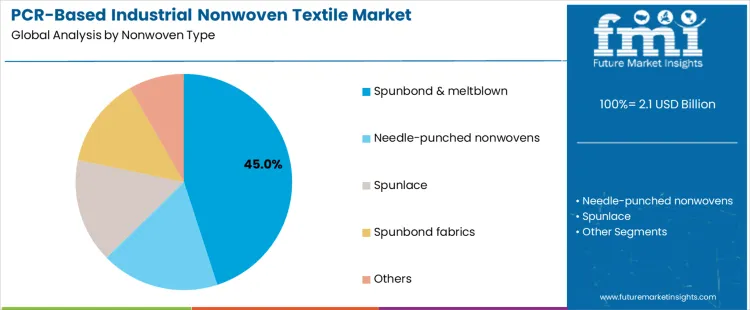
Spunbond and meltblown nonwovens account for about 45% of demand because they dominate filtration and wipe structures. These processes allow controlled fiber diameter and uniform web formation, supporting predictable performance even with PCR inputs. Existing large-scale production lines enable efficient blending of recycled and virgin polymers, reducing cost and qualification time. Spunbond fabrics are widely used in industrial covers and hygiene layers, reinforcing scale advantages. Meltblown structures support fine filtration applications, anchoring demand.
Needle-punched and spunlace nonwovens serve more specialized roles. Needle-punched fabrics provide bulk and strength for automotive and construction uses but face variability challenges with PCR. Spunlace offers softness for wipes but requires tighter fiber control. Other nonwoven types remain niche. Nonwoven type leadership therefore reflects process scalability, fiber control, and compatibility with recycled feedstock rather than diversity of end-use requirements.
How Is the PCR-Based Industrial Nonwoven Textile Market Being Applied Across Industrial and Consumer Applications?
Use appears in filtration, automotive, hygiene, and construction sectors where post-consumer recycled (PCR) polymers are converted into nonwoven fabrics. Manufacturers adopt PCR-based nonwovens for air and liquid filters, insulation, wipes, geotextiles, and protective coverings, maintaining functional performance while meeting sustainability targets. Automotive and industrial producers integrate these textiles in cabin filters, HVAC systems, and packaging liners. These applications reflect operational and environmental priorities rather than aesthetic objectives, with adoption driven by recyclate utilization, regulatory compliance, and material performance.
What Operational and Material Conditions Support Adoption of PCR-Based Industrial Nonwoven Textiles?
Selection aligns with polymer feedstocks that provide consistent melt flow, fiber formation, and tensile strength. Spunbond, meltblown, or needle-punched processes are optimized to maintain uniform fiber diameter, porosity, and mechanical integrity. Quality control monitors contamination, fiber uniformity, and functional properties such as filtration efficiency or absorbency. Manufacturers integrate PCR nonwovens with lamination, coating, or composite processes without compromising end-use performance. These conditions emerge from operational reliability, material consistency, and functional performance priorities in structured textile production workflows.
Which Practical Considerations Limit Wider Use of PCR-Based Industrial Nonwoven Textiles?
Feedstock variability, color inconsistency, and residual contaminants can affect fiber formation and mechanical properties. Higher processing costs compared with virgin polymers may influence adoption in price-sensitive applications. Compatibility with coatings, adhesives, or secondary processes must be ensured. Regulatory standards for filtration, hygiene, or industrial use require validation. These factors lead to selective deployment where recyclate integration, functional performance, and sustainability objectives justify incremental cost and operational oversight.
What is the Demand for PCR Based Industrial Nonwoven Textiles by Country?
| Country | CAGR (%) |
|---|---|
| USA | 7.8% |
| Germany | 7.2% |
| China | 11.0% |
| India | 12.4% |
| Brazil | 8.2% |
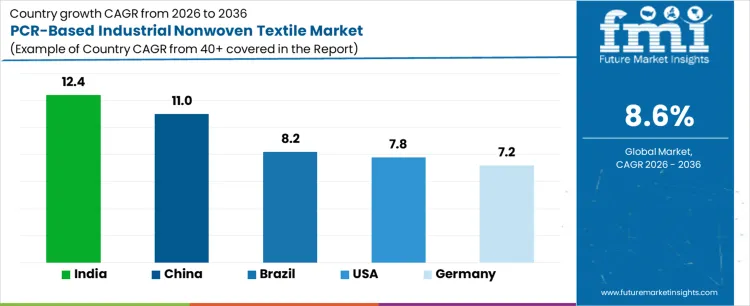
The demand for PCR based industrial nonwoven textiles varies across countries, driven by sustainable textile adoption, industrial applications, and recycling initiatives. India leads with a 12.4% CAGR, supported by growing industrial textile production, expanding nonwoven applications in hygiene, filtration, and packaging, and rising adoption of recycled polymers. China follows at 11.0%, driven by large scale manufacturing, recycling integration, and increasing industrial demand. The USA grows at 7.8%, reflecting steady adoption in industrial, medical, and filtration applications. Brazil records 8.2%, shaped by industrial expansion and sustainability initiatives. Germany posts 7.2%, supported by mature industrial nonwoven markets and regulatory compliance.
How Is the PCR-Based Industrial Nonwoven Textile Market Expanding in the United States?
In the United States, the PCR-Based Industrial Nonwoven Textile Market is growing at a CAGR of 7.8% through 2036, driven by increasing demand for recycled-content nonwoven fabrics in automotive, filtration, and hygiene applications. Manufacturers are integrating PCR fibers to reduce virgin polymer usage, meet sustainability targets, and comply with environmental standards. Demand is concentrated in industrial textile production hubs, automotive component suppliers, and hygiene product facilities. Compared to Germany, where adoption is primarily regulatory-driven, the U.S. market emphasizes sustainability alongside operational efficiency. Domestic suppliers provide high-performance, recycled-content nonwoven fibers suitable for recurring production and high-volume applications.
- Industrial textile hubs, automotive suppliers, and hygiene product facilities drive adoption
- PCR fibers reduce virgin polymer usage and support sustainability targets
- Domestic suppliers provide high-performance, recycled-content nonwoven fibers
- Recurring production cycles sustain high-volume adoption
How Are Regulatory Standards Driving Growth in Germany?
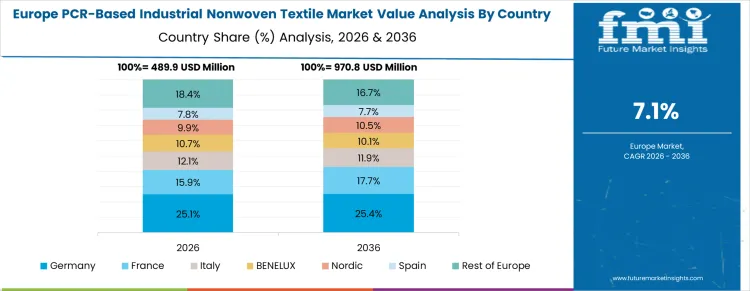
Germany is witnessing growth at a CAGR of 7.2% through 2036, supported by EU mandates on recycled-content textiles and strict environmental compliance requirements. Nonwoven textile manufacturers, automotive component producers, and industrial filtration companies are adopting PCR-based fibers to meet regulatory standards, reduce environmental impact, and maintain product quality. Demand is concentrated in industrial clusters, automotive manufacturing zones, and filtration product facilities. Compared to the U.S., adoption is more compliance-driven than efficiency-focused. Domestic suppliers provide EU-certified, high-quality PCR fibers compatible with automated production lines. Recurring production cycles and regulatory monitoring sustain steady adoption nationwide.
- Industrial clusters, automotive manufacturing zones, and filtration product facilities drive adoption
- PCR fibers reduce environmental impact and ensure compliance
- Domestic suppliers provide EU-certified, high-quality fibers
- Recurring production cycles sustain steady adoption
How Is Industrial Expansion Driving Adoption in China?
In China, the market is expanding at a CAGR of 11% through 2036, fueled by rapid industrialization, urban manufacturing clusters, and growing demand for sustainable nonwoven textiles in automotive, filtration, and hygiene sectors. Manufacturers are adopting PCR-based fibers to reduce virgin polymer consumption, comply with local environmental regulations, and meet corporate sustainability goals. Demand is concentrated in urban industrial zones, automotive component hubs, and nonwoven textile production facilities. Domestic suppliers are scaling high-performance, recycled-content fibers compatible with automated production equipment. Compared to Brazil, adoption emphasizes large-scale industrial integration and urban supply chain efficiency. Recurring production cycles sustain rapid adoption nationwide.
- Urban industrial zones, automotive hubs, and nonwoven production facilities drive adoption
- PCR fibers reduce virgin polymer usage and support sustainability goals
- Domestic suppliers scale high-performance, recycled-content fibers
- Recurring production cycles sustain rapid adoption
How Are Emerging Industrial Zones Driving Market Growth in India?
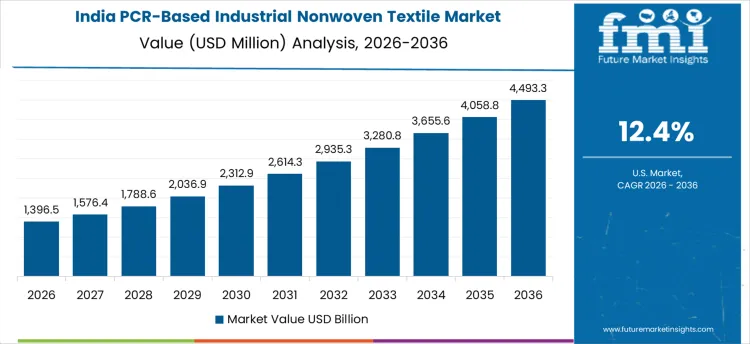
In India, revenue is growing at a CAGR of 12.4% through 2036, supported by expansion of industrial parks, textile manufacturing clusters, and hygiene and filtration product industries. Companies are adopting PCR-based fibers to reduce environmental impact, meet sustainability objectives, and comply with emerging packaging and product standards. Demand is concentrated in urban industrial clusters, nonwoven textile production hubs, and automotive component facilities. Domestic suppliers provide cost-effective, high-performance PCR fibers suitable for automated production and recurring operations. Compared to China, adoption is influenced more by emerging zones and government incentives promoting recycled-content textiles. Recurring production cycles sustain robust adoption nationwide.
- Industrial clusters, nonwoven hubs, and automotive facilities drive adoption
- PCR fibers reduce environmental impact and support sustainability objectives
- Domestic suppliers provide cost-effective, high-performance fibers
- Recurring production cycles sustain robust adoption
How Are Industrial Hubs Supporting Growth in Brazil?
In Brazil, the market is growing at a CAGR of 8.2% through 2036, driven by adoption of PCR-based nonwoven fibers in established industrial hubs, automotive suppliers, and hygiene product manufacturers. Companies are integrating recycled-content fibers to reduce virgin polymer usage, comply with environmental standards, and meet corporate sustainability goals. Demand is concentrated in industrial clusters, urban production zones, and filtration and hygiene manufacturing facilities. Domestic suppliers provide high-performance, production-compatible PCR fibers. Compared to India and China, adoption focuses on established hubs rather than rapid industrial expansion. Recurring production cycles sustain steady adoption nationwide.
- Industrial clusters, automotive suppliers, and hygiene product facilities drive adoption
- PCR fibers reduce virgin polymer use and improve sustainability
- Domestic suppliers provide high-performance, production-compatible fibers
- Recurring production cycles sustain steady adoption
Which Strategic Approaches Define Competition in the PCR Based Industrial Nonwoven Textile Market through Performance Assurance and End Use Qualification?
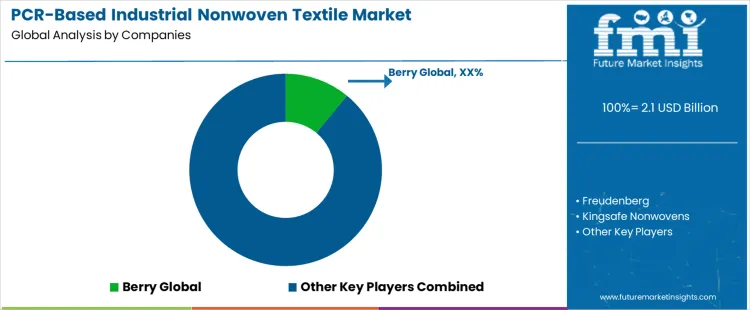
Competition in the PCR based industrial nonwoven textile market is shaped by how recycled content is introduced without disrupting functional performance in demanding applications. Berry Global and Fitesa approach this market through controlled PCR integration, prioritizing tensile strength, basis weight stability, and filtration or absorbency consistency. Freudenberg and Ahlstrom emphasize application specific engineering, where PCR fibers are qualified within technical nonwovens used for filtration, wipes, and industrial substrates. Their strategies focus on maintaining process repeatability and downstream performance rather than maximizing recycled content percentages. Customers evaluate suppliers based on durability under mechanical stress, compatibility with converting operations, and reliability across long production runs, making conservative material integration a competitive advantage.
A different strategic logic applies among vertically integrated and regionally focused producers. Toray leverages polymer and fiber expertise to manage PCR quality at the raw material level, enabling tighter control over fiber morphology and bonding behavior. Welspun and Kingsafe Nonwovens compete by aligning PCR nonwoven production with cost sensitive industrial uses, balancing performance thresholds with scale efficiency. These suppliers often tailor products to regional waste streams and customer specifications, influencing adoption through customization rather than standardization. Across the market, competitive advantage is built through feedstock governance, qualification discipline, and close collaboration with industrial end users. Success depends on predictable performance, audit readiness, and supply continuity rather than rapid expansion of recycled content claims.
Key Players in the PCR Based Industrial Nonwoven Textile Market
- Berry Global
- Freudenberg
- Kingsafe Nonwovens
- Welspun
- Fitesa
- Toray
- Ahlstrom
Scope of the Report
| Items | Values |
|---|---|
| Quantitative Units (2026) | USD billion |
| Type | Spunbond and Meltblown Nonwovens, Needle-Punched Nonwovens, Spunlace Nonwovens, Other Types |
| Application | Filtration Media, Industrial Wipes, Automotive Interiors, Construction and Geotextiles, Hygiene and Infrastructure Uses |
| End User | Industrial Manufacturers, Automotive Component Suppliers, Filtration and HVAC Producers, Hygiene Product Manufacturers |
| Regions Covered | Asia Pacific, Europe, North America, Latin America, Middle East & Africa |
| Countries Covered | USA, Germany, China, India, Japan, South Korea, Brazil, United Kingdom, France, Italy, Canada, Mexico, ASEAN countries, GCC countries, and other global regions |
| Key Companies Profiled | Berry Global, Freudenberg, Fitesa, Ahlstrom, Toray, Welspun, Kingsafe Nonwovens |
| Additional Attributes | Dollar sales by nonwoven type and material categories, regional adoption trends across Asia Pacific, Europe, and North America, competitive landscape across global and regional industrial nonwoven producers, PCR feedstock sourcing and fiber quality requirements, processing yield, performance validation, and qualification requirements across industrial end-use applications |
PCR Based Industrial Nonwoven Textile Market Segmentation
End-use:
- Filtration & industrial wipes
- Automotive & construction
- Industrial applications
- Infrastructure & hygiene
- Industrial wipes
- High-spec industrial uses
Nonwoven Type:
- Spunbond & meltblown
- Needle-punched nonwovens
- Spunlace
- Spunbond fabrics
- Others
Material:
- PCR-PP / PCR-PET
- PCR-PET
- PCR-PP
- Others
Technology:
- High-purity PCR fibre spinning
- Thermal bonding
- High-speed nonwoven lines
- Cost-efficient PCR fibre processing
- Others
Region
- Asia Pacific
- China
- Japan
- South Korea
- India
- Australia & New Zealand
- ASEAN
- Rest of Asia Pacific
- Europe
- Germany
- United Kingdom
- France
- Italy
- Spain
- Nordic
- BENELUX
- Rest of Europe
- North America
- United States
- Canada
- Mexico
- Latin America
- Brazil
- Chile
- Rest of Latin America
- Middle East & Africa
- Kingdom of Saudi Arabia
- Other GCC Countries
- Turkey
- South Africa
- Other African Union
- Rest of Middle East & Africa
Frequently Asked Questions
How big is the PCR-based industrial nonwoven textile market in 2026?
The global PCR-based industrial nonwoven textile market is estimated to be valued at USD 2.1 billion in 2026.
What will be the size of PCR-based industrial nonwoven textile market in 2036?
The market size for the PCR-based industrial nonwoven textile market is projected to reach USD 4.8 billion by 2036.
How much will be the PCR-based industrial nonwoven textile market growth between 2026 and 2036?
The PCR-based industrial nonwoven textile market is expected to grow at a 8.6% CAGR between 2026 and 2036.
What are the key product types in the PCR-based industrial nonwoven textile market?
The key product types in PCR-based industrial nonwoven textile market are filtration & industrial wipes, automotive & construction, industrial applications, infrastructure & hygiene, industrial wipes and high-spec industrial uses.
Which nonwoven type segment to contribute significant share in the PCR-based industrial nonwoven textile market in 2026?
In terms of nonwoven type, spunbond & meltblown segment to command 45.0% share in the PCR-based industrial nonwoven textile market in 2026.
Preview the report firsthand - request a free sample
Get SampleGet the brochure for pricing and purchase details.
Get PDFTable of Content
- Executive Summary
- Global Market Outlook
- Demand-side Trends
- Supply-side Trends
- Technology Roadmap Analysis
- Analysis and Recommendations
- Market Overview
- Market Coverage / Taxonomy
- Market Definition / Scope / Limitations
- Market Background
- Market Dynamics
- Drivers
- Restraints
- Opportunity
- Trends
- Scenario Forecast
- Demand in Optimistic Scenario
- Demand in Likely Scenario
- Demand in Conservative Scenario
- Opportunity Map Analysis
- Product Life Cycle Analysis
- Supply Chain Analysis
- Investment Feasibility Matrix
- Value Chain Analysis
- PESTLE and Porter’s Analysis
- Regulatory Landscape
- Regional Parent Market Outlook
- Production and Consumption Statistics
- Import and Export Statistics
- Market Dynamics
- Global Market Analysis 2021 to 2025 and Forecast, 2026 to 2036
- Historical Market Size Value (USD Million) Analysis, 2021 to 2025
- Current and Future Market Size Value (USD Million) Projections, 2026 to 2036
- Y-o-Y Growth Trend Analysis
- Absolute $ Opportunity Analysis
- Global Market Pricing Analysis 2021 to 2025 and Forecast 2026 to 2036
- Global Market Analysis 2021 to 2025 and Forecast 2026 to 2036, By End-use
- Introduction / Key Findings
- Historical Market Size Value (USD Million) Analysis By End-use , 2021 to 2025
- Current and Future Market Size Value (USD Million) Analysis and Forecast By End-use , 2026 to 2036
- Filtration & industrial wipes
- Automotive & construction
- Industrial applications
- Infrastructure & hygiene
- Industrial wipes
- High-spec industrial uses
- Filtration & industrial wipes
- Y-o-Y Growth Trend Analysis By End-use , 2021 to 2025
- Absolute $ Opportunity Analysis By End-use , 2026 to 2036
- Global Market Analysis 2021 to 2025 and Forecast 2026 to 2036, By Nonwoven Type
- Introduction / Key Findings
- Historical Market Size Value (USD Million) Analysis By Nonwoven Type, 2021 to 2025
- Current and Future Market Size Value (USD Million) Analysis and Forecast By Nonwoven Type, 2026 to 2036
- Spunbond & meltblown
- Needle-punched nonwovens
- Spunlace
- Spunbond fabrics
- Others
- Spunbond & meltblown
- Y-o-Y Growth Trend Analysis By Nonwoven Type, 2021 to 2025
- Absolute $ Opportunity Analysis By Nonwoven Type, 2026 to 2036
- Global Market Analysis 2021 to 2025 and Forecast 2026 to 2036, By Material
- Introduction / Key Findings
- Historical Market Size Value (USD Million) Analysis By Material, 2021 to 2025
- Current and Future Market Size Value (USD Million) Analysis and Forecast By Material, 2026 to 2036
- PCR-PP / PCR-PET
- PCR-PET
- PCR-PP
- PCR-PP
- Others
- PCR-PP / PCR-PET
- Y-o-Y Growth Trend Analysis By Material, 2021 to 2025
- Absolute $ Opportunity Analysis By Material, 2026 to 2036
- Global Market Analysis 2021 to 2025 and Forecast 2026 to 2036, By Technology
- Introduction / Key Findings
- Historical Market Size Value (USD Million) Analysis By Technology, 2021 to 2025
- Current and Future Market Size Value (USD Million) Analysis and Forecast By Technology, 2026 to 2036
- High-purity PCR fibre spinning
- Thermal bonding
- High-speed nonwoven lines
- Cost-efficient PCR fibre processing
- Others
- High-purity PCR fibre spinning
- Y-o-Y Growth Trend Analysis By Technology, 2021 to 2025
- Absolute $ Opportunity Analysis By Technology, 2026 to 2036
- Global Market Analysis 2021 to 2025 and Forecast 2026 to 2036, By Region
- Introduction
- Historical Market Size Value (USD Million) Analysis By Region, 2021 to 2025
- Current Market Size Value (USD Million) Analysis and Forecast By Region, 2026 to 2036
- North America
- Latin America
- Western Europe
- Eastern Europe
- East Asia
- South Asia and Pacific
- Middle East & Africa
- Market Attractiveness Analysis By Region
- North America Market Analysis 2021 to 2025 and Forecast 2026 to 2036, By Country
- Historical Market Size Value (USD Million) Trend Analysis By Market Taxonomy, 2021 to 2025
- Market Size Value (USD Million) Forecast By Market Taxonomy, 2026 to 2036
- By Country
- USA
- Canada
- Mexico
- By End-use
- By Nonwoven Type
- By Material
- By Technology
- By Country
- Market Attractiveness Analysis
- By Country
- By End-use
- By Nonwoven Type
- By Material
- By Technology
- Key Takeaways
- Latin America Market Analysis 2021 to 2025 and Forecast 2026 to 2036, By Country
- Historical Market Size Value (USD Million) Trend Analysis By Market Taxonomy, 2021 to 2025
- Market Size Value (USD Million) Forecast By Market Taxonomy, 2026 to 2036
- By Country
- Brazil
- Chile
- Rest of Latin America
- By End-use
- By Nonwoven Type
- By Material
- By Technology
- By Country
- Market Attractiveness Analysis
- By Country
- By End-use
- By Nonwoven Type
- By Material
- By Technology
- Key Takeaways
- Western Europe Market Analysis 2021 to 2025 and Forecast 2026 to 2036, By Country
- Historical Market Size Value (USD Million) Trend Analysis By Market Taxonomy, 2021 to 2025
- Market Size Value (USD Million) Forecast By Market Taxonomy, 2026 to 2036
- By Country
- Germany
- UK
- Italy
- Spain
- France
- Nordic
- BENELUX
- Rest of Western Europe
- By End-use
- By Nonwoven Type
- By Material
- By Technology
- By Country
- Market Attractiveness Analysis
- By Country
- By End-use
- By Nonwoven Type
- By Material
- By Technology
- Key Takeaways
- Eastern Europe Market Analysis 2021 to 2025 and Forecast 2026 to 2036, By Country
- Historical Market Size Value (USD Million) Trend Analysis By Market Taxonomy, 2021 to 2025
- Market Size Value (USD Million) Forecast By Market Taxonomy, 2026 to 2036
- By Country
- Russia
- Poland
- Hungary
- Balkan & Baltic
- Rest of Eastern Europe
- By End-use
- By Nonwoven Type
- By Material
- By Technology
- By Country
- Market Attractiveness Analysis
- By Country
- By End-use
- By Nonwoven Type
- By Material
- By Technology
- Key Takeaways
- East Asia Market Analysis 2021 to 2025 and Forecast 2026 to 2036, By Country
- Historical Market Size Value (USD Million) Trend Analysis By Market Taxonomy, 2021 to 2025
- Market Size Value (USD Million) Forecast By Market Taxonomy, 2026 to 2036
- By Country
- China
- Japan
- South Korea
- By End-use
- By Nonwoven Type
- By Material
- By Technology
- By Country
- Market Attractiveness Analysis
- By Country
- By End-use
- By Nonwoven Type
- By Material
- By Technology
- Key Takeaways
- South Asia and Pacific Market Analysis 2021 to 2025 and Forecast 2026 to 2036, By Country
- Historical Market Size Value (USD Million) Trend Analysis By Market Taxonomy, 2021 to 2025
- Market Size Value (USD Million) Forecast By Market Taxonomy, 2026 to 2036
- By Country
- India
- ASEAN
- Australia & New Zealand
- Rest of South Asia and Pacific
- By End-use
- By Nonwoven Type
- By Material
- By Technology
- By Country
- Market Attractiveness Analysis
- By Country
- By End-use
- By Nonwoven Type
- By Material
- By Technology
- Key Takeaways
- Middle East & Africa Market Analysis 2021 to 2025 and Forecast 2026 to 2036, By Country
- Historical Market Size Value (USD Million) Trend Analysis By Market Taxonomy, 2021 to 2025
- Market Size Value (USD Million) Forecast By Market Taxonomy, 2026 to 2036
- By Country
- Kingdom of Saudi Arabia
- Other GCC Countries
- Turkiye
- South Africa
- Other African Union
- Rest of Middle East & Africa
- By End-use
- By Nonwoven Type
- By Material
- By Technology
- By Country
- Market Attractiveness Analysis
- By Country
- By End-use
- By Nonwoven Type
- By Material
- By Technology
- Key Takeaways
- Key Countries Market Analysis
- USA
- Pricing Analysis
- Market Share Analysis, 2025
- By End-use
- By Nonwoven Type
- By Material
- By Technology
- Canada
- Pricing Analysis
- Market Share Analysis, 2025
- By End-use
- By Nonwoven Type
- By Material
- By Technology
- Mexico
- Pricing Analysis
- Market Share Analysis, 2025
- By End-use
- By Nonwoven Type
- By Material
- By Technology
- Brazil
- Pricing Analysis
- Market Share Analysis, 2025
- By End-use
- By Nonwoven Type
- By Material
- By Technology
- Chile
- Pricing Analysis
- Market Share Analysis, 2025
- By End-use
- By Nonwoven Type
- By Material
- By Technology
- Germany
- Pricing Analysis
- Market Share Analysis, 2025
- By End-use
- By Nonwoven Type
- By Material
- By Technology
- UK
- Pricing Analysis
- Market Share Analysis, 2025
- By End-use
- By Nonwoven Type
- By Material
- By Technology
- Italy
- Pricing Analysis
- Market Share Analysis, 2025
- By End-use
- By Nonwoven Type
- By Material
- By Technology
- Spain
- Pricing Analysis
- Market Share Analysis, 2025
- By End-use
- By Nonwoven Type
- By Material
- By Technology
- France
- Pricing Analysis
- Market Share Analysis, 2025
- By End-use
- By Nonwoven Type
- By Material
- By Technology
- India
- Pricing Analysis
- Market Share Analysis, 2025
- By End-use
- By Nonwoven Type
- By Material
- By Technology
- ASEAN
- Pricing Analysis
- Market Share Analysis, 2025
- By End-use
- By Nonwoven Type
- By Material
- By Technology
- Australia & New Zealand
- Pricing Analysis
- Market Share Analysis, 2025
- By End-use
- By Nonwoven Type
- By Material
- By Technology
- China
- Pricing Analysis
- Market Share Analysis, 2025
- By End-use
- By Nonwoven Type
- By Material
- By Technology
- Japan
- Pricing Analysis
- Market Share Analysis, 2025
- By End-use
- By Nonwoven Type
- By Material
- By Technology
- South Korea
- Pricing Analysis
- Market Share Analysis, 2025
- By End-use
- By Nonwoven Type
- By Material
- By Technology
- Russia
- Pricing Analysis
- Market Share Analysis, 2025
- By End-use
- By Nonwoven Type
- By Material
- By Technology
- Poland
- Pricing Analysis
- Market Share Analysis, 2025
- By End-use
- By Nonwoven Type
- By Material
- By Technology
- Hungary
- Pricing Analysis
- Market Share Analysis, 2025
- By End-use
- By Nonwoven Type
- By Material
- By Technology
- Kingdom of Saudi Arabia
- Pricing Analysis
- Market Share Analysis, 2025
- By End-use
- By Nonwoven Type
- By Material
- By Technology
- Turkiye
- Pricing Analysis
- Market Share Analysis, 2025
- By End-use
- By Nonwoven Type
- By Material
- By Technology
- South Africa
- Pricing Analysis
- Market Share Analysis, 2025
- By End-use
- By Nonwoven Type
- By Material
- By Technology
- USA
- Market Structure Analysis
- Competition Dashboard
- Competition Benchmarking
- Market Share Analysis of Top Players
- By Regional
- By End-use
- By Nonwoven Type
- By Material
- By Technology
- Competition Analysis
- Competition Deep Dive
- Berry Global
- Overview
- Product Portfolio
- Profitability by Market Segments (Product/Age /Sales Channel/Region)
- Sales Footprint
- Strategy Overview
- Marketing Strategy
- Product Strategy
- Channel Strategy
- Freudenberg
- Kingsafe Nonwovens
- Welspun
- Fitesa
- Toray
- Ahlstrom
- Berry Global
- Competition Deep Dive
- Assumptions & Acronyms Used
- Research Methodology


