

- Industry Size (2026)
- USD 4.3 Bn
- Forecast (2036)
- USD 8.9 Bn
- CAGR (2026 to 2036)
- 7.5%
Chemical Storage and Hazmat Handling Market Forecast and Outlook 2026 to 2036
The chemical storage and hazmat handling market is valued at USD 4.3 billion in 2026 and is projected to reach USD 8.9 billion by 2036, reflecting a CAGR of 7.5%. Performance over this period is driven by cost structures tied to compliance obligations, facility certification, and labor specialization rather than simple capacity growth. High fixed costs related to containment systems, safety audits, insurance coverage, and monitoring technology create operating leverage for established providers. Firms with owned assets maintain tighter cost control and steadier pricing than operators dependent on leased infrastructure. Margin stability improves where utilization rates remain high across contract cycles and exposure to spot pricing remains limited.
Between 2026 and 2036, value capture increasingly favors operators that manage regulatory risk and liability transfer rather than those maximizing handled volumes. Customers place greater weight on audit continuity, documentation accuracy, and incident accountability, reducing sensitivity to base storage rates. Providers offering integrated compliance services alongside storage retain stronger pricing control and longer contract duration. These structures raise switching costs and protect margins against competitive bidding. Capacity additions remain selective due to permitting complexity and capital requirements, reinforcing incumbent positions. Profit pools concentrate among firms aligning asset life cycles with long term contracts, enabling consistent recovery of compliance driven costs.
Quick Stats of the Chemical Storage and Hazmat Handling Market:
- Chemical Storage & Hazmat Handling Market Value (2026): USD 4.3 billion
- Chemical Storage & Hazmat Handling Forecast Value (2036): USD 8.9 billion
- Chemical Storage & Hazmat Handling Forecast CAGR (2026 to 2036): 7.5%
- Leading Product Type in the Market: Cabinets, Pallets & IBC Handling Systems (45%)
- Key Growth Regions in the Market: India, China, Brazil, USA, Germany
- Top Players in the Market: Justrite, Denios, Jiangsu Safety Tech, Godrej Storage, TRUSCO Nakayama, Eagle Manufacturing, Asecos
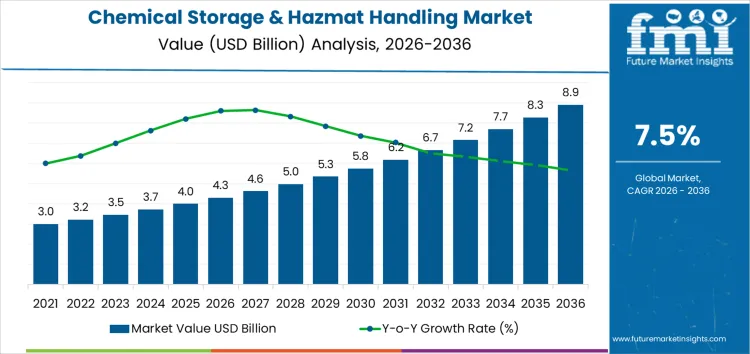
What is the growth forecast for chemical storage and hazmat handling market through 2036?
Between 2026 and 2031, the chemical storage and hazmat handling market is expected to increase from USD 4.3 billion to USD 5.7 billion, reflecting an absolute expansion of USD 1.4 billion. Year-over-year progression during this phase remains moderate and sequential, with annual market values expanding steadily from the 2026 base of USD 4.3 billion as regulatory compliance investments and incremental capacity additions gain momentum. Historical growth was anchored in replacement demand and basic compliance upgrades across industrial sites. Forward momentum is supported by incremental capacity additions, rising regulatory oversight, and steady investments in compliant storage systems across chemicals, refining, and manufacturing facilities.
From 2031 to 2036, the market is projected to grow from USD 5.7 billion to USD 8.9 billion, adding USD 3.2 billion and representing the stronger growth phase. Annual values advance consistently from USD 6.1 billion to USD 8.9 billion, indicating accelerating year over year expansion. Earlier growth focused on containment and regulatory alignment, while future demand is shaped by integrated hazmat handling systems, centralized storage facilities, and higher specification safety infrastructure. Increased deployment across pharmaceuticals, specialty chemicals, and logistics operations, combined with larger project scopes, supports sustained and higher value additions through the latter half of the forecast period.
Chemical Storage and Hazmat Handling Market Key Takeaways
| Metric | Value |
|---|---|
| Market Value (2026) | USD 4.3 billion |
| Forecast Value (2036) | USD 8.9 billion |
| Forecast CAGR (2026 to 2036) | 7.5% |
What Is Driving Growth in the Chemical Storage and Hazmat Handling Market?
Market growth is driven by rising regulatory scrutiny and operational risk associated with hazardous material storage. Industries handling chemicals face stricter requirements for segregation, labeling, secondary containment, and worker protection. Legacy storage practices often fail to meet updated safety codes, leading to compliance gaps and higher incident exposure. Facilities are investing in purpose built cabinets, containment pallets, and controlled handling systems to reduce spill risk and improve audit readiness. Increased inspection frequency and higher penalties for non-compliance are influencing purchasing decisions. Demand is further supported by workforce safety programs that prioritize controlled access, spill prevention, and standardized handling procedures across industrial, laboratory, and logistics environments.
Future growth reflects integration of chemical storage into broader risk management and facility design strategies. Organizations are shifting from reactive upgrades toward planned investments aligned with insurance requirements, safety audits, and environmental reporting. New facilities increasingly specify hazmat storage systems during design to ensure compatibility with ventilation, fire suppression, and emergency response plans. Advances in corrosion resistant materials, modular storage layouts, and monitoring technologies are improving reliability and lifecycle performance. Companies are also centralizing chemical inventories to improve traceability and reduce redundant storage risks. Market expansion will follow formal safety frameworks, documentation requirements, and long term liability management rather than isolated response to individual incidents.
What Factors Are Affecting the Demand for Chemical Storage and Hazmat Handling Market in Terms of End Use and Product Type?
The chemical storage and hazmat handling market is driven by stricter safety regulations, higher audit frequency, and rising liability associated with hazardous material incidents. Demand focuses on solutions that standardize storage, reduce spill risk, and support regulatory compliance across industrial environments. Purchasing decisions are shaped by operational scale, chemical hazard class, and workflow integration rather than discretionary safety upgrades. Market structure reflects risk exposure and compliance intensity across end-use industries.
What Is Driving Leadership by End Use in the Chemical Storage and Hazmat Handling Market?
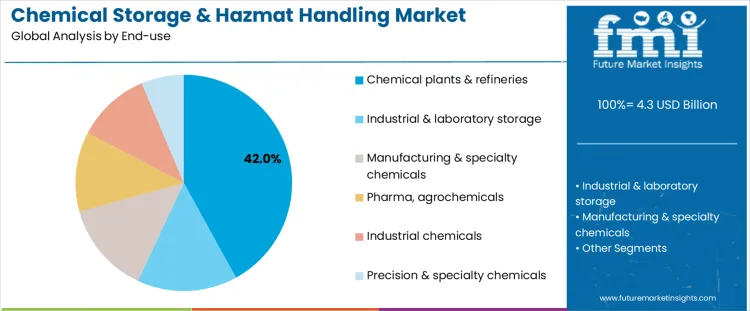
Chemical plants and refineries account for about 42% of demand because they manage large volumes of hazardous chemicals under continuous operating conditions. These facilities handle flammable, corrosive, and toxic substances across production, blending, and storage stages, requiring robust containment systems. Regulatory inspections, insurance requirements, and internal safety audits reinforce consistent investment in compliant storage and handling infrastructure. High material throughput and complex inventories increase dependence on standardized systems that support segregation, labeling, and spill response. End-use leadership is therefore anchored in operational risk concentration rather than facility count alone.
Other end-use segments such as industrial laboratories, specialty chemical manufacturing, and pharmaceutical production contribute meaningful but smaller demand volumes. These environments handle lower quantities but greater chemical diversity, requiring selective deployment of hazmat solutions. Laboratory and pharma settings prioritize precision containment and controlled access over bulk handling. Specialty chemical producers balance safety with space and cost constraints. These sectors adopt hazmat systems based on specific process risks, limiting overall share. End-use dominance remains with large-scale chemical processing where continuous exposure and regulatory oversight are highest.
What Is Driving Leadership by Product Type in the Chemical Storage and Hazmat Handling Market?
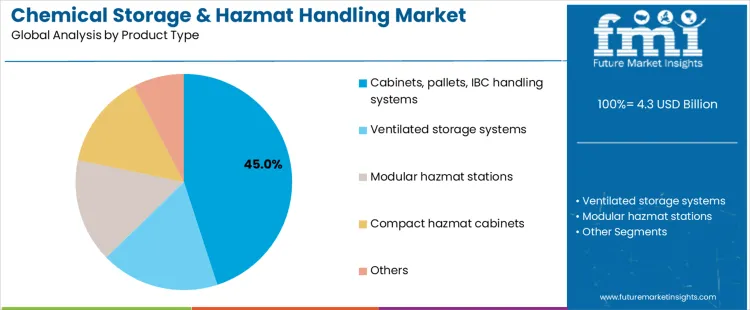
Cabinets, pallets, and IBC handling systems represent about 45% of demand because they address core requirements for hazardous material storage and movement. These products provide standardized containment, secondary spill protection, and compatibility with forklifts and material handling equipment. Their modular design allows deployment across warehouses, production floors, and transfer zones. Compliance certifications and durability under industrial conditions support widespread adoption. Product leadership reflects versatility and suitability for high-volume, routine operations across chemical facilities.
Ventilated storage systems, modular hazmat stations, and compact cabinets serve more specific needs but remain secondary. Ventilated systems are required for volatile or fume-emitting substances, while modular stations support point-of-use handling in production areas. Compact cabinets are favored in laboratories and pharmaceutical sites with limited space. These products expand functionality but are applied selectively based on hazard class and workflow design. Product type leadership therefore reflects scalability and standardization rather than specialization or customization intensity.
How Is the Chemical Storage and Hazmat Handling Market Being Applied Across Industrial and Laboratory Settings?
Use appears in chemical manufacturing plants, laboratories, and industrial facilities where safe storage, transport, and handling of hazardous materials are critical. Operators adopt specialized storage cabinets, containment systems, and handling equipment to manage flammable, corrosive, toxic, or reactive substances. Pharmaceutical, petrochemical, and specialty chemical facilities integrate automated monitoring, secondary containment, and ventilation systems to prevent accidents and comply with regulatory standards. These applications reflect operational and safety priorities rather than aesthetic objectives, with adoption driven by risk mitigation, regulatory compliance, and worker protection.
What Operational and Material Conditions Support Adoption of Chemical Storage and Hazmat Handling Solutions?
Selection aligns with facility requirements for material compatibility, fire resistance, and spill containment. Storage systems are designed to segregate incompatible chemicals and maintain temperature, humidity, and ventilation standards. Operators implement standard operating procedures, personal protective equipment, and automated monitoring for leak detection and inventory tracking. Regulatory frameworks such as OSHA, EPA, and local fire codes guide design and operational protocols. These conditions emerge from operational safety, compliance, and hazard mitigation priorities in structured chemical handling workflows.
Which Practical Considerations Limit Wider Use of Chemical Storage and Hazmat Handling Solutions?
High capital and maintenance costs can restrict adoption in small or low-volume facilities. Space constraints may limit optimal segregation or containment. Staff training and procedural adherence are essential to maintain safety and regulatory compliance. Equipment must be compatible with a wide range of chemical properties to prevent corrosion or degradation. These factors lead to selective deployment where hazard control, operational safety, and regulatory adherence justify incremental cost and operational planning.
What is the Demand for Chemical Storage and Hazmat Handling by Country?
| Country | CAGR (%) |
|---|---|
| USA | 6.9% |
| Germany | 6.2% |
| China | 10.0% |
| India | 11.2% |
| Brazil | 7.6% |
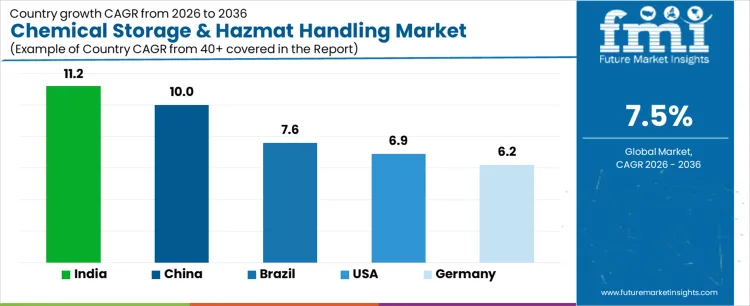
The demand for chemical storage and hazmat handling solutions varies across countries, driven by industrial growth, safety regulations, and chemical management requirements. India leads with an 11.2% CAGR, supported by expanding chemical manufacturing, increasing industrial operations, and stricter workplace safety compliance. China follows at 10.0%, driven by large scale industrial and chemical production and adoption of advanced storage and handling systems. The USA grows at 6.9%, reflecting established industrial infrastructure and regulatory enforcement. Brazil records 7.6%, shaped by growing chemical and manufacturing sectors. Germany posts 6.2%, supported by mature industrial markets and stringent safety standards.
How Are Chemical Storage and Hazmat Handling Solutions Expanding Industrial Safety in the United States?
In the United States, the Chemical Storage & Hazmat Handling Market is growing at a CAGR of 6.9% through 2036, driven by stringent OSHA regulations and increasing adoption of automated storage and containment systems in chemical, pharmaceutical, and manufacturing sectors. Hospitals, research laboratories, and industrial parks are investing in spill containment, safety cabinets, and handling automation to reduce workplace incidents and environmental hazards. Compared to Germany, where regulatory compliance dominates adoption, the USA market emphasizes operational efficiency alongside safety. Domestic suppliers provide versatile solutions compatible with multiple chemical classes, supporting recurring storage needs and long-term industrial expansion.
- Chemical, pharmaceutical, and manufacturing facilities drive adoption
- Automated storage and spill containment improve safety and efficiency
- Recurring industrial operations sustain adoption
How Are Regulatory and Industrial Drivers Supporting Growth in Germany?
Germany is witnessing growth at a CAGR of 6.2% through 2036, primarily influenced by strict EU chemical handling regulations, safety audits, and hazardous material tracking standards. Industrial clusters, chemical plants, and R&D centers are adopting compliant storage cabinets, automated handling systems, and monitoring technologies to maintain regulatory adherence. Compared to the USA, where operational efficiency is emphasized, Germany’s market is more compliance-driven. Suppliers focus on providing solutions tailored to hazardous classification, audit documentation, and traceability. Recurring inspections, industrial safety programs, and government enforcement are sustaining adoption in manufacturing and chemical sectors across the country.
- Industrial clusters, chemical plants, and R&D centers drive adoption
- Storage and handling systems ensure regulatory compliance and traceability
- Suppliers provide solutions tailored to hazardous classifications
How Is Industrial Expansion Driving Adoption in China?
In China, the market is growing at a CAGR of 10% through 2036, supported by rapid industrialization, expansion of chemical and pharmaceutical production, and new industrial park development. Companies are deploying advanced storage solutions and automated handling systems to improve worker safety, reduce spillage risks, and comply with national environmental standards. Compared to Brazil, which is developing regionally focused industrial hubs, China emphasizes large-scale integration of storage and handling across urban chemical clusters. Domestic suppliers are scaling high-capacity, multi-class storage solutions compatible with industrial automation, meeting both safety and operational efficiency objectives.
- Urban chemical clusters, industrial parks, and pharmaceutical plants drive adoption
- Automated systems improve safety and reduce spillage risks
- Large-scale integration sustains adoption
How Is Industrial Infrastructure Expansion Supporting Growth in India?
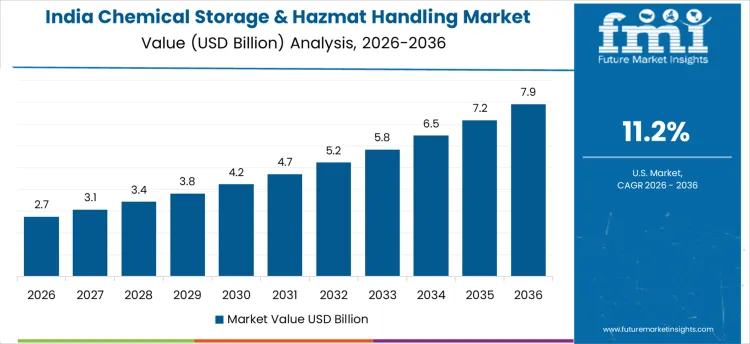
India is witnessing growth at a CAGR of 11.2% through 2036, driven by new chemical parks, expanding pharmaceutical manufacturing, and government-led safety initiatives. Companies are adopting automated storage, containment units, and handling systems to improve compliance, reduce hazards, and manage increasing chemical volumes. Compared to China, India’s growth is concentrated in developing industrial zones with emerging compliance frameworks rather than fully integrated urban clusters. Domestic suppliers are offering cost-effective, regulatory-aligned storage and handling solutions compatible with multiple hazardous chemical types. Recurring industrial operations, safety compliance programs, and infrastructure expansion are sustaining robust adoption nationwide.
- Chemical parks, pharmaceutical facilities, and industrial zones drive adoption
- Storage systems reduce hazards and improve compliance
- Domestic suppliers provide regulatory-aligned, multi-chemical solutions
How Are Regional Chemical Hubs Driving Market Expansion in Brazil?
In Brazil, the market is growing at a CAGR of 7.6% through 2036, supported by regional chemical hubs, pharmaceutical production centers, and industrial warehouses requiring secure storage and handling solutions. Facilities are investing in spill containment, safety cabinets, and automated handling to comply with environmental regulations and reduce workplace incidents. Compared to India, where industrial parks are rapidly developing, Brazil’s growth is more concentrated in established chemical zones with moderate adoption of automation. Domestic suppliers provide high-performance storage solutions tailored to local compliance standards. Recurring operational needs and ongoing safety programs are sustaining steady market growth.
- Regional chemical hubs, pharmaceutical production centers, and industrial warehouses drive adoption
- Storage systems improve workplace safety and regulatory compliance
- Domestic suppliers provide tailored, high-performance solutions
Which Strategic Approaches Define Competition in the Chemical Storage and Hazmat Handling Market across Regulated Workplaces?
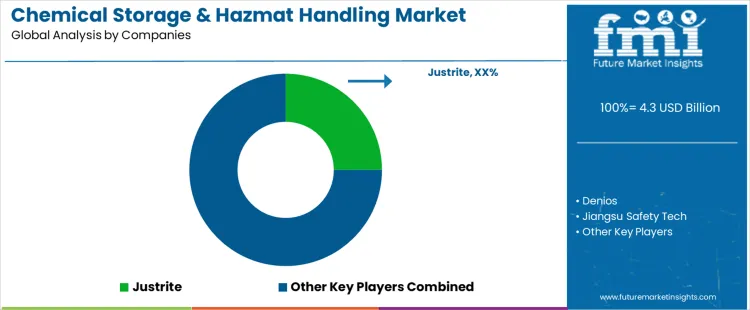
Competition in the chemical storage and hazmat handling market is shaped primarily by how suppliers interpret and operationalize safety obligations at the site level. Purchasing decisions are often led by environmental health and safety managers who prioritize inspection outcomes, incident prevention, and alignment with insurance requirements. Justrite, Asecos, and Denios position their offerings around compliance assurance, emphasizing certified designs, standardized testing, and documentation that supports audits.
Their strategies focus on reducing decision risk for buyers by translating complex fire, occupational safety, and environmental rules into prescriptive storage solutions. Product selection is influenced by containment integrity, ventilation performance, and predictable behavior under abnormal conditions rather than by design differentiation or aesthetics.
A different strategic logic applies among regionally focused manufacturers. Jiangsu Safety Tech and Godrej Storage compete by adapting hazmat storage products to local regulations, space constraints, and budget realities in Asian industrial facilities. TRUSCO Nakayama addresses demand in Japan through compact, standardized storage aligned with workplace organization norms and frequent inspection practices.
Eagle Manufacturing emphasizes durability and outdoor suitability, serving maintenance, utilities, and energy sites where environmental exposure is a primary concern. Across the market, suppliers compete on responsiveness, customization capability, and technical guidance. Competitive advantage is built through regulatory credibility, installation support, and long term reliability rather than rapid product innovation or price based competition.
Key Players in the Chemical Storage and Hazmat Handling Market
- Justrite
- Denios
- Jiangsu Safety Tech
- Godrej Storage
- TRUSCO Nakayama
- Eagle Manufacturing
- Asecos
Scope of the Report
| Items | Values |
|---|---|
| Quantitative Units (2026) | USD billion |
| Type | Cabinets, Pallets and IBC Handling Systems, Ventilated Storage Systems, Modular Hazmat Stations, Compact Hazmat Cabinets, Other Types |
| Application | Chemical Manufacturing, Industrial Storage, Laboratory Storage, Pharmaceutical Production, Specialty Chemicals |
| End User | Chemical Plants and Refineries, Industrial and Laboratory Facilities, Manufacturing and Specialty Chemical Producers, Pharma and Agrochemical Facilities |
| Regions Covered | Asia Pacific, Europe, North America, Latin America, Middle East & Africa |
| Countries Covered | USA, Germany, China, India, Japan, South Korea, Brazil, United Kingdom, France, Italy, Canada, Mexico, ASEAN countries, GCC countries, and other global regions |
| Key Companies Profiled | Justrite, Denios, Asecos, Eagle Manufacturing, Jiangsu Safety Tech, Godrej Storage, TRUSCO Nakayama |
| Additional Attributes | Dollar sales by product type and end-use categories, regional adoption trends across Asia Pacific, Europe, and North America, competitive landscape across global and regional hazmat storage providers, facility compliance requirements under OSHA, EU, and national safety codes, deployment considerations across industrial, laboratory, and pharmaceutical environments |
Chemical Storage and Hazmat Handling Market Segmentation
By End-use:
- Chemical plants & refineries
- Industrial & laboratory storage
- Manufacturing & specialty chemicals
- Pharma, agrochemicals
- Industrial chemicals
- Precision & specialty chemicals
By Product Type:
- Cabinets, pallets, IBC handling systems
- Ventilated storage systems
- Modular hazmat stations
- Compact hazmat cabinets
- Others
By Material:
- Steel, HDPE
- Steel
- Steel, composites
- Others
Technology:
- Fire-rated containment, leak detection
- EN-compliant fire protection
- High-volume fabrication
- Cost-efficient compliance designs
- Others
By Region
- Asia Pacific
- China
- Japan
- South Korea
- India
- Australia & New Zealand
- ASEAN
- Rest of Asia Pacific
- Europe
- Germany
- United Kingdom
- France
- Italy
- Spain
- Nordic
- BENELUX
- Rest of Europe
- North America
- United States
- Canada
- Mexico
- Latin America
- Brazil
- Chile
- Rest of Latin America
- Middle East & Africa
- Kingdom of Saudi Arabia
- Other GCC Countries
- Turkey
- South Africa
- Other African Union
- Rest of Middle East & Africa
Bibliography
- USA Occupational Safety and Health Administration. (2023). Hazardous materials storage and handling requirements. OSHA Standards 29 CFR 1910 Subpart H.
- European Chemicals Agency. (2022). Guidance on the storage and handling of hazardous chemicals under REACH and CLP regulations. ECHA Guidance Documents.
Frequently Asked Questions
How big is the chemical storage & hazmat handling market in 2026?
The global chemical storage & hazmat handling market is estimated to be valued at USD 4.3 billion in 2026.
What will be the size of chemical storage & hazmat handling market in 2036?
The market size for the chemical storage & hazmat handling market is projected to reach USD 8.9 billion by 2036.
How much will be the chemical storage & hazmat handling market growth between 2026 and 2036?
The chemical storage & hazmat handling market is expected to grow at a 7.5% CAGR between 2026 and 2036.
What are the key end-use types in the chemical storage & hazmat handling market?
The key end-use types in chemical storage & hazmat handling market are chemical plants & refineries, industrial & laboratory storage, manufacturing & specialty chemicals, pharma, agrochemicals, industrial chemicals and precision & specialty chemicals.
Which product type segment to contribute significant share in the chemical storage & hazmat handling market in 2026?
In terms of product type, cabinets, pallets, ibc handling systems segment to command 45.0% share in the chemical storage & hazmat handling market in 2026.
Preview the report firsthand - request a free sample
Get SampleGet the brochure for pricing and purchase details.
Get PDFTable of Content
- Executive Summary
- Global Market Outlook
- Demand-side Trends
- Supply-side Trends
- Technology Roadmap Analysis
- Analysis and Recommendations
- Market Overview
- Market Coverage / Taxonomy
- Market Definition / Scope / Limitations
- Market Background
- Market Dynamics
- Drivers
- Restraints
- Opportunity
- Trends
- Scenario Forecast
- Demand in Optimistic Scenario
- Demand in Likely Scenario
- Demand in Conservative Scenario
- Opportunity Map Analysis
- Product Life Cycle Analysis
- Supply Chain Analysis
- Investment Feasibility Matrix
- Value Chain Analysis
- PESTLE and Porter’s Analysis
- Regulatory Landscape
- Regional Parent Market Outlook
- Production and Consumption Statistics
- Import and Export Statistics
- Market Dynamics
- Global Market Analysis 2021 to 2025 and Forecast, 2026 to 2036
- Historical Market Size Value (USD Million) Analysis, 2021 to 2025
- Current and Future Market Size Value (USD Million) Projections, 2026 to 2036
- Y-o-Y Growth Trend Analysis
- Absolute $ Opportunity Analysis
- Global Market Pricing Analysis 2021 to 2025 and Forecast 2026 to 2036
- Global Market Analysis 2021 to 2025 and Forecast 2026 to 2036, By End-use
- Introduction / Key Findings
- Historical Market Size Value (USD Million) Analysis By End-use , 2021 to 2025
- Current and Future Market Size Value (USD Million) Analysis and Forecast By End-use , 2026 to 2036
- Chemical plants & refineries
- Industrial & laboratory storage
- Manufacturing & specialty chemicals
- Pharma, agrochemicals
- Industrial chemicals
- Precision & specialty chemicals
- Chemical plants & refineries
- Y-o-Y Growth Trend Analysis By End-use , 2021 to 2025
- Absolute $ Opportunity Analysis By End-use , 2026 to 2036
- Global Market Analysis 2021 to 2025 and Forecast 2026 to 2036, By Product Type
- Introduction / Key Findings
- Historical Market Size Value (USD Million) Analysis By Product Type, 2021 to 2025
- Current and Future Market Size Value (USD Million) Analysis and Forecast By Product Type, 2026 to 2036
- Cabinets, pallets, IBC handling systems
- Ventilated storage systems
- Modular hazmat stations
- Compact hazmat cabinets
- Others
- Cabinets, pallets, IBC handling systems
- Y-o-Y Growth Trend Analysis By Product Type, 2021 to 2025
- Absolute $ Opportunity Analysis By Product Type, 2026 to 2036
- Global Market Analysis 2021 to 2025 and Forecast 2026 to 2036, By Material
- Introduction / Key Findings
- Historical Market Size Value (USD Million) Analysis By Material, 2021 to 2025
- Current and Future Market Size Value (USD Million) Analysis and Forecast By Material, 2026 to 2036
- Steel, HDPE
- Steel
- Steel, composites
- Steel
- Others
- Steel, HDPE
- Y-o-Y Growth Trend Analysis By Material, 2021 to 2025
- Absolute $ Opportunity Analysis By Material, 2026 to 2036
- Global Market Analysis 2021 to 2025 and Forecast 2026 to 2036, By Technology
- Introduction / Key Findings
- Historical Market Size Value (USD Million) Analysis By Technology, 2021 to 2025
- Current and Future Market Size Value (USD Million) Analysis and Forecast By Technology, 2026 to 2036
- Fire-rated containment, leak detection
- EN-compliant fire protection
- High-volume fabrication
- Others
- Fire-rated containment, leak detection
- Y-o-Y Growth Trend Analysis By Technology, 2021 to 2025
- Absolute $ Opportunity Analysis By Technology, 2026 to 2036
- Global Market Analysis 2021 to 2025 and Forecast 2026 to 2036, By Region
- Introduction
- Historical Market Size Value (USD Million) Analysis By Region, 2021 to 2025
- Current Market Size Value (USD Million) Analysis and Forecast By Region, 2026 to 2036
- North America
- Latin America
- Western Europe
- Eastern Europe
- East Asia
- South Asia and Pacific
- Middle East & Africa
- Market Attractiveness Analysis By Region
- North America Market Analysis 2021 to 2025 and Forecast 2026 to 2036, By Country
- Historical Market Size Value (USD Million) Trend Analysis By Market Taxonomy, 2021 to 2025
- Market Size Value (USD Million) Forecast By Market Taxonomy, 2026 to 2036
- By Country
- USA
- Canada
- Mexico
- By End-use
- By Product Type
- By Material
- By Technology
- By Country
- Market Attractiveness Analysis
- By Country
- By End-use
- By Product Type
- By Material
- By Technology
- Key Takeaways
- Latin America Market Analysis 2021 to 2025 and Forecast 2026 to 2036, By Country
- Historical Market Size Value (USD Million) Trend Analysis By Market Taxonomy, 2021 to 2025
- Market Size Value (USD Million) Forecast By Market Taxonomy, 2026 to 2036
- By Country
- Brazil
- Chile
- Rest of Latin America
- By End-use
- By Product Type
- By Material
- By Technology
- By Country
- Market Attractiveness Analysis
- By Country
- By End-use
- By Product Type
- By Material
- By Technology
- Key Takeaways
- Western Europe Market Analysis 2021 to 2025 and Forecast 2026 to 2036, By Country
- Historical Market Size Value (USD Million) Trend Analysis By Market Taxonomy, 2021 to 2025
- Market Size Value (USD Million) Forecast By Market Taxonomy, 2026 to 2036
- By Country
- Germany
- UK
- Italy
- Spain
- France
- Nordic
- BENELUX
- Rest of Western Europe
- By End-use
- By Product Type
- By Material
- By Technology
- By Country
- Market Attractiveness Analysis
- By Country
- By End-use
- By Product Type
- By Material
- By Technology
- Key Takeaways
- Eastern Europe Market Analysis 2021 to 2025 and Forecast 2026 to 2036, By Country
- Historical Market Size Value (USD Million) Trend Analysis By Market Taxonomy, 2021 to 2025
- Market Size Value (USD Million) Forecast By Market Taxonomy, 2026 to 2036
- By Country
- Russia
- Poland
- Hungary
- Balkan & Baltic
- Rest of Eastern Europe
- By End-use
- By Product Type
- By Material
- By Technology
- By Country
- Market Attractiveness Analysis
- By Country
- By End-use
- By Product Type
- By Material
- By Technology
- Key Takeaways
- East Asia Market Analysis 2021 to 2025 and Forecast 2026 to 2036, By Country
- Historical Market Size Value (USD Million) Trend Analysis By Market Taxonomy, 2021 to 2025
- Market Size Value (USD Million) Forecast By Market Taxonomy, 2026 to 2036
- By Country
- China
- Japan
- South Korea
- By End-use
- By Product Type
- By Material
- By Technology
- By Country
- Market Attractiveness Analysis
- By Country
- By End-use
- By Product Type
- By Material
- By Technology
- Key Takeaways
- South Asia and Pacific Market Analysis 2021 to 2025 and Forecast 2026 to 2036, By Country
- Historical Market Size Value (USD Million) Trend Analysis By Market Taxonomy, 2021 to 2025
- Market Size Value (USD Million) Forecast By Market Taxonomy, 2026 to 2036
- By Country
- India
- ASEAN
- Australia & New Zealand
- Rest of South Asia and Pacific
- By End-use
- By Product Type
- By Material
- By Technology
- By Country
- Market Attractiveness Analysis
- By Country
- By End-use
- By Product Type
- By Material
- By Technology
- Key Takeaways
- Middle East & Africa Market Analysis 2021 to 2025 and Forecast 2026 to 2036, By Country
- Historical Market Size Value (USD Million) Trend Analysis By Market Taxonomy, 2021 to 2025
- Market Size Value (USD Million) Forecast By Market Taxonomy, 2026 to 2036
- By Country
- Kingdom of Saudi Arabia
- Other GCC Countries
- Turkiye
- South Africa
- Other African Union
- Rest of Middle East & Africa
- By End-use
- By Product Type
- By Material
- By Technology
- By Country
- Market Attractiveness Analysis
- By Country
- By End-use
- By Product Type
- By Material
- By Technology
- Key Takeaways
- Key Countries Market Analysis
- USA
- Pricing Analysis
- Market Share Analysis, 2025
- By End-use
- By Product Type
- By Material
- By Technology
- Canada
- Pricing Analysis
- Market Share Analysis, 2025
- By End-use
- By Product Type
- By Material
- By Technology
- Mexico
- Pricing Analysis
- Market Share Analysis, 2025
- By End-use
- By Product Type
- By Material
- By Technology
- Brazil
- Pricing Analysis
- Market Share Analysis, 2025
- By End-use
- By Product Type
- By Material
- By Technology
- Chile
- Pricing Analysis
- Market Share Analysis, 2025
- By End-use
- By Product Type
- By Material
- By Technology
- Germany
- Pricing Analysis
- Market Share Analysis, 2025
- By End-use
- By Product Type
- By Material
- By Technology
- UK
- Pricing Analysis
- Market Share Analysis, 2025
- By End-use
- By Product Type
- By Material
- By Technology
- Italy
- Pricing Analysis
- Market Share Analysis, 2025
- By End-use
- By Product Type
- By Material
- By Technology
- Spain
- Pricing Analysis
- Market Share Analysis, 2025
- By End-use
- By Product Type
- By Material
- By Technology
- France
- Pricing Analysis
- Market Share Analysis, 2025
- By End-use
- By Product Type
- By Material
- By Technology
- India
- Pricing Analysis
- Market Share Analysis, 2025
- By End-use
- By Product Type
- By Material
- By Technology
- ASEAN
- Pricing Analysis
- Market Share Analysis, 2025
- By End-use
- By Product Type
- By Material
- By Technology
- Australia & New Zealand
- Pricing Analysis
- Market Share Analysis, 2025
- By End-use
- By Product Type
- By Material
- By Technology
- China
- Pricing Analysis
- Market Share Analysis, 2025
- By End-use
- By Product Type
- By Material
- By Technology
- Japan
- Pricing Analysis
- Market Share Analysis, 2025
- By End-use
- By Product Type
- By Material
- By Technology
- South Korea
- Pricing Analysis
- Market Share Analysis, 2025
- By End-use
- By Product Type
- By Material
- By Technology
- Russia
- Pricing Analysis
- Market Share Analysis, 2025
- By End-use
- By Product Type
- By Material
- By Technology
- Poland
- Pricing Analysis
- Market Share Analysis, 2025
- By End-use
- By Product Type
- By Material
- By Technology
- Hungary
- Pricing Analysis
- Market Share Analysis, 2025
- By End-use
- By Product Type
- By Material
- By Technology
- Kingdom of Saudi Arabia
- Pricing Analysis
- Market Share Analysis, 2025
- By End-use
- By Product Type
- By Material
- By Technology
- Turkiye
- Pricing Analysis
- Market Share Analysis, 2025
- By End-use
- By Product Type
- By Material
- By Technology
- South Africa
- Pricing Analysis
- Market Share Analysis, 2025
- By End-use
- By Product Type
- By Material
- By Technology
- USA
- Market Structure Analysis
- Competition Dashboard
- Competition Benchmarking
- Market Share Analysis of Top Players
- By Regional
- By End-use
- By Product Type
- By Material
- By Technology
- Competition Analysis
- Competition Deep Dive
- Justrite
- Overview
- Product Portfolio
- Profitability by Market Segments (Product/Age /Sales Channel/Region)
- Sales Footprint
- Strategy Overview
- Marketing Strategy
- Product Strategy
- Channel Strategy
- Denios
- Jiangsu Safety Tech
- Godrej Storage
- TRUSCO Nakayama
- Denios
- Eagle Manufacturing
- Asecos
- Justrite
- Competition Deep Dive
- Assumptions & Acronyms Used
- Research Methodology


