

- Industry Size (2026)
- USD 3100.0 Mn
- Forecast (2036)
- USD 5295.0 Mn
- CAGR (2026 to 2036)
- 5.5%
Low-VOC Industrial Primers Market Forecast and Outlook 2026 to 2036
The low-VOC industrial primers market represents a fundamental transformation in protective coatings technology, projected to expand from USD 3,100.0 million in 2026 to USD 5,295.0 million by 2036, achieving a 5.5% CAGR throughout the forecast period.
Quick Stats for Low-VOC Industrial Primers Market
- Low-VOC Industrial Primers Market Value (2026): USD 3,100.0 million
- Low-VOC Industrial Primers Market Forecast Value (2036): USD 5,295.0 million
- Low-VOC Industrial Primers Market Forecast CAGR: 5.5%
- Leading End-Use Industry in Low-VOC Industrial Primers Market: Industrial and Protective Coatings (38%)
- Key Growth Countries in Low-VOC Industrial Primers Market: China, USA., U.K., Germany, South Korea, Japan
- Key Players in Low-VOC Industrial Primers Market: PPG Industries, AkzoNobel, Sherwin-Williams, Jotun, Hempel
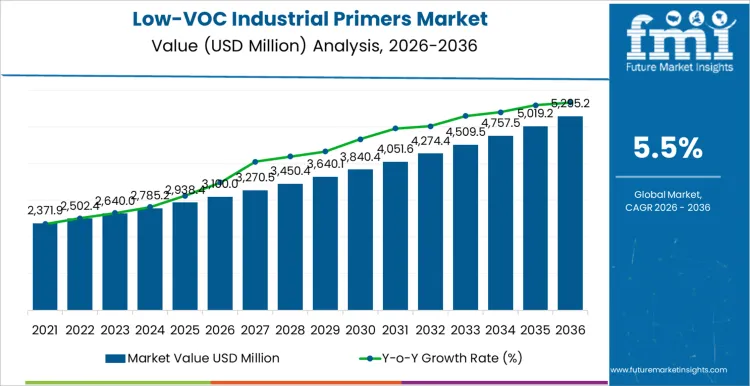
The low-VOC industrial primers industry encompasses specialized primer formulations designed to meet increasingly stringent environmental regulations while maintaining the corrosion protection, adhesion, and durability characteristics essential for industrial applications.
The growth trajectory reflects a global shift toward sustainable coating technologies driven by regulatory compliance requirements, corporate environmental commitments, and technological advances that enable high-performance formulations with drastically reduced volatile organic compound emissions.
Industrial primers serve as the critical foundation layer in protective coating systems, providing corrosion inhibition, substrate adhesion, and compatibility with topcoat systems across diverse substrates including steel, galvanized metals, concrete, and composite materials.
Traditional solvent-based primers have dominated industrial applications for decades due to their superior performance characteristics including excellent wetting, corrosion protection, and application versatility.
Mounting environmental pressure and regulatory restrictions on VOC emissions have catalyzed development of innovative low-VOC alternatives that maintain industrial performance standards while meeting environmental compliance requirements.
Low-VOC Industrial Primers Market Key Takeaways
| Metric | Value |
|---|---|
| Market Value (2026) | USD 3,100.0 million |
| Market Forecast Value (2036) | USD 5,295.0 million |
| Forecast CAGR 2026 to 2036 | 5.5% |
Why are Environmental Regulations Transforming Primer Chemistry?
The escalating stringency of environmental regulations worldwide creates unprecedented pressure on industrial coating manufacturers to develop primer formulations that achieve dramatic VOC reductions while maintaining the corrosion protection and adhesion characteristics essential for industrial applications. New regulatory frameworks including the EPA's National Emission Standards for Hazardous Air Pollutants, European Union's Industrial Emissions Directive, and regional air quality management requirements establish increasingly restrictive VOC limits that render traditional solvent-based primers non-compliant in many jurisdictions. These regulations encompass not only manufacturing emissions but also application-stage VOC releases that affect air quality in industrial facilities and surrounding communities.
Regulatory compliance extends beyond simple VOC content limitations to encompass comprehensive environmental impact assessments including ozone formation potential, worker exposure limits, and waste stream management requirements that influence primer formulation strategies. Modern regulations often incorporate tiered compliance structures where facilities can achieve credits for using low-VOC products while facing penalties for exceeding emission thresholds, creating economic incentives for adopting environmental technologies. The complexity of regulatory landscape management drives demand for primer suppliers who can provide comprehensive compliance documentation and technical support for navigating permitting processes.
How is the Market Structured across Technology Platforms?
The low-VOC industrial primers market exhibits sophisticated segmentation reflecting diverse technological approaches to achieving environmental compliance while maintaining industrial performance requirements across varying substrate types, application methods, and service environments.
Market structure encompasses resin chemistry categories representing different molecular approaches to VOC reduction, technology platforms addressing specific application methods and performance characteristics, and substrate classifications requiring specialized adhesion and protection strategies. This multidimensional segmentation reflects the complexity of industrial coating applications where generic solutions prove inadequate for addressing specific performance and environmental requirements.
Which Resin Chemistry Platform Dominates Performance Applications?
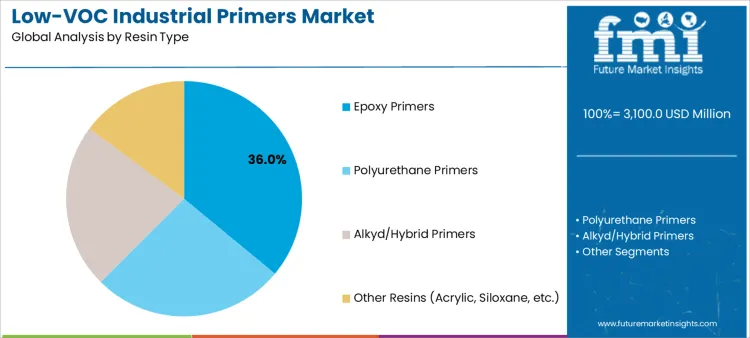
Epoxy primers command 36.0% market share, representing the largest segment due to their exceptional adhesion characteristics, corrosion inhibition properties, and versatility across diverse substrates and service environments. Epoxy chemistry provides superior substrate wetting and mechanical adhesion that creates durable bonds essential for long-term coating system performance under harsh industrial conditions. Modern low-VOC epoxy primers incorporate waterborne dispersions, high-solids formulations, and modified resin architectures that achieve environmental compliance while maintaining the chemical resistance and durability characteristics that made epoxy the standard for demanding industrial applications.
Which Technology Platform Enables Optimal Environmental Performance?
Waterborne primer systems dominate with 38.0% market share, representing the most successful approach to achieving dramatic VOC reductions while maintaining acceptable performance characteristics for most industrial applications.
Waterborne technology eliminates organic solvents as the primary carrier medium, typically achieving VOC levels below 50 grams per liter while providing application characteristics approaching traditional solvent-based systems. Advanced waterborne primers utilize sophisticated polymer dispersions, rheology modifiers, and coalescent systems that optimize film formation while minimizing VOC emissions during application and curing.
Which Substrate Category Drives Market Demand?
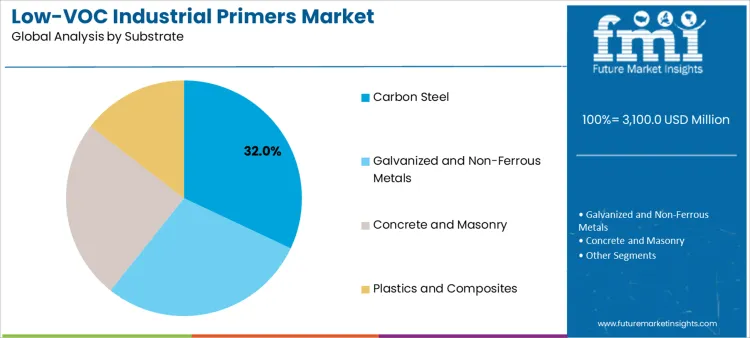
Carbon steel substrates command 32.0% market share, representing the largest application category due to steel's widespread use in industrial construction, equipment manufacturing, and infrastructure applications where corrosion protection constitutes a critical performance requirement.
Steel substrates present unique challenges for low-VOC primers including surface preparation requirements, flash rust prevention, and long-term corrosion protection that demand specialized formulation approaches. Low-VOC primers for steel applications must provide excellent wetting of prepared steel surfaces while delivering corrosion inhibition performance comparable to traditional solvent-based systems.
Which End-Use Industry Leads Technology Adoption?
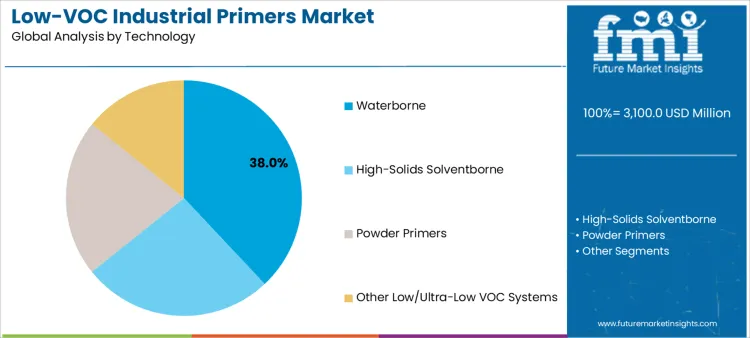
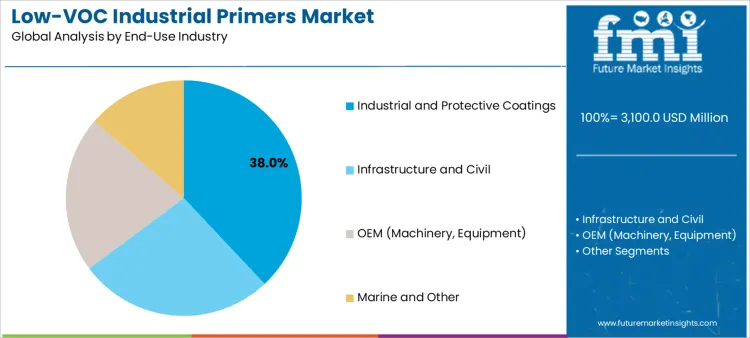
Industrial and protective coatings applications dominate with 38.0% market share, encompassing general industrial equipment, chemical processing facilities, power generation plants, and other demanding applications where corrosion protection and chemical resistance constitute critical performance requirements.
This segment drives the most demanding performance requirements while requiring compliance with stringent environmental regulations that vary by facility type and location. Industrial users typically evaluate primer systems based on total cost of ownership including material costs, application efficiency, service life, and maintenance requirements.
How are Regulatory Changes Accelerating Technology Adoption?
The rapid evolution of environmental regulations creates continuous pressure for technological advancement in low-VOC primer formulations as regulatory agencies implement increasingly restrictive VOC limits and expand coverage to previously unregulated industry sectors.
Recent regulatory developments include lowered VOC thresholds, enhanced enforcement mechanisms, and integration of climate change considerations that affect coating formulation strategies. Regulatory agencies increasingly coordinate across jurisdictions to harmonize standards and prevent regulatory arbitrage that can undermine environmental protection objectives.
New regulatory frameworks often incorporate performance-based standards that require demonstration of environmental benefits rather than simple compliance with composition limits. These approaches create opportunities for innovative technologies that provide superior environmental performance while challenging suppliers to develop comprehensive documentation and validation programs. Regulatory agencies also emphasize lifecycle environmental impact assessments that consider manufacturing, application, and disposal phases in evaluating coating technologies.
Do Performance Trade-offs Constrain Market Growth?
The inherent performance trade-offs associated with VOC reduction create ongoing challenges for low-VOC primer adoption in demanding industrial applications where coating failure can result in significant economic and safety consequences. Traditional solvent-based primers offer superior substrate wetting, corrosion protection, and application versatility that can be difficult to replicate with environmental technologies. Performance compromises may include reduced pot life, environmental sensitivity during application, and limitations in substrate compatibility that restrict low-VOC primer usage in specific applications.
Advanced low-VOC technologies continue to address performance gaps through innovative chemistry, application methods, and system optimization approaches that minimize trade-offs while achieving environmental objectives. Successful low-VOC primer systems often require modified application procedures, enhanced surface preparation, or complementary technologies that optimize performance while maintaining environmental compliance. These requirements can create adoption barriers while providing opportunities for suppliers who can offer comprehensive technical support and application expertise.
How do Cost Considerations Influence Technology Selection?
The cost implications of low-VOC primer adoption encompass both direct material costs and indirect factors including application efficiency, equipment requirements, and regulatory compliance that affect total cost of ownership calculations. Low-VOC primers often command premium pricing due to specialized chemistry and development costs while potentially offering savings in regulatory compliance, waste disposal, and worker protection requirements. Industrial users increasingly evaluate primer systems based on total cost models that consider environmental, safety, and operational factors beyond initial material costs.
Economic justification for low-VOC primers often includes avoided costs for permits, emissions controls, waste management, and potential regulatory penalties that can substantially exceed material cost premiums. Facilities with air quality compliance challenges may find low-VOC primers essential for continued operation while others may adopt these technologies for competitive advantages in environmentally conscious markets. Long-term cost trends favor low-VOC technologies as regulatory requirements tighten and environmental technologies achieve economies of scale.
How Is the Low-VOC Industrial Primers Market Expected to Evolve Across Major Nations?
The global low-VOC industrial primers market demonstrates distinct regional development patterns reflecting varying regulatory approaches, industrial base characteristics, and environmental policy priorities that influence technology adoption rates and market growth trajectories. Regional market evolution encompasses both established industrial economies implementing mature environmental regulations and emerging markets developing environmental frameworks while building industrial capabilities. The geographic distribution reflects complex interactions between regulatory stringency, industrial activity levels, environmental awareness, and technological infrastructure that shape market opportunities.
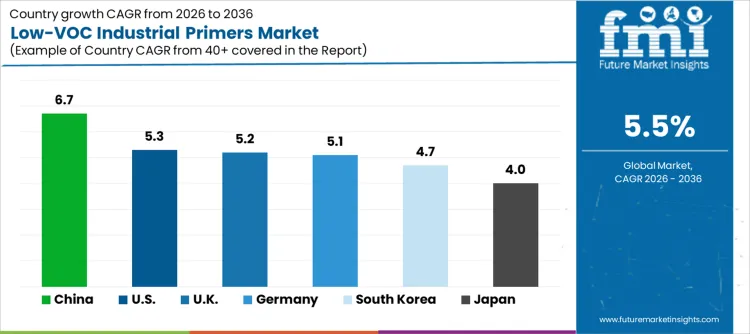
| Country | CAGR (%) |
|---|---|
| China | 6.7% |
| USA. | 5.3% |
| U.K. | 5.2% |
| Germany | 5.1% |
| South Korea | 4.7% |
| Japan | 4.0% |
What Drives China's Market Leadership?
China's low-VOC industrial primers market is projected to achieve a CAGR of 6.7%, representing the highest growth rate globally and reflecting the country's aggressive environmental policy implementation combined with massive industrial infrastructure development that creates enormous demand for protective coatings. Chinese environmental regulations have evolved rapidly to address air quality concerns while the country's manufacturing sector requires advanced coating technologies that support both domestic consumption and export requirements. Government initiatives including the National Air Pollution Prevention and Control Action Plan establish stringent VOC limits while providing enforcement mechanisms that accelerate low-VOC technology adoption.
Chinese coating manufacturers benefit from government support for environmental technology development while serving domestic and international markets with increasing environmental requirements. The integration of environmental performance metrics into government evaluation systems creates powerful incentives for industrial facilities to adopt low-VOC technologies while building capabilities for export market competition. China's massive infrastructure development programs create sustained demand for protective coatings while environmental regulations ensure these projects utilize compliant technologies.
How Are US Environmental Policies Shaping Technology Adoption?
The United States low-VOC industrial primers market is projected to record a CAGR of 5.3%, reflecting the country's established environmental regulatory framework and diverse industrial base that creates substantial demand for compliant coating technologies. American environmental policy operates through federal standards including EPA regulations combined with state-level requirements that often exceed federal minimums in areas with severe air quality challenges. The regulatory framework's maturity provides stability for long-term technology investments while continuing evolution addresses emerging environmental challenges.
US industrial facilities face complex compliance requirements that vary by location, industry sector, and facility characteristics, creating demand for flexible low-VOC primer solutions that address diverse regulatory scenarios. State-level regulations in California, northeastern states, and other regions often establish technology-forcing standards that drive innovation while creating market opportunities for advanced environmental technologies. The emphasis on technology-based standards encourages development of innovative solutions that provide competitive advantages.
What Drives the UK's Environmental Excellence Focus?
The United Kingdom's low-VOC industrial primers market is estimated to expand at a CAGR of 5.2%, supported by comprehensive environmental policies including Brexit-era independence in setting environmental standards and traditional leadership in environmental technology development. British environmental policy emphasizes integrated pollution prevention and control approaches that address air quality, worker safety, and broader sustainability considerations. The UK's manufacturing sector increasingly emphasizes environmental performance as a competitive advantage in global markets.
British coating manufacturers leverage expertise in specialty chemistry and advanced materials to develop innovative low-VOC technologies while addressing diverse industrial application requirements. Research institutions and government agencies support technology development through collaborative programs that advance fundamental understanding while building practical applications. The focus on sustainable development creates market opportunities for technologies that demonstrate superior environmental performance.
How Does Germany's Engineering Approach Shape Market Development?
Germany's low-VOC industrial primers market is likely to rise at a CAGR of 5.1%, reflecting the country's systematic approach to environmental technology development and industrial leadership in engineering-intensive sectors that demand high-performance coating systems. German environmental policy integrates technology requirements with industrial competitiveness objectives while maintaining stringent environmental protection standards. The country's chemical industry expertise supports development of advanced low-VOC formulations while established automotive and machinery sectors create demand for high-performance primer systems.
German manufacturers emphasize systematic optimization, comprehensive testing, and quality assurance approaches that ensure low-VOC primers meet demanding industrial application requirements. Research institutions and corporate laboratories advance primer chemistry through fundamental research while building practical solutions for specific industrial challenges. The focus on engineering excellence creates opportunities for premium low-VOC technologies that provide measurable performance advantages.
Why Does South Korea Emphasize Technology Innovation?
South Korea's low-VOC industrial primers market is projected to increase at a CAGR of 4.7%, driven by the country's advanced manufacturing capabilities and emphasis on environmental technology as a competitive advantage in global markets. Korean environmental policy focuses on technology-based solutions while supporting industrial competitiveness through advanced environmental technologies. The country's chemical industry expertise enables development of innovative low-VOC formulations while major industrial sectors including automotive and shipbuilding create demand for high-performance primer systems.
Korean manufacturers invest heavily in research and development capabilities while building export capabilities for environmentally advanced coating technologies. Government support for environmental technology development includes funding for research collaborations and technology commercialization programs. The emphasis on technological innovation creates opportunities for breakthrough low-VOC technologies that provide competitive advantages in domestic and international markets.
How Does Japan's Quality Culture Drive Premium Technology Adoption?
Japan's low-VOC industrial primers market is likely to expand at a CAGR of 4.0%, reflecting the country's emphasis on quality excellence and systematic technology development that creates demand for premium low-VOC primer solutions meeting exceptional performance standards. Japanese environmental policy emphasizes voluntary initiatives and industry cooperation while maintaining stringent performance requirements. The country's manufacturing sector prioritizes long-term technology development that balances environmental compliance with superior performance characteristics.
Japanese coating manufacturers focus on incremental improvement and systematic optimization approaches that create technological foundations for superior environmental performance. Research institutions and corporate laboratories advance primer science through fundamental research while building practical applications for demanding industrial requirements. The emphasis on quality and reliability creates opportunities for low-VOC technologies that demonstrate exceptional consistency and long-term performance.
How are Manufacturers Securing Market Share?
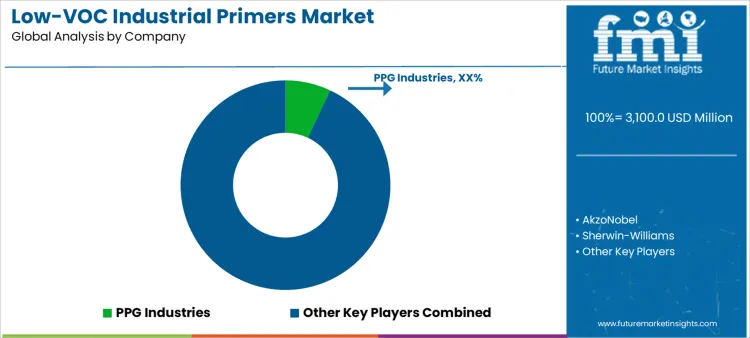
Competition in low-VOC industrial primers is getting tougher because buyers want cleaner products without giving up the basics that matter on site. Established coatings brands, specialty chemical suppliers, and newer formulation players are all chasing the same goal: primers that meet tightening VOC rules while still delivering reliable adhesion, corrosion protection, and recoat performance across different substrates and application conditions. What separates suppliers is not only the lab spec sheet, but how well the primer works in the customer’s process. Application support is a big lever, especially for surface prep windows, humidity and temperature tolerance, cure speed, and compatibility with topcoats. That is why long-term trials and co-validation with industrial users are becoming standard.
Innovation is centered on resin and additive design, plus system thinking that balances performance with environmental limits. Companies that can show repeatable results at pilot scale and then hold quality at full production scale build trust faster. IP and acquisitions matter mostly when they help fill gaps in resin platforms, cure mechanisms, or functional additives. The leaders tend to offer broad portfolios across metal, concrete, composites, and plastics, and they back it with global supply and local technical teams so multi-site customers can standardize primers across regions.
Key Players in the Low-VOC Industrial Primers Market
- PPG Industries
- AkzoNobel
- Sherwin-Williams
- Jotun
- Hempel
- Nippon Paint
- Axalta Coating Systems
- Kansai Paint
- Teknos
- Chugoku Marine Paints
Scope of Report
| Items | Values |
|---|---|
| Quantitative Units | USD Million |
| Resin Type Segments | Epoxy Primers; Polyurethane Primers; Alkyd/Hybrid Primers; Other Resins |
| Technology Categories | Waterborne; High-Solids Solventborne; Powder Primers; Other Low/Ultra-Low VOC Systems |
| Substrate Types | Carbon Steel; Galvanized and Non-Ferrous Metals; Concrete and Masonry; Plastics and Composites |
| End-Use Industry Segments | Industrial and Protective Coatings; Infrastructure and Civil; OEM; Marine and Other |
| Regions Covered | North America, Europe, Asia Pacific, Latin America, Middle East & Africa |
| Key Countries | USA, Germany, China, U.K., South Korea, Japan |
| Key Companies Profiled | PPG Industries, AkzoNobel, Sherwin-Williams, Jotun, Hempel, and others |
Low-VOC Industrial Primers Market by Segments
By Resin Type
- Epoxy Primers
- Polyurethane Primers
- Alkyd/Hybrid Primers
- Other Resins (Acrylic, Siloxane, etc.)
By Technology
- Waterborne
- High-Solids Solventborne
- Powder Primers
- Other Low/Ultra-Low VOC Systems
By Substrate
- Carbon Steel
- Galvanized and Non-Ferrous Metals
- Concrete and Masonry
- Plastics and Composites
By End-Use Industry
- Industrial and Protective Coatings
- Infrastructure and Civil
- OEM (Machinery, Equipment)
- Marine and Other
Bibliography
- European Chemicals Agency. (2024). Guidance on the regulation of industrial coatings under REACH. ECHA Publications.
- National Association for Surface Finishing. (2024). Low VOC industrial coatings: Performance and application guidelines. NASF Technical Report Series.
- Paint and Coatings Industry Magazine. (2024). Environmental regulations and low VOC coating technologies: A comprehensive review. Paint & Coatings Industry, 40(3), 42-58.
Frequently Asked Questions
How big is the low-voc industrial primers market in 2026?
The global low-voc industrial primers market is estimated to be valued at USD 3,100.0 million in 2026.
What will be the size of low-voc industrial primers market in 2036?
The market size for the low-voc industrial primers market is projected to reach USD 5,295.2 million by 2036.
How much will be the low-voc industrial primers market growth between 2026 and 2036?
The low-voc industrial primers market is expected to grow at a 5.5% CAGR between 2026 and 2036.
What are the key product types in the low-voc industrial primers market?
The key product types in low-voc industrial primers market are epoxy primers, polyurethane primers, alkyd/hybrid primers and other resins (acrylic, siloxane, etc.).
Which technology segment to contribute significant share in the low-voc industrial primers market in 2026?
In terms of technology, waterborne segment to command 38.0% share in the low-voc industrial primers market in 2026.
Preview the report firsthand - request a free sample
Get SampleGet the brochure for pricing and purchase details.
Get PDFTable of Content
- Executive Summary
- Global Market Outlook
- Demand-side Trends
- Supply-side Trends
- Technology Roadmap Analysis
- Analysis and Recommendations
- Market Overview
- Market Coverage / Taxonomy
- Market Definition / Scope / Limitations
- Market Background
- Market Dynamics
- Drivers
- Restraints
- Opportunity
- Trends
- Scenario Forecast
- Demand in Optimistic Scenario
- Demand in Likely Scenario
- Demand in Conservative Scenario
- Opportunity Map Analysis
- Product Life Cycle Analysis
- Supply Chain Analysis
- Investment Feasibility Matrix
- Value Chain Analysis
- PESTLE and Porter’s Analysis
- Regulatory Landscape
- Regional Parent Market Outlook
- Production and Consumption Statistics
- Import and Export Statistics
- Market Dynamics
- Global Market Analysis 2021 to 2025 and Forecast, 2026 to 2036
- Historical Market Size Value (USD Million) Analysis, 2021 to 2025
- Current and Future Market Size Value (USD Million) Projections, 2026 to 2036
- Y-o-Y Growth Trend Analysis
- Absolute $ Opportunity Analysis
- Global Market Pricing Analysis 2021 to 2025 and Forecast 2026 to 2036
- Global Market Analysis 2021 to 2025 and Forecast 2026 to 2036, By Resin Type
- Introduction / Key Findings
- Historical Market Size Value (USD Million) Analysis By Resin Type , 2021 to 2025
- Current and Future Market Size Value (USD Million) Analysis and Forecast By Resin Type , 2026 to 2036
- Epoxy Primers
- Polyurethane Primers
- Alkyd/Hybrid Primers
- Other Resins (Acrylic, Siloxane, etc.)
- Epoxy Primers
- Y-o-Y Growth Trend Analysis By Resin Type , 2021 to 2025
- Absolute $ Opportunity Analysis By Resin Type , 2026 to 2036
- Global Market Analysis 2021 to 2025 and Forecast 2026 to 2036, By Technology
- Introduction / Key Findings
- Historical Market Size Value (USD Million) Analysis By Technology, 2021 to 2025
- Current and Future Market Size Value (USD Million) Analysis and Forecast By Technology, 2026 to 2036
- Waterborne
- High-Solids Solventborne
- Powder Primers
- Other Low/Ultra-Low VOC Systems
- Waterborne
- Y-o-Y Growth Trend Analysis By Technology, 2021 to 2025
- Absolute $ Opportunity Analysis By Technology, 2026 to 2036
- Global Market Analysis 2021 to 2025 and Forecast 2026 to 2036, By Substrate
- Introduction / Key Findings
- Historical Market Size Value (USD Million) Analysis By Substrate, 2021 to 2025
- Current and Future Market Size Value (USD Million) Analysis and Forecast By Substrate, 2026 to 2036
- Carbon Steel
- Galvanized and Non-Ferrous Metals
- Concrete and Masonry
- Plastics and Composites
- Carbon Steel
- Y-o-Y Growth Trend Analysis By Substrate, 2021 to 2025
- Absolute $ Opportunity Analysis By Substrate, 2026 to 2036
- Global Market Analysis 2021 to 2025 and Forecast 2026 to 2036, By End-Use Industry
- Introduction / Key Findings
- Historical Market Size Value (USD Million) Analysis By End-Use Industry, 2021 to 2025
- Current and Future Market Size Value (USD Million) Analysis and Forecast By End-Use Industry, 2026 to 2036
- Industrial and Protective Coatings
- Infrastructure and Civil
- OEM (Machinery, Equipment)
- Marine and Other
- Industrial and Protective Coatings
- Y-o-Y Growth Trend Analysis By End-Use Industry, 2021 to 2025
- Absolute $ Opportunity Analysis By End-Use Industry, 2026 to 2036
- Global Market Analysis 2021 to 2025 and Forecast 2026 to 2036, By Region
- Introduction
- Historical Market Size Value (USD Million) Analysis By Region, 2021 to 2025
- Current Market Size Value (USD Million) Analysis and Forecast By Region, 2026 to 2036
- North America
- Latin America
- Western Europe
- Eastern Europe
- East Asia
- South Asia and Pacific
- Middle East & Africa
- Market Attractiveness Analysis By Region
- North America Market Analysis 2021 to 2025 and Forecast 2026 to 2036, By Country
- Historical Market Size Value (USD Million) Trend Analysis By Market Taxonomy, 2021 to 2025
- Market Size Value (USD Million) Forecast By Market Taxonomy, 2026 to 2036
- By Country
- USA
- Canada
- Mexico
- By Resin Type
- By Technology
- By Substrate
- By End-Use Industry
- By Country
- Market Attractiveness Analysis
- By Country
- By Resin Type
- By Technology
- By Substrate
- By End-Use Industry
- Key Takeaways
- Latin America Market Analysis 2021 to 2025 and Forecast 2026 to 2036, By Country
- Historical Market Size Value (USD Million) Trend Analysis By Market Taxonomy, 2021 to 2025
- Market Size Value (USD Million) Forecast By Market Taxonomy, 2026 to 2036
- By Country
- Brazil
- Chile
- Rest of Latin America
- By Resin Type
- By Technology
- By Substrate
- By End-Use Industry
- By Country
- Market Attractiveness Analysis
- By Country
- By Resin Type
- By Technology
- By Substrate
- By End-Use Industry
- Key Takeaways
- Western Europe Market Analysis 2021 to 2025 and Forecast 2026 to 2036, By Country
- Historical Market Size Value (USD Million) Trend Analysis By Market Taxonomy, 2021 to 2025
- Market Size Value (USD Million) Forecast By Market Taxonomy, 2026 to 2036
- By Country
- Germany
- UK
- Italy
- Spain
- France
- Nordic
- BENELUX
- Rest of Western Europe
- By Resin Type
- By Technology
- By Substrate
- By End-Use Industry
- By Country
- Market Attractiveness Analysis
- By Country
- By Resin Type
- By Technology
- By Substrate
- By End-Use Industry
- Key Takeaways
- Eastern Europe Market Analysis 2021 to 2025 and Forecast 2026 to 2036, By Country
- Historical Market Size Value (USD Million) Trend Analysis By Market Taxonomy, 2021 to 2025
- Market Size Value (USD Million) Forecast By Market Taxonomy, 2026 to 2036
- By Country
- Russia
- Poland
- Hungary
- Balkan & Baltic
- Rest of Eastern Europe
- By Resin Type
- By Technology
- By Substrate
- By End-Use Industry
- By Country
- Market Attractiveness Analysis
- By Country
- By Resin Type
- By Technology
- By Substrate
- By End-Use Industry
- Key Takeaways
- East Asia Market Analysis 2021 to 2025 and Forecast 2026 to 2036, By Country
- Historical Market Size Value (USD Million) Trend Analysis By Market Taxonomy, 2021 to 2025
- Market Size Value (USD Million) Forecast By Market Taxonomy, 2026 to 2036
- By Country
- China
- Japan
- South Korea
- By Resin Type
- By Technology
- By Substrate
- By End-Use Industry
- By Country
- Market Attractiveness Analysis
- By Country
- By Resin Type
- By Technology
- By Substrate
- By End-Use Industry
- Key Takeaways
- South Asia and Pacific Market Analysis 2021 to 2025 and Forecast 2026 to 2036, By Country
- Historical Market Size Value (USD Million) Trend Analysis By Market Taxonomy, 2021 to 2025
- Market Size Value (USD Million) Forecast By Market Taxonomy, 2026 to 2036
- By Country
- India
- ASEAN
- Australia & New Zealand
- Rest of South Asia and Pacific
- By Resin Type
- By Technology
- By Substrate
- By End-Use Industry
- By Country
- Market Attractiveness Analysis
- By Country
- By Resin Type
- By Technology
- By Substrate
- By End-Use Industry
- Key Takeaways
- Middle East & Africa Market Analysis 2021 to 2025 and Forecast 2026 to 2036, By Country
- Historical Market Size Value (USD Million) Trend Analysis By Market Taxonomy, 2021 to 2025
- Market Size Value (USD Million) Forecast By Market Taxonomy, 2026 to 2036
- By Country
- Kingdom of Saudi Arabia
- Other GCC Countries
- Turkiye
- South Africa
- Other African Union
- Rest of Middle East & Africa
- By Resin Type
- By Technology
- By Substrate
- By End-Use Industry
- By Country
- Market Attractiveness Analysis
- By Country
- By Resin Type
- By Technology
- By Substrate
- By End-Use Industry
- Key Takeaways
- Key Countries Market Analysis
- USA
- Pricing Analysis
- Market Share Analysis, 2025
- By Resin Type
- By Technology
- By Substrate
- By End-Use Industry
- Canada
- Pricing Analysis
- Market Share Analysis, 2025
- By Resin Type
- By Technology
- By Substrate
- By End-Use Industry
- Mexico
- Pricing Analysis
- Market Share Analysis, 2025
- By Resin Type
- By Technology
- By Substrate
- By End-Use Industry
- Brazil
- Pricing Analysis
- Market Share Analysis, 2025
- By Resin Type
- By Technology
- By Substrate
- By End-Use Industry
- Chile
- Pricing Analysis
- Market Share Analysis, 2025
- By Resin Type
- By Technology
- By Substrate
- By End-Use Industry
- Germany
- Pricing Analysis
- Market Share Analysis, 2025
- By Resin Type
- By Technology
- By Substrate
- By End-Use Industry
- UK
- Pricing Analysis
- Market Share Analysis, 2025
- By Resin Type
- By Technology
- By Substrate
- By End-Use Industry
- Italy
- Pricing Analysis
- Market Share Analysis, 2025
- By Resin Type
- By Technology
- By Substrate
- By End-Use Industry
- Spain
- Pricing Analysis
- Market Share Analysis, 2025
- By Resin Type
- By Technology
- By Substrate
- By End-Use Industry
- France
- Pricing Analysis
- Market Share Analysis, 2025
- By Resin Type
- By Technology
- By Substrate
- By End-Use Industry
- India
- Pricing Analysis
- Market Share Analysis, 2025
- By Resin Type
- By Technology
- By Substrate
- By End-Use Industry
- ASEAN
- Pricing Analysis
- Market Share Analysis, 2025
- By Resin Type
- By Technology
- By Substrate
- By End-Use Industry
- Australia & New Zealand
- Pricing Analysis
- Market Share Analysis, 2025
- By Resin Type
- By Technology
- By Substrate
- By End-Use Industry
- China
- Pricing Analysis
- Market Share Analysis, 2025
- By Resin Type
- By Technology
- By Substrate
- By End-Use Industry
- Japan
- Pricing Analysis
- Market Share Analysis, 2025
- By Resin Type
- By Technology
- By Substrate
- By End-Use Industry
- South Korea
- Pricing Analysis
- Market Share Analysis, 2025
- By Resin Type
- By Technology
- By Substrate
- By End-Use Industry
- Russia
- Pricing Analysis
- Market Share Analysis, 2025
- By Resin Type
- By Technology
- By Substrate
- By End-Use Industry
- Poland
- Pricing Analysis
- Market Share Analysis, 2025
- By Resin Type
- By Technology
- By Substrate
- By End-Use Industry
- Hungary
- Pricing Analysis
- Market Share Analysis, 2025
- By Resin Type
- By Technology
- By Substrate
- By End-Use Industry
- Kingdom of Saudi Arabia
- Pricing Analysis
- Market Share Analysis, 2025
- By Resin Type
- By Technology
- By Substrate
- By End-Use Industry
- Turkiye
- Pricing Analysis
- Market Share Analysis, 2025
- By Resin Type
- By Technology
- By Substrate
- By End-Use Industry
- South Africa
- Pricing Analysis
- Market Share Analysis, 2025
- By Resin Type
- By Technology
- By Substrate
- By End-Use Industry
- USA
- Market Structure Analysis
- Competition Dashboard
- Competition Benchmarking
- Market Share Analysis of Top Players
- By Regional
- By Resin Type
- By Technology
- By Substrate
- By End-Use Industry
- Competition Analysis
- Competition Deep Dive
- PPG Industries
- Overview
- Product Portfolio
- Profitability by Market Segments (Product/Age /Sales Channel/Region)
- Sales Footprint
- Strategy Overview
- Marketing Strategy
- Product Strategy
- Channel Strategy
- AkzoNobel
- Sherwin-Williams
- Jotun
- Hempel
- Nippon Paint
- Axalta Coating Systems
- Kansai Paint
- Teknos
- Chugoku Marine Paints
- PPG Industries
- Competition Deep Dive
- Assumptions & Acronyms Used
- Research Methodology


