

- Industry Size (2026)
- USD 521.8 Mn
- Forecast (2036)
- USD 1201.6 Mn
- CAGR (2026 to 2036)
- 8.7%
Hydrogen Sulfide Scavengers in Sewage Systems Market Forecast and Outlook 2026 to 2036
The hydrogen sulfide scavengers in sewage systems market is valued at USD 521.8 million in 2026 and is forecasted to reach USD 1,201.6 million by 2036, expanding at a CAGR of 8.7%. Growth is driven by corrosion mitigation requirements, odor control mandates, and rising investment in sewer network rehabilitation. Utilities focus on chemical solutions that suppress hydrogen sulfide formation, protect concrete and metal assets, and improve occupational safety across gravity sewers and force mains.
Triazine-based scavengers represent leading scavenger chemistry globally due to rapid reaction kinetics, high sulfide removal efficiency, and compatibility with continuous dosing systems. These formulations effectively neutralize dissolved hydrogen sulfide before volatilization, reducing downstream odor emissions and acid-induced infrastructure degradation. Sewage collection and pipeline networks account for largest application share, reflecting priority on upstream control to minimize treatment plant load and lifecycle maintenance costs. Segment structure highlights preference for proven chemistries offering predictable performance under variable flow and temperature conditions.
India and China lead growth due to expanding urban sewer networks and elevated sulfide challenges in warm climates. USA, Germany, and Brazil reflect demand from aging infrastructure upgrades and stricter environmental compliance. Competitive landscape includes Ecolab, Kemira, Solenis, Veolia Water Technologies, and SUEZ Water Technologies, emphasizing optimized dosing, combined odor–corrosion programs, and system-wide sulfide management strategies.
Quick Stats for Hydrogen Sulfide Scavengers in Sewage Systems Market
- Hydrogen Sulfide Scavengers in Sewage Systems Market Value (2026): USD 521.8 million
- Hydrogen Sulfide Scavengers in Sewage Systems Market Forecast Value (2036): USD 1,201.6 million
- Hydrogen Sulfide Scavengers in Sewage Systems Market Forecast CAGR (2026 to 2036): 8.7%
- Leading Scavenger Chemistry in Global Demand: Triazine-Based Scavengers
- Fastest-Growing Countries: India, China, USA, Germany, Brazil
- Top Players in Global Demand: Ecolab, Kemira, Solenis, Veolia Water Technologies, SUEZ Water Technologies

Hydrogen Sulfide Scavengers in Sewage Systems Market Key Takeaways
| Metric | Value |
|---|---|
| Market Value (2026) | USD 521.8 million |
| Market Forecast Value (2036) | USD 1,201.6 million |
| Forecast CAGR (2026 to 2036) | 8.7% |
Why is the Demand for Hydrogen Sulfide Scavengers in Sewage Systems Market Growing?
Demand for hydrogen sulfide scavengers in sewage systems is growing globally due to rising concerns over worker safety, infrastructure corrosion, and environmental compliance. Hydrogen sulfide gas forms in anaerobic sections of sewer networks and treatment plants, posing acute health risks at elevated concentrations and contributing to odor complaints that affect community living environments. Exposure of concrete structures, metal pipes, and mechanical equipment to hydrogen sulfide accelerates corrosion, reducing service life and increasing maintenance costs for wastewater utilities and industrial facilities.
Regulatory frameworks in multiple regions set limits on toxic gas emissions and mandate protective measures to safeguard workers and the public, which motivates adoption of effective scavenger chemistries that neutralize or remove hydrogen sulfide from sewer flows. Expansion of urban populations and aging sewer infrastructure intensify challenges associated with gas generation and system degradation. Municipalities and private operators implement hydrogen sulfide control as part of comprehensive sewer management programs to ensure reliable operation and reduce risk of structural failure.
Formulation advancements improve scavenger efficiency, compatibility, and safety across diverse wastewater conditions, supporting broader applicability. Corporate sustainability and public health objectives reinforce continued deployment of hydrogen sulfide scavengers across sewage systems worldwide.
How Are the Segments Classified in the Hydrogen Sulfide Scavengers in Sewage Systems Market?
Demand for hydrogen sulfide scavengers in sewage systems globally is shaped by corrosion prevention needs, odor control mandates, and asset protection across aging sewer infrastructure. Operators assess scavenging efficiency, reaction speed, dosing stability, and compatibility with anaerobic conditions. Adoption patterns reflect continuous control requirements across collection networks, treatment facilities, and pumping assets managing sulfide generation and related operational risks.
Which Scavenger Chemistry Commands the Largest Share of Global Demand?

Triazine-based scavengers hold 28.0%, commanding the largest share of global demand. These formulations react rapidly with hydrogen sulfide and provide predictable performance across variable sewage compositions. Iron salt-based scavengers hold 26.0%, enabling sulfide precipitation while supporting odor suppression and corrosion control. Nitrate-based and oxidative scavengers account for 22.0%, limiting sulfide formation through biological and chemical pathways. Bio-organic and enzyme-based scavengers hold 14.0%, reflecting interest in lower-toxicity control methods. Other specialty formulations hold 10.0%. Chemistry distribution reflects reliance on fast-acting chemical neutralization with supplemental biological approaches.
Key Points:
- Triazine chemistries lead due to rapid sulfide reaction kinetics.
- Iron salts support precipitation and corrosion mitigation.
- Nitrate systems limit sulfide formation biologically.
Which Application Area Drives the Highest Share of Global Adoption?
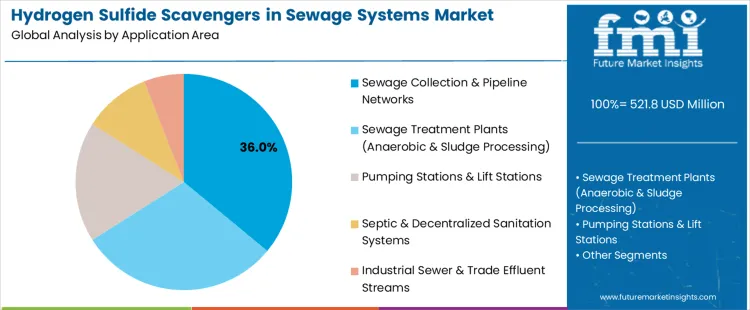
Sewage collection and pipeline networks hold 36.0%, driving the highest share of global adoption. These assets experience prolonged retention times and elevated sulfide generation risk. Sewage treatment plants hold 30.0%, addressing sulfide during anaerobic treatment and sludge processing stages. Pumping and lift stations account for 18.0%, managing localized sulfide accumulation. Septic and decentralized sanitation systems hold 10.0%, requiring simplified dosing approaches. Industrial sewer and trade effluent streams account for 6.0%. Application distribution reflects priority on upstream sulfide prevention within conveyance infrastructure.
Key Points:
- Collection networks dominate due to continuous sulfide formation.
- Treatment plants manage sulfide during anaerobic processes.
- Pump stations require localized control strategies.
Which Treatment Method Represents the Largest Share of Global Demand?
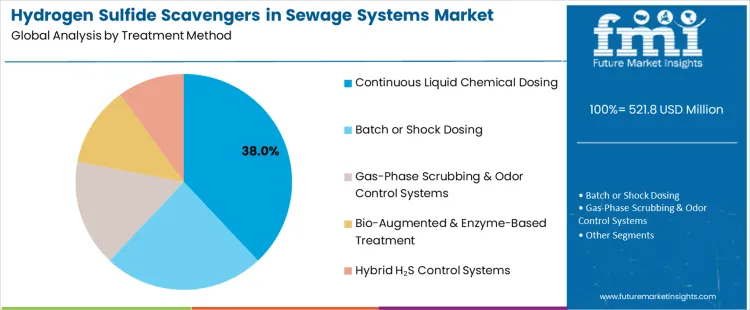
Continuous liquid chemical dosing holds 38.0%, representing the largest share of global demand. This method enables stable sulfide control under fluctuating flow and load conditions. Batch or shock dosing accounts for 24.0%, supporting episodic control during peak sulfide events. Gas-phase scrubbing and odor control systems hold 16.0%, addressing vapor-phase emissions. Bio-augmented and enzyme-based treatment accounts for 12.0%, reflecting gradual biological intervention strategies. Hybrid control systems hold 10.0%. Treatment-method distribution reflects preference for continuous, automated dosing within sewer networks.
Key Points:
- Continuous dosing leads due to control consistency.
- Shock dosing addresses peak sulfide excursions.
- Hybrid systems integrate chemical and biological control.
What are the Key Dynamics in the Hydrogen Sulfide Scavengers in Sewage Systems Market?
Global demand rises as municipal wastewater utilities, sewer network operators, and industrial contributors adopt hydrogen sulfide (H₂S) scavengers to mitigate corrosion, odor, and safety hazards in collection systems and treatment facilities. H₂S scavengers such as iron salts, peroxide-based reagents, and specialized chelators neutralize sulfide species, reducing infrastructure degradation and protecting worker health. Adoption aligns with tightening wastewater quality standards, urbanization-driven sewer loads, and investment in reliable sewer maintenance practices across diverse regions. Usage spans municipal networks, industrial sewer outfalls, and combined sewer systems requiring proactive odor and corrosion control.
How do regulatory requirements and infrastructure protection priorities shape global demand?
Governments and environmental agencies enforce air quality and public health standards that consider H₂S emission impacts on communities and sewer maintenance personnel. Elevated H₂S concentrations contribute to crown corrosion in concrete sewer lines, leading to structural degradation and increased rehabilitation costs. Utilities deploy scavengers in interceptors, manholes, and treatment plant influent lines to suppress sulfide formation and odor release, supporting regulatory compliance and prolonging asset life. Industrial wastewater generators, including food processing, pulp and paper, and petrochemical operations, use scavengers to manage H₂S loads before entry into shared sewer systems. Public and stakeholder expectations for safe, odor-minimized environments reinforce investment in effective scavenging chemistries as part of broader sewer system management strategies.
How do source variability, cost pressures, and dosing complexity influence market scalability?
Performance of H₂S scavengers depends on wastewater composition, flow rates, and biochemical conditions that influence sulfide generation, requiring tailored reagent selection and dosing strategies. Chemical costs and frequency of application influence operational budgets, particularly in high-load or large-diameter sewer networks. Integration of scavengers with biological treatment processes requires careful control to avoid disruption of downstream microbial systems. Safety, storage, and handling protocols introduce additional operational oversight. Regional differences in regulatory frameworks and enforcement timelines create variability in adoption urgency. Global growth depends on development of cost-effective, robust scavenging chemistries with adaptable dosing protocols and harmonized performance criteria that address diverse sewer system conditions worldwide.
How Is Demand for Hydrogen Sulfide Scavengers in Sewage Systems Evolving?
Demand for hydrogen sulfide scavengers in sewage systems is increasing globally due to corrosion prevention needs, odor control requirements, and infrastructure protection priorities. India leads with a 9.5% CAGR, supported by sewer network expansion and sanitation program implementation. China follows at 9.2%, driven by urban wastewater infrastructure growth and enforcement of odor and corrosion controls. USA records a 7.6% CAGR, reflecting aging sewer assets and regulatory compliance for air quality and worker safety. Germany posts 7.1%, shaped by preventive infrastructure management and process optimization. Brazil records 6.8%, supported by municipal sanitation expansion and odor mitigation mandates. Growth reflects sustained focus on sulfide control to protect assets and communities worldwide.
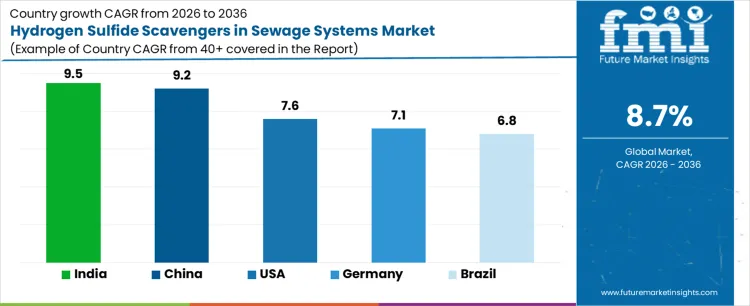
| Country | CAGR (%) |
|---|---|
| India | 9.5% |
| China | 9.2% |
| USA | 7.6% |
| Germany | 7.1% |
| Brazil | 6.8% |
What factors are driving strong adoption of hydrogen sulfide scavengers in India?
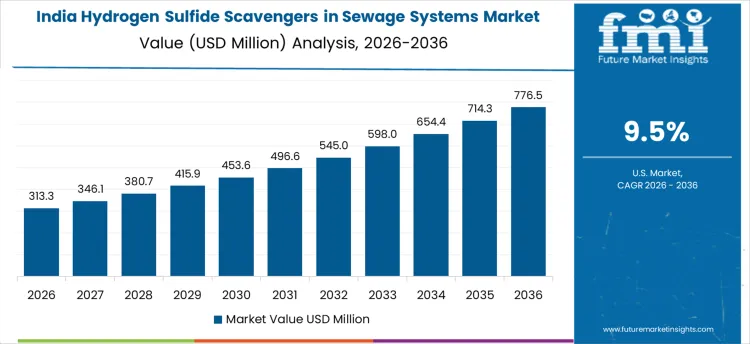
India demand is driven by expansion of sewer networks, pumping stations, and wastewater treatment plants under national sanitation initiatives. CAGR of 9.5% reflects increased use of nitrate-based, iron salt, and liquid scavenger formulations to control sulfide generation. High ambient temperatures accelerate sulfide formation, increasing treatment frequency. Urban densification places sewer infrastructure near residential zones, elevating odor control needs. Operators favor chemical scavengers due to rapid deployment without major capital modification. Growth remains infrastructure-led and compliance-focused, aligned with improving sanitation reliability and asset protection.
- Expansion of sewer and pumping infrastructure
- High temperature-driven sulfide formation
- Odor control near dense residential areas
- Preference for rapid, low-capital solutions
How is China sustaining high growth in hydrogen sulfide scavenger usage?
China demand reflects scale of urban sewer systems and regulatory emphasis on corrosion and odor mitigation. CAGR of 9.2% is supported by widespread deployment of scavengers across force mains and lift stations. Centralized planning enables standardized chemical dosing programs. Industrial wastewater contributions increase sulfide load in municipal sewers. Continuous monitoring requirements support consistent scavenger application. Domestic suppliers scale production of iron-based and oxidizing scavengers. Growth remains scale-driven and regulation-aligned, supported by urbanization and infrastructure protection objectives.
- Large urban sewer network deployment
- Standardized dosing under centralized planning
- Industrial contribution to sulfide loads
- Expansion of domestic scavenger supply
What regulatory drivers shape hydrogen sulfide scavenger demand in the USA?
USA demand is shaped by aging sewer infrastructure, air quality standards, and worker safety regulations. CAGR of 7.6% reflects consistent use of scavengers to prevent concrete corrosion and manage odor complaints. Utilities deploy chemical control in force mains and gravity sewers to extend asset life. Regulatory scrutiny on hydrogen sulfide exposure influences operational practices. Budget constraints favor chemical optimization over infrastructure replacement. Growth remains regulation-driven and operations-focused, aligned with asset preservation and community impact management.
- Aging sewer and force main infrastructure
- Air quality and worker safety compliance
- Asset life extension through chemical control
- Cost-effective operational optimization
Why does Germany show steady but controlled demand growth?
Germany demand reflects preventive infrastructure management and precautionary environmental regulation. CAGR of 7.1% is supported by targeted use of hydrogen sulfide scavengers within optimized sewer systems. Operators emphasize upstream control, precise dosing, and integration with ventilation strategies. Strong design standards reduce baseline sulfide formation. Documentation and validation requirements guide chemical application. Growth remains efficiency-led and stability-focused, aligned with established wastewater management practices.
- Preventive sewer system design and management
- Emphasis on precise and efficient dosing
- Integration with non-chemical control methods
- Strong documentation and validation standards
What supports continued demand growth for hydrogen sulfide scavengers in Brazil?
Brazil demand is driven by expansion of municipal sewer coverage and sanitation programs. CAGR of 6.8% reflects increased use of scavengers to manage sulfide-related odors and corrosion. Warm climate conditions elevate sulfide generation risk. Urban expansion places sewer infrastructure near populated areas. Environmental licensing includes odor and corrosion control provisions. Growth remains application-driven and compliance-aligned, supported by sanitation infrastructure investment and regulatory oversight.
- Expansion of municipal sewer networks
- Warm climate accelerating sulfide formation
- Odor mitigation near urban populations
- Environmental licensing and compliance needs
What is the competitive landscape of demand for hydrogen sulfide scavengers in sewage systems?
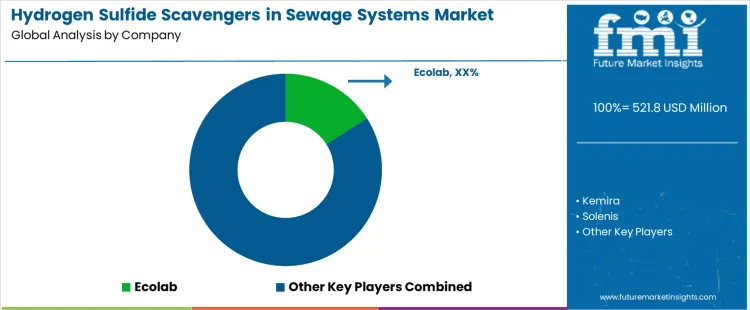
Demand for hydrogen sulfide scavengers in sewage systems is driven by corrosion prevention, odor mitigation, and compliance with occupational safety requirements. Treatment programs target sulfide generation in gravity sewers, force mains, lift stations, and sludge handling infrastructure. Buyers evaluate scavenging efficiency, reaction speed, dosing stability, and compatibility with wastewater chemistry and downstream biological processes. Procurement teams prioritize chemicals that reduce hydrogen sulfide formation, limit concrete and metal corrosion, and operate effectively under variable flow and temperature conditions. Trend in the global market reflects increased infrastructure rehabilitation costs, stricter odor regulations, and broader adoption of preventive sulfide control strategies.
Ecolab maintains strong positioning through service-integrated sulfide control programs combining scavenger chemicals with monitoring and optimization support. Kemira supplies iron-based and specialty scavengers widely used for hydrogen sulfide control and corrosion mitigation in sewer networks. Solenis provides tailored sulfide scavenging chemistries aligned with municipal wastewater system requirements. Veolia Water Technologies supports global operators with hydrogen sulfide control solutions embedded within broader wastewater management programs. SUEZ Water Technologies contributes scavenger chemicals integrated into collection system optimization and odor control frameworks. Competitive differentiation depends on scavenging effectiveness, operational reliability, technical service depth, and ability to support long-term infrastructure protection.
Key Players in the Hydrogen Sulfide Scavengers in Sewage Systems Market
- Ecolab
- Kemira
- Solenis
- Veolia Water Technologies
- SUEZ Water Technologies
Scope of the Report
| Items | Values |
|---|---|
| Quantitative Units | USD million |
| Scavenger Chemistry | Triazine-Based Scavengers; Iron Salt-Based Scavengers (FeCl₃, FeSO₄); Nitrate-Based & Oxidative Scavengers; Bio-Organic & Enzyme-Based Scavengers; Other Specialty H₂S Control Formulations |
| Application Area | Sewage Collection & Pipeline Networks; Sewage Treatment Plants (Anaerobic & Sludge Processing); Pumping Stations & Lift Stations; Septic & Decentralized Sanitation Systems; Industrial Sewer & Trade Effluent Streams |
| Treatment Method | Continuous Liquid Chemical Dosing; Batch or Shock Dosing; Gas-Phase Scrubbing & Odor Control Systems; Bio-Augmented & Enzyme-Based Treatment; Hybrid H₂S Control Systems |
| Regions Covered | Asia Pacific, Europe, North America, Latin America, Middle East & Africa |
| Countries Covered | India, China, USA, Germany, Brazil, and 40+ countries |
| Key Companies Profiled | Ecolab; Kemira; Solenis; Veolia Water Technologies; SUEZ Water Technologies |
| Additional Attributes | Dollar sales by scavenger chemistry and treatment method; adoption trends for triazine, iron salt, and bio-organic H₂S control solutions; performance metrics for sulfide suppression, corrosion control, and odor reduction; compatibility with sewer materials and anaerobic process conditions; dosing stability, sludge impact, and byproduct management considerations; regulatory odor limits and wastewater safety standards influencing scavenger selection. |
Hydrogen Sulfide Scavengers in Sewage Systems Market by Segment
BY Scavenger Chemistry:
- Triazine-Based Scavengers
- Iron Salt-Based Scavengers (FeCl₃, FeSO₄)
- Nitrate-Based & Oxidative Scavengers
- Bio-Organic & Enzyme-Based Scavengers
- Other Specialty H₂S Control Formulations
BY Application Area:
- Sewage Collection & Pipeline Networks
- Sewage Treatment Plants (Anaerobic & Sludge Processing)
- Pumping Stations & Lift Stations
- Septic & Decentralized Sanitation Systems
- Industrial Sewer & Trade Effluent Streams
BY Treatment Method:
- Continuous Liquid Chemical Dosing
- Batch or Shock Dosing
- Gas-Phase Scrubbing & Odor Control Systems
- Bio-Augmented & Enzyme-Based Treatment
- Hybrid H₂S Control Systems
BY Region:
- Asia Pacific
- China
- Japan
- South Korea
- India
- Australia & New Zealand
- ASEAN
- Rest of Asia Pacific
- Europe
- Germany
- United Kingdom
- France
- Italy
- Spain
- Nordic
- BENELUX
- Rest of Europe
- North America
- United States
- Canada
- Mexico
- Latin America
- Brazil
- Chile
- Rest of Latin America
- Middle East & Africa
- Kingdom of Saudi Arabia
- Other GCC Countries
- Turkey
- South Africa
- Other African Union
- Rest of Middle East & Africa
Frequently Asked Questions
How big is the hydrogen sulfide scavengers in sewage systems market in 2026?
The global hydrogen sulfide scavengers in sewage systems market is estimated to be valued at USD 521.8 million in 2026.
What will be the size of hydrogen sulfide scavengers in sewage systems market in 2036?
The market size for the hydrogen sulfide scavengers in sewage systems market is projected to reach USD 1,201.7 million by 2036.
How much will be the hydrogen sulfide scavengers in sewage systems market growth between 2026 and 2036?
The hydrogen sulfide scavengers in sewage systems market is expected to grow at a 8.7% CAGR between 2026 and 2036.
What are the key product types in the hydrogen sulfide scavengers in sewage systems market?
The key product types in hydrogen sulfide scavengers in sewage systems market are triazine-based scavengers, iron salt-based scavengers (fecl₃, feso₄), nitrate-based & oxidative scavengers, bio-organic & enzyme-based scavengers and other specialty h₂s control formulations.
Which application area segment to contribute significant share in the hydrogen sulfide scavengers in sewage systems market in 2026?
In terms of application area, sewage collection & pipeline networks segment to command 36.0% share in the hydrogen sulfide scavengers in sewage systems market in 2026.
Preview the report firsthand - request a free sample
Get SampleGet the brochure for pricing and purchase details.
Get PDFTable of Content
- Executive Summary
- Global Market Outlook
- Demand-side Trends
- Supply-side Trends
- Technology Roadmap Analysis
- Analysis and Recommendations
- Market Overview
- Market Coverage / Taxonomy
- Market Definition / Scope / Limitations
- Market Background
- Market Dynamics
- Drivers
- Restraints
- Opportunity
- Trends
- Scenario Forecast
- Demand in Optimistic Scenario
- Demand in Likely Scenario
- Demand in Conservative Scenario
- Opportunity Map Analysis
- Product Life Cycle Analysis
- Supply Chain Analysis
- Investment Feasibility Matrix
- Value Chain Analysis
- PESTLE and Porter’s Analysis
- Regulatory Landscape
- Regional Parent Market Outlook
- Production and Consumption Statistics
- Import and Export Statistics
- Market Dynamics
- Global Market Analysis 2021 to 2025 and Forecast, 2026 to 2036
- Historical Market Size Value (USD Million) Analysis, 2021 to 2025
- Current and Future Market Size Value (USD Million) Projections, 2026 to 2036
- Y-o-Y Growth Trend Analysis
- Absolute $ Opportunity Analysis
- Global Market Pricing Analysis 2021 to 2025 and Forecast 2026 to 2036
- Global Market Analysis 2021 to 2025 and Forecast 2026 to 2036, By Scavenger Chemistry
- Introduction / Key Findings
- Historical Market Size Value (USD Million) Analysis By Scavenger Chemistry , 2021 to 2025
- Current and Future Market Size Value (USD Million) Analysis and Forecast By Scavenger Chemistry , 2026 to 2036
- Triazine-Based Scavengers
- Iron Salt-Based Scavengers (FeCl₃, FeSO₄)
- Nitrate-Based & Oxidative Scavengers
- Bio-Organic & Enzyme-Based Scavengers
- Other Specialty H₂S Control Formulations
- Triazine-Based Scavengers
- Y-o-Y Growth Trend Analysis By Scavenger Chemistry , 2021 to 2025
- Absolute $ Opportunity Analysis By Scavenger Chemistry , 2026 to 2036
- Global Market Analysis 2021 to 2025 and Forecast 2026 to 2036, By Application Area
- Introduction / Key Findings
- Historical Market Size Value (USD Million) Analysis By Application Area, 2021 to 2025
- Current and Future Market Size Value (USD Million) Analysis and Forecast By Application Area, 2026 to 2036
- Sewage Collection & Pipeline Networks
- Sewage Treatment Plants (Anaerobic & Sludge Processing)
- Pumping Stations & Lift Stations
- Septic & Decentralized Sanitation Systems
- Industrial Sewer & Trade Effluent Streams
- Sewage Collection & Pipeline Networks
- Y-o-Y Growth Trend Analysis By Application Area, 2021 to 2025
- Absolute $ Opportunity Analysis By Application Area, 2026 to 2036
- Global Market Analysis 2021 to 2025 and Forecast 2026 to 2036, By Treatment Method
- Introduction / Key Findings
- Historical Market Size Value (USD Million) Analysis By Treatment Method, 2021 to 2025
- Current and Future Market Size Value (USD Million) Analysis and Forecast By Treatment Method, 2026 to 2036
- Continuous Liquid Chemical Dosing
- Batch or Shock Dosing
- Gas-Phase Scrubbing & Odor Control Systems
- Bio-Augmented & Enzyme-Based Treatment
- Hybrid H₂S Control Systems
- Continuous Liquid Chemical Dosing
- Y-o-Y Growth Trend Analysis By Treatment Method, 2021 to 2025
- Absolute $ Opportunity Analysis By Treatment Method, 2026 to 2036
- Global Market Analysis 2021 to 2025 and Forecast 2026 to 2036, By Region
- Introduction
- Historical Market Size Value (USD Million) Analysis By Region, 2021 to 2025
- Current Market Size Value (USD Million) Analysis and Forecast By Region, 2026 to 2036
- North America
- Latin America
- Western Europe
- Eastern Europe
- East Asia
- South Asia and Pacific
- Middle East & Africa
- Market Attractiveness Analysis By Region
- North America Market Analysis 2021 to 2025 and Forecast 2026 to 2036, By Country
- Historical Market Size Value (USD Million) Trend Analysis By Market Taxonomy, 2021 to 2025
- Market Size Value (USD Million) Forecast By Market Taxonomy, 2026 to 2036
- By Country
- USA
- Canada
- Mexico
- By Scavenger Chemistry
- By Application Area
- By Treatment Method
- By Country
- Market Attractiveness Analysis
- By Country
- By Scavenger Chemistry
- By Application Area
- By Treatment Method
- Key Takeaways
- Latin America Market Analysis 2021 to 2025 and Forecast 2026 to 2036, By Country
- Historical Market Size Value (USD Million) Trend Analysis By Market Taxonomy, 2021 to 2025
- Market Size Value (USD Million) Forecast By Market Taxonomy, 2026 to 2036
- By Country
- Brazil
- Chile
- Rest of Latin America
- By Scavenger Chemistry
- By Application Area
- By Treatment Method
- By Country
- Market Attractiveness Analysis
- By Country
- By Scavenger Chemistry
- By Application Area
- By Treatment Method
- Key Takeaways
- Western Europe Market Analysis 2021 to 2025 and Forecast 2026 to 2036, By Country
- Historical Market Size Value (USD Million) Trend Analysis By Market Taxonomy, 2021 to 2025
- Market Size Value (USD Million) Forecast By Market Taxonomy, 2026 to 2036
- By Country
- Germany
- UK
- Italy
- Spain
- France
- Nordic
- BENELUX
- Rest of Western Europe
- By Scavenger Chemistry
- By Application Area
- By Treatment Method
- By Country
- Market Attractiveness Analysis
- By Country
- By Scavenger Chemistry
- By Application Area
- By Treatment Method
- Key Takeaways
- Eastern Europe Market Analysis 2021 to 2025 and Forecast 2026 to 2036, By Country
- Historical Market Size Value (USD Million) Trend Analysis By Market Taxonomy, 2021 to 2025
- Market Size Value (USD Million) Forecast By Market Taxonomy, 2026 to 2036
- By Country
- Russia
- Poland
- Hungary
- Balkan & Baltic
- Rest of Eastern Europe
- By Scavenger Chemistry
- By Application Area
- By Treatment Method
- By Country
- Market Attractiveness Analysis
- By Country
- By Scavenger Chemistry
- By Application Area
- By Treatment Method
- Key Takeaways
- East Asia Market Analysis 2021 to 2025 and Forecast 2026 to 2036, By Country
- Historical Market Size Value (USD Million) Trend Analysis By Market Taxonomy, 2021 to 2025
- Market Size Value (USD Million) Forecast By Market Taxonomy, 2026 to 2036
- By Country
- China
- Japan
- South Korea
- By Scavenger Chemistry
- By Application Area
- By Treatment Method
- By Country
- Market Attractiveness Analysis
- By Country
- By Scavenger Chemistry
- By Application Area
- By Treatment Method
- Key Takeaways
- South Asia and Pacific Market Analysis 2021 to 2025 and Forecast 2026 to 2036, By Country
- Historical Market Size Value (USD Million) Trend Analysis By Market Taxonomy, 2021 to 2025
- Market Size Value (USD Million) Forecast By Market Taxonomy, 2026 to 2036
- By Country
- India
- ASEAN
- Australia & New Zealand
- Rest of South Asia and Pacific
- By Scavenger Chemistry
- By Application Area
- By Treatment Method
- By Country
- Market Attractiveness Analysis
- By Country
- By Scavenger Chemistry
- By Application Area
- By Treatment Method
- Key Takeaways
- Middle East & Africa Market Analysis 2021 to 2025 and Forecast 2026 to 2036, By Country
- Historical Market Size Value (USD Million) Trend Analysis By Market Taxonomy, 2021 to 2025
- Market Size Value (USD Million) Forecast By Market Taxonomy, 2026 to 2036
- By Country
- Kingdom of Saudi Arabia
- Other GCC Countries
- Turkiye
- South Africa
- Other African Union
- Rest of Middle East & Africa
- By Scavenger Chemistry
- By Application Area
- By Treatment Method
- By Country
- Market Attractiveness Analysis
- By Country
- By Scavenger Chemistry
- By Application Area
- By Treatment Method
- Key Takeaways
- Key Countries Market Analysis
- USA
- Pricing Analysis
- Market Share Analysis, 2025
- By Scavenger Chemistry
- By Application Area
- By Treatment Method
- Canada
- Pricing Analysis
- Market Share Analysis, 2025
- By Scavenger Chemistry
- By Application Area
- By Treatment Method
- Mexico
- Pricing Analysis
- Market Share Analysis, 2025
- By Scavenger Chemistry
- By Application Area
- By Treatment Method
- Brazil
- Pricing Analysis
- Market Share Analysis, 2025
- By Scavenger Chemistry
- By Application Area
- By Treatment Method
- Chile
- Pricing Analysis
- Market Share Analysis, 2025
- By Scavenger Chemistry
- By Application Area
- By Treatment Method
- Germany
- Pricing Analysis
- Market Share Analysis, 2025
- By Scavenger Chemistry
- By Application Area
- By Treatment Method
- UK
- Pricing Analysis
- Market Share Analysis, 2025
- By Scavenger Chemistry
- By Application Area
- By Treatment Method
- Italy
- Pricing Analysis
- Market Share Analysis, 2025
- By Scavenger Chemistry
- By Application Area
- By Treatment Method
- Spain
- Pricing Analysis
- Market Share Analysis, 2025
- By Scavenger Chemistry
- By Application Area
- By Treatment Method
- France
- Pricing Analysis
- Market Share Analysis, 2025
- By Scavenger Chemistry
- By Application Area
- By Treatment Method
- India
- Pricing Analysis
- Market Share Analysis, 2025
- By Scavenger Chemistry
- By Application Area
- By Treatment Method
- ASEAN
- Pricing Analysis
- Market Share Analysis, 2025
- By Scavenger Chemistry
- By Application Area
- By Treatment Method
- Australia & New Zealand
- Pricing Analysis
- Market Share Analysis, 2025
- By Scavenger Chemistry
- By Application Area
- By Treatment Method
- China
- Pricing Analysis
- Market Share Analysis, 2025
- By Scavenger Chemistry
- By Application Area
- By Treatment Method
- Japan
- Pricing Analysis
- Market Share Analysis, 2025
- By Scavenger Chemistry
- By Application Area
- By Treatment Method
- South Korea
- Pricing Analysis
- Market Share Analysis, 2025
- By Scavenger Chemistry
- By Application Area
- By Treatment Method
- Russia
- Pricing Analysis
- Market Share Analysis, 2025
- By Scavenger Chemistry
- By Application Area
- By Treatment Method
- Poland
- Pricing Analysis
- Market Share Analysis, 2025
- By Scavenger Chemistry
- By Application Area
- By Treatment Method
- Hungary
- Pricing Analysis
- Market Share Analysis, 2025
- By Scavenger Chemistry
- By Application Area
- By Treatment Method
- Kingdom of Saudi Arabia
- Pricing Analysis
- Market Share Analysis, 2025
- By Scavenger Chemistry
- By Application Area
- By Treatment Method
- Turkiye
- Pricing Analysis
- Market Share Analysis, 2025
- By Scavenger Chemistry
- By Application Area
- By Treatment Method
- South Africa
- Pricing Analysis
- Market Share Analysis, 2025
- By Scavenger Chemistry
- By Application Area
- By Treatment Method
- USA
- Market Structure Analysis
- Competition Dashboard
- Competition Benchmarking
- Market Share Analysis of Top Players
- By Regional
- By Scavenger Chemistry
- By Application Area
- By Treatment Method
- Competition Analysis
- Competition Deep Dive
- Ecolab
- Overview
- Product Portfolio
- Profitability by Market Segments (Product/Age /Sales Channel/Region)
- Sales Footprint
- Strategy Overview
- Marketing Strategy
- Product Strategy
- Channel Strategy
- Kemira
- Solenis
- Veolia Water Technologies
- SUEZ Water Technologies
- Ecolab
- Competition Deep Dive
- Assumptions & Acronyms Used
- Research Methodology


