

- Industry Size (2025)
- USD 165.1 Mn
- Forecast (2035)
- USD 305.7 Mn
- CAGR (2025 to 2035)
- 6.4%
Hydrogenated Polyisobutene Market Forecast and Outlook 2025 to 2035
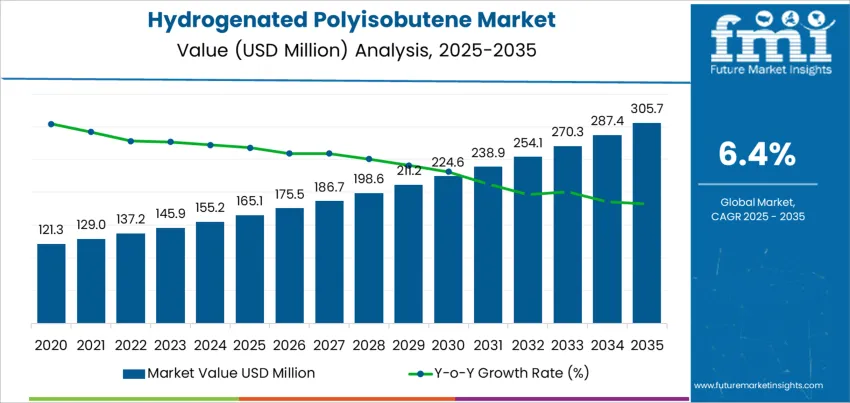
The hydrogenated polyisobutene market is valued at USD 165.1 million in 2025 and is expected to reach USD 305.7 million by 2035, growing at a CAGR of 6.4%. Growth comes from its steady use in personal care, adhesives, and lubricant applications, where stability, low volatility, and good moisture resistance are important. Its ability to improve texture and create a smooth, glossy finish supports strong placement across high-volume product lines.
Until 2030, demand in the hydrogenated polyisobutene market increases mainly through greater usage in skin care creams, lip balms, lipsticks, and sunscreens, as brands look for clean-feeling alternatives to mineral oils. In industry settings, hydrogenated polyisobutene continues to be included in pressure-sensitive adhesives and specialty greases, where reliability and long-term performance drive adoption. Growth remains led by higher inclusion levels per formulation rather than large new category introductions. As more companies shift toward lightweight textures and better water resistance, the hydrogenated polyisobutene market continues to show consistent, year-on-year expansion.
Quick Stats of the Hydrogenated Polyisobutene Market
- Hydrogenated Polyisobutene Market Value (2025): USD 165.1 million
- Hydrogenated Polyisobutene Market Forecast Value (2035): USD 305.7 million
- Hydrogenated Polyisobutene Market Forecast CAGR (2025 to 2035): 6.4%
- Leading Product Form in Hydrogenated Polyisobutene Market: Powder (17.7%)
- Key Growth Regions in Hydrogenated Polyisobutene Market: Asia Pacific, Europe
- Top Players in Hydrogenated Polyisobutene Market: BASF SE, Croda International, Evonik Industries, Symrise (incl. IFF/Givaudan actives), Dow / Dow Inc., Ashland, Clariant, Seppic
What is the Growth Forecast for the Hydrogenated Polyisobutene Market through 2035?
After 2030, the demand expansion rate remains structurally consistent as higher intensity use across established applications sustains volume growth. Market value rises from about USD 224.6 million in 2030 toward USD 305.7 million by 2035 as cosmetic manufacturers increase loading levels in long wear makeup, hair serums, and skin barrier products. Lubricant demand expands through electrical insulation oils and sealed gear systems requiring low reactivity. Procurement patterns remain contract oriented as formulators lock in supply for validated formulations. Producers focus on hydrogenation efficiency, molecular weight uniformity, and impurity control to support higher throughput. Distribution remains concentrated among specialty chemical channels serving regulated personal care and industrial users with consistent bulk delivery schedules.
The global hydrogenated polyisobutene market expands from USD 165.1 million in 2025 to USD 211.2 million by 2030, generating an absolute gain of USD 46.1 million in the first half of the forecast period. This translates into a moderate Expansion Efficiency Score, as each USD 1.00 of 2025 market size yields about USD 0.28 in incremental value by 2030. Growth efficiency in this phase is driven by rising inclusion in lipsticks, glosses, sunscreens, and dermatological ointments where stability, gloss, and non-tacky emollience are critical. Industrial lubrication, adhesive tackifiers, and plastic modifiers add secondary support. Expansion remains efficient but controlled, as pricing discipline and formulation substitution cap rapid value escalation.
From 2030 to 2035, the market advances from USD 211.2 million to USD 305.7 million, representing a stronger absolute gain of USD 94.5 million and significantly improving the Expansion Efficiency. This sharper efficiency reflects deeper penetration into long-wear cosmetics, medical-grade skincare bases, and high-purity lubricant systems, where formulation loading rates and price realization both rise. As downstream users prioritize oxidation resistance, shelf-life stability, and sensory neutrality, hydrogenated polyisobutene shifts from a supporting ingredient into a high-efficiency value carrier, driving structurally stronger expansion through 2035.
Hydrogenated Polyisobutene Industry Key Takeaways
| Metric | Value |
|---|---|
| Industry Value (2025) | USD 165.1 million |
| Forecast Value (2035) | USD 305.7 million |
| Forecast CAGR (2025 to 2035) | 6.4% |
How Is the Hydrogenated Polyisobutene Market Evolving Across Personal Care, Lubrication, and Specialty Fluid Applications?
The hydrogenated polyisobutene market developed from earlier use of conventional polyisobutene as a lubricant and viscosity modifier in industrial systems. Hydrogenation expanded its role by removing unsaturation, which improved color stability, odor profile, and oxidative resistance. This made the material suitable for direct contact applications where sensory purity and long term stability are required.
Early commercial use concentrated in cosmetic oils, lip products, and skin care where hydrogenated polyisobutene delivered high gloss, cushion feel, and low irritation compared with mineral oils. At the same time, it retained importance in lubricants and greases for machinery requiring stable performance under prolonged thermal stress. Its dual compatibility with cosmetic and industrial systems allowed steady cross sector demand rather than dependence on a single end use.
Future growth of the hydrogenated polyisobutene market will be shaped by clean formulation strategies, performance driven lubrication needs, and tightening purity standards in regulated applications. In personal care, brands favor it as a non-greasy, high shine emollient with low reactivity, especially in lip care, sunscreens, and makeup. In lubricants, demand will rise for stable base fluids that resist oxidation in compact mechanical systems and electric drive components.
Barriers include regulatory pressure on synthetic hydrocarbons, substitution by bio-based emollients in some beauty segments, and cost sensitivity in commodity lubricant formulations. Long-term growth will depend on how well hydrogenated polyisobutene balances sensory performance, oxidative stability, and regulatory acceptance across both consumer and industrial markets.
How Are End Use Application and Product Form Structuring the Demand for Hydrogenated Polyisobutene?
The demand for hydrogenated polyisobutene is structured by end use application and product form. Skin care represents 11.6% of total demand, followed by body care, hair care, sun care, color cosmetics, men grooming, baby and kids care, and dermocosmetic and professional care. By product form, powder accounts for 17.7% of total consumption, followed by granules and agglomerates, flakes, pellets and prills, liquid solutions, high active concentrates, dispersions and suspensions, emulsions, pastes, gels, wax or solid block formats, and oils. Demand behavior is shaped by occlusive performance, oxidative stability, viscosity control, gloss enhancement, and compatibility with both anhydrous and emulsion based cosmetic systems.
Why Does Skin Care Lead the Hydrogenated Polyisobutene End Use Demand?

Skin care accounts for 11.6% of total hydrogenated polyisobutene demand due to its role as a high performance emollient that delivers lasting hydration without greasy residue. Hydrogenated polyisobutene forms a continuous protective layer on the skin surface that reduces transepidermal water loss while maintaining a lightweight sensory profile. These properties support its use in moisturizers, lip treatments, barrier creams, night masks, and anti aging formulations where prolonged moisture retention is required.
Skin care formulators favor this ingredient for its strong oxidative stability compared with unsaturated oils, which improves shelf life and fragrance stability. Its non tacky afterfeel also supports use in leave on products that require quick absorption and comfortable daily wear. Its clarity and neutral odor allow seamless integration into fragrance driven formulations. These hydration efficiency, oxidative resistance, and sensory balance attributes sustain skin care as the leading end use segment within hydrogenated polyisobutene demand.
Why Does Powder Lead the Hydrogenated Polyisobutene Product Form Demand?
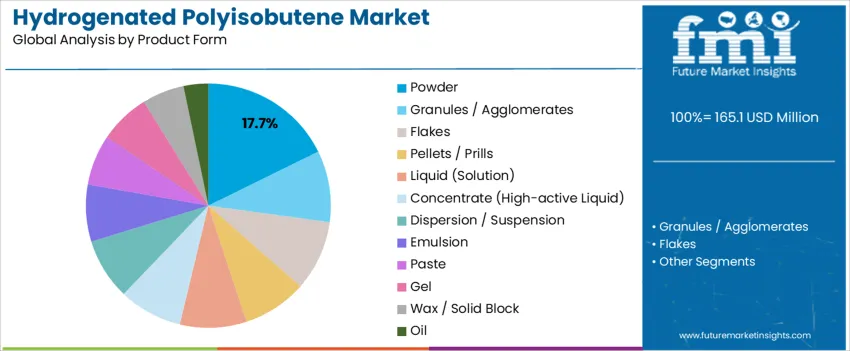
Powder accounts for 17.7% of total hydrogenated polyisobutene demand due to its improved dosing control, enhanced storage stability, and suitability for structured blending systems. Powdered hydrogenated polyisobutene allows formulators to precisely manage occlusivity and gloss intensity across emulsions, gels, and solid cosmetic formats without liquid migration risks. Low moisture exposure minimizes degradation and preserves consistent emollient performance during extended warehousing.
Powder form also integrates efficiently into pressed products, balms, sticks, and hybrid formulations where free flowing handling is required during production. It supports controlled melt behavior during heating cycles used in wax based systems. Packaging in moisture barrier containers maintains flow integrity and prevents agglomeration during transport. These processing reliability, formulation precision, and shelf life stability advantages position powder as the leading product form within the hydrogenated polyisobutene demand structure.
Why Has Hydrogenated Polyisobutene Become The “Quiet Weight” Behind Long-Wear Slip And Cushion?
Hydrogenated polyisobutene is chosen when formulators need lasting slip without visible oiliness or fast evaporation. It spreads smoothly, stays in place, and resists oxidation far better than many plant oils. In lip products, foundations, sunscreens, and hair gloss systems, it delivers elastic cushion that does not collapse under heat, sweat, or sebum. Users rarely recognize it, yet it controls drag, shine balance, and payoff stability. Its role is not to nourish or absorb but to hold sensory structure steady over time, which makes it a backbone material in wear-critical personal care systems.
How Does Its Petroleum-Derived Structure Translate Into Unusual Stability Advantages?
Unlike triglycerides and ester oils, hydrogenated polyisobutene is a saturated hydrocarbon with no reactive double bonds. This molecular simplicity gives it exceptional resistance to oxidation, hydrolysis, and odor drift. It does not thicken under cold stress or thin excessively under heat. That stability allows it to survive long shelf lives, repeated temperature cycling in transport, and aggressive pigment loads. These traits matter in color cosmetics, sun care, and industrial lubricating blends. Demand follows this chemical resilience rather than any botanical positioning or renewable sourcing narrative.
What Sensory Limits and Regulatory Pressures Keep It Out of Certain Product Categories?
Hydrogenated polyisobutene cannot deliver water solubility, breathability, or fast sensory disappearance. Its film remains on the surface, which makes it unsuitable for lightweight skincare, foaming cleansers, or sprayable water-based formats. Regulatory pressure against petroleum-derived ingredients also limits its use in some natural-leaning brands and regions with aggressive clean-label expectations. Cost is also higher than basic mineral oils. These boundaries compress its usage into categories where permanence, gloss control, and inert stability outweigh demands for biodegradability or lightweight sensory profiles.
Where Is Demand Quietly Concentrating as Makeup, Hair, And Sunscreen Formats Evolve?
Current growth is forming in transfer-resistant color cosmetics, gel-oil hair serums, and high-SPF sunscreen systems that must remain uniform under UV, salt, and sweat exposure. Lip products use it to stabilize pigment dispersion and prevent feathering without stiffness. Scalp oils and anti-frizz glosses adopt it for humidity resistance without heavy buildup. Hybrid sunscreens rely on it to maintain even UV filter distribution without crystallization. These uses expand not through marketing stories but through internal formulation necessity in products that cannot fail under physical or environmental stress.
What Is the Global Growth Outlook for the Hydrogenated Polyisobutene Industry by Country?
| Country | CAGR (%) |
|---|---|
| India | 8.6 |
| China | 7.9 |
| Japan | 7.3 |
| UK | 6.7 |
| Germany | 6.0 |
| USA | 5.4 |
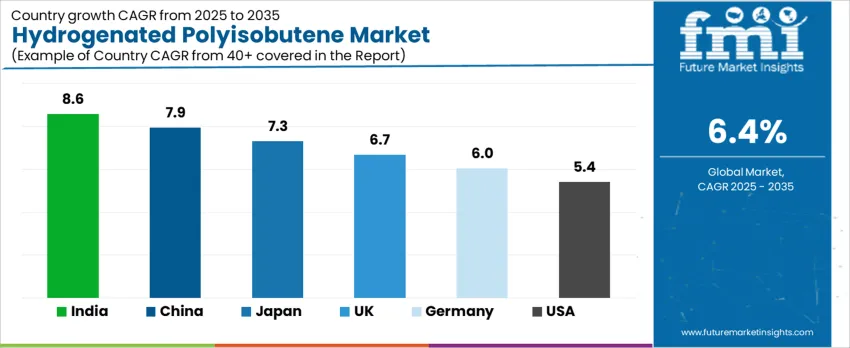
The hydrogenated polyisobutene industry is showing steady global expansion across major cosmetics, lubricant, and personal care formulation markets, with India leading at an 8.6% CAGR. Growth in India is supported by rising production of skincare, hair care, and color cosmetics where hydrogenated polyisobutene is used for emolliency and gloss enhancement. China follows at 7.9%, driven by large scale personal care manufacturing, expanding export activity, and steady demand from industrial lubricant applications.
Japan at 7.3% reflects stable adoption in premium cosmetics, dermatology products, and specialty formulations. The UK and Germany record 6.7% and 6.0% growth, supported by personal care innovation and industrial specialty fluid usage. The USA at 5.4% reflects a mature but steadily advancing market driven by cosmetics formulation upgrades, pharmaceutical ointments, and specialty lubricant demand.
What Is Driving Hydrogenated Polyisobutene Demand Across Cosmetics and Lubricants in India?
Expansion in India is progressing at a CAGR of 8.6% through 2035 for hydrogenated polyisobutene demand, driven by rising production of cosmetic emollients, lip care products, and industrial lubricants. Personal care brands apply this material for smooth spreadability and moisture retention in lip balms, foundations, and hair serums. Automotive service oils and specialty greases add industrial volume. Domestic production remains limited to mid grade material, while high purity cosmetic grades rely on imports. Demand remains formulation driven and retail aligned, shaped by expanding beauty product consumption and steady growth in automotive maintenance activity.
- Lip care and makeup products anchor cosmetic demand
- Hair serums support repeat personal care usage
- Specialty lubricants add industrial consumption volume
- Import dependence remains high for cosmetic grades
How Is China Scaling Industrial Output of Hydrogenated Polyisobutene?
Growth in China reflects a CAGR of 7.9% through 2035 for hydrogenated polyisobutene utilization, supported by large scale personal care manufacturing, lubricant blending, and private label cosmetic production. This polymer appears in skin creams, massage oils, industrial greases, and metalworking fluids. Domestic chemical producers operate high capacity hydrogenation units for stable bulk supply. Export oriented manufacturers also ship finished beauty and lubricant products worldwide. Demand remains production driven and volume oriented, aligned with mass cosmetics output, steady lubricant blending activity, and strong integration across downstream chemical processing value chains.
- Mass skincare production supports bulk emollient usage
- Grease and metalworking fluids drive industrial demand
- Domestic hydrogenation stabilizes supply volumes
- Export production strengthens global offtake
Why Does Japan Sustain High Purity Hydrogenated Polyisobutene Usage?
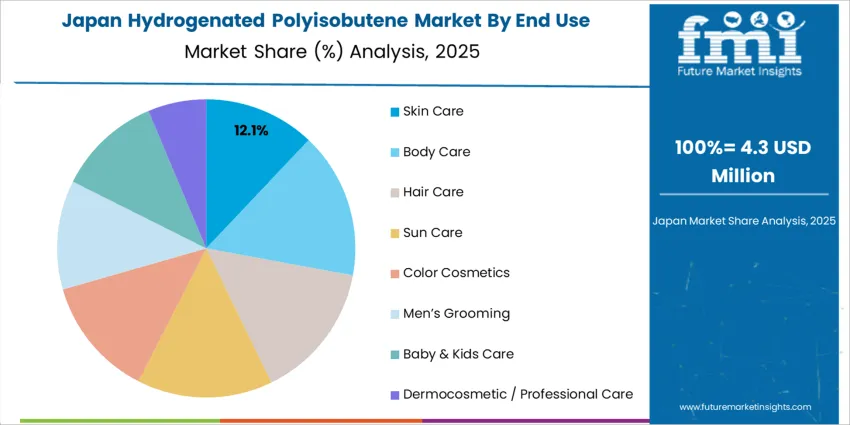
Demand in Japan is increasing at a CAGR of 7.3% through 2035 for hydrogenated polyisobutene usage, supported by premium cosmetics, medical grade ointments, and precision lubricant formulations. The material is used in barrier creams, wound care dressings, and low volatility industrial lubricants. Domestic refiners emphasize ultra low odor and impurity control. Dermatology aligned personal care brands favor its stable skin feel and oxidation resistance. Demand stays quality driven and application focused, supported by aging population skincare needs, regulated topical formulations, and continuous development of high reliability lubricant systems.
- Medical ointments support regulated cosmetic consumption
- Premium skincare sustains high purity grade usage
- Precision lubricants drive specialty industrial demand
- Domestic refining stabilizes tight quality standards
What Is Supporting Hydrogenated Polyisobutene Market Expansion in the United Kingdom?
Growth in the UK is advancing at a CAGR of 6.7% through 2035 for hydrogenated polyisobutene demand, supported by clean beauty product development, massage oil production, and pharmaceutical topical formulations. The material appears in sensitive skin creams, therapeutic balms, and athletic recovery gels. Independent cosmetic brands and clinical skincare suppliers drive steady usage. Imports dominate sourcing due to the absence of domestic hydrogenation capacity. Demand remains retail driven and formulation focused, shaped by rising demand for gentle emollients, steady growth in sports recovery products, and controlled expansion of pharmacy distributed topicals.
- Sensitive skincare creams anchor primary cosmetic demand
- Sports recovery gels support therapeutic usage
- Pharmacy distribution sustains regulated product turnover
- Imported sourcing dominates national supply structure
How Is Germany Integrating Hydrogenated Polyisobutene into Regulated Industrial and Medical Products?
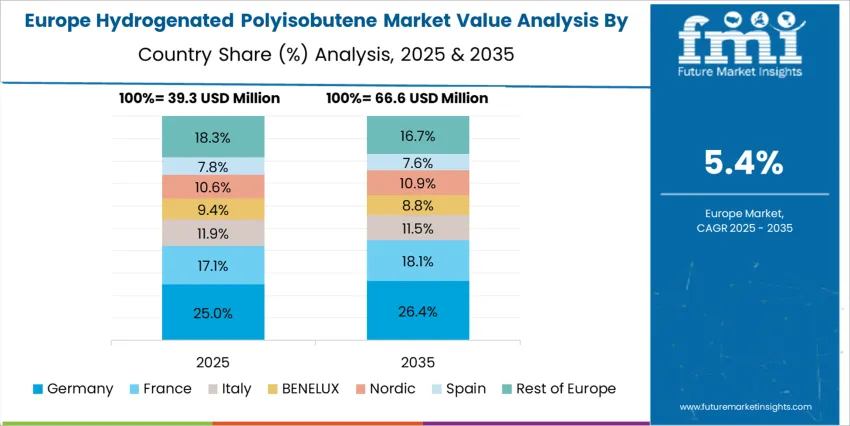
Growth in Germany reflects a CAGR of 6.0% through 2035 for hydrogenated polyisobutene consumption, driven by pharmaceutical ointments, medical device lubrication, and certified cosmetic manufacturing. The polymer is used in wound protection salves, catheter lubricants, and fragrance free skin creams. Strict testing, documentation, and material traceability govern supplier qualification. Imports remain the primary supply route for high purity grades. Demand stays quality focused and regulation aligned, supported by preventive healthcare practices, controlled cosmetic usage, and steady expansion of medical grade lubrication materials across hospitals and clinics.
- Medical lubricants drive regulated industrial demand
- Wound care salves sustain pharmaceutical consumption
- Compliance standards shape supplier qualification
- Hospital procurement supports steady long term usage
What Is Driving Measured Hydrogenated Polyisobutene Growth in the United States?
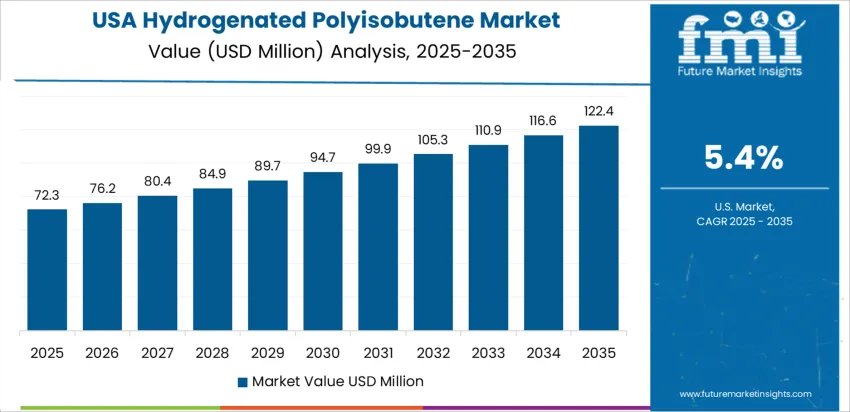
Expansion in the United States is moving at a CAGR of 5.4% through 2035 for hydrogenated polyisobutene demand, supported by mass cosmetics production, sports ointments, and specialty industrial lubricants. The polymer appears in lip gloss, hand creams, athletic muscle rubs, and low volatility compressor oils. Consumer brands and industrial service suppliers both contribute to volume demand. Imports supply most cosmetic grade material. Demand remains application driven and formulation diverse, shaped by steady personal care sales, consistent lubricant replacement cycles, and controlled expansion of topical wellness product usage.
- Lip gloss and hand creams anchor consumer demand
- Athletic muscle rubs support therapeutic product volume
- Low volatility oils drive specialty lubricant usage
- Import dependence dominates cosmetic grade procurement
What is the Competitive Intensity in the Hydrogenated Polyisobutene Market?
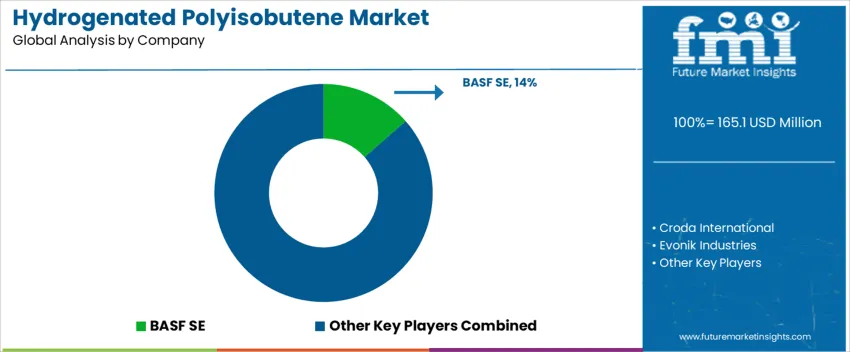
Competition in the hydrogenated polyisobutene (HPIB) market is relatively high. Major chemical and specialty ingredient firms such as BASF SE, Croda International, Evonik Industries, Symrise (including its IFF/Givaudan actives division), Dow Inc., Ashland, Clariant and several smaller specialist producers (e.g. Seppic, Lubrizol, Lonza, Inolex) supply HPIB globally for cosmetics, personal care, pharmaceuticals, lubricants and industrial formulations.
Because many of these suppliers offer similar product grades and overlapping applications (emollients, lubricants, formulation bases), rivalry is fierce. Price and supply chain flexibility, formulation support and regulatory compliance tend to drive supplier differentiation rather than unique proprietary technology. As a result, switching between suppliers is relatively easy for buyers, which maintains downward pressure on prices and margins for commodity grades.
Price control power in this market tends to reside with the large integrated producers. These firms secure long term access to feedstocks, maintain diversified end use portfolios, and benefit from economies of scale. When crude oil or raw material costs rise, they can absorb part of the increase or rely on alternate sourcing strategies to stabilize supply. Small or niche producers face weaker pricing power; they are more exposed to feedstock volatility and cannot offset cost swings easily. In addition, use of HPIB as an alternative to silicones or mineral oils in "clean label" cosmetics and increasing regulatory scrutiny on VOCs and environmental impact give firms with sustainable credentials and compliance experience additional leverage over smaller competitors.
Key Players in the Hydrogenated Polyisobutene Market
- BASF SE
- Croda International
- Evonik Industries
- Symrise (incl. IFF/Givaudan actives)
- Dow / Dow Inc.
- Ashland
- Clariant
- Seppic
- Others
Scope of the report
| Items | Values |
|---|---|
| Quantitative Units (2025) | USD million |
| End-Use Applications | Skin Care, Body Care, Hair Care, Sun Care, Color Cosmetics, Men’s Grooming, Baby & Kids Care, Dermocosmetic / Professional Care |
| Product Forms | Powder, Granules/Agglomerates, Flakes, Pellets/Prills, Liquid (Solution), Concentrate (High-active Liquid), Dispersion/Suspension, Emulsion, Paste, Gel, Wax / Solid Block, Oil |
| Regions Covered | Asia Pacific, Europe, North America, Latin America, Middle East & Africa |
| Countries Covered | China, Japan, South Korea, India, Australia & New Zealand, ASEAN, Germany, United Kingdom, France, Italy, Spain, Nordic, BENELUX, USA, Canada, Mexico, Brazil, Chile, Saudi Arabia, Turkey, South Africa, plus 40+ additional countries globally |
| Key Companies Profiled | BASF SE, Croda International, Evonik Industries, Symrise (incl. IFF/Givaudan actives), Dow Inc., Ashland, Clariant, Seppic, Lubrizol, Lonza, Inolex |
| Additional Attributes | Dollar by sales breakdown by region, country, end-use, and product form; global growth projections; multi-sector adoption (cosmetic, nutraceutical, functional food); extract bioactivity profiling; iodine and polyphenol standardization; contract harvesting; vertical integration; supply chain stability; regulatory compliance; sensory and bioavailability performance |
Hydrogenated Polyisobutene Market Segmentation
End Use Application:
- Skin Care
- Body Care
- Hair Care
- Sun Care
- Color Cosmetics
- Men’s Grooming
- Baby & Kids Care
- Dermocosmetic / Professional Care
Product Form:
- Powder
- Granules / Agglomerates
- Flakes
- Pellets / Prills
- Liquid (Solution)
- Concentrate (High-active Liquid)
- Dispersion / Suspension
- Emulsion
- Paste
- Gel
- Wax / Solid Block
- Oil
Region
-
Asia Pacific
- China
- Japan
- South Korea
- India
- Australia & New Zealand
- ASEAN
- Rest of Asia Pacific
-
Europe
- Germany
- United Kingdom
- France
- Italy
- Spain
- Nordic
- BENELUX
- Rest of Europe
-
North America
- United States
- Canada
- Mexico
-
Latin America
- Brazil
- Chile
- Rest of Latin America
-
Middle East & Africa
- Kingdom of Saudi Arabia
- Other GCC Countries
- Turkey
- South Africa
- Other African Union
- Rest of Middle East & Africa
Frequently Asked Questions
How big is the hydrogenated polyisobutene market in 2025?
The global hydrogenated polyisobutene market is estimated to be valued at USD 165.1 million in 2025.
What will be the size of hydrogenated polyisobutene market in 2035?
The market size for the hydrogenated polyisobutene market is projected to reach USD 305.7 million by 2035.
How much will be the hydrogenated polyisobutene market growth between 2025 and 2035?
The hydrogenated polyisobutene market is expected to grow at a 6.4% CAGR between 2025 and 2035.
What are the key product types in the hydrogenated polyisobutene market?
The key product types in hydrogenated polyisobutene market are skin care, body care, hair care, sun care, color cosmetics, men’s grooming, baby & kids care and dermocosmetic / professional care.
Which product form segment to contribute significant share in the hydrogenated polyisobutene market in 2025?
In terms of product form , powder segment to command 17.7% share in the hydrogenated polyisobutene market in 2025.
Preview the report firsthand - request a free sample
Get SampleGet the brochure for pricing and purchase details.
Get PDFTable of Content
- Executive Summary
- Global Market Outlook
- Demand-side Trends
- Supply-side Trends
- Technology Roadmap Analysis
- Analysis and Recommendations
- Market Overview
- Market Coverage / Taxonomy
- Market Definition / Scope / Limitations
- Market Background
- Market Dynamics
- Drivers
- Restraints
- Opportunity
- Trends
- Scenario Forecast
- Demand in Optimistic Scenario
- Demand in Likely Scenario
- Demand in Conservative Scenario
- Opportunity Map Analysis
- Product Life Cycle Analysis
- Supply Chain Analysis
- Investment Feasibility Matrix
- Value Chain Analysis
- PESTLE and Porter’s Analysis
- Regulatory Landscape
- Regional Parent Market Outlook
- Production and Consumption Statistics
- Import and Export Statistics
- Market Dynamics
- Global Market Analysis 2020 to 2024 and Forecast, 2025 to 2035
- Historical Market Size Value (USD Million) Analysis, 2020 to 2024
- Current and Future Market Size Value (USD Million) Projections, 2025 to 2035
- Y-o-Y Growth Trend Analysis
- Absolute $ Opportunity Analysis
- Global Market Pricing Analysis 2020 to 2024 and Forecast 2025 to 2035
- Global Market Analysis 2020 to 2024 and Forecast 2025 to 2035, By End Use Application
- Introduction / Key Findings
- Historical Market Size Value (USD Million) Analysis By End Use Application , 2020 to 2024
- Current and Future Market Size Value (USD Million) Analysis and Forecast By End Use Application , 2025 to 2035
- Skin Care
- Body Care
- Hair Care
- Sun Care
- Color Cosmetics
- Men’s Grooming
- Baby & Kids Care
- Dermocosmetic / Professional Care
- Y-o-Y Growth Trend Analysis By End Use Application , 2020 to 2024
- Absolute $ Opportunity Analysis By End Use Application , 2025 to 2035
- Global Market Analysis 2020 to 2024 and Forecast 2025 to 2035, By Product Form
- Introduction / Key Findings
- Historical Market Size Value (USD Million) Analysis By Product Form, 2020 to 2024
- Current and Future Market Size Value (USD Million) Analysis and Forecast By Product Form, 2025 to 2035
- Powder
- Granules / Agglomerates
- Flakes
- Pellets / Prills
- Liquid (Solution)
- Concentrate (High-active Liquid)
- Dispersion / Suspension
- Emulsion
- Paste
- Gel
- Wax / Solid Block
- Y-o-Y Growth Trend Analysis By Product Form, 2020 to 2024
- Absolute $ Opportunity Analysis By Product Form, 2025 to 2035
- Global Market Analysis 2020 to 2024 and Forecast 2025 to 2035, By Region
- Introduction
- Historical Market Size Value (USD Million) Analysis By Region, 2020 to 2024
- Current Market Size Value (USD Million) Analysis and Forecast By Region, 2025 to 2035
- North America
- Latin America
- Western Europe
- Eastern Europe
- East Asia
- South Asia and Pacific
- Middle East & Africa
- Market Attractiveness Analysis By Region
- North America Market Analysis 2020 to 2024 and Forecast 2025 to 2035, By Country
- Historical Market Size Value (USD Million) Trend Analysis By Market Taxonomy, 2020 to 2024
- Market Size Value (USD Million) Forecast By Market Taxonomy, 2025 to 2035
- By Country
- USA
- Canada
- Mexico
- By End Use Application
- By Product Form
- By Country
- Market Attractiveness Analysis
- By Country
- By End Use Application
- By Product Form
- Key Takeaways
- Latin America Market Analysis 2020 to 2024 and Forecast 2025 to 2035, By Country
- Historical Market Size Value (USD Million) Trend Analysis By Market Taxonomy, 2020 to 2024
- Market Size Value (USD Million) Forecast By Market Taxonomy, 2025 to 2035
- By Country
- Brazil
- Chile
- Rest of Latin America
- By End Use Application
- By Product Form
- By Country
- Market Attractiveness Analysis
- By Country
- By End Use Application
- By Product Form
- Key Takeaways
- Western Europe Market Analysis 2020 to 2024 and Forecast 2025 to 2035, By Country
- Historical Market Size Value (USD Million) Trend Analysis By Market Taxonomy, 2020 to 2024
- Market Size Value (USD Million) Forecast By Market Taxonomy, 2025 to 2035
- By Country
- Germany
- UK
- Italy
- Spain
- France
- Nordic
- BENELUX
- Rest of Western Europe
- By End Use Application
- By Product Form
- By Country
- Market Attractiveness Analysis
- By Country
- By End Use Application
- By Product Form
- Key Takeaways
- Eastern Europe Market Analysis 2020 to 2024 and Forecast 2025 to 2035, By Country
- Historical Market Size Value (USD Million) Trend Analysis By Market Taxonomy, 2020 to 2024
- Market Size Value (USD Million) Forecast By Market Taxonomy, 2025 to 2035
- By Country
- Russia
- Poland
- Hungary
- Balkan & Baltic
- Rest of Eastern Europe
- By End Use Application
- By Product Form
- By Country
- Market Attractiveness Analysis
- By Country
- By End Use Application
- By Product Form
- Key Takeaways
- East Asia Market Analysis 2020 to 2024 and Forecast 2025 to 2035, By Country
- Historical Market Size Value (USD Million) Trend Analysis By Market Taxonomy, 2020 to 2024
- Market Size Value (USD Million) Forecast By Market Taxonomy, 2025 to 2035
- By Country
- China
- Japan
- South Korea
- By End Use Application
- By Product Form
- By Country
- Market Attractiveness Analysis
- By Country
- By End Use Application
- By Product Form
- Key Takeaways
- South Asia and Pacific Market Analysis 2020 to 2024 and Forecast 2025 to 2035, By Country
- Historical Market Size Value (USD Million) Trend Analysis By Market Taxonomy, 2020 to 2024
- Market Size Value (USD Million) Forecast By Market Taxonomy, 2025 to 2035
- By Country
- India
- ASEAN
- Australia & New Zealand
- Rest of South Asia and Pacific
- By End Use Application
- By Product Form
- By Country
- Market Attractiveness Analysis
- By Country
- By End Use Application
- By Product Form
- Key Takeaways
- Middle East & Africa Market Analysis 2020 to 2024 and Forecast 2025 to 2035, By Country
- Historical Market Size Value (USD Million) Trend Analysis By Market Taxonomy, 2020 to 2024
- Market Size Value (USD Million) Forecast By Market Taxonomy, 2025 to 2035
- By Country
- Kingdom of Saudi Arabia
- Other GCC Countries
- Turkiye
- South Africa
- Other African Union
- Rest of Middle East & Africa
- By End Use Application
- By Product Form
- By Country
- Market Attractiveness Analysis
- By Country
- By End Use Application
- By Product Form
- Key Takeaways
- Key Countries Market Analysis
- USA
- Pricing Analysis
- Market Share Analysis, 2024
- By End Use Application
- By Product Form
- Canada
- Pricing Analysis
- Market Share Analysis, 2024
- By End Use Application
- By Product Form
- Mexico
- Pricing Analysis
- Market Share Analysis, 2024
- By End Use Application
- By Product Form
- Brazil
- Pricing Analysis
- Market Share Analysis, 2024
- By End Use Application
- By Product Form
- Chile
- Pricing Analysis
- Market Share Analysis, 2024
- By End Use Application
- By Product Form
- Germany
- Pricing Analysis
- Market Share Analysis, 2024
- By End Use Application
- By Product Form
- UK
- Pricing Analysis
- Market Share Analysis, 2024
- By End Use Application
- By Product Form
- Italy
- Pricing Analysis
- Market Share Analysis, 2024
- By End Use Application
- By Product Form
- Spain
- Pricing Analysis
- Market Share Analysis, 2024
- By End Use Application
- By Product Form
- France
- Pricing Analysis
- Market Share Analysis, 2024
- By End Use Application
- By Product Form
- India
- Pricing Analysis
- Market Share Analysis, 2024
- By End Use Application
- By Product Form
- ASEAN
- Pricing Analysis
- Market Share Analysis, 2024
- By End Use Application
- By Product Form
- Australia & New Zealand
- Pricing Analysis
- Market Share Analysis, 2024
- By End Use Application
- By Product Form
- China
- Pricing Analysis
- Market Share Analysis, 2024
- By End Use Application
- By Product Form
- Japan
- Pricing Analysis
- Market Share Analysis, 2024
- By End Use Application
- By Product Form
- South Korea
- Pricing Analysis
- Market Share Analysis, 2024
- By End Use Application
- By Product Form
- Russia
- Pricing Analysis
- Market Share Analysis, 2024
- By End Use Application
- By Product Form
- Poland
- Pricing Analysis
- Market Share Analysis, 2024
- By End Use Application
- By Product Form
- Hungary
- Pricing Analysis
- Market Share Analysis, 2024
- By End Use Application
- By Product Form
- Kingdom of Saudi Arabia
- Pricing Analysis
- Market Share Analysis, 2024
- By End Use Application
- By Product Form
- Turkiye
- Pricing Analysis
- Market Share Analysis, 2024
- By End Use Application
- By Product Form
- South Africa
- Pricing Analysis
- Market Share Analysis, 2024
- By End Use Application
- By Product Form
- USA
- Market Structure Analysis
- Competition Dashboard
- Competition Benchmarking
- Market Share Analysis of Top Players
- By Regional
- By End Use Application
- By Product Form
- Competition Analysis
- Competition Deep Dive
- BASF SE
- Overview
- Product Portfolio
- Profitability by Market Segments (Product/Age /Sales Channel/Region)
- Sales Footprint
- Strategy Overview
- Marketing Strategy
- Product Strategy
- Channel Strategy
- Croda International
- Evonik Industries
- Symrise (incl. IFF/Givaudan actives)
- Dow / Dow Inc.
- Ashland
- Clariant
- Seppic
- Others
- BASF SE
- Competition Deep Dive
- Assumptions & Acronyms Used
- Research Methodology


