

- Industry Size (2026)
- USD 1.8 Bn
- Forecast (2036)
- USD 3.7 Bn
- CAGR (2026 to 2036)
- 7.5%
Spectrum Monitoring and Interference Analysis Systems Market Forecast and Outlook 2026 to 2036
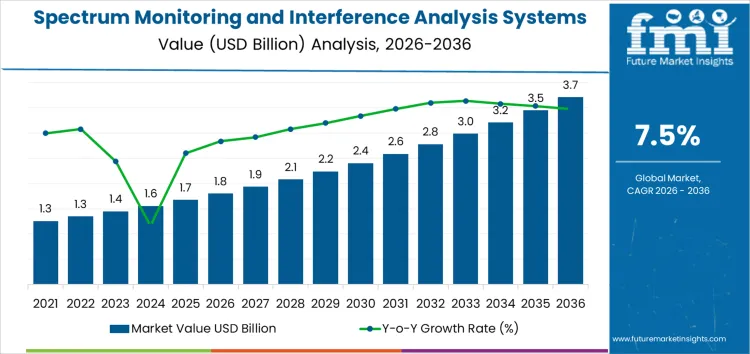
The global spectrum monitoring and interference analysis systems market is projected to grow from USD 1.8 billion in 2026 to USD 3.7 billion by 2036, with a CAGR of 7.5%. This growth is driven by the increasing demand for reliable wireless communication, especially with the rise of 5G, IoT, and connected devices that place greater strain on radio frequency (RF) environments. As mobile networks evolve and spectrum usage becomes more complex, interference risks, both intentional and unintentional, also rise. Spectrum monitoring and interference analysis systems enable operators, regulators, and defense agencies to detect, locate, and resolve disruptions, ensuring network integrity and optimal performance. Technological advancements, including machine learning, real-time monitoring, and automated analytics, are improving the accuracy and responsiveness of these systems.
Quick Stats for Spectrum Monitoring and Interference Analysis Systems Market
- Spectrum Monitoring and Interference Analysis Systems Market Value (2026): USD 1.8 billion
- Spectrum Monitoring and Interference Analysis Systems Market Forecast Value (2036): USD 3.7 billion
- Spectrum Monitoring and Interference Analysis Systems Market Forecast CAGR: 7.5%
- Leading Application in Spectrum Monitoring and Interference Analysis Systems Market: Telecom network assurance
- Top Platform in Spectrum Monitoring and Interference Analysis Systems Market: Fixed monitoring sites
- Key Growth Regions in Spectrum Monitoring and Interference Analysis Systems Market: North America, Asia Pacific
- Key Players in Spectrum Monitoring and Interference Analysis Systems Market: Rohde & Schwarz, Keysight, Anritsu, CRFS, Narda (L3Harris)
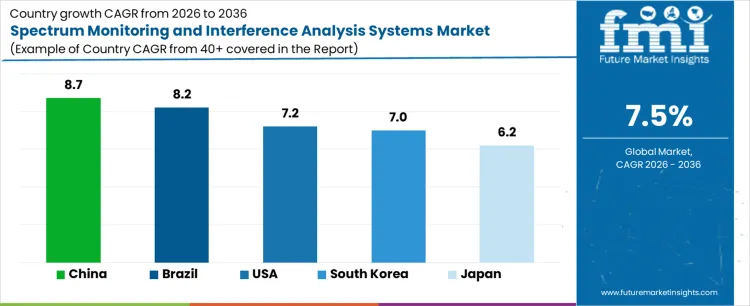
The market is particularly buoyed by stricter regulatory requirements for spectrum management and the growing need for uninterrupted communication in sectors like telecom, defense, transportation, and utilities. Adoption of these systems is essential for safeguarding critical communications and optimizing spectrum utilization. Regional variations in demand are noticeable, with countries like China (8.7%) and Brazil (8.2%) leading growth due to their expanding telecommunications infrastructure. In the USA, the market grows at a 7.2% rate, while Japan (6.2%) and South Korea (7%) continue to invest heavily in advanced spectrum monitoring technologies. The increasing convergence of spectrum monitoring with cybersecurity solutions and dynamic spectrum sharing frameworks further fuels the growth of this market globally.
Spectrum Monitoring and Interference Analysis Systems Market Key Takeaways
| Metric | Value |
|---|---|
| Industry Value (2026) | USD 1.8 billion |
| Forecast Value (2036) | USD 3.7 billion |
| Forecast CAGR (2026–2036) | 7.5% |
How is the Global Spectrum Monitoring and Interference Analysis Systems Sector Advancing?
The global spectrum monitoring and interference analysis systems market is expanding as the demand for reliable wireless communications continues to grow across industries and geographies. These systems are used to detect, locate, and analyze interference in radio frequency (RF) environments to ensure optimal performance of communication networks. As mobile networks evolve to support 5G, IoT, and advanced broadband services, the complexity of spectrum usage increases, creating greater potential for interference from intentional and unintentional sources. Spectrum monitoring and interference analysis solutions help network operators, regulators, and defense agencies maintain signal integrity, improve service quality, and quickly resolve disruptions.
Adoption of these systems is driven by rapid growth in wireless connectivity, stricter regulatory requirements around spectrum management, and the proliferation of connected devices that place greater demands on available frequencies. Enterprises and public safety sectors also deploy these technologies to safeguard mission critical communications and to optimize spectrum utilization. Advances in analytics, machine learning, and real time monitoring are improving the accuracy, responsiveness, and automation capabilities of modern systems. These technological improvements enable quicker detection of anomalies and faster resolution of interference events, allowing organizations to maintain service continuity and regulatory compliance.
Challenges such as staying ahead of evolving interference threats, integrating with legacy communication infrastructures, and ensuring compatibility with diverse wireless standards may influence adoption rates. Despite these hurdles, the ongoing expansion of wireless networks, the need for robust spectrum management, and the importance of interference mitigation will sustain demand for spectrum monitoring and interference analysis systems globally.
What is the Segment-Wise Analysis for the Global Spectrum Monitoring and Interference Analysis Systems Market?
The global spectrum monitoring and interference analysis systems market is segmented by platform and application. Fixed monitoring sites lead the market with a 34% share, offering stable, long-term monitoring capabilities for consistent spectrum surveillance. Portable systems and vehicle systems follow, providing flexible solutions for mobile and on-the-go spectrum analysis. In terms of application, telecom network assurance and defense sectors each hold a 34% share, driven by the need to monitor and protect communication networks and military operations.
Why Do Fixed Monitoring Sites Lead the Global Spectrum Monitoring Market?
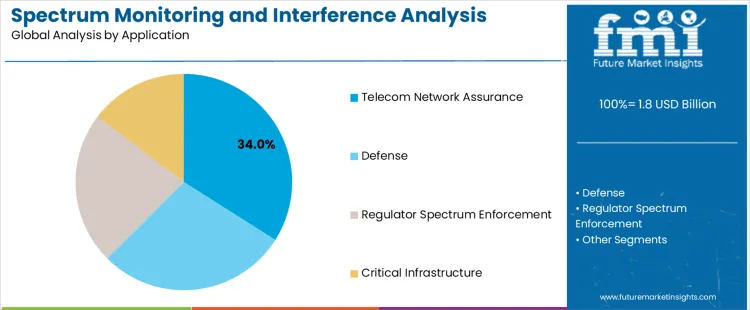
Fixed monitoring sites lead the global spectrum monitoring and interference analysis systems market with a 34% share due to their stability and capability for continuous, real-time monitoring. These sites are ideal for monitoring electromagnetic interference in high-traffic or sensitive spectrum environments, providing consistent, reliable data. As the demand for telecom network assurance and regulatory enforcement grows, fixed sites are increasingly adopted by regulatory bodies and industries to maintain spectrum integrity and prevent interference. Their long-term performance and low operational costs contribute to their dominance in the market.
Why Do Telecom Network Assurance and Defense Hold the Largest Market Share in the Global Spectrum Monitoring Market?
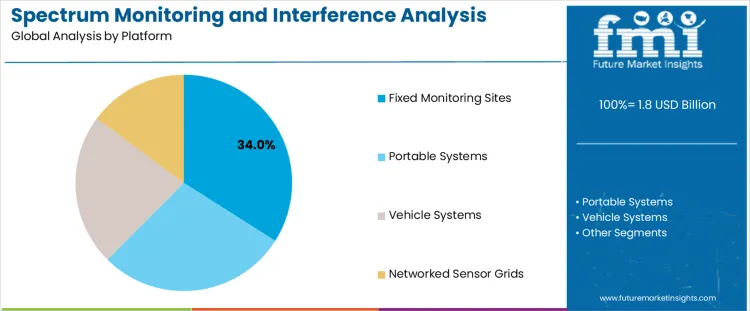
Telecom network assurance and defense hold a combined 34% share of the global spectrum monitoring and interference analysis systems market due to their crucial role in safeguarding communication networks and national security. Telecom operators require constant monitoring to ensure the integrity and reliability of their networks, while defense applications need advanced systems to detect, analyze, and mitigate interference that could compromise military operations. The growing reliance on secure and uninterrupted communication drives demand for these applications, making them the leading sectors in the market.
What are the Key Dynamics in Spectrum Monitoring and Interference Analysis Systems Market?
The spectrum monitoring and interference analysis systems market is expanding as wireless communications grow in complexity and scale. With the proliferation of 4G/5G, IoT, satellite, and public safety networks, regulators and service providers need tools to detect, locate, and mitigate interference that can degrade service quality. Rising demand for reliable connectivity in industries such as telecom, defense, transportation, and utilities drives investment in real time spectrum awareness. Increasing regulatory enforcement on spectrum usage, unauthorized transmissions, and network security concerns is pushing governments and enterprises to deploy advanced monitoring solutions to protect spectrum integrity.
What Are the Key Drivers for the Spectrum Monitoring and Interference Analysis Systems Market?
Key drivers include the rapid expansion of wireless services and the growing density of spectrum users, which elevate the risk of signal overlap and interference. Telecom operators and regulators require sophisticated systems to ensure quality of service, optimize network performance, and enforce spectrum licensing. The transition to 5G and beyond introduces new frequency bands and dynamic spectrum sharing methods that necessitate real time monitoring and analytics. Security concerns, such as jamming and unauthorized transmissions, also propel demand, especially in defense and critical infrastructure sectors. The increasing use of AI/ML for automated anomaly detection further accelerates market uptake.
What Key Trends Are Shaping the Spectrum Monitoring and Interference Analysis Systems Market?
Key trends include the integration of AI and machine learning to automate detection, classification, and prediction of interference patterns. Cloud based spectrum monitoring platforms are gaining traction, offering scalable analytics and remote access. There is also increasing use of software defined radios (SDRs) that enable flexible, upgradable monitoring across wide frequency ranges without hardware replacements. Real time visualization dashboards and geolocation tools are becoming standard for rapid decision making. Convergence with cybersecurity solutions enhances protection against malicious spectrum attacks, while collaborative spectrum sharing frameworks push demand for dynamic monitoring and analytics capabilities.
What is the Growth Outlook for the Spectrum Monitoring and Interference Analysis Systems Market by Country?
| Country | CAGR (%) |
|---|---|
| USA | 7.2% |
| Japan | 6.2% |
| South Korea | 7% |
| China | 8.7% |
| Brazil | 8.2% |
The spectrum monitoring and interference analysis systems market is growing steadily, with China leading at an 8.7% CAGR, driven by its growing telecommunications infrastructure and the increasing demand for managing spectrum resources. Brazil follows with an 8.2% growth rate, supported by growing efforts to improve wireless communication networks and optimize spectrum use. The USA’s market grows at 7.2%, driven by the need for enhanced spectrum management due to rising demands in telecommunications and broadcasting. South Korea’s market grows at 7%, supported by a well-established communications sector and increasing interference analysis requirements. Japan’s market grows at 6.2%, driven by technological advancements and regulatory developments aimed at optimizing spectrum efficiency.
Why is China Leading in the Spectrum Monitoring and Interference Analysis Systems Market?
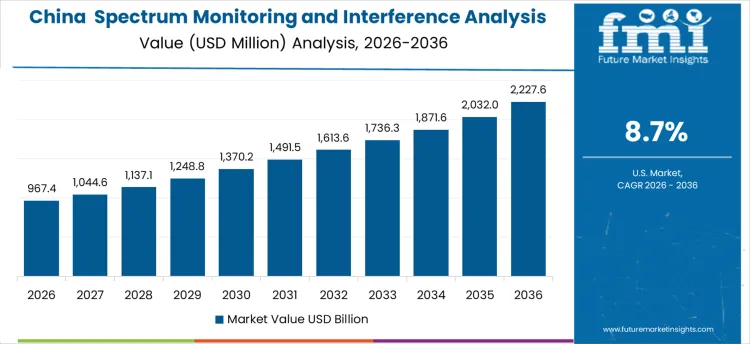
China’s spectrum monitoring and interference analysis systems market is growing at 8.7%, driven by the rapid expansion of its telecommunications infrastructure and an increasing demand for wireless services. As one of the largest markets for mobile devices, broadband, and wireless communication, China is faced with the challenge of managing and optimizing its spectrum resources. Spectrum monitoring systems are crucial to managing interference, ensuring efficient spectrum allocation, and preventing signal congestion. The government’s strong focus on expanding 5G networks and enhancing communication infrastructure has further driven the need for advanced spectrum monitoring technologies. With China’s growing emphasis on improving network quality and service efficiency, the market for spectrum monitoring and interference analysis systems is expected to continue to grow robustly.
What is Driving the Growth of the Spectrum Monitoring and Interference Analysis Systems Market in Brazil?
Brazil’s spectrum monitoring and interference analysis systems market is growing at 8.2%, driven by the expanding telecommunications sector and the increasing demand for efficient spectrum management solutions. With Brazil’s large and growing mobile network, the demand for interference-free communication and optimized spectrum use is rising. As the country works to enhance its wireless infrastructure, particularly with the rollout of 5G networks, the need for advanced spectrum monitoring systems is increasing. These systems help manage radio frequency interference and ensure the effective use of available spectrum. Government initiatives to improve the quality and reliability of communication networks are further driving market growth. As Brazil continues to develop its telecommunications infrastructure, the demand for spectrum monitoring and interference analysis systems is expected to rise steadily.
How is the Spectrum Monitoring and Interference Analysis Systems Market Expanding in the USA?
The USA’s spectrum monitoring and interference analysis systems market is growing at 7.2%, driven by rising demand for efficient spectrum management solutions in telecommunications, broadcasting, and public safety sectors. With increasing wireless communication demands, especially in mobile networks, 5G technologies, and satellite communications, the USA needs advanced systems to manage and analyze spectrum usage and detect interference. Spectrum monitoring systems are critical to ensuring optimal spectrum allocation and minimizing interference, which can degrade communication quality. Regulatory initiatives and the continuous need for technological advancements to optimize wireless services are contributing to the market’s growth. As wireless communication technologies continue to evolve, the market for spectrum monitoring and interference analysis systems in the USA is expected to expand steadily.
What is Contributing to the Growth of the Spectrum Monitoring and Interference Analysis Systems Market in South Korea?
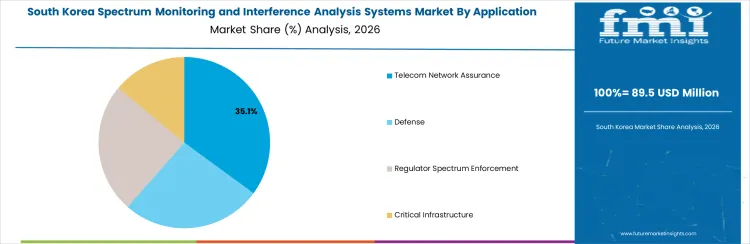
South Korea’s spectrum monitoring and interference analysis systems market is growing at 7%, driven by its advanced telecommunications infrastructure and the growing demand for efficient spectrum management. South Korea’s telecommunications sector is highly developed, with a strong focus on 5G networks, IoT applications, and broadcasting services. As wireless communication becomes increasingly complex, the need for systems to monitor spectrum usage, identify interference, and optimize bandwidth is rising. The government’s regulatory efforts and industry investments to maintain high-quality wireless services are further propelling market growth. As South Korea continues to expand its 5G network and improve spectrum utilization efficiency, the market for spectrum monitoring systems is expected to grow, supported by technological advancements and increased demand for interference-free communication.
What is Driving the Growth of the Spectrum Monitoring and Interference Analysis Systems Market in Japan?
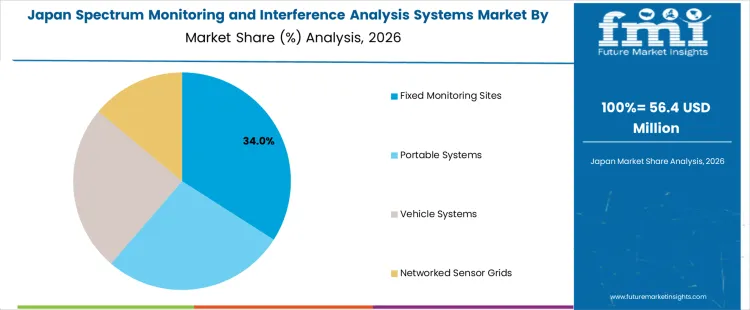
Japan’s spectrum monitoring and interference analysis systems market is growing at 6.2%, driven by the country’s advancements in telecommunications and a strong regulatory focus on spectrum efficiency. As Japan continues to roll out 5G networks and expand its wireless infrastructure, the need for robust spectrum monitoring systems to manage interference and optimize spectrum usage is growing. Japan’s strict regulatory environment encourages the adoption of systems that ensure reliable communication and minimize signal congestion. The market is also supported by technological innovations and the increasing demand for high-quality wireless services across mobile, broadcasting, and IoT applications. With Japan’s continued focus on optimizing wireless networks and maintaining service quality, the demand for spectrum monitoring and interference analysis systems is expected to continue growing.
How Are Firms Competing in the Spectrum Monitoring and Interference Analysis Systems Market?
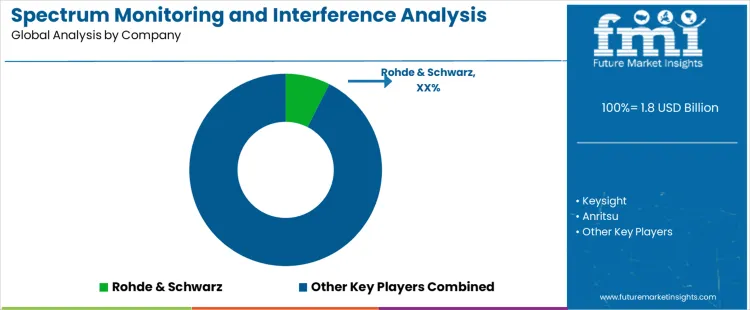
In the spectrum monitoring and interference analysis systems market Rohde & Schwarz, Keysight, Anritsu, CRFS, Narda (L3Harris), TCI International, VIAVI, Tektronix, Spirent, and Thales are each positioned with product brochures that emphasize precision, real time analytics, and regulatory compliance. Rohde & Schwarz materials present high performance monitoring receivers and signal analysis platforms with clear specifications on frequency range, sensitivity, and integration options. Brochures include visual summaries of user interfaces and deployment examples suitable for national regulators and service providers. Keysight collateral focuses on modular test and measurement systems described with deep analytics capabilities. Performance charts and interface snapshots support technical evaluation by RF engineers. Anritsu literature highlights portable and scalable spectrum monitoring solutions with concise data on accuracy, portability, and ease of use for field teams.
CRFS product briefs showcase cloud connected monitoring systems and interference detection tools with simple diagrams and deployment guides. Narda (L3Harris) brochures emphasize ruggedized analyzers and direction finding systems tailored to defense and spectrum security. TCI International materials present centralized monitoring platforms with clear network diagrams and scalability notes. VIAVI collateral focuses on automated interference hunting and visualization tools with performance summaries and workflow aids. Tektronix brochures describe real time spectrum analysis instruments with intuitive interfaces. Spirent product literature showcases RF test suites with emphasis on simulation and validation of complex wireless environments. Thales materials present integrated monitoring and spectrum protection systems with concise feature tables and global deployment case summaries.
Key Players Spectrum Monitoring and Interference Analysis Systems Market
- Rohde & Schwarz
- Keysight
- Anritsu
- CRFS
- Narda (L3Harris)
- TCI International
- VIAVI
- Tektronix
- Spirent
- Thales
Scope of Report
| Items | Values |
|---|---|
| Quantitative Units (2026) | USD billion |
| Platform Types | Fixed Monitoring Sites, Portable Systems, Vehicle Systems, Networked Sensor Grids |
| Applications | Telecom Network Assurance, Defense, Regulator Spectrum Enforcement, Critical Infrastructure |
| Regions Covered | Asia Pacific, Europe, North America, Latin America, Middle East & Africa |
| Countries Covered | USA, China, Japan, South Korea, India, Australia & New Zealand, ASEAN, Germany, UK, France, Italy, Spain, Nordic, BENELUX, Brazil, Chile, Mexico, Saudi Arabia, Other GCC Countries, Turkey, South Africa, Other African Union |
| Key Companies Profiled | Rohde & Schwarz, Keysight, Anritsu, CRFS, Narda (L3Harris), TCI International, VIAVI, Tektronix, Spirent, Thales |
| Additional Attributes | Dollar sales by platform, application, and region; regional CAGR and growth outlook; key regulatory frameworks for spectrum management; market positioning of global vs regional suppliers. |
Spectrum Monitoring and Interference Analysis Systems Market by Segments
Platform:
- Fixed Monitoring Sites
- Portable Systems
- Vehicle Systems
- Networked Sensor Grids
Application:
- Telecom Network Assurance
- Defense
- Regulator Spectrum Enforcement
- Critical Infrastructure
Region:
- Asia Pacific
- China
- Japan
- South Korea
- India
- Australia & New Zealand
- ASEAN
- Rest of Asia Pacific
- Europe
- Germany
- United Kingdom
- France
- Italy
- Spain
- Nordic
- BENELUX
- Rest of Europe
- North America
- United States
- Canada
- Mexico
- Latin America
- Brazil
- Chile
- Rest of Latin America
- Middle East & Africa
- Kingdom of Saudi Arabia
- Other GCC Countries
- Turkey
- South Africa
- Other African Union
- Rest of Middle East & Africa
Preview the report firsthand - request a free sample
Get SampleGet the brochure for pricing and purchase details.
Get PDFTable of Content
- Executive Summary
- Global Market Outlook
- Demand-side Trends
- Supply-side Trends
- Technology Roadmap Analysis
- Analysis and Recommendations
- Market Overview
- Market Coverage / Taxonomy
- Market Definition / Scope / Limitations
- Market Background
- Market Dynamics
- Drivers
- Restraints
- Opportunity
- Trends
- Scenario Forecast
- Demand in Optimistic Scenario
- Demand in Likely Scenario
- Demand in Conservative Scenario
- Opportunity Map Analysis
- Product Life Cycle Analysis
- Supply Chain Analysis
- Investment Feasibility Matrix
- Value Chain Analysis
- PESTLE and Porter’s Analysis
- Regulatory Landscape
- Regional Parent Market Outlook
- Production and Consumption Statistics
- Import and Export Statistics
- Market Dynamics
- Global Market Analysis 2021 to 2025 and Forecast, 2026 to 2036
- Historical Market Size Value (USD Million) Analysis, 2021 to 2025
- Current and Future Market Size Value (USD Million) Projections, 2026 to 2036
- Y-o-Y Growth Trend Analysis
- Absolute $ Opportunity Analysis
- Global Market Pricing Analysis 2021 to 2025 and Forecast 2026 to 2036
- Global Market Analysis 2021 to 2025 and Forecast 2026 to 2036, By Platform
- Introduction / Key Findings
- Historical Market Size Value (USD Million) Analysis By Platform , 2021 to 2025
- Current and Future Market Size Value (USD Million) Analysis and Forecast By Platform , 2026 to 2036
- Fixed Monitoring Sites
- Portable Systems
- Vehicle Systems
- Networked Sensor Grids
- Fixed Monitoring Sites
- Y-o-Y Growth Trend Analysis By Platform , 2021 to 2025
- Absolute $ Opportunity Analysis By Platform , 2026 to 2036
- Global Market Analysis 2021 to 2025 and Forecast 2026 to 2036, By Application
- Introduction / Key Findings
- Historical Market Size Value (USD Million) Analysis By Application, 2021 to 2025
- Current and Future Market Size Value (USD Million) Analysis and Forecast By Application, 2026 to 2036
- Telecom Network Assurance
- Defense
- Regulator Spectrum Enforcement
- Critical Infrastructure
- Telecom Network Assurance
- Y-o-Y Growth Trend Analysis By Application, 2021 to 2025
- Absolute $ Opportunity Analysis By Application, 2026 to 2036
- Global Market Analysis 2021 to 2025 and Forecast 2026 to 2036, By Region
- Introduction
- Historical Market Size Value (USD Million) Analysis By Region, 2021 to 2025
- Current Market Size Value (USD Million) Analysis and Forecast By Region, 2026 to 2036
- North America
- Latin America
- Western Europe
- Eastern Europe
- East Asia
- South Asia and Pacific
- Middle East & Africa
- Market Attractiveness Analysis By Region
- North America Market Analysis 2021 to 2025 and Forecast 2026 to 2036, By Country
- Historical Market Size Value (USD Million) Trend Analysis By Market Taxonomy, 2021 to 2025
- Market Size Value (USD Million) Forecast By Market Taxonomy, 2026 to 2036
- By Country
- USA
- Canada
- Mexico
- By Platform
- By Application
- By Country
- Market Attractiveness Analysis
- By Country
- By Platform
- By Application
- Key Takeaways
- Latin America Market Analysis 2021 to 2025 and Forecast 2026 to 2036, By Country
- Historical Market Size Value (USD Million) Trend Analysis By Market Taxonomy, 2021 to 2025
- Market Size Value (USD Million) Forecast By Market Taxonomy, 2026 to 2036
- By Country
- Brazil
- Chile
- Rest of Latin America
- By Platform
- By Application
- By Country
- Market Attractiveness Analysis
- By Country
- By Platform
- By Application
- Key Takeaways
- Western Europe Market Analysis 2021 to 2025 and Forecast 2026 to 2036, By Country
- Historical Market Size Value (USD Million) Trend Analysis By Market Taxonomy, 2021 to 2025
- Market Size Value (USD Million) Forecast By Market Taxonomy, 2026 to 2036
- By Country
- Germany
- UK
- Italy
- Spain
- France
- Nordic
- BENELUX
- Rest of Western Europe
- By Platform
- By Application
- By Country
- Market Attractiveness Analysis
- By Country
- By Platform
- By Application
- Key Takeaways
- Eastern Europe Market Analysis 2021 to 2025 and Forecast 2026 to 2036, By Country
- Historical Market Size Value (USD Million) Trend Analysis By Market Taxonomy, 2021 to 2025
- Market Size Value (USD Million) Forecast By Market Taxonomy, 2026 to 2036
- By Country
- Russia
- Poland
- Hungary
- Balkan & Baltic
- Rest of Eastern Europe
- By Platform
- By Application
- By Country
- Market Attractiveness Analysis
- By Country
- By Platform
- By Application
- Key Takeaways
- East Asia Market Analysis 2021 to 2025 and Forecast 2026 to 2036, By Country
- Historical Market Size Value (USD Million) Trend Analysis By Market Taxonomy, 2021 to 2025
- Market Size Value (USD Million) Forecast By Market Taxonomy, 2026 to 2036
- By Country
- China
- Japan
- South Korea
- By Platform
- By Application
- By Country
- Market Attractiveness Analysis
- By Country
- By Platform
- By Application
- Key Takeaways
- South Asia and Pacific Market Analysis 2021 to 2025 and Forecast 2026 to 2036, By Country
- Historical Market Size Value (USD Million) Trend Analysis By Market Taxonomy, 2021 to 2025
- Market Size Value (USD Million) Forecast By Market Taxonomy, 2026 to 2036
- By Country
- India
- ASEAN
- Australia & New Zealand
- Rest of South Asia and Pacific
- By Platform
- By Application
- By Country
- Market Attractiveness Analysis
- By Country
- By Platform
- By Application
- Key Takeaways
- Middle East & Africa Market Analysis 2021 to 2025 and Forecast 2026 to 2036, By Country
- Historical Market Size Value (USD Million) Trend Analysis By Market Taxonomy, 2021 to 2025
- Market Size Value (USD Million) Forecast By Market Taxonomy, 2026 to 2036
- By Country
- Kingdom of Saudi Arabia
- Other GCC Countries
- Turkiye
- South Africa
- Other African Union
- Rest of Middle East & Africa
- By Platform
- By Application
- By Country
- Market Attractiveness Analysis
- By Country
- By Platform
- By Application
- Key Takeaways
- Key Countries Market Analysis
- USA
- Pricing Analysis
- Market Share Analysis, 2025
- By Platform
- By Application
- Canada
- Pricing Analysis
- Market Share Analysis, 2025
- By Platform
- By Application
- Mexico
- Pricing Analysis
- Market Share Analysis, 2025
- By Platform
- By Application
- Brazil
- Pricing Analysis
- Market Share Analysis, 2025
- By Platform
- By Application
- Chile
- Pricing Analysis
- Market Share Analysis, 2025
- By Platform
- By Application
- Germany
- Pricing Analysis
- Market Share Analysis, 2025
- By Platform
- By Application
- UK
- Pricing Analysis
- Market Share Analysis, 2025
- By Platform
- By Application
- Italy
- Pricing Analysis
- Market Share Analysis, 2025
- By Platform
- By Application
- Spain
- Pricing Analysis
- Market Share Analysis, 2025
- By Platform
- By Application
- France
- Pricing Analysis
- Market Share Analysis, 2025
- By Platform
- By Application
- India
- Pricing Analysis
- Market Share Analysis, 2025
- By Platform
- By Application
- ASEAN
- Pricing Analysis
- Market Share Analysis, 2025
- By Platform
- By Application
- Australia & New Zealand
- Pricing Analysis
- Market Share Analysis, 2025
- By Platform
- By Application
- China
- Pricing Analysis
- Market Share Analysis, 2025
- By Platform
- By Application
- Japan
- Pricing Analysis
- Market Share Analysis, 2025
- By Platform
- By Application
- South Korea
- Pricing Analysis
- Market Share Analysis, 2025
- By Platform
- By Application
- Russia
- Pricing Analysis
- Market Share Analysis, 2025
- By Platform
- By Application
- Poland
- Pricing Analysis
- Market Share Analysis, 2025
- By Platform
- By Application
- Hungary
- Pricing Analysis
- Market Share Analysis, 2025
- By Platform
- By Application
- Kingdom of Saudi Arabia
- Pricing Analysis
- Market Share Analysis, 2025
- By Platform
- By Application
- Turkiye
- Pricing Analysis
- Market Share Analysis, 2025
- By Platform
- By Application
- South Africa
- Pricing Analysis
- Market Share Analysis, 2025
- By Platform
- By Application
- USA
- Market Structure Analysis
- Competition Dashboard
- Competition Benchmarking
- Market Share Analysis of Top Players
- By Regional
- By Platform
- By Application
- Competition Analysis
- Competition Deep Dive
- Rohde & Schwarz
- Overview
- Product Portfolio
- Profitability by Market Segments (Product/Age /Sales Channel/Region)
- Sales Footprint
- Strategy Overview
- Marketing Strategy
- Product Strategy
- Channel Strategy
- Keysight
- Anritsu
- CRFS
- Narda (L3Harris)
- TCI International
- VIAVI
- Tektronix
- Spirent
- Thales
- Rohde & Schwarz
- Competition Deep Dive
- Assumptions & Acronyms Used
- Research Methodology


