

- Industry Size (2026)
- USD 107.5 Mn
- Forecast (2036)
- USD 194.3 Mn
- CAGR (2026 to 2036)
- 6.10%
Copper Water Bottle Market Size, Market Forecast and Outlook By FMI
The copper water bottle market was valued at USD 101.3 million in 2025. Sector is expected to reach USD 107.5 million in 2026 at a copper water bottle CAGR of 6.10% during the forecast period. Industry analysis is projected to lift revenue to USD 194.3 million through 2036 as regulatory formalization of potable water containers merges with zero-plastic enterprise mandates to expand the overall copper water bottle market size.
Summary of Copper Water Bottle Market
- Market Snapshot
- The Copper Water Bottle Market was valued at USD 101.3 million in 2025 and is projected to reach USD 194.3 million by 2036.
- The industry is expected to expand at a 6.1% CAGR from 2026 to 2036, creating an incremental opportunity of USD 86.8 million over the decade.
- Copper water bottles sit within the reusable drinkware space but form a much narrower niche shaped by material purity, craft finish, and safe-contact compliance, especially in India.
- Market structure remains fragmented and premium-skewed, with value concentration stronger in wellness, gifting, and artisanal online retail than in mass hydration formats.
- Demand and Growth Drivers
- Demand is rising because the broader policy environment keeps pressuring users and retailers to reduce single-use plastic dependence and normalize reusable containers.
- Copper’s historical antimicrobial positioning and wellness association keep it commercially distinct from steel and plastic alternatives, though the category still requires careful safe-use communication.
- Growth is also supported by premium gifting and décor-based purchasing, since many live product lines are sold as bottle-and-glass sets or decorative hammered bottles rather than plain commodity hydration items.
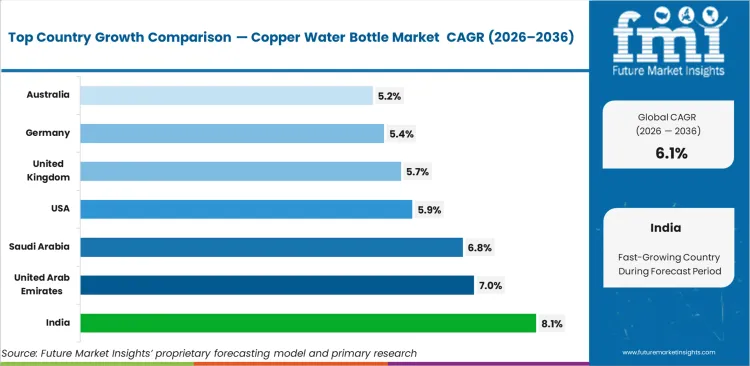
- India is expected to lead at 8.1% CAGR, followed by the UAE at 7.0%, Saudi Arabia at 6.8%, the United States at 5.9%, the United Kingdom at 5.7%, Germany at 5.4%, and Australia at 5.2%.
- Growth is moderated by copper safety limits in drinking-water contexts and by the fact that this is a specialized material choice, not an everyday mainstream bottle format.
- Product and Segment View
- The market covers potable water bottles made primarily from copper sheet or copper-bodied formats, often with lacquered exteriors, decorative hammering, or gift-pack configurations, and in India it falls under IS 17803.
- These bottles are used across home hydration, office carry, gifting, hospitality décor, and wellness-based retail.
- Plain bottles are expected to hold 41% of the Product Type segment in 2026, supported by easier manufacturing economics, lower decoration costs, and stronger suitability for everyday use.
- The 750–1000 ml range is estimated to capture 48% of the Capacity segment in 2026, reflecting the size band most commonly positioned for regular personal hydration across active market listings.
- Online retail is anticipated to account for 44% of the Distribution Channel segment in 2026, as the category depends heavily on D2C discovery, wellness-led product messaging, and presentation-friendly gifting formats.
- Individual buyers are poised to command 57% of the Buyer Type segment in 2026, while corporate gifting is expected to remain an important but comparatively smaller source of demand.
- Lacquered finish is set to represent 46% of the Finish Type segment in 2026, as exterior coating helps preserve visual appeal and limits visible surface tarnish during routine handling.
- The scope includes standalone potable copper water bottles and bottle themed gift sets, but excludes insulated flasks with only internal copper coating, large copper dispensers, and adjacent non-bottle copper tableware.
- Geography and Competitive Outlook
- India, the UAE, and Saudi Arabia are the fastest-growing demand pockets, while the United States and Germany remain important stable import and premium-retail markets.
- Competition is being shaped more by online assortment depth, artisanal finish, purity claims, and gifting formats than by heavy industrial scale alone.
- Key companies include Milton, P-TAL, Indian Art Villa, Signoraware, The Better Home, Kaarigar, and Borosil, with Milton likely holding the single largest share in a still-fragmented field.
- The market is fragmented, and the leading player is estimated at only 8.5% share, which fits a design-led, multi-brand consumerware niche.
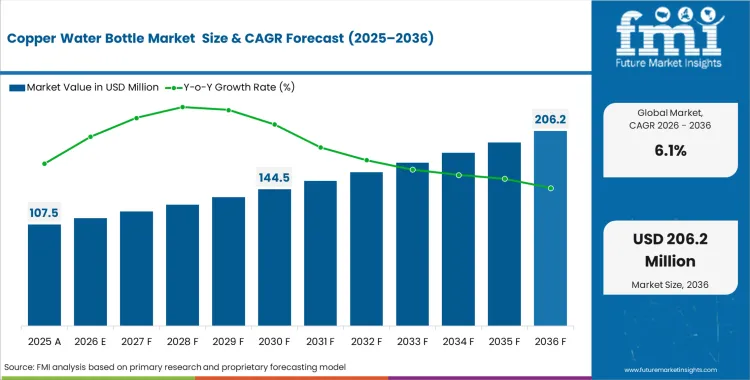
Corporate gifting programs are increasingly shifting away from synthetic drinkware toward culturally aligned and reusable hydration formats. Delaying this transition risks losing enterprise accounts aiming to align employee merchandise with zero-plastic regulations. Transitioning catalogs toward these raw-finish items requires sourcing from specialized fabricators rather than generic reusable water bottles vendors. Category differentiation between stainless steel vs copper bottles requires more active maintenance because oxidation affects surface appearance over time.
Wider adoption of quality-certified metal drinkware in hospitality is expected to shift volume toward organized suppliers with stronger documentation and finish consistency. Brand differentiation immediately shifts from surface aesthetics to material purity verification. Rising compliance expectations may raise operating pressure on mid-tier copper water bottle manufacturers that lack testing discipline or consistent fabrication standards. This structural shift fundamentally alters the copper water bottle market forecast by concentrating volume among certified exporters.
India is estimated to record 8.1% CAGR during 2026 to 2036, supported by entrenched household usage and BIS quality control measures shaping the India copper water bottle market. The United Arab Emirates is anticipated to register 7.0% CAGR, while Saudi Arabia is set to post 6.8% CAGR as premium corporate gifting and high-value retail channels absorb hammered and decorative variants. The United States is expected to reflect 5.9% CAGR, while the United Kingdom is projected to see 5.7% CAGR through the forecast period. Germany is likely to witness 5.4% CAGR, and Australia is poised to rise at a 5.2% CAGR by 2036. The gap reflects utility based consumption in South Asia versus premium purchasing across Western markets.
Segmental Analysis
Copper Water Bottle Market Analysis by Product Type
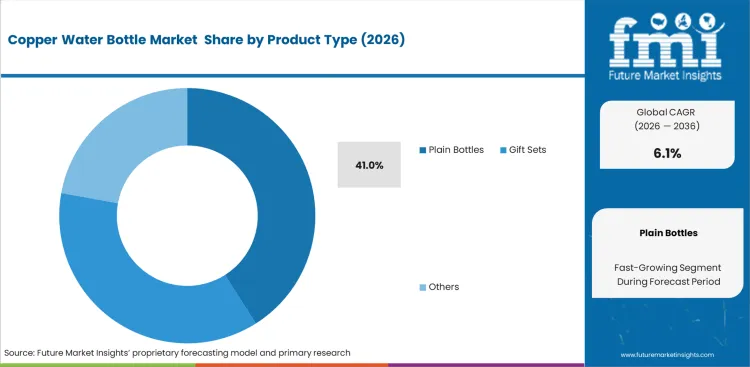
Manufacturing reliability keeps plain bottles ahead in this category because simpler geometry is easier to produce at consistent gauge, finish quality, and material integrity. Plain bottles are expected to hold 41.0% share of the segment in 2026, as their production economics remain more favorable for daily-use formats and broader retail distribution. Straight-wall formats reduce forming complexity, improve batch uniformity, and make purity validation more straightforward across large production runs, which strengthens their position against substitution from the aluminium bottle category in everyday hydration formats. Decorative contours may lift shelf appeal, which is one reason the hammered copper bottle market remains more concentrated in premium gifting and decorative retail.
- Defect visibility: Plain surfaces expose extrusion flaws immediately during initial factory inspections. Quality engineers reject compromised units before shipping.
- Coating adhesion: Flat geometries allow automated spray nozzles to apply uniform lacquer barriers. Production managers maintain predictable cost margins through reduced chemical waste.
- Customization viability: Smooth exteriors provide optimal blank space for laser etching. Merchandising directors rely on this format to secure high-margin corporate branding contracts.
Copper Water Bottle Market Analysis by Capacity
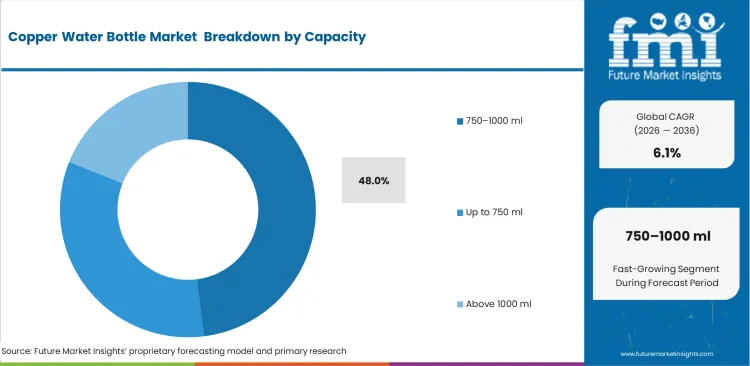
Portable usability keeps the 750–1000 ml range ahead because copper carries more empty-weight burden than plastic or light-gauge steel, making capacity discipline commercially important. This size band offers the strongest balance between practical daily hydration, manageable carry weight, and acceptable handling comfort across routine home, office, and travel use. Smaller formats limit perceived utility for full-day use, while larger bottles become less attractive once filled weight, handling ease, and shelf placement are considered together, especially when consumers compare them with lighter thermos drinkware options. The 750–1000 ml segment is estimated to capture 48.0% share in 2026, reflecting the point where utility, ergonomics, and production efficiency align most effectively. Continued preference for this range is likely to keep it ahead through 2036.
- Sheet yield optimization: Fabricators can size metal blanks more efficiently for liter-class bottles, which helps improve material utilization and keeps scrap generation more controlled. Better yield supports more stable production economics across larger runs.
- Transport density: This capacity range fits more comfortably within standard carton and pallet formats, allowing stronger case configuration and more efficient shipping density. Better freight utilization matters in a category where product weight already influences landed cost.
- Hydration tracking: Liter-class bottles align more naturally with daily intake routines and wellness-led positioning. Clear functional relevance makes this format easier to merchandise as a repeat-use personal hydration product.
Copper Water Bottle Market Analysis by Distribution Channel
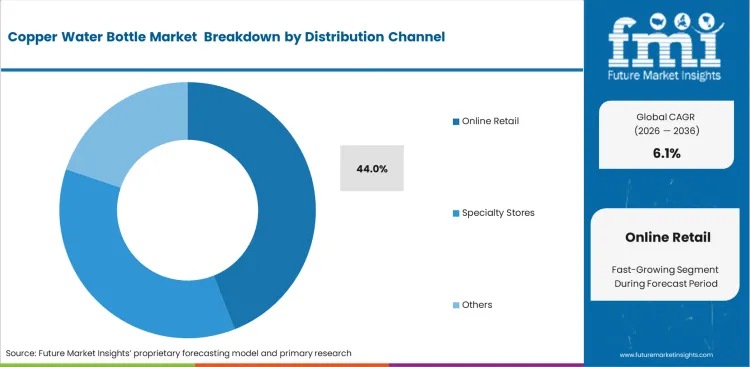
Online retail is anticipated to account for 44.0% share of the distribution channel segment in 2026 because copper water bottles depend heavily on product explanation, visual presentation, and finish-led differentiation rather than impulse-led shelf pickup. Digital platforms allow brands to position these items within wellness, gifting, and lifestyle-oriented purchase journeys where material story, care guidance, and design finish can be communicated more clearly. This advantage becomes more pronounced in adjacent specialty formats such as reusable beverage bottles crates, where education and product context also influence channel performance. Online retail is likely to remain commercially ahead, especially while the category sits closer to specialized drinkware and wellness presentation than to routine mass-market metalware.
- Educational bandwidth: Product pages can carry maintenance guidance, usage instructions, and finish-related explanations in far greater detail than physical shelves. Better expectation setting helps reduce return risk in a category where oxidation and surface change can be misunderstood.
- Inventory consolidation: Centralized fulfillment allows wider SKU variation without spreading slow-moving stock across multiple store locations. This structure improves assortment depth while keeping working capital more controlled.
- Feedback loops: Digital reviews and post-purchase responses reveal finish issues, leakage complaints, or coating inconsistencies quickly. Faster visibility helps manufacturers correct product specifications earlier than channels that depend on slower offline sell-through.
Copper Water Bottle Market Analysis by Buyer Type
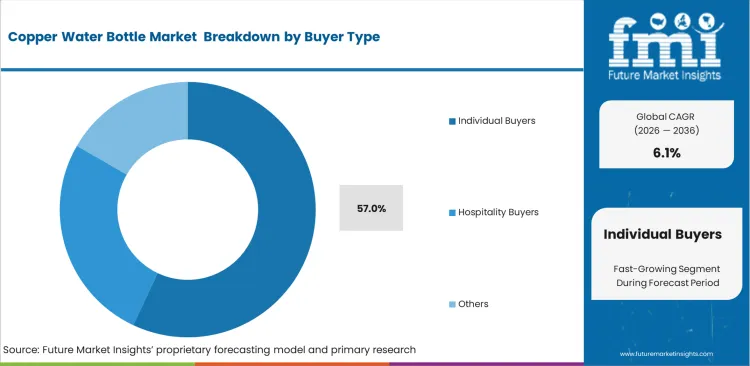
Consumer-led demand keeps individual buyers ahead in this category because purchase decisions are shaped more by wellness association, personal use, gifting relevance, and product identity than by rigid price benchmarking. Acceptance of handcrafted character is also higher in this segment, which makes mild finish variation, patina development, and artisanal presentation more commercially workable than in institutional orders. Digital-first selling further strengthens this position by allowing brands to connect directly with consumers through wellness messaging while also differentiating copper bottles from alternatives such as the metal thermos flask. Individual buyers are anticipated to capture 57.0% share in 2026, reflecting stronger participation in direct retail and online channels than in corporate or bulk purchase formats. FMI projects that in the copper bottle gifting market, private label copper bottles is anticipated to observe standardized institutional demand rather than consumer-led personal purchases.
- Aesthetic tolerance: Solo consumers are more willing to accept mild finish variation, natural patina development, and handcrafted irregularity as part of the product’s appeal. Higher tolerance for visual variation gives manufacturers more flexibility in artisanal and semi-handcrafted output.
- Acquisition velocity: Digital commerce shortens the path from product discovery to purchase, especially when wellness messaging and design presentation are strong. Faster conversion supports smaller order sizes but wider consumer reach across online channels.
- Lifecycle attachment: End users often maintain and reuse the same vessel over longer periods, which strengthens attachment to product appearance and care. This behavior supports repeat sales in accessories, cleaning products, and replacement gifting purchases.Top of Form
Copper Water Bottle Market Analysis by Finish Type
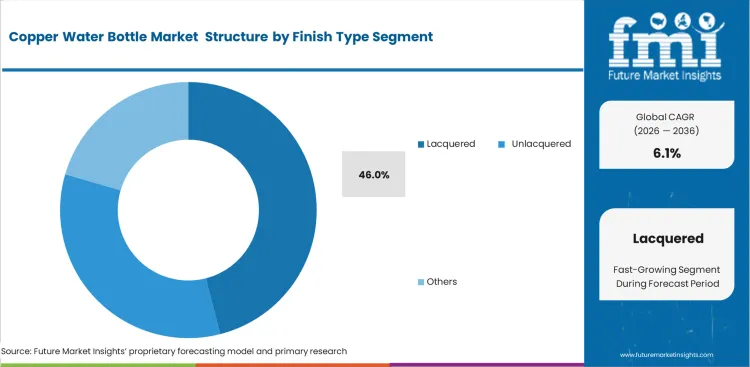
Visual stability keeps lacquered finishes ahead because retail presentation in this category depends heavily on maintaining a clean and polished surface over extended display periods. Uncoated copper is more prone to tarnish, fingerprint marking, and uneven oxidation, which can weaken shelf appeal before purchase, keeping lacquered copper bottle demand firm across mainstream retail formats. Lacquered finish is expected to hold 46.0% share in 2026, as manufacturers rely on exterior coating to preserve appearance uniformity and reduce visible surface change during storage, handling, and display. This preference is likely to remain commercially important where decorative value, gift-readiness, and lower maintenance at the point of sale carry more weight than full metal exposure, much like presentation-led buying patterns seen in the smart water bottle category.
- Shelf preservation: Polymer barriers reduce exposure to air and moisture, which helps maintain a brighter and more uniform surface during retail display. Better visual consistency lowers the need for repeated polishing and limits presentation loss on shelf.
- Handling friction: Coated exteriors are less vulnerable to sweat marks, fingerprints, and localized oxidation during packing, transport, and in-store handling. This improves appearance control across multi-unit retail inventory.
- Design longevity: Decorative prints, etched branding, and surface motifs perform better on a more stable outer layer. Stronger finish retention supports gift-oriented presentation and helps manufacturers protect design value over longer selling cycles.
Copper Water Bottle Market Drivers, Restraints, and Opportunities
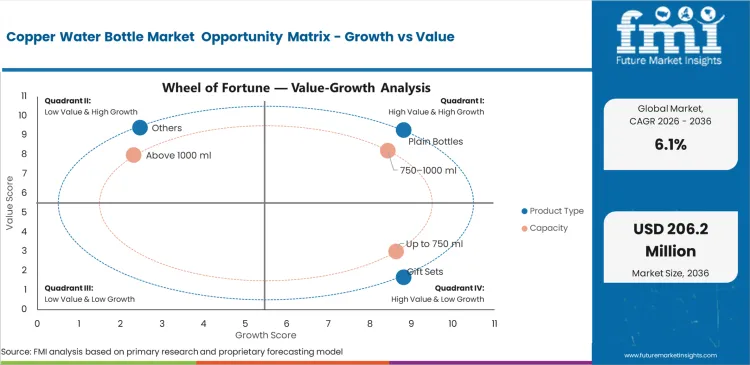
Zero-plastic corporate sustainability mandates compel enterprise gifting buyers to source culturally resonant metal alternatives immediately. Delaying this material transition risks losing massive corporate accounts that require documented zero-plastic compliance for annual employee onboarding kits. Procurement officers cannot substitute basic stainless steel without appearing frugal. They require a material with perceived intrinsic value. Copper fulfills this mandate by offering immediate visual differentiation and wellness-adjacent messaging. Sourcing directors scramble to locate fabricators capable of meeting massive volume requirements with consistent antimicrobial bottle closures and reliable material purity certificates. Buyers analyzing a copper bottle vs steel bottle recognize that copper delivers a superior perception of value for executive gifting.
Validation friction slows adoption consistently across international borders. Customs officials require extensive metallurgical testing to verify food-safe compliance before clearing bulk shipments. This regulatory hurdle persists because informal fabrication networks frequently incorporate trace lead or toxic alloys during the soldering process. Mid-sized brands cannot afford continuous batch testing, leaving their supply chains vulnerable to sudden border seizures. Consumers constantly ask are copper water bottles safe for daily use, creating a persistent educational burden. Brands must clarify what safety limits matter for copper drinking bottles to overcome purchasing hesitation. Until standardized material passports become ubiquitous, category managers hesitate to shift primary inventory allocations away from highly regulated usa and canada packer bottle formats.
Opportunities in the Copper Water Bottle Market
- Interior coating innovation: Chemical engineers formulate transparent, food-safe linings that permit ion transfer while blocking aggressive oxidation. R&D directors secure premium pricing for low-maintenance variants.
- Corporate personalization systems: Automated laser etching cells integrate directly with fulfillment software. Operations managers capture massive enterprise margins through rapid customized deployment.
- Hybrid material combinations: Product designers merge high-purity copper interiors with vacuum-sealed insulated products exterior shells. Category directors eliminate condensation issues while retaining core antimicrobial messaging.
Regional Analysis
.webp "Top Country Growth Comparison Copper Water Bottle Market Cagr (2026 2036)")
Based on regional analysis, Copper Water Bottle is segmented into North America, Europe, South Asia, Oceania, and Middle East and Africa across 40 plus countries.
| Country | CAGR (2026 to 2036) |
|---|---|
| India | 8.1% |
| United Arab Emirates | 7.0% |
| Saudi Arabia | 6.8% |
| United States | 5.9% |
| United Kingdom | 5.7% |
| Germany | 5.4% |
| Australia | 5.2% |
Source: Future Market Insights (FMI) analysis, based on proprietary forecasting model and primary research
South Asia Copper Water Bottle Market Analysis
Regulatory formalization defines South Asia more than any other region because demand here is tied not only to cultural familiarity with copper vessels, but also to the ability of manufacturers to meet rising quality expectations in organized retail and gifting channels. India remains the structural center of the region, supported by its established fabrication base, deeper household acceptance of copper drinkware, and stronger alignment between domestic demand and export-oriented production. Compliance readiness now carries greater commercial weight, especially where modern retail and institutional buyers expect tighter control over material purity, finish consistency, and documented manufacturing standards. This shift is gradually moving volume away from loosely organized supply and toward better-equipped producers that can serve both domestic and higher-value downstream channels.
- India: Formal product standardization is expected to keep India ahead because the market combines entrenched consumer familiarity with a manufacturing ecosystem already oriented toward copper household articles. Copper water bottles industry in India is estimated to rise at a 8.1% CAGR, supported by stronger acceptance in personal use, gifting, and organized retail formats. Compliance-led upgrading is also likely to improve production discipline in soldering, finish control, and purity assurance, which strengthens the position of more structured manufacturers over time. This keeps India central not only as the largest demand base in South Asia, but also as the region’s most credible supply platform for quality-aligned copper bottle production.
FMI's report includes Sri Lanka and Bangladesh. Regional expansion relies heavily on localized wellness traditions merging with rising disposable incomes. Nepal is also likely to add relevance over the forecast period, as culturally familiar metalware usage and expanding urban gifting demand create a supportive base for premium personal hydration products.
Middle East and Africa Copper Water Bottle Market Analysis
Gift-led demand and hospitality presentation give the Gulf a distinct position in this market, because copper bottles here function as premium display and relationship-building products rather than routine hydration items. Ornamental finishes, heavier construction, and stronger visual impact carry greater commercial value in the region, especially across luxury hospitality, curated corporate gifting, and high-end retail environments. Demand also benefits from buyers placing greater emphasis on finish durability and presentation stability, since products often remain visible in guest-facing settings for extended periods. This keeps the Gulf relevant to the global copper water bottle market as a high-value destination where premiumization matters more than broad-based everyday consumption.
- United Arab Emirates: Luxury hospitality and premium gifting continue to support stronger demand in the UAE, where hammered and visually refined bottles fit naturally into upscale room presentation, event gifting, and decorative retail assortments. Demand for copper water bottles in the United Arab Emirates is projected to increase at a CAGR of 7.0% from 2026 to 2036, with finish quality and coating durability carrying more weight than entry-level pricing. Stable preference for thicker-walled and presentation-oriented products is also expected to support value realization across imported premium variants. This keeps the UAE positioned as a commercially attractive market for decorative and higher-margin copper bottle formats.
- Saudi Arabia: Institutional gifting and formal presentation continue to shape demand in Saudi Arabia, where culturally aligned metal drinkware fits more easily into premium welcome kits, executive gifting, and event-linked purchasing programs. Structured sourcing relationships with organized manufacturers are likely to remain important as buyers prioritize consistency, finish quality, and dependable supply across larger order cycles. Demand analysis of copper water bottles in Saudi Arabia positions the sector to expand at a CAGR of 6.8% through 2036. This growth outlook reinforces the country’s importance to suppliers that balance aesthetic differentiation with consistent production standards.
FMI's report includes South Africa and Egypt. Regional distributors prioritize aesthetic durability to withstand intense climate conditions. Kenya is likely to emerge as an additional market of interest, supported by expanding premium homeware retail and greater consumer exposure to reusable wellness-oriented drinkware.
North America Copper Water Bottle Market Analysis
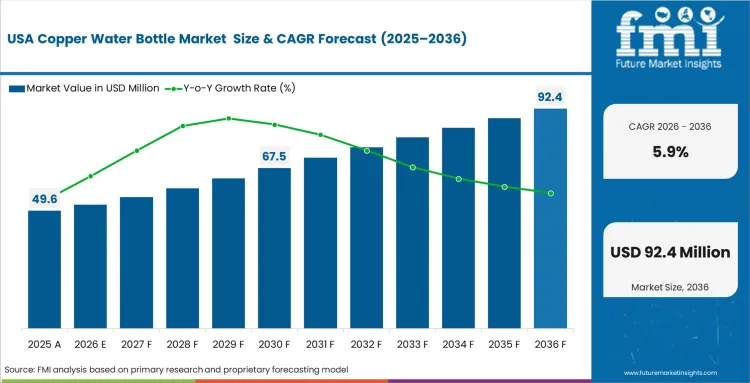
Compliance sensitivity shapes North America more than cultural familiarity, which keeps adoption narrower and more documentation-driven than in South Asia or the Gulf. Material purity, lead-free fabrication, and finish safety carry greater weight in this region because organized retail channels are less willing to absorb product-risk ambiguity in metal drinkware. Demand remains concentrated on premium wellness, studio-led retail, and design-oriented specialty channels, where interest in the best copper bottle brands is tied as much to documentation quality as to finish and presentation. This structure favors suppliers that can pair visual appeal with cleaner compliance records, stronger testing discipline, and more reliable quality assurance across imported product lines.
- United States: Premium wellness retail remains the main growth engine in the United States. Copper water bottles industry in the country is expected to rise at a 5.9% CAGR from 2026 to 2036, as adoption stays concentrated in yoga studios, premium gyms, and upscale wellness-oriented retail environments. Wider acceptance still depends on confidence in material safety, especially where buyers expect clearer validation around metal composition and manufacturing quality. This keeps the market commercially relevant for suppliers that can meet stricter compliance expectations while sustaining premium product presentation.
FMI's report includes Canada and Mexico. Cross-border logistics require careful b2b reusable beverage kegs and pooling coordination to prevent transit damage. Costa Rica is also expected to gain relevance over time, as premium hospitality and wellness retail formats widen the market for decorative reusable drinkware.
Europe Copper Water Bottle Market Analysis
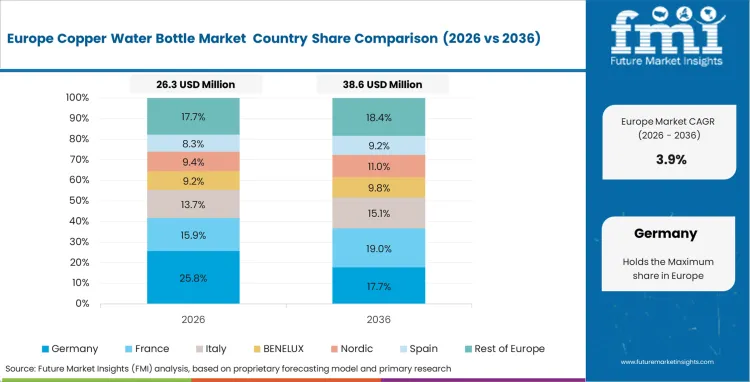
Food-contact compliance and sustainability positioning define Europe more than tradition-led consumption, which keeps copper bottles in a narrower but higher-specification retail space. Import viability depends heavily on batch consistency, material traceability, and finish compliance, especially where organized retail channels are less willing to absorb documentation risk. Recyclability also strengthens category relevance in this region, as copper vessels are more often marketed as durable and design-led alternatives within premium homeware and wellness assortments. This keeps Europe commercially important for suppliers that can combine regulatory discipline with stronger aesthetic execution.
- United Kingdom: Design-led retail keeps the United Kingdom relevant because copper bottles fit more naturally into premium home accessories, gifting displays, and curated lifestyle assortments than into broad utility hydration shelves. Copper water bottles sector in the United Kingdom is projected to increase at a CAGR of 5.7%, supported by stronger acceptance of printed and decorative variants that carry higher visual appeal. Cross-merchandising with barware and premium tabletop items is also likely to widen exposure beyond core wellness buyers. This gives the country added importance where decorative presentation and gifting relevance support value-led demand.
- Germany: Documentation discipline remains a stronger market filter in Germany, where imported metal drinkware is expected to face closer scrutiny around material traceability, environmental compliance, and production consistency. More structured supplier validation is likely to keep lower-specification and weakly documented offerings under pressure across organized retail channels. Demand for copper water bottles in Germany is anticipated to rise at a 5.4% CAGR during 2026 to 2036. This operating environment continues to favor manufacturers with tighter quality systems, stronger factory control, and better ability to sustain repeat compliance across batches.
FMI's report includes France and Italy. Regulatory alignment determines exact entry timing for new market participants. Spain is also likely to influence regional expansion, as premium homeware demand and stronger gifting-led retail formats create additional room for decorative copper bottle assortments.
Oceania Copper Water Bottle Market Analysis
Environmental exposure limits broader copper bottle adoption in Oceania, where coastal humidity, salt-heavy air, and active outdoor usage conditions make surface maintenance more demanding than in many other regions. Category fit is narrower and more controlled, with demand concentrating in indoor wellness, office use, and decorative personal hydration rather than in sports-led or outdoor recreation channels. Finish protection carries greater commercial importance here because appearance deterioration can affect both product acceptance and return exposure more quickly under local operating conditions. This keeps Oceania relevant as a selective market where coated, presentation-stable formats are better aligned with real usage conditions than raw-finish variants.
- Australia: Indoor and desk-based use is expected to remain the stronger demand base in Australia, where copper bottles are less suited to rugged outdoor positioning and more compatible with office, gifting, and wellness-oriented retail settings. Sales of copper water bottles in Australia is poised to rise at a CAGR of 5.2% from 2026 to 2036, supported by continued preference for lacquered formats that can better withstand humid coastal conditions and reduce visible oxidation. Product positioning is also likely to stay concentrated in lower-maintenance, presentation-led formats rather than in active recreation channels. This keeps the market commercially viable for suppliers that can align finish durability with premium indoor-use appeal.
FMI's report includes New Zealand. Logistics managers optimize container loads to offset extreme shipping distances. collapsible water bottles strategies rarely apply here due to rigid material properties. Fiji is also likely to add niche relevance, supported by tourism-led gifting demand and premium resort retail formats that favor decorative drinkware.
Competitive Aligners for Market Players
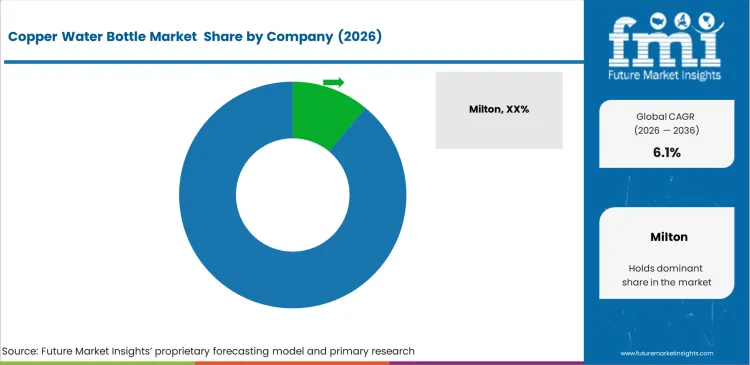
Commodity pricing sets the cost floor in this market, so consolidation does not follow the same pattern seen in design-led personal care accessories. Mid-tier fabricators often struggle to absorb swings in copper input costs, which narrows their room to compete on price and pushes them toward finish, design, and gifting appeal as the main points of differentiation. Larger brands such as Milton and Borosil benefit from broader distribution reach and more standardized quality systems, allowing them to place consistent copper bottle assortments across mainstream retail channels. Smaller challengers remain more dependent on niche wellness positioning, artisanal presentation, and symbolic design language to justify pricing above raw material value. Market leadership in the copper water bottle space is shaped as much by testing discipline and manufacturing stability as by brand visibility.
Established fabricators also retain an advantage because formal compliance and material-control systems require investment that smaller competitors often find difficult to sustain. Maintaining food-contact documentation, batch-level traceability, and repeatable metallurgy standards raises the operating threshold for participation in more organized retail channels. Stricter vendor evaluation works in favor of suppliers that can demonstrate reliable purity control and consistent fabrication quality across production runs. Once a smaller participant falls short on trace-metal assurance or finish consistency, shelf space tends to shift toward better-documented brands with stronger manufacturing depth. Reliable copper water bottle suppliers are more likely to secure long-term retail presence when metallurgical control and audit readiness become part of the purchasing.
Retail buyers still limit supplier pricing power by spreading finish specifications across multiple vendors rather than concentrating volume with a single source. Hammered, printed, and decorative variants are often split deliberately to preserve negotiation flexibility and reduce dependence on one fabrication base. Exclusive designs also matter because differentiated aesthetics make direct price comparison with online sellers less straightforward and help retailers protect margin. Generic formats carry less strategic value in this setting, while custom-developed finishes and retailer-specific visual programs command stronger interest. Manufacturers operating as an OEM copper water bottle factory are better placed to capture this demand by supplying design-led, retailer-aligned products without relying solely on standalone consumer branding.
Key Players in Copper Water Bottle Market
- Milton
- P-TAL
- Indian Art Villa
- Signoraware
- The Better Home
- Kaarigar
- Borosil
Scope of the Report
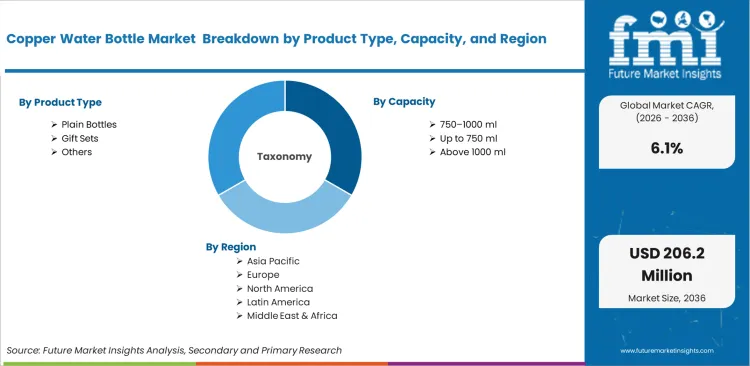
| Metric | Value |
|---|---|
| Quantitative Units | USD 107.5 million to USD 194.3 million, at a CAGR of 6.10% |
| Market Definition | This sector comprises portable hydration vessels manufactured from high-purity copper alloys. Structural designs emphasize oligodynamic microbial suppression alongside aesthetic patina development for domestic and individual use. |
| Segmentation | Product Type, Capacity, Distribution Channel, Buyer Type, Finish Type, Region |
| Regions Covered | North America, Latin America, Europe, East Asia, South Asia, Oceania, Middle East and Africa |
| Countries Covered | India, United Arab Emirates, Saudi Arabia, United States, United Kingdom, Germany, Australia |
| Key Companies Profiled | Milton, P-TAL, Indian Art Villa, Signoraware, The Better Home, Kaarigar, Borosil |
| Forecast Period | 2026 to 2036 |
| Approach | Global copper houseware trade flows map against domestic production outputs to calculate retail volume. |
Source: Future Market Insights (FMI) analysis, based on proprietary forecasting model and primary research
Copper Water Bottle Market Analysis by Segments
- Product Type
- Plain bottles
- Hammered bottles
- Printed bottles
- Gift sets
- Capacity
- 750–1000 ml
- Up to 750 ml
- Above 1000 ml
- Distribution Channel
- Online retail
- Specialty stores
- Modern trade
- Gift stores
- Buyer Type
- Individual buyers
- Corporate gifting
- Hospitality buyers
- Wellness retail
- Finish Type
- Lacquered finish
- Unlacquered
- Nickel finish
- Etched finish
- Region
- North America
- Latin America
- Europe
- East Asia
- South Asia
- Oceania
- Middle East and Africa
Bibliography
- Bureau of Indian Standards. (2026). Scheme-I (ISI Mark Scheme): Potable Water Bottles.
- Environmental Protection Agency. (2026, January 2). Lead and Copper Rule.
- European Commission. (2024). Single-use plastics.
- Mellor, Z., Zhang, M., Wang, J., et al. (2024). Unexpectedly high antibacterial ability of water in copper vessels induced by natural organic matter and salts.
- Observatory of Economic Complexity. (2026). Copper housewares (HS: 7418) product trade, exporters and importers.
- United Nations Environment Programme. (2024, August 22). A life-cycle approach to plastic pollution.
- Żebrowska, A. E., Charkiewicz, A. E., & colleagues. (2024). Is copper still safe for us? What do we know and what are the health implications?
- International Organization for Standardization. (2025, February). Metallic materials — Copper and copper alloys.
- Food and Drug Administration. (2025, January). Food Contact Substances.
This bibliography is provided for reader reference. The full FMI report contains the complete reference list with primary source documentation.
This Report Addresses
- Quality control requirements reshaping modern copper fabrication.
- Trace lead compliance risks impacting international cross-border trade.
- Retail margin erosion connected directly to untreated natural oxidation.
- Material authentication protocols favored by major enterprise gifting agencies.
- Heavy metal screening processes utilized by North American wellness buyers.
- Factory tooling limitations affecting standard capacity economics.
- Hospitality interior specifications driving unlacquered variant demand.
- Algorithmic lifestyle marketing optimizing direct-to-consumer online distribution.
Frequently Asked Questions
What is the market size of copper water bottles?
The valuation reached USD 101.3 million in 2025. This baseline establishes the formal retail footprint before accounting for enterprise-level volume shifts expected throughout the upcoming decade.
How big is the copper bottle market in India?
India leads global compound growth at 8.1% through 2036. Strict regulatory enforcement concentrates this massive domestic consumption directly into modernized, export-ready manufacturing plants.
How to choose a genuine copper water bottle supplier?
Procurement directors must require independent spectrometer testing reports and BIS or FDA compliance documentation. Verifiable lead-free solder certificates separate reliable factory partners from informal assembly networks.
Why are copper water bottles gaining demand?
Corporate enterprise buyers substitute synthetic materials with metal alternatives to meet zero-plastic mandates. This specific material offers distinct aesthetic value and wellness-adjacent positioning unavailable in standard stainless steel.
Which countries buy copper water bottles most?
India maintains the highest absolute volume due to cultural heritage. The United Arab Emirates and Saudi Arabia drive premium growth through high-volume corporate and luxury hospitality procurement.
What limits capacity expansion beyond 1000 ml?
Standard deep-draw extrusion presses cannot maintain uniform wall thickness over extended lengths. Facility managers face severe scrap rates and exponential tooling costs when attempting to manufacture oversized variants.
Why do plain bottles dominate the product type dimension?
Quality control managers validate material purity easily on smooth surfaces. Plain geometry avoids the micro-fractures common in heavily hammered designs during automated fabrication processes.
How does corporate gifting influence regional demand?
Enterprise buyers in the UAE and Saudi Arabia utilize premium metal vessels as high-status corporate merchandise. Procurement directors sign multi-year contracts specifically to align with zero-plastic mandates.
What causes physical retail locations to struggle with stock?
Brick-and-mortar staff lack the technical vocabulary to differentiate natural oxidation from tarnishing. Category managers face severe return rates when uneducated consumers assume natural patina indicates product failure.
What function does the lacquered finish serve?
Store directors demand protective coatings to prevent shelf-level tarnishing before purchase. Polymer barriers preserve visual aesthetics but completely neutralize the oligodynamic effect on the exterior surface.
How do online platforms capture specific demographics?
Algorithmic targeting isolates wellness-focused demographics efficiently. Digital storefronts deploy automated post-purchase care sequences to manage oxidation expectations and minimize returns.
What structural constraint limits European expansion?
Stringent European Commission food contact regulations require continuous compliance documentation across every production batch. Importing brands reject suppliers lacking comprehensive material passports.
Why do individual buyers differ from corporate procurement?
Solo consumers value aesthetic imperfections as proof of handcrafted authenticity. Corporate officers reject these identical variations as unacceptable defects, creating massive quality control conflicts for factories.
What advantage do established incumbent manufacturers possess?
Leading fabricators operate dedicated laboratory infrastructure to secure BIS and FDA clearance continuously. Challengers lacking testing budgets cannot clear customs barriers during cross-border transit.
How do hospitality specifications create supplier friction?
Hotel facility managers demand lacquered exteriors to minimize weekly acidic descaling requirements. This visual maintenance priority forces raw metal fabricators to split margins with specialized coating vendors.
What role does shipping weight play in material selection?
Procurement directors restrict inventory to one-liter capacities strictly to manage filled weight. Shipping oversized variants guarantees dead inventory and heavily penalized logistics margins.
Why are gift sets expanding within distribution channels?
Merchandising directors bundle matching tumblers with core bottles to inflate average order values. Coordinated sets appeal directly to enterprise buyers seeking comprehensive onboarding kits.
Why do unlacquered variants command a premium?
Wellness practitioners require bare metal contact for water purification. Direct-to-consumer brands frame rapid oxidation as proof of authenticity, justifying extreme markups over coated alternatives.
What restricts Australian market volume?
Saltwater exposure accelerates oxidation severely, forcing product developers to restrict copper strictly to indoor desktop environments. This deliberate positioning permanently caps active outdoor volume.
Preview the report firsthand - request a free sample
Get SampleGet the brochure for pricing and purchase details.
Get PDFTable of Content
- Executive Summary
- Global Market Outlook
- Demand-side Trends
- Supply-side Trends
- Technology Roadmap Analysis
- Analysis and Recommendations
- Market Overview
- Market Coverage / Taxonomy
- Market Definition / Scope / Limitations
- Research Methodology
- Chapter Orientation
- Analytical Lens and Working Hypotheses
- Market Structure, Signals, and Trend Drivers
- Benchmarking and Cross-market Comparability
- Market Sizing, Forecasting, and Opportunity Mapping
- Research Design and Evidence Framework
- Desk Research Programme (Secondary Evidence)
- Company Annual and Sustainability Reports
- Peer-reviewed Journals and Academic Literature
- Corporate Websites, Product Literature, and Technical Notes
- Earnings Decks and Investor Briefings
- Statutory Filings and Regulatory Disclosures
- Technical White Papers and Standards Notes
- Trade Journals, Industry Magazines, and Analyst Briefs
- Conference Proceedings, Webinars, and Seminar Materials
- Government Statistics Portals and Public Data Releases
- Press Releases and Reputable Media Coverage
- Specialist Newsletters and Curated Briefings
- Sector Databases and Reference Repositories
- FMI Internal Proprietary Databases and Historical Market Datasets
- Subscription Datasets and Paid Sources
- Social Channels, Communities, and Digital Listening Inputs
- Additional Desk Sources
- Expert Input and Fieldwork (Primary Evidence)
- Primary Modes
- Qualitative Interviews and Expert Elicitation
- Quantitative Surveys and Structured Data Capture
- Blended Approach
- Why Primary Evidence is Used
- Field Techniques
- Interviews
- Surveys
- Focus Groups
- Observational and In-context Research
- Social and Community Interactions
- Stakeholder Universe Engaged
- C-suite Leaders
- Board Members
- Presidents and Vice Presidents
- R&D and Innovation Heads
- Technical Specialists
- Domain Subject-matter Experts
- Scientists
- Physicians and Other Healthcare Professionals
- Governance, Ethics, and Data Stewardship
- Research Ethics
- Data Integrity and Handling
- Primary Modes
- Tooling, Models, and Reference Databases
- Desk Research Programme (Secondary Evidence)
- Data Engineering and Model Build
- Data Acquisition and Ingestion
- Cleaning, Normalisation, and Verification
- Synthesis, Triangulation, and Analysis
- Quality Assurance and Audit Trail
- Market Background
- Market Dynamics
- Drivers
- Restraints
- Opportunity
- Trends
- Scenario Forecast
- Demand in Optimistic Scenario
- Demand in Likely Scenario
- Demand in Conservative Scenario
- Opportunity Map Analysis
- Product Life Cycle Analysis
- Supply Chain Analysis
- Investment Feasibility Matrix
- Value Chain Analysis
- PESTLE and Porter’s Analysis
- Regulatory Landscape
- Regional Parent Market Outlook
- Production and Consumption Statistics
- Import and Export Statistics
- Market Dynamics
- Global Market Analysis 2021 to 2025 and Forecast, 2026 to 2036
- Historical Market Size Value (USD Million) Analysis, 2021 to 2025
- Current and Future Market Size Value (USD Million) Projections, 2026 to 2036
- Y-o-Y Growth Trend Analysis
- Absolute $ Opportunity Analysis
- Global Market Pricing Analysis 2021 to 2025 and Forecast 2026 to 2036
- Global Market Analysis 2021 to 2025 and Forecast 2026 to 2036, By Product Type
- Introduction / Key Findings
- Historical Market Size Value (USD Million) Analysis By Product Type , 2021 to 2025
- Current and Future Market Size Value (USD Million) Analysis and Forecast By Product Type , 2026 to 2036
- Plain Bottles
- Gift Sets
- Others
- Plain Bottles
- Y-o-Y Growth Trend Analysis By Product Type , 2021 to 2025
- Absolute $ Opportunity Analysis By Product Type , 2026 to 2036
- Global Market Analysis 2021 to 2025 and Forecast 2026 to 2036, By Capacity
- Introduction / Key Findings
- Historical Market Size Value (USD Million) Analysis By Capacity, 2021 to 2025
- Current and Future Market Size Value (USD Million) Analysis and Forecast By Capacity, 2026 to 2036
- 750–1000 ml
- Up to 750 ml
- Above 1000 ml
- 750–1000 ml
- Y-o-Y Growth Trend Analysis By Capacity, 2021 to 2025
- Absolute $ Opportunity Analysis By Capacity, 2026 to 2036
- Global Market Analysis 2021 to 2025 and Forecast 2026 to 2036, By Distribution Channel
- Introduction / Key Findings
- Historical Market Size Value (USD Million) Analysis By Distribution Channel, 2021 to 2025
- Current and Future Market Size Value (USD Million) Analysis and Forecast By Distribution Channel, 2026 to 2036
- Online Retail
- Specialty Stores
- Others
- Online Retail
- Y-o-Y Growth Trend Analysis By Distribution Channel, 2021 to 2025
- Absolute $ Opportunity Analysis By Distribution Channel, 2026 to 2036
- Global Market Analysis 2021 to 2025 and Forecast 2026 to 2036, By Buyer Type
- Introduction / Key Findings
- Historical Market Size Value (USD Million) Analysis By Buyer Type, 2021 to 2025
- Current and Future Market Size Value (USD Million) Analysis and Forecast By Buyer Type, 2026 to 2036
- Individual Buyers
- Hospitality Buyers
- Others
- Individual Buyers
- Y-o-Y Growth Trend Analysis By Buyer Type, 2021 to 2025
- Absolute $ Opportunity Analysis By Buyer Type, 2026 to 2036
- Global Market Analysis 2021 to 2025 and Forecast 2026 to 2036, By Finish Type
- Introduction / Key Findings
- Historical Market Size Value (USD Million) Analysis By Finish Type, 2021 to 2025
- Current and Future Market Size Value (USD Million) Analysis and Forecast By Finish Type, 2026 to 2036
- Lacquered
- Unlacquered
- Others
- Lacquered
- Y-o-Y Growth Trend Analysis By Finish Type, 2021 to 2025
- Absolute $ Opportunity Analysis By Finish Type, 2026 to 2036
- Global Market Analysis 2021 to 2025 and Forecast 2026 to 2036, By Region
- Introduction
- Historical Market Size Value (USD Million) Analysis By Region, 2021 to 2025
- Current Market Size Value (USD Million) Analysis and Forecast By Region, 2026 to 2036
- North America
- Latin America
- Western Europe
- Eastern Europe
- East Asia
- South Asia and Pacific
- Middle East & Africa
- Market Attractiveness Analysis By Region
- North America Market Analysis 2021 to 2025 and Forecast 2026 to 2036, By Country
- Historical Market Size Value (USD Million) Trend Analysis By Market Taxonomy, 2021 to 2025
- Market Size Value (USD Million) Forecast By Market Taxonomy, 2026 to 2036
- By Country
- USA
- Canada
- Mexico
- By Product Type
- By Capacity
- By Distribution Channel
- By Buyer Type
- By Finish Type
- By Country
- Market Attractiveness Analysis
- By Country
- By Product Type
- By Capacity
- By Distribution Channel
- By Buyer Type
- By Finish Type
- Key Takeaways
- Latin America Market Analysis 2021 to 2025 and Forecast 2026 to 2036, By Country
- Historical Market Size Value (USD Million) Trend Analysis By Market Taxonomy, 2021 to 2025
- Market Size Value (USD Million) Forecast By Market Taxonomy, 2026 to 2036
- By Country
- Brazil
- Chile
- Rest of Latin America
- By Product Type
- By Capacity
- By Distribution Channel
- By Buyer Type
- By Finish Type
- By Country
- Market Attractiveness Analysis
- By Country
- By Product Type
- By Capacity
- By Distribution Channel
- By Buyer Type
- By Finish Type
- Key Takeaways
- Western Europe Market Analysis 2021 to 2025 and Forecast 2026 to 2036, By Country
- Historical Market Size Value (USD Million) Trend Analysis By Market Taxonomy, 2021 to 2025
- Market Size Value (USD Million) Forecast By Market Taxonomy, 2026 to 2036
- By Country
- Germany
- UK
- Italy
- Spain
- France
- Nordic
- BENELUX
- Rest of Western Europe
- By Product Type
- By Capacity
- By Distribution Channel
- By Buyer Type
- By Finish Type
- By Country
- Market Attractiveness Analysis
- By Country
- By Product Type
- By Capacity
- By Distribution Channel
- By Buyer Type
- By Finish Type
- Key Takeaways
- Eastern Europe Market Analysis 2021 to 2025 and Forecast 2026 to 2036, By Country
- Historical Market Size Value (USD Million) Trend Analysis By Market Taxonomy, 2021 to 2025
- Market Size Value (USD Million) Forecast By Market Taxonomy, 2026 to 2036
- By Country
- Russia
- Poland
- Hungary
- Balkan & Baltic
- Rest of Eastern Europe
- By Product Type
- By Capacity
- By Distribution Channel
- By Buyer Type
- By Finish Type
- By Country
- Market Attractiveness Analysis
- By Country
- By Product Type
- By Capacity
- By Distribution Channel
- By Buyer Type
- By Finish Type
- Key Takeaways
- East Asia Market Analysis 2021 to 2025 and Forecast 2026 to 2036, By Country
- Historical Market Size Value (USD Million) Trend Analysis By Market Taxonomy, 2021 to 2025
- Market Size Value (USD Million) Forecast By Market Taxonomy, 2026 to 2036
- By Country
- China
- Japan
- South Korea
- By Product Type
- By Capacity
- By Distribution Channel
- By Buyer Type
- By Finish Type
- By Country
- Market Attractiveness Analysis
- By Country
- By Product Type
- By Capacity
- By Distribution Channel
- By Buyer Type
- By Finish Type
- Key Takeaways
- South Asia and Pacific Market Analysis 2021 to 2025 and Forecast 2026 to 2036, By Country
- Historical Market Size Value (USD Million) Trend Analysis By Market Taxonomy, 2021 to 2025
- Market Size Value (USD Million) Forecast By Market Taxonomy, 2026 to 2036
- By Country
- India
- ASEAN
- Australia & New Zealand
- Rest of South Asia and Pacific
- By Product Type
- By Capacity
- By Distribution Channel
- By Buyer Type
- By Finish Type
- By Country
- Market Attractiveness Analysis
- By Country
- By Product Type
- By Capacity
- By Distribution Channel
- By Buyer Type
- By Finish Type
- Key Takeaways
- Middle East & Africa Market Analysis 2021 to 2025 and Forecast 2026 to 2036, By Country
- Historical Market Size Value (USD Million) Trend Analysis By Market Taxonomy, 2021 to 2025
- Market Size Value (USD Million) Forecast By Market Taxonomy, 2026 to 2036
- By Country
- Kingdom of Saudi Arabia
- Other GCC Countries
- Turkiye
- South Africa
- Other African Union
- Rest of Middle East & Africa
- By Product Type
- By Capacity
- By Distribution Channel
- By Buyer Type
- By Finish Type
- By Country
- Market Attractiveness Analysis
- By Country
- By Product Type
- By Capacity
- By Distribution Channel
- By Buyer Type
- By Finish Type
- Key Takeaways
- Key Countries Market Analysis
- USA
- Pricing Analysis
- Market Share Analysis, 2025
- By Product Type
- By Capacity
- By Distribution Channel
- By Buyer Type
- By Finish Type
- Canada
- Pricing Analysis
- Market Share Analysis, 2025
- By Product Type
- By Capacity
- By Distribution Channel
- By Buyer Type
- By Finish Type
- Mexico
- Pricing Analysis
- Market Share Analysis, 2025
- By Product Type
- By Capacity
- By Distribution Channel
- By Buyer Type
- By Finish Type
- Brazil
- Pricing Analysis
- Market Share Analysis, 2025
- By Product Type
- By Capacity
- By Distribution Channel
- By Buyer Type
- By Finish Type
- Chile
- Pricing Analysis
- Market Share Analysis, 2025
- By Product Type
- By Capacity
- By Distribution Channel
- By Buyer Type
- By Finish Type
- Germany
- Pricing Analysis
- Market Share Analysis, 2025
- By Product Type
- By Capacity
- By Distribution Channel
- By Buyer Type
- By Finish Type
- UK
- Pricing Analysis
- Market Share Analysis, 2025
- By Product Type
- By Capacity
- By Distribution Channel
- By Buyer Type
- By Finish Type
- Italy
- Pricing Analysis
- Market Share Analysis, 2025
- By Product Type
- By Capacity
- By Distribution Channel
- By Buyer Type
- By Finish Type
- Spain
- Pricing Analysis
- Market Share Analysis, 2025
- By Product Type
- By Capacity
- By Distribution Channel
- By Buyer Type
- By Finish Type
- France
- Pricing Analysis
- Market Share Analysis, 2025
- By Product Type
- By Capacity
- By Distribution Channel
- By Buyer Type
- By Finish Type
- India
- Pricing Analysis
- Market Share Analysis, 2025
- By Product Type
- By Capacity
- By Distribution Channel
- By Buyer Type
- By Finish Type
- ASEAN
- Pricing Analysis
- Market Share Analysis, 2025
- By Product Type
- By Capacity
- By Distribution Channel
- By Buyer Type
- By Finish Type
- Australia & New Zealand
- Pricing Analysis
- Market Share Analysis, 2025
- By Product Type
- By Capacity
- By Distribution Channel
- By Buyer Type
- By Finish Type
- China
- Pricing Analysis
- Market Share Analysis, 2025
- By Product Type
- By Capacity
- By Distribution Channel
- By Buyer Type
- By Finish Type
- Japan
- Pricing Analysis
- Market Share Analysis, 2025
- By Product Type
- By Capacity
- By Distribution Channel
- By Buyer Type
- By Finish Type
- South Korea
- Pricing Analysis
- Market Share Analysis, 2025
- By Product Type
- By Capacity
- By Distribution Channel
- By Buyer Type
- By Finish Type
- Russia
- Pricing Analysis
- Market Share Analysis, 2025
- By Product Type
- By Capacity
- By Distribution Channel
- By Buyer Type
- By Finish Type
- Poland
- Pricing Analysis
- Market Share Analysis, 2025
- By Product Type
- By Capacity
- By Distribution Channel
- By Buyer Type
- By Finish Type
- Hungary
- Pricing Analysis
- Market Share Analysis, 2025
- By Product Type
- By Capacity
- By Distribution Channel
- By Buyer Type
- By Finish Type
- Kingdom of Saudi Arabia
- Pricing Analysis
- Market Share Analysis, 2025
- By Product Type
- By Capacity
- By Distribution Channel
- By Buyer Type
- By Finish Type
- Turkiye
- Pricing Analysis
- Market Share Analysis, 2025
- By Product Type
- By Capacity
- By Distribution Channel
- By Buyer Type
- By Finish Type
- South Africa
- Pricing Analysis
- Market Share Analysis, 2025
- By Product Type
- By Capacity
- By Distribution Channel
- By Buyer Type
- By Finish Type
- USA
- Market Structure Analysis
- Competition Dashboard
- Competition Benchmarking
- Market Share Analysis of Top Players
- By Region
- By Product Type
- By Capacity
- By Distribution Channel
- By Buyer Type
- By Finish Type
- Competition Analysis
- Competition Deep Dive
- Milton
- Overview
- Product Portfolio
- Profitability by Market Segments (Product/Age /Sales Channel/Region)
- Sales Footprint
- Strategy Overview
- Marketing Strategy
- Product Strategy
- Channel Strategy
- P-TAL
- Indian Art Villa
- Signoraware
- The Better Home
- Kaarigar
- Borosil
- Milton
- Competition Deep Dive
- Assumptions & Acronyms Used


