

- Industry Size (2026)
- USD 154.5 Mn
- Forecast (2036)
- USD 168.2 Mn
- CAGR (2026 to 2036)
- 8.3%
Photoluminescent Aircraft Rescue Marking Systems Market Size, Market Forecast and Outlook By FMI
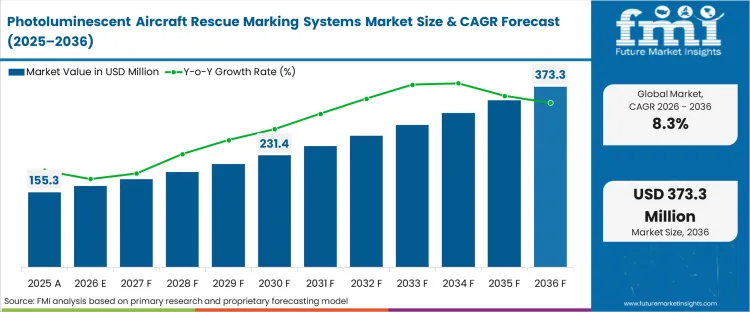
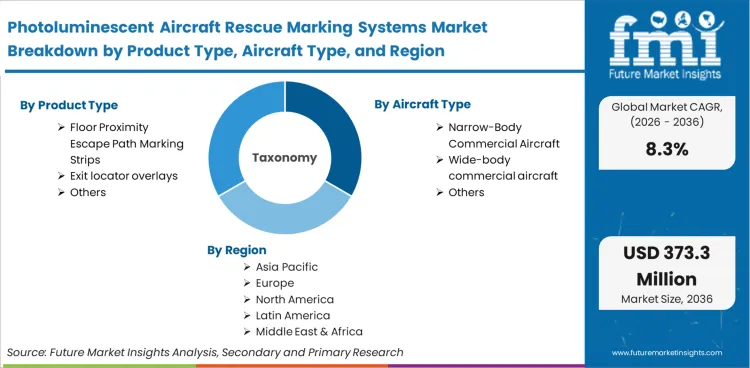
In 2025, the photoluminescent aircraft rescue marking systems market generated USD 154.5 million in terms of global market value. Projections for 2026 indicate a climb to USD 168.2 million, establishing 8.3% of CAGR for the coming decade. The industry growth’s overall financial footprint is on track to hit USD 373.3 million by 2036, driven by carriers urgently executing overnight A-check compliance replacements to escape severe grounded fleet penalties.
Aviation safety directors face immediate pressure to compress cabin maintenance windows without violating strict EASA illumination thresholds. Maintenance crews evaluate track assemblies entirely on installation velocity rather than peak brightness duration alone. Replacing degraded floor tracks previously required extensive seat removal and specialized curing times, driving up operational downtime. Modern continuous aircraft interior lighting strip designs eliminate complex wiring harnesses, allowing MRO technicians to snap fresh polymer profiles into existing polycarbonate tracks during standard overnight layovers. Fleet operators ignoring this workflow advantage risk severe schedule disruptions when regulators spot dimming aisles during routine gate inspections. Calculating the maintenance savings of photoluminescent floor marking aircraft becomes critical for procurement teams justifying premium polymer upgrades.
Certification authorities mandate immediate component replacement once luminescent degradation falls below minimal visibility limits near galley borders. Inspectors logging a single localized failure trigger mandatory audits across entire aircraft zones. Airlines respond by preemptively ripping out aging rigid laminates before formal violations occur, guaranteeing continuous replacement cycles across the aircraft emergency floor path marking market regardless of overall cabin condition.
Summary of Photoluminescent Aircraft Rescue Marking Systems Market
- Photoluminescent Aircraft Rescue Marking Systems Market Definition
- Passive, non-electrical luminous cabin safety assemblies designed to guide passenger egress during complete power failure by absorbing ambient light and emitting continuous glow along floor paths and exit boundaries.
- Demand Drivers in the Market
- EASA visibility regulations require MRO engineers to conduct frequent photoluminescent degradation audits.
- Turnaround time constraints force airline procurement heads to prioritize snap-in track systems over adhesive types.
- Aisle cart abrasion pushes cabin maintenance directors to procure scratch-resistant coated polymer strips.
- Key Segments Analyzed in the FMI Report
- Floor Proximity Escape Path Marking Strips: 58.0% in 2026, operating as the core component within the aircraft floor proximity emergency escape path marking market.
- Narrow-Body Commercial Aircraft: 49.0% in 2026, as high-frequency regional routes accelerate cabin material degradation.
- Retrofit/Aftermarket: 61.0% in 2026, fueled by mandatory safety audits during scheduled heavy maintenance checks.
- Flexible Photoluminescent Polymer Strips: 46.0% in 2026, favored by installers for rapid integration around complex cabin geometries.
- Airlines And Fleet Operators: 55.0% in 2026, controlling direct procurement to optimize overnight maintenance schedules.
- India: 10.1% CAGR, reflecting massive domestic carrier fleet induction and local regulatory compliance enforcement.
- Analyst Opinion at FMI
- Nikhil Kaitwade, Principal Analyst for Automotive at Future Market Insights, notes that, "Airline procurement teams assume photoluminescent strips represent a simple commodity purchase driven entirely by unit cost. Chemical resistance dictates total lifecycle value. MRO teams constantly replace 'cheap' luminous strips because standard aviation cleaning solvents degrade protective clear coats within six months, causing rapid luminance failure. Premium carriers calculating true operational costs specify expensive solvent-resistant polymers immediately, recognizing that labor costs to rip out failed tracks during an A-check completely erase any initial material savings. Evaluating aircraft photoluminescent strip durability proves essential because a visible glow failure grounds an aircraft just as effectively as an engine warning light."
- Strategic Implications / Executive Takeaways
- Fleet operators must standardize track geometries across different aircraft types to minimize spare parts inventory.
- MRO facilities need rapid-cure adhesive solutions to prevent delayed aircraft dispatch following floor strip replacements.
- Cabin interior designers should specify the best aircraft floor path marking system available to protect airline clients from premature degradation penalties.
- Methodology
- Primary Research: Aviation safety directors, MRO cabin engineers, and airline procurement managers
- Desk Research: FAA Airworthiness Directives, EASA safety bulletins, and aircraft OEM component registry databases
- Market-Sizing and Forecasting: Annual commercial aircraft delivery schedules and scheduled fleet cabin retrofit cycles
- Data Validation and Update Cycle: Independent global MRO maintenance log statistics and airline procurement disclosures
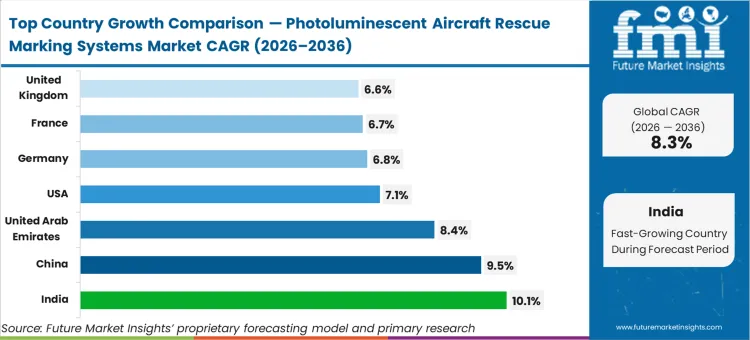
India leads expansion at 10.1% as domestic carriers induct massive wide-body orders requiring localized safety compliance. China tracks closely at 9.5% driven by aggressive domestic fleet expansion and stringent regional certification mandates. United Arab Emirates advances at 8.4% as premium carriers refurbish wide-body cabins to maintain luxury aesthetics while ensuring safety compliance. United States grows at 7.1% supported by legacy airline fleet modernization programs. France progresses at 6.7% on strong aerospace manufacturing hubs. United Kingdom expands at 6.6% alongside Germany at 6.8%, both anchored by major MRO facilities servicing European airline networks. Securing contracts with top aircraft photoluminescent marking suppliers remains a priority across all regions.
Photoluminescent Aircraft Rescue Marking Systems Market Definition
Photoluminescent aircraft rescue marking consists of passive safety assemblies installed across aircraft cabin interiors to guide passenger egress during total power failure. These non-electrical aircraft escape path marking components absorb ambient cabin light and emit continuous glow, creating visible pathways and identifying exit boundaries. Systems include floor-level tracks, door-frame identifiers, and localized signage engineered to withstand extreme physical abrasion, UV degradation, and chemical exposure from aviation cleaning solvents while meeting strict regulatory burn-test standards.
Photoluminescent Aircraft Rescue Marking Systems Market Inclusions
Covered components encompass floor proximity strips, polycarbonate mounting tracks, adhesive-backed exit overlays, and integrated carpet markers. Analysis evaluates both aftermarket replacements and factory-installed assemblies managed by primary aircraft OEMs or independent MRO providers. Sourcing a complete photoluminescent floor path marking retrofit kit aircraft falls strictly within this scope alongside systems engineered specifically for aircraft evacuation protocols. Revenue calculations incorporate material costs, specialized certification fees, and dedicated installation hardware required for securing these luminescent profiles inside commercial or military transport cabins.
Photoluminescent Aircraft Rescue Marking Systems Market Exclusions
Active LED escape path lighting systems and their associated electrical harnesses fall outside this analysis. Independent emergency flashlights, crew communication devices, and standard overhead cabin lighting fixtures receive no consideration here. Electrical components demand different maintenance protocols and regulatory approvals compared to passive photoluminescent materials. Standalone chemical glow sticks used by ground personnel also remain excluded.
Photoluminescent Aircraft Rescue Marking Systems Market Research Methodology
- Primary Research: Aviation safety directors, MRO cabin engineers, and airline procurement managers
- Desk Research: FAA Airworthiness Directives, EASA safety bulletins, and aircraft OEM component registry databases
- Market-Sizing and Forecasting: Annual commercial aircraft delivery schedules and scheduled fleet cabin retrofit cycles
- Data Validation and Update Cycle: Independent global MRO maintenance log statistics and airline procurement disclosures
Segmental Analysis
Photoluminescent Aircraft Rescue Marking Systems Market Analysis by Product Type
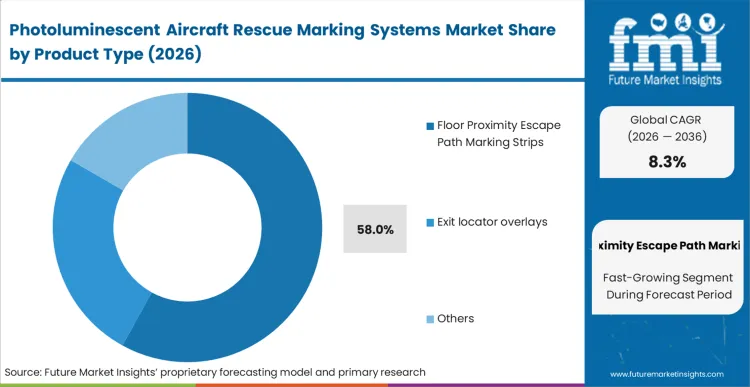
MRO cabin engineers schedule proactive strip replacements based on visual wear patterns long before actual photoluminescent charging capacity fails. The aspect that airline accounting departments rarely realize is that specifying cheaper surface laminates doubles long-term labor expenses by forcing technicians to execute track replacements during compressed overnight checks instead of major C-checks. Operators relying on older aircraft exterior lighting standards often misjudge internal cabin component degradation rates. Regulatory maintenance manuals prioritize floor-level visibility because smoke inhalation risks force passengers to crawl during severe cabin fires. Floor proximity escape path marking strips capture 58.0% share, and FMI's analysis indicates this dominance relies entirely on abrasive wear mechanics rather than intrinsic material failure. Passenger foot traffic and heavy service carts continuously grind microscopic scratches into protective topcoats, reducing light absorption efficiency over thousands of flights. Procurement managers delaying proactive floor track purchases inevitably face emergency AOG situations when unexpected regulatory ramp inspections identify non-compliant luminosity levels near emergency exits, making aircraft photoluminescent marker installation time a critical evaluation metric.
- Abrasive Wear Mechanics: Service carts continuously scratch floor-level protective coats, reducing light absorption capacity. Cabin maintenance directors face accelerated replacement schedules to maintain regulatory compliance.
- Overnight Installation Constraints: Complex rigid tracks require extended adhesive curing times during replacement. MRO technicians demand flexible snap-in profiles to avoid delaying early morning flight departures.
- Inventory Standardization Friction: Airlines operating mixed fleets struggle with incompatible track geometries across different OEM platforms. Procurement heads must source custom adapters to prevent massive spare parts stockpiling.
Photoluminescent Aircraft Rescue Marking Systems Market Analysis by Aircraft Type
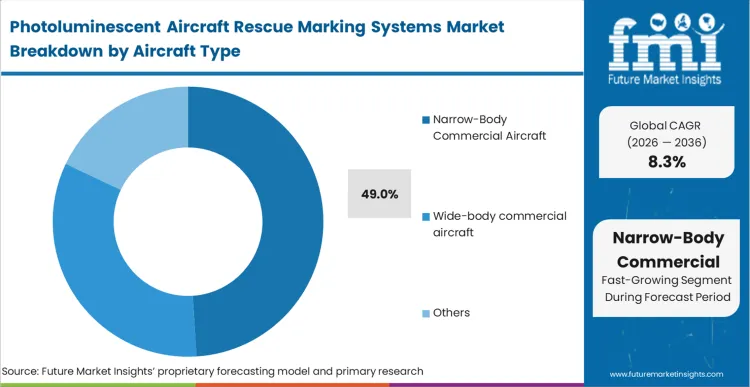
High-frequency flight schedules dictate component survival rates across different aviation platforms. Narrow-body commercial aircraft command 49.0% share because multiple daily boarding cycles subject cabin floors to extreme physical punishment. Regional jets executing six segments daily expose interior plastics to continuous temperature fluctuations and aggressive turnaround cleaning protocols. Airline safety inspectors constantly monitor these high-traffic aisles for premature topcoat delamination. FMI observes that legacy carriers operating aging platforms treat luminescent floor tracks as consumable maintenance items rather than permanent fixtures, budgeting for complete replacements every four years. A critical disconnect emerges when low-cost carriers attempt to stretch replacement intervals. While smoke detection systems activate warning protocols, dim escape strips fail to provide necessary visual cues during actual evacuations. Fleet managers evaluating rescue marking systems for Boeing 737 retrofit or rescue marking systems for Airbus A320 retrofit face sudden grounding orders if they gamble on extended strip lifespans and fail unannounced cabin safety audits at destination gates.
- Turnaround Cleaning Exposure: High-frequency routes require aggressive chemical cleaning between short flights. Cabin sanitation crews inadvertently destroy standard luminescent topcoats using harsh aviation solvents.
- Boarding Cycle Abrasion: Multiple daily passenger loadings concentrate physical wear around forward galley areas. MRO planners must replace forward zone strips three times faster than aft cabin segments.
- Mixed Fleet Complexity: Low-cost carriers acquiring second-hand narrow bodies inherit incompatible track systems. Fleet interior managers face expensive full-cabin retrofits to unify safety protocols across newly acquired aircraft.
Photoluminescent Aircraft Rescue Marking Systems Market Analysis by Fit Type
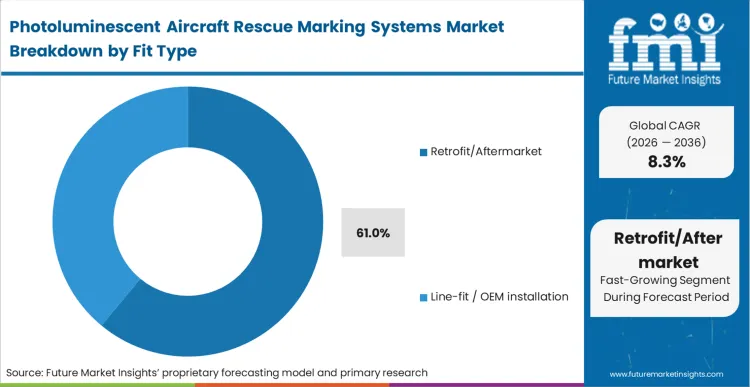
According to FMI's estimates, wide-body operators frequently discard perfectly functional luminescent strips simply because integrating new cabin carpet patterns requires matching track profiles. The hidden trap for MRO facilities lies in calculating the true aircraft rescue marking retrofit cost. Scraping old track glue off composite floor panels consumes more labor hours than installing new survivability equipment combined. Maintenance planners failing to specify low-residue backing tapes during initial retrofits guarantee massive labor overruns during the next scheduled cabin teardown. Aircraft interiors undergo complete refurbishments multiple times before airframes reach retirement age. Retrofit and aftermarket installations secure 61.0% share due to strict regulatory limits on material degradation. As original OEM strips lose charging efficiency after years of UV exposure, airlines must rip out entire aisle assemblies during heavy maintenance D-checks. Cabin refurbishment specialists utilize these scheduled teardowns to upgrade legacy lighting components within the broader aircraft MRO cabin retrofit safety systems category.
- D-Check Integration Logic: Airlines strip cabins to bare metal during heavy maintenance intervals. Refurbishment directors seize this opportunity to replace aging tracks without incurring additional out-of-service penalties.
- Adhesive Removal Friction: Legacy mounting tapes leave hardened residue on composite floor panels. Maintenance technicians waste valuable labor hours scraping tracks instead of completing safety inspections.
- Carpet Matching Dependency: New interior aesthetics often require different floor track profiles. Interior design leads force functional strip replacements merely to accommodate updated cabin color schemes.
Photoluminescent Aircraft Rescue Marking Systems Market Analysis by Material/Construction
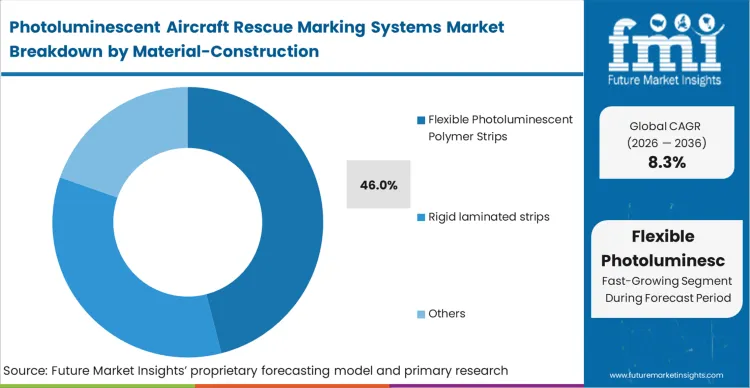
Installation speed determines component selection when labor costs exceed material value. Flexible photoluminescent polymer strips hold 46.0% share because technicians can bend them around curved galley monuments without cutting or splicing. Rigid assemblies snap under tension during turbulent flights, creating tripping hazards and immediate compliance failures. Flexible polymers absorb structural flexing without delaminating from polycarbonate bases. Based on FMI's assessment, airlines constantly underestimate UV degradation in specialized formulations, assuming all glow strips perform identically under continuous cabin lighting. Premium formulations contain specialized blockers preventing yellowing, maintaining crisp aesthetic appearance while preserving critical light absorption properties. Seeking sustainable aircraft floor path marking solutions pushes operators toward highly durable polymers. Buyers acquiring uncertified polymer rolls from secondary suppliers risk immediate aircraft door zone inspection failures when inferior materials shrink under temperature extremes, leaving dark gaps along emergency escape pathways.
- Structural Flexing Tolerance: Aircraft fuselages bend slightly during heavy turbulence and hard landings. Engineering teams specify flexible polymers to prevent rigid track cracking near structural joints.
- Continuous Lighting Degradation: Standard polymers yellow and lose charging capacity under constant LED cabin illumination. Procurement teams must source UV-stabilized variants to avoid premature aesthetic deterioration.
- Thermal Shrinkage Gaps: Inferior plastics contract significantly when parked in sub-zero climates overnight. Quality control inspectors reject cabins displaying visible dark gaps between marking segments.
Photoluminescent Aircraft Rescue Marking Systems Market Analysis by End User
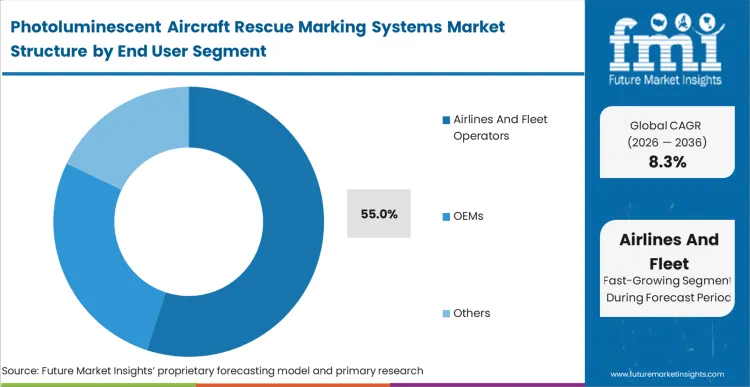
Engineering departments engage established aircraft escape path marking manufacturers to demand universal snap-in profiles compatible with generic polycarbonate bases, ensuring any line mechanic can swap a damaged strip within ten minutes using standard tools. Small regional operators ignoring this standardization strategy end up grounding entire aircraft over minor lightning protection or lighting compliance issues simply because their required proprietary floor strips sit in customs warehouses halfway across the globe. Airlines and fleet operators capture 55.0% share by purchasing directly from specialized safety component manufacturers rather than relying on OEM catalogs. Bypassing airframe builders removes massive markup costs and secures localized inventory control at primary hub airports. FMI analysts point out that major operators actively avoid proprietary OEM track designs to prevent vendor lock-in during future cabin retrofits. Direct operational control allows carriers to harmonize safety components across diverse platforms.
- Direct Sourcing Leverage: Airlines bypass airframe OEM catalogs to avoid massive markup fees. Procurement directors negotiate bulk contracts directly with luminescent material manufacturers to secure hub inventory.
- Proprietary Track Lock-In: Certain airframe builders design proprietary floor tracks to monopolize aftermarket sales. Fleet engineers counter this by ripping out original tracks during first retrofits to install universal profiles.
- Line Mechanic Accessibility: Complex designs require specialized tools for emergency replacement. Maintenance managers demand snap-in systems allowing basic ramp mechanics to fix damaged strips instantly.
Photoluminescent Aircraft Rescue Marking Systems Market Drivers, Restraints, and Opportunities
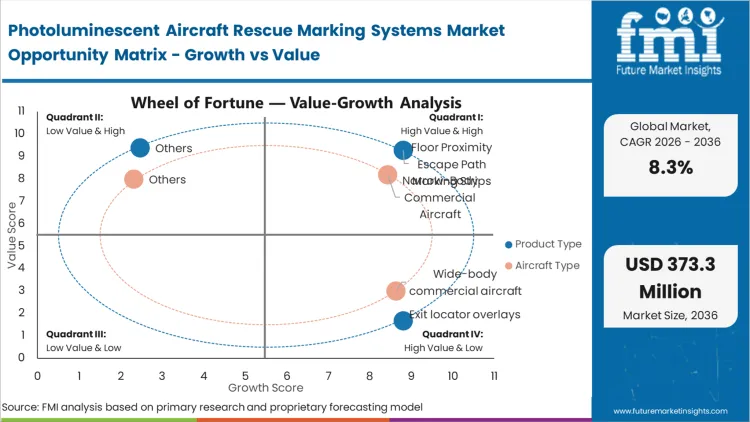
Airlines face immediate financial hemorrhage when regulatory inspectors ground aircraft over dimming floor strips. Safety compliance directors evaluating the need to compare photoluminescent versus electrical aircraft escape path marking consistently choose passive glow systems to eliminate complex wiring harnesses that frequently fail during standard cabin operations. Missing a single scheduled flight sequence due to an electrical floor lighting failure costs carriers exponentially more than upgrading entire passive cabin marking systems. This severe commercial consequence forces procurement teams to stock massive inventories of solvent-resistant, high-luminance polymers at all major maintenance hubs, guaranteeing zero delays when localized wear demands instant component swapping before passengers board.
Adhesive residue removal paralyzes overnight cabin retrofits even when maintenance crews hold sufficient replacement stock. Pulling aging track assemblies off composite floor panels frequently leaves hardened glue requiring manual chemical scraping, a process destroying predicted labor timelines. Professionals researching what regulations govern aircraft photoluminescent floor path marking discover that MRO managers combat this friction by testing novel low-tack mounting tapes, yet these alternatives sometimes fail rigorous vibration certification standards. Until manufacturers perfect temporary adhesives capable of surviving extreme aviation environments, manual floor scraping remains a structural bottleneck slowing widespread fleet modernization.
Opportunities in the Photoluminescent Aircraft Rescue Marking Systems Market
- Streamlined Qualification Pathways: Engineering teams pursue rigorous aircraft floor path marking certification early in product development. Securing specialized STC approvals allows new material suppliers to access lucrative retrofit contracts.
- Color-Matched Daylight Aesthetics: Advanced pigments allow strips to match cabin decors under daylight while glowing standard regulatory green in darkness. Brand managers utilizing photoluminescent paints preserve premium cabin aesthetics without compromising strict safety visibility mandates.
- UV-Resistant Heavy-Duty Coatings: Formulators develop specialized clear coats impervious to aviation cleaning solvents. Maintenance chiefs drastically extend replacement intervals by preventing chemical degradation during turnaround cleaning.
Regional Analysis
.webp "Top Country Growth Comparison Photoluminescent Aircraft Rescue Marking Systems Market Cagr (2026 2036)")
The global adoption of passive luminous safety components reveals distinct regional trajectories shaped by local regulatory enforcement, fleet expansion rates, and the maturity of independent maintenance hubs. While established aviation markets focus on mandatory retrofitting of aging platforms, emerging regions prioritize massive localized stockpiling to support unprecedented new aircraft inductions with the market being segmented into United States, Germany, United Kingdom, France, China, India, and United Arab Emirates across 40 plus countries.
| Country | CAGR (2026 to 2036) |
|---|---|
| India | 10.1% |
| China | 9.5% |
| United Arab Emirates | 8.4% |
| United States | 7.1% |
| Germany | 6.8% |
| France | 6.7% |
| United Kingdom | 6.6% |
Source: Future Market Insights (FMI) analysis, based on proprietary forecasting model and primary research
North America Photoluminescent Aircraft Rescue Marking Systems Market Analysis
Continuous cabin retrofit cycles dominate the operational reality for North American carriers, driven largely by FAA mandates targeting the modernization of legacy fleets. To remain competitive against incoming aircraft deliveries, engineering departments utilize mandatory D-checks on aging domestic platforms to replace outdated, toxic chemical glow components with modern polymer strips verified against the rigorous FAA AC 25.812-2 photoluminescent marking standard. FMI notes that severe material degradation caused by endless baggage impacts during aggressive turnaround schedules at major continental hubs forces maintenance crews to source ultra-durable topcoats. Meanwhile, safety inspectors increasingly scrutinize regional operators of older turboprops, strictly verifying compliance before clearing passenger service.
- United States: Expanding at a steady 7.1% CAGR, the domestic landscape is defined by legacy airlines fighting constant interior maintenance battles across vast narrow-body fleets. Major carriers actively secure direct supplier contracts to completely bypass OEM backlogs and ensure component availability. To mitigate surging labor costs during these mandatory safety upgrades, cabin refurbishment directors prioritize the procurement of specialized snap-in polymers.
FMI's report includes Canada and Mexico. Strong cross-border airline alliances harmonize maintenance standards across North American MRO facilities, driving uniform procurement strategies.
Europe Photoluminescent Aircraft Rescue Marking Systems Market Analysis
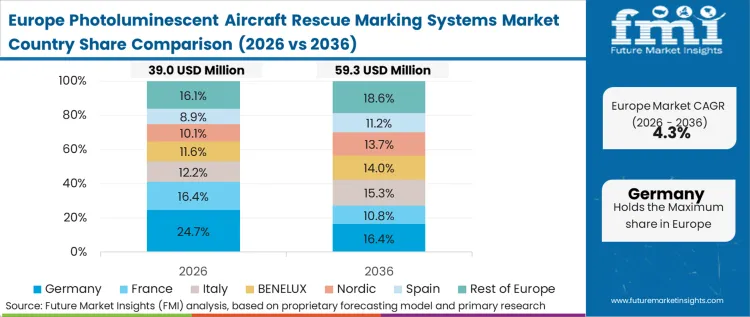
Independent MRO facilities forming the backbone of regional aviation networks currently drive immense volume purchases to maintain diverse international fleets under strict EASA CS-25 escape path marking photoluminescent regulations. Operators face severe penalties from safety inspectors conducting uncompromising, unannounced cabin audits across primary transit hubs for even marginal luminescence degradation. The strict environmental reporting requirements further force fleet managers to integrate non-toxic, recyclable materials alongside emergency light sticks to satisfy continental sustainability mandates. According to FMI's assessment, business jet completion centers and luxury charter operators simultaneously push boundaries by demanding bespoke, color-matched glow systems that blend seamlessly into premium aesthetics while passing mandatory certification flights.
- Germany: Engineering chiefs managing massive independent MRO centers prioritize universal track adapters to efficiently service the mixed global fleets constantly moving through local hubs. Progressing at a 6.8% CAGR, these facilities command a dominant position in premium interior completion projects, ensuring rapid turnaround compliance for international carriers. This unique capability effectively enables local suppliers to dictate specialized component standards on a global scale.
- United Kingdom: Heavy transatlantic traffic funnels through extensive wide-body maintenance bases where fleet managers battle the severe aisle wear typical of 12-hour long-haul flights. Driven by a solid 6.6% CAGR, British engineering teams tackle this degradation by installing ultra-durable rigid laminates and pioneering novel installation techniques. This relentless focus on reducing out-of-service time makes local facilities global leaders in highly complex cabin retrofits.
- France: Direct access to primary airframe manufacturing lines provides local suppliers with an overwhelming line-fit advantage over foreign competitors. OEM procurement managers seamlessly embed advanced photoluminescent profiles directly into nascent cabin architectures long before final delivery, resulting with the robust aerospace hubs to forecast a 6.7% of CAGR value, thereby permanently securing lucrative aftermarket revenue streams by controlling initial factory specifications.
FMI's report includes Italy and Spain. High seasonal charter traffic exposes regional cabins to extreme boarding cycle abrasion, necessitating frequent floor track replacements before peak summer schedules commence.
Asia Pacific Photoluminescent Aircraft Rescue Marking Systems Market Analysis
Maximum seating densities and punishing turnaround schedules utilized by dominant low-cost carriers push cabin interior materials to their absolute physical limits. To support explosive domestic route expansion, airlines are inducting hundreds of airframes annually while desperately attempting to build out localized maintenance infrastructure. Because extreme passenger footfall destroys standard protective topcoats in a matter of months, engineering teams aggressively hunt for ultra-durable, scratch-resistant solutions across the aircraft photoluminescent rescue marking market. FMI estimates that new MRO facilities are actively circumventing traditional OEM supply chains, opting instead to heavily stockpile universal replacement strips alongside airport runway lighting provisions to prevent minor safety violations from grounding massive fleets.
- India: Surging ahead with a leading 10.1% CAGR, the domestic aviation sector is executing an unprecedented wave of narrow-body and wide-body fleet inductions. This aggressive operational expansion fundamentally requires robust supply chain autonomy, forcing global suppliers to establish dedicated regional manufacturing hubs. To sustain such momentum without dispatch delays, airline procurement teams demand immense, localized stockpiles of critical interior safety components.
- China: Uncompromising regional certification mandates leave domestic airlines no choice but to maintain absolutely pristine cabin safety conditions at all times. To keep aircraft airborne and maximize revenue generation, maintenance directors strategically prioritize flexible strips designed for rapid installation. The national demand advances at a highly accelerated 9.5% CAGR, as local MRO networks rapidly mature to handle complex D-checks independently and slash operational downtime.
FMI's report includes Japan and South Korea. Legacy carriers in these nations focus heavily on premium passenger experiences, demanding flawless visual integration of safety markers within luxury cabin environments.
Middle East Photoluminescent Aircraft Rescue Marking Systems Market Analysis
Premium cabin aesthetics and long-haul international transit define the operational priorities for major carriers in this geography. Engineering teams face the unique challenge of maintaining strict safety compliance without disrupting the highly customized, luxury interior designs that attract global transfer passengers. Based on FMI's assessment, operators actively transition away from generic marking profiles, opting instead for bespoke, color-matched photoluminescent integrations that withstand the intense UV exposure characteristic of the region's climate.
- United Arab Emirates: Hub carriers engaged in fierce competition for premium international travelers continuously execute lavish wide-body cabin refurbishments. Driven by a robust 8.4% CAGR, procurement teams operating out of Dubai and Abu Dhabi mandate visually unobtrusive yet highly efficient safety markers that blend seamlessly with high-end carpets and customized galleys. The ability to harmonize luxury branding with non-negotiable EASA visibility thresholds secures lucrative, long-term supplier contracts in this uniquely demanding landscape.
FMI's report includes Saudi Arabia and Qatar. Massive investments in mega-airport infrastructure and national carrier fleet expansions compel local aviation authorities to rapidly standardize interior safety protocols across newly acquired airframes.
Competitive Aligners for Market Players
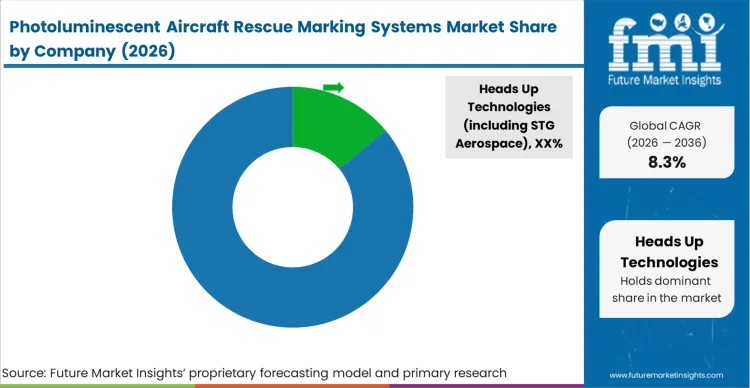
Securing dominance in aerospace safety components requires chemical formulation capabilities that far exceed standard plastic extrusion. Aviation procurement directors researching who are the top suppliers of aircraft photoluminescent rescue markings evaluate candidates based entirely on Supplemental Type Certificate libraries, rendering raw material pricing completely irrelevant if a luminous profile lacks certified approval for a specific airframe variant. Entities such as Heads Up Technologies (including STG Aerospace) and Astronics Luminescent Systems, widely recognized as photoluminescent aircraft rescue marking key players, do not merely distribute glowing polymers; they commercialize guaranteed EASA and FAA compliance. A glowing strip holds zero commercial value without the corresponding engineering paperwork verifying its survival under extreme cabin fire conditions. Competitors like PERMALUX and Madelec Aero survive this intense regulatory threshold by targeting highly specific regional certification gaps or bespoke aircraft configurations where massive volume players lack pre-approved geometries. Niche operators often rely on these specialized aircraft escape path marking manufacturers to engineer custom profiles for modified cargo-to-passenger conversions or specialized military transports. This dynamic ensures that while tier-one aircraft photoluminescent marking suppliers capture the vast majority of standard narrow-body fleet retrofits, agile chemical formulators maintain a profitable grip on lower-volume, high-complexity interior overhauls.
Gaining a Supplemental Type Certificate for a newly designed floor track requires burning actual cabin sections in certified laboratories to prove toxicity and flammability limits, erecting a massive financial barrier against uncertified commercial manufacturers attempting to enter the aviation sector. Established heavyweights actively embed their track geometries into major airline maintenance manuals to monopolize aftermarket purchasing cycles across decades of aircraft operation. Identifying reliable floor proximity emergency escape path marking systems suppliers remains complex because when an operator bolts a proprietary polycarbonate base from Lufthansa Technik to their composite floor panels, switching to a different supplier requires ripping out the entire cabin infrastructure. This physical vendor lock-in effectively guarantees recurring revenue streams, as airlines rarely authorize the immense aircraft rescue marking retrofit cost and labor hours required to scrape hardened adhesive off floor panels simply to change strip suppliers. Mid-tier specialists like Bruce Aerospace navigate this structural blockade by engineering universal adapter clips, allowing their replacement strips to seamlessly integrate within existing aircraft cabin interiors without forcing airlines to absorb prohibitive vendor-switching costs. Designing a component that fits perfectly into a competitor's proprietary track requires profound engineering precision to ensure the flexible polymer does not rattle loose during severe flight turbulence, a crucial factor in securing aircraft floor path marking certification.
Shattering the OEM monopoly on aftermarket replacement cycles begins at the negotiating table, where major airlines now absolutely refuse to accept proprietary track geometries on new deliveries. Procurement executives explicitly stipulate that new airframes must feature universal mounting bases compatible with multiple aftermarket providers, deliberately breaking OEM monopolies to lower long-term maintenance overhead across their fleets. Agile challengers including Cobalt Aerospace exploit this structural shift by designing highly adaptable, drop-in polymer strips that satisfy both premium aesthetic requirements and strict regulatory mandates for rapid passenger evacuation. Airlines recognizing the leverage of this modularity actively rewrite their internal sourcing guidelines for aircraft MRO cabin retrofit safety systems to forbid the installation of proprietary safety hardware during heavy D-check refurbishments. Maintenance chiefs prioritize universal interoperability, ensuring that a delayed shipment from one supplier does not ground an entire aircraft simply because a proprietary adapter clip is missing from the local hub inventory. This ongoing conflict between proprietary physical infrastructure and open-source component modularity continuously forces airlines to weigh the simplicity of single-vendor maintenance contracts against the financial agility of a heavily diversified aftermarket supply chain.
Key Players in Photoluminescent Aircraft Rescue Marking Systems Market
- Heads Up Technologies (including STG Aerospace)
- Lufthansa Technik
- Astronics Luminescent Systems
- Bruce Aerospace
- Cobalt Aerospace
- PERMALUX
- Madelec Aero
Scope of the Report
| Metric | Value |
|---|---|
| Quantitative Units | USD 168.2 million to USD 373.3 million, at a CAGR of 8.3% |
| Market Definition | Passive, non-electrical luminous cabin safety assemblies designed to guide passenger egress during complete power failure by absorbing ambient light and emitting continuous glow along floor paths and exit boundaries. |
| Segmentation | Product Type, Aircraft Type, Fit Type, Material / Construction, End User, and Region |
| Regions Covered | North America, Latin America, Europe, East Asia, South Asia & Pacific, Middle East & Africa |
| Countries Covered | United States, Germany, United Kingdom, France, China, India, United Arab Emirates |
| Key Companies Profiled | Heads Up Technologies (including STG Aerospace), Lufthansa Technik, Astronics Luminescent Systems, Bruce Aerospace, Cobalt Aerospace, PERMALUX, Madelec Aero |
| Forecast Period | 2026 to 2036 |
| Approach | Annual commercial aircraft delivery schedules and scheduled fleet cabin retrofit cycles |
Source: Future Market Insights (FMI) analysis, based on proprietary forecasting model and primary research
Key Segments:
Product Type
- Floor proximity escape path marking strips
- Exit locator overlays
- Directional aisle guidance markers
- Photoluminescent informational signage
- Door-frame and monument rescue markings
Aircraft Type
- Narrow-body commercial aircraft
- Wide-body commercial aircraft
- Regional aircraft
- Business jets
- Military transport and special mission aircraft
Fit Type
- Retrofit / aftermarket
- Line-fit / OEM installation
Material/Construction
- Flexible photoluminescent polymer strips
- Rigid laminated strips
- Scratch-protected coated assemblies
- Carpet-integrated customized markings
- Hybrid strip-plus-signage kits
End User
- Airlines and fleet operators
- OEMs
- MROs and cabin retrofit specialists
- Leasing companies
- Defense and government operators
Regions:
- North America
- United States
- Canada
- Mexico
- Latin America
- Brazil
- Argentina
- Chile
- Europe
- Germany
- United Kingdom
- France
- Italy
- Spain
- Asia-Pacific
- China
- Japan
- South Korea
- India
- ASEAN
- ANZ
- Middle East & Africa
- UAE
- Saudi Arabia
- South Africa
Bibliography
- Chen, K., Zhang, X., & coauthors. (2025). Modeling and evaluating passenger evacuation and risk in blended wing body aircraft based on a continuous displacement field method. SN Applied Sciences.
- International Air Transport Association. (2025). The global commercial aircraft fleet. IATA.
- Liu, T., Wang, Y., & coauthors. (2024). Process of cabin smoke and flame propagation and its impact on personnel evacuation in a Boeing 737 cabin fire. Case Studies in Thermal Engineering.
- Lufthansa Technik. (2025). GuideU. Lufthansa Technik.
- European Union Aviation Safety Agency. (2025). Cabin Safety: Installed Physical Secondary Barrier. EASA.
This bibliography is provided for reader reference. The full FMI report contains the complete reference list with primary source documentation.
This Report Addresses
- Procurement strategies minimizing proprietary track lock-in during major wide-body retrofits.
- Impact of EASA visibility regulations on overnight A-check cabin maintenance schedules.
- Technical differences dictating flexible polymer usage versus rigid laminate floor installations.
- Analysis of the photoluminescent aircraft rescue marking CAGR and market valuation trajectories.
- Hidden labor costs associated with adhesive scraping during heavy D-check maintenance cycles.
- Abrasive wear mechanics driving accelerated strip replacements near forward galley monuments.
- Rapid wide-body fleet induction fueling massive safety component stockpiling across Indian hubs.
- Certification barriers preventing generic plastic extruders from entering aerospace supply chains.
Frequently Asked Questions
What regulations govern aircraft photoluminescent floor path marking?
Systems must comply with strict FAA AC 25.812-2 and EASA CS-25 visibility standards, ensuring materials provide sufficient glow duration to guide passengers safely out of smoke-filled cabins.
Are photoluminescent aircraft markings FAA compliant?
Passive non-electrical glow systems achieve full FAA compliance by passing rigorous burn, toxicity, and luminosity tests while securing proper Supplemental Type Certificates for specific airframe models.
Who are the top suppliers of aircraft photoluminescent rescue markings?
Dominant providers include Heads Up Technologies, Lufthansa Technik, and Astronics Luminescent Systems, who maintain their market leadership by controlling the vast STC libraries necessary for legal cabin installations.
How does photoluminescent marking compare with powered emergency lighting?
When safety compliance directors compare photoluminescent versus electrical aircraft escape path marking, they favor passive systems because they eliminate the heavy wiring harnesses prone to frequent electrical failures that cause sudden aircraft groundings.
What limits photoluminescent strip lifespan inside commercial cabins?
Harsh aviation cleaning solvents and constant service cart abrasion destroy protective topcoats long before the actual luminous pigments fail, forcing MRO teams into premature replacements to maintain visibility compliance.
Why do airlines avoid rigid laminate escape tracks?
Fleet engineers avoid rigid laminates and specify flexible polymers because aircraft structures flex significantly during turbulence and heavy landings, which causes rigid tracks to crack or delaminate from the floor.
How does adhesive residue affect airline maintenance costs?
Scraping hardened glue left by legacy mounting tapes off composite floor panels consumes excessive labor hours during teardowns, occasionally delaying dispatch schedules even worse than the actual component installations do.
Why do narrow-body aircraft consume more glow strips than wide-bodies?
High-frequency operations and multiple daily boarding cycles subject narrow-body aisles to continuous physical impact, forcing maintenance planners to schedule much more frequent proactive strip replacements.
How do premium carriers maintain aesthetics without failing safety inspections?
Premium carriers utilize advanced formulations with custom pigments that perfectly match interior carpet colors under daylight while still emitting the required regulatory green glow in darkness to satisfy EASA visibility minimums.
What structural barrier blocks new manufacturers from entering aerospace safety?
Strict flammability and toxicity certification requirements demand massive upfront testing capital, meaning uncertified plastics face immediate rejection by aviation authorities, which entirely locks generic commercial extruders out of the market.
Why are carpet-integrated markings gaining traction among interior designers?
Weaving luminous threads directly into cabin textiles eliminates heavy polycarbonate floor tracks entirely, allowing engineering chiefs to reduce overall cabin weight and remove the tripping hazards associated with raised plastic profiles.
How does regulatory enforcement alter procurement timelines?
Because unannounced ramp inspections can immediately ground aircraft displaying dim escape paths, airlines are forced to stockpile excess inventory at every major hub to ensure instant overnight swapping.
Why does India lead regional growth trajectories?
India leads regional growth because domestic carriers are inducting hundreds of new airframes annually, creating a massive expansion that demands robust local supply chains independent of traditional European or American OEM bottlenecks.
What operational penalty exists for mixed-fleet operators?
Because second-hand aircraft carry incompatible proprietary track geometries from their previous owners, procurement managers must source multiple distinct adapter types, which complicates inventory management and slows down routine maintenance.
How do UV blockers improve long-term component viability?
UV-stabilized formulations prevent the rapid yellowing caused by continuous LED cabin illumination, satisfying brand managers by preserving interior aesthetics while maintaining critical light absorption efficiency.
Why do maintenance directors demand snap-in polymer profiles?
Maintenance directors demand snap-in designs because they require zero adhesive curing time, allowing basic line mechanics to replace damaged sections instantly during brief layovers without specialized tooling.
What advantage do line-fit installations provide airframe builders?
Factory integration ensures proprietary tracks embed directly into the original cabin architecture, securing guaranteed aftermarket revenue for OEMs because airlines typically avoid ripping out structurally integrated bases.
How do cleaning crews inadvertently cause safety compliance failures?
Cleaning crews relying on harsh industrial solvents to achieve rapid turnaround times inadvertently melt cheap protective topcoats, which instantly destroys the underlying photoluminescent charging properties.
Why do wide-body operators frequently discard functional strips?
Wide-body operators frequently discard functional strips during major cabin refurbishments because interior design choices force track removal merely to match new carpet patterns and seating layouts, regardless of remaining component luminosity.
What role do leasing companies play in component standardization?
Lessors mandate universal safety hardware across their portfolios to simplify aircraft transitions between different airline clients, utilizing standardized tracks to eliminate costly cabin modifications during lessee handovers.
How do low-cost carriers miscalculate safety marking expenses?
Budget operators miscalculate by prioritizing cheap initial material costs over long-term durability, leading to rapid failures that require expensive emergency overnight labor rates to restore compliance.
Why are door-frame markings critical during smoke events?
Because smoke inhalation forces passengers to crawl and completely obscures traditional overhead exit signs, brightly glowing lower door-frame markers become critical for guiding passengers directly toward egress points when visibility reaches zero.
What forces European operators to adopt non-toxic materials?
Strict continental sustainability directives that penalize hazardous cabin materials force regional airlines to specify fully recyclable safety profiles to satisfy comprehensive corporate environmental reporting requirements.
How do custom adapter clips break OEM aftermarket monopolies?
Independent MROs engineer universal adapter clips that allow standard strips to lock into proprietary bases, creating a modularity that frees airlines from purchasing overpriced proprietary replacements from original airframe builders.
Preview the report firsthand - request a free sample
Get SampleGet the brochure for pricing and purchase details.
Get PDFTable of Content
- Executive Summary
- Global Market Outlook
- Demand-side Trends
- Supply-side Trends
- Technology Roadmap Analysis
- Analysis and Recommendations
- Market Overview
- Market Coverage / Taxonomy
- Market Definition / Scope / Limitations
- Research Methodology
- Chapter Orientation
- Analytical Lens and Working Hypotheses
- Market Structure, Signals, and Trend Drivers
- Benchmarking and Cross-market Comparability
- Market Sizing, Forecasting, and Opportunity Mapping
- Research Design and Evidence Framework
- Desk Research Programme (Secondary Evidence)
- Company Annual and Sustainability Reports
- Peer-reviewed Journals and Academic Literature
- Corporate Websites, Product Literature, and Technical Notes
- Earnings Decks and Investor Briefings
- Statutory Filings and Regulatory Disclosures
- Technical White Papers and Standards Notes
- Trade Journals, Industry Magazines, and Analyst Briefs
- Conference Proceedings, Webinars, and Seminar Materials
- Government Statistics Portals and Public Data Releases
- Press Releases and Reputable Media Coverage
- Specialist Newsletters and Curated Briefings
- Sector Databases and Reference Repositories
- FMI Internal Proprietary Databases and Historical Market Datasets
- Subscription Datasets and Paid Sources
- Social Channels, Communities, and Digital Listening Inputs
- Additional Desk Sources
- Expert Input and Fieldwork (Primary Evidence)
- Primary Modes
- Qualitative Interviews and Expert Elicitation
- Quantitative Surveys and Structured Data Capture
- Blended Approach
- Why Primary Evidence is Used
- Field Techniques
- Interviews
- Surveys
- Focus Groups
- Observational and In-context Research
- Social and Community Interactions
- Stakeholder Universe Engaged
- C-suite Leaders
- Board Members
- Presidents and Vice Presidents
- R&D and Innovation Heads
- Technical Specialists
- Domain Subject-matter Experts
- Scientists
- Physicians and Other Healthcare Professionals
- Governance, Ethics, and Data Stewardship
- Research Ethics
- Data Integrity and Handling
- Primary Modes
- Tooling, Models, and Reference Databases
- Desk Research Programme (Secondary Evidence)
- Data Engineering and Model Build
- Data Acquisition and Ingestion
- Cleaning, Normalisation, and Verification
- Synthesis, Triangulation, and Analysis
- Quality Assurance and Audit Trail
- Market Background
- Market Dynamics
- Drivers
- Restraints
- Opportunity
- Trends
- Scenario Forecast
- Demand in Optimistic Scenario
- Demand in Likely Scenario
- Demand in Conservative Scenario
- Opportunity Map Analysis
- Product Life Cycle Analysis
- Supply Chain Analysis
- Investment Feasibility Matrix
- Value Chain Analysis
- PESTLE and Porter’s Analysis
- Regulatory Landscape
- Regional Parent Market Outlook
- Production and Consumption Statistics
- Import and Export Statistics
- Market Dynamics
- Global Market Analysis 2021 to 2025 and Forecast, 2026 to 2036
- Historical Market Size Value (USD Million) Analysis, 2021 to 2025
- Current and Future Market Size Value (USD Million) Projections, 2026 to 2036
- Y-o-Y Growth Trend Analysis
- Absolute $ Opportunity Analysis
- Global Market Pricing Analysis 2021 to 2025 and Forecast 2026 to 2036
- Global Market Analysis 2021 to 2025 and Forecast 2026 to 2036, By Product Type
- Introduction / Key Findings
- Historical Market Size Value (USD Million) Analysis By Product Type , 2021 to 2025
- Current and Future Market Size Value (USD Million) Analysis and Forecast By Product Type , 2026 to 2036
- Floor Proximity Escape Path Marking Strips
- Exit locator overlays
- Others
- Floor Proximity Escape Path Marking Strips
- Y-o-Y Growth Trend Analysis By Product Type , 2021 to 2025
- Absolute $ Opportunity Analysis By Product Type , 2026 to 2036
- Global Market Analysis 2021 to 2025 and Forecast 2026 to 2036, By Aircraft Type
- Introduction / Key Findings
- Historical Market Size Value (USD Million) Analysis By Aircraft Type, 2021 to 2025
- Current and Future Market Size Value (USD Million) Analysis and Forecast By Aircraft Type, 2026 to 2036
- Narrow-Body Commercial Aircraft
- Wide-body commercial aircraft
- Others
- Narrow-Body Commercial Aircraft
- Y-o-Y Growth Trend Analysis By Aircraft Type, 2021 to 2025
- Absolute $ Opportunity Analysis By Aircraft Type, 2026 to 2036
- Global Market Analysis 2021 to 2025 and Forecast 2026 to 2036, By Fit Type
- Introduction / Key Findings
- Historical Market Size Value (USD Million) Analysis By Fit Type, 2021 to 2025
- Current and Future Market Size Value (USD Million) Analysis and Forecast By Fit Type, 2026 to 2036
- Retrofit/Aftermarket
- Line-fit / OEM installation
- Retrofit/Aftermarket
- Y-o-Y Growth Trend Analysis By Fit Type, 2021 to 2025
- Absolute $ Opportunity Analysis By Fit Type, 2026 to 2036
- Global Market Analysis 2021 to 2025 and Forecast 2026 to 2036, By Material-Construction
- Introduction / Key Findings
- Historical Market Size Value (USD Million) Analysis By Material-Construction, 2021 to 2025
- Current and Future Market Size Value (USD Million) Analysis and Forecast By Material-Construction, 2026 to 2036
- Flexible Photoluminescent Polymer Strips
- Rigid laminated strips
- Others
- Flexible Photoluminescent Polymer Strips
- Y-o-Y Growth Trend Analysis By Material-Construction, 2021 to 2025
- Absolute $ Opportunity Analysis By Material-Construction, 2026 to 2036
- Global Market Analysis 2021 to 2025 and Forecast 2026 to 2036, By End User
- Introduction / Key Findings
- Historical Market Size Value (USD Million) Analysis By End User, 2021 to 2025
- Current and Future Market Size Value (USD Million) Analysis and Forecast By End User, 2026 to 2036
- Airlines And Fleet Operators
- OEMs
- Others
- Airlines And Fleet Operators
- Y-o-Y Growth Trend Analysis By End User, 2021 to 2025
- Absolute $ Opportunity Analysis By End User, 2026 to 2036
- Global Market Analysis 2021 to 2025 and Forecast 2026 to 2036, By Region
- Introduction
- Historical Market Size Value (USD Million) Analysis By Region, 2021 to 2025
- Current Market Size Value (USD Million) Analysis and Forecast By Region, 2026 to 2036
- North America
- Latin America
- Western Europe
- Eastern Europe
- East Asia
- South Asia and Pacific
- Middle East & Africa
- Market Attractiveness Analysis By Region
- North America Market Analysis 2021 to 2025 and Forecast 2026 to 2036, By Country
- Historical Market Size Value (USD Million) Trend Analysis By Market Taxonomy, 2021 to 2025
- Market Size Value (USD Million) Forecast By Market Taxonomy, 2026 to 2036
- By Country
- USA
- Canada
- Mexico
- By Product Type
- By Aircraft Type
- By Fit Type
- By Material-Construction
- By End User
- By Country
- Market Attractiveness Analysis
- By Country
- By Product Type
- By Aircraft Type
- By Fit Type
- By Material-Construction
- By End User
- Key Takeaways
- Latin America Market Analysis 2021 to 2025 and Forecast 2026 to 2036, By Country
- Historical Market Size Value (USD Million) Trend Analysis By Market Taxonomy, 2021 to 2025
- Market Size Value (USD Million) Forecast By Market Taxonomy, 2026 to 2036
- By Country
- Brazil
- Chile
- Rest of Latin America
- By Product Type
- By Aircraft Type
- By Fit Type
- By Material-Construction
- By End User
- By Country
- Market Attractiveness Analysis
- By Country
- By Product Type
- By Aircraft Type
- By Fit Type
- By Material-Construction
- By End User
- Key Takeaways
- Western Europe Market Analysis 2021 to 2025 and Forecast 2026 to 2036, By Country
- Historical Market Size Value (USD Million) Trend Analysis By Market Taxonomy, 2021 to 2025
- Market Size Value (USD Million) Forecast By Market Taxonomy, 2026 to 2036
- By Country
- Germany
- UK
- Italy
- Spain
- France
- Nordic
- BENELUX
- Rest of Western Europe
- By Product Type
- By Aircraft Type
- By Fit Type
- By Material-Construction
- By End User
- By Country
- Market Attractiveness Analysis
- By Country
- By Product Type
- By Aircraft Type
- By Fit Type
- By Material-Construction
- By End User
- Key Takeaways
- Eastern Europe Market Analysis 2021 to 2025 and Forecast 2026 to 2036, By Country
- Historical Market Size Value (USD Million) Trend Analysis By Market Taxonomy, 2021 to 2025
- Market Size Value (USD Million) Forecast By Market Taxonomy, 2026 to 2036
- By Country
- Russia
- Poland
- Hungary
- Balkan & Baltic
- Rest of Eastern Europe
- By Product Type
- By Aircraft Type
- By Fit Type
- By Material-Construction
- By End User
- By Country
- Market Attractiveness Analysis
- By Country
- By Product Type
- By Aircraft Type
- By Fit Type
- By Material-Construction
- By End User
- Key Takeaways
- East Asia Market Analysis 2021 to 2025 and Forecast 2026 to 2036, By Country
- Historical Market Size Value (USD Million) Trend Analysis By Market Taxonomy, 2021 to 2025
- Market Size Value (USD Million) Forecast By Market Taxonomy, 2026 to 2036
- By Country
- China
- Japan
- South Korea
- By Product Type
- By Aircraft Type
- By Fit Type
- By Material-Construction
- By End User
- By Country
- Market Attractiveness Analysis
- By Country
- By Product Type
- By Aircraft Type
- By Fit Type
- By Material-Construction
- By End User
- Key Takeaways
- South Asia and Pacific Market Analysis 2021 to 2025 and Forecast 2026 to 2036, By Country
- Historical Market Size Value (USD Million) Trend Analysis By Market Taxonomy, 2021 to 2025
- Market Size Value (USD Million) Forecast By Market Taxonomy, 2026 to 2036
- By Country
- India
- ASEAN
- Australia & New Zealand
- Rest of South Asia and Pacific
- By Product Type
- By Aircraft Type
- By Fit Type
- By Material-Construction
- By End User
- By Country
- Market Attractiveness Analysis
- By Country
- By Product Type
- By Aircraft Type
- By Fit Type
- By Material-Construction
- By End User
- Key Takeaways
- Middle East & Africa Market Analysis 2021 to 2025 and Forecast 2026 to 2036, By Country
- Historical Market Size Value (USD Million) Trend Analysis By Market Taxonomy, 2021 to 2025
- Market Size Value (USD Million) Forecast By Market Taxonomy, 2026 to 2036
- By Country
- Kingdom of Saudi Arabia
- Other GCC Countries
- Turkiye
- South Africa
- Other African Union
- Rest of Middle East & Africa
- By Product Type
- By Aircraft Type
- By Fit Type
- By Material-Construction
- By End User
- By Country
- Market Attractiveness Analysis
- By Country
- By Product Type
- By Aircraft Type
- By Fit Type
- By Material-Construction
- By End User
- Key Takeaways
- Key Countries Market Analysis
- USA
- Pricing Analysis
- Market Share Analysis, 2025
- By Product Type
- By Aircraft Type
- By Fit Type
- By Material-Construction
- By End User
- Canada
- Pricing Analysis
- Market Share Analysis, 2025
- By Product Type
- By Aircraft Type
- By Fit Type
- By Material-Construction
- By End User
- Mexico
- Pricing Analysis
- Market Share Analysis, 2025
- By Product Type
- By Aircraft Type
- By Fit Type
- By Material-Construction
- By End User
- Brazil
- Pricing Analysis
- Market Share Analysis, 2025
- By Product Type
- By Aircraft Type
- By Fit Type
- By Material-Construction
- By End User
- Chile
- Pricing Analysis
- Market Share Analysis, 2025
- By Product Type
- By Aircraft Type
- By Fit Type
- By Material-Construction
- By End User
- Germany
- Pricing Analysis
- Market Share Analysis, 2025
- By Product Type
- By Aircraft Type
- By Fit Type
- By Material-Construction
- By End User
- UK
- Pricing Analysis
- Market Share Analysis, 2025
- By Product Type
- By Aircraft Type
- By Fit Type
- By Material-Construction
- By End User
- Italy
- Pricing Analysis
- Market Share Analysis, 2025
- By Product Type
- By Aircraft Type
- By Fit Type
- By Material-Construction
- By End User
- Spain
- Pricing Analysis
- Market Share Analysis, 2025
- By Product Type
- By Aircraft Type
- By Fit Type
- By Material-Construction
- By End User
- France
- Pricing Analysis
- Market Share Analysis, 2025
- By Product Type
- By Aircraft Type
- By Fit Type
- By Material-Construction
- By End User
- India
- Pricing Analysis
- Market Share Analysis, 2025
- By Product Type
- By Aircraft Type
- By Fit Type
- By Material-Construction
- By End User
- ASEAN
- Pricing Analysis
- Market Share Analysis, 2025
- By Product Type
- By Aircraft Type
- By Fit Type
- By Material-Construction
- By End User
- Australia & New Zealand
- Pricing Analysis
- Market Share Analysis, 2025
- By Product Type
- By Aircraft Type
- By Fit Type
- By Material-Construction
- By End User
- China
- Pricing Analysis
- Market Share Analysis, 2025
- By Product Type
- By Aircraft Type
- By Fit Type
- By Material-Construction
- By End User
- Japan
- Pricing Analysis
- Market Share Analysis, 2025
- By Product Type
- By Aircraft Type
- By Fit Type
- By Material-Construction
- By End User
- South Korea
- Pricing Analysis
- Market Share Analysis, 2025
- By Product Type
- By Aircraft Type
- By Fit Type
- By Material-Construction
- By End User
- Russia
- Pricing Analysis
- Market Share Analysis, 2025
- By Product Type
- By Aircraft Type
- By Fit Type
- By Material-Construction
- By End User
- Poland
- Pricing Analysis
- Market Share Analysis, 2025
- By Product Type
- By Aircraft Type
- By Fit Type
- By Material-Construction
- By End User
- Hungary
- Pricing Analysis
- Market Share Analysis, 2025
- By Product Type
- By Aircraft Type
- By Fit Type
- By Material-Construction
- By End User
- Kingdom of Saudi Arabia
- Pricing Analysis
- Market Share Analysis, 2025
- By Product Type
- By Aircraft Type
- By Fit Type
- By Material-Construction
- By End User
- Turkiye
- Pricing Analysis
- Market Share Analysis, 2025
- By Product Type
- By Aircraft Type
- By Fit Type
- By Material-Construction
- By End User
- South Africa
- Pricing Analysis
- Market Share Analysis, 2025
- By Product Type
- By Aircraft Type
- By Fit Type
- By Material-Construction
- By End User
- USA
- Market Structure Analysis
- Competition Dashboard
- Competition Benchmarking
- Market Share Analysis of Top Players
- By Regional
- By Product Type
- By Aircraft Type
- By Fit Type
- By Material-Construction
- By End User
- Competition Analysis
- Competition Deep Dive
- Heads Up Technologies (including STG Aerospace)
- Overview
- Product Portfolio
- Profitability by Market Segments (Product/Age /Sales Channel/Region)
- Sales Footprint
- Strategy Overview
- Marketing Strategy
- Product Strategy
- Channel Strategy
- Lufthansa Technik
- Astronics Luminescent Systems
- Bruce Aerospace
- Cobalt Aerospace
- PERMALUX
- Madelec Aero
- Heads Up Technologies (including STG Aerospace)
- Competition Deep Dive
- Assumptions & Acronyms Used


