

- Industry Size (2026)
- USD 0.5 Bn
- Forecast (2036)
- USD 1.0 Bn
- CAGR (2026 to 2036)
- 6.8%
Mandrel Release Lubricant Market Forecast and Outlook 2026 to 2036
The mandrel release lubricant market is likely to be valued at USD 0.5 billion in 2026 and is expected to reach USD 1.0 billion by 2036, reflecting a CAGR of 6.8%. These materials are not purchased as general purpose lubricants but as process enablers in rubber hose, composite tubing, filament winding, and molded sleeve production. Their function is to ensure clean part separation, stable surface finish, and consistent internal dimensions, which directly affects scrap rates and downstream rework. Demand therefore tracks the mix of mandrel based manufacturing rather than overall polymer or composite output. Formulation choice depends on residue behavior, wash off characteristics, and compatibility with curing cycles.
Specification and process engineering teams largely control product selection because release behavior becomes part of the validated manufacturing recipe. Once a lubricant is qualified for a given mandrel and material system, substitution is uncommon due to the risk of surface defects, sticking, or contamination in later bonding or coating steps. Consumption is tied to production runs and cleaning cycles rather than to equipment count. Suppliers compete on consistency, batch repeatability, and technical support more than on unit price. The market grows through higher use of mandrel based forming methods and tighter surface quality requirements, not through expansion of general purpose lubrication applications.
Quick Stats for Mandrel Release Lubricant Market
- Mandrel Release Lubricant Market Value (2026): USD 0.5 billion
- Mandrel Release Lubricant Market Forecast Value (2036): USD 1.0 billion
- Mandrel Release Lubricant Market Forecast CAGR 2026 to 2036: 6.8%
- Leading Product Type in Mandrel Release Lubricant Market: Graphite-based release lubricants
- Leading End-Use Industry in Mandrel Release Lubricant Market: Tube and pipe manufacturing
- Key Growth Regions in Mandrel Release Lubricant Market: Asia Pacific, Europe, North America
- Top Players in Mandrel Release Lubricant Market: Lubrication Engineers, Henkel AG & Co. KGaA, ExxonMobil Chemical, Shell Chemicals, Quaker Houghton, Fuchs Petrolub, BASF SE
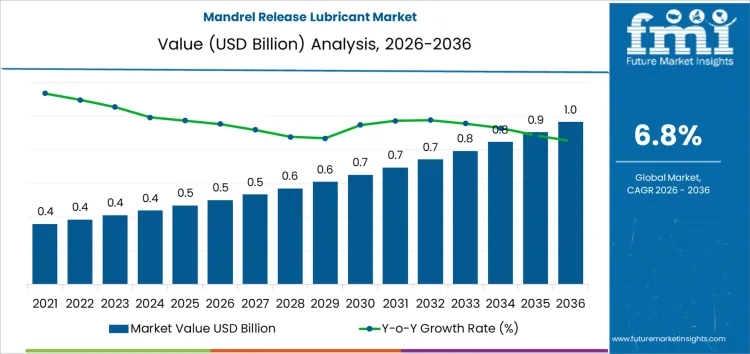
What is the Growth Forecast for the Mandrel Release Lubricant Market through 2036?
The mandrel release lubricant segment is shaped mainly by the need to protect costly tooling and prevent downtime in continuous forming and molding operations. In the early stage, many facilities still treat release lubricants as a low-visibility consumable, even though mandrel sticking, surface defects, and tool damage can stop production lines and create significant losses. As awareness increases, manufacturers begin recognizing that demolding issues are not just quality concerns but major throughput disruptions that affect scheduling, labor utilization, and machine productivity.
With faster production cycles and rising tooling replacement costs, the segment expands as companies shift from minimizing consumable spending to maximizing equipment availability. Release lubricants are increasingly selected by production and process engineering teams rather than procurement, with priority given to consistent performance, stable cycle times, and reduced cleaning frequency. Over time, value growth is driven by higher lubricant usage intensity, tighter surface finish requirements, and the high cost of unplanned line stoppages. Purchasing decisions in this segment are increasingly guided by line stability, extension of cleaning intervals, and improved mandrel life economics, making operational impact more important than formulation novelty or unit pricing.
Mandrel Release Lubricant Market Key Takeaways
| Metric | Value |
|---|---|
| Market Value (2026) | USD 0.5 billion |
| Forecast Value (2036) | USD 1.0 billion |
| Forecast CAGR 2026 to 2036 | 6.8% |
How Is the Mandrel Release Lubricant Market Supporting Efficient Composite Manufacturing?
Mandrel release lubricants are increasingly adopted to facilitate the removal of mandrels in composite material fabrication, improving surface quality and production efficiency. Historically, manual or basic release agents were used, which often caused sticking, surface defects, or damage to composite structures during demolding. Modern mandrel release lubricants incorporate specialized chemical formulations that provide uniform coating, high slip performance, and compatibility with various composite resins and curing conditions. Aerospace manufacturers, industrial pipe producers, and high-performance tubing fabricators prioritize release efficiency, chemical stability, and minimal residue. Early adoption focused on aerospace and specialty composite applications, while current demand spans wind turbine blades, automotive components, and industrial piping, driven by production speed, quality standards, and defect minimization. Lubricant compatibility, thermal stability, and film uniformity influence supplier selection.
Reducing demolding issues and maintaining component quality are shaping market adoption. Compared with conventional release agents, modern mandrel lubricants provide consistent separation, improved surface finish, and reduced cycle time for composite fabrication. Cost considerations include chemical formulation, application method, and environmental compliance, concentrating margins among suppliers capable of delivering reliable, high-performance solutions. Manufacturers adopt these lubricants to enhance process efficiency, minimize defects, and maintain repeatable quality across production batches. Moving forward, mandrel release lubricants are expected to become a standard solution in composite manufacturing, supporting faster production cycles, superior surface integrity, and reliable part removal across aerospace, industrial, and automotive applications.
What Factors Are Shaping the Demand for Mandrel Release Lubricant Market, Segment wise by Product Type and End Use Industry, in 2026?
The Mandrel Release Lubricant Market in 2026 is structured primarily by process repeatability requirements, surface finish control, and mandrel life-cycle economics rather than by lubricant unit cost alone. By product type, demand in the Mandrel Release Lubricant Market is distributed across graphite-based release lubricants, silicone-based release lubricants, wax or emulsion release agents, and PTFE-based release lubricants.
By end-use industry, demand in the Mandrel Release Lubricant Market is concentrated in tube and pipe manufacturing, composites and fiber-reinforced plastics, rubber and elastomer processing, and metal forming and extrusion. These segments reflect differences in operating temperature, surface finish sensitivity, and tolerance for residue or post-process cleaning. In most mandrel-based forming operations, the release agent is not a consumable selected independently of the process. It is a controlled input that affects part quality, tool wear, and downstream finishing steps. Procurement and qualification decisions are therefore influenced by production stability, scrap risk, and maintenance intervals as much as by material cost or availability.
How Do Process Stability and Surface Quality Requirements Shape Product Type Demand in the Mandrel Release Lubricant Market?
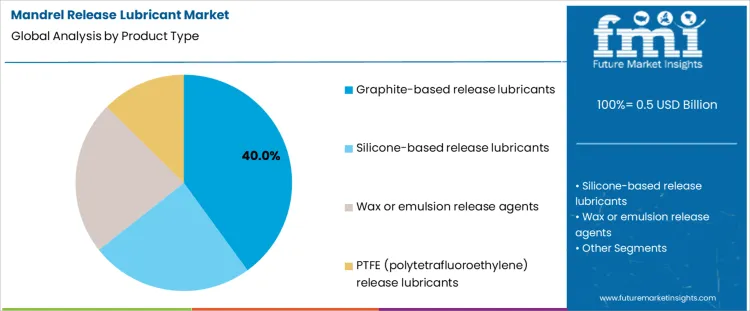
Graphite-based release lubricants account for approximately 40% of demand in the Mandrel Release Lubricant Market because they provide reliable performance under high temperature and high pressure forming conditions, particularly in metal tube and pipe operations.
Their ability to maintain lubricity under severe thermal loads makes them suitable for processes where mandrel seizure or tearing would result in immediate scrap and equipment downtime. However, graphite residues often require post-process cleaning, which limits their use in applications with strict surface cleanliness requirements. Silicone-based and wax or emulsion release agents are specified where surface appearance, mold cleanliness, or downstream bonding performance is critical, particularly in composites and elastomer processing.
PTFE-based release lubricants are adopted where low friction, minimal transfer, and consistent film behavior are required, often in precision metal forming and extrusion. The structure of the Mandrel Release Lubricant Market is therefore determined less by generic lubrication performance and more by how each product type balances release reliability against cleaning effort, surface integrity, and maintenance workload within specific production environments.
Why Does Tube and Pipe Manufacturing Represent the Largest End Use Segment in the Mandrel Release Lubricant Market?
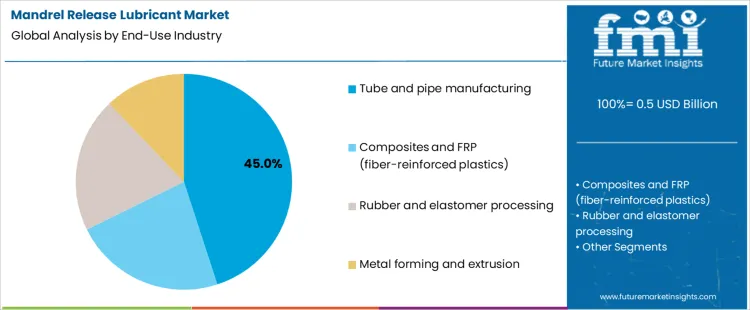
Tube and pipe manufacturing accounts for approximately 45% of demand in the Mandrel Release Lubricant Market because this sector combines high forming forces, continuous production cycles, and a strong dependence on mandrel-based shaping processes. In these operations, mandrel extraction reliability directly affects line uptime, yield, and tool replacement frequency. Even minor release failures can result in part deformation, surface scoring, or mandrel damage, leading to immediate production interruptions.
As a result, release lubricant selection in tube and pipe plants is treated as a critical process parameter rather than as a routine consumable choice. Composites and elastomer processing also rely on mandrels, but production volumes are typically lower and cycle times longer. Metal forming and extrusion use release agents in high-load conditions, but mandrel usage is often more intermittent or confined to specific product lines. Tube and pipe manufacturing combines continuous operation, high throughput, and high sensitivity to release failures.
This combination creates structurally higher and more consistent consumption of qualified release lubricants and explains why this segment remains the dominant source of demand in the Mandrel Release Lubricant Market.
How Are the Key Dynamics Reshaping the Mandrel Release Lubricant Market?
The mandrel release lubricant market lives in the narrow space between surface chemistry and production rhythm. These materials are rarely visible in finished parts, yet they decide whether demolding is routine or a daily fight. As composite layup, tube forming, and elastomer molding push toward tighter tolerances and faster cycles, small changes in release behavior turn into line wide effects. At the same time, plants are trying to reduce cleaning, scrap, and variability. This turns the mandrel release lubricant market into a reliability lever for repeatability, not a consumables line item chosen by habit.
Why the Mandrel Release Lubricant Market Is Cycle-Stability Driven?
Most attention appears when parts start sticking, tearing, or requiring extra force to extract. That friction does more than damage parts. It disrupts time, increases tool wear, and creates rework loops. In high volume operations, a few seconds added to demolding compounds across shifts. The Mandrel Release Lubricant Market benefits where producers optimize for stable, predictable cycles rather than peak speed. Once a formulation proves it can run many shots without reapplication or cleaning, it becomes part of the process recipe. Demand follows process tuning programs and throughput stabilization, not simple increases in part volume.
Why the Mandrel Release Lubricant Market Material-Interaction Sensitive?
Release performance is never universal. Resins, rubbers, metals, and composites all interact differently with both mandrel surfaces and lubricants. A change in cure temperature, surface finish, or additive package can break a previously stable setup. This makes the mandrel release lubricant market dependent on application engineering more than catalog selection. Plants often keep multiple formulations for different lines or even different part families. Qualification takes time because failures are costly. This slows substitution and favors proven pairings of lubricant, substrate, and process window over theoretically better but unproven alternatives.
Why the Mandrel Release Lubricant Market Follow Tooling Strategies?
Some manufacturers treat mandrels as long-life assets and build processes around preserving surface condition. Others accept frequent refurbishment or replacement. That philosophy decides how critical release chemistry becomes. Where tooling is expensive or geometrically complex, the mandrel release lubricant market becomes strategic because it protects capital and uptime. Where tooling is simple and cheap, operators tolerate rougher extraction and more maintenance. As more industries move toward complex, high-precision mandrels, release materials stop being afterthoughts and become part of tooling strategy. The mandrel release lubricant market therefore follows how producers think about tool life, not just part output.
What is the Demand for Mandrel Release Lubricants by Country?
| Country | CAGR (%) |
|---|---|
| USA | 6.3 |
| UK | 6.0 |
| China | 7.2 |
| India | 7.5 |
| Brazil | 6.5 |
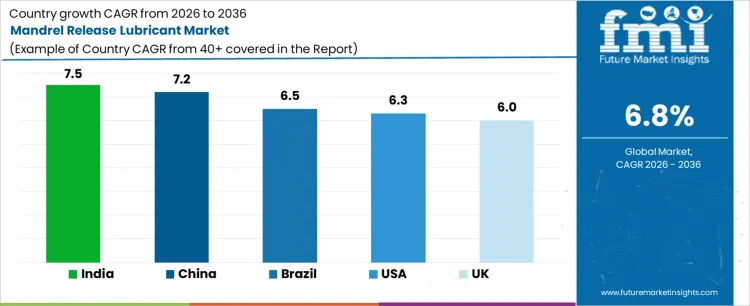
Demand for mandrel release lubricants is rising as manufacturing and industrial sectors adopt specialized lubricants to improve production efficiency, reduce material sticking, and extend equipment life. India leads with a 7.5% CAGR, driven by growth in pipe and tube manufacturing, increasing industrial output, and adoption of high-performance release solutions. China follows at 7.2%, supported by expanding manufacturing capacity and use in industrial forming processes. Brazil records 6.5% growth, shaped by demand in metal fabrication and manufacturing sectors. The USA grows at 6.3%, influenced by replacement demand and operational efficiency initiatives. The UK shows 6.0% CAGR, reflecting steady adoption in industrial and manufacturing applications.
How do yield and cycle time economics shape demand in the United States?
Process optimization inside hose, tube, and composite forming lines keeps mandrel release lubricant demand in United States on a 6.3% CAGR path. Purchasing decisions sit with process engineers responsible for scrap rates and demolding stability. Most volume is locked into qualified process recipes rather than sourced through spot buying. Lubricant choice affects surface finish, cleanup time, and tool life.
Once approved, products remain in use for long production runs. Automotive, aerospace, and industrial hose producers account for a large share of consumption. Suppliers compete on consistency, residue control, and compatibility with downstream bonding or coating steps. Price pressure exists in commodity lines. Commercial success depends on winning process qualifications and line trials rather than selling through general purpose chemical distribution channels.
Why does process validation govern purchases in the United Kingdom?
Manufacturing quality control regimes in United Kingdom keep mandrel release lubricant demand expanding at a 6% CAGR across composites, rubber goods, and specialty tubing production. Tooling engineers and quality teams control approval lists. Once a lubricant is validated, changeovers require new trials and documentation. This creates stable repeat volume. Product selection focuses on release reliability, surface cleanliness, and absence of downstream contamination.
Aerospace and high specification industrial products account for a meaningful share of usage. Import brands serve tighter tolerance applications. Local suppliers compete in standard processes. Production scheduling and scrap cost reduction shape buying priorities. Revenue timing follows new program launches and line requalification projects. Commercial visibility depends on inclusion inside approved process specifications rather than sales to maintenance stores or indirect channels.
What manufacturing scale dynamics drive demand in China?
High volume production of hoses, pipes, and composite structures keeps China on a 7.2% growth track for mandrel release lubricant consumption. Factory output scale makes small yield improvements financially significant. Domestic producers dominate standard lubricant categories through pricing and supply reach. International suppliers retain positions in advanced composite and precision molding lines. Process engineers control product selection during line setup.
Once locked in, usage remains stable across long runs. Order timing follows capacity additions and new line installations. Margin structure depends on mix between commodity lubricants and engineered formulations. Training and application guidance influence acceptance. Commercial success depends on participation in large manufacturing programs rather than selling into fragmented workshops or short run operations.
Why does line expansion drive volume in India?
Growth of automotive, infrastructure, and industrial hose manufacturing keeps India on a 7.5% CAGR path for mandrel release lubricant demand. New line installations and capacity expansion projects generate most qualification activity. Process teams define lubricant standards during commissioning. Import products serve higher temperature and composite applications. Domestic suppliers cover mainstream rubber and polymer processes. Once a lubricant is approved, switching becomes rare due to trial cost and production risk. Scrap reduction and cycle time targets influence selection. Distributor presence supports logistics rather than specification. Revenue follows factory expansion schedules. Commercial success depends on early engagement in new line projects and process trials rather than transactional selling into existing plants.
How do production mix and defect cost shape Brazil demand?
Industrial hose, tubing, and composite goods production keeps Brazil on a 6.5% CAGR track for mandrel release lubricant usage. Manufacturers focus on reducing surface defects and demolding failures that create rework. Lubricant choice influences both yield and cleanup time. Import products serve higher specification and export oriented lines. Local suppliers compete in standard processes. Engineering teams control qualification and approval lists. Once a product is selected, repeat volume follows production output. Spending increases with line upgrades and product mix shifts. Commercial risk sits in process trial performance. Revenue visibility depends on positioning inside approved process standards rather than selling through general chemical supply catalogs or maintenance driven channels.
How Are Suppliers Positioning Products in the Mandrel Release Lubricant Market?
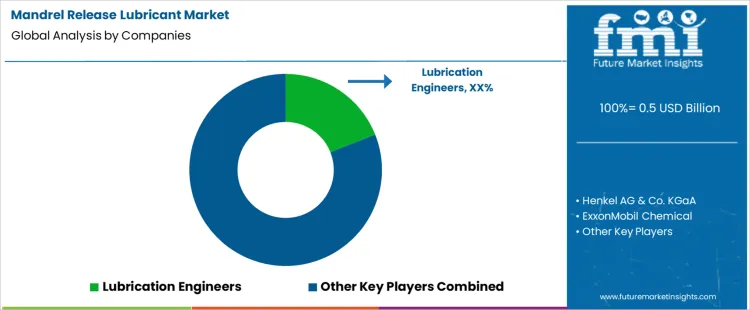
Lubrication Engineers formulates mandrel release lubricants that emphasize consistent film formation and ease of release in tube bending and mandrel assisted metal forming. Products focus on balanced viscosity and thermal stability to reduce scuffing and scoring during high stress operations. Henkel AG & Co. KGaA supplies specialty lubricants that pair release performance with surface finish preservation, supporting fabricators where downstream coating or plating quality matters.
ExxonMobil Chemical delivers base oils and additive‑enhanced lubricants engineered for controlled shear strength and extended bath life in continuous forming environments. Shell Chemicals provides formulations that balance release efficacy with compatibility across steel and non‑ferrous alloys in industrial forming applications. Quaker Houghton offers release compounds that integrate corrosion inhibition to protect both tooling and workpieces during storage and transit.
Fuchs Petrolub develops mandrel release lubricants with emphasis on film resilience and emulsification behavior suited to varying process speeds and temperatures. BASF SE contributes performance additives that enhance boundary lubrication and reduce die wear under repeated load cycles, helping maintain dimensional consistency. Other regional and specialty producers supply tailored blends for specific substrate combinations or localized operating conditions.
Differences among offerings arise from base fluid selection, additive packages that govern friction and adhesion, and ability to withstand thermal cycling without leaving problematic residues. Buyers evaluate lubricants on criteria including release effectiveness, ease of cleaning from finished parts, impact on surface quality, and overall cost of use in production runs. Suppliers that combine robust technical data, application support, and consistent product quality maintain relevance in sectors where mandrel release performance directly influences throughput, tooling life, and end product integrity.
Key Players in the Mandrel Release Lubricant Market
- Eppendorf
- Thermo Fisher Scientific
- BINDER GmbH
- Memmert GmbH + Co. KG
- Labnet International
- Benchmark Scientific
- Fisher Scientific (part of Thermo Fisher)
Scope of the Report
| Items | Values |
|---|---|
| Quantitative Units (2026) | USD billion |
| Product Type | Graphite-based release lubricants, Silicone-based release lubricants, Wax or emulsion release agents, PTFE (polytetrafluoroethylene) release lubricants |
| End-Use Industry | Tube and pipe manufacturing, Composites and FRP (fiber-reinforced plastics), Rubber and elastomer processing, Metal forming and extrusion |
| Region | Asia Pacific, Europe, North America, Latin America, Middle East & Africa |
| Countries Covered | China, Japan, South Korea, India, Australia & New Zealand, ASEAN, Germany, United Kingdom, France, Italy, Spain, Nordic, BENELUX, United States, Canada, Mexico, Brazil, Chile, Saudi Arabia, Turkey, South Africa, and other regional markets |
| Key Companies Profiled | Lubrication Engineers, Henkel AG & Co. KGaA, ExxonMobil Chemical, Shell Chemicals, Quaker Houghton, Fuchs Petrolub, BASF SE |
| Additional Attributes | Dollar sales by product type and end-use; demand driven by mandrel-based forming intensity and surface finish control; growth led by higher line speeds and tooling cost pressure; purchasing shaped by release reliability, residue behavior, cleaning intervals, and impact on scrap rates and mandrel life rather than lubricant price alone. |
Mandrel Release Lubricant Market Segmentation
Product Type:
- Graphite-based release lubricants
- Silicone-based release lubricants
- Wax or emulsion release agents
- PTFE (polytetrafluoroethylene) release lubricants
End-Use Industry:
- Tube and pipe manufacturing
- Composites and FRP (fiber-reinforced plastics)
- Rubber and elastomer processing
- Metal forming and extrusion
Region
- Asia Pacific
- China
- Japan
- South Korea
- India
- Australia & New Zealand
- ASEAN
- Rest of Asia Pacific
- Europe
- Germany
- United Kingdom
- France
- Italy
- Spain
- Nordic
- BENELUX
- Rest of Europe
- North America
- United States
- Canada
- Mexico
- Latin America
- Brazil
- Chile
- Rest of Latin America
- Middle East & Africa
- Kingdom of Saudi Arabia
- Other GCC Countries
- Turkey
- South Africa
- Other African Union
- Rest of Middle East & Africa
References
- U.S. Environmental Protection Agency. (2024). TSCA Chemical Data Reporting (CDR) 2024 instructions and industrial lubricants guidance. EPA.
- ASTM International. (2024). ASTM D1894-24: Standard test method for coefficient of friction of plastic film and sheeting and related lubricant films. ASTM International.
- European Chemicals Agency. (2025). Restrictions on the use of PFAS and microplastics in industrial lubricants and release agents. ECHA.
Frequently Asked Questions
How big is the mandrel release lubricant market in 2026?
The global mandrel release lubricant market is estimated to be valued at USD 0.5 billion in 2026.
What will be the size of mandrel release lubricant market in 2036?
The market size for the mandrel release lubricant market is projected to reach USD 1.0 billion by 2036.
How much will be the mandrel release lubricant market growth between 2026 and 2036?
The mandrel release lubricant market is expected to grow at a 6.8% CAGR between 2026 and 2036.
What are the key product types in the mandrel release lubricant market?
The key product types in mandrel release lubricant market are graphite‑based release lubricants , silicone‑based release lubricants, wax or emulsion release agents and ptfe (polytetrafluoroethylene) release lubricants.
Which end‑use industry segment to contribute significant share in the mandrel release lubricant market in 2026?
In terms of end‑use industry, tube and pipe manufacturing segment to command 45.0% share in the mandrel release lubricant market in 2026.
Preview the report firsthand - request a free sample
Get SampleGet the brochure for pricing and purchase details.
Get PDFTable of Content
- Executive Summary
- Global Market Outlook
- Demand-side Trends
- Supply-side Trends
- Technology Roadmap Analysis
- Analysis and Recommendations
- Market Overview
- Market Coverage / Taxonomy
- Market Definition / Scope / Limitations
- Market Background
- Market Dynamics
- Drivers
- Restraints
- Opportunity
- Trends
- Scenario Forecast
- Demand in Optimistic Scenario
- Demand in Likely Scenario
- Demand in Conservative Scenario
- Opportunity Map Analysis
- Product Life Cycle Analysis
- Supply Chain Analysis
- Investment Feasibility Matrix
- Value Chain Analysis
- PESTLE and Porter’s Analysis
- Regulatory Landscape
- Regional Parent Market Outlook
- Production and Consumption Statistics
- Import and Export Statistics
- Market Dynamics
- Global Market Analysis 2021 to 2025 and Forecast, 2026 to 2036
- Historical Market Size Value (USD Million) Analysis, 2021 to 2025
- Current and Future Market Size Value (USD Million) Projections, 2026 to 2036
- Y-o-Y Growth Trend Analysis
- Absolute $ Opportunity Analysis
- Global Market Pricing Analysis 2021 to 2025 and Forecast 2026 to 2036
- Global Market Analysis 2021 to 2025 and Forecast 2026 to 2036, By Product Type
- Introduction / Key Findings
- Historical Market Size Value (USD Million) Analysis By Product Type , 2021 to 2025
- Current and Future Market Size Value (USD Million) Analysis and Forecast By Product Type , 2026 to 2036
- Graphite‑based release lubricants
- Silicone‑based release lubricants
- Wax or emulsion release agents
- PTFE (polytetrafluoroethylene) release lubricants
- Graphite‑based release lubricants
- Y-o-Y Growth Trend Analysis By Product Type , 2021 to 2025
- Absolute $ Opportunity Analysis By Product Type , 2026 to 2036
- Global Market Analysis 2021 to 2025 and Forecast 2026 to 2036, By End‑Use Industry
- Introduction / Key Findings
- Historical Market Size Value (USD Million) Analysis By End‑Use Industry, 2021 to 2025
- Current and Future Market Size Value (USD Million) Analysis and Forecast By End‑Use Industry, 2026 to 2036
- Tube and pipe manufacturing
- Composites and FRP (fiber‑reinforced plastics)
- Rubber and elastomer processing
- Metal forming and extrusion
- Tube and pipe manufacturing
- Y-o-Y Growth Trend Analysis By End‑Use Industry, 2021 to 2025
- Absolute $ Opportunity Analysis By End‑Use Industry, 2026 to 2036
- Global Market Analysis 2021 to 2025 and Forecast 2026 to 2036, By Region
- Introduction
- Historical Market Size Value (USD Million) Analysis By Region, 2021 to 2025
- Current Market Size Value (USD Million) Analysis and Forecast By Region, 2026 to 2036
- North America
- Latin America
- Western Europe
- Eastern Europe
- East Asia
- South Asia and Pacific
- Middle East & Africa
- Market Attractiveness Analysis By Region
- North America Market Analysis 2021 to 2025 and Forecast 2026 to 2036, By Country
- Historical Market Size Value (USD Million) Trend Analysis By Market Taxonomy, 2021 to 2025
- Market Size Value (USD Million) Forecast By Market Taxonomy, 2026 to 2036
- By Country
- USA
- Canada
- Mexico
- By Product Type
- By End‑Use Industry
- By Country
- Market Attractiveness Analysis
- By Country
- By Product Type
- By End‑Use Industry
- Key Takeaways
- Latin America Market Analysis 2021 to 2025 and Forecast 2026 to 2036, By Country
- Historical Market Size Value (USD Million) Trend Analysis By Market Taxonomy, 2021 to 2025
- Market Size Value (USD Million) Forecast By Market Taxonomy, 2026 to 2036
- By Country
- Brazil
- Chile
- Rest of Latin America
- By Product Type
- By End‑Use Industry
- By Country
- Market Attractiveness Analysis
- By Country
- By Product Type
- By End‑Use Industry
- Key Takeaways
- Western Europe Market Analysis 2021 to 2025 and Forecast 2026 to 2036, By Country
- Historical Market Size Value (USD Million) Trend Analysis By Market Taxonomy, 2021 to 2025
- Market Size Value (USD Million) Forecast By Market Taxonomy, 2026 to 2036
- By Country
- Germany
- UK
- Italy
- Spain
- France
- Nordic
- BENELUX
- Rest of Western Europe
- By Product Type
- By End‑Use Industry
- By Country
- Market Attractiveness Analysis
- By Country
- By Product Type
- By End‑Use Industry
- Key Takeaways
- Eastern Europe Market Analysis 2021 to 2025 and Forecast 2026 to 2036, By Country
- Historical Market Size Value (USD Million) Trend Analysis By Market Taxonomy, 2021 to 2025
- Market Size Value (USD Million) Forecast By Market Taxonomy, 2026 to 2036
- By Country
- Russia
- Poland
- Hungary
- Balkan & Baltic
- Rest of Eastern Europe
- By Product Type
- By End‑Use Industry
- By Country
- Market Attractiveness Analysis
- By Country
- By Product Type
- By End‑Use Industry
- Key Takeaways
- East Asia Market Analysis 2021 to 2025 and Forecast 2026 to 2036, By Country
- Historical Market Size Value (USD Million) Trend Analysis By Market Taxonomy, 2021 to 2025
- Market Size Value (USD Million) Forecast By Market Taxonomy, 2026 to 2036
- By Country
- China
- Japan
- South Korea
- By Product Type
- By End‑Use Industry
- By Country
- Market Attractiveness Analysis
- By Country
- By Product Type
- By End‑Use Industry
- Key Takeaways
- South Asia and Pacific Market Analysis 2021 to 2025 and Forecast 2026 to 2036, By Country
- Historical Market Size Value (USD Million) Trend Analysis By Market Taxonomy, 2021 to 2025
- Market Size Value (USD Million) Forecast By Market Taxonomy, 2026 to 2036
- By Country
- India
- ASEAN
- Australia & New Zealand
- Rest of South Asia and Pacific
- By Product Type
- By End‑Use Industry
- By Country
- Market Attractiveness Analysis
- By Country
- By Product Type
- By End‑Use Industry
- Key Takeaways
- Middle East & Africa Market Analysis 2021 to 2025 and Forecast 2026 to 2036, By Country
- Historical Market Size Value (USD Million) Trend Analysis By Market Taxonomy, 2021 to 2025
- Market Size Value (USD Million) Forecast By Market Taxonomy, 2026 to 2036
- By Country
- Kingdom of Saudi Arabia
- Other GCC Countries
- Turkiye
- South Africa
- Other African Union
- Rest of Middle East & Africa
- By Product Type
- By End‑Use Industry
- By Country
- Market Attractiveness Analysis
- By Country
- By Product Type
- By End‑Use Industry
- Key Takeaways
- Key Countries Market Analysis
- USA
- Pricing Analysis
- Market Share Analysis, 2025
- By Product Type
- By End‑Use Industry
- Canada
- Pricing Analysis
- Market Share Analysis, 2025
- By Product Type
- By End‑Use Industry
- Mexico
- Pricing Analysis
- Market Share Analysis, 2025
- By Product Type
- By End‑Use Industry
- Brazil
- Pricing Analysis
- Market Share Analysis, 2025
- By Product Type
- By End‑Use Industry
- Chile
- Pricing Analysis
- Market Share Analysis, 2025
- By Product Type
- By End‑Use Industry
- Germany
- Pricing Analysis
- Market Share Analysis, 2025
- By Product Type
- By End‑Use Industry
- UK
- Pricing Analysis
- Market Share Analysis, 2025
- By Product Type
- By End‑Use Industry
- Italy
- Pricing Analysis
- Market Share Analysis, 2025
- By Product Type
- By End‑Use Industry
- Spain
- Pricing Analysis
- Market Share Analysis, 2025
- By Product Type
- By End‑Use Industry
- France
- Pricing Analysis
- Market Share Analysis, 2025
- By Product Type
- By End‑Use Industry
- India
- Pricing Analysis
- Market Share Analysis, 2025
- By Product Type
- By End‑Use Industry
- ASEAN
- Pricing Analysis
- Market Share Analysis, 2025
- By Product Type
- By End‑Use Industry
- Australia & New Zealand
- Pricing Analysis
- Market Share Analysis, 2025
- By Product Type
- By End‑Use Industry
- China
- Pricing Analysis
- Market Share Analysis, 2025
- By Product Type
- By End‑Use Industry
- Japan
- Pricing Analysis
- Market Share Analysis, 2025
- By Product Type
- By End‑Use Industry
- South Korea
- Pricing Analysis
- Market Share Analysis, 2025
- By Product Type
- By End‑Use Industry
- Russia
- Pricing Analysis
- Market Share Analysis, 2025
- By Product Type
- By End‑Use Industry
- Poland
- Pricing Analysis
- Market Share Analysis, 2025
- By Product Type
- By End‑Use Industry
- Hungary
- Pricing Analysis
- Market Share Analysis, 2025
- By Product Type
- By End‑Use Industry
- Kingdom of Saudi Arabia
- Pricing Analysis
- Market Share Analysis, 2025
- By Product Type
- By End‑Use Industry
- Turkiye
- Pricing Analysis
- Market Share Analysis, 2025
- By Product Type
- By End‑Use Industry
- South Africa
- Pricing Analysis
- Market Share Analysis, 2025
- By Product Type
- By End‑Use Industry
- USA
- Market Structure Analysis
- Competition Dashboard
- Competition Benchmarking
- Market Share Analysis of Top Players
- By Regional
- By Product Type
- By End‑Use Industry
- Competition Analysis
- Competition Deep Dive
- Lubrication Engineers
- Overview
- Product Portfolio
- Profitability by Market Segments (Product/Age /Sales Channel/Region)
- Sales Footprint
- Strategy Overview
- Marketing Strategy
- Product Strategy
- Channel Strategy
- Henkel AG & Co. KGaA
- ExxonMobil Chemical
- Shell Chemicals
- Quaker Houghton
- Fuchs Petrolub
- BASF SE
- Lubrication Engineers
- Competition Deep Dive
- Assumptions & Acronyms Used
- Research Methodology


