

- Industry Size (2026)
- USD 821.5 Mn
- Forecast (2036)
- USD 3723.7 Mn
- CAGR (2026 to 2036)
- 16.3%
Demand for Energy Intelligence Solution in the UK 2026 to 2036
Demand for energy intelligence solutions in the UK is likely to be valued at USD 821.5 million in 2026 and is projected to reach USD 3,723.7 million by 2036, reflecting a 16.3% CAGR. This demand reflects how energy oversight has shifted into a continuous management discipline tied to cost exposure, operational efficiency, and emissions accountability across organizations with complex energy footprints.
Adoption is driven by the need for granular visibility into consumption patterns across buildings, production assets, and distributed portfolios. UK operators rely on energy intelligence platforms to translate metered data into interpretable signals that support budgeting accuracy, load optimization, and performance benchmarking. Systems that deliver timely alerts, trend analysis, and normalized comparisons across sites help teams identify inefficiencies that are not visible through periodic reviews or manual tracking.
Quick Stats for Energy Intelligence Solution Industry in the UK
- Energy Intelligence Solution Industry Value (2026): USD 821.5 million
- Energy Intelligence Solution Industry Forecast Value (2036): USD 3,723.7 million
- Energy Intelligence Solution Industry Forecast CAGR 2026 to 2036: 16.3%
- Leading End Use by Demand Share: Commercial buildings
- Fastest-Growing Regions: England, Scotland, Wales, Northern Ireland
- Key Industry Participants: Schneider Electric, Siemens, ABB Ltd, Emerson, Honeywell International, General Electric
Procurement decisions emphasize integration depth and data reliability. Buyers favor solutions that connect smoothly with metering infrastructure, building systems, and enterprise reporting tools while maintaining data integrity across large datasets. As energy costs remain material to operating margins, energy intelligence becomes embedded within routine planning, compliance workflows, and investment decisions. Demand growth is anchored in the role these platforms play in converting energy data into operational control rather than standalone reporting capability.
Energy Intelligence Solution Industry in the UK Key Takeaways
| Metric | Value |
|---|---|
| Industry Value (2026) | USD 821.5 million |
| Industry Forecast Value (2036) | USD 3,723.7 million |
| Forecast CAGR (2026 to 2036) | 16.3% |
Why is the UK Building Steady Demand for Energy Intelligence Solutions?
Organizations across the UK now emphasize operational transparency and cost control in energy use, prompting investment in energy intelligence solutions that offer real-time consumption insights. Businesses with large facilities and complex energy portfolios need detailed visibility to balance efficiency goals with financial performance, making data-driven energy oversight a routine managerial function rather than an occasional audit tool.
Energy procurement and regulatory expectations in the UK shape buyer behaviour. Firms must respond to evolving reporting frameworks that emphasise carbon reduction and energy performance standards. Tools that consolidate meter data, benchmark performance and highlight inefficiencies help compliance teams and sustainability leaders demonstrate progress against internal targets and external requirements. These capabilities support structured decision-making.
Operational teams also seek to reduce waste and anticipate demand spikes without manual intervention. Energy intelligence solutions that integrate analytics and alerting enable facilities managers to pre-empt inefficiencies and optimize load distribution. As energy costs remain a significant overhead for manufacturers, retailers and service providers, systems that translate raw usage data into actionable insights become part of routine infrastructure planning and expense management.
How is Energy Intelligence Solution Demand Segmented by End Use, Solution, and Deployment in the UK?
Demand for energy intelligence solutions in the UK reflects how organizations track consumption behaviour, manage cost exposure, and respond to tightening efficiency expectations. Segmentation patterns align with asset scale, data visibility needs, and the ability to translate energy data into operational action.
Why do commercial buildings lead end-use adoption?
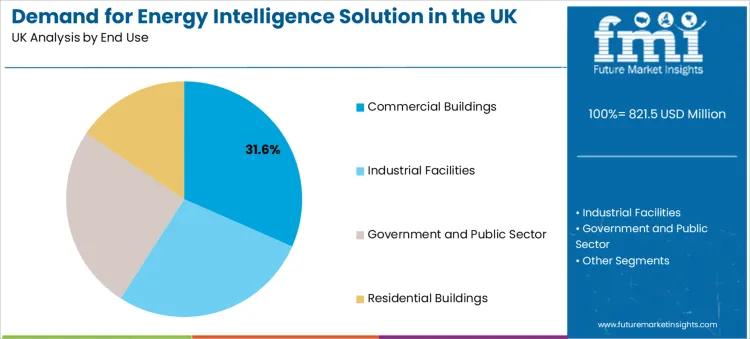
Commercial buildings account for a 31.6% share, placing them as the primary end-use group. Office complexes, retail spaces, and mixed-use properties operate with variable occupancy profiles that create uneven energy demand patterns. Energy intelligence tools support visibility across lighting, HVAC, and equipment loads, allowing facility teams to identify inefficiencies that are difficult to detect through manual monitoring.
Building owners also rely on these solutions to support tenant reporting, cost allocation, and compliance documentation. Centralized insight across multiple sites strengthens budgeting accuracy and improves confidence in energy performance disclosures.
What positions energy management systems as the leading solution category?
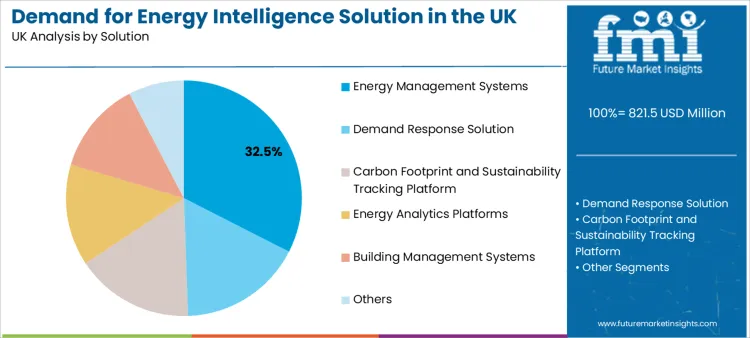
Energy management systems represent a 32.5% share, reflecting their role as the operational backbone for energy monitoring and control. These systems consolidate meter data, equipment inputs, and consumption trends into structured dashboards that support decision-making. Facility teams value the ability to set thresholds, track deviations, and trigger corrective actions without relying on fragmented tools.
Energy management systems also integrate with existing building infrastructure, allowing gradual optimization without disruptive upgrades. This compatibility supports wider adoption across legacy building portfolios.
Why does cloud-based deployment remain the preferred approach?
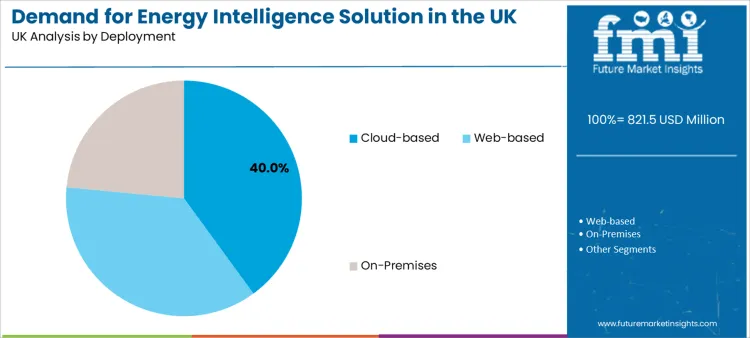
Cloud-based deployment holds a 40.0% share, indicating preference for scalability and remote accessibility. Cloud platforms allow users to monitor multiple locations from a single interface while reducing dependence on local infrastructure. Automatic updates and centralized data storage support consistent analytics across sites, which suits organizations managing dispersed property assets and evolving reporting requirements.
What are the Key Dynamics in Demand for Energy Intelligence Solutions in the UK?
Demand for energy intelligence solutions in the UK is propelled by commitments to decarbonisation, rising energy costs, and regulatory frameworks that require detailed consumption reporting. Commercial, industrial and public sector organizations increasingly adopt software and analytics to monitor, forecast and optimize energy use across multi-site estates. The Smart Export Guarantee and power industry volatility heighten need for real-time visibility of usage, price signals and demand response participation. Procurement decisions focus on integration with existing building management, metering systems and corporate sustainability reporting platforms.
How do regulatory drivers and corporate net zero strategies shape uptake?
Adoption increases where UK companies must comply with Streamlined Energy and Carbon Reporting (SECR), Energy Savings Opportunity Scheme (ESOS) audits and building performance disclosures. Energy intelligence tools help firms aggregate half-hourly settlement data, normalize consumption against production and weather variables and identify cost reduction opportunities. Organizations with public net zero targets use these systems to track scope 1 and scope 2 emissions, linking energy performance metrics with broader environmental, social and governance (ESG) reporting. In the manufacturing sector, granular load profiling supports peak demand management and participation in capacity industries or flexibility services, enhancing operational resilience.
How do integration complexity and data quality challenges influence demand patterns?
Demand for energy intelligence in the UK is influenced by the technical challenge of integrating disparate data sources and ensuring high-quality data feeds. Legacy building and industrial control systems often lack standardized outputs, requiring custom adapters or middleware that extend deployment timelines. Variability in metering infrastructure, including mixed use of smart and traditional meters, complicates accurate baseline creation and comparison across sites. Organizations must invest in data governance frameworks to reconcile inconsistent data, which places a premium on solutions with strong validation and cleansing capabilities. Capital budgets in smaller enterprises may limit uptake where perceived savings are uncertain or where internal expertise for analytics interpretation is lacking.
How is Energy Intelligence Solution Demand Evolving across Key Regions in the UK?
Demand for energy intelligence solutions across the UK accelerates as organizations seek granular visibility, cost control, and emissions accountability. Regional variation reflects asset intensity, digital readiness, regulatory exposure, and how quickly operators embed analytics into operational decision cycles and capital planning frameworks.
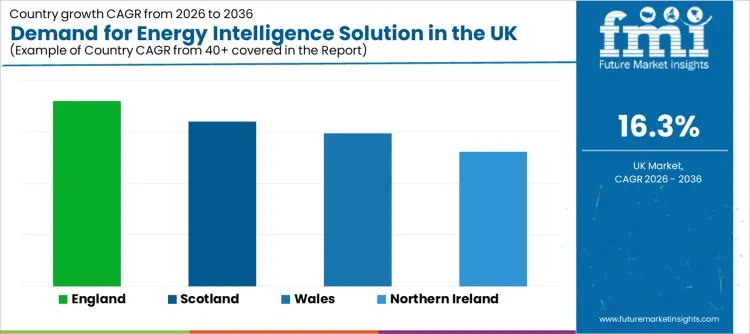
| Region | CAGR 2026 to 2036 |
|---|---|
| England | 17.9% |
| Scotland | 16.0% |
| Wales | 14.8% |
| Northern Ireland | 13.1% |
Source: FMI analysis based on primary research and proprietary forecasting model
Why is England leading expansion through portfolio scale and analytics-driven optimization?
England grows at 17.9%, supported by large estates spanning commercial buildings, industrial sites, transport assets, and data centres. Demand rises where operators deploy analytics to track consumption patterns, forecast peaks, and automate efficiency actions. Buyers prioritize platforms that integrate metering, building systems, and enterprise software, enabling continuous optimization across complex, multi-site portfolios.
How is Scotland progressing through structured adoption in utilities and heavy industry?
Scotland expands at 16.0%, shaped by uptake within utilities, manufacturing, and public infrastructure seeking tighter energy governance. Demand builds where solutions deliver asset-level insight, anomaly detection, and performance benchmarking. Engineering teams value tools that support scenario analysis, resilience planning, and alignment with decarbonisation targets across energy-intensive operations.
What is shaping Wales as organizations focus on actionable insight and cost discipline?
Wales advances at 14.8%, driven by adoption among organizations aiming to convert energy data into operational actions. Demand strengthens when platforms simplify reporting, highlight inefficiencies, and guide corrective measures without heavy integration effort. Decision-makers favour systems that demonstrate fast payback, clear dashboards, and reliable recommendations suited to constrained implementation resources.
Why is Northern Ireland showing strong momentum tied to compliance and efficiency goals?
Northern Ireland records 13.1% growth, reflecting deployment where compliance obligations and energy cost exposure intersect. Adoption progresses when solutions provide auditable data, forecasting accuracy, and clear prioritization of efficiency measures. Demand improves where providers deliver dependable support, scalable architectures, and insights that translate directly into operational savings across defined asset sets.
What Defines the Competitive Landscape for Energy Intelligence Solution in the UK?
UK demand for energy intelligence solutions is shaped by net zero targets, volatile energy prices, and grid decentralisation. Buyers assess platform capabilities around real time monitoring, predictive analytics, asset level visibility, and regulatory reporting. Evaluation also includes interoperability with building systems, cybersecurity assurance, data granularity, and measurable cost reduction outcomes. Procurement behaviour in the UK favours vendors supporting multi-site estates, flexible licensing, and advisory led deployment models. Industry direction reflects movement from energy dashboards toward decision grade platforms enabling optimization across operations.
Schneider Electric holds leading positioning through Energy and EcoStruxure platforms widely adopted by UK commercial and industrial users. Siemens competes strongly with integrated energy management tied to automation, digital twins, and infrastructure portfolios. ABB Ltd maintains relevance via grid focused analytics and electrification software aligned with utilities and transport operators. Emerson and Honeywell support demand within process industries through energy optimization linked to control and safety systems. General Electric participates primarily in asset heavy sectors using energy intelligence embedded within power generation and grid solutions.
Key Industry Participants
- Schneider Electric
- Siemens
- ABB Ltd
- Emerson
- General Electric
- Honeywell International Inc.
Scope of Report
| Items | Values |
|---|---|
| Quantitative Units | USD million |
| End Use | Commercial Buildings; Industrial Facilities; Government and Public Sector; Residential Buildings |
| Solution | Energy Management Systems; Demand Response Solution; Carbon Footprint and Sustainability Tracking Platform; Energy Analytics Platforms; Building Management Systems; Others |
| Deployment | Cloud-based; Web-based; On-Premises |
| Regions Covered | England; Scotland; Wales; Northern Ireland |
| Key Companies Profiled | Schneider Electric; Siemens; ABB Ltd; Emerson; General Electric; Honeywell International Inc. |
Energy Intelligence Solution Demand in the UK by Segments
End Use:
- Commercial Buildings
- Industrial Facilities
- Government and Public Sector
- Residential Buildings
Solution:
- Energy Management Systems
- Demand Response Solution
- Carbon Footprint and Sustainability Tracking Platform
- Energy Analytics Platforms
- Building Management Systems
- Others
Deployment:
- Cloud-based
- Web-based
- On-Premises
By Region
- England
- Scotland
- Wales
- Northern Ireland
Bibliography
- Department for Energy Security and Net Zero. (2023). Powering up Britain: Energy security plan. UK Government.
- Department for Energy Security and Net Zero. (2024). Smart systems and flexibility plan: Digitalising energy demand and supply. UK Government.
- Office for National Statistics. (2024). Energy consumption in the UK: Industrial, commercial, and public sector analysis. UK Government.
- International Energy Agency. (2023). Digitalisation and energy efficiency: Data-driven approaches for demand optimisation. IEA Publications.
- International Organization for Standardization. (2023). ISO 50001:2023-Energy management systems: Requirements with guidance for use. ISO.
- Zhang, Y., Wang, J., & Li, F. (2023). Energy data analytics and intelligence platforms for building and industrial energy management. Applied Energy, 344, 121102.
Frequently Asked Questions
How big is the demand for energy intelligence solution in the uk in 2026?
The demand for energy intelligence solution in the uk is estimated to be valued at USD 821.5 million in 2026.
What will be the size of energy intelligence solution in the uk in 2036?
The market size for the energy intelligence solution in the uk is projected to reach USD 3,723.7 million by 2036.
How much will be the demand for energy intelligence solution in the uk growth between 2026 and 2036?
The demand for energy intelligence solution in the uk is expected to grow at a 16.3% CAGR between 2026 and 2036.
What are the key product types in the energy intelligence solution in the uk?
The key product types in energy intelligence solution in the uk are commercial buildings, industrial facilities , government and public sector and residential buildings.
Which solution segment is expected to contribute significant share in the energy intelligence solution in the uk in 2026?
In terms of solution, energy management systems segment is expected to command 32.5% share in the energy intelligence solution in the uk in 2026.
Preview the report firsthand - request a free sample
Get SampleGet the brochure for pricing and purchase details.
Get PDFTable of Content
- Executive Summary
- UK Market Outlook
- Demand-side Trends
- Supply-side Trends
- Technology Roadmap Analysis
- Analysis and Recommendations
- Market Overview
- Market Coverage / Taxonomy
- Market Definition / Scope / Limitations
- Market Background
- Market Dynamics
- Drivers
- Restraints
- Opportunity
- Trends
- Scenario Forecast
- Demand in Optimistic Scenario
- Demand in Likely Scenario
- Demand in Conservative Scenario
- Opportunity Map Analysis
- Product Life Cycle Analysis
- Supply Chain Analysis
- Investment Feasibility Matrix
- Value Chain Analysis
- PESTLE and Porter’s Analysis
- Regulatory Landscape
- Regional Parent Market Outlook
- Production and Consumption Statistics
- Import and Export Statistics
- Market Dynamics
- UK Market Analysis 2021 to 2025 and Forecast, 2026 to 2036
- Historical Market Size Value (USD Million) Analysis, 2021 to 2025
- Current and Future Market Size Value (USD Million) Projections, 2026 to 2036
- Y-o-Y Growth Trend Analysis
- Absolute $ Opportunity Analysis
- UK Market Pricing Analysis 2021 to 2025 and Forecast 2026 to 2036
- UK Market Analysis 2021 to 2025 and Forecast 2026 to 2036, By End Use
- Introduction / Key Findings
- Historical Market Size Value (USD Million) Analysis By End Use , 2021 to 2025
- Current and Future Market Size Value (USD Million) Analysis and Forecast By End Use , 2026 to 2036
- Commercial Buildings
- Industrial Facilities
- Government and Public Sector
- Residential Buildings
- Commercial Buildings
- Y-o-Y Growth Trend Analysis By End Use , 2021 to 2025
- Absolute $ Opportunity Analysis By End Use , 2026 to 2036
- UK Market Analysis 2021 to 2025 and Forecast 2026 to 2036, By Solution
- Introduction / Key Findings
- Historical Market Size Value (USD Million) Analysis By Solution, 2021 to 2025
- Current and Future Market Size Value (USD Million) Analysis and Forecast By Solution, 2026 to 2036
- Energy Management Systems
- Demand Response Solution
- Carbon Footprint and Sustainability Tracking Platform
- Energy Analytics Platforms
- Building Management Systems
- Others
- Energy Management Systems
- Y-o-Y Growth Trend Analysis By Solution, 2021 to 2025
- Absolute $ Opportunity Analysis By Solution, 2026 to 2036
- UK Market Analysis 2021 to 2025 and Forecast 2026 to 2036, By Deployment
- Introduction / Key Findings
- Historical Market Size Value (USD Million) Analysis By Deployment, 2021 to 2025
- Current and Future Market Size Value (USD Million) Analysis and Forecast By Deployment, 2026 to 2036
- Cloud-based
- Web-based
- On-Premises
- Cloud-based
- Y-o-Y Growth Trend Analysis By Deployment, 2021 to 2025
- Absolute $ Opportunity Analysis By Deployment, 2026 to 2036
- Market Structure Analysis
- Competition Dashboard
- Competition Benchmarking
- Market Share Analysis of Top Players
- By Regional
- By End Use
- By Solution
- By Deployment
- Competition Analysis
- Competition Deep Dive
- Schneider Electric
- Overview
- Product Portfolio
- Profitability by Market Segments (Product/Age /Sales Channel/Region)
- Sales Footprint
- Strategy Overview
- Marketing Strategy
- Product Strategy
- Channel Strategy
- Siemens
- ABB Ltd
- Emerson
- General Electric
- Honeywell International Inc.
- Schneider Electric
- Competition Deep Dive
- Assumptions & Acronyms Used
- Research Methodology


