

- Industry Size (2026)
- USD 2.2 Bn
- Forecast (2036)
- USD 8.5 Bn
- CAGR (2026 to 2036)
- 14.5%
Audience Analytics Market Size, Market Forecast and Outlook By FMI
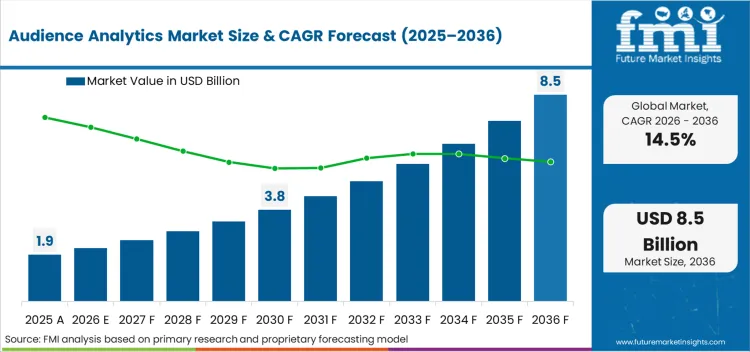
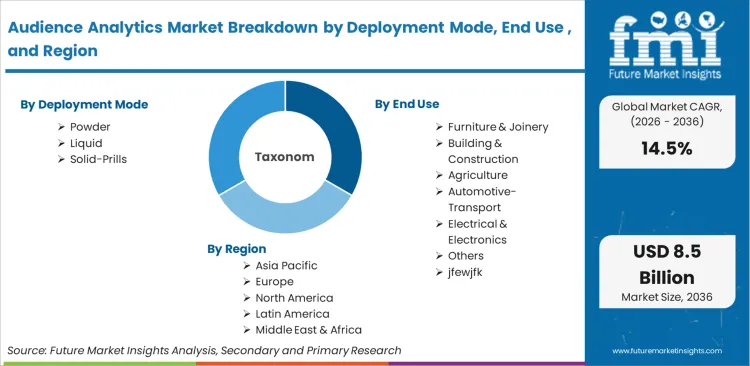
In 2025, the audience analytics Market was valued at USD 1.9 billion. Based on Future Market Insights’ analysis, demand for audience analytics platforms is estimated to grow to USD 2.2 Billion in 2026 and USD 8.5 Billion by 2036. FMI projects a CAGR of 14.5% during the forecast period.
Absolute dollar growth of USD 6.3 billion over the decade signals a structural realignment in how enterprises understand, segment, and activate audience data. Procurement specifications are shifting from discretionary, ad-hoc measurement tools to "always-on" audience infrastructure capable of unifying first-party signals across fragmented touchpoints. As per FMI's projection, this transition is driven by the need to resolve identity in a cookieless environment, forcing buyers to integrate analytics directly with cloud data warehouses rather than relying on siloed, third-party data brokers.
Summary of Audience Analytics Market
- Audience Analytics Market Definition
- Market encompasses software platforms that collect and activate behavioral and contextual data to construct actionable audience segments for targeting and personalization.
- Demand Drivers in the Market
- Deprecation of third-party tracking cookies is compelling enterprises to rebuild intelligence on first-party data foundations.
- Rapid growth of retail media networks is creating net-new procurement of audience monetization infrastructure.
- Consolidation of martech on cloud data warehouses is driving adoption of warehouse-native analytics platforms.
- Key Segments Analyzed in the FMI Report
- Form: Cloud deployment dominates with a 64% market share in 2026.
- Application: Retail & eCommerce leads with 22% of revenue share in 2026.
- Geography: North America retains the largest revenue base; Asia Pacific registers the highest growth.
- Analyst Opinion at FMI
- Rahul Pandita, Principal Consultant for Technology at Future Market Insights, opines, "In the updated version of the Audience Analytics Market Report for 2026 to 2036, CXOs will find insights into how privacy-centric data collaboration is replacing open-market programmatic buying. Besides this, my findings point at the critical role of AI in resolving identity across fragmented devices, which will distinguish winning platforms from legacy tools."
- Strategic Implications/Executive Takeaways
- Vendors must prioritize native cloud data warehouse integrations to avoid displacement by unified data platforms.
- Retail & eCommerce buyers represent the highest-velocity demand segment for go-to-market investment.
- Asia Pacific offers greenfield opportunities where local deployment and data residency compliance are key differentiators.
- Methodology
- Validated through first-hand corporate production and capacity data.
- Zero reliance on speculative third-party market research reports.
- Based on verifiable industrial benchmarks and verified sources.
As Jeff Green, CEO of The Trade Desk, noted regarding the industry's shift toward data-driven precision, “As AI transforms the advertising ecosystem, customers globally are relying on The Trade Desk to enable objective, data-rich buying across channels and partners, to drive real-world outcomes for their businesses.” [4] This perspective reinforces the broader market trend, where enterprises are increasingly prioritizing AI‑enabled, first‑party data infrastructure to navigate a cookieless future and achieve more deterministic audience intelligence.
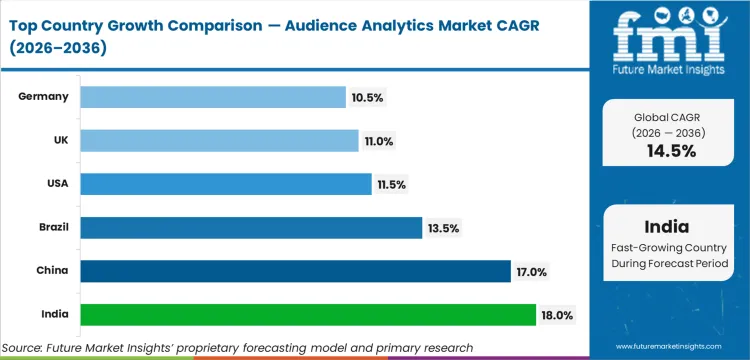
India (18.0% CAGR) and China (17.0% CAGR) represent the fastest-growing markets, driven by mobile-first digital advertising ecosystems and the scaling of domestic analytics platforms. Brazil (13.5% CAGR) follows, supported by expanding eCommerce transaction volumes and the adoption of retail media networks. Mature markets like the United States (11.5% CAGR), the United Kingdom (11.0% CAGR), and Germany (10.5% CAGR) generate demand primarily through the replacement of legacy cookie-based stacks with first-party data infrastructure, though growth is structurally constrained by the complexity of adhering to stringent regulatory frameworks like GDPR and CCPA.
Audience Analytics Market Definition
Audience analytics refers to the systematic collection, classification, analysis, and activation of behavioral, demographic, psychographic, and contextual data associated with defined user populations. Its primary function is to convert raw interaction signals-such as click streams, transaction histories, and identity graph associations-into structured audience taxonomies actionable for advertising targeting and content personalization. The market encompasses software platforms and cloud-based services enabling organizations to construct and query segments from first-party, second-party, and consented third-party data sources.
Audience Analytics Market Inclusions
The report includes a comprehensive analysis of global and regional market sizes, forecast periods, and segment breakdowns by deployment mode and end-use industry. Coverage extends to cloud-based and on-premise audience analytics platforms, identity resolution modules, behavioral segmentation engines, and real-time activation connectors. The scope also includes retail media audience analytics platforms and managed services for implementation and data governance consulting.
Audience Analytics Market Exclusions
Scope excludes general-purpose web analytics platforms used exclusively for session-level traffic measurement without audience segmentation capabilities. Customer Relationship Management (CRM) software focused solely on sales pipeline tracking, marketing automation platforms lacking standalone behavioral modeling, and pure-play data management platforms (DMPs) or data clean rooms that do not feature embedded audience analytics or segmentation modules are also omitted.
Audience Analytics Market Research Methodology
- Primary Research: Interviews were conducted with senior executives, data scientists, and marketing technology leaders across Retail & eCommerce, Media & Entertainment, BFSI, and Telecom sectors to validate demand drivers and adoption patterns.
- Desk Research: A systematic review of public financial disclosures, investor presentations, product launch announcements, regulatory filings, and technology trade publications was performed to contextualize market drivers.
- Market-Sizing and Forecasting: A bottom-up sizing methodology aggregated vendor-level revenue estimates across deployment categories, cross-validated against end-use industry adoption rates and regional digital advertising expenditure proxies.
- Data Validation and Update Cycle: Outputs undergo anomaly screening, variance checks across production and trade datasets, and structured peer review prior to release.
Segmental Analysis
Audience Analytics Market Analysis by Deployment Mode
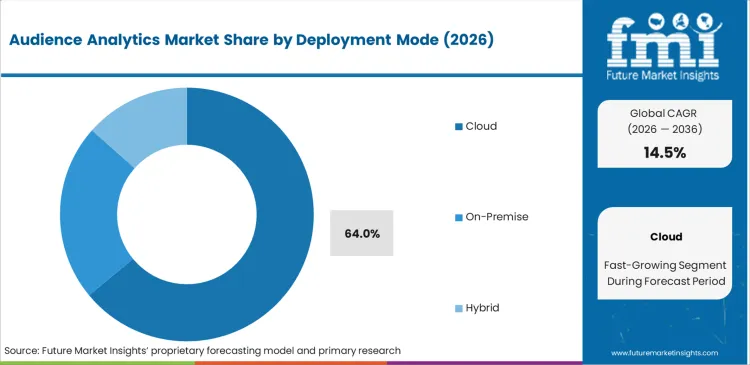
Based on FMI's Audience Analytics Market report, consumption of Cloud deployment is estimated to hold 64% share in 2026. Growth in this segment is driven by the structural preference for scalable, API-native platforms that eliminate on-premise management burdens and integrate natively with modern marketing stacks.
- Warehouse-Native Integration: Demand is reinforced by the shift toward "composable" architectures, where analytics sit directly on top of data clouds; Snowflake's 2025 Modern Marketing Data Stack report highlights "One to Watch" partners like Audience Acuity that enable identity resolution directly within the AI Data Cloud [2].
- Real-Time Scalability: Adoption accelerates where programmatic advertising requires sub-second segment updates; Adobe's Real-Time CDP Collaboration, launched in early 2025, allows brands to discover and activate high-value audiences instantly without data replication [5].
- Cost Efficiency: Enterprise procurement shifts to cloud models to leverage elastic compute for heavy query loads, allowing marketing teams to process millions of behavioral signals without the capital expenditure of on-premise hardware.
Audience Analytics Market Analysis by End Use Industry
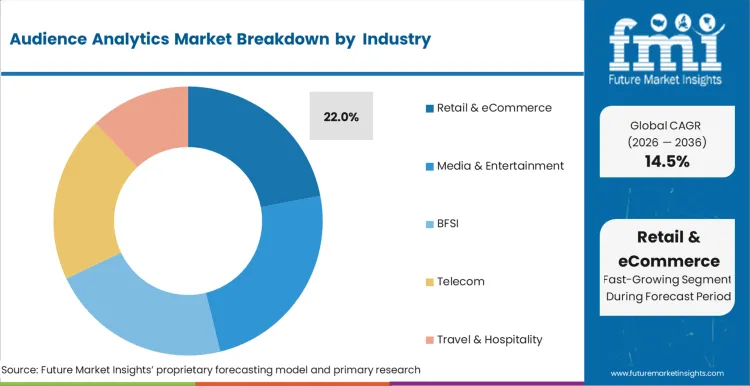
Retail & eCommerce holds 22% share in 2026, driven by the convergence of shopper data monetization and the structural growth of retail media networks. FMI analysts opine that retailers are investing heavily to construct granular shopper segments that command higher CPMs from brand advertisers, underwriting analytics investment with direct revenue generation.
- Retail Media Monetization: Growth is anchored in the need for closed-loop attribution; Nielsen’s 2025 Annual Marketing Report notes that 65% of marketers plan to increase the role of retail media networks in their strategies, necessitating robust analytics to prove ROI [3].
- Audience Suppression: Retailers deploy analytics to suppress recent purchasers from retargeting campaigns, a strategy that delivers quantifiable ROI by eliminating wasted ad spend on users who have already converted.
- Cross-Channel Identity: The proliferation of touchpoints necessitates platforms with identity resolution; The Trade Desk’s integration with Warner Bros. Discovery via OpenPath enables advertisers to connect campaigns to real-world outcomes across streaming and display channels [4].
Audience Analytics Market Drivers, Restraints, and Opportunities
Drivers and Restraints
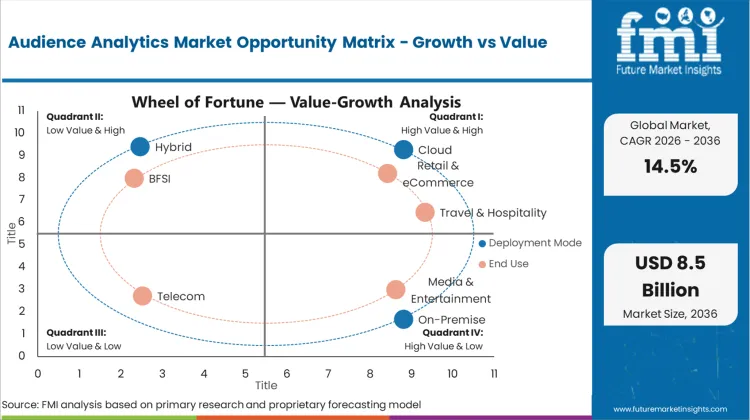
Future Market Insights analysis observes that the audience analytics market is in a structural inflection phase, transitioning from passive cookie collection to active, infrastructure-level intelligence. The obsolescence of third-party cookies functions as a "green de-commoditization" event, creating a quality premium for platforms that deliver deterministic, consented, first-party signals. Buyers can no longer substitute cheap, cookie-based targeting for genuine audience understanding, compelling investment in purpose-built platforms like Adobe Real-Time CDP Collaboration that provide durable, legally compliant audience signals [5].
However, growth is restrained by the complexity of adhering to divergent global privacy frameworks. Regulatory mandates such as GDPR and CCPA function as a compliance gate, requiring platforms to embed consent management and audit trails directly into the segmentation workflow. This increases the total cost of ownership and extends implementation timelines, particularly for legacy enterprises migrating from on-premise systems.
Opportunities
- Green De-commoditization: The shift to first-party data creates an opportunity for vendors to upsell "clean room" and collaboration capabilities; Adobe's 2025 launch of brand-to-brand collaboration tools allows advertisers to securely match audiences with publishers without exposing PII [5].
- Export-Driven Upgrading: In developing markets, export-oriented digital commerce is introducing international measurement standards; platforms that offer global-grade verification and de-duplication are displacing local point solutions.
- AI-Driven Segmentation: The integration of generative AI into analytics platforms offers a new frontier for value creation; Snowflake's AI Data Cloud enables marketers to use natural language to query audience data, lowering the technical barrier to entry for complex segmentation [2].
Regional Analysis
Based on the regional analysis, the Audience Analytics Market is segmented into North America, Latin America, Europe, East Asia, South Asia, Oceania and Middle East & Africa across 40+ countries. The full report also offers market attractiveness analysis based on regional trends.
.webp "Top Country Growth Comparison Audience Analytics Market Cagr (2026 2036)")
| Country | CAGR (2026 to 2036) |
|---|---|
| India | 18.0% |
| China | 17.0% |
| Brazil | 13.5% |
| United States | 11.5% |
| United Kingdom | 11.0% |
| Germany | 10.5% |
Source: Future Market Insights (FMI) analysis, based on proprietary forecasting model and primary research
Asia Pacific Audience Analytics Market Analysis
Asia Pacific is the highest-growth region, characterized by rapid digital advertising expansion and mobile-first audience behaviors. FMI analysts opine that the region is seeing a surge in domestic analytics platforms in China and high adoption of global tools in India to support programmatic advertising transitions.
- China: Leading with a 17.0% CAGR, the market is shifting toward unified commerce environments where platforms integrate social and entertainment data to generate rich behavioral insights. This demand is supported by the need for sophisticated segmentation to navigate the unique walled gardens of the Chinese digital ecosystem.
- India: Domestic demand is accelerating at an 18.0% CAGR, supported by a digital advertising market transitioning from impression-based to audience-optimized buying. Growth is anchored in the adoption of first-party data strategies, which are becoming essential as privacy regulations tighten and third-party cookies decline [1].
The full report analyzes the audience analytics market across East and South Asia from 2021-2036, covering pricing, trends, and growth drivers in China, India, Japan, South Korea, and Australia. The assessment highlights trends that dictate regional platform adoption and data residency strategies.
North America Audience Analytics Market Analysis
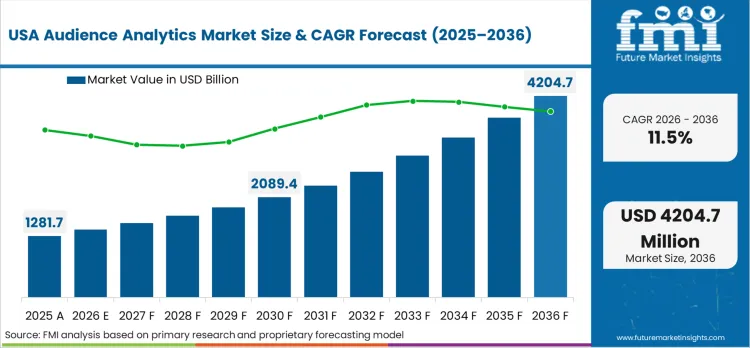
North America represents the global center of the audience analytics market, driven by the scale of its programmatic advertising ecosystem and high enterprise software penetration. According to FMI's estimates, the region's sophisticated retail media sector drives innovation in shopper data monetization and cross-channel measurement.
- United States: Demand for audience analytics in the United States is projected to rise at 11.5% CAGR through 2036. This growth is driven by the structural shift of media conglomerates toward census-level measurement systems, evidenced by Nielsen's expansion of OOH measurement to cover 100% of the US population in February 2025, enabling advertisers to capture a complete view of unique viewership [3].
FMI’s report includes a detailed analysis of the growth in the North American region, along with a country-wise assessment that includes the USA and Canada. Readers can also find regional trends, regulations, and market growth based on different segments and countries in the North America region.
Latin America Audience Analytics Market Analysis
Latin America is led by rapid digital commerce growth, particularly in Brazil and Mexico, where expanding transaction volumes are creating the raw material for sophisticated audience segmentation. The region is transitioning from basic web analytics to advanced audience intelligence to support CPG and retail advertising.
- Brazil: A projected 13.5% CAGR through 2036 is supported by the explosion of eCommerce and super-app ecosystems that generate massive first-party transactional data. Retailers are monetizing this data through new analytics investments, necessitating enterprise-grade segmentation tools to optimize marketing spend and retain high-value customers.
The report consists of a detailed analysis for the market in Brazil, Mexico, Argentina, and Rest of Latin America. Readers can find detailed information about several factors, such as the pricing analysis and regional trends, which are impacting growth in the Latin America region.
Europe Audience Analytics Market Analysis
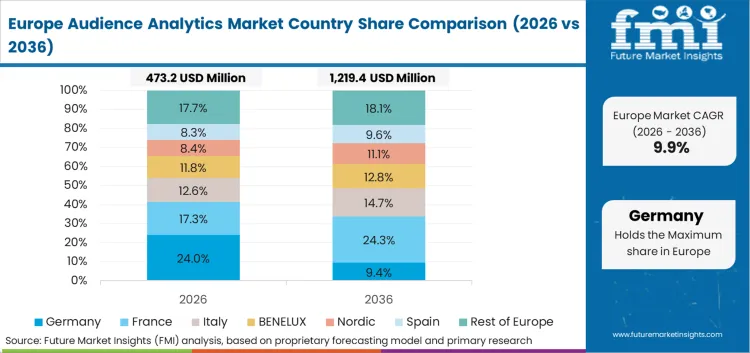
Europe is defined by the stringent regulatory architecture of GDPR, which shapes the market by imposing strict consent and data minimization obligations. The region leads globally in the deployment of privacy-compliant, first-party data strategies and clean room infrastructure.
- United Kingdom: Demand for audience analytics in the United Kingdom is rising at an 11.0% CAGR through 2036, driven by the advanced deprecation of cross-site tracking. Publishers and advertisers are investing in server-side tracking and first-party identity resolution frameworks, treating audience analytics as a compliance-necessary system rather than just a targeting tool.
FMI’s analysis of the audience analytics market in Europe consists of country-wise assessment that includes the United Kingdom, Germany, France, Italy, and Spain. Readers can know various regulations and latest trends in the regional market.
Competitive Aligners for Market Players
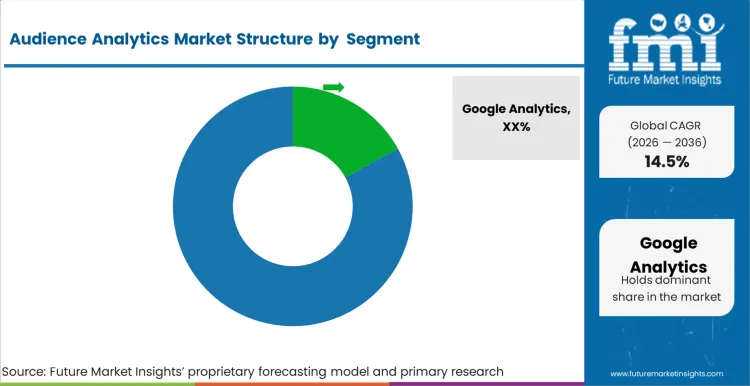
The audience analytics market is characterized by a competitive structure that spans hyperscale cloud platform vendors, specialized independent software vendors, and enterprise software conglomerates. The market is moderately concentrated at the top with players like Google and Adobe, but remains fragmented in specialized segments. FMI analysts opine that the primary competitive variable is the depth of first-party data integration, with advantage accruing to vendors that offer pre-built connectors to enterprise data warehouses and CRM systems.
Structural advantages are held by vendors that can simultaneously address data integration breadth and privacy-compliant architecture. Companies like Snowflake and Databricks are leveraging their infrastructure dominance to extend into analytics use cases, challenging traditional marketing cloud vendors. These infrastructure-native players benefit from the "data gravity" of the warehouse, offering lower total cost of ownership and superior security compliance compared to point solutions that require data replication.
Buyer behavior is increasingly influenced by the need to avoid vendor lock-in and ensure regulatory compliance. Large enterprise customers are managing supplier dependency by prioritizing platforms with open APIs and "bring your own model" capabilities. This shifts pricing power toward vendors that can demonstrate interoperability and audit readiness. Privacy-by-design is becoming a critical selection criterion, with buyers favoring vendors that embed consent enforcement directly into the segmentation workflow.
Recent Developments
- In February 2025, Adobe announced the general availability of Real-Time CDP Collaboration in the USA, enabling advertisers and publishers to collaborate on first-party data without sharing PII.[5]
- In October 2024, Snowflake recognized Audience Acuity as a "One to Watch" partner in its 2025 Modern Marketing Data Stack report for its identity resolution capabilities.[2]
Key Players in the Audience Analytics Market
- Google Analytics
- Adobe Analytics
- Mixpanel
- Amplitude
- Snowflake
- Databricks
- SAS
- IBM
- Oracle
- Salesforce
Scope of the Report
| Metric | Value |
|---|---|
| Quantitative Units | USD 2.2 Billion (2026) to USD 8.5 Billion (2036), at a CAGR of 14.5% |
| Market Definition | Audience analytics refers to the systematic collection, classification, analysis, and activation of behavioral, demographic, psychographic, and contextual data associated with defined user populations, primarily utilizing first-party and consented data sources for targeted advertising and personalization. |
| Deployment Mode Segmentation | Cloud, On-Premise, Hybrid |
| End Use Industry Segmentation | Retail & eCommerce, Media & Entertainment, BFSI, Telecom, Travel & Hospitality, Others |
| Application Coverage | Behavioral Segmentation, Identity Resolution, Reach/Frequency Analytics, Retail Media Monetization |
| Regions Covered | North America, Latin America, Europe, Asia Pacific, Middle East & Africa |
| Countries Covered | United States, Canada, Mexico, Brazil, Argentina, Germany, France, United Kingdom, Italy, Spain, China, India, Japan, South Korea, Australia, and others |
| Key Companies Profiled | Google Analytics, Adobe Analytics, Mixpanel, Amplitude, Snowflake, Databricks, SAS, IBM, Oracle, Salesforce |
| Forecast Period | 2026 to 2036 |
| Approach | Bottom-up sizing methodology aggregating vendor-level revenue estimates across deployment categories, cross-validated against end-use industry adoption rates and regional digital advertising expenditure proxies |
Audience Analytics Market Analysis by Segments
Deployment Mode
- Cloud
- On-Premise
- Hybrid
End Use Industry
- Retail & eCommerce
- Media & Entertainment
- BFSI
- Telecom
- Travel & Hospitality
- Others
Region
- North America
- Latin America
- Europe
- East Asia
- South Asia
- Oceania
- Middle East & Africa
Bibliography
- [1] HT Media. (2025). First Party Data 2025: Definition, Use Cases, and Segmentation Strategies. HT Media.
- [2] Audience Acuity. (2024). Audience Acuity Recognized as “One to Watch” in Snowflake’s 2025 Modern Marketing Data Stack Report. Audience Acuity Press Release, October 2024.
- [3] Nielsen. (2025). Nielsen Releases its 2025 Annual Marketing Report Looking at the Power of Data-Driven Marketing. Nielsen News Center, May 2025.
- [4] The Trade Desk. (2025). The Trade Desk Reports Third Quarter 2025 Financial Results. Investor Relations, November 2025.
- [5] Adobe. (2025). Adobe Announces General Availability of Real-Time CDP Collaboration for Brands to Jointly Drive Ad Performance in a Privacy-First Landscape. Adobe News, February 2025.
This bibliography is provided for reader reference and is not exhaustive. The full report contains the complete reference list and detailed citations.
This Report Addresses
- Market intelligence to enable structured strategic decision making across enterprise and mid-market segments.
- Market size estimation and 10-year revenue forecasts from 2026 to 2036, supported by validated capacity and trade benchmarks.
- Growth opportunity mapping across cloud, on-premise, and hybrid deployment modes.
- Segment and regional revenue forecasts covering Retail, Media, BFSI, and Telecom industries.
- Competition strategy assessment including cloud warehouse integration and privacy-compliant architecture.
- Product capability tracking including identity resolution, real-time segmentation, and activation.
- Regulatory impact analysis covering GDPR, CCPA, and cookie deprecation effects.
- Market report delivery in PDF, Excel, PPT, and interactive dashboard formats.
Frequently Asked Questions
How large is the demand for Audience Analytics in the global market in 2026?
Demand for Audience Analytics in the global market is estimated to be valued at USD 2.2 Billion in 2026.
What will be the market size of Audience Analytics in the global market by 2036?
Market size for Audience Analytics is projected to reach USD 8.5 Billion by 2036.
What is the expected demand growth for Audience Analytics in the global market between 2026 and 2036?
Demand for Audience Analytics in the global market is expected to grow at a CAGR of 14.5% between 2026 and 2036.
Which deployment mode is poised to lead global sales by 2026?
Cloud deployment is expected to be the dominant mode, capturing approximately 64% of global market share in 2026 due to scalability and warehouse integration.
How significant is the role of Retail & eCommerce in driving Audience Analytics adoption in 2026?
Retail & eCommerce represents a critical segment, projected to hold a substantial 22% share of the total market in 2026 as retail media monetization drives investment.
What is driving demand in the United States?
Demand is driven by the structural shift of media conglomerates and streaming platforms toward census-level measurement systems to replace legacy panels.
What compliance standards or regulations are referenced for the United States?
Regulations such as CCPA and the deprecation of third-party cookies are referenced as key drivers for first-party data infrastructure adoption.
What is the United States growth outlook in this report?
The United States is projected to grow at a CAGR of 11.5% during 2026 to 2036.
Why is Europe described as a priority region in this report?
Europe is a priority because GDPR imposes strict consent obligations, driving demand for privacy-compliant, first-party data strategies.
What type of demand dominates in Europe?
Demand for consent management integration and privacy-compliant analytics dominates regional consumption.
What is Germany growth outlook in this report?
Germany is projected to expand at a CAGR of 10.5% during 2026 to 2036.
Does the report cover India in its regional analysis?
Yes, India is included within Asia Pacific under the regional scope of analysis.
What are the sources referred to for analyzing India?
Primary research and digital advertising expenditure proxies are used to validate the high growth in India's mobile-first ecosystem.
What is the main demand theme linked to India in its region coverage?
India's demand is linked to the rapid expansion of the internet user base and the transition to audience-optimized programmatic buying.
Does the report cover China in its regional analysis?
Yes, China is included within Asia Pacific under the regional coverage framework.
What is the main China related demand theme in its region coverage?
Demand in China is driven by the need for sophisticated segmentation to navigate unified commerce, social, and entertainment platforms.
Which deployment mode is strategically important for North American supply chains?
Cloud deployment is strategically important due to the need for elastic scalability and native integration with modern marketing stacks.
What is Audience Analytics and what is it mainly used for?
Audience analytics refers to the systematic collection and analysis of behavioral data to construct audience segments for targeted advertising and personalization.
What does Audience Analytics Market mean in this report?
Audience Analytics Market refers to the global software and services market for platforms that enable the construction and activation of audience segments.
What is included in the scope of this Audience Analytics report?
The scope covers audience analytics platforms by deployment mode, end-use industry, and key applications like identity resolution and retail media.
What is excluded from the scope of this report?
General-purpose web analytics, CRM software without behavioral modeling, and pure-play DMPs without embedded analytics are excluded.
What does market forecast mean on this page?
Market forecast represents a model-based projection built on defined assumptions for strategic planning purposes.
How does FMI build and validate the Audience Analytics forecast?
The forecast is developed using a bottom-up sizing methodology aggregated from vendor revenues and cross-validated against industry adoption rates.
What does zero reliance on speculative third-party market research mean here?
Primary interviews and verifiable public datasets are used instead of unverified syndicated market estimates.
Preview the report firsthand - request a free sample
Get SampleGet the brochure for pricing and purchase details.
Get PDFTable of Content
- Executive Summary
- Global Market Outlook
- Demand-side Trends
- Supply-side Trends
- Technology Roadmap Analysis
- Analysis and Recommendations
- Market Overview
- Market Coverage / Taxonomy
- Market Definition / Scope / Limitations
- Research Methodology
- Chapter Orientation
- Analytical Lens and Working Hypotheses
- Market Structure, Signals, and Trend Drivers
- Benchmarking and Cross-market Comparability
- Market Sizing, Forecasting, and Opportunity Mapping
- Research Design and Evidence Framework
- Desk Research Programme (Secondary Evidence)
- Company Annual and Sustainability Reports
- Peer-reviewed Journals and Academic Literature
- Corporate Websites, Product Literature, and Technical Notes
- Earnings Decks and Investor Briefings
- Statutory Filings and Regulatory Disclosures
- Technical White Papers and Standards Notes
- Trade Journals, Industry Magazines, and Analyst Briefs
- Conference Proceedings, Webinars, and Seminar Materials
- Government Statistics Portals and Public Data Releases
- Press Releases and Reputable Media Coverage
- Specialist Newsletters and Curated Briefings
- Sector Databases and Reference Repositories
- FMI Internal Proprietary Databases and Historical Market Datasets
- Subscription Datasets and Paid Sources
- Social Channels, Communities, and Digital Listening Inputs
- Additional Desk Sources
- Expert Input and Fieldwork (Primary Evidence)
- Primary Modes
- Qualitative Interviews and Expert Elicitation
- Quantitative Surveys and Structured Data Capture
- Blended Approach
- Why Primary Evidence is Used
- Field Techniques
- Interviews
- Surveys
- Focus Groups
- Observational and In-context Research
- Social and Community Interactions
- Stakeholder Universe Engaged
- C-suite Leaders
- Board Members
- Presidents and Vice Presidents
- R&D and Innovation Heads
- Technical Specialists
- Domain Subject-matter Experts
- Scientists
- Physicians and Other Healthcare Professionals
- Governance, Ethics, and Data Stewardship
- Research Ethics
- Data Integrity and Handling
- Primary Modes
- Tooling, Models, and Reference Databases
- Desk Research Programme (Secondary Evidence)
- Data Engineering and Model Build
- Data Acquisition and Ingestion
- Cleaning, Normalisation, and Verification
- Synthesis, Triangulation, and Analysis
- Quality Assurance and Audit Trail
- Market Background
- Market Dynamics
- Drivers
- Restraints
- Opportunity
- Trends
- Scenario Forecast
- Demand in Optimistic Scenario
- Demand in Likely Scenario
- Demand in Conservative Scenario
- Opportunity Map Analysis
- Product Life Cycle Analysis
- Supply Chain Analysis
- Investment Feasibility Matrix
- Value Chain Analysis
- PESTLE and Porter’s Analysis
- Regulatory Landscape
- Regional Parent Market Outlook
- Production and Consumption Statistics
- Import and Export Statistics
- Market Dynamics
- Global Market Analysis 2021 to 2025 and Forecast, 2026 to 2036
- Historical Market Size Value (USD Million) Analysis, 2021 to 2025
- Current and Future Market Size Value (USD Million) Projections, 2026 to 2036
- Y-o-Y Growth Trend Analysis
- Absolute $ Opportunity Analysis
- Global Market Pricing Analysis 2021 to 2025 and Forecast 2026 to 2036
- Global Market Analysis 2021 to 2025 and Forecast 2026 to 2036, By Deployment Mode
- Introduction / Key Findings
- Historical Market Size Value (USD Million) Analysis By Deployment Mode , 2021 to 2025
- Current and Future Market Size Value (USD Million) Analysis and Forecast By Deployment Mode , 2026 to 2036
- Cloud
- On-Premise
- Hybrid
- Cloud
- Y-o-Y Growth Trend Analysis By Deployment Mode , 2021 to 2025
- Absolute $ Opportunity Analysis By Deployment Mode , 2026 to 2036
- Global Market Analysis 2021 to 2025 and Forecast 2026 to 2036, By End Use
- Introduction / Key Findings
- Historical Market Size Value (USD Million) Analysis By End Use, 2021 to 2025
- Current and Future Market Size Value (USD Million) Analysis and Forecast By End Use, 2026 to 2036
- Retail & eCommerce
- Media & Entertainment
- BFSI
- Telecom
- Travel & Hospitality
- Retail & eCommerce
- Y-o-Y Growth Trend Analysis By End Use, 2021 to 2025
- Absolute $ Opportunity Analysis By End Use, 2026 to 2036
- Global Market Analysis 2021 to 2025 and Forecast 2026 to 2036, By Region
- Introduction
- Historical Market Size Value (USD Million) Analysis By Region, 2021 to 2025
- Current Market Size Value (USD Million) Analysis and Forecast By Region, 2026 to 2036
- North America
- Latin America
- Western Europe
- Eastern Europe
- East Asia
- South Asia and Pacific
- Middle East & Africa
- Market Attractiveness Analysis By Region
- North America Market Analysis 2021 to 2025 and Forecast 2026 to 2036, By Country
- Historical Market Size Value (USD Million) Trend Analysis By Market Taxonomy, 2021 to 2025
- Market Size Value (USD Million) Forecast By Market Taxonomy, 2026 to 2036
- By Country
- USA
- Canada
- Mexico
- By Deployment Mode
- By End Use
- By Country
- Market Attractiveness Analysis
- By Country
- By Deployment Mode
- By End Use
- Key Takeaways
- Latin America Market Analysis 2021 to 2025 and Forecast 2026 to 2036, By Country
- Historical Market Size Value (USD Million) Trend Analysis By Market Taxonomy, 2021 to 2025
- Market Size Value (USD Million) Forecast By Market Taxonomy, 2026 to 2036
- By Country
- Brazil
- Chile
- Rest of Latin America
- By Deployment Mode
- By End Use
- By Country
- Market Attractiveness Analysis
- By Country
- By Deployment Mode
- By End Use
- Key Takeaways
- Western Europe Market Analysis 2021 to 2025 and Forecast 2026 to 2036, By Country
- Historical Market Size Value (USD Million) Trend Analysis By Market Taxonomy, 2021 to 2025
- Market Size Value (USD Million) Forecast By Market Taxonomy, 2026 to 2036
- By Country
- Germany
- UK
- Italy
- Spain
- France
- Nordic
- BENELUX
- Rest of Western Europe
- By Deployment Mode
- By End Use
- By Country
- Market Attractiveness Analysis
- By Country
- By Deployment Mode
- By End Use
- Key Takeaways
- Eastern Europe Market Analysis 2021 to 2025 and Forecast 2026 to 2036, By Country
- Historical Market Size Value (USD Million) Trend Analysis By Market Taxonomy, 2021 to 2025
- Market Size Value (USD Million) Forecast By Market Taxonomy, 2026 to 2036
- By Country
- Russia
- Poland
- Hungary
- Balkan & Baltic
- Rest of Eastern Europe
- By Deployment Mode
- By End Use
- By Country
- Market Attractiveness Analysis
- By Country
- By Deployment Mode
- By End Use
- Key Takeaways
- East Asia Market Analysis 2021 to 2025 and Forecast 2026 to 2036, By Country
- Historical Market Size Value (USD Million) Trend Analysis By Market Taxonomy, 2021 to 2025
- Market Size Value (USD Million) Forecast By Market Taxonomy, 2026 to 2036
- By Country
- China
- Japan
- South Korea
- By Deployment Mode
- By End Use
- By Country
- Market Attractiveness Analysis
- By Country
- By Deployment Mode
- By End Use
- Key Takeaways
- South Asia and Pacific Market Analysis 2021 to 2025 and Forecast 2026 to 2036, By Country
- Historical Market Size Value (USD Million) Trend Analysis By Market Taxonomy, 2021 to 2025
- Market Size Value (USD Million) Forecast By Market Taxonomy, 2026 to 2036
- By Country
- India
- ASEAN
- Australia & New Zealand
- Rest of South Asia and Pacific
- By Deployment Mode
- By End Use
- By Country
- Market Attractiveness Analysis
- By Country
- By Deployment Mode
- By End Use
- Key Takeaways
- Middle East & Africa Market Analysis 2021 to 2025 and Forecast 2026 to 2036, By Country
- Historical Market Size Value (USD Million) Trend Analysis By Market Taxonomy, 2021 to 2025
- Market Size Value (USD Million) Forecast By Market Taxonomy, 2026 to 2036
- By Country
- Kingdom of Saudi Arabia
- Other GCC Countries
- Turkiye
- South Africa
- Other African Union
- Rest of Middle East & Africa
- By Deployment Mode
- By End Use
- By Country
- Market Attractiveness Analysis
- By Country
- By Deployment Mode
- By End Use
- Key Takeaways
- Key Countries Market Analysis
- USA
- Pricing Analysis
- Market Share Analysis, 2025
- By Deployment Mode
- By End Use
- Canada
- Pricing Analysis
- Market Share Analysis, 2025
- By Deployment Mode
- By End Use
- Mexico
- Pricing Analysis
- Market Share Analysis, 2025
- By Deployment Mode
- By End Use
- Brazil
- Pricing Analysis
- Market Share Analysis, 2025
- By Deployment Mode
- By End Use
- Chile
- Pricing Analysis
- Market Share Analysis, 2025
- By Deployment Mode
- By End Use
- Germany
- Pricing Analysis
- Market Share Analysis, 2025
- By Deployment Mode
- By End Use
- UK
- Pricing Analysis
- Market Share Analysis, 2025
- By Deployment Mode
- By End Use
- Italy
- Pricing Analysis
- Market Share Analysis, 2025
- By Deployment Mode
- By End Use
- Spain
- Pricing Analysis
- Market Share Analysis, 2025
- By Deployment Mode
- By End Use
- France
- Pricing Analysis
- Market Share Analysis, 2025
- By Deployment Mode
- By End Use
- India
- Pricing Analysis
- Market Share Analysis, 2025
- By Deployment Mode
- By End Use
- ASEAN
- Pricing Analysis
- Market Share Analysis, 2025
- By Deployment Mode
- By End Use
- Australia & New Zealand
- Pricing Analysis
- Market Share Analysis, 2025
- By Deployment Mode
- By End Use
- China
- Pricing Analysis
- Market Share Analysis, 2025
- By Deployment Mode
- By End Use
- Japan
- Pricing Analysis
- Market Share Analysis, 2025
- By Deployment Mode
- By End Use
- South Korea
- Pricing Analysis
- Market Share Analysis, 2025
- By Deployment Mode
- By End Use
- Russia
- Pricing Analysis
- Market Share Analysis, 2025
- By Deployment Mode
- By End Use
- Poland
- Pricing Analysis
- Market Share Analysis, 2025
- By Deployment Mode
- By End Use
- Hungary
- Pricing Analysis
- Market Share Analysis, 2025
- By Deployment Mode
- By End Use
- Kingdom of Saudi Arabia
- Pricing Analysis
- Market Share Analysis, 2025
- By Deployment Mode
- By End Use
- Turkiye
- Pricing Analysis
- Market Share Analysis, 2025
- By Deployment Mode
- By End Use
- South Africa
- Pricing Analysis
- Market Share Analysis, 2025
- By Deployment Mode
- By End Use
- USA
- Market Structure Analysis
- Competition Dashboard
- Competition Benchmarking
- Market Share Analysis of Top Players
- By Regional
- By Deployment Mode
- By End Use
- Competition Analysis
- Competition Deep Dive
- Google Analytics
- Overview
- Product Portfolio
- Profitability by Market Segments (Product/Age /Sales Channel/Region)
- Sales Footprint
- Strategy Overview
- Marketing Strategy
- Product Strategy
- Channel Strategy
- Adobe Analytics
- Mixpanel
- Amplitude
- Snowflake
- Databricks
- SAS
- IBM
- Oracle
- Google Analytics
- Competition Deep Dive
- Assumptions & Acronyms Used


