

- Industry Size (2026)
- USD 79.8 Bn
- Forecast (2036)
- USD 339.9 Bn
- CAGR (2026 to 2036)
- 15.6%
Location Based Marketing Services Market Forecast and Outlook 2026 to 2036
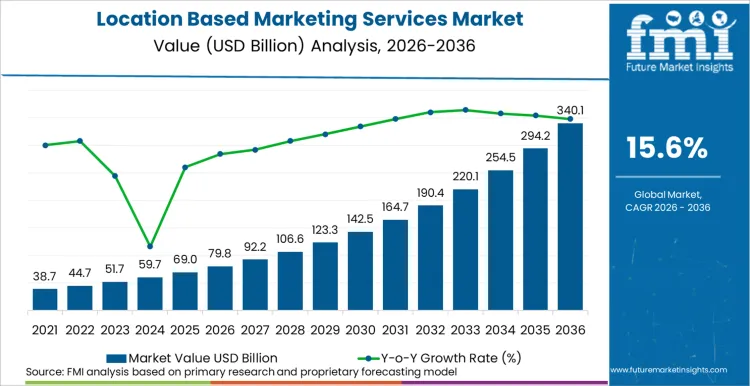
In 2025, the location based marketing services market was valued at USD 69.0 billion. Based on Future Market Insights' analysis, demand is estimated to grow to USD 79.8 billion in 2026 and USD 339.9 billion by 2036. FMI projects a CAGR of 15.6% during the forecast period.
Absolute dollar growth of USD 260.2 billion over the decade reflects a structural shift in digital advertising toward location-verified attribution. The integration of AI into 61% of advertising campaign delivery systems by early 2026 has enabled closed-loop optimization that predicts consumer movement patterns and triggers ads before a user enters a defined geofence. Hybrid proximity deployments combining GPS-based geofencing for nearby app users with Bluetooth Low Energy beacons for aisle-level in-store navigation are becoming the standard enterprise configuration.
As Nick Patrick, CEO of Radar, stated regarding the evolution of geolocation data, 'In 2025, enterprises leaned into geolocation in new ways. Geolocation, once a nice-to-have, is increasingly mission-critical infrastructure.' [1]
The United States (16.2% CAGR) leads through digital advertising maturity and retail media network investment. China (17.0% CAGR) is the fastest-growing market, driven by super-app ecosystem integration and retail proximity marketing adoption. India (16.5% CAGR) benefits from smartphone penetration growth and digital payment integration with location triggers. Germany (14.5% CAGR) grows through GDPR-compliant contextual targeting solutions. Japan (13.8% CAGR) contributes through transit system advertising integration.
Location Based Marketing Services Market Market Definition
The location based marketing services market covers the provision of marketing technology services that use real-time or historical geographic location data to deliver targeted advertising, proximity alerts, in-store navigation, and location analytics to consumers. Technologies include GPS/geofencing, Bluetooth Low Energy beacons, Wi-Fi positioning, NFC, and hybrid systems.
Location Based Marketing Services Market Market Inclusions
The report covers global and regional market sizes by revenue for the 2026 to 2036 forecast period. It includes segmental breakdowns by technology, application, and end use. Platform licensing revenue, advertising spend attribution, and privacy compliance tracking are included.
Location Based Marketing Services Market Market Exclusions
The scope excludes general-purpose digital advertising platforms that do not use location data as a primary targeting signal. It also omits standalone GPS navigation services, fleet management telematics, and location-based gaming unless monetized through advertising or marketing partnerships.
Location Based Marketing Services Market Research Methodology
- Primary Research: Interviews were conducted with location data platform providers, retail media network operators, digital advertising agencies, beacon hardware manufacturers, and privacy compliance officers across the United States, Europe, China, and India.
- Desk Research: Digital advertising spend databases, app download and SDK integration statistics, beacon deployment tracking, and privacy regulation implementation records supported demand benchmarking.
- Market-Sizing and Forecasting: A hybrid model combined top-down digital advertising spend analysis with bottom-up location SDK activation data and beacon hardware shipments, validated against platform revenue disclosures.
- Data Validation and Update Cycle: Outputs undergo anomaly screening, variance checks across advertising spend and location event datasets, and structured peer review prior to release.
Summary of Location Based Marketing Services Market
- Power in the location based marketing services value chain is concentrated among mobile operating system owners and digital advertising platforms. Google and Apple control the location permission frameworks on Android and iOS, and any change to location data access policies directly affects the entire downstream LBMS ecosystem. As per FMI, platforms like Radar and Foursquare that build first-party location SDKs integrated directly into enterprise apps hold a structural advantage over providers that depend on third-party data aggregators, which face increasing privacy restrictions.
- Pricing asymmetry reflects the attribution-value hierarchy. Basic geofencing notification services are commoditized at per-message pricing under USD 0.01, while closed-loop attribution platforms that connect digital ad impressions to verified physical store visits command enterprise subscription fees of USD 50,000 to 500,000 per year. FMI analysts note that the highest-value segment is retail media networks that use location data to sell in-store advertising inventory to CPG brands, creating a new margin layer on top of existing physical retail infrastructure.
- Sourcing fragility centres on location data quality and consent management. Apple's App Tracking Transparency and Google's evolving Privacy Sandbox have progressively restricted access to device-level location signals, forcing LBMS providers to invest in first-party data collection through SDK integrations with enterprise apps. Beacon hardware supply is concentrated among fewer than ten global BLE beacon manufacturers, and chip shortages can delay deployment timelines.
- Brand and compliance risks are tied to privacy regulation enforcement. GDPR in Europe, CCPA/CPRA in California, and India's Digital Personal Data Protection Act impose consent requirements and data minimization obligations on location data collection. FMI opines that LBMS providers who build privacy-by-design architectures and maintain documented consent management systems will retain enterprise client confidence through regulatory tightening cycles.
- Geographic leverage varies by digital advertising maturity. The United States has the most developed retail media network ecosystem. China's super-app platforms (WeChat, Alipay) enable location marketing at scale within closed ecosystems. Europe is GDPR-constrained but growing through contextual and consented location targeting. India is a rapid-adoption market where smartphone penetration and UPI digital payment integration create new location-triggered marketing touchpoints.
- For C-suite executives in retail, advertising, and martech, the LBMS market through 2036 rewards companies that own first-party location data through SDK integration, build closed-loop attribution systems that prove physical-visit ROI, and invest in privacy-compliant consent infrastructure. The competitive moat sits in data quality, attribution accuracy, and regulatory compliance capability.
Key Industry Highlights
Integration of Advanced Technologies such as Artificial Intelligence (AI), Machine Learning (ML)
The location based marketing services market is witnessing significant growth due to integration of emerging technologies such as AI, ML, and cloud computing to improve the operational efficiency of the services and reduce the overhead costs. AI and ML technologies ability to analyze complex and enormous amount of data to identify patterns and predict consumer behavior is creating favorable environment for location based marketing services market.
AI and ML tools process the data from multiple sources and prepare the individual customer profiles. This enables marketers to tailor the custom and personalized messages targeting the needs of the customers and encouraging them to purchase the products.
Additionally, by locating micro-segments within larger consumers groups, AI and ML equipped LBMS can improve targeting and segmentation. Traditional marketing are generally dependent of broad demographic categories; however, with use of AI-equipped LBMS, niche and potential audience with the specific patterns can be identified.
These allows marketers to design more effective and targeted campaigns to send the right message to the targeted audience in real time. AI continuously monitors the marketing campaigns providing actionable insights to the marketing professionals to modify offers or efficient budget allocation.
Location-Based Social Media Advertising is an Escalating Trend
Location-based social media approach is a cutting-edge and effective marketing strategy that utilizes users' geolocation data on social media sites to target ads, social media advertising. This approach leverages the vast data collection capabilities of the social media and extensive usage of the smartphones. Businesses can serve ads that are relevant to their present context such as region-specific promotions, nearby stores, and local events.
One of the main advantage of the location-based social media advertising is personalized and timely marketing messages, supporting the location based marketing services market growth. For instance, restaurant can employ targeted advertising within a certain area at lunch time to reach user and luring them in with exclusive offers and discounts.
Similar to this, retail establishments can advertise in-store deals or recent arrivals to customers in the area, increasing foot traffic and revenue. As this advertisement are relevant to user’s want and needs, its boosts the customer engagement and conversion.
Social media platforms such as X (Twitter), Instagram, Facebook, and Snapchat possess effective geolocation capabilities that market professionals can utilize to drive the traffic on their websites. With the help of these platforms, advertisers can specify target regions that small as a single block or as large as an entire city. Additionally, they offer thorough analytics and insights into location-based campaign effectiveness, allowing marketers to enhance ROI and optimize their approaches.
Rising Smart City Initiatives across the Globe
Metropolitan areas are being transformed owing to smart projects in which advanced technologies are integrated to improve quality of life, economic growth, and sustainability. Location based marketing services uses networked architecture of smart cities to offer creative marketing solutions and raise public participation.
The smart cities incorporates high speed connectivity, Internet-of-things (IoT) devices, and sensors which generates the enormous and complex data volumes. This creates the opportunities for the public services and businesses to deliver contextually relevant and highly targeted information.
The enhancement in public transportation systems in smart city initiatives can significantly propel the location based marketing services market growth. The commuters can receive the real time updates regarding the bus or train time tables, alternate routes or delays using the data from GPS enabled devices.
Businesses can leverage this information by providing location-specific advertisement to the commuters while travelling such as retail establishments or local coffee shops to maximizer their business profitability. Based on commuter’s preferences and current location, travelers can receive tailored recommendations and deals. For instance, a visitor close to a historic site might be informed about offers on restaurants, guided tours, and other local activities.
Increasing Concerns about Consumer Privacy and Data Security Restrict Location Based Marketing Services Market Growth
Data security and consumer privacy are the major issues which are threatening the location based marketing services market growth because of complex trade-off between personalized marketing and consumer data privacy. The services help to collect the user’s location data and inherently also involves collection and analysis of the other sensitive data. Several privacy issues caused due to these services are raised, which causes consumers’ anxiety and attracts regulatory attention.
Customers are getting more aware of what is being done with their personal data because of high profile data breaches and growing digital literacy levels. Especially, collection of user’s location data may reveal the private information which includes the user’s daily preferences, habits and routine. If this data is not handled and secured effectively, it may result in unauthorized access or misuse access which can lose the consumer trust.
The regulatory frameworks such as the California Consumer Privacy Act in the USA and General Data Protection Regulation in Europe are drafted to protect the privacy rights of the consumers. Under both the laws, businesses will first secure user consent before collecting their location information. They also need to disclose to users transparency information on how their location data will be used.
The companies have to establish adequate measures to protect the collected location data from breaches and unauthorized access.
2021 to 2022 Global Location Based Marketing Services Sales Outlook Compared to Demand Forecast from 2026 to 2036
From 2021 to 2024, the location based marketing services market grow rapidly, driven by the need for personalized marketing, increasing smartphone penetration and technology. The evolution of smartphone technology, with the proliferation of GPS enabled smartphones created a lucrative opportunity for the location based marketing services market. Wi-Fi and Bluetooth advancements along with improved GPS accuracy help marketers to collect location data and tailor their marketing strategies.
Social distancing and lockdowns forced digital transformation across various industries supporting the industry trend. Location based marketing services became essential for customer engagement when physical was not an option. Retailers moved to curbside pickup and contactless delivery, using location data to optimize those services.
Despite the economic downturn the need for new digital marketing solutions kept the market afloat. However, privacy concerns rose as consumers became more aware of data sharing which prompted businesses to put transparency and compliance with various data privacy regulations such as GDPR and CCPA.
Post pandemic, the market experienced significant growth led by rose in demand for digital solutions. The increased reliance on mobile applications and normalization of the hybrid work models further drive the location based marketing services market’s growth. Various businesses focused on expanding their online presence to provide personalized experience in both offline and online using the location data.
Despite facing the privacy challenges, the market demonstrated adaptability & resilience with the businesses finding balance between data protection and location based personalized marketing.
Market Concentration
Tier 1 companies comprise key market players capturing significant market share of 45% to 50% in global location based marketing services market. These market players are recognized by comprehensive product offerings, and extensive resources and significant investment in R&Ds to improve their location based marketing services delivery.
These companies have broad geographical reach with extensive customer base. Prominent companies within tier 1 include Google, Inc., Apple, Inc., Microsoft Corporation, HERE Technologies, Cisco Systems, and Oracle Corporation.
Tier 2 companies include mid-size players considerably have strong market presence but less market share than tier 1 players. These players mostly targets the local markets and offers high quality innovative solutions. These players are involved in strategic marketing initiatives to expand their geographical reach and have strong market knowledge. Prominent companies in tier 2 include Bharti Airtel Ltd, Groupon, Gimbal, Bluedot, and Radar.
Tier 3 comprises the majority of small-scale companies and startups that caters to the specific needs of the local customers. These company primarily focuses on the needs of the local companies and thereby distinguished as Tier 3 segment. Tier 3 segment is considered as unorganized market due to presence of various small scale players having limited geographical reach.
These players may lack the wide location based marketing services solutions portfolio and extensive consumer base as compared to Tier 1 and Tier 2 players.
Country-wise Insights
The section below covers the industry analysis for the location based marketing services market for different countries. Market demand analysis on key countries in several regions of the globe, including the USA, Germany, China, UK, and India, is provided. The United States is dominating in North America, with a value share of 76.3% by the end of 2024. In East Asia Pacific, South Korea is projected to witness a CAGR of 15.1% by 2036.
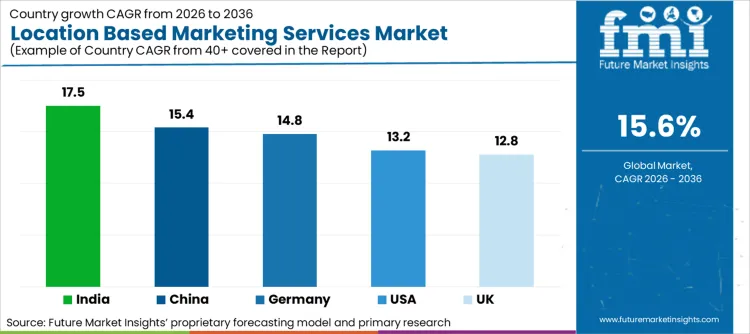
| Countries | Value CAGR (2026 to 2036) |
|---|---|
| USA | 13.2% |
| Germany | 14.8% |
| China | 15.4% |
| India | 17.5% |
| UK | 12.8% |
Rising Customer Expectation for Personalized Services is Boosting the Market in Germany
Germany’s location based marketing services market is poised to exhibit a CAGR of 14.8% between 2024 and 2034. Germany is dominating highest share in the European market and the trend is expected to continue in the forecast period.
The solid tech base and high smartphone penetration the country is a prime location for location based services. The spread of Wi-Fi, Bluetooth and GPS technologies has increased location data accuracy and reliability. The rollout of 5G networks makes these services even more accurate and faster, making real time location based marketing more viable and attractive for companies in the country.
In terms of personalized experiences, German consumers’ expectations are higher from the businesses. Location based marketing services enables businesses to meet such expectation by offering tailored advertisements, offers, and contents based on geographic locations and behaviors of their customers. This tailored strategy boosts the efficacy of marketing campaigns thereby increasing engagement and conversion rate and improving the customer experience.
Expanding Digital Advertising Landscape is Propelling Demand in the USA
North America, spearheaded by the USA currently holds around 76.3% share of the North America location based marketing services industry. North America’s market is anticipated to grow at a CAGR of 13.2% throughout the forecast period.
The shifting focus of various businesses on innovative digital advertising tactics to reach and engage their target audience is boosting the growth of the location based marketing services market growth in the country.
The shift is propelled due to the proliferation of digital channels such as mobile apps, search engines, & social media and widespread use of mobile devices here consumers spend a significant amount of time. Moreover, AI and advanced data analytics enrich the location-based marketing capacities enabling accurate customer preference and behavior, supporting the industry expansion.
Rise in Social Media Platforms and Growth of E-commerce in China Push the Location Based Marketing Services Market
China’s location based marketing services market is anticipated to register a CAGR of 15.4% from 2026 to 2036. The country is expected to grow at a significant pace and continue its dominance in East Asia through 2036.
The boom of ecommerce sector and proliferation of the social media platforms has been a key factor for driving the market growth. The China’s ecommerce market is largest in the world driven by rise of digital payment platforms and strong mobile internet access.
Major e-commerce players such as Pinduoduo, JD.com, and Alibaba leverages location-based marketing to offer hyper-targeted promotions and advertisements tailored to consumers purchasing behaviors. Furthermore, social media platforms such as Douyin, Weibo, and WeChat have billions of active users that are daily engaged in shopping through apps and sharing experiences & content. This platforms offer extensive data of customers which businesses uses to deliver personalized marketing messages.
Category-wise Insights
The section contains information about the leading segments in the industry. By solution, the services segment is estimated to grow at a CAGR of 17.1% throughout 2036. Additionally, the by end user, pharma companies segment is projected to expand at 17.8% till 2036.
Geo-fencing Marketing Dominate the Location Based Marketing Services Market in terms of Value
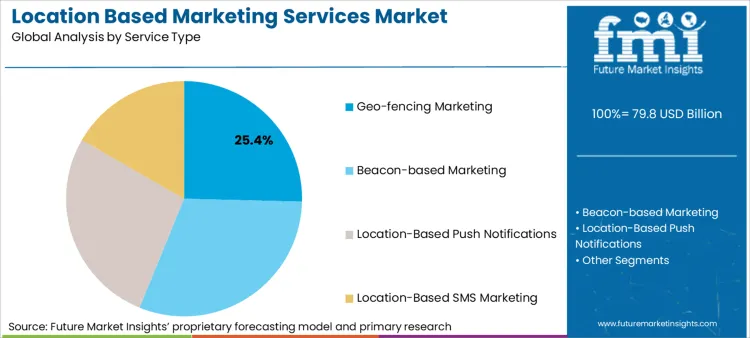
| Service Type | Geo-fencing Marketing |
|---|---|
| Value Share (2036) | 25.4% |
Geo-fencing Marketing is anticipated to encompass the majority of shares of 25.4% in the location based marketing services market in terms of service type in 2036. The geo-fencing marketing segment is witnessing notable growth owing to increasing usage of Wi-Fi & cellular data and rapid advancements in GPS technologies worldwide.
The improved accuracy of GPS technologies enables marketing professionals to target the precise targeted audience and make the data-driven decision for an effective marketing strategy.
Location Based Marketing Services are Mostly Utilized in the Retail & eCommerce
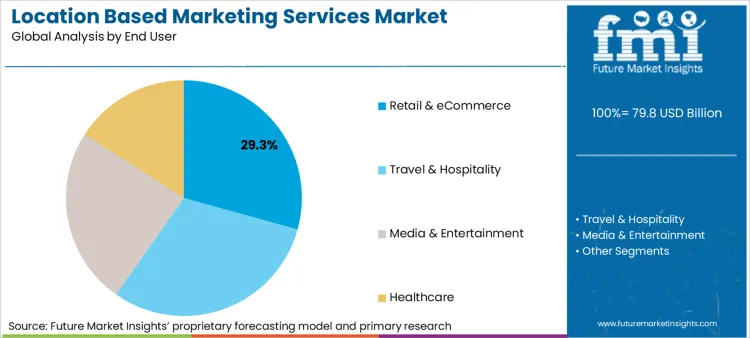
| End User | Retail & eCommerce |
|---|---|
| Value Share (2036) | 29.3% |
The retail & eCommerce companies segment is poised to acquire share of 29.3% by 2036. The retail & eCommerce companies are using the services to obtain competitive advantage, provide individualized experiences and enhance customer interaction, supporting the industry growth.
Competitive Landscape
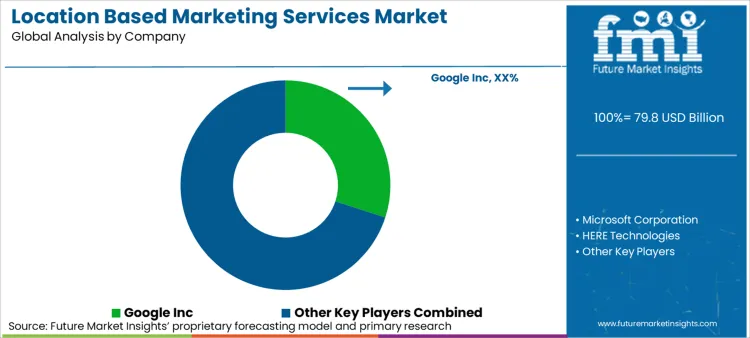
Key players operating in the location based marketing services market are investing in advanced technologies and also entering into partnerships. Key location based marketing services providers have also been acquiring smaller players to grow their presence to further penetrate the market across multiple regions.
Recent Developments:
- The report includes full coverage of key trends from competitive benchmarking. Some of the recent developments covered in the report:
- In early 2026, Radar reported that geolocation has become mission-critical infrastructure for enterprises, with companies leaning into location data in new ways beyond traditional marketing. [1]
- In early 2026, Yext acquired Places Scout to provide brands with advanced search intelligence and competitive location insights. [2]
- In February 2026, Google and Meta reported that 61% of advertisers have integrated AI tools for closed-loop location-based campaign optimization. [3]
- In January 2026, the retail sector saw a surge in hybrid proximity deployments combining GPS geofencing with BLE beacons for aisle-level in-store navigation. [4]
- In 2025, Foursquare expanded its first-party location data platform with SDK integrations into major retail and hospitality apps. [5]
Key Players of Location Based Marketing Services Industry
- Google, Inc.
- Apple, Inc.
- Microsoft Corporation
- HERE Technologies
- Cisco Systems
- Oracle Corporation
- Bharti Airtel Ltd
- Groupon
- Gimbal
- Bluedot
Scope of the Report
| Items | Values |
|---|---|
| Quantitative Units | USD 79.8 billion (2026) to USD 339.9 billion (2036), at a CAGR of 15.6% |
| Market Definition | Covers marketing technology services using real-time or historical geographic location data for targeted advertising, proximity alerts, in-store navigation, and location analytics. |
| Technology Segmentation | GPS/Geofencing, Bluetooth/BLE Beacons, Wi-Fi, NFC, Others |
| Application Segmentation | Proximity Marketing, Geo-targeted Advertising, Location Analytics, In-store Navigation, Others |
| Regions Covered | North America, Latin America, Europe, East Asia, South Asia, Oceania, Middle East and Africa |
| Countries Covered | United States, China, India, Germany, United Kingdom, Japan, South Korea, France, Brazil, Australia, Canada and 30 plus countries |
| Key Companies Profiled | Google, Apple, Radar, Foursquare, Yext, HERE Technologies, Skyhook, PlaceIQ, Xtremepush, Bluedot |
| Forecast Period | 2026 to 2036 |
| Approach | Hybrid top-down and bottom-up modeling validated through primary interviews with location data platforms, retail media networks, and digital advertising agencies |
Key Segments of Location Based Marketing Services Industry
By Service Type:
In terms of service type, the industry is divided into geo-fencing marketing, beacon-based marketing, location-based push notifications, location-based SMS marketing, location-based mobile ads, location-based search ads, location-based social media marketing, and others.
By Enterprise Size:
In terms of enterprise size, the industry is segregated into small & medium enterprises and large enterprises.
By Industry:
The industry is classified by industry as retail & eCommerce, travel & hospitality, media & entertainment, healthcare, transportation & logistics, financial services, and others.
By Region:
Key countries of North America, Latin America, East Asia, South Asia & Pacific, Western Europe, Eastern Europe, and Middle East & Africa (MEA) have been covered in the report.
Bibliography
- Radar. (2026). 2025 Recap and 2026 Preview.
- Yext. (2026). Acquisition of Places Scout. Corporate Press Release.
- Google / Meta. (2026). AI-Powered Campaign Optimization Adoption Report. February 2026.
- RetailDive. (2026). Hybrid Proximity Marketing Deployments in Retail. January 2026.
- Foursquare. (2025). First-Party Location Data Platform Expansion.
- Apple. (2025). App Tracking Transparency Policy.
- Google. (2025). Privacy Sandbox for Android.
- European Commission. (2025). GDPR Enforcement Statistics.
- California Attorney General. (2025). CCPA/CPRA Enforcement.
- IAB. (2025). Digital Advertising Revenue Report.
This Report Addresses
- Market intelligence for location data platforms, retail media networks, and digital advertising agencies
- Market size estimation and 10-year revenue forecasts from 2026 to 2036
- Growth opportunity mapping across GPS, BLE beacon, Wi-Fi, and NFC technologies
- Segment and regional revenue forecasts covering proximity marketing, geo-targeted advertising, and location analytics
- Competition strategy assessment including first-party SDK integration, attribution model development, and retail media positioning
- Privacy compliance tracking including GDPR, CCPA/CPRA, and India DPDP Act requirements
- Technology tracking including AI-powered campaign optimization, hybrid proximity systems, and consent management
- Market report delivery in PDF, Excel, PPT, and interactive dashboard formats
Frequently Asked Questions
How large is the LBMS market in 2026?
The global location based marketing services market is estimated at USD 79.8 billion in 2026.
What will the market size be by 2036?
The market is projected to reach USD 339.9 billion by 2036.
What is the expected CAGR?
Demand is expected to grow at a CAGR of 15.6% between 2026 and 2036.
Which technology leads?
GPS/geofencing holds the largest technology share, with BLE beacons the fastest-growing for in-store applications.
Which country is growing fastest?
China at 17.0% CAGR, driven by super-app ecosystem integration.
What drives enterprise adoption?
Closed-loop attribution that ties digital ad impressions to verified physical store visits is the primary enterprise adoption driver.
Preview the report firsthand - request a free sample
Get SampleGet the brochure for pricing and purchase details.
Get PDFTable of Content
- Executive Summary
- Global Market Outlook
- Demand-side Trends
- Supply-side Trends
- Technology Roadmap Analysis
- Analysis and Recommendations
- Market Overview
- Market Coverage / Taxonomy
- Market Definition / Scope / Limitations
- Research Methodology
- Chapter Orientation
- Analytical Lens and Working Hypotheses
- Market Structure, Signals, and Trend Drivers
- Benchmarking and Cross-market Comparability
- Market Sizing, Forecasting, and Opportunity Mapping
- Research Design and Evidence Framework
- Desk Research Programme (Secondary Evidence)
- Company Annual and Sustainability Reports
- Peer-reviewed Journals and Academic Literature
- Corporate Websites, Product Literature, and Technical Notes
- Earnings Decks and Investor Briefings
- Statutory Filings and Regulatory Disclosures
- Technical White Papers and Standards Notes
- Trade Journals, Industry Magazines, and Analyst Briefs
- Conference Proceedings, Webinars, and Seminar Materials
- Government Statistics Portals and Public Data Releases
- Press Releases and Reputable Media Coverage
- Specialist Newsletters and Curated Briefings
- Sector Databases and Reference Repositories
- FMI Internal Proprietary Databases and Historical Market Datasets
- Subscription Datasets and Paid Sources
- Social Channels, Communities, and Digital Listening Inputs
- Additional Desk Sources
- Expert Input and Fieldwork (Primary Evidence)
- Primary Modes
- Qualitative Interviews and Expert Elicitation
- Quantitative Surveys and Structured Data Capture
- Blended Approach
- Why Primary Evidence is Used
- Field Techniques
- Interviews
- Surveys
- Focus Groups
- Observational and In-context Research
- Social and Community Interactions
- Stakeholder Universe Engaged
- C-suite Leaders
- Board Members
- Presidents and Vice Presidents
- R&D and Innovation Heads
- Technical Specialists
- Domain Subject-matter Experts
- Scientists
- Physicians and Other Healthcare Professionals
- Governance, Ethics, and Data Stewardship
- Research Ethics
- Data Integrity and Handling
- Primary Modes
- Tooling, Models, and Reference Databases
- Desk Research Programme (Secondary Evidence)
- Data Engineering and Model Build
- Data Acquisition and Ingestion
- Cleaning, Normalisation, and Verification
- Synthesis, Triangulation, and Analysis
- Quality Assurance and Audit Trail
- Market Background
- Market Dynamics
- Drivers
- Restraints
- Opportunity
- Trends
- Scenario Forecast
- Demand in Optimistic Scenario
- Demand in Likely Scenario
- Demand in Conservative Scenario
- Opportunity Map Analysis
- Product Life Cycle Analysis
- Supply Chain Analysis
- Investment Feasibility Matrix
- Value Chain Analysis
- PESTLE and Porter’s Analysis
- Regulatory Landscape
- Regional Parent Market Outlook
- Production and Consumption Statistics
- Import and Export Statistics
- Market Dynamics
- Global Market Analysis 2021 to 2025 and Forecast, 2026 to 2036
- Historical Market Size Value (USD Million) Analysis, 2021 to 2025
- Current and Future Market Size Value (USD Million) Projections, 2026 to 2036
- Y-o-Y Growth Trend Analysis
- Absolute $ Opportunity Analysis
- Global Market Pricing Analysis 2021 to 2025 and Forecast 2026 to 2036
- Global Market Analysis 2021 to 2025 and Forecast 2026 to 2036, By Service Type
- Introduction / Key Findings
- Historical Market Size Value (USD Million) Analysis By Service Type , 2021 to 2025
- Current and Future Market Size Value (USD Million) Analysis and Forecast By Service Type , 2026 to 2036
- Geo-fencing Marketing
- Beacon-based Marketing
- Location-Based Push Notifications
- Location-Based SMS Marketing
- Geo-fencing Marketing
- Y-o-Y Growth Trend Analysis By Service Type , 2021 to 2025
- Absolute $ Opportunity Analysis By Service Type , 2026 to 2036
- Global Market Analysis 2021 to 2025 and Forecast 2026 to 2036, By End User
- Introduction / Key Findings
- Historical Market Size Value (USD Million) Analysis By End User, 2021 to 2025
- Current and Future Market Size Value (USD Million) Analysis and Forecast By End User, 2026 to 2036
- Retail & eCommerce
- Travel & Hospitality
- Media & Entertainment
- Healthcare
- Retail & eCommerce
- Y-o-Y Growth Trend Analysis By End User, 2021 to 2025
- Absolute $ Opportunity Analysis By End User, 2026 to 2036
- Global Market Analysis 2021 to 2025 and Forecast 2026 to 2036, By Region
- Introduction
- Historical Market Size Value (USD Million) Analysis By Region, 2021 to 2025
- Current Market Size Value (USD Million) Analysis and Forecast By Region, 2026 to 2036
- North America
- Latin America
- Western Europe
- Eastern Europe
- East Asia
- South Asia and Pacific
- Middle East & Africa
- Market Attractiveness Analysis By Region
- North America Market Analysis 2021 to 2025 and Forecast 2026 to 2036, By Country
- Historical Market Size Value (USD Million) Trend Analysis By Market Taxonomy, 2021 to 2025
- Market Size Value (USD Million) Forecast By Market Taxonomy, 2026 to 2036
- By Country
- USA
- Canada
- Mexico
- By Service Type
- By End User
- By Country
- Market Attractiveness Analysis
- By Country
- By Service Type
- By End User
- Key Takeaways
- Latin America Market Analysis 2021 to 2025 and Forecast 2026 to 2036, By Country
- Historical Market Size Value (USD Million) Trend Analysis By Market Taxonomy, 2021 to 2025
- Market Size Value (USD Million) Forecast By Market Taxonomy, 2026 to 2036
- By Country
- Brazil
- Chile
- Rest of Latin America
- By Service Type
- By End User
- By Country
- Market Attractiveness Analysis
- By Country
- By Service Type
- By End User
- Key Takeaways
- Western Europe Market Analysis 2021 to 2025 and Forecast 2026 to 2036, By Country
- Historical Market Size Value (USD Million) Trend Analysis By Market Taxonomy, 2021 to 2025
- Market Size Value (USD Million) Forecast By Market Taxonomy, 2026 to 2036
- By Country
- Germany
- UK
- Italy
- Spain
- France
- Nordic
- BENELUX
- Rest of Western Europe
- By Service Type
- By End User
- By Country
- Market Attractiveness Analysis
- By Country
- By Service Type
- By End User
- Key Takeaways
- Eastern Europe Market Analysis 2021 to 2025 and Forecast 2026 to 2036, By Country
- Historical Market Size Value (USD Million) Trend Analysis By Market Taxonomy, 2021 to 2025
- Market Size Value (USD Million) Forecast By Market Taxonomy, 2026 to 2036
- By Country
- Russia
- Poland
- Hungary
- Balkan & Baltic
- Rest of Eastern Europe
- By Service Type
- By End User
- By Country
- Market Attractiveness Analysis
- By Country
- By Service Type
- By End User
- Key Takeaways
- East Asia Market Analysis 2021 to 2025 and Forecast 2026 to 2036, By Country
- Historical Market Size Value (USD Million) Trend Analysis By Market Taxonomy, 2021 to 2025
- Market Size Value (USD Million) Forecast By Market Taxonomy, 2026 to 2036
- By Country
- China
- Japan
- South Korea
- By Service Type
- By End User
- By Country
- Market Attractiveness Analysis
- By Country
- By Service Type
- By End User
- Key Takeaways
- South Asia and Pacific Market Analysis 2021 to 2025 and Forecast 2026 to 2036, By Country
- Historical Market Size Value (USD Million) Trend Analysis By Market Taxonomy, 2021 to 2025
- Market Size Value (USD Million) Forecast By Market Taxonomy, 2026 to 2036
- By Country
- India
- ASEAN
- Australia & New Zealand
- Rest of South Asia and Pacific
- By Service Type
- By End User
- By Country
- Market Attractiveness Analysis
- By Country
- By Service Type
- By End User
- Key Takeaways
- Middle East & Africa Market Analysis 2021 to 2025 and Forecast 2026 to 2036, By Country
- Historical Market Size Value (USD Million) Trend Analysis By Market Taxonomy, 2021 to 2025
- Market Size Value (USD Million) Forecast By Market Taxonomy, 2026 to 2036
- By Country
- Kingdom of Saudi Arabia
- Other GCC Countries
- Turkiye
- South Africa
- Other African Union
- Rest of Middle East & Africa
- By Service Type
- By End User
- By Country
- Market Attractiveness Analysis
- By Country
- By Service Type
- By End User
- Key Takeaways
- Key Countries Market Analysis
- USA
- Pricing Analysis
- Market Share Analysis, 2025
- By Service Type
- By End User
- Canada
- Pricing Analysis
- Market Share Analysis, 2025
- By Service Type
- By End User
- Mexico
- Pricing Analysis
- Market Share Analysis, 2025
- By Service Type
- By End User
- Brazil
- Pricing Analysis
- Market Share Analysis, 2025
- By Service Type
- By End User
- Chile
- Pricing Analysis
- Market Share Analysis, 2025
- By Service Type
- By End User
- Germany
- Pricing Analysis
- Market Share Analysis, 2025
- By Service Type
- By End User
- UK
- Pricing Analysis
- Market Share Analysis, 2025
- By Service Type
- By End User
- Italy
- Pricing Analysis
- Market Share Analysis, 2025
- By Service Type
- By End User
- Spain
- Pricing Analysis
- Market Share Analysis, 2025
- By Service Type
- By End User
- France
- Pricing Analysis
- Market Share Analysis, 2025
- By Service Type
- By End User
- India
- Pricing Analysis
- Market Share Analysis, 2025
- By Service Type
- By End User
- ASEAN
- Pricing Analysis
- Market Share Analysis, 2025
- By Service Type
- By End User
- Australia & New Zealand
- Pricing Analysis
- Market Share Analysis, 2025
- By Service Type
- By End User
- China
- Pricing Analysis
- Market Share Analysis, 2025
- By Service Type
- By End User
- Japan
- Pricing Analysis
- Market Share Analysis, 2025
- By Service Type
- By End User
- South Korea
- Pricing Analysis
- Market Share Analysis, 2025
- By Service Type
- By End User
- Russia
- Pricing Analysis
- Market Share Analysis, 2025
- By Service Type
- By End User
- Poland
- Pricing Analysis
- Market Share Analysis, 2025
- By Service Type
- By End User
- Hungary
- Pricing Analysis
- Market Share Analysis, 2025
- By Service Type
- By End User
- Kingdom of Saudi Arabia
- Pricing Analysis
- Market Share Analysis, 2025
- By Service Type
- By End User
- Turkiye
- Pricing Analysis
- Market Share Analysis, 2025
- By Service Type
- By End User
- South Africa
- Pricing Analysis
- Market Share Analysis, 2025
- By Service Type
- By End User
- USA
- Market Structure Analysis
- Competition Dashboard
- Competition Benchmarking
- Market Share Analysis of Top Players
- By Regional
- By Service Type
- By End User
- Competition Analysis
- Competition Deep Dive
- Google Inc
- Overview
- Product Portfolio
- Profitability by Market Segments (Product/Age /Sales Channel/Region)
- Sales Footprint
- Strategy Overview
- Marketing Strategy
- Product Strategy
- Channel Strategy
- Microsoft Corporation
- HERE Technologies
- Cisco Systems
- Oracle Corporation
- Bharti Airtel Ltd
- Groupon
- Google Inc
- Competition Deep Dive
- Assumptions & Acronyms Used


