

- Market Size (2026)
- USD 1.1 Bn
- Forecast (2036)
- USD 5.5 Bn
- CAGR (2026 to 2036)
- 17.5%
How big is AI Datasets Licensing Academic Research Publishing Market in 2026?
USD 1.1 billion in 2026 and USD 5.5 billion by 2036 at a 17.5% CAGR.
AI datasets licensing academic research publishing demand is projected to expand at 17.5% CAGR between 2026 and 2036, lifting valuation from USD 1.1 billion to USD 5.5 billion. Universities license scholarly corpora to run literature mapping and model-development work without rebuilding source collections for every project. Crossref released its 2026 public data file in March 2026 with nearly 180 million records from more than 24,000 members across over 160 countries. The record scale shows why institutions need research analytics platforms that preserve identifiers and version history across repeated queries. Commercial value depends on reliable machine access and contract terms that define permitted uses across recurring institutional research projects.
Licensing routes differ sharply between the USA and Germany due to different institutional structures for negotiating scholarly data rights. American universities often negotiate rights institution by institution, while German consortia coordinate metadata standards through shared research infrastructure. The United States Copyright Office released Part 3 of its Copyright and Artificial Intelligence report in May 2025 and addressed licensing for generative AI training. The report places greater weight on provenance and permitted machine uses during institutional contract review. Providers therefore need enterprise data management controls that separate user permissions from corpus rights and preserve every dataset version. Contracts become easier to renew once technical access and legal scope remain visible within one institutional workflow.
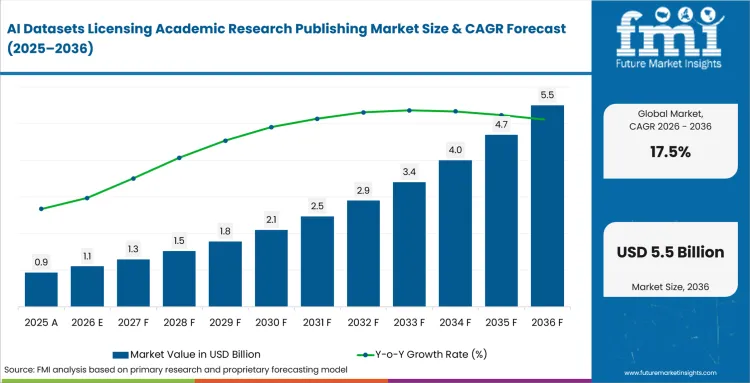
Key Takeaways of AI Datasets Licensing Academic Research Publishing Market
- University libraries and research offices require machine-readable scholarly corpora that preserve rights, identifiers, and dataset versions across recurring analytical projects.
- Scientific research datasets are estimated to account for 34.0% of dataset type in 2026, supported by cross-disciplinary records and persistent identifiers.
- Academic research is projected to capture 39.0% share, while universities and academic institutions represent 36.0% of end user in 2026.
- Direct institutional licensing is forecast to hold 42.0% of distribution channel, and subscription licensing registers 37.0% by licensing model in 2026.
- Unclear training rights and incomplete document-level permissions extend legal review across universities planning machine-assisted research or model development.
- Elsevier, Clarivate, and Digital Science compete through content depth and research intelligence, while Springer Nature, Wiley, Taylor & Francis, ProQuest, and Figshare add publishing or repository access.
Analyst Perspective
“Licensed scholarly data becomes commercially valuable once an institution can trace every machine result to a permitted source and a stable dataset version. Publishers that expose content without clear training rights create more review work than research value. The strongest offers combine disciplined rights management with reliable interfaces so university libraries and research offices can support repeat analysis without reopening the same legal and technical questions.”
- Sudip Saha, Principal Analyst, Future Market Insights
How is the AI Datasets Licensing Academic Research Publishing Market segmented?
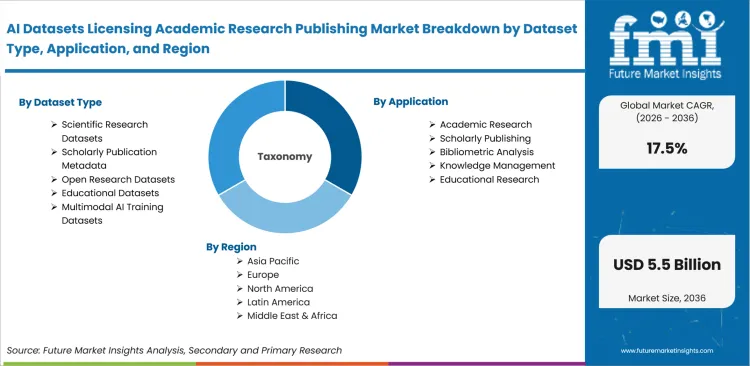
The AI datasets licensing academic research publishing market is segmented by dataset type, application, end user, distribution channel, licensing model, and region.
The market is assessed by dataset type, application, end user, distribution channel, licensing model, and region. Dataset type identifies the licensed content, application defines the research task, and end user identifies the institution that controls access. Distribution channel explains how the corpus reaches authorized users or systems, while licensing model sets contract duration and machine-use limits. This structure separates content ownership from data-as-a-service delivery and clarifies the economics of recurring institutional access.
Why do scientific research datasets lead the dataset type category?
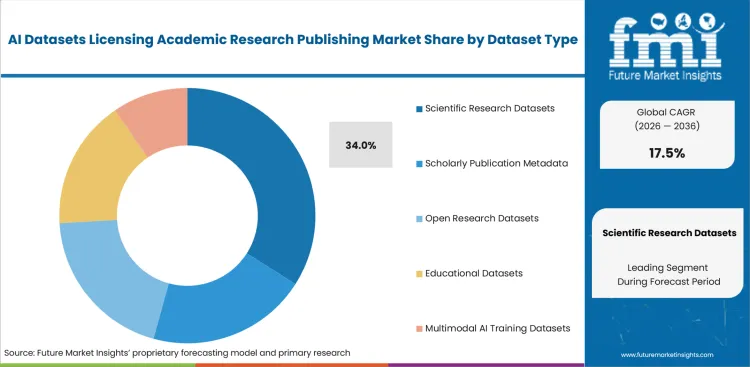
Scientific research datasets combine bibliographic records, persistent identifiers, and discipline-level metadata that institutions can reuse across discovery and bibliometric analysis. Crossref released its 2025 public data file in March 2025 with more than 165 million records from over 22,000 members. The file provides a common structure for comparative analysis across publisher collections and repeated institutional research projects. Institutions use data lake infrastructure to retain provenance and compare earlier snapshots against later corrections.
- Scientific research datasets are projected to hold 34.0% share in 2026 owing to repeated use of linked records across discovery and bibliometric analysis. Crossref reported in October 2025 that its participation reports covered more than 175 million records from 23,000 members across 164 countries. That breadth supports cross-disciplinary selection, but institutions must inspect license and text-mining fields during approval of machine use.
- Research groups adopt this dataset class to connect publications with grants, institutions, and earlier experimental outputs across repeat projects. Stable snapshots reduce reconciliation work and allow independent reviewers to reproduce published analytical results across later validation cycles. Adoption weakens if providers cannot explain removed records or preserve prior versions for later institutional audits.
How does academic research shape demand in the application category?
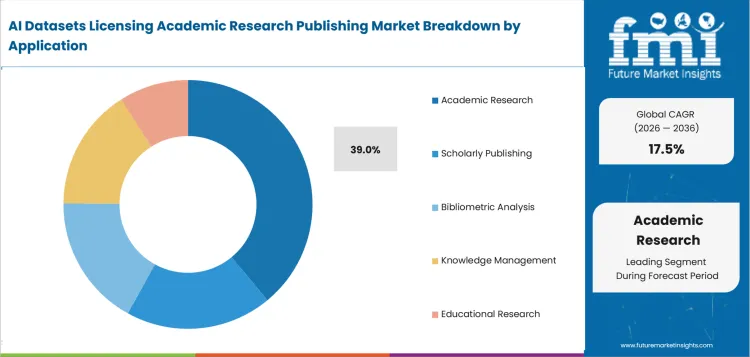
Academic research turns licensed content into literature mapping, evidence synthesis, and model-development workflows tied to defined research questions. Digital Science relaunched its SRAD program in July 2025 with no-cost Altmetric and Dimensions data for non-commercial scientometric studies. The program also provided Dimensions on BigQuery for analysis-ready scholarly information used in non-commercial institutional studies. Universities use analytics-as-a-service tools to test collaboration patterns without rebuilding the source corpus for every study.
- By application, academic research is forecast to represent 39.0% in 2026 driven by repeated use of one governed corpus for literature mapping and evidence synthesis. The segment fits projects that reuse one governed corpus across several questions and research teams. Its position depends on contracts that define model training, derivative outputs, and reproducible extraction across authorized institutional purposes.
- University researchers prefer licenses that preserve the dataset version supporting every chart or model result. Documented update histories let teams repeat earlier analyses following metadata corrections or record additions across later project reviews. Adoption slows if an interface changes silently or removes records without preserving a recoverable institutional snapshot for peer review and grant reporting.
What keeps universities and academic institutions ahead within end user?
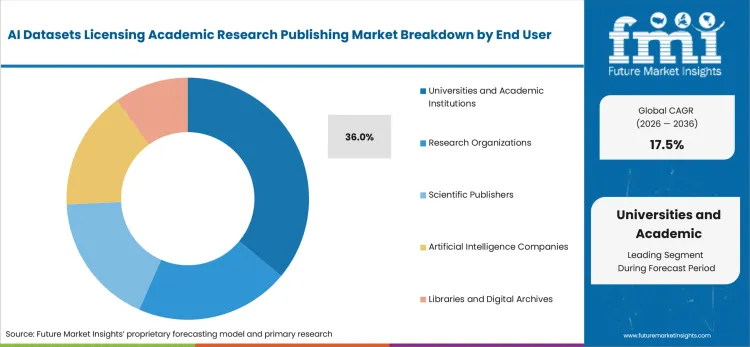
Universities combine library collections, research offices, and central identity systems under governance structures that can approve multi-department access. Clarivate launched Web of Science Research Intelligence in May 2026 following development with more than 50 partners across 20 countries. The platform connects publications with patents, funding, policy documents, and clinical trials for institutional planning. That operating model aligns with knowledge management software used by research administrators across coordinated institutional planning workflows.
- The universities and academic institutions segment is likely to capture 36.0% share in 2026 attributable to central library governance across several departments and research teams. Central governance lets one institution control access across authorized departments and reduce duplicate subscriptions across campus research teams. The share position weakens at universities whose repositories, finance systems, and reporting platforms use incompatible identifiers.
- Campus adoption advances through contracts that give librarians and research administrators one access policy with clear role controls. Shared authentication reduces duplicate account management and makes institutional use easier for library administrators to review. Integration remains difficult across departmental repositories that apply different identifiers or retention rules during cross-faculty research programs.
Which buying mechanism supports direct institutional licensing in the distribution channel category?
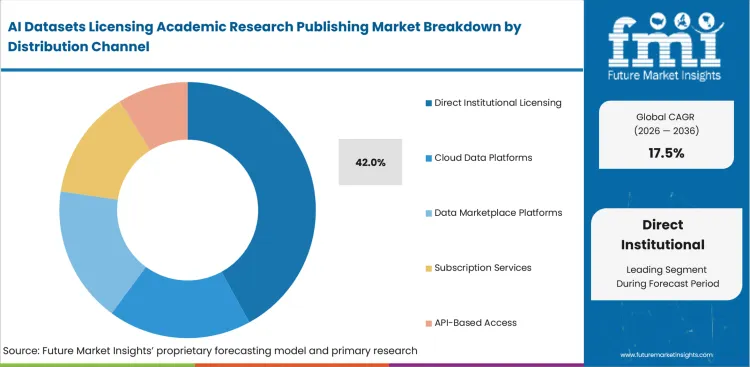
Direct institutional licensing lets universities negotiate corpus coverage against their own legal and technical requirements. Jisc concluded agreements with five academic publishers in December 2025 covering more than 11,000 journals and over one million articles annually. Collective negotiations combine pricing and governance with access conditions inside one accountable institutional agreement for participating universities. Comparable insights-as-a-service models rely on clear service ownership across library teams and institutional legal offices.
- Direct institutional licensing is set to lead the distribution channel with 42.0% share in 2026 due to negotiated rights and institution-level controls for machine-readable content. The route suits universities that need named users, permitted research purposes, and institution-level usage controls. Its position depends on renewals that avoid separate negotiations across every department and research group.
- Research consortia use direct licenses to combine bargaining power with common technical requirements across member institutions. Shared interfaces preserve separate authentication and detailed usage reporting for every participating university or campus. Adoption becomes difficult if members apply conflicting rules for training rights or data retention across a jointly licensed corpus.
What supports subscription licensing within the licensing model category?
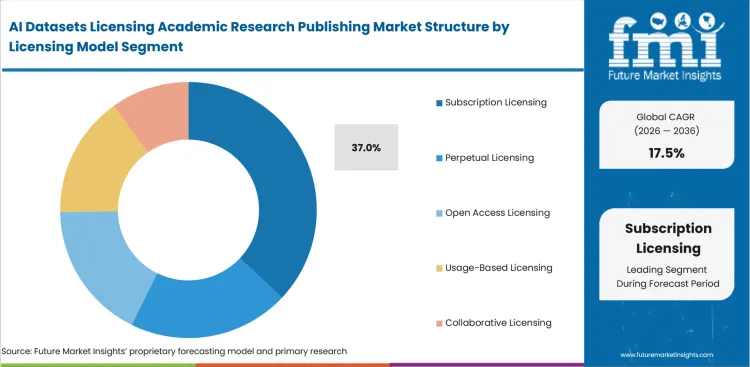
Subscription licensing matches scholarly datasets that receive frequent records, corrections, and metadata updates throughout the research cycle. Crossref reported in November 2025 that its REST API received about one billion monthly hits and held roughly 180 million records. The organization changed rate limits to protect service stability during heavy machine demand from institutional users. Institutions compare similar terms with research publication support costs across recurring academic programs and publishing workflows.
- By licensing model, subscription licensing is estimated to hold 37.0% in 2026 owing to recurring updates that fit annual library budgets and ongoing research programs. Annual fees fit operating budgets more easily than irregular purchases of complete dataset extracts for individual projects. The segment loses appeal if renewal prices rise without measurable improvements in coverage, update speed, or technical support.
- University libraries prefer subscriptions that state update frequency and machine-use limits before automated access begins. A stable interface lets research groups repeat analyses throughout the contract term without rebuilding earlier extraction workflows. Providers protect renewal value through transparent change logs and service commitments that remain consistent across annual budget cycles and audit reviews.
What are the drivers, restraints, and opportunities in the AI Datasets Licensing Academic Research Publishing Market?
Machine-readable scholarly corpora reduce repeated research work, while unclear training rights delay institutional approval. Rights-cleared field-specific datasets create a practical commercial opening.
- Driver: Machine-readable scholarly corpora reduce repeated search and extraction work across recurring research and model-development projects.
- Restraint: Unclear training permissions and incomplete document-level licenses extend legal review across institutional access agreements.
- Opportunity: Rights-cleared field-specific corpora can combine reliable machine access with entitlement controls and reproducible dataset versions.
Machine-readable scholarly corpora reduce repeated search and extraction work across research teams that analyze the same literature from different questions. Elsevier launched ScienceDirect AI in March 2025 with access to more than 14 million full-text articles and book chapters. The launch shows how authenticated content can support comparison and synthesis within a governed research environment. Licensing revenue becomes more durable as citations and access controls remain connected to recurring institutional projects.
Copyright uncertainty materially delays contracts intended for model training or automated text analysis across publisher collections. The European Commission published its training-content summary template in July 2025 for general-purpose AI providers. The template requires public disclosure of training-content categories and relevant data sources used by general-purpose AI providers. Dataset licensors therefore need document-level provenance and usable license fields across machine-delivery workflows serving institutional researchers. Institutional review expands if permissions remain separated from metadata and user controls across the licensed corpus.
Rights-cleared field-specific corpora create a practical opening for providers that combine content access with entitlement controls. Clarivate introduced Nexus in January 2026 as an academic assistant designed to reconnect AI users with licensed library resources. Early access was scheduled for the third quarter of 2026 rather than immediate general deployment. Providers can build on that route through reproducible extracts and transparent coverage records for defined research fields.
Which country CAGRs are profiled in the AI Datasets Licensing Academic Research Publishing Market?
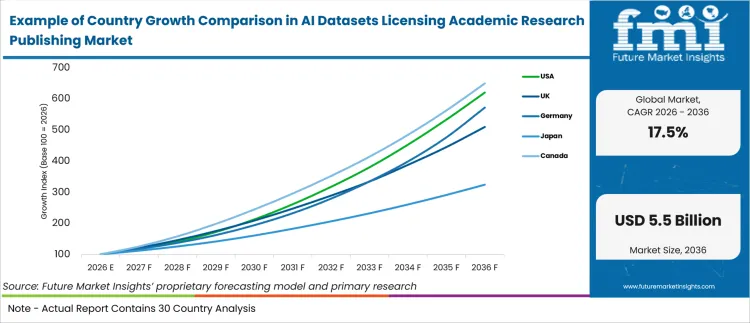
| Country | CAGR |
|---|---|
| Canada | 20.6% |
| USA | 20.0% |
| Germany | 19.1% |
| UK | 17.7% |
| South Korea | 15.1% |
| Australia | 14.8% |
| Japan | 12.5% |
How do country-level CAGRs compare in the AI Datasets Licensing Academic Research Publishing Market?
The country rates span 8.1 percentage points between Canada at the upper boundary and Japan at the lower boundary. Canada and the USA form a close upper pair, while South Korea and Australia differ by 0.3 points. The spacing reflects differences in licensing routes and research infrastructure rather than a ranking of national revenue.
- Canada remains 0.6 percentage points above the USA as provincial licensing routes operate across a broad national service geography.
- The USA stays close to Canada amid large research systems and fragmented institution-specific copyright review.
- Germany sits 0.9 percentage points below the USA as national research-data consortia support adoption alongside detailed interoperability requirements.
- The UK remains 1.4 percentage points below Germany as collective access routes face uneven integration budgets across university systems.
- South Korea trails the UK by 2.6 percentage points as national repository connectivity meets local-language metadata requirements.
- Australia remains 0.3 percentage points below South Korea as shared infrastructure supports institutions separated by substantial service distances.
- Japan defines the lower boundary of the profiled range as coordinated infrastructure develops alongside long validation cycles and strict metadata requirements.
Similar growth rates can produce different revenue pools because contract size and corpus coverage vary across institutions. Market entry should reflect local rights interpretation, integration needs, and service capacity rather than the displayed rate alone.
Country-wise Analysis
- Canadian universities rely on provincial purchasing structures and national digital research services that must cover institutions across a broad geography. In Canada, licensed scholarly dataset demand is predicted to advance at 20.6% CAGR through 2036, supported by coordinated national infrastructure and cross-border research-data cooperation. The Digital Research Alliance of Canada signed a cooperation agreement with the Australian Research Data Commons in February 2025 to exchange expertise on national digital research infrastructure. The partnership strengthens training and shared service practices that institutions need for integrating external scholarly corpora. Direct licenses can coordinate corpus rights across several departments, but provincial policies and long support routes complicate national implementation.
- United States universities combine large research programs with decentralized contracting and institution-specific legal review for machine-readable scholarly content. Adoption of licensed scholarly datasets in the USA is estimated to expand at 20.0% CAGR through 2036, shaped by national data-system investment and institution-specific copyright review. National research systems need stable data services that connect repositories with computing resources and institutional identity controls. The National Science Foundation issued its Integrated Data Systems and Services solicitation in August 2025 for operational systems supporting open and AI-driven research. Cloud ELN services create a practical integration route for laboratories, while copyright review and separate university contracts remain material frictions.
- German universities work through discipline-specific research-data consortia that coordinate metadata standards and service expectations across participating institutions. The German Research Foundation published second-period program documents for the National Research Data Infrastructure in March 2025 and referenced 27 funded consortia. Germany's AI datasets licensing outlook is anticipated to advance at 19.1% CAGR over the assessment period, underpinned by discipline-specific consortia and formal interoperability requirements. The consortium model gives licensed corpora a route into established research-data governance across several academic disciplines. Common standards support adoption, while specialized integration and detailed rights review increase implementation effort for external providers. Commercial entry requires connectors that preserve national identifiers and support discipline-specific metadata without breaking institutional access controls.
- United Kingdom universities use collective licensing and nationally coordinated data services across a research system with uneven local integration capacity. National services can reduce duplicate negotiation and provide shared governance across participating universities and research organizations. Smart Data Research UK announced two financial and energy data services in January 2025 and completed a six-service national network. By 2036, the United Kingdom AI datasets licensing market is projected to grow at 17.7% CAGR, supported by collective access routes and nationally coordinated secure data services. Collective agreements support adoption, but older platforms and restricted integration budgets limit implementation across smaller universities.
- South Korean universities operate within a national research-data system that prioritizes local-language discovery and coordinated repository access. AI datasets licensing demand in South Korea is forecast to rise at 15.1% CAGR over the forecast period, reinforced by national repository connectivity and local-language discovery requirements. The linked repository environment creates a ready discovery layer for externally licensed scholarly content across university research teams. KISTI reported in July 2025 that DataON connected about 4.78 million datasets from domestic and international research-data platforms. Local-language mappings support adoption, while specialized support and document-level rights interpretation remain material frictions for commercial providers. Successful entry requires Korean metadata coverage and a local service route that can resolve integration problems during active research projects.
- Australian universities depend on shared digital research infrastructure across institutions and specialist support teams separated by substantial service distances. The Australian Research Data Commons published its year in review in November 2025 and documented thematic data commons with national cloud services. Licensed scholarly dataset sales in Australia are forecast to expand at 14.8% CAGR by 2036, enabled by shared research-data services across widely separated institutions. The national infrastructure gives licensed corpora a route into shared computing and data-management workflows across participating universities. Common services support adoption, but long support routes and varied local systems increase implementation effort.
- Japan is building a research-data ecosystem that connects institutional repositories with shared cloud services and national discovery platforms. The Japanese AI datasets licensing sector is projected to record 12.5% CAGR during the assessment period, influenced by coordinated repository infrastructure and detailed institutional validation. Coordinated infrastructure and strict quality expectations shape the local adoption route for licensed scholarly corpora. The National Institute of Informatics published its Research Data Ecosystem issue in January 2025 and described services connecting repositories with the national research cloud. The existing structure supports institutional discovery and controlled data circulation across several academic disciplines and university repositories. Japanese-language metadata and long validation cycles create friction for providers that cannot document rights or preserve stable dataset versions.
Who are the notable companies in the AI Datasets Licensing Academic Research Publishing Market?
Elsevier, Clarivate, Digital Science, Springer Nature, Wiley, Taylor & Francis, ProQuest, and Figshare are the notable companies assessed in this market.
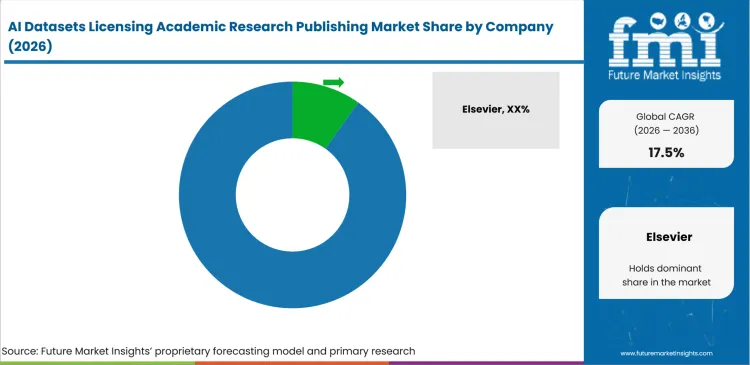
Competition combines scholarly publishers, research-intelligence platforms and repository infrastructure providers serving university research, library and scholarly communication workflows. Market participants differentiate through the breadth of licensed scholarly content, research metadata coverage, analytics capabilities and support for AI-enabled discovery and research management. Elsevier combines extensive journal content with citation and research intelligence assets through Scopus, while Springer Nature leverages a large corpus of scholarly publications and AI-assisted editorial and publishing workflows. These vendors compete through access to machine-readable research content and integration across research lifecycle activities.
- Digital Science focuses on its connected research-intelligence ecosystem, including publications, grants, patents, policy documents, and clinical-trial data linked through provenance-based analytics.
- Clarivate, through ProQuest and related academic information services, combines content distribution and preservation infrastructure, while Figshare strengthens institutional repository capabilities through governed research data management and sharing. Competitive positioning in this segment depends on the ability to connect diverse research entities, maintain trusted records, and support institution-wide knowledge management.
- Wiley and Taylor & Francis compete through large proprietary scholarly content portfolios and longstanding relationships with universities, research organizations, and library consortia. Their positions are supported by negotiated content-access agreements, institutional distribution channels, and expanding opportunities for licensed AI use cases.
Competitive Benchmarking: AI Datasets Licensing Academic Research Publishing Market
| Company | Licensed Scholarly Corpus | Research Metadata and Analytics | Institutional Delivery | Geographic Reach |
|---|---|---|---|---|
| Elsevier | High | High | High | Global |
| Clarivate | High | High | High | Global |
| Digital Science | Medium | High | High | Global |
| Springer Nature | High | Medium | High | Global |
| Wiley | High | Medium | High | Global |
| Taylor & Francis | High | Medium | Medium | Global |
| ProQuest | High | Medium | High | Global |
| Figshare | Low | Medium | High | Global |
Key Developments in the AI Datasets Licensing Academic Research Publishing Market
- In April 2026, Clarivate introduced Nexus Connect as a university-branded gateway linking licensed library content with general-purpose AI chat agents. Five universities in North America and Asia-Pacific were named among the first institutions scheduled to deploy the service. The gateway uses entitlement controls and institutional identity to preserve library visibility inside emerging research interfaces. A broader early-access program was planned for July 2026 to extend institutional participation beyond the initial university group.
- In January 2025, Springer Nature launched an AI tool that automates editorial quality checks and alerts editors to potentially unsuitable manuscripts before peer review. The company tested the system across more than 100 open-access journals and over 100,000 submissions. Fourteen suitability checks covered data availability and ethics alongside clinical trials and potential misuse threats. Human experts retained responsibility for every final editorial decision produced through the automated screening workflow.
- In October 2025, Wiley launched AI Gateway as a single endpoint for peer-reviewed scholarly content across external AI platforms. The service uses the Model Context Protocol and preserves citation integrity during machine-assisted research across external technology environments. Anthropic Claude, AWS Marketplace, Mistral AI, and Perplexity were named as connected technology environments for the service. The launch gives institutions a clearer route for licensed content inside established AI workflows used by researchers.
- In February 2025, Taylor & Francis expanded its ResearchGate Journal Home partnership to 595 journals and added the Open Access Agreement Upgrade. The arrangement introduced 178 additional titles and made institutional funding routes easier for researchers to discover. Taylor & Francis reported that ResearchGate served more than 25 million members across its international research community. The expansion strengthens researcher-facing distribution without changing the publisher’s underlying licensing responsibilities for institutional content access.
Key Players in the AI Datasets Licensing Academic Research Publishing Market
Core Content and Intelligence Providers
- Elsevier
- Clarivate
- Springer Nature
Integrated Research Infrastructure Participants
- Digital Science
- ProQuest
- Figshare
Licensed Publishing Challengers
- Wiley
- Taylor & Francis
AI Datasets Licensing Academic Research Publishing Market - Report Scope
| Coverage field | Report scope |
|---|---|
| Market breakdown | Dataset type, application, end user, distribution channel, licensing model, and region. |
| Quantitative Units | Revenue in USD Billion, CAGR in %. |
| Market Definition | Institutional and commercial licensing of scholarly datasets and research metadata for machine-readable research and publishing workflows. |
| Regions Covered | North America, Latin America, Western Europe, Eastern Europe, East Asia, South Asia and Pacific, and Middle East and Africa. |
| Countries Covered | Canada, USA, Germany, UK, South Korea, Australia, Japan, and additional countries within the regional model. |
| Key Companies Profiled | Elsevier, Clarivate, Digital Science, Springer Nature, Wiley, Taylor & Francis, ProQuest, and Figshare. |
| Forecast Period | 2026 to 2036. |
| Approach | Hybrid bottom-up and top-down market sizing supported by primary interviews and official desk research. |
AI Datasets Licensing Academic Research Publishing Market - Research Methodology
| Method | Approach |
|---|---|
| Primary Research | FMI analysts gathered input from manufacturers, service providers, technology developers, distributors, end users, sourcing teams, and subject-matter experts. Interviews examined purchasing decisions, product or service evaluation, adoption barriers, approval requirements, pricing considerations, and expectations for technical or commercial support. Respondents were also asked what evidence is required before a trial, pilot, or initial order develops into regular purchasing. |
| Desk Research | Desk research covered government statistics, regulatory publications, trade data, industry associations, technical literature, standards, company filings, product information, and official corporate announcements. Sources were reviewed for relevance, publication date, geographic coverage, and consistency with the defined market scope. Claims relating to performance, applications, approvals, capacity, investment, and commercial activity were retained only when supported by credible public evidence. |
| Market Sizing and Forecasting | The market model combined the baseline value with historical performance, segment structure, pricing and volume indicators, adoption levels, company participation, and country-level demand conditions. Forecast assumptions considered economic activity, investment trends, regulatory developments, technology adoption, purchasing cycles, supply availability, and barriers to wider market use. Segment and regional estimates were reconciled before the final market total was calculated. |
| Data Validation | Estimates were checked against multiple independent indicators, including public data, company activity, trade patterns, industry developments, and findings from primary interviews. Validation also tested whether products, services, applications, and company revenues fell within the defined market boundaries. Adjacent categories, unsupported claims, overlapping revenues, and activities without direct market relevance were excluded to reduce double counting and maintain consistency across segments and countries. |
AI Datasets Licensing Academic Research Publishing Market by Segments
AI Datasets Licensing Academic Research Publishing Market segmented by Dataset Type:
- Scientific Research Datasets
- Life Sciences Datasets
- Physical Sciences Datasets
- Scholarly Publication Metadata
- Citation Metadata
- Bibliographic Records
- Open Research Datasets
- Open Government Data
- Open Institutional Repositories
- Educational Datasets
- Learning Analytics Data
- Curriculum Data
- Multimodal AI Training Datasets
- Text and Image Datasets
- Scientific Image Collections
AI Datasets Licensing Academic Research Publishing Market segmented by Application:
- Academic Research
- AI Model Development
- Scientific Discovery
- Scholarly Publishing
- Editorial Automation
- Peer Review Support
- Bibliometric Analysis
- Citation Analysis
- Research Impact Assessment
- Knowledge Management
- Semantic Search
- Knowledge Graph Development
- Educational Research
- Learning Outcome Analysis
- Curriculum Development
AI Datasets Licensing Academic Research Publishing Market segmented by End User:
- Universities and Academic Institutions
- Public Universities
- Private Universities
- Research Organizations
- Government Research Institutes
- Independent Research Centers
- Scientific Publishers
- Academic Publishers
- Open Access Publishers
- Artificial Intelligence Companies
- Generative AI Developers
- AI Research Labs
- Libraries and Digital Archives
- National Libraries
- Digital Repository Providers
AI Datasets Licensing Academic Research Publishing Market segmented by Distribution Channel:
- Direct Institutional Licensing
- University License Agreements
- Research Consortium Agreements
- Cloud Data Platforms
- Academic Cloud Repositories
- Research Data Platforms
- Data Marketplace Platforms
- Commercial Data Exchanges
- AI Dataset Marketplaces
- Subscription Services
- Annual Institutional Subscription
- Usage-Based Subscription
- API-Based Access
- REST APIs
- Bulk Data APIs
AI Datasets Licensing Academic Research Publishing Market segmented by Licensing Model:
- Subscription Licensing
- Annual Subscription
- Multi-Year Subscription
- Perpetual Licensing
- Institutional License
- Enterprise License
- Open Access Licensing
- Creative Commons License
- Open Data License
- Usage-Based Licensing
- API Consumption License
- Pay-Per-Download
- Collaborative Licensing
- Research Consortium License
- Public-Private Partnership License
AI Datasets Licensing Academic Research Publishing Market by Region:
- North America
- United States
- Canada
- Latin America
- Brazil
- Mexico
- Argentina
- Chile
- Western Europe
- Germany
- France
- United Kingdom
- Italy
- Spain
- Benelux
- Nordics
- Eastern Europe
- Poland
- Czech Republic
- Romania
- Hungary
- East Asia
- China
- Japan
- South Korea
- South Asia and Pacific
- India
- ASEAN
- Australia and New Zealand
- Middle East and Africa
- GCC Countries
- South Africa
- Türkiye
- Israel
Research Sources and Bibliography
- Crossref. (2026, March 17). 2026 public data file now available.
- USA Copyright Office. (2025, May 9). Copyright and Artificial Intelligence, Part 3: Generative AI Training (Pre-Publication Version).
- Crossref. (2025, March 12). 2025 public data file now available.
- Crossref. (2025, October 22). New tool to report on completeness of open research information globally.
- Digital Science. (2025, July 22). Digital Science Relaunches SRAD Data Access Program.
- Clarivate. (2026, May 6). Clarivate Launches Web of Science Research Intelligence.
- Jisc. (2025, December 22). Landmark publishing agreements for UK universities.
- Crossref. (2025, November 5). Announcing changes to REST API rate limits.
- Elsevier. (2025, March 12). Elsevier launches ScienceDirect AI to transform research with rapid mission-critical insights from trusted content.
- European Commission. (2025, July 24). Explanatory Notice and Template for the Public Summary of Training Content for general-purpose AI models.
- Clarivate. (2026, January 22). Clarivate Introduces Nexus, Connecting AI Users to Trusted Academic Resources.
- Alliance de recherche numérique du Canada. (2025, February 18). Le Canada et l’Australie unissent leurs forces pour renforcer les liens technologiques et scientifiques dans la région de l’Indopacifique.
- USA National Science Foundation. (2025, August 6). NSF 25-544: Integrated Data Systems & Services (IDSS).
- German Research Foundation. (2025, March 14). National Research Data Infrastructure: Programme and Proposal Documents for the Second Funding Period.
- Smart Data Research UK. (2025, January 20). Finance and energy data services announced.
- Korea Institute of Science and Technology Information. (2025, July 14). KISTI, 2025 DATA·AI.
- Australian Research Data Commons. (2025, November). Innovation Starts with Data: ARDC Year in Review 2025.
- National Institute of Informatics. (2025, January). Research Data Ecosystem -Connecting and Circulating Research Data Across Disciplines
- Elsevier. (2025, September 17). Redefining Research: Elsevier Announces Next-Generation AI-Powered Researcher Solution.
- Springer Nature. (2026, March 12). Springer Nature embraces AI tools across the publishing process, resulting in less friction and increased author satisfaction.
- Digital Science. (2026, July 6). Digital Science announces Dimensions Research Strategy: AI analytics for research strategy on demand.
- ProQuest. (2025, March 26). Partner Announcement: Portico to Preserve Clarivate’s Ebook Central.
- Figshare. (2025, April 9). UL Research Institutes (ULRI) launches new digital repository with Figshare to enhance the discoverability of its research outputs.
- Wiley. (2025, June 17). Research Growth, AI Licensing, and Cost Reduction Drive Wiley’s Fiscal 2025 Results.
- Taylor & Francis. (2025, December 19). Jisc and Taylor & Francis sign new UK open research agreement.
- Clarivate. (2026, April 28). Clarivate Introduces Nexus Connect, the First Institutional AI Gateway to Trusted Research and Learning.
- Springer Nature. (2025, January 7). Springer Nature: Authors, editors and peer reviewers supported with launch of new AI tool.
- Wiley. (2025, October 14). Wiley Launches Interoperable Platform to Power Scientific Discovery in World's Leading AI Technologies.
- Taylor & Francis. (2025, February 13). ResearchGate and Taylor & Francis expand Journal Home partnership to 595 journals and activate Open Access Agreement Upgrade.
This bibliography is provided for reader reference and is not exhaustive. The full report contains the complete reference list and detailed citations.
This Report Answers
- How large is the AI Datasets Licensing Academic Research Publishing Market in 2026 and 2036?
- Which dataset types and research applications support recurring institutional licensing demand?
- How do universities evaluate rights and technical delivery before approving machine-readable corpus access?
- Which distribution channels and licensing models support recurring institutional revenue?
- What direct drivers and restraints influence contract conversion across academic research publishing workflows?
- How do growth conditions differ across Canada, USA, Germany, UK, South Korea, Australia, and Japan?
- Which companies participate through scholarly content, research intelligence, repositories, or institutional delivery?
- How do company capabilities compare across licensed corpus depth and research analytics?
- Which recent company developments are changing AI-supported scholarly research and content licensing?
Frequently Asked Questions
How big is the AI Datasets Licensing Academic Research Publishing Market in 2026?
The AI datasets licensing academic research publishing market is valued at USD 1.1 billion in 2026 and is forecast to reach USD 5.5 billion by 2036. Growth reflects universities licensing scholarly corpora to run literature mapping and model-development work without rebuilding source collections for every research project.
What is the CAGR of the AI Datasets Licensing Academic Research Publishing Market from 2026 to 2036?
The AI datasets licensing academic research publishing market grows at a CAGR of 17.5% between 2026 and 2036, supported by machine-readable scholarly corpora that reduce repeated search and extraction work across recurring research and model-development projects.
Which distribution channel leads the AI Datasets Licensing Academic Research Publishing Market?
Direct institutional licensing accounts for 42.0% of the AI datasets licensing academic research publishing market by distribution channel in 2026, due to negotiated rights and institution-level controls that suit universities needing named users and permitted research purposes.
How much will the AI Datasets Licensing Academic Research Publishing Market add between 2026 and 2036?
The AI datasets licensing academic research publishing market is set to add USD 4.4 billion between 2026 and 2036, growing from USD 1.1 billion to USD 5.5 billion as licensed scholarly corpora extend across a widening base of university research and model-development programs.
Who are the leading companies in the AI Datasets Licensing Academic Research Publishing Market?
Five companies lead the AI datasets licensing academic research publishing market, including Elsevier, Clarivate, Digital Science, Springer Nature, and Wiley, competing through licensed scholarly corpus depth, research metadata and analytics, and institutional delivery capabilities.
Preview the report firsthand - request a free sample
Get SampleGet the brochure for pricing and purchase details.
Get PDFTable of Content
- Key Takeaways
- Market Size and CAGR
- Top Growth Driver
- Fastest Growing Segment
- Leading Region
- Key Companies
- Emerging Opportunities
- Executive Summary
- Global Market Outlook
- Demand-side Trends
- Supply-side Trends
- Technology Roadmap Analysis
- Analysis and Recommendations
- Analyst Perspective (What is happening? Why now? What should investors know?)
- Key Questions Answered
- How large is the market?
- What is the CAGR?
- What are key trends?
- Which region dominates?
- Who are the leaders?
- Market Overview
- Market Coverage / Taxonomy
- Market Definition / Scope / Limitations
- Research Methodology
- Chapter Orientation
- Analytical Lens and Working Hypotheses
- Market Structure, Signals, and Trend Drivers
- Benchmarking and Cross-market Comparability
- Market Sizing, Forecasting, and Opportunity Mapping
- Research Design and Evidence Framework
- Desk Research Programme (Secondary Evidence)
- Expert Input and Fieldwork (Primary Evidence)
- Tooling, Models, and Reference Databases
- Data Engineering and Model Build
- Quality Assurance and Audit Trail
- Market Background
- Market Dynamics (Drivers, Restraints, Opportunity, Trends)
- Scenario Forecast (Optimistic, Likely, Conservative)
- Impact Analysis
- AI Impact
- Sustainability Impact
- Regulatory Impact
- Technology Impact
- Consumer / Buyer Analysis
- Purchase Drivers
- Adoption Barriers
- Buyer Journey
- Opportunity Map Analysis
- Product Life Cycle Analysis
- Supply Chain Analysis
- Investment Feasibility Matrix
- Value Chain Analysis
- PESTLE and Porter's Analysis
- Regulatory Landscape
- Regional Parent Market Outlook
- Production and Consumption Statistics
- Import and Export Statistics
- Global Market Analysis and Forecast, 2021 to 2036
- Historical Market Size Value (USD Billion) Analysis, 2021 to 2025
- Current and Future Market Size Value (USD Billion) Projections, 2026 to 2036
- Y-o-Y Growth Trend Analysis
- Absolute $ Opportunity Analysis
- Global Market Pricing Analysis, 2021 to 2036
- Global Market Analysis and Forecast, By Dataset Type, 2021 to 2036
- Introduction / Key Findings
- Historical Market Size Value (USD Billion) Analysis By Dataset Type, 2021 to 2025
- Current and Future Market Size Value (USD Billion) Analysis and Forecast By Dataset Type, 2026 to 2036
- Scientific Research Datasets
- Life Sciences Datasets
- Physical Sciences Datasets
- Scholarly Publication Metadata
- Citation Metadata
- Bibliographic Records
- Open Research Datasets
- Open Government Data
- Open Institutional Repositories
- Educational Datasets
- Learning Analytics Data
- Curriculum Data
- Multimodal AI Training Datasets
- Text and Image Datasets
- Scientific Image Collections
- Scientific Research Datasets
- Y-o-Y Growth Trend Analysis By Dataset Type, 2021 to 2025
- Absolute $ Opportunity Analysis By Dataset Type, 2026 to 2036
- Global Market Analysis and Forecast, By Application, 2021 to 2036
- Introduction / Key Findings
- Historical Market Size Value (USD Billion) Analysis By Application, 2021 to 2025
- Current and Future Market Size Value (USD Billion) Analysis and Forecast By Application, 2026 to 2036
- Academic Research
- AI Model Development
- Scientific Discovery
- Scholarly Publishing
- Editorial Automation
- Peer Review Support
- Bibliometric Analysis
- Citation Analysis
- Research Impact Assessment
- Knowledge Management
- Semantic Search
- Knowledge Graph Development
- Educational Research
- Learning Outcome Analysis
- Curriculum Development
- Academic Research
- Y-o-Y Growth Trend Analysis By Application, 2021 to 2025
- Absolute $ Opportunity Analysis By Application, 2026 to 2036
- Global Market Analysis and Forecast, By End User, 2021 to 2036
- Introduction / Key Findings
- Historical Market Size Value (USD Billion) Analysis By End User, 2021 to 2025
- Current and Future Market Size Value (USD Billion) Analysis and Forecast By End User, 2026 to 2036
- Universities and Academic Institutions
- Public Universities
- Private Universities
- Research Organizations
- Government Research Institutes
- Independent Research Centers
- Scientific Publishers
- Academic Publishers
- Open Access Publishers
- Artificial Intelligence Companies
- Generative AI Developers
- AI Research Labs
- Libraries and Digital Archives
- National Libraries
- Digital Repository Providers
- Universities and Academic Institutions
- Y-o-Y Growth Trend Analysis By End User, 2021 to 2025
- Absolute $ Opportunity Analysis By End User, 2026 to 2036
- Global Market Analysis and Forecast, By Distribution Channel, 2021 to 2036
- Introduction / Key Findings
- Historical Market Size Value (USD Billion) Analysis By Distribution Channel, 2021 to 2025
- Current and Future Market Size Value (USD Billion) Analysis and Forecast By Distribution Channel, 2026 to 2036
- Direct Institutional Licensing
- University License Agreements
- Research Consortium Agreements
- Cloud Data Platforms
- Academic Cloud Repositories
- Research Data Platforms
- Data Marketplace Platforms
- Commercial Data Exchanges
- AI Dataset Marketplaces
- Subscription Services
- Annual Institutional Subscription
- Usage-Based Subscription
- API-Based Access
- REST APIs
- Bulk Data APIs
- Direct Institutional Licensing
- Y-o-Y Growth Trend Analysis By Distribution Channel, 2021 to 2025
- Absolute $ Opportunity Analysis By Distribution Channel, 2026 to 2036
- Global Market Analysis and Forecast, By Licensing Model, 2021 to 2036
- Introduction / Key Findings
- Historical Market Size Value (USD Billion) Analysis By Licensing Model, 2021 to 2025
- Current and Future Market Size Value (USD Billion) Analysis and Forecast By Licensing Model, 2026 to 2036
- Subscription Licensing
- Annual Subscription
- Multi-Year Subscription
- Perpetual Licensing
- Institutional License
- Enterprise License
- Open Access Licensing
- Creative Commons License
- Open Data License
- Usage-Based Licensing
- API Consumption License
- Pay-Per-Download
- Collaborative Licensing
- Research Consortium License
- Public-Private Partnership License
- Subscription Licensing
- Y-o-Y Growth Trend Analysis By Licensing Model, 2021 to 2025
- Absolute $ Opportunity Analysis By Licensing Model, 2026 to 2036
- Global Market Analysis and Forecast, By Region, 2021 to 2036
- Introduction
- Historical Market Size Value (USD Billion) Analysis By Region, 2021 to 2025
- Current Market Size Value (USD Billion) Analysis and Forecast By Region, 2026 to 2036
- North America
- Latin America
- Western Europe
- Eastern Europe
- East Asia
- South Asia and Pacific
- Middle East & Africa
- Market Attractiveness Analysis By Region
- North America Market Analysis and Forecast, By Country, 2021 to 2036
- Historical Market Size Value (USD Billion) Trend Analysis By Market Taxonomy, 2021 to 2025
- Market Size Value (USD Billion) Forecast By Market Taxonomy, 2026 to 2036
- By Country
- USA
- Canada
- By Dataset Type
- By Application
- By End User
- By Distribution Channel
- By Licensing Model
- By Country
- Market Attractiveness Analysis
- By Country
- By Dataset Type
- By Application
- By End User
- By Distribution Channel
- By Licensing Model
- Key Takeaways
- Latin America Market Analysis and Forecast, By Country
- Historical Market Size Value (USD Billion) Trend Analysis By Market Taxonomy, 2021 to 2025
- Market Size Value (USD Billion) Forecast By Market Taxonomy, 2026 to 2036
- By Country
- Brazil
- Mexico
- Chile
- Rest of Latin America
- By Dataset Type
- By Application
- By End User
- By Distribution Channel
- By Licensing Model
- By Country
- Market Attractiveness Analysis
- By Country
- By Dataset Type
- By Application
- By End User
- By Distribution Channel
- By Licensing Model
- Key Takeaways
- Western Europe Market Analysis and Forecast, By Country
- Historical Market Size Value (USD Billion) Trend Analysis By Market Taxonomy, 2021 to 2025
- Market Size Value (USD Billion) Forecast By Market Taxonomy, 2026 to 2036
- By Country
- Germany
- UK
- Italy
- Spain
- France
- Nordic
- BENELUX
- Rest of Western Europe
- By Dataset Type
- By Application
- By End User
- By Distribution Channel
- By Licensing Model
- By Country
- Market Attractiveness Analysis
- By Country
- By Dataset Type
- By Application
- By End User
- By Distribution Channel
- By Licensing Model
- Key Takeaways
- Eastern Europe Market Analysis and Forecast, By Country
- Historical Market Size Value (USD Billion) Trend Analysis By Market Taxonomy, 2021 to 2025
- Market Size Value (USD Billion) Forecast By Market Taxonomy, 2026 to 2036
- By Country
- Russia
- Poland
- Hungary
- Balkan & Baltic
- Rest of Eastern Europe
- By Dataset Type
- By Application
- By End User
- By Distribution Channel
- By Licensing Model
- By Country
- Market Attractiveness Analysis
- By Country
- By Dataset Type
- By Application
- By End User
- By Distribution Channel
- By Licensing Model
- Key Takeaways
- East Asia Market Analysis and Forecast, By Country
- Historical Market Size Value (USD Billion) Trend Analysis By Market Taxonomy, 2021 to 2025
- Market Size Value (USD Billion) Forecast By Market Taxonomy, 2026 to 2036
- By Country
- China
- Japan
- South Korea
- By Dataset Type
- By Application
- By End User
- By Distribution Channel
- By Licensing Model
- By Country
- Market Attractiveness Analysis
- By Country
- By Dataset Type
- By Application
- By End User
- By Distribution Channel
- By Licensing Model
- Key Takeaways
- South Asia and Pacific Market Analysis and Forecast, By Country
- Historical Market Size Value (USD Billion) Trend Analysis By Market Taxonomy, 2021 to 2025
- Market Size Value (USD Billion) Forecast By Market Taxonomy, 2026 to 2036
- By Country
- India
- ASEAN
- Australia & New Zealand
- Rest of South Asia and Pacific
- By Dataset Type
- By Application
- By End User
- By Distribution Channel
- By Licensing Model
- By Country
- Market Attractiveness Analysis
- By Country
- By Dataset Type
- By Application
- By End User
- By Distribution Channel
- By Licensing Model
- Key Takeaways
- Middle East & Africa Market Analysis and Forecast, By Country
- Historical Market Size Value (USD Billion) Trend Analysis By Market Taxonomy, 2021 to 2025
- Market Size Value (USD Billion) Forecast By Market Taxonomy, 2026 to 2036
- By Country
- Kingdom of Saudi Arabia
- Other GCC Countries
- Türkiye
- South Africa
- Other African Union
- Rest of Middle East & Africa
- By Dataset Type
- By Application
- By End User
- By Distribution Channel
- By Licensing Model
- By Country
- Market Attractiveness Analysis
- By Country
- By Dataset Type
- By Application
- By End User
- By Distribution Channel
- By Licensing Model
- Key Takeaways
- Key Countries Market Analysis
- USA
- Pricing Analysis
- Market Share Analysis, 2025
- By Dataset Type
- By Application
- By End User
- By Distribution Channel
- By Licensing Model
- Canada
- Pricing Analysis
- Market Share Analysis, 2025
- By Dataset Type
- By Application
- By End User
- By Distribution Channel
- By Licensing Model
- Mexico
- Pricing Analysis
- Market Share Analysis, 2025
- By Dataset Type
- By Application
- By End User
- By Distribution Channel
- By Licensing Model
- Brazil
- Pricing Analysis
- Market Share Analysis, 2025
- By Dataset Type
- By Application
- By End User
- By Distribution Channel
- By Licensing Model
- Chile
- Pricing Analysis
- Market Share Analysis, 2025
- By Dataset Type
- By Application
- By End User
- By Distribution Channel
- By Licensing Model
- Germany
- Pricing Analysis
- Market Share Analysis, 2025
- By Dataset Type
- By Application
- By End User
- By Distribution Channel
- By Licensing Model
- UK
- Pricing Analysis
- Market Share Analysis, 2025
- By Dataset Type
- By Application
- By End User
- By Distribution Channel
- By Licensing Model
- Italy
- Pricing Analysis
- Market Share Analysis, 2025
- By Dataset Type
- By Application
- By End User
- By Distribution Channel
- By Licensing Model
- Spain
- Pricing Analysis
- Market Share Analysis, 2025
- By Dataset Type
- By Application
- By End User
- By Distribution Channel
- By Licensing Model
- France
- Pricing Analysis
- Market Share Analysis, 2025
- By Dataset Type
- By Application
- By End User
- By Distribution Channel
- By Licensing Model
- India
- Pricing Analysis
- Market Share Analysis, 2025
- By Dataset Type
- By Application
- By End User
- By Distribution Channel
- By Licensing Model
- ASEAN
- Pricing Analysis
- Market Share Analysis, 2025
- By Dataset Type
- By Application
- By End User
- By Distribution Channel
- By Licensing Model
- Australia & New Zealand
- Pricing Analysis
- Market Share Analysis, 2025
- By Dataset Type
- By Application
- By End User
- By Distribution Channel
- By Licensing Model
- China
- Pricing Analysis
- Market Share Analysis, 2025
- By Dataset Type
- By Application
- By End User
- By Distribution Channel
- By Licensing Model
- Japan
- Pricing Analysis
- Market Share Analysis, 2025
- By Dataset Type
- By Application
- By End User
- By Distribution Channel
- By Licensing Model
- South Korea
- Pricing Analysis
- Market Share Analysis, 2025
- By Dataset Type
- By Application
- By End User
- By Distribution Channel
- By Licensing Model
- Russia
- Pricing Analysis
- Market Share Analysis, 2025
- By Dataset Type
- By Application
- By End User
- By Distribution Channel
- By Licensing Model
- Poland
- Pricing Analysis
- Market Share Analysis, 2025
- By Dataset Type
- By Application
- By End User
- By Distribution Channel
- By Licensing Model
- Hungary
- Pricing Analysis
- Market Share Analysis, 2025
- By Dataset Type
- By Application
- By End User
- By Distribution Channel
- By Licensing Model
- Kingdom of Saudi Arabia
- Pricing Analysis
- Market Share Analysis, 2025
- By Dataset Type
- By Application
- By End User
- By Distribution Channel
- By Licensing Model
- Türkiye
- Pricing Analysis
- Market Share Analysis, 2025
- By Dataset Type
- By Application
- By End User
- By Distribution Channel
- By Licensing Model
- South Africa
- Pricing Analysis
- Market Share Analysis, 2025
- By Dataset Type
- By Application
- By End User
- By Distribution Channel
- By Licensing Model
- USA
- Market Structure Analysis
- Competition Dashboard
- Competition Benchmarking
- Market Share Analysis of Top Players
- By Regional
- By Dataset Type
- By Application
- By End User
- By Distribution Channel
- By Licensing Model
- Emerging Startups
- Innovation Benchmarking
- Competition Analysis
- Competition Deep Dive
- Elsevier
- Overview
- Product Portfolio
- Profitability by Market Segments
- Sales Footprint
- Strategy Overview
- Marketing Strategy
- Product Strategy
- Channel Strategy
- Clarivate
- Digital Science
- Springer Nature
- Wiley
- ProQuest
- Dimensions AI
- OpenAlex
- Figshare
- Taylor & Francis
- Elsevier
- Case Studies
- Success Stories
- Recent Developments
- Competition Deep Dive
- Assumptions & Acronyms Used


