

- 2025 (base history)
- USD 0.87 Bn
- 2026 (current)
- USD 0.96 Bn
- 2036 (forecast)
- USD 2.56 Bn
- CAGR (2026 to 2036)
- 10.3%
How big is the connected power tool fleet management market in 2026?
USD 0.96 billion in 2026 and USD 2.56 billion by 2036 at a 10.3% CAGR.
The connected power tool fleet management industry value is forecast to grow from USD 0.87 billion in 2025 to USD 2.56 billion by 2036 at 10.3% CAGR during the forecast period. Enterprise fleets are forecast to represent 52.0% share in 2026 because large contractors face the highest tool loss exposure. Subscription software is expected to secure 57.0% share in 2026, led by paid reporting and user-role controls.
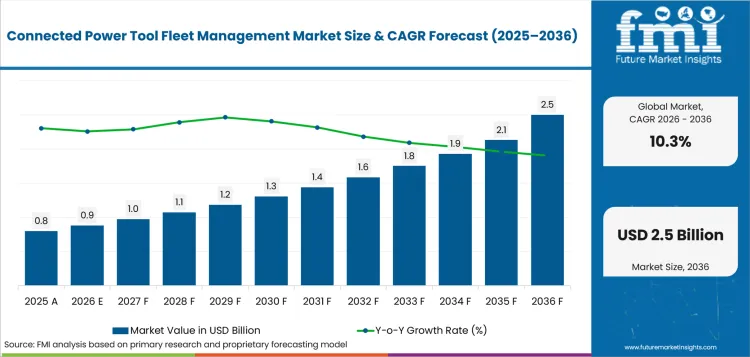
Connected Power Tool Fleet Management Market Overview: Size and Forecast
- 2025 (base history): USD 0.87 billion
- 2026 (current): USD 0.96 billion
- 2036 (forecast): USD 2.56 billion
- CAGR (2026–2036): 10.3%
- Leading Connectivity Model: Embedded
- Embedded Share in 2026: 48.0%
- Leading Revenue Model: Subscription
- Subscription Share in 2026: 57.0%
- Fastest-growing Country: India
- India CAGR: 13.0% by 2036
Summary of connected power tool fleet management market
- Demand and Growth Drivers
- Contractors are shifting from manual tool logs to software records that show worker assignment and site location.
- Battery health data is turning connected cordless platforms into a service-planning tool for larger fleets.
- Rental and dealer channels are giving more attention to connected tool records that support billing and repair checks.
- Product and Segment View
- Embedded connectivity is projected to represent 48.0% share in 2026, led by battery and tool data captured without separate tagging.
- Subscription software is forecast to hold 57.0% share in 2026 as buyers pay for reporting and admin controls.
- Enterprise Fleet is anticipated to secure 52.0% share in 2026 since multi-site users need role-based asset ownership.
- Geography and Competitive Outlook
- India is projected to record 13.0% CAGR by 2036 as organized contractors scale app-based tool control.
- China is expected to expand at 12.1% CAGR by 2036 through infrastructure activity and domestic tool manufacturing.
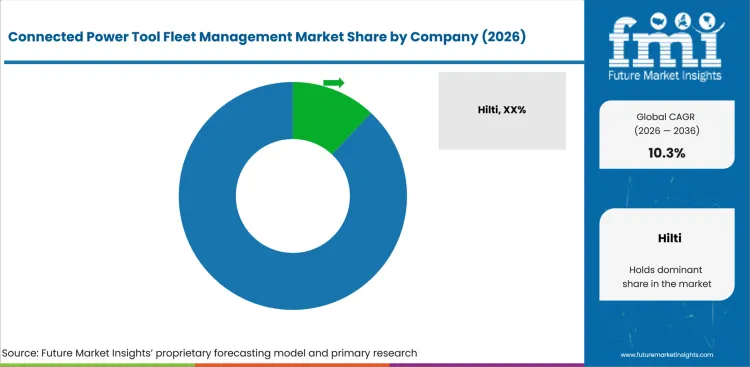
- Hilti leads the OEM group with Milwaukee Tool and DEWALT. Bosch Professional and STIHL complete the toolmaker set. Husqvarna and Tenna extend the verified competitive group.
- Specialist platforms such as Tenna compete by linking power tools with mixed equipment fleets and back-office systems.
- Analyst Opinion
- Nikhil Kaitwade, Principal Consultant at FMI says, “I see this market less as a tool tracking category and more as a jobsite control layer. Buyers first want to know who has the tool. They also need to know whether the battery is healthy and whether the asset is due for service. Suppliers win when they connect the physical tool with the worker and project cost record in one workflow.”
Fleet control is becoming a jobsite operating need as contractors connect tools and batteries. Chargers and service records are now part of the same workflow. Hilti combines Nuron and Fleet Management with ON!Track for battery health and asset location workflows. Milwaukee ONE-KEY gives users inventory control and connected tool reports. DEWALT Tool Connect Site Manager extends the same idea into asset use and safety workflows. Suppliers that link tool data with repair history can reduce downtime and improve audit records.
What supports value in the connected power tool fleet management market?
Subscription revenue and embedded tool data support market value across professional contractor channels.
- Market value is supported by connected tool software before hardware tags and battery data add incremental revenue.
- Supplier pricing reflects user seats and reporting tiers before ERP integration affects enterprise account value.
- Revenue improves as contractors replace spreadsheets with role-based access and repair documentation.
- Fleet trust rises as platforms make assignment and service status easier to compare with replacement timing.
Why is the connected power tool fleet management market growing?
Contractors are digitizing tool rooms since lost tools and idle batteries create direct project cost leakage.
Large contractors are the first adoption pocket because their tool problem is not only location. It is accountability across crews and cost centers. The USA Census Bureau estimated April 2026 construction spending at a seasonally adjusted annual rate of USD 2,172.4 billion. That scale gives contractors a large asset pool that needs stronger control. A fleet platform lowers the time spent finding tools and checking repair history.
The second driver is the shift from tagged assets to data-generating tools. Milwaukee says ONE-KEY compatible tools need to be added to inventory to use built-in security and tracking functions. This changes buying behavior because users compare tool performance and data access together. A platform with alerts and lockout functions gives procurement teams a clearer operating case than a tool-only purchase.
How is the connected power tool fleet management market segmented?
The connected power tool fleet management industry is segmented by connectivity model, revenue model, fleet size, end use, and integration type.
- Embedded connectivity is projected to secure 48.0% share in 2026, led by connected batteries and tools that reduce manual tagging work.
- Subscription software is expected to hold 57.0% share in 2026 since paid tiers fund alerts and reporting features.
- Enterprise Fleet is anticipated to represent 52.0% share in 2026 because large contractors need admin roles and audit logs.
- Construction is forecast to account for 61.0% share in 2026 due to frequent jobsite transfers and shared tool cribs.
- ERP Integrated systems are projected to hold 41.0% share in 2026, guided by cost-code links and back-office control.
Which connectivity model leads the connected power tool fleet management market?
Embedded connectivity holds 48.0% share in 2026 as connected batteries and tools send data without separate tag attachment.
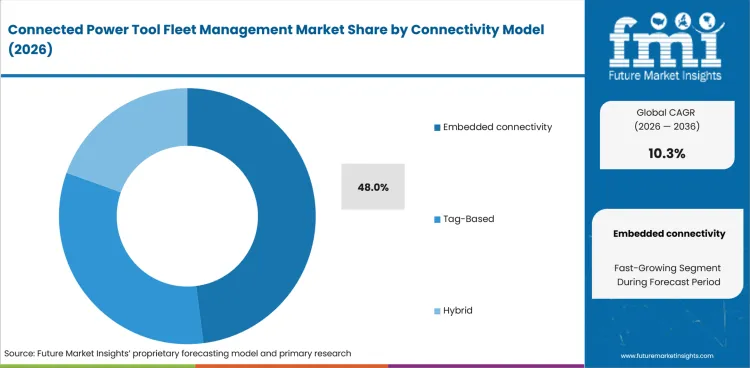
- Embedded connectivity is projected to account for 48.0% share in 2026, influenced by direct usage data from batteries and tools.
- Tag-based systems remain useful where contractors manage mixed-brand power tool fleets.
Which revenue model leads the connected power tool fleet management market?
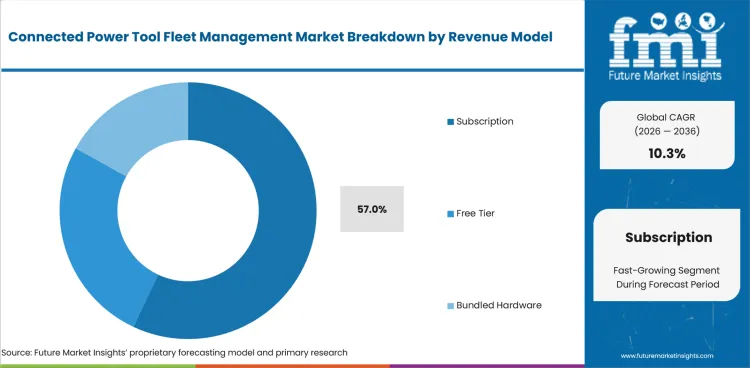
- Subscription software is expected to represent 57.0% share in 2026, supported by recurring user access and reporting.
- Bundled hardware models gain use when OEMs package tool leases with service coverage and fleet records.
Which fleet size leads the connected power tool fleet management market?
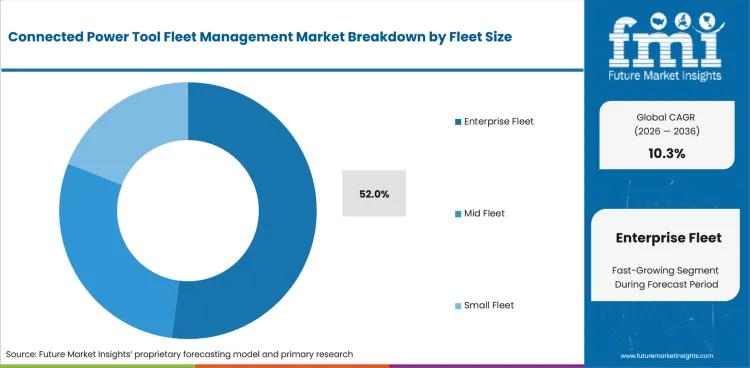
- Enterprise Fleet is anticipated to hold 52.0% share in 2026, led by multi-site ownership and tool crib complexity.
- Mid Fleet accounts grow as regional contractors standardize paid apps after early free-tier use.
Which end use leads the connected power tool fleet management market?
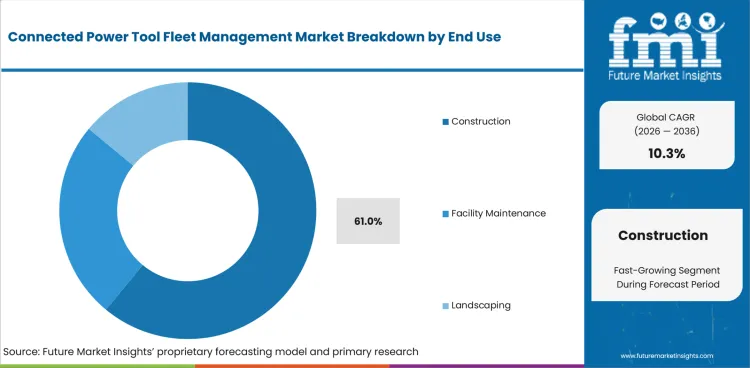
- Construction is projected to reach 61.0% share in 2026, shaped by jobsite transfer risk and shared crew use.
- Facility maintenance gains importance where distributed teams need repair history and battery availability records.
Which integration type leads the connected power tool fleet management market?
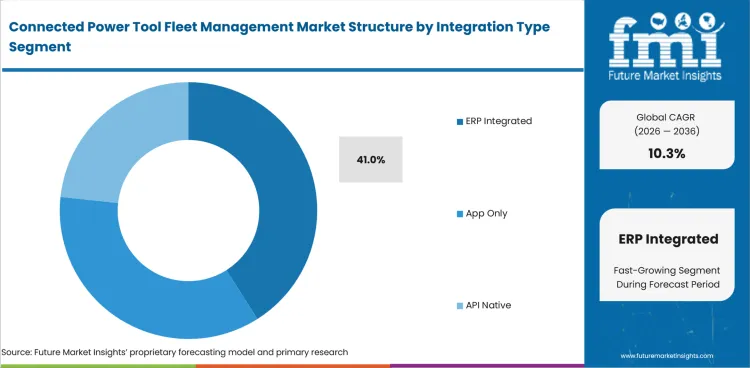
- ERP Integrated systems are estimated to account for 41.0% share in 2026, supported by cost-code links and asset registers.
- App-only workflows remain relevant for smaller contractors that need faster onboarding without IT integration.
What are the drivers, restraints and opportunities in the connected power tool fleet management market?
Battery data and assignment records support growth while mixed-brand fragmentation slows wider software standardization.
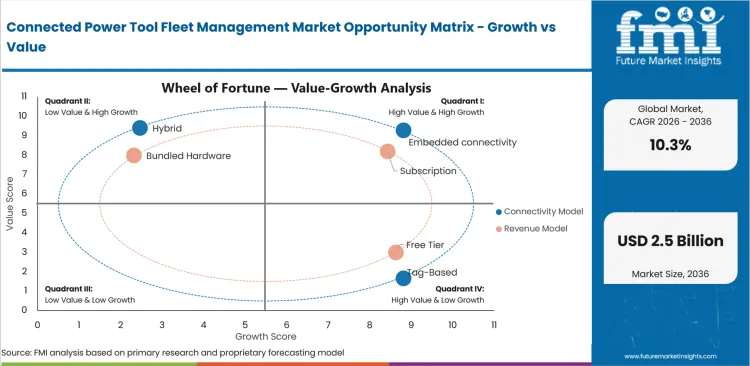
- Driver: Battery health data helps fleets plan replacement timing before crews lose productivity on site.
- Restraint: Mixed-brand ownership limits one-platform visibility when contractors own several battery systems and tag formats.
- Opportunity: Software bundling with tool leasing can make connected fleet management easier to sell at renewal time.
Battery systems are becoming the most valuable data layer in the market. Hilti explains that ON!Track gives Fleet Management users proactive end-of-life battery notifications by email. That feature turns a replacement decision into a planned workflow instead of a site disruption. Mixed fleets remain the main restraint because many contractors own Hilti coring tools and Milwaukee grinders. DEWALT concrete tools and Bosch measuring tools add further platform variation. Tenna fits this gap by positioning its platform around mixed fleets and integrations.
Who buys connected power tool fleet management systems?
Large contractors and rental fleets form the primary buyer base. Facility maintenance teams add a third buyer group. Consumer segmentation is expected to center on professional users with shared tool pools and multi-site accountability. Enterprise contractors need jobsite assignment records and admin permissions. Rental firms need billing and repair history. Facility maintenance teams need service reminders and battery readiness data. Smaller crews usually begin with free apps before paying for broader reporting.
What influences connected power tool fleet management purchase decisions?
Loss reduction and battery visibility shape buying decisions. Service history and software fit also matter across contractor channels. Purchase decisions are expected to depend on whether the platform reduces lost-tool exposure and simplifies repair planning. OEM-connected systems gain trust when tool electronics feed clean usage data. Mixed-fleet platforms gain trust when contractors need one view across tools and attachments. Vehicles and equipment can be added to the same fleet view. Integration with cost codes and ERP systems can move the purchase from a tool-room decision to an enterprise software decision.
Which countries are growing fastest in the connected power tool fleet management market?
India reaches 13.0% CAGR followed by China at 12.1% through 2036.
.webp "Top Country Growth Comparison Connected Power Tool Fleet Management Market Cagr (2026 2036)")
| Country | CAGR |
|---|---|
| India | 13.0% |
| China | 12.1% |
| South Korea | 10.4% |
| United States | 9.8% |
| Germany | 9.1% |
| United Kingdom | 8.7% |
| Japan | 8.6% |
| France | 8.2% |
Source: Future Market Insights, 2026.
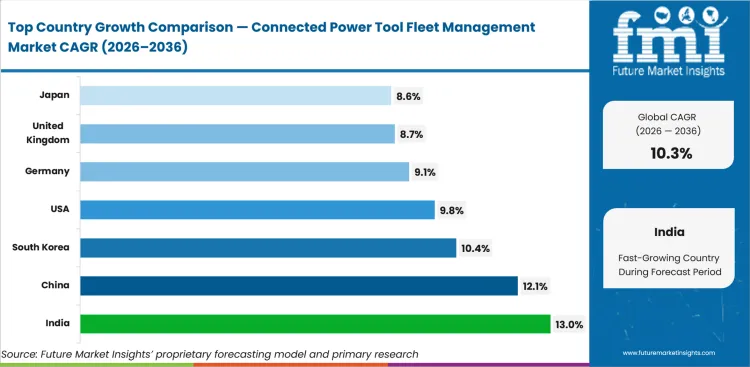
How do country-level CAGRs compare in the connected power tool fleet management market?
India leads country growth while France records the most cautious expansion outlook among profiled markets.
- India is forecast to record 13.0% CAGR by 2036 as organized contractors adopt app-based tool tracking from a low starting point.
- China is expected to expand at 12.1% CAGR from 2026 to 2036 due to infrastructure demand and domestic connected hardware scale.
- South Korea is projected to grow at 10.4% CAGR through 2036 as dense worksites raise tool accountability needs.
- The United States is estimated to rise at 9.8% CAGR by 2036 with enterprise contractors and rental channels driving adoption.
- Germany is forecast to post 9.1% CAGR through 2036 as OEM depth and service-led buying support connected tool records.
- The United Kingdom is expected to advance at 8.7% CAGR over the forecast period through repair work and framework procurement.
- Japan is projected to grow at 8.6% CAGR by 2036 as professional service culture supports embedded tool data.
- France is forecast to grow at 8.2% CAGR through 2036 as rental channels support gradual fleet software exposure.
How fast is the connected power tool fleet management market growing in India?
A 13.0% CAGR through 2036 reflects organized construction growth from a low software penetration base.
Country Market Snapshot Table
| Parameter | Value |
|---|---|
| Market Size in 2025 (Value) | USD 33.6 million |
| Market Size in 2026 (Value) | USD 38.0 million |
| Market Forecast in 2036 (Value) | USD 129.0 million |
| CAGR (2026 to 2036) | 13.0% |
| Years Considered | 2021 to 2036 |
| Base Year | 2025 |
| Forecast Period | 2026 to 2036 |
| Units Considered | Value (USD million) |
| Leading Sub-Region | Mumbai and NCR infrastructure corridors |
India Connected Power Tool Fleet Management Market Outlook
- India demand is shaped by infrastructure contractors that need tool accountability across multiple project locations.
- Small contractors are expected to start with free app functions before converting to paid plans.
Key Growth Drivers
- Press Information Bureau reported that nearly 23% of rural households undertaking own-account construction used institutional funding. This points to wider formal financing in construction activity.
- Press Information Bureau reported 3.91 crore PMAY-G houses sanctioned and 3.03 crore completed as of May 2026. This supports construction activity beyond large metros.
- Authorized dealer growth improves support for connected tool registration and service records.
- Low software penetration creates room for basic app-led conversion among organized contractors.
Key Restraints
- Press Information Bureau reporting showed that institutional funding reached only about 23% of rural own-account construction households. This leaves many buyers dependent on self-funded or informal spending.
- Price-sensitive buyers resist recurring fees without visible loss reduction or warranty savings.
- Regional service gaps make premium platforms harder to sell outside major cities.
What makes India unique
India is unique because connected fleets grow from a low digital starting point but a large contractor expansion curve.
Key Companies
- Bosch India
- Hilti India
- Stanley Black & Decker India
- Makita India
- STIHL India
- Milwaukee Tool India
Sales & Marketing Channels
- Authorized dealer networks
- Infrastructure contractor accounts
- Online B2B channels
- Rental and hire firms
- OEM service programs
- Regional distributor training
Country Segment Breakdown Table
| Segment | Sub-Segments |
|---|---|
| By Connectivity Model | Embedded, Tag-Based, Hybrid |
| By Revenue Model | Subscription, Free Tier, Bundled Hardware |
| By Fleet Size | Enterprise Fleet, Mid Fleet, Small Fleet |
| By End Use | Construction, Facility Maintenance, Landscaping, Industrial MRO |
| By Integration Type | ERP Integrated, App Only, API Native |
| Key Sub-Regions Covered, Infrastructure and contractor corridors | Mumbai, National Capital Region, Bengaluru, Hyderabad, Pune, Chennai, Ahmedabad infrastructure corridors |
Frequently Asked Questions
How fast is India connected power tool fleet management market growing?
The sector in India is projected to expand at 13.0% CAGR from 2026 to 2036, reflected by mumbai and ncr infrastructure corridors.
Who leads India connected power tool fleet management market?
Bosch India and Hilti India compete through professional tool channels. Stanley Black & Decker India and Makita India support fleet service coverage.
What is driving adoption in India connected power tool fleet management market?
Contractor accountability and connected tool service records are moving professional users toward software-backed fleet control in India.
What is the connected power tool fleet management market outlook in China?
A 12.1% CAGR through 2036 reflects infrastructure spending and low-cost connected hardware pathways.
Country Market Snapshot Table
| Parameter | Value |
|---|---|
| Market Size in 2025 (Value) | USD 116.0 million |
| Market Size in 2026 (Value) | USD 130.0 million |
| Market Forecast in 2036 (Value) | USD 407.4 million |
| CAGR (2026 to 2036) | 12.1% |
| Years Considered | 2021 to 2036 |
| Base Year | 2025 |
| Forecast Period | 2026 to 2036 |
| Units Considered | Value (USD million) |
| Leading Sub-Region | Yangtze River Delta and Greater Bay Area project clusters |
China Connected Power Tool Fleet Management Market Outlook
- China demand is shaped by infrastructure contractors that need low-cost tool visibility across many project sites.
- Domestic tool and battery makers are expected to push connected functions into lower price bands.
Key Growth Drivers
- The State Council of China reported Q1 2026 fixed-asset investment growth of 1.7% year over year. This supports equipment spending across organized contractors.
- The National Bureau of Statistics reported fixed-asset investment of CNY 14,129.3 billion from January to April 2026. This supports a broad base for contractor equipment use.
- E-commerce channels speed awareness of tags and app-based asset tools among small and mid-sized buyers.
- Industrial construction and facility maintenance accounts create demand beyond residential building activity.
Key Restraints
- The National Bureau of Statistics reported January to April 2026 fixed-asset investment declined 1.6% year over year. This can delay tool upgrades in cautious contractor accounts.
- Subscription willingness is weaker outside large enterprise accounts where buyers expect low upfront pricing.
- Mixed local brands make data standards and service records harder to unify.
What makes China unique
China is unique because local manufacturing can push connected features into lower price bands faster than most countries.
Key Companies
- Dongcheng
- Chervon
- Positec
- Bosch China
- Hilti China
- Techtronic Industries
Sales & Marketing Channels
- OEM direct sales
- Online B2B platforms
- Regional dealer networks
- Infrastructure contractor accounts
- Industrial distributors
- Service center networks
Country Segment Breakdown Table
| Segment | Sub-Segments |
|---|---|
| By Connectivity Model | Embedded, Tag-Based, Hybrid |
| By Revenue Model | Subscription, Free Tier, Bundled Hardware |
| By Fleet Size | Enterprise Fleet, Mid Fleet, Small Fleet |
| By End Use | Construction, Facility Maintenance, Landscaping, Industrial MRO |
| By Integration Type | ERP Integrated, App Only, API Native |
| Key Sub-Regions Covered, Industrial and infrastructure corridors | Yangtze River Delta, Greater Bay Area, Beijing-Tianjin-Hebei, Chengdu-Chongqing, Wuhan, Xi’an infrastructure corridor |
Frequently Asked Questions
How fast is China connected power tool fleet management market growing?
The sector in China is projected to expand at 12.1% CAGR from 2026 to 2036, reflected by yangtze river delta and greater bay area project clusters.
Who leads China connected power tool fleet management market?
Dongcheng and Chervon compete through professional tool channels. Positec and Bosch China support fleet service coverage.
What is driving adoption in China connected power tool fleet management market?
Contractor accountability and connected tool service records are moving professional users toward software-backed fleet control in China.
What is driving connected power tool fleet management market growth in South Korea?
A 10.4% CAGR through 2036 reflects dense worksites and organized contractor adoption.
Country Market Snapshot Table
| Parameter | Value |
|---|---|
| Market Size in 2025 (Value) | USD 27.2 million |
| Market Size in 2026 (Value) | USD 30.0 million |
| Market Forecast in 2036 (Value) | USD 80.7 million |
| CAGR (2026 to 2036) | 10.4% |
| Years Considered | 2021 to 2036 |
| Base Year | 2025 |
| Forecast Period | 2026 to 2036 |
| Units Considered | Value (USD million) |
| Leading Sub-Region | Seoul Capital Area and Ulsan industrial corridors |
South Korea Connected Power Tool Fleet Management Market Outlook
- South Korea demand is shaped by large contractors and industrial users that digitize small assets across compact worksites.
- Shipyards and facility maintenance accounts are expected to use service records to reduce tool downtime.
Key Growth Drivers
- The Ministry of Data and Statistics reported that 2024 construction enterprises rose 1.4% from 2023. This supports a larger base of potential professional tool buyers.
- The Ministry of Data and Statistics reported that 2024 construction contract value rose 3.4% from 2023. This supports tool accountability needs in organized contractor accounts.
- Dealer-led premium tool sales support connected platform trials among professional users.
- Large contractors need better control of tools across dense urban jobsites and high-rise worksites.
Key Restraints
- Statistics Korea data showed South Korea construction output decreased 5.5% year over year in April 2026. This can delay nonessential software spending in smaller accounts.
- Multi-brand fleets make single-platform data coverage incomplete for contractors with mixed tool rooms.
- Korean-language app support and dealer training remain necessary before broader paid software conversion.
What makes South Korea unique
South Korea is unique because dense worksites raise tool accountability needs even when fleet counts are smaller.
Key Companies
- Keyang Electric
- Aimsak
- Hilti Korea
- Bosch Korea
- Milwaukee Tool Korea
- Husqvarna Korea
Sales & Marketing Channels
- Industrial distributors
- Dealer networks
- Direct contractor sales
- Facility maintenance accounts
- Shipyard procurement routes
- OEM service portals
Country Segment Breakdown Table
| Segment | Sub-Segments |
|---|---|
| By Connectivity Model | Embedded, Tag-Based, Hybrid |
| By Revenue Model | Subscription, Free Tier, Bundled Hardware |
| By Fleet Size | Enterprise Fleet, Mid Fleet, Small Fleet |
| By End Use | Construction, Facility Maintenance, Landscaping, Industrial MRO |
| By Integration Type | ERP Integrated, App Only, API Native |
| Key Sub-Regions Covered, Industrial and infrastructure corridors | Seoul Capital Area, Busan, Ulsan, Incheon, Daegu, Daejeon, industrial shipyard corridors |
Frequently Asked Questions
How fast is South Korea connected power tool fleet management market growing?
The sector in South Korea is projected to expand at 10.4% CAGR from 2026 to 2036, reflected by seoul capital area and ulsan industrial corridors.
Who leads South Korea connected power tool fleet management market?
Keyang Electric and Aimsak compete through professional tool channels. Hilti Korea and Bosch Korea support fleet service coverage.
What is driving adoption in South Korea connected power tool fleet management market?
Contractor accountability and connected tool service records are moving professional users toward software-backed fleet control in South Korea.
What is the connected power tool fleet management market outlook in the United States?
A 9.8% CAGR through 2036 reflects enterprise contractor spending and national rental channel scale.
Country Market Snapshot Table
| Parameter | Value |
|---|---|
| Market Size in 2025 (Value) | USD 218.6 million |
| Market Size in 2026 (Value) | USD 240.0 million |
| Market Forecast in 2036 (Value) | USD 611.3 million |
| CAGR (2026 to 2036) | 9.8% |
| Years Considered | 2021 to 2036 |
| Base Year | 2025 |
| Forecast Period | 2026 to 2036 |
| Units Considered | Value (USD million) |
| Leading Sub-Region | Texas and Southeast contractor corridors |
United States Connected Power Tool Fleet Management Market Outlook
- United States demand is shaped by enterprise contractors that need jobsite ownership records and tool crib accountability.
- Large buyers are expected to compare platforms on loss control and service documentation before approving subscriptions.
Key Growth Drivers
- The USA Census Bureau estimated April 2026 construction spending at USD 2,172.4 billion. This supports a large tool pool for connected fleet workflows.
- The USA Bureau of Labor Statistics reported 1,034 fatal work injuries in construction during 2024. This keeps inspection and service records central to safety-led buying.
- Large commercial contractors need digital ownership records across multi-state jobsites and regional tool cribs.
- Rental and service channels create a practical route for connected tool onboarding among contractors that test platforms before ownership.
Key Restraints
- The USA Census Bureau reported April 2026 single-family housing starts at 930,000. This was 9.0% below the revised March figure and can slow tool replacement among residential trades.
- Mixed-brand fleets slow standardization because contractors often own cordless platforms from multiple suppliers.
- Smaller contractors resist recurring software fees unless loss events or warranty gaps are already visible.
What makes United States unique
The United States is unique because software buying often starts with enterprise risk control rather than tool performance alone.
Key Companies
- Milwaukee Tool
- DEWALT
- Hilti North America
- Bosch Tools
- Tenna
- ToolWatch
Sales & Marketing Channels
- Direct enterprise sales
- Industrial distributor networks
- Contractor rental channels
- Home center pro desks
- OEM fleet programs
- Construction software integrators
Country Segment Breakdown Table
| Segment | Sub-Segments |
|---|---|
| By Connectivity Model | Embedded, Tag-Based, Hybrid |
| By Revenue Model | Subscription, Free Tier, Bundled Hardware |
| By Fleet Size | Enterprise Fleet, Mid Fleet, Small Fleet |
| By End Use | Construction, Facility Maintenance, Landscaping, Industrial MRO |
| By Integration Type | ERP Integrated, App Only, API Native |
| Key Sub-Regions Covered, Infrastructure and contractor corridors | Northeast megaproject corridors, Texas, California, Southeast logistics hubs, Great Lakes industrial sites, Mountain West commercial projects |
Frequently Asked Questions
How fast is United States connected power tool fleet management market growing?
The sector in United States is projected to expand at 9.8% CAGR from 2026 to 2036, reflected by texas and southeast contractor corridors.
Who leads United States connected power tool fleet management market?
Milwaukee Tool and DEWALT compete through professional tool channels. Hilti North America and Bosch Tools support fleet service coverage.
What is driving adoption in United States connected power tool fleet management market?
Contractor accountability and connected tool service records are moving professional users toward software-backed fleet control in United States.
How is the connected power tool fleet management market performing in Germany?
A 9.1% CAGR through 2036 reflects OEM depth and service-led buying across professional tool channels.
Country Market Snapshot Table
| Parameter | Value |
|---|---|
| Market Size in 2025 (Value) | USD 68.7 million |
| Market Size in 2026 (Value) | USD 75.0 million |
| Market Forecast in 2036 (Value) | USD 179.2 million |
| CAGR (2026 to 2036) | 9.1% |
| Years Considered | 2021 to 2036 |
| Base Year | 2025 |
| Forecast Period | 2026 to 2036 |
| Units Considered | Value (USD million) |
| Leading Sub-Region | Bavaria and North Rhine-Westphalia tool clusters |
Germany Connected Power Tool Fleet Management Market Outlook
- Germany demand is shaped by professional buyers that link service history with warranty records and tool reliability.
- Local OEM strength is expected to keep connected tool functions visible in dealer and service conversations.
Key Growth Drivers
- Destatis showed the April 2026 main construction production index at 100.8. The index was 1.3% higher than the corresponding month of the previous year.
- Destatis reported April 2026 construction production growth of 2.4% month over month inside industrial production data. This supports near-term use of professional tool fleets.
- Dealer service culture gives connected software a clear repair and warranty use case across professional channels.
- Infrastructure and energy retrofit work are expected to support larger fleets that require assignment records.
Key Restraints
- Destatis reported March 2026 construction new orders at 108.3 on a non-adjusted index. The figure was 5.3% lower than the corresponding month of the previous year and can restrain faster tool purchases.
- Residential weakness reduces replacement speed for some trade users and narrows near-term software budgets.
- Data protection caution can slow user-level tracking in workforce settings.
What makes Germany unique
Germany is unique because local OEM strength shapes both product design and buyer trust.
Key Companies
- Bosch Professional
- STIHL
- Hilti Deutschland
- Festool
- Milwaukee Tool Germany
- Husqvarna Germany
Sales & Marketing Channels
- Fachhandel dealer networks
- Direct OEM fleet sales
- Rental partners
- Contractor key accounts
- Service centers
- Digital warranty portals
Country Segment Breakdown Table
| Segment | Sub-Segments |
|---|---|
| By Connectivity Model | Embedded, Tag-Based, Hybrid |
| By Revenue Model | Subscription, Free Tier, Bundled Hardware |
| By Fleet Size | Enterprise Fleet, Mid Fleet, Small Fleet |
| By End Use | Construction, Facility Maintenance, Landscaping, Industrial MRO |
| By Integration Type | ERP Integrated, App Only, API Native |
| Key Sub-Regions Covered, Professional tool and service corridors | Bavaria, Baden-Württemberg, North Rhine-Westphalia, Hamburg, Berlin-Brandenburg, Saxony industrial corridors |
Frequently Asked Questions
How fast is Germany connected power tool fleet management market growing?
The sector in Germany is projected to expand at 9.1% CAGR from 2026 to 2036, reflected by bavaria and north rhine-westphalia tool clusters.
Who leads Germany connected power tool fleet management market?
Bosch Professional and STIHL compete through professional tool channels. Hilti Deutschland and Festool support fleet service coverage.
What is driving adoption in Germany connected power tool fleet management market?
Contractor accountability and connected tool service records are moving professional users toward software-backed fleet control in Germany.
How is the connected power tool fleet management market performing in the United Kingdom?
An 8.7% CAGR through 2036 reflects repair work and framework procurement across mature contractor channels.
Country Market Snapshot Table
| Parameter | Value |
|---|---|
| Market Size in 2025 (Value) | USD 50.6 million |
| Market Size in 2026 (Value) | USD 55.0 million |
| Market Forecast in 2036 (Value) | USD 126.7 million |
| CAGR (2026 to 2036) | 8.7% |
| Years Considered | 2021 to 2036 |
| Base Year | 2025 |
| Forecast Period | 2026 to 2036 |
| Units Considered | Value (USD million) |
| Leading Sub-Region | London and Midlands contractor corridors |
United Kingdom Connected Power Tool Fleet Management Market Outlook
- United Kingdom demand is shaped by repair and maintenance teams that use distributed workforces across compact tool fleets.
- Tier-one contractors are expected to use framework buying and approved supplier lists to standardize software-backed tool records.
Key Growth Drivers
- The Office for National Statistics reported March 2026 construction output growth of 1.5%. This supports mobile asset tracking across active repair and new work teams.
- The Office for National Statistics reported repair and maintenance growth of 3.4% in the three months to April 2026. This strengthens demand for app-led records across service trades.
- Framework procurement supports supplier standardization when larger contractors select approved tool platforms.
- Health and safety documentation needs are expected to support inspection-linked service records across contractor teams.
Key Restraints
- The Health and Safety Executive reported 35 fatal injuries to construction workers in 2024/25. This raises compliance pressure and can lengthen approval steps for new jobsite systems.
- Smaller contractors often delay subscriptions during weak order periods and prioritize replacement tools over software.
- Mixed distributor routes make fleet data consistency harder to maintain across branch-led purchases.
What makes United Kingdom unique
The United Kingdom is unique because repair and maintenance teams create demand outside new-build cycles.
Key Companies
- Hilti Great Britain
- Bosch Professional UK
- Milwaukee Tool UK
- DEWALT UK
- Husqvarna UK
- Screwfix Trade
Sales & Marketing Channels
- Builder merchant branches
- Pro retail channels
- Direct contractor accounts
- Rental and hire firms
- Framework procurement
- OEM service portals
Country Segment Breakdown Table
| Segment | Sub-Segments |
|---|---|
| By Connectivity Model | Embedded, Tag-Based, Hybrid |
| By Revenue Model | Subscription, Free Tier, Bundled Hardware |
| By Fleet Size | Enterprise Fleet, Mid Fleet, Small Fleet |
| By End Use | Construction, Facility Maintenance, Landscaping, Industrial MRO |
| By Integration Type | ERP Integrated, App Only, API Native |
| Key Sub-Regions Covered, Repair and rental clusters | London, Midlands, Manchester, Birmingham, Leeds, Glasgow, South East repair corridors |
Frequently Asked Questions
How fast is United Kingdom connected power tool fleet management market growing?
The sector in United Kingdom is projected to expand at 8.7% CAGR from 2026 to 2036, reflected by london and midlands contractor corridors.
Who leads United Kingdom connected power tool fleet management market?
Hilti Great Britain and Bosch Professional UK compete through professional tool channels. Milwaukee Tool UK and DEWALT UK support fleet service coverage.
What is driving adoption in United Kingdom connected power tool fleet management market?
Contractor accountability and connected tool service records are moving professional users toward software-backed fleet control in United Kingdom.
What is the connected power tool fleet management market forecast for Japan?
An 8.6% CAGR through 2036 reflects embedded tool data and service culture inside professional channels.
Country Market Snapshot Table
| Parameter | Value |
|---|---|
| Market Size in 2025 (Value) | USD 55.2 million |
| Market Size in 2026 (Value) | USD 60.0 million |
| Market Forecast in 2036 (Value) | USD 136.9 million |
| CAGR (2026 to 2036) | 8.6% |
| Years Considered | 2021 to 2036 |
| Base Year | 2025 |
| Forecast Period | 2026 to 2036 |
| Units Considered | Value (USD million) |
| Leading Sub-Region | Tokyo and Chubu industrial corridors |
Japan Connected Power Tool Fleet Management Market Outlook
- Japan demand is shaped by professional buyers that favor durable tools and clear service continuity.
- Connected adoption is expected to center on battery records and warranty tracking before full fleet analytics.
Key Growth Drivers
- Japan e-Stat lists 966 datasets under the Current Survey on Orders Received for Construction. This gives suppliers an official basis for tracking contractor activity.
- Japan e-Stat lists 410 datasets under Building Starts. This supports localized planning for dealer-led tool demand.
- Dealer service routes support gradual connected feature onboarding among professional tool users.
- Industrial maintenance teams value tool history and service documentation across factory and facility accounts.
Key Restraints
- MLIT reported planned enterprise land investment of JPY 3,775.8 billion for fiscal 2025. The figure was 20.3% below the previous fiscal year and can restrain construction-linked capital spending.
- Conservative procurement slows full software replacement of manual records in smaller contractor accounts.
- Smaller subcontractors may avoid subscription tools until OEM bundles lower the switching burden.
What makes Japan unique
Japan is unique because embedded tool data can grow through warranty and service culture before full fleet software adoption.
Key Companies
- Makita
- HiKOKI
- Bosch Japan
- Hilti Japan
- DEWALT Japan
- Husqvarna Japan
Sales & Marketing Channels
- Professional dealer networks
- OEM service portals
- Industrial distributor channels
- Facility maintenance accounts
- Contractor key accounts
- App store onboarding
Country Segment Breakdown Table
| Segment | Sub-Segments |
|---|---|
| By Connectivity Model | Embedded, Tag-Based, Hybrid |
| By Revenue Model | Subscription, Free Tier, Bundled Hardware |
| By Fleet Size | Enterprise Fleet, Mid Fleet, Small Fleet |
| By End Use | Construction, Facility Maintenance, Landscaping, Industrial MRO |
| By Integration Type | ERP Integrated, App Only, API Native |
| Key Sub-Regions Covered, Professional tool and service corridors | Tokyo, Osaka, Nagoya, Fukuoka, Yokohama, Kobe, Chubu manufacturing corridor |
Frequently Asked Questions
How fast is Japan connected power tool fleet management market growing?
The sector in Japan is projected to expand at 8.6% CAGR from 2026 to 2036, reflected by tokyo and chubu industrial corridors.
Who leads Japan connected power tool fleet management market?
Makita and HiKOKI compete through professional tool channels. Bosch Japan and Hilti Japan support fleet service coverage.
What is driving adoption in Japan connected power tool fleet management market?
Contractor accountability and connected tool service records are moving professional users toward software-backed fleet control in Japan.
What is driving connected power tool fleet management market growth in France?
An 8.2% CAGR through 2036 reflects larger contractor adoption despite selective construction spending.
Country Market Snapshot Table
| Parameter | Value |
|---|---|
| Market Size in 2025 (Value) | USD 41.6 million |
| Market Size in 2026 (Value) | USD 45.0 million |
| Market Forecast in 2036 (Value) | USD 99.0 million |
| CAGR (2026 to 2036) | 8.2% |
| Years Considered | 2021 to 2036 |
| Base Year | 2025 |
| Forecast Period | 2026 to 2036 |
| Units Considered | Value (USD million) |
| Leading Sub-Region | Paris region and Auvergne-Rhône-Alpes contractor clusters |
France Connected Power Tool Fleet Management Market Outlook
- France demand is shaped by organized contractor fleets and rental-led channels that expose buyers to asset software.
- Civil engineering and specialized trades are expected to adopt fleet records faster than smaller residential contractors.
Key Growth Drivers
- Eurostat reported March 2026 EU construction production growth of 1.2% month over month. This gives French suppliers a regional signal for renewed contractor activity.
- Eurostat reported March 2026 EU civil engineering production growth of 4.8% month over month. This supports connected tool needs across infrastructure and depot-based crews.
- Rental channels support software exposure before contractors move to full ownership adoption.
- Professional distribution gives OEMs a route to train buyers on tool assignment and warranty records.
Key Restraints
- Eurostat reported that France recorded a 0.2% monthly decrease in construction production in March 2026. This creates a selective buying environment for smaller firms.
- Smaller firms remain price-sensitive toward monthly software charges and may prefer free app functions.
- Public tender cycles can delay platform decisions when procurement teams separate tools from software services.
What makes France unique
France is unique because rental and professional distribution channels play a larger role in software exposure.
Key Companies
- Hilti France
- Bosch Professional France
- Milwaukee Tool France
- DEWALT France
- Husqvarna France
- Kiloutou
Sales & Marketing Channels
- Professional distributors
- Rental chains
- Direct key accounts
- OEM service programs
- Public contractor tenders
- Dealer training programs
Country Segment Breakdown Table
| Segment | Sub-Segments |
|---|---|
| By Connectivity Model | Embedded, Tag-Based, Hybrid |
| By Revenue Model | Subscription, Free Tier, Bundled Hardware |
| By Fleet Size | Enterprise Fleet, Mid Fleet, Small Fleet |
| By End Use | Construction, Facility Maintenance, Landscaping, Industrial MRO |
| By Integration Type | ERP Integrated, App Only, API Native |
| Key Sub-Regions Covered, Repair and rental clusters | Île-de-France, Lyon, Marseille, Lille, Toulouse, Nantes, Grand Paris project corridors |
Frequently Asked Questions
How fast is France connected power tool fleet management market growing?
The sector in France is projected to expand at 8.2% CAGR from 2026 to 2036, reflected by paris region and auvergne-rhône-alpes contractor clusters.
Who leads France connected power tool fleet management market?
Hilti France and Bosch Professional France compete through professional tool channels. Milwaukee Tool France and DEWALT France support fleet service coverage.
What is driving adoption in France connected power tool fleet management market?
Contractor accountability and connected tool service records are moving professional users toward software-backed fleet control in France.
Who are the leading companies in the connected power tool fleet management market?
Hilti and Milwaukee Tool lead OEM relevance. DEWALT and Bosch Professional support connected tool coverage. Tenna leads mixed-fleet software relevance.
- OEM-connected platforms hold an advantage when batteries and tools feed data directly into fleet software.
- Specialist construction platforms gain relevance when contractors need one view across mixed equipment fleets.
- Outdoor and facility systems extend connected fleet control into landscaping and municipal work with maintenance teams.
- ERP and service integrations support trial when buyers connect tool records with cost centers and repair history.
Tobacco groups in the reference were replaced with verified connected tool suppliers. Hilti competes through ON!Track and Fleet Management with Nuron battery data. Milwaukee competes through ONE-KEY inventory and smart tool controls. DEWALT links Tool Connect and Site Manager with jobsite asset workflows. Bosch PRO360 supports service and connected tool management.
Specialist platforms win when fleets are mixed across brands and asset types. Tenna targets contractors that track tools beside vehicles and larger equipment. ToolWatch supports construction tool management through durable barcode and asset workflows. Their path is strongest with contractors that want one fleet view across tools and attachments. Vehicles and equipment can remain in the same asset record.
Outdoor and facility suppliers extend the same fleet logic into route-based crews and maintenance teams. Husqvarna Fleet Services supports connected equipment monitoring. STIHL Connected uses app-based product records and Bluetooth-enabled tools. Suppliers with embedded data and mixed-fleet integrations are best positioned because they connect field assets with service decisions.
How do top connected power tool fleet management companies compare?
Hilti scores strongest on embedded tool data while Tenna and ToolWatch lead mixed-fleet breadth.
| Company | Relevance to Market Title | Embedded Tool Data Depth | Mixed Fleet Tracking Breadth | Service Workflow Integration | Geographic Footprint |
|---|---|---|---|---|---|
| Hilti | Very High | Very Strong | Strong | Very Strong | Global |
| Milwaukee Tool | Very High | Very Strong | Strong | Strong | North America, Europe, Asia-Pacific |
| DEWALT | Very High | Strong | Mo derate | Strong | Global |
| Bosch Professional | High | Moderate | Moderate | Strong | Global |
| STIHL | High | Moderate | Moderate | Moderate | Global |
| Husqvarna | High | Moderate | Strong | Moderate | Global |
| Makita | Moderate to High | Moderate | Low to Moderate | Moderate | Global |
| Tenna | Very High | Low to Moderate | Very Strong | Strong | North America |
| ToolWatch | High | Low to Moderate | Very Strong | Strong | North America |
Source: Future Market Insights competitive analysis, 2026.
Who are the key players in the connected power tool fleet management market?
Hilti and Milwaukee Tool are listed with DEWALT and Bosch Professional. STIHL and Husqvarna are also listed. Makita and Tenna complete the supplier set with ToolWatch.
Key global companies leading the connected power tool fleet management market include:
- Hilti
- Milwaukee Tool
- DEWALT
- Bosch Professional
- STIHL
- Husqvarna
- Makita
- Tenna
- ToolWatch
- ToolSense
Key Developments in Connected Power Tool Fleet Management Market
- In January 2025, Hilti launched Nuron cordless products including a cordless diamond core rig and rotating lasers. The expansion widened the pool of tools that can support connected fleet workflows.
- In December 2024, Milwaukee introduced the MX FUEL 1HP 2-inch submersible pump with ONE-KEY compatibility. The launch extended connected tracking into mobile jobsite pumping equipment.
- In January 2026, DEWALT highlighted Tool Connect Site Manager for tool and asset utilization. The update strengthened DEWALT’s software case for jobsite asset control.
Key Players in the Connected Power Tool Fleet Management Market
OEM-Connected Platforms
- Hilti
- Milwaukee Tool
- DEWALT
- Bosch Professional
- STIHL
- Husqvarna
- Makita
Construction Asset Platforms
- Tenna
- ToolWatch
- ToolSense
Outdoor and Facility Systems
- Husqvarna
- STIHL
- ToolSense
Connected Power Tool Fleet Management Market - Scope & Definition
| Attribute | Detail |
|---|---|
| Market Definition | Software, tags, batteries, chargers, and connected tool platforms used to track and administer professional power tool fleets across jobsites and service environments |
| Functions Covered | Inventory control, tool assignment, location records, service reminders, battery health visibility, utilization views, audit trails, and app-based fleet administration |
| Applications Covered | Professional power tool tracking, cordless battery monitoring, tool crib control, contractor asset assignment, rental fleet support, and service documentation |
| End-Use Industries | Construction, facility maintenance, landscaping, industrial maintenance repair and operations, rental channels, and dealer-supported contractor services |
| Connectivity Models Covered | Embedded connected tools, tag-based systems, hybrid fleet records, app-only workflows, and API-native integrations |
| Inclusions | OEM connected tool systems, Bluetooth tags, NFC labels, QR-based tool records, battery health dashboards, service history tools, subscriptions, and jobsite asset portals |
| Exclusions | Passenger vehicle tracking, heavy equipment telematics without tool modules, consumer DIY apps, general warehouse inventory tools, non-powered hand tools, and standalone battery sales with no fleet data service |
Connected Power Tool Fleet Management Market - Research Methodology
| Method | Description |
|---|---|
| Primary Research | FMI analyst interviews with contractor tool crib managers, rental managers, safety officers, facility teams, dealer staff, and construction technology buyers across key markets |
| Desk Research | Review of official construction indicators, company product pages, support documents, trade classifications, safety data, and verified supplier documentation related to connected tools |
| Market Sizing & Forecasting | Bottom-up modelling using professional power tool fleet value, connected hardware penetration, software attach rates, subscription pricing, and country-level contractor maturity |
| Data Validation | Cross-verification using construction activity, tool trade indicators, supplier portfolios, adoption patterns in adjacent fleet software, and interviews with distributors and contractors |
Connected Power Tool Fleet Management Market - Report Scope
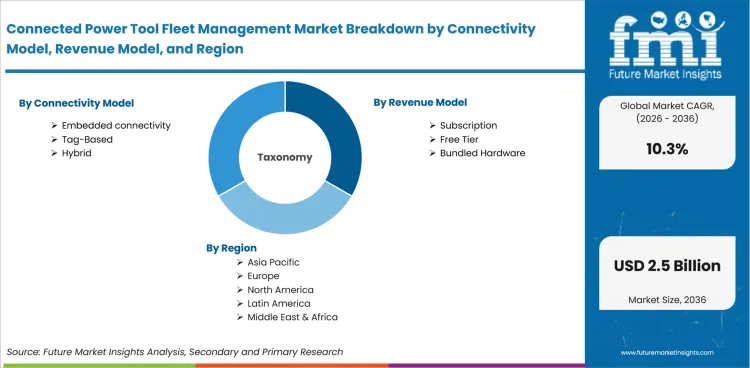
| Item | Value |
|---|---|
| Market size by 2036 | USD 2.56 billion |
| Growth rate | 10.3% CAGR from 2026 to 2036 |
| Forecast period | 2026 to 2036 |
| Base year value (2025) | USD 0.87 billion |
| By connectivity model | Embedded, tag-based, hybrid |
| By revenue model | Subscription, free tier, bundled hardware |
| By fleet size | Enterprise Fleet, Mid Fleet, Small Fleet |
| By end use | Construction, facility maintenance, landscaping, industrial MRO |
| By integration type | ERP Integrated, App Only, API Native |
| Regions covered | North America, Latin America, Europe, East Asia, South Asia and Pacific, Middle East and Africa |
| Countries covered | India, China, South Korea, United States, Germany, United Kingdom, Japan, France |
| Key companies profiled | Hilti, Milwaukee Tool, DEWALT, Bosch Professional, STIHL, Husqvarna, Makita, Tenna, ToolWatch |
| Approach | Bottom-up product-boundary approach using professional tool fleet value, connected hardware penetration, subscription attach rates, and country-level contractor maturity |
Source: Future Market Insights, 2026.
Connected Power Tool Fleet Management Market Breakdown by Connectivity Model and Other Segments
Connected Power Tool Fleet Management Market Segmented by Connectivity Model
- Embedded
- Tag-Based
- Hybrid
Connected Power Tool Fleet Management Market Segmented by Revenue Model
- Subscription
- Free Tier
- Bundled Hardware
Connected Power Tool Fleet Management Market Segmented by Fleet Size
- Enterprise Fleet
- Mid Fleet
- Small Fleet
Connected Power Tool Fleet Management Market Segmented by End Use
- Construction
- Facility Maintenance
- Landscaping
- Industrial MRO
Connected Power Tool Fleet Management Market Segmented by Integration Type
- ERP Integrated
- App Only
- API Native
Connected Power Tool Fleet Management Market by Region
- North America
- Latin America
- Europe
- East Asia
- South Asia and Pacific
- Middle East and Africa
Research Sources and Bibliography
- USACensus Bureau. (2026, June 1). Monthly construction spending, April 2026.
- USA Census Bureau. (2026, May 21). New residential construction, April 2026.
- USA Bureau of Labor Statistics. (2026, February 19). Census of Fatal Occupational Injuries summary, 2024.
- Office for National Statistics. (2026, May 14). Construction output in Great Britain: March 2026, new orders and construction output price indices.
- Office for National Statistics. (2026, June 12). Construction output in Great Britain: April 2026.
- Health and Safety Executive. (2025, July 15). Work-related fatal injuries in Great Britain, April 2024 to March 2025.
- Federal Statistical Office of Germany. (2026). Production index in main construction industry.
- Federal Statistical Office of Germany. (2026). Index of new orders received in construction industry, total.
- Federal Statistical Office of Germany. (2026, June 9). Production in April 2026: +0.4% on the previous month.
- Eurostat. (2026, May 21). Production in construction up by 0.8% in the euro area and by 1.2% in the EU.
- Ministry of Land, Infrastructure, Transport and Tourism. (2025, September 2). Fiscal Year 2024 Trends Concerning Land.
- e-Stat. (2026). Current Survey on Orders Received for Construction.
- e-Stat. (2026). Building Starts.
- State Council of China. (2026, April 16). China’s fixed-asset investment up 1.7 percent in Q1.
- National Bureau of Statistics of China. (2026, May 19). Investment in fixed assets from January to April 2026.
- Ministry of Data and Statistics. (2025, August 22). Preliminary results of the 2024 Construction Survey.
- Statistics Korea. (2026). Construction output, April 2026.
- Press Information Bureau. (2026, April 10). Pilot survey on household construction and institutional funding.
- Press Information Bureau. (2026, June 8). Empowering the poor: A decade of inclusive transformation.
- Press Information Bureau. (2026, June 9). Infrastructure at the core of India’s development.
- Hilti. (2026, May 18). How to exchange an end-of-life Nuron battery via a battery alert.
- Milwaukee Tool. (2026). Inventory management. ONE-KEY Support.
- DEWALT. (2026, January 26). Best practices for tool and asset utilization with safety and incident control through DEWALT Site Manager.
- Bosch Professional. (2026, May 23). Bosch PRO360 service app.
- Tenna. (2024, July). Tenna introduces TennaINTEL and TennaBLE RT1.
This bibliography is provided for reader reference and is not exhaustive. The full report contains the complete reference list and detailed citations.
This Report Answers
- What is the 2026 value and 2036 forecast for connected power tool fleet management market?
- What connectivity model is projected to hold the leading share during the forecast period?
- What revenue model is expected to account for the leading 2026 share?
- How do battery data and software subscriptions affect fleet control adoption?
- What companies compete in connected power tool fleet management?
Frequently Asked Questions
What is the connected power tool fleet management market size in 2026?
The connected power tool fleet management market size is anticipated to cross USD 0.96 billion in 2026.
What is the connected power tool fleet management market forecast for 2036?
The connected power tool fleet management industry revenue is predicted to reach USD 2.56 billion by 2036 as connected tool records expand.
What is the connected power tool fleet management market CAGR?
The connected power tool fleet management sector is projected to expand at 10.3% CAGR from 2026 to 2036.
What segment leads the connected power tool fleet management market?
Subscription software is likely to capture 57.0% share in 2026 due to recurring reporting and user access controls.
What country grows fastest in the connected power tool fleet management market?
India is set to record 13.0% CAGR by 2036, driven by organized construction and low initial software penetration.
Preview the report firsthand - request a free sample
Get SampleGet the brochure for pricing and purchase details.
Get PDFTable of Content
- Key Takeaways
- Market Size and CAGR
- Top Growth Driver
- Fastest Growing Segment
- Leading Region
- Key Companies
- Emerging Opportunities
- Executive Summary
- Global Market Outlook
- Demand-side Trends
- Supply-side Trends
- Technology Roadmap Analysis
- Analysis and Recommendations
- Analyst Perspective (What is happening? Why now? What should investors know?)
- Key Questions Answered
- How large is the market?
- What is the CAGR?
- What are key trends?
- Which region dominates?
- Who are the leaders?
- Market Overview
- Market Coverage / Taxonomy
- Market Definition / Scope / Limitations
- Research Methodology
- Chapter Orientation
- Analytical Lens and Working Hypotheses
- Market Structure, Signals, and Trend Drivers
- Benchmarking and Cross-market Comparability
- Market Sizing, Forecasting, and Opportunity Mapping
- Research Design and Evidence Framework
- Desk Research Programme (Secondary Evidence)
- Expert Input and Fieldwork (Primary Evidence)
- Tooling, Models, and Reference Databases
- Data Engineering and Model Build
- Quality Assurance and Audit Trail
- Market Background
- Market Dynamics (Drivers, Restraints, Opportunity, Trends)
- Scenario Forecast (Optimistic, Likely, Conservative)
- Impact Analysis
- AI Impact
- Sustainability Impact
- Regulatory Impact
- Technology Impact
- Consumer / Buyer Analysis
- Purchase Drivers
- Adoption Barriers
- Buyer Journey
- Opportunity Map Analysis
- Product Life Cycle Analysis
- Supply Chain Analysis
- Investment Feasibility Matrix
- Value Chain Analysis
- PESTLE and Porter's Analysis
- Regulatory Landscape
- Regional Parent Market Outlook
- Production and Consumption Statistics
- Import and Export Statistics
- Global Market Analysis and Forecast, 2021 to 2036
- Historical Market Size Value (USD Billion) & Volume (Unit) Analysis, 2021 to 2025
- Current and Future Market Size Value (USD Billion) & Volume (Unit) Projections, 2026 to 2036
- Y-o-Y Growth Trend Analysis
- Absolute $ Opportunity Analysis
- Global Market Pricing Analysis, 2021 to 2036
- Global Market Analysis and Forecast, By Connectivity Model, 2021 to 2036
- Introduction / Key Findings
- Historical Market Size Value (USD Billion) & Volume (Unit) Analysis By Connectivity Model, 2021 to 2025
- Current and Future Market Size Value (USD Billion) & Volume (Unit) Analysis and Forecast By Connectivity Model, 2026 to 2036
- Embedded
- Tag-Based
- Hybrid
- Tamper / Vibration Sensors
- Embedded
- Y-o-Y Growth Trend Analysis By Connectivity Model, 2021 to 2025
- Absolute $ Opportunity Analysis By Connectivity Model, 2026 to 2036
- Global Market Analysis and Forecast, By Revenue Model, 2021 to 2036
- Introduction / Key Findings
- Historical Market Size Value (USD Billion) & Volume (Unit) Analysis By Revenue Model, 2021 to 2025
- Current and Future Market Size Value (USD Billion) & Volume (Unit) Analysis and Forecast By Revenue Model, 2026 to 2036
- Subscription
- Free Tier
- Bundled Hardware
- Utility / Outdoor Cabinets
- Subscription
- Y-o-Y Growth Trend Analysis By Revenue Model, 2021 to 2025
- Absolute $ Opportunity Analysis By Revenue Model, 2026 to 2036
- Global Market Analysis and Forecast, By Fleet Size, 2021 to 2036
- Introduction / Key Findings
- Historical Market Size Value (USD Billion) & Volume (Unit) Analysis By Fleet Size, 2021 to 2025
- Current and Future Market Size Value (USD Billion) & Volume (Unit) Analysis and Forecast By Fleet Size, 2026 to 2036
- Enterprise Fleet
- Mid Fleet
- Small Fleet
- Enterprise Fleet
- Y-o-Y Growth Trend Analysis By Fleet Size, 2021 to 2025
- Absolute $ Opportunity Analysis By Fleet Size, 2026 to 2036
- Global Market Analysis and Forecast, By End Use, 2021 to 2036
- Introduction / Key Findings
- Historical Market Size Value (USD Billion) & Volume (Unit) Analysis By End Use, 2021 to 2025
- Current and Future Market Size Value (USD Billion) & Volume (Unit) Analysis and Forecast By End Use, 2026 to 2036
- Construction
- Facility Maintenance
- Landscaping
- Industrial MRO
- Construction
- Y-o-Y Growth Trend Analysis By End Use, 2021 to 2025
- Absolute $ Opportunity Analysis By End Use, 2026 to 2036
- Global Market Analysis and Forecast, By Integration Type, 2021 to 2036
- Introduction / Key Findings
- Historical Market Size Value (USD Billion) & Volume (Unit) Analysis By Integration Type, 2021 to 2025
- Current and Future Market Size Value (USD Billion) & Volume (Unit) Analysis and Forecast By Integration Type, 2026 to 2036
- ERP Integrated
- App Only
- API Native
- ERP Integrated
- Y-o-Y Growth Trend Analysis By Integration Type, 2021 to 2025
- Absolute $ Opportunity Analysis By Integration Type, 2026 to 2036
- Global Market Analysis and Forecast, By Region, 2021 to 2036
- Introduction
- Historical Market Size Value (USD Billion) & Volume (Unit) Analysis By Region, 2021 to 2025
- Current Market Size Value (USD Billion) & Volume (Unit) Analysis and Forecast By Region, 2026 to 2036
- North America
- Latin America
- Western Europe
- Eastern Europe
- East Asia
- South Asia and Pacific
- Middle East & Africa
- Market Attractiveness Analysis By Region
- North America Market Analysis and Forecast, By Country, 2021 to 2036
- Historical Market Size Value (USD Billion) & Volume (Unit) Trend Analysis By Market Taxonomy, 2021 to 2025
- Market Size Value (USD Billion) & Volume (Unit) Forecast By Market Taxonomy, 2026 to 2036
- By Country
- USA
- Canada
- Mexico
- By Connectivity Model
- By Revenue Model
- By Fleet Size
- By End Use
- By Integration Type
- By Country
- Market Attractiveness Analysis
- By Country
- By Connectivity Model
- By Revenue Model
- By Fleet Size
- By End Use
- By Integration Type
- Key Takeaways
- Latin America Market Analysis and Forecast, By Country
- Historical Market Size Value (USD Billion) & Volume (Unit) Trend Analysis By Market Taxonomy, 2021 to 2025
- Market Size Value (USD Billion) & Volume (Unit) Forecast By Market Taxonomy, 2026 to 2036
- By Country
- Brazil
- Chile
- Rest of Latin America
- By Connectivity Model
- By Revenue Model
- By Fleet Size
- By End Use
- By Integration Type
- By Country
- Market Attractiveness Analysis
- By Country
- By Connectivity Model
- By Revenue Model
- By Fleet Size
- By End Use
- By Integration Type
- Key Takeaways
- Western Europe Market Analysis and Forecast, By Country
- Historical Market Size Value (USD Billion) & Volume (Unit) Trend Analysis By Market Taxonomy, 2021 to 2025
- Market Size Value (USD Billion) & Volume (Unit) Forecast By Market Taxonomy, 2026 to 2036
- By Country
- Germany
- UK
- Italy
- Spain
- France
- Nordic
- BENELUX
- Rest of Western Europe
- By Connectivity Model
- By Revenue Model
- By Fleet Size
- By End Use
- By Integration Type
- By Country
- Market Attractiveness Analysis
- By Country
- By Connectivity Model
- By Revenue Model
- By Fleet Size
- By End Use
- By Integration Type
- Key Takeaways
- Eastern Europe Market Analysis and Forecast, By Country
- Historical Market Size Value (USD Billion) & Volume (Unit) Trend Analysis By Market Taxonomy, 2021 to 2025
- Market Size Value (USD Billion) & Volume (Unit) Forecast By Market Taxonomy, 2026 to 2036
- By Country
- Russia
- Poland
- Hungary
- Balkan & Baltic
- Rest of Eastern Europe
- By Connectivity Model
- By Revenue Model
- By Fleet Size
- By End Use
- By Integration Type
- By Country
- Market Attractiveness Analysis
- By Country
- By Connectivity Model
- By Revenue Model
- By Fleet Size
- By End Use
- By Integration Type
- Key Takeaways
- East Asia Market Analysis and Forecast, By Country
- Historical Market Size Value (USD Billion) & Volume (Unit) Trend Analysis By Market Taxonomy, 2021 to 2025
- Market Size Value (USD Billion) & Volume (Unit) Forecast By Market Taxonomy, 2026 to 2036
- By Country
- China
- Japan
- South Korea
- By Connectivity Model
- By Revenue Model
- By Fleet Size
- By End Use
- By Integration Type
- By Country
- Market Attractiveness Analysis
- By Country
- By Connectivity Model
- By Revenue Model
- By Fleet Size
- By End Use
- By Integration Type
- Key Takeaways
- South Asia and Pacific Market Analysis and Forecast, By Country
- Historical Market Size Value (USD Billion) & Volume (Unit) Trend Analysis By Market Taxonomy, 2021 to 2025
- Market Size Value (USD Billion) & Volume (Unit) Forecast By Market Taxonomy, 2026 to 2036
- By Country
- India
- ASEAN
- Australia & New Zealand
- Rest of South Asia and Pacific
- By Connectivity Model
- By Revenue Model
- By Fleet Size
- By End Use
- By Integration Type
- By Country
- Market Attractiveness Analysis
- By Country
- By Connectivity Model
- By Revenue Model
- By Fleet Size
- By End Use
- By Integration Type
- Key Takeaways
- Middle East & Africa Market Analysis and Forecast, By Country
- Historical Market Size Value (USD Billion) & Volume (Unit) Trend Analysis By Market Taxonomy, 2021 to 2025
- Market Size Value (USD Billion) & Volume (Unit) Forecast By Market Taxonomy, 2026 to 2036
- By Country
- Kingdom of Saudi Arabia
- Other GCC Countries
- Türkiye
- South Africa
- Other African Union
- Rest of Middle East & Africa
- By Connectivity Model
- By Revenue Model
- By Fleet Size
- By End Use
- By Integration Type
- By Country
- Market Attractiveness Analysis
- By Country
- By Connectivity Model
- By Revenue Model
- By Fleet Size
- By End Use
- By Integration Type
- Key Takeaways
- Key Countries Market Analysis
- USA
- Pricing Analysis
- Market Share Analysis, 2025
- By Connectivity Model
- By Revenue Model
- By Fleet Size
- By End Use
- By Integration Type
- Canada
- Pricing Analysis
- Market Share Analysis, 2025
- By Connectivity Model
- By Revenue Model
- By Fleet Size
- By End Use
- By Integration Type
- Mexico
- Pricing Analysis
- Market Share Analysis, 2025
- By Connectivity Model
- By Revenue Model
- By Fleet Size
- By End Use
- By Integration Type
- Brazil
- Pricing Analysis
- Market Share Analysis, 2025
- By Connectivity Model
- By Revenue Model
- By Fleet Size
- By End Use
- By Integration Type
- Chile
- Pricing Analysis
- Market Share Analysis, 2025
- By Connectivity Model
- By Revenue Model
- By Fleet Size
- By End Use
- By Integration Type
- Germany
- Pricing Analysis
- Market Share Analysis, 2025
- By Connectivity Model
- By Revenue Model
- By Fleet Size
- By End Use
- By Integration Type
- UK
- Pricing Analysis
- Market Share Analysis, 2025
- By Connectivity Model
- By Revenue Model
- By Fleet Size
- By End Use
- By Integration Type
- Italy
- Pricing Analysis
- Market Share Analysis, 2025
- By Connectivity Model
- By Revenue Model
- By Fleet Size
- By End Use
- By Integration Type
- Spain
- Pricing Analysis
- Market Share Analysis, 2025
- By Connectivity Model
- By Revenue Model
- By Fleet Size
- By End Use
- By Integration Type
- France
- Pricing Analysis
- Market Share Analysis, 2025
- By Connectivity Model
- By Revenue Model
- By Fleet Size
- By End Use
- By Integration Type
- India
- Pricing Analysis
- Market Share Analysis, 2025
- By Connectivity Model
- By Revenue Model
- By Fleet Size
- By End Use
- By Integration Type
- ASEAN
- Pricing Analysis
- Market Share Analysis, 2025
- By Connectivity Model
- By Revenue Model
- By Fleet Size
- By End Use
- By Integration Type
- Australia & New Zealand
- Pricing Analysis
- Market Share Analysis, 2025
- By Connectivity Model
- By Revenue Model
- By Fleet Size
- By End Use
- By Integration Type
- China
- Pricing Analysis
- Market Share Analysis, 2025
- By Connectivity Model
- By Revenue Model
- By Fleet Size
- By End Use
- By Integration Type
- Japan
- Pricing Analysis
- Market Share Analysis, 2025
- By Connectivity Model
- By Revenue Model
- By Fleet Size
- By End Use
- By Integration Type
- South Korea
- Pricing Analysis
- Market Share Analysis, 2025
- By Connectivity Model
- By Revenue Model
- By Fleet Size
- By End Use
- By Integration Type
- Russia
- Pricing Analysis
- Market Share Analysis, 2025
- By Connectivity Model
- By Revenue Model
- By Fleet Size
- By End Use
- By Integration Type
- Poland
- Pricing Analysis
- Market Share Analysis, 2025
- By Connectivity Model
- By Revenue Model
- By Fleet Size
- By End Use
- By Integration Type
- Hungary
- Pricing Analysis
- Market Share Analysis, 2025
- By Connectivity Model
- By Revenue Model
- By Fleet Size
- By End Use
- By Integration Type
- Kingdom of Saudi Arabia
- Pricing Analysis
- Market Share Analysis, 2025
- By Connectivity Model
- By Revenue Model
- By Fleet Size
- By End Use
- By Integration Type
- Türkiye
- Pricing Analysis
- Market Share Analysis, 2025
- By Connectivity Model
- By Revenue Model
- By Fleet Size
- By End Use
- By Integration Type
- South Africa
- Pricing Analysis
- Market Share Analysis, 2025
- By Connectivity Model
- By Revenue Model
- By Fleet Size
- By End Use
- By Integration Type
- USA
- Market Structure Analysis
- Competition Dashboard
- Competition Benchmarking
- Market Share Analysis of Top Players
- By Regional
- By Connectivity Model
- By Revenue Model
- By Fleet Size
- By End Use
- By Integration Type
- Emerging Startups
- Innovation Benchmarking
- Competition Analysis
- Competition Deep Dive
- Hilti
- Overview
- Product Portfolio
- Profitability by Market Segments (Product/Region/Sales Channel)
- Sales Footprint
- Strategy Overview
- Marketing Strategy
- Product Strategy
- Channel Strategy
- Milwaukee Tool
- DEWALT
- Bosch Professional
- STIHL
- Husqvarna
- Makita
- Tenna
- ToolWatch
- ToolSense
- Hilti
- Case Studies
- Success Stories
- Recent Developments
- Competition Deep Dive
- Assumptions & Acronyms Used


