

- Market Size (2026)
- USD 760.6 Mn
- Forecast (2036)
- USD 3185.8 Mn
- CAGR (2026 to 2036)
- 15.4%
How big is the Powerline Inspection Robots Market?
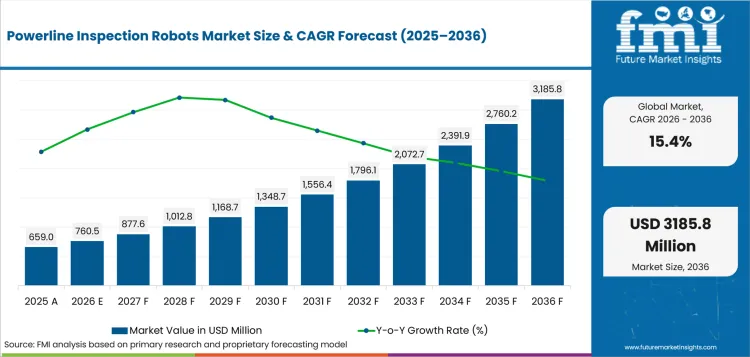
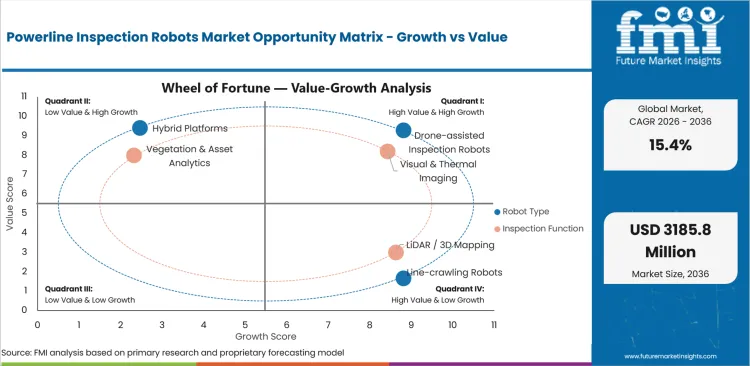
The Powerline Inspection Robots Market is projected to grow from USD 760.6 million in 2026 to USD 3185.8 million by 2036, at a CAGR of 15.4%.
The Powerline Inspection Robots Market was valued at USD 659.0988 million in 2025 and is expected to reach USD 760.6 million in 2026. The market is projected to reach USD 3185.8 million by 2036 at a CAGR of 15.4% from 2026 to 2036. The USA Department of Energy announced about USD 1.9 billion under SPARK in March 2026 for reconductoring and other advanced transmission technologies.
| Metric | Value |
|---|---|
| 2025 Market Size | USD 659.0988 million. |
| 2026 Market Size | USD 760.6 million. |
| 2036 Market Size | USD 3185.8 million. |
| Forecast CAGR | 15.4% from 2026 to 2036. |
| Featured Robot Type | Drone-assisted Inspection Robots. |
| Drone-assisted Inspection Robots Share in 2026 | 48.0%. |
| Featured Inspection Function | Visual & Thermal Imaging. |
| Visual & Thermal Imaging Share in 2026 | 45.0%. |
| Country CAGR Highlight | China. |
| China CAGR | 17.8% by 2036. |
Summary of the Powerline Inspection Robots Market
| Market Signal | Commercial Impact |
|---|---|
| Demand and Growth Drivers | Utilities are increasingly deploying robotic inspection systems to improve grid reliability and worker safety.
|
| Product and Segment View | Drone-assisted robots and imaging technologies continue to dominate power grid inspection applications.
|
| Geography and Competitive Outlook | Asia and North America are expected to remain key markets for robotic grid inspection solutions.
|
| Analyst Perspective | Grid inspection robotics are evolving into data-driven asset intelligence platforms rather than standalone inspection tools.
— Nikhil Kaitwade, Principal Consultant, Industrial Domain, Future Market Insights |
China’s State Council information office reported in August 2024 that robots and drones are widely used for grid inspection.
This supports inspection workflows that verify span condition before new capacity is added.
Why is the Powerline Inspection Robots Market growing?
Utilities are automating corridor patrols since longer transmission routes need faster defect screening than manual climbing permits. Drone-assisted systems reduce crew exposure when energized lines and storm-damaged corridors need visual checks.
- Utilities are automating corridor patrols since longer transmission routes need faster defect screening than manual climbing permits.
- Drone-assisted systems reduce crew exposure when energized lines and storm-damaged corridors need visual checks.
- Substation robots are gaining buyer interest as unmanned inspection lowers routine entry into high-voltage yards.
Transmission owners are moving robot inspection into planning cycles before large reinforcement work begins. The USA Department of Energy’s March 2026 SPARK funding notice set about USD 1.9 billion for critical grid infrastructure including reconductoring and advanced transmission technologies.
That level of grid work increases the need for repeatable conductor and clearance records before crews start upgrades. Robot inspection tools reduce field uncertainty by checking asset condition without repeated tower climbs. The practical result is a larger service pool for suppliers that can combine safe inspection with clean data output. Grid operators are also using robots to inspect assets that are hard or unsafe to reach by ordinary patrol.
How is the Powerline Inspection Robots Market segmented?
The Powerline Inspection Robots Market is segmented by robot type, inspection function, grid asset, buyer type, deployment, and region.
- Drone-assisted Inspection Robots are estimated to account for 48.0% of By Robot Type revenue in 2026 as utilities need broad corridor coverage.
- With an estimated 45.0% share in 2026, Visual & Thermal Imaging is expected to support By Inspection Function due to first-pass fault screening.
- Transmission Lines are projected to represent 55.0% of By Grid Asset demand in 2026 with long-span inspection driving service volume.
How does Drone-assisted Inspection Robots contribute to the robot type category?
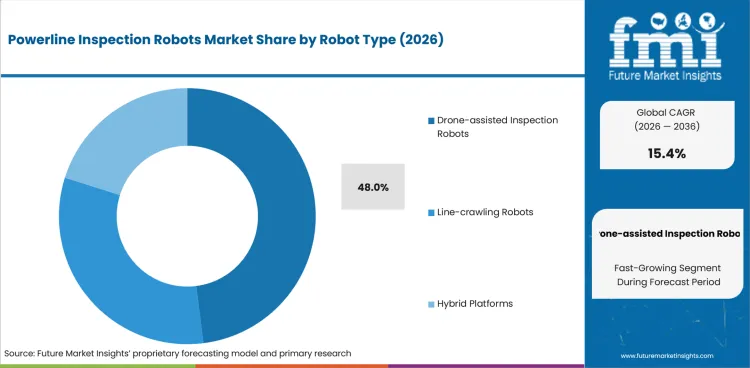
- Drone-assisted Inspection Robots are projected to account for a 48.0% share in 2026 as utilities favor wide-area patrols that cover towers and spans without climbing crews.
- Line-crawling Robots stay relevant for contact checks on conductors and sleeves, especially where resistance measurement is required without interrupting line service.
What supports demand for Visual & Thermal Imaging?
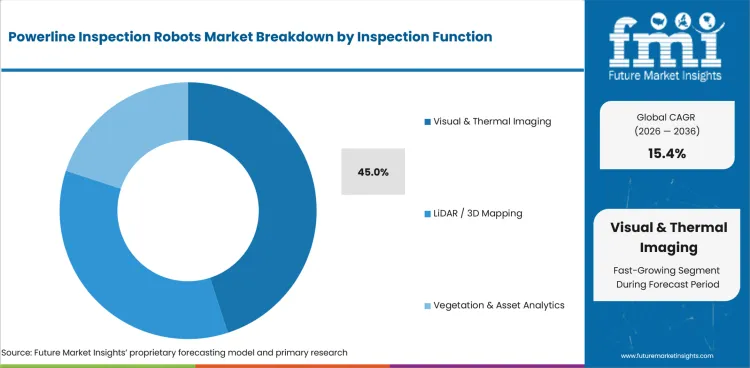
- Visual & Thermal Imaging is estimated to represent a 45.0% share in 2026 since most maintenance teams start with visible damage and heat anomaly screening.
- Corona and partial discharge tools carry smaller share but higher specialist value, as buyers need trained interpretation for electrical leakage evidence.
How do buyers evaluate Transmission Lines within the grid asset category?
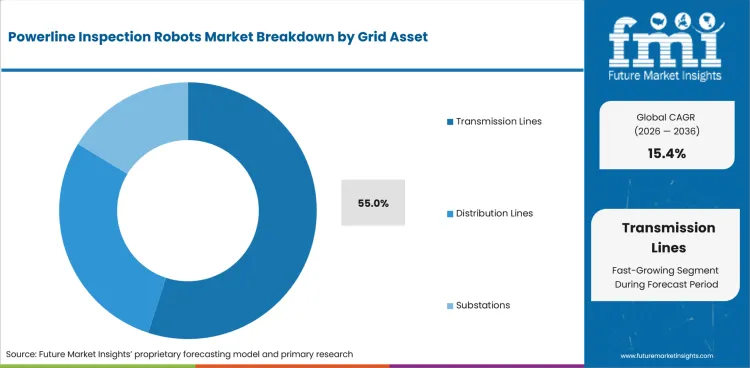
- Transmission Lines are anticipated to hold a 55.0% share in 2026 as utilities prioritize long corridors with high outage impact and access limits.
- Substations need shorter robot routes but stricter safety logic, which supports ground robots with thermal cameras and acoustic sensors.
What market factors influence demand for Utilities?
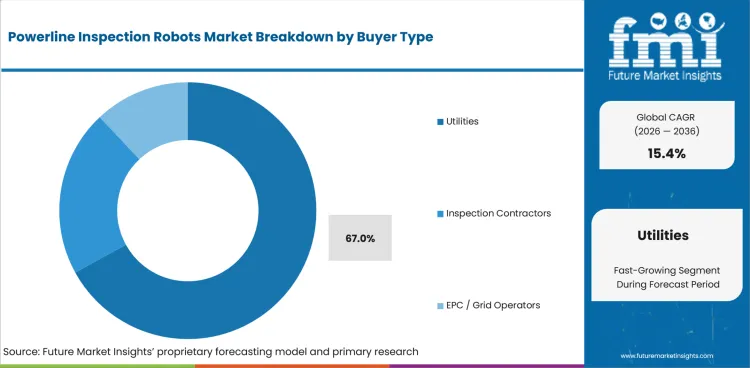
- Utilities are expected to account for a 67.0% share in 2026 as they own asset standards and decide when inspection data triggers repair work.
- Inspection contractors win work when utilities prefer service purchase orders over owning pilots, payloads, trained operators, and data review staff.
How does Inspection-as-a-Service affect the deployment outlook?
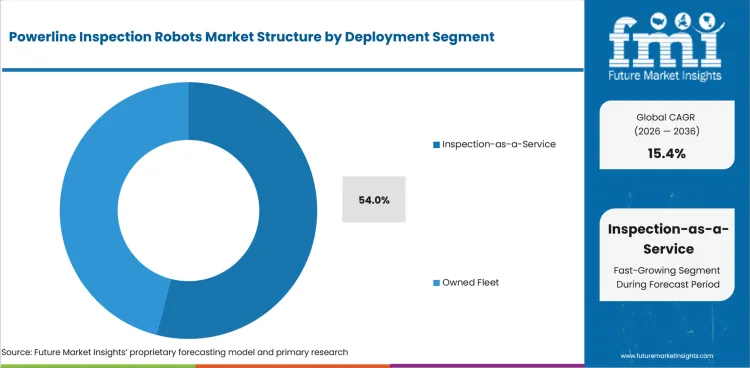
- Inspection-as-a-Service is projected to represent a 54.0% share in 2026 as utilities buy verified inspection output without managing robot fleets.
- Owned Fleet demand is stronger among large utilities that have drone teams, safety approvals, and recurring corridor inspection calendars.
What drives and restrains the market?
The market reflects a balance between the identified demand driver, adoption constraints, and the supplier opportunity outlined below.
Driver: Transmission expansion drives inspection needs as utilities must verify conductor, tower, and clearance condition before upgrade work; restraint: Data quality is a restraint since low-resolution imagery often creates manual review work for utility engineers; opportunity: inspection-as-a-Service creates an opportunity for contractors that combine licensed pilots, payloads, and defect review.
- Driver: Transmission expansion drives inspection needs as utilities must verify conductor, tower, and clearance condition before upgrade work.
- Restraint: Data quality is a restraint since low-resolution imagery often creates manual review work for utility engineers.
- Opportunity: inspection-as-a-Service creates an opportunity for contractors that combine licensed pilots, payloads, and defect review.
Live-line Safety Economics: Live-line inspection is gaining budget priority because utilities face high labor risk when crews climb energized or damaged structures. Drone Volt’s LineDrone is designed to land on energized lines and measure electrical resistance across sleeves without interrupting service. This type of field capability changes the cost discussion from robot price to avoided outages and safer work. It also supports more frequent inspection of high-risk fittings that crews cannot check quickly. Buyers will favor suppliers that prove contact safety and operator control in utility field settings.
The commercial effect is clear: software quality can outweigh robot speed in enterprise contracts. Suppliers with defect libraries and work-order links will hold stronger pricing power. Corridor Access Constraints: Corridor access limits are creating room for hybrid inspection models that combine drones, line robots, and remote analytics. Germany’s network development plan confirmed in March 2024 about 4,800 kilometers of new lines and about 2,500 kilometers of reinforcement. That scale makes inspection timing important before construction and during energization checks. Robots reduce repeated site visits by gathering tower, conductor, and vegetation evidence in fewer passes.
Which factors support expansion?
Commercial expansion is reinforced by the value, workflow, and recurring-demand factors below.
- Market value is rising as utilities move drone inspection and monitoring into planned maintenance rather than emergency response.
- Transmission upgrade budgets are changing inspection scope since asset owners need reliable corridor data before reconductoring work begins.
- Inspection-as-a-Service models are widening buyer access with the segment projected to hold a 54.0% share in 2026.
Which country markets are included in the CAGR comparison?
The selected CAGR comparison covers China (17.8%), India (17.2%), South Korea (16.1%), United States (15.8%), and United Kingdom (15.0%) through 2036.
| Country | CAGR |
|---|---|
| China | 17.8% |
| India | 17.2% |
| South Korea | 16.1% |
| United States | 15.8% |
| United Kingdom | 15.0% |
Source: Future Market Insights analysis based on the supplied country forecast table.
.webp "Top Country Growth Comparison — Powerline Inspection Robots Market CAGR (2026–2036)")
How do country-level CAGRs compare?
- China (CAGR: 17.8%): China’s large grid scale and automation policy make robot inspection part of routine operations.
- India (CAGR: 17.2%): Transmission expansion creates a large corridor inspection requirement across states.
- South Korea (CAGR: 16.1%): Grid expansion for renewables and industrial load creates inspection needs across constrained corridors.
- United States (CAGR: 15.8%): Wildfire, storm, and aging-line exposure keep inspection frequency high across western and southeastern utility territories.
- United Kingdom (CAGR: 15.0%): Transmission asset age and reinforcement needs make inspection evidence important for regulated spending cases.
The global Powerline Inspection Robots Market is forecast to record a CAGR of 15.4% from 2026 to 2036. The supplied study covers 8 named country forecasts across the report regions.
How is the Powerline Inspection Robots Market developing in China?
China is projected to record a CAGR of 17.8% through 2036. The country outlook identifies this demand signal: China’s large grid scale and automation policy make robot inspection part of routine operations.
Country Market Snapshot
| Country | China |
|---|---|
| Forecast CAGR | 17.8% |
| Demand anchor | China’s large grid scale and automation policy make robot inspection part of routine operations. |
| Policy proof | China reported in August 2024 that robots and drones are widely used in grid inspection. |
| Buyer structure | State-owned grid buyers shape procurement through national and provincial operating units. |
| Company signal | DJI Enterprise provides powerline and substation inspection solutions for electric utility use. |
| Application mix | Ultra-high-voltage corridors, substations, and renewable interconnects support robot use. |
| Restraint | Public procurement cycles and local technical standards can be hard for foreign suppliers. |
| Primary demand signal | China’s large grid scale and automation policy make robot inspection part of routine operations. |
Market Outlook
China is projected to record a CAGR of 17.8% through 2036 as grid automation shifts robot inspection into daily operations. China’s State Council information office stated in August 2024 that robots and drones are widely used in grid inspection. That official signal separates China from markets where robot inspection remains a pilot-heavy activity. The scale of transmission corridors and substations supports both owned fleets and service contracts. Chinese buyers prioritize scale, price, and integration with utility control workflows.
Key Growth Drivers
- National grid digitization supports routine use of drones and robots for inspection.
- Large ultra-high-voltage corridors need faster and repeatable inspection workflows.
- Local drone supply lowers equipment access barriers for utility and contractor users.
- China’s large grid scale and automation policy make robot inspection part of routine operations.
Key Restraints
- Public-sector buying can favor qualified domestic suppliers and approved platforms.
- Data governance expectations can restrict foreign analytics tools in critical infrastructure.
- Public procurement cycles and local technical standards can be hard for foreign suppliers.
Country Market FAQs
Why should executives monitor Powerline Inspection Robots Market demand in China?
Executives should monitor China because local buyer readiness, china’s large grid scale and automation policy make robot inspection part of routine operations, and service capacity can influence account timing and market-entry priorities.
What should suppliers localize for China?
Suppliers should localize proof points, pricing logic, partner coverage, and training support around buyer access and account ownership and local support coverage.
What adoption risk needs attention in China?
Executive teams should watch adoption risk because public-sector buying can favor qualified domestic suppliers and approved platforms can delay conversion from evaluation to commercial deployment.
How is the Powerline Inspection Robots Market developing in India?
India is projected to record a CAGR of 17.2% through 2036. The country outlook identifies this demand signal: Transmission expansion creates a large corridor inspection requirement across states.
Country Market Snapshot
| Country | India |
|---|---|
| Forecast CAGR | 17.2% |
| Demand anchor | Transmission expansion creates a large corridor inspection requirement across states. |
| Policy proof | India’s transmission plan targets major growth in circuit kilometers and transformation capacity by 2032. |
| Buyer behavior | Public utilities and transmission licensees rely on tenders and EPC packages. |
| Application mix | Inter-state transmission, renewable evacuation, and substations shape robot use. |
| Channel route | Inspection robots enter through utility pilots, EPC contractors, and drone service providers. |
| Restraint | Price sensitivity and tender rules can slow premium robot purchases. |
| Primary demand signal | Transmission expansion creates a large corridor inspection requirement across states. |
Market Outlook
India is forecast to grow at a CAGR of 17.2% through 2036 as transmission expansion creates one of the substantial inspection workloads. India’s power ministry reported in September 2024 that the transmission network is planned to expand from 4.85 lakh circuit kilometers in 2024 to 6.48 lakh circuit kilometers by 2032. That scale makes manual inspection costly and slow across remote corridors. Robot inspection services can support line commissioning, fault detection, and vegetation review across new renewable evacuation routes.
Key Growth Drivers
- Transmission buildout raises inspection needs for new interstate and renewable evacuation lines.
- Public utilities need lower-cost inspection routes across remote and hard-to-access corridors.
- EPC contractors can bundle robotic inspection into commissioning and warranty checks.
- Transmission expansion creates a large corridor inspection requirement across states.
Key Restraints
- Tender price pressure can limit high-end payload adoption in smaller utility programs.
- Local drone permissions and trained operator availability vary across states.
- Price sensitivity and tender rules can slow premium robot purchases.
Country Market FAQs
Why should executives monitor Powerline Inspection Robots Market demand in India?
Executives should monitor India because local buyer readiness, transmission expansion creates a large corridor inspection requirement across states, and service capacity can influence account timing and market-entry priorities.
What should suppliers localize for India?
Suppliers should localize proof points, pricing logic, partner coverage, and training support around inspection robots enter through utility pilots, epc contractors, and drone service providers and inspection robots enter through utility pilots, epc contractors, and drone service providers.
What adoption risk needs attention in India?
Executive teams should watch adoption risk because tender price pressure can limit high-end payload adoption in smaller utility programs can delay conversion from evaluation to commercial deployment.
How is the Powerline Inspection Robots Market developing in South Korea?
South Korea is projected to record a CAGR of 16.1% through 2036. The country outlook identifies this demand signal: Grid expansion for renewables and industrial load creates inspection needs across constrained corridors.
Country Market Snapshot
| Country | South Korea |
|---|---|
| Forecast CAGR | 16.1% |
| Demand anchor | Grid expansion for renewables and industrial load creates inspection needs across constrained corridors. |
| Policy context | South Korea’s long-term power plan targets major network investment and renewable integration. |
| Buyer behavior | Utility purchasing is concentrated, with KEPCO influence shaping field validation routes. |
| Application mix | Substations, coastal corridors, and renewable interconnects drive inspection use cases. |
| Channel signal | Specialist robot suppliers need local partners to reach utility and industrial buyers. |
| Restraint | Centralized approval can slow supplier entry into routine grid work. |
| Primary demand signal | Grid expansion for renewables and industrial load creates inspection needs across constrained corridors. |
Market Outlook
South Korea is expected to record a CAGR of 16.1% through 2036 as grid reinforcement supports renewable integration and industrial power demand. A 2026 study of Korea’s 2024 to 2038 power plan reported KRW 72.8 trillion of grid investment and a planned 72% rise in transmission capacity. This creates a stronger inspection requirement around substations and interconnect corridors. Robots can shorten inspection cycles where access is constrained by terrain or dense development.
Key Growth Drivers
- Renewable grid connection needs increase inspection work around substations and interconnect corridors.
- Dense urban and industrial zones favor remote inspection over repeated field access.
- Central utility influence can scale approved solutions once validation is completed.
- Grid expansion for renewables and industrial load creates inspection needs across constrained corridors.
Key Restraints
- Concentrated utility buying can delay new supplier entry until reference projects are proven.
- Aviation and data rules can restrict automated drone routes near critical infrastructure.
- Centralized approval can slow supplier entry into routine grid work.
Country Market FAQs
Why should executives monitor Powerline Inspection Robots Market demand in South Korea?
Executives should monitor South Korea because local buyer readiness, grid expansion for renewables and industrial load creates inspection needs across constrained corridors, and service capacity can influence account timing and market-entry priorities.
What should suppliers localize for South Korea?
Suppliers should localize proof points, pricing logic, partner coverage, and training support around buyer access and account ownership and specialist robot suppliers need local partners to reach utility and industrial buyers.
What adoption risk needs attention in South Korea?
Executive teams should watch adoption risk because concentrated utility buying can delay new supplier entry until reference projects are proven can delay conversion from evaluation to commercial deployment.
How is the Powerline Inspection Robots Market developing in the United States?
The United States is projected to record a CAGR of 15.8% through 2036. The country outlook identifies this demand signal: Wildfire, storm, and aging-line exposure keep inspection frequency high across western and southeastern utility territories.
Country Market Snapshot
| Country | United States |
|---|---|
| Forecast CAGR | 15.8% |
| Demand anchor | Wildfire, storm, and aging-line exposure keep inspection frequency high across western and southeastern utility territories. |
| Policy context | Federal grid funding supports reconductoring and advanced transmission technologies that need pre-work asset inspection. |
| Buyer behavior | Investor-owned utilities often test drones first before adding docked units or managed inspection services. |
| Channel signal | Enterprise drone programs use direct supplier sales, utility pilots, and specialist inspection contractors. |
| Company context | Skydio, Percepto, LineVision, and GE Vernova show relevant USA inspection or grid analytics activity. |
| Restraint | Beyond-visual-line-of-sight approvals and internal safety reviews slow broad corridor programs. |
| Primary demand signal | Wildfire, storm, and aging-line exposure keep inspection frequency high across western and southeastern utility territories. |
Market Outlook
The United States is projected to record a CAGR of 15.8% through 2036 as reliability spending moves toward automated inspection and asset records. DOE’s 2026 SPARK program created a federal signal for critical grid work including reconductoring and advanced transmission technologies. That policy push does not buy robots directly in every case. It raises the value of inspection evidence before utilities harden lines or expand capacity.
Key Growth Drivers
- Federal grid programs raise inspection needs before reconductoring, tower work, and weather resilience upgrades.
- Wildfire-prone utility regions need faster conductor and vegetation checks after wind events.
- Utility drone teams create a base of trained operators for larger robot inspection contracts.
- Wildfire, storm, and aging-line exposure keep inspection frequency high across western and southeastern utility territories.
Key Restraints
- Aviation approval limits can delay corridor-scale flights beyond early utility pilots.
- Enterprise cyber reviews slow software onboarding for inspection analytics platforms.
- Beyond-visual-line-of-sight approvals and internal safety reviews slow broad corridor programs.
Country Market FAQs
Why should executives monitor Powerline Inspection Robots Market demand in the United States?
Executives should monitor the United States because local buyer readiness, wildfire, storm, and aging-line exposure keep inspection frequency high across western and southeastern utility territories, and service capacity can influence account timing and market-entry priorities.
What should suppliers localize for the United States?
Suppliers should localize proof points, pricing logic, partner coverage, and training support around buyer access and account ownership and enterprise drone programs use direct supplier sales, utility pilots, and specialist inspection contractors.
What adoption risk needs attention in the United States?
Executive teams should watch adoption risk because aviation approval limits can delay corridor-scale flights beyond early utility pilots can delay conversion from evaluation to commercial deployment.
How is the Powerline Inspection Robots Market developing in the United Kingdom?
The United Kingdom is projected to record a CAGR of 15.0% through 2036. The country outlook identifies this demand signal: Transmission asset age and reinforcement needs make inspection evidence important for regulated spending cases.
Country Market Snapshot
| Country | United Kingdom |
|---|---|
| Forecast CAGR | 15.0% |
| Demand anchor | Transmission asset age and reinforcement needs make inspection evidence important for regulated spending cases. |
| Policy context | Ofgem’s 2024 review highlighted network asset risk work across overhead lines and substations. |
| Procurement route | Regulated utilities tend to buy through framework suppliers, trials, and approved service vendors. |
| Channel signal | National Grid work with LineVision shows interest in live-line monitoring and capacity intelligence. |
| Application mix | Transmission lines, substations, and offshore grid links shape inspection priorities. |
| Restraint | Strict utility approval steps slow new robot entry into operational environments. |
| Primary demand signal | Transmission asset age and reinforcement needs make inspection evidence important for regulated spending cases. |
Market Outlook
The United Kingdom is expected to grow at a CAGR of 15.0% through 2036 as regulated networks turn asset data into investment evidence. Ofgem’s July 2024 assessment noted an average transmission network asset age of 36 years across Great Britain. That age profile supports inspection tools that document risk before reinforcement spending is approved. Robots gain value when they provide repeatable records for overhead line fittings, towers, and substation assets.
Key Growth Drivers
- RIIO-style network regulation rewards evidence-backed asset intervention planning.
- Offshore wind grid links increase inspection needs across difficult access corridors.
- Utility frameworks create repeat business for suppliers with proven safety cases.
- Transmission asset age and reinforcement needs make inspection evidence important for regulated spending cases.
Key Restraints
- Supplier onboarding can be slow due to utility safety and cyber assurance requirements.
- Narrow operating windows limit drone inspection around weather and network constraints.
- Strict utility approval steps slow new robot entry into operational environments.
Country Market FAQs
Why should executives monitor Powerline Inspection Robots Market demand in the United Kingdom?
Executives should monitor the United Kingdom because local buyer readiness, transmission asset age and reinforcement needs make inspection evidence important for regulated spending cases, and service capacity can influence account timing and market-entry priorities.
What should suppliers localize for the United Kingdom?
Suppliers should localize proof points, pricing logic, partner coverage, and training support around regulated utility frameworks, approved service vendors, trial evidence, and measurable inspection-workflow value.
What adoption risk needs attention in the United Kingdom?
Executive teams should watch adoption risk because supplier onboarding can be slow due to utility safety and cyber assurance requirements can delay conversion from evaluation to commercial deployment.
Which companies are discussed in the Powerline Inspection Robots Market?
The preview discusses DJI Enterprise, Skydio, Percepto, Drone Volt, and HiBot among the companies active in this market.
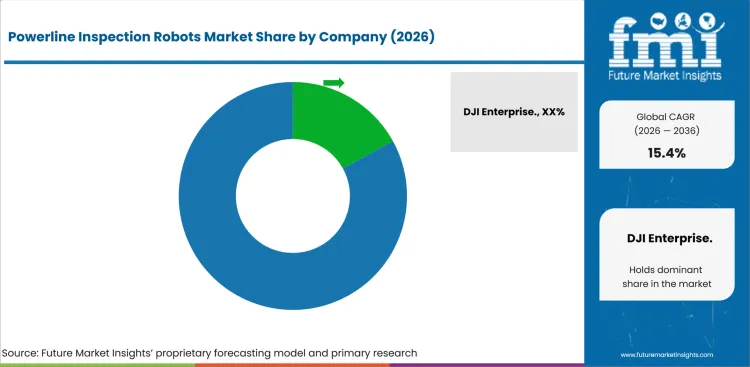
Market concentration is moderate since drone hardware leaders, grid software firms, and specialist inspection robot makers serve different buying points. DJI Enterprise and Skydio support on drone platforms, while HiBot and Drone Volt stand out in line-contact inspection. Percepto and ANYbotics compete through autonomous inspection workflows for substations and industrial energy assets.
Entry barriers include utility safety approval, aviation compliance, electrical clearance rules, and validated defect analytics. The notable competitors are not defined only by robot design. They win by turning inspection work into utility-grade evidence. DJI Enterprise supports electricity users with powerline and substation inspection solutions, including payloads suited to visual and thermal checks.
How is competition structured?
Competition reflects differences in specialization, portfolio scope, geographic reach, evidence, and customer access.
Competition is suitable understood by role because hardware, software, and service models meet different utility needs.
- Drone and Aerial Inspection Platforms: DJI Enterprise, Skydio, Percepto, and Drone Volt compete through flight safety, payload depth, and utility-specific workflows. DJI Enterprise supports powerline and substation inspection applications, while Skydio emphasizes infrastructure-grade autonomous drones.
- Grid Analytics and Asset Intelligence Providers: LineVision, Siemens Energy, Hitachi Energy, and GE Vernova compete by linking inspection evidence with grid operation.
- Line and Substation Robotics Specialists: HiBot and ANYbotics compete through purpose-built inspection hardware for difficult grid assets. HiBot’s Expliner-T targets high-voltage transmission line inspection and maintenance.
How do selected companies compare?
The selected companies differ in portfolio focus, geographic reach, evidence depth, and channel strength.
| Company | Competitive position |
|---|---|
| DJI Enterprise | DJI Enterprise supports powerline and substation inspection applications, while Skydio emphasizes infrastructure-grade autonomous drones. |
| Skydio | Skydio positions its X10 for utility inspection with electromagnetic interference resistance and compliance features important for critical infrastructure buyers. |
| Percepto | Percepto and ANYbotics compete through autonomous inspection workflows for substations and industrial energy assets. |
| Drone Volt | Drone Volt’s line-contact system targets live high-voltage sleeve testing without service interruption. |
| HiBot | HiBot’s Expliner-T targets high-voltage transmission line inspection and maintenance. |
What are the key developments in the Powerline Inspection Robots Market?
- In February 2024, Skydio and Mitsubishi Electric Power Products partnered to support remote substation inspection. The move strengthened autonomous inspection routes for utility grid assets.
- In April 2024, AES used LineVision sensors on transmission structures in Indiana and Ohio. The project highlighted non-contact line monitoring as a bridge to smarter inspection planning.
- In May 2024, LineVision and National Grid operationalized dynamic line ratings on four 115 kV lines in New York. That work linked line monitoring with capacity decisions.
Selected Companies in the Powerline Inspection Robots Market
Companies referenced in this preview
- DJI Enterprise.
- Skydio.
- Percepto.
- Drone Volt.
- HiBot.
- ANYbotics.
- LineVision.
- Siemens Energy.
- Hitachi Energy.
- GE Vernova.
Market Scope & Definition
| Market definition | The Powerline Inspection Robots Market covers robots and robotic inspection services used to inspect overhead powerlines, towers, substations, and renewable interconnect assets. Included systems cover line-crawling robots, drone-assisted inspection robots, substation robots, hybrid platforms, sensing payloads, analytics software, and managed inspection services. |
|---|---|
| Functions covered | Line-crawling Robots, Drone-assisted Inspection Robots, Substation / Tower Robots, Hybrid Platforms |
| Applications covered | Line-crawling Robots, Drone-assisted Inspection Robots, Substation / Tower Robots, Hybrid Platforms |
| Inclusions | Market scope covers commercially traded robotic inspection systems categorized by robot type, inspection function, grid asset, buyer type, and deployment model, including line-crawling robots, drone-assisted inspection robots, substation or tower robots, hybrid platforms, visual and thermal imaging, LiDAR or 3D mapping, corona or partial. |
| Exclusions | Market scope excludes non-robotic inspection cameras, handheld thermal tools, fixed sensors without movement, satellite-only monitoring services, general construction drones, consumer drones, and grid software that does not use robotic inspection data. |
Research Methodology
| Primary Research | FMI analysts reviewed utility inspection teams, grid contractors, drone service operators, robotics suppliers, and asset management software users. Interviews focused on inspection cycles, live-line rules, payload selection, data handoff, and buyer approval steps. |
|---|---|
| Desk Research | Desk work reviewed government grid investment plans, utility inspection references, robotics standards, company product information, and public grid reliability material. The addressable pool was defined around robotic tools that directly inspect energized or de-energized grid assets. |
| Market Sizing and Forecasting | The model combined robot unit volumes, service revenue, payload pricing, utility spending patterns, and country-level grid reinforcement activity. Segment use rates were adjusted for transmission density, grid age, storm exposure, and buyer preference for owned fleets or service contracts. |
| Data Validation | Forecasts were checked against utility procurement behavior, robot supplier portfolios, drone inspection references, and adjacent autonomous drone platform adoption. Validation focused on whether inspection output could enter maintenance workflows without heavy manual review. |
What does the report cover?
The report covers robot type, inspection function, grid asset, buyer type, deployment, and region across the 2026-2036 forecast period in 30+ countries.
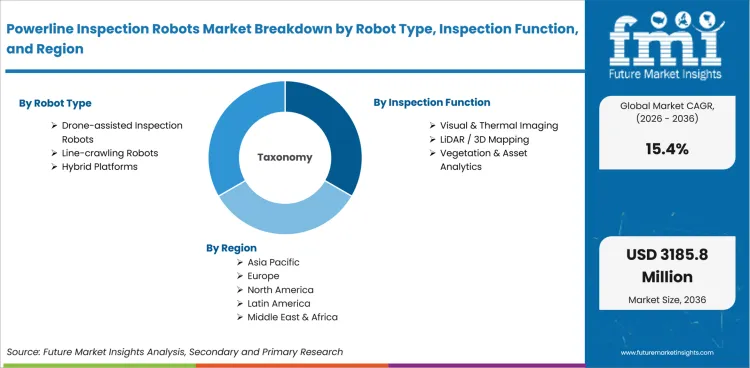
| Periods | Base year 2025; estimated year 2026; forecast period 2026-2036 |
|---|---|
| Quantitative units | USD 760.6 million in 2026 to USD 3185.8 million by 2036, at a CAGR of 15.4% |
| Segment axes | robot type, inspection function, grid asset, buyer type, deployment, and region |
| Regions | North America, Western Europe, East Asia, and South Asia and Pacific |
| Countries | United States, United Kingdom, Germany, France, Japan, China, South Korea, India and 30+ |
| Companies | DJI Enterprise, Skydio, Percepto, Drone Volt, HiBot, ANYbotics, LineVision, Siemens Energy, Hitachi Energy, GE Vernova |
| Approach | Hybrid bottom-up and selected-down methodology using robot fleets, inspection service revenue, utility asset cycles, and country-level grid programs. |
Market Segmentation Analysis
Segmented by Robot Type
- Line-crawling Robots.
- Drone-assisted Inspection Robots.
- Substation / Tower Robots.
- Hybrid Platforms.
Segmented by Inspection Function
- Visual & Thermal Imaging.
- LiDAR / 3D Mapping.
- Corona / Partial Discharge.
- Vegetation & Asset Analytics.
Segmented by Grid Asset
- Transmission Lines.
- Distribution Lines.
- Substations.
- Renewable Interconnects.
Segmented by Buyer Type
- Utilities.
- Inspection Contractors.
- EPC / Grid Operators.
Segmented by Deployment
- Owned Fleet.
- Inspection-as-a-Service.
By Region
- North America.
- United States.
- Western Europe.
- Germany.
- France.
- East Asia.
- China.
- Japan.
- South Korea.
- South Asia and Pacific.
- India.
- United Kingdom.
Research Sources and Bibliography
- . USA Department of Energy. (2026, March 12). Energy Department announces approximately $1.9 billion to strengthen critical grid infrastructure and lower energy bills. USA Department of Energy. https://www.energy.gov/articles/energy-department-announces-approximately-19-billion-strengthen-critical-grid-infrastructure
- 2. State Council Information Office of the People’s Republic of China. (2024, August 29). China’s energy transition. The State Council Information Office. http://english.scio.gov.cn/whitepapers/2024-08/29/content_117390863.htm
- 3. Oak Ridge National Laboratory. (2024, August 27). Drones and sensors help utilities inspect power lines. Oak Ridge National Laboratory. https://www.ornl.gov/news/drones-and-sensors-help-utilities-inspect-power-lines
- 4. Ofgem. (2024, July). Electricity transmission network asset risk review. Office of Gas and Electricity Markets. https://www.ofgem.gov.uk/
- 5. Bundesnetzagentur. (2024, March 1). Bundesnetzagentur confirms electricity grid development plan 2023-2037/2045. Bundesnetzagentur. https://www.bundesnetzagentur.de/
- 6. Ministry of Power, Government of India. (2024, September 23). National electricity plan for transmission. Press Information Bureau. https://www.pib.gov.in/PressReleasePage.aspx? PRID=2057891
- 7. DJI Enterprise. (2025, June 11). DJI Matrice 400 enterprise drone. DJI Enterprise. https://enterprise.dji.com/news/detail/dji-matrice-400
- 8. Skydio. (2024, February 22). Skydio and Mitsubishi Electric Power Products partner to remotely monitor and automate substation inspections. Skydio. https://www.skydio.com/blog/skydio-and-meppi-partner-to-remotely-monitor-and-automate-substation-inspections
- 9. Percepto. (2024). Autonomous inspection for electric utilities. Percepto. https://percepto.co/industry/electric-utilities/
- 10. LineVision. (2024, May 9). LineVision and National Grid operationalize dynamic line ratings in New York. LineVision. https://www.LineVisioninc.com/news/
- 11. Drone Volt. (2024). Power line inspection services with LineDrone. Drone Volt. https://www.dronevolt.com/en/power-line-inspection/
- 12. ANYbotics. (2024, December 4). GE, GMV, ANYbotics and Elewit collaborate to transform power grid maintenance. ANYbotics. https://www.anybotics.com/news/
- 13. Siemens Energy. (2026, June). Siemens Energy to acquire Camlin Group. Siemens Energy. https://www.siemens-energy.com/global/en/home/press-releases.html
- 14. Hitachi Energy. (2024). Vegetation management for utilities. Hitachi Energy. https://www.hitachienergy.com/
- 15. GE Vernova. (2024). GridOS Visual Intelligence. GE Vernova. https://www.gevernova.com/
- 16. HiBot. (2025). Expliner-T selected for public showcase at Expo 2025 Osaka. HiBot. https://www.hibot.co.jp/
The bibliography is provided for reader reference and uses primary government, official company, regulator, laboratory, and trade body publications.
This Report Answers
- What is the projected value of the Powerline Inspection Robots Market in 2026?
- What value is forecast for the Powerline Inspection Robots Market by 2036?
- What CAGR is forecast for the Powerline Inspection Robots Market from 2026 to 2036?
- What 2026 share is projected for Drone-assisted Inspection Robots within the robot type category?
- What 2026 share is projected for Visual & Thermal Imaging within the inspection function category?
- Which demand factors support the Powerline Inspection Robots Market outlook?
- Which restraints and opportunities affect adoption in the Powerline Inspection Robots Market?
- How are country CAGR outlooks, including China at 17.8%, compared?
- Which companies and product developments are covered in the competitive analysis?
- What is included in the market scope, and how is the forecast validated?
Frequently Asked Questions
Why should executives track the Powerline Inspection Robots Market?
Executives should track this market because it can affect capital allocation, supplier strategy, operating risk, and competitive positioning across commercial use cases.
What business problem does the Powerline Inspection Robots Market address?
It helps executive teams judge where customer pain, supplier capability, compliance exposure, and implementation economics justify investment, procurement, or market-entry decisions.
What should procurement leaders evaluate before selecting suppliers?
Procurement leaders should assess evidence quality, integration fit, service coverage, compliance readiness, total cost of ownership, and supplier execution capability.
What can limit return on investment for buyers?
Return on investment can be limited by low utilization, integration delays, training gaps, unclear ownership, pricing pressure, or weak fit with existing workflows.
How can suppliers build executive confidence?
Suppliers can build confidence by proving implementation speed, risk reduction, support depth, reference use cases, and measurable outcomes for budget owners.
Preview the report firsthand - request a free sample
Get SampleGet the brochure for pricing and purchase details.
Get PDFTable of Content
- Key Takeaways
- Market Size and CAGR
- Top Growth Driver
- Fastest Growing Segment
- Leading Region
- Key Companies
- Emerging Opportunities
- Executive Summary
- Global Market Outlook
- Demand-side Trends
- Supply-side Trends
- Technology Roadmap Analysis
- Analysis and Recommendations
- Analyst Perspective (What is happening? Why now? What should investors know?)
- Key Questions Answered
- How large is the market?
- What is the CAGR?
- What are key trends?
- Which region dominates?
- Who are the leaders?
- Market Overview
- Market Coverage / Taxonomy
- Market Definition / Scope / Limitations
- Research Methodology
- Chapter Orientation
- Analytical Lens and Working Hypotheses
- Market Structure, Signals, and Trend Drivers
- Benchmarking and Cross-market Comparability
- Market Sizing, Forecasting, and Opportunity Mapping
- Research Design and Evidence Framework
- Desk Research Programme (Secondary Evidence)
- Expert Input and Fieldwork (Primary Evidence)
- Tooling, Models, and Reference Databases
- Data Engineering and Model Build
- Quality Assurance and Audit Trail
- Market Background
- Market Dynamics (Drivers, Restraints, Opportunity, Trends)
- Scenario Forecast (Optimistic, Likely, Conservative)
- Impact Analysis
- AI Impact
- Sustainability Impact
- Regulatory Impact
- Technology Impact
- Consumer / Buyer Analysis
- Purchase Drivers
- Adoption Barriers
- Buyer Journey
- Opportunity Map Analysis
- Product Life Cycle Analysis
- Supply Chain Analysis
- Investment Feasibility Matrix
- Value Chain Analysis
- PESTLE and Porter's Analysis
- Regulatory Landscape
- Regional Parent Market Outlook
- Production and Consumption Statistics
- Import and Export Statistics
- Global Market Analysis and Forecast, 2021 to 2036
- Historical Market Size Value (USD Million) Analysis, 2021 to 2025
- Current and Future Market Size Value (USD Million) Projections, 2026 to 2036
- Y-o-Y Growth Trend Analysis
- Absolute $ Opportunity Analysis
- Global Market Pricing Analysis, 2021 to 2036
- Global Market Analysis and Forecast, By Robot Type, 2021 to 2036
- Introduction / Key Findings
- Historical Market Size Value (USD Million) Analysis By Robot Type, 2021 to 2025
- Current and Future Market Size Value (USD Million) Analysis and Forecast By Robot Type, 2026 to 2036
- Drone-assisted Inspection Robots
- Line-crawling Robots
- Hybrid Platforms
- Drone-assisted Inspection Robots
- Y-o-Y Growth Trend Analysis By Robot Type, 2021 to 2025
- Absolute $ Opportunity Analysis By Robot Type, 2026 to 2036
- Global Market Analysis and Forecast, By Inspection Function, 2021 to 2036
- Introduction / Key Findings
- Historical Market Size Value (USD Million) Analysis By Inspection Function, 2021 to 2025
- Current and Future Market Size Value (USD Million) Analysis and Forecast By Inspection Function, 2026 to 2036
- Visual & Thermal Imaging
- LiDAR / 3D Mapping
- Vegetation & Asset Analytics
- Visual & Thermal Imaging
- Y-o-Y Growth Trend Analysis By Inspection Function, 2021 to 2025
- Absolute $ Opportunity Analysis By Inspection Function, 2026 to 2036
- Global Market Analysis and Forecast, By Grid Asset, 2021 to 2036
- Introduction / Key Findings
- Historical Market Size Value (USD Million) Analysis By Grid Asset, 2021 to 2025
- Current and Future Market Size Value (USD Million) Analysis and Forecast By Grid Asset, 2026 to 2036
- Transmission Lines
- Distribution Lines
- Substations
- Transmission Lines
- Y-o-Y Growth Trend Analysis By Grid Asset, 2021 to 2025
- Absolute $ Opportunity Analysis By Grid Asset, 2026 to 2036
- Global Market Analysis and Forecast, By Buyer Type, 2021 to 2036
- Introduction / Key Findings
- Historical Market Size Value (USD Million) Analysis By Buyer Type, 2021 to 2025
- Current and Future Market Size Value (USD Million) Analysis and Forecast By Buyer Type, 2026 to 2036
- Utilities
- Inspection Contractors
- EPC / Grid Operators
- Utilities
- Y-o-Y Growth Trend Analysis By Buyer Type, 2021 to 2025
- Absolute $ Opportunity Analysis By Buyer Type, 2026 to 2036
- Global Market Analysis and Forecast, By Deployment, 2021 to 2036
- Introduction / Key Findings
- Historical Market Size Value (USD Million) Analysis By Deployment, 2021 to 2025
- Current and Future Market Size Value (USD Million) Analysis and Forecast By Deployment, 2026 to 2036
- Inspection-as-a-Service
- Owned Fleet
- Inspection-as-a-Service
- Y-o-Y Growth Trend Analysis By Deployment, 2021 to 2025
- Absolute $ Opportunity Analysis By Deployment, 2026 to 2036
- Global Market Analysis and Forecast, By Region, 2021 to 2036
- Introduction
- Historical Market Size Value (USD Million) Analysis By Region, 2021 to 2025
- Current Market Size Value (USD Million) Analysis and Forecast By Region, 2026 to 2036
- North America
- Latin America
- Western Europe
- Eastern Europe
- East Asia
- South Asia and Pacific
- Middle East & Africa
- Market Attractiveness Analysis By Region
- North America Market Analysis and Forecast, By Country, 2021 to 2036
- Historical Market Size Value (USD Million) Trend Analysis By Market Taxonomy, 2021 to 2025
- Market Size Value (USD Million) Forecast By Market Taxonomy, 2026 to 2036
- By Country
- USA
- Canada
- Mexico
- By Robot Type
- By Inspection Function
- By Grid Asset
- By Buyer Type
- By Deployment
- By Country
- Market Attractiveness Analysis
- By Country
- By Robot Type
- By Inspection Function
- By Grid Asset
- By Buyer Type
- By Deployment
- Key Takeaways
- Latin America Market Analysis and Forecast, By Country
- Historical Market Size Value (USD Million) Trend Analysis By Market Taxonomy, 2021 to 2025
- Market Size Value (USD Million) Forecast By Market Taxonomy, 2026 to 2036
- By Country
- Brazil
- Chile
- Rest of Latin America
- By Robot Type
- By Inspection Function
- By Grid Asset
- By Buyer Type
- By Deployment
- By Country
- Market Attractiveness Analysis
- By Country
- By Robot Type
- By Inspection Function
- By Grid Asset
- By Buyer Type
- By Deployment
- Key Takeaways
- Western Europe Market Analysis and Forecast, By Country
- Historical Market Size Value (USD Million) Trend Analysis By Market Taxonomy, 2021 to 2025
- Market Size Value (USD Million) Forecast By Market Taxonomy, 2026 to 2036
- By Country
- Germany
- UK
- Italy
- Spain
- France
- Nordic
- BENELUX
- Rest of Western Europe
- By Robot Type
- By Inspection Function
- By Grid Asset
- By Buyer Type
- By Deployment
- By Country
- Market Attractiveness Analysis
- By Country
- By Robot Type
- By Inspection Function
- By Grid Asset
- By Buyer Type
- By Deployment
- Key Takeaways
- Eastern Europe Market Analysis and Forecast, By Country
- Historical Market Size Value (USD Million) Trend Analysis By Market Taxonomy, 2021 to 2025
- Market Size Value (USD Million) Forecast By Market Taxonomy, 2026 to 2036
- By Country
- Russia
- Poland
- Hungary
- Balkan & Baltic
- Rest of Eastern Europe
- By Robot Type
- By Inspection Function
- By Grid Asset
- By Buyer Type
- By Deployment
- By Country
- Market Attractiveness Analysis
- By Country
- By Robot Type
- By Inspection Function
- By Grid Asset
- By Buyer Type
- By Deployment
- Key Takeaways
- East Asia Market Analysis and Forecast, By Country
- Historical Market Size Value (USD Million) Trend Analysis By Market Taxonomy, 2021 to 2025
- Market Size Value (USD Million) Forecast By Market Taxonomy, 2026 to 2036
- By Country
- China
- Japan
- South Korea
- By Robot Type
- By Inspection Function
- By Grid Asset
- By Buyer Type
- By Deployment
- By Country
- Market Attractiveness Analysis
- By Country
- By Robot Type
- By Inspection Function
- By Grid Asset
- By Buyer Type
- By Deployment
- Key Takeaways
- South Asia and Pacific Market Analysis and Forecast, By Country
- Historical Market Size Value (USD Million) Trend Analysis By Market Taxonomy, 2021 to 2025
- Market Size Value (USD Million) Forecast By Market Taxonomy, 2026 to 2036
- By Country
- India
- ASEAN
- Australia & New Zealand
- Rest of South Asia and Pacific
- By Robot Type
- By Inspection Function
- By Grid Asset
- By Buyer Type
- By Deployment
- By Country
- Market Attractiveness Analysis
- By Country
- By Robot Type
- By Inspection Function
- By Grid Asset
- By Buyer Type
- By Deployment
- Key Takeaways
- Middle East & Africa Market Analysis and Forecast, By Country
- Historical Market Size Value (USD Million) Trend Analysis By Market Taxonomy, 2021 to 2025
- Market Size Value (USD Million) Forecast By Market Taxonomy, 2026 to 2036
- By Country
- Kingdom of Saudi Arabia
- Other GCC Countries
- Türkiye
- South Africa
- Other African Union
- Rest of Middle East & Africa
- By Robot Type
- By Inspection Function
- By Grid Asset
- By Buyer Type
- By Deployment
- By Country
- Market Attractiveness Analysis
- By Country
- By Robot Type
- By Inspection Function
- By Grid Asset
- By Buyer Type
- By Deployment
- Key Takeaways
- Key Countries Market Analysis
- USA
- Pricing Analysis
- Market Share Analysis, 2025
- By Robot Type
- By Inspection Function
- By Grid Asset
- By Buyer Type
- By Deployment
- Canada
- Pricing Analysis
- Market Share Analysis, 2025
- By Robot Type
- By Inspection Function
- By Grid Asset
- By Buyer Type
- By Deployment
- Mexico
- Pricing Analysis
- Market Share Analysis, 2025
- By Robot Type
- By Inspection Function
- By Grid Asset
- By Buyer Type
- By Deployment
- Brazil
- Pricing Analysis
- Market Share Analysis, 2025
- By Robot Type
- By Inspection Function
- By Grid Asset
- By Buyer Type
- By Deployment
- Chile
- Pricing Analysis
- Market Share Analysis, 2025
- By Robot Type
- By Inspection Function
- By Grid Asset
- By Buyer Type
- By Deployment
- Germany
- Pricing Analysis
- Market Share Analysis, 2025
- By Robot Type
- By Inspection Function
- By Grid Asset
- By Buyer Type
- By Deployment
- UK
- Pricing Analysis
- Market Share Analysis, 2025
- By Robot Type
- By Inspection Function
- By Grid Asset
- By Buyer Type
- By Deployment
- Italy
- Pricing Analysis
- Market Share Analysis, 2025
- By Robot Type
- By Inspection Function
- By Grid Asset
- By Buyer Type
- By Deployment
- Spain
- Pricing Analysis
- Market Share Analysis, 2025
- By Robot Type
- By Inspection Function
- By Grid Asset
- By Buyer Type
- By Deployment
- France
- Pricing Analysis
- Market Share Analysis, 2025
- By Robot Type
- By Inspection Function
- By Grid Asset
- By Buyer Type
- By Deployment
- India
- Pricing Analysis
- Market Share Analysis, 2025
- By Robot Type
- By Inspection Function
- By Grid Asset
- By Buyer Type
- By Deployment
- ASEAN
- Pricing Analysis
- Market Share Analysis, 2025
- By Robot Type
- By Inspection Function
- By Grid Asset
- By Buyer Type
- By Deployment
- Australia & New Zealand
- Pricing Analysis
- Market Share Analysis, 2025
- By Robot Type
- By Inspection Function
- By Grid Asset
- By Buyer Type
- By Deployment
- China
- Pricing Analysis
- Market Share Analysis, 2025
- By Robot Type
- By Inspection Function
- By Grid Asset
- By Buyer Type
- By Deployment
- Japan
- Pricing Analysis
- Market Share Analysis, 2025
- By Robot Type
- By Inspection Function
- By Grid Asset
- By Buyer Type
- By Deployment
- South Korea
- Pricing Analysis
- Market Share Analysis, 2025
- By Robot Type
- By Inspection Function
- By Grid Asset
- By Buyer Type
- By Deployment
- Russia
- Pricing Analysis
- Market Share Analysis, 2025
- By Robot Type
- By Inspection Function
- By Grid Asset
- By Buyer Type
- By Deployment
- Poland
- Pricing Analysis
- Market Share Analysis, 2025
- By Robot Type
- By Inspection Function
- By Grid Asset
- By Buyer Type
- By Deployment
- Hungary
- Pricing Analysis
- Market Share Analysis, 2025
- By Robot Type
- By Inspection Function
- By Grid Asset
- By Buyer Type
- By Deployment
- Kingdom of Saudi Arabia
- Pricing Analysis
- Market Share Analysis, 2025
- By Robot Type
- By Inspection Function
- By Grid Asset
- By Buyer Type
- By Deployment
- Türkiye
- Pricing Analysis
- Market Share Analysis, 2025
- By Robot Type
- By Inspection Function
- By Grid Asset
- By Buyer Type
- By Deployment
- South Africa
- Pricing Analysis
- Market Share Analysis, 2025
- By Robot Type
- By Inspection Function
- By Grid Asset
- By Buyer Type
- By Deployment
- USA
- Market Structure Analysis
- Competition Dashboard
- Competition Benchmarking
- Market Share Analysis of Top Players
- By Regional
- By Robot Type
- By Inspection Function
- By Grid Asset
- By Buyer Type
- By Deployment
- Emerging Startups
- Innovation Benchmarking
- Competition Analysis
- Competition Deep Dive
- DJI Enterprise.
- Overview
- Product Portfolio
- Profitability by Market Segments (Product/Region/Sales Channel)
- Sales Footprint
- Strategy Overview
- Marketing Strategy
- Product Strategy
- Channel Strategy
- Skydio.
- Percepto.
- Drone Volt.
- HiBot.
- ANYbotics.
- LineVision.
- DJI Enterprise.
- Case Studies
- Success Stories
- Recent Developments
- Competition Deep Dive
- Assumptions & Acronyms Used


