

- Market Size (2026)
- USD 1.2 Bn
- Forecast (2036)
- USD 6.6 Bn
- CAGR (2026 to 2036)
- 18.2%
How big is the Crop Weeding Robots market in 2026?
USD 1.2 billion in 2026 and USD 6.6 billion by 2036 at an 18.2% CAGR.
The crop weeding robots market was valued at USD 1.0 billion in 2025. It is expected to grow from USD 1.2 billion in 2026 to USD 6.6 billion in 2036 at a CAGR of 18.2% as commercial farms shift weed removal from manual crews toward camera-guided machines and precision field platforms. Equipment sale is expected to hold 58.0% share in 2026, supported by fleet control and peak-season scheduling needs. Large farms are projected to secure 49.0% share in 2026, backed by better robot utilization across repeated crop blocks.
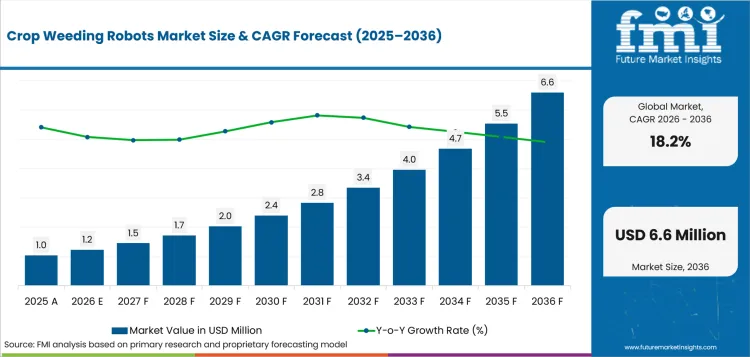
| Metric | Value |
|---|---|
| 2026 Market Size | USD 1.2 billion |
| 2036 Market Size | USD 6.6 billion |
| Forecast CAGR (2026-2036) | 18.2% |
| Leading Sales Model | Equipment Sale |
| Equipment Sale Share (2026) | 58.0% |
| Leading Farm Size | Large Farms |
| Large Farms Share (2026) | 49.0% |
| Fastest-growing Country | China |
| China CAGR by 2036 | 20.8% |
Summary of the Crop Weeding Robots Market
| Market Signal | Commercial Impact |
|---|---|
| Demand and Growth Drivers | Demand for crop weeding robots is projected to expand through 2036 as growers reduce herbicide dependence, address labor shortages, and adopt precision weed-control technologies supported by dealer-led service networks.
|
| Product and Segment View | Equipment sales, large farms, and vegetable cultivation continue to lead their respective market segments.
|
| Geography and Growth Outlook | Asia continues to accelerate adoption of autonomous agricultural technologies through smart farming initiatives and expanding horticultural production.
|
| Competitive Landscape | Competition increasingly focuses on precision weed detection, autonomous field performance, and reliable service support.
|
| Analyst Perspective | Crop weeding robots are becoming an important productivity investment as growers seek lower labor costs, reduced herbicide dependence, and consistent field performance.
- Nikhil Kaitwade, Principal Consultant at Future Market Insights |
Agricultural automation investment is gaining policy and cost weight across labor-constrained crop systems. United States field workers received USD 18.70 per hour in May 2025, making hand-weeding cost a measurable pressure point for specialty crop growers. OECD agricultural policy monitoring published in 2025 reported USD 842 billion in average annual support to agriculture across covered economies during 2022 to 2024, showing ample public focus on productivity and sustainability tools. Ecorobotix reported 1,000 ARA ultra-high precision sprayers sold worldwide in March 2026, confirming commercial movement from pilot programs into plant-level crop-care equipment. Crop weeding robot suppliers gain value as farms need field uptime and service access during short weed-control windows.
Which factors support expansion in the Crop Weeding Robots market?
Finished robot platforms and service-backed field programs support market value across commercial crop systems.
- Market value rises as farms need machines that complete weed control during narrow field windows.
- Laser and mechanical tools raise interest as growers seek lower herbicide exposure near premium crops.
- Vegetable farms influence steady demand through repeated field passes and crop-quality risk near plant rows.
- Contract weeding providers shift spending toward robots that can serve multiple growers through seasonal work.
- Dealer-supported ownership expands as buyers request setup and operating data before equipment decisions.
Why is the Crop Weeding Robots market growing?
Specialty crop economics increase robot demand as weeds near crop rows raise labor cost and quality risk.
Crop weeding robot buyers spend more on automation as vegetable fields require repeated weed removal during short crop stages. USDA vegetable data published in February 2026 reported romaine lettuce value at USD 2.78 billion in 2025, up 46% from the prior season, showing how high-value rows can justify precise weed control. Weed pressure near lettuce, onions, carrots, and leafy greens can reduce pack-out quality and add hand-labor exposure. Suppliers able to link plant recognition, safe treatment, and dealer service gain stronger positions in specialty crop equipment contracts.
How is the Crop Weeding Robots Market segmented?
Crop Weeding Robots Market is segmented by robot type, weeding technology, crop type, farm size, and sales model.
- Autonomous Field Robots are projected to account for 38.0% share in 2026, influenced by independent field operation during tight weed-control windows.
- Mechanical Weeding is expected to hold 42.0% share in 2026, shaped by organic production needs and chemical-free weed removal close to crop rows.
- Vegetables are anticipated to account for 46.0% share in 2026, led by high labor exposure and weed sensitivity across premium row crops.
- Large Farms are projected to hold 49.0% share by Farm Size in 2026, guided by equipment utilization across repeated acres and crop cycles.
- Equipment Sale is expected to represent 58.0% share by Sales Model in 2026, supported by buyer control over timing and field data.
Why do Autonomous Field Robots dominate the Crop Weeding Robots market by robot type?
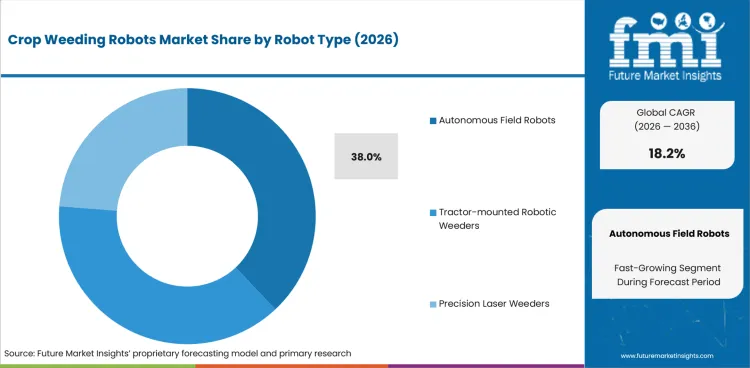
- Autonomous field robots are projected to account for 38.0% share in 2026, driven by grower preference for machines that reduce operator hours during short weed-control windows.
- Tractor-mounted robotic weeders gain demand as farms with guidance-ready tractors add camera control without replacing existing equipment plans.
Which weeding technology leads the Crop Weeding Robots market?
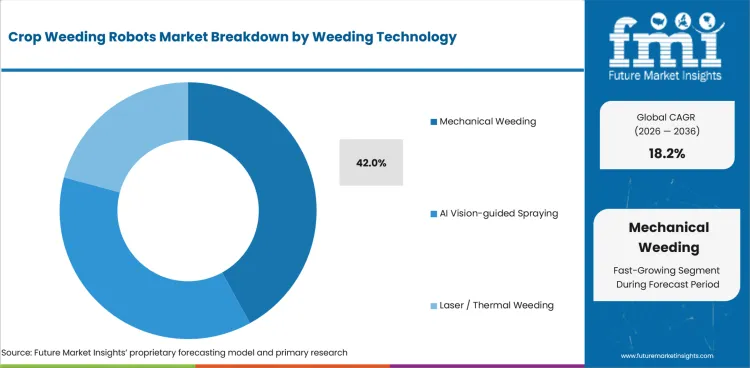
- Mechanical weeding is expected to hold 42.0% share in 2026, shaped by chemical-free weed removal needs across organic vegetables and herbicide-restricted fields.
- AI vision-guided spraying gains use as growers try to reduce chemical volume while keeping crop-specific treatment accuracy.
Which crop type leads the Crop Weeding Robots Market?
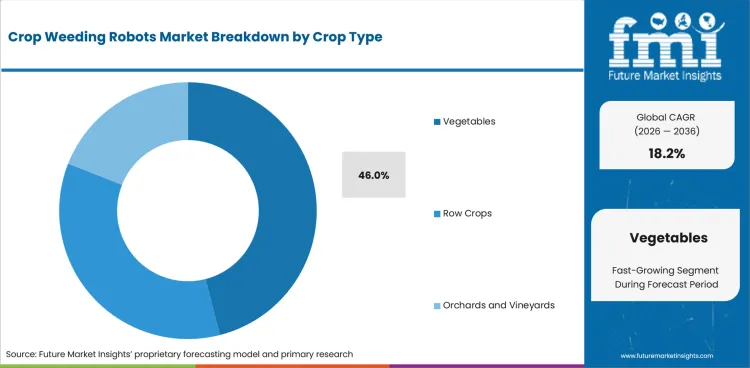
- Vegetables are anticipated to account for 46.0% share in 2026, led by weed-pressure intensity across lettuce and similar crops.
- Orchards and vineyards create added demand as growers seek under-tree and under-vine treatment without repeated manual passes.
Which farm size leads the Crop Weeding Robots Market?
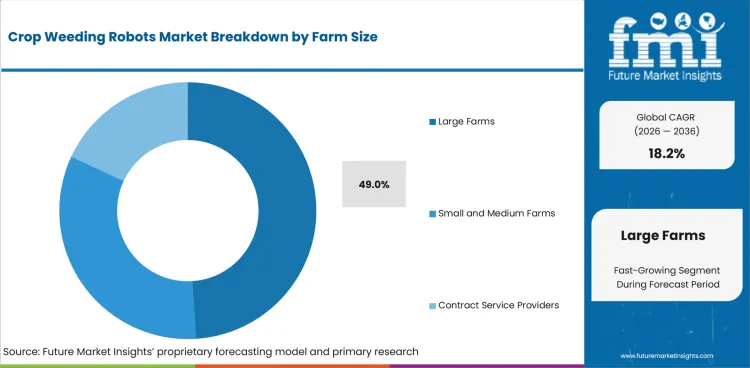
- Large farms are projected to hold 49.0% share in 2026, reflected by better robot utilization across acreage and seasonal schedules.
- Small and medium farms gain access through contractors, cooperatives, grants, and Robotics-as-a-Service programs.
Which sales model leads the Crop Weeding Robots Market?
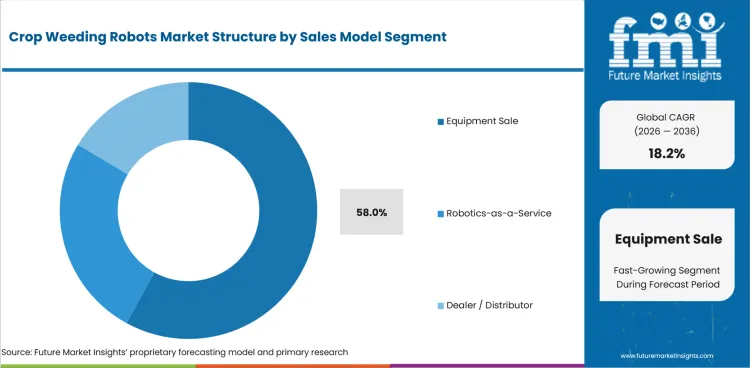
- Equipment sale is expected to represent 58.0% share in 2026, guided by buyer preference for control over timing and field data.
- Robotics-as-a-service stays active among farms that need robot access without full ownership cost.
What are the drivers, restraints, and opportunities in the Crop Weeding Robots Market?
Farm labor pressure and service-led automation programs are shaping crop weeding robot buying decisions.
- Driver: Specialty crop farms need plant-level weed control that reduces hand-weeding exposure during peak field windows.
- Restraint: High purchase cost can limit robot adoption for farms with uneven acreage and limited service access.
- Opportunity: Dealer and cooperative service models can improve access for smaller farms needing robot use by acre.
Specialty Crop Value Strengthens Robot Demand
High-value crop programs increase the appeal of precise weed control. USDA vegetable reporting published in 2026 showed sweet corn production at 58.2 million cwt in 2025, up 9% from 2024, with crop value reaching USD 748 million. Higher crop value supports equipment decisions that protect plant stands and reduce field labor exposure. Crop weeding robots gain demand as growers compare robot cost with repeated hand passes and delayed field work.
Acreage Volatility Limits Utilization Planning
Robot payback can weaken if crop area declines or field conditions reduce working days. United Kingdom horticulture statistics published in 2025 showed vegetable planted area falling 3.5% to 97 thousand hectares in 2024 despite vegetable production value rising to just over GBP 2 billion. Smaller planted area can reduce seasonal operating hours for owned robots. Suppliers can ease adoption pressure through rental programs and service-backed operating plans.
Service Models Create Access Beyond Large Farms
Service-led access can move robots into farms that cannot justify full ownership. World Bank agribusiness information shows USD 24 billion currently invested in farming and agribusiness, with agribusiness financing planned to double to USD 9 billion annually by 2030. Such financing attention supports mechanization and access programs across developing farm systems. Crop weeding robot suppliers can use contractor networks and cooperative channels to reach growers with limited capital budgets.
Which countries record the top CAGRs in the Crop Weeding Robots market?
China 20.8% CAGR, India 19.6% CAGR, United States 18.9% CAGR, France 18.0% CAGR, Japan 17.8% CAGR, South Korea 17.4% CAGR, Germany 17.1% CAGR, and United Kingdom 16.2% CAGR through 2036.
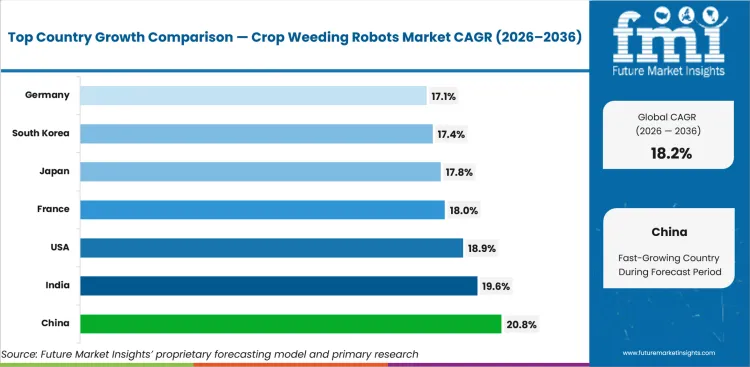
| Country | CAGR |
|---|---|
| China | 20.8% |
| India | 19.6% |
| United States | 18.9% |
| France | 18.0% |
| Japan | 17.8% |
| South Korea | 17.4% |
| Germany | 17.1% |
| United Kingdom | 16.2% |
Source: Future Market Insights, 2026.
How do country-level CAGRs compare in the Crop Weeding Robots Market?
China leads country expansion, while United Kingdom records a more cautious pace among profiled markets.
- China is forecast to record 20.8% CAGR by 2036, guided by smart agriculture policy and domestic machinery scale.
- India is expected to expand at 19.6% CAGR from 2026 to 2036, led by horticulture density and custom-hiring channels.
- United States is projected to grow at 18.9% CAGR through 2036 as specialty crop farms invest in labor-saving weed control.
- France is estimated to rise at 18.0% CAGR by 2036, reflected by pesticide-risk planning and domestic robot suppliers.
- Japan is expected to advance at 17.8% CAGR over the forecast period as farm automation policy meets aging-farmer pressure.
- South Korea is forecast to grow at 17.4% CAGR by 2036, backed by smart-farming plans and greenhouse automation familiarity.
- Germany is projected to post 17.1% CAGR by 2036, guided by machinery engineering depth and organic vegetable production.
- United Kingdom is expected to record 16.2% CAGR by 2036, driven by grant-backed automation and horticulture labor needs.
How fast is the Crop Weeding Robots market growing in China?
A 20.8% CAGR through 2036 reflects smart agriculture policy and domestic machinery scale.
Country Market Snapshot Table
| Parameter | Value |
|---|---|
| Market Size in 2025 Value | USD 186.5 million |
| Market Size in 2026 Value | USD 225.3 million |
| Market Forecast in 2036 Value | USD 1,490.8 million |
| CAGR 2026 to 2036 | 20.8% |
| Years Considered | 2021 to 2036 |
| Base Year | 2025 |
| Forecast Period | 2026 to 2036 |
| Units Considered | Value USD million |
| Leading Sub-Region | Shandong vegetable belt and Yangtze River Delta farms |
China Crop Weeding Robots Market Outlook
China crop weeding robot demand draws support from smart agriculture programs and domestic machinery depth. Farms need low-cost field tools that connect plant recognition and mechanical treatment.
Buyers are expected to favor suppliers offering rugged machines and provincial service coverage. Local manufacturing will stay important as farms compare robot cost with familiar tractors and sprayers.
Key Growth Drivers
- National smart agriculture planning creates a stronger automation base, supported by the 2024 to 2028 action plan targeting digital integration in farm production above 32% by 2028.
- Domestic mechanization depth supports robot readiness, as official 2026 reporting placed crop cultivation and harvesting mechanization at 76.7% in 2025.
- Provincial demonstrations help farms compare AI spraying and drone service models before purchase.
- Local suppliers gain scope as farms seek Mandarin service support and parts access outside large coastal markets.
Key Restraints
- Service coverage can weaken outside major farming provinces as robots need replacement parts and operator training.
- Diverse farm structures can slow standardization as vegetable plots and orchard blocks need different row formats.
- Water-use exposure keeps agricultural automation under resource scrutiny, as OECD’s 2025 China chapter reported agriculture accounted for 62.2% of national water abstraction.
What makes China unique
China stands apart through domestic farm machinery scale and rapid drone service familiarity.
Key Companies
- XAG
- DJI Agriculture
- FJDynamics
- Zoomlion Agricultural Machinery
- Lovol
- YTO Group
- Hanhe Aviation
Sales & Marketing Channels
- Direct
- Dealers
- Provincial demonstrations
- Farm machinery cooperatives
- Service providers
- Digital agriculture integrators
Country Segment Breakdown Table
| Segment | Sub-Segments |
|---|---|
| By Robot Type | Autonomous Field Robots · Tractor-mounted Robotic Weeders · Precision Laser Weeders · Micro-robotic / Other |
| By Weeding Technology | Mechanical Weeding · AI Vision-guided Spraying · Laser / Thermal Weeding · Electrical / Other |
| By Crop Type | Vegetables · Row Crops · Orchards and Vineyards · Specialty Crops |
| By Farm Size | Small and Medium Farms · Large Farms · Contract Service Providers |
| By Sales Model | Equipment Sale · Robotics-as-a-Service · Dealer / Distributor |
| Key Sub-Regions Covered, Agricultural Corridors | Shandong · Jiangsu · Guangdong · Yangtze River Delta · Hebei · Henan |
Frequently Asked Questions
How fast is China Crop Weeding Robots market growing?
Industry in China is projected to rise at 20.8% CAGR from 2026 to 2036, guided by smart agriculture planning, domestic machinery scale, and vegetable-field automation.
Who leads China Crop Weeding Robots market?
XAG, DJI Agriculture, FJDynamics, Zoomlion Agricultural Machinery, Lovol, YTO Group, and Hanhe Aviation compete due to local machinery and AI-enabled field equipment.
What is driving adoption in China Crop Weeding Robots market?
Smart agriculture programs and domestic farm machinery suppliers are moving growers toward robotic weed control.
How fast is the Crop Weeding Robots market growing in India?
A 19.6% CAGR through 2036 reflects horticulture density and custom-hiring access routes.
Country Market Snapshot Table
| Parameter | Value |
|---|---|
| Market Size in 2025 Value | USD 110.8 million |
| Market Size in 2026 Value | USD 132.5 million |
| Market Forecast in 2036 Value | USD 793.5 million |
| CAGR 2026 to 2036 | 19.6% |
| Years Considered | 2021 to 2036 |
| Base Year | 2025 |
| Forecast Period | 2026 to 2036 |
| Units Considered | Value USD million |
| Leading Sub-Region | Maharashtra, Karnataka, Punjab, and Tamil Nadu horticulture clusters |
India Crop Weeding Robots Market Outlook
India crop weeding robot adoption is led by horticulture scale and labor-saving needs across vegetable farms. Commercial growers need low-cost robots that survive dust and variable crop spacing.
Buyers are expected to favor custom-hiring routes, farmer producer organizations, and dealer-led demonstrations. Domestic service access will stay central as smaller farms prefer robot use by acre rather than full machine ownership.
Key Growth Drivers
- Weeding mechanization gaps create room for field robots, as official 2025 reporting placed average mechanization at 33% for weeding and inter-culture.
- Horticulture scale strengthens the buyer base, with 2025 official estimates projecting vegetable production at 215.684 million tonnes for 2025 to 2026.
- Custom-hiring centers can move robots into smaller farms that cannot carry ownership cost alone.
- Domestic start-ups gain scope as growers seek lower-cost spot spraying and mechanical weed control designed for Indian fields.
Key Restraints
- Small plot sizes and mixed cropping can raise calibration time before robots deliver repeatable field results.
- Seasonal financing limits can delay owned equipment purchases among farmers outside premium horticulture clusters.
- Owned robot purchases can strain farms needing formal credit, as 2025 official reporting stated small and marginal farmers’ loan access reached 76% in 2023-24.
What makes India unique
India differs through high horticulture output and custom-hiring channels for machinery access.
Key Companies
- TartanSense
- Niqo Robotics
- Green Robot Machinery
- Mahindra Farm Equipment
- TAFE
- Garuda Aerospace
- Bullwork Mobility
Sales & Marketing Channels
- Direct
- Dealer networks
- Custom hiring centers
- Farmer producer organizations
- Agri-startup service routes
- Demonstration farms
Country Segment Breakdown Table
| Segment | Sub-Segments |
|---|---|
| By Robot Type | Autonomous Field Robots · Tractor-mounted Robotic Weeders · Precision Laser Weeders · Micro-robotic / Other |
| By Weeding Technology | Mechanical Weeding · AI Vision-guided Spraying · Laser / Thermal Weeding · Electrical / Other |
| By Crop Type | Vegetables · Row Crops · Orchards and Vineyards · Specialty Crops |
| By Farm Size | Small and Medium Farms · Large Farms · Contract Service Providers |
| By Sales Model | Equipment Sale · Robotics-as-a-Service · Dealer / Distributor |
| Key Sub-Regions Covered, Agricultural Corridors | Maharashtra · Karnataka · Punjab · Tamil Nadu · Uttar Pradesh · Gujarat |
Frequently Asked Questions
How fast is India Crop Weeding Robots market growing?
Industry in India is projected to rise at 19.6% CAGR from 2026 to 2036, driven by horticulture production and low weeding mechanization.
Who leads India Crop Weeding Robots market?
TartanSense, Niqo Robotics, Green Robot Machinery, Mahindra Farm Equipment, TAFE, Garuda Aerospace, and Bullwork Mobility compete based on local farm automation and dealer reach.
What is driving adoption in India Crop Weeding Robots market?
Custom-hiring access and low weeding mechanization are moving Indian growers toward robotic weed control.
How is the Crop Weeding Robots Market performing in the United States?
An 18.9% CAGR through 2036 reflects specialty crop labor pressure and early commercial robot adoption.
Country Market Snapshot Table
| Parameter | Value |
|---|---|
| Market Size in 2025 Value | USD 243.9 million |
| Market Size in 2026 Value | USD 290.0 million |
| Market Forecast in 2036 Value | USD 1,637.6 million |
| CAGR 2026 to 2036 | 18.9% |
| Years Considered | 2021 to 2036 |
| Base Year | 2025 |
| Forecast Period | 2026 to 2036 |
| Units Considered | Value USD million |
| Leading Sub-Region | California and Pacific Northwest specialty crop corridors |
United States Crop Weeding Robots Market Outlook
United States adoption is led by specialty crop farms, labor cost pressure, and early commercial use of laser and plant-level treatment platforms. Growers need machines that protect premium crops without delaying field schedules.
Buyers are expected to favor suppliers offering field proof and local service access. California, Arizona, Washington, and Idaho farms will stay important due to vegetables and high-value specialty crops.
Key Growth Drivers
- Field labor cost supports robot evaluation, with USDA reporting field workers received USD 18.70 per hour in May 2025.
- Vegetable crop value strengthens payback cases, as USDA reported head lettuce value at USD 1.68 billion in 2025.
- Laser weeding and precision application platforms benefit from grower interest in chemical-free or lower-input crop programs.
- Local suppliers gain scope as specialty crop farms request demos and in-season service response.
Key Restraints
- Large equipment cost can slow purchases among growers without enough acreage for repeated robot use.
- Safety review and field liability concerns can delay autonomous or laser equipment adoption.
- Vegetable acreage shifts can reduce utilization planning, with USDA reporting leaf lettuce harvested area down 10% in 2025 from 2024.
What makes United States unique
United States is distinct for commercial laser weeding adoption and specialty crop farms willing to test plant-level automation.
Key Companies
- Carbon Robotics
- Verdant Robotics
- FarmWise
- John Deere
- Blue River Technology
- Farm-ng
- Monarch Tractor
Sales & Marketing Channels
- Direct
- Dealers
- Farm demonstrations
- Leasing
- Service contracts
- Specialty crop consultants
Country Segment Breakdown Table
| Segment | Sub-Segments |
|---|---|
| By Robot Type | Autonomous Field Robots · Tractor-mounted Robotic Weeders · Precision Laser Weeders · Micro-robotic / Other |
| By Weeding Technology | Mechanical Weeding · AI Vision-guided Spraying · Laser / Thermal Weeding · Electrical / Other |
| By Crop Type | Vegetables · Row Crops · Orchards and Vineyards · Specialty Crops |
| By Farm Size | Small and Medium Farms · Large Farms · Contract Service Providers |
| By Sales Model | Equipment Sale · Robotics-as-a-Service · Dealer / Distributor |
| Key Sub-Regions Covered, Agricultural Corridors | California · Arizona · Washington · Idaho · Oregon · Florida |
Frequently Asked Questions
How fast is United States Crop Weeding Robots market growing?
Industry in the United States is projected to rise at 18.9% CAGR from 2026 to 2036, driven by specialty crop labor costs and leafy vegetable value.
Who leads United States Crop Weeding Robots market?
Carbon Robotics, Verdant Robotics, FarmWise, John Deere, Blue River Technology, Farm-ng, and Monarch Tractor compete through laser weeding and autonomous farm platforms.
What is driving adoption in United States Crop Weeding Robots market?
Labor-cost pressure and laser weeding commercialization are driving crop weeding robot adoption in the United States.
What is driving Crop Weeding Robots Market expansion in France?
An 18.0% CAGR through 2036 reflects pesticide-risk planning and domestic robotics suppliers.
Country Market Snapshot Table
| Parameter | Value |
|---|---|
| Market Size in 2025 Value | USD 81.8 million |
| Market Size in 2026 Value | USD 96.5 million |
| Market Forecast in 2036 Value | USD 505.1 million |
| CAGR 2026 to 2036 | 18.0% |
| Years Considered | 2021 to 2036 |
| Base Year | 2025 |
| Forecast Period | 2026 to 2036 |
| Units Considered | Value USD million |
| Leading Sub-Region | Occitanie, Brittany, and Loire Valley horticulture corridors |
France Crop Weeding Robots Market Outlook
France demand is supported by pesticide-risk planning and domestic robot suppliers. Growers need machines that fit mixed field sizes and support chemical-reduction programs.
Buyers are expected to favor local demonstrations and dealer service. Domestic robot producers create a stronger base for vegetable and supervised field service applications.
Key Growth Drivers
- Chemical-reduction policy supports alternatives, with Ecophyto 2030 reaffirming a national objective to cut pesticide use and risk by 50%.
- Organic production creates mechanical weeding pull, as Agreste reported 2.8 million hectares of organic area equal to 10.4% of utilized agricultural area in 2024.
- Vineyard and vegetable farms need compact robots that handle narrow rows and repeated field passes.
- Local robot suppliers help reduce buyer hesitation through demonstrations and language-specific service.
Key Restraints
- Mixed plot sizes can reduce robot utilization unless contractors spread equipment across several farms.
- Cooperative validation can lengthen sales cycles as growers compare robotic weeders with existing mechanical cultivators.
- Farm age structure limits rapid technology replacement, with Eurostat reporting only 10.7% of EU farm managers under 40 in 2023.
What makes France unique
France stands out through domestic weeding robot suppliers and vineyard-plus-vegetable use cases.
Key Companies
- Naio Technologies
- Vitirover
- Vitibot
- Sabi Agri
- Carré
- Exxact Robotics
- Kuhn France
Sales & Marketing Channels
- Direct
- Dealers
- Cooperatives
- Vineyard service providers
- Demonstration farms
- Regional innovation programs
Country Segment Breakdown Table
| Segment | Sub-Segments |
|---|---|
| By Robot Type | Autonomous Field Robots · Tractor-mounted Robotic Weeders · Precision Laser Weeders · Micro-robotic / Other |
| By Weeding Technology | Mechanical Weeding · AI Vision-guided Spraying · Laser / Thermal Weeding · Electrical / Other |
| By Crop Type | Vegetables · Row Crops · Orchards and Vineyards · Specialty Crops |
| By Farm Size | Small and Medium Farms · Large Farms · Contract Service Providers |
| By Sales Model | Equipment Sale · Robotics-as-a-Service · Dealer / Distributor |
| Key Sub-Regions Covered, Agricultural Corridors | Occitanie · Brittany · Loire Valley · Nouvelle-Aquitaine · Grand Est · Provence-Alpes-Côte d’Azur |
Frequently Asked Questions
How fast is France Crop Weeding Robots market growing?
Industry in France is projected to rise at 18.0% CAGR from 2026 to 2036, supported by pesticide-risk policy, domestic robot suppliers, and vineyard-vegetable applications.
Who leads France Crop Weeding Robots market?
Naio Technologies, Vitirover, Vitibot, Sabi Agri, Carré, Exxact Robotics, and Kuhn France compete through domestic autonomous platforms and guided mechanical weeders.
What is driving adoption in France Crop Weeding Robots market?
Pesticide-risk policy, cooperative trials, and domestic vineyard robots are moving French growers toward robotic weed control.
What is the Crop Weeding Robots Market forecast for Japan?
A 17.8% CAGR through 2036 reflects smart agriculture policy and aging-farmer pressure.
Country Market Snapshot Table
| Parameter | Value |
|---|---|
| Market Size in 2025 Value | USD 71.5 million |
| Market Size in 2026 Value | USD 84.2 million |
| Market Forecast in 2036 Value | USD 433.3 million |
| CAGR 2026 to 2036 | 17.8% |
| Years Considered | 2021 to 2036 |
| Base Year | 2025 |
| Forecast Period | 2026 to 2036 |
| Units Considered | Value USD million |
| Leading Sub-Region | Hokkaido, Kanto, and Kyushu vegetable areas |
Japan Crop Weeding Robots Market Outlook
Japan adoption is guided by smart agriculture policy and compact field layouts. Farms need safe and easy-handling robots for vegetables and mixed crop plots.
Buyers are expected to favor compact machines and trusted domestic brands. Service simplicity will stay central as farms evaluate reliability and operator workload before equipment decisions.
Key Growth Drivers
- Smart agriculture policy supports adoption, backed by 2025 reporting that MAFF allocated JPY 4,500 million to promote smart agricultural technology.
- Aging workforce pressure strengthens labor-saving demand, as OECD reported Japan’s average farmer age at 68.7 years and farm workforce at 1.8 million in 2023.
- Compact robot designs suit vegetable plots and small field blocks.
- Domestic farm machinery brands can link weeding robots with familiar tractors and dealer service.
Key Restraints
- Small plot fragmentation can reduce operating speed and raise setup time for larger robots.
- Safety expectations can extend validation cycles before autonomous field equipment gains farm trust.
- Organic vegetable scale stays limited, with MAFF reporting organic vegetables at 0.43% of Japan’s agricultural product output in 2025 material.
What makes Japan unique
Japan differs through aging-farmer pressure and policy-backed smart agriculture promotion.
Key Companies
- Kubota
- Yanmar
- Iseki
- OPTiM
- Inaho
- Yukimoto
- Nileworks
Sales & Marketing Channels
- Direct
- Agricultural cooperatives
- Dealers
- Municipal trials
- Demonstration farms
- Service operators
Country Segment Breakdown Table
| Segment | Sub-Segments |
|---|---|
| By Robot Type | Autonomous Field Robots · Tractor-mounted Robotic Weeders · Precision Laser Weeders · Micro-robotic / Other |
| By Weeding Technology | Mechanical Weeding · AI Vision-guided Spraying · Laser / Thermal Weeding · Electrical / Other |
| By Crop Type | Vegetables · Row Crops · Orchards and Vineyards · Specialty Crops |
| By Farm Size | Small and Medium Farms · Large Farms · Contract Service Providers |
| By Sales Model | Equipment Sale · Robotics-as-a-Service · Dealer / Distributor |
| Key Sub-Regions Covered, Agricultural Corridors | Hokkaido · Kanto · Kyushu · Chubu · Kansai · Tohoku |
Frequently Asked Questions
How fast is Japan Crop Weeding Robots market growing?
Industry in Japan is projected to rise at 17.8% CAGR from 2026 to 2036, led by smart agriculture funding and compact vegetable field needs.
Who leads Japan Crop Weeding Robots market?
Kubota, Yanmar, Iseki, OPTiM, Inaho, Yukimoto, and Nileworks compete through domestic smart agriculture equipment and compact automation programs.
What is driving adoption in Japan Crop Weeding Robots market?
Smart agriculture funding and labor-saving needs across aging farm operations are supporting adoption in Japan.
How is the Crop Weeding Robots Market performing in South Korea?
A 17.4% CAGR through 2036 reflects smart-farming plans and greenhouse automation familiarity.
Country Market Snapshot Table
| Parameter | Value |
|---|---|
| Market Size in 2025 Value | USD 54.9 million |
| Market Size in 2026 Value | USD 64.5 million |
| Market Forecast in 2036 Value | USD 320.8 million |
| CAGR 2026 to 2036 | 17.4% |
| Years Considered | 2021 to 2036 |
| Base Year | 2025 |
| Forecast Period | 2026 to 2036 |
| Units Considered | Value USD million |
| Leading Sub-Region | Jeolla and Gyeongsang horticulture corridors |
South Korea Crop Weeding Robots Market Outlook
South Korea demand is tied to smart-farming policy and high automation familiarity across protected cultivation. Field robots need to prove outdoor safety and crop-specific performance.
Buyers are expected to favor domestic machinery brands, cooperative demonstrations, and government-backed pilots. Adoption will improve as field robots connect with existing smart-farm expectations.
Key Growth Drivers
- Smart-farming policy strengthens robotics readiness, as MAFRA plans to convert 35% of 55,000 greenhouse hectares into smart farms.
- Digital advisory experience can ease robot data adoption, since APEC reported about 40,000 farmers in 110 South Korean cities using weather-risk advisory services in 2025.
- Greenhouse automation familiarity helps growers understand sensors and controlled application tools.
- Domestic machinery suppliers can connect robot sales with tractor dealerships and cooperative trials.
Key Restraints
- Open-field weed robots need more proof than greenhouse tools due to weather and crop variability.
- Smaller farm structures can raise ownership cost pressure without shared service models.
- Aging-driven succession can slow operator training, as OECD reported 2024 retirement payments rising from KRW 3.3 million to KRW 6.0 million per hectare sold each year.
What makes South Korea unique
South Korea stands apart through greenhouse automation experience and domestic machinery suppliers.
Key Companies
- Daedong
- TYM
- LS Mtron
- Tong Yang Moolsan
- HADA
- Unmanned Solution
- Greenlabs
Sales & Marketing Channels
- Direct
- Dealers
- Cooperatives
- Government demonstrations
- Smart-farm clusters
- Service partnerships
Country Segment Breakdown Table
| Segment | Sub-Segments |
|---|---|
| By Robot Type | Autonomous Field Robots · Tractor-mounted Robotic Weeders · Precision Laser Weeders · Micro-robotic / Other |
| By Weeding Technology | Mechanical Weeding · AI Vision-guided Spraying · Laser / Thermal Weeding · Electrical / Other |
| By Crop Type | Vegetables · Row Crops · Orchards and Vineyards · Specialty Crops |
| By Farm Size | Small and Medium Farms · Large Farms · Contract Service Providers |
| By Sales Model | Equipment Sale · Robotics-as-a-Service · Dealer / Distributor |
| Key Sub-Regions Covered, Agricultural Corridors | Jeolla · Gyeongsang · Chungcheong · Gyeonggi · Gangwon · Jeju |
Frequently Asked Questions
How fast is South Korea Crop Weeding Robots market growing?
Industry in South Korea is projected to rise at 17.4% CAGR from 2026 to 2036, supported by smart-farm greenhouse targets and domestic machinery channels.
Who leads South Korea Crop Weeding Robots market?
Daedong, TYM, LS Mtron, Tong Yang Moolsan, HADA, Unmanned Solution, and Greenlabs compete due to local farm machinery reach and automation services.
What is driving adoption in South Korea Crop Weeding Robots market?
Smart-farm targets and greenhouse automation familiarity are supporting adoption in South Korea.
What is the Crop Weeding Robots Market forecast for Germany?
A 17.1% CAGR through 2036 reflects machinery engineering depth and organic vegetable production.
Country Market Snapshot Table
| Parameter | Value |
|---|---|
| Market Size in 2025 Value | USD 67.3 million |
| Market Size in 2026 Value | USD 78.8 million |
| Market Forecast in 2036 Value | USD 382.0 million |
| CAGR 2026 to 2036 | 17.1% |
| Years Considered | 2021 to 2036 |
| Base Year | 2025 |
| Forecast Period | 2026 to 2036 |
| Units Considered | Value USD million |
| Leading Sub-Region | Lower Saxony, Bavaria, and North Rhine-Westphalia farming corridors |
Germany Crop Weeding Robots Market Outlook
Germany demand builds around organic vegetable production and field-equipment demonstrations. Growers treat robots as industrial equipment requiring documentation and parts support.
Buyers are expected to favor suppliers with safety records and dealer service. Contractors can improve adoption by spreading robot cost across farms and crop cycles.
Key Growth Drivers
- Domestic machinery capability supports automation, with Germany Trade & Invest reporting EUR 4.8 billion in German agricultural machinery production in 2024.
- Organic vegetable programs support mechanical weeding, as Destatis listed outdoor organic vegetable cultivation at 20,290.8 hectares in 2025.
- Agritechnica-style demonstrations help farms compare autonomous platforms and implement controls before purchase.
- Domestic suppliers gain scope as farms seek industrial-grade machines compatible with tractors and precision equipment.
Key Restraints
- Strict safety expectations can lengthen field validation for autonomous machines and laser platforms.
- Wetter soil and mixed farms can reduce working days for lightweight autonomous weeders.
- Labor constraints affect machinery service access, with OECD’s 2025 Germany survey projecting working-age population decline of about 9% over the next 10 years.
What makes Germany unique
Germany differs through machinery engineering depth and strict service-quality expectations.
Key Companies
- Farming Revolution
- crop.zone
- Bosch BASF Smart Farming
- CLAAS
- HORSCH
- Fendt
- E-Terry
Sales & Marketing Channels
- Direct
- Machinery dealers
- Contractors
- Cooperative trials
- Equipment exhibitions
- Retrofit integrators
Country Segment Breakdown Table
| Segment | Sub-Segments |
|---|---|
| By Robot Type | Autonomous Field Robots · Tractor-mounted Robotic Weeders · Precision Laser Weeders · Micro-robotic / Other |
| By Weeding Technology | Mechanical Weeding · AI Vision-guided Spraying · Laser / Thermal Weeding · Electrical / Other |
| By Crop Type | Vegetables · Row Crops · Orchards and Vineyards · Specialty Crops |
| By Farm Size | Small and Medium Farms · Large Farms · Contract Service Providers |
| By Sales Model | Equipment Sale · Robotics-as-a-Service · Dealer / Distributor |
| Key Sub-Regions Covered, Agricultural Corridors | Lower Saxony · Bavaria · North Rhine-Westphalia · Baden-Württemberg · Hesse · Saxony |
Frequently Asked Questions
How fast is Germany Crop Weeding Robots market growing?
Industry in Germany is projected to rise at 17.1% CAGR from 2026 to 2036, reflected by organic vegetable area and dealer-backed validation.
Who leads Germany Crop Weeding Robots market?
Farming Revolution, crop.zone, Bosch BASF Smart Farming, CLAAS, HORSCH, Fendt, and E-Terry compete through autonomous field robotics and machinery service proximity.
What is driving adoption in Germany Crop Weeding Robots market?
Organic vegetable production and equipment-exhibition validation are driving adoption in Germany.
How is the Crop Weeding Robots Market performing in the United Kingdom?
A 16.2% CAGR through 2036 reflects grant-backed automation and horticulture labor needs.
Country Market Snapshot Table
| Parameter | Value |
|---|---|
| Market Size in 2025 Value | USD 46.5 million |
| Market Size in 2026 Value | USD 54.0 million |
| Market Forecast in 2036 Value | USD 242.4 million |
| CAGR 2026 to 2036 | 16.2% |
| Years Considered | 2021 to 2036 |
| Base Year | 2025 |
| Forecast Period | 2026 to 2036 |
| Units Considered | Value USD million |
| Leading Sub-Region | East Anglia, Lincolnshire, Kent, and Scottish vegetable areas |
United Kingdom Crop Weeding Robots Market Outlook
United Kingdom adoption is influenced by horticulture labor needs, grant support, and compact field formats. Growers need robots that handle wet soils and scattered plots.
Buyers are expected to favor local trials and machinery grants. Adoption will rely on field proof across brassicas and mixed vegetables.
Key Growth Drivers
- Horticulture economics support automation, with official 2025 statistics showing vegetable production value just over GBP 2 billion in 2024.
- Equipment funding lowers trial cost for farms and contractors, as FETF 2026 made GBP 50 million available across 3 themes.
- Compact mechanical weeders suit smaller fields and mixed crop layouts common across horticulture operations.
- Local manufacturers and distributors can build trust through grower demonstrations and repair support.
Key Restraints
- Wet soil and short weather windows can reduce robot field days in vegetable-growing areas.
- Farm layouts can reduce efficiency if machines move between small blocks and narrow lanes.
- Pesticide planning adds compliance complexity, with the UK Pesticides National Action Plan 2025 setting 3 objectives across integrated pest management and compliance.
What makes United Kingdom unique
United Kingdom stands apart through grant-backed equipment routes and local implement makers.
Key Companies
- Garford Farm Machinery
- RootWave
- Tillett and Hague Technology
- Small Robot Company
- Techneat Engineering
- Autonomous Agri Solutions
- Knight Farm Machinery
Sales & Marketing Channels
- Direct
- Dealers
- Contractors
- Grant-backed purchases
- Grower demonstrations
- Distributor service routes
Country Segment Breakdown Table
| Segment | Sub-Segments |
|---|---|
| By Robot Type | Autonomous Field Robots · Tractor-mounted Robotic Weeders · Precision Laser Weeders · Micro-robotic / Other |
| By Weeding Technology | Mechanical Weeding · AI Vision-guided Spraying · Laser / Thermal Weeding · Electrical / Other |
| By Crop Type | Vegetables · Row Crops · Orchards and Vineyards · Specialty Crops |
| By Farm Size | Small and Medium Farms · Large Farms · Contract Service Providers |
| By Sales Model | Equipment Sale · Robotics-as-a-Service · Dealer / Distributor |
| Key Sub-Regions Covered, Agricultural Corridors | East Anglia · Lincolnshire · Kent · Scotland · Yorkshire · West Midlands |
Frequently Asked Questions
How fast is United Kingdom Crop Weeding Robots market growing?
Industry in the United Kingdom is projected to rise at 16.2% CAGR from 2026 to 2036, aided by grant funding and domestic guided-weeding suppliers.
Who leads United Kingdom Crop Weeding Robots market?
Garford Farm Machinery, RootWave, Tillett and Hague Technology, Small Robot Company, Techneat Engineering, Autonomous Agri Solutions, and Knight Farm Machinery compete through local mechanical weeding and distributor routes.
What is driving adoption in United Kingdom Crop Weeding Robots market?
Grant-backed equipment access and domestic guided-weeding suppliers are supporting adoption in the United Kingdom.
Who are the leading companies in the Crop Weeding Robots Market?
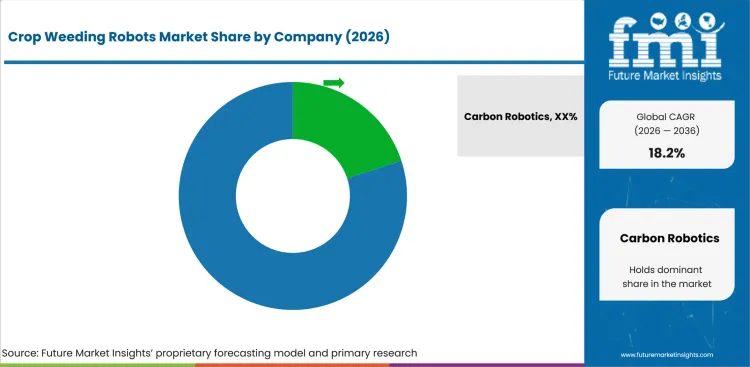
Carbon Robotics, Naio Technologies, Ecorobotix, Verdant Robotics and FarmWise.
- Established agricultural robotics companies hold an advantage through technical service teams and proven field programs.
- System-linked suppliers gain stronger acceptance by connecting weed-control tools with crop-safe field operation.
- Regional machinery companies win in country markets by offering fast field response and locally stocked parts.
- Service-ready suppliers improve renewal chances led by operator training and plant-recognition support.
Agricultural robotics companies compete by combining machine design and farm-level support. Carbon Robotics has a strong position through commercial laser weeding and specialty crop presence. Naio Technologies competes based on autonomous field robots for vegetable and vineyard applications. Ecorobotix supports precision spraying through plant-by-plant technology and an expanding ARA base.
Manufacturing and technical service depth have become stronger competitive separators as crop weeding robots move beyond trial plots. Verdant Robotics and FarmWise compete based on plant-level applications and intra-row crop treatment. John Deere, Blue River Technology, AgXeed, FarmDroid, Farming Revolution, and Vitirover strengthen competition depending on dealer support and crop-specific tools. Buyers compare supplier performance through weed kill and completed acres during field windows.
Smaller and regional suppliers can win through local agronomy knowledge and faster field support. India, China, and South Korea create opportunities for suppliers with application teams and local service networks. United States and Europe create stronger demand for safety documentation and technical validation. Companies that prove robot performance under changing soil and crop-spacing conditions should gain more durable equipment and service contracts.
How do top Crop Weeding Robots companies compare?
Carbon Robotics and Verdant Robotics score strongly on plant recognition while Naio Technologies leads through autonomous field readiness.
| Company | Relevance to Market Title | Plant Recognition Depth | Field Autonomy Readiness | Crop-Specific Tooling | Channel Reach | Geographic Footprint |
|---|---|---|---|---|---|---|
| Carbon Robotics | Very High | Very Strong | Strong | Very Strong | Strong | North America, Europe, and Australia |
| Naio Technologies | Very High | Strong | Very Strong | Strong | Strong | Europe and export markets |
| FarmWise | High | Very Strong | Moderate | Strong | Moderate | United States |
| Ecorobotix | High | Very Strong | Moderate | Strong | Strong | Europe, North America, and Oceania |
| Verdant Robotics | Very High | Very Strong | Strong | Very Strong | Moderate | United States |
| John Deere / Blue River Technology | High | Very Strong | Strong | Moderate | Very Strong | Global |
| AgXeed | Moderate to High | Moderate | Very Strong | Moderate | Moderate | Europe and export markets |
| FarmDroid | High | Moderate | Very Strong | Strong | Moderate | Europe and export markets |
| Farming Revolution | High | Very Strong | Strong | Strong | Moderate | Europe |
| Vitirover | Moderate | Moderate | Moderate | Moderate | Moderate | France and service markets |
Source: Future Market Insights competitive analysis, 2026.
Who are the key players in the Crop Weeding Robots Market?
Carbon Robotics, Naio Technologies and Ecorobotix are listed with Verdant Robotics and FarmWise among other suppliers.
Key global companies leading the Crop Weeding Robots Market include:
- Carbon Robotics
- Naio Technologies
- FarmWise
- Ecorobotix
- Blue River Technology
- AgXeed
- Verdant Robotics
- FarmDroid
- Farming Revolution
- Vitirover
Key Developments in Crop Weeding Robots Market
- In February 2025, Carbon Robotics introduced the LaserWeeder G2 product line for faster, lighter, and modular laser weeding.
- In May 2025, Verdant Robotics expanded commercial availability of SharpShooter across the United States for specialty crop growers.
- In February 2026, KIOTI Europe and Naio Technologies announced a strategic partnership for a new robotic agricultural platform.
- In April 2026, Ecorobotix announced a USD 50 million United States expansion plan and ARA assembly in Kansas.
Key Players in the Crop Weeding Robots Market
Autonomous and Laser Specialists
- Carbon Robotics
- Naio Technologies
- FarmDroid
- Farming Revolution
- Vitirover
Precision Application Specialists
- Verdant Robotics
- Ecorobotix
- FarmWise
- Blue River Technology
- TartanSense
Autonomous Platform and OEM Players
- John Deere
- AgXeed
- Kubota
- Daedong
- XAG
Mechanical and Guided Weeding Companies
- Garford Farm Machinery
- Tillett and Hague Technology
- Carré
- HORSCH
- crop.zone
Crop Weeding Robots Market - Report Scope
| Parameter | Details |
|---|---|
| Forecast period | 2026 to 2036 |
| Historical period | 2021 to 2025 |
| Quantitative unit | Revenue in USD million |
| By robot type | Autonomous Field Robots, Tractor-mounted Robotic Weeders, Precision Laser Weeders, Micro-robotic / Other |
| By weeding technology | Mechanical Weeding, AI Vision-guided Spraying, Laser / Thermal Weeding, Electrical / Other |
| By crop type | Vegetables, Row Crops, Orchards and Vineyards, Specialty Crops |
| By farm size | Small and Medium Farms, Large Farms, Contract Service Providers |
| By sales model | Equipment Sale, Robotics-as-a-Service, Dealer / Distributor |
| Regions covered | North America, Latin America, Europe, East Asia, South Asia and Pacific, Middle East and Africa |
| Countries covered | China, India, United States, France, Japan, South Korea, Germany, United Kingdom |
| Key companies profiled | Carbon Robotics, Naio Technologies, FarmWise, Ecorobotix, Blue River Technology, AgXeed, Verdant Robotics, FarmDroid, Farming Revolution, Vitirover |
| Approach | Bottom-up equipment and service revenue approach using robot unit demand, average selling price, service model revenue, crop exposure, sales model mix, and country readiness |
Source: Future Market Insights competitive analysis, 2026.
Crop Weeding Robots Market - Scope & Definition
| Attribute | Detail |
|---|---|
| Market Definition | Autonomous, tractor-mounted, or service-operated machines that identify and treat weeds in crop fields. |
| Functions Covered | Weed detection, mechanical removal, targeted spraying, laser treatment, thermal treatment, electrical treatment, field mapping, and crop-safe navigation. |
| Applications Covered | Vegetable weeding, row-crop weed control, orchard and vineyard floor management, specialty crop treatment, organic field programs, and contract weeding services. |
| End-Use Industries | Commercial farming, specialty crop production, organic farming, vineyards, orchards, agricultural contractors, cooperatives, and farm machinery service providers. |
| Grades Covered | Autonomous robots, tractor-mounted robotic weeders, precision laser weeders, guided mechanical weeders, plant-level precision sprayers, and service-operated systems. |
| Inclusions | All commercially sold and service-operated robotic weed-control systems across robot type, weeding technology, crop type, farm size, sales model, and country-level demand. |
| Exclusions | Hand tools, conventional cultivators without robotic control, standard sprayers without plant targeting, harvesting robots, irrigation robots, livestock robots, drones without weed-treatment capability, and software sold without robotic field action. |
Crop Weeding Robots Market - Research Methodology
| Method | Description |
|---|---|
| Primary Research | FMI analyst interviews with specialty growers, large crop farms, robotic service operators, agricultural dealers, and farm equipment integrators across selected markets. |
| Desk Research | Review of government agriculture statistics, farm automation policies, official company disclosures, product literature, machinery references, and robotics technology sources. |
| Market Sizing & Forecasting | Bottom-up equipment and service revenue approach using robot unit demand, average selling price, service model revenue, crop exposure, sales model mix, and country readiness. |
| Forecast Basis | Demand assessment reflects company portfolios, official farm statistics, country policy signals, vegetable and specialty crop exposure, and broader farm automation demand. |
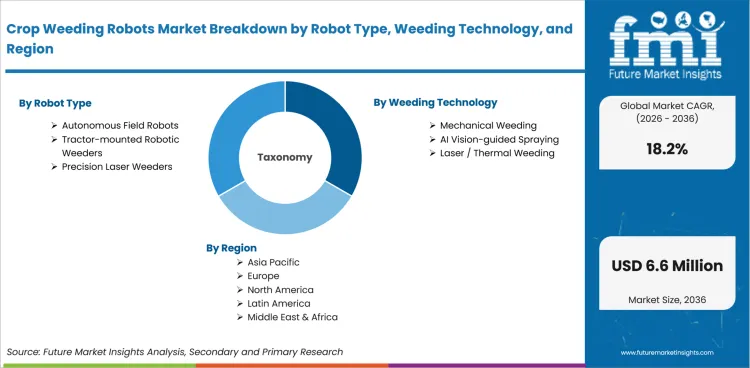
Crop Weeding Robots Market Breakdown by Robot Type, Weeding Technology, Crop Type, Farm Size, Sales Model, and Region
Crop Weeding Robots Market Segmented by Robot Type
- Autonomous Field Robots
- Tractor-mounted Robotic Weeders
- Precision Laser Weeders
- Micro-robotic / Other
Crop Weeding Robots Market Segmented by Weeding Technology
- Mechanical Weeding
- AI Vision-guided Spraying
- Laser / Thermal Weeding
- Electrical / Other
Crop Weeding Robots Market Segmented by Crop Type
- Vegetables
- Row Crops
- Orchards and Vineyards
- Specialty Crops
Crop Weeding Robots Market Segmented by Farm Size
- Small and Medium Farms
- Large Farms
- Contract Service Providers
Crop Weeding Robots Market Segmented by Sales Model
- Equipment Sale
- Robotics-as-a-Service
- Dealer / Distributor
Crop Weeding Robots Market by Region
- North America
- Latin America
- Europe
- East Asia
- South Asia and Pacific
- Middle East and Africa
Research Sources and Bibliography
- Carbon Robotics. (2025, February 10). Carbon Robotics introduces faster, lighter and modular LaserWeeder G2 product line.
- Carbon Robotics. (2026). LaserWeeder product specifications and performance information.
- Department for Environment, Food and Rural Affairs. (2025, June 26). Horticulture statistics 2024.
- Department for Environment, Food and Rural Affairs. (2025, October 24). UK Pesticides National Action Plan 2025: Working for a more sustainable future.
- Department for Environment, Food and Rural Affairs. (2026, February 24). Farming Equipment and Technology Fund 2026 guidance now available.
- Ecorobotix. (2026, March 17). Ecorobotix reaches milestone: 1,000 ARA ultra-high precision sprayers sold worldwide.
- Ecorobotix. (2026, April 27). Ecorobotix invests USD 50 million to expand U.S. operations.
- European Commission, Eurostat. (2025). Farmers and the agricultural labour force statistics.
- Federal Statistical Office of Germany. (2026). Organic farming in Germany 2024 and 2025: Complete organic cultivated area.
- Food and Agriculture Organization of the United Nations. (2025, September 4). SmartFarm Korea.
- Germany Trade & Invest. (2025). Smart farming industry.
- Ministry of Agriculture and Rural Affairs of the People’s Republic of China. (2026, January 22). China’s grain output hits new high in 2025.
- Ministry of Agriculture and Farmers Welfare. (2025, March 13). Annual report 2024-25.
- Ministry of Agriculture and Farmers Welfare. (2025, July 22). Farm mechanization and agricultural workforce.
- Ministry of Agriculture and Farmers Welfare. (2025, November 25). Horticulture area increases to 29.488 million hectares and production expands.
- Ministry of Agriculture, Food and Rural Affairs. (2025, February 26). First master plan for promotion of the growth of the smart-farming industry for 2025 to 2029.
- Ministry of Agriculture, Forestry and Fisheries of Japan. (2025, October 1). Promotion of smart agriculture.
- Ministry of Agriculture, Forestry and Fisheries of Japan. (2025, September 22). Situation surrounding organic agriculture in Japan.
- Naio Technologies. (2026, February 5). KIOTI Europe and Naio announce a strategic partnership and plans for a new robotic platform by 2026.
- Organisation for Economic Co-operation and Development. (2025, October 30). Agricultural policy monitoring and evaluation 2025.
- Organisation for Economic Co-operation and Development. (2025, October 30). China: Agricultural policy monitoring and evaluation 2025.
- Organisation for Economic Co-operation and Development. (2025, October 30). Germany: OECD economic survey 2025.
- Organisation for Economic Co-operation and Development. (2025, October 30). Japan: Agricultural policy monitoring and evaluation 2025.
- Organisation for Economic Co-operation and Development. (2025, October 30). Korea: Agricultural policy monitoring and evaluation 2025.
- Press Information Bureau. (2025, February 1). Strengthening India’s agricultural backbone.
- Press Information Bureau. (2025, July 22). Farm mechanization and agricultural workforce.
- State Council of the People’s Republic of China. (2026, June 2). China issues five-year plan for agricultural and rural modernization.
- U.S. Department of Agriculture, Economic Research Service. (2025, February 25). Wages of hired farmworkers growing, but still behind nonfarm wages.
- U.S. Department of Agriculture, Foreign Agricultural Service. (2024, November 25). China: National smart agriculture action plan published.
- U.S. Department of Agriculture, National Agricultural Statistics Service. (2025, May 21). Farm labor.
- U.S. Department of Agriculture, National Agricultural Statistics Service. (2026, February 12). Vegetables 2025 summary.
- Verdant Robotics. (2024, October 21). Verdant Robotics announces commercial launch of 2025 SharpShooter.
- Verdant Robotics. (2025, May 28). Verdant Robotics expands commercial availability of SharpShooter across the United States.
- World Bank Group. (2026). Farming and agribusiness.
This bibliography is provided for reader reference and is not exhaustive. The full report contains the complete reference list and detailed citations.
This Report Answers
- Market size estimates for 2026 and forecasts through 2036 for the Crop Weeding Robots Market.
- Insights across regional and country-level crop automation markets.
- Analysis of demand drivers and purchasing behavior.
- Evaluation of robot types, weeding technologies, crop types, farm sizes, and sales models.
- Assessment of labor cost pressure and crop-value impacts.
- Identification of opportunities across laser weeding and service-led robot access.
- Evaluation of service contract models and technical sales channels.
- Country-level analysis covering China, India, United States, France, Japan, South Korea, Germany, and United Kingdom.
- Assessment of competition, including leading agricultural robotics suppliers and farm machinery companies.
- Analysis of plant-level decision drivers and renewal criteria.
- Regional outlooks across North America, Europe, East Asia, South Asia and Pacific, Latin America, and Middle East and Africa.
- Delivery of market data, forecasts, and supporting analysis in report-ready format.
Frequently Asked Questions
What is the growth prospect for Crop Weeding Robots?
Demand for crop weeding robots is expected to rise at a considerable pace as farms shift toward automated weed removal and plant-level treatment.
Which companies are expected to shape the Crop Weeding Robots market?
Carbon Robotics, Naio Technologies, Ecorobotix, Verdant Robotics, FarmWise, John Deere, Blue River Technology, AgXeed, FarmDroid, Farming Revolution, and Vitirover are expected to shape market competition due to field platforms and service support.
Why are agricultural technology companies investing in Crop Weeding Robots?
Agricultural technology companies are investing in crop weeding robots to support growers managing labor cost and crop-safe weed control.
Why are service-led sales channels important in the Crop Weeding Robots market?
Service-led sales channels support calibration and plant troubleshooting across robotic weed-control systems.
Which robot formats are gaining attention in Crop Weeding Robots?
Tractor-mounted robotic weeders and AI vision-guided sprayers are gaining attention as farms push toward retrofit and plant-level treatment options.
How do regulations influence Crop Weeding Robots demand?
Regulations influence demand through integrated pest management programs and farm machinery safety requirements.
Why is mechanical weeding important for Crop Weeding Robots?
Mechanical weeding is important since it offers a chemical-free route for organic and herbicide-restricted crops.
What role does Equipment Sale play in Crop Weeding Robots adoption?
Equipment Sale supports adoption by giving farms control over timing and peak-season scheduling.
Preview the report firsthand - request a free sample
Get SampleGet the brochure for pricing and purchase details.
Get PDFTable of Content
- Key Takeaways
- Market Size and CAGR
- Top Growth Driver
- Fastest Growing Segment
- Leading Region
- Key Companies
- Emerging Opportunities
- Executive Summary
- Global Market Outlook
- Demand-side Trends
- Supply-side Trends
- Technology Roadmap Analysis
- Analysis and Recommendations
- Analyst Perspective (What is happening? Why now? What should investors know?)
- Key Questions Answered
- How large is the market?
- What is the CAGR?
- What are key trends?
- Which region dominates?
- Who are the leaders?
- Market Overview
- Market Coverage / Taxonomy
- Market Definition / Scope / Limitations
- Research Methodology
- Chapter Orientation
- Analytical Lens and Working Hypotheses
- Market Structure, Signals, and Trend Drivers
- Benchmarking and Cross-market Comparability
- Market Sizing, Forecasting, and Opportunity Mapping
- Research Design and Evidence Framework
- Desk Research Programme (Secondary Evidence)
- Expert Input and Fieldwork (Primary Evidence)
- Tooling, Models, and Reference Databases
- Data Engineering and Model Build
- Quality Assurance and Audit Trail
- Market Background
- Market Dynamics (Drivers, Restraints, Opportunity, Trends)
- Scenario Forecast (Optimistic, Likely, Conservative)
- Impact Analysis
- AI Impact
- Sustainability Impact
- Regulatory Impact
- Technology Impact
- Consumer / Buyer Analysis
- Purchase Drivers
- Adoption Barriers
- Buyer Journey
- Opportunity Map Analysis
- Product Life Cycle Analysis
- Supply Chain Analysis
- Investment Feasibility Matrix
- Value Chain Analysis
- PESTLE and Porter's Analysis
- Regulatory Landscape
- Regional Parent Market Outlook
- Production and Consumption Statistics
- Import and Export Statistics
- Global Market Analysis and Forecast, 2021 to 2036
- Historical Market Size Value (USD Million) Analysis, 2021 to 2025
- Current and Future Market Size Value (USD Million) Projections, 2026 to 2036
- Y-o-Y Growth Trend Analysis
- Absolute $ Opportunity Analysis
- Global Market Pricing Analysis, 2021 to 2036
- Global Market Analysis and Forecast, By Robot Type, 2021 to 2036
- Introduction / Key Findings
- Historical Market Size Value (USD Million) Analysis By Robot Type, 2021 to 2025
- Current and Future Market Size Value (USD Million) Analysis and Forecast By Robot Type, 2026 to 2036
- Autonomous Field Robots
- Tractor-mounted Robotic Weeders
- Precision Laser Weeders
- Micro-robotic / Other
- Autonomous Field Robots
- Y-o-Y Growth Trend Analysis By Robot Type, 2021 to 2025
- Absolute $ Opportunity Analysis By Robot Type, 2026 to 2036
- Global Market Analysis and Forecast, By Weeding Technology, 2021 to 2036
- Introduction / Key Findings
- Historical Market Size Value (USD Million) Analysis By Weeding Technology, 2021 to 2025
- Current and Future Market Size Value (USD Million) Analysis and Forecast By Weeding Technology, 2026 to 2036
- Mechanical Weeding
- AI Vision-guided Spraying
- Laser / Thermal Weeding
- Mechanical Weeding
- Y-o-Y Growth Trend Analysis By Weeding Technology, 2021 to 2025
- Absolute $ Opportunity Analysis By Weeding Technology, 2026 to 2036
- Global Market Analysis and Forecast, By Crop Type, 2021 to 2036
- Introduction / Key Findings
- Historical Market Size Value (USD Million) Analysis By Crop Type, 2021 to 2025
- Current and Future Market Size Value (USD Million) Analysis and Forecast By Crop Type, 2026 to 2036
- Vegetables
- Row Crops
- Orchards and Vineyards
- Vegetables
- Y-o-Y Growth Trend Analysis By Crop Type, 2021 to 2025
- Absolute $ Opportunity Analysis By Crop Type, 2026 to 2036
- Global Market Analysis and Forecast, By Farm Size, 2021 to 2036
- Introduction / Key Findings
- Historical Market Size Value (USD Million) Analysis By Farm Size, 2021 to 2025
- Current and Future Market Size Value (USD Million) Analysis and Forecast By Farm Size, 2026 to 2036
- Large Farms
- Small and Medium Farms
- Contract Service Providers
- Large Farms
- Y-o-Y Growth Trend Analysis By Farm Size, 2021 to 2025
- Absolute $ Opportunity Analysis By Farm Size, 2026 to 2036
- Global Market Analysis and Forecast, By Sales Model, 2021 to 2036
- Introduction / Key Findings
- Historical Market Size Value (USD Million) Analysis By Sales Model, 2021 to 2025
- Current and Future Market Size Value (USD Million) Analysis and Forecast By Sales Model, 2026 to 2036
- Equipment Sale
- Robotics-as-a-Service
- Dealer / Distributor
- Equipment Sale
- Y-o-Y Growth Trend Analysis By Sales Model, 2021 to 2025
- Absolute $ Opportunity Analysis By Sales Model, 2026 to 2036
- Global Market Analysis and Forecast, By Region, 2021 to 2036
- Introduction
- Historical Market Size Value (USD Million) Analysis By Region, 2021 to 2025
- Current Market Size Value (USD Million) Analysis and Forecast By Region, 2026 to 2036
- North America
- Latin America
- Western Europe
- Eastern Europe
- East Asia
- South Asia and Pacific
- Middle East & Africa
- Market Attractiveness Analysis By Region
- North America Market Analysis and Forecast, By Country, 2021 to 2036
- Historical Market Size Value (USD Million) Trend Analysis By Market Taxonomy, 2021 to 2025
- Market Size Value (USD Million) Forecast By Market Taxonomy, 2026 to 2036
- By Country
- USA
- Canada
- Mexico
- By Robot Type
- By Weeding Technology
- By Crop Type
- By Farm Size
- By Sales Model
- By Country
- Market Attractiveness Analysis
- By Country
- By Robot Type
- By Weeding Technology
- By Crop Type
- By Farm Size
- By Sales Model
- Key Takeaways
- Latin America Market Analysis and Forecast, By Country
- Historical Market Size Value (USD Million) Trend Analysis By Market Taxonomy, 2021 to 2025
- Market Size Value (USD Million) Forecast By Market Taxonomy, 2026 to 2036
- By Country
- Brazil
- Chile
- Rest of Latin America
- By Robot Type
- By Weeding Technology
- By Crop Type
- By Farm Size
- By Sales Model
- By Country
- Market Attractiveness Analysis
- By Country
- By Robot Type
- By Weeding Technology
- By Crop Type
- By Farm Size
- By Sales Model
- Key Takeaways
- Western Europe Market Analysis and Forecast, By Country
- Historical Market Size Value (USD Million) Trend Analysis By Market Taxonomy, 2021 to 2025
- Market Size Value (USD Million) Forecast By Market Taxonomy, 2026 to 2036
- By Country
- Germany
- UK
- Italy
- Spain
- France
- Nordic
- BENELUX
- Rest of Western Europe
- By Robot Type
- By Weeding Technology
- By Crop Type
- By Farm Size
- By Sales Model
- By Country
- Market Attractiveness Analysis
- By Country
- By Robot Type
- By Weeding Technology
- By Crop Type
- By Farm Size
- By Sales Model
- Key Takeaways
- Eastern Europe Market Analysis and Forecast, By Country
- Historical Market Size Value (USD Million) Trend Analysis By Market Taxonomy, 2021 to 2025
- Market Size Value (USD Million) Forecast By Market Taxonomy, 2026 to 2036
- By Country
- Russia
- Poland
- Hungary
- Balkan & Baltic
- Rest of Eastern Europe
- By Robot Type
- By Weeding Technology
- By Crop Type
- By Farm Size
- By Sales Model
- By Country
- Market Attractiveness Analysis
- By Country
- By Robot Type
- By Weeding Technology
- By Crop Type
- By Farm Size
- By Sales Model
- Key Takeaways
- East Asia Market Analysis and Forecast, By Country
- Historical Market Size Value (USD Million) Trend Analysis By Market Taxonomy, 2021 to 2025
- Market Size Value (USD Million) Forecast By Market Taxonomy, 2026 to 2036
- By Country
- China
- Japan
- South Korea
- By Robot Type
- By Weeding Technology
- By Crop Type
- By Farm Size
- By Sales Model
- By Country
- Market Attractiveness Analysis
- By Country
- By Robot Type
- By Weeding Technology
- By Crop Type
- By Farm Size
- By Sales Model
- Key Takeaways
- South Asia and Pacific Market Analysis and Forecast, By Country
- Historical Market Size Value (USD Million) Trend Analysis By Market Taxonomy, 2021 to 2025
- Market Size Value (USD Million) Forecast By Market Taxonomy, 2026 to 2036
- By Country
- India
- ASEAN
- Australia & New Zealand
- Rest of South Asia and Pacific
- By Robot Type
- By Weeding Technology
- By Crop Type
- By Farm Size
- By Sales Model
- By Country
- Market Attractiveness Analysis
- By Country
- By Robot Type
- By Weeding Technology
- By Crop Type
- By Farm Size
- By Sales Model
- Key Takeaways
- Middle East & Africa Market Analysis and Forecast, By Country
- Historical Market Size Value (USD Million) Trend Analysis By Market Taxonomy, 2021 to 2025
- Market Size Value (USD Million) Forecast By Market Taxonomy, 2026 to 2036
- By Country
- Kingdom of Saudi Arabia
- Other GCC Countries
- Türkiye
- South Africa
- Other African Union
- Rest of Middle East & Africa
- By Robot Type
- By Weeding Technology
- By Crop Type
- By Farm Size
- By Sales Model
- By Country
- Market Attractiveness Analysis
- By Country
- By Robot Type
- By Weeding Technology
- By Crop Type
- By Farm Size
- By Sales Model
- Key Takeaways
- Key Countries Market Analysis
- USA
- Pricing Analysis
- Market Share Analysis, 2025
- By Robot Type
- By Weeding Technology
- By Crop Type
- By Farm Size
- By Sales Model
- Canada
- Pricing Analysis
- Market Share Analysis, 2025
- By Robot Type
- By Weeding Technology
- By Crop Type
- By Farm Size
- By Sales Model
- Mexico
- Pricing Analysis
- Market Share Analysis, 2025
- By Robot Type
- By Weeding Technology
- By Crop Type
- By Farm Size
- By Sales Model
- Brazil
- Pricing Analysis
- Market Share Analysis, 2025
- By Robot Type
- By Weeding Technology
- By Crop Type
- By Farm Size
- By Sales Model
- Chile
- Pricing Analysis
- Market Share Analysis, 2025
- By Robot Type
- By Weeding Technology
- By Crop Type
- By Farm Size
- By Sales Model
- Germany
- Pricing Analysis
- Market Share Analysis, 2025
- By Robot Type
- By Weeding Technology
- By Crop Type
- By Farm Size
- By Sales Model
- UK
- Pricing Analysis
- Market Share Analysis, 2025
- By Robot Type
- By Weeding Technology
- By Crop Type
- By Farm Size
- By Sales Model
- Italy
- Pricing Analysis
- Market Share Analysis, 2025
- By Robot Type
- By Weeding Technology
- By Crop Type
- By Farm Size
- By Sales Model
- Spain
- Pricing Analysis
- Market Share Analysis, 2025
- By Robot Type
- By Weeding Technology
- By Crop Type
- By Farm Size
- By Sales Model
- France
- Pricing Analysis
- Market Share Analysis, 2025
- By Robot Type
- By Weeding Technology
- By Crop Type
- By Farm Size
- By Sales Model
- India
- Pricing Analysis
- Market Share Analysis, 2025
- By Robot Type
- By Weeding Technology
- By Crop Type
- By Farm Size
- By Sales Model
- ASEAN
- Pricing Analysis
- Market Share Analysis, 2025
- By Robot Type
- By Weeding Technology
- By Crop Type
- By Farm Size
- By Sales Model
- Australia & New Zealand
- Pricing Analysis
- Market Share Analysis, 2025
- By Robot Type
- By Weeding Technology
- By Crop Type
- By Farm Size
- By Sales Model
- China
- Pricing Analysis
- Market Share Analysis, 2025
- By Robot Type
- By Weeding Technology
- By Crop Type
- By Farm Size
- By Sales Model
- Japan
- Pricing Analysis
- Market Share Analysis, 2025
- By Robot Type
- By Weeding Technology
- By Crop Type
- By Farm Size
- By Sales Model
- South Korea
- Pricing Analysis
- Market Share Analysis, 2025
- By Robot Type
- By Weeding Technology
- By Crop Type
- By Farm Size
- By Sales Model
- Russia
- Pricing Analysis
- Market Share Analysis, 2025
- By Robot Type
- By Weeding Technology
- By Crop Type
- By Farm Size
- By Sales Model
- Poland
- Pricing Analysis
- Market Share Analysis, 2025
- By Robot Type
- By Weeding Technology
- By Crop Type
- By Farm Size
- By Sales Model
- Hungary
- Pricing Analysis
- Market Share Analysis, 2025
- By Robot Type
- By Weeding Technology
- By Crop Type
- By Farm Size
- By Sales Model
- Kingdom of Saudi Arabia
- Pricing Analysis
- Market Share Analysis, 2025
- By Robot Type
- By Weeding Technology
- By Crop Type
- By Farm Size
- By Sales Model
- Türkiye
- Pricing Analysis
- Market Share Analysis, 2025
- By Robot Type
- By Weeding Technology
- By Crop Type
- By Farm Size
- By Sales Model
- South Africa
- Pricing Analysis
- Market Share Analysis, 2025
- By Robot Type
- By Weeding Technology
- By Crop Type
- By Farm Size
- By Sales Model
- USA
- Market Structure Analysis
- Competition Dashboard
- Competition Benchmarking
- Market Share Analysis of Top Players
- By Regional
- By Robot Type
- By Weeding Technology
- By Crop Type
- By Farm Size
- By Sales Model
- Emerging Startups
- Innovation Benchmarking
- Competition Analysis
- Competition Deep Dive
- Carbon Robotics
- Overview
- Product Portfolio
- Profitability by Market Segments (Product/Region/Sales Channel)
- Sales Footprint
- Strategy Overview
- Marketing Strategy
- Product Strategy
- Channel Strategy
- Naio Technologies
- FarmWise
- Ecorobotix
- Blue River Technology
- AgXeed
- Verdant Robotics
- Carbon Robotics
- Case Studies
- Success Stories
- Recent Developments
- Competition Deep Dive
- Assumptions & Acronyms Used


