

- Industry Size (2026)
- USD 189 Mn
- Forecast (2036)
- USD 893.1 Mn
- CAGR (2026 to 2036)
- 16.8%
Targeted Phage-Based Bactericide for Specialty Crops Market Forecast and Outlook 2026 to 2036
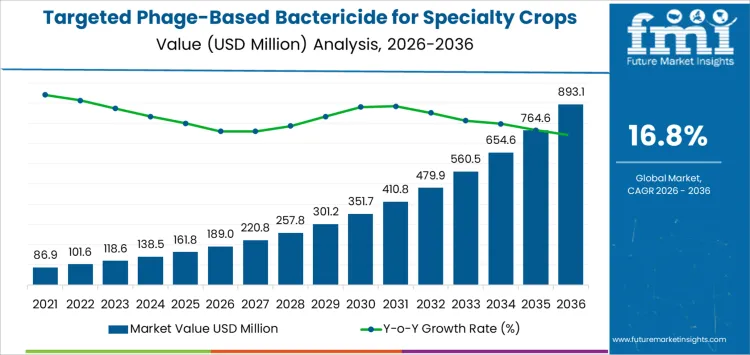
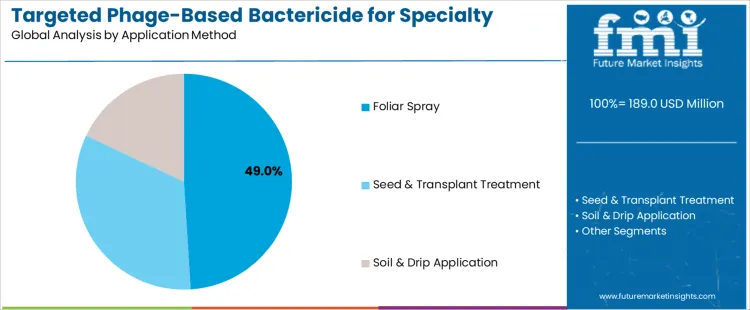
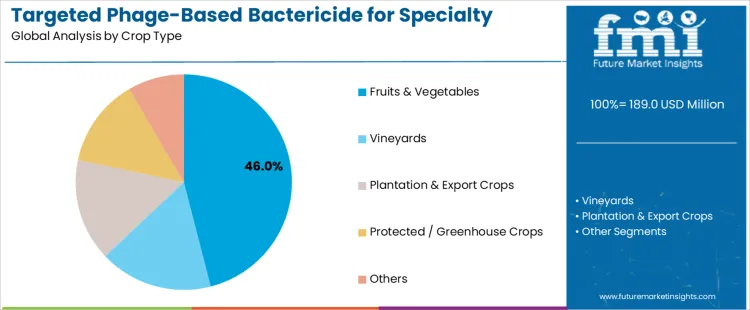
The global targeted phage-based bactericide for specialty crops market is projected to grow from USD 189 million in 2026 to USD 893.1 million by 2036, with a robust CAGR of 16.8%. The market is driven by the increasing adoption of phage-based bactericides for specialty crops such as fruits, vegetables, and vineyards, which lead the market with a combined share of 46%. The market also includes plantation & export crops, protected/greenhouse crops, and other specialty crops, reflecting the broad applicability of phage technology across diverse agricultural sectors. In terms of application methods, foliar spray holds the largest share at 49%, with seed & transplant treatment, soil & drip application, and others contributing to growing demand due to their precision and effectiveness.
Quick Stats for Targeted Phage-Based Bactericide for Specialty Crops Market
- Targeted Phage-Based Bactericide for Specialty Crops Market Value (2026): USD 189 million
- Targeted Phage-Based Bactericide for Specialty Crops Market Forecast Value (2036): USD 893.1 million
- Targeted Phage-Based Bactericide for Specialty Crops Market Forecast CAGR: 16.8%
- Leading Crop Type in Targeted Phage-Based Bactericide Market: Fruits & Vegetables (46%)
- Top Application Method in Targeted Phage-Based Bactericide Market: Foliar Spray (49%)
- Key Growth Regions in Targeted Phage-Based Bactericide Market: North America, Asia Pacific
- Key Players in Targeted Phage-Based Bactericide Market: AgBiome, Armata Pharmaceuticals (Agri), Bayer CropScience, Syngenta Group, APS Biocontrol
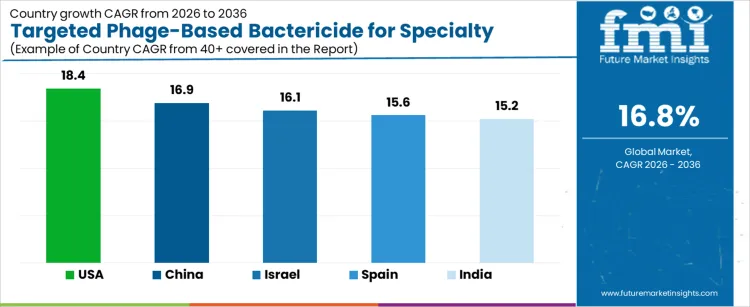
The USA leads the market with an 18.4% CAGR, supported by investments in green farming and eco-friendly pest control solutions. China follows closely with a 16.9% CAGR, reflecting its large agricultural base and demand for targeted disease control methods. Israel, Spain, and India also show strong growth, with respective CAGRs of 16.1%, 15.6%, and 15.2%. These countries are increasingly adopting biological solutions, driven by regulatory pressures, environmental concerns, and the need for high-quality crop protection in specialty crops. As the market expands, the targeted approach of phage-based bactericides ensures minimal impact on beneficial microbes, positioning them as a green and effective alternative to traditional chemical treatments.
Targeted Phage‑Based Bactericide for Specialty Crops Market Key Takeaways
| Metric | Value |
|---|---|
| Industry Value (2026) | USD 189 million |
| Forecast Value (2036) | USD 893.1 million |
| Forecast CAGR (2026–2036) | 16.8% |
How is the Global Targeted Phage‑Based Bactericide for Specialty Crops Sector Advancing?
The global targeted phage‑based bactericide for specialty crops market is expanding rapidly as growers adopt precision biological solutions to manage bacterial diseases while reducing reliance on conventional chemical bactericides. Phage‑based bactericides use specific viruses (bacteriophages) that infect and kill pathogenic bacteria affecting crops like fruits, vegetables, nuts, and horticultural plants. These solutions offer high specificity, minimizing impacts on beneficial microbes and lowering the risk of resistance development that is common with broad‑spectrum chemical treatments. As environmental and regulatory pressures mount against traditional pesticides, phage‑based products are gaining traction as an environmentally responsible alternative.
Adoption is being driven by growing demand for green and residue‑free agricultural produce, especially in premium and export markets where specialty crops command higher value. Advances in formulation and delivery technologies are improving the stability, persistence, and field performance of phage treatments, enabling more reliable disease control under diverse growing conditions. Integration of phage bactericides into integrated pest management (IPM) programs allows growers to combine biological control with cultural practices and other targeted interventions, enhancing overall crop health.
The market is expected to maintain strong growth as research expands the range of target pathogens and improves application protocols. Challenges such as ensuring consistent efficacy across environments, regulatory approval pathways, and grower education on biological pest management may influence adoption rates. The increasing focus on green crop protection and reduced chemical inputs is fueling demand for targeted phage‑based bactericides in the specialty crops segment worldwide.
What is the Segment-Wise Analysis for the Global Targeted Phage-Based Bactericide for Specialty Crops Market?
The global targeted phage-based bactericide for specialty crops market is segmented by crop type and application method. Fruits & vegetables lead the market with a 46% share due to their vulnerability to bacterial diseases and the increasing adoption of phage-based bactericides for targeted protection. Other significant crop types include vineyards, plantation & export crops, and protected/greenhouse crops. In terms of application methods, foliar spray holds the largest share at 49%, followed by seed & transplant treatment, soil & drip application, and others.
How is the Global Targeted Phage-Based Bactericide for Specialty Crops Sector Advancing?
The global targeted phage-based bactericide for specialty crops sector is advancing as growers seek more green and precise methods for managing bacterial diseases. Phage-based bactericides use specific bacteriophages to target and eliminate harmful bacteria without impacting beneficial microbes. This targeted approach offers an eco-friendly alternative to conventional chemical bactericides, reducing the risk of resistance development. As environmental concerns and regulatory pressures increase, phage-based solutions are gaining popularity, especially in premium and export markets where residue-free crops are in high demand. Advances in formulation and delivery technologies are enhancing the effectiveness and stability of phage treatments, enabling reliable disease control under varying growing conditions.
Why is the Global Targeted Phage-Based Bactericide for Specialty Crops Sector Expanding?
The global targeted phage-based bactericide for specialty crops market is expanding due to the increasing demand for green farming practices and the growing need to reduce chemical pesticide use. Phage-based bactericides provide highly specific targeting of pathogenic bacteria, ensuring minimal impact on beneficial microorganisms and reducing resistance risks common with chemical treatments. These advantages make phage-based solutions highly attractive in premium and export markets, where residue-free produce is in demand. Ongoing advancements in formulation and delivery technologies are enhancing the efficacy and stability of phage treatments, enabling reliable disease control in diverse agricultural environments. With green crop protection becoming a priority for farmers worldwide, the demand for phage-based bactericides continues to rise, driving strong market growth in the specialty crop sector.
What is Shaping the Targeted Phage‑Based Bactericide for Specialty Crops Market?
Phage‑based bactericides use viruses that specifically infect and kill pathogenic bacteria affecting fruits, vegetables, nuts, and other high‑value crops without harming non‑target organisms. Growing resistance to conventional bactericides, regulatory limits on chemical pesticides, and increasing demand for green and residue‑free crop protection are driving adoption. Advances in phage discovery, formulation stability, and delivery technologies are influencing market growth.
What Challenges Are Limiting Adoption of Targeted Phage‑Based Bactericides for Specialty Crops?
Adoption is limited by formulation and application challenges, including phage sensitivity to environmental conditions such as UV exposure, temperature extremes, and rainfall, which can reduce efficacy. Development and registration costs for phage products are relatively high due to rigorous testing requirements and regulatory variability across regions. Grower skepticism or unfamiliarity with biological pest control can delay adoption, particularly where traditional chemicals have long‑standing use. Tailoring phage cocktails to diverse bacterial strains and crop systems requires ongoing R&D and precise diagnostics.
What Key Trends Are Shaping the Targeted Phage‑Based Bactericide for Specialty Crops Market?
Key trends include advanced formulation technologies that enhance phage stability and persistence on plant surfaces, such as microencapsulation and UV protectants. There is rising integration of phage products into IPM programs and digital agriculture tools that guide application timing based on pathogen pressure and weather forecasting. Collaborations between biotech firms, agri‑chemical companies, and academic institutions are accelerating product pipelines. The trend toward combining phage bactericides with other biologicals (e.g., beneficial microbes, SAR inducers) for holistic crop protection is also gaining traction as growers seek multifunctional solutions.
What is the Growth Outlook for the Targeted Phage-Based Bactericide for Specialty Crops Market by Country?
| Country | CAGR (%) |
|---|---|
| USA | 18.4% |
| China | 16.9% |
| Israel | 16.1% |
| Spain | 15.6% |
| India | 15.2% |
The targeted phage-based bactericide for specialty crops market is experiencing strong growth, with the USA leading at an 18.4% CAGR, driven by advancements in green farming practices and increasing demand for eco-friendly pest management solutions. China follows closely with 16.9%, supported by its large agricultural base and the rising need for effective, environmentally friendly disease control methods. Israel shows steady growth at 16.1%, with a strong emphasis on agricultural innovation and biotechnology. Spain’s market grows at 15.6%, fueled by the need to protect high-value crops, especially in vineyards and orchards. India’s market grows at 15.2%, driven by the country’s expanding agricultural sector and growing focus on green crop protection methods.
Why is the USA Leading in the Targeted Phage-Based Bactericide for Specialty Crops Market?
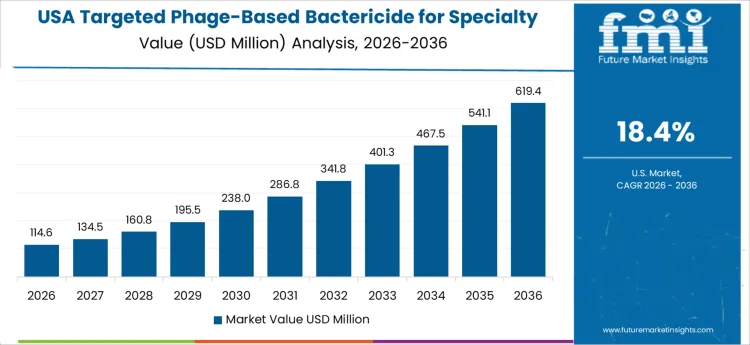
The USA’s targeted phage-based bactericide for specialty crops market is growing at 18.4%, driven by significant investments in agricultural innovation and the increasing need for green farming practices. As concerns over pesticide resistance and environmental impact grow, phage-based bactericides offer a targeted, eco-friendly alternative for controlling bacterial diseases in crops like fruits, vegetables, and vineyards. The USA’s strong research focus and regulatory support for biological pest control solutions are further driving this market. With a growing emphasis on reducing chemical pesticide use and increasing consumer demand for organic and sustainably grown produce, the market for phage-based bactericides is set for continued growth in the USA, helping farmers manage pests and diseases without harming the environment.
What is Driving the Growth of the Targeted Phage-Based Bactericide for Specialty Crops Market in China?
China’s targeted phage-based bactericide for specialty crops market is growing at 16.9%, fueled by the country’s massive agricultural base and a rising demand for green crop protection methods. China faces significant challenges with crop diseases, and the adoption of phage-based bactericides is seen as a more effective, targeted alternative to traditional chemical pesticides. With the government’s push for eco-friendly farming practices and the growing awareness of environmental degradation caused by overuse of chemicals, phage-based solutions are gaining popularity. The increasing focus on food safety and quality, particularly in export crops like fruits and vegetables, is driving the adoption of these biological solutions. As China continues to modernize its agriculture, the demand for phage-based bactericides is expected to increase.
How is the Targeted Phage-Based Bactericide for Specialty Crops Market Expanding in Israel?
Israel’s targeted phage-based bactericide for specialty crops market is growing at 16.1%, driven by the country’s leadership in agricultural technology and innovation. Israel’s agricultural sector is known for its cutting-edge approaches to crop protection, and phage-based bactericides are gaining traction due to their precision and durability. These bactericides offer a promising solution for controlling bacterial diseases without the environmental drawbacks of chemical pesticides. With the growing demand for more green pest control solutions in Israel’s high-value crops, such as vegetables and fruits, phage-based treatments are increasingly seen as an effective and eco-friendly alternative. As Israel continues to focus on enhancing agricultural productivity while minimizing environmental impact, the market for phage-based bactericides is expected to expand further.
What is Contributing to the Growth of the Targeted Phage-Based Bactericide for Specialty Crops Market in Spain?
Spain’s targeted phage-based bactericide for specialty crops market is growing at 15.6%, supported by the country’s strong agricultural industry, particularly in vineyards, orchards, and high-value crops like tomatoes and citrus. Spain’s agricultural sector is increasingly turning to biological solutions, such as phage-based bactericides, to address the rising concern over pesticide resistance and the environmental impact of chemical pesticides. Phage-based solutions provide a greener method to manage bacterial diseases while maintaining crop quality and yield. Spain’s strict regulations on pesticide use and increasing focus on green farming practices are driving the adoption of phage-based bactericides. With a growing interest in eco-friendly pest management solutions, the market for these products in Spain is expected to continue growing.
What is Driving the Growth of the Targeted Phage-Based Bactericide for Specialty Crops Market in India?
India’s targeted phage-based bactericide for specialty crops market is growing at 15.2%, driven by the country’s expanding agricultural sector and the increasing need for green pest control solutions. With India’s diverse agricultural landscape, including high-value crops like fruits, vegetables, and spices, the demand for effective crop protection methods is rising. Phage-based bactericides offer a targeted solution to control bacterial diseases while reducing the reliance on chemical pesticides. As India faces challenges with crop diseases and environmental concerns, these biological solutions are gaining popularity. Government initiatives to promote green farming practices and reduce chemical pesticide use are further boosting the adoption of phage-based bactericides. As India’s agriculture continues to modernize and prioritize environmental responsibility, the market for these products is expected to grow steadily.
How Are Companies Competing in the Targeted Phage‑Based Bactericide for Specialty Crops Market?
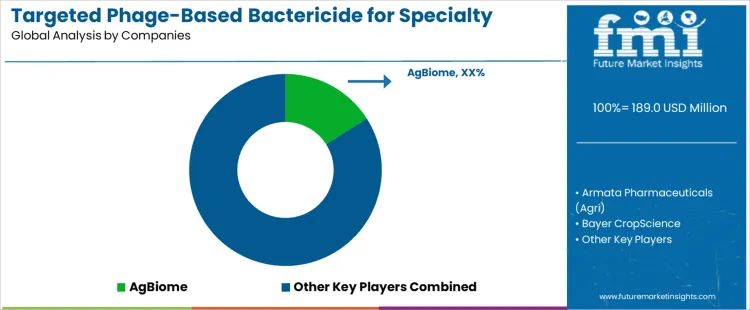
In the targeted phage‑based bactericide market for specialty crops AgBiome, Armata Pharmaceuticals (Agri), Bayer CropScience, Syngenta Group, and APS Biocontrol are differentiated by their product brochures and strategic positioning. AgBiome materials are centered on high‑precision bacteriophage agents that are described with specificity against key bacterial pathogens. Trial results are highlighted, with emphasis placed on reduction of disease incidence without affecting beneficial microbiota. Application guidance and compatibility with integrated pest management systems are included. Armata Pharmaceuticals (Agri) brochures present phage formulations engineered for stability and target selectivity. Detailed mode‑of‑action illustrations and recommended spray schedules are provided, supporting adoption by crop advisors.
Bayer CropScience literature frames phage‑based bactericides within a broader crop health portfolio, with product briefs that stress targeted efficacy and environmental safety profiles. Performance comparisons against conventional bactericides are shown to help growers understand value in reducing chemical inputs. Syngenta Group collateral highlights phage agents developed to match specific crop and pathogen combinations. Charts are used to present field efficacy data, and clear usage instructions are given to support proper application timing. APS Biocontrol brochures focus on phage technologies tailored to specialty crops with historic bacterial challenges. Information on formulation robustness and field deployment is provided, with summaries of observed disease control outcomes.
Key Players in Targeted Phage-Based Bactericide for Specialty Crops Market
- AgBiome
- Armata Pharmaceuticals (Agri)
- Bayer CropScience
- Syngenta Group
- APS Biocontrol
Scope of Report
| Items | Values |
|---|---|
| Quantitative Units (2026) | USD million |
| Crop Type | Fruits & Vegetables, Vineyards, Plantation & Export Crops, Protected / Greenhouse Crops, Others |
| Application Method | Foliar Spray, Seed & Transplant Treatment, Soil & Drip Application |
| Regions Covered | Asia Pacific, Europe, North America, Latin America, Middle East & Africa |
| Countries Covered | USA, China, Japan, South Korea, India, Australia & New Zealand, ASEAN, Germany, UK, France, Italy, Spain, Nordic, BENELUX, Brazil, Chile, Mexico, Saudi Arabia, Other GCC Countries, Turkey, South Africa, Other African Union |
| Key Companies Profiled | AgBiome, Armata Pharmaceuticals (Agri), Bayer CropScience, Syngenta Group, APS Biocontrol |
| Additional Attributes | Dollar sales by crop type, application method, and region; regional CAGR and growth outlook; distribution channels including biocontrol suppliers, seed treatment companies, and agricultural service providers; innovation trends in targeted phage-based bactericides for crop protection; competitive positioning of global vs regional suppliers. |
Targeted Phage-Based Bactericide for Specialty Crops Market by Segments
Crop Type:
- Fruits & Vegetables
- Vineyards
- Plantation & Export Crops
- Protected / Greenhouse Crops
- Others
Application Method:
- Foliar Spray
- Seed & Transplant Treatment
- Soil & Drip Application
Region:
- Asia Pacific
- China
- Japan
- South Korea
- India
- Australia & New Zealand
- ASEAN
- Rest of Asia Pacific
- Europe
- Germany
- United Kingdom
- France
- Italy
- Spain
- Nordic
- BENELUX
- Rest of Europe
- North America
- United States
- Canada
- Mexico
- Latin America
- Brazil
- Chile
- Rest of Latin America
- Middle East & Africa
- Kingdom of Saudi Arabia
- Other GCC Countries
- Turkey
- South Africa
- Other African Union
- Rest of Middle East & Africa
Frequently Asked Questions
How big is the targeted phage-based bactericide for specialty crops market in 2026?
The global targeted phage-based bactericide for specialty crops market is estimated to be valued at USD 189.0 million in 2026.
What will be the size of targeted phage-based bactericide for specialty crops market in 2036?
The market size for the targeted phage-based bactericide for specialty crops market is projected to reach USD 893.1 million by 2036.
How much will be the targeted phage-based bactericide for specialty crops market growth between 2026 and 2036?
The targeted phage-based bactericide for specialty crops market is expected to grow at a 16.8% CAGR between 2026 and 2036.
What are the key product types in the targeted phage-based bactericide for specialty crops market?
The key product types in targeted phage-based bactericide for specialty crops market are fruits & vegetables, vineyards, plantation & export crops, protected / greenhouse crops and others.
Which application method segment to contribute significant share in the targeted phage-based bactericide for specialty crops market in 2026?
In terms of application method, foliar spray segment to command 49.0% share in the targeted phage-based bactericide for specialty crops market in 2026.
Preview the report firsthand - request a free sample
Get SampleGet the brochure for pricing and purchase details.
Get PDFTable of Content
- Executive Summary
- Global Market Outlook
- Demand-side Trends
- Supply-side Trends
- Technology Roadmap Analysis
- Analysis and Recommendations
- Market Overview
- Market Coverage / Taxonomy
- Market Definition / Scope / Limitations
- Market Background
- Market Dynamics
- Drivers
- Restraints
- Opportunity
- Trends
- Scenario Forecast
- Demand in Optimistic Scenario
- Demand in Likely Scenario
- Demand in Conservative Scenario
- Opportunity Map Analysis
- Product Life Cycle Analysis
- Supply Chain Analysis
- Investment Feasibility Matrix
- Value Chain Analysis
- PESTLE and Porter’s Analysis
- Regulatory Landscape
- Regional Parent Market Outlook
- Production and Consumption Statistics
- Import and Export Statistics
- Market Dynamics
- Global Market Analysis 2021 to 2025 and Forecast, 2026 to 2036
- Historical Market Size Value (USD Million) Analysis, 2021 to 2025
- Current and Future Market Size Value (USD Million) Projections, 2026 to 2036
- Y-o-Y Growth Trend Analysis
- Absolute $ Opportunity Analysis
- Global Market Pricing Analysis 2021 to 2025 and Forecast 2026 to 2036
- Global Market Analysis 2021 to 2025 and Forecast 2026 to 2036, By Crop Type
- Introduction / Key Findings
- Historical Market Size Value (USD Million) Analysis By Crop Type , 2021 to 2025
- Current and Future Market Size Value (USD Million) Analysis and Forecast By Crop Type , 2026 to 2036
- Fruits & Vegetables
- Vineyards
- Plantation & Export Crops
- Protected / Greenhouse Crops
- Others
- Y-o-Y Growth Trend Analysis By Crop Type , 2021 to 2025
- Absolute $ Opportunity Analysis By Crop Type , 2026 to 2036
- Global Market Analysis 2021 to 2025 and Forecast 2026 to 2036, By Application Method
- Introduction / Key Findings
- Historical Market Size Value (USD Million) Analysis By Application Method, 2021 to 2025
- Current and Future Market Size Value (USD Million) Analysis and Forecast By Application Method, 2026 to 2036
- Foliar Spray
- Seed & Transplant Treatment
- Soil & Drip Application
- Y-o-Y Growth Trend Analysis By Application Method, 2021 to 2025
- Absolute $ Opportunity Analysis By Application Method, 2026 to 2036
- Global Market Analysis 2021 to 2025 and Forecast 2026 to 2036, By Region
- Introduction
- Historical Market Size Value (USD Million) Analysis By Region, 2021 to 2025
- Current Market Size Value (USD Million) Analysis and Forecast By Region, 2026 to 2036
- North America
- Latin America
- Western Europe
- Eastern Europe
- East Asia
- South Asia and Pacific
- Middle East & Africa
- Market Attractiveness Analysis By Region
- North America Market Analysis 2021 to 2025 and Forecast 2026 to 2036, By Country
- Historical Market Size Value (USD Million) Trend Analysis By Market Taxonomy, 2021 to 2025
- Market Size Value (USD Million) Forecast By Market Taxonomy, 2026 to 2036
- By Country
- USA
- Canada
- Mexico
- By Crop Type
- By Application Method
- By Country
- Market Attractiveness Analysis
- By Country
- By Crop Type
- By Application Method
- Key Takeaways
- Latin America Market Analysis 2021 to 2025 and Forecast 2026 to 2036, By Country
- Historical Market Size Value (USD Million) Trend Analysis By Market Taxonomy, 2021 to 2025
- Market Size Value (USD Million) Forecast By Market Taxonomy, 2026 to 2036
- By Country
- Brazil
- Chile
- Rest of Latin America
- By Crop Type
- By Application Method
- By Country
- Market Attractiveness Analysis
- By Country
- By Crop Type
- By Application Method
- Key Takeaways
- Western Europe Market Analysis 2021 to 2025 and Forecast 2026 to 2036, By Country
- Historical Market Size Value (USD Million) Trend Analysis By Market Taxonomy, 2021 to 2025
- Market Size Value (USD Million) Forecast By Market Taxonomy, 2026 to 2036
- By Country
- Germany
- UK
- Italy
- Spain
- France
- Nordic
- BENELUX
- Rest of Western Europe
- By Crop Type
- By Application Method
- By Country
- Market Attractiveness Analysis
- By Country
- By Crop Type
- By Application Method
- Key Takeaways
- Eastern Europe Market Analysis 2021 to 2025 and Forecast 2026 to 2036, By Country
- Historical Market Size Value (USD Million) Trend Analysis By Market Taxonomy, 2021 to 2025
- Market Size Value (USD Million) Forecast By Market Taxonomy, 2026 to 2036
- By Country
- Russia
- Poland
- Hungary
- Balkan & Baltic
- Rest of Eastern Europe
- By Crop Type
- By Application Method
- By Country
- Market Attractiveness Analysis
- By Country
- By Crop Type
- By Application Method
- Key Takeaways
- East Asia Market Analysis 2021 to 2025 and Forecast 2026 to 2036, By Country
- Historical Market Size Value (USD Million) Trend Analysis By Market Taxonomy, 2021 to 2025
- Market Size Value (USD Million) Forecast By Market Taxonomy, 2026 to 2036
- By Country
- China
- Japan
- South Korea
- By Crop Type
- By Application Method
- By Country
- Market Attractiveness Analysis
- By Country
- By Crop Type
- By Application Method
- Key Takeaways
- South Asia and Pacific Market Analysis 2021 to 2025 and Forecast 2026 to 2036, By Country
- Historical Market Size Value (USD Million) Trend Analysis By Market Taxonomy, 2021 to 2025
- Market Size Value (USD Million) Forecast By Market Taxonomy, 2026 to 2036
- By Country
- India
- ASEAN
- Australia & New Zealand
- Rest of South Asia and Pacific
- By Crop Type
- By Application Method
- By Country
- Market Attractiveness Analysis
- By Country
- By Crop Type
- By Application Method
- Key Takeaways
- Middle East & Africa Market Analysis 2021 to 2025 and Forecast 2026 to 2036, By Country
- Historical Market Size Value (USD Million) Trend Analysis By Market Taxonomy, 2021 to 2025
- Market Size Value (USD Million) Forecast By Market Taxonomy, 2026 to 2036
- By Country
- Kingdom of Saudi Arabia
- Other GCC Countries
- Turkiye
- South Africa
- Other African Union
- Rest of Middle East & Africa
- By Crop Type
- By Application Method
- By Country
- Market Attractiveness Analysis
- By Country
- By Crop Type
- By Application Method
- Key Takeaways
- Key Countries Market Analysis
- USA
- Pricing Analysis
- Market Share Analysis, 2025
- By Crop Type
- By Application Method
- Canada
- Pricing Analysis
- Market Share Analysis, 2025
- By Crop Type
- By Application Method
- Mexico
- Pricing Analysis
- Market Share Analysis, 2025
- By Crop Type
- By Application Method
- Brazil
- Pricing Analysis
- Market Share Analysis, 2025
- By Crop Type
- By Application Method
- Chile
- Pricing Analysis
- Market Share Analysis, 2025
- By Crop Type
- By Application Method
- Germany
- Pricing Analysis
- Market Share Analysis, 2025
- By Crop Type
- By Application Method
- UK
- Pricing Analysis
- Market Share Analysis, 2025
- By Crop Type
- By Application Method
- Italy
- Pricing Analysis
- Market Share Analysis, 2025
- By Crop Type
- By Application Method
- Spain
- Pricing Analysis
- Market Share Analysis, 2025
- By Crop Type
- By Application Method
- France
- Pricing Analysis
- Market Share Analysis, 2025
- By Crop Type
- By Application Method
- India
- Pricing Analysis
- Market Share Analysis, 2025
- By Crop Type
- By Application Method
- ASEAN
- Pricing Analysis
- Market Share Analysis, 2025
- By Crop Type
- By Application Method
- Australia & New Zealand
- Pricing Analysis
- Market Share Analysis, 2025
- By Crop Type
- By Application Method
- China
- Pricing Analysis
- Market Share Analysis, 2025
- By Crop Type
- By Application Method
- Japan
- Pricing Analysis
- Market Share Analysis, 2025
- By Crop Type
- By Application Method
- South Korea
- Pricing Analysis
- Market Share Analysis, 2025
- By Crop Type
- By Application Method
- Russia
- Pricing Analysis
- Market Share Analysis, 2025
- By Crop Type
- By Application Method
- Poland
- Pricing Analysis
- Market Share Analysis, 2025
- By Crop Type
- By Application Method
- Hungary
- Pricing Analysis
- Market Share Analysis, 2025
- By Crop Type
- By Application Method
- Kingdom of Saudi Arabia
- Pricing Analysis
- Market Share Analysis, 2025
- By Crop Type
- By Application Method
- Turkiye
- Pricing Analysis
- Market Share Analysis, 2025
- By Crop Type
- By Application Method
- South Africa
- Pricing Analysis
- Market Share Analysis, 2025
- By Crop Type
- By Application Method
- USA
- Market Structure Analysis
- Competition Dashboard
- Competition Benchmarking
- Market Share Analysis of Top Players
- By Regional
- By Crop Type
- By Application Method
- Competition Analysis
- Competition Deep Dive
- AgBiome
- Overview
- Product Portfolio
- Profitability by Market Segments (Product/Age /Sales Channel/Region)
- Sales Footprint
- Strategy Overview
- Marketing Strategy
- Product Strategy
- Channel Strategy
- Armata Pharmaceuticals (Agri)
- Bayer CropScience
- Syngenta Group
- APS Biocontrol
- AgBiome
- Competition Deep Dive
- Assumptions & Acronyms Used
- Research Methodology


