

- Market Size (2026)
- USD 2.22 billion
- Forecast (2036)
- USD 5.13 billion
- CAGR (2026 to 2036)
- 8.7%
Multi-Brand Interchangeable Battery Platforms Market Size, Market Forecast and Outlook By FMI
USD 2.22 billion in 2026 and USD 5.13 billion by 2036 at an 8.7% CAGR.
The multi-brand interchangeable battery platforms market was valued at USD 2.05 billion in 2025.
It is expected to grow from USD 2.22 billion in 2026 to USD 5.13 billion by 2036 at an 8.7% CAGR. Buyers are shifting from tool-only purchases toward shared battery systems that lower charger duplication across professional, household, and garden tools. CAS is forecast to represent 34.0% share in 2026 because its partner network covers specialist professional tools. Cordless tools are expected to secure 64.0% share in 2026, led by tool kits that create the first battery lock-in.
Summary of the Multi-Brand Interchangeable Battery Platforms Market
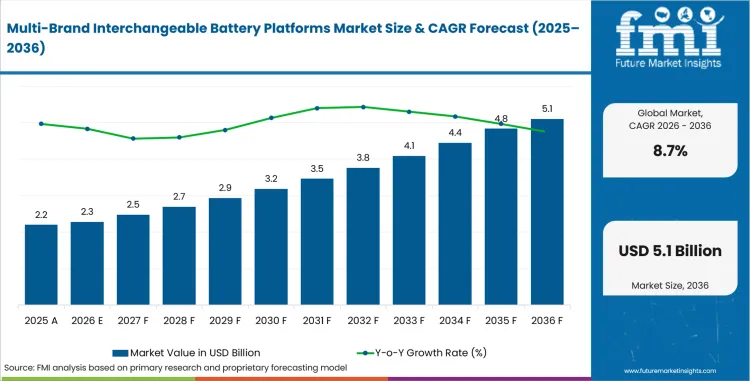
Multi-Brand Interchangeable Battery Platforms Market Overview: Size and Forecast
- 2026 Market Size: USD 2.22 billion
- 2036 Market Size: USD 5.13 billion
- Forecast CAGR: 8.7% from 2026 to 2036
- Leading Alliance Type: CAS
- CAS Share in 2026: 34.0%
- Leading Revenue Type: Cordless Tools
- Cordless Tools Share in 2026: 64.0%
- Fastest-growing Country: India
- India CAGR: 10.1% by 2036
The multi-brand interchangeable battery platforms market is expected to expand through 2036, supported by shared 18V packs, specialist trade-tool access, and buyers trying to reduce duplicate chargers.
- Demand and Growth Drivers
- Demand is expected to rise as users expand their tool collections after investing in an initial compatible battery and charger system.
- Adoption is being driven by the convenience of using a single battery platform across multiple tools, reducing ownership complexity.
- Sales growth is supported by professional users seeking to standardize battery systems, lowering downtime and simplifying jobsite operations.
- Lower overall kit costs are encouraging purchases among price-sensitive buyers, particularly in emerging markets.
- Dealer-supported service networks are improving buyer confidence and supporting stronger adoption rates.
- Growing availability of compatible tools from multiple brands is increasing platform attractiveness and driving repeat purchases.
- Product and Segment View
- CAS is projected to lead the Alliance Type segment with 34.0% share in 2026 as specialist brands widen tool compatibility.
- Cordless Tools are expected to lead the Revenue Type segment with 64.0% share in 2026 since users enter platforms through tool purchases.
- Professional Trades are projected to lead the User Class segment with 58.0% share in 2026 with contractors valuing shared batteries on jobsites.
- The 18V class is expected to lead the Voltage Class segment with 76.0% share in 2026 given its fit across drilling, cutting, and garden tools.
- Offline Dealers are projected to lead the Sales Channel segment with 54.0% share in 2026 as buyers compare fit and warranty support.
- Geography and Competitive Outlook
- China is forecast to grow at 9.2% CAGR through 2036 as manufacturing depth supports compatible tool and pack supply.
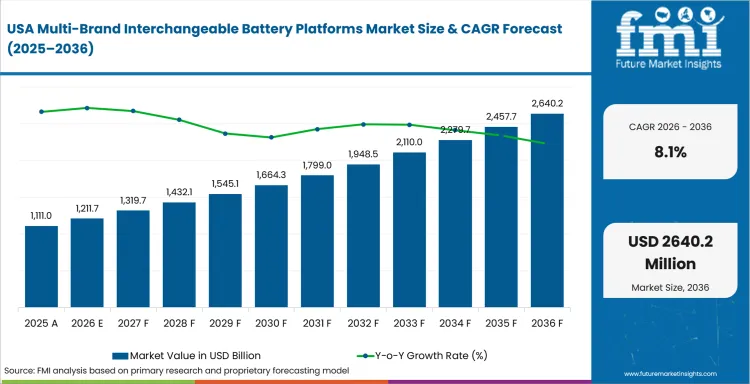
- The United States is projected to record 8.1% CAGR through 2036 as pro channels widen AMPShare and Bosch Professional access.
- Bosch and Metabo shape the core competitive structure through AMPShare, Power For All, and CAS participation.
- Einhell and Gardena compete strongly in consumer-facing platforms where garden and home tools widen battery use.
- Mafell, Rothenberger, and Starmix add specialist trade credibility in woodwork, pipe tools, and dust extraction.
- Analyst Opinion
- Nikhil Kaitwade, Principal Consultant at Future Market Insights, says, “Battery platforms have become a system decision before they are a tool decision. Buyers start comparing packs and chargers once they own several cordless products. Suppliers with broad 18V compatibility, clear warranty rules, and dealer training should hold the strongest accounts.”
Battery-platform depth is becoming a commercial filter for cordless power tool buyers because crews want one pack family across drilling and cutting plus cleaning and outdoor maintenance. In August 2025, the U.S. Bureau of Labor Statistics projected 149,400 annual openings for construction laborers and helpers from 2024 to 2034.
That labor churn matters because contractors and dealers need systems that reduce charger clutter and training time. It also reduces replacement-battery confusion across mixed crews. CAS currently reports compatibility with more than 50 brands and more than 500 18V tools. Bosch Professional’s AMPShare system states compatibility with more than 35 brands and more than 350 tools. Mid-size tool makers therefore need to compete on battery access and dealer education. Warranty clarity and cross-category availability now matter as much as motor output.
Which factors support expansion in the multi-brand interchangeable battery platforms market?
Cordless tool-kit revenue and compatible battery-pack replacement support market value across professional and DIY channels.
- Market value is supported by compatible cordless tool-kit revenue before battery-pack replacement adds repeat sales.
- Supplier pricing reflects pack chemistry, charger design, and warranty coverage before licensing services affect margin.
- Revenue improves as users add compatible drills, saws, vacuums, and garden tools after the first battery purchase.
- Dealer confidence rises when brands make battery fit, warranty limits, and charger compatibility easy to compare.
Why is the multi-brand interchangeable battery platforms market growing?
Users avoid duplicate chargers when one 18V pack runs across drills, saws, vacuums, and garden tools.
Professional demand is shifting toward battery pools that reduce jobsite downtime. The USA Census Bureau estimated April 2026 construction spending at USD 2,172.4 billion on a seasonally adjusted annual rate. Shared platforms fit this setting because crews do not want separate chargers for every specialist tool. The consumer side is expanding through garden and household tools that bring non-trade users into shared pack systems. Retailers gain a clearer cross-sell when a user already owns a compatible pack. This pattern links the report to adjacent tool and pack categories such as electric power tools, electric hedge trimmers, and cordless multi rotary tools that depend on battery compatibility and repeat accessory purchases.
How is the multi-brand interchangeable battery platforms market segmented?
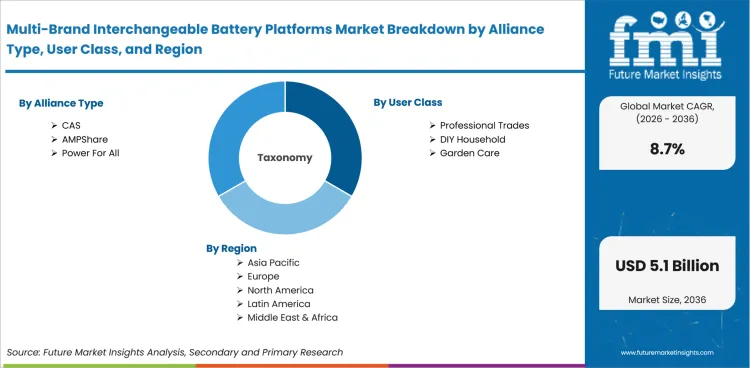
The multi-brand interchangeable battery platforms industry is segmented by alliance type, user class, revenue type, voltage class, sales channel, and region.
- CAS is projected to secure 34.0% share in 2026, led by a broad specialist brand pool and professional tool coverage.
- Professional Trades are anticipated to hold 58.0% share in 2026 because paid users replace packs faster and buy add-on tools more often.
- Cordless Tools are expected to capture 64.0% share in 2026 since tool kits create the first platform purchase.
- The 18V class is forecast to represent 76.0% share in 2026, guided by power-to-weight balance across daily tool applications.
- Offline Dealers are projected to account for 54.0% share in 2026, reflected by buyer need to confirm pack fit and warranty rules.
Why does CAS lead the multi-brand interchangeable battery platforms market?
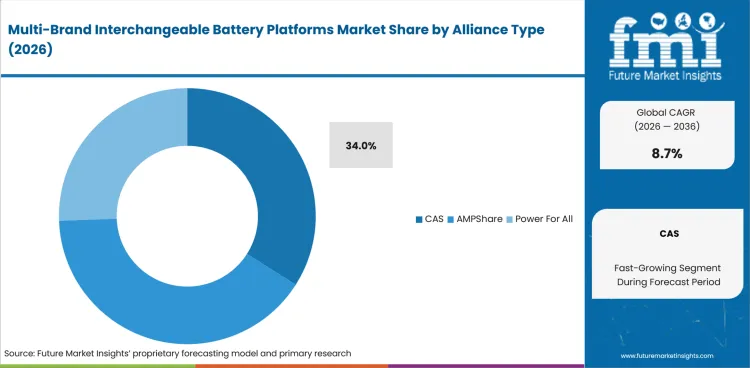
- CAS is projected to account for 34.0% share in 2026, influenced by its over 50-brand pool and specialist trade coverage.
- AMPShare gains use where Bosch Professional and partner brands need a common 18V platform for trade users.
Which user class leads the multi-brand interchangeable battery platforms market?
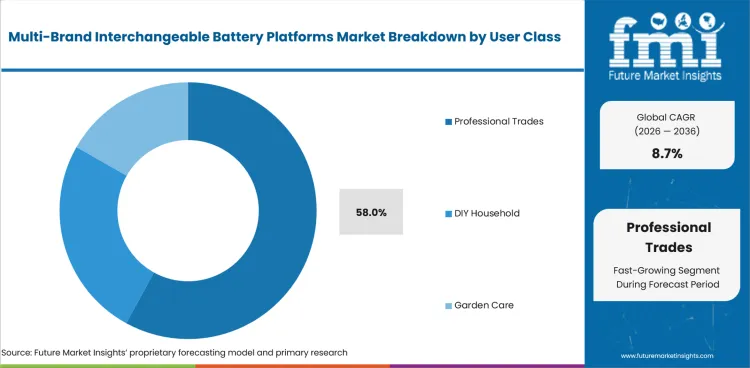
- Professional Trades are expected to hold 58.0% share in 2026 through high use intensity and frequent pack replacement.
- DIY Household users add volume when compatible garden, repair, and cleaning tools share the same pack family.
Which revenue type leads the multi-brand interchangeable battery platforms market?
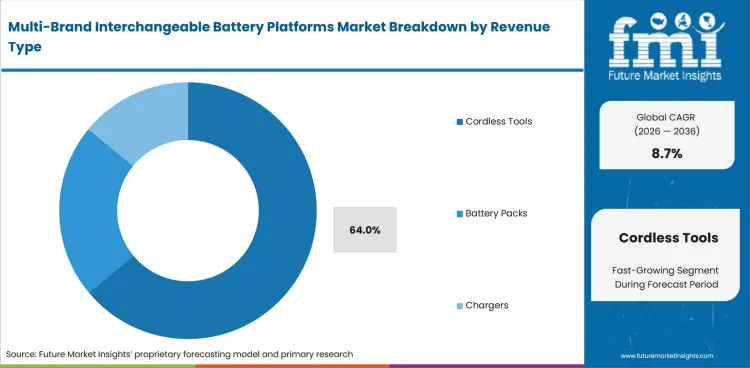
- Cordless Tools are anticipated to hold 64.0% share in 2026 since first-time platform entry usually starts with a tool kit.
- Battery packs carry higher repeat potential as installed tool counts rise across jobsites and household workshops.
Which voltage class leads the multi-brand interchangeable battery platforms market?
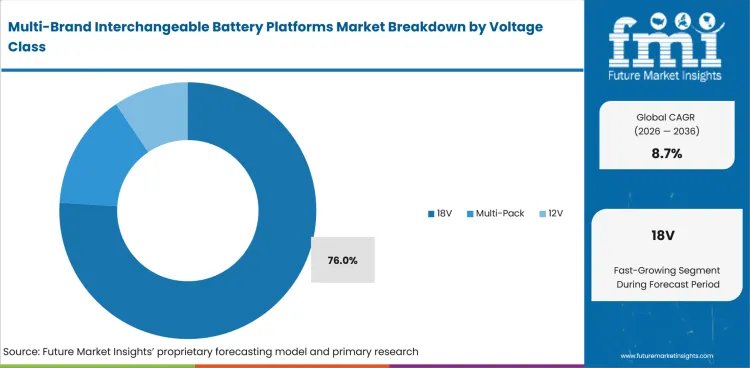
- The 18V class is forecast to secure 76.0% share in 2026, reflected by its fit across handheld professional and garden applications.
- Multi-pack systems remain relevant for high-load tools where a single 18V pack cannot deliver enough runtime.
Which sales channel leads the multi-brand interchangeable battery platforms market?
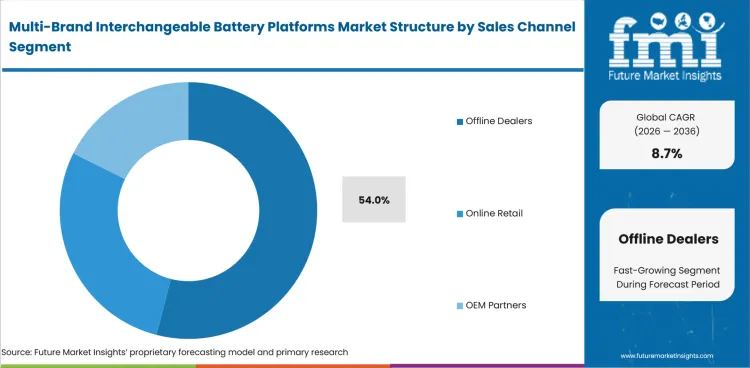
- Offline Dealers are expected to represent 54.0% share in 2026, shaped by fit checks and warranty explanation at point of sale.
- Online retail gains importance for repeat pack purchases once users already understand the platform system.
What are the drivers, restraints, and opportunities in the multi-brand interchangeable battery platforms market?
Battery lock-in and partner-brand access support growth while safety and warranty concerns limit wider platform switching.
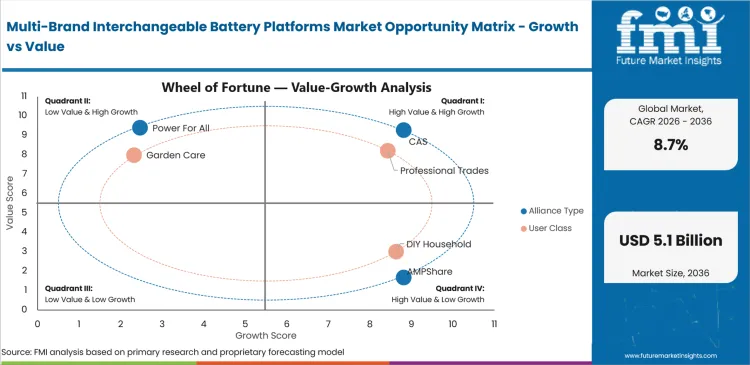
- Driver: Users add compatible tools after the first battery and charger purchase.
- Restraint: Wrong charger advice and counterfeit packs can damage trust in shared platforms.
- Opportunity: Licensing can help mid-size brands enter outdoor power equipment without building a battery system alone.
Multi-Brand Interchangeable Battery Platforms Market Demand Outlook
Demand outlook is moving toward platform systems that prove battery fit before buyers expand into additional tools. Bosch said in May 2025 that its professional pole hedge trimmer and pole pruner extend the 18V System into outdoor work while remaining tied to AMPShare. Mafell said in January 2025 that its K 85-18 uses two 18V lithium-ion packs and can use all CAS batteries. These launches show how brands can add professional and outdoor use cases without requiring users to buy a separate charger family. Pack economics also connect this market to battery supply and testing categories. Growth in lithium-ion battery systems and battery materials will affect pack cost, safety checks, and replacement cycles. Battery testing inspection and certification services are expected to gain relevance as alliances spread across more brands.
Consumer Segmentation and Purchase Behavior Analysis
Professional trades form the main switching pool because crews value fewer chargers and easier pack sharing across jobsites. DIY household users are more price sensitive, although they can become repeat buyers when a drill battery also supports garden or cleaning equipment. Online users tend to buy replacement packs after they understand compatibility, while first-time buyers often need dealer advice. Rental fleets add another purchase group because they favor clear warranty rules and easy battery replacement.
Voice of Customer and Decision-driver Analysis
Purchase decisions are shaped by tool count, pack runtime, dealer trust, and warranty clarity. Contractors compare whether a battery family can support drilling, cutting, dust extraction, lighting, and outdoor work without carrying too many chargers. Household buyers compare kit price and future tool availability. Brands that explain voltage class, charger fit, and warranty boundaries are better positioned than brands that rely only on partner-logo claims.
Which countries are growing fastest in the multi-brand interchangeable battery platforms market?
India 10.1% CAGR, China 9.2% CAGR, Germany 8.9% CAGR, United States 8.1% CAGR, France 7.6% CAGR, United Kingdom 7.4% CAGR, South Korea 7.1% CAGR, and Japan 6.9% CAGR through 2036.
.webp "Top Country Growth Comparison Multi Brand Interchangeable Battery Platforms Market Cagr (2026 2036)")
| Country | CAGR |
|---|---|
| United States | 8.1% |
| United Kingdom | 7.4% |
| Germany | 8.9% |
| France | 7.6% |
| Japan | 6.9% |
| China | 9.2% |
| South Korea | 7.1% |
| India | 10.1% |
Source: Future Market Insights, 2026.
How do country-level CAGRs compare in the multi-brand interchangeable battery platforms market?
India leads country growth while Japan records the most cautious expansion outlook among profiled markets.
- United States is forecast to record 8.1% CAGR by 2036 with pro-channel depth and dealer-led tool education.
- United Kingdom is forecast to record 7.4% CAGR by 2036 with repair and maintenance demand and trade-counter access.
- Germany is forecast to record 8.9% CAGR by 2036 with direct CAS and AMPShare evidence from domestic tool brands.
- France is forecast to record 7.6% CAGR by 2036 with DIY retail scale and professional distributor access.
- Japan is forecast to record 6.9% CAGR by 2036 with home-center discipline and compact tool use.
- China is forecast to record 9.2% CAGR by 2036 with battery manufacturing depth and OEM tool production.
- South Korea is forecast to record 7.1% CAGR by 2036 with online retail strength and manufacturing depth.
- India is forecast to record 10.1% CAGR by 2036 with lower kit-cost needs and expanding contractor demand.
How fast is the multi-brand interchangeable battery platforms market growing in the United States?
A 8.1% CAGR through 2036 reflects pro dealers, rental fleets, and home improvement chains can scale compatible packs through several purchase channels.
Country Market Snapshot Table
| Parameter | Value |
|---|---|
| Market Size in 2025 (Value) | USD 402.6 million |
| Market Size in 2026 (Value) | USD 435.2 million |
| Market Forecast in 2036 (Value) | USD 948.7 million |
| CAGR (2026 to 2036) | 8.1% |
| Years Considered | 2021 to 2036 |
| Base Year | 2025 |
| Forecast Period | 2026 to 2036 |
| Units Considered | Value (USD million) |
| Leading Sub-Region | Great Lakes and national pro-dealer corridors |
United States Multi-Brand Interchangeable Battery Platforms Market Outlook
United States demand is shaped by cordless tool replacement, dealer education, and user interest in reducing duplicated batteries and chargers. Shared platforms are expected to gain more attention where buyers compare tool additions against the packs they already own.
Retailers and distributors can support adoption when compatibility claims are clear and warranty boundaries are easy to explain. Brands with broad 18V coverage should gain stronger repeat orders because users can expand the platform over time.
Key Growth Drivers
- USA Census Bureau reported April 2026 construction spending at USD 2,172.4 billion on a seasonally adjusted annual rate. That workload supports pro-tool replacement and shared battery testing.
- BLS reported 1,368.1 thousand jobs at building material and garden equipment dealers in May 2026. Dealer staffing supports in-store compatibility education.
- Facility maintenance teams are expected to favor shared 18V packs where drills and lights plus vacuums and saws move across repair jobs.
- AMPShare and Bosch Professional access are expected to give specialist partner tools a clearer route through USA pro channels.
Key Restraints
- BEA estimated real GDP growth at a 1.6% annual rate in Q1 2026. Softer macro activity can delay discretionary tool replacement.
- Closed DeWalt and Milwaukee plus Makita ecosystems keep strong loyalty among contractors that already own large pack inventories.
- Counterfeit packs and warranty confusion can make users cautious about cross-brand compatibility claims.
What makes United States unique
The United States is unique because pro dealers, rental fleets, and home improvement chains can scale compatible packs through several purchase channels.
Key Companies
- Robert Bosch Tool Corporation
- Metabo HPT
- Fein Power Tools Inc.
- Makita U.S.A., Inc.
- Hilti North America
- Milwaukee Tool
- Greenworks Commercial
Sales & Marketing Channels
- Professional tool dealers
- Home improvement chains
- Online pro retail
- Rental fleets
- Electrical wholesalers
- Garden equipment dealers
Country Segment Breakdown Table
| Segment | Sub-Segments |
|---|---|
| By Alliance Type | CAS · AMPShare · Power For All · Power X-Change · Other Alliances |
| By User Class | Professional Trades · DIY Household · Garden Care |
| By Revenue Type | Cordless Tools · Battery Packs · Chargers · Licensing Services |
| By Voltage Class | 18V · Multi-Pack · 12V · Other Voltage |
| By Sales Channel | Offline Dealers · Online Retail · OEM Partners · Rental Fleets |
| Key Sub-Regions Covered, Tool and Dealer Clusters | Northeast · Midwest · South Atlantic · Texas · California · Pacific Northwest |
Market Taxonomy and Sub-Regions Covered
Frequently Asked Questions
How fast is United States multi-brand interchangeable battery platforms market growing?
Demand in United States is projected to grow at 8.1% CAGR from 2026 to 2036, supported by compatible cordless tool adoption.
Who leads United States multi-brand interchangeable battery platforms market?
Robert Bosch Tool Corporation, Metabo HPT, Fein Power Tools Inc., Makita U.S.A., Inc. compete through compatible tool portfolios, dealer access, and pack-service support.
What is driving adoption in United States multi-brand interchangeable battery platforms market?
Battery compatibility, lower charger duplication, and dealer-led fit checks are moving users toward shared cordless tool systems.
What is the multi-brand interchangeable battery platforms market outlook in the United Kingdom?
A 7.4% CAGR through 2036 reflects trade counters and online tool stores can move battery-platform decisions into repair and maintenance work.
Country Market Snapshot Table
| Parameter | Value |
|---|---|
| Market Size in 2025 (Value) | USD 128.0 million |
| Market Size in 2026 (Value) | USD 137.5 million |
| Market Forecast in 2036 (Value) | USD 281.0 million |
| CAGR (2026 to 2036) | 7.4% |
| Years Considered | 2021 to 2036 |
| Base Year | 2025 |
| Forecast Period | 2026 to 2036 |
| Units Considered | Value (USD million) |
| Leading Sub-Region | England trade and garden retail corridors |
United Kingdom Multi-Brand Interchangeable Battery Platforms Market Outlook
United Kingdom demand is shaped by cordless tool replacement, dealer education, and user interest in reducing duplicated batteries and chargers. Shared platforms are expected to gain more attention where buyers compare tool additions against the packs they already own.
Retailers and distributors can support adoption when compatibility claims are clear and warranty boundaries are easy to explain. Brands with broad 18V coverage should gain stronger repeat orders because users can expand the platform over time.
Key Growth Drivers
- ONS estimated total construction output grew by 0.4% in Q1 2026. Repair and maintenance activity supports replacement demand for cordless tools.
- Department for Business and Trade reported construction material exports of GBP 8,860.0 million in 2025. Active trade supply supports dealer stocking for tools and packs.
- Trade counters are expected to support shared-platform education because buyers can confirm pack fit before purchase.
- Garden and home repair users are expected to add compatible tools after their first battery kit purchase.
Key Restraints
- The Insolvency Service reported 2,085 company insolvencies in England and Wales in April 2026. Contractor caution can delay discretionary tool upgrades.
- Private label and proprietary systems are expected to remain cheaper at entry level for occasional household users.
- Wrong charger advice can reduce trust when online listings fail to explain alliance compatibility clearly.
What makes United Kingdom unique
The United Kingdom is unique because trade counters and online tool stores can move battery-platform decisions into repair and maintenance work.
Key Companies
- Bosch Professional UK
- Einhell UK
- Metabo UK
- Makita UK
- Toolstream Limited
- Axminster Tools
- Draper Tools
Sales & Marketing Channels
- Trade counters
- DIY retail chains
- Online tool stores
- Garden equipment dealers
- Rental fleets
- Electrical wholesalers
Country Segment Breakdown Table
| Segment | Sub-Segments |
| By Alliance Type | CAS · AMPShare · Power For All · Power X-Change · Other Alliances |
| By User Class | Professional Trades · DIY Household · Garden Care |
| By Revenue Type | Cordless Tools · Battery Packs · Chargers · Licensing Services |
| By Voltage Class | 18V · Multi-Pack · 12V · Other Voltage |
| By Sales Channel | Offline Dealers · Online Retail · OEM Partners · Rental Fleets |
| Key Sub-Regions Covered, Tool and Dealer Clusters | London · Birmingham · Manchester · Leeds · Glasgow · Bristol |
Market Taxonomy and Sub-Regions Covered
Frequently Asked Questions
How fast is United Kingdom multi-brand interchangeable battery platforms market growing?
Demand in United Kingdom is projected to grow at 7.4% CAGR from 2026 to 2036, supported by compatible cordless tool adoption.
Who leads United Kingdom multi-brand interchangeable battery platforms market?
Bosch Professional UK, Einhell UK, Metabo UK, Makita UK compete through compatible tool portfolios, dealer access, and pack-service support.
What is driving adoption in United Kingdom multi-brand interchangeable battery platforms market?
Battery compatibility, lower charger duplication, and dealer-led fit checks are moving users toward shared cordless tool systems.
How is Germany performing in the multi-brand interchangeable battery platforms market?
A 8.9% CAGR through 2036 reflects Bosch, Metabo, Mafell, Rothenberger, and Starmix give the country direct evidence of alliance-led tool compatibility.
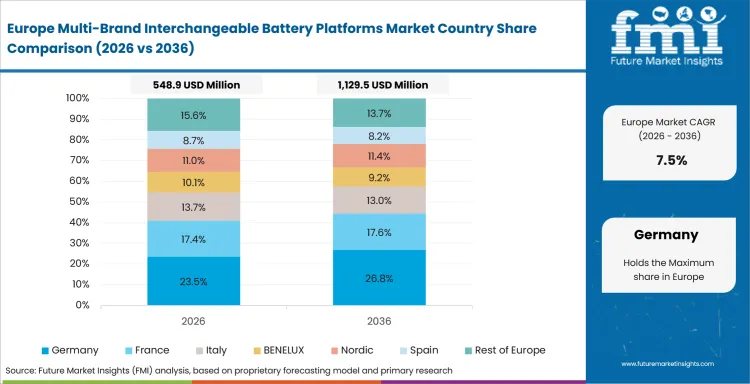
Country Market Snapshot Table
| Parameter | Value |
|---|---|
| Market Size in 2025 (Value) | USD 286.5 million |
| Market Size in 2026 (Value) | USD 312.0 million |
| Market Forecast in 2036 (Value) | USD 730.8 million |
| CAGR (2026 to 2036) | 8.9% |
| Years Considered | 2021 to 2036 |
| Base Year | 2025 |
| Forecast Period | 2026 to 2036 |
| Units Considered | Value (USD million) |
| Leading Sub-Region | Baden-Württemberg and North Rhine-Westphalia tool clusters |
Germany Multi-Brand Interchangeable Battery Platforms Market Outlook
Germany demand is shaped by cordless tool replacement, dealer education, and user interest in reducing duplicated batteries and chargers. Shared platforms are expected to gain more attention where buyers compare tool additions against the packs they already own.
Retailers and distributors can support adoption when compatibility claims are clear and warranty boundaries are easy to explain. Brands with broad 18V coverage should gain stronger repeat orders because users can expand the platform over time.
Key Growth Drivers
- Destatis reported 2024 construction-industry turnover of EUR 190.2 billion. This work base supports professional replacement demand for compatible cordless systems.
- CAS states that more than 50 brands and over 500 tools use its shared battery system. This gives German trade buyers a wider compatibility base.
- CAS presence is expected to support specialist trades because Metabo-compatible packs cover tools from Mafell, Rothenberger, and Starmix.
- German professional distributors are expected to favor platform depth where warranty rules and battery fit can be checked at counter level.
Key Restraints
- Eurostat reported construction production in the euro area fell 1.2% year over year in March 2026. Regional weakness can slow tool replacement budgets.
- Closed professional ecosystems remain a restraint where contractors already own several same-brand packs and chargers.
- Battery safety questions can raise dealer training needs before wider cross-brand selling develops.
What makes Germany unique
Germany is unique because Bosch, Metabo, Mafell, Rothenberger, and Starmix give the country direct evidence of alliance-led tool compatibility.
Key Companies
- Robert Bosch Power Tools GmbH
- Metabowerke GmbH
- Mafell AG
- Eibenstock Elektrowerkzeuge GmbH
- Rothenberger Werkzeuge GmbH
- Starmix/Electrostar GmbH
- Einhell Germany AG
Sales & Marketing Channels
- Specialist tool dealers
- Professional distributors
- Online tool stores
- Garden equipment retail
- Rental fleets
- OEM partner channels
Country Segment Breakdown Table
| Segment | Sub-Segments |
|---|---|
| By Alliance Type | CAS · AMPShare · Power For All · Power X-Change · Other Alliances |
| By User Class | Professional Trades · DIY Household · Garden Care |
| By Revenue Type | Cordless Tools · Battery Packs · Chargers · Licensing Services |
| By Voltage Class | 18V · Multi-Pack · 12V · Other Voltage |
| By Sales Channel | Offline Dealers · Online Retail · OEM Partners · Rental Fleets |
| Key Sub-Regions Covered, Tool and Dealer Clusters | Baden-Württemberg · North Rhine-Westphalia · Bavaria · Hesse · Saxony · Lower Saxony |
Market Taxonomy and Sub-Regions Covered
Frequently Asked Questions
How fast is Germany multi-brand interchangeable battery platforms market growing?
Demand in Germany is projected to grow at 8.9% CAGR from 2026 to 2036, supported by compatible cordless tool adoption.
Who leads Germany multi-brand interchangeable battery platforms market?
Robert Bosch Power Tools GmbH, Metabowerke GmbH, Mafell AG, Eibenstock Elektrowerkzeuge GmbH compete through compatible tool portfolios, dealer access, and pack-service support.
What is driving adoption in Germany multi-brand interchangeable battery platforms market?
Battery compatibility, lower charger duplication, and dealer-led fit checks are moving users toward shared cordless tool systems.
What supports multi-brand interchangeable battery platform demand in France?
A 7.6% CAGR through 2036 reflects DIY chains and professional distributors can position compatible packs across renovation, garden care, and light trade tools.
Country Market Snapshot Table
| Parameter | Value |
|---|---|
| Market Size in 2025 (Value) | USD 112.8 million |
| Market Size in 2026 (Value) | USD 121.4 million |
| Market Forecast in 2036 (Value) | USD 252.7 million |
| CAGR (2026 to 2036) | 7.6% |
| Years Considered | 2021 to 2036 |
| Base Year | 2025 |
| Forecast Period | 2026 to 2036 |
| Units Considered | Value (USD million) |
| Leading Sub-Region | Île-de-France and Auvergne-Rhône-Alpes trade corridors |
France Multi-Brand Interchangeable Battery Platforms Market Outlook
France demand is shaped by cordless tool replacement, dealer education, and user interest in reducing duplicated batteries and chargers. Shared platforms are expected to gain more attention where buyers compare tool additions against the packs they already own.
Retailers and distributors can support adoption when compatibility claims are clear and warranty boundaries are easy to explain. Brands with broad 18V coverage should gain stronger repeat orders because users can expand the platform over time.
Key Growth Drivers
- INSEE reported manufacturing output increased 1.2% in March 2026. Industrial activity supports replacement demand for compatible cordless tools in workshops and maintenance.
- Eurostat reported euro-area construction production increased 0.8% in March 2026 from February 2026. Regional improvement supports French distributors serving trade buyers.
- DIY chains are expected to widen battery-platform displays where garden tools and home repair tools can share the same pack family.
- Online marketplaces are expected to support repeat pack and charger purchases after customers understand the compatible alliance system.
Key Restraints
- Banque de France reported 68,145 corporate bankruptcies over the twelve months to October 2025. Contractor stress can delay professional tool upgrades.
- French buyers can resist alliance switching when proprietary packs already cover drills and garden tools at lower kit prices.
- Warranty uncertainty is expected to slow adoption when cross-brand compatibility is not explained clearly by sellers.
What makes France unique
France is unique because DIY chains and professional distributors can position compatible packs across renovation, garden care, and light trade tools.
Key Companies
- Bosch France
- Einhell France
- Metabo France
- Mafell France
- Rothenberger France
- Groupe Samse
- ManoMano
Sales & Marketing Channels
- DIY chains
- Professional distributors
- Online marketplaces
- Garden retail
- Rental channels
- Electrical wholesalers
Country Segment Breakdown Table
| Segment | Sub-Segments |
|---|---|
| By Alliance Type | CAS · AMPShare · Power For All · Power X-Change · Other Alliances |
| By User Class | Professional Trades · DIY Household · Garden Care |
| By Revenue Type | Cordless Tools · Battery Packs · Chargers · Licensing Services |
| By Voltage Class | 18V · Multi-Pack · 12V · Other Voltage |
| By Sales Channel | Offline Dealers · Online Retail · OEM Partners · Rental Fleets |
| Key Sub-Regions Covered, Tool and Dealer Clusters | Île-de-France · Auvergne-Rhône-Alpes · Nouvelle-Aquitaine · Occitanie · Hauts-de-France · Grand Est |
Market Taxonomy and Sub-Regions Covered
Frequently Asked Questions
How fast is France multi-brand interchangeable battery platforms market growing?
Demand in France is projected to grow at 7.6% CAGR from 2026 to 2036, supported by compatible cordless tool adoption.
Who leads France multi-brand interchangeable battery platforms market?
Bosch France, Einhell France, Metabo France, Mafell France compete through compatible tool portfolios, dealer access, and pack-service support.
What is driving adoption in France multi-brand interchangeable battery platforms market?
Battery compatibility, lower charger duplication, and dealer-led fit checks are moving users toward shared cordless tool systems.
What is the multi-brand interchangeable battery platforms market forecast for Japan?
A 6.9% CAGR through 2036 reflects compact worksites and disciplined home-center retail favor clear pack compatibility and small-format cordless tools.
Country Market Snapshot Table
| Parameter | Value |
|---|---|
| Market Size in 2025 (Value) | USD 103.6 million |
| Market Size in 2026 (Value) | USD 110.7 million |
| Market Forecast in 2036 (Value) | USD 215.8 million |
| CAGR (2026 to 2036) | 6.9% |
| Years Considered | 2021 to 2036 |
| Base Year | 2025 |
| Forecast Period | 2026 to 2036 |
| Units Considered | Value (USD million) |
| Leading Sub-Region | Tokyo and Osaka professional retail corridors |
Japan Multi-Brand Interchangeable Battery Platforms Market Outlook
Japan demand is shaped by cordless tool replacement, dealer education, and user interest in reducing duplicated batteries and chargers. Shared platforms are expected to gain more attention where buyers compare tool additions against the packs they already own.
Retailers and distributors can support adoption when compatibility claims are clear and warranty boundaries are easy to explain. Brands with broad 18V coverage should gain stronger repeat orders because users can expand the platform over time.
Key Growth Drivers
- Cabinet Office reported total machinery orders increased 4.3% in March 2026. Capital-equipment ordering supports demand for professional battery tools and chargers.
- MLIT reported planned enterprise land investment of 3,775.8 billion yen for FY2025. Capital planning supports home-center and jobsite demand signals.
- Compact worksites are expected to favor shared battery systems because users can reduce charger count in small vans and workshops.
- Home-center retailers are expected to support clear platform labeling where buyers compare drills and saws plus garden tools together.
Key Restraints
- Statistics Bureau of Japan reported April 2026 household spending was down 0.5% in real terms. Price caution can delay premium battery-kit purchases.
- Domestic proprietary brands keep strong loyalty among users that already own closed battery packs.
- Premium battery kits can face price resistance among household buyers that use cordless tools only occasionally.
What makes Japan unique
Japan is unique because compact worksites and disciplined home-center retail favor clear pack compatibility and small-format cordless tools.
Key Companies
- Bosch Japan
- Makita Corporation
- HiKOKI
- Kyocera Industrial Tools
- Panasonic Electric Works
- Yamazen Corporation
- MonotaRO Co. Ltd.
Sales & Marketing Channels
- Hardware chains
- Online industrial retail
- Professional distributors
- Home center stores
- Garden retail
- Rental channels
Country Segment Breakdown Table
| Segment | Sub-Segments |
|---|---|
| By Alliance Type | CAS · AMPShare · Power For All · Power X-Change · Other Alliances |
| By User Class | Professional Trades · DIY Household · Garden Care |
| By Revenue Type | Cordless Tools · Battery Packs · Chargers · Licensing Services |
| By Voltage Class | 18V · Multi-Pack · 12V · Other Voltage |
| By Sales Channel | Offline Dealers · Online Retail · OEM Partners · Rental Fleets |
| Key Sub-Regions Covered, Tool and Dealer Clusters | Tokyo · Osaka · Nagoya · Yokohama · Fukuoka · Sapporo |
Market Taxonomy and Sub-Regions Covered
Frequently Asked Questions
How fast is Japan multi-brand interchangeable battery platforms market growing?
Demand in Japan is projected to grow at 6.9% CAGR from 2026 to 2036, supported by compatible cordless tool adoption.
Who leads Japan multi-brand interchangeable battery platforms market?
Bosch Japan, Makita Corporation, HiKOKI, Kyocera Industrial Tools compete through compatible tool portfolios, dealer access, and pack-service support.
What is driving adoption in Japan multi-brand interchangeable battery platforms market?
Battery compatibility, lower charger duplication, and dealer-led fit checks are moving users toward shared cordless tool systems.
How fast is China growing in the multi-brand interchangeable battery platforms market?
A 9.2% CAGR through 2036 reflects battery manufacturing depth and export tool production can support rapid partner-brand platform scaling.
Country Market Snapshot Table
| Parameter | Value |
|---|---|
| Market Size in 2025 (Value) | USD 330.0 million |
| Market Size in 2026 (Value) | USD 360.4 million |
| Market Forecast in 2036 (Value) | USD 868.1 million |
| CAGR (2026 to 2036) | 9.2% |
| Years Considered | 2021 to 2036 |
| Base Year | 2025 |
| Forecast Period | 2026 to 2036 |
| Units Considered | Value (USD million) |
| Leading Sub-Region | Guangdong and Yangtze River Delta manufacturing clusters |
China Multi-Brand Interchangeable Battery Platforms Market Outlook
China demand is shaped by cordless tool replacement, dealer education, and user interest in reducing duplicated batteries and chargers. Shared platforms are expected to gain more attention where buyers compare tool additions against the packs they already own.
Retailers and distributors can support adoption when compatibility claims are clear and warranty boundaries are easy to explain. Brands with broad 18V coverage should gain stronger repeat orders because users can expand the platform over time.
Key Growth Drivers
- National Bureau of Statistics reported lithium-ion battery output increased 40.8% year over year in Q1 2026. Battery supply depth supports compatible pack manufacturing.
- China’s State Council reported online retail sales of physical goods reached 13.09 trillion yuan in 2025. E-commerce supports compatible tool-kit discovery.
- Export-oriented tool makers are expected to use shared packs to serve DIY and professional ranges under several brands.
- OEM partners are expected to widen multi-brand platforms because China already has broad cordless-tool and battery-pack manufacturing capacity.
Key Restraints
- National Bureau of Statistics reported total retail sales grew 0.2% year over year in April 2026. Slower consumption can pressure premium battery-kit pricing.
- Low-grade aftermarket batteries can weaken trust when users cannot distinguish certified packs from unsafe alternatives.
- Export buyers may require stricter safety testing before accepting cross-brand battery systems in regulated markets.
What makes China unique
China is unique because battery manufacturing depth and export tool production can support rapid partner-brand platform scaling.
Key Companies
- Bosch Power Tools China
- Positec Group
- Chervon Holdings
- Greenworks Tools
- Dongcheng Tools
- Worx China
- Jiangsu Jinding Electric Tools
Sales & Marketing Channels
- Online marketplaces
- OEM partners
- Professional tool dealers
- Industrial distributors
- Garden retail
- Export channels
Country Segment Breakdown Table
| Segment | Sub-Segments |
|---|---|
| By Alliance Type | CAS · AMPShare · Power For All · Power X-Change · Other Alliances |
| By User Class | Professional Trades · DIY Household · Garden Care |
| By Revenue Type | Cordless Tools · Battery Packs · Chargers · Licensing Services |
| By Voltage Class | 18V · Multi-Pack · 12V · Other Voltage |
| By Sales Channel | Offline Dealers · Online Retail · OEM Partners · Rental Fleets |
| Key Sub-Regions Covered, Tool and Dealer Clusters | Guangdong · Zhejiang · Jiangsu · Shanghai · Shandong · Chongqing |
Market Taxonomy and Sub-Regions Covered
Frequently Asked Questions
How fast is China multi-brand interchangeable battery platforms market growing?
Demand in China is projected to grow at 9.2% CAGR from 2026 to 2036, supported by compatible cordless tool adoption.
Who leads China multi-brand interchangeable battery platforms market?
Bosch Power Tools China, Positec Group, Chervon Holdings, Greenworks Tools compete through compatible tool portfolios, dealer access, and pack-service support.
What is driving adoption in China multi-brand interchangeable battery platforms market?
Battery compatibility, lower charger duplication, and dealer-led fit checks are moving users toward shared cordless tool systems.
What shapes South Korea demand for multi-brand interchangeable battery platforms?
A 7.1% CAGR through 2036 reflects online retail strength and manufacturing depth support compact cordless tools for apartments, workshops, and maintenance users.
Country Market Snapshot Table
| Parameter | Value |
|---|---|
| Market Size in 2025 (Value) | USD 81.7 million |
| Market Size in 2026 (Value) | USD 87.5 million |
| Market Forecast in 2036 (Value) | USD 173.6 million |
| CAGR (2026 to 2036) | 7.1% |
| Years Considered | 2021 to 2036 |
| Base Year | 2025 |
| Forecast Period | 2026 to 2036 |
| Units Considered | Value (USD million) |
| Leading Sub-Region | Seoul Capital Area and Busan trade corridors |
South Korea Multi-Brand Interchangeable Battery Platforms Market Outlook
South Korea demand is shaped by cordless tool replacement, dealer education, and user interest in reducing duplicated batteries and chargers. Shared platforms are expected to gain more attention where buyers compare tool additions against the packs they already own.
Retailers and distributors can support adoption when compatibility claims are clear and warranty boundaries are easy to explain. Brands with broad 18V coverage should gain stronger repeat orders because users can expand the platform over time.
Key Growth Drivers
- MOTIR reported Korea’s 2025 exports reached USD 709.7 billion. Export manufacturing depth supports cordless tool and component supply chains.
- MAFRA reported agro-industry exports of USD 3.22 billion in 2025. Agricultural equipment exports support wider battery-tool relevance in garden and light machinery channels.
- Online retail is expected to support repeat pack purchases because buyers can search compatible tools after the first kit.
- Apartment maintenance and small-workshop users are expected to favor compact packs that reduce charger and storage clutter.
Key Restraints
- Statistics Korea reported construction completed decreased 14.2% year over year in July 2025. Weak construction activity can slow professional tool upgrades.
- Brand owners may hesitate to join open alliances when proprietary interfaces protect replacement-pack margins.
- Safety documentation can raise launch costs for smaller suppliers selling batteries across more tool brands.
What makes South Korea unique
South Korea is unique because online retail strength and manufacturing depth support compact cordless tools for apartments, workshops, and maintenance users.
Key Companies
- Bosch Korea
- Keyang Electric Machinery
- ES산전
- Hikoki Korea
- Makita Korea
- ToolnShop Korea
- Yujin Robot tool channel partners
Sales & Marketing Channels
- Online marketplaces
- Professional tool dealers
- Home improvement retail
- Industrial distributors
- Rental channels
- Garden equipment stores
Country Segment Breakdown Table
| Segment | Sub-Segments |
|---|---|
| By Alliance Type | CAS · AMPShare · Power For All · Power X-Change · Other Alliances |
| By User Class | Professional Trades · DIY Household · Garden Care |
| By Revenue Type | Cordless Tools · Battery Packs · Chargers · Licensing Services |
| By Voltage Class | 18V · Multi-Pack · 12V · Other Voltage |
| By Sales Channel | Offline Dealers · Online Retail · OEM Partners · Rental Fleets |
| Key Sub-Regions Covered, Tool and Dealer Clusters | Seoul · Gyeonggi · Incheon · Busan · Daegu · Daejeon |
Market Taxonomy and Sub-Regions Covered
Frequently Asked Questions
How fast is South Korea multi-brand interchangeable battery platforms market growing?
Demand in South Korea is projected to grow at 7.1% CAGR from 2026 to 2036, supported by compatible cordless tool adoption.
Who leads South Korea multi-brand interchangeable battery platforms market?
Bosch Korea, Keyang Electric Machinery, ES산전, Hikoki Korea compete through compatible tool portfolios, dealer access, and pack-service support.
What is driving adoption in South Korea multi-brand interchangeable battery platforms market?
Battery compatibility, lower charger duplication, and dealer-led fit checks are moving users toward shared cordless tool systems.
How is India positioned in the multi-brand interchangeable battery platforms market?
A 10.1% CAGR through 2036 reflects price-sensitive buyers can use shared batteries to lower charger duplication across drills, cutters, and garden tools.
Country Market Snapshot Table
| Parameter | Value |
|---|---|
| Market Size in 2025 (Value) | USD 63.4 million |
| Market Size in 2026 (Value) | USD 69.8 million |
| Market Forecast in 2036 (Value) | USD 182.6 million |
| CAGR (2026 to 2036) | 10.1% |
| Years Considered | 2021 to 2036 |
| Base Year | 2025 |
| Forecast Period | 2026 to 2036 |
| Units Considered | Value (USD million) |
| Leading Sub-Region | Delhi NCR and western industrial corridors |
India Multi-Brand Interchangeable Battery Platforms Market Outlook
India demand is shaped by cordless tool replacement, dealer education, and user interest in reducing duplicated batteries and chargers. Shared platforms are expected to gain more attention where buyers compare tool additions against the packs they already own.
Retailers and distributors can support adoption when compatibility claims are clear and warranty boundaries are easy to explain. Brands with broad 18V coverage should gain stronger repeat orders because users can expand the platform over time.
Key Growth Drivers
- PIB reported India’s construction sector grew 9.4% in FY 2024-25. This activity supports contractor demand for cordless tools and compatible packs.
- MoSPI reported India’s IIP grew 4.1% year over year in March 2026 with manufacturing up 4.3%. Factory activity supports tool and component channels.
- Hardware dealers are expected to position shared batteries as a way to reduce kit cost for price-sensitive trade buyers.
- Online marketplaces are expected to widen trial for compatible packs in large cities where small contractors compare tool bundles.
Key Restraints
- Ministry of Heavy Industries reported 40 GWh of PLI ACC capacity had been awarded by February 2026. Slow domestic cell ramp-up can limit local pack supply.
- Low-cost imports and counterfeit batteries can pressure certified platform suppliers on price.
- After-sales service gaps can slow adoption outside major cities when users need warranty support for packs and chargers.
What makes India unique
India is unique because price-sensitive buyers can use shared batteries to lower charger duplication across drills, cutters, and garden tools.
Key Companies
- Bosch Power Tools India
- Makita Power Tools India
- Stanley Black & Decker India
- KPT Industries
- Tata Agrico
- Ingco India
- Taparia Tools channel partners
Sales & Marketing Channels
- Hardware dealers
- Electrical wholesalers
- Online marketplaces
- Industrial distributors
- Rental fleets
- Garden equipment stores
Country Segment Breakdown Table
| Segment | Sub-Segments |
|---|---|
| By Alliance Type | CAS · AMPShare · Power For All · Power X-Change · Other Alliances |
| By User Class | Professional Trades · DIY Household · Garden Care |
| By Revenue Type | Cordless Tools · Battery Packs · Chargers · Licensing Services |
| By Voltage Class | 18V · Multi-Pack · 12V · Other Voltage |
| By Sales Channel | Offline Dealers · Online Retail · OEM Partners · Rental Fleets |
| Key Sub-Regions Covered, Tool and Dealer Clusters | Delhi NCR · Mumbai · Pune · Bengaluru · Chennai · Hyderabad |
Market Taxonomy and Sub-Regions Covered
Frequently Asked Questions
How fast is India multi-brand interchangeable battery platforms market growing?
Demand in India is projected to grow at 10.1% CAGR from 2026 to 2036, supported by compatible cordless tool adoption.
Who leads India multi-brand interchangeable battery platforms market?
Bosch Power Tools India, Makita Power Tools India, Stanley Black & Decker India, KPT Industries compete through compatible tool portfolios, dealer access, and pack-service support.
What is driving adoption in India multi-brand interchangeable battery platforms market?
Battery compatibility, lower charger duplication, and dealer-led fit checks are moving users toward shared cordless tool systems.
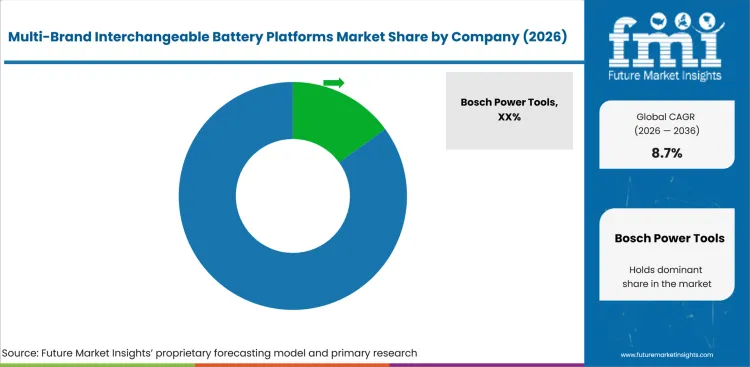
Who are the leading companies in the multi-brand interchangeable battery platforms market?
Bosch, Metabo, Einhell, Gardena, Mafell, Rothenberger, and Starmix are among the leading companies in the market.
- Established power tool brands hold an advantage through existing dealer access and broad 18V tool families.
- Specialist brands gain reach by joining CAS or AMPShare instead of building a closed battery system alone.
- Garden and household brands expand compatible battery use beyond drills into mowing, trimming, cleaning, and coating work.
- Retail-ready compatibility labels support trial by making voltage class and charger fit easier to compare.
Power tool groups in the market compete by combining battery-pack depth with dealer explanation. Bosch and Metabo shape the strongest alliance structures through AMPShare, Power For All, and CAS. Einhell and Gardena compete across consumer-facing platforms where garden and household tools widen pack use. Mafell, Rothenberger, and Starmix add specialist trade credibility in woodworking, pipe tools, and dust extraction.
Manufacturing scale has become a competitive separator as shared platforms move beyond small tool families. Brands with clear compatibility rules can raise repeat purchases after the first kit. Smaller and regional players can win through local dealer training and specialist tool depth. Suppliers relying only on low-cost kits are expected to face weaker acceptance where users need certified packs and dependable warranty coverage.
How do top multi-brand interchangeable battery platform companies compare?
Bosch and Metabo score strongest on platform depth while Einhell and Gardena lead consumer-facing compatibility breadth.
| Company | Relevance to Market Title | Alliance Exposure | Platform Portfolio | Channel Control | Channel Reach | Geographic Footprint |
|---|---|---|---|---|---|---|
| Bosch Power Tools | Very High | Very Strong | Very Strong | Very Strong | Very Strong | Global |
| Metabo | Very High | Very Strong | Very Strong | Strong | Strong | Europe and Global |
| Einhell | High | Strong | Strong | Strong | Strong | Global |
| Gardena | High | Strong | Strong | Strong | Strong | Europe and Global |
| Mafell | High | Very Strong | Moderate | Strong | Moderate | Europe |
| Rothenberger | High | Very Strong | Moderate | Strong | Strong | Global |
| Starmix | High | Very Strong | Moderate | Moderate | Moderate | Europe |
| Wagner | Moderate to High | Strong | Moderate | Moderate | Strong | Europe and Americas |
| Gloria | Moderate | Strong | Moderate | Moderate | Moderate | Europe |
| Brennenstuhl | Moderate | Strong | Moderate | Strong | Strong | Europe |
Source: Future Market Insights, 2026.
Who are the key players in the multi-brand interchangeable battery platforms market?
Bosch, Metabo, Einhell, Gardena, Mafell, Rothenberger, and Starmix are listed with other compatible platform suppliers.
Key global companies leading the multi-brand interchangeable battery platforms market include:
- Bosch Power Tools
- Metabo
- Einhell
- Gardena
- Mafell
- Rothenberger
- Starmix
- Wagner
- Gloria
- Brennenstuhl
Key Developments in Multi-Brand Interchangeable Battery Platforms Market
- In May 2025, Bosch Professional introduced its GHE 18V-50 TP pole hedge trimmer and GKE 18V-25 TP pole pruner. The tools extend the Professional 18V System into outdoor work and remain tied to AMPShare compatibility.
- In January 2025, Mafell presented the K 85-18 cordless portable circular saw. The tool uses two 18V lithium-ion packs and can use all CAS batteries.
Key Players in the Multi-Brand Interchangeable Battery Platforms Market
Core Alliance Owners and Sponsors
- Bosch Power Tools
- Metabo
- Einhell
- Gardena
Specialist Professional Tool Brands
- Mafell
- Rothenberger
- Starmix
- Eibenstock
- Brennenstuhl
Consumer and Garden Platform Brands
- Wagner
- Gloria
- Flymo
- Steinel
- Rapid
Multi-Brand Interchangeable Battery Platforms Market - Report Scope
| Item | Value |
|---|---|
| Market size by 2036 | USD 5.13 billion |
| Growth rate | 8.7% CAGR from 2026 to 2036 |
| Forecast period | 2026 to 2036 |
| Base year value (2025) | USD 2.05 billion |
| By alliance type | CAS, AMPShare, Power For All, Power X-Change, other alliances |
| By user class | Professional trades, DIY household, garden care |
| By revenue type | Cordless tools, battery packs, chargers, licensing services |
| By voltage class | 18V, multi-pack, 12V, other voltage |
| By sales channel | Offline dealers, online retail, OEM partners, rental fleets |
| Regions covered | North America, Latin America, Europe, East Asia, South Asia and Pacific, Middle East and Africa |
| Countries covered | United States, United Kingdom, Germany, France, Japan, China, South Korea, India |
| Key companies profiled | Bosch, Metabo, Einhell, Gardena, Mafell, Rothenberger, Starmix, Wagner, Gloria, Brennenstuhl |
| Approach | Bottom-up platform-boundary approach using compatible tool counts, channel presence, pack replacement rates, revenue type, and country-level adoption |
Source: Future Market Insights, 2026.
Multi-Brand Interchangeable Battery Platforms Market - Scope & Definition
| Attribute | Detail |
|---|---|
| Market Definition | Cordless tool systems in which one battery pack and charger work across products from two or more brands, including compatible tools, battery packs, chargers, adapter-free interfaces, and licensing support tied to shared battery platforms. |
| Functions Covered | Battery sharing, charger reduction, cordless power delivery, platform lock-in, tool-family expansion, and cross-brand compatibility. |
| Applications Covered | Professional construction, facility maintenance, woodworking, pipe work, garden care, DIY repair, mobile cleaning, and outdoor equipment. |
| End-Use Industries | Construction, professional trades, facility management, woodworking, plumbing, garden equipment, consumer DIY, rental fleets, and retail distribution. |
| Voltage Classes Covered | 18V, multi-pack, 12V, and other voltage classes used in handheld and jobsite tools. |
| Inclusions | Commercially sold multi-brand compatible cordless tools, battery packs, chargers, licensing services, and platform-linked revenue across alliance types and sales channels. |
| Exclusions | Single-brand closed battery systems, aftermarket adapter hacks, counterfeit packs, EV traction batteries, consumer power banks, medical power tools, and stationary industrial batteries. |
Multi-Brand Interchangeable Battery Platforms Market - Research Methodology
| Method | Description |
|---|---|
| Primary Research | FMI analyst interviews with brand managers, distributor heads, dealer owners, professional tool users, rental fleet buyers, and garden equipment sellers across key markets. |
| Desk Research | Review of official alliance pages, company product data, government construction statistics, retail channel indicators, battery documentation, and safety-related product information. |
| Market Sizing & Forecasting | Bottom-up platform-boundary approach using compatible tool counts, estimated platform penetration, average kit value, pack replacement rates, channel maturity, and country-level adoption trends. |
| Evidence Review | Review using construction activity, industrial output, dealer channel behavior, battery manufacturing signals, company product launches, and platform compatibility evidence. |
Multi-Brand Interchangeable Battery Platforms Market Breakdown by Alliance Type, User Class, Revenue Type, Voltage Class, Sales Channel, and Region
Multi-Brand Interchangeable Battery Platforms Market Segmented by Alliance Type
- CAS
- AMPShare
- Power For All
- Power X-Change
- Other Alliances
Multi-Brand Interchangeable Battery Platforms Market Segmented by User Class
- Professional Trades
- DIY Household
- Garden Care
Multi-Brand Interchangeable Battery Platforms Market Segmented by Revenue Type
- Cordless Tools
- Battery Packs
- Chargers
- Licensing Services
Multi-Brand Interchangeable Battery Platforms Market Segmented by Voltage Class
- 18V
- Multi-Pack
- 12V
- Other Voltage
Multi-Brand Interchangeable Battery Platforms Market Segmented by Sales Channel
- Offline Dealers
- Online Retail
- OEM Partners
- Rental Fleets
Multi-Brand Interchangeable Battery Platforms Market by Region
- North America
- Latin America
- Europe
- East Asia
- South Asia and Pacific
- Middle East and Africa
Research Sources and Bibliography
- Brennenstuhl. (2024, March 18). Brennenstuhl joins the AMPShare battery alliance.
- Bosch Professional. (2025, May 6). Bosch Professional extends the 18V system with pole hedge trimmer and pole pruner.
- Cabinet Office of Japan. (2026, May 22). Machinery orders in March 2026 and forecast for April to June 2026.
- Department for Business and Trade. (2026, May 6). Construction building materials: Commentary, April 2026.
- Destatis. (2025, March 5). Local unit, employed persons and turnover in the construction industry.
- Destatis. (2026, May 8). Production in March 2026: -0.7% on the previous month.
- Eurostat. (2026, May 21). Production in construction up by 0.8% in the euro area and by 1.2% in the EU.
- INSEE. (2026, April 3). In February 2026, manufacturing output was stable.
- INSEE. (2026, May 6). In March 2026, manufacturing output increased by 1.2%.
- Mafell AG. (2025, January). K 85-18 cordless portable circular saw product release.
- Ministry of Agriculture, Food and Rural Affairs. (2026, January 20). Exports of K-Food Plus reached USD 13.6 billion in 2025.
- Ministry of Land, Infrastructure, Transport and Tourism. (2025, September). Survey on planned land transactions in FY2025.
- Ministry of Heavy Industries. (2025, February 18). Programme agreement signed with Reliance New Energy Battery Limited for 10 GWh capacity under the PLI ACC scheme.
- Ministry of Statistics and Programme Implementation. (2026, April 28). Quick estimate of Index of Industrial Production for March 2026.
- National Bureau of Statistics of China. (2026, April 16). National economy got off to a good start in the first quarter.
- National Bureau of Statistics of China. (2026, May 18). Total retail sales of consumer goods in April 2026.
- Office for National Statistics. (2026, May 14). Construction output in Great Britain: March 2026.
- The Insolvency Service. (2026, May 19). Commentary - Company insolvency statistics April 2026.
- Press Information Bureau. (2025, May 30). Provisional estimates of annual gross domestic product for FY 2024-25.
- Statistics Korea. (2025, August 29). Industrial activity trends in July 2025.
- USA Bureau of Economic Analysis. (2026, May 28). GDP, second estimate, and corporate profits, first quarter 2026.
- USA Bureau of Labor Statistics. (2026, June 5). Employment Situation, May 2026.
- USA Census Bureau. (2026, June 1). Monthly construction spending, April 2026.
- The State Council of the People’s Republic of China. (2026, January 19). China’s retail sales up 3.7 pct in 2025.
- Statistics Bureau of Japan. (2026, June 5). Summary of the latest month on family income and expenditure survey.
- Cordless Alliance System. (2026). CAS: The multi-brand battery system.
- Banque de France. (2025, December 5). Business failures - France - 2025-10.
This Report Answers
- Market size estimates for 2026 and forecasts through 2036 for the multi-brand interchangeable battery platforms market.
- Insights across regional and country-level markets for shared cordless tool battery platforms.
- Analysis of demand drivers, platform adoption patterns, voltage-class preferences, and tool purchase behavior.
- Evaluation of alliance types and sales channels including offline dealers, online retail, OEM partners, and rental fleets.
- Assessment of compatibility rules, battery safety concerns, warranty controls, and dealer education impacts on market development.
- Identification of growth opportunities across alliance types, user classes, revenue types, and voltage classes.
- Evaluation of supply-chain dynamics, product development trends, and distribution channel structures.
- Country-level growth analysis covering the United States, United Kingdom, Germany, France, Japan, China, South Korea, and India.
- Assessment of the competitive landscape including leading platform sponsors and specialist tool brands.
- Analysis of user preferences, platform penetration trends, and future growth opportunities.
- Regional outlooks across North America, Europe, Asia Pacific, and South Asia.
- Delivery of market data, forecasts, and supporting analysis in PDF and Excel formats.
Frequently Asked Questions
What is the multi-brand interchangeable battery platforms market size in 2026?
The multi-brand interchangeable battery platforms market size is anticipated to reach USD 2.22 billion in 2026.
What is the multi-brand interchangeable battery platforms market forecast for 2036?
The industry revenue is predicted to reach USD 5.13 billion by 2036 as compatible 18V systems expand.
What is the multi-brand interchangeable battery platforms market CAGR?
The sector is projected to expand at 8.7% CAGR from 2026 to 2036.
What segment leads the multi-brand interchangeable battery platforms market?
Cordless Tools are likely to capture 64.0% share in 2026 because first platform entry usually starts with a tool kit.
What country grows fastest in the multi-brand interchangeable battery platforms market?
India is set to record 10.1% CAGR by 2036, driven by contractor demand and lower charger-duplication needs.
Preview the report firsthand - request a free sample
Get SampleGet the brochure for pricing and purchase details.
Get PDFTable of Content
- Executive Summary
- Global Market Outlook
- Demand to side Trends
- Supply to side Trends
- Technology Roadmap Analysis
- Analysis and Recommendations
- Market Overview
- Market Coverage / Taxonomy
- Market Definition / Scope / Limitations
- Research Methodology
- Chapter Orientation
- Analytical Lens and Working Hypotheses
- Market Structure, Signals, and Trend Drivers
- Benchmarking and Cross-market Comparability
- Market Sizing, Forecasting, and Opportunity Mapping
- Research Design and Evidence Framework
- Desk Research Programme (Secondary Evidence)
- Company Annual and Sustainability Reports
- Peer-reviewed Journals and Academic Literature
- Corporate Websites, Product Literature, and Technical Notes
- Earnings Decks and Investor Briefings
- Statutory Filings and Regulatory Disclosures
- Technical White Papers and Standards Notes
- Trade Journals, Industry Magazines, and Analyst Briefs
- Conference Proceedings, Webinars, and Seminar Materials
- Government Statistics Portals and Public Data Releases
- Press Releases and Reputable Media Coverage
- Specialist Newsletters and Curated Briefings
- Sector Databases and Reference Repositories
- FMI Internal Proprietary Databases and Historical Market Datasets
- Subscription Datasets and Paid Sources
- Social Channels, Communities, and Digital Listening Inputs
- Additional Desk Sources
- Expert Input and Fieldwork (Primary Evidence)
- Primary Modes
- Qualitative Interviews and Expert Elicitation
- Quantitative Surveys and Structured Data Capture
- Blended Approach
- Why Primary Evidence is Used
- Field Techniques
- Interviews
- Surveys
- Focus Groups
- Observational and In-context Research
- Social and Community Interactions
- Stakeholder Universe Engaged
- C-suite Leaders
- Board Members
- Presidents and Vice Presidents
- R&D and Innovation Heads
- Technical Specialists
- Domain Subject-matter Experts
- Scientists
- Physicians and Other Healthcare Professionals
- Governance, Ethics, and Data Stewardship
- Research Ethics
- Data Integrity and Handling
- Primary Modes
- Tooling, Models, and Reference Databases
- Desk Research Programme (Secondary Evidence)
- Data Engineering and Model Build
- Data Acquisition and Ingestion
- Cleaning, Normalisation, and Verification
- Synthesis, Triangulation, and Analysis
- Quality Assurance and Audit Trail
- Market Background
- Market Dynamics
- Drivers
- Restraints
- Opportunity
- Trends
- Scenario Forecast
- Demand in Optimistic Scenario
- Demand in Likely Scenario
- Demand in Conservative Scenario
- Opportunity Map Analysis
- Product Life Cycle Analysis
- Supply Chain Analysis
- Investment Feasibility Matrix
- Value Chain Analysis
- PESTLE and Porter’s Analysis
- Regulatory Landscape
- Regional Parent Market Outlook
- Production and Consumption Statistics
- Import and Export Statistics
- Market Dynamics
- Global Market Analysis 2021 to 2025 and Forecast, 2026 to 2036
- Historical Market Size Value (USD Million) Analysis, 2021 to 2025
- Current and Future Market Size Value (USD Million) Projections, 2026 to 2036
- Y-o-Y Growth Trend Analysis
- Absolute $ Opportunity Analysis
- Global Market Pricing Analysis 2021 to 2025 and Forecast 2026 to 2036
- Global Market Analysis 2021 to 2025 and Forecast 2026 to 2036, By Alliance Type
- Introduction / Key Findings
- Historical Market Size Value (USD Million) Analysis By Alliance Type , 2021 to 2025
- Current and Future Market Size Value (USD Million) Analysis and Forecast By Alliance Type , 2026 to 2036
- CAS
- AMPShare
- Power For All, Power X-Change, Other Alliances
- CAS
- Y-o-Y Growth Trend Analysis By Alliance Type , 2021 to 2025
- Absolute $ Opportunity Analysis By Alliance Type , 2026 to 2036
- Global Market Analysis 2021 to 2025 and Forecast 2026 to 2036, By User Class
- Introduction / Key Findings
- Historical Market Size Value (USD Million) Analysis By User Class, 2021 to 2025
- Current and Future Market Size Value (USD Million) Analysis and Forecast By User Class, 2026 to 2036
- Professional Trades
- DIY Household
- Garden Care
- Professional Trades
- Y-o-Y Growth Trend Analysis By User Class, 2021 to 2025
- Absolute $ Opportunity Analysis By User Class, 2026 to 2036
- Global Market Analysis 2021 to 2025 and Forecast 2026 to 2036, By Revenue Type
- Introduction / Key Findings
- Historical Market Size Value (USD Million) Analysis By Revenue Type, 2021 to 2025
- Current and Future Market Size Value (USD Million) Analysis and Forecast By Revenue Type, 2026 to 2036
- Cordless Tools
- Battery Packs
- Chargers, Licensing Services
- Cordless Tools
- Y-o-Y Growth Trend Analysis By Revenue Type, 2021 to 2025
- Absolute $ Opportunity Analysis By Revenue Type, 2026 to 2036
- Global Market Analysis 2021 to 2025 and Forecast 2026 to 2036, By Voltage Class
- Introduction / Key Findings
- Historical Market Size Value (USD Million) Analysis By Voltage Class, 2021 to 2025
- Current and Future Market Size Value (USD Million) Analysis and Forecast By Voltage Class, 2026 to 2036
- 18V
- Multi-Pack
- 12V, Other Voltage
- 18V
- Y-o-Y Growth Trend Analysis By Voltage Class, 2021 to 2025
- Absolute $ Opportunity Analysis By Voltage Class, 2026 to 2036
- Global Market Analysis 2021 to 2025 and Forecast 2026 to 2036, By Sales Channel
- Introduction / Key Findings
- Historical Market Size Value (USD Million) Analysis By Sales Channel, 2021 to 2025
- Current and Future Market Size Value (USD Million) Analysis and Forecast By Sales Channel, 2026 to 2036
- Offline Dealers
- Online Retail
- OEM Partners, Rental Fleets
- Offline Dealers
- Y-o-Y Growth Trend Analysis By Sales Channel, 2021 to 2025
- Absolute $ Opportunity Analysis By Sales Channel, 2026 to 2036
- Global Market Analysis 2021 to 2025 and Forecast 2026 to 2036, By Region
- Introduction
- Historical Market Size Value (USD Million) Analysis By Region, 2021 to 2025
- Current Market Size Value (USD Million) Analysis and Forecast By Region, 2026 to 2036
- North America
- Latin America
- Western Europe
- Eastern Europe
- East Asia
- South Asia and Pacific
- Middle East & Africa
- Market Attractiveness Analysis By Region
- North America Market Analysis 2021 to 2025 and Forecast 2026 to 2036, By Country
- Historical Market Size Value (USD Million) Trend Analysis By Market Taxonomy, 2021 to 2025
- Market Size Value (USD Million) Forecast By Market Taxonomy, 2026 to 2036
- By Country
- USA
- Canada
- Mexico
- By Alliance Type
- By User Class
- By Revenue Type
- By Voltage Class
- By Sales Channel
- By Country
- Market Attractiveness Analysis
- By Country
- By Alliance Type
- By User Class
- By Revenue Type
- By Voltage Class
- By Sales Channel
- Key Takeaways
- Latin America Market Analysis 2021 to 2025 and Forecast 2026 to 2036, By Country
- Historical Market Size Value (USD Million) Trend Analysis By Market Taxonomy, 2021 to 2025
- Market Size Value (USD Million) Forecast By Market Taxonomy, 2026 to 2036
- By Country
- Brazil
- Chile
- Rest of Latin America
- By Alliance Type
- By User Class
- By Revenue Type
- By Voltage Class
- By Sales Channel
- By Country
- Market Attractiveness Analysis
- By Country
- By Alliance Type
- By User Class
- By Revenue Type
- By Voltage Class
- By Sales Channel
- Key Takeaways
- Western Europe Market Analysis 2021 to 2025 and Forecast 2026 to 2036, By Country
- Historical Market Size Value (USD Million) Trend Analysis By Market Taxonomy, 2021 to 2025
- Market Size Value (USD Million) Forecast By Market Taxonomy, 2026 to 2036
- By Country
- Germany
- UK
- Italy
- Spain
- France
- Nordic
- BENELUX
- Rest of Western Europe
- By Alliance Type
- By User Class
- By Revenue Type
- By Voltage Class
- By Sales Channel
- By Country
- Market Attractiveness Analysis
- By Country
- By Alliance Type
- By User Class
- By Revenue Type
- By Voltage Class
- By Sales Channel
- Key Takeaways
- Eastern Europe Market Analysis 2021 to 2025 and Forecast 2026 to 2036, By Country
- Historical Market Size Value (USD Million) Trend Analysis By Market Taxonomy, 2021 to 2025
- Market Size Value (USD Million) Forecast By Market Taxonomy, 2026 to 2036
- By Country
- Russia
- Poland
- Hungary
- Balkan & Baltic
- Rest of Eastern Europe
- By Alliance Type
- By User Class
- By Revenue Type
- By Voltage Class
- By Sales Channel
- By Country
- Market Attractiveness Analysis
- By Country
- By Alliance Type
- By User Class
- By Revenue Type
- By Voltage Class
- By Sales Channel
- Key Takeaways
- East Asia Market Analysis 2021 to 2025 and Forecast 2026 to 2036, By Country
- Historical Market Size Value (USD Million) Trend Analysis By Market Taxonomy, 2021 to 2025
- Market Size Value (USD Million) Forecast By Market Taxonomy, 2026 to 2036
- By Country
- China
- Japan
- South Korea
- By Alliance Type
- By User Class
- By Revenue Type
- By Voltage Class
- By Sales Channel
- By Country
- Market Attractiveness Analysis
- By Country
- By Alliance Type
- By User Class
- By Revenue Type
- By Voltage Class
- By Sales Channel
- Key Takeaways
- South Asia and Pacific Market Analysis 2021 to 2025 and Forecast 2026 to 2036, By Country
- Historical Market Size Value (USD Million) Trend Analysis By Market Taxonomy, 2021 to 2025
- Market Size Value (USD Million) Forecast By Market Taxonomy, 2026 to 2036
- By Country
- India
- ASEAN
- Australia & New Zealand
- Rest of South Asia and Pacific
- By Alliance Type
- By User Class
- By Revenue Type
- By Voltage Class
- By Sales Channel
- By Country
- Market Attractiveness Analysis
- By Country
- By Alliance Type
- By User Class
- By Revenue Type
- By Voltage Class
- By Sales Channel
- Key Takeaways
- Middle East & Africa Market Analysis 2021 to 2025 and Forecast 2026 to 2036, By Country
- Historical Market Size Value (USD Million) Trend Analysis By Market Taxonomy, 2021 to 2025
- Market Size Value (USD Million) Forecast By Market Taxonomy, 2026 to 2036
- By Country
- Kingdom of Saudi Arabia
- Other GCC Countries
- Turkiye
- South Africa
- Other African Union
- Rest of Middle East & Africa
- By Alliance Type
- By User Class
- By Revenue Type
- By Voltage Class
- By Sales Channel
- By Country
- Market Attractiveness Analysis
- By Country
- By Alliance Type
- By User Class
- By Revenue Type
- By Voltage Class
- By Sales Channel
- Key Takeaways
- Key Countries Market Analysis
- USA
- Pricing Analysis
- Market Share Analysis, 2025
- By Alliance Type
- By User Class
- By Revenue Type
- By Voltage Class
- By Sales Channel
- Canada
- Pricing Analysis
- Market Share Analysis, 2025
- By Alliance Type
- By User Class
- By Revenue Type
- By Voltage Class
- By Sales Channel
- Mexico
- Pricing Analysis
- Market Share Analysis, 2025
- By Alliance Type
- By User Class
- By Revenue Type
- By Voltage Class
- By Sales Channel
- Brazil
- Pricing Analysis
- Market Share Analysis, 2025
- By Alliance Type
- By User Class
- By Revenue Type
- By Voltage Class
- By Sales Channel
- Chile
- Pricing Analysis
- Market Share Analysis, 2025
- By Alliance Type
- By User Class
- By Revenue Type
- By Voltage Class
- By Sales Channel
- Germany
- Pricing Analysis
- Market Share Analysis, 2025
- By Alliance Type
- By User Class
- By Revenue Type
- By Voltage Class
- By Sales Channel
- UK
- Pricing Analysis
- Market Share Analysis, 2025
- By Alliance Type
- By User Class
- By Revenue Type
- By Voltage Class
- By Sales Channel
- Italy
- Pricing Analysis
- Market Share Analysis, 2025
- By Alliance Type
- By User Class
- By Revenue Type
- By Voltage Class
- By Sales Channel
- Spain
- Pricing Analysis
- Market Share Analysis, 2025
- By Alliance Type
- By User Class
- By Revenue Type
- By Voltage Class
- By Sales Channel
- France
- Pricing Analysis
- Market Share Analysis, 2025
- By Alliance Type
- By User Class
- By Revenue Type
- By Voltage Class
- By Sales Channel
- India
- Pricing Analysis
- Market Share Analysis, 2025
- By Alliance Type
- By User Class
- By Revenue Type
- By Voltage Class
- By Sales Channel
- ASEAN
- Pricing Analysis
- Market Share Analysis, 2025
- By Alliance Type
- By User Class
- By Revenue Type
- By Voltage Class
- By Sales Channel
- Australia & New Zealand
- Pricing Analysis
- Market Share Analysis, 2025
- By Alliance Type
- By User Class
- By Revenue Type
- By Voltage Class
- By Sales Channel
- China
- Pricing Analysis
- Market Share Analysis, 2025
- By Alliance Type
- By User Class
- By Revenue Type
- By Voltage Class
- By Sales Channel
- Japan
- Pricing Analysis
- Market Share Analysis, 2025
- By Alliance Type
- By User Class
- By Revenue Type
- By Voltage Class
- By Sales Channel
- South Korea
- Pricing Analysis
- Market Share Analysis, 2025
- By Alliance Type
- By User Class
- By Revenue Type
- By Voltage Class
- By Sales Channel
- Russia
- Pricing Analysis
- Market Share Analysis, 2025
- By Alliance Type
- By User Class
- By Revenue Type
- By Voltage Class
- By Sales Channel
- Poland
- Pricing Analysis
- Market Share Analysis, 2025
- By Alliance Type
- By User Class
- By Revenue Type
- By Voltage Class
- By Sales Channel
- Hungary
- Pricing Analysis
- Market Share Analysis, 2025
- By Alliance Type
- By User Class
- By Revenue Type
- By Voltage Class
- By Sales Channel
- Kingdom of Saudi Arabia
- Pricing Analysis
- Market Share Analysis, 2025
- By Alliance Type
- By User Class
- By Revenue Type
- By Voltage Class
- By Sales Channel
- Turkiye
- Pricing Analysis
- Market Share Analysis, 2025
- By Alliance Type
- By User Class
- By Revenue Type
- By Voltage Class
- By Sales Channel
- South Africa
- Pricing Analysis
- Market Share Analysis, 2025
- By Alliance Type
- By User Class
- By Revenue Type
- By Voltage Class
- By Sales Channel
- USA
- Market Structure Analysis
- Competition Dashboard
- Competition Benchmarking
- Market Share Analysis of Top Players
- By Regional
- By Alliance Type
- By User Class
- By Revenue Type
- By Voltage Class
- By Sales Channel
- Competition Analysis
- Competition Deep Dive
- Bosch Power Tools
- Overview
- Product Portfolio
- Profitability by Market Segments (Alliance Type/Revenue Type/Sales Channel/Region)
- Sales Footprint
- Strategy Overview
- Marketing Strategy
- Product Strategy
- Channel Strategy
- Metabo
- Einhell
- Gardena
- Mafell
- Bosch Power Tools
- Competition Deep Dive
- Assumptions & Acronyms Used


