

- Market Size (2026)
- USD 2.0 Bn
- Forecast (2036)
- USD 11.9 Bn
- CAGR (2026 to 2036)
- 19.5%
How big is AI-Enabled Food Formulation & R&D Software Market size?
USD 2.0 billion in 2026 and USD 11.9 billion by 2036 at a 19.5% CAGR.
Demand for AI-enabled food formulation and R&D software is projected to expand at 19.5% CAGR between 2026 and 2036, increasing valuation from USD 2.0 billion in 2026 to USD 11.9 billion by 2036. Food companies actively use specialized formulation software to manage recipe constraints and preserve vital technical evidence. In April 2026, Brightseed reported that its proprietary bioactive dataset contained 21 million natural compounds. Accessing this extensive data depth influences wider candidate screening across both, ingredient discovery and recipe formulation programs. Such specialized online platforms help product developers create healthier food options faster and more efficiently.
Regional regulatory requirements strongly influence how food companies configure their formulation software across different development programs. Organizations in the United States and Europe prioritize clear evidence lineage and controlled access. Companies in China and India emphasize local regulatory rules and supplier-data normalization. In December 2025, Eurostat reported that 20.0% of European Union enterprises used artificial intelligence technologies during 2025.. This growing enterprise adoption directly supports the wider use of specialized software across regional food-development teams.
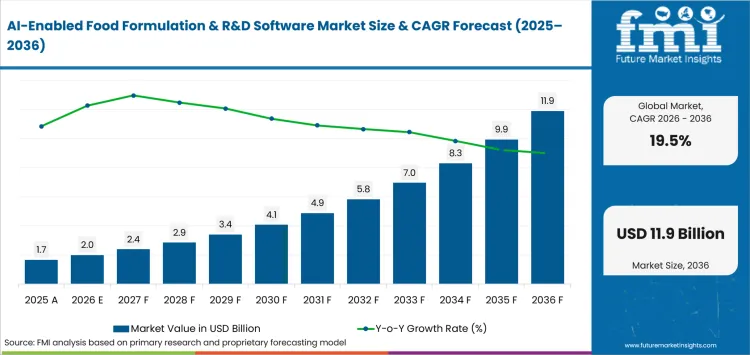
Key Takeaways for the AI-enabled Food Formulation & R&D Software Market
- Demand for AI-enabled food formulation and R&D software is driven by shorter development cycles, with food companies favoring platforms that compare ingredient options within defined technical and regulatory constraints.
- Cloud deployment is forecast to garner 58.0% share of deployment in 2026, influenced by shared access across distributed R&D teams and centralized software maintenance.
- Recipe/formulation is estimated to lead application with 34.0% share in 2026, backed by multi-constraint assessment across nutrition and sensory requirements.
- Inconsistent specifications and incomplete sensory records represent primary barriers limiting dependable recommendations and enterprise-level implementation.
- Competition focusses on Ingredion, IFF, Givaudan, dsm-firmenich, NotCo AI, Brightseed, Shiru, and Nuritas, with providers differentiating based on ingredient knowledge and food-science assistance.
Analyst Perspective
“AI-enabled formulation software brings commercial value by narrowing impractical recipe options before laboratory resources are assigned. Food R&D teams examine source records and secure knowledge sharing during platform review. Stronger adoption comes from connecting computational recommendations with physical testing and approved product specifications.”
- Nandini Roy Choudhury, Principal Analyst for Food and Beverage at Future Market Insights
How is AI-Enabled Food Formulation & R&D Software Market segmented?
The AI-enabled food formulation and R&D software industry is segmented by deployment, application, end user, and region.
The AI-enabled food formulation and R&D software market is segmented by deployment, application, end user, and region. Deployment coverage includes cloud and on-premise systems serving distinct hosting requirements. Application coverage addresses recipe and formulation work together with sensory prediction. Shelf-life assessment and regulatory retrieval complete application coverage across product development. End-user coverage spans ingredient suppliers, CPG companies, and foodservice operators. Regional coverage includes North America and Latin America together with Western Europe. Eastern Europe and East Asia extend analysis across established food industries. South Asia and Pacific with Middle East and Africa complete geographic assessment.
What makes cloud central to deployment selection?
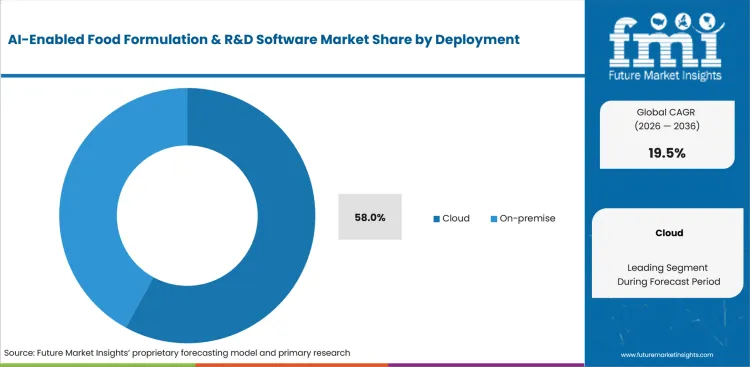
Cloud deployment promotes shared formulation work across supplier and customer R&D teams. Product briefs and validation records stay available inside one controlled workspace. Brightseed reported more than 40 partnerships in March 2026, demonstrating recurring collaboration across scientific development programs. Central access reduces duplicate records across participating laboratories and customer business units.
- Cloud is predicted to represent 58.0% share of deployment in 2026, driven by shared access across distributed R&D groups. Customer teams assess identity controls and regional hosting during enterprise platform reviews.
- On-premise deployment contributes to companies protecting proprietary formulas and plant records. Local ownership increases maintenance duties across software updates and model administration.
Why does recipe/formulation lead application demand?
Recipe development combines cost and nutrition during early candidate screening. Processing limits and sensory targets narrow workable options prior to laboratory preparation. Givaudan challenged participating start-ups in April 2024 to reduce alternative protein recipe costs by up to 20.0%, reinforcing demand for multi-constraint formulation support. Physical trials confirm matrix behavior and plant performance during final product approval.
- In 2026, recipe/formulation is anticipated to account for 34.0% share owing to its role in screening commercially workable candidates. Constraint comparison removes unsuitable options prior to laboratory resource allocation.
- Sensory prediction and shelf-life applications support evidence needs during later development stages. Regulatory tools confirm ingredient permissions during final specification approval.
What supports ingredient suppliers across end user demand?
Regional use conditions extend technical guidance across customer development programs. Ingredion reported service coverage across more than 120 countries as of 2026, promoting demand for maintained regional application guidance. Customer teams retain authority for matrix testing and final specification approval. Ingredient suppliers retain detailed knowledge about dosage and processing tolerance across food matrices.
- By end user, ingredient suppliers are likely to hold 40.9% share in 2026, driven by proprietary product knowledge supporting substitution reviews. Controlled assistance connects technical records with customer formulation needs.
- CPG companies manage branded specifications across longer development processes. Foodservice operators emphasize repeatability across shorter cycles and varied ingredient availability.
What are drivers, restraints, and opportunities in AI-Enabled Food Formulation & R&D Software Market?
Cycle compression supports adoption across formulation teams and weak evidence slows enterprise conversion. Controlled knowledge reuse creates expansion potential across validated product programs.
- Driver: Formulation teams need wider candidate comparison without multiplying avoidable physical experiments across every product program.
- Restraint: Inconsistent specifications and sensory records weaken model reliability during technical approval and product release.
- Opportunity: Controlled platforms connect ingredient knowledge with experiments and approved scale-up learning across related development programs.
Formulation teams compare expanding ingredient combinations under tighter nutrition and cost requirements. Eurostat reported 20.0% of European Union enterprises used artificial intelligence during 2025 in its December 2025 release, supporting enterprise familiarity with software-assisted analysis. Familiarity reduces training barriers during initial formulation-platform assessment. Food-specific validation remains necessary throughout recipe approval.
Evidence quality restricts adoption across specifications and sensory testing records. German Federal Statistical Office reported in November 2025 that 44.0% of enterprises avoiding artificial intelligence cited insufficient data availability or quality, highlighting preparation demands affecting model reliability. Food companies need consistent units and revision histories across formulation records. Physical confirmation remains necessary for final product release.
Governed scientific records create expansion potential across ingredient discovery and formulation programs. Brightseed reported a proprietary dataset containing 21 million natural compounds in April 2026, expanding candidate-search capacity across nutrition research. Greater data depth supports wider candidate evaluation under documented scientific conditions. Commercial value requires traceable movement from discovery into formulation and physical validation.
How are country CAGRs aligned in AI-Enabled Food Formulation & R&D Software Market?
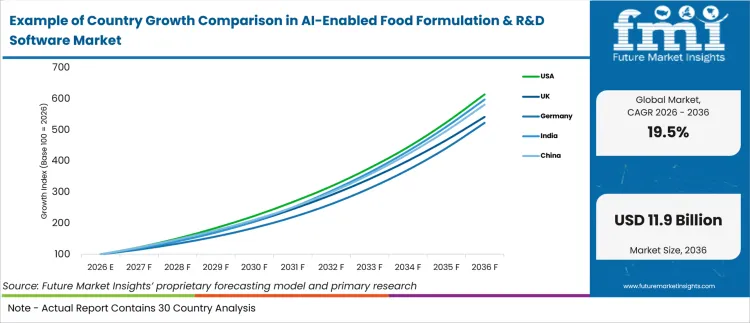
| Country or Market | CAGR |
|---|---|
| India | 19.6% |
| China | 19.2% |
| United States | 18.8% |
| United Kingdom | 18.4% |
| Germany | 18.0% |
Source: Future Market Insights analysis, 2026.
How do country-level CAGRs compare in AI-Enabled Food Formulation & R&D Software Market?
Country comparison shows a gradual step-down across the markets covered. India occupies the upper end of the range, followed by China. United States forms the middle position across the disclosed comparison. United Kingdom and Germany complete the lower forecast band. A 1.6 percentage-point spread separates India from Germany. Profiled rates reflect comparable expansion prospects under distinct implementation conditions.
- India is anticipated to lead the comparison and place South Asia at the upper forecast position.
- China is likely to follow India and maintain a limited difference from the leading rate.
- United States is expected to occupy the middle band under established enterprise software review practices.
- United Kingdom and Germany are projected to complete the comparison under documentation-intensive approval systems.
- Profiled rates create a gradual downward slope without sharp national separation.
Markets carrying similar CAGRs are expected to present distinct entry conditions based on regulatory maintenance and supplier-record quality. Full report coverage includes North America, Latin America, Europe, East Asia, South Asia and Pacific, Middle East and Africa.
Country-wise Analysis
- AI-enabled food formulation software market in India is forecast to expand at 19.6% CAGR between 2026 and 2036, guided by localized rule maintenance and formal product-testing requirements. Regional onboarding needs encourage platforms supporting structured supplier records and maintained regulatory content. Food Safety and Standards Authority of India listed 20 referral food laboratories in December 2025, reinforcing demand for formulation records connected with documented testing.
- National Bureau of Statistics of China reported 5.6% expansion in agricultural and food processing activity during 2025 through its February 2026 publication, increasing formulation volumes across domestic producers. Expanding processing activity creates more specification records and ingredient substitutions across product programs. Demand in China is estimated to rise at 19.2% CAGR during the study period, aided by domestic manufacturing depth and China-specific platform requirements.
- Established enterprise software use promotes formulation-platform assessment across prominent United States food companies. Sector in the United States is projected to record 18.8% CAGR from 2026 to 2036, reflecting established R&D operations and formal product-release controls. USA Census Bureau reported artificial intelligence use among 37.0% of firms employing at least 250 people in May 2026, demonstrating enterprise familiarity across larger organizations.
- Sales in the United Kingdom are anticipated to scale at 18.4% CAGR during the forecast period, underpinned by enterprise software familiarity and separate national rule maintenance. Office for National Statistics reported artificial intelligence use among 25.0% of United Kingdom businesses in January 2026, influencing initial platform consideration across established companies. Configurable approval routes and maintained national content influence enterprise deployment decisions.
- German Federal Statistical Office recorded artificial intelligence use among 26.0% of enterprises in November 2025, highlighting an established base for specialist software assessment. Documentation-led reviews place emphasis on source records and controlled user permissions. Industry in Germany is predicted to grow at 18.0% CAGR during the assessment period, backed by formal governance practices across ingredient and food manufacturers.
Who are notable companies in AI-Enabled Food Formulation & R&D Software Market?
Ingredion, IFF, Givaudan, dsm-firmenich, NotCo AI, Brightseed, Shiru, and Nuritas are the notable companies shaping this market.
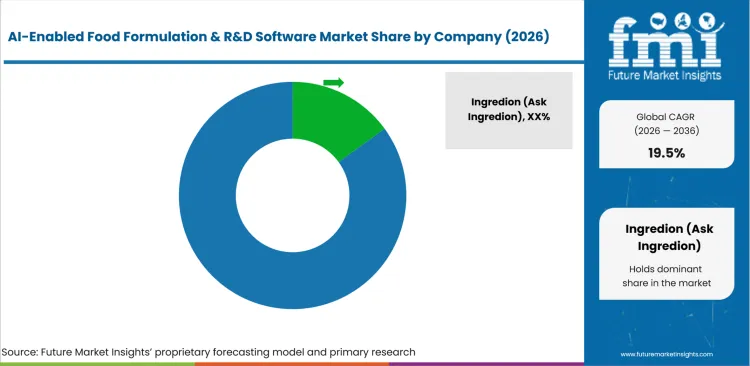
Competition in the sector centers on evidence quality and food science support across enterprise programs. Ingredient groups use application laboratories and proprietary technical content during customer development. Model-led specialists focus on candidate comparison across recipe constraints and sensory requirements. Discovery providers connect computational screening with physical validation and ingredient development. Buyer review covers data ownership and specialist access during implementation and renewal.
- Ingredion and IFF compete based on application knowledge connected with customer formulation services. Product teams assess response quality across reformulation work and technical problem resolution.
- Givaudan and dsm-firmenich compete depending on sensory expertise connected with controlled development tools. Food companies assess evidence depth across taste and texture decisions during candidate review.
- NotCo AI competes through model-led formulation across product briefs and technical constraints. Customer teams assess output transparency and physical test handoff during platform review.
- Brightseed and Shiru compete driven by computational ingredient discovery across health and food applications. Nuritas adds peptide discovery supported by clinical development and formulation guidance.
Competitive Benchmarking: AI-enabled Food Formulation & R&D Software Market
| Company | Formulation Workflow | Ingredient Knowledge | Discovery Capability | Service Reach |
|---|---|---|---|---|
| Ingredion | High | High | Medium | Global |
| IFF | High | High | Medium | Global |
| Givaudan | High | High | High | Global |
| dsm-firmenich | High | High | Medium | Global |
| NotCo AI | High | Medium | High | Selected global programs |
| Brightseed | Medium | High | High | International partnerships |
| Shiru | Medium | High | High | International partnerships |
| Nuritas | Medium | High | High | International partnerships |
Source: Future Market Insights competitive analysis.
Key Developments in AI-enabled Food Formulation & R&D Software Market
- In September 2025, IFF launched SipScape for adult beverage concept development. Company information connected consumer research with early concept selection across beverage projects.
- In February 2026, dsm-firmenich reported digitized recipe management across food development operations. Company information connected formulation software with quicker review and stronger compliance records.
- In May 2026, Brightseed launched Hummingbird for development decisions across ingredient programs. Company information connected scientific evidence with opportunity ranking during early commercial review.
Key Players in AI-enabled Food Formulation & R&D Software Market
Ingredient Knowledge and Customer Formulation
- Ingredion
- IFF
- Givaudan
- dsm-firmenich
Model-Led Formulation Platforms
- NotCo AI
Computational Ingredient Discovery
- Brightseed
- Shiru
- Nuritas
AI-enabled Food Formulation & R&D Software Market Report Scope
| Coverage field | Report scope |
|---|---|
| Market breakdown | AI-enabled food formulation & R&D software market breakdown includes deployment, application, end user, and region. |
| Quantitative Units | USD million an CAGR in %. |
| Market Definition | AI-enabled food formulation and R&D software applies machine learning or controlled retrieval to recipe design. Sensory prediction and shelf-life estimation support product development. Ingredient substitution and regulatory retrieval complete defined software coverage. Generic enterprise software without formulation intelligence is excluded. |
| Regions Covered | North America, Latin America, Western Europe, Eastern Europe, East Asia, South Asia and Pacific, Middle East and Africa. |
| Countries Covered | India, China, United States, United Kingdom, Germany and more than 25 additional countries complete full report coverage. |
| Key Companies Profiled | Ingredion, IFF, Givaudan, dsm-firmenich, NotCo AI, Brightseed, Shiru, and Nuritas. |
| Forecast Period | 2026 to 2036 |
| Approach | Hybrid bottom-up and top-down methodology uses segment shares and country CAGRs. Company activity and buyer adoption support final market reconciliation. |
Source: Future Market Insights analysis, 2026.
AI-enabled Food Formulation & R&D Software Market - Research Methodology
| Method | Approach |
|---|---|
| Primary Research | FMI analysts gathered input from manufacturers, service providers, technology developers, distributors, end users, procurement teams, and subject-matter experts. Interviews examined purchasing decisions, product or service evaluation, adoption barriers, approval requirements, pricing considerations, and expectations for technical or commercial support. Respondents were also asked what evidence is required before a trial, pilot, or initial order develops into regular purchasing. |
| Desk Research | Desk research covered government statistics, regulatory publications, trade data, industry associations, technical literature, standards, company filings, product information, and official corporate announcements. Sources were reviewed for relevance, publication date, geographic coverage, and consistency with the defined market scope. Claims relating to performance, applications, approvals, capacity, investment, and commercial activity were retained only when supported by credible public evidence. |
| Market Sizing and Forecasting | The market model combined the baseline value with historical performance, segment structure, pricing and volume indicators, adoption levels, company participation, and country-level demand conditions. Forecast assumptions considered economic activity, investment trends, regulatory developments, technology adoption, purchasing cycles, supply availability, and barriers to wider market use. Segment and regional estimates were reconciled before the final market total was calculated. |
| Data Validation | Estimates were checked against multiple independent indicators, including public data, company activity, trade patterns, industry developments, and findings from primary interviews. Validation also tested whether products, services, applications, and company revenues fell within the defined market boundaries. Adjacent categories, unsupported claims, overlapping revenues, and activities without direct market relevance were excluded to reduce double counting and maintain consistency across segments and countries. |
Source: Future Market Insights analysis, 2026.
AI-enabled Food Formulation & R&D Software Market by Segments
AI-enabled Food Formulation & R&D Software Market segmented by Deployment:
- Cloud
- On-premise
AI-enabled Food Formulation & R&D Software Market segmented by Application:
- Recipe/Formulation
- Sensory Prediction
- Shelf-life
- Regulatory
AI-enabled Food Formulation & R&D Software Market segmented by End User:
- Ingredient Suppliers
- CPG
- Foodservice
AI-enabled Food Formulation & R&D Software Market segmented by Region:
- North America
- United States
- Canada
- Latin America
- Brazil
- Mexico
- Argentina
- Chile
- Western Europe
- Germany
- France
- United Kingdom
- Italy
- Spain
- Benelux
- Nordics
- Eastern Europe
- Poland
- Czech Republic
- Romania
- Hungary
- East Asia
- China
- Japan
- South Korea
- South Asia and Pacific
- India
- ASEAN
- Australia and New Zealand
- Middle East and Africa
- GCC Countries
- South Africa
- Türkiye
- Israel
Research Sources and Bibliography
- Eurostat. (2025, December 11). 20% of EU enterprises use AI technologies.
- Brightseed, Inc. (2026, March 25). Brightseed Launches the World’s First Clinically-Validated, Enterprise AI Platform, Built on Over a Decade of Scientific Research.
- dsm-firmenich. (2026, February 20). Sustainability, innovation, and partnerships.
- Nestlé. (2025, November 19). Nestlé selected to join the Frontier Firm AI Initiative, a collaboration with D^3 Institute at Harvard and Microsoft.
- IFF. (2025, October 9). Product Reformulation: Navigating the Future of Food & Beverage.
- Nestlé. (2024, April). Science-based solutions to improve nutritional value.
- German Federal Statistical Office. (2025, November 24). Reasons against the use of artificial intelligence technologies, by employment size class.
- Brightseed, Inc. (2026, January 18). Brightseed’s 2025 Year in Review.
- Food Safety and Standards Authority of India. (2025, December 5). Food Laboratories.
- National Bureau of Statistics of China. (2026, February 28). Statistical Communiqué of the People’s Republic of China on the 2025 National Economic and Social Development.
- Grundy, A., Breaux, C., & Khatiwoda, D. (2026, May 26). Large Firms With at Least 20 Employees Biggest AI Users. USA Census Bureau.
- Office for National Statistics. (2026, January 8). Business insights and impact on the UK economy: 8 January 2026.
- German Federal Statistical Office. (2025, November 24). Enterprises using artificial intelligence technologies, by employment size class.
- IFF. (2025, September 9). IFF launches interactive platform to inspire adult beverage innovation.
- Brightseed, Inc. (2026, May 13). Brightseed Launches Hummingbird, Advancing Its AI-Powered Innovation Platform from Discovery to Development.
- Brightseed, Inc. (2026, April 15). Brightseed expands world’s largest proprietary bioactive dataset to 21 million compounds, strengthening AI-native innovation platform.
This bibliography is provided for reader reference and is not exhaustive. The full report contains the complete reference list and detailed citations.
This Report Answers
- How do segments influence demand across deployment and application with end user coverage?
- What criteria guide food R&D teams evaluating AI-enabled formulation software prior to enterprise use?
- Why do country CAGRs differ across the key countries for the market?
- What companies compete depending on ingredient knowledge and model-led formulation capabilities?
- How are forecasts validated through bottom-up and top-down analysis using independent indicators?
- What evidence supports food company review prior to multi-site software deployment?
- Why do constraint handling and source records influence platform selection?
- How does weak data preparation limit return across integration and validation work?
- How do expert review records influence approval across R&D and quality teams?
- What company capabilities improve long-term confidence and recurring platform use?
Frequently Asked Questions
How big is the AI-Enabled Food Formulation & R&D Software Market in 2026?
The AI-enabled food formulation & R&D software market is valued at USD 2.0 billion in 2026 and is forecast to reach USD 11.9 billion by 2036. Growth is supported by food companies adopting specialized platforms that compare ingredient options within defined technical and regulatory constraints to shorten development cycles across commercial product programs.
What is the CAGR of the AI-Enabled Food Formulation & R&D Software Market from 2026 to 2036?
The AI-enabled food formulation & R&D software market grows at a CAGR of 19.5% between 2026 and 2036, supported by formulation teams adopting cloud-based platforms once those systems connect ingredient knowledge with physical testing and approved product specifications across distributed R&D programs.
Which deployment leads the AI-Enabled Food Formulation & R&D Software Market?
Cloud deployment accounts for 58.0% of the AI-enabled food formulation & R&D software market in 2026, driven by shared access across distributed R&D teams and centralized software maintenance that keeps product briefs and validation records available within one controlled workspace across supplier and customer development programs.
How much will the AI-Enabled Food Formulation & R&D Software Market add between 2026 and 2036?
The AI-enabled food formulation & R&D software market is set to add USD 9.9 billion between 2026 and 2036, growing from USD 2.0 billion to USD 11.9 billion as machine learning formulation platforms and computational ingredient discovery tools enter funded commercial pathways across a widening base of food and beverage R&D programs.
Who are the leading companies in the AI-Enabled Food Formulation & R&D Software Market?
Five companies lead the AI-enabled food formulation & R&D software market, including Ingredion, IFF, Givaudan, dsm-firmenich, and Brightseed, competing through proprietary ingredient knowledge, sensory expertise, model-led recipe formulation, and computational discovery platforms across enterprise food and beverage development programs worldwide.
Preview the report firsthand - request a free sample
Get SampleGet the brochure for pricing and purchase details.
Get PDFTable of Content
- Key Takeaways
- Market Size and CAGR
- Top Growth Driver
- Fastest Growing Segment
- Leading Region
- Key Companies
- Emerging Opportunities
- Executive Summary
- Global Market Outlook
- Demand-side Trends
- Supply-side Trends
- Technology Roadmap Analysis
- Analysis and Recommendations
- Analyst Perspective (What is happening? Why now? What should investors know?)
- Key Questions Answered
- How large is the market?
- What is the CAGR?
- What are key trends?
- Which region dominates?
- Who are the leaders?
- Market Overview
- Market Coverage / Taxonomy
- Market Definition / Scope / Limitations
- Research Methodology
- Chapter Orientation
- Analytical Lens and Working Hypotheses
- Market Structure, Signals, and Trend Drivers
- Benchmarking and Cross-market Comparability
- Market Sizing, Forecasting, and Opportunity Mapping
- Research Design and Evidence Framework
- Desk Research Programme (Secondary Evidence)
- Expert Input and Fieldwork (Primary Evidence)
- Tooling, Models, and Reference Databases
- Data Engineering and Model Build
- Quality Assurance and Audit Trail
- Market Background
- Market Dynamics (Drivers, Restraints, Opportunity, Trends)
- Scenario Forecast (Optimistic, Likely, Conservative)
- Impact Analysis
- AI Impact
- Sustainability Impact
- Regulatory Impact
- Technology Impact
- Consumer / Buyer Analysis
- Purchase Drivers
- Adoption Barriers
- Buyer Journey
- Opportunity Map Analysis
- Product Life Cycle Analysis
- Supply Chain Analysis
- Investment Feasibility Matrix
- Value Chain Analysis
- PESTLE and Porter's Analysis
- Regulatory Landscape
- Regional Parent Market Outlook
- Production and Consumption Statistics
- Import and Export Statistics
- Global Market Analysis and Forecast, 2021 to 2036
- Historical Market Size Value (USD Billion) Analysis, 2021 to 2025
- Current and Future Market Size Value (USD Billion) Projections, 2026 to 2036
- Y-o-Y Growth Trend Analysis
- Absolute $ Opportunity Analysis
- Global Market Pricing Analysis, 2021 to 2036
- Global Market Analysis and Forecast, By Deployment, 2021 to 2036
- Introduction / Key Findings
- Historical Market Size Value (USD Billion) Analysis By Deployment, 2021 to 2025
- Current and Future Market Size Value (USD Billion) Analysis and Forecast By Deployment, 2026 to 2036
- Cloud
- On-premise
- Cloud
- Y-o-Y Growth Trend Analysis By Deployment, 2021 to 2025
- Absolute $ Opportunity Analysis By Deployment, 2026 to 2036
- Global Market Analysis and Forecast, By Application, 2021 to 2036
- Introduction / Key Findings
- Historical Market Size Value (USD Billion) Analysis By Application, 2021 to 2025
- Current and Future Market Size Value (USD Billion) Analysis and Forecast By Application, 2026 to 2036
- Recipe/Formulation
- Sensory Prediction
- Shelf-life
- Regulatory
- Recipe/Formulation
- Y-o-Y Growth Trend Analysis By Application, 2021 to 2025
- Absolute $ Opportunity Analysis By Application, 2026 to 2036
- Global Market Analysis and Forecast, By End User, 2021 to 2036
- Introduction / Key Findings
- Historical Market Size Value (USD Billion) Analysis By End User, 2021 to 2025
- Current and Future Market Size Value (USD Billion) Analysis and Forecast By End User, 2026 to 2036
- Ingredient Suppliers
- CPG
- Foodservice
- Ingredient Suppliers
- Y-o-Y Growth Trend Analysis By End User, 2021 to 2025
- Absolute $ Opportunity Analysis By End User, 2026 to 2036
- Global Market Analysis and Forecast, By Region, 2021 to 2036
- Introduction
- Historical Market Size Value (USD Billion) Analysis By Region, 2021 to 2025
- Current Market Size Value (USD Billion) Analysis and Forecast By Region, 2026 to 2036
- North America
- Latin America
- Western Europe
- Eastern Europe
- East Asia
- South Asia and Pacific
- Middle East & Africa
- Market Attractiveness Analysis By Region
- North America Market Analysis and Forecast, By Country, 2021 to 2036
- Historical Market Size Value (USD Billion) Trend Analysis By Market Taxonomy, 2021 to 2025
- Market Size Value (USD Billion) Forecast By Market Taxonomy, 2026 to 2036
- By Country
- USA
- Canada
- By Deployment
- By Application
- By End User
- By Country
- Market Attractiveness Analysis
- By Country
- By Deployment
- By Application
- By End User
- Key Takeaways
- Latin America Market Analysis and Forecast, By Country
- Historical Market Size Value (USD Billion) Trend Analysis By Market Taxonomy, 2021 to 2025
- Market Size Value (USD Billion) Forecast By Market Taxonomy, 2026 to 2036
- By Country
- Brazil
- Mexico
- Chile
- Rest of Latin America
- By Deployment
- By Application
- By End User
- By Country
- Market Attractiveness Analysis
- By Country
- By Deployment
- By Application
- By End User
- Key Takeaways
- Western Europe Market Analysis and Forecast, By Country
- Historical Market Size Value (USD Billion) Trend Analysis By Market Taxonomy, 2021 to 2025
- Market Size Value (USD Billion) Forecast By Market Taxonomy, 2026 to 2036
- By Country
- Germany
- UK
- Italy
- Spain
- France
- Nordic
- BENELUX
- Rest of Western Europe
- By Deployment
- By Application
- By End User
- By Country
- Market Attractiveness Analysis
- By Country
- By Deployment
- By Application
- By End User
- Key Takeaways
- Eastern Europe Market Analysis and Forecast, By Country
- Historical Market Size Value (USD Billion) Trend Analysis By Market Taxonomy, 2021 to 2025
- Market Size Value (USD Billion) Forecast By Market Taxonomy, 2026 to 2036
- By Country
- Russia
- Poland
- Hungary
- Balkan & Baltic
- Rest of Eastern Europe
- By Deployment
- By Application
- By End User
- By Country
- Market Attractiveness Analysis
- By Country
- By Deployment
- By Application
- By End User
- Key Takeaways
- East Asia Market Analysis and Forecast, By Country
- Historical Market Size Value (USD Billion) Trend Analysis By Market Taxonomy, 2021 to 2025
- Market Size Value (USD Billion) Forecast By Market Taxonomy, 2026 to 2036
- By Country
- China
- Japan
- South Korea
- By Deployment
- By Application
- By End User
- By Country
- Market Attractiveness Analysis
- By Country
- By Deployment
- By Application
- By End User
- Key Takeaways
- South Asia and Pacific Market Analysis and Forecast, By Country
- Historical Market Size Value (USD Billion) Trend Analysis By Market Taxonomy, 2021 to 2025
- Market Size Value (USD Billion) Forecast By Market Taxonomy, 2026 to 2036
- By Country
- India
- ASEAN
- Australia & New Zealand
- Rest of South Asia and Pacific
- By Deployment
- By Application
- By End User
- By Country
- Market Attractiveness Analysis
- By Country
- By Deployment
- By Application
- By End User
- Key Takeaways
- Middle East & Africa Market Analysis and Forecast, By Country
- Historical Market Size Value (USD Billion) Trend Analysis By Market Taxonomy, 2021 to 2025
- Market Size Value (USD Billion) Forecast By Market Taxonomy, 2026 to 2036
- By Country
- Kingdom of Saudi Arabia
- Other GCC Countries
- Türkiye
- South Africa
- Other African Union
- Rest of Middle East & Africa
- By Deployment
- By Application
- By End User
- By Country
- Market Attractiveness Analysis
- By Country
- By Deployment
- By Application
- By End User
- Key Takeaways
- Key Countries Market Analysis
- USA
- Pricing Analysis
- Market Share Analysis, 2025
- By Deployment
- By Application
- By End User
- Canada
- Pricing Analysis
- Market Share Analysis, 2025
- By Deployment
- By Application
- By End User
- Mexico
- Pricing Analysis
- Market Share Analysis, 2025
- By Deployment
- By Application
- By End User
- Brazil
- Pricing Analysis
- Market Share Analysis, 2025
- By Deployment
- By Application
- By End User
- Chile
- Pricing Analysis
- Market Share Analysis, 2025
- By Deployment
- By Application
- By End User
- Germany
- Pricing Analysis
- Market Share Analysis, 2025
- By Deployment
- By Application
- By End User
- UK
- Pricing Analysis
- Market Share Analysis, 2025
- By Deployment
- By Application
- By End User
- Italy
- Pricing Analysis
- Market Share Analysis, 2025
- By Deployment
- By Application
- By End User
- Spain
- Pricing Analysis
- Market Share Analysis, 2025
- By Deployment
- By Application
- By End User
- France
- Pricing Analysis
- Market Share Analysis, 2025
- By Deployment
- By Application
- By End User
- India
- Pricing Analysis
- Market Share Analysis, 2025
- By Deployment
- By Application
- By End User
- ASEAN
- Pricing Analysis
- Market Share Analysis, 2025
- By Deployment
- By Application
- By End User
- Australia & New Zealand
- Pricing Analysis
- Market Share Analysis, 2025
- By Deployment
- By Application
- By End User
- China
- Pricing Analysis
- Market Share Analysis, 2025
- By Deployment
- By Application
- By End User
- Japan
- Pricing Analysis
- Market Share Analysis, 2025
- By Deployment
- By Application
- By End User
- South Korea
- Pricing Analysis
- Market Share Analysis, 2025
- By Deployment
- By Application
- By End User
- Russia
- Pricing Analysis
- Market Share Analysis, 2025
- By Deployment
- By Application
- By End User
- Poland
- Pricing Analysis
- Market Share Analysis, 2025
- By Deployment
- By Application
- By End User
- Hungary
- Pricing Analysis
- Market Share Analysis, 2025
- By Deployment
- By Application
- By End User
- Kingdom of Saudi Arabia
- Pricing Analysis
- Market Share Analysis, 2025
- By Deployment
- By Application
- By End User
- Türkiye
- Pricing Analysis
- Market Share Analysis, 2025
- By Deployment
- By Application
- By End User
- South Africa
- Pricing Analysis
- Market Share Analysis, 2025
- By Deployment
- By Application
- By End User
- USA
- Market Structure Analysis
- Competition Dashboard
- Competition Benchmarking
- Market Share Analysis of Top Players
- By Regional
- By Deployment
- By Application
- By End User
- Emerging Startups
- Innovation Benchmarking
- Competition Analysis
- Competition Deep Dive
- Ingredion (Ask Ingredion)
- Overview
- Product Portfolio
- Profitability by Market Segments
- Sales Footprint
- Strategy Overview
- Marketing Strategy
- Product Strategy
- Channel Strategy
- IFF
- Givaudan
- dsm-firmenich
- Brightseed
- Turtle Tree
- NotCo (Giuseppe)
- Climax Foods
- Shiru
- Ingredion (Ask Ingredion)
- Case Studies
- Success Stories
- Recent Developments
- Competition Deep Dive
- Assumptions & Acronyms Used


