

- Industry Size (2026):
- USD 210 Mn
- Forecast (2036):
- USD 585.6 Mn
- CAGR (2026 to 2036)
- 10.8%
Trans-Atlantic Collaborative Bioplastic R&D Platform Market Forecast and Outlook 2026 to 2036
The trans-Atlantic collaborative bioplastic R&D platform market is projected to grow from USD 210 million in 2026 to USD 585.6 million by 2036, reflecting a compound annual growth rate (CAGR) of 10.8%. Regionally, demand for collaborative R&D platforms will be concentrated in North America and Europe, where the push for sustainability and innovation in bioplastics is strongest. These regions have established regulatory frameworks and significant funding available for green technology development. However, adoption may be slower in emerging markets due to lower access to capital and differing regulatory standards.
Geographic cost advantages will also influence market dynamics, with R&D hubs in regions with lower operational costs potentially gaining traction. Despite these advantages, the uneven adoption of bioplastics in different sectors could create challenges in scaling innovations across borders. As the market evolves, the most successful players will be those able to navigate both regional nuances and global supply chain dynamics, balancing cost efficiency with cutting-edge bioplastic development.
Quick Stats of the Trans-Atlantic Collaborative Bioplastic R&D Platform Market
- Trans-Atlantic Collaborative Bioplastic R&D Platform Market Value (2026): USD 210 million
- Trans-Atlantic Collaborative Bioplastic R&D Platform Market Forecast Value (2036): USD 585.6 million
- Trans-Atlantic Collaborative Bioplastic R&D Platform Market Global Forecast CAGR (2026-2036): 10.8%
- Trans-Atlantic Collaborative Bioplastic R&D Platform Market Leading Segment: Fermentation Platforms for Bioplastic Monomers 34%
- Key Growth Regions in Trans-Atlantic Collaborative Bioplastic R&D Platform Market: USA
- Top Players in Trans-Atlantic Collaborative Bioplastic R&D Platform Market: BioInnovation Institute, National Institute of Standards and Technology, European Bioeconomy University Alliance, Center for Bioplastics & Biocomposites (CBB), American Chemical Society Green Chemistry Institute, Horizon Europe Bioplastics Research Clusters, NSF Engineering Research Centers (Biomaterials Focus), Fraunhofer Society (Biopolymers Divisions), MIT Materials Research Laboratory (Collab Programs), University of Massachusetts Center for BioMicrobial Dynamics

What is the Growth Forecast for the Trans-Atlantic Collaborative Bioplastic R&D Platform Market through 2036?
The market share erosion or gain analysis for the trans-Atlantic collaborative bioplastic R&D platform market highlights the dynamics of industry shifts as bioplastic technologies evolve and scale over time. From 2026 to 2031, the market will grow from USD 210 million to USD 395 million, representing significant market gains driven by increased collaboration and investment in R&D. During this phase, the focus will be on advancing bioplastic research, improving material performance, and optimizing production processes to make bioplastics more commercially viable. Market share will likely be gained by leading R&D platforms and institutions with strong collaborative ties, as they develop innovative solutions and push the boundaries of bioplastic production.
From 2031 to 2036, as the market matures, the rate of expansion will slow, with growth from USD 395 million to USD 585.6 million. In this phase, the market share distribution will stabilize, with key players cementing their positions as industry leaders in bioplastic R&D. Companies that have invested early in trans-Atlantic collaborations and developed scalable bioplastic technologies will maintain or expand their market share. However, competition will increase as new players enter the market, looking to capitalize on the growing demand for sustainable materials. As the market continues to mature, there will be a shift from rapid innovation to optimizing existing technologies and focusing on production efficiency, leading to more stable market share dynamics.
Trans-Atlantic Collaborative Bioplastic R&D Platform Market Key Takeaways
| Metric | Value |
|---|---|
| Industry Sales Value (2026) | USD 210 million |
| Industry Forecast Value (2036) | USD 585.6 million |
| Industry Forecast CAGR (2026-2036) | 10.8% |
What Is Driving the Demand for Trans-Atlantic Collaborative Bioplastic R&D Platform Market?
Historical demand for collaborative bioplastic research and development stems from early efforts to advance renewable and sustainable polymer technologies in both North America and Europe, where industry, academia, and government programs sought alternatives to fossil based plastics. The European Union has supported bio based plastics research through frameworks such as Horizon 2020 and successor programs that fund collaborative innovation and industrial research partnerships, involving multiple member state institutions and private partners to develop new materials and processes. These initiatives helped build cross sector expertise, establish testing infrastructure, and align research priorities with environmental and circular economy goals. Industry associations in Europe also participate in research networks that bring together material developers, converters, and end use stakeholders to share knowledge and accelerate innovation. In parallel, research institutions and companies across the Atlantic invested in bioplastics science, addressing fermentation technologies, novel polymers, and integration into existing supply chains, reflecting parallel but initially less integrated development pathways.
Future demand for Trans Atlantic collaborative bioplastic R&D platforms is expected to increase as sustainability mandates and market drivers push for harmonized innovation that bridges regulatory, technical, and commercial frameworks between key regions. Collaborative initiatives align material development with trans Atlantic regulatory expectations and market requirements for performance, safety, and sustainability, enabling new bioplastics to meet both European and North American standards efficiently. Increasing corporate and public sector interest in replacing fossil based polymers with renewable alternatives creates incentives for shared R&D that pools resources, data, and expertise to tackle common challenges such as cost, scalability, and feedstock variability. Growth factors include expanding global bioplastics production capacity, projected to nearly double by 2030 as demand rises for compostable and bio based materials in packaging and consumer goods, and the need for coordinated research to deliver advanced bioplastic solutions. Technical complexity, differing regional regulatory frameworks, and the need for interoperable testing protocols remain challenges, but structured collaboration across research institutions and industry sectors can help de risk innovation pathways and support broader commercial adoption of sustainable polymer technologies.
What are the Leading Segments in the Global Trans-Atlantic Collaborative Bioplastic R&D Platform Market?
The global trans-Atlantic collaborative bioplastic R&D platform market is segmented by the type of collaboration platform and focus area of research. Among collaboration types, government-funded consortia lead the market, capturing 38% of the share, followed by university-industry joint programs, public-private strategic alliances, and cross-border innovation hubs. Government-funded consortia are preferred due to the significant financial and regulatory support they offer for bioplastic research initiatives. On the research focus side, fermentation platforms for bioplastic monomers dominate, holding 34% of the share, followed by advanced polymer formulations & composites, bio-economy digital platforms & data sharing, and sustainability metrics & lifecycle analytics. Fermentation platforms for bioplastic monomers are the most researched due to their importance in developing bio-based building blocks for bioplastics.
What Drives the Growth of Government-Funded Consortia in the Trans-Atlantic Collaborative Bioplastic R&D Platform Market?

Government-funded consortia are the leading collaboration platform in the trans-Atlantic collaborative bioplastic R&D platform market, holding 38% of the share. This demand is driven by the large-scale support provided by government agencies to encourage sustainable practices and innovation in the bioplastics sector. Governments recognize the growing need for sustainable alternatives to petroleum-based plastics and actively fund consortia that bring together research institutions, industries, and public entities to accelerate the development of bioplastics.
These collaborations often focus on large-scale projects, such as developing new bioplastic monomers and improving production processes. Government funding allows for long-term, high-impact research without the immediate financial pressures typically faced by private companies. As the global push for sustainability intensifies, the demand for government-funded consortia to drive advancements in bioplastic technologies will continue to grow, ensuring that they remain a dominant force in the market.
What is Driving the Demand for Fermentation Platforms for Bioplastic Monomers in the Trans-Atlantic Collaborative Bioplastic R&D Platform Market?

Fermentation platforms for bioplastic monomers are the leading focus area in the trans-Atlantic collaborative bioplastic R&D platform market, holding 34% of the share. This demand is primarily driven by the significant role fermentation plays in producing bioplastics from renewable resources. Fermentation platforms use microorganisms, such as bacteria, yeast, and algae, to convert plant-based sugars or organic waste into high-value bioplastic monomers like PLA, PHA, and bio-PET.
This approach offers a sustainable alternative to traditional fossil-fuel-based plastic production, making it a key area of research in the bioplastics industry. The growing emphasis on reducing plastic pollution and greenhouse gas emissions has led to increased interest in bioplastics derived from renewable feedstocks. As a result, research on fermentation platforms is critical to advancing bioplastic production and making it more commercially viable at a global scale. The continued innovation in fermentation processes will ensure that these platforms remain central to the development of the bioplastics industry, driving the demand for research in this area.
What are the Key Dynamics in the Trans Atlantic Collaborative Bioplastic R&D Platform Market?
The Trans‑Atlantic collaborative bioplastic research and development platform market is defined by joint efforts between stakeholders in North America and Europe to advance bio‑based polymer science. These platforms combine institutional expertise, shared research facilities, and coordinated technology development to address common challenges in bioplastic building block production, performance, and end‑of‑life outcomes. Participants assess initiatives on research outputs, intellectual property frameworks, and alignment with regulatory goals for renewable materials. Policy harmonisation, funding mechanisms, and standardisation efforts influence how collaborative R&D activity is prioritised and how results are adopted by industry.
What are the Main Drivers Supporting Growth in This Market?
Growth in this market is supported by shared policy objectives to reduce reliance on fossil resources and lower environmental impacts of plastics. Governments in the United States and European Union are allocating research funding and creating incentives for bioplastic innovation that encourage cross-border cooperation. Industrial partners seek to leverage complementary strengths in biotechnology, materials science, and manufacturing to accelerate development of bio-based polymers and processing technologies. Academic and public research institutions contribute foundational knowledge, while industry involvement helps align research with commercial needs. Increasing corporate commitments to renewable content and sustainable supply chains further reinforce interest in collaborative R&D platforms.
What Restraints Are Limiting Market Expansion?
Market expansion is constrained by differences in regulatory and certification frameworks between regions, which can complicate alignment of research objectives and technology pathways. Funding cycles and priorities may vary across participating organisations, affecting continuity and scale of collaborative projects. Intellectual property and data sharing considerations require careful negotiation to balance openness with commercial interests. Variability in industrial capacity for technology adoption and scale-up across countries adds complexity for research outcomes to transition into commercial deployment. Coordination costs and administrative requirements for multinational research consortia can also limit participation by smaller entities.
What Emerging Trends Are Shaping the Future of This Market?
Emerging trends include increased integration of digital research infrastructures that allow real-time data exchange, remote experimentation, and shared modelling tools across institutions. There is growing emphasis on aligning R&D with harmonised standards for bioplastic performance and environmental metrics to facilitate regulatory acceptance and market interoperability. Joint pilot projects that validate bioplastic precursors and processing methods under both North American and European production contexts are gaining prominence. Partnerships involving industry, government, and academic stakeholders are expanding to include lifecycle assessment and circular economy considerations as core components of research agendas. These developments are shaping how collaborative platforms generate innovation pathways that support scalable and sustainable bioplastic solutions.
What is the Country-Wise Analysis of the Trans-Atlantic Collaborative Bioplastic R&D Platform Market?
The trans-Atlantic collaborative bioplastic R&D platform market is growing as industries and research institutions focus on advancing bioplastic technologies through cross-border collaboration. These platforms allow for the sharing of knowledge, resources, and innovation in the development of sustainable bioplastics. Developed markets such as the USA, Germany, the UK, and France are at the forefront of these collaborations, driven by strong research and development ecosystems and a shared commitment to sustainability. The Netherlands is also witnessing growth in this space due to its focus on green technologies and sustainability. As governments and industries work together to address the challenges of plastic pollution and promote sustainable alternatives, the market for trans-Atlantic bioplastic R&D platforms is expected to expand significantly, particularly as the demand for bioplastics in packaging, automotive, and consumer goods rises.
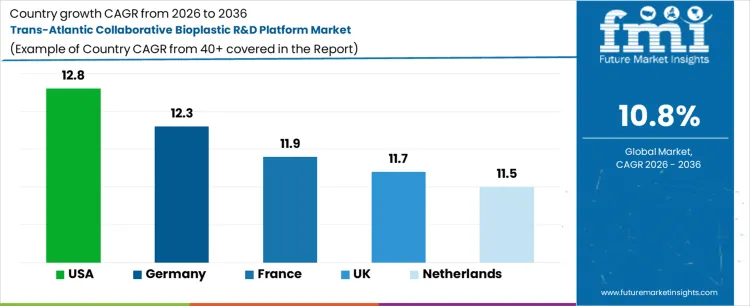
| Country | CAGR (2026-2036) |
|---|---|
| USA | 12.8% |
| Germany | 12.3% |
| France | 11.9% |
| UK | 11.7% |
| Netherlands | 11.5% |
What is the Growth Outlook for the Trans-Atlantic Collaborative Bioplastic R&D Platform Market in the USA?
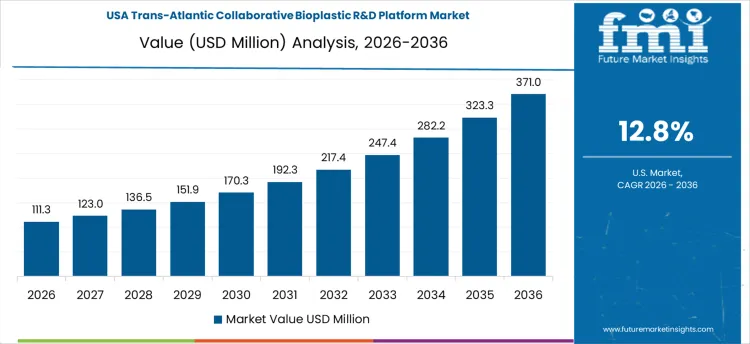
The trans-Atlantic collaborative bioplastic R&D platform market in the USA is projected to grow steadily, with a projected CAGR of 12.8% from 2026 to 2036. As a leader in innovation and sustainability, the USA is home to numerous research institutions, corporations, and government initiatives focused on advancing bioplastic technologies. The growing demand for sustainable packaging, automotive, and consumer goods is driving investments in bioplastic R&D, particularly through collaborative platforms that allow for shared knowledge and resources across borders. U.S. participation in trans-Atlantic bioplastic R&D collaborations is expected to increase as the country continues to prioritize environmental sustainability and the reduction of plastic waste. With ongoing government and industry support for sustainable manufacturing technologies, the market for collaborative bioplastic R&D platforms in the USA is set to experience strong growth.
What is the Market Outlook for the Trans-Atlantic Collaborative Bioplastic R&D Platform Market in Germany?
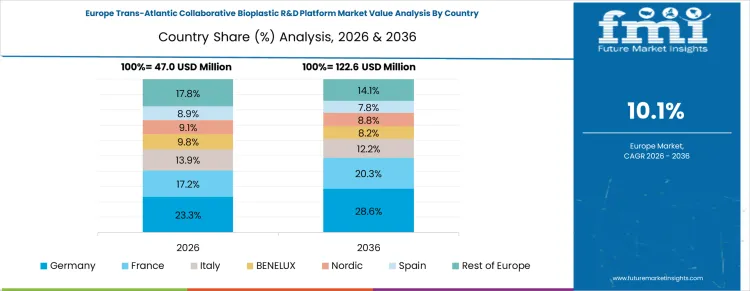
Germany is expected to see steady growth in the trans-Atlantic collaborative bioplastic R&D platform market, with a projected CAGR of 12.3% from 2026 to 2036. Germany’s commitment to sustainability and innovation in materials science is driving the adoption of bioplastic technologies. The German government’s focus on green manufacturing and circular economy principles is creating an ideal environment for the development of sustainable bioplastics. Collaborative bioplastic R&D platforms, particularly those involving international partnerships, are helping Germany’s industry leaders advance bioplastic solutions across sectors such as packaging, automotive, and consumer goods. With strong research and development ecosystems and increasing demand for sustainable alternatives to petroleum-based plastics, the market for trans-Atlantic bioplastic R&D platforms in Germany is expected to continue growing steadily.
What is the Growth Forecast for the Trans-Atlantic Collaborative Bioplastic R&D Platform Market in France?
France is projected to experience steady growth in the trans-Atlantic collaborative bioplastic R&D platform market, with a projected CAGR of 11.9% from 2026 to 2036. France has been an early adopter of sustainable technologies, particularly in packaging and material science. As part of the European Union’s sustainability initiatives, France is focusing on reducing plastic waste and promoting the use of renewable materials. Collaborative R&D platforms that span across the Atlantic, particularly between the U.S. and European countries, are helping to drive innovation in bioplastics. With increasing regulatory pressure to adopt sustainable solutions and the growing demand for eco-friendly products, the French market for collaborative bioplastic R&D platforms is expected to grow steadily in the coming years.
What is the Market Outlook for the Trans-Atlantic Collaborative Bioplastic R&D Platform Market in the UK?
The UK is expected to see steady growth in the trans-Atlantic collaborative bioplastic R&D platform market, with a projected CAGR of 11.7% from 2026 to 2036. The UK is highly focused on sustainable innovation, particularly in packaging and consumer goods. The government’s emphasis on reducing plastic waste and supporting green technologies is driving the adoption of bioplastic solutions. Collaborative bioplastic R&D platforms that connect researchers, companies, and governments across the Atlantic are helping to accelerate advancements in bioplastic technologies. As demand for sustainable packaging solutions rises and environmental regulations tighten, the UK’s market for trans-Atlantic bioplastic R&D platforms is expected to grow steadily.
What is the Growth Forecast for the Trans-Atlantic Collaborative Bioplastic R&D Platform Market in the Netherlands?
The Netherlands is projected to experience steady growth in the trans-Atlantic collaborative bioplastic R&D platform market, with a projected CAGR of 11.5% from 2026 to 2036. The Netherlands has long been at the forefront of green technologies and sustainable manufacturing. The Dutch government’s support for sustainable innovation and circular economy initiatives has created a strong foundation for the development of bioplastic technologies. The country’s focus on reducing plastic waste and promoting environmentally friendly alternatives is fueling demand for bioplastic solutions. Collaborative bioplastic R&D platforms that involve partnerships between the Netherlands, the U.S., and other European countries are playing a critical role in advancing bioplastics. As the demand for sustainable materials increases across industries, the market for bioplastic R&D platforms in the Netherlands is expected to grow steadily.
What is the Competitive Landscape for the Trans-Atlantic Collaborative Bioplastic R&D Platform Market?

The trans-Atlantic collaborative bioplastic R&D platform market is gaining momentum as academic institutions, research organizations, and industry players from both Europe and North America collaborate to advance bioplastic technologies and accelerate their commercial adoption. BioInnovation Institute leads the market with its comprehensive R&D platform focused on the development of innovative, sustainable bioplastics. Their strategic collaborations with universities and industry partners position them as a dominant player in the bioplastics research space.
National Institute of Standards and Technology (NIST), European Bioeconomy University Alliance, and Center for Bioplastics & Biocomposites (CBB) are significant competitors, each contributing to the development of bioplastics through cutting-edge research and collaboration across the Atlantic. NIST focuses on developing standards for bioplastic products and processes, while European Bioeconomy University Alliance unites European institutions for collaborative research into sustainable materials. CBB emphasizes advancing bioplastics and biocomposites through partnerships between academia and industry.
American Chemical Society Green Chemistry Institute, Horizon Europe Bioplastics Research Clusters, and NSF Engineering Research Centers (Biomaterials Focus) further strengthen the competitive landscape by supporting bioplastic research initiatives that focus on sustainable materials, green chemistry, and innovative production technologies. Fraunhofer Society (Biopolymers Divisions) and MIT Materials Research Laboratory (Collab Programs) contribute significantly through their leading-edge research in biopolymers and materials science, fostering trans-Atlantic collaboration.
University of Massachusetts Center for BioMicrobial Dynamics focuses on developing biotechnologies for bioplastic production using microbial processes. These organizations compete by driving innovation in the field of bioplastics, fostering collaborations that lead to breakthrough technologies in material science, sustainability, and biopolymer production. As the demand for sustainable materials increases, the market for trans-Atlantic bioplastic R&D collaborations is expected to expand, encouraging further cooperation, research, and innovation across the sector.
Key Players of the Trans-Atlantic Collaborative Bioplastic R&D Platform Market
- BioInnovation Institute
- National Institute of Standards and Technology
- European Bioeconomy University Alliance
- Center for Bioplastics & Biocomposites (CBB)
- American Chemical Society Green Chemistry Institute
- Horizon Europe Bioplastics Research Clusters
- NSF Engineering Research Centers (Biomaterials Focus)
- Fraunhofer Society (Biopolymers Divisions)
- MIT Materials Research Laboratory (Collab Programs)
- University of Massachusetts Center for BioMicrobial Dynamics
Scope of the Report
| Items | Values |
|---|---|
| Quantitative Units (2026) | USD Million |
| Type of Collaboration Platform | Government-Funded Consortia, University-Industry Joint Programs, Public-Private Strategic Alliances, Cross-Border Innovation Hubs |
| Focus Area of Research | Fermentation Platforms for Bioplastic Monomers, Advanced Polymer Formulations & Composites, Bioeconomy Digital Platforms & Data Sharing, Sustainability Metrics & Lifecycle Analytics |
| Stakeholder Type | Academic & Research Institutions, Biotech/Materials Corporates, Government & Funding Bodies, Nonprofit & Standards Organizations |
| Companies | BioInnovation Institute, National Institute of Standards and Technology, European Bioeconomy University Alliance, Center for Bioplastics & Biocomposites (CBB), American Chemical Society Green Chemistry Institute, Horizon Europe Bioplastics Research Clusters, NSF Engineering Research Centers (Biomaterials Focus), Fraunhofer Society (Biopolymers Divisions), MIT Materials Research Laboratory (Collab Programs), University of Massachusetts Center for BioMicrobial Dynamics |
| Regions Covered | North America, Latin America, Western Europe, Eastern Europe, South Asia & Pacific, East Asia, Middle East & Africa |
| Countries Covered | United States, Canada, Mexico, Brazil, Argentina, Germany, France, United Kingdom, Italy, Spain, Netherlands, China, India, Japan, South Korea, ANZ, GCC Countries, South Africa |
| Additional Attributes | Dollar sales by type of collaboration platform, focus area of research, stakeholder type, and region. Includes analysis of market trends in transatlantic collaborative bioplastic R&D platforms, focus on bioplastic monomer fermentation, polymer formulations, bioeconomy platforms, and sustainability analytics, cost and collaboration model dynamics, regulatory and environmental considerations, market share and positioning of key research bodies and corporate collaborators, innovations in bioplastic R&D platforms, and evaluation of impact on technology commercialization, cross-border collaboration, and sustainable bioplastic innovation. |
Trans-Atlantic Collaborative Bioplastic R&D Platform Market Segmentation
Type of Collaboration Platform:
- Government-Funded Consortia
- University-Industry Joint Programs
- Public-Private Strategic Alliances
- Cross-Border Innovation Hubs
Focus Area of Research:
- Fermentation Platforms for Bioplastic Monomers
- Advanced Polymer Formulations & Composites
- Bio-Economy Digital Platforms & Data Sharing
- Sustainability Metrics & Lifecycle Analytics
Stakeholder Type:
- Academic & Research Institutions
- Biotech/Materials Corporates
- Government & Funding Bodies
- Nonprofit & Standards Organizations
Region:
- Asia Pacific
- China
- Japan
- South Korea
- India
- Australia & New Zealand
- ASEAN
- Rest of Asia Pacific
- Europe
- Germany
- United Kingdom
- France
- Italy
- Spain
- Nordic
- BENELUX
- Rest of Europe
- North America
- United States
- Canada
- Mexico
- Latin America
- Brazil
- Chile
- Rest of Latin America
- Middle East & Africa
- Kingdom of Saudi Arabia
- Other GCC Countries
- Turkey
- South Africa
- Other African Union
- Rest of Middle East & Africa
Frequently Asked Questions
How big is the trans-atlantic collaborative bioplastic R&D platform market in 2026?
The global trans-atlantic collaborative bioplastic R&D platform market is estimated to be valued at USD 210.0 million in 2026.
What will be the size of trans-atlantic collaborative bioplastic R&D platform market in 2036?
The market size for the trans-atlantic collaborative bioplastic R&D platform market is projected to reach USD 585.6 million by 2036.
How much will be the trans-atlantic collaborative bioplastic R&D platform market growth between 2026 and 2036?
The trans-atlantic collaborative bioplastic R&D platform market is expected to grow at a 10.8% CAGR between 2026 and 2036.
What are the type of collaboration platform in the trans-atlantic collaborative bioplastic R&D platform market?
The key type of collaboration platform in trans-atlantic collaborative bioplastic R&D platform market are government‑funded consortia, university‑industry joint programs, public‑private strategic alliances and cross‑border innovation hubs.
Which focus area of research segment will contribute significant share in the trans-atlantic collaborative bioplastic R&D platform market in 2026?
In terms of focus area of research, fermentation platforms for bioplastic monomers segment to command 34.0% share in the trans-atlantic collaborative bioplastic R&D platform market in 2026.
Preview the report firsthand - request a free sample
Get SampleGet the brochure for pricing and purchase details.
Get PDFTable of Content
- Executive Summary
- Global Market Outlook
- Demand-side Trends
- Supply-side Trends
- Technology Roadmap Analysis
- Analysis and Recommendations
- Market Overview
- Market Coverage / Taxonomy
- Market Definition / Scope / Limitations
- Market Background
- Market Dynamics
- Drivers
- Restraints
- Opportunity
- Trends
- Scenario Forecast
- Demand in Optimistic Scenario
- Demand in Likely Scenario
- Demand in Conservative Scenario
- Opportunity Map Analysis
- Product Life Cycle Analysis
- Supply Chain Analysis
- Investment Feasibility Matrix
- Value Chain Analysis
- PESTLE and Porter’s Analysis
- Regulatory Landscape
- Regional Parent Market Outlook
- Production and Consumption Statistics
- Import and Export Statistics
- Market Dynamics
- Global Market Analysis 2021 to 2025 and Forecast, 2026 to 2036
- Historical Market Size Value (USD Million) Analysis, 2021 to 2025
- Current and Future Market Size Value (USD Million) Projections, 2026 to 2036
- Y-o-Y Growth Trend Analysis
- Absolute $ Opportunity Analysis
- Global Market Pricing Analysis 2021 to 2025 and Forecast 2026 to 2036
- Global Market Analysis 2021 to 2025 and Forecast 2026 to 2036, By Type of Collaboration Platform
- Introduction / Key Findings
- Historical Market Size Value (USD Million) Analysis By Type of Collaboration Platform , 2021 to 2025
- Current and Future Market Size Value (USD Million) Analysis and Forecast By Type of Collaboration Platform , 2026 to 2036
- Government‑Funded Consortia
- University‑Industry Joint Programs
- Public‑Private Strategic Alliances
- Cross‑Border Innovation Hubs
- Government‑Funded Consortia
- Y-o-Y Growth Trend Analysis By Type of Collaboration Platform , 2021 to 2025
- Absolute $ Opportunity Analysis By Type of Collaboration Platform , 2026 to 2036
- Global Market Analysis 2021 to 2025 and Forecast 2026 to 2036, By Focus Area of Research
- Introduction / Key Findings
- Historical Market Size Value (USD Million) Analysis By Focus Area of Research, 2021 to 2025
- Current and Future Market Size Value (USD Million) Analysis and Forecast By Focus Area of Research, 2026 to 2036
- Fermentation Platforms for Bioplastic Monomers
- Advanced Polymer Formulations & Composites
- Bio‑Economy Digital Platforms & Data Sharing
- Sustainability Metrics & Lifecycle Analytics
- Fermentation Platforms for Bioplastic Monomers
- Y-o-Y Growth Trend Analysis By Focus Area of Research, 2021 to 2025
- Absolute $ Opportunity Analysis By Focus Area of Research, 2026 to 2036
- Global Market Analysis 2021 to 2025 and Forecast 2026 to 2036, By Stakeholder Type
- Introduction / Key Findings
- Historical Market Size Value (USD Million) Analysis By Stakeholder Type, 2021 to 2025
- Current and Future Market Size Value (USD Million) Analysis and Forecast By Stakeholder Type, 2026 to 2036
- Academic & Research Institutions
- Biotech/Materials Corporates
- Government & Funding Bodies
- Nonprofit & Standards Organizations
- Academic & Research Institutions
- Y-o-Y Growth Trend Analysis By Stakeholder Type, 2021 to 2025
- Absolute $ Opportunity Analysis By Stakeholder Type, 2026 to 2036
- Global Market Analysis 2021 to 2025 and Forecast 2026 to 2036, By Region
- Introduction
- Historical Market Size Value (USD Million) Analysis By Region, 2021 to 2025
- Current Market Size Value (USD Million) Analysis and Forecast By Region, 2026 to 2036
- North America
- Latin America
- Western Europe
- Eastern Europe
- East Asia
- South Asia and Pacific
- Middle East & Africa
- Market Attractiveness Analysis By Region
- North America Market Analysis 2021 to 2025 and Forecast 2026 to 2036, By Country
- Historical Market Size Value (USD Million) Trend Analysis By Market Taxonomy, 2021 to 2025
- Market Size Value (USD Million) Forecast By Market Taxonomy, 2026 to 2036
- By Country
- USA
- Canada
- Mexico
- By Type of Collaboration Platform
- By Focus Area of Research
- By Stakeholder Type
- By Country
- Market Attractiveness Analysis
- By Country
- By Type of Collaboration Platform
- By Focus Area of Research
- By Stakeholder Type
- Key Takeaways
- Latin America Market Analysis 2021 to 2025 and Forecast 2026 to 2036, By Country
- Historical Market Size Value (USD Million) Trend Analysis By Market Taxonomy, 2021 to 2025
- Market Size Value (USD Million) Forecast By Market Taxonomy, 2026 to 2036
- By Country
- Brazil
- Chile
- Rest of Latin America
- By Type of Collaboration Platform
- By Focus Area of Research
- By Stakeholder Type
- By Country
- Market Attractiveness Analysis
- By Country
- By Type of Collaboration Platform
- By Focus Area of Research
- By Stakeholder Type
- Key Takeaways
- Western Europe Market Analysis 2021 to 2025 and Forecast 2026 to 2036, By Country
- Historical Market Size Value (USD Million) Trend Analysis By Market Taxonomy, 2021 to 2025
- Market Size Value (USD Million) Forecast By Market Taxonomy, 2026 to 2036
- By Country
- Germany
- UK
- Italy
- Spain
- France
- Nordic
- BENELUX
- Rest of Western Europe
- By Type of Collaboration Platform
- By Focus Area of Research
- By Stakeholder Type
- By Country
- Market Attractiveness Analysis
- By Country
- By Type of Collaboration Platform
- By Focus Area of Research
- By Stakeholder Type
- Key Takeaways
- Eastern Europe Market Analysis 2021 to 2025 and Forecast 2026 to 2036, By Country
- Historical Market Size Value (USD Million) Trend Analysis By Market Taxonomy, 2021 to 2025
- Market Size Value (USD Million) Forecast By Market Taxonomy, 2026 to 2036
- By Country
- Russia
- Poland
- Hungary
- Balkan & Baltic
- Rest of Eastern Europe
- By Type of Collaboration Platform
- By Focus Area of Research
- By Stakeholder Type
- By Country
- Market Attractiveness Analysis
- By Country
- By Type of Collaboration Platform
- By Focus Area of Research
- By Stakeholder Type
- Key Takeaways
- East Asia Market Analysis 2021 to 2025 and Forecast 2026 to 2036, By Country
- Historical Market Size Value (USD Million) Trend Analysis By Market Taxonomy, 2021 to 2025
- Market Size Value (USD Million) Forecast By Market Taxonomy, 2026 to 2036
- By Country
- China
- Japan
- South Korea
- By Type of Collaboration Platform
- By Focus Area of Research
- By Stakeholder Type
- By Country
- Market Attractiveness Analysis
- By Country
- By Type of Collaboration Platform
- By Focus Area of Research
- By Stakeholder Type
- Key Takeaways
- South Asia and Pacific Market Analysis 2021 to 2025 and Forecast 2026 to 2036, By Country
- Historical Market Size Value (USD Million) Trend Analysis By Market Taxonomy, 2021 to 2025
- Market Size Value (USD Million) Forecast By Market Taxonomy, 2026 to 2036
- By Country
- India
- ASEAN
- Australia & New Zealand
- Rest of South Asia and Pacific
- By Type of Collaboration Platform
- By Focus Area of Research
- By Stakeholder Type
- By Country
- Market Attractiveness Analysis
- By Country
- By Type of Collaboration Platform
- By Focus Area of Research
- By Stakeholder Type
- Key Takeaways
- Middle East & Africa Market Analysis 2021 to 2025 and Forecast 2026 to 2036, By Country
- Historical Market Size Value (USD Million) Trend Analysis By Market Taxonomy, 2021 to 2025
- Market Size Value (USD Million) Forecast By Market Taxonomy, 2026 to 2036
- By Country
- Kingdom of Saudi Arabia
- Other GCC Countries
- Turkiye
- South Africa
- Other African Union
- Rest of Middle East & Africa
- By Type of Collaboration Platform
- By Focus Area of Research
- By Stakeholder Type
- By Country
- Market Attractiveness Analysis
- By Country
- By Type of Collaboration Platform
- By Focus Area of Research
- By Stakeholder Type
- Key Takeaways
- Key Countries Market Analysis
- USA
- Pricing Analysis
- Market Share Analysis, 2025
- By Type of Collaboration Platform
- By Focus Area of Research
- By Stakeholder Type
- Canada
- Pricing Analysis
- Market Share Analysis, 2025
- By Type of Collaboration Platform
- By Focus Area of Research
- By Stakeholder Type
- Mexico
- Pricing Analysis
- Market Share Analysis, 2025
- By Type of Collaboration Platform
- By Focus Area of Research
- By Stakeholder Type
- Brazil
- Pricing Analysis
- Market Share Analysis, 2025
- By Type of Collaboration Platform
- By Focus Area of Research
- By Stakeholder Type
- Chile
- Pricing Analysis
- Market Share Analysis, 2025
- By Type of Collaboration Platform
- By Focus Area of Research
- By Stakeholder Type
- Germany
- Pricing Analysis
- Market Share Analysis, 2025
- By Type of Collaboration Platform
- By Focus Area of Research
- By Stakeholder Type
- UK
- Pricing Analysis
- Market Share Analysis, 2025
- By Type of Collaboration Platform
- By Focus Area of Research
- By Stakeholder Type
- Italy
- Pricing Analysis
- Market Share Analysis, 2025
- By Type of Collaboration Platform
- By Focus Area of Research
- By Stakeholder Type
- Spain
- Pricing Analysis
- Market Share Analysis, 2025
- By Type of Collaboration Platform
- By Focus Area of Research
- By Stakeholder Type
- France
- Pricing Analysis
- Market Share Analysis, 2025
- By Type of Collaboration Platform
- By Focus Area of Research
- By Stakeholder Type
- India
- Pricing Analysis
- Market Share Analysis, 2025
- By Type of Collaboration Platform
- By Focus Area of Research
- By Stakeholder Type
- ASEAN
- Pricing Analysis
- Market Share Analysis, 2025
- By Type of Collaboration Platform
- By Focus Area of Research
- By Stakeholder Type
- Australia & New Zealand
- Pricing Analysis
- Market Share Analysis, 2025
- By Type of Collaboration Platform
- By Focus Area of Research
- By Stakeholder Type
- China
- Pricing Analysis
- Market Share Analysis, 2025
- By Type of Collaboration Platform
- By Focus Area of Research
- By Stakeholder Type
- Japan
- Pricing Analysis
- Market Share Analysis, 2025
- By Type of Collaboration Platform
- By Focus Area of Research
- By Stakeholder Type
- South Korea
- Pricing Analysis
- Market Share Analysis, 2025
- By Type of Collaboration Platform
- By Focus Area of Research
- By Stakeholder Type
- Russia
- Pricing Analysis
- Market Share Analysis, 2025
- By Type of Collaboration Platform
- By Focus Area of Research
- By Stakeholder Type
- Poland
- Pricing Analysis
- Market Share Analysis, 2025
- By Type of Collaboration Platform
- By Focus Area of Research
- By Stakeholder Type
- Hungary
- Pricing Analysis
- Market Share Analysis, 2025
- By Type of Collaboration Platform
- By Focus Area of Research
- By Stakeholder Type
- Kingdom of Saudi Arabia
- Pricing Analysis
- Market Share Analysis, 2025
- By Type of Collaboration Platform
- By Focus Area of Research
- By Stakeholder Type
- Turkiye
- Pricing Analysis
- Market Share Analysis, 2025
- By Type of Collaboration Platform
- By Focus Area of Research
- By Stakeholder Type
- South Africa
- Pricing Analysis
- Market Share Analysis, 2025
- By Type of Collaboration Platform
- By Focus Area of Research
- By Stakeholder Type
- USA
- Market Structure Analysis
- Competition Dashboard
- Competition Benchmarking
- Market Share Analysis of Top Players
- By Regional
- By Type of Collaboration Platform
- By Focus Area of Research
- By Stakeholder Type
- Competition Analysis
- Competition Deep Dive
- BioInnovation Institute
- Overview
- Product Portfolio
- Profitability by Market Segments (Product/Age /Sales Channel/Region)
- Sales Footprint
- Strategy Overview
- Marketing Strategy
- Product Strategy
- Channel Strategy
- National Institute of Standards and Technology
- European Bioeconomy University Alliance
- Center for Bioplastics & Biocomposites (CBB)
- American Chemical Society Green Chemistry Institute
- Horizon Europe Bioplastics Research Clusters
- NSF Engineering Research Centers (Biomaterials Focus)
- Fraunhofer Society (Biopolymers Divisions)
- MIT Materials Research Laboratory (Collab Programs)
- University of Massachusetts Center for BioMicrobial Dynamics
- BioInnovation Institute
- Competition Deep Dive
- Assumptions & Acronyms Used
- Research Methodology


