

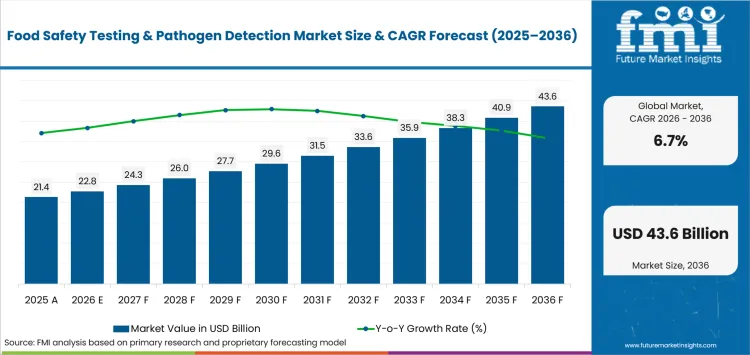
- Market Size (2026)
- USD 22.8 Bn
- Forecast (2036)
- USD 43.6 Bn
- CAGR (2026 to 2036)
- 6.7%
How big is Food Safety Testing & Pathogen Detection Market in 2026?
USD 22.8 billion in 2026 and USD 43.6 billion by 2036 at a 6.7% CAGR.
Food safety testing and pathogen detection demand is projected to increase valuation from USD 22.8 billion in 2026 to USD 43.6 billion by 2036, at a 6.7% CAGR supported by scheduled surveillance and faster confirmation in processing plants and accredited laboratories. The European Food Safety Authority reported in January 2026 that more than 350,000 human foodborne zoonotic cases are recorded annually in the European Union. The authority also states that food operators and national agencies test products against defined Salmonella and Listeria safety criteria. Demand for food safety testing services therefore grows through environmental samples and finished-product checks that guide release decisions and contamination investigations.
United States meat and poultry plants operate under federal sampling projects that define product eligibility and laboratory submission requirements. FSIS revised its ready-to-eat program in January 2025 by combining Listeria monocytogenes and Salmonella product sampling under one project. China revised its national food sampling rules in April 2025 to assign risk-based duties to national and local authorities. Effective pathogen detection programs must support scheduled testing and defensible confirmation under both regulatory systems. American laboratories need dependable capacity during assigned sampling windows and clear escalation routes for positive findings. Chinese laboratories require broad standards coverage and consistent reporting among provincial inspection programs and regional authorities. Different operating rules shape recurring testing orders more directly than general food-manufacturing output in either country.
Key Takeaways of Food Safety Testing & Pathogen Detection Market
- Demand for food safety testing and pathogen detection is driven by recurring pathogen surveillance generating routine environmental and finished-product testing across food processors and accredited laboratories.
- By type, pathogen testing holds the leading share at 39.0% in 2026, due to recurring Salmonella and Listeria surveillance in regulated food operations.
- PCR is the dominant technology segment, holding 59.1% share in 2026, owing to sensitive target detection and standardized digital interpretation for several food matrices.
- Meat accounts for 45.6% food-tested share in 2026, through frequent official controls and contamination exposure in animal-processing facilities.
- GMO and residue testing require separate preparation methods and documentation for cross-border food programs, adding complexity beyond routine pathogen and PCR-based workflows.
- India, China, and the USA record CAGRs of 8.0%, 7.6%, and 7.2% respectively through 2036, while Germany and the UK combine mature control systems with different surveillance and laboratory investment requirements.
- Competition centers on SGS, Eurofins Scientific, Intertek, Mérieux NutriSciences, Neogen Corporation, bioMérieux, Hygiena, and Bio-Rad Laboratories, with vendors differentiating through laboratory coverage breadth, regional sample access, and rapid molecular assay development.
Analyst Perspective
Commercial confidence in food safety testing hinges on consistency for the intended matrix under normal production schedules, not on assay speed alone. A rapid PCR result carries limited value if the laboratory lacks dependable confirmation capacity and a clear corrective-action route once a presumptive positive surfaces. Regional collection logistics deserve the same scrutiny as instrument performance, since per-test reagent costs and sample transport time at distributed sites can quietly determine whether a testing program stays financially sustainable. Service agreements should spell out turnaround commitments and escalation responsibilities for every presumptive-positive investigation before they're needed, not after.
-Nikhil Kaitwade, Principal Analyst at Future Market Insights
Source: FMI's proprietary forecasting model and primary research
How is the Food Safety Testing Pathogen Detection Market segmented?
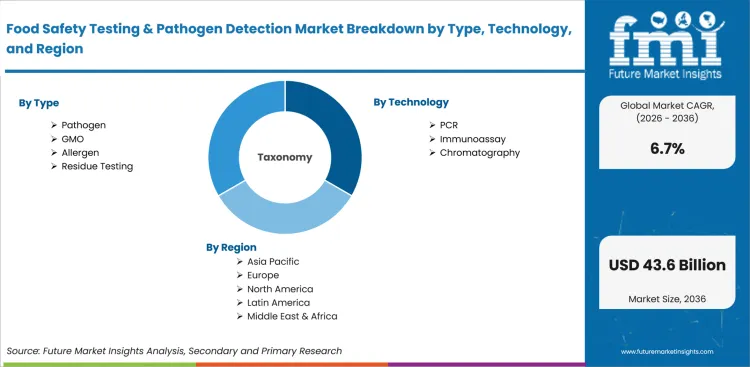
The market is segmented by type and technology along with food tested and region to distinguish hazards from testing methods and product groups.
Segmentation separates the hazard being measured from the analytical method and the food matrix entering each laboratory. Type analysis covers pathogen and GMO testing alongside allergen and residue testing through different preparation and confirmation needs. Technology analysis compares PCR with immunoassay and chromatography by turnaround speed and target sensitivity during routine workflows. Food tested analysis covers meat and dairy alongside produce through matrix interference and sample-handling requirements. Regional analysis considers laboratory accreditation and official sampling programs that influence recurring testing demand in each geography. Commercial food diagnostics services connect these categories with release decisions at processing sites and laboratory networks. Related food authenticity testing uses some molecular infrastructure but answers separate identity and origin questions.
What supports demand for pathogen within the type category?
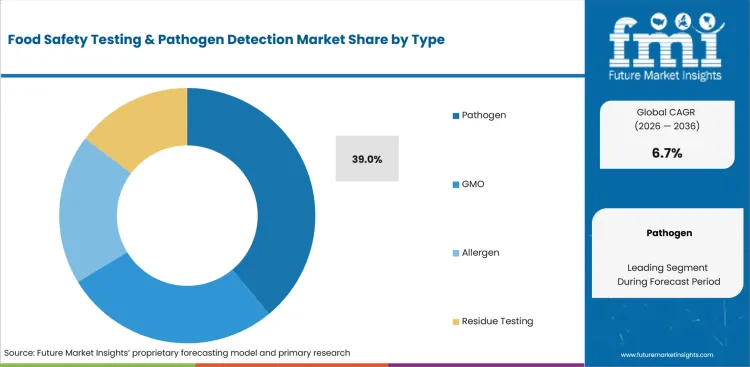
Pathogen testing addresses contamination risks that can interrupt production and trigger expensive product withdrawals in several food categories. In January 2025, Neogen launched a quantitative Salmonella molecular assay that reports numerical contamination results through its established detection platform. The assay gives poultry laboratories another route for measuring intervention performance rather than recording a simple positive result. Food plants can compare numerical findings over repeated production periods and identify weak controls earlier. The rapid microbiology testing approach strengthens this segment through evidence that narrows sanitation investigations and supports defensible release decisions.
- Pathogen is set to lead the type category with 39.0% share in 2026 due to recurring Salmonella and Listeria surveillance in regulated food operations. Environmental samples and finished-product checks create repeat laboratory work for high-throughput processing plants during normal production schedules. The segment carries direct financial exposure through delayed release and contaminated lots that require corrective action.
- Food processors adopt pathogen testing to verify sanitation controls and document corrective action over repeated production runs. Environmental monitoring and finished-product release answer different operating questions and therefore require separate sampling plans. Laboratory managers also need escalation rules for presumptive results and dependable confirmation capacity during urgent investigations. Adoption becomes durable through consistent turnaround and clear interpretation under routine schedules and contamination events.
How does PCR shape demand within the technology category?
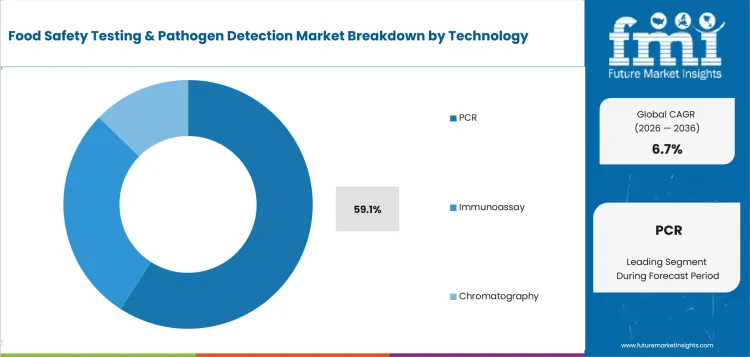
PCR shortens the interval between enrichment and a targeted molecular result during routine food safety workflows. In February 2025, bioMérieux launched GENE-UP TYPER for rapid Listeria monocytogenes strain characterization and root-cause analysis. The system combines a real-time PCR assay with a web application that groups related contamination strains. Laboratories can compare strain patterns from different production areas and focus sanitation work on recurring routes. The launch supports faster investigations following an initial positive result in food processing environments and recurring sanitation reviews.
- PCR is projected to hold 59.1% share in 2026 owing to sensitive target detection and standardized interpretation for several food matrices. Shared thermocycling platforms and digital interpretation support several screening and confirmation programs in one laboratory. Disciplined enrichment and contamination controls remain essential for reliable performance during every analytical run in routine laboratory operations.
- Food manufacturers adopt PCR to protect release schedules and reduce extended inventory holds in high-volume facilities. Target-specific DNA methods also support food allergen testing in processed matrices that limit visual identification. Weak enrichment and sample preparation can remove the analytical advantage despite strong instrument performance in routine laboratory use. Adoption expands through dependable controls and confirmation routes that satisfy local rules in commercial laboratory networks.
Why is meat central to the food tested category?
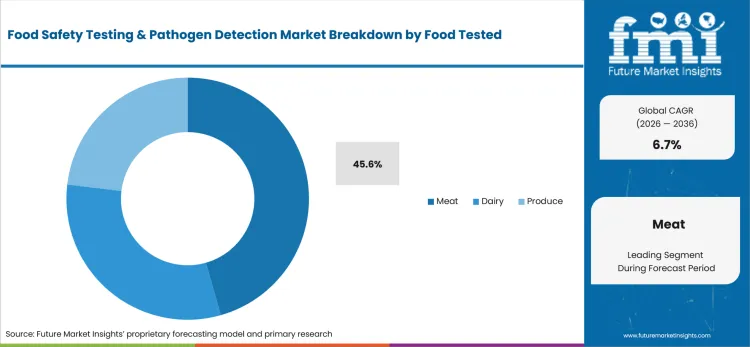
Slaughter and processing create several points for microbial transfer, which gives meat testing high commercial importance. In January 2025, FSIS announced that raw poultry sampling frequency would use monthly production volume instead of daily production volume. The revised approach expands eligibility and aligns verification activity more closely with sustained output at regulated establishments. Animal processors therefore need methods that recover target organisms from variable fat and protein conditions. Export-oriented residue testing services also help meat exporters meet destination-specific contaminant limits and documented release requirements.
- By food tested, meat is estimated to hold 45.6% in 2026 owing to recurring official controls and contamination exposure in animal processing. Sampling covers raw products and ready-to-eat lines alongside environmental surfaces under recurring schedules in defined facility zones. The segment carries substantial financial consequences through delayed release and confirmed contamination in high-throughput operations.
- Meat processors adopt testing systems that handle fat and protein interference without weakening pathogen recovery or result interpretation. Laboratories need matrix-specific enrichment and validated confirmation methods for beef and poultry surveillance programs within regulated production systems. Processing plants also require dependable cold-chain transport for samples collected from distant slaughter and production facilities. Adoption strengthens through local collection routes and validated methods matched to the meat category under investigation.
What are the drivers, restraints, and opportunities in the Food Safety Testing Pathogen Detection Market?
Routine surveillance creates recurring pathogen screening throughout processing environments and finished food lots during normal production schedules. Uneven laboratory infrastructure extends sample transport and confirmation in dispersed production regions outside major testing clusters. Integrated molecular evidence supports faster root-cause investigations and more targeted corrective action in food plants.
- Driver: Routine surveillance creates recurring pathogen screening requirements across production environments and finished food lots throughout normal operating schedules.
- Restraint: Uneven laboratory infrastructure extends turnaround and limits advanced microbiology coverage across regions with dispersed processing facilities.
- Opportunity: Integrated molecular data connects positive results with root-cause investigation and documented corrective action across processing environments.
Public surveillance investment supports recurring testing through wider genomic coverage and stronger information exchange in national food systems. The United Kingdom Food Standards Agency reported in September 2025 that PATH-SAFE involved thirty projects and more than sixty-five delivery partners. The program also produced 18,000 genome sequences and shared tools among participating surveillance organizations. Shared genomic records help national agencies compare contamination signals and coordinate investigations across laboratory and public-health networks.
Laboratory access remains a restraint in regions that lack advanced microbiology capacity and dependable sample transport. India's Ministry of Health and Family Welfare reported in December 2025 that authorities had upgraded forty-seven state laboratories and established thirty-four microbiology laboratories. The same release recorded 305 mobile testing laboratories against funding for 541 units in states and union territories. The remaining infrastructure gap can extend travel and confirmation times for processing sites outside major testing clusters.
Integrated molecular workflows create an opportunity to screen related hazards during one validated analytical run. In May 2025, Hygiena launched an ISO 16140-2 validated multiplex PCR assay for Salmonella and Cronobacter. The system combines both targets within one workflow for dry-food and infant-formula production environments under routine production schedules. Combined screening can reduce duplicate sample preparation and release laboratory capacity for separate confirmation work.
Which country CAGRs are profiled in the Food Safety Testing Pathogen Detection Market?
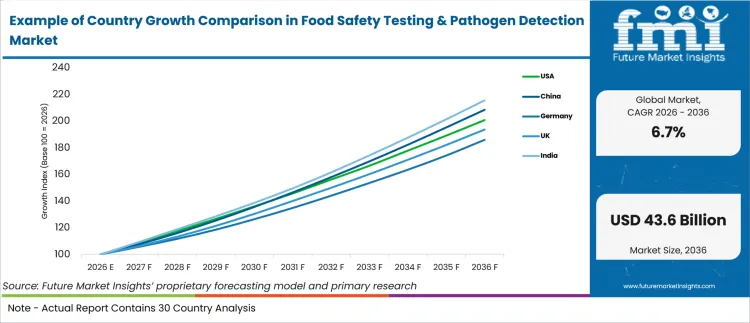
| Country | CAGR |
|---|---|
| USA | 7.2% |
| China | 7.6% |
| Germany | 6.4% |
| UK | 6.8% |
| India | 8.0% |
How do country-level CAGRs compare in the Food Safety Testing Pathogen Detection Market?
The five country forecasts form a narrow 1.6 percentage-point range between India and Germany across the comparison. India and China occupy the upper band while the USA and UK remain closely grouped below them. Germany follows with a smaller difference from the middle group than the table order alone suggests. The compact spread indicates broadly similar market momentum despite different laboratory systems and regulatory conditions.
- India and China are separated by 0.4 percentage points, which creates the closest upper growth cluster within the comparison.
- China and the USA also differ by 0.4 percentage points despite distinct national sampling systems and laboratory access models.
- The USA remains 0.4 percentage points above the UK across the approved forecast set and comparable commercial planning horizon.
- The UK exceeds Germany by 0.4 percentage points even though both countries operate mature food control and laboratory systems.
- Similar forecast rates do not remove differences in sample transport and accreditation coverage across the five country markets.
Country CAGR supports sequencing but does not measure the starting revenue pool or laboratory capacity available within each geography. The full report provides country-level CAGR analysis across North America, Latin America, Europe, East Asia, South Asia, Oceania and the Middle East and Africa.
Country-wise Analysis
- Federal verification rules shape pathogen testing at United States meat and poultry establishments through defined inspection and sampling activities. The USA food safety testing sector records 7.2% CAGR during the assessment period, supported by recurring inspection schedules and established laboratory networks. FSIS revised its food safety verification directive in January 2025 and defined inspection activities for establishment systems. A large accredited laboratory network supports recurring confirmation and investigation work in major production regions. Rural sample transport and uneven local turnaround can delay corrective decisions outside dense laboratory clusters. Food companies need service plans that separate routine screening capacity from urgent confirmation during contamination events.
- China coordinates national and local sampling through risk-based plans that cover several regulated food categories. Food safety testing sales in China expand at 7.6% CAGR by 2036, reinforced by national sampling plans and coordinated provincial coverage. SAMR reported in November 2025 that national sampling covered thirty-nine major food categories and 2,066 indicators. Broad official coverage creates recurring work for laboratories that support several standards within one network. Provincial reporting rules and long transport distances can complicate consistent turnaround in less concentrated production regions. Laboratory groups need standards expertise and local sample routes that match each authority's operating program.
- Germany combines accredited laboratory access with an established rapid-alert system for food and feed investigations. Germany's food safety testing outlook advances at 6.4% CAGR over the assessment period, underpinned by established alert reporting and formal control systems. BVL reported in July 2025 that the European rapid-alert network recorded more than 5,300 notifications during 2024. The notification volume creates follow-up testing and traceability work for imported and domestically produced food. Strict method documentation and labor costs can lengthen laboratory qualification for smaller processing companies in regional markets. Testing providers need efficient confirmation workflows that support rapid investigations without weakening accreditation controls during formal laboratory operations.
- United Kingdom food laboratories support national surveillance programs alongside routine testing for processors and retailers. The UK's food safety testing market grows at 6.8% CAGR by 2036 through renewed pathogen surveillance investment and laboratory reporting. The Food Standards Agency reported in June 2026 that laboratory-confirmed Campylobacter and Salmonella cases increased 17.1% during 2025. The agency also noted that wider multiplex PCR use contributed to improved case detection in surveillance systems. Changes in diagnostic practice can alter case counts alongside underlying incidence and complicate surveillance interpretation. Laboratories need clear confirmation rules that separate surveillance signals from direct production-control decisions in regulated food operations.
- India combines expanding notified laboratory coverage with long travel distances between many food production sites and advanced microbiology facilities. Food safety testing demand in India rises at 8.0% CAGR over the forecast period, shaped by updated laboratory notifications and wider regional access. FSSAI published an updated notification of NABL-accredited food laboratories in June 2025 for several Indian regions. The notification identifies laboratories authorized to support regulated testing under the national food safety system. Long transport routes and limited advanced confirmation capacity remain material frictions outside major urban clusters. Service models need regional collection routes and clear referral pathways for complex pathogen findings in distant production areas.
Who are the notable companies in the Food Safety Testing Pathogen Detection Market?
The notable companies shaping this market include SGS; Eurofins Scientific; Intertek; Mérieux NutriSciences; Neogen Corporation; bioMérieux; Hygiena; and Bio-Rad Laboratories.
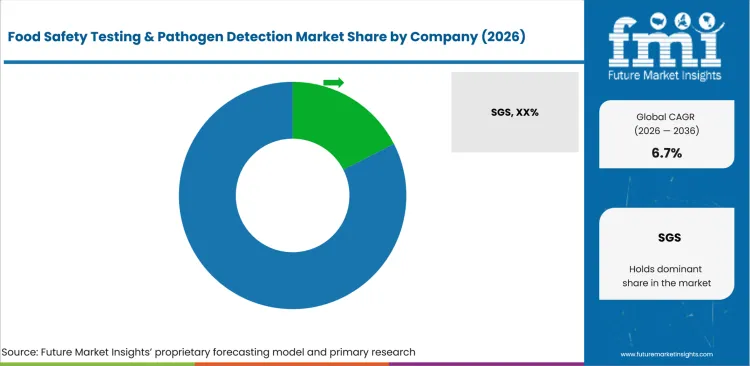
The competitive field combines outsourced laboratory networks with assay developers that support testing inside food plants. SGS and Eurofins Scientific provide broad laboratory coverage for several food categories and regulatory programs. Intertek and Mérieux NutriSciences add regional sample access through multi-country networks and accredited laboratory locations. Neogen Corporation and bioMérieux focus on rapid molecular screening and contamination investigation in processing sites. Hygiena and Bio-Rad Laboratories provide validated workflows for pathogen detection and characterization in several food matrices. GMO testing services require specialized accreditation and method coverage that differ from routine pathogen screening. Laboratory groups supporting international food certification programs need consistent methods and accreditation across each participating production region.
- In March 2026, SGS expanded North American microbial testing through its acquisition of Murray-Brown Laboratories and added regional pathogen capacity. In January 2025, Eurofins reported new food microbiology laboratories in five states across the United States for meat and produce programs. Both expansions support testing and certification programs through shorter sample routes for routine release and contamination investigations.
- Intertek and Mérieux NutriSciences provide outsourced microbiology and chemistry testing through multi-country laboratory networks serving several food categories. Their regional facilities shorten sample travel for food companies that manage regulated products in several national markets. Program managers should compare local accreditation and method coverage before assigning one network to every product category.
- Rapid molecular platforms from Neogen Corporation and bioMérieux support screening and contamination investigation inside food operations. Hygiena adds multiplex pathogen workflows for infant-formula and dry-food environments through validated molecular testing systems. In March 2025, Bio-Rad Laboratories launched an automated Salmonella serotyping assay that supports faster characterization following detection. Laboratory directors should compare matrix validation and software integration before standardizing one platform in several plants.
Competitive Benchmarking: Food Safety Testing & Pathogen Detection Market
| Company | Pathogen Testing | Testing Workflow | Food Matrix Breadth | Geographic Reach |
|---|---|---|---|---|
| SGS | High | High | High | Global laboratory network |
| Eurofins Scientific | High | High | High | Global laboratory network |
| Intertek | High | High | High | Global laboratory network |
| Mérieux NutriSciences | High | High | High | Global laboratory network |
| Neogen Corporation | High | Medium | Medium | Global product distribution |
| bioMérieux | Medium | High | Medium | Global product distribution |
| Hygiena | Medium | Medium | Medium | Global product distribution |
| Bio-Rad Laboratories | Medium | Medium | Medium | Global product distribution |
Key Developments in the Food Safety Testing & Pathogen Detection Market
- In July 2025, Neogen launched Molecular Detection Assay Listeria Right Now for enrichment-free environmental testing. The assay produces results in about two hours and processes as many as ninety-six samples during one run. Food plants can complete surface checks and sanitation decisions during the same production shift in monitored areas. The launch reduces the delay between environmental sampling and documented corrective action in routine Listeria monitoring programs.
- In June 2026, bioMérieux introduced GENE-UP TYPER SLM for rapid Salmonella strain discrimination in food production environments. The real-time PCR assay works with a web application that groups related strains and supports contamination tracing. The new assay extends the platform beyond its earlier Listeria application during food production investigations. Laboratories can compare recurring Salmonella findings from several production areas and direct sanitation work toward the likely contamination source.
- In November 2025, Intertek acquired Suplilab in Costa Rica and expanded food safety testing capacity in Central America. The acquired laboratory added microbiology and chemistry services for regional food production programs across Costa Rica and neighboring markets. Closer sample access can reduce transport time for contamination investigations and routine release testing at nearby production sites. The transaction strengthens Intertek's support for manufacturers that need accredited testing near facilities in several Central American countries.
- In September 2025, Mérieux NutriSciences completed its worldwide acquisition of Bureau Veritas' food testing activities. The transaction integrated operations in fifteen countries and added nearly 2,000 employees to the combined laboratory network. The enlarged organization reported a network exceeding 140 laboratories following the final closing in multiple regions. The larger footprint expands microbiological and molecular testing access in the Americas and Asia Pacific for multinational food programs.
Key Players in the Food Safety Testing & Pathogen Detection Market
Global Testing and Laboratory Networks
- SGS
- Eurofins Scientific
- Intertek
- Mérieux NutriSciences
Rapid Assay and Workflow Providers
- Hygiena
- Bio-Rad Laboratories
Molecular Detection Platform Providers
- Neogen Corporation
- bioMérieux
Food Safety Testing & Pathogen Detection Market - Report Scope
| Coverage field | Report scope |
|---|---|
| Market breakdown | Type, technology, food tested, and region. |
| Quantitative Units | USD billion, CAGR in %. |
| Market Definition | Revenue from laboratory testing services and instruments as well as assays and reagents used directly for food safety testing and pathogen detection. The scope covers screening and confirmation workflows across the named segment categories and regulated food applications. Adjacent laboratory activity without a direct food safety role remains outside the defined market boundary. |
| Regions Covered | North America, Latin America, Western Europe, Eastern Europe, East Asia, South Asia and Pacific, and Middle East and Africa. |
| Countries Covered | USA, China, Germany, UK, India, plus more than twenty-five additional countries across the regions covered. |
| Key Companies Profiled | SGS, Eurofins Scientific, Intertek, Mérieux NutriSciences, Neogen Corporation, bioMérieux, Hygiena, Bio-Rad Laboratories |
| Forecast Period | 2026 to 2036. |
| Approach | Hybrid bottom-up and top-down market sizing supported by primary interviews and authoritative official desk research. |
Food Safety Testing & Pathogen Detection Market - Research Methodology
| Method | Approach |
|---|---|
| Primary Research | FMI analysts gathered input from manufacturers, service providers, technology developers, distributors, end users, procurement teams, and subject-matter experts. Interviews examined purchasing decisions, product or service evaluation, adoption barriers, approval requirements, pricing considerations, and expectations for technical or commercial support. Respondents were also asked what evidence is required before a trial, pilot, or initial order develops into regular purchasing. |
| Desk Research | Desk research covered government statistics, regulatory publications, trade data, industry associations, technical literature, standards, company filings, product information, and official corporate announcements. Sources were reviewed for relevance, publication date, geographic coverage, and consistency with the defined market scope. Claims relating to performance, applications, approvals, capacity, investment, and commercial activity were retained only when supported by credible public evidence. |
| Market Sizing and Forecasting | The market model combined the baseline value with historical performance, segment structure, pricing and volume indicators, adoption levels, company participation, and country-level demand conditions. Forecast assumptions considered economic activity, investment trends, regulatory developments, technology adoption, purchasing cycles, supply availability, and barriers to wider market use. Segment and regional estimates were reconciled before the final market total was calculated. |
| Data Validation | Estimates were checked against multiple independent indicators, including public data, company activity, trade patterns, industry developments, and findings from primary interviews. Validation also tested whether products, services, applications, and company revenues fell within the defined market boundaries. Adjacent categories, unsupported claims, overlapping revenues, and activities without direct market relevance were excluded to reduce double counting and maintain consistency across segments and countries. |
Food Safety Testing & Pathogen Detection Market by Segments
Food Safety Testing & Pathogen Detection Market segmented by Type:
- Pathogen
- GMO
- Allergen
- Residue Testing
Food Safety Testing & Pathogen Detection Market segmented by Technology:
- PCR
- Immunoassay
- Chromatography
Food Safety Testing & Pathogen Detection Market segmented by Food Tested:
- Meat
- Dairy
- Produce
Food Safety Testing & Pathogen Detection Market by Region:
- North America
- United States
- Canada
- Latin America
- Brazil
- Mexico
- Argentina
- Chile
- Western Europe
- Germany
- France
- United Kingdom
- Italy
- Spain
- Benelux
- Nordics
- Eastern Europe
- Poland
- Czech Republic
- Romania
- Hungary
- East Asia
- China
- Japan
- South Korea
- South Asia and Pacific
- India
- ASEAN
- Australia and New Zealand
- Middle East and Africa
- GCC Countries
- South Africa
- Türkiye
- Israel
Research Sources and Bibliography
- European Food Safety Authority. (2026, January 6). Foodborne zoonotic diseases.
- USA Department of Agriculture, Food Safety and Inspection Service. (2025, January 17). FSIS Ready-To-Eat Sampling Programs - Revision 1.
- USA Department of Agriculture, Food Safety and Inspection Service. (2025, January 10). Verifying an Establishment's Food Safety System - Revision 8.
- USA Department of Agriculture, Food Safety and Inspection Service. (2025, January 17). Constituent Update - January 17, 2025.
- State Administration for Market Regulation. (2025, April 3).
- Food Standards Agency. (2025, September 29). FSA concludes major four-year PATH-SAFE programme enhancing UK surveillance of foodborne disease and antimicrobial resistance.
- Food Standards Agency. (2026, June 25). Foodborne Disease - Update.
- Bundesamt für Verbraucherschutz und Lebensmittelsicherheit. (2025, July 24). Gefährlicher Trend: Pilzgift Muscimol in Fruchtgummis.
- Ministry of Health and Family Welfare. (2025, December 2). Steps taken to strengthen food safety enforcement and adulteration control.
- Food Safety and Standards Authority of India. (2025, June 4). Gazette Notification of NABL Accredited Laboratories under section 43(1) of FSS Act.
- State Administration for Market Regulation. (2025, November 26).
- Neogen Corporation. (2025, January 16). Neogen® Launches New MDA2 Quantitative Salmonella Molecular Detection Assay.
- Neogen Corporation. (2025, July 28). Neogen® Expands its Pathogen Portfolio and Environmental Monitoring Solutions with a New Rapid Test for Listeria.
- bioMérieux. (2025, February 13). bioMérieux launches GENE-UP® TYPER, an innovative diagnostic solution for food industries to rapidly analyze the root cause of contamination of Listeria monocytogenes.
- bioMérieux. (2026, June 18). bioMérieux introduces Salmonella testing kit on GENE-UP® TYPER to support root cause analysis in the food industry.
- Intertek Group plc. (2025, November 3). Intertek expands ATIC footprint in Central America with acquisition of leading Costa Rican testing business Suplilab.
- Mérieux NutriSciences. (2025, September 3). Mérieux NutriSciences Completes Global Acquisition of Bureau Veritas’ Food Testing Business.
- SGS. (2026, March 22). SGS Acquires Murray-Brown Laboratories, Expanding Food Safety and Nutraceutical Testing Capabilities in North America.
- Eurofins Scientific. (2025, January 30). Eurofins achieves new record level of annual revenues while demonstrating a strong increase in margins and cash generation and returns to its pre-COVID profitability and cash flow growth trends.
- Hygiena. (2025, May 20). Hygiena® Becomes First Manufacturer with ISO 16140-2 Validation for Multiplex RT-PCR Detection of Salmonella and Cronobacter.
- Bio-Rad Laboratories. (2025, March 10). Bio-Rad Launches XP-Design Assay Salmonella Serotyping Solution for Rapid and Accurate Food Safety Testing.
This bibliography is provided for reader reference and is not exhaustive. The full report contains the complete reference list and detailed citations
This Report Answers
- How large is the Food Safety Testing & Pathogen Detection Market in 2026 and 2036?
- Which regulatory and operating pressures support recurring pathogen testing across food production facilities?
- Why is pathogen central to the type category during 2026?
- How does PCR support faster detection and root-cause analysis across food testing workflows?
- Why is meat central to the food tested category during 2026?
- How do approved country CAGRs compare across the USA, China, Germany, UK, and India?
- Which companies provide laboratory networks or rapid molecular platforms for food safety programs?
- What infrastructure gaps can delay sample processing and confirmation across regional laboratory systems?
- Which recent launches and acquisitions are reshaping pathogen testing capacity and workflow design?
Frequently Asked Questions
How big is the Food Safety Testing & Pathogen Detection Market in 2026?
The food safety testing and pathogen detection market is valued at USD 22.8 billion in 2026 and is forecast to reach USD 43.6 billion by 2036. Growth reflects scheduled surveillance and faster confirmation across processing plants and accredited laboratories responding to recurring foodborne contamination risks worldwide.
What is the CAGR of the Food Safety Testing & Pathogen Detection Market from 2026 to 2036?
The food safety testing and pathogen detection market grows at a CAGR of 6.7% between 2026 and 2036, supported by routine surveillance that creates recurring pathogen screening requirements across production environments and finished food lots throughout normal operating schedules.
Which technology leads the Food Safety Testing & Pathogen Detection Market?
PCR accounts for 59.1% of the food safety testing and pathogen detection market by technology in 2026, owing to sensitive target detection and standardized digital interpretation that support several screening and confirmation programs within one laboratory workflow.
How much will the Food Safety Testing & Pathogen Detection Market add between 2026 and 2036?
The food safety testing and pathogen detection market is set to add USD 20.8 billion between 2026 and 2036, growing from USD 22.8 billion to USD 43.6 billion as molecular screening capacity extends across a widening base of processing plants and accredited laboratory networks.
Who are the leading companies in the Food Safety Testing & Pathogen Detection Market?
Five companies lead the food safety testing and pathogen detection market, including SGS, Eurofins Scientific, Intertek, Mérieux NutriSciences, and Neogen Corporation, competing through laboratory coverage breadth, regional sample access, and rapid molecular assay development.
Preview the report firsthand - request a free sample
Get SampleGet the brochure for pricing and purchase details.
Get PDFTable of Content
- Key Takeaways
- Market Size and CAGR
- Top Growth Driver
- Fastest Growing Segment
- Leading Region
- Key Companies
- Emerging Opportunities
- Executive Summary
- Global Market Outlook
- Demand-side Trends
- Supply-side Trends
- Technology Roadmap Analysis
- Analysis and Recommendations
- Analyst Perspective (What is happening? Why now? What should investors know?)
- Key Questions Answered
- How large is the market?
- What is the CAGR?
- What are key trends?
- Which region dominates?
- Who are the leaders?
- Market Overview
- Market Coverage / Taxonomy
- Market Definition / Scope / Limitations
- Research Methodology
- Chapter Orientation
- Analytical Lens and Working Hypotheses
- Market Structure, Signals, and Trend Drivers
- Benchmarking and Cross-market Comparability
- Market Sizing, Forecasting, and Opportunity Mapping
- Research Design and Evidence Framework
- Desk Research Programme (Secondary Evidence)
- Expert Input and Fieldwork (Primary Evidence)
- Tooling, Models, and Reference Databases
- Data Engineering and Model Build
- Quality Assurance and Audit Trail
- Market Background
- Market Dynamics (Drivers, Restraints, Opportunity, Trends)
- Scenario Forecast (Optimistic, Likely, Conservative)
- Impact Analysis
- AI Impact
- Sustainability Impact
- Regulatory Impact
- Technology Impact
- Consumer / Buyer Analysis
- Purchase Drivers
- Adoption Barriers
- Buyer Journey
- Opportunity Map Analysis
- Product Life Cycle Analysis
- Supply Chain Analysis
- Investment Feasibility Matrix
- Value Chain Analysis
- PESTLE and Porter's Analysis
- Regulatory Landscape
- Regional Parent Market Outlook
- Production and Consumption Statistics
- Import and Export Statistics
- Global Market Analysis and Forecast, 2021 to 2036
- Historical Market Size Value (USD Billion) Analysis, 2021 to 2025
- Current and Future Market Size Value (USD Billion) Projections, 2026 to 2036
- Y-o-Y Growth Trend Analysis
- Absolute $ Opportunity Analysis
- Global Market Pricing Analysis, 2021 to 2036
- Global Market Analysis and Forecast, By Type, 2021 to 2036
- Introduction / Key Findings
- Historical Market Size Value (USD Billion) Analysis By Type, 2021 to 2025
- Current and Future Market Size Value (USD Billion) Analysis and Forecast By Type, 2026 to 2036
- Pathogen
- GMO
- Allergen
- Residue Testing
- Pathogen
- Y-o-Y Growth Trend Analysis By Type, 2021 to 2025
- Absolute $ Opportunity Analysis By Type, 2026 to 2036
- Global Market Analysis and Forecast, By Technology, 2021 to 2036
- Introduction / Key Findings
- Historical Market Size Value (USD Billion) Analysis By Technology, 2021 to 2025
- Current and Future Market Size Value (USD Billion) Analysis and Forecast By Technology, 2026 to 2036
- PCR
- Immunoassay
- Chromatography
- PCR
- Y-o-Y Growth Trend Analysis By Technology, 2021 to 2025
- Absolute $ Opportunity Analysis By Technology, 2026 to 2036
- Global Market Analysis and Forecast, By Food Tested, 2021 to 2036
- Introduction / Key Findings
- Historical Market Size Value (USD Billion) Analysis By Food Tested, 2021 to 2025
- Current and Future Market Size Value (USD Billion) Analysis and Forecast By Food Tested, 2026 to 2036
- Meat
- Dairy
- Produce
- Meat
- Y-o-Y Growth Trend Analysis By Food Tested, 2021 to 2025
- Absolute $ Opportunity Analysis By Food Tested, 2026 to 2036
- Global Market Analysis and Forecast, By Region, 2021 to 2036
- Introduction
- Historical Market Size Value (USD Billion) Analysis By Region, 2021 to 2025
- Current Market Size Value (USD Billion) Analysis and Forecast By Region, 2026 to 2036
- North America
- Latin America
- Western Europe
- Eastern Europe
- East Asia
- South Asia and Pacific
- Middle East & Africa
- Market Attractiveness Analysis By Region
- North America Market Analysis and Forecast, By Country, 2021 to 2036
- Historical Market Size Value (USD Billion) Trend Analysis By Market Taxonomy, 2021 to 2025
- Market Size Value (USD Billion) Forecast By Market Taxonomy, 2026 to 2036
- By Country
- USA
- Canada
- By Type
- By Technology
- By Food Tested
- By Country
- Market Attractiveness Analysis
- By Country
- By Type
- By Technology
- By Food Tested
- Key Takeaways
- Latin America Market Analysis and Forecast, By Country
- Historical Market Size Value (USD Billion) Trend Analysis By Market Taxonomy, 2021 to 2025
- Market Size Value (USD Billion) Forecast By Market Taxonomy, 2026 to 2036
- By Country
- Brazil
- Mexico
- Chile
- Rest of Latin America
- By Type
- By Technology
- By Food Tested
- By Country
- Market Attractiveness Analysis
- By Country
- By Type
- By Technology
- By Food Tested
- Key Takeaways
- Western Europe Market Analysis and Forecast, By Country
- Historical Market Size Value (USD Billion) Trend Analysis By Market Taxonomy, 2021 to 2025
- Market Size Value (USD Billion) Forecast By Market Taxonomy, 2026 to 2036
- By Country
- Germany
- UK
- Italy
- Spain
- France
- Nordic
- BENELUX
- Rest of Western Europe
- By Type
- By Technology
- By Food Tested
- By Country
- Market Attractiveness Analysis
- By Country
- By Type
- By Technology
- By Food Tested
- Key Takeaways
- Eastern Europe Market Analysis and Forecast, By Country
- Historical Market Size Value (USD Billion) Trend Analysis By Market Taxonomy, 2021 to 2025
- Market Size Value (USD Billion) Forecast By Market Taxonomy, 2026 to 2036
- By Country
- Russia
- Poland
- Hungary
- Balkan & Baltic
- Rest of Eastern Europe
- By Type
- By Technology
- By Food Tested
- By Country
- Market Attractiveness Analysis
- By Country
- By Type
- By Technology
- By Food Tested
- Key Takeaways
- East Asia Market Analysis and Forecast, By Country
- Historical Market Size Value (USD Billion) Trend Analysis By Market Taxonomy, 2021 to 2025
- Market Size Value (USD Billion) Forecast By Market Taxonomy, 2026 to 2036
- By Country
- China
- Japan
- South Korea
- By Type
- By Technology
- By Food Tested
- By Country
- Market Attractiveness Analysis
- By Country
- By Type
- By Technology
- By Food Tested
- Key Takeaways
- South Asia and Pacific Market Analysis and Forecast, By Country
- Historical Market Size Value (USD Billion) Trend Analysis By Market Taxonomy, 2021 to 2025
- Market Size Value (USD Billion) Forecast By Market Taxonomy, 2026 to 2036
- By Country
- India
- ASEAN
- Australia & New Zealand
- Rest of South Asia and Pacific
- By Type
- By Technology
- By Food Tested
- By Country
- Market Attractiveness Analysis
- By Country
- By Type
- By Technology
- By Food Tested
- Key Takeaways
- Middle East & Africa Market Analysis and Forecast, By Country
- Historical Market Size Value (USD Billion) Trend Analysis By Market Taxonomy, 2021 to 2025
- Market Size Value (USD Billion) Forecast By Market Taxonomy, 2026 to 2036
- By Country
- Kingdom of Saudi Arabia
- Other GCC Countries
- Türkiye
- South Africa
- Other African Union
- Rest of Middle East & Africa
- By Type
- By Technology
- By Food Tested
- By Country
- Market Attractiveness Analysis
- By Country
- By Type
- By Technology
- By Food Tested
- Key Takeaways
- Key Countries Market Analysis
- USA
- Pricing Analysis
- Market Share Analysis, 2025
- By Type
- By Technology
- By Food Tested
- Canada
- Pricing Analysis
- Market Share Analysis, 2025
- By Type
- By Technology
- By Food Tested
- Mexico
- Pricing Analysis
- Market Share Analysis, 2025
- By Type
- By Technology
- By Food Tested
- Brazil
- Pricing Analysis
- Market Share Analysis, 2025
- By Type
- By Technology
- By Food Tested
- Chile
- Pricing Analysis
- Market Share Analysis, 2025
- By Type
- By Technology
- By Food Tested
- Germany
- Pricing Analysis
- Market Share Analysis, 2025
- By Type
- By Technology
- By Food Tested
- UK
- Pricing Analysis
- Market Share Analysis, 2025
- By Type
- By Technology
- By Food Tested
- Italy
- Pricing Analysis
- Market Share Analysis, 2025
- By Type
- By Technology
- By Food Tested
- Spain
- Pricing Analysis
- Market Share Analysis, 2025
- By Type
- By Technology
- By Food Tested
- France
- Pricing Analysis
- Market Share Analysis, 2025
- By Type
- By Technology
- By Food Tested
- India
- Pricing Analysis
- Market Share Analysis, 2025
- By Type
- By Technology
- By Food Tested
- ASEAN
- Pricing Analysis
- Market Share Analysis, 2025
- By Type
- By Technology
- By Food Tested
- Australia & New Zealand
- Pricing Analysis
- Market Share Analysis, 2025
- By Type
- By Technology
- By Food Tested
- China
- Pricing Analysis
- Market Share Analysis, 2025
- By Type
- By Technology
- By Food Tested
- Japan
- Pricing Analysis
- Market Share Analysis, 2025
- By Type
- By Technology
- By Food Tested
- South Korea
- Pricing Analysis
- Market Share Analysis, 2025
- By Type
- By Technology
- By Food Tested
- Russia
- Pricing Analysis
- Market Share Analysis, 2025
- By Type
- By Technology
- By Food Tested
- Poland
- Pricing Analysis
- Market Share Analysis, 2025
- By Type
- By Technology
- By Food Tested
- Hungary
- Pricing Analysis
- Market Share Analysis, 2025
- By Type
- By Technology
- By Food Tested
- Kingdom of Saudi Arabia
- Pricing Analysis
- Market Share Analysis, 2025
- By Type
- By Technology
- By Food Tested
- Türkiye
- Pricing Analysis
- Market Share Analysis, 2025
- By Type
- By Technology
- By Food Tested
- South Africa
- Pricing Analysis
- Market Share Analysis, 2025
- By Type
- By Technology
- By Food Tested
- USA
- Market Structure Analysis
- Competition Dashboard
- Competition Benchmarking
- Market Share Analysis of Top Players
- By Regional
- By Type
- By Technology
- By Food Tested
- Emerging Startups
- Innovation Benchmarking
- Competition Analysis
- Competition Deep Dive
- SGS
- Overview
- Product Portfolio
- Profitability by Market Segments
- Sales Footprint
- Strategy Overview
- Marketing Strategy
- Product Strategy
- Channel Strategy
- Eurofins
- Bureau Veritas
- Intertek
- Neogen
- Merck
- Thermo Fisher
- 3M (Neogen)
- SGS
- Case Studies
- Success Stories
- Recent Developments
- Competition Deep Dive
- Assumptions & Acronyms Used


