

- Industry Size (2026)
- USD 3.2 Bn in 2026
- Forecast (2036)
- USD 10.5 Bn
- CAGR (2026 to 2036)
- 12.70%
AI-Enabled Semiconductor Defect Classification and Review Systems Market Size, Market Forecast and Outlook By FMI
The AI semiconductor defect classification market was valued at USD 2.8 billion in 2025. Revenue is poised to surpass USD 3.2 billion in 2026, driven by a semiconductor defect review CAGR of 12.70% during the forecast period. Continued capital investment is set to drive the semiconductor review systems market to USD 10.5 billion by 2036, as the growing complexity of advanced packaging elevates inspection demands beyond the capabilities of traditional human optical analysis.
Yield-management directors at leading-edge foundries evaluating the semiconductor defect review systems market are actively calculating how quickly they can strip manual review out of their high-volume manufacturing lines. Delaying this transition effectively caps wafer throughput because sub-7nm design rules produce defect signatures too subtle for legacy algorithms. What equipment buyers rarely factor into their semiconductor defect classification platform pricing models is that integrating ai industrial defect detection creates immediate friction with existing fab server architecture, forcing simultaneous upgrades in data transport infrastructure.
Once process control teams automate the nuisance-defect filtering layer, optical review tools suddenly handle triple their historical sampling rates. Passing this operational threshold validates the ROI of AI-based automated defect classification in fabs, shifting the factory bottleneck from defect discovery to root-cause correlation.
Summary of AI-Enabled Semiconductor Defect Classification and Review Systems Market
- AI-Enabled Semiconductor Defect Classification and Review Systems Market Definition
- Infrastructure utilizing machine learning to categorize and correlate wafer anomalies, replacing rule-based filtering with neural networks to isolate critical defects during semiconductor fabrication.
- Demand Drivers in the Market
- Sub-7nm design rules force yield engineers to deploy deep learning for classifying defects invisible to legacy optical comparators.
- Advanced packaging complexity requires metrology directors to automate 3D interconnect inspection across heterogeneous dies.
- Escalating wafer costs and the necessity of reducing manual defect review time in wafer fabs compel fab operations managers to minimize false-positive review rates.
- Key Segments Analyzed in the FMI Report
- Automated defect classification software is projected to capture 36.0% share in 2026, anchoring the semiconductor defect classification software market through continuous algorithmic updates decoupled from hardware lifecycles.
- Tool-embedded AI inference is set to hold 41.0% share, minimizing latency during high-speed inline inspection routing.
- E-beam review and classification is estimated to command 39.0% share, providing the angstrom-level resolution required for leading-edge ground truth data.
- Leading-edge logic and foundry anticipated to record 34.0% share, dictated by the zero-tolerance yield parameters of extreme ultraviolet lithography layers.
- Integrated device manufacturers is poised to account for 33.0% share, leveraging closed-loop data ecosystems to train proprietary defect models.
- India: 14.8% compound growth, anchored by aggressive greenfield semiconductor facility capitalization.
- Analyst Opinion at FMI
- Sudip Saha, Principal Analyst, Technology, at FMI, observes, "Metrology directors assume upgrading optical review tools with AI models for semiconductor defect image classification will instantly clear their inspection bottlenecks. Deploying deep learning classification exposes severe bandwidth constraints within legacy fab networks. Pushing terabytes of uncompressed image data from the tool edge to a centralized yield server creates latency that forces tools to idle. The equipment vendor who solves the data transport architecture, rather than just optimizing the neural network, ultimately controls the classification footprint."
- Strategic Implications / Executive Takeaways
- Yield-management directors must prioritize edge-inference hardware to prevent fab networks from collapsing under image data payloads.
- Procurement heads face vendor lock-in as proprietary AI models become inextricably linked to specific defect libraries.
- Metrology vendors risk losing recurring software revenue if they cannot prove clear yield-learning acceleration to fab operations managers.
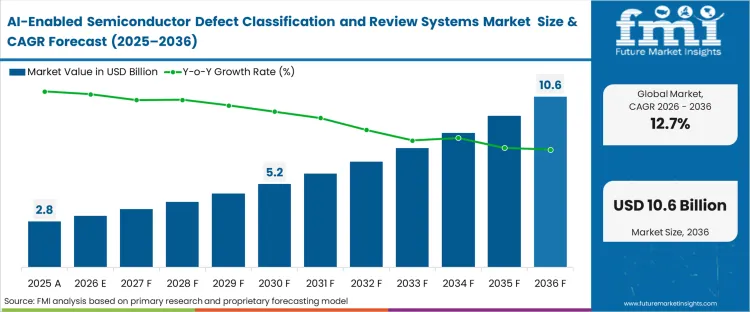
Key Takeaways
| Metric | Details |
|---|---|
| Industry Size (2026) | USD 3.2 billion |
| Industry Value (2036) | USD 10.5 billion |
| CAGR (2026 to 2036) | 12.70% |
Source: Future Market Insights (FMI) analysis, based on proprietary forecasting model and primary research
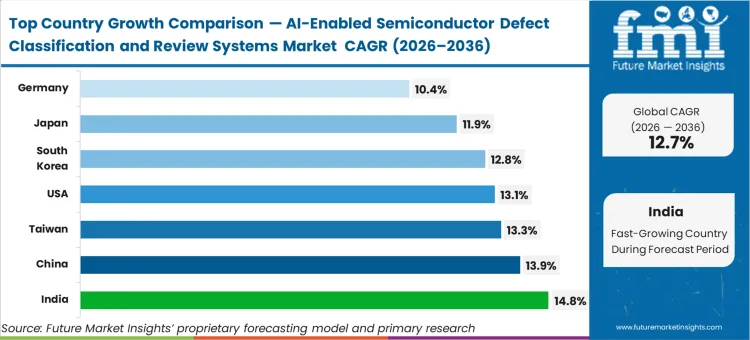
India leads at 14.8% as the emerging India semiconductor ADC market pulls in fresh review capacity from a zero baseline, while the China semiconductor defect review industry tracks at 13.9% on policy-led domestic ecosystem creation. Taiwan advances at 13.3% driven by advanced logic capacity additions, followed closely by the US semiconductor defect review systems market at 13.1%, leveraging CHIPS-backed infrastructure scaling. The South Korea AI defect review tools grows at 12.8% due to high-bandwidth memory intensity, and the Japan semiconductor review systems expand at 11.9% on Rapidus process-control reinvestment. Germany trails the global average at 10.4%, reflecting a concentration in mature-node automotive production rather than leading-edge volume.
AI-Enabled Semiconductor Defect Classification and Review Systems Market Definition
Understanding what automated defect classification in semiconductors is requires looking at the hardware and software infrastructure that applies machine learning algorithms to identify, categorise, and correlate anomalies on silicon. This operational category replaces deterministic, rule-based optical filtering with neural networks trained on proprietary yield data to distinguish killer defects from nuisance anomalies.
AI-Enabled Semiconductor Defect Classification and Review Systems Market Inclusions
Scope covers deep learning inference engines embedded directly on review tools, standalone fab defect image classification platform platforms, and hybrid edge-cloud systems. Evaluated hardware incorporates e-beam and optical platforms explicitly equipped with neural processing units or shipped with proprietary semiconductor metrology and inspection algorithms utilised specifically for wafer defect classification systems.
AI-Enabled Semiconductor Defect Classification and Review Systems Market Exclusions
Standard optical inspection tools relying solely on pixel-to-pixel comparative algorithms are omitted from this analysis because they lack self-learning capabilities. Bare wafer handling robotics without integrated inspection optics fall outside the research boundary. General-purpose enterprise AI software not specifically trained on semiconductor defect taxonomy is excluded from the AI-enabled defect review market boundary.
AI-Enabled Semiconductor Defect Classification and Review Systems Market Research Methodology
- Primary Research: Yield engineering directors, metrology equipment procurement heads, and fab operations managers
- Desk Research: SEC equipment filings, SEMI equipment billings reports, semiconductor process control symposium proceedings
- Market-Sizing and Forecasting: Installed base of optical and e-beam review tools multiplied by AI software attach rates
- Data Validation and Update Cycle: Foundry capital expenditure guidance cross-referenced with vendor quarterly software revenue
Segmental Analysis
AI-Enabled Semiconductor Defect Classification and Review Systems Market Analysis by System Type
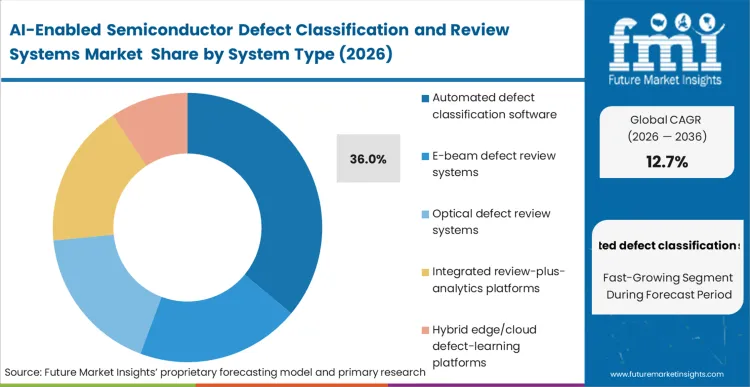
Software unbundling changes how procurement directors evaluate ADC software vendors for semiconductor fabs, decoupling the analytical brain from the optical iron. Automated defect classification software commands 36.0% share, dominating the automated defect classification semiconductor market, and FMI's assessment is that this figure understates the margin concentration: software layers generate the vast majority of vendor operating profit while hardware remains a lower-margin delivery vehicle. Yield managers purchase algorithmic capability rather than glass and metal, knowing neural network updates can extend a legacy tool's effective life by three nodes. What procurement directors rarely factor into their lifecycle modelling when evaluating rule-based ADC vs AI-based ADC in semiconductor fabs is that upgrading software continuously requires localised compute resources that older frames cannot support, forcing unexpected server upgrades. Failing to upgrade the underlying compute architecture results in classification algorithms timing out, turning an advanced wafer inspection system into a factory bottleneck.
- Evaluation trigger: Legacy rule-based filtering captures too many false positives during 5nm ramps. Yield directors must upgrade classification software to maintain throughput.
- Qualification validation: Deep learning models must demonstrate a high kill-ratio accuracy against human-verified ground truth data. Procurement heads approve rollout upon passing this metric.
- Expansion catalyst: Successful deployment on critical layers prompts horizontal expansion across non-critical steps. Fab operations managers drive this to standardize the AI yield learning systems for fabs.
AI-Enabled Semiconductor Defect Classification and Review Systems Market Analysis by Deployment Architecture
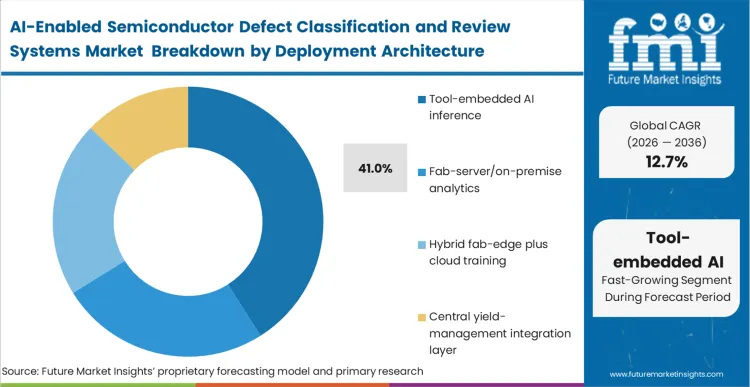
Latency dictates routing decisions during high-volume manufacturing, forcing intelligence to the absolute edge. Tool-embedded AI inference holds 41.0% share, heavily influencing inline defect review tools for semiconductors, because pushing uncompressed image data to a central server introduces milliseconds of delay that compounding across thousands of wafers destroys factory throughput metrics. In FMI's view, embedded architecture wins not on absolute analytical power, but on strict temporal compliance. Fab operations managers accept slightly less complex models if they execute locally within the mechanical transit time of the wafer stage. A non-obvious reality of embedded inference is that it fractures the fab's central intelligence, creating isolated pockets of learning that struggle to cross-correlate defects across different semiconductor capital equipment platforms. Relying entirely on localized inference without a cloud synchronization strategy ultimately blinds the yield engineering team to macro-level process drift.
- Procurement baseline: Tool-embedded processors eliminate secondary server capital expenditures. Procurement directors capture immediate cost savings on data transport infrastructure.
- Operational friction: Maintaining separate model versions across fifty standalone tools requires dedicated software engineers. Fab managers absorb hidden labor costs updating fragmented inference engines.
- Lifecycle comparison: Centralized servers scale computing power easily, whereas embedded chips remain fixed. Yield engineers face early obsolescence when future algorithms exceed the embedded processor's thermal limits.
AI-Enabled Semiconductor Defect Classification and Review Systems Market Analysis by Inspection/Review Modality
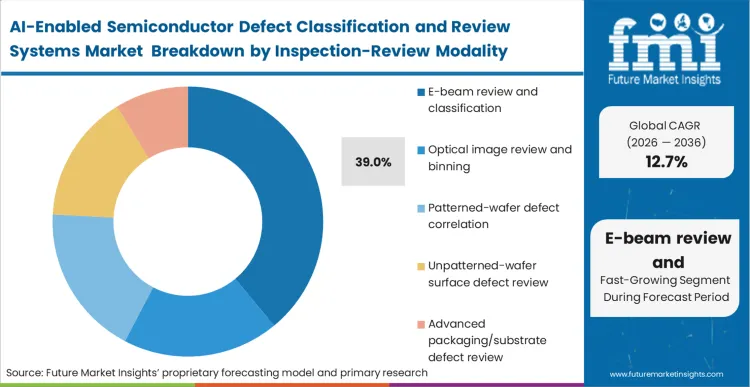
Resolution limits determine where machine learning provides the most value, driving growth in the e-beam defect review system market by pushing complex algorithms toward the slowest imaging technologies. E-beam review and classification retains 39.0% share as FMI analysts note that optical limits below 10nm force engineers utilising a defect review SEM for chip manufacturing to rely on electron beams for definitive ground truth. E-beam tools are notoriously slow, processing single-digit wafers per hour; applying AI to this specific modality prevents these tools from wasting hours imaging false positives. What the modality share figure obscures is the sequential dependency: analysing optical review vs e-beam review semiconductor defects reveals that e-beam AI models are fundamentally trained by the output of optical semiconductor defect inspection equipment, making the two modalities symbiotic rather than strictly competitive. Choosing an e-beam platform with incompatible data formatting prevents this automated handoff, severely restricting the metrology department's ability to correlate inline defects with physical failure mechanisms.
- Preventable failure: Rule-based e-beam review wastes extreme resolution on dust particles. Metrology directors deploy AI to filter out nuisance defects before imaging begins.
- Residual risk: AI models trained on one specific e-beam hardware configuration rarely transfer perfectly to a competitor's frame. Yield engineers must continuously retrain models after hardware changes.
- Value capture: Realizing the full throughput advantage requires integrating the e-beam classifier directly with the optical defect map. Integration specialists must write custom APIs to bridge disparate systems.
AI-Enabled Semiconductor Defect Classification and Review Systems Market Analysis by Application Node/Process Focus
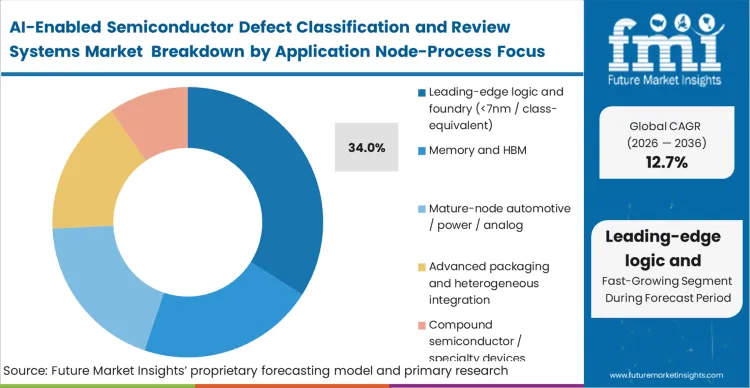
Node shrinkage exponentially increases the cost of missed excursions, justifying aggressive investment in unproven software. Leading-edge logic and foundry processes hold 34.0% share because extreme ultraviolet lithography layers possess defect margins so narrow that human operators cannot visually classify them with statistical reliability. According to FMI's estimates, sub-7nm foundries deploy wafer defect classification for logic fabs not for efficiency, but for basic functional viability. This segment dictates algorithmic development, forcing vendors to optimize for complex 3D transistor structures before addressing simpler planar geometries. Interestingly, algorithms optimized for 3nm gate-all-around structures frequently fail when applied backwards as semiconductor review systems for mature-node automotive chips because the defect taxonomy is fundamentally different, requiring complete retraining. Metrology heads who attempt to port leading-edge AI models directly to power device lines suffer massive false-alarm spikes, eroding operator trust in the automated semiconductor inspection system.
- Baseline expectation: Advanced node algorithms easily classify standard particle contamination. Yield managers treat this capability as table stakes during vendor evaluation.
- Edge deterioration: Deep learning struggles to categorize entirely novel defect types generated during the first weeks of a new node ramp. Process engineers must manually intervene until the model accumulates sufficient training data.
- Acceptability threshold: Foundries demand AI classification speeds that match the physical throughput of the inspection tool. Procurement heads reject any software that introduces mechanical idling.
AI-Enabled Semiconductor Defect Classification and Review Systems Market Analysis by End User
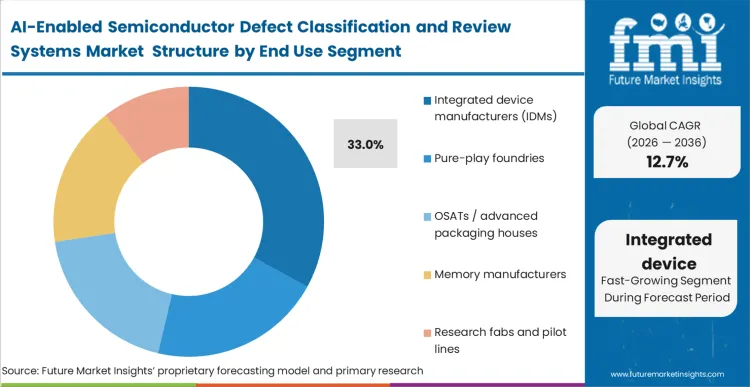
Proprietary data accumulation creates an insurmountable moat for early adopters. Integrated device manufacturers maintain 33.0% share, leveraging their control over both design and manufacturing to feed massive, highly annotated defect libraries into their training clusters. FMI observes that IDMs cross-correlate inline optical data directly with final electrical test yields, generating ground truth mapping that pure-play foundries operating in the foundry defect review market struggle to replicate due to fabless customer confidentiality firewalls. A practitioner reality is that IDMs actively suppress sharing their classified defect libraries with tool vendors, forcing equipment suppliers to build less capable, generalized models for the broader market. Foundries attempting to catch up must invest heavily in 3nm semiconductor eda ai tools to simulate defect impacts, compensating for their lack of end-to-end proprietary product data.
- Initial deployment: IDMs with closed-loop data ecosystems deploy AI defect classification first. Operations managers exploit deep historical yield data to train highly accurate baseline models.
- Secondary wave: Pure-play foundries follow, adapting generalized vendor models to specific customer designs. Foundry metrology directors must build secure partitions to prevent cross-contamination of client defect libraries.
- Final conversion: Mature-node specialty fabs adopt AI last, driven only when legacy optical tools reach end-of-life. Procurement managers in these facilities prioritize cost over bleeding-edge classification accuracy.
AI-Enabled Semiconductor Defect Classification and Review Systems Market Drivers, Restraints, and Opportunities
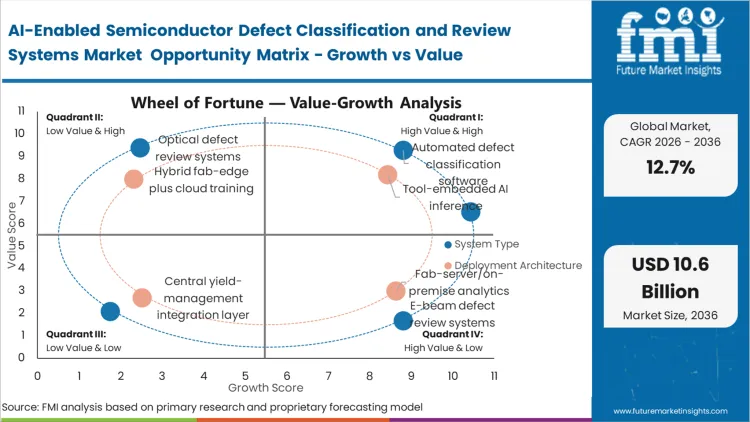
The explosion of advanced packaging architectures forces metrology directors to automate 3D interconnect inspection, heavily driving adoption of AI review tools for advanced packaging defects. Heterogeneous integration stacks multiple chiplets, meaning a single killer defect in a top-layer semiconductor wafers destroys the value of several known-good dies beneath it. Yield engineers cannot rely on manual review for millions of microbumps per package. This commercial pressure compels assembly facility managers to deploy deep learning classifiers that can accurately identify missing bumps or bridging under complex optical distortion. Delaying this integration results in scrapping high-value logic packages at final electrical test, a yield loss that directly impacts gross margins.
Fragmented data silos prevent the creation of unified training models across different equipment vendors, exacerbating defect classification false positives in semiconductor fabs. Metrology departments operate tools from multiple suppliers, each utilizing proprietary image formats and isolated databases. This friction forces yield engineers to maintain separate neural networks for each tool fleet, dramatically increasing the volume of manually labeled data required to achieve baseline accuracy. While centralized yield management platforms attempt to standardize these inputs, the lack of an industry-wide open-source defect taxonomy ensures that classification accuracy remains localized and difficult to scale across the entire fab.
Opportunities in the AI-Enabled Semiconductor Defect Classification and Review Systems Market
- Synthetic training data generation: Generative adversarial networks can simulate rare critical defects. Yield engineers bypass the wait for actual silicon failures, training robust models before new nodes ramp.
- Cross-fleet federated learning: Decentralized model training allows competing fabs to improve algorithmic accuracy without sharing proprietary wafer images. Metrology directors gain robust classifiers while maintaining strict intellectual property isolation.
- Automated recipe creation: Leveraging semiconductor review recipe optimization software, AI layers can independently adjust optical inspection parameters based on historical yield outcomes. Operations managers reduce tool setup time, accelerating the deployment of wafer processing equipment during volume manufacturing.
Regional Analysis
.webp "Top Country Growth Comparison Ai Enabled Semiconductor Defect Classification And Review Systems Market Cagr (2026 2036)")
According to the regional breakdown, the AI‑Enabled Semiconductor Defect Classification and Review Systems market spans more than 40 countries across Asia Pacific, North America, and Europe.
| Country | CAGR (2026 to 2036) |
|---|---|
| India | 14.8% |
| China | 13.9% |
| Taiwan | 13.3% |
| United States | 13.1% |
| South Korea | 12.8% |
| Japan | 11.9% |
| Germany | 10.4% |
Source: Future Market Insights (FMI) analysis, based on proprietary forecasting model and primary research
Asia Pacific AI-Enabled Semiconductor Defect Classification and Review Systems Market Analysis
Greenfield capitalization dictates the adoption curve across Asian manufacturing hubs, where new facilities integrate machine learning classifiers natively rather than retrofitting legacy systems. Fab operations managers in this region benefit from installing uniform, AI-ready data infrastructure from day one, bypassing the network bandwidth constraints that plague older fabs. According to FMI's estimates, this clean-slate approach accelerates the time-to-yield for advanced logic and memory nodes. A critical dynamic is the massive concentration of OSAT facilities, driving unique demand for OSAT inspection and review AI tools and complex 3D packaging defect models that remain scarce in other geographies.
- India: The AI‑enabled semiconductor defect-classification and review systems market revenue in India expands at 14.8% as the domestic ecosystem establishes its initial high-volume baseline. Greenfield fab buildouts pull in fresh review capacity from a zero baseline, circumventing legacy integration hurdles. Procurement directors secure advanced software architectures immediately, positioning local facilities to compete aggressively for outsourced assembly contracts. The trajectory points toward heavy reliance on cloud-trained models initially, transitioning to edge inference as local engineering talent matures.
- China: Policy-led semiconductor ecosystem creation necessitates domestic alternatives to restricted foreign equipment. Yield managers deploy software-heavy advanced process control to squeeze maximum viability out of older node hardware. The demand for AI‑enabled semiconductor defect-classification and review systems grows by 13.9%. This environment forces local developers to pioneer aggressive algorithmic solutions that compensate for lagging physical optics.
- Taiwan: The AI‑enabled semiconductor defect-classification and review systems segment advances at 13.3% in Taiwan. Advanced logic and foundry capacity additions dictate the highest volume of leading-edge AI deployment globally. Metrology directors mandate sub-nanometer classification accuracy to sustain 3nm yield ramps. Taiwanese fabs establish the global ground truth standards that equipment vendors use to baseline their commercial software releases.
- South Korea: In South Korea, high-bandwidth memory intensity requires massive parallel defect classification across complex vertical stacks. Yield engineers analyzing defect review systems for HBM and memory deploy specialized neural networks tuned specifically for deep trench and through-silicon via anomalies. AI‑enabled semiconductor defect-classification and review systems revenue climbs at 12.8%. Mastering these unique memory defect taxonomies provides a durable competitive advantage against emerging memory competitors.
- Japan: In Japan, Rapidus and domestic process-control reinvestment stimulate a resurgence in localized AI software development. Operations managers partner with legacy metrology hardware leaders to embed modern inference capabilities into proven optical frames. The operational outcome is a highly customized, ultra-reliable inspection ecosystem tailored to specialty analog and logic production. The AI‑enabled semiconductor defect-classification and review systems industry growth maintains 11.9%.
FMI's report includes Malaysia, Singapore, and Vietnam. Southeast Asian packaging hubs aggressively adopt optical defect binning automation in semiconductor manufacturing to manage the exploding volume of heterogeneous integration projects migrating from higher-cost centers.
North America AI-Enabled Semiconductor Defect Classification and Review Systems Market Analysis
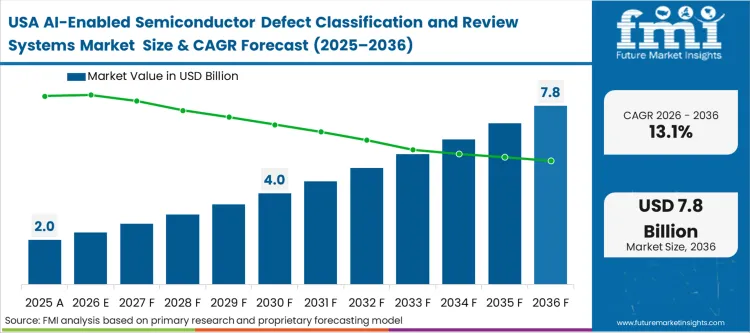
Subsidized infrastructure scaling alters the purchasing behavior of metrology departments across domestic logic and foundry operations. Operations managers leverage federal funding to rip and replace aging optical review fleets, skipping intermediate upgrades in favor of natively AI-embedded automated optical inspection systems. FMI's analysis indicates this capitalization wave heavily favors software platforms that offer multi-vendor compatibility, as government-backed fabs attempt to diversify their equipment supply chains. The region exhibits high demand for cloud-federated learning architectures, enabling distributed research facilities requiring research fab defect classification software to collaborate on rare defect models without violating corporate data security protocols.
- United States: The US AI‑enabled semiconductor defect-classification and review systems industry growth expands at 13.1%. CHIPS-backed capacity additions raise the inspection intensity per wafer significantly above historical baselines. Yield directors utilize these capital injections to deploy comprehensive fab-wide analytics platforms. Procurement teams leverage this funding to negotiate favourable long-term software licensing agreements with major metrology vendors.
FMI's report includes Canada and Mexico. Cross-border automotive component assembly relies increasingly on automated AI visual inspection to satisfy stringent zero-defect mandates from major vehicle manufacturers.
Europe AI-Enabled Semiconductor Defect Classification and Review Systems Market Analysis
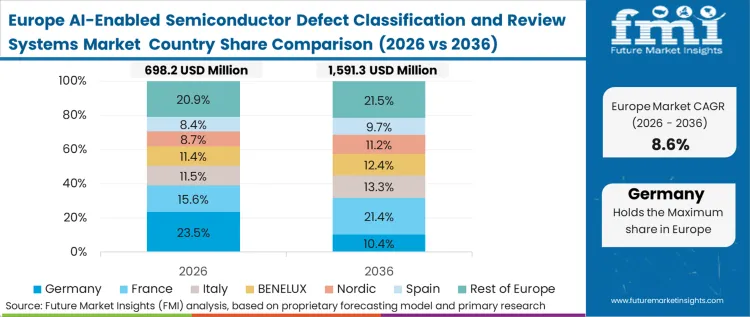
Automotive and industrial specialty nodes govern the European process control environment, prioritizing extreme reliability over bleeding-edge dimension shrinkage. Yield engineers utilizing automotive semiconductor quality review systems require AI classifiers trained specifically on thick-resist anomalies and silicon carbide crystal defects, which differ fundamentally from logic defect signatures. Based on FMI's assessment, the lack of leading-edge volume production means software vendors must customize algorithms extensively for regional IDMs. This customization requirement slows broad software rollout but results in highly sticky vendor-client relationships once a neural network successfully validates against an automotive qualification standard.
- Germany: A concentration in mature-node automotive production dictates a focus on specialized power device defect taxonomies. Metrology directors prioritize algorithms that can perform defect classification in SiC wafer manufacturing to detect subtle crystal dislocations in compound semiconductors. The German AI‑enabled semiconductor defect-classification and review systems industry revenue advances at 10.4%. Vendors who successfully build robust silicon carbide defect models secure dominant, long-term positioning within the European automotive supply chain.
FMI's report includes France, Italy, and the United Kingdom. Specialized research fabs push the boundaries of quantum and photonic chip inspection, demanding highly experimental machine learning approaches to categorize entirely novel physical structures.
Competitive Aligners for Market Players
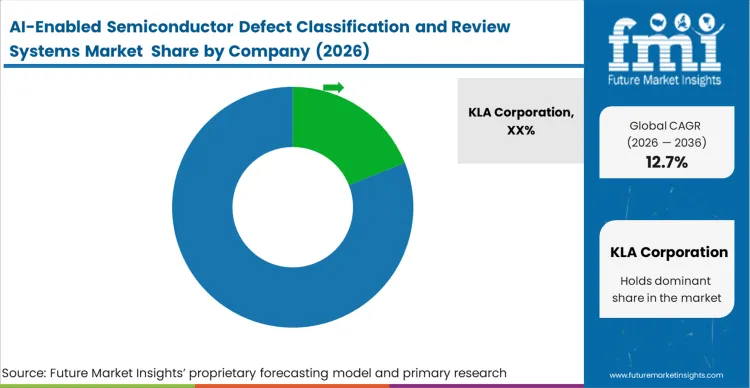
Deeply embedded hardware-software integration defines the competitive reality for semiconductor defect review system suppliers, completely marginalizing independent software developers. Evaluating the best semiconductor defect review systems for foundries, KLA Corporation, Applied Materials, and Onto Innovation command dominant positions because they lock proprietary neural networks directly to their physical optical and e-beam imaging architectures. FMI analysts point out that independent AI startups cannot compete because they lack access to the vast, uncompressed raw image data generated inside the tool before it hits the fab network. Procurement directors overwhelmingly select integrated advanced packaging review systems, refusing to accept the liability of integrating third-party classification algorithms onto million-dollar optical frames.
Players in the industry hold a decisive advantage through their massive libraries of historical defect images, accumulated over decades of tool deployments across global foundries. Buyers looking for a request for quote semiconductor defect review tool often find that Camtek Ltd. and Hitachi High-Tech Corporation leverage these localized data repositories to pre-train their models, ensuring new tools achieve high baseline accuracy immediately upon installation. Challengers attempting to enter the space possess modern neural network architectures but lack the millions of labeled images required to train them. Yield engineers will not halt production to generate training data for an unproven vendor, making the established data library the ultimate barrier to entry.
Large semiconductor manufacturers resist this vendor lock-in by forcing metrology suppliers to support standardized data output formats. IDMs and foundries deploy central yield-management integration layers designed to aggregate image data from Lasertec Corporation and Tokyo Seimitsu Co., Ltd. tools into unified fab-level databases. When procurement managers issue a tender to evaluate fab AI inspection software providers, they use this consolidated data to train their own proprietary neural networks, attempting to commoditise the hardware vendor's proprietary algorithms. The tension between equipment suppliers trying to sell closed-loop AI capabilities and fab operators demanding open data architectures heavily influences procurement negotiations during capacity expansions.
Key Players in AI-Enabled Semiconductor Defect Classification and Review Systems Market
- KLA Corporation
- Applied Materials, Inc.
- Onto Innovation Inc.
- Camtek Ltd.
- Hitachi High-Tech Corporation
- Lasertec Corporation
- Tokyo Seimitsu Co., Ltd.
Scope of the Report
| Metric | Value |
|---|---|
| Quantitative Units | USD 3.2 billion to USD 10.5 billion, at a CAGR of 12.70% |
| Market Definition | Infrastructure utilizing machine learning to categorize and correlate wafer anomalies, replacing rule-based filtering with neural networks to isolate critical defects during semiconductor fabrication. |
| Segmentation | System type, Deployment architecture, Inspection/review modality, Application node / process focus, End user, Region |
| Regions Covered | North America, Latin America, Europe, Asia Pacific, Middle East and Africa |
| Countries Covered | United States, Canada, Mexico, Brazil, Germany, United Kingdom, France, Italy, China, Japan, India, South Korea, Taiwan |
| Key Companies Profiled | KLA Corporation, Applied Materials, Inc., Onto Innovation Inc., Camtek Ltd., Hitachi High-Tech Corporation, Lasertec Corporation, Tokyo Seimitsu Co., Ltd. |
| Forecast Period | 2026 to 2036 |
| Approach | Installed base of optical and e-beam review tools multiplied by AI software attach rates |
Source: Future Market Insights (FMI) analysis, based on proprietary forecasting model and primary research
AI-Enabled Semiconductor Defect Classification and Review Systems Market Analysis by Segments
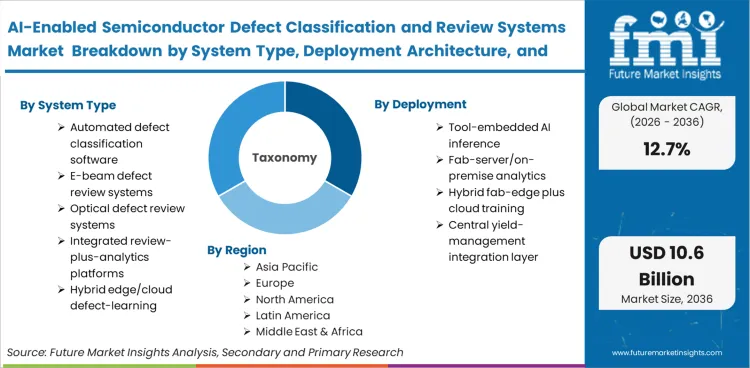
System type
- Automated defect classification software
- E-beam defect review systems
- Optical defect review systems
- Integrated review-plus-analytics platforms
- Hybrid edge/cloud defect-learning platforms
Deployment architecture
- Tool-embedded AI inference
- Fab-server/on-premise analytics
- Hybrid fab-edge plus cloud training
- Central yield-management integration layer
Inspection/review modality
- E-beam review and classification
- Optical image review and binning
- Patterned-wafer defect correlation
- Unpatterned-wafer surface defect review
- Advanced packaging/substrate defect review
Application node / process focus
- Leading-edge logic and foundry (<7nm / class-equivalent)
- Memory and HBM
- Mature-node automotive / power / analog
- Advanced packaging and heterogeneous integration
- Compound semiconductor / specialty devices
End user
- Integrated device manufacturers (IDMs)
- Pure-play foundries
- OSATs / advanced packaging houses
- Memory manufacturers
- Research fabs and pilot lines
Region
- North America
- United States
- Canada
- Mexico
- Latin America
- Brazil
- Argentina
- Europe
- Germany
- United Kingdom
- France
- Italy
- Spain
- Asia Pacific
- China
- Japan
- India
- South Korea
- Taiwan
- Australia
- Middle East and Africa
- South Africa
- GCC
Bibliography
- SEMI. (2025, July 22). SEMI reports global total semiconductor equipment sales forecast to reach 125.5 billion dollars in 2025.
- Applied Materials, Inc. (2025, February 19). Applied Materials accelerates chip defect review with next-gen eBeam system.
- Camtek Ltd. (2026, February 18). CAMTEK announces record results for the fourth quarter & full year 2025.
- Office of Inspector General, USA Department of Commerce. (2025, June 2). OIG status report for Commerce CHIPS Act programs.
- Taiwan Semiconductor Manufacturing Company. (2025, March 4). TSMC intends to expand its investment in the United States to US$165 billion to power the future of AI.
- Government of India, Press Information Bureau. (2025, September 1). SEMICON 2025 – Building the next semiconductor powerhouse in India.
This bibliography is provided for reader reference. The full FMI report contains the complete reference list with primary source documentation.
This Report Addresses
- What underlying data latency forces yield directors to move neural networks onto the tool edge.
- How advanced packaging complexity drives the adoption of optical defect binning algorithms.
- Why legacy mature nodes resist adopting deep learning models optimized for sub-7nm logic.
- Where centralized fab servers create friction with isolated tool-embedded AI processors.
- Who captures the highest operating margins within the semiconductor defect review supply chain.
- What specific metrology bottlenecks occur when foundries upgrade from 5nm to 3nm processes.
- How policy-driven capitalization in India accelerates the deployment of AI-ready inspection fleets.
- Which data barriers prevent independent software vendors from disrupting established metrology hardware providers.
Frequently Asked Questions
What is automated defect classification in semiconductors?
It is the integration of machine learning algorithms into the inspection workflow to automatically categorize and correlate anomalies found on silicon wafers. This replaces traditional rule-based optical filtering, allowing the system to distinguish critical, killer defects from harmless nuisance particles with high statistical reliability.
How does AI improve semiconductor defect review?
Deep learning models filter out millions of false positives that legacy optical comparators flag during advanced node manufacturing. This drastically reduces the time metrology engineers spend manually classifying anomalies, effectively removing the inspection bottleneck and increasing overall wafer throughput.
What is the difference between defect inspection and defect review?
Inspection utilizes high-speed optical tools to scan the entire wafer and generate a map of potential anomalies. Review takes those specific coordinates and uses slower, high-resolution tools,often e-beam, to zoom in, classify the exact nature of the anomaly, and determine if it is a yield-killing defect.
Which companies make semiconductor defect review systems?
The market is dominated by incumbent hardware providers who bundle proprietary software with their optical and e-beam frames. Key leaders include KLA Corporation, Applied Materials, Onto Innovation, Camtek Ltd., Hitachi High-Tech Corporation, Lasertec Corporation, and Tokyo Seimitsu Co., Ltd.
Who are the leading vendors in AI semiconductor defect review?
KLA Corporation and Applied Materials lead the sector due to their massive installed hardware base and proprietary defect image libraries. Vendors like Onto Innovation and Camtek excel in specialized niches such as advanced packaging and optical binning.
Why are defect review systems important in advanced nodes?
Extreme ultraviolet lithography creates physical structures with defect margins too narrow for human operators or rule-based detection to classify. Sub-7nm foundries rely on these systems because identifying micro-anomalies early prevents massive financial losses at final electrical testing.
What is ADC in wafer inspection?
ADC stands for Automated Defect Classification. It refers to the software layer that processes raw images captured by inspection tools, utilizing neural networks to assign specific defect categories without requiring manual human verification.
Compare optical defect review and e-beam defect review for advanced nodes?
Optical review is significantly faster and handles high-volume inline processing but lacks the resolution to clearly image sub-10nm anomalies. E-beam review provides angstrom-level ground truth resolution for critical classification but is too slow for full-wafer scanning, meaning the two technologies must operate symbiotically.
Summarize market size and CAGR for semiconductor defect classification systems?
The market was valued at USD 2.8 billion in 2025 and is projected to reach USD 3.2 billion by 2026. Driven by advanced packaging complexity and sub-7nm logic ramps, it will expand at a 12.70% compound annual growth rate to achieve USD 10.5 billion by 2036.
Which regions will grow fastest for AI defect review tools in fabs?
India leads global growth at 14.8% due to greenfield manufacturing buildouts starting from a zero baseline. China and Taiwan follow closely, driven respectively by policy-led domestic ecosystem creation and massive advanced logic capacity additions.
How much does an e-beam defect review system cost?
While exact pricing varies by configuration, leading-edge e-beam platforms represent multi-million dollar capital expenditures. Procurement directors evaluate this high cost against the severe financial penalty of yield excursions in high-value logic and memory production.
Explain the AI-enabled semiconductor defect classification and review systems market?
This sector provides the vital quality-control infrastructure for modern chipmaking. It encompasses the hardware platforms and neural-network software layers required to automatically identify, categorize, and filter microscopic manufacturing errors before they destroy entire batches of wafers.
What drives growth in semiconductor ADC and review systems?
The primary drivers are the shrinking of logic nodes below 7nm, which renders legacy optical comparators obsolete, and the rise of heterogeneous integration, which requires automated 3D interconnect inspection for millions of advanced packaging microbumps.
Where is demand strongest for semiconductor defect classification software?
Demand heavily concentrates in leading-edge foundries in Taiwan and the United States, as well as high-bandwidth memory facilities in South Korea. These environments face the highest financial penalties for yield excursions, necessitating immediate software upgrades.
How do fabs calculate ROI from AI-based automated defect classification?
Operations managers measure ROI by calculating the reduction in expensive e-beam tool idling time, the decrease in manual engineering labor hours spent on nuisance defects, and the overall acceleration of the time-to-yield during new node manufacturing ramps.
Explain semiconductor defect review workflow?
High-speed optical inspection first flags potential anomalies and creates a wafer map. The review tool then navigates to those specific coordinates, captures high-resolution images, and utilizes the AI classification software to categorize the anomaly and update the fab's central yield database.
What limits the accuracy of tool-embedded AI inference platforms?
Thermal ceilings on embedded processors restrict the depth of neural networks that can run locally. Yield managers accept this constraint because pushing data to a server introduces latency that ruins high-volume inspection throughput.
How does leading-edge logic dictate AI inspection development?
Extreme ultraviolet lithography creates physical structures with defect margins too narrow for rule-based detection. Foundries deploying sub-7nm processes use these strict parameters to establish the global algorithmic baseline for all subsequent software releases.
Why does India present a 14.8% compound growth rate?
Greenfield manufacturing facilities install machine learning classifiers natively on day one. Procurement directors bypass the network bandwidth upgrades that heavily delay AI deployment in legacy factories.
How do IDMs maintain an advantage in defect classification?
Integrated device manufacturers cross-reference inline optical data directly with final electrical test yields. This closed-loop ecosystem allows operations managers to train vastly superior neural networks compared to pure-play foundries.
What prevents independent startups from disrupting metrology incumbents?
Startups lack access to the raw, uncompressed wafer images generated inside the tool before it reaches the fab network. Without millions of labeled training images, yield engineers refuse to qualify their classification models.
Why do mature-node automotive fabs resist advanced AI models?
Algorithms optimized for 3nm gate-all-around structures frequently misclassify thick-resist anomalies and silicon carbide crystal dislocations. Metrology directors abandon these models when false-positive rates erode operator trust.
What function does automated recipe creation serve?
AI layers adjust optical inspection parameters autonomously based on historical yield outcomes. Operations managers utilize this capability to drastically reduce tool setup times during the transition to volume manufacturing.
How does central yield-management software combat vendor lock-in?
Fabs deploy unified integration layers to aggregate raw image data from multiple equipment suppliers. Yield teams use this consolidated data to train proprietary neural networks, commoditizing the hardware vendor's proprietary algorithms.
Preview the report firsthand - request a free sample
Get SampleGet the brochure for pricing and purchase details.
Get PDFTable of Content
- Executive Summary
- Global Market Outlook
- Demand-side Trends
- Supply-side Trends
- Technology Roadmap Analysis
- Analysis and Recommendations
- Market Overview
- Market Coverage / Taxonomy
- Market Definition / Scope / Limitations
- Research Methodology
- Chapter Orientation
- Analytical Lens and Working Hypotheses
- Market Structure, Signals, and Trend Drivers
- Benchmarking and Cross-market Comparability
- Market Sizing, Forecasting, and Opportunity Mapping
- Research Design and Evidence Framework
- Desk Research Programme (Secondary Evidence)
- Company Annual and Sustainability Reports
- Peer-reviewed Journals and Academic Literature
- Corporate Websites, Product Literature, and Technical Notes
- Earnings Decks and Investor Briefings
- Statutory Filings and Regulatory Disclosures
- Technical White Papers and Standards Notes
- Trade Journals, Industry Magazines, and Analyst Briefs
- Conference Proceedings, Webinars, and Seminar Materials
- Government Statistics Portals and Public Data Releases
- Press Releases and Reputable Media Coverage
- Specialist Newsletters and Curated Briefings
- Sector Databases and Reference Repositories
- FMI Internal Proprietary Databases and Historical Market Datasets
- Subscription Datasets and Paid Sources
- Social Channels, Communities, and Digital Listening Inputs
- Additional Desk Sources
- Expert Input and Fieldwork (Primary Evidence)
- Primary Modes
- Qualitative Interviews and Expert Elicitation
- Quantitative Surveys and Structured Data Capture
- Blended Approach
- Why Primary Evidence is Used
- Field Techniques
- Interviews
- Surveys
- Focus Groups
- Observational and In-context Research
- Social and Community Interactions
- Stakeholder Universe Engaged
- C-suite Leaders
- Board Members
- Presidents and Vice Presidents
- R&D and Innovation Heads
- Technical Specialists
- Domain Subject-matter Experts
- Scientists
- Physicians and Other Healthcare Professionals
- Governance, Ethics, and Data Stewardship
- Research Ethics
- Data Integrity and Handling
- Primary Modes
- Tooling, Models, and Reference Databases
- Desk Research Programme (Secondary Evidence)
- Data Engineering and Model Build
- Data Acquisition and Ingestion
- Cleaning, Normalisation, and Verification
- Synthesis, Triangulation, and Analysis
- Quality Assurance and Audit Trail
- Market Background
- Market Dynamics
- Drivers
- Restraints
- Opportunity
- Trends
- Scenario Forecast
- Demand in Optimistic Scenario
- Demand in Likely Scenario
- Demand in Conservative Scenario
- Opportunity Map Analysis
- Product Life Cycle Analysis
- Supply Chain Analysis
- Investment Feasibility Matrix
- Value Chain Analysis
- PESTLE and Porter’s Analysis
- Regulatory Landscape
- Regional Parent Market Outlook
- Production and Consumption Statistics
- Import and Export Statistics
- Market Dynamics
- Global Market Analysis 2021 to 2025 and Forecast, 2026 to 2036
- Historical Market Size Value (USD Million) Analysis, 2021 to 2025
- Current and Future Market Size Value (USD Million) Projections, 2026 to 2036
- Y-o-Y Growth Trend Analysis
- Absolute $ Opportunity Analysis
- Global Market Pricing Analysis 2021 to 2025 and Forecast 2026 to 2036
- Global Market Analysis 2021 to 2025 and Forecast 2026 to 2036, By System Type
- Introduction / Key Findings
- Historical Market Size Value (USD Million) Analysis By System Type , 2021 to 2025
- Current and Future Market Size Value (USD Million) Analysis and Forecast By System Type , 2026 to 2036
- Automated defect classification software
- E-beam defect review systems
- Optical defect review systems
- Integrated review-plus-analytics platforms
- Hybrid edge/cloud defect-learning platforms
- Automated defect classification software
- Y-o-Y Growth Trend Analysis By System Type , 2021 to 2025
- Absolute $ Opportunity Analysis By System Type , 2026 to 2036
- Global Market Analysis 2021 to 2025 and Forecast 2026 to 2036, By Deployment Architecture
- Introduction / Key Findings
- Historical Market Size Value (USD Million) Analysis By Deployment Architecture, 2021 to 2025
- Current and Future Market Size Value (USD Million) Analysis and Forecast By Deployment Architecture, 2026 to 2036
- Tool-embedded AI inference
- Fab-server/on-premise analytics
- Hybrid fab-edge plus cloud training
- Central yield-management integration layer
- Tool-embedded AI inference
- Y-o-Y Growth Trend Analysis By Deployment Architecture, 2021 to 2025
- Absolute $ Opportunity Analysis By Deployment Architecture, 2026 to 2036
- Global Market Analysis 2021 to 2025 and Forecast 2026 to 2036, By Inspection-Review Modality
- Introduction / Key Findings
- Historical Market Size Value (USD Million) Analysis By Inspection-Review Modality, 2021 to 2025
- Current and Future Market Size Value (USD Million) Analysis and Forecast By Inspection-Review Modality, 2026 to 2036
- E-beam review and classification
- Optical image review and binning
- Patterned-wafer defect correlation
- Unpatterned-wafer surface defect review
- Advanced packaging/substrate defect review
- E-beam review and classification
- Y-o-Y Growth Trend Analysis By Inspection-Review Modality, 2021 to 2025
- Absolute $ Opportunity Analysis By Inspection-Review Modality, 2026 to 2036
- Global Market Analysis 2021 to 2025 and Forecast 2026 to 2036, By Application Node-Process Focus
- Introduction / Key Findings
- Historical Market Size Value (USD Million) Analysis By Application Node-Process Focus, 2021 to 2025
- Current and Future Market Size Value (USD Million) Analysis and Forecast By Application Node-Process Focus, 2026 to 2036
- Leading-edge logic and foundry (<7nm / class-equivalent)
- Memory and HBM
- Mature-node automotive / power / analog
- Advanced packaging and heterogeneous integration
- Compound semiconductor / specialty devices
- Leading-edge logic and foundry (<7nm / class-equivalent)
- Y-o-Y Growth Trend Analysis By Application Node-Process Focus, 2021 to 2025
- Absolute $ Opportunity Analysis By Application Node-Process Focus, 2026 to 2036
- Global Market Analysis 2021 to 2025 and Forecast 2026 to 2036, By End Use
- Introduction / Key Findings
- Historical Market Size Value (USD Million) Analysis By End Use, 2021 to 2025
- Current and Future Market Size Value (USD Million) Analysis and Forecast By End Use, 2026 to 2036
- Integrated device manufacturers (IDMs)
- Pure-play foundries
- OSATs / advanced packaging houses
- Memory manufacturers
- Research fabs and pilot lines
- Integrated device manufacturers (IDMs)
- Y-o-Y Growth Trend Analysis By End Use, 2021 to 2025
- Absolute $ Opportunity Analysis By End Use, 2026 to 2036
- Global Market Analysis 2021 to 2025 and Forecast 2026 to 2036, By Region
- Introduction
- Historical Market Size Value (USD Million) Analysis By Region, 2021 to 2025
- Current Market Size Value (USD Million) Analysis and Forecast By Region, 2026 to 2036
- North America
- Latin America
- Western Europe
- Eastern Europe
- East Asia
- South Asia and Pacific
- Middle East & Africa
- Market Attractiveness Analysis By Region
- North America Market Analysis 2021 to 2025 and Forecast 2026 to 2036, By Country
- Historical Market Size Value (USD Million) Trend Analysis By Market Taxonomy, 2021 to 2025
- Market Size Value (USD Million) Forecast By Market Taxonomy, 2026 to 2036
- By Country
- USA
- Canada
- Mexico
- By System Type
- By Deployment Architecture
- By Inspection-Review Modality
- By Application Node-Process Focus
- By End Use
- By Country
- Market Attractiveness Analysis
- By Country
- By System Type
- By Deployment Architecture
- By Inspection-Review Modality
- By Application Node-Process Focus
- By End Use
- Key Takeaways
- Latin America Market Analysis 2021 to 2025 and Forecast 2026 to 2036, By Country
- Historical Market Size Value (USD Million) Trend Analysis By Market Taxonomy, 2021 to 2025
- Market Size Value (USD Million) Forecast By Market Taxonomy, 2026 to 2036
- By Country
- Brazil
- Chile
- Rest of Latin America
- By System Type
- By Deployment Architecture
- By Inspection-Review Modality
- By Application Node-Process Focus
- By End Use
- By Country
- Market Attractiveness Analysis
- By Country
- By System Type
- By Deployment Architecture
- By Inspection-Review Modality
- By Application Node-Process Focus
- By End Use
- Key Takeaways
- Western Europe Market Analysis 2021 to 2025 and Forecast 2026 to 2036, By Country
- Historical Market Size Value (USD Million) Trend Analysis By Market Taxonomy, 2021 to 2025
- Market Size Value (USD Million) Forecast By Market Taxonomy, 2026 to 2036
- By Country
- Germany
- UK
- Italy
- Spain
- France
- Nordic
- BENELUX
- Rest of Western Europe
- By System Type
- By Deployment Architecture
- By Inspection-Review Modality
- By Application Node-Process Focus
- By End Use
- By Country
- Market Attractiveness Analysis
- By Country
- By System Type
- By Deployment Architecture
- By Inspection-Review Modality
- By Application Node-Process Focus
- By End Use
- Key Takeaways
- Eastern Europe Market Analysis 2021 to 2025 and Forecast 2026 to 2036, By Country
- Historical Market Size Value (USD Million) Trend Analysis By Market Taxonomy, 2021 to 2025
- Market Size Value (USD Million) Forecast By Market Taxonomy, 2026 to 2036
- By Country
- Russia
- Poland
- Hungary
- Balkan & Baltic
- Rest of Eastern Europe
- By System Type
- By Deployment Architecture
- By Inspection-Review Modality
- By Application Node-Process Focus
- By End Use
- By Country
- Market Attractiveness Analysis
- By Country
- By System Type
- By Deployment Architecture
- By Inspection-Review Modality
- By Application Node-Process Focus
- By End Use
- Key Takeaways
- East Asia Market Analysis 2021 to 2025 and Forecast 2026 to 2036, By Country
- Historical Market Size Value (USD Million) Trend Analysis By Market Taxonomy, 2021 to 2025
- Market Size Value (USD Million) Forecast By Market Taxonomy, 2026 to 2036
- By Country
- China
- Japan
- South Korea
- By System Type
- By Deployment Architecture
- By Inspection-Review Modality
- By Application Node-Process Focus
- By End Use
- By Country
- Market Attractiveness Analysis
- By Country
- By System Type
- By Deployment Architecture
- By Inspection-Review Modality
- By Application Node-Process Focus
- By End Use
- Key Takeaways
- South Asia and Pacific Market Analysis 2021 to 2025 and Forecast 2026 to 2036, By Country
- Historical Market Size Value (USD Million) Trend Analysis By Market Taxonomy, 2021 to 2025
- Market Size Value (USD Million) Forecast By Market Taxonomy, 2026 to 2036
- By Country
- India
- ASEAN
- Australia & New Zealand
- Rest of South Asia and Pacific
- By System Type
- By Deployment Architecture
- By Inspection-Review Modality
- By Application Node-Process Focus
- By End Use
- By Country
- Market Attractiveness Analysis
- By Country
- By System Type
- By Deployment Architecture
- By Inspection-Review Modality
- By Application Node-Process Focus
- By End Use
- Key Takeaways
- Middle East & Africa Market Analysis 2021 to 2025 and Forecast 2026 to 2036, By Country
- Historical Market Size Value (USD Million) Trend Analysis By Market Taxonomy, 2021 to 2025
- Market Size Value (USD Million) Forecast By Market Taxonomy, 2026 to 2036
- By Country
- Kingdom of Saudi Arabia
- Other GCC Countries
- Turkiye
- South Africa
- Other African Union
- Rest of Middle East & Africa
- By System Type
- By Deployment Architecture
- By Inspection-Review Modality
- By Application Node-Process Focus
- By End Use
- By Country
- Market Attractiveness Analysis
- By Country
- By System Type
- By Deployment Architecture
- By Inspection-Review Modality
- By Application Node-Process Focus
- By End Use
- Key Takeaways
- Key Countries Market Analysis
- USA
- Pricing Analysis
- Market Share Analysis, 2025
- By System Type
- By Deployment Architecture
- By Inspection-Review Modality
- By Application Node-Process Focus
- By End Use
- Canada
- Pricing Analysis
- Market Share Analysis, 2025
- By System Type
- By Deployment Architecture
- By Inspection-Review Modality
- By Application Node-Process Focus
- By End Use
- Mexico
- Pricing Analysis
- Market Share Analysis, 2025
- By System Type
- By Deployment Architecture
- By Inspection-Review Modality
- By Application Node-Process Focus
- By End Use
- Brazil
- Pricing Analysis
- Market Share Analysis, 2025
- By System Type
- By Deployment Architecture
- By Inspection-Review Modality
- By Application Node-Process Focus
- By End Use
- Chile
- Pricing Analysis
- Market Share Analysis, 2025
- By System Type
- By Deployment Architecture
- By Inspection-Review Modality
- By Application Node-Process Focus
- By End Use
- Germany
- Pricing Analysis
- Market Share Analysis, 2025
- By System Type
- By Deployment Architecture
- By Inspection-Review Modality
- By Application Node-Process Focus
- By End Use
- UK
- Pricing Analysis
- Market Share Analysis, 2025
- By System Type
- By Deployment Architecture
- By Inspection-Review Modality
- By Application Node-Process Focus
- By End Use
- Italy
- Pricing Analysis
- Market Share Analysis, 2025
- By System Type
- By Deployment Architecture
- By Inspection-Review Modality
- By Application Node-Process Focus
- By End Use
- Spain
- Pricing Analysis
- Market Share Analysis, 2025
- By System Type
- By Deployment Architecture
- By Inspection-Review Modality
- By Application Node-Process Focus
- By End Use
- France
- Pricing Analysis
- Market Share Analysis, 2025
- By System Type
- By Deployment Architecture
- By Inspection-Review Modality
- By Application Node-Process Focus
- By End Use
- India
- Pricing Analysis
- Market Share Analysis, 2025
- By System Type
- By Deployment Architecture
- By Inspection-Review Modality
- By Application Node-Process Focus
- By End Use
- ASEAN
- Pricing Analysis
- Market Share Analysis, 2025
- By System Type
- By Deployment Architecture
- By Inspection-Review Modality
- By Application Node-Process Focus
- By End Use
- Australia & New Zealand
- Pricing Analysis
- Market Share Analysis, 2025
- By System Type
- By Deployment Architecture
- By Inspection-Review Modality
- By Application Node-Process Focus
- By End Use
- China
- Pricing Analysis
- Market Share Analysis, 2025
- By System Type
- By Deployment Architecture
- By Inspection-Review Modality
- By Application Node-Process Focus
- By End Use
- Japan
- Pricing Analysis
- Market Share Analysis, 2025
- By System Type
- By Deployment Architecture
- By Inspection-Review Modality
- By Application Node-Process Focus
- By End Use
- South Korea
- Pricing Analysis
- Market Share Analysis, 2025
- By System Type
- By Deployment Architecture
- By Inspection-Review Modality
- By Application Node-Process Focus
- By End Use
- Russia
- Pricing Analysis
- Market Share Analysis, 2025
- By System Type
- By Deployment Architecture
- By Inspection-Review Modality
- By Application Node-Process Focus
- By End Use
- Poland
- Pricing Analysis
- Market Share Analysis, 2025
- By System Type
- By Deployment Architecture
- By Inspection-Review Modality
- By Application Node-Process Focus
- By End Use
- Hungary
- Pricing Analysis
- Market Share Analysis, 2025
- By System Type
- By Deployment Architecture
- By Inspection-Review Modality
- By Application Node-Process Focus
- By End Use
- Kingdom of Saudi Arabia
- Pricing Analysis
- Market Share Analysis, 2025
- By System Type
- By Deployment Architecture
- By Inspection-Review Modality
- By Application Node-Process Focus
- By End Use
- Turkiye
- Pricing Analysis
- Market Share Analysis, 2025
- By System Type
- By Deployment Architecture
- By Inspection-Review Modality
- By Application Node-Process Focus
- By End Use
- South Africa
- Pricing Analysis
- Market Share Analysis, 2025
- By System Type
- By Deployment Architecture
- By Inspection-Review Modality
- By Application Node-Process Focus
- By End Use
- USA
- Market Structure Analysis
- Competition Dashboard
- Competition Benchmarking
- Market Share Analysis of Top Players
- By Regional
- By System Type
- By Deployment Architecture
- By Inspection-Review Modality
- By Application Node-Process Focus
- By End Use
- Competition Analysis
- Competition Deep Dive
- KLA Corporation
- Overview
- Product Portfolio
- Profitability by Market Segments (Product/Age /Sales Channel/Region)
- Sales Footprint
- Strategy Overview
- Marketing Strategy
- Product Strategy
- Channel Strategy
- Applied Materials, Inc.
- Onto Innovation Inc.
- Camtek Ltd.
- Hitachi High-Tech Corporation
- Lasertec Corporation
- Tokyo Seimitsu Co., Ltd.
- KLA Corporation
- Competition Deep Dive
- Assumptions & Acronyms Used


