

- Industry Size (2026)
- USD 383.8 Mn
- Forecast (2036)
- USD 837 Mn
- CAGR (2026 to 2036)
- 8.1%
3nm Semiconductor EDA AI Tools Market Forecast and Outlook 2026 to 2036
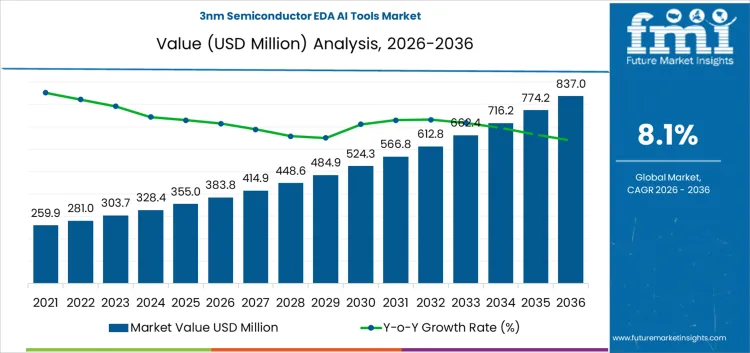
The 3nm semiconductor EDA AI tools market is valued at USD 383.8 million in 2026 and is projected to reach USD 837 million by 2036, reflecting a CAGR of 8.1%. Market performance is concentrated among suppliers providing AI-driven electronic design automation solutions for advanced semiconductor nodes. Regional concentration influences cost structures, access to specialized talent, and proximity to chip fabrication facilities. Adoption varies according to fab modernization, design cycle requirements, and IP integration. Smaller providers face challenges in delivering validated tools compatible with multi-fab environments and ensuring compliance with semiconductor standards.
Margin concentration favors operators offering certified AI tools with multi-platform compatibility, workflow integration, and design validation services. Fragmentation persists among niche or regional developers, whereas leading companies capture concentrated value through alignment with high-volume semiconductor programs, proven tool reliability, and design cycle efficiency rather than the number of licenses deployed. Market outcomes are determined by integration with fab operations, computational capability, and design accuracy rather than software distribution volume.
Quick Stats of the 3nm Semiconductor EDA AI Tools Market
- 3nm Semiconductor EDA AI Tools Market Value (2026): USD 383.8 million
- 3nm Semiconductor EDA AI Tools Forecast Value (2036): USD 837 million
- 3nm Semiconductor EDA AI Tools Forecast CAGR (2026 to 2036): 8.1%
- Leading Design Stage in 3nm Semiconductor EDA AI Tools Market: Place-and-Route (P&R) and Synthesis (31% share)
- Leading Customer Segment in 3nm Semiconductor EDA AI Tools Market: Foundries (44% share)
- Key Growth Regions in 3nm Semiconductor EDA AI Tools Market: USA, Taiwan, South Korea, China
- Top Players in 3nm Semiconductor EDA AI Tools Market: Synopsys, Cadence, Siemens EDA, Ansys, Silvaco, Keysight
What is the Growth Forecast for 3nm Semiconductor EDA AI Tools Market through 2036?
Between 2026 and 2031, the 3nm semiconductor EDA AI tools market is projected to grow from USD 383.8 million to USD 524.1 million, generating an absolute increase of USD 140.3 million and reflecting a CAGR of 8.1%. Growth is driven by adoption of P&R and synthesis, verification and sign-off, power and thermal AI, yield optimisation, and DFM AI across foundries, fabless companies, and IDMs. Subscription, project, and usage-based license models enable flexible deployment. Expansion is supported by rising demand for advanced process nodes, design efficiency, and AI-assisted optimization in semiconductor design workflows.
From 2031 to 2036, the market is expected to expand from USD 524.1 million to USD 837 million, adding USD 312.6 million. Growth is fueled by broader adoption of AI-driven EDA tools, accelerated 3nm chip development, and integration with multi-node design strategies. Market drivers include increasing complexity of IC design, power-performance optimization requirements, and faster time-to-market pressures. Competitive advantage favors suppliers providing validated AI algorithms, scalable deployment, and robust customer support. Leading companies include Synopsys, Cadence, Siemens EDA, Ansys, Silvaco, and Keysight.
3nm Semiconductor EDA AI Tools Market Key Takeaways
| Metric | Value |
|---|---|
| Market Value (2026) | USD 383.8 million |
| Forecast Value (2036) | USD 837 million |
| Forecast CAGR (2026 to 2036) | 8.10% |
What Is Driving Demand for 3nm Semiconductor EDA AI Tools?
3nm semiconductor EDA (Electronic Design Automation) AI tools are increasingly adopted to design highly complex, next-generation integrated circuits with enhanced performance and energy efficiency. Historically, conventional EDA software relied on manual optimization and rule-based algorithms, limiting scalability and precision at advanced process nodes. Modern AI-driven EDA tools integrate machine learning, predictive modeling, and automated design optimization to manage transistor-level complexity, power, and timing challenges in 3nm chips. Semiconductor fabs, chip designers, and foundries prioritize tool accuracy, integration with design flows, and compatibility with advanced process technologies. Early adoption focused on leading-edge processors and high-performance computing, while current demand spans mobile SoCs, AI accelerators, and automotive semiconductors driven by performance, energy efficiency, and manufacturing yield targets. Algorithm robustness, runtime efficiency, and design accuracy influence adoption.
Rising demand for smaller, faster, and energy-efficient chips, coupled with the complexity of 3nm design, is shaping market growth. Compared with conventional EDA solutions, AI-enhanced tools emphasize predictive optimization, automated layout generation, and error minimization to accelerate design cycles. Cost structures depend on software licensing, AI model development, and integration support, concentrating margins among providers capable of delivering reliable, validated EDA platforms. Semiconductor companies adopt these tools to improve design productivity, reduce manufacturing defects, and achieve performance targets. By 2036, 3nm semiconductor EDA AI tools are expected to become standard in advanced chip design, supporting high-performance computing, mobile, and automotive applications globally.
What Factors Are Shaping the Demand for 3nm Semiconductor EDA AI Tools in Terms of Design Stage and Customer?
The demand for 3nm semiconductor EDA AI tools is segmented by design stage and customer type. Design stages include place-and-route (P&R) and synthesis, verification and sign-off, power and thermal AI, yield optimization, and DFM AI. Customer types include foundries, fabless companies, integrated device manufacturers (IDMs), and other semiconductor players. Adoption is influenced by process complexity, design precision, and time-to-market pressures. Uptake is driven by the need for reduced defects, optimized performance, and cost-effective manufacturing. Design stage and customer selection depend on project scale, technology node requirements, and integration capabilities, ensuring reliable, efficient, and high-performing semiconductor design workflows.
Why Is Place-and-Route (P&R) and Synthesis Leading the Design Stage Segment in 3nm Semiconductor EDA AI Tools?
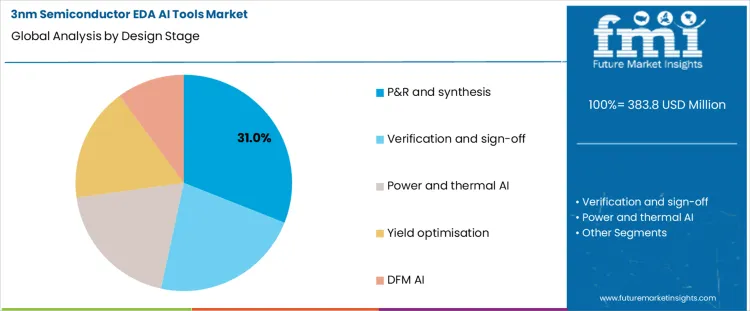
Place-and-route (P&R) and synthesis account for approximately 31% of total design stage demand, making it the leading category. These tools optimize transistor placement, interconnect routing, and logical synthesis for complex 3nm designs. Adoption is driven by the increasing circuit density, performance targets, and power constraints of advanced semiconductor nodes. AI-enhanced tools evaluate multiple layout options, predict timing bottlenecks, and optimize power distribution in real time. Operational procedures include iterative simulations, design rule compliance checks, and performance validation. P&R and synthesis tools deliver measurable reductions in design cycles, improved chip performance, and reduced post-fabrication errors.
Operational factors further support adoption. Tools must handle massive data sets, complex design hierarchies, and tight process variation margins while providing accurate timing and power estimations. Integration with verification, DFM, and thermal analysis workflows ensures seamless design progression. P&R and synthesis leads because it enables predictable, efficient, and optimized chip layouts, meeting the stringent requirements of 3nm semiconductor fabrication and ensuring high-yield production.
Why Are Foundries Representing the Largest Customer Segment in 3nm Semiconductor EDA AI Tools?
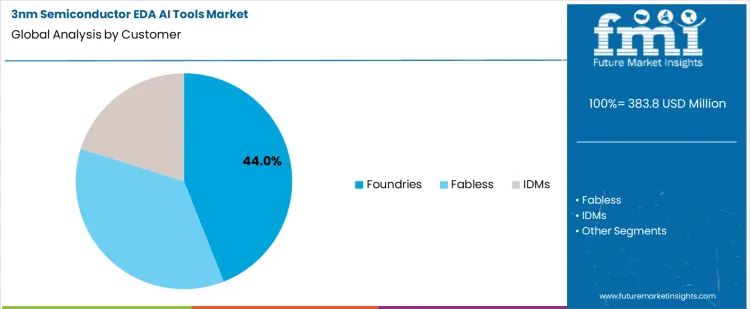
Foundries account for approximately 44% of total customer demand, making them the largest category. Adoption is driven by high-volume manufacturing requirements, process complexity, and stringent yield and reliability targets. Foundries rely on EDA AI tools to optimize chip layouts, ensure design compliance, and predict manufacturability challenges before tape-out. Operational procedures include integrating design inputs from fabless customers, conducting design rule checks, and performing predictive simulations for power, timing, and thermal behavior. AI tools assist in evaluating design variations, mitigating defects, and optimizing wafer usage for maximum yield.
Functional and operational factors further reinforce adoption. Tools must process large-scale designs, manage variability across wafers, and support multiple process nodes while ensuring accuracy. Foundries lead because EDA AI solutions provide enhanced design-to-manufacturing alignment, improved yield, reduced errors, and predictable performance, enabling efficient production of 3nm semiconductor devices with high reliability and cost-effectiveness.
How Are AI Tools Enabling Cognitive Design for 3nm Chips?
AI-driven EDA tools are increasingly used to interpret complex 3nm design constraints, predict interconnect behavior, and optimize layouts without manual trial-and-error. Adoption is strongest in regions with advanced semiconductor R&D, multi-node fabrication facilities, and high-complexity IC demand. Tools are selected for predictive analytics, cognitive design recommendations, and cross-module optimization. Growth is driven by escalating design intricacy, multi-physics interactions, and demand for faster innovation cycles. Investment focuses on AI model training, adaptive algorithms, and integration with heterogeneous design workflows. Chip designers prioritize tools that reduce human cognitive load, anticipate failure modes, and accelerate innovation at 3nm nodes.
Why Are Cross-Disciplinary Collaboration and Predictive Modeling Driving Adoption?
Demand is shaped by the need to integrate circuit, layout, thermal, and power domains in a unified design flow. Semiconductor teams adopt AI EDA tools to predict hotspots, voltage drops, and timing violations early in the design process. Platforms with multi-objective optimization, scenario simulation, and adaptive learning gain preference. Adoption is concentrated in regions with collaborative semiconductor ecosystems and access to high-performance computing. Predictive accuracy, cross-domain insight, and innovation speed drive procurement rather than cost. Vendors offering robust, domain-aware AI models gain advantage among fabless designers and integrated device manufacturers.
What Technical Complexities Restrict Broader Deployment?
Training AI models for 3nm node designs requires massive datasets, specialized compute infrastructure, and precise physics-based validation. Tools may underperform with unconventional architectures or emerging materials. Integration with legacy EDA workflows, IP cores, and verification pipelines adds complexity. Smaller design firms or regions lacking HPC infrastructure adopt solutions more slowly. These factors concentrate early deployment among leading semiconductor innovators, top-tier fabless companies, and regions with robust AI-driven design ecosystems.
How Are Innovative AI Architectures and Ecosystem Collaboration Shaping Market Trends?
Recent advancements include reinforcement learning for layout optimization, graph-based predictive analysis for signal integrity, and automated cross-layer verification. Collaboration between AI developers, semiconductor designers, and research labs ensures model accuracy, early defect prediction, and multi-node workflow compatibility. Pilot projects assess predictive reliability, power-performance-area optimization, and manufacturability before large-scale adoption. Quality control, continuous learning, and workflow standardization maintain consistency. Focus is on cognitive design augmentation, predictive performance, and complexity management rather than cost or scale. Collaborative initiatives enable broader adoption of AI EDA tools, supporting faster and more reliable 3nm semiconductor development.
What is the Demand for 3nm Semiconductor EDA AI Tools by Country?

| Country | CAGR (%) |
|---|---|
| USA | 8.5% |
| Taiwan | 8.0% |
| South Korea | 7.8% |
| China | 7.5% |
Demand for 3nm semiconductor EDA AI tools is rising as chip manufacturers adopt advanced design automation solutions to optimize performance, power efficiency, and yield for next-generation nodes. The USA leads with an 8.5% CAGR, driven by leadership in semiconductor design, adoption of AI-assisted verification and simulation tools, and investment in cutting-edge fabs. Taiwan follows at 8.0%, supported by major foundries and design houses optimizing 3nm process nodes. South Korea records 7.8% growth, shaped by semiconductor manufacturing and integration of AI tools for design and production efficiency. China shows 7.5% CAGR, reflecting rapid expansion of domestic semiconductor design capabilities and adoption of AI-based EDA solutions for advanced nodes.
How Is the United States Experiencing Growth in the 3nm Semiconductor EDA AI Tools Market?
United States is experiencing growth at a CAGR of 8.5%, supported by adoption of 3nm Semiconductor EDA AI Tools Market solutions to accelerate chip design, optimize layouts, and enhance verification processes for advanced semiconductor nodes. EDA tool providers and semiconductor companies are deploying AI-enabled platforms optimized for predictive design, error detection, and automation of complex circuit analysis. Demand is concentrated in semiconductor design hubs, R&D centers, and high-performance computing facilities. Investments focus on AI algorithm efficiency, system integration, and compliance with industry standards rather than large-scale hardware deployment. Growth reflects increasing adoption of AI-assisted design tools, demand for smaller process nodes, and industrial focus on time-to-market reduction for next-generation chips.
- Advanced chip design drives adoption.
- AI tools optimize layout, verification, and predictive design.
- Semiconductor hubs and R&D centers concentrate demand.
- AI algorithm efficiency and integration guide investment.
How Is Taiwan Witnessing Growth in the 3nm Semiconductor EDA AI Tools Market?
Taiwan is witnessing growth at a CAGR of 8%, fueled by adoption of 3nm Semiconductor EDA AI Tools Market solutions to improve chip design efficiency and support advanced semiconductor manufacturing. EDA providers and chip designers are deploying AI tools optimized for predictive verification, layout optimization, and process node compliance. Demand is concentrated in semiconductor foundries, design houses, and R&D centers. Investments prioritize system performance, AI integration, and regulatory compliance rather than broad-scale deployment. Growth reflects industrial focus on next-generation chip development, adoption of AI-assisted design methodologies, and acceleration of semiconductor production timelines.
- Advanced node design drives adoption.
- AI tools enhance predictive verification and layout optimization.
- Semiconductor foundries and R&D centers concentrate demand.
- System performance and AI integration guide investment.
How Is South Korea Experiencing Growth in the 3nm Semiconductor EDA AI Tools Market?
South Korea is experiencing growth at a CAGR of 7.8%, supported by adoption of 3nm Semiconductor EDA AI Tools Market solutions to optimize chip layouts, improve verification speed, and accelerate advanced semiconductor design cycles. Semiconductor companies and EDA tool providers are deploying AI-enabled platforms optimized for predictive design, error detection, and process node compliance. Demand is concentrated in semiconductor design hubs, industrial R&D centers, and advanced foundries. Investments focus on AI system performance, computational efficiency, and compliance with semiconductor standards rather than large-scale deployment. Growth reflects industrial adoption of AI-assisted design, expansion of semiconductor capabilities, and demand for faster production cycles.
- Advanced semiconductor design drives adoption.
- AI tools optimize layouts, verification, and predictive design.
- Design hubs and R&D centers concentrate demand.
- AI performance and computational efficiency guide investment.
How Is China Witnessing Growth in the 3nm Semiconductor EDA AI Tools Market?
China is witnessing growth at a CAGR of 7.5%, fueled by adoption of 3nm Semiconductor EDA AI Tools Market solutions to accelerate chip design, improve verification accuracy, and support advanced semiconductor manufacturing. Manufacturers and EDA providers are deploying AI-enabled platforms optimized for predictive design, layout optimization, and error detection. Demand is concentrated in semiconductor design hubs, industrial R&D centers, and high-performance computing facilities. Investments prioritize system reliability, AI algorithm efficiency, and compliance with industry standards rather than large-scale deployment. Growth reflects government support for semiconductor development, industrial adoption of AI-assisted design, and increasing demand for next-generation chip solutions.
- Advanced semiconductor nodes drive adoption.
- AI tools enhance predictive design and verification.
- Design hubs and R&D centers concentrate demand.
- System reliability and AI algorithm efficiency guide investment.
Who Competes in the 3nm Semiconductor EDA AI Tools Market and What Defines Their Capabilities?
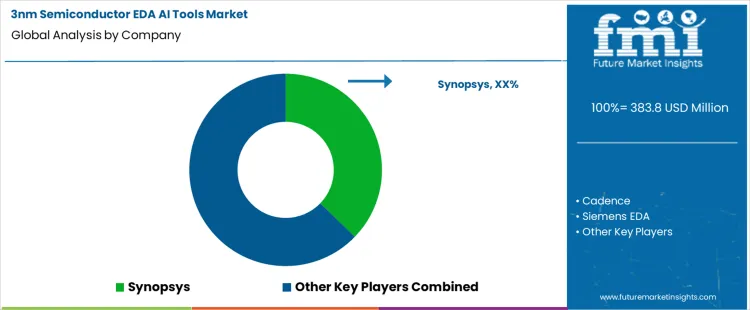
Competition in the 3nm semiconductor EDA AI tools market is defined by design automation, AI-assisted verification, and support for advanced process nodes. Synopsys provides AI-powered EDA tools enabling design optimization, timing analysis, and verification for 3nm semiconductor processes. Cadence delivers AI-integrated tools for physical design, circuit simulation, and layout verification targeting advanced semiconductor nodes. Siemens EDA supplies EDA platforms with machine learning features to accelerate design closure and ensure manufacturability at 3nm. Ansys develops AI-assisted simulation and verification tools for device reliability and performance modeling. Silvaco offers design and verification tools optimized for nanoscale semiconductor development.
Keysight provides AI-driven verification and analysis software integrated with measurement data for advanced semiconductor nodes. Other participants include regional and niche EDA software providers supporting AI-enabled optimization for leading-edge semiconductor design. Differentiation arises from tool accuracy, AI-assisted automation, process node support, and integration with semiconductor manufacturing workflows. Market relevance is influenced by ability to reduce design cycles, improve yield, and ensure compliance with 3nm process design rules. Suppliers capable of delivering validated, AI-enhanced tools that address the complexities of ultra-advanced nodes maintain a competitive advantage in semiconductor design and verification.
Key Players in the 3nm Semiconductor EDA AI Tools Market
- Synopsys
- Cadence
- Siemens EDA
- Ansys
- Silvaco
- Keysight
Scope of the Report
| Items | Values |
|---|---|
| Quantitative Units (2026) | USD million |
| Design Stage | P&R and synthesis, Verification and sign-off, Power and thermal AI, Yield optimisation, DFM AI |
| Customer | Foundries, Fabless, IDMs |
| License Model | Subscription, Project license, Usage-based |
| Region | Asia Pacific, Europe, North America, Latin America, Middle East & Africa |
| Key Countries Covered | USA, Taiwan, South Korea, China, Japan |
| Key Companies Profiled | Synopsys, Cadence, Siemens EDA, Ansys, Silvaco, Keysight |
| Additional Attributes | Dollar sales by design stage and customer type; regional CAGR, volume and value growth projections; adoption across foundries, fabless, and IDM segments; AI-assisted P&R, verification, and yield optimisation capabilities; integration with multi-node and advanced process workflows; predictive modeling, power-performance optimization, and DFM analysis; support for subscription, project, and usage-based licenses; tool validation, reliability, and semiconductor standard compliance; contribution to reduced design cycles and improved yield for 3nm nodes. |
3nm Semiconductor EDA AI Tools Market Segmentation
Design Stage:
- P&R and synthesis
- Verification and sign-off
- Power and thermal AI
- Yield optimisation
- DFM AI
Customer:
- Foundries
- Fabless
- IDMs
License Model:
- Subscription
- Project license
- Usage-based
Region
- Asia Pacific
- China
- Japan
- South Korea
- India
- Australia & New Zealand
- ASEAN
- Rest of Asia Pacific
- Europe
- Germany
- United Kingdom
- France
- Italy
- Spain
- Nordic
- BENELUX
- Rest of Europe
- North America
- United States
- Canada
- Mexico
- Latin America
- Brazil
- Chile
- Rest of Latin America
- Middle East & Africa
- Kingdom of Saudi Arabia
- Other GCC Countries
- Turkey
- South Africa
- Other African Union
- Rest of Middle East & Africa
Bibliography
Semiconductor Industry Association. (2024). 2024 state of the U.S. semiconductor industry. Semiconductor Industry Association.
IEEE International Roadmap for Devices and Systems (IRDS). (2023). The international roadmap for devices and systems: 2023 edition. IEEE.
Taiwan Semiconductor Research Institute. (n.d.). Chip design innovation (program overview and resources). Taiwan Semiconductor Research Institute (TSRI).
Fraunhofer Institute for Integrated Systems and Device Technology IISB. (2024). Annual report 2024. Fraunhofer IISB.
If you specifically need an EDA-at-advanced-nodes “design automation challenges” source that is explicit (instead of being implied via annual reports), this one is extremely on-target:
ACM. (2024). Panel: EDA challenges at advanced technology nodes. Association for Computing Machinery (ACM Digital Library
Frequently Asked Questions
How big is the 3nm semiconductor eda ai tools market in 2026?
The global 3nm semiconductor eda ai tools market is estimated to be valued at USD 383.8 million in 2026.
What will be the size of 3nm semiconductor eda ai tools market in 2036?
The market size for the 3nm semiconductor eda ai tools market is projected to reach USD 837.0 million by 2036.
How much will be the 3nm semiconductor eda ai tools market growth between 2026 and 2036?
The 3nm semiconductor eda ai tools market is expected to grow at a 8.1% CAGR between 2026 and 2036.
What are the key product types in the 3nm semiconductor eda ai tools market?
The key product types in 3nm semiconductor eda ai tools market are p&r and synthesis, verification and sign-off, power and thermal ai, yield optimisation and dfm ai.
Which customer segment to contribute significant share in the 3nm semiconductor eda ai tools market in 2026?
In terms of customer, foundries segment to command 44.0% share in the 3nm semiconductor eda ai tools market in 2026.
Preview the report firsthand - request a free sample
Get SampleGet the brochure for pricing and purchase details.
Get PDFTable of Content
- Executive Summary
- Global Market Outlook
- Demand-side Trends
- Supply-side Trends
- Technology Roadmap Analysis
- Analysis and Recommendations
- Market Overview
- Market Coverage / Taxonomy
- Market Definition / Scope / Limitations
- Market Background
- Market Dynamics
- Drivers
- Restraints
- Opportunity
- Trends
- Scenario Forecast
- Demand in Optimistic Scenario
- Demand in Likely Scenario
- Demand in Conservative Scenario
- Opportunity Map Analysis
- Product Life Cycle Analysis
- Supply Chain Analysis
- Investment Feasibility Matrix
- Value Chain Analysis
- PESTLE and Porter’s Analysis
- Regulatory Landscape
- Regional Parent Market Outlook
- Production and Consumption Statistics
- Import and Export Statistics
- Market Dynamics
- Global Market Analysis 2021 to 2025 and Forecast, 2026 to 2036
- Historical Market Size Value (USD Million) Analysis, 2021 to 2025
- Current and Future Market Size Value (USD Million) Projections, 2026 to 2036
- Y-o-Y Growth Trend Analysis
- Absolute $ Opportunity Analysis
- Global Market Pricing Analysis 2021 to 2025 and Forecast 2026 to 2036
- Global Market Analysis 2021 to 2025 and Forecast 2026 to 2036, By Design Stage
- Introduction / Key Findings
- Historical Market Size Value (USD Million) Analysis By Design Stage , 2021 to 2025
- Current and Future Market Size Value (USD Million) Analysis and Forecast By Design Stage , 2026 to 2036
- P&R and synthesis
- Verification and sign-off
- Power and thermal AI
- Yield optimisation
- DFM AI
- P&R and synthesis
- Y-o-Y Growth Trend Analysis By Design Stage , 2021 to 2025
- Absolute $ Opportunity Analysis By Design Stage , 2026 to 2036
- Global Market Analysis 2021 to 2025 and Forecast 2026 to 2036, By Customer
- Introduction / Key Findings
- Historical Market Size Value (USD Million) Analysis By Customer, 2021 to 2025
- Current and Future Market Size Value (USD Million) Analysis and Forecast By Customer, 2026 to 2036
- Foundries
- Fabless
- IDMs
- Foundries
- Y-o-Y Growth Trend Analysis By Customer, 2021 to 2025
- Absolute $ Opportunity Analysis By Customer, 2026 to 2036
- Global Market Analysis 2021 to 2025 and Forecast 2026 to 2036, By License Model
- Introduction / Key Findings
- Historical Market Size Value (USD Million) Analysis By License Model, 2021 to 2025
- Current and Future Market Size Value (USD Million) Analysis and Forecast By License Model, 2026 to 2036
- Subscription
- Project license
- Usage-based
- Subscription
- Y-o-Y Growth Trend Analysis By License Model, 2021 to 2025
- Absolute $ Opportunity Analysis By License Model, 2026 to 2036
- Global Market Analysis 2021 to 2025 and Forecast 2026 to 2036, By Region
- Introduction
- Historical Market Size Value (USD Million) Analysis By Region, 2021 to 2025
- Current Market Size Value (USD Million) Analysis and Forecast By Region, 2026 to 2036
- North America
- Latin America
- Western Europe
- Eastern Europe
- East Asia
- South Asia and Pacific
- Middle East & Africa
- Market Attractiveness Analysis By Region
- North America Market Analysis 2021 to 2025 and Forecast 2026 to 2036, By Country
- Historical Market Size Value (USD Million) Trend Analysis By Market Taxonomy, 2021 to 2025
- Market Size Value (USD Million) Forecast By Market Taxonomy, 2026 to 2036
- By Country
- USA
- Canada
- Mexico
- By Design Stage
- By Customer
- By License Model
- By Country
- Market Attractiveness Analysis
- By Country
- By Design Stage
- By Customer
- By License Model
- Key Takeaways
- Latin America Market Analysis 2021 to 2025 and Forecast 2026 to 2036, By Country
- Historical Market Size Value (USD Million) Trend Analysis By Market Taxonomy, 2021 to 2025
- Market Size Value (USD Million) Forecast By Market Taxonomy, 2026 to 2036
- By Country
- Brazil
- Chile
- Rest of Latin America
- By Design Stage
- By Customer
- By License Model
- By Country
- Market Attractiveness Analysis
- By Country
- By Design Stage
- By Customer
- By License Model
- Key Takeaways
- Western Europe Market Analysis 2021 to 2025 and Forecast 2026 to 2036, By Country
- Historical Market Size Value (USD Million) Trend Analysis By Market Taxonomy, 2021 to 2025
- Market Size Value (USD Million) Forecast By Market Taxonomy, 2026 to 2036
- By Country
- Germany
- UK
- Italy
- Spain
- France
- Nordic
- BENELUX
- Rest of Western Europe
- By Design Stage
- By Customer
- By License Model
- By Country
- Market Attractiveness Analysis
- By Country
- By Design Stage
- By Customer
- By License Model
- Key Takeaways
- Eastern Europe Market Analysis 2021 to 2025 and Forecast 2026 to 2036, By Country
- Historical Market Size Value (USD Million) Trend Analysis By Market Taxonomy, 2021 to 2025
- Market Size Value (USD Million) Forecast By Market Taxonomy, 2026 to 2036
- By Country
- Russia
- Poland
- Hungary
- Balkan & Baltic
- Rest of Eastern Europe
- By Design Stage
- By Customer
- By License Model
- By Country
- Market Attractiveness Analysis
- By Country
- By Design Stage
- By Customer
- By License Model
- Key Takeaways
- East Asia Market Analysis 2021 to 2025 and Forecast 2026 to 2036, By Country
- Historical Market Size Value (USD Million) Trend Analysis By Market Taxonomy, 2021 to 2025
- Market Size Value (USD Million) Forecast By Market Taxonomy, 2026 to 2036
- By Country
- China
- Japan
- South Korea
- By Design Stage
- By Customer
- By License Model
- By Country
- Market Attractiveness Analysis
- By Country
- By Design Stage
- By Customer
- By License Model
- Key Takeaways
- South Asia and Pacific Market Analysis 2021 to 2025 and Forecast 2026 to 2036, By Country
- Historical Market Size Value (USD Million) Trend Analysis By Market Taxonomy, 2021 to 2025
- Market Size Value (USD Million) Forecast By Market Taxonomy, 2026 to 2036
- By Country
- India
- ASEAN
- Australia & New Zealand
- Rest of South Asia and Pacific
- By Design Stage
- By Customer
- By License Model
- By Country
- Market Attractiveness Analysis
- By Country
- By Design Stage
- By Customer
- By License Model
- Key Takeaways
- Middle East & Africa Market Analysis 2021 to 2025 and Forecast 2026 to 2036, By Country
- Historical Market Size Value (USD Million) Trend Analysis By Market Taxonomy, 2021 to 2025
- Market Size Value (USD Million) Forecast By Market Taxonomy, 2026 to 2036
- By Country
- Kingdom of Saudi Arabia
- Other GCC Countries
- Turkiye
- South Africa
- Other African Union
- Rest of Middle East & Africa
- By Design Stage
- By Customer
- By License Model
- By Country
- Market Attractiveness Analysis
- By Country
- By Design Stage
- By Customer
- By License Model
- Key Takeaways
- Key Countries Market Analysis
- USA
- Pricing Analysis
- Market Share Analysis, 2025
- By Design Stage
- By Customer
- By License Model
- Canada
- Pricing Analysis
- Market Share Analysis, 2025
- By Design Stage
- By Customer
- By License Model
- Mexico
- Pricing Analysis
- Market Share Analysis, 2025
- By Design Stage
- By Customer
- By License Model
- Brazil
- Pricing Analysis
- Market Share Analysis, 2025
- By Design Stage
- By Customer
- By License Model
- Chile
- Pricing Analysis
- Market Share Analysis, 2025
- By Design Stage
- By Customer
- By License Model
- Germany
- Pricing Analysis
- Market Share Analysis, 2025
- By Design Stage
- By Customer
- By License Model
- UK
- Pricing Analysis
- Market Share Analysis, 2025
- By Design Stage
- By Customer
- By License Model
- Italy
- Pricing Analysis
- Market Share Analysis, 2025
- By Design Stage
- By Customer
- By License Model
- Spain
- Pricing Analysis
- Market Share Analysis, 2025
- By Design Stage
- By Customer
- By License Model
- France
- Pricing Analysis
- Market Share Analysis, 2025
- By Design Stage
- By Customer
- By License Model
- India
- Pricing Analysis
- Market Share Analysis, 2025
- By Design Stage
- By Customer
- By License Model
- ASEAN
- Pricing Analysis
- Market Share Analysis, 2025
- By Design Stage
- By Customer
- By License Model
- Australia & New Zealand
- Pricing Analysis
- Market Share Analysis, 2025
- By Design Stage
- By Customer
- By License Model
- China
- Pricing Analysis
- Market Share Analysis, 2025
- By Design Stage
- By Customer
- By License Model
- Japan
- Pricing Analysis
- Market Share Analysis, 2025
- By Design Stage
- By Customer
- By License Model
- South Korea
- Pricing Analysis
- Market Share Analysis, 2025
- By Design Stage
- By Customer
- By License Model
- Russia
- Pricing Analysis
- Market Share Analysis, 2025
- By Design Stage
- By Customer
- By License Model
- Poland
- Pricing Analysis
- Market Share Analysis, 2025
- By Design Stage
- By Customer
- By License Model
- Hungary
- Pricing Analysis
- Market Share Analysis, 2025
- By Design Stage
- By Customer
- By License Model
- Kingdom of Saudi Arabia
- Pricing Analysis
- Market Share Analysis, 2025
- By Design Stage
- By Customer
- By License Model
- Turkiye
- Pricing Analysis
- Market Share Analysis, 2025
- By Design Stage
- By Customer
- By License Model
- South Africa
- Pricing Analysis
- Market Share Analysis, 2025
- By Design Stage
- By Customer
- By License Model
- USA
- Market Structure Analysis
- Competition Dashboard
- Competition Benchmarking
- Market Share Analysis of Top Players
- By Regional
- By Design Stage
- By Customer
- By License Model
- Competition Analysis
- Competition Deep Dive
- Synopsys
- Overview
- Product Portfolio
- Profitability by Market Segments (Product/Age /Sales Channel/Region)
- Sales Footprint
- Strategy Overview
- Marketing Strategy
- Product Strategy
- Channel Strategy
- Cadence
- Siemens EDA
- Ansys
- Silvaco
- Keysight
- Synopsys
- Competition Deep Dive
- Assumptions & Acronyms Used
- Research Methodology


