

- Industry Size (2026)
- USD 460 Mn
- Forecast (2036)
- USD 1140.0 Mn
- CAGR (2026 to 2036)
- 9.50%
AI Osteoporosis Screening Tools Market Forecast and Outlook 2026 to 2036
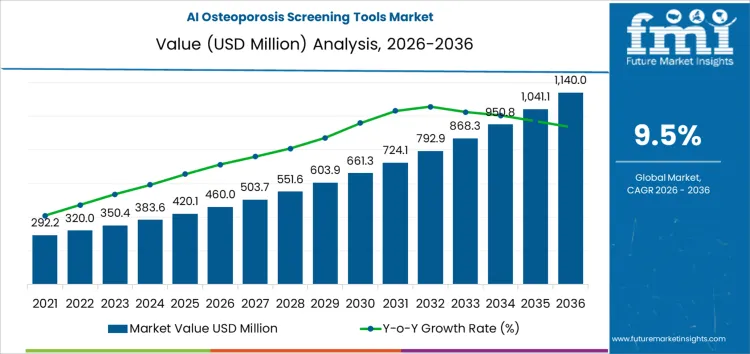
The AI osteoporosis screening tools market is expected to expand from USD 460 million in 2026 to USD 1,140.0 million by 2036, at a CAGR of 9.50%. Commercial relevance is driven by timing rather than pure innovation. Healthcare systems are under pressure to shift diagnosis upstream, where intervention is less expensive and outcomes are more controllable. Ai screening tools convert routine imaging into actionable insight, changing the economics of bone health assessment without proportional increases in staffing or equipment.
Buyer intent is pragmatic, focused on reducing missed diagnoses and improving throughput under value-based care models. Adoption decisions are sensitive to regulatory clarity, reimbursement signals, and workflow disruption risk. Vendors that shorten implementation timelines and demonstrate economic justification gain faster traction. The decade ahead favors solutions embedded into standard care pathways rather than standalone pilots. This market rewards suppliers who understand institutional buying cycles, budget constraints, and the financial logic of preventive healthcare delivery.
Quick Stats for AI Osteoporosis Screening Tools Market
- AI Osteoporosis Screening Tools Market Value (2026): USD 460 Million
- AI Osteoporosis Screening Tools Market Forecast Value (2036): USD 1,140.0 Million
- AI Osteoporosis Screening Tools Market Forecast CAGR 2026 to 2036: 9.50%
- Leading Technology in AI Osteoporosis Screening Tools Market: AI-Enabled DXA Image Analysis (46% share)
- Key Growth Regions in AI Osteoporosis Screening Tools Market: North America, Asia Pacific, Europe, Latin America, Middle East & Africa
- Top Key Players in AI Osteoporosis Screening Tools Market: Hologic, Inc., GE HealthCare, Siemens Healthineers, Philips Healthcare, Fujifilm Healthcare, Canon Medical Systems Corporation, Mindray Medical International Limited, Esaote S.p.A., Qure.ai Technologies Pvt. Ltd., Zebra Medical Vision Ltd.
Key Takeaways, Market Size, and Forecast
| Metric | Value |
|---|---|
| Market Size (2026) | USD 460.0 Million |
| Market Size (2036) | USD 1,140.0 Million |
| CAGR (2026–2036) | 9.5% |
| Leading Product | AI-Enabled DXA Image Analysis |
| AI-Enabled DXA Image Analysis Share | 46.0% |
| Leading End User | Hospitals & Diagnostic Centers |
| Hospitals & Diagnostic Centers Share | 48.0% |
AI Osteoporosis Screening Tools Market Key Takeaways
| Metric | Value |
|---|---|
| AI Osteoporosis Screening Tools Market Value (2026) | USD 460 Million |
| AI Osteoporosis Screening Tools Market Forecast Value (2036) | USD 1,140.0 Million |
| AI Osteoporosis Screening Tools Market Forecast CAGR 2026 to 2036 | 9.50% |
How Is AI Adoption Transforming Osteoporosis Screening and Creating Market Opportunities?
The AI osteoporosis screening tools market is expanding as healthcare systems seek scalable and cost-efficient solutions for early bone health assessment. Rising prevalence of osteoporosis among aging populations is increasing screening volumes, while shortages of specialists and imaging resources are limiting access to conventional diagnostic pathways. AI-based screening tools, capable of analyzing X-rays, CT scans, and opportunistic imaging data, are enabling broader population-level screening without significant infrastructure expansion. For technology providers, this shift opens opportunities to embed AI algorithms directly into existing imaging workflows.
Commercial adoption is being driven by the ability of AI tools to improve detection rates and clinical efficiency. Automated bone density estimation and fracture risk assessment reduce diagnostic variability and support faster clinical decision-making. Hospitals and diagnostic centers are increasingly favoring solutions that integrate seamlessly with PACS, RIS, and electronic health record systems. Vendors offering interoperable, regulatory-cleared software with minimal workflow disruption are better positioned to scale across multi-site healthcare networks.
Reimbursement evolution and preventive healthcare focus are further strengthening market momentum. Health systems are emphasizing early diagnosis to reduce long-term fracture-related costs, supporting the use of AI-enabled screening as a preventive tool rather than a secondary diagnostic aid. Emerging markets are also adopting AI screening platforms to compensate for limited access to DXA scanners. For suppliers, long-term success depends on algorithm accuracy, clinical validation, and partnership with imaging OEMs, positioning the AI osteoporosis screening tools market as a high-growth, software-led healthcare segment.
What Is The Segment Overview Of The AI Osteoporosis Screening Tools Market?
The AI osteoporosis screening tools market is segmented by technology and end user, reflecting how artificial intelligence is being deployed across imaging modalities and clinical settings. By technology, ai-enabled DXA image analysis leads adoption, as DXA remains the clinical reference standard for bone mineral density assessment. Other technologies such as opportunistic CT and X-ray ai screening, ultrasound-based ai screening, and alternative ai-driven tools expand screening reach beyond conventional workflows. By end user, hospitals and diagnostic centers represent the primary demand base, supported by high patient volumes and integrated imaging infrastructure. Specialty orthopedic clinics, imaging centers, and research institutions contribute to broader clinical and analytical usage.
Why Does AI-Enabled DXA Image Analysis Lead The AI Osteoporosis Screening Tools Market By Technology?
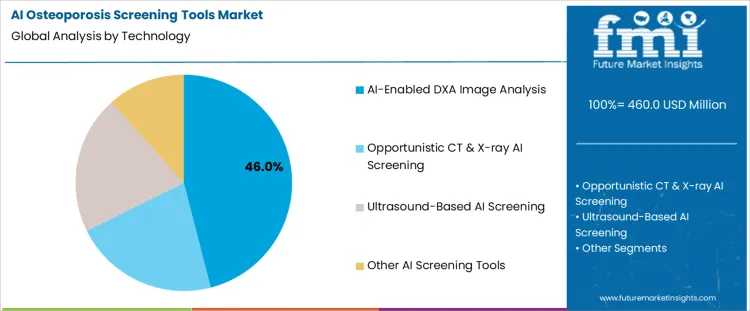
Ai-enabled DXA image analysis holds 46% share in the ai osteoporosis screening tools market because it enhances the diagnostic value of an already established imaging modality. DXA scans are widely used for osteoporosis diagnosis, and ai algorithms improve fracture risk assessment, image consistency, and reporting efficiency. Hospitals and diagnostic centers adopt ai-driven DXA tools to reduce interpretation variability and support early detection. Integration with existing DXA hardware lowers implementation barriers for providers. For technology developers and suppliers, DXA-based ai tools offer faster commercialization due to regulatory familiarity and clinical acceptance. This combination of clinical trust and workflow compatibility explains their leading position.
Why Do Hospitals And Diagnostic Centers Dominate The AI Osteoporosis Screening Tools Market By End User?
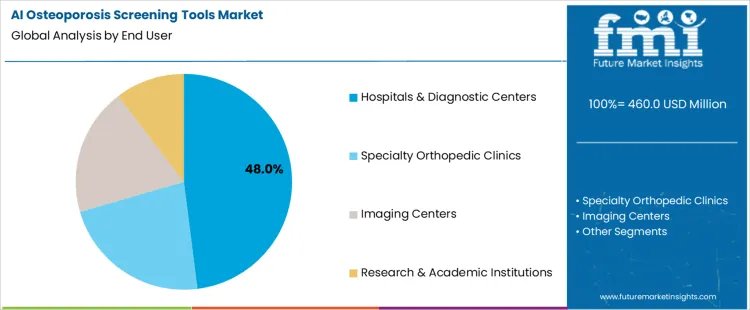
Hospitals and diagnostic centers account for 48% share of the ai osteoporosis screening tools market because they manage the highest volume of bone health assessments. These facilities operate centralized imaging departments where ai tools can be embedded into routine DXA, CT, and X-ray workflows. High patient throughput creates demand for faster interpretation, standardized reporting, and decision support. Ai screening tools help clinicians identify at-risk patients earlier, supporting preventive care pathways. From a supplier perspective, hospitals and diagnostic centers provide scalable deployment opportunities and long-term software licensing potential. These operational and commercial factors explain their dominance as end users.
What are the Key Dynamics in the AI Osteoporosis Screening Tools Market?
The AI osteoporosis screening tools market is driven by rising prevalence of osteoporosis and the need for early, accessible, and cost-effective diagnostic solutions. AI-enabled tools enhance the interpretation of bone density scans, radiographs, and clinical risk data to identify patients at risk of fractures with higher accuracy and consistency than traditional methods. Integration with existing imaging equipment and electronic health records (EHRs) is increasing adoption in hospitals, clinics, and community screening programs. For developers and suppliers, regulatory approvals, clinical validation studies, and interoperability with healthcare IT systems are critical for commercial success and differentiation in this rapidly evolving market.
How Are Technological Innovations Shaping The AI Osteoporosis Screening Tools Market?
Technological innovations are accelerating the AI osteoporosis screening tools market by improving algorithm performance, automation, and integration capabilities. Deep learning models trained on large imaging datasets are delivering better bone quality assessment, fracture risk prediction, and anomaly detection with minimal manual oversight. Cloud-based AI platforms facilitate remote screening, telemedicine workflows, and scalability across healthcare networks. Integration with DXA (dual-energy X-ray absorptiometry), CT, and radiographic imaging systems enhances usability for clinicians and radiologists. For technology providers, the ability to continually update AI models through federated learning and secure data pipelines increases long-term value and tool performance.
Why Do Regulatory, Validation, And Adoption Barriers Restrain The AI Osteoporosis Screening Tools Market?
Regulatory requirements, clinical validation needs, and adoption barriers restrain the AI osteoporosis screening tools market. Regulatory approval processes such as FDA clearance and CE marking demand extensive clinical evidence demonstrating safety, accuracy, and real-world performance, increasing time-to-market for developers. Skepticism among clinicians regarding AI interpretability and integration into standard care pathways slows adoption. Data privacy concerns and interoperability challenges with existing imaging and EHR systems add complexity for healthcare providers. Limited reimbursement frameworks for AI-assisted diagnostics in many regions reduce financial incentives for implementation, particularly in smaller clinics and low-resource settings.
How Is the Global Healthcare AI Landscape Creating Country-Level Opportunities in the AI Osteoporosis Screening Tools Market?
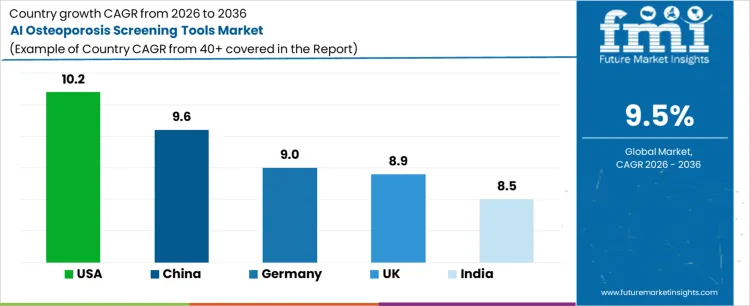
Demand for AI osteoporosis screening tools is shaped by aging demographics, imaging infrastructure maturity, reimbursement dynamics, and regulatory openness to clinical AI adoption. Developed healthcare systems lead early adoption through integration with existing radiology workflows, while emerging markets show rapid uptake through scalable, software-first screening models. Growth is increasingly driven by opportunistic screening using X-ray, CT, and DXA imaging, combined with AI-enabled risk stratification. Vendors that offer modality-agnostic algorithms, cloud deployment options, and clinical validation gain stronger traction. Country-level opportunities differ based on procurement pathways, hospital digitization levels, and public health screening priorities.
| Country | CAGR (%) |
|---|---|
| USA | 10.2% |
| China | 9.6% |
| Germany | 9.0% |
| UK | 8.9% |
| India | 8.5% |
Why Does the United States Lead Commercial Adoption of AI Osteoporosis Screening Tools?
Demand for AI osteoporosis screening tools in the United States, expanding at a CAGR of 10.2% during 2026 to 2036, is driven by a convergence of high osteoporosis prevalence, advanced imaging penetration, and early acceptance of clinical AI. Hospitals and diagnostic networks increasingly deploy AI to enable opportunistic screening from routine CT and X-ray scans, converting incidental imaging into preventive insights. Buyers prioritize FDA-cleared solutions with strong clinical validation, explainability, and seamless integration with PACS, RIS, and enterprise imaging platforms. Health systems view AI screening as a pathway to reduce fracture-related costs under value-based care models. Replacement demand is accelerating as providers move from rule-based or manual assessment tools to deep-learning-driven risk stratification platforms. Procurement decisions often involve multi-site enterprise contracts, favoring vendors with scalable deployment and cybersecurity readiness. Vendors benefit from premium pricing, recurring software revenue, and long-term service agreements. The US market rewards suppliers that combine regulatory readiness, workflow interoperability, and measurable clinical and economic outcomes.
How Is China Scaling AI Osteoporosis Screening Across Large Healthcare Networks?
Sales of AI osteoporosis screening tools in China, growing at a CAGR of 9.6% from 2026 to 2036, are supported by rapid digitization of hospital imaging infrastructure and centralized healthcare expansion. Large public hospitals and regional health systems seek AI solutions capable of processing high imaging volumes with consistent output. Buyers emphasize automation, throughput efficiency, and compatibility with domestically manufactured imaging equipment. Government-backed healthcare AI initiatives and pilot programs accelerate adoption of software-based diagnostics. Procurement is often centralized, favoring vendors that can support wide-scale rollouts across hospital groups. Pricing sensitivity remains, but it is offset by significant volume potential. Localization, language adaptation, and compliance with domestic data governance requirements influence supplier selection. Vendors offering flexible deployment models, including on-premise and private cloud, gain advantage. China represents a scale-driven opportunity where success depends on rapid deployment capability, workflow standardization, and long-term platform support rather than premium pricing strategies.
What Drives Clinical Acceptance of AI Osteoporosis Screening in Germany?
Demand for AI osteoporosis screening tools in Germany, expanding at a CAGR of 9.0%, is shaped by strong emphasis on diagnostic accuracy, clinical accountability, and regulatory compliance. Hospitals and imaging centers require extensive validation data, CE marking, and transparency in algorithm decision-making. Procurement processes are structured and evidence-driven, with involvement from clinical committees and hospital administrators. Adoption focuses on improving diagnostic consistency, reducing inter-reader variability, and managing radiologist workload. Buyers value explainable AI outputs that support clinical decision-making rather than replace it. Replacement demand is emerging as institutions modernize legacy assessment methods with AI-assisted tools. Volumes are moderate compared with Asia, but willingness to pay remains high for solutions meeting clinical and regulatory expectations. Vendors with strong documentation, audit readiness, and long-term service support are favored. Germany rewards suppliers that align AI performance with rigorous healthcare standards and integrate smoothly into established clinical workflows.
Why Is the UK a Strong Market for AI-Enabled Preventive Screening Tools?
Sales of AI osteoporosis screening tools in the United Kingdom, growing at a CAGR of 8.9%, are driven by NHS priorities around early detection, preventive care, and population health management. Buyers focus on solutions that deliver measurable efficiency gains and integrate with existing imaging infrastructure without adding operational complexity. Centralized procurement and pilot-based adoption shape market entry, requiring vendors to demonstrate clinical and economic value before large-scale deployment. Interoperability with NHS systems and adherence to data governance standards are critical. AI tools that enable opportunistic screening from routine imaging gain preference due to cost efficiency. Pricing pressure exists, but long-term contracts and national rollouts offer stability. Vendors offering strong health economic evidence, scalable deployment, and service reliability gain traction. The UK market favors suppliers capable of supporting public healthcare objectives rather than purely commercial use cases.
How Is India Emerging as a High-Growth, Software-First Market?
Demand for AI osteoporosis screening tools in India, expanding at a CAGR of 8.5%, is driven by rising diagnostic imaging volumes and significant unmet screening needs. Private diagnostic chains, multi-specialty hospitals, and tele-radiology providers lead adoption rather than public institutions. Buyers emphasize affordability, cloud-based deployment, and minimal infrastructure requirements. AI tools are viewed as a means to expand screening reach without proportional increases in specialist staffing. Procurement decisions favor software-centric solutions compatible with diverse imaging equipment. Pricing sensitivity is high, encouraging subscription-based and pay-per-use models. Localization, ease of training, and rapid implementation influence supplier success. India represents a growth-oriented market where scalable, cost-efficient AI platforms aligned with high-volume diagnostic workflows can achieve rapid penetratio
How Are Companies Competing in the AI Osteoporosis Screening Tools Market?
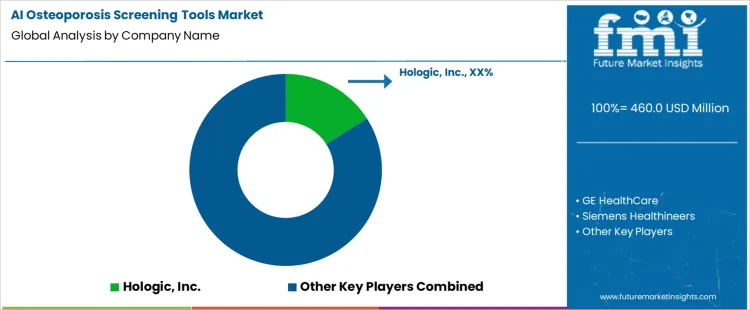
Competition in the AI osteoporosis screening tools market is anchored in clinically validated algorithms, imaging modality compatibility, and regulatory clearance claims detailed in official documentation. Hologic, Inc. positions its AI-enhanced bone health solutions with brochures that outline integration with dual-energy X-ray absorptiometry (DXA) systems and proprietary risk stratification metrics. Product materials emphasize precision, automated reporting, and longitudinal tracking tailored to osteoporosis assessment workflows in radiology and endocrinology clinics. GE HealthCare competes through AI frameworks that extend across DXA and conventional radiography, with literature highlighting automated vertebral fracture detection and actionable clinical outputs validated against large population datasets. Siemens Healthineers differentiates via scalable AI modules embedded in its imaging suites, supported by technical sheets that document sensitivity, specificity, and seamless PACS integration.
Major imaging OEMs leverage cross-modality ecosystems. Philips Healthcare markets AI osteoporosis screening tools integrated with its bone densitometry and radiography platforms, with brochures focused on workflow automation and standardized reporting. Fujifilm Healthcare and Canon Medical Systems Corporation position their AI solutions around multimodal screening versatility, with product guides detailing compatibility across DXA, radiographs, and opportunistic CT analyses to identify low bone mass with clinical confidence. Mindray Medical International Limited and Esaote S.p.A. compete by bundling AI screening capabilities with broader imaging portfolios aimed at emerging markets, with documentation that underscores cost-effective deployment and simplified user experiences.
Providers of standalone AI software emphasize scalable analytics and interoperability. Carestream Health and Agfa HealthCare offer AI osteoporosis plugins for existing imaging systems, with official materials stressing standards-based integration (DICOM, HL7) and customizable reporting templates for clinical decision support. Naitive Technologies, Inc. and 16 Bit Inc. focus on cloud-enabled AI analytics with technical brochures highlighting rapid processing, continuous learning models, and secure data handling. Qure.ai Technologies Pvt. Ltd. and Zebra Medical Vision Ltd. differentiate through deep learning frameworks validated across multi-center studies, with documentation outlining automated fracture risk scoring and opportunistic screening from routine imaging. Across all players, competition is defined by AI performance metrics validated in clinical settings, ease of integration with imaging infrastructure, and regulatory clearances detailed in official product resources rather than pricing alone.
Key Players in AI Osteoporosis Screening Tools Market
- Hologic, Inc.
- GE HealthCare
- Siemens Healthineers
- Philips Healthcare
- Fujifilm Healthcare
- Canon Medical Systems Corporation
- Mindray Medical International Limited
- Esaote S.p.A.
- Carestream Health
- Agfa HealthCare
- Naitive Technologies, Inc.
- 16 Bit Inc.
- Qure.ai Technologies Pvt. Ltd.
- Zebra Medical Vision Ltd.
Scope of Report
| Attribute | Description |
|---|---|
| Quantitative Unit | USD Million |
| Technology | AI-Enabled DXA Image Analysis, Opportunistic CT & X-ray AI Screening, Ultrasound-Based AI Screening, Other AI Screening Tools |
| End User | Hospitals & Diagnostic Centers, Specialty Orthopedic Clinics, Imaging Centers, Research & Academic Institutions |
| Countries Covered | China, Japan, South Korea, India, Australia & New Zealand, ASEAN, Rest of Asia Pacific, Germany, United Kingdom, France, Italy, Spain, Nordic, BENELUX, Rest of Europe, United States, Canada, Mexico, Brazil, Chile, Rest of Latin America, Kingdom of Saudi Arabia, Other GCC Countries, Turkey, South Africa, Other African Union, Rest of Middle East & Africa |
| Regions Covered | Asia Pacific, Europe, North America, Latin America, Middle East & Africa |
| Key Companies Profiled | Hologic, Inc., GE HealthCare, Siemens Healthineers, Philips Healthcare, Fujifilm Healthcare, Canon Medical Systems Corporation, Mindray Medical International Limited, Esaote S.p.A., Carestream Health, Agfa HealthCare, Naitive Technologies, Inc., 16 Bit Inc., Qure.ai Technologies Pvt. Ltd., Zebra Medical Vision Ltd. |
| Additional Attributes | Dollar sales by technology and end user are evaluated across clinical imaging workflows and screening programs. The report includes country-level demand assessment, growth projections for 2026 to 2036, analysis of AI diagnostic accuracy and workflow integration, evaluation of regulatory and reimbursement readiness, competitive benchmarking of solution providers, and assessment of adoption trends across hospital and diagnostic imaging networks. |
AI Osteoporosis Screening Tools Market by Key Segments
Technology
- AI-Enabled DXA Image Analysis
- Opportunistic CT & X-ray AI Screening
- Ultrasound-Based AI Screening
- Other AI Screening Tools
End User
- Hospitals & Diagnostic Centers
- Specialty Orthopedic Clinics
- Imaging Centers
- Research & Academic Institutions
Region:
- Asia Pacific
- China
- Japan
- South Korea
- India
- Australia & New Zealand
- ASEAN
- Rest of Asia Pacific
- Europe
- Germany
- United Kingdom
- France
- Italy
- Spain
- Nordic
- BENELUX
- Rest of Europe
- North America
- United States
- Canada
- Mexico
- Latin America
- Brazil
- Chile
- Rest of Latin America
- Middle East & Africa
- Kingdom of Saudi Arabia
- Other GCC Countries
- Turkey
- South Africa
- Other African Union
- Rest of Middle East & Africa
Bibliography
- U.S. Food and Drug Administration. (2025). Marketing submission recommendations for predetermined change control plans for AI/ML-enabled device software functions. Center for Devices and Radiological Health, U.S. Department of Health and Human Services.
- European Commission, Medical Device Coordination Group. (2025). Guidance on interplay between the Medical Devices Regulation (MDR), In Vitro Diagnostic Regulation (IVDR), and Artificial Intelligence Act (AIA) (MDCG 2025-6). European Commission.
- Medicines and Healthcare products Regulatory Agency. (2025). Software and AI as a medical device change programme: Implementation roadmap 2025 revision. UK Government (MHRA).
Frequently Asked Questions
How big is the ai osteoporosis screening tools market in 2026?
The global ai osteoporosis screening tools market is estimated to be valued at USD 460.0 million in 2026.
What will be the size of ai osteoporosis screening tools market in 2036?
The market size for the ai osteoporosis screening tools market is projected to reach USD 1,140.0 million by 2036.
How much will be the ai osteoporosis screening tools market growth between 2026 and 2036?
The ai osteoporosis screening tools market is expected to grow at a 9.5% CAGR between 2026 and 2036.
What are the key product types in the ai osteoporosis screening tools market?
The key product types in ai osteoporosis screening tools market are ai-enabled dxa image analysis, opportunistic ct & x-ray ai screening, ultrasound-based ai screening and other ai screening tools.
Which end user segment to contribute significant share in the ai osteoporosis screening tools market in 2026?
In terms of end user, hospitals & diagnostic centers segment to command 48.0% share in the ai osteoporosis screening tools market in 2026.
Preview the report firsthand - request a free sample
Get SampleGet the brochure for pricing and purchase details.
Get PDFTable of Content
- Executive Summary
- Global Market Outlook
- Demand-side Trends
- Supply-side Trends
- Technology Roadmap Analysis
- Analysis and Recommendations
- Market Overview
- Market Coverage / Taxonomy
- Market Definition / Scope / Limitations
- Market Background
- Market Dynamics
- Drivers
- Restraints
- Opportunity
- Trends
- Scenario Forecast
- Demand in Optimistic Scenario
- Demand in Likely Scenario
- Demand in Conservative Scenario
- Opportunity Map Analysis
- Product Life Cycle Analysis
- Supply Chain Analysis
- Investment Feasibility Matrix
- Value Chain Analysis
- PESTLE and Porter’s Analysis
- Regulatory Landscape
- Regional Parent Market Outlook
- Production and Consumption Statistics
- Import and Export Statistics
- Market Dynamics
- Global Market Analysis 2021 to 2025 and Forecast, 2026 to 2036
- Historical Market Size Value (USD Million) Analysis, 2021 to 2025
- Current and Future Market Size Value (USD Million) Projections, 2026 to 2036
- Y-o-Y Growth Trend Analysis
- Absolute $ Opportunity Analysis
- Global Market Pricing Analysis 2021 to 2025 and Forecast 2026 to 2036
- Global Market Analysis 2021 to 2025 and Forecast 2026 to 2036, By Technology
- Introduction / Key Findings
- Historical Market Size Value (USD Million) Analysis By Technology , 2021 to 2025
- Current and Future Market Size Value (USD Million) Analysis and Forecast By Technology , 2026 to 2036
- AI-Enabled DXA Image Analysis
- Opportunistic CT & X-ray AI Screening
- Ultrasound-Based AI Screening
- Other AI Screening Tools
- AI-Enabled DXA Image Analysis
- Y-o-Y Growth Trend Analysis By Technology , 2021 to 2025
- Absolute $ Opportunity Analysis By Technology , 2026 to 2036
- Global Market Analysis 2021 to 2025 and Forecast 2026 to 2036, By End User
- Introduction / Key Findings
- Historical Market Size Value (USD Million) Analysis By End User, 2021 to 2025
- Current and Future Market Size Value (USD Million) Analysis and Forecast By End User, 2026 to 2036
- Hospitals & Diagnostic Centers
- Specialty Orthopedic Clinics
- Imaging Centers
- Research & Academic Institutions
- Hospitals & Diagnostic Centers
- Y-o-Y Growth Trend Analysis By End User, 2021 to 2025
- Absolute $ Opportunity Analysis By End User, 2026 to 2036
- Global Market Analysis 2021 to 2025 and Forecast 2026 to 2036, By Region
- Introduction
- Historical Market Size Value (USD Million) Analysis By Region, 2021 to 2025
- Current Market Size Value (USD Million) Analysis and Forecast By Region, 2026 to 2036
- North America
- Latin America
- Western Europe
- Eastern Europe
- East Asia
- South Asia and Pacific
- Middle East & Africa
- Market Attractiveness Analysis By Region
- North America Market Analysis 2021 to 2025 and Forecast 2026 to 2036, By Country
- Historical Market Size Value (USD Million) Trend Analysis By Market Taxonomy, 2021 to 2025
- Market Size Value (USD Million) Forecast By Market Taxonomy, 2026 to 2036
- By Country
- USA
- Canada
- Mexico
- By Technology
- By End User
- By Country
- Market Attractiveness Analysis
- By Country
- By Technology
- By End User
- Key Takeaways
- Latin America Market Analysis 2021 to 2025 and Forecast 2026 to 2036, By Country
- Historical Market Size Value (USD Million) Trend Analysis By Market Taxonomy, 2021 to 2025
- Market Size Value (USD Million) Forecast By Market Taxonomy, 2026 to 2036
- By Country
- Brazil
- Chile
- Rest of Latin America
- By Technology
- By End User
- By Country
- Market Attractiveness Analysis
- By Country
- By Technology
- By End User
- Key Takeaways
- Western Europe Market Analysis 2021 to 2025 and Forecast 2026 to 2036, By Country
- Historical Market Size Value (USD Million) Trend Analysis By Market Taxonomy, 2021 to 2025
- Market Size Value (USD Million) Forecast By Market Taxonomy, 2026 to 2036
- By Country
- Germany
- UK
- Italy
- Spain
- France
- Nordic
- BENELUX
- Rest of Western Europe
- By Technology
- By End User
- By Country
- Market Attractiveness Analysis
- By Country
- By Technology
- By End User
- Key Takeaways
- Eastern Europe Market Analysis 2021 to 2025 and Forecast 2026 to 2036, By Country
- Historical Market Size Value (USD Million) Trend Analysis By Market Taxonomy, 2021 to 2025
- Market Size Value (USD Million) Forecast By Market Taxonomy, 2026 to 2036
- By Country
- Russia
- Poland
- Hungary
- Balkan & Baltic
- Rest of Eastern Europe
- By Technology
- By End User
- By Country
- Market Attractiveness Analysis
- By Country
- By Technology
- By End User
- Key Takeaways
- East Asia Market Analysis 2021 to 2025 and Forecast 2026 to 2036, By Country
- Historical Market Size Value (USD Million) Trend Analysis By Market Taxonomy, 2021 to 2025
- Market Size Value (USD Million) Forecast By Market Taxonomy, 2026 to 2036
- By Country
- China
- Japan
- South Korea
- By Technology
- By End User
- By Country
- Market Attractiveness Analysis
- By Country
- By Technology
- By End User
- Key Takeaways
- South Asia and Pacific Market Analysis 2021 to 2025 and Forecast 2026 to 2036, By Country
- Historical Market Size Value (USD Million) Trend Analysis By Market Taxonomy, 2021 to 2025
- Market Size Value (USD Million) Forecast By Market Taxonomy, 2026 to 2036
- By Country
- India
- ASEAN
- Australia & New Zealand
- Rest of South Asia and Pacific
- By Technology
- By End User
- By Country
- Market Attractiveness Analysis
- By Country
- By Technology
- By End User
- Key Takeaways
- Middle East & Africa Market Analysis 2021 to 2025 and Forecast 2026 to 2036, By Country
- Historical Market Size Value (USD Million) Trend Analysis By Market Taxonomy, 2021 to 2025
- Market Size Value (USD Million) Forecast By Market Taxonomy, 2026 to 2036
- By Country
- Kingdom of Saudi Arabia
- Other GCC Countries
- Turkiye
- South Africa
- Other African Union
- Rest of Middle East & Africa
- By Technology
- By End User
- By Country
- Market Attractiveness Analysis
- By Country
- By Technology
- By End User
- Key Takeaways
- Key Countries Market Analysis
- USA
- Pricing Analysis
- Market Share Analysis, 2025
- By Technology
- By End User
- Canada
- Pricing Analysis
- Market Share Analysis, 2025
- By Technology
- By End User
- Mexico
- Pricing Analysis
- Market Share Analysis, 2025
- By Technology
- By End User
- Brazil
- Pricing Analysis
- Market Share Analysis, 2025
- By Technology
- By End User
- Chile
- Pricing Analysis
- Market Share Analysis, 2025
- By Technology
- By End User
- Germany
- Pricing Analysis
- Market Share Analysis, 2025
- By Technology
- By End User
- UK
- Pricing Analysis
- Market Share Analysis, 2025
- By Technology
- By End User
- Italy
- Pricing Analysis
- Market Share Analysis, 2025
- By Technology
- By End User
- Spain
- Pricing Analysis
- Market Share Analysis, 2025
- By Technology
- By End User
- France
- Pricing Analysis
- Market Share Analysis, 2025
- By Technology
- By End User
- India
- Pricing Analysis
- Market Share Analysis, 2025
- By Technology
- By End User
- ASEAN
- Pricing Analysis
- Market Share Analysis, 2025
- By Technology
- By End User
- Australia & New Zealand
- Pricing Analysis
- Market Share Analysis, 2025
- By Technology
- By End User
- China
- Pricing Analysis
- Market Share Analysis, 2025
- By Technology
- By End User
- Japan
- Pricing Analysis
- Market Share Analysis, 2025
- By Technology
- By End User
- South Korea
- Pricing Analysis
- Market Share Analysis, 2025
- By Technology
- By End User
- Russia
- Pricing Analysis
- Market Share Analysis, 2025
- By Technology
- By End User
- Poland
- Pricing Analysis
- Market Share Analysis, 2025
- By Technology
- By End User
- Hungary
- Pricing Analysis
- Market Share Analysis, 2025
- By Technology
- By End User
- Kingdom of Saudi Arabia
- Pricing Analysis
- Market Share Analysis, 2025
- By Technology
- By End User
- Turkiye
- Pricing Analysis
- Market Share Analysis, 2025
- By Technology
- By End User
- South Africa
- Pricing Analysis
- Market Share Analysis, 2025
- By Technology
- By End User
- USA
- Market Structure Analysis
- Competition Dashboard
- Competition Benchmarking
- Market Share Analysis of Top Players
- By Regional
- By Technology
- By End User
- Competition Analysis
- Competition Deep Dive
- Hologic, Inc.
- Overview
- Product Portfolio
- Profitability by Market Segments (Product/Age /Sales Channel/Region)
- Sales Footprint
- Strategy Overview
- Marketing Strategy
- Product Strategy
- Channel Strategy
- GE HealthCare
- Siemens Healthineers
- Philips Healthcare
- Fujifilm Healthcare
- Canon Medical Systems Corporation
- Mindray Medical International Limited
- Esaote S.p.A.
- Carestream Health
- Agfa HealthCare
- Naitive Technologies, Inc.
- 16 Bit Inc.
- Qure.ai Technologies Pvt. Ltd.
- Zebra Medical Vision Ltd.
- Hologic, Inc.
- Competition Deep Dive
- Assumptions & Acronyms Used
- Research Methodology


