

- Industry Size (2026)
- USD 6.5 Bn
- Forecast (2036)
- USD 21.0 Bn
- CAGR (2026 to 2036)
- 12.4%
Resale Authentication Services Market Size, Market Forecast and Outlook By FMI
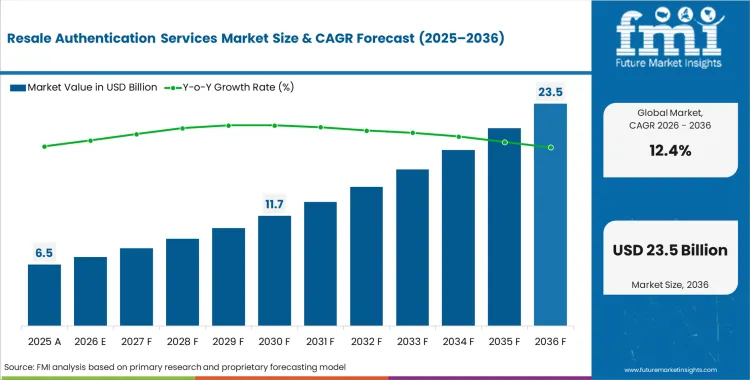
The resale authentication services market was valued at USD 5.8 billion in 2025. The sector is estimated to reach a valuation of USD 6.5 billion in 2026 at a CAGR of 12.4% during this forecast period. Sustained investment carries total valuation to USD 21.0 billion through 2036. Platforms automate counterfeit detection workflows to handle surging item submission volumes effectively.
Summary of Resale Authentication Services Market
- Market Snapshot
- The resale authentication services market is valued at USD 5.8 billion in 2025. It is projected to reach USD 21.0 billion by 2036.
- The industry is expected to grow at a 12.4% CAGR from 2026 to 2036. This expansion creates an incremental opportunity of USD 14.5 billion.
- The market functions as a trust and verification layer for pre-owned fashion and luxury transactions. Counterfeit detection, provenance checks, and resale platform credibility shape purchasing behavior in this space.
- Competitive advantage depends on speed, brand coverage, and workflow integration. The mix of AI inspection with trained human review also dictates competitive advantage.
- Demand and Growth Drivers
- Demand is rising as counterfeit exposure remains high in global trade. This pushes marketplaces and buyers toward authenticated resale channels.
- AI-assisted verification is gaining share. Platforms need faster item screening, lower manual friction, and more scalable trust controls across growing SKU volumes.
- Platform operators are expanding paid or embedded authentication. Higher-ticket resale categories depend on confidence at checkout and lower fraud losses after sale.
- Among key countries, China is set to expand at 14.1% CAGR, followed by the United States at 13.2%. The United Kingdom grows at 12.8%, France at 12.5%, Japan at 11.9%, and South Korea at 11.6%. The United Arab Emirates expands at 11.2%.
- Growth is moderated by category-specific expertise requirements and false-positive risk. The cost of combining physical inspection Demand is rising as counterfeit exposure remains high in global trade. This pushes marketplaces and buyers toward authenticated resale channels.
- AI-assisted verification is gaining share. Platforms need faster item screening, lower manual friction, and more scalable trust controls across growing SKU volumes.
- Platform operators are expanding paid or embedded authentication. Higher-ticket resale categories depend on confidence at checkout and lower fraud losses after sale.
- Among key countries, China leads at 14.1% CAGR, followed by the United States at 13.2%. The United Kingdom grows at 12.8%, France at 12.5%, Japan at 11.9%, and South Korea at 11.6%. The United Arab Emirates expands at 11.2%.
- Growth is moderated by category-specific expertise requirements and false-positive risk. The cost of combining physical inspectionwith digital verification at scale also moderates growth.
- Product and Segment View
- The market covers AI authentication, expert review, hybrid verification, certification services, and provenance tracking. These services are used for premium pre-owned goods.
- These services are delivered through platform-embedded tools, standalone apps, API workflows, and in-store verification desks.
- AI Authentication leads the service type segment with 41.0% share. The need for scale and faster screening of luxury and fashion inventory supports this share.
- Platform-embedded leads the delivery mode segment with 52.0% share. Verification is increasingly built into resale marketplace workflows directly.
- Handbags lead the item category segment with 34.0% share. High counterfeit exposure and strong resale liquidity in luxury bags reflect this dominance.
- Marketplaces lead the end user segment with 46.0% share. Large resale platforms need authentication to sustain conversion and trust.
- Image Analysis leads the authentication method segment with 38.0% share. The speed and scalability of digital first-pass inspection drive this segment.
- Scope includes digital and expert-led authentication for handbags, apparel, footwear, watches, and jewelry. It excludes generic classifieds, pure shipping services, and non-verified e-commerce listing tools.
- Geography and Competitive Outlook
- China, the United States, and the United Kingdom are the fastest-growing demand centers. France and Japan remain stable high-value markets for authenticated premium resale.
- Competition is shaped by AI deployment, authentication-center expansion, digital ID integration, and platform-native verification offers.
- Key participants include The RealReal, Entrupy, eBay, Vestiaire Collective, Vinted, StockX, and Real Authentication.
Businesses face a major commercial imperative concerning the internalization of counterfeit liability. Companies must achieve this crucial objective without detrimentally impacting seller listing speeds. Operational departments experience immediate loss of premium consignors if items remain in manual verification queues over periods of multiple weeks. Expanding physical inspection capabilities completely destroys unit economics for the entire business model. This situation requires a strategic shift toward algorithmic image screening technology. Integrating rapid fashion resale authentication software is now absolutely essential for commercial survival in this marketplace.
Postponing system integration causes the surrender of lucrative, high-margin transactions to competing exchanges. Market rivals offer instant digital assurances of trust, a powerful mechanism to attract and retain top-tier sellers. These sophisticated algorithmic systems fundamentally operate as initial triage mechanisms. They reserve complex, unconventional scenarios and difficult edge cases for specialized human reviewers with expert knowledge. Marketplace operators increasingly require a proven authenticated resale infrastructure before they finalize premium checkout processes. Digital product authentication applied to resale transactions fundamentally alters the speed and flow of inventory. Advanced authentication systems substantially reduce operational overhead expenses throughout the complete ecosystem.
China is projected to expand at a 14.1% CAGR from 2026 to 2036, supported by sustained platform investment in counterfeit risk mitigation. The United States is expected to grow at a 13.2% CAGR, driven by high peer‑to‑peer transaction velocity, while the United Kingdom is forecast to advance at a 12.8% CAGR on the strength of mature, institutionalized resale platforms. France is estimated to register a 12.5% CAGR, reflecting regulatory enforcement intensity, as Japan is projected to grow at an 11.9% CAGR, supported by verified‑provenance demand from a strong collector base. South Korea is expected to expand at an 11.6% CAGR through 2036, underpinned by digitally advanced marketplace infrastructure.
Resale Authentication Services Market Key Takeaways
| Metric | Details |
|---|---|
| Industry Size (2026) | USD 6.5 Billion |
| Industry Value (2036) | USD 21.0 Billion |
| CAGR (2026 to 2036) | 12.4% |
Source: Future Market Insights (FMI) analysis, based on proprietary forecasting model and primary research
Segmental Analysis
Resale Authentication Services Market Analysis by Service Type
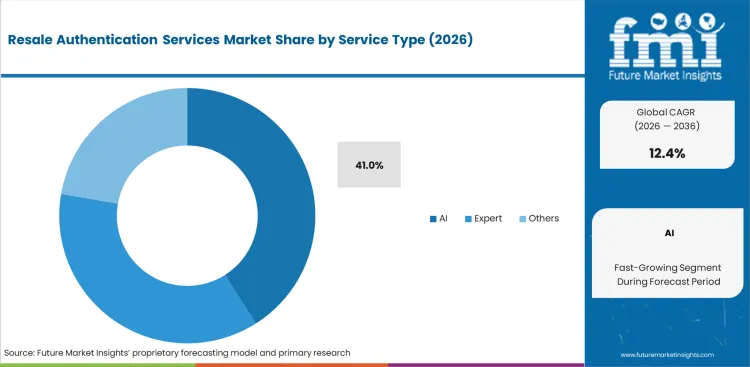
Manual inspection processes become unsustainable as daily peer-to-peer listings attain global enterprise scale. The AI authentication segment commands a 41.0% share in 2026, due to substantial processing capacity, fueled by extreme cost-efficiency. High-speed processing needs directly drive this massive segment dominance across major digital platforms. Marketplace product management utilizes algorithmic tools for efficient baseline sorting. FMI's assessment indicates these systems quickly process standardized photos submitted by casual sellers. Integration of apparel re-commerce logic directly into submission portals ensures complete prevention of fraudulent listings. Algorithms function primarily as high-speed triage mechanisms within the resale authentication services market. Complex edge cases and super-premium items route automatically to specialized human authenticators. Platforms delaying AI adoption experience surging operational expenses as manual reviewers contend with overwhelming volume. Procurement utilizes these AI authentication for resale models for rapid profitability enhancement.
- Initial screening: Algorithmic image analysis processes user-submitted photos within milliseconds. Marketplace product management gains massive scalability.
- Exception routing: Systems identify ambiguous details requiring physical inspection. Human authenticators consequently avoid wasting time on obvious counterfeits.
- Algorithm refinement: Continuous data feedback loops enhance detection accuracy. Trust departments realize lower long-term liability costs.
Resale Authentication Services Market Analysis by Delivery Mode
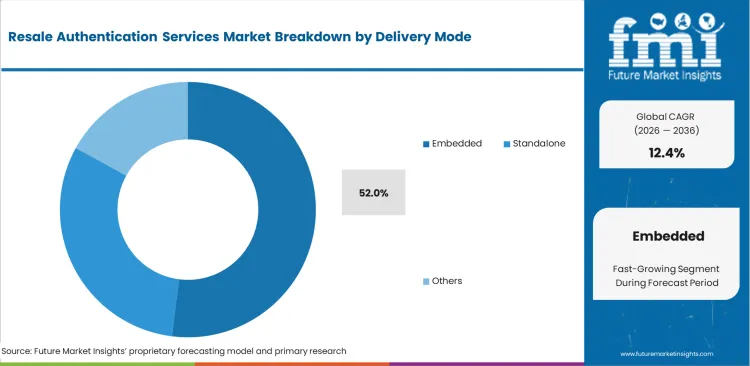
Seller resistance influences adoption rates across global digital secondary commerce platforms. Platform-embedded verification segment accounts for 52.0% of the market share in 2026, primarily due to streamlined user workflows and seamless user experiences. Strong integration capabilities directly contribute to this persistent compound growth across the sector. Consignment operations successfully embed verification tools directly into native listing procedures. FMI's analysis suggests this smooth integration prevents users from abandoning the process during critical inventory acquisition phases. Independent second-hand fashion applications exist alongside embedded APIs, capturing the majority of the market. Platforms prefer maintaining proprietary control over user submission behaviors to maximize data retention. Engaging third-party verification applications for interface management decreases overall platform profitability. Marketplaces that require users to navigate to separate, standalone portals experience immediate decreases in listing volume. Technology teams continually optimize these embedded procedures to ensure smooth user transactions.
- Procurement savings: Embedded APIs reduce the burden of internal development. Platform engineers avoid creating complex computer vision models from the beginning.
- Hidden latency: High volumes of API requests occasionally cause upload timeouts. Operations departments experience localized server issues during periods of peak traffic.
- Lifecycle comparison: Native integration results in superior long-term retention. Marketing departments observe better repeat-seller metrics compared to disjointed application experiences.
Resale Authentication Services Market Analysis by Item Category
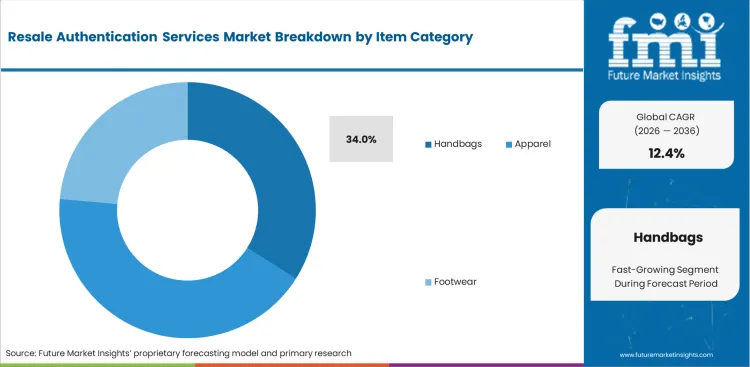
Counterfeit exposure historically focuses intensely upon select high-margin accessories and luxury goods. Brand protection priorities significantly influence this high compound growth and segment dominance. Authentication departments prioritize luxury handbag authentication service protocols due to substantial price premiums. As per FMI's projection, verifying a single designer purse unlocks immense Gross Merchandise Value (GMV) instantly. Handbag market dominance masks a critical technical reality concerning computer vision capabilities. Rigid construction, distinct stitching patterns, and standardized metal hardware facilitate precise algorithmic mapping. Algorithms map microscopic image points much more consistently than draped apparel. Handbags segment account for 34.0% of the market share in 2026, determined by absolute buyer confidence requirements and high threat posed by replicas. Vendors unable to support comprehensive handbag databases lose enterprise contracts immediately. Fashion authentication services for marketplaces rely heavily on securing these handbag verification capabilities.
- Hardware mapping: Algorithms analyze microscopic grain structures on metal clasps. Authentication departments prevent high-fidelity replica infiltration.
- Soft material ambiguity: Leather creasing presents false-negative risks. Quality control managers struggle against natural wear mimicking counterfeit errors.
- Data dependency: Verification requires constant model updates for new releases. Vendor sourcing teams must acquire authentic reference items instantly.
Resale Authentication Services Market Analysis by End User
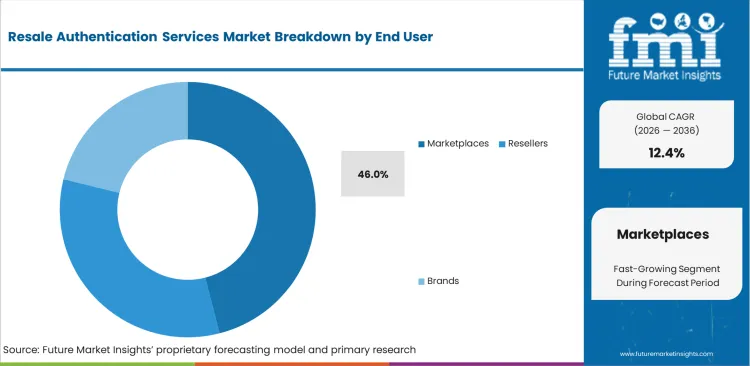
Centralized verification remains necessary across global peer-to-peer networks due to institutional trust requirements. Marketplaces segment account for 46.0% revenue share in 2026, a result of stringent internal platform policies and rapid platform expansion. Consumer protection mandates directly drive this rapid compound growth and segment leadership. FMI notes large platforms absorb verification costs directly; this action encourages buyer conversion. These corporate entities integrate automated secondhand apparel screening across vast server architectures. Individual professional consignors constitute a rapidly expanding group; these individuals adopt independent pre-authentication tools. They use these tools to secure greater payout margins before submitting inventory. Platforms operating absent robust verification quickly become repositories for sophisticated replicas. This deficiency entirely destroys consumer trust and enterprise valuation. Resale authentication service providers specifically target these large marketplaces to secure profitable B2B contracts.
- First-mover adoption: Mega-platforms integrate API screening to process millions of SKUs. Chief Trust Officers establish fundamental security standards.
- Mid-tier follower mechanics: Niche resale sites lease third-party verification tools. Operations departments circumvent substantial upfront technology investments.
- Holdout conversion: Independent vintage dealers ultimately adopt digital passports. Boutique owners recognize unverified inventory commands considerably lower market prices.
Resale Authentication Services Market Analysis by Authentication Method
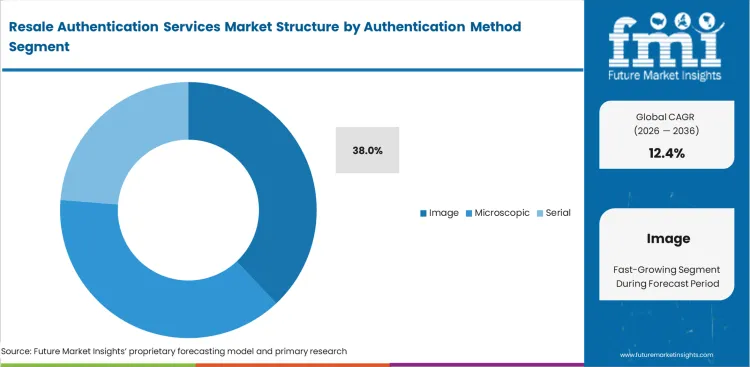
Maintaining inventory liquidity across all resale platforms requires rapid processing. Specialized hardware requirements are absent, a factor directly driving this swift universal compound growth. Technology procurement officers prefer image-based systems to avoid specialized hardware deployment. FMI analysts observe digital checking of stitching angles satisfies standard second-hand apparel verification requirements. Image analysis segment secures a 38.0% market share in 2026, attributed to instant smartphone photo processing capabilities. Counterfeiters deliberately engineer visual flaws, continuously misleading established computer vision models. This creates an ongoing contest requiring constant algorithm retraining and optimization. Systems lacking daily reference data updates become obsolete within months. Technology departments maintain the luxury resale authentication ecosystem through model updates. Digital ID for resale goods represents the upcoming development in authentication methodology.
- Visual mismatch: Algorithms identify incorrect logo spacing from smartphone uploads. Trust managers immediately ban fraudulent seller accounts.
- Adversarial blindspots: High-quality replicas successfully bypass basic visual screening. Operations departments must introduce microscopic physical inspections for extremely valuable assets.
- Optimization mandate: Providers must ensure weekly updates to visual databases. Procurement officers terminate contracts for software failing to include newly released counterfeit batches.
Resale Authentication Services Market Drivers, Restraints, and Opportunities
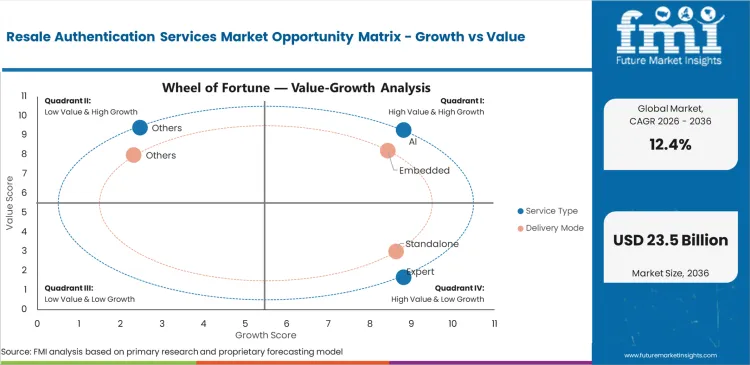
Escalating liability associated with facilitating fraudulent transactions mandates immediate implementation of robust safeguards by marketplace executive teams. Digital platforms previously relied upon safe harbor provisions, presenting themselves as mere conduits for transactions. Contemporary shifts in the regulatory landscape now establish accountability for digital exchanges regarding fraudulent merchandise that transits their proprietary servers. Marketplace trust and safety departments face immediate and substantial commercial ramifications stemming from these stringent new policies. Failure to effectively prevent sophisticated counterfeit reproduction sales exposes the organization to catastrophic litigation initiated by brand partners, simultaneously eroding buyer confidence and destroying customer retention metrics. Postponing the integration of necessary API connections leaves platforms vulnerable to targeted exploitation by organized counterfeit operations, utilizing unverified listing workflows for nefarious purposes. Consequently, the market size for resale authentication services is undergoing rapid expansion as organizations expedite the deployment of these now-mandatory protection mechanisms. Significant acceleration in the growth trajectory of this sector is anticipated.
The issue of 'false-positive' rejections generates considerable operational friction, thereby significantly impeding the seamless deployment of automated systems across the enterprise. Specifically, an algorithmic tool that incorrectly flags a genuine, legitimately aged vintage product as a counterfeit item risks alienating and losing professional consignors whose inventory is vital. Supply chain management personnel understand that algorithmic systems encounter significant challenges processing the wide array of production variations globally, especially those dating back several decades. Furthermore, products that have undergone repair procedures utilizing non-standard, third-party components also consistently trigger substantial rates of algorithmic failure during automated screening processes. This persistent accuracy gap requires that platforms continue to allocate resources to and maintain expensive human review teams to manage the inevitable influx of seller appeals and disputes. This non-negotiable requirement for physical, human intervention inherently limits the organization's capacity for true automation scalability and consequently restricts the overall potential for market margin expansion.
Opportunities in the Resale Authentication Services Market
- Financial guarantee integration: Verification providers offering insurance against authenticated counterfeits secure premium contracts. Marketplace executives offload financial liability completely.
- Digital passport minting: Creating immutable blockchain records for verified items opens recurring revenue streams. Consignors gain permanent proof of ownership.
- Category expansion algorithms: Developing specialized models for USA and Canada secondhand apparel unlocks new platform partnerships. Operations departments demand broader SKU coverage beyond bags.
Regional Analysis
The resale authentication services market is segmented into North America, Europe, Asia Pacific, Latin America, and Middle East & Africa.
.webp "Top Country Growth Comparison Resale Authentication Services Market Cagr (2026 2036)")
| Country | CAGR (2026 to 2036) |
|---|---|
| China | 14.1% |
| United States | 13.2% |
| United Kingdom | 12.8% |
| France | 12.5% |
| Germany | 12.3% |
| Italy | 12.1% |
| Canada | 12.0% |
| Japan | 11.9% |
| Spain | 11.8% |
| South Korea | 11.6% |
| Taiwan | 11.5% |
| Singapore | 11.4% |
| GCC Countries | 11.2% |
| Brazil | 11.0% |
| Mexico | 10.8% |
| Argentina | 10.5% |
| Israel | 10.4% |
| South Africa | 10.2% |
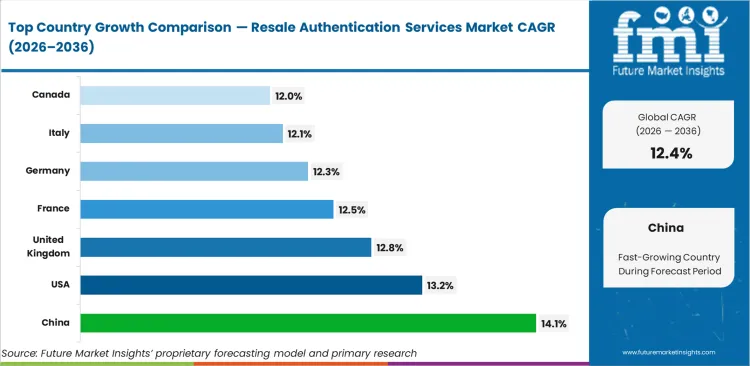
Source: Future Market Insights (FMI) analysis, based on proprietary forecasting model and primary research
North America Resale Authentication Services Market Analysis
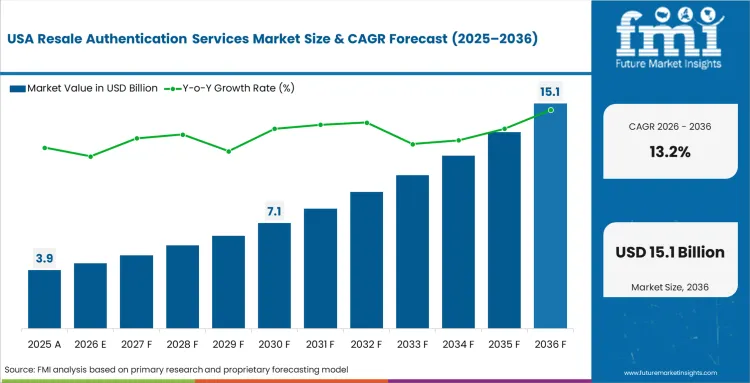
Substantial peer-to-peer transaction volumes require the rapid deployment of automated screening tools by platforms operating within the United States market. Operations management teams across North America now contend with extremely high listing velocities, effectively rendering traditional physical inspection centers obsolete for efficient processing. Consequently, these platforms are heavily transitioning toward integrated API verification methods to instantly process consumer-uploaded imagery with minimal delay. Algorithmic triage processes seamlessly determine the exact warehouse routing required for physical items versus granting instant digital approval for verified listings. The resale authentication market maintains an incredibly strong forecast across this entire North America, driven by these technological shifts and increased consumer adoption.
- United States: High-velocity peer-to-peer exchange networks demand immediate listing approvals to successfully maintain robust seller engagement across the platform ecosystem. Platforms establishing proprietary image databases are creating significant protective competitive moats against new market entrants attempting to gain traction. Industry in the US is poised to register a 13.2% CAGR during the forecast period, as verification services expand their scope beyond high-end luxury goods to encompass mid-tier street-wear and other popular consumer items. Rapid adoption of advanced technology serves as the primary factor supporting this continued compound growth trajectory for the sector.
- Canada: Canada platforms are increasingly adopting harmonized cross-border verification standards to gain access to significantly larger unified regional liquidity pools. Efficiency in cross-border trade operations constitutes the main factor supporting this ongoing compound growth within the Canadian authentication segment. Canada market is set to rise at a 12.0% CAGR by 2036, primarily driven by successful integration efforts with major marketplace architectures located in the southern neighboring country. Operations departments now require flawless, seamless API connectivity to effectively participate in the evolving regional resale ecosystems and maintain competitive footing.
Europe Resale Authentication Services Market Analysis
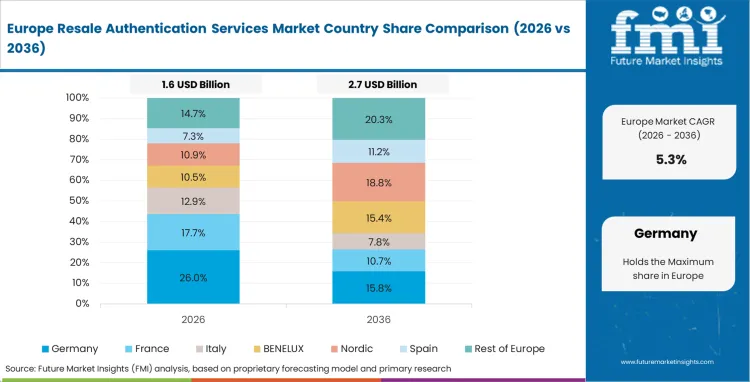
Strict anti-counterfeiting enforcement protecting heritage luxury brands significantly shapes the market architecture across Europe. Regulatory compliance officers mandate stringent verification protocols to avoid substantial financial penalties associated with facilitating illicit trade. Estimates from FMI suggest Europe platforms integrate the speed of algorithmic processes with established physical inspection centers. These dedicated centers are strategically positioned near major fashion capitals. This careful placement ensures absolute verification accuracy for high-value items. The expansion of the luxury resale authentication market is heavily dependent upon these strategically localized Europe verification hubs.
- United Kingdom: Institutionalized premium exchange networks require robust API integration. This technology is essential for effectively managing complex cross-border inventory flows. High digital penetration serves as the main contributing factor supporting this compound growth trajectory. Operations departments achieving approval times in less than a minute are capturing the dominant market share. Demand in UK is estimated to rise at 12.8% CAGR during the forecast period, as platforms absorb verification costs internally. This strategy successfully boosts transaction volumes across the network.
- France: Industry in France is expected to garner a 12.5% CAGR during the forecast period, supported by country’s deep domestic luxury heritage and consistently strict enforcement of these essential laws. Rapid intellectual property protection legislation compels resale platforms to provide an absolute guarantee of authenticity for all listed items. The close proximity to major brand operations serves as the primary factor underpinning this compound growth. Authenticators in France possess institutional knowledge that surpasses current algorithmic replication capabilities.
- Germany: High consumer protection standards in this market mandate rigorous item verification across all major digital platforms operating within the country. The market is expanding at 12.3% CAGR during the forecast period, driven by stringent regulatory compliance mandates imposed by governing bodies. The country's advanced technological infrastructure serves as the key factor supporting this current compound growth.
- Italy: Italy-based platforms are actively integrating specialized material testing protocols. These protocols are directly connected to established regional leather goods manufacturing standards for thorough assessment. Demand outlook in Italy is hinting toward an expansion at 12.1% CAGR during the forecast period, strongly supported by the country's deep local manufacturing expertise in luxury goods. The close proximity to artisan production acts as the primary factor supporting this consistent compound growth.
- Spain: The increasing volume of peer-to-peer apparel exchanges is driving the widespread domestic adoption of automated verification tools across the platform landscape. Spain is set to record an 11.8% CAGR during the forecast period, as fashion re-commerce achieves widespread mainstream consumer acceptance across diverse demographics. Engagement from the youth demographic serves as the primary factor supporting this compound growth.
Asia Pacific Resale Authentication Services Market Analysis
The significant presence of sophisticated local counterfeit manufacturing operations requires rigorous verification protocols across the Asia Pacific region's platforms. Senior Trust and Security personnel are actively addressing the challenge posed by superfakes, items produced in unauthorized parallel production facilities utilizing genuine manufacturing methods and processes. The Financial Market Institute (FMI) consistently observes that fundamental image analysis techniques are proving insufficient and regularly fail under these highly challenging and extreme conditions. Consequently, platforms are compelled to implement advanced microscopic material testing and comprehensive blockchain provenance tracking mechanisms to maintain operational viability and safeguard consumer confidence in transactions.
- China: Extensive domestic exposure to the creation of high-fidelity counterfeit goods mandates that platforms enforce comprehensive and absolute verification procedures for all items traded. Market expansion demonstrates a robust rate of 14.1% CAGR, as achieving digital trust has become a foundational and indispensable requirement for maintaining transaction liquidity. The enormous transaction volume constitutes the primary element driving this substantial compound growth within the market. Verification service providers that successfully secure contracts with major China-designed platforms acquire a substantial competitive advantage in terms of crucial data insights and operational scale.
- Japan: A deeply entrenched collector culture requires immaculate condition grading for pre-owned items, along with stringent and non-negotiable authenticity checks for all product categories. Gaining successful market entry and significant penetration in Japan requires providers to demonstrate exceptional precision in identifying and authenticating variations present in vintage production runs. Sector’s upward trajectory, tracking at 11.9% CAGR, reflects a mature, institutionalized secondary commerce environment that requires total and unassailable buyer trust for continued operation. Elevated cultural standards, emphasizing quality and originality, represent the central element supporting this steady compound expansion.
- South Korea: Domestic exchange networks are characterized by the rapid and widespread integration of platform-embedded verification widgets directly into consumer applications. The country's sophisticated and advanced telecommunications infrastructure is the fundamental element underpinning this significant compound growth rate. Operational teams are concentrating efforts on eliminating any physical inspection bottlenecks within the workflow to dramatically accelerate the speed of inventory turnover and delivery to customers. Market growth is expanding at 11.6% CAGR, directly attributable to the highly digitized purchasing and trading behaviors exhibited by the consumer base.
- Taiwan: The market is poised to expand at a steady 11.5% CAGR through 2036, fueled by the successful and robust integration of local technological innovations into platform operations. Significant domestic expertise in hardware manufacturing provides a crucial advantage, translating directly into the local development of highly advanced microscopic verification instruments and sophisticated technological tools. The skilled local technology workforce represents the principal element sustaining this compound growth trajectory.
- Singapore: The country's established position as a premium regional hub for the exchange of high-value luxury goods requires the adherence to absolute and uncompromising verification standards across all platforms operating there. Industry is set to register an 11.4% CAGR during the forecast, as platforms strategically orient their services toward accommodating the specific needs of high-net-worth individual collectors and institutional buyers. High cross-border liquidity, facilitating the easy movement of premium assets, serves as the primary and most important element driving this consistent compound expansion.
Latin America Resale Authentication Services Market Analysis
The expansion of middle-class consumer segments generates increased product demand for authenticated premium items across Latin America countries. Digital platforms face a considerable challenge addressing deeply ingrained consumer skepticism concerning the acquisition of luxury goods online within the region. Consequently, operational departments are strategically implementing mobile-first verification technologies specifically to safely engage and capture this newly emerging demographic. The overall growth trajectory is projected to accelerate as the digital payment infrastructure continues to achieve greater maturity throughout the continent. Leading companies specializing in resale authentication identify this geographical area as a significant, yet largely untapped, opportunity for strategic business expansion in the near term.
- Brazil: The immense population scale makes this market highly attractive to international resale platforms, requiring the immediate implementation of specifically localized product verification protocols. This market in Brazil is expected to expand at an 11.0% CAGR, primarily propelled by the steadily increasing consumption of luxury items among the growing middle-class population. Furthermore, enhanced internet penetration serves as the key underlying element supporting this sustained compound annual growth rate.
- Mexico: Mexico is set to register a CAGR of 10.8% by 2036, a rate strongly underpinned by the established and integrated supply chains across the country. Its geographical proximity to the established northern markets facilitates a significant cross-border exchange of high-value premium merchandise, mandating the necessity of stringent item verification processes. Existing trade agreements between partner nations function as the primary factor providing support for this compound annual growth rate.
- Argentina: Industry is set to expand at a 10.5% CAGR through 2036, a trend driven by prevalent alternative consumer investment behaviors. The persistent practice of hedging against inflation constitutes the principal factor supporting this notable compound annual growth rate. Prevailing domestic economic conditions motivate consumers to increasingly utilize authenticated premium resale purchases as a pragmatic strategy for preserving asset value.
Middle East & Africa Resale Authentication Services Market Analysis
The Middle East & Africa verification environment is characterized by significant levels of ultra-luxury consumption. Operations departments concentrate solely on super-premium asset categories, requiring extremely precise verification. Platforms employ both specialized human analysts and sophisticated artificial intelligence systems to ensure the security of these high-value transactions.
- GCC Countries: Enormous concentrations of wealth fuel substantial demand for authenticated super-premium watches and designer handbags. The market is experiencing growth at a rate of 11.2%, indicative of the brisk exchange of imported, high-ticket luxury items. The primary factor supporting this compound growth rate is the elevated level of disposable income available to consumers across the region.
- Israel: The country’s advanced domestic sectors in cybersecurity and artificial intelligence are responsible for the local creation of leading-edge algorithms for counterfeit detection. The market expands at a rate of 10.4%, a performance driven substantially by the deep, internal technological expertise present in the country. The density of research and development activities serves as the main supporting factor for this sustained compound growth.
- South Africa: Growth of the market expands at CAGR of 10.2% as formal digital resale platforms gradually supplant more traditional, informal trading arrangements. Urban modernization across the country is the key factor supporting this current compound growth trend. Developing networks for luxury item exchange require dependable digital verification processes to establish fundamental consumer trust from the outset.
Competitive Aligners for Market Players
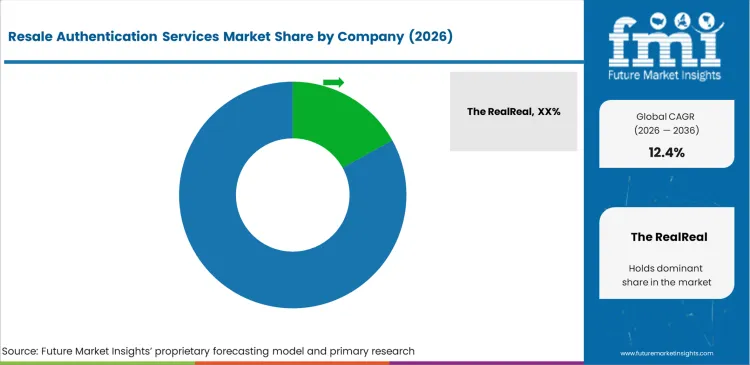
Algorithmic training data constitutes the primary competitive moat separating dominant resale authentication software vendors from startups. Companies like Entrupy and Real Authentication leverage years of processed image data to refine models. Marketplace product managers choose verification partners based strictly on false-positive rates and API response times. Speed dictates platform liquidity universally across the entire authenticated resale infrastructure. Providers causing upload timeouts or incorrectly flagging legitimate inventory lose enterprise contracts immediately. FMI's analysis indicates true differentiation requires offering comprehensive financial guarantees to platforms.
Incumbents possess massive proprietary databases containing microscopic images of authentic materials and hardware gradients. Challengers attempting to build new screening tools from scratch encounter severe cold-start problems. Their algorithms fail against sophisticated replicas without extensive authentic reference items. Large resale platforms like The RealReal and eBay increasingly acquire specialized verification technology aggressively. Controlling the authentication layer allows platforms to capture higher take-rates consistently. This control helps maintain absolute dominance over user listing experiences globally.
Major marketplaces resist vendor lock-in by utilizing multiple verification APIs simultaneously across different categories. Sneaker exchanges route inventory to StockX-style verification pipelines specifically designed for footwear. Luxury handbag submissions route to entirely different specialized software providers simultaneously. The industry is expected to pivot toward blockchain-backed digital passports minted at initial retail sale. This technology shifts verification from post-manufacturing inspection directly to immutable cryptographic tracking systems. Providers failing to integrate with emerging provenance verification systems face rapid obsolescence.
Key Players in Resale Authentication Services Market
- The RealReal
- Entrupy
- eBay
- Vestiaire Collective
- Vinted
- StockX
- Real Authentication
Scope of the Report
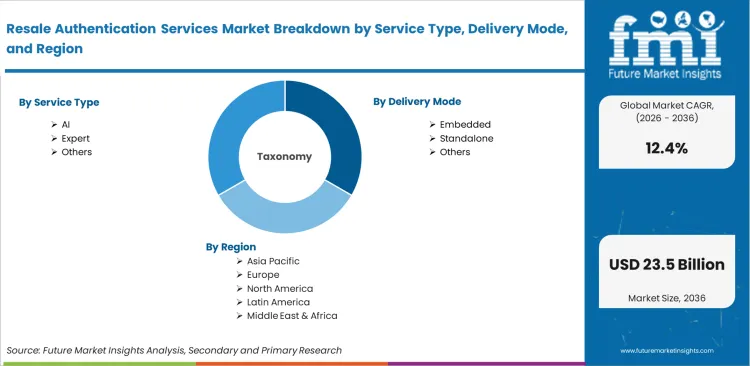
| Metric | Value |
|---|---|
| Quantitative Units | USD 6.5 Billion to USD 21.0 Billion, at a CAGR of 12.4% |
| Market Definition | Digital and physical verification workflows designed to validate pre-owned premium goods before transaction completion. |
| Segmentation | Service Type, Delivery Mode, Item Category, End User, Authentication Method |
| Regions Covered | North America, Europe, Asia Pacific, Latin America, Middle East & Africa |
| Countries Covered | United States, Canada, Germany, United Kingdom, France, Italy, Spain, China, Japan, South Korea, Taiwan, Singapore, Brazil, Mexico, Argentina, GCC Countries, South Africa, Israel, Rest of Middle East & Africa |
| Key Companies Profiled | The RealReal, Entrupy, eBay, Vestiaire Collective, Vinted, StockX, Real Authentication |
| Forecast Period | 2026 to 2036 |
| Approach | Annual GMV of verified luxury resale transactions processed through major digital platforms |
Source: Future Market Insights (FMI) analysis, based on proprietary forecasting model and primary research
Resale Authentication Services Market Analysis by Segments
Service Type
- AI
- Expert
- Hybrid
- Certificates
- Provenance
Delivery Mode
- Embedded
- Standalone
- API
- In-Store
Item Category
- Handbags
- Apparel
- Footwear
- Watches
- Jewelry
End User
- Marketplaces
- Resellers
- Brands
- Consignors
- Collectors
Authentication Method
- Image
- Microscopic
- Serial
- Material
- Digital IDs
Region
- North America
- United States
- Canada
- Europe
- Germany
- United Kingdom
- France
- Italy
- Spain
- Asia Pacific
- China
- Japan
- South Korea
- Taiwan
- Singapore
- Latin America
- Brazil
- Mexico
- Argentina
- Middle East & Africa
- GCC Countries
- South Africa
- Israel
- Rest of Middle East & Africa
Bibliography
- European Union Intellectual Property Office. (2025). Mapping global trade in fakes 2025. EUIPO Observatory.
- The RealReal, Inc. (2026). Annual report on Form 10-K for the fiscal year ended December 31, 2025. USA Securities and Exchange Commission.
- Organisation for Economic Co-operation and Development. (2025, May 7). Global trade in fake goods reached USD 467 billion, posing risks to consumer safety and compromising intellectual property.
- USA Customs and Border Protection. (2025, September 29). Intellectual Property Rights (IPR) seizures.
- Entrupy. (2025). State of the Fake Report 2025.
This bibliography is provided for reader reference. The full FMI report contains the complete reference list with primary source documentation.
This Report Addresses
- Algorithmic triage models replacing manual inspection bottlenecks across major resale platforms.
- Liability shifts forcing marketplace executives to internalize counterfeit detection.
- Proprietary image database requirements creating defensive moats for established verification vendors.
- Platform-embedded API tools dominating standalone verification application usage among sellers.
- Handbag hardware consistency enabling microscopic mapping advantages over soft apparel categories.
- China marketplace exposure to sophisticated replica manufacturing accelerating AI adoption rates.
- False-positive rejection friction permanently alienating high-value professional consignors.
- Digital product passports threatening post-manufacturing visual inspection workflows toward 2036.
Frequently Asked Questions
How big is the resale authentication services market?
Valuation crosses USD 6.5 billion in 2026 and reaches USD 21.0 billion by 2036. This massive expansion reflects platform mandates requiring algorithmic screening to handle surging peer-to-peer listing volumes.
Give me the forecast for resale authentication services through 2036?
Growth tracks at a 12.4% CAGR through 2036. Sustained investment occurs because large marketplaces must protect brand reputation and avoid regulatory penalties associated with facilitating counterfeit transactions.
What drives growth in resale authentication services?
Surging "superfake" quality compels marketplace trust officers to adopt algorithmic screening. Regulatory pressure regarding counterfeit facilitation forces platform executives to internalize verification liability immediately.
Which companies provide resale authentication services?
Leading participants include The RealReal, Entrupy, eBay, Vestiaire Collective, Vinted, StockX, and Real Authentication. These firms dominate through proprietary image databases and deep platform integrations.
How does AI detect counterfeit fashion items?
Algorithms process user-submitted photos to analyze stitching angles, logo typography, and microscopic hardware grain structures. Visual mismatches against authentic reference databases trigger immediate listing rejections.
Compare AI authentication and expert authentication in resale.
AI processes standardized photos within milliseconds for baseline sorting, offering massive scalability. Expert authentication handles complex edge cases, vintage variations, and extreme high-value assets where algorithms struggle with natural wear.
Explain the resale authentication services market?
This sector comprises digital and physical verification workflows designed to validate pre-owned premium goods. It functions as trust infrastructure, bridging information asymmetry between anonymous buyers and sellers in secondary commerce networks.
Why does AI lead the Service Type segment?
Human review cannot scale with massive listing velocities. Platforms deploy algorithmic tools for high-speed triage, routing only complex edge cases to specialized physical authenticators.
Why do Platform-Embedded tools dominate Delivery Mode?
Sellers refuse to use separate applications just to verify items. Embedding APIs directly into native submission workflows prevents user abandonment and accelerates inventory acquisition.
Why do Handbags represent the largest Item Category?
Beyond high retail value, handbags feature rigid hardware and distinct stitching. These physical characteristics allow algorithms to map microscopic image points much more consistently than draped apparel.
Why do Marketplaces lead End User adoption?
Institutional exchanges absorb verification costs directly to incentivize buyer conversion. They deploy automated screening across massive server architectures to protect overall platform valuation.
Why does Image Analysis dominate Authentication Methods?
Digital screening processes smartphone photos instantly without requiring specialized hardware deployment among sellers. This speed satisfies baseline verification requirements for high-volume mid-tier categories.
What gate accelerates AI adoption across platforms?
Once API accuracy crosses specific brand thresholds, platforms instantly approve listings without physical warehousing. Removing this friction unlocks massive liquidity pools previously trapped in verification queues.
Why is China the fastest-growing country in this sector?
Deep domestic exposure to high-fidelity "superfake" production forces platforms to mandate comprehensive verification. Digital trust becomes an absolute baseline requirement for maintaining transaction liquidity.
How does United States adoption differ from Japan?
United States growth relies on massive peer-to-peer transaction volumes requiring API speed. Japan adoption leverages institutionalized expert networks to satisfy strict collector culture demanding immaculate provenance.
What friction slows algorithmic deployment globally?
False-positive rejections create severe operational issues. When tools incorrectly flag legitimate vintage items, platforms permanently alienate high-value consignors who secure platform supply.
What capability defines competitive advantage for vendors?
Proprietary training data constitutes the primary moat. Vendors possessing massive databases of microscopic authentic reference images outperform startups attempting to build computer vision models from scratch.
How do platforms resist vendor lock-in successfully?
Major marketplaces utilize multiple APIs simultaneously. They route sneaker inventory to specialized verification pipelines while directing luxury handbag submissions to different software providers.
Why are standalone verification apps losing market share?
Marketplaces want proprietary control over user submission behavior. Forcing sellers outward to third-party portals causes immediate drops in listing liquidity and surrenders valuable engagement data.
What role do digital product passports play in resale?
Minting immutable blockchain records at initial retail sale shifts verification away from post-manufacturing visual inspection. Providers failing to integrate cryptographic tracking face obsolescence toward 2036.
How do European regulations impact service adoption?
Strict anti-counterfeiting laws protecting heritage brands force French and Italian platforms to guarantee absolute authenticity. Compliance officers implement multi-layered screening combining digital triage with physical review.
Why do individual consignors use pre-authentication tools?
Professional sellers adopt independent tools to command higher payout margins. Unverified inventory sells at significant discounts; securing an authenticity score before submission maximizes seller returns.
What causes API integration latency during peak hours?
High-volume API calls occasionally create upload timeouts during peak traffic. Operations managers must balance robust screening depth against server friction slowing the user listing experience.
Why do algorithms struggle with vintage luxury items?
Decade-old production variations and repairs using non-standard components trigger false-negative flags. Algorithms trained exclusively on pristine modern releases fail against natural wear patterns.
Preview the report firsthand - request a free sample
Get SampleGet the brochure for pricing and purchase details.
Get PDFTable of Content
- Executive Summary
- Global Market Outlook
- Demand-side Trends
- Supply-side Trends
- Technology Roadmap Analysis
- Analysis and Recommendations
- Market Overview
- Market Coverage / Taxonomy
- Market Definition / Scope / Limitations
- Research Methodology
- Chapter Orientation
- Analytical Lens and Working Hypotheses
- Market Structure, Signals, and Trend Drivers
- Benchmarking and Cross-market Comparability
- Market Sizing, Forecasting, and Opportunity Mapping
- Research Design and Evidence Framework
- Desk Research Programme (Secondary Evidence)
- Company Annual and Sustainability Reports
- Peer-reviewed Journals and Academic Literature
- Corporate Websites, Product Literature, and Technical Notes
- Earnings Decks and Investor Briefings
- Statutory Filings and Regulatory Disclosures
- Technical White Papers and Standards Notes
- Trade Journals, Industry Magazines, and Analyst Briefs
- Conference Proceedings, Webinars, and Seminar Materials
- Government Statistics Portals and Public Data Releases
- Press Releases and Reputable Media Coverage
- Specialist Newsletters and Curated Briefings
- Sector Databases and Reference Repositories
- FMI Internal Proprietary Databases and Historical Market Datasets
- Subscription Datasets and Paid Sources
- Social Channels, Communities, and Digital Listening Inputs
- Additional Desk Sources
- Expert Input and Fieldwork (Primary Evidence)
- Primary Modes
- Qualitative Interviews and Expert Elicitation
- Quantitative Surveys and Structured Data Capture
- Blended Approach
- Why Primary Evidence is Used
- Field Techniques
- Interviews
- Surveys
- Focus Groups
- Observational and In-context Research
- Social and Community Interactions
- Stakeholder Universe Engaged
- C-suite Leaders
- Board Members
- Presidents and Vice Presidents
- R&D and Innovation Heads
- Technical Specialists
- Domain Subject-matter Experts
- Scientists
- Physicians and Other Healthcare Professionals
- Governance, Ethics, and Data Stewardship
- Research Ethics
- Data Integrity and Handling
- Primary Modes
- Tooling, Models, and Reference Databases
- Desk Research Programme (Secondary Evidence)
- Data Engineering and Model Build
- Data Acquisition and Ingestion
- Cleaning, Normalisation, and Verification
- Synthesis, Triangulation, and Analysis
- Quality Assurance and Audit Trail
- Market Background
- Market Dynamics
- Drivers
- Restraints
- Opportunity
- Trends
- Scenario Forecast
- Demand in Optimistic Scenario
- Demand in Likely Scenario
- Demand in Conservative Scenario
- Opportunity Map Analysis
- Product Life Cycle Analysis
- Supply Chain Analysis
- Investment Feasibility Matrix
- Value Chain Analysis
- PESTLE and Porter’s Analysis
- Regulatory Landscape
- Regional Parent Market Outlook
- Production and Consumption Statistics
- Import and Export Statistics
- Market Dynamics
- Global Market Analysis 2021 to 2025 and Forecast, 2026 to 2036
- Historical Market Size Value (USD Million) Analysis, 2021 to 2025
- Current and Future Market Size Value (USD Million) Projections, 2026 to 2036
- Y-o-Y Growth Trend Analysis
- Absolute $ Opportunity Analysis
- Global Market Pricing Analysis 2021 to 2025 and Forecast 2026 to 2036
- Global Market Analysis 2021 to 2025 and Forecast 2026 to 2036, By Service Type
- Introduction / Key Findings
- Historical Market Size Value (USD Million) Analysis By Service Type , 2021 to 2025
- Current and Future Market Size Value (USD Million) Analysis and Forecast By Service Type , 2026 to 2036
- AI
- Expert
- Others
- AI
- Y-o-Y Growth Trend Analysis By Service Type , 2021 to 2025
- Absolute $ Opportunity Analysis By Service Type , 2026 to 2036
- Global Market Analysis 2021 to 2025 and Forecast 2026 to 2036, By Delivery Mode
- Introduction / Key Findings
- Historical Market Size Value (USD Million) Analysis By Delivery Mode, 2021 to 2025
- Current and Future Market Size Value (USD Million) Analysis and Forecast By Delivery Mode, 2026 to 2036
- Embedded
- Standalone
- Others
- Embedded
- Y-o-Y Growth Trend Analysis By Delivery Mode, 2021 to 2025
- Absolute $ Opportunity Analysis By Delivery Mode, 2026 to 2036
- Global Market Analysis 2021 to 2025 and Forecast 2026 to 2036, By Item Category
- Introduction / Key Findings
- Historical Market Size Value (USD Million) Analysis By Item Category, 2021 to 2025
- Current and Future Market Size Value (USD Million) Analysis and Forecast By Item Category, 2026 to 2036
- Handbags
- Apparel
- Footwear
- Handbags
- Y-o-Y Growth Trend Analysis By Item Category, 2021 to 2025
- Absolute $ Opportunity Analysis By Item Category, 2026 to 2036
- Global Market Analysis 2021 to 2025 and Forecast 2026 to 2036, By End User
- Introduction / Key Findings
- Historical Market Size Value (USD Million) Analysis By End User, 2021 to 2025
- Current and Future Market Size Value (USD Million) Analysis and Forecast By End User, 2026 to 2036
- Marketplaces
- Resellers
- Brands
- Marketplaces
- Y-o-Y Growth Trend Analysis By End User, 2021 to 2025
- Absolute $ Opportunity Analysis By End User, 2026 to 2036
- Global Market Analysis 2021 to 2025 and Forecast 2026 to 2036, By Authentication Method
- Introduction / Key Findings
- Historical Market Size Value (USD Million) Analysis By Authentication Method, 2021 to 2025
- Current and Future Market Size Value (USD Million) Analysis and Forecast By Authentication Method, 2026 to 2036
- Image
- Microscopic
- Serial
- Image
- Y-o-Y Growth Trend Analysis By Authentication Method, 2021 to 2025
- Absolute $ Opportunity Analysis By Authentication Method, 2026 to 2036
- Global Market Analysis 2021 to 2025 and Forecast 2026 to 2036, By Region
- Introduction
- Historical Market Size Value (USD Million) Analysis By Region, 2021 to 2025
- Current Market Size Value (USD Million) Analysis and Forecast By Region, 2026 to 2036
- North America
- Latin America
- Western Europe
- Eastern Europe
- East Asia
- South Asia and Pacific
- Middle East & Africa
- Market Attractiveness Analysis By Region
- North America Market Analysis 2021 to 2025 and Forecast 2026 to 2036, By Country
- Historical Market Size Value (USD Million) Trend Analysis By Market Taxonomy, 2021 to 2025
- Market Size Value (USD Million) Forecast By Market Taxonomy, 2026 to 2036
- By Country
- USA
- Canada
- Mexico
- By Service Type
- By Delivery Mode
- By Item Category
- By End User
- By Authentication Method
- By Country
- Market Attractiveness Analysis
- By Country
- By Service Type
- By Delivery Mode
- By Item Category
- By End User
- By Authentication Method
- Key Takeaways
- Latin America Market Analysis 2021 to 2025 and Forecast 2026 to 2036, By Country
- Historical Market Size Value (USD Million) Trend Analysis By Market Taxonomy, 2021 to 2025
- Market Size Value (USD Million) Forecast By Market Taxonomy, 2026 to 2036
- By Country
- Brazil
- Chile
- Rest of Latin America
- By Service Type
- By Delivery Mode
- By Item Category
- By End User
- By Authentication Method
- By Country
- Market Attractiveness Analysis
- By Country
- By Service Type
- By Delivery Mode
- By Item Category
- By End User
- By Authentication Method
- Key Takeaways
- Western Europe Market Analysis 2021 to 2025 and Forecast 2026 to 2036, By Country
- Historical Market Size Value (USD Million) Trend Analysis By Market Taxonomy, 2021 to 2025
- Market Size Value (USD Million) Forecast By Market Taxonomy, 2026 to 2036
- By Country
- Germany
- UK
- Italy
- Spain
- France
- Nordic
- BENELUX
- Rest of Western Europe
- By Service Type
- By Delivery Mode
- By Item Category
- By End User
- By Authentication Method
- By Country
- Market Attractiveness Analysis
- By Country
- By Service Type
- By Delivery Mode
- By Item Category
- By End User
- By Authentication Method
- Key Takeaways
- Eastern Europe Market Analysis 2021 to 2025 and Forecast 2026 to 2036, By Country
- Historical Market Size Value (USD Million) Trend Analysis By Market Taxonomy, 2021 to 2025
- Market Size Value (USD Million) Forecast By Market Taxonomy, 2026 to 2036
- By Country
- Russia
- Poland
- Hungary
- Balkan & Baltic
- Rest of Eastern Europe
- By Service Type
- By Delivery Mode
- By Item Category
- By End User
- By Authentication Method
- By Country
- Market Attractiveness Analysis
- By Country
- By Service Type
- By Delivery Mode
- By Item Category
- By End User
- By Authentication Method
- Key Takeaways
- East Asia Market Analysis 2021 to 2025 and Forecast 2026 to 2036, By Country
- Historical Market Size Value (USD Million) Trend Analysis By Market Taxonomy, 2021 to 2025
- Market Size Value (USD Million) Forecast By Market Taxonomy, 2026 to 2036
- By Country
- China
- Japan
- South Korea
- By Service Type
- By Delivery Mode
- By Item Category
- By End User
- By Authentication Method
- By Country
- Market Attractiveness Analysis
- By Country
- By Service Type
- By Delivery Mode
- By Item Category
- By End User
- By Authentication Method
- Key Takeaways
- South Asia and Pacific Market Analysis 2021 to 2025 and Forecast 2026 to 2036, By Country
- Historical Market Size Value (USD Million) Trend Analysis By Market Taxonomy, 2021 to 2025
- Market Size Value (USD Million) Forecast By Market Taxonomy, 2026 to 2036
- By Country
- India
- ASEAN
- Australia & New Zealand
- Rest of South Asia and Pacific
- By Service Type
- By Delivery Mode
- By Item Category
- By End User
- By Authentication Method
- By Country
- Market Attractiveness Analysis
- By Country
- By Service Type
- By Delivery Mode
- By Item Category
- By End User
- By Authentication Method
- Key Takeaways
- Middle East & Africa Market Analysis 2021 to 2025 and Forecast 2026 to 2036, By Country
- Historical Market Size Value (USD Million) Trend Analysis By Market Taxonomy, 2021 to 2025
- Market Size Value (USD Million) Forecast By Market Taxonomy, 2026 to 2036
- By Country
- Kingdom of Saudi Arabia
- Other GCC Countries
- Turkiye
- South Africa
- Other African Union
- Rest of Middle East & Africa
- By Service Type
- By Delivery Mode
- By Item Category
- By End User
- By Authentication Method
- By Country
- Market Attractiveness Analysis
- By Country
- By Service Type
- By Delivery Mode
- By Item Category
- By End User
- By Authentication Method
- Key Takeaways
- Key Countries Market Analysis
- USA
- Pricing Analysis
- Market Share Analysis, 2025
- By Service Type
- By Delivery Mode
- By Item Category
- By End User
- By Authentication Method
- Canada
- Pricing Analysis
- Market Share Analysis, 2025
- By Service Type
- By Delivery Mode
- By Item Category
- By End User
- By Authentication Method
- Mexico
- Pricing Analysis
- Market Share Analysis, 2025
- By Service Type
- By Delivery Mode
- By Item Category
- By End User
- By Authentication Method
- Brazil
- Pricing Analysis
- Market Share Analysis, 2025
- By Service Type
- By Delivery Mode
- By Item Category
- By End User
- By Authentication Method
- Chile
- Pricing Analysis
- Market Share Analysis, 2025
- By Service Type
- By Delivery Mode
- By Item Category
- By End User
- By Authentication Method
- Germany
- Pricing Analysis
- Market Share Analysis, 2025
- By Service Type
- By Delivery Mode
- By Item Category
- By End User
- By Authentication Method
- UK
- Pricing Analysis
- Market Share Analysis, 2025
- By Service Type
- By Delivery Mode
- By Item Category
- By End User
- By Authentication Method
- Italy
- Pricing Analysis
- Market Share Analysis, 2025
- By Service Type
- By Delivery Mode
- By Item Category
- By End User
- By Authentication Method
- Spain
- Pricing Analysis
- Market Share Analysis, 2025
- By Service Type
- By Delivery Mode
- By Item Category
- By End User
- By Authentication Method
- France
- Pricing Analysis
- Market Share Analysis, 2025
- By Service Type
- By Delivery Mode
- By Item Category
- By End User
- By Authentication Method
- India
- Pricing Analysis
- Market Share Analysis, 2025
- By Service Type
- By Delivery Mode
- By Item Category
- By End User
- By Authentication Method
- ASEAN
- Pricing Analysis
- Market Share Analysis, 2025
- By Service Type
- By Delivery Mode
- By Item Category
- By End User
- By Authentication Method
- Australia & New Zealand
- Pricing Analysis
- Market Share Analysis, 2025
- By Service Type
- By Delivery Mode
- By Item Category
- By End User
- By Authentication Method
- China
- Pricing Analysis
- Market Share Analysis, 2025
- By Service Type
- By Delivery Mode
- By Item Category
- By End User
- By Authentication Method
- Japan
- Pricing Analysis
- Market Share Analysis, 2025
- By Service Type
- By Delivery Mode
- By Item Category
- By End User
- By Authentication Method
- South Korea
- Pricing Analysis
- Market Share Analysis, 2025
- By Service Type
- By Delivery Mode
- By Item Category
- By End User
- By Authentication Method
- Russia
- Pricing Analysis
- Market Share Analysis, 2025
- By Service Type
- By Delivery Mode
- By Item Category
- By End User
- By Authentication Method
- Poland
- Pricing Analysis
- Market Share Analysis, 2025
- By Service Type
- By Delivery Mode
- By Item Category
- By End User
- By Authentication Method
- Hungary
- Pricing Analysis
- Market Share Analysis, 2025
- By Service Type
- By Delivery Mode
- By Item Category
- By End User
- By Authentication Method
- Kingdom of Saudi Arabia
- Pricing Analysis
- Market Share Analysis, 2025
- By Service Type
- By Delivery Mode
- By Item Category
- By End User
- By Authentication Method
- Turkiye
- Pricing Analysis
- Market Share Analysis, 2025
- By Service Type
- By Delivery Mode
- By Item Category
- By End User
- By Authentication Method
- South Africa
- Pricing Analysis
- Market Share Analysis, 2025
- By Service Type
- By Delivery Mode
- By Item Category
- By End User
- By Authentication Method
- USA
- Market Structure Analysis
- Competition Dashboard
- Competition Benchmarking
- Market Share Analysis of Top Players
- By Regional
- By Service Type
- By Delivery Mode
- By Item Category
- By End User
- By Authentication Method
- Competition Analysis
- Competition Deep Dive
- The RealReal
- Overview
- Product Portfolio
- Profitability by Market Segments (Product/Age /Sales Channel/Region)
- Sales Footprint
- Strategy Overview
- Marketing Strategy
- Product Strategy
- Channel Strategy
- Entrupy
- eBay
- Vestiaire Collective
- Vinted
- StockX
- Real Authentication
- The RealReal
- Competition Deep Dive
- Assumptions & Acronyms Used


