

- Industry Size (2026)
- USD 2.6 Bn
- Forecast (2036)
- USD 4.8 Bn
- CAGR (2026 to 2036)
- 6.30%
Luxury Candle Market Size, Market Forecast and Outlook By FMI
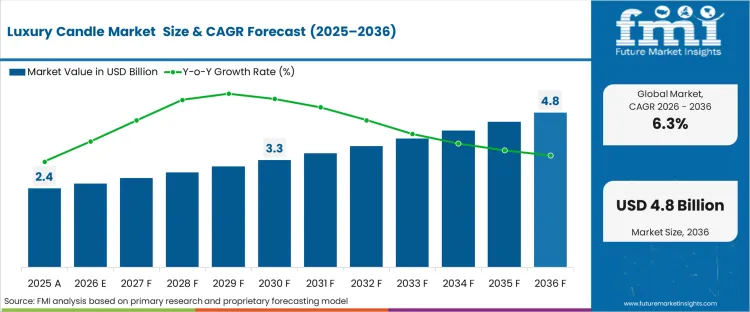
The luxury candle market was valued at USD 2.4 billion in 2025. The sector is expected to reach USD 2.6 billion in 2026 at a CAGR of 6.30% during the forecast period. Sustained investment propels the total opportunity to USD 4.8 billion through 2036 as consumer spending shifts from personal fragrances to home-focused scent products.
Interior designers and premium hospitality operators are currently shifting from seasonal gifting models to continuous olfactory identity systems. This transformation forces heritage fragrance houses to formulate standardized hot throw profiles that perform identically across various environmental conditions, a requirement that elevates the scented candles segment from a decorative add-on to a critical architectural component. Buyers are no longer evaluating these products on single-note appeal but on their ability to maintain atmospheric consistency over 40-plus hour burn cycles. The stakes of delay in formalizing these spatial scent strategies involve the loss of brand-distinctive environmental conditioning, allowing competitors to capture the sensory memory of high-net-worth clients first.
Summary of Luxury Candle Market
- Luxury Candle Market Definition
- A specialized home fragrance category characterized by complex botanical and synthetic scent architectures suspended in premium wax substrates. It operates as an interior design asset, distinguishing itself from functional lighting through high fragrance loads and culturally significant vessel branding.
- Demand Drivers in the Market
- Premium hospitality standards compel interior design procurement teams to integrate custom spatial scenting into permanent operating budgets.
- Remote working arrangements push ultra-high-net-worth consumers to elevate residential environments through prestige sensory investments.
- Changing corporate gifting expectations obligate enterprise relationship managers to source universally acceptable but highly branded physical assets.
- Key Segments Analyzed in the FMI Report
- Soy Wax: Soy Wax is expected to hold 42.4% share in 2026, driven by its unique ability to suspend heavy fragrance oil loads without sweating during ambient temperature fluctuations.
- Woody: Woody is anticipated to record 34.2% share in 2026, as buyers prefer grounding, gender-neutral profiles for shared architectural spaces over polarizing floral notes.
- Specialty Stores: Specialty Stores are likely to account for 45.1% share in 2026, providing the necessary controlled environment for olfactory sampling and brand storytelling.
- United Arab Emirates: 9.1% compound growth, driven by aggressive integration of permanent spatial scenting infrastructure into mega-scale luxury real estate projects.
- Analyst Opinion at FMI
- Rahul Pandita, Principal Analyst, Consumer Product, at FMI, opines, "Standard market metrics accurately capture the rising volume of premium wax formulations being poured and shipped globally. What they miss entirely is that the primary cost center and value driver has decoupled from the fragrance itself. Consumers are paying for the architectural vessel and its associated social signaling weight. If a brand optimizes its wax chemistry but fails to engineer a heavy, recognizable container that survives the burn cycle to become a display object, they lose the repeat purchase entirely."
- Strategic Implications / Executive Takeaways
- Formulators must secure long-term allocations for raw botanical extracts to maintain scent consistency across multiple production batches.
- Prestige beauty retailers should reposition home fragrance from secondary shelving to primary high-traffic zones to capture impulse aesthetic upgrades.
- Packaging engineers face strict requirements to eliminate secondary plastic wraps while protecting fragile ceramic and glass components during direct-to-consumer transit.
- Methodology
- The forecasting model triangulates primary interviews with heritage perfumers against raw material import data for premium waxes and botanical extracts.
- Validation relies on tracking vessel manufacturing output and matching it against retail expansion announcements in the prestige channel.
Before growth becomes self-reinforcing, the supply chain must solve the digital sampling barrier. Niche perfumers trigger this structural gate by integrating micro-dosed solid wax samplers into primary cosmetics shipments, bypassing the physical limitations of online commerce. Once consumers can accurately assess hot throw without blind purchasing a full-size vessel, direct-to-consumer velocities bypass traditional department store bottlenecks, allowing smaller artisanal houses to scale without massive physical retail overhead.
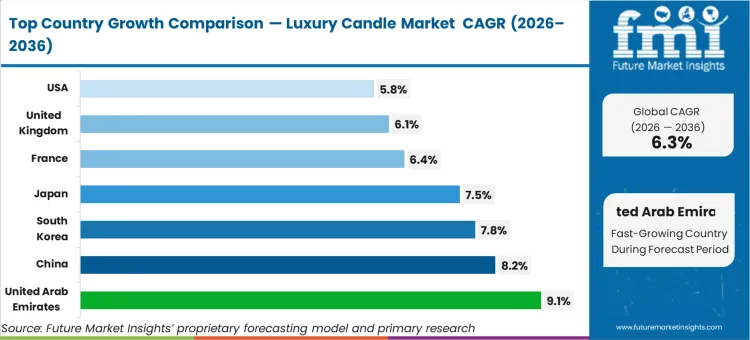
The United Arab Emirates is projected to expand at 9.1%, followed by China advancing at 8.2% and South Korea tracking at 7.8%. Japan is likely to post a CAGR of 7.5%, while France registers 6.4% and the United Kingdom follows at 6.1%. The United States is estimated to advance at 5.8%. The divergence across this range reflects a distinct structural split between regions relying on individual residential consumption and those embedding commercial spatial scenting directly into new luxury real estate developments.
Luxury Candle Market Key Takeaways
| Metric | Details |
|---|---|
| Industry Size (2026) | USD 2.6 billion |
| Industry Value (2036) | USD 4.8 billion |
| CAGR (2026–2036) | 6.30% |
Source: Future Market Insights (FMI) analysis, based on proprietary forecasting model and primary research
Luxury Candle Market Definition
The luxury candle represents a specialized segment of home fragrance defined by complex olfactory structures, premium wax substrates, and high-retention architectural vessels. This category serves fundamentally as an interior design and social signaling asset rather than a functional light source or basic odor neutralizer. Products in this tier require specific curing protocols to ensure the structural integrity of high-load volatile fragrance oils during transport and continuous combustion.
Luxury Candle Market Inclusions
Scope includes premium poured wax products utilizing soy, beeswax, coconut, and highly refined paraffin blend formulations containing multi-layered fragrance architectures. The analysis covers single-wick and multi-wick configurations enclosed in heavy-base glass, ceramic, brass, or specialized architectural vessels. It also captures candle jar systems and integrated accessory sets sold directly with the primary product, including branded wick trimmers and structured extinguishing tools.
Luxury Candle Market Exclusions
Basic commodity tapers, functional pillar candles, and mass-market synthetic gel items are explicitly excluded. These lower-tier products rely on single-note synthetic fragrances and baseline illumination functions rather than complex scent throws or interior design integration. Reed diffusers, room sprays, and electric nebulizers are also excluded, as their physical delivery mechanisms and formulation chemistries operate under entirely different procurement and manufacturing constraints than poured hot-throw products.
Luxury Candle Market Research Methodology
- Primary Research: Procurement directors at premium hospitality groups, category managers for luxury department stores, and lead formulators at heritage fragrance houses.
- Desk Research: European Chemicals Agency REACH annex updates regarding synthetic musks, International Fragrance Association standard publications, and packaging recyclability mandates.
- Market-Sizing and Forecasting: Baseline valuation anchors strictly to regional customs data for premium home goods and verified vendor revenue streams in the prestige beauty channel.
- Data Validation and Update Cycle: Forecasts undergo cross-validation through independent supplier capacity reporting for raw botanical extracts and premium glass vessel manufacturing volumes.
Segmental Analysis
Luxury Candle Market Analysis by Wax Type
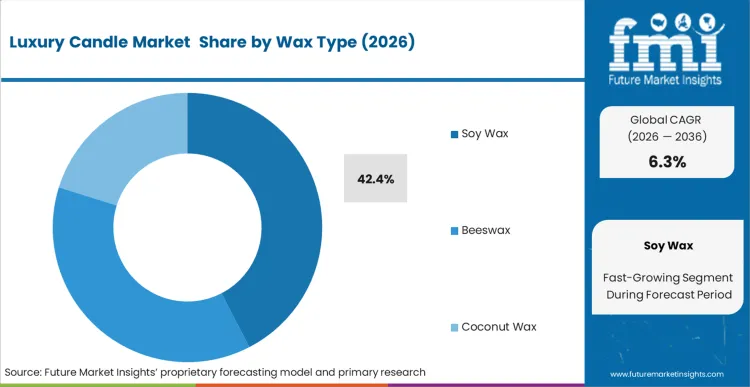
The reason soy wax holds 42.4% of this market comes down to a single operational reality: alternative materials cannot reliably suspend high concentrations of essential oils without degrading the burn profile. When heritage fragrance houses formulate complex scent architectures, they require a substrate that burns cleanly enough to avoid masking delicate top notes with carbon soot. According to FMI's estimates, procurement teams consistently specify soy formulations because the material mitigates the risk of oil sweating during premium transit in variable climates. If a luxury vessel arrives with visible oil pooling on the wax surface, the consumer immediately perceives a manufacturing defect. Brands that attempt to substitute cheaper paraffin blends into premium lines frequently trigger elevated return rates and permanent brand dilution in the prestige retail channel. Adoption of bio wax variants continues to climb as sustainability mandates tighten.
- Load Capacity: Soy substrates chemically bind with higher ratios of fragrance oils than traditional paraffin. Formulators utilize this property to guarantee a consistent hot throw from the first burn through the bottom of the vessel.
- Thermal Stability: The lower melting point creates a wider and faster melt pool. This ensures the fragrance releases evenly across a room rather than tunneling down the center of the wick.
- Supply Consolidation: Agricultural consolidation in soybean processing ensures highly predictable bulk pricing. Procurement directors lock in long-term contracts to insulate their margins from the volatility of petroleum-derived alternatives.
Luxury Candle Market Analysis by Scent Type
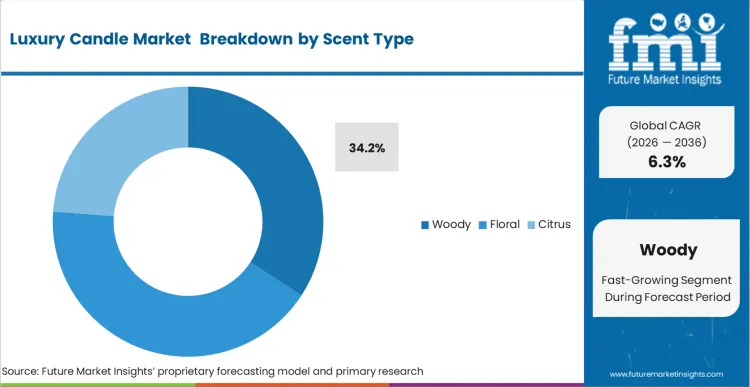
Traditional single-note florals fail to deliver the sophisticated spatial identity that high-net-worth buyers now demand for their primary residences. This failure pushes consumers toward complex woody profiles, which are projected to secure a 34.2% share by 2026. These gender-neutral compositions blend sandalwood, cedar, and vetiver to create grounded environments that do not clash with culinary aromas or personal perfumes. Interior designers specifically source these profiles because they establish an ambient luxury background rather than demanding direct sensory attention. When brands miscalculate and launch overly aggressive sweet or floral profiles in their premium tiers, they invariably see those SKUs stall on department store shelves while the muted, architectural woody variants sell through their allocations. Many brands are now exploring gourmand fragrance notes to add complexity to these woody bases.
- Purchase Trigger: Buyers initially select woody profiles based on cold throw assessments in retail environments. The subtlety signals sophistication and aligns with minimalist interior design trends.
- Qualification Phase: The scent proves its value operationally by filling a large architectural space without inducing olfactory fatigue over a four-hour burn cycle.
- Expansion Driver: Consumers who successfully integrate a woody profile into a living space typically expand the same scent identity into secondary rooms and travel formats.
Luxury Candle Market Analysis by Distribution Channel
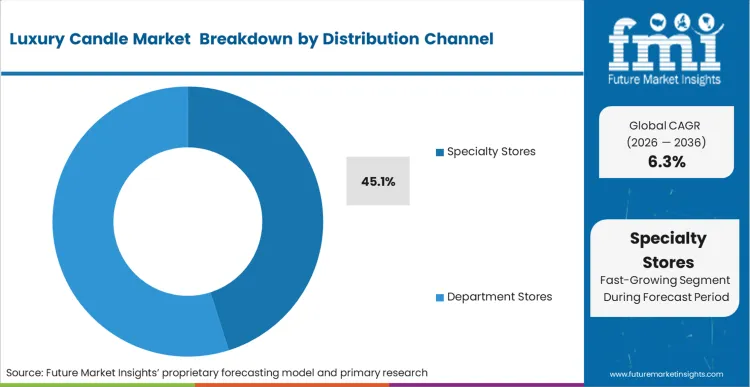
High-net-worth buyers are actively choosing to bypass standard digital carts in favor of specialty stores, concentrating 45.1% of volume in physical luxury retail. This decision stems from the impossibility of accurately judging complex hot throws and the tactile weight of a vessel through a screen. The physical space also protects the brand's exclusivity halo by strictly controlling adjacencies and lighting. Digital-only brands that attempt to scale without a physical retail footprint encounter massive customer acquisition costs, ultimately forcing them to accept restricted growth ceilings. FMI analysts opine that these dedicated physical environments allow sales associates to guide clients through complex olfactory pyramids, justifying premium price points through detailed brand storytelling. Integrating fragrance diffuser systems alongside candles in these boutiques helps create a multi-sensory brand experience.
- Environmental Control: Specialty boutiques meticulously manage ambient airflow and lighting. This prevents competing odors from confusing the buyer's palate during the critical sampling phase.
- Tactile Validation: Consumers physically lift the product to assess glass thickness and base weight. This physical interaction frequently overrides minor price sensitivities.
- Relationship Continuity: Sales associates maintain detailed client purchase histories. They use this data to trigger targeted replenishment orders before the client's current vessel burns out entirely.
Luxury Candle Market Drivers, Restraints, and Opportunities
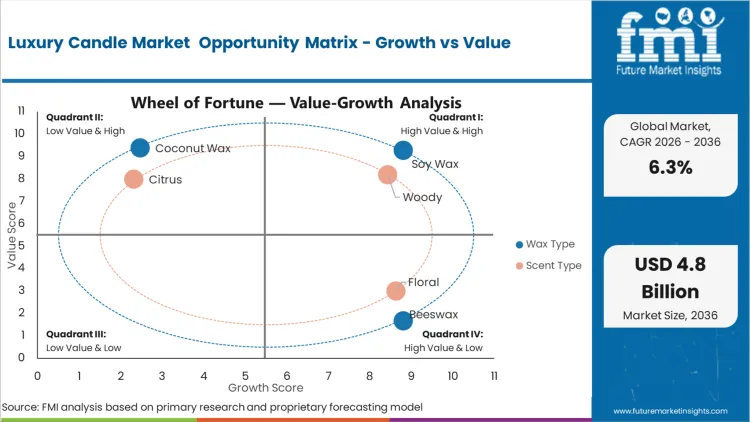
The structural shift toward integrated interior design forces high-end hospitality operators to contract continuous olfactory replenishment rather than rely on arbitrary seasonal purchases. A luxury hotel manager cannot risk a lobby smelling generically clean; the scent must actively reinforce the property's specific brand identity from the moment the doors open. This commercial pressure obligates procurement teams to establish standing orders with heritage fragrance houses, securing guaranteed monthly volumes. Failing to formalize these spatial scent contracts leaves the property vulnerable to inconsistent atmospheric experiences, directly degrading the perceived value of their premium room rates. Investment in fragrance product development is now a core requirement for brand differentiation in this sector.
Direct-to-consumer velocity faces a massive structural friction point: the physical impossibility of sampling a true hot throw through digital channels. Buyers hesitate to commit capital to an untested, expensive fragrance profile based entirely on text descriptions of top and base notes. While some niche perfumers have introduced micro-dosed wax samplers, these programs introduce complex reverse-logistics costs and packaging waste that erode baseline margins. This friction remains structural because olfactory perception is highly subjective; a description of smoky vetiver translates differently to every palate, keeping return rates unsustainably high for blind digital purchases.
Opportunities in the Luxury Candle Market
- Cross-category Integration: High-margin skincare brands possess established, fiercely loyal customer bases. Formulation directors capture immediate incremental revenue by translating their signature scents into fragrance concentrates for premium poured wax formats.
- Vessel Upcycling: Eco-conscious affluent consumers heavily scrutinize single-use luxury items. Industrial designers engineer high-fired ceramic vessels with standardized dimensions, allowing buyers to repurpose them as permanent planters.
- Subscription Replenishment: Affluent households value frictionless operational management over discount hunting. Brand strategists capture this segment by offering automated quarterly deliveries of seasonal scent profiles curated for the subscriber's geographic climate.
Regional Analysis
Based on the regional analysis, the Luxury Candle market is segmented into North America, Europe, Asia Pacific, and other key regions across 40 plus countries.
.webp "Top Country Growth Comparison Luxury Candle Market Cagr (2026 2036)")
| Country | CAGR (2026 to 2036) |
|---|---|
| United Arab Emirates | 9.1% |
| China | 8.2% |
| South Korea | 7.8% |
| Japan | 7.5% |
| France | 6.4% |
| United Kingdom | 6.1% |
| United States | 5.8% |
Source: Future Market Insights (FMI) analysis, based on proprietary forecasting model and primary research
Middle East and Africa Luxury Candle Market Analysis
FMI's assessment indicates that developers treat signature spatial scenting as a core architectural requirement, entirely equivalent to lighting or acoustic design. This creates massive, highly concentrated demand spikes whenever a new ultra-high-net-worth residential tower or mega-hotel reaches completion. Growth here is heavily anchored by commercial procurement teams outfitting entire newly built environments, often utilizing smart fragrance box technology to manage scent dispersion.
- United Arab Emirates: The integration of permanent spatial scenting infrastructure into mega-scale projects defines the United Arab Emirates trajectory in this space. Brands that successfully negotiate these initial bulk contracts secure highly lucrative, multi-year replenishment agreements that lock out competing vendors entirely. The market for luxury candles in the United Arab Emirates is forecast to register a CAGR of 9.1%. Procurement directors in Dubai and Abu Dhabi prioritize extreme hot throw performance to fill expansive marble-clad volumes efficiently.
FMI's report includes secondary markets across the broader Gulf Cooperation Council. These adjacent territories closely mirror the UAE's procurement behavior, heavily favoring intense oriental and oud-based scent architectures that project overt opulence in large commercial spaces.
Asia Pacific Luxury Candle Market Analysis
The structural lens here is deeply tied to buyer behavior: space constraints in premium Asian real estate mean that physical objects must carry immense aesthetic weight to justify their footprint. Based on FMI's assessment, consumers evaluate the prestige of the European or American manufacturing origin just as rigorously as the actual olfactory performance. Rapidly modernizing urban centers generate highly concentrated pockets of affluent consumers who utilize imported aromatherapy assets primarily for social signaling.
- China: China's intense focus on visible brand heritage forces new market entrants to invest heavily in specialized physical pop-up experiences to validate their prestige status. Securing prime physical placement in luxury malls fundamentally alters a brand's operational scale, shifting them from niche imports to high-volume prestige staples. China is expected to see its luxury candle sector grow at a CAGR of 8.2%. Category managers in top-tier cities require these activations to educate consumers on complex scent profiles before stocking items permanently.
- South Korea: Brand collaborations with high-profile cultural icons define South Korea's specific adoption curve. Retail buyers coordinate inventory drops precisely with media releases, causing massive, instantaneous spikes in demand. South Korea's luxury candle industry is projected to demonstrate a CAGR of 7.8%. This rapid trend cycle forces competitors to maintain highly agile supply chains, creating a distinct disadvantage for slow-moving heritage brands.
- Japan: Japanese procurement standards enforce the strictest quality control tolerances globally regarding clean burns and zero-soot emissions. Operations managers at premium department stores will instantly delist a product line if a single batch exhibits uneven melt pools or excessive smoke. FMI estimates the luxury candle market in Japan to expand at a CAGR of 7.5%. This zero-tolerance environment pushes formulators toward hyper-refined wax blends and cotton-core wicks.
FMI's report includes emerging affluent hubs in Southeast Asia. These markets demonstrate a distinct preference for lighter profiles that perform better in high-humidity environments.
Europe Luxury Candle Market Analysis
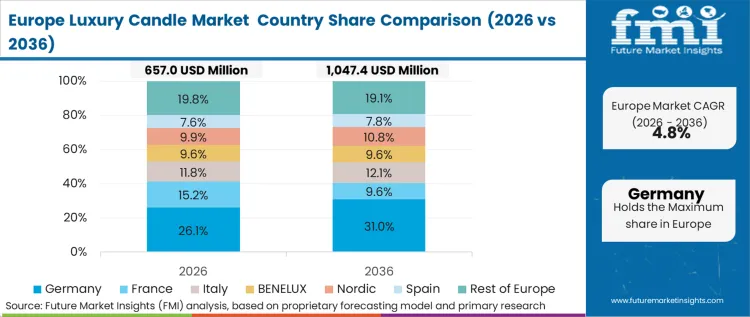
As per FMI's projection, regulatory updates from chemical oversight bodies regarding synthetic musks and allergens continually force legacy brands to quietly reformulate their recipes. The European market dynamic is anchored by the deep historical infrastructure of heritage perfumery. The structural condition here is not rapid expansion, but the aggressive defense of established production traditions against synthetic commoditization, often involving advanced fragrance fixatives to maintain scent longevity.
- France: France's unmatched concentration of raw material processors and master perfumers allows domestic brands to iterate complex architectures faster than foreign competitors. Product development teams operate intimately with extraction facilities, identifying unique seasonal botanical yields before they hit the open market. A CAGR of 6.4% is expected for luxury candles in France over the forecast period. Access to top-tier "noses" remains fiercely guarded by legacy conglomerates.
- United Kingdom: Stately home aesthetics and heritage retail environments heavily influence the United Kingdom's specific purchasing patterns. Buyers in London's premium department stores prioritize heavy, apothecary-style vessels and complex botanical narratives. The United Kingdom market for luxury candles is likely to post a CAGR of 6.1%. Brands that master this specific blend of historical storytelling and modern clean-burn chemistry capture multi-generational household loyalty.
FMI's report includes analysis of the Nordic regions. Consumers in these countries exhibit distinct behavioral patterns, prioritizing minimalist aesthetics and certified organic substrates over complex, heavy historical profiles.
North America Luxury Candle Market Analysis
North American procurement trends are heavily influenced by the convergence of prestige beauty and residential wellness routines. Based on FMI's assessment, a structural shift toward integrated interior design forces established vendors to abandon opaque synthetic blends in favor of transparent, traceable botanical supply chains. The continent represents a highly fragmented retail landscape where independent boutiques hold significant power in validating new market entrants.
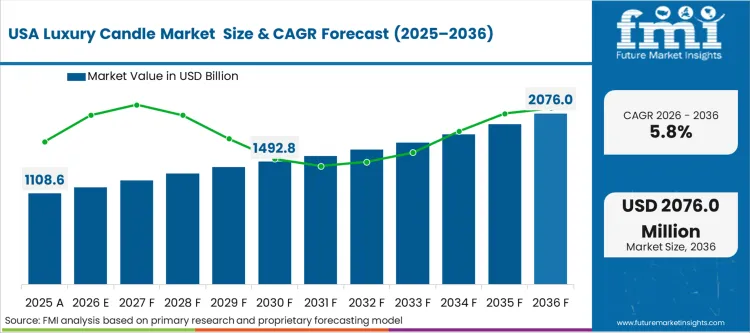
- United States: Direct-to-consumer digital acquisition defines the initial trajectory for independent brands within the United States. Brands that successfully bridge the gap from digital hype to physical retail permanence unlock immense national distribution networks. FMI estimates the luxury candle market in the United States to expand at a CAGR of 5.8%. Scaling past early adopters requires securing shelf space in specialized prestige retailers capable of facilitating physical scent trials.
FMI's report includes secondary markets across Canada and Mexico. The adoption patterns in these bordering nations align closely with major United States metropolitan centers, heavily prioritizing eco-conscious packaging.
Competitive Aligners for Market Players
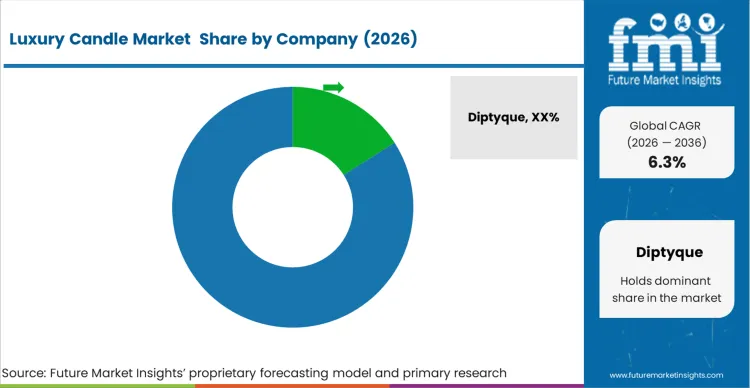
The extreme concentration at the apex of the luxury candle market stems from a singular structural reality: affluent consumers do not purchase wax chemistry; they purchase the cultural weight of the vessel. Heritage incumbents command steep price premiums because their specific typography and glass silhouettes serve as instantaneous, universally recognized signals of prestige. Buyers use this visual brand shorthand as the primary variable to separate qualified luxury investments from mass-market imitations. When a hospitality procurement director specs a premium product, they are not merely buying a fragrance profile; they are purchasing the social cachet that justifies a higher room rate, creating a formidable barrier for any new entrant.
The structural advantage held by legacy European houses lies in their multi-generational lock on prime raw material harvests. To bypass this supply-side fortress, modern disruptors have successfully engineered a different category of capability: the subversive, gender-fluid scent narrative wrapped in minimalist aesthetics. This positioning persists because it directly captures a younger affluent demographic actively rejecting the hyper-traditional storytelling of older conglomerates. However, sustaining this cultural edge requires these newer entrants to build highly responsive essential oils supply networks. Brands that bridge this gap must pair an irreproachable modern identity with a flawlessly executed, clean-burning formulation.
Large hospitality buyers and luxury retail conglomerates actively resist vendor lock-in by continually rotating independent, culturally relevant names through their secondary visual merchandising zones. This creates a permanent operational tension: procurement directors need the high-volume fulfillment reliability of massive conglomerates, yet they must source the cultural edge provided by independent niche formulators. Instead of launching competing youth-focused lines organically, legacy houses are responding by aggressively absorbing these agile independent brands. By 2036, the market architecture shifts into a hyper-consolidated financial reality where a handful of global parent companies control the underlying manufacturing infrastructure.
Key Players in Luxury Candle Market
- Diptyque
- Jo Malone London
- Byredo
- Trudon
- Le Labo
- Boy Smells
- D.S. & Durga
- Acqua di Parma
Scope of the Report
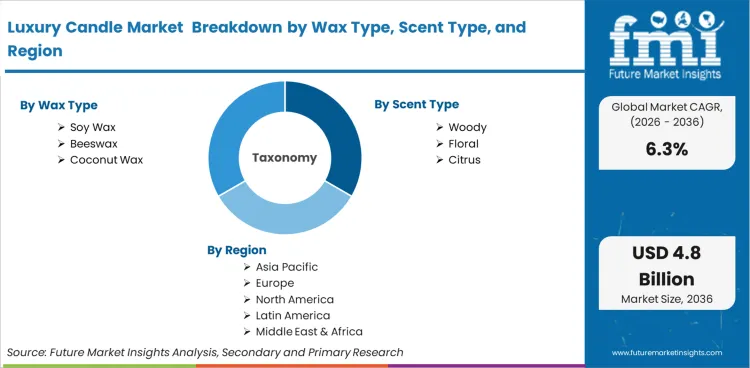
| Metric | Value |
|---|---|
| Quantitative Units | USD 2.6 billion to USD 4.8 billion, at a CAGR of 6.30% |
| Market Definition | A specialized home fragrance category defined by complex olfactory structures, premium wax substrates, and high-retention architectural vessels acting as interior design assets. |
| Wax Type Segmentation | Soy Wax, Beeswax, Paraffin Blends, Coconut Wax |
| Scent Type Segmentation | Floral, Woody, Citrus, Oriental, Custom Blends |
| Distribution Channel Segmentation | Online Boutiques, Specialty Stores, Department Stores |
| Regions Covered | North America, Latin America, Europe, East Asia, South Asia, Oceania, Middle East and Africa |
| Countries Covered | United Arab Emirates, China, South Korea, Japan, France, United Kingdom, United States, and 40 plus countries |
| Key Companies Profiled | Diptyque, Jo Malone London, Byredo, Trudon, Le Labo, Boy Smells, D.S. & Durga, Acqua di Parma |
| Forecast Period | 2026 to 2036 |
| Approach | Primary interviews targeted procurement directors at premium hospitality groups and lead formulators at heritage fragrance houses. The baseline quantitative anchor relies on regional customs data. |
Source: Future Market Insights (FMI) analysis, based on proprietary forecasting model and primary research
Luxury Candle Market Analysis by Segments
-
Wax Type:
- Soy Wax
- Beeswax
- Paraffin Blends
- Coconut Wax
-
Scent Type:
- Floral
- Woody
- Citrus
- Oriental
- Custom Blends
-
Distribution Channel:
- Online Boutiques
- Specialty Stores
- Department Stores
-
Region:
- North America
- United States
- Canada
- Europe
- Germany
- United Kingdom
- France
- Asia Pacific
- China
- Japan
- South Korea
- Middle East and Africa
- United Arab Emirates
- North America
Bibliography
- National Candle Association. (2024, May). Wax Composition and Particulate Emissions Guidelines. NCA Regulatory Database
- Diptyque Paris. (2024). Sustainable Commitments and Sourcing. Diptyque Corporate.
- Fragrance Creators Association. (2024, October). North American Home Fragrance Compliance Protocols. FCA Guidelines.
- Society of Cosmetic Chemists. (2024, January). Volatile Organic Compound Emissions in Poured Wax Formulations. Journal of Cosmetic Science.
- American Soybean Association. (2024). Soy Wax Industrial Applications and Export Trends. ASA Market Reports.
- British Retail Consortium (BRCGS). (2024). Global Standard for Consumer Products – Luxury Goods Annex. BRCGS Publications.
This bibliography is provided for reader reference. The full FMI report contains the complete reference list with primary source documentation.
This Report Addresses
- Market intelligence to support strategic decision making across premium poured wax formats and architectural vessel configurations
- Market size estimation and 10-year revenue forecasts from 2026 to 2036, supported by premium glass vessel manufacturing volume tracking
- Growth opportunity mapping across specific wax substrates and complex scent architectures with emphasis on the digital sampling resolution threshold
- Segment and regional revenue forecasts covering soy, beeswax, woody, and floral profiles across luxury retail and commercial hospitality procurement environments
- Competition strategy assessment including vessel recognition parameters, gender-neutral branding aesthetics, and social signaling weight
- Product development tracking including REACH annex compliance regarding synthetic musks and low-soot emission standard adherence
- Market access analysis covering premium department store qualification pathways and specialty boutique distribution frameworks
- Market report delivery in PDF, Excel, PPT, and interactive dashboard formats for executive strategy, retail category planning, and operational benchmarking use
Frequently Asked Questions
How large is the Luxury Candle Market in 2026?
The valuation reaches USD 2.6 billion in 2026. This figure indicates that premium poured wax products have successfully transitioned from seasonal gift items into permanent, high-rotation interior design assets used for year-round environmental conditioning.
What will it be valued at by 2036?
The valuation is projected to hit USD 4.8 billion by the end of 2036. This scale reflects the total absorption of the category by luxury hospitality groups and developers who now treat spatial scenting as a core architectural utility.
What CAGR is projected?
A CAGR of 6.30% is expected during the forecast period. This steady expansion aligns with the slow, deliberate pace at which high-net-worth consumers adopt and physically trial new complex olfactory profiles for their primary residences.
Which Wax Type segment leads?
Soy wax secures the leading position because it binds structurally with heavy essential oil concentrations without sweating or degrading the burn profile. Formulators choose this substrate specifically to ensure consistent hot throw performance during long transit routes in variable climates.
Which Scent Type segment leads?
Woody profiles command the highest share because buyers require grounding, gender-neutral scents for shared architectural spaces that do not clash with personal perfumes. These compositions blend sandalwood and cedar to create a subtle ambient luxury background.
Which Distribution Channel segment leads?
Specialty stores capture the most volume as consumers actively seek out physical spaces to accurately judge complex scent pyramids before purchasing. These environments allow sales associates to justify premium price points through detailed olfactory storytelling.
What drives rapid growth?
Luxury real estate developers are standardizing custom spatial scenting within their permanent operating budgets, treating it as an essential architectural utility. This bulk commercial demand creates massive baseline revenue streams that protect manufacturers from retail volatility.
What is the primary restraint?
The physical impossibility of digitally sampling a true hot throw severely restricts direct-to-consumer velocity and keeps customer acquisition costs high. Without an accurate way to test scent dispersion through a screen, brands struggle to convert blind buyers.
Which country grows fastest?
The United Arab Emirates outpaces China structurally because its growth is anchored by massive, centralized commercial procurement for newly built mega-hotels and residential towers. Chinese growth relies more heavily on incremental individual consumer adoption at the retail level.
How do REACH chemical regulations impact European formulations?
Oversight bodies continually update restrictions on synthetic musks and allergens, forcing legacy houses to quietly re-engineer recipes without altering the recognized final hot throw. These compliance shifts demand highly agile procurement teams capable of sourcing alternative botanical extracts.
What shifts are occurring in vessel design and packaging?
Consumers increasingly view the empty vessel as a permanent social signaling object, demanding heavy-fired ceramics and stamped brass over basic glass. This forces packaging engineers to eliminate secondary plastics while engineering transit structures that prevent heavy components from shattering.
Why are independent brands gaining traction against heritage houses?
Independent formulators strip away hyper-traditional storytelling to offer minimalist, gender-fluid aesthetics that align with modern architectural trends. They capture younger affluent demographics by focusing on clean-burn chemistry and subversive scent narratives.
How does Japan's market structure differ from the United Kingdom's?
Japanese buyers enforce zero-tolerance thresholds for soot emissions and uneven melt pools, causing instant delisting for minor technical failures. In contrast, United Kingdom buyers prioritize the historical narrative and apothecary styling, often showing more tolerance for burn inconsistencies if the heritage is strong.
What role does organic certification play in South Korea?
While organic sourcing matters, South Korean velocity is far more dependent on immediate cultural collaborations and high-profile influencer drops. Fast-moving aesthetic trends override subtle chemical purity claims in this specific rapid-cycle retail environment.
How do custom blends perform compared to standard profiles?
Custom formulations command the highest margins but suffer from slow qualification cycles as commercial buyers rigorously test prototypes in active hospitality environments. Once approved, these custom profiles provide total vendor lock-in for multiple years.
Why is coconut wax remaining a niche segment?
Coconut substrates offer excellent scent throw but present severe thermal stability issues in warmer climates, leading to unacceptable melting during summer transit. Procurement directors limit its use strictly to regional, short-supply-chain operations.
How do department stores manage inventory for seasonal scents?
Category managers intentionally under-allocate seasonal profiles to artificially enforce scarcity and protect the prestige halo. Overstocking seasonal luxury items forces eventual discounting, which permanently damages the brand's perceived value.
What is the impact of cross-merchandising in beauty boutiques?
Integrating candles directly alongside prestige skincare dramatically lowers the cognitive barrier to purchase. The consumer already trusts the brand's chemical competence, easily translating a serum purchase into a matching home fragrance add-on.
How do wick trimmers and accessories alter profitability?
Branded extinguishing tools and trimmers offer extreme gross margins while reinforcing the ritualistic nature of the product. Sales associates use these low-friction add-ons to immediately increase the average transaction value at the point of sale.
Why are single-wick configurations maintaining dominance?
Single wicks offer a slower, more controlled burn that extends the lifespan of an expensive asset, aligning with the buyer's expectation of longevity. Multi-wick vessels are relegated to statement pieces rather than everyday residential use.
How does FMI validate its premium pricing models?
The methodology cross-references raw material import costs for botanical extracts against the publicly reported gross margins of prestige beauty conglomerates. This isolates the exact premium consumers pay for the vessel and the brand name.
What prevents mass-market candle manufacturers from trading up?
Mass producers lack the established relationships with Grasse-based botanical extractors required to formulate complex top, heart, and base notes. Attempting to replicate these architectures using cheap synthetic oils results in a harsh hot throw that luxury buyers reject.
Preview the report firsthand - request a free sample
Get SampleGet the brochure for pricing and purchase details.
Get PDFTable of Content
- Executive Summary
- Global Market Outlook
- Demand-side Trends
- Supply-side Trends
- Technology Roadmap Analysis
- Analysis and Recommendations
- Market Overview
- Market Coverage / Taxonomy
- Market Definition / Scope / Limitations
- Research Methodology
- Chapter Orientation
- Analytical Lens and Working Hypotheses
- Market Structure, Signals, and Trend Drivers
- Benchmarking and Cross-market Comparability
- Market Sizing, Forecasting, and Opportunity Mapping
- Research Design and Evidence Framework
- Desk Research Programme (Secondary Evidence)
- Company Annual and Sustainability Reports
- Peer-reviewed Journals and Academic Literature
- Corporate Websites, Product Literature, and Technical Notes
- Earnings Decks and Investor Briefings
- Statutory Filings and Regulatory Disclosures
- Technical White Papers and Standards Notes
- Trade Journals, Industry Magazines, and Analyst Briefs
- Conference Proceedings, Webinars, and Seminar Materials
- Government Statistics Portals and Public Data Releases
- Press Releases and Reputable Media Coverage
- Specialist Newsletters and Curated Briefings
- Sector Databases and Reference Repositories
- FMI Internal Proprietary Databases and Historical Market Datasets
- Subscription Datasets and Paid Sources
- Social Channels, Communities, and Digital Listening Inputs
- Additional Desk Sources
- Expert Input and Fieldwork (Primary Evidence)
- Primary Modes
- Qualitative Interviews and Expert Elicitation
- Quantitative Surveys and Structured Data Capture
- Blended Approach
- Why Primary Evidence is Used
- Field Techniques
- Interviews
- Surveys
- Focus Groups
- Observational and In-context Research
- Social and Community Interactions
- Stakeholder Universe Engaged
- C-suite Leaders
- Board Members
- Presidents and Vice Presidents
- R&D and Innovation Heads
- Technical Specialists
- Domain Subject-matter Experts
- Scientists
- Physicians and Other Healthcare Professionals
- Governance, Ethics, and Data Stewardship
- Research Ethics
- Data Integrity and Handling
- Primary Modes
- Tooling, Models, and Reference Databases
- Desk Research Programme (Secondary Evidence)
- Data Engineering and Model Build
- Data Acquisition and Ingestion
- Cleaning, Normalisation, and Verification
- Synthesis, Triangulation, and Analysis
- Quality Assurance and Audit Trail
- Market Background
- Market Dynamics
- Drivers
- Restraints
- Opportunity
- Trends
- Scenario Forecast
- Demand in Optimistic Scenario
- Demand in Likely Scenario
- Demand in Conservative Scenario
- Opportunity Map Analysis
- Product Life Cycle Analysis
- Supply Chain Analysis
- Investment Feasibility Matrix
- Value Chain Analysis
- PESTLE and Porter’s Analysis
- Regulatory Landscape
- Regional Parent Market Outlook
- Production and Consumption Statistics
- Import and Export Statistics
- Market Dynamics
- Global Market Analysis 2021 to 2025 and Forecast, 2026 to 2036
- Historical Market Size Value (USD Million) Analysis, 2021 to 2025
- Current and Future Market Size Value (USD Million) Projections, 2026 to 2036
- Y-o-Y Growth Trend Analysis
- Absolute $ Opportunity Analysis
- Global Market Pricing Analysis 2021 to 2025 and Forecast 2026 to 2036
- Global Market Analysis 2021 to 2025 and Forecast 2026 to 2036, By Wax Type
- Introduction / Key Findings
- Historical Market Size Value (USD Million) Analysis By Wax Type , 2021 to 2025
- Current and Future Market Size Value (USD Million) Analysis and Forecast By Wax Type , 2026 to 2036
- Soy Wax
- Beeswax
- Coconut Wax
- Soy Wax
- Y-o-Y Growth Trend Analysis By Wax Type , 2021 to 2025
- Absolute $ Opportunity Analysis By Wax Type , 2026 to 2036
- Global Market Analysis 2021 to 2025 and Forecast 2026 to 2036, By Scent Type
- Introduction / Key Findings
- Historical Market Size Value (USD Million) Analysis By Scent Type, 2021 to 2025
- Current and Future Market Size Value (USD Million) Analysis and Forecast By Scent Type, 2026 to 2036
- Woody
- Floral
- Citrus
- Woody
- Y-o-Y Growth Trend Analysis By Scent Type, 2021 to 2025
- Absolute $ Opportunity Analysis By Scent Type, 2026 to 2036
- Global Market Analysis 2021 to 2025 and Forecast 2026 to 2036, By Distribution Channel
- Introduction / Key Findings
- Historical Market Size Value (USD Million) Analysis By Distribution Channel, 2021 to 2025
- Current and Future Market Size Value (USD Million) Analysis and Forecast By Distribution Channel, 2026 to 2036
- Specialty Stores
- Department Stores
- Specialty Stores
- Y-o-Y Growth Trend Analysis By Distribution Channel, 2021 to 2025
- Absolute $ Opportunity Analysis By Distribution Channel, 2026 to 2036
- Global Market Analysis 2021 to 2025 and Forecast 2026 to 2036, By Region
- Introduction
- Historical Market Size Value (USD Million) Analysis By Region, 2021 to 2025
- Current Market Size Value (USD Million) Analysis and Forecast By Region, 2026 to 2036
- North America
- Latin America
- Western Europe
- Eastern Europe
- East Asia
- South Asia and Pacific
- Middle East & Africa
- Market Attractiveness Analysis By Region
- North America Market Analysis 2021 to 2025 and Forecast 2026 to 2036, By Country
- Historical Market Size Value (USD Million) Trend Analysis By Market Taxonomy, 2021 to 2025
- Market Size Value (USD Million) Forecast By Market Taxonomy, 2026 to 2036
- By Country
- USA
- Canada
- Mexico
- By Wax Type
- By Scent Type
- By Distribution Channel
- By Country
- Market Attractiveness Analysis
- By Country
- By Wax Type
- By Scent Type
- By Distribution Channel
- Key Takeaways
- Latin America Market Analysis 2021 to 2025 and Forecast 2026 to 2036, By Country
- Historical Market Size Value (USD Million) Trend Analysis By Market Taxonomy, 2021 to 2025
- Market Size Value (USD Million) Forecast By Market Taxonomy, 2026 to 2036
- By Country
- Brazil
- Chile
- Rest of Latin America
- By Wax Type
- By Scent Type
- By Distribution Channel
- By Country
- Market Attractiveness Analysis
- By Country
- By Wax Type
- By Scent Type
- By Distribution Channel
- Key Takeaways
- Western Europe Market Analysis 2021 to 2025 and Forecast 2026 to 2036, By Country
- Historical Market Size Value (USD Million) Trend Analysis By Market Taxonomy, 2021 to 2025
- Market Size Value (USD Million) Forecast By Market Taxonomy, 2026 to 2036
- By Country
- Germany
- UK
- Italy
- Spain
- France
- Nordic
- BENELUX
- Rest of Western Europe
- By Wax Type
- By Scent Type
- By Distribution Channel
- By Country
- Market Attractiveness Analysis
- By Country
- By Wax Type
- By Scent Type
- By Distribution Channel
- Key Takeaways
- Eastern Europe Market Analysis 2021 to 2025 and Forecast 2026 to 2036, By Country
- Historical Market Size Value (USD Million) Trend Analysis By Market Taxonomy, 2021 to 2025
- Market Size Value (USD Million) Forecast By Market Taxonomy, 2026 to 2036
- By Country
- Russia
- Poland
- Hungary
- Balkan & Baltic
- Rest of Eastern Europe
- By Wax Type
- By Scent Type
- By Distribution Channel
- By Country
- Market Attractiveness Analysis
- By Country
- By Wax Type
- By Scent Type
- By Distribution Channel
- Key Takeaways
- East Asia Market Analysis 2021 to 2025 and Forecast 2026 to 2036, By Country
- Historical Market Size Value (USD Million) Trend Analysis By Market Taxonomy, 2021 to 2025
- Market Size Value (USD Million) Forecast By Market Taxonomy, 2026 to 2036
- By Country
- China
- Japan
- South Korea
- By Wax Type
- By Scent Type
- By Distribution Channel
- By Country
- Market Attractiveness Analysis
- By Country
- By Wax Type
- By Scent Type
- By Distribution Channel
- Key Takeaways
- South Asia and Pacific Market Analysis 2021 to 2025 and Forecast 2026 to 2036, By Country
- Historical Market Size Value (USD Million) Trend Analysis By Market Taxonomy, 2021 to 2025
- Market Size Value (USD Million) Forecast By Market Taxonomy, 2026 to 2036
- By Country
- India
- ASEAN
- Australia & New Zealand
- Rest of South Asia and Pacific
- By Wax Type
- By Scent Type
- By Distribution Channel
- By Country
- Market Attractiveness Analysis
- By Country
- By Wax Type
- By Scent Type
- By Distribution Channel
- Key Takeaways
- Middle East & Africa Market Analysis 2021 to 2025 and Forecast 2026 to 2036, By Country
- Historical Market Size Value (USD Million) Trend Analysis By Market Taxonomy, 2021 to 2025
- Market Size Value (USD Million) Forecast By Market Taxonomy, 2026 to 2036
- By Country
- Kingdom of Saudi Arabia
- Other GCC Countries
- Turkiye
- South Africa
- Other African Union
- Rest of Middle East & Africa
- By Wax Type
- By Scent Type
- By Distribution Channel
- By Country
- Market Attractiveness Analysis
- By Country
- By Wax Type
- By Scent Type
- By Distribution Channel
- Key Takeaways
- Key Countries Market Analysis
- USA
- Pricing Analysis
- Market Share Analysis, 2025
- By Wax Type
- By Scent Type
- By Distribution Channel
- Canada
- Pricing Analysis
- Market Share Analysis, 2025
- By Wax Type
- By Scent Type
- By Distribution Channel
- Mexico
- Pricing Analysis
- Market Share Analysis, 2025
- By Wax Type
- By Scent Type
- By Distribution Channel
- Brazil
- Pricing Analysis
- Market Share Analysis, 2025
- By Wax Type
- By Scent Type
- By Distribution Channel
- Chile
- Pricing Analysis
- Market Share Analysis, 2025
- By Wax Type
- By Scent Type
- By Distribution Channel
- Germany
- Pricing Analysis
- Market Share Analysis, 2025
- By Wax Type
- By Scent Type
- By Distribution Channel
- UK
- Pricing Analysis
- Market Share Analysis, 2025
- By Wax Type
- By Scent Type
- By Distribution Channel
- Italy
- Pricing Analysis
- Market Share Analysis, 2025
- By Wax Type
- By Scent Type
- By Distribution Channel
- Spain
- Pricing Analysis
- Market Share Analysis, 2025
- By Wax Type
- By Scent Type
- By Distribution Channel
- France
- Pricing Analysis
- Market Share Analysis, 2025
- By Wax Type
- By Scent Type
- By Distribution Channel
- India
- Pricing Analysis
- Market Share Analysis, 2025
- By Wax Type
- By Scent Type
- By Distribution Channel
- ASEAN
- Pricing Analysis
- Market Share Analysis, 2025
- By Wax Type
- By Scent Type
- By Distribution Channel
- Australia & New Zealand
- Pricing Analysis
- Market Share Analysis, 2025
- By Wax Type
- By Scent Type
- By Distribution Channel
- China
- Pricing Analysis
- Market Share Analysis, 2025
- By Wax Type
- By Scent Type
- By Distribution Channel
- Japan
- Pricing Analysis
- Market Share Analysis, 2025
- By Wax Type
- By Scent Type
- By Distribution Channel
- South Korea
- Pricing Analysis
- Market Share Analysis, 2025
- By Wax Type
- By Scent Type
- By Distribution Channel
- Russia
- Pricing Analysis
- Market Share Analysis, 2025
- By Wax Type
- By Scent Type
- By Distribution Channel
- Poland
- Pricing Analysis
- Market Share Analysis, 2025
- By Wax Type
- By Scent Type
- By Distribution Channel
- Hungary
- Pricing Analysis
- Market Share Analysis, 2025
- By Wax Type
- By Scent Type
- By Distribution Channel
- Kingdom of Saudi Arabia
- Pricing Analysis
- Market Share Analysis, 2025
- By Wax Type
- By Scent Type
- By Distribution Channel
- Turkiye
- Pricing Analysis
- Market Share Analysis, 2025
- By Wax Type
- By Scent Type
- By Distribution Channel
- South Africa
- Pricing Analysis
- Market Share Analysis, 2025
- By Wax Type
- By Scent Type
- By Distribution Channel
- USA
- Market Structure Analysis
- Competition Dashboard
- Competition Benchmarking
- Market Share Analysis of Top Players
- By Regional
- By Wax Type
- By Scent Type
- By Distribution Channel
- Competition Analysis
- Competition Deep Dive
- Diptyque
- Overview
- Product Portfolio
- Profitability by Market Segments (Product/Age /Sales Channel/Region)
- Sales Footprint
- Strategy Overview
- Marketing Strategy
- Product Strategy
- Channel Strategy
- Jo Malone London
- Byredo
- Trudon
- Le Labo
- Boy Smells
- Diptyque
- Competition Deep Dive
- Assumptions & Acronyms Used


