

- Market Size (2026)
- USD 8.8 Bn
- Forecast (2036)
- USD 15.8 Bn
- CAGR (2026 to 2036)
- 6.0%
How big is Luxury Rigid Box Market in 2026?
Sales in the luxury rigid box market are projected to grow at 6.0% CAGR, with the market size rising from USD 8.3 billion in 2025 to USD 8.8 billion in 2026 and reaching USD 15.8 billion by 2036.
According to FMI research indicates, the global luxury rigid box market stands at USD 8.3 billion in 2025 and rises to USD 8.8 billion in 2026. Industry valuation is projected to reach USD 15.8 billion by 2036, expanding at a 6.0% CAGR and generating USD 7.0 billion in added revenue across the forecast period. Premium beauty, watch and consumer electronics brands are under pressure to prevent corner compression and surface scuffing as high-value gift packs navigate parcel delivery networks. In August 2026, the European Commission initiated mandatory implementation of new packaging recyclability objectives, restricting unseparated plastic films and concealed magnets in luxury packaging formats [1]. Paperboard structures capture the leading material share at 58.0% in 2026, as brand owners favor rigid fiberboard walls that allow crisp sharp-edge wrapping, foil stamping, and mechanical embossing. Growth across evaluated economies ranges from 5.1% in Germany to 7.2% in China, though manual wrapping labor costs and strict recyclability audits continue to limit multi-material box adoption.
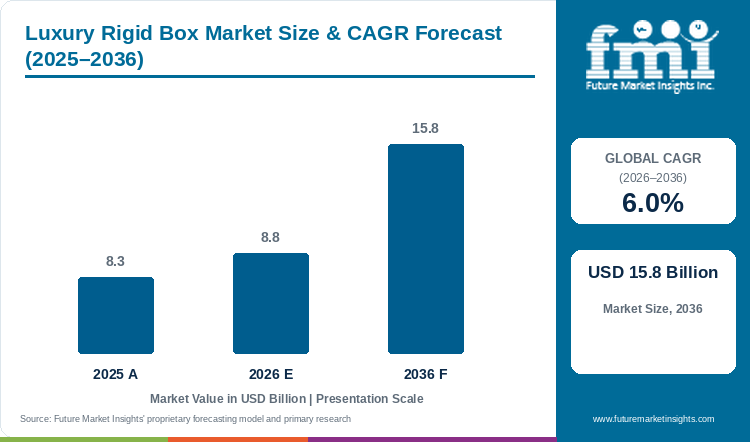
Key Market Trends & Insights
- Paperboard is expected to account for 58.0% in 2026 as converters can hold the box shape and still use foil, embossing or a printed wrap without shifting to a heavier mixed-material structure.
- Lid and base boxes are estimated to hold 34.0% in 2026. The format is not new, but its tooling can be used again across fragrance sets, confectionery and jewelry launches, which keeps redesign risk under control.
- Cosmetics and personal care is expected to lead with 37.0% share in 2026 as fragrance and skincare brands keep using gift sets to place more than one product inside a single presentation pack.
- Magnetic closures are forecast to represent 29.0% in 2026 owing to the defined closing action and repeat storage value; however, the same concealed magnet can become a hurdle where easy material separation is required.
- Foil stamping is likely to capture 31.0% in 2026 as a small metallic area can carry the logo contrast without covering the complete wrap, although poor registration can quickly make the pack look defective.
- Direct brand contracts are set to lead with 52.0% in 2026 since rigid box programs pass through board dummies, color trials, insert-fit checks and final brand signoff before the production run is released.
Regional Highlights
- Fastest-growing evaluated country: China, at 7.2% CAGR from 2026 to 2036.
- By country: India at 6.8% and the United States at 6.5% follow, while Germany records the lowest evaluated CAGR at 5.1%.
Market Size & Forecast
Table 1: Market Size and Forecast for the Luxury Rigid Box Market (USD billion and CAGR percentage), 2025 to 2036
| Metric | Value |
|---|---|
| 2025 Market Size | USD 8.3 billion |
| Estimated Market Size in 2026 | USD 8.8 billion |
| Projected Market Size by 2036 | USD 15.8 billion |
| CAGR, 2026 to 2036 | 6.0% |
| Added Revenue, 2026 to 2036 | USD 7.0 billion |
Direct delivery is bringing structural testing into the same approval cycle as color and finishing. U.S. retail e-commerce sales reached USD 340.2 billion on an adjusted basis in the second quarter of 2026 and accounted for 17.1% of retail sales [2]. This is why corner compression, scuffing and insert retention are receiving attention before a decorative finish is approved; a premium box which fails during fulfillment removes the value created by the finish.
Unit-Volume and Premium Box Spending Sizing
Table 2: Unit-Volume and Average Box Revenue Sizing for the Luxury Rigid Box Market (USD billion, units, and USD per box), 2025 to 2036
| Metric | 2025 | 2026 | 2036 |
|---|---|---|---|
| Market size (USD billion) | 8.3 | 8.8 | 15.8 |
| Estimated premium rigid boxes (billion units) | 2.55 to 2.85 | 2.65 to 2.98 | 4.05 to 4.6 |
| Average supplier revenue per box (USD) | 2.93 to 3.27 | 2.97 to 3.34 | 3.44 to 3.91 |
| Paperboard-attributed revenue (USD billion) | 4.8 | 5.1 | 9.2 |
Per Capita and Contract-Program Sizing
Luxury rigid boxes gain more value when the pack remains with the buyer after the product is opened. This is common in fragrance, watches, jewelry and premium technology where the box becomes part of storage. Direct brand programs therefore move around launch calendars, prototype changes, color approvals and finish qualification. A supplier that shortens these steps can protect the launch date, while a supplier that misses shade, lid fit or insert position can lose the repeat program.
Table 3: Per Capita Spending Indicators for the Luxury Rigid Box Market (USD), 2025 to 2036
| Metric | 2025 | 2026 | 2036 |
|---|---|---|---|
| World population (billion) | 8.23 | 8.30 | 8.95 |
| Spend per capita (USD) | 1.013 | 1.065 | 1.770 |
| Spend per 1,000 people (USD) | 1,013.4 | 1,065.1 | 1,769.8 |
| Cosmetics and personal care revenue (USD billion) | 3.09 | 3.27 | 5.86 |
Table 4: Brand-Contract and Format Revenue Indicators for the Luxury Rigid Box Market (USD billion and percentages), 2026
| Metric | Value | Basis |
|---|---|---|
| Market size, 2026 | USD 8.8 billion | Report value |
| Direct brand contract revenue | USD 4.6 billion | 52.0% share |
| Lid and base format revenue | USD 3.0 billion | 34.0% share |
| Foil stamping revenue | USD 2.7 billion | 31.0% share |
Segment revenues apply the reported 2026 shares to the USD 8.8 billion market estimate. These values should not be added together as product type, format, decoration and sales channel describe different sides of the same box program.
Analyst Perspective
“Luxury rigid boxes must now defend brand value during shipping while passing stricter material reviews. Suppliers combining exact finish control with traceable fiber will secure repeat brand programs.”
- Nandini Roy Choudhury, Principal Consultant, Future Market Insights.
How is the luxury rigid box market segmented?
The luxury rigid box market is segmented by product type, box format, application, closure type, decoration, and sales channel. In 2026, paperboard is projected at 58.0%, lid and base at 34.0%, cosmetics and personal care at 37.0%, magnetic closures at 29.0%, foil stamping at 31.0%, and direct brand contracts at 52.0%.
Paperboard is expected to account for 58.0% in 2026 as converters can hold the box shape and still use foil, embossing or a printed wrap without shifting to a heavier mixed-material structure.
Lid and base boxes are estimated to hold 34.0% in 2026. The format is not new, but its tooling can be used again across fragrance sets, confectionery and jewelry launches, which keeps redesign risk under control.
Cosmetics and personal care is expected to lead with 37.0% share in 2026 as fragrance and skincare brands keep using gift sets to place more than one product inside a single presentation pack.
Magnetic closures are forecast to represent 29.0% in 2026 owing to the defined closing action and repeat storage value; however, the same concealed magnet can become a hurdle where easy material separation is required.
Foil stamping is likely to capture 31.0% in 2026 as a small metallic area can carry the logo contrast without covering the complete wrap, although poor registration can quickly make the pack look defective.
Direct brand contracts are set to lead with 52.0% in 2026 since rigid box programs pass through board dummies, color trials, insert-fit checks and final brand signoff before the production run is released.
Why does paperboard account for a notable share of product type demand?
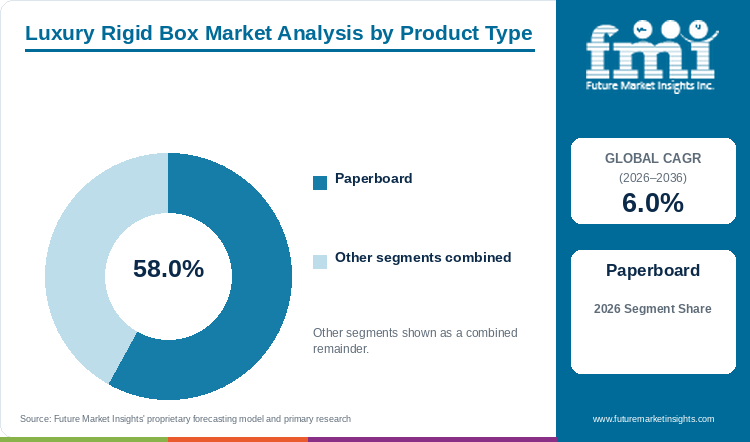
Paperboard represents 58.0% of product type in 2026, pairing structural stiffness with controlled printing and finishing.
Table 5: Product Type Share for the Luxury Rigid Box Market (percentage share), 2026
| Product Type | Share (2026) |
|---|---|
| Paperboard | 58.0% |
| Other Segments Combined | 42.0%* |
| Total | 100.0% |
*Calculated as the balance after deducting the leading segment share from 100.0%.
Table 6: Product Type Leadership and Market Growth for the Luxury Rigid Box Market (segment and CAGR percentage), 2026 to 2036
| Metric | Value |
|---|---|
| Global CAGR (2026 to 2036) | 6.0% |
| Leading Segment | Paperboard |
Paperboard is gaining preference where the brand needs stiff walls but does not want the recovery route to become more complicated. Dense board can be wrapped with specialty paper and still keep the edge geometry required for foil or embossing. This supports the 58.0% share in 2026. However, extra films, foam inserts or concealed components can weaken the same fiber-led case during a recyclability review. This also connects with wider paperboard packaging decisions taken by brand and packaging teams.
- Paperboard is projected to hold 58.0% of product type in 2026, supported by precise print surfaces and familiar recovery streams.
- European packaging rules make material documentation and recyclable design more relevant to premium box approval.
What supports lid and base as a preferred box format?
Lid and base formats hold 34.0% of box format in 2026, driven by repeat gifting and dependable assembly.
Lid and base formats continue to be used as the two-piece structure can be carried from one seasonal launch to another with limited tooling change. Inserts can be altered for a new bottle or product set while the outer format remains familiar. This explains the 34.0% share in 2026, although poor lid friction or corner alignment can still delay approval. This also connects with wider luxury packaging decisions taken by brand and packaging teams.
- By box format, lid and base is estimated to hold 34.0% in 2026, owing to reusable tooling across seasonal launches.
- Brand teams use physical prototypes to test lid friction, corner alignment, and repeat opening before production. [3]
How is cosmetics and personal care gaining use across applications?
Cosmetics and personal care accounts for 37.0% of application in 2026, meeting gifting and launch-calendar needs.
Cosmetics and personal care takes 37.0% share in 2026 as gift sets place several glass bottles, jars or tubes into one pack and increase the requirement for both protection and presentation. The opportunity is higher around fragrance launches and festive sets, but short launch windows can also create rework if an insert or printed shade changes late. This also connects with wider rigid sleeve boxes decisions taken by brand and packaging teams.
- In 2026, cosmetics and personal care leads application with 37.0% share, driven by gift sets and limited editions.
- Italy reported cosmetics exports increased 4.1% in 2025, reinforcing demand for presentation packaging. [8]
Why are buyers selecting magnetic closures within the closure mix?
Magnetic closures represent 29.0% of closure demand in 2026, supporting controlled opening and repeat post-purchase storage.
Magnetic closure keeps a clean outer surface and provides a closing action which buyers can feel during repeat use. This supports 29.0% share in 2026. The hurdle is not the opening experience; it is the concealed mixed material. Brands working under stricter separation rules may therefore move towards removable magnets or paper-led locking structures. This also connects with wider folding boxboard decisions taken by brand and packaging teams.
- By closure type, magnetic formats are forecast to represent 29.0% in 2026, linked to tactile opening cues.
- Recyclability reviews are increasing pressure to reduce concealed mixed materials in premium packs.
Which market conditions keep foil stamping ahead by decoration?
Foil stamping holds 31.0% of decoration demand in 2026, reinforcing concise logos without covering entire wrap surfaces.
Foil stamping accounts for 31.0% in 2026 as a controlled metallic mark can carry the brand logo on dark or textured paper without printing the complete surface. The process also leaves little room for production drift. Fine lettering, uneven pressure or poor registration becomes visible immediately and can raise rejection on short premium runs. This also connects with wider packaging waste recycling decisions taken by brand and packaging teams.
- Foil stamping is likely to capture 31.0% in 2026, influenced by strong logo visibility on premium wraps.
- Mondi presented premium papers for sustainable luxury packaging at LUXE PACK Paris in June 2025. [11]
What gives direct brand contracts the leading sales-channel position?
Direct brand contracts represent 52.0% of sales channel value in 2026, managing iterative samples and approval gates.
Direct brand contracts hold 52.0% of 2026 sales channel value as luxury boxes rarely move from artwork to production without a dummy, print trial and finish signoff. A direct relationship shortens the correction loop between the brand and converter. It also places more pressure on the supplier to hold color, texture, insert fit and final packing conditions across repeat orders. This also connects with wider premium packaging decisions taken by brand and packaging teams.
- Direct brand contracts are set to lead sales channels with 52.0% in 2026, underpinned by close design approval.
- Metsä Board opened a Milan design studio in 2026 to bring material testing and co-creation closer to brands. [10]
What are the drivers, restraints, and opportunities in the luxury rigid box market?
Premium launch programs increase presentation-box content, whereas manual assembly constrains short runs, and traceable fiber creates new approval routes.
- Driver: Premium beauty, jewelry, and technology brands specify rigid boxes to protect product value through retail and direct delivery.
- Restraint: Hand wrapping, insert placement, and finish inspection raise unit costs when launches require small runs or repeated revisions.
- Opportunity: Certified paperboard and simplified decoration help brands meet recyclability reviews without removing the controlled opening experience.
Growth Analysis and Future Potential: Brand Presentation Meets Delivery Protection
Direct delivery has changed the point at which a luxury box creates value. The box now has to survive fulfillment before the surface, opening sequence or foil mark can influence the buyer. U.S. e-commerce sales represented 17.1% of retail sales in the second quarter of 2026. At this scale, scuff resistance, corner strength and insert retention become part of brand protection. This supports direct brand contracts at 52.0% as buyers want transit testing beside print and finish samples. The supplier which can test and correct the structure early is more likely to reduce replacement claims and hold the next launch.
Risk Assessment of the Luxury Rigid Box Market: Assembly and Material-Separation Friction
Manual wrapping is still the main cost pressure when a luxury program is small or repeatedly revised. A slight shift at the corner, foil edge or lid gap remains visible and can push the box into rework. Material separation creates another hurdle. Magnets, foam, plastic trays and laminated wraps may improve the opening effect but can weaken recyclability claims. The risk is higher where the brand develops a complicated sample and later removes components after compliance review, as the converter then carries another tooling and approval cycle. This also connects with wider digital folding cartons decisions taken by brand and packaging teams.
Commercial Opportunity Analysis: Fiber Traceability and Faster Design Approval
The stronger commercial opportunity is not only a new board grade; it is the time saved between concept and an approved sample. Metsä Board announced a Milan design studio in February 2026 and introduced faster custom-cut sheet delivery in March 2026. These steps matter when a fragrance, beauty or fashion launch changes close to production. Faster material access can lower excess board holding and give the converter more time for structural trials. The opportunity will remain stronger where traceable fiber and fewer mixed elements are reached without removing the expected opening experience. This also connects with wider paper packaging tapes decisions taken by brand and packaging teams.
Luxury Rigid Box Market by Country (2026 to 2036)
As per Future Market Insights, China represents the fastest-growing luxury rigid box market among seven evaluated countries at 7.2% CAGR from 2026 to 2036, while Germany records the slowest expansion at 5.1%. Across these economies, commercial success depends on premium retail growth, short design cycles, and compliance with material and recycling requirements.
Table 7: Country CAGR and Primary Growth Levers for the Luxury Rigid Box Market (CAGR percentage and operational drivers), 2026 to 2036
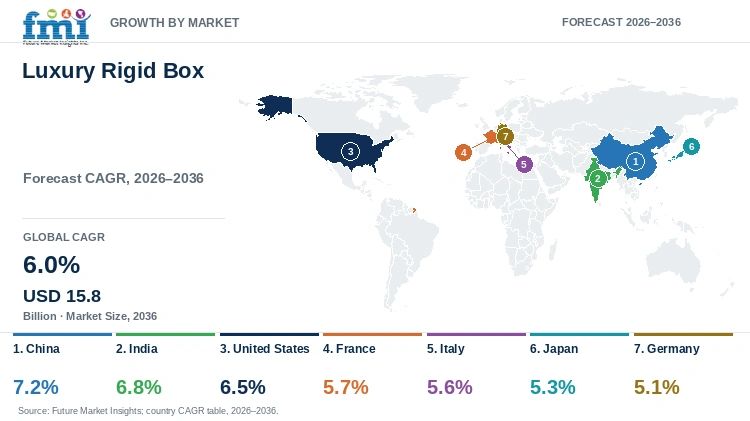
| Country | CAGR (2026 to 2036) | Primary Growth Lever |
|---|---|---|
| China | 7.2% | Large online physical-goods base and expanding domestic premium brands |
| India | 6.8% | Premium gifting and wider e-retail access beyond metro cities |
| United States | 6.5% | E-commerce protection requirements and direct-to-consumer brand programs |
| France | 5.7% | Luxury maisons, fragrance launches, and strict packaging approvals |
| Italy | 5.6% | Cosmetics exports and local design-to-production networks |
| Japan | 5.3% | Gift culture and exacting fit-and-finish requirements |
| Germany | 5.1% | Recyclability review and established paper recovery systems |
Source: An FMI review
China Luxury Rigid Box Market Outlook (2026 to 2036)
China is expected to advance at 7.2% CAGR through 2036, the fastest rate among evaluated countries. The difference from the global market is the combination of a very large online physical-goods base and local brands which can move a design into production quickly. Physical-goods online retail sales reached 13,092.3 billion yuan in 2025. This gives rigid boxes more use in beauty and gifting, but high-volume price competition can reduce finishing margins. Domestic converters that use automated wrapping and local prototyping are better placed to hold speed without allowing the premium finish to become inconsistent. [7]
Key takeaway: In China, expansive online retail volume and rapid domestic brand launch cycles reward converters deploying automated rigid-box wrapping machinery.
India Luxury Rigid Box Market Outlook (2026 to 2036)
Key takeaway: In India, surging festive gifting and corporate brand packages drive volume expansion while lower per-unit cost caps require modular insert designs.
India is projected to rise at 6.8% CAGR through 2036 as premium gifting is moving beyond weddings and festivals into beauty, corporate gift packs and online brand launches. The market differs from mature luxury centers as the box often has to meet a lower unit-cost ceiling and smaller order quantity. This can restrict full hand-finished formats for emerging brands. Modular inserts, common outer sizes and lower minimum runs can widen adoption, while suppliers depending on long imported-material lead times may miss short festive buying windows. [6]
Key takeaway: In the United States, direct-to-consumer parcel transit and transit durability tests compel brand owners to mandate reinforced board corners and scuff-resistant wraps.
United States Luxury Rigid Box Market Outlook (2026 to 2036)
Key takeaway: In France, historic luxury fragrance houses enforce rigorous aesthetic shade fidelity while adapting presentation boxes to meet European Union circularity rules.
The United States is forecast to expand at 6.5% CAGR through 2036 and fulfillment performance is likely to decide more supplier approvals than decorative range alone. Adjusted retail e-commerce sales reached USD 340.2 billion in the second quarter of 2026. Premium beauty and technology products therefore pass through parcel networks before the buyer sees the finish. This raises the value of corner testing, fixed inserts and scuff-resistant wraps. The hurdle is added testing and freight cost, particularly where the box is oversized only to create shelf presence.
Key takeaway: In Italy, strong cosmetic export momentum and regional artisanal converting clusters support rapid design adjustments for limited-edition gift boxes.
France Luxury Rigid Box Market Outlook (2026 to 2036)
Key takeaway: In Japan, deeply rooted ceremonial gifting and uncompromising fit-and-finish tolerances favor converters maintaining zero-defect lid friction and seamless edge alignment.
France is estimated to grow at 5.7% CAGR through 2036. Demand remains closely tied to fragrance, fashion and established luxury houses, where changing a paper shade or foil tone is not a simple procurement decision. The differentiating pressure is that presentation standards now sit beside EU packaging requirements. A mixed-material concept may satisfy the creative brief and still return for redesign. Certified paperboard, limited plastic content and early finish trials can protect the brand code without extending approval time.
Key takeaway: In Germany, stringent recyclability documentation and fiber recovery mandates push brand owners toward mono-material paperboard structures without concealed magnets.
Italy Luxury Rigid Box Market Outlook (2026 to 2036)
Italy is projected to record 5.6% CAGR through 2036, supported by cosmetics exports, premium confectionery and a close design-to-production network. Cosmetics exports increased 4.1% in 2025. This gives local converters repeat work from seasonal and export-led launches. The challenge is capacity rather than design access when several short programs reach hand-finishing lines together. Suppliers keeping sampling, decoration and assembly geographically close can correct late changes faster, while fragmented outsourcing can place the delivery date at risk.
Japan Luxury Rigid Box Market Outlook (2026 to 2036)
Japan is expected to advance at 5.3% CAGR through 2036. The market is different from higher-volume countries as clean edges, exact fit and predictable opening resistance can carry more weight than a heavily decorated surface. Seasonal gifting and beauty support demand, but small runs raise inspection cost. Repeatable lid-and-base structures and compact inserts can protect presentation without creating new tooling for every program. Suppliers that treat fit tolerance as a secondary check may face rejection even when the printed finish is correct. [13]
Germany Luxury Rigid Box Market Outlook (2026 to 2036)
Germany is estimated to post 5.1% CAGR through 2036, the slowest rate among evaluated countries, but the lower rate does not mean weak premium demand. Approval is more likely to slow where material composition and separation are not clearly documented. EU rules require all packaging to become recyclable by 2030. Decorative laminates, foam and concealed magnets can therefore hold back an otherwise acceptable concept. Fiber-led structures and fewer mixed elements can move through approval more easily, although the simpler construction must still retain the expected premium opening.
Full report country CAGRs cover: North America; Latin America; Western Europe; Eastern Europe; East Asia; South Asia and Pacific; Middle East and Africa.
Who are the notable companies in the luxury rigid box market?
Smurfit Westrock plc, International Paper Company, Mondi plc, Sonoco Products Company, Pusterla 1880 S.p.A., Knoll Printing & Packaging Inc., HH Deluxe Packaging Limited, Progress Packaging Limited, and Bell Incorporated are notable companies operating in this market.
Competition is split between groups that control board supply and converters that control the finish. Smurfit Westrock, International Paper, Mondi and Sonoco can support larger multi-region programs, while Pusterla 1880, Knoll and HH Deluxe Packaging are more closely associated with complex presentation work. This means brand owners are not comparing unit price alone. Board provenance, sample speed, wrap alignment, insert engineering and production continuity decide whether the supplier can hold a repeat program when the launch changes or volume moves between regions. This also connects with wider sustainable packaging decisions taken by brand and packaging teams.
- Global Paper-Packaging Groups: Smurfit Westrock, International Paper, Mondi, and Sonoco combine material access with broad converting operations.
- Specialist Luxury Converters: Pusterla 1880, Knoll Printing & Packaging, and HH Deluxe Packaging emphasize premium finishes and complex presentation formats.
- Regional Format Specialists: Progress Packaging and Bell Incorporated support design-led programs with controlled local production and sampling.
Competitive Benchmarking: Luxury Rigid Box Market
Table 8: Competitive Benchmarking for the Luxury Rigid Box Market (qualitative capability ratings), 2026
| Company | Design-to-Sample Speed | Certified Board Access | Hand-Finish Control | Geographic Reach |
|---|---|---|---|---|
| Smurfit Westrock | High | High | Medium | High |
| International Paper | Medium | High | Medium | High |
| Mondi | High | High | Medium | High |
| Sonoco Products Company | Medium | Medium | Medium | High |
| Pusterla 1880 | High | Medium | High | Medium |
| Knoll Printing & Packaging | High | Medium | High | High |
| HH Deluxe Packaging | Medium | Medium | High | Medium |
| Progress Packaging | High | Medium | High | Medium |
| Bell Incorporated | Medium | Medium | Medium | Medium |
Scoring basis: High indicates broad public evidence across the stated capability, while Medium indicates a narrower or more regionally concentrated offering. Ratings describe relative capability and do not represent audited market share.
Key Developments in the Luxury Rigid Box Market
- In May 2026, Metsä Board presented Muoto molded fiber technology at Interpack 2026, extending three-dimensional fiber structures into packaging concepts that can complement premium paperboard sleeves. [12]
- In March 2026, Metsä Board launched a new board and delivery concept with FastTrack custom-cut sheets delivered within three weeks in Europe. [9]
- In February 2026, Metsä Board announced a Milan Packaging Design Studio to accelerate co-creation with European brand owners and converters.
- In June 2025, Mondi showcased PERGRAPHICA and associated premium papers at LUXE PACK Paris for sustainable luxury packaging applications.
- In March 2025, Stora Enso started ramp-up of its 750,000-tonne Oulu consumer board line, with first deliveries planned for the second quarter. [14]
Key Players in the Luxury Rigid Box Market
Global Paper-Packaging Groups
- Smurfit Westrock plc
- International Paper Company
- Mondi plc
- Sonoco Products Company
Specialist Luxury Converters
- Pusterla 1880 S.p.A.
- Knoll Printing & Packaging Inc.
- HH Deluxe Packaging Limited
Regional and Format Specialists
- Progress Packaging Limited
- Bell Incorporated
Luxury Rigid Box Market - Report Scope
Table 9: Report Scope for the Luxury Rigid Box Market (coverage fields and definitions), 2026 to 2036
| Coverage field | Report scope |
|---|---|
| Market breakdown | Product Type; Box Format; Application; Closure Type; Decoration; Sales Channel |
| Quantitative Units | USD Billion |
| Market Definition | Premium rigid boxes made from heavyweight board or specialty substrates for luxury-goods presentation and protection. |
| Regions Covered | North America; Latin America; Western Europe; Eastern Europe; East Asia; South Asia and Pacific; Middle East and Africa |
| Countries Covered | China, India, United States, France, Italy, Japan, Germany, and additional countries in the full report |
| Key Companies Covered | Smurfit Westrock, International Paper, Mondi, Sonoco, Pusterla 1880, Knoll, HH Deluxe Packaging, Progress Packaging, Bell Incorporated |
| Forecast Period | 2026 to 2036 |
| Approach | Primary and secondary research with market triangulation. |
Luxury Rigid Box Market - Research Methodology
Table 10: Research Methodology for the Luxury Rigid Box Market (research methods and approach), 2026 edition
| Method | Approach |
|---|---|
| Primary Research | Primary interviews were conducted with box manufacturers, material suppliers, converters, distributors, brand owners, designers, and industry experts to validate demand patterns and purchasing requirements. |
| Secondary Research | Secondary research included company reports, investor presentations, regulatory publications, industry associations, technical papers, trade journals, company websites, product literature, and other public sources. |
| Market Sizing and Forecasting | Market sizing for 2026 to 2036 used top-down and bottom-up approaches to assess supplier revenue, format demand, average prices, and application adoption. |
| Data Triangulation and Validation | Data is validated against luxury-goods demand, e-commerce indicators, packaging regulation, material trends, and company activity to improve consistency and reduce overlap. |
Luxury Rigid Box Market by Segments
Luxury Rigid Box Market segmented by Product Type:
- Paperboard
- Corrugated Board
- Specialty Materials
Luxury Rigid Box Market segmented by Box Format:
- Lid and Base
- Drawer
- Magnetic Closure
- Book Style
Luxury Rigid Box Market segmented by Application:
- Cosmetics and Personal Care
- Jewelry and Watches
- Electronics and Technology
- Fashion and Apparel
- Food and Beverage Gifting
Luxury Rigid Box Market segmented by Closure Type:
- Magnetic Closures
- Ribbon Pulls
- Sleeve Closure
- Hinged Lids
Luxury Rigid Box Market segmented by Decoration:
- Foil Stamping
- Embossing
- Soft Touch
- Printed Wrap
Luxury Rigid Box Market segmented by Sales Channel:
- Direct Brand Contracts
- Packaging Distributors
- Design Agencies
- Online Suppliers
Luxury Rigid Box Market by Region
- North America
- United States
- Canada
- Latin America
- Brazil
- Mexico
- Argentina
- Chile
- Western Europe
- Germany
- France
- United Kingdom
- Italy
- Spain
- Benelux
- Nordics
- Eastern Europe
- Poland
- Czech Republic
- Romania
- Hungary
- East Asia
- China
- Japan
- South Korea
- South Asia and Pacific
- India
- ASEAN
- Australia and New Zealand
- Middle East and Africa
- GCC Countries
- South Africa
- Türkiye
- Israel
Research Sources and Bibliography
- [1] European Commission Directorate-General for Environment. (2026). Packaging and packaging waste regulation: implementation and recyclability objectives. European Commission.
- [2] United States Census Bureau. (2026, May). Quarterly retail e-commerce sales, first quarter 2026. U.S. Department of Commerce.
- [3] Eurostat. (2025). Packaging waste statistics. European Commission Statistics Explained.
- [4] American Forest & Paper Association. (2025). Paper industry announces 2024 U.S. paper recycling rates. AF&PA.
- [5] Confederation of European Paper Industries. (2026). New 2025 pulp and paper manufacturing figures show moderate resilience. CEPI.
- [6] Invest India. (2026). Investment opportunities in retail and e-commerce. Government of India.
- [7] National Bureau of Statistics of China. (2026). Total retail sales of consumer goods in December 2025. Government of China.
- [8] OpportunItaly. (2026). Italian cosmetics 2025: exports, consumption and turnover. Government of Italy.
- [9] Metsä Board Corporation. (2026, March 3). New product and service concept for fast-moving brand packaging in Europe. Corporate Releases.
- [10] Metsä Board Corporation. (2026, February 17). New Packaging Design Studio in Milan. Corporate Announcements.
- [11] Mondi plc. (2025, June 17). Mondi at Édition Spéciale by LUXE PACK Paris 2025. Corporate News.
- [12] Metsä Board Corporation. (2026, May 6). Muoto molded fibre solution showcased at Interpack 2026. Technical Releases.
- [13] Japan Cosmetic Industry Association. (2026). Cosmetics statistics based on official ministry datasets. JCIA Reports.
- [14] Stora Enso Oyj. (2025, March 19). New consumer packaging board line at Oulu starts operations. Stora Enso Press.
- [15] Future Market Insights. (2026, June 3). Luxury rigid box market: Global industry analysis and opportunity assessment, 2026 to 2036. FMI Research Reports.
This bibliography is provided for reader reference and is not exhaustive. The full report contains the complete reference list and detailed citations.
This Report Answers
- How large is the luxury rigid box market in 2026 and what is forecast for 2036?
- Which material, box format, application, closure, decoration, and sales channel lead demand in 2026?
- Why does paperboard remain central to premium rigid box programs?
- How do e-commerce shipments change structural requirements for luxury packaging?
- Why do growth rates differ across China, India, the United States, and Western Europe?
- Which suppliers compete in luxury rigid boxes and what capabilities matter most?
- What limits short-run adoption and supplier switching?
- What should buyers evaluate before approving a luxury rigid box program?
Frequently Asked Questions
How big is the luxury rigid box market in 2026, and what is forecast for 2036?
Future Market Insights estimates the market at USD 8.8 billion in 2026. Revenue is projected to reach USD 15.8 billion by 2036.
What is the CAGR from 2026 to 2036?
The market is projected to expand at a 6.0% CAGR during the assessment period, supported by premium presentation and direct-delivery requirements.
Which product type leads the market?
Paperboard is projected to hold 58.0% share in 2026 due to controlled wrapping, print quality, and clearer fiber recovery routes.
Which application leads demand?
Cosmetics and personal care is expected to account for 37.0% in 2026 as fragrance and skincare launches use gift-ready presentation boxes.
Which country has the fastest evaluated growth outlook?
FMI finds that China is projected to register 7.2% CAGR through 2036, supported by online premium retail and domestic luxury brands.
Who are the key players?
Key participants include Smurfit Westrock, International Paper, Mondi, Sonoco, Pusterla 1880, Knoll Printing & Packaging, HH Deluxe Packaging, Progress Packaging, and Bell Incorporated.
Preview the report firsthand - request a free sample
Get SampleGet the brochure for pricing and purchase details.
Get PDFTable of Content
- Key Takeaways
- Market Size and CAGR
- Top Growth Driver
- Fastest Growing Segment
- Leading Region
- Key Companies
- Emerging Opportunities
- Executive Summary
- Global Market Outlook
- Demand-side Trends
- Supply-side Trends
- Technology Roadmap Analysis
- Analysis and Recommendations
- Analyst Perspective (What is happening? Why now? What should investors know?)
- Key Questions Answered
- How large is the market?
- What is the CAGR?
- What are key trends?
- Which region dominates?
- Who are the leaders?
- Market Overview
- Market Coverage / Taxonomy
- Market Definition / Scope / Limitations
- Research Methodology
- Chapter Orientation
- Analytical Lens and Working Hypotheses
- Market Structure, Signals, and Trend Drivers
- Benchmarking and Cross-market Comparability
- Market Sizing, Forecasting, and Opportunity Mapping
- Research Design and Evidence Framework
- Desk Research Programme (Secondary Evidence)
- Expert Input and Fieldwork (Primary Evidence)
- Tooling, Models, and Reference Databases
- Data Engineering and Model Build
- Quality Assurance and Audit Trail
- Market Background
- Market Dynamics (Drivers, Restraints, Opportunity, Trends)
- Scenario Forecast (Optimistic, Likely, Conservative)
- Impact Analysis
- AI Impact
- Sustainability Impact
- Regulatory Impact
- Technology Impact
- Consumer / Buyer Analysis
- Purchase Drivers
- Adoption Barriers
- Buyer Journey
- Opportunity Map Analysis
- Product Life Cycle Analysis
- Supply Chain Analysis
- Investment Feasibility Matrix
- Value Chain Analysis
- PESTLE and Porter's Analysis
- Regulatory Landscape
- Regional Parent Market Outlook
- Production and Consumption Statistics
- Import and Export Statistics
- Global Market Analysis and Forecast, 2021 to 2036
- Historical Market Size Value (USD Billion) Analysis, 2021 to 2025
- Current and Future Market Size Value (USD Billion) Projections, 2026 to 2036
- Y-o-Y Growth Trend Analysis
- Absolute $ Opportunity Analysis
- Global Market Pricing Analysis, 2021 to 2036
- Global Market Analysis and Forecast, By Product Type, 2021 to 2036
- Introduction / Key Findings
- Historical Market Size Value (USD Billion) Analysis By Product Type, 2021 to 2025
- Current and Future Market Size Value (USD Billion) Analysis and Forecast By Product Type, 2026 to 2036
- Paperboard
- Corrugated Board
- Specialty Materials
- Y-o-Y Growth Trend Analysis By Product Type, 2021 to 2025
- Absolute $ Opportunity Analysis By Product Type, 2026 to 2036
- Global Market Analysis and Forecast, By Box Format, 2021 to 2036
- Introduction / Key Findings
- Historical Market Size Value (USD Billion) Analysis By Box Format, 2021 to 2025
- Current and Future Market Size Value (USD Billion) Analysis and Forecast By Box Format, 2026 to 2036
- Lid and Base
- Drawer
- Magnetic Closure
- Book Style
- Y-o-Y Growth Trend Analysis By Box Format, 2021 to 2025
- Absolute $ Opportunity Analysis By Box Format, 2026 to 2036
- Global Market Analysis and Forecast, By Application, 2021 to 2036
- Introduction / Key Findings
- Historical Market Size Value (USD Billion) Analysis By Application, 2021 to 2025
- Current and Future Market Size Value (USD Billion) Analysis and Forecast By Application, 2026 to 2036
- Cosmetics and Personal Care
- Jewelry and Watches
- Electronics and Technology
- Fashion and Apparel
- Food and Beverage Gifting
- Y-o-Y Growth Trend Analysis By Application, 2021 to 2025
- Absolute $ Opportunity Analysis By Application, 2026 to 2036
- Global Market Analysis and Forecast, By Closure Type, 2021 to 2036
- Introduction / Key Findings
- Historical Market Size Value (USD Billion) Analysis By Closure Type, 2021 to 2025
- Current and Future Market Size Value (USD Billion) Analysis and Forecast By Closure Type, 2026 to 2036
- Magnetic Closures
- Ribbon Pulls
- Sleeve Closure
- Hinged Lids
- Y-o-Y Growth Trend Analysis By Closure Type, 2021 to 2025
- Absolute $ Opportunity Analysis By Closure Type, 2026 to 2036
- Global Market Analysis and Forecast, By Decoration, 2021 to 2036
- Introduction / Key Findings
- Historical Market Size Value (USD Billion) Analysis By Decoration, 2021 to 2025
- Current and Future Market Size Value (USD Billion) Analysis and Forecast By Decoration, 2026 to 2036
- Foil Stamping
- Embossing
- Soft Touch
- Printed Wrap
- Y-o-Y Growth Trend Analysis By Decoration, 2021 to 2025
- Absolute $ Opportunity Analysis By Decoration, 2026 to 2036
- Global Market Analysis and Forecast, By Sales Channel, 2021 to 2036
- Introduction / Key Findings
- Historical Market Size Value (USD Billion) Analysis By Sales Channel, 2021 to 2025
- Current and Future Market Size Value (USD Billion) Analysis and Forecast By Sales Channel, 2026 to 2036
- Direct Brand Contracts
- Packaging Distributors
- Design Agencies
- Online Suppliers
- Y-o-Y Growth Trend Analysis By Sales Channel, 2021 to 2025
- Absolute $ Opportunity Analysis By Sales Channel, 2026 to 2036
- Global Market Analysis and Forecast, By Region, 2021 to 2036
- Introduction
- Historical Market Size Value (USD Billion) Analysis By Region, 2021 to 2025
- Current Market Size Value (USD Billion) Analysis and Forecast By Region, 2026 to 2036
- North America
- Latin America
- Western Europe
- Eastern Europe
- East Asia
- South Asia and Pacific
- Middle East and Africa
- Market Attractiveness Analysis By Region
- North America Market Analysis and Forecast, By Country, 2021 to 2036
- Historical Market Size Value (USD Billion) Trend Analysis By Market Taxonomy, 2021 to 2025
- Market Size Value (USD Billion) Forecast By Market Taxonomy, 2026 to 2036
- By Country
- United States
- Canada
- By Product Type
- By Box Format
- By Application
- By Closure Type
- By Decoration
- By Sales Channel
- By Country
- Market Attractiveness Analysis
- By Country
- By Product Type
- By Box Format
- By Application
- By Closure Type
- By Decoration
- By Sales Channel
- Key Takeaways
- Latin America Market Analysis and Forecast, By Country
- Historical Market Size Value (USD Billion) Trend Analysis By Market Taxonomy, 2021 to 2025
- Market Size Value (USD Billion) Forecast By Market Taxonomy, 2026 to 2036
- By Country
- Brazil
- Mexico
- Argentina
- Chile
- By Product Type
- By Box Format
- By Application
- By Closure Type
- By Decoration
- By Sales Channel
- By Country
- Market Attractiveness Analysis
- By Country
- By Product Type
- By Box Format
- By Application
- By Closure Type
- By Decoration
- By Sales Channel
- Key Takeaways
- Western Europe Market Analysis and Forecast, By Country
- Historical Market Size Value (USD Billion) Trend Analysis By Market Taxonomy, 2021 to 2025
- Market Size Value (USD Billion) Forecast By Market Taxonomy, 2026 to 2036
- By Country
- Germany
- France
- United Kingdom
- Italy
- Spain
- Benelux
- Nordics
- By Product Type
- By Box Format
- By Application
- By Closure Type
- By Decoration
- By Sales Channel
- By Country
- Market Attractiveness Analysis
- By Country
- By Product Type
- By Box Format
- By Application
- By Closure Type
- By Decoration
- By Sales Channel
- Key Takeaways
- Eastern Europe Market Analysis and Forecast, By Country
- Historical Market Size Value (USD Billion) Trend Analysis By Market Taxonomy, 2021 to 2025
- Market Size Value (USD Billion) Forecast By Market Taxonomy, 2026 to 2036
- By Country
- Poland
- Czech Republic
- Romania
- Hungary
- By Product Type
- By Box Format
- By Application
- By Closure Type
- By Decoration
- By Sales Channel
- By Country
- Market Attractiveness Analysis
- By Country
- By Product Type
- By Box Format
- By Application
- By Closure Type
- By Decoration
- By Sales Channel
- Key Takeaways
- East Asia Market Analysis and Forecast, By Country
- Historical Market Size Value (USD Billion) Trend Analysis By Market Taxonomy, 2021 to 2025
- Market Size Value (USD Billion) Forecast By Market Taxonomy, 2026 to 2036
- By Country
- China
- Japan
- South Korea
- By Product Type
- By Box Format
- By Application
- By Closure Type
- By Decoration
- By Sales Channel
- By Country
- Market Attractiveness Analysis
- By Country
- By Product Type
- By Box Format
- By Application
- By Closure Type
- By Decoration
- By Sales Channel
- Key Takeaways
- South Asia and Pacific Market Analysis and Forecast, By Country
- Historical Market Size Value (USD Billion) Trend Analysis By Market Taxonomy, 2021 to 2025
- Market Size Value (USD Billion) Forecast By Market Taxonomy, 2026 to 2036
- By Country
- India
- ASEAN
- Australia and New Zealand
- By Product Type
- By Box Format
- By Application
- By Closure Type
- By Decoration
- By Sales Channel
- By Country
- Market Attractiveness Analysis
- By Country
- By Product Type
- By Box Format
- By Application
- By Closure Type
- By Decoration
- By Sales Channel
- Key Takeaways
- Middle East and Africa Market Analysis and Forecast, By Country
- Historical Market Size Value (USD Billion) Trend Analysis By Market Taxonomy, 2021 to 2025
- Market Size Value (USD Billion) Forecast By Market Taxonomy, 2026 to 2036
- By Country
- GCC Countries
- South Africa
- Türkiye
- Israel
- By Product Type
- By Box Format
- By Application
- By Closure Type
- By Decoration
- By Sales Channel
- By Country
- Market Attractiveness Analysis
- By Country
- By Product Type
- By Box Format
- By Application
- By Closure Type
- By Decoration
- By Sales Channel
- Key Takeaways
- Key Countries Market Analysis
- United States
- Pricing Analysis
- Market Share Analysis, 2025
- By Product Type
- By Box Format
- By Application
- By Closure Type
- By Decoration
- By Sales Channel
- Canada
- Pricing Analysis
- Market Share Analysis, 2025
- By Product Type
- By Box Format
- By Application
- By Closure Type
- By Decoration
- By Sales Channel
- Mexico
- Pricing Analysis
- Market Share Analysis, 2025
- By Product Type
- By Box Format
- By Application
- By Closure Type
- By Decoration
- By Sales Channel
- Brazil
- Pricing Analysis
- Market Share Analysis, 2025
- By Product Type
- By Box Format
- By Application
- By Closure Type
- By Decoration
- By Sales Channel
- Chile
- Pricing Analysis
- Market Share Analysis, 2025
- By Product Type
- By Box Format
- By Application
- By Closure Type
- By Decoration
- By Sales Channel
- Germany
- Pricing Analysis
- Market Share Analysis, 2025
- By Product Type
- By Box Format
- By Application
- By Closure Type
- By Decoration
- By Sales Channel
- United Kingdom
- Pricing Analysis
- Market Share Analysis, 2025
- By Product Type
- By Box Format
- By Application
- By Closure Type
- By Decoration
- By Sales Channel
- Italy
- Pricing Analysis
- Market Share Analysis, 2025
- By Product Type
- By Box Format
- By Application
- By Closure Type
- By Decoration
- By Sales Channel
- Spain
- Pricing Analysis
- Market Share Analysis, 2025
- By Product Type
- By Box Format
- By Application
- By Closure Type
- By Decoration
- By Sales Channel
- France
- Pricing Analysis
- Market Share Analysis, 2025
- By Product Type
- By Box Format
- By Application
- By Closure Type
- By Decoration
- By Sales Channel
- India
- Pricing Analysis
- Market Share Analysis, 2025
- By Product Type
- By Box Format
- By Application
- By Closure Type
- By Decoration
- By Sales Channel
- ASEAN
- Pricing Analysis
- Market Share Analysis, 2025
- By Product Type
- By Box Format
- By Application
- By Closure Type
- By Decoration
- By Sales Channel
- Australia and New Zealand
- Pricing Analysis
- Market Share Analysis, 2025
- By Product Type
- By Box Format
- By Application
- By Closure Type
- By Decoration
- By Sales Channel
- China
- Pricing Analysis
- Market Share Analysis, 2025
- By Product Type
- By Box Format
- By Application
- By Closure Type
- By Decoration
- By Sales Channel
- Japan
- Pricing Analysis
- Market Share Analysis, 2025
- By Product Type
- By Box Format
- By Application
- By Closure Type
- By Decoration
- By Sales Channel
- South Korea
- Pricing Analysis
- Market Share Analysis, 2025
- By Product Type
- By Box Format
- By Application
- By Closure Type
- By Decoration
- By Sales Channel
- Poland
- Pricing Analysis
- Market Share Analysis, 2025
- By Product Type
- By Box Format
- By Application
- By Closure Type
- By Decoration
- By Sales Channel
- Hungary
- Pricing Analysis
- Market Share Analysis, 2025
- By Product Type
- By Box Format
- By Application
- By Closure Type
- By Decoration
- By Sales Channel
- Türkiye
- Pricing Analysis
- Market Share Analysis, 2025
- By Product Type
- By Box Format
- By Application
- By Closure Type
- By Decoration
- By Sales Channel
- South Africa
- Pricing Analysis
- Market Share Analysis, 2025
- By Product Type
- By Box Format
- By Application
- By Closure Type
- By Decoration
- By Sales Channel
- United States
- Market Structure Analysis
- Competition Dashboard
- Competition Benchmarking
- Market Share Analysis of Top Players
- By Regional
- By Product Type
- By Box Format
- By Application
- By Closure Type
- By Decoration
- By Sales Channel
- Emerging Startups
- Innovation Benchmarking
- Competition Analysis
- Competition Deep Dive
- Smurfit Westrock
- Overview
- Product Portfolio
- Profitability by Market Segments
- Sales Footprint
- Strategy Overview
- Marketing Strategy
- Product Strategy
- Channel Strategy
- International Paper
- Mondi
- Sonoco Products Company
- Pusterla 1880
- Knoll Printing & Packaging
- HH Deluxe Packaging
- Progress Packaging
- Bell Incorporated
- Smurfit Westrock plc
- International Paper Company
- Mondi plc
- Pusterla 1880 S.p.A.
- HH Deluxe Packaging Limited
- Progress Packaging Limited
- Smurfit Westrock
- Case Studies
- Success Stories
- Recent Developments
- Competition Deep Dive
- Assumptions & Acronyms Used


