

- Industry Size (2026)
- USD 4.5 Bn
- Forecast (2036)
- USD 21.7 Bn
- CAGR (2026 to 2036)
- 17.1%
Distance Health Technology Outlook in the UK 2026 to 2036
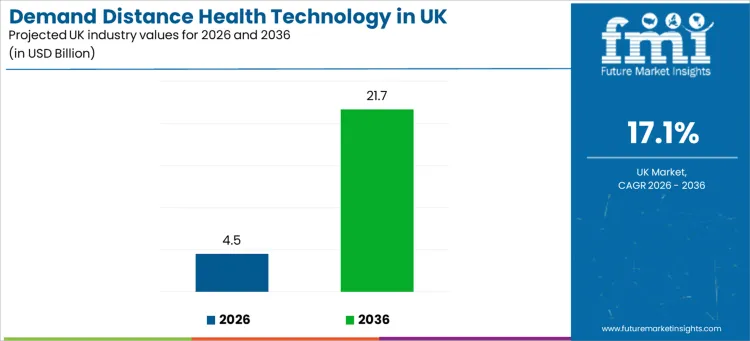
Demand for distance health technology in the UK is projected at USD 4.5 billion in 2026 and is expected to reach USD 21.7 billion by 2036, expanding at a 17.1% CAGR. This trajectory is defined by the strategic decisions of healthcare providers, integrated care systems, and private health operators seeking to enhance patient access, optimize clinical workflows, and manage operational costs. Daily clinical delivery, patient engagement models, and long-term healthcare infrastructure planning shape the adoption curve.
Distance health solutions operate in clinical and home environments where data accuracy, interoperability, user compliance, and system reliability determine care quality and efficiency. Procurement teams judge performance through reduced hospital readmissions, improved patient engagement metrics, clinician time savings, and the technology’s ability to maintain secure, stable connections across diverse user groups. Healthcare leaders prioritize ecosystems that integrate smoothly with existing electronic health records, offer intuitive patient interfaces, and deliver consistent performance across urban and rural settings.
Quick Stats for Distance Health Technology Demand in the UK
- Distance Health Technology Valuation in the UK (2026): USD 4.5 billion
- Distance Health Technology Forecast Valuation in the UK (2036): USD 21.7 billion
- Distance Health Technology Forecast CAGR 2026 to 2036: 17.1%
- Leading Regional Growth: England (18.8%)
- Leading Product Type: Telemedicine Hardware (31.6% share)
- Leading Application: Teleconsultation (38.0% share)
- Leading End User: Hospitals (29.3% share)
- Key Companies Profiled: Cisco Systems, Inc.; Honeywell International, Inc.; Medtronic plc; Koninklijke Philips N.V.; Teladoc Health, Inc.
For technology integrators and clinical service leads, the procurement discussion extends beyond a single device or platform. Decisions are intrinsically linked to data security compliance, clinician training protocols, interoperability standards, and long-term technical support. The capacity to deploy standardized technology stacks across multiple care sites, ensure rapid clinician proficiency, and guarantee predictable maintenance cycles supports adoption across large NHS trusts and independent specialist clinics alike.
Distance Health Technology Industry in the UK Key Takeaways
| Metric | Value |
|---|---|
| Industry Value (2026) | USD 4.5 billion |
| Industry Forecast Value (2036) | USD 21.7 billion |
| Forecast CAGR 2026 to 2036 | 17.1% |
Why is the UK Building Steady Demand for Distance Health Technology?
Demand in the UK grows as healthcare system leaders focus on expanding access, controlling long-term care costs, and improving clinical outcomes. Providers face pressure to deliver consistent, high-quality care without geographic constraints, particularly for managing chronic conditions, post-operative recovery, and mental health support. Effective remote care reduces unnecessary hospital visits, streamlines specialist referrals, and enables more proactive health management.
Healthcare policy and investment momentum influence procurement. NHS long-term plans emphasize digital transformation and integrated care, creating a structured push towards technology-enabled service models. In this environment, operational directors prioritize solutions that prevent clinical bottlenecks, reduce waiting lists, and protect service continuity across patient populations.
Clinical delivery strategies evolve with patient needs. Providers managing chronic cardiovascular or respiratory conditions evaluate the reliability and clinical validity of remote vital monitors. Mental health services focus on secure, high-quality video platforms that foster therapeutic alliances. Many procurement teams also cross-check distance health investments against adjacent digital health tools such as remote patient monitoring platforms used in chronic disease management when designing comprehensive virtual care pathways.
Procurement decisions are equally shaped by regulatory and safety expectations. UK guidelines on medical device software and data protection, including adherence to the UK Medical Devices Regulations 2002 and data security standards, highlight the necessity for robust cybersecurity, clinical safety assurance, and clear patient data governance. This directs buyers towards solutions with strong compliance credentials, transparent data handling protocols, and vendor support that ensures ongoing regulatory adherence.
How is Distance Health Technology Demand Segmented by Product Type, Application, and End User?
The segmentation of the distance health technology landscape in the UK reflects how healthcare providers match technology to clinical use cases, balance investment with population health goals, and manage workforce digital literacy.
Why does telemedicine hardware capture the largest share of technology procurement?
Telemedicine hardware holds a 31.6% share as the leading product type. This underscores the foundational need for reliable, high-quality audio-visual equipment in clinical settings to facilitate effective remote consultations. For trust IT managers, the primary purchasing priority is stable, high-definition video and clear audio that replicates an in-person clinical interaction, ensuring diagnostic accuracy and patient rapport are maintained.
Clinical teams also value hardware that integrates seamlessly with clinical software systems and offers simple operation for both clinicians and patients. Technology strategy often aligns with broader investments in integrated telehealth platforms for chronic disease management where platform capabilities directly impact service scalability.
What drives teleconsultation as the dominant application for remote care delivery?
Teleconsultation accounts for a 38.0% share, representing the most common application. This reflects the widespread adoption of video and audio consultations for primary care, outpatient follow-ups, and initial specialist assessments. This mode of delivery offers significant efficiencies in clinician time management and patient convenience, forming the core of many digital-first access policies.
The success of this application depends on intuitive scheduling software, minimal technical barriers for patients, and clinical workflows that support safe and effective remote assessment. Its growth is often considered alongside digital health solutions for mental wellness where therapeutic communication is paramount.
What positions hospitals as the leading end users investing in remote care infrastructure?
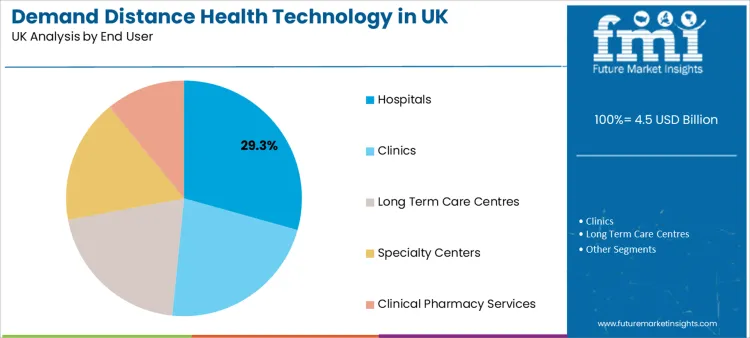
Hospitals represent a 29.3% share as the leading end-user segment. Major acute trusts drive adoption as they seek to decongest facilities, manage post-discharge care, and offer virtual outpatient services. The key procurement driver is creating a cohesive technology ecosystem that connects hospital-based specialists with patients at home or in community settings.
Hospital digital teams require solutions that interface with existing hospital information systems, scale across multiple departments, and provide robust clinical governance frameworks. Investment in hospital-led distance health is paired with strategy for clinical decision support systems enhancing diagnostic accuracy to ensure a high standard of remote care.
What are the Dynamics, Restraints, Opportunities, and Threats Shaping this Space?
What dynamics keep procurement active across both public health systems and private providers?
Clinical efficiency and patient access demands drive activity. Service managers require technology that reduces did-not-attend rates, optimizes clinician schedules, and provides equitable access to care. IT directors prefer interoperable systems designed for easy deployment, stable performance, and straightforward compliance auditing.
Clinical safety leads look for validated tools that maintain care standards and reduce clinical risk. Evolving regulatory expectations also act as a driver. Principles embedded in the UK’s Digital Technology Assessment Criteria (DTAC) support a structured evaluation of clinical safety, data protection, and technical security during procurement.
What restraints slow investment decisions for some healthcare organizations?
High initial integration costs present a barrier, particularly for smaller clinics or GP federations managing constrained capital budgets. Workforce digital literacy and change management requirements can slow the realization of benefits, as clinical outcomes improve only when staff are confidently trained and patients are adequately supported.
Regulatory complexity shapes procurement behavior. The UKCA marking process and evolving data protection laws set requirements that must be met before deployment. Buyers pay close attention to a vendor’s conformity documentation, post-market surveillance commitments, and ongoing compliance support.
Where are the Strongest Opportunities for Technology Suppliers and Service Integrators?
Differentiation through holistic service and support is a major opportunity. Suppliers that provide comprehensive staff training, seamless implementation support, and guaranteed service-level agreements build long-term trust. Another opportunity exists in bundling core hardware with advanced analytics software and patient engagement tools.
Healthcare organizations building end-to-end virtual care pathways often evaluate complementary technologies such as wearable medical devices for continuous psychological tracking and adjacent software such as health information systems for data integration.
What Threats can Disrupt Adoption Expectations?
Fragmented digital investment cycles can delay technology refresh, especially when healthcare organizations face competing financial pressures. Supply chain disruptions for critical hardware components can impede rollout timelines and affect service reliability. Data security breaches remain a persistent risk.
If cybersecurity, software maintenance, or user authentication protocols are inadequate, organizations face significant operational, financial, and reputational damage. This sustains a sharp focus on stringent data protection and rigorous vendor risk management across the UK health sector.
How is Distance Health Technology Demand Evolving across Key Regions in the UK?
Regional adoption varies based on population health needs, existing digital infrastructure maturity, funding allocations, and local integrated care system priorities.
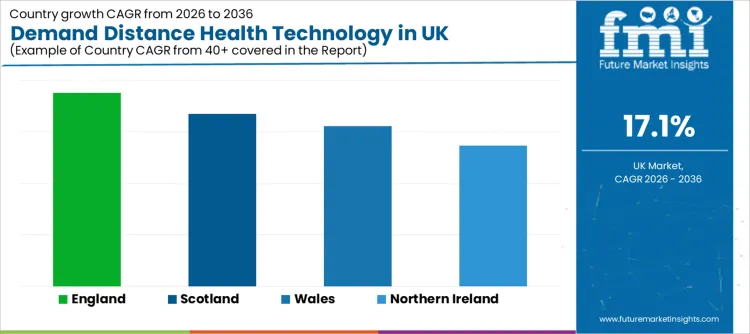
| Region | CAGR 2026 to 2036 |
|---|---|
| England | 18.8% |
| Scotland | 16.7% |
| Wales | 15.5% |
| Northern Ireland | 13.6% |
How does England’s advanced digital infrastructure and scale catalyze adoption?
England grows at 18.8%, propelled by its high concentration of specialist tertiary care centers, significant population density, and targeted national funding for digital transformation. Extensive supplier networks and specialized IT support services improve confidence in managing large-scale deployments. Many integrated care systems are standardizing virtual care pathways, which accelerates procurement of technologies that ensure consistent service quality across geographic patches.
What underpins Scotland’s demand through its distinct public health strategy and rural care focus?
Scotland expands at 16.7%, shaped by a strong national digital health and care strategy and the need to serve dispersed populations. Procurement often focuses on technologies that enable specialist central hospitals to support community clinics and home-based patients, prioritizing solutions with proven durability in varied settings and reliable connectivity.
How is Wales advancing adoption through its integrated approach to health and social care?
Wales grows at 15.5%, driven by its unique policy focus on integrating health and social services. Buyers often seek flexible technology platforms that can serve both clinical and social care needs, favoring solutions that facilitate multi-disciplinary teamwork and support preventative care models without introducing excessive operational complexity.
Why does Northern Ireland exhibit a measured, consensus-driven adoption pathway?
Northern Ireland rises at 13.6%, reflecting a careful, partnership-based approach to health technology investment within its single integrated health and social care system. Procurement teams frequently prioritize technologies with strong evidence of benefit in similar systems, clear pathways for staff engagement, and vendors that provide substantial implementation support to ensure smooth integration and user adoption.
What Defines the Competitive Landscape for Distance Health Technology in the UK?
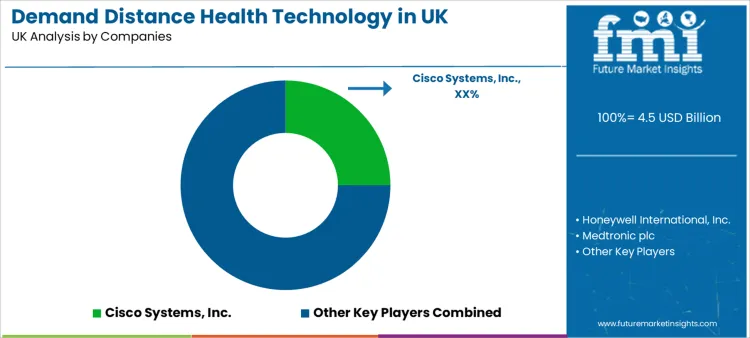
Competition is shaped by solution reliability, interoperability, clinical evidence, and the ability to deliver positive health outcomes across different care settings. Buyers evaluate providers on practical factors such as platform uptime, ease of integration with NHS systems, quality of clinical user experience, and the vendor’s capacity to provide rapid, expert support during critical clinical use.
Cisco Systems, Inc. is associated with secure, scalable collaboration infrastructure that forms the backbone for large health networks. Honeywell International, Inc. contributes through connected health solutions focused on patient monitoring and independent living, often in home and community settings. Medtronic plc competes through clinically validated remote monitoring technologies, particularly in chronic disease management.
Koninklijke Philips N.V. provides a broad portfolio spanning acute care tele-ICU solutions to home-based chronic care management, emphasizing connected ecosystems. Teladoc Health, Inc. is positioned through its comprehensive virtual care delivery platform and clinical services, offering an end-to-end model for primary and specialist teleconsultation.
Key Industry Participants
- Cisco Systems, Inc.
- Honeywell International, Inc.
- Medtronic plc
- Koninklijke Philips N.V.
- Teladoc Health, Inc.
Scope of Report
| Items | Values |
|---|---|
| Quantitative Units | USD Billion |
| Product Type | Telemedicine Hardware; Remote Vital Monitors; Blood Pressure Devices; Bluetooth Enabled Scales; Digital Thermometers |
| Application | Teleconsultation; Telehealth in Disability; Teleneurology; Tele-Physical Therapy; Remote Diet and Nutrition Counseling |
| End User | Hospitals; Clinics; Long Term Care Centres; Specialty Centers; Clinical Pharmacy Services |
| Regions Covered | England; Scotland; Wales; Northern Ireland |
| Key Companies Profiled | Cisco Systems, Inc.; Honeywell International, Inc.; Medtronic plc; Koninklijke Philips N.V.; Teladoc Health, Inc. |
Distance Health Technology Demand in the UK by Segment
By Product Type:
- Telemedicine Hardware
- Remote Vital Monitors
- Blood Pressure Devices
- Bluetooth Enabled Scales
- Digital Thermometers
By Application:
- Teleconsultation
- Telehealth in Disability
- Teleneurology
- Tele-Physical Therapy
- Remote Diet and Nutrition Counselling
By End User:
- Hospitals
- Clinics
- Long Term Care Centres
- Specialty Centers
- Clinical Pharmacy Services
By Region:
- England
- Scotland
- Wales
- Northern Ireland
Bibliography
- Department of Health and Social Care. (2022). A plan for digital health and social care. UK Government.
- National Health Service England. (2021). The NHS Long Term Plan. NHS England.
- National Institute for Health and Care Excellence. (2023). Evidence standards framework for digital health technologies. NICE.
- UK Government. (2002). The Medical Devices Regulations 2002 (SI 2002 No. 618).
- UK Government. (2018). Data Protection Act 2018.
Frequently Asked Questions
How big is the demand distance health technology in uk in 2026?
The demand distance health technology in uk is estimated to be valued at USD 4.5 billion in 2026.
What will be the size of demand distance health technology in uk in 2036?
The market size for the demand distance health technology in uk is projected to reach USD 21.7 billion by 2036.
How much will be the demand distance health technology in uk growth between 2026 and 2036?
The demand distance health technology in uk is expected to grow at a 17.1% CAGR between 2026 and 2036.
What are the key product types in the demand distance health technology in uk?
The key product types in demand distance health technology in uk are telemedicine hardware, remote vital monitors, blood pressure devices, bluetooth enabled scales and digital thermometers.
Which application segment is expected to contribute significant share in the demand distance health technology in uk in 2026?
In terms of application, teleconsultation segment is expected to command 38.0% share in the demand distance health technology in uk in 2026.
Preview the report firsthand - request a free sample
Get SampleGet the brochure for pricing and purchase details.
Get PDFTable of Content
- Executive Summary
- UK Market Outlook
- Demand-side Trends
- Supply-side Trends
- Technology Roadmap Analysis
- Analysis and Recommendations
- Market Overview
- Market Coverage / Taxonomy
- Market Definition / Scope / Limitations
- Market Background
- Market Dynamics
- Drivers
- Restraints
- Opportunity
- Trends
- Scenario Forecast
- Demand in Optimistic Scenario
- Demand in Likely Scenario
- Demand in Conservative Scenario
- Opportunity Map Analysis
- Product Life Cycle Analysis
- Supply Chain Analysis
- Investment Feasibility Matrix
- Value Chain Analysis
- PESTLE and Porter’s Analysis
- Regulatory Landscape
- Regional Parent Market Outlook
- Production and Consumption Statistics
- Import and Export Statistics
- Market Dynamics
- UK Market Analysis 2021 to 2025 and Forecast, 2026 to 2036
- Historical Market Size Value (USD Million) Analysis, 2021 to 2025
- Current and Future Market Size Value (USD Million) Projections, 2026 to 2036
- Y-o-Y Growth Trend Analysis
- Absolute $ Opportunity Analysis
- UK Market Pricing Analysis 2021 to 2025 and Forecast 2026 to 2036
- UK Market Analysis 2021 to 2025 and Forecast 2026 to 2036, By Product Type
- Introduction / Key Findings
- Historical Market Size Value (USD Million) Analysis By Product Type , 2021 to 2025
- Current and Future Market Size Value (USD Million) Analysis and Forecast By Product Type , 2026 to 2036
- Telemedicine hardware
- Remote Vital Monitors
- Blood Pressure Devices
- Bluetooth Enabled Scales
- Digital Thermometers
- Telemedicine hardware
- Y-o-Y Growth Trend Analysis By Product Type , 2021 to 2025
- Absolute $ Opportunity Analysis By Product Type , 2026 to 2036
- UK Market Analysis 2021 to 2025 and Forecast 2026 to 2036, By Application
- Introduction / Key Findings
- Historical Market Size Value (USD Million) Analysis By Application, 2021 to 2025
- Current and Future Market Size Value (USD Million) Analysis and Forecast By Application, 2026 to 2036
- Teleconsultation
- Telehealth in Disability
- Teleneurology
- Tele-Physical Therapy
- Remote Diet and Nutrition Counselling
- Teleconsultation
- Y-o-Y Growth Trend Analysis By Application, 2021 to 2025
- Absolute $ Opportunity Analysis By Application, 2026 to 2036
- UK Market Analysis 2021 to 2025 and Forecast 2026 to 2036, By End User
- Introduction / Key Findings
- Historical Market Size Value (USD Million) Analysis By End User, 2021 to 2025
- Current and Future Market Size Value (USD Million) Analysis and Forecast By End User, 2026 to 2036
- Hospitals
- Clinics
- Long Term Care Centres
- Specialty Centers
- Clinical Pharmacy Services
- Hospitals
- Y-o-Y Growth Trend Analysis By End User, 2021 to 2025
- Absolute $ Opportunity Analysis By End User, 2026 to 2036
- Market Structure Analysis
- Competition Dashboard
- Competition Benchmarking
- Market Share Analysis of Top Players
- By Regional
- By Product Type
- By Application
- By End User
- Competition Analysis
- Competition Deep Dive
- Cisco Systems, Inc.
- Overview
- Product Portfolio
- Profitability by Market Segments (Product/Age /Sales Channel/Region)
- Sales Footprint
- Strategy Overview
- Marketing Strategy
- Product Strategy
- Channel Strategy
- Honeywell International, Inc.
- Medtronic plc
- Koninklijke Philips N.V.
- Teladoc Health, Inc.
- Cisco Systems, Inc.
- Competition Deep Dive
- Assumptions & Acronyms Used
- Research Methodology


