

- Industry Size (2026)
- USD 4.4 Bn
- Forecast (2036)
- USD 6.6 Bn
- CAGR (2026 to 2036)
- 4.10%
Clean Coal Technology Market Size, Market Forecast and Outlook By FMI
The Clean Coal Technology market crossed a valuation of USD 4.2 billion in 2025. It is expected to reach USD 4.4 billion in 2026 and USD 6.6 billion by 2036, growing at a CAGR of 4.10% during the forecast period. Growth is being supported by continued investment in retrofit solutions for existing baseload power infrastructure.
Utility executives and energy portfolio managers are increasingly evaluating whether to invest in advanced mitigation upgrades for legacy baseload assets or manage the growing risk of stranded capacity under tighter emissions requirements. Delayed qualification can reduce access to clean coal technology funding pathways and increase retirement pressure on older assets. Although energy transition discussions remain centered on renewables, fossil baseload generation continues to play a role in managing grid intermittency, which keeps these upgrades relevant for system stability.
Summary of Clean Coal Technology Market
- Clean Coal Technology Market Definition:
- This sector comprises the specialized engineering systems and chemical processes required to strip pollutants and carbon dioxide from coal-fired generation. It operates at the intersection of thermal energy production and environmental compliance, serving as the technical bridge extending the life of necessary baseload assets.
- Demand Drivers in the Market:
- Tightening national emissions mandates force utility executives to install advanced mitigation systems to prevent forced asset retirement.
- Grid intermittency challenges obligate energy portfolio managers to maintain thermal baseload capacity, necessitating compliance upgrades.
- Federal and state-level transition subsidies push EPC contractors to scale capture technologies to commercial viability.
- Key Segments Analyzed in the FMI Report:
- Carbon Capture and Storage Technology is estimated to hold 19.4% share in 2026, driven by its status as the only viable pathway to achieve net-zero targets while utilizing fossil assets.
- Pulverized Coal Combustion is expected to grab 35.2% share in 2026, reflecting the massive legacy installed base that requires immediate aftermarket retrofitting.
- Bituminous is anticipated to hold 42.0% share in 2026, as its high energy density justifies the capital expenditure of advanced mitigation systems.
- Desulfurization is poised to account for 54.0% share in 2026, functioning as the immediate regulatory priority in rapidly industrializing Asian economies.
- India: 6.0% compound growth, propelled by the urgent need to align a highly coal-dependent grid with new baseline environmental standards.
- Analyst Opinion at FMI:
- Nikhil Kaitwade, Principal Consultant for Oil and Gas at Future Market Insights, opines, “Our latest evaluation indicates that carbon capture, utilization, and storage (CCUS) technologies are becoming central to the evolution of cleaner coal-based energy systems. Integrating capture technologies into existing power plants allows operators to significantly reduce carbon emissions without completely redesigning generation infrastructure. Companies that develop scalable and cost-efficient capture solutions will play a decisive role in decarbonizing legacy coal assets.”
- Strategic Implications / Executive Takeaways:
- Utility operators must qualify tier-1 engineering partners early to secure capacity in the retrofit supply chain before compliance deadlines bottleneck availability.
- EPC contractors should modularize their capture system designs to avoid the massive cost overruns typical of bespoke thermal plant upgrades.
- Solvent technology providers face a fragmented intellectual property landscape that requires aggressive patent positioning to secure long-term licensing revenue.
- Methodology:
- Primary Research: Direct consultation with utility fleet managers and environmental compliance officers.
- Desk Research: Analysis of approved utility rate cases and global plant retirement schedules.
- Market-Sizing and Forecasting: Triangulation of expected capital deployment against the total addressable megawatt capacity requiring upgrades.
- Data Validation and Update Cycle: Verification through cross-referencing public procurement contracts and OEM backlog reports.

Broader adoption will depend on carbon capture and storage costs falling below the level of regional emissions penalties on a per-ton basis. Engineering firms are supporting this shift through advances in solvent design and heat integration, improving the return profile of retrofit investments. Once this threshold is reached, adoption can move beyond regulatory necessity toward a more viable asset-life extension strategy.
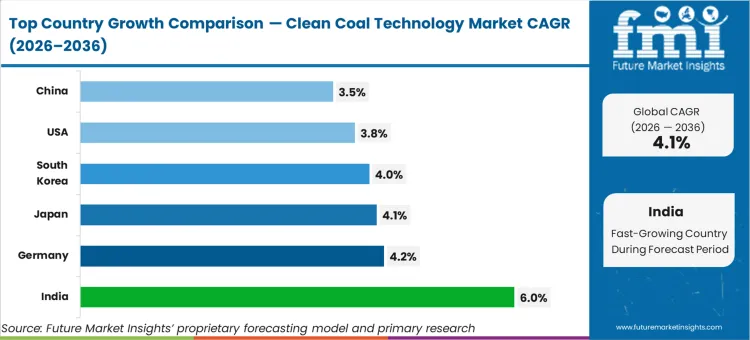
India is expected to advance at 6.0%, supported by reliance on domestic coal reserves and parallel installation of desulfurization systems across its generation fleet. Germany follows at 4.2%, where grid stability considerations continue to support selected thermal assets with advanced mitigation measures. Japan is projected to expand at 4.1%, while South Korea tracks at 4.0%, with both markets emphasizing high-efficiency gasification pathways. The United States is poised to register 3.8%, supported by federal funding for front-end engineering studies, while China is estimated to grow at 3.5%, reflecting a large but stabilizing installed base. This regional divergence reflects the different balance between baseload security in developing economies and transition management in mature power markets.
Clean Coal Technology Market Key Takeaways
| Metric | Details |
|---|---|
| Industry Size (2026) | USD 4.4 Billion |
| Industry Value (2036) | USD 6.6 Billion |
| CAGR (2026-2036) | 4.10% |
Source: Future Market Insights (FMI) analysis, based on proprietary forecasting model and primary research
Clean Coal Technology Market Definition
The sector encompasses the suite of engineered systems, chemical processes, and hardware designed to mitigate the environmental impact of coal-fired power generation and heavy industrial coal use. It is functionally bounded by its focus on extending the operational viability of fossil-fuel assets through the reduction of sulfur dioxide, nitrogen oxides, particulate matter, and carbon dioxide emissions, distinguishing it from alternative energy generation markets.
Clean Coal Technology Market Inclusions
Scope includes pre-combustion, in-situ, and post-combustion mitigation systems such as carbon capture and sequestration equipment, advanced scrubbers, supercritical boiler components, and solvent-based capture infrastructure. It also incorporates the engineering, procurement, and construction services directly tied to retrofitting these systems onto existing thermal plants or integrating them into new high-efficiency facilities.
Clean Coal Technology Market Exclusions
Explicitly excluded are the raw extraction and basic washing of coal at the mine level, as these are upstream commodity processes rather than engineered emissions mitigation. Additionally, standalone renewable energy technologies, grid-level battery storage systems, and general plant maintenance services unrelated to emissions control fall outside this boundary.
Clean Coal Technology Market Research Methodology
- Primary Research: FMI analysts interview chief sustainability officers, plant operations directors, and EPC lead engineers at tier-1 utility companies.
- Desk Research: Aggregation of environmental compliance filings, national emissions database records, and engineering specification sheets from major equipment OEMs.
- Market-Sizing and Forecasting: The baseline anchors to the verifiable megawatt capacity of thermal plants currently scheduled for compliance retrofits globally.
- Data Validation and Update Cycle: Forecasts are cross-validated against independent records of capital expenditure allocations published by regulated utility commissions.
Segmental Analysis
Clean Coal Technology Market Analysis by Technology
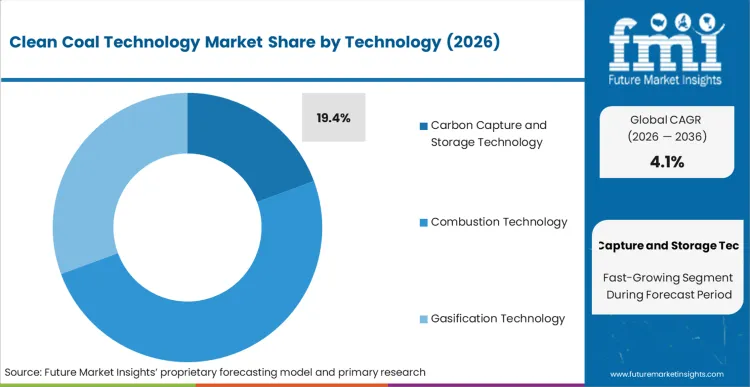
Carbon Capture and Storage Technology holds a 19.4% share in 2026 because it offers a practical route for lowering emissions from baseload thermal plants under tightening climate rules. Plant operators understand that efficiency upgrades alone may not be enough, while carbon capture supports broader decarbonization targets. FMI estimates that utilities are directing major capital toward these systems to avoid the disruption of retiring still-functioning assets. Installing capture modules on exhaust streams allows operators to reduce emissions and extend plant life. Delays in project execution may create compliance pressure and limit future operating flexibility.
- Capture Efficiency Limits: This technology prevents the total decommissioning of legacy thermal assets. Even with advanced amine solvents, the parasitic energy load remains a residual risk that actively reduces the net megawatt output of the host facility.
- Solvent Degradation Profiles: The chemical breakdown of capture agents prevents runaway operational costs. The buyer must establish rigorous fluid monitoring protocols to capture the full benefit of continuous compliance without unplanned outages.
- Integration Bottlenecks: Modular deployment prevents massive downtime during the retrofit phase. Procurement teams must align these installations with scheduled plant maintenance windows to avoid catastrophic disruption to the regional power grid.
Clean Coal Technology Market Analysis by Combustion

Subcritical boiler infrastructure is becoming less effective at delivering the thermal efficiency needed to absorb the energy penalties of modern emission controls, which is encouraging a shift toward advanced alternatives. In 2026, Pulverized Coal Combustion holds a 35.2% share, as plant engineers favor ultra-supercritical parameters to maximize steam generation per ton of fuel. FMI’s assessment indicates that this pathway improves furnace pressure and temperature performance across broader carbon capture and thermal fleet applications. This efficiency gain helps plants operate auxiliary scrubbers with less pressure on overall economics. Utilities that remain dependent on legacy subcritical systems may face weaker competitiveness in dispatch markets.
- Initial Boiler Retrofits: Cost savings originate directly from the reduced volume of fuel required to maintain baseload output. Upgrading the combustion environment minimizes the raw input needed for baseline steam production.
- Material Stress Limits: Hidden costs emerge operationally through the accelerated degradation of boiler tubing under extreme supercritical temperatures. Fleet managers must account for advanced metallurgy replacements in their ongoing maintenance budgets.
- Lifecycle Dispatch Calculations: The total lifecycle cost comparison reveals that higher upfront capital for advanced combustion directly lowers the marginal cost of generation.
Clean Coal Technology Market Analysis by Coal Type

Operators must assess which fuel grades can justify the scale of mitigation investment required to keep power plants online. Bituminous coal accounts for a 42.0% share in 2026 because its higher energy density helps support the output needed for large flue gas desulphurization systems. According to FMI analysis, lower-grade alternatives can create pressure on plant operations by increasing fuel volume requirements and stressing material handling infrastructure. Stable access to high-grade fuel helps operators maintain mitigation systems at intended performance levels. Plants using lower-quality fuel mixes may face operational issues in ash handling and downstream emission control systems.
- Thermal Output Baselines: Performance exceeds expectations when high-density fuel ensures stable combustion temperatures. This stability allows the downstream capture chemistry to operate at its peak design efficiency.
- Moisture Content Variability: Performance gaps appear rapidly under edge conditions where lower-grade blends introduce excessive moisture. This degrades boiler efficiency and forces the emission control systems to process larger volumes of contaminated exhaust.
- Specification Enforcement: National environmental regulatory bodies determine the strict acceptability of the exhaust profile. Buyers must rigorously qualify their fuel supply chains to guarantee they never breach the baseline limits set by their local air quality permits.
Clean Coal Technology Market Analysis by Application
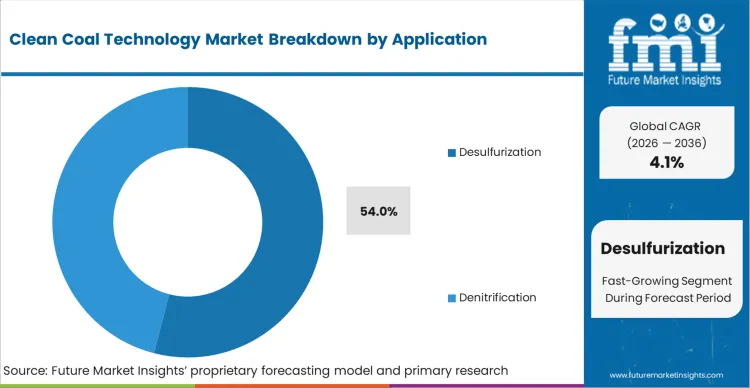
Desulfurization holds a 54.0% share in 2026 because controlling sulfur dioxide emissions is essential for continued thermal plant operation. Plants that exceed permitted levels may face penalties, regulatory action, and possible operating restrictions. FMI projects that wet and dry scrubbing systems remain central to reducing sulfur emissions before exhaust is released. Their use supports compliance and helps plants remain connected to grid dispatch. Operators that delay flue gas desulfurization installation may face rising legal and operational pressure.
- Reagent Sourcing: Tier-1 chemical suppliers produce the immense volumes of limestone and specialized absorbents required to run these scrubbers. They sustain this position by locking utilities into multi-year bulk supply contracts.
- Logistics Constraints: Buyers must plan around the severe supply constraints of moving millions of tons of reactant material to remote plant locations. This requires dedicated rail and freight infrastructure tightly integrated with the plant's daily burn rate.
- Long-term Consolidation: The supply landscape heading toward 2036 heavily favors integrated chemical conglomerates capable of managing both the input reagent and the downstream disposal of synthetic gypsum byproducts.
Clean Coal Technology Market Drivers, Restraints, and Opportunities
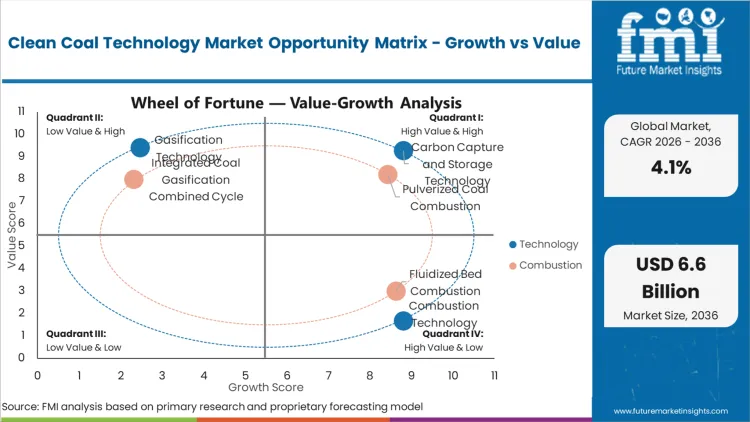
Tightening national emissions mandates compel utility fleet managers to fundamentally restructure their capital expenditure models to keep legacy assets online. This structural pressure forces operators away from routine maintenance and toward deep, multi-billion-dollar mitigation retrofits to satisfy new baseline environmental standards. The commercial stakes are absolute: deploying these systems ensures the plant remains a dispatchable, revenue-generating asset, while failing to upgrade guarantees forced retirement and the stranding of billions in physical infrastructure.
The single biggest organizational friction slowing this transition is the parasitic energy load these air pollution control systems impose on older thermal units. Plant operators face a reality where running the mitigation equipment consumes up to a fifth of the plant's total electrical output, devastating the facility's marginal profitability. While engineering firms are developing lower-temperature solvents and more efficient fan arrays to partially offset this load, the physical reality of moving and treating millions of cubic feet of exhaust gas creates a permanent operational drag that fundamentally alters the plant's core economics.
Opportunities in the Clean Coal Technology Market
- Capture Solvent Optimization: The physical limits of legacy amine systems enable this opportunity. Specialty chemical formulators who develop low-degradation, lower-temperature capture fluids can secure dominant positions within the amine based carbon capture ecosystem.
- Byproduct Valorization: The massive accumulation of captured sulfur and carbon creates an undeniable logistical liability. Integrated waste-management contractors who convert scrubber sludge into commercial-grade synthetic gypsum for the construction industry transform a disposal cost into a secondary revenue stream.
- Modular Retrofit Deployment: The severe grid instability caused by prolonged plant shutdowns forces operators to seek faster installation methods. EPC contractors who pre-fabricate capture arrays off-site and install them during standard maintenance windows capture the vast majority of new utility procurement contracts.
Regional Analysis
Based on the regional analysis, the clean coal technology market is segmented into Asia Pacific, Europe, North America, Latin America, and Middle East & Africa across 40 plus countries.
.webp "Top Country Growth Comparison Clean Coal Technology Market Cagr (2026 2036)")
| Country | CAGR (2026 to 2036) |
|---|---|
| India | 6.0% |
| Germany | 4.2% |
| Japan | 4.1% |
| South Korea | 4.0% |
| United States | 3.8% |
| China | 3.5% |
Source: Future Market Insights (FMI) analysis, based on proprietary forecasting model and primary research
Asia Pacific Clean Coal Technology Market Analysis
The physical condition of the existing electrical infrastructure dictates the exact pace of mitigation deployment across this geography. Grid operators are managing a fleet of relatively young thermal assets that form the absolute backbone of regional industrialization, meaning premature retirement is physically impossible without causing severe brownouts. In FMI's view, this reality forces regional utilities to prioritize aftermarket gas scrubber installations and boiler upgrades over unproven replacement technologies. The focus here is strictly on extending the viable life of these heavy assets while meeting newly enforced environmental performance standards. This creates a massive, captive audience for tier-1 engineering firms capable of executing large-scale retrofits without disrupting the delicate balance of the region's baseload power supply.
- India: India's heavy reliance on domestic coal reserves forces its central electricity authorities to mandate comprehensive emission control upgrades across its vast, aging thermal fleet. Utility operators in the country must execute these massive capital projects precisely during narrow seasonal downtime windows to prevent widespread grid collapse. Demand for these upgrades in India is set to grow at 6.0% over the forecast period. Firms that successfully navigate this complex installation matrix secure preferred contractor status for the next two decades of inevitable compliance cycles.
- Japan: Japan's severe lack of domestic energy resources requires its utilities to extract maximum efficiency from every imported ton of fuel while maintaining pristine environmental compliance. Fleet managers face immense pressure to integrate advanced gasification combined-cycle technologies that push the physical limits of thermal efficiency. FMI estimates the mitigation technology landscape in Japan to expand at an annual growth rate of 4.1%. Once these advanced architectures are fully qualified, utilities drastically reduce their exposure to volatile global fuel markets and permanently lower their baseline operating costs.
- South Korea: A highly concentrated procurement structure forces South Korean power companies to align perfectly with state directives on emission reductions, leaving no room for delayed compliance. Facilities operating within this tight network must immediately adopt standardized capture protocols to maintain their grid dispatch priority. Over the forecast period, South Korea is expected to see its sector grow at a compound annual rate of 4.0%. The reality on the ground is that these upgrades are executed not through competitive bidding, but through highly choreographed consortiums of domestic heavy industries moving in lockstep.
- China: The sheer scale of the installed thermal base in China requires an entirely different approach to mitigation, focusing on standardizing the cheapest possible compliant systems across hundreds of facilities simultaneously. Central planners must balance the need for rapid industrialization against severe urban air quality crises, pushing immediate desulfurization mandates over complex long-term sequestration. China's industry is projected to witness growth at a CAGR of 3.5%. Following this massive wave of basic filtration upgrades, the market will inevitably transition into the world's largest consumer of deep carbon capture modules by the early 2030s.
Europe Clean Coal Technology Market Analysis
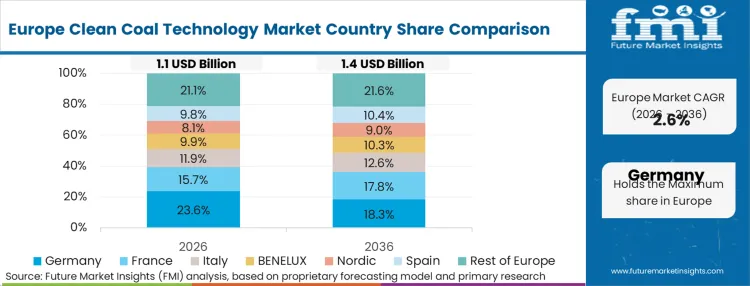
Climate policy across Europe is exerting strong influence over capital decisions for thermal asset owners. Energy portfolio managers are balancing efficiency goals with the need to respond to tighter carbon rules and higher emissions costs. This pressure is encouraging operators to adopt advanced carbon mitigation technologies to preserve the viability of existing assets. The region is also becoming a key base for next-generation sequestration projects and pilot programs focused on lowering the emissions intensity of fossil-based power generation.
- Germany: The aggressive phase-out calendar for unmitigated thermal assets defines Germany's trajectory in this sector, forcing grid managers to identify exactly which core facilities must remain active to balance the system. Operators of these critical plants operate under severe scrutiny, requiring them to deploy the most advanced filtration and capture systems available regardless of the upfront cost. The market for these critical mitigation technologies in Germany is forecast to register a CAGR of 4.2%. This creates a distinct advantage for domestic engineering firms capable of meeting the strictest European standards, allowing them to export these validated solutions to adjacent, less mature markets.
North America Clean Coal Technology Market Analysis
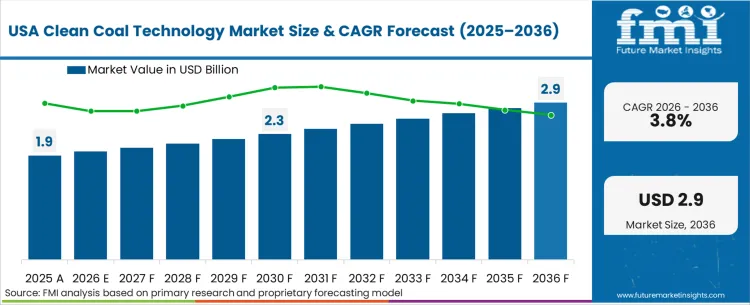
The availability of massive federal tax incentives fundamentally alters the return-on-investment calculations for thermal plant operators in this region. Utility executives are shifting from viewing emissions control as a sunk compliance cost to treating it as a subsidized asset-extension strategy. Based on FMI's assessment, the deployment of oil gas carbon capture and other advanced sequestration frameworks is driven by the direct monetization of the captured carbon, either through enhanced oil recovery or direct government payouts per ton. This purely economic driver accelerates the engineering timelines for massive retrofit projects that would otherwise stall in regulatory purgatory.
- United States: The structural advantage of extensive geological storage formations enables the United States to aggressively pursue full-scale carbon sequestration alongside traditional scrubbers. Plant operators here must qualify for newly released front-end engineering design funding to offset the immense upfront capital required for these gigawatt-scale integrations. The United States market is likely to post a CAGR of 3.8%. Once these subsidized capture systems are activated, utilities successfully isolate their baseload assets from the volatility of future carbon pricing markets.
FMI's report includes extensive analysis of emerging regulatory frameworks in Latin America and the Middle East. The overarching structural pattern across these secondary geographies relies entirely on the prior validation of capture technologies in mature regions, as local utilities lack the capital to absorb the risk of first-generation engineering failures.
Competitive Aligners for Market Players
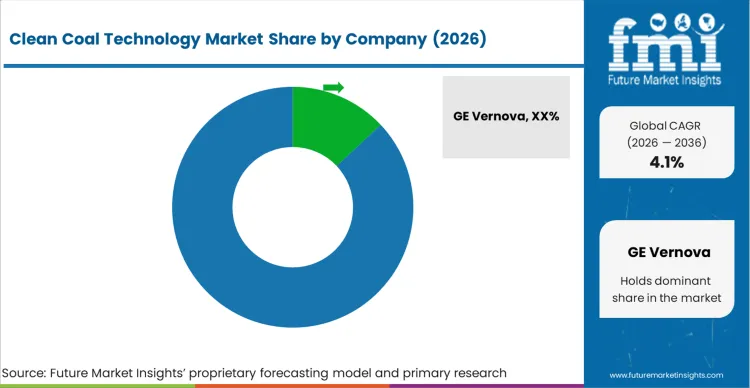
The massive capital requirements and extreme engineering risks associated with gigawatt-scale thermal plant retrofits naturally force this sector into a highly concentrated oligopoly. Tier-1 engineering conglomerates like GE Vernova, Siemens Energy, and Mitsubishi Heavy Industries dominate the landscape because utility procurement directors require absolute balance sheet certainty before awarding multi-billion-dollar compliance contracts. Buyers do not distinguish vendors based on marginal efficiency claims: they evaluate them entirely on their ability to underwrite complete system performance guarantees and absorb the catastrophic financial penalties of a failed installation. This dynamic locks out smaller engineering firms, relegating them to tier-2 component supply rather than prime contractor status.
Incumbents maintain their dominant positions by holding vast portfolios of proprietary solvent formulations and specialized flue gas coolers metallurgy that are incredibly difficult to reverse-engineer. Companies like Shell plc and Exxon Mobil possess a profound structural advantage derived from decades of managing massive fluid flows and complex chemical separations at commercial scale. To successfully challenge these entrenched players, a new entrant must build a verifiable operational track record of running capture systems continuously over multiple years without catastrophic solvent degradation, a capability that requires hundreds of millions in pilot plant funding before a utility will even issue a request for proposal.
Large utility buyers actively resist this severe vendor lock-in by mandating open-architecture control systems and insisting on multi-vendor compatibility for consumable reagents. Despite these efforts, the structural tension between utility preferences for flexible supply chains and vendor incentives to mandate proprietary aftermarket services will heavily favor the vendors through 2036. The sector is structurally designed to become even more concentrated, as the sheer engineering complexity of zero-emission thermal baseload forces further consolidation among the few heavy industry players capable of executing the work.
Key Players in Clean Coal Technology Market
- GE Vernova
- Siemens Energy
- Mitsubishi Heavy Industries, Ltd.
- Shell plc
- KBR, Inc.
- Exxon Mobil Corporation
- China Huaneng Group Co., Ltd.
Scope of the Report
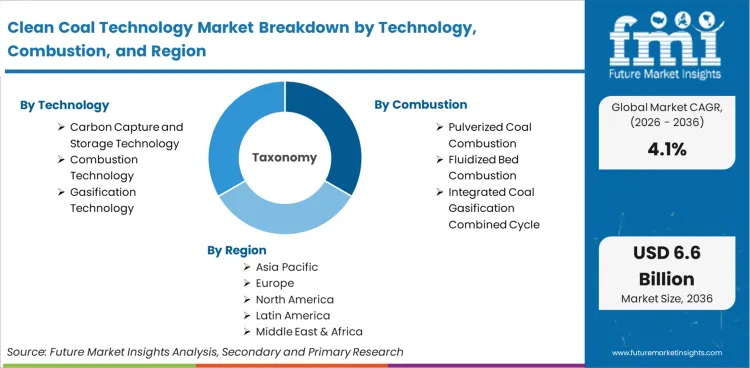
| Metric | Value |
|---|---|
| Quantitative Units | USD 4.4 Billion to USD 6.6 Billion, at a CAGR of 4.10% |
| Market Definition | The clean coal technology sector encompasses the specialized engineering systems and chemical processes required to strip pollutants and carbon dioxide from coal-fired generation. It operates at the intersection of thermal energy production and environmental compliance, serving as the technical bridge extending the life of necessary baseload assets. |
| Technology Segmentation | Carbon Capture and Storage Technology, Combustion Technology, Gasification Technology, Enabling Technology, Carbon Sequestration Technology |
| Combustion Segmentation | Pulverized Coal Combustion, Fluidized Bed Combustion, Integrated Coal Gasification Combined Cycle (IGCC) |
| Coal Type Segmentation | Bituminous, Anthracite, Sub-bituminous, Lignite |
| Application Segmentation | Desulfurization, Denitrification |
| Regions Covered | Asia Pacific, Europe, North America, Latin America, Middle East & Africa |
| Countries Covered | India, Germany, Japan, South Korea, United States, China, and 40 plus countries |
| Key Companies Profiled | GE Vernova, Siemens Energy, Mitsubishi Heavy Industries, Ltd., Shell plc, KBR, Inc., Exxon Mobil Corporation, China Huaneng Group Co., Ltd. |
| Forecast Period | 2026 to 2036 |
| Approach | FMI conducted extensive primary interviews with utility fleet managers, EPC lead engineers, and chief sustainability officers. The baseline data anchors directly to the verifiable megawatt capacity of thermal plants currently scheduled for global compliance retrofits. Analysts cross-validated the resulting revenue forecasts against publicly available utility rate case approvals and national emissions database records. |
Source: Future Market Insights (FMI) analysis, based on proprietary forecasting model and primary research
Clean Coal Technology Market Analysis by Segments
Technology:
- Carbon Capture and Storage Technology
- Combustion Technology
- Gasification Technology
- Enabling Technology
- Carbon Sequestration Technology
Combustion:
- Pulverized Coal Combustion
- Fluidized Bed Combustion
- Integrated Coal Gasification Combined Cycle (IGCC)
Coal Type:
- Bituminous
- Anthracite
- Sub-bituminous
- Lignite
Application:
- Desulfurization
- Denitrification
Region:
- Asia Pacific
- India
- China
- Japan
- South Korea
- Indonesia
- Australia & New Zealand
- ASEAN
- Rest of Asia Pacific
- Europe
- Germany
- Italy
- France
- United Kingdom
- Spain
- Benelux
- Nordics
- Central & Eastern Europe
- Rest of Europe
- North America
- United States
- Canada
- Mexico
- Latin America
- Brazil
- Argentina
- Chile
- Rest of Latin America
- Middle East & Africa
- Kingdom of Saudi Arabia
- United Arab Emirates
- South Africa
- Turkey
- Rest of Middle East & Africa
Bibliography
- International Energy Agency. (2024, January). Coal 2024: Analysis and forecast to 2027. IEA.
- Global CCS Institute. (2024, January). Global status of CCS 2024. Global CCS Institute.
- U.S. Environmental Protection Agency. (2026, February 27). Greenhouse gas standards and guidelines for fossil fuel-fired power plants.
- Verikios, G., Reedman, L., Green, D., Nolan, M., Lu, Y., Rodriguez, S., Murugesan, M., & Havas, L. (2024, August). Modelling sectoral pathways to net zero emissions (EP2024-4366). CSIRO.
- State-owned Assets Supervision and Administration Commission of the State Council. (2025, September 29). China launches world's largest coal-fired carbon capture project.
This bibliography is provided for reader reference. The full FMI report contains the complete reference list with primary source documentation.
This Report Addresses
- Market intelligence to support strategic decision making across specific thermal energy production and environmental compliance applications.
- Market size estimation and 10-year revenue forecasts from 2026 to 2036, supported by direct baseline data anchored to verifiable megawatt capacity of scheduled plant retrofits.
- Growth opportunity mapping across Carbon Capture and Storage Technology and Pulverized Coal Combustion segments with emphasis on the standardization of capture solvent economics.
- Segment and regional revenue forecasts covering Desulfurization applications across aggressive policy-led compliance frameworks in Europe and infrastructure-led regions in Asia.
- Competition strategy assessment including severe vendor lock-in dynamics, proprietary solvent formulations, and balance sheet certainty requirements.
- Technology development tracking including supercritical boiler components, modular capture deployment, and low-temperature amine fluid systems.
- Market access analysis covering national emissions database records, approved utility rate cases, and strict acceptable exhaust profile mandates.
- Market report delivery in PDF, Excel, PPT, and interactive dashboard formats for executive strategy, utility fleet management, and operational benchmarking use.
Frequently Asked Questions
How large is the demand for Clean Coal Technology in the global market in 2026?
Demand for Clean Coal Technology in the global market is estimated to be valued at USD 4.4 billion in 2026.
What will be the market size of Clean Coal Technology in the global market by 2036?
Market size for Clean Coal Technology is projected to reach USD 6.6 billion by 2036.
What is the expected demand growth for Clean Coal Technology in the global market between 2026 and 2036?
Demand for Clean Coal Technology is expected to grow at a CAGR of 4.10% between 2026 and 2036.
Which Technology is poised to lead global sales by 2026?
Carbon Capture and Storage Technology accounts for 19.4% in 2026 as utilities view it as the most viable route to reduce carbon emissions while extending the life of existing coal-fired assets.
How significant is the role of Pulverized Coal Combustion in driving Clean Coal Technology adoption in 2026?
Pulverized Coal Combustion represents 35.2% of segment share in 2026 as the large installed base of legacy thermal plants creates immediate retrofit demand for advanced mitigation systems.
What is driving demand in China?
China’s demand is driven by the need to standardize cost-effective emissions control systems across a very large coal-fired installed base while balancing industrial growth and air quality pressures.
What compliance standards or regulations are referenced for Germany?
Germany’s market is shaped by aggressive phase-out timelines for unmitigated thermal assets and strict European environmental compliance requirements.
What is the China growth outlook in this report?
China is projected to grow at a CAGR of 3.5% during 2026 to 2036.
Why is North America described as a priority region in this report?
North America is described as a priority region because federal incentives and geological storage availability improve the economics of large-scale carbon capture retrofit projects.
What type of demand dominates in North America?
Demand heavily focuses on carbon capture and sequestration systems that convert emissions control from a compliance burden into an asset-life extension strategy.
What is India's growth outlook in this report?
India is projected to expand at a CAGR of 6.0% during 2026 to 2036.
Does the report cover USA in its regional analysis?
Yes, USA is included within North America under the regional scope of analysis.
What are the sources referred to for analyzing USA?
Utility rate case approvals, national emissions database records, plant retrofit schedules, public procurement contracts, and primary interviews with utility and EPC stakeholders form the analytical basis.
What is the main demand theme linked to USA in its region coverage?
The main demand theme in the United States is the deployment of subsidized carbon capture and sequestration systems to preserve dispatchable baseload capacity.
Does the report cover Germany in its regional analysis?
Yes, Germany is included within Europe under the regional coverage framework.
What is the main Germany related demand theme in its region coverage?
Germany’s demand is tied to keeping selected critical thermal assets online through advanced filtration and carbon mitigation upgrades under strict policy scrutiny.
Which product formats or configurations are strategically important for Asia Pacific supply chains?
Carbon capture modules, desulfurization systems, supercritical boiler components, advanced gasification pathways, and modular retrofit packages are strategically important for Asia Pacific supply chains.
What is Clean Coal Technology and what is it mainly used for?
Clean Coal Technology comprises engineered systems and chemical processes that reduce emissions from coal-fired generation, and it is mainly used to lower sulfur dioxide, nitrogen oxides, particulate matter, and carbon dioxide from thermal assets.
What does Clean Coal Technology mean in this report?
The scope refers to the technical systems that extend the operational viability of coal-based power assets through emissions mitigation and environmental compliance.
What is included in the scope of this Clean Coal Technology report?
The market covers carbon capture and sequestration equipment, advanced scrubbers, supercritical boiler components, solvent-based capture systems, and EPC services tied to compliance retrofits and high-efficiency coal facilities.
What is excluded from the scope of this report?
Raw coal extraction, basic coal washing, standalone renewable energy systems, grid battery storage, and general plant maintenance unrelated to emissions control are explicitly excluded.
What does market forecast mean on this page?
The market forecast represents a model-based projection built on scheduled retrofit capacity, emissions compliance timelines, technology economics, and utility capital deployment assumptions.
How does FMI build and validate the Clean Coal Technology forecast?
The model applies a retrofit-capacity-based methodology anchored to the verifiable megawatt base of plants scheduled for compliance upgrades, then cross-validates projections against utility commission capex records and emissions databases.
What does zero reliance on speculative third-party market research mean here?
Primary interviews, compliance filings, emissions database records, utility rate cases, procurement contracts, and OEM backlog indicators are used exclusively instead of unverified syndicated estimates.
Preview the report firsthand - request a free sample
Get SampleGet the brochure for pricing and purchase details.
Get PDFTable of Content
- Executive Summary
- Global Market Outlook
- Demand-side Trends
- Supply-side Trends
- Technology Roadmap Analysis
- Analysis and Recommendations
- Market Overview
- Market Coverage / Taxonomy
- Market Definition / Scope / Limitations
- Research Methodology
- Chapter Orientation
- Analytical Lens and Working Hypotheses
- Market Structure, Signals, and Trend Drivers
- Benchmarking and Cross-market Comparability
- Market Sizing, Forecasting, and Opportunity Mapping
- Research Design and Evidence Framework
- Desk Research Programme (Secondary Evidence)
- Company Annual and Sustainability Reports
- Peer-reviewed Journals and Academic Literature
- Corporate Websites, Product Literature, and Technical Notes
- Earnings Decks and Investor Briefings
- Statutory Filings and Regulatory Disclosures
- Technical White Papers and Standards Notes
- Trade Journals, Industry Magazines, and Analyst Briefs
- Conference Proceedings, Webinars, and Seminar Materials
- Government Statistics Portals and Public Data Releases
- Press Releases and Reputable Media Coverage
- Specialist Newsletters and Curated Briefings
- Sector Databases and Reference Repositories
- FMI Internal Proprietary Databases and Historical Market Datasets
- Subscription Datasets and Paid Sources
- Social Channels, Communities, and Digital Listening Inputs
- Additional Desk Sources
- Expert Input and Fieldwork (Primary Evidence)
- Primary Modes
- Qualitative Interviews and Expert Elicitation
- Quantitative Surveys and Structured Data Capture
- Blended Approach
- Why Primary Evidence is Used
- Field Techniques
- Interviews
- Surveys
- Focus Groups
- Observational and In-context Research
- Social and Community Interactions
- Stakeholder Universe Engaged
- C-suite Leaders
- Board Members
- Presidents and Vice Presidents
- R&D and Innovation Heads
- Technical Specialists
- Domain Subject-matter Experts
- Scientists
- Physicians and Other Healthcare Professionals
- Governance, Ethics, and Data Stewardship
- Research Ethics
- Data Integrity and Handling
- Primary Modes
- Tooling, Models, and Reference Databases
- Desk Research Programme (Secondary Evidence)
- Data Engineering and Model Build
- Data Acquisition and Ingestion
- Cleaning, Normalisation, and Verification
- Synthesis, Triangulation, and Analysis
- Quality Assurance and Audit Trail
- Market Background
- Market Dynamics
- Drivers
- Restraints
- Opportunity
- Trends
- Scenario Forecast
- Demand in Optimistic Scenario
- Demand in Likely Scenario
- Demand in Conservative Scenario
- Opportunity Map Analysis
- Product Life Cycle Analysis
- Supply Chain Analysis
- Investment Feasibility Matrix
- Value Chain Analysis
- PESTLE and Porter’s Analysis
- Regulatory Landscape
- Regional Parent Market Outlook
- Production and Consumption Statistics
- Import and Export Statistics
- Market Dynamics
- Global Market Analysis 2021 to 2025 and Forecast, 2026 to 2036
- Historical Market Size Value (USD Million) Analysis, 2021 to 2025
- Current and Future Market Size Value (USD Million) Projections, 2026 to 2036
- Y-o-Y Growth Trend Analysis
- Absolute $ Opportunity Analysis
- Global Market Pricing Analysis 2021 to 2025 and Forecast 2026 to 2036
- Global Market Analysis 2021 to 2025 and Forecast 2026 to 2036, By Technology
- Introduction / Key Findings
- Historical Market Size Value (USD Million) Analysis By Technology , 2021 to 2025
- Current and Future Market Size Value (USD Million) Analysis and Forecast By Technology , 2026 to 2036
- Carbon Capture and Storage Technology
- Combustion Technology
- Gasification Technology
- Carbon Capture and Storage Technology
- Y-o-Y Growth Trend Analysis By Technology , 2021 to 2025
- Absolute $ Opportunity Analysis By Technology , 2026 to 2036
- Global Market Analysis 2021 to 2025 and Forecast 2026 to 2036, By Combustion
- Introduction / Key Findings
- Historical Market Size Value (USD Million) Analysis By Combustion, 2021 to 2025
- Current and Future Market Size Value (USD Million) Analysis and Forecast By Combustion, 2026 to 2036
- Pulverized Coal Combustion
- Fluidized Bed Combustion
- Integrated Coal Gasification Combined Cycle
- Pulverized Coal Combustion
- Y-o-Y Growth Trend Analysis By Combustion, 2021 to 2025
- Absolute $ Opportunity Analysis By Combustion, 2026 to 2036
- Global Market Analysis 2021 to 2025 and Forecast 2026 to 2036, By Coal Type
- Introduction / Key Findings
- Historical Market Size Value (USD Million) Analysis By Coal Type, 2021 to 2025
- Current and Future Market Size Value (USD Million) Analysis and Forecast By Coal Type, 2026 to 2036
- Bituminous
- Anthracite
- Sub-bituminous
- Bituminous
- Y-o-Y Growth Trend Analysis By Coal Type, 2021 to 2025
- Absolute $ Opportunity Analysis By Coal Type, 2026 to 2036
- Global Market Analysis 2021 to 2025 and Forecast 2026 to 2036, By Application
- Introduction / Key Findings
- Historical Market Size Value (USD Million) Analysis By Application, 2021 to 2025
- Current and Future Market Size Value (USD Million) Analysis and Forecast By Application, 2026 to 2036
- Desulfurization
- Denitrification
- Desulfurization
- Y-o-Y Growth Trend Analysis By Application, 2021 to 2025
- Absolute $ Opportunity Analysis By Application, 2026 to 2036
- Global Market Analysis 2021 to 2025 and Forecast 2026 to 2036, By Region
- Introduction
- Historical Market Size Value (USD Million) Analysis By Region, 2021 to 2025
- Current Market Size Value (USD Million) Analysis and Forecast By Region, 2026 to 2036
- North America
- Latin America
- Western Europe
- Eastern Europe
- East Asia
- South Asia and Pacific
- Middle East & Africa
- Market Attractiveness Analysis By Region
- North America Market Analysis 2021 to 2025 and Forecast 2026 to 2036, By Country
- Historical Market Size Value (USD Million) Trend Analysis By Market Taxonomy, 2021 to 2025
- Market Size Value (USD Million) Forecast By Market Taxonomy, 2026 to 2036
- By Country
- USA
- Canada
- Mexico
- By Technology
- By Combustion
- By Coal Type
- By Application
- By Country
- Market Attractiveness Analysis
- By Country
- By Technology
- By Combustion
- By Coal Type
- By Application
- Key Takeaways
- Latin America Market Analysis 2021 to 2025 and Forecast 2026 to 2036, By Country
- Historical Market Size Value (USD Million) Trend Analysis By Market Taxonomy, 2021 to 2025
- Market Size Value (USD Million) Forecast By Market Taxonomy, 2026 to 2036
- By Country
- Brazil
- Chile
- Rest of Latin America
- By Technology
- By Combustion
- By Coal Type
- By Application
- By Country
- Market Attractiveness Analysis
- By Country
- By Technology
- By Combustion
- By Coal Type
- By Application
- Key Takeaways
- Western Europe Market Analysis 2021 to 2025 and Forecast 2026 to 2036, By Country
- Historical Market Size Value (USD Million) Trend Analysis By Market Taxonomy, 2021 to 2025
- Market Size Value (USD Million) Forecast By Market Taxonomy, 2026 to 2036
- By Country
- Germany
- UK
- Italy
- Spain
- France
- Nordic
- BENELUX
- Rest of Western Europe
- By Technology
- By Combustion
- By Coal Type
- By Application
- By Country
- Market Attractiveness Analysis
- By Country
- By Technology
- By Combustion
- By Coal Type
- By Application
- Key Takeaways
- Eastern Europe Market Analysis 2021 to 2025 and Forecast 2026 to 2036, By Country
- Historical Market Size Value (USD Million) Trend Analysis By Market Taxonomy, 2021 to 2025
- Market Size Value (USD Million) Forecast By Market Taxonomy, 2026 to 2036
- By Country
- Russia
- Poland
- Hungary
- Balkan & Baltic
- Rest of Eastern Europe
- By Technology
- By Combustion
- By Coal Type
- By Application
- By Country
- Market Attractiveness Analysis
- By Country
- By Technology
- By Combustion
- By Coal Type
- By Application
- Key Takeaways
- East Asia Market Analysis 2021 to 2025 and Forecast 2026 to 2036, By Country
- Historical Market Size Value (USD Million) Trend Analysis By Market Taxonomy, 2021 to 2025
- Market Size Value (USD Million) Forecast By Market Taxonomy, 2026 to 2036
- By Country
- China
- Japan
- South Korea
- By Technology
- By Combustion
- By Coal Type
- By Application
- By Country
- Market Attractiveness Analysis
- By Country
- By Technology
- By Combustion
- By Coal Type
- By Application
- Key Takeaways
- South Asia and Pacific Market Analysis 2021 to 2025 and Forecast 2026 to 2036, By Country
- Historical Market Size Value (USD Million) Trend Analysis By Market Taxonomy, 2021 to 2025
- Market Size Value (USD Million) Forecast By Market Taxonomy, 2026 to 2036
- By Country
- India
- ASEAN
- Australia & New Zealand
- Rest of South Asia and Pacific
- By Technology
- By Combustion
- By Coal Type
- By Application
- By Country
- Market Attractiveness Analysis
- By Country
- By Technology
- By Combustion
- By Coal Type
- By Application
- Key Takeaways
- Middle East & Africa Market Analysis 2021 to 2025 and Forecast 2026 to 2036, By Country
- Historical Market Size Value (USD Million) Trend Analysis By Market Taxonomy, 2021 to 2025
- Market Size Value (USD Million) Forecast By Market Taxonomy, 2026 to 2036
- By Country
- Kingdom of Saudi Arabia
- Other GCC Countries
- Turkiye
- South Africa
- Other African Union
- Rest of Middle East & Africa
- By Technology
- By Combustion
- By Coal Type
- By Application
- By Country
- Market Attractiveness Analysis
- By Country
- By Technology
- By Combustion
- By Coal Type
- By Application
- Key Takeaways
- Key Countries Market Analysis
- USA
- Pricing Analysis
- Market Share Analysis, 2025
- By Technology
- By Combustion
- By Coal Type
- By Application
- Canada
- Pricing Analysis
- Market Share Analysis, 2025
- By Technology
- By Combustion
- By Coal Type
- By Application
- Mexico
- Pricing Analysis
- Market Share Analysis, 2025
- By Technology
- By Combustion
- By Coal Type
- By Application
- Brazil
- Pricing Analysis
- Market Share Analysis, 2025
- By Technology
- By Combustion
- By Coal Type
- By Application
- Chile
- Pricing Analysis
- Market Share Analysis, 2025
- By Technology
- By Combustion
- By Coal Type
- By Application
- Germany
- Pricing Analysis
- Market Share Analysis, 2025
- By Technology
- By Combustion
- By Coal Type
- By Application
- UK
- Pricing Analysis
- Market Share Analysis, 2025
- By Technology
- By Combustion
- By Coal Type
- By Application
- Italy
- Pricing Analysis
- Market Share Analysis, 2025
- By Technology
- By Combustion
- By Coal Type
- By Application
- Spain
- Pricing Analysis
- Market Share Analysis, 2025
- By Technology
- By Combustion
- By Coal Type
- By Application
- France
- Pricing Analysis
- Market Share Analysis, 2025
- By Technology
- By Combustion
- By Coal Type
- By Application
- India
- Pricing Analysis
- Market Share Analysis, 2025
- By Technology
- By Combustion
- By Coal Type
- By Application
- ASEAN
- Pricing Analysis
- Market Share Analysis, 2025
- By Technology
- By Combustion
- By Coal Type
- By Application
- Australia & New Zealand
- Pricing Analysis
- Market Share Analysis, 2025
- By Technology
- By Combustion
- By Coal Type
- By Application
- China
- Pricing Analysis
- Market Share Analysis, 2025
- By Technology
- By Combustion
- By Coal Type
- By Application
- Japan
- Pricing Analysis
- Market Share Analysis, 2025
- By Technology
- By Combustion
- By Coal Type
- By Application
- South Korea
- Pricing Analysis
- Market Share Analysis, 2025
- By Technology
- By Combustion
- By Coal Type
- By Application
- Russia
- Pricing Analysis
- Market Share Analysis, 2025
- By Technology
- By Combustion
- By Coal Type
- By Application
- Poland
- Pricing Analysis
- Market Share Analysis, 2025
- By Technology
- By Combustion
- By Coal Type
- By Application
- Hungary
- Pricing Analysis
- Market Share Analysis, 2025
- By Technology
- By Combustion
- By Coal Type
- By Application
- Kingdom of Saudi Arabia
- Pricing Analysis
- Market Share Analysis, 2025
- By Technology
- By Combustion
- By Coal Type
- By Application
- Turkiye
- Pricing Analysis
- Market Share Analysis, 2025
- By Technology
- By Combustion
- By Coal Type
- By Application
- South Africa
- Pricing Analysis
- Market Share Analysis, 2025
- By Technology
- By Combustion
- By Coal Type
- By Application
- USA
- Market Structure Analysis
- Competition Dashboard
- Competition Benchmarking
- Market Share Analysis of Top Players
- By Regional
- By Technology
- By Combustion
- By Coal Type
- By Application
- Competition Analysis
- Competition Deep Dive
- GE Vernova
- Overview
- Product Portfolio
- Profitability by Market Segments (Product/Age /Sales Channel/Region)
- Sales Footprint
- Strategy Overview
- Marketing Strategy
- Product Strategy
- Channel Strategy
- Siemens Energy
- Mitsubishi Heavy Industries, Ltd.
- Shell plc
- KBR, Inc.
- Exxon Mobil Corporation
- GE Vernova
- Competition Deep Dive
- Assumptions & Acronyms Used


