

- Industry Size (2026)
- USD 112.3 Mn
- Forecast (2036)
- USD 142.7 Mn
- CAGR (2026 to 2036)
- 2.70%
Coal Mine Ventilation Fans Market Size, Market Forecast and Outlook By FMI
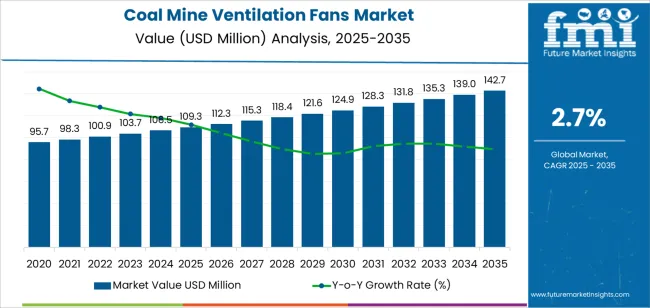
In 2025, the coal mine ventilation fans market was valued at USD 109.3 million. Demand for ventilation fans is estimated to grow to USD 112.3 million in 2026 and USD 142.7 million by 2036. FMI projects a CAGR of 2.70% during the forecast period.
Procurement specifications are shifting from simple airflow capacity to integrated "climate control" mandates as regulatory bodies impose stricter occupational health standards. For instance, in April 2024, India's Directorate General of Mines Safety (DGMS) issued a technical circular mandating specific precautions against heat waves, compelling mine operators to upgrade ventilation infrastructure to manage deeper, hotter working faces [1]. This regulatory trigger forces buyers to prioritize fans with higher pressure capabilities and integrated cooling systems over standard models, effectively raising the average selling price and creating a technical barrier to entry for low-cost suppliers.
Summary of Coal Mine Ventilation Fans Market
- Coal Mine Ventilation Fans Market Definition
- Critical safety infrastructure for managing airflow, methane dilution, and thermal conditions in coal extraction environments.
- Demand Drivers in the Market
- Deepening mine shafts require higher pressure fans to overcome increased resistance.
- Strict regulatory mandates on heat stress and dust control force equipment upgrades.
- Electrification of haulage fleets alters ventilation load profiles.
- Key Segments Analyzed in the FMI Report
- Axial Type fans (55.00% share) dominate due to high efficiency in main airways.
- Underground Coal Mines (60.00% share) represent the primary revenue stream.
- Asia Pacific leads volume growth while Europe focuses on post-mining management.
- Analyst Opinion at FMI
- Nikhil Kaitwade, Principal Consultant for Chemicals and Materials Industry at Future Market Insights, opines, "Operators are moving away from fixed-speed systems to Ventilation on Demand (VOD) to cut energy costs, which can account for 40% of a mine's electricity bill. The future belongs to smart fans that adjust automatically to real-time air quality data."
- Strategic Implications/Executive Takeaways
- Pivot R&D toward high-pressure, low-noise designs for deep-level applications.
- Bundle fans with digital monitoring services to lock in recurring revenue.
- Target retrofit opportunities in Western markets where new mine openings are limited.
- Methodology
- Validated through first-hand corporate production and capacity data.
- Zero reliance on speculative third-party market research reports.
- Based on verifiable industrial benchmarks and verified sources.
Managing Director of Howden Projects, Kudzai Nyangoni, noted the scale of these technical requirements during a project in Zambia: "We build multimillion-dollar pieces of equipment-it’s hard for most to imagine We have just commissioned a mine cooling plant at the world’s deepest mine in South Africa. We are producing 100 tonnes of ice which is piped four km down the shaft where it melts with the cold water used to chill gas which is used for cooling the working surfaces" [2]. This statement highlights a structural shift where ventilation is no longer just about moving air but involves complex thermodynamic management, implying that suppliers must evolve into full-service climate engineers to capture high-value contracts.
Growth rates vary significantly across key jurisdictions, reflecting divergent energy policies. China is projected to lead with a 3.60% CAGR, followed by India at 3.40% and Germany at 3.10%. Brazil is expected to grow at 2.80%, while the USA is forecast at 2.60%.
Coal Mine Ventilation Fans Market Definition
The coal mine ventilation fans market comprises the global trade and deployment of heavy-duty industrial fans designed specifically to supply fresh air, remove hazardous gases like methane, and regulate temperature in underground and surface coal mining operations.
Coal Mine Ventilation Fans Market Inclusions
The report includes a comprehensive analysis of main fan units, booster fans, and auxiliary ventilation systems used in extraction zones. It covers revenue from new equipment sales and retrofitting services, including the integration of variable frequency drives (VFDs) and automated control systems that regulate airflow based on real-time sensor data.
Coal Mine Ventilation Fans Market Exclusions
The scope excludes general-purpose industrial HVAC systems not rated for explosive atmospheres (ATEX or MSHA standards). It also omits residential or commercial ventilation units and passive ventilation infrastructure such as brattice cloths or stoppings, focusing strictly on the powered mechanical air-moving machinery.
Coal Mine Ventilation Fans Market Research Methodology
- Primary Research: Interviews with mine safety directors, ventilation engineers, and procurement heads at major mining conglomerates.
- Desk Research: Analysis of regulatory technical circulars, corporate annual reports, and production data from national energy ministries.
- Market-Sizing and Forecasting: A bottom-up model aggregating mine-level production plans with ventilation power density coefficients.
- Data Validation and Update Cycle: Verification of contract awards against mine development capital expenditure filings.
Segmental Analysis
Coal Mine Ventilation Fans Market Analysis by Type
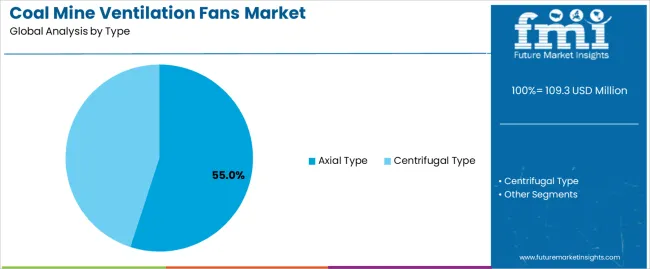
The dominance of Axial Type fans, holding 55.00% of the market, is driven by their superior aerodynamic efficiency in moving large volumes of air against moderate pressures in main mine shafts. Mine operators favor axial designs because the pitch of the blades can be adjusted to match changing resistance curves as the mine expands, providing a capital-efficient way to scale ventilation without replacing the entire housing. In contrast, centrifugal fans are retained for specific high-pressure auxiliary applications where robust static pressure is required to force air through long duct runs in blind headings.
- Axial Type: Manufacturers are increasingly engineering these units for extreme depth; for instance, TLT-Turbo recently commissioned bifurcated fan stations with dual-stage 220kw systems specifically to meet the high-pressure demands of the Eastern Limb Project [3].
- Centrifugal Type: Demand in this segment is sustained by strict technical specifications for stable airflow, such as Clean Air Metals' 2024 ventilation requirement of 600-650 cubic meters per second for its Thunder Bay North Project, which necessitates robust fan architecture [4].
- Mixed Flow: Emerging as a hybrid solution for complex circuit geometries requiring balanced pressure and volume.
Coal Mine Ventilation Fans Market Analysis by Application
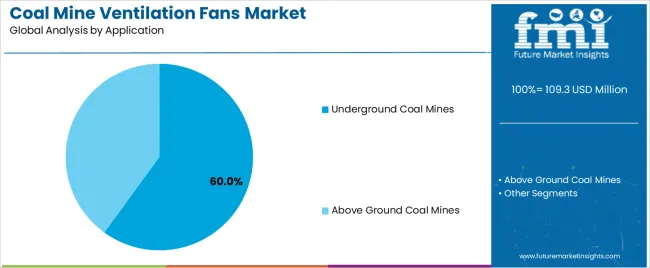
Underground Coal Mines account for 60.00% of global demand, as the physics of subsurface extraction necessitates mechanical life support systems that surface mines do not require. The deepening of reserves in mature markets means that for every vertical meter descended, the ventilation energy penalty increases, compelling operators to invest in high-efficiency primary fans. Above-ground operations utilize fans primarily for dust suppression in crushers and enclosed conveyers, a smaller but regulatory-critical niche.
- Underground Coal Mines: The drive for volume directly impacts infrastructure; Coal India Limited's FY 2024 production surge to 773.6 million tonnes (+10%) requires a proportional expansion of underground ventilation equipment networks to safe-guard new extraction faces [5].
- Above-Ground Coal Mines: Focused on dust collection and confined space ventilation in processing facilities.
- Processing Plants: utilization of smaller units for coal handling and preparation plant (CHPP) air quality control.
Coal Mine Ventilation Fans Market Drivers, Restraints, and Opportunities
The relentless push for energy security in developing economies acts as the primary catalyst for market volume. State-owned entities like Coal India Limited produced 773.6 million tonnes of coal in FY 2024, a 10% increase over the previous year, necessitating immediate expansion of ventilation capacity to support new extraction faces [5]. This volume growth is directly correlated with hardware procurement, as every new panel or gallery requires dedicated auxiliary ventilation to dilute explosive gases and maintain breathable air.
However, the market faces constraints from the high capital cost of retrofitting legacy mines with modern, energy-efficient systems. While newer fans offer operational savings, the initial capex barrier is significant for low-margin operators. Conversely, this creates an opportunity for "Ventilation as a Service" models and automation technologies. For example, Epiroc and ABB signed a Memorandum of Understanding in January 2025 to collaborate on electrification solutions, which includes optimizing ventilation for battery-electric vehicle fleets that produce less heat and diesel particulate matter than traditional machinery [6].
- Deep Mine Expansion: As surface reserves deplete, deeper shafts require exponentially more powerful fans.
- Regulatory Heat Compliance: New rules on working temperature force investment in cooling-integrated ventilation.
- Automation Synergy: Autonomous electric fleets reduce ventilation demand, allowing for down-scaled, smarter fan systems.
Regional Analysis
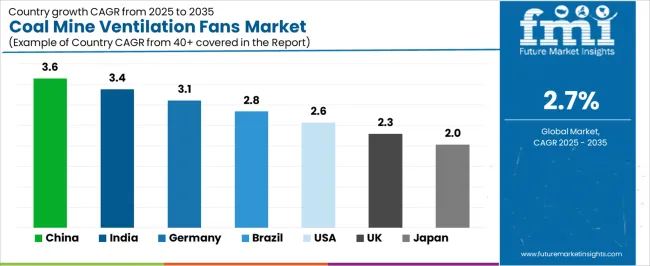
| Country | CAGR (2026 to 2036) |
|---|---|
| China | 3.6% |
| India | 3.4% |
| Germany | 3.1% |
| Brazil | 2.8% |
| USA | 2.6% |
Asia Pacific Coal Mine Ventilation Fans Market Analysis
In Asia Pacific, the sheer velocity of industrial output dictates the market trajectory, as national mandates for energy security override purely economic contraction signals. The mechanism is a direct correlation between kilowatt-hour demand and extraction depth; as surface deposits are exhausted, state planners authorize deeper shafts that physically require exponentially higher air pressure to remain viable. This "depth penalty" ensures a sustained retrofit cycle for high-capacity fans even if total coal tonnage plateaus.
- China: The market is forecast to expand at a 3.60% CAGR through 2036. Despite renewable investments, coal power provided nearly 40% of the increase in total electricity generation in late 2024, enforcing a base-load inertia that keeps mine ventilation procurement active [7].
- India: Domestic consumption is set to grow at a 3.40% CAGR through 2036. Legislative intervention is now the primary procurement accelerator, with the DGMS Technical Circular No. 1 of 2024 mandating strict heat management protocols that legacy ventilation systems cannot meet without upgrades [1].
FMI’s report includes a detailed analysis of growth in the Asia Pacific region, along with a country-wise assessment that includes China, India, and Indonesia. Readers can also find regional trends, regulations, and market growth based on different segments and countries in Asia Pacific, including Australia and Vietnam.
Europe Coal Mine Ventilation Fans Market Analysis
Europe has transitioned into a "legacy management" market where value is generated not by extraction, but by the complex engineering required for safe decommissioning and environmental remediation. The region serves as a global reference lab for post-mining technologies, where ventilation systems are repurposed to manage methane buildup in sealed voids and support water drainage infrastructure. Growth here is technically "negative" in volume but "positive" in value due to the high engineering content of these specialized systems.
- Germany: Sales are anticipated to progress at a 3.10% CAGR through 2036. The focus has shifted entirely to post-mining safety; for instance, the Ibbenbüren mine drainage project utilizes ventilation and pumps that consume energy equivalent to 12,900 households, proving that "closed" mines remain active energy consumers [8].
FMI’s report includes a detailed analysis of growth in the Europe region, along with a country-wise assessment that includes Germany and Poland. Readers can also find regional trends, regulations, and market growth based on different segments and countries in Europe, including Turkey and the Czech Republic.
North America Coal Mine Ventilation Fans Market Analysis
The North American market is defined by a "margin preservation" dynamic, where operators invest in technology primarily to lower the cost-per-ton and ensure survival in a competitive export market. Compliance with safety standards acts as a non-negotiable gatekeeper; mines that cannot afford the ventilation upgrades required by MSHA simply cease operations, consolidating market share among well-capitalized players who view high-efficiency fans as an opex reduction tool rather than a regulatory burden.
- United States: The sector is expected to witness a 2.60% CAGR through 2036. Financial discipline drives procurement; Ramaco Resources, for example, maintained its 2024 position in the first quartile of the cost curve, a status achievable only through rigorously efficient infrastructure including ventilation [9].
FMI’s report includes a detailed analysis of growth in the North America region, along with a country-wise assessment that includes the United States and Canada. Readers can also find regional trends, regulations, and market growth based on different segments and countries in North America, including Mexico.
Latin America Coal Mine Ventilation Fans Market Analysis
Latin America is emerging as a testbed for the "autonomous transition," where the integration of robotics into mining fleets is fundamentally rewriting ventilation specifications. By removing human operators from the most hazardous haulage zones, mines can reduce the safety factor required for breathable air, shifting the ventilation load from "life support" to "machine cooling." This structural change favors smart, sensor-driven fan systems that can modulate airflow based on the real-time location of autonomous assets.
- Brazil: Projections indicate a 2.80% CAGR through 2036. The shift to automation is tangible, with Vale signing an agreement in December 2024 to expand its autonomous truck fleet to approximately 90 vehicles, a move that directly alters the ventilation load profile of its operations [10].
FMI’s report includes a detailed analysis of growth in the Latin America region, along with a country-wise assessment that includes Brazil and Chile. Readers can also find regional trends, regulations, and market growth based on different segments and countries in Latin America, including Colombia and Peru.
Competitive Aligners for Market Players
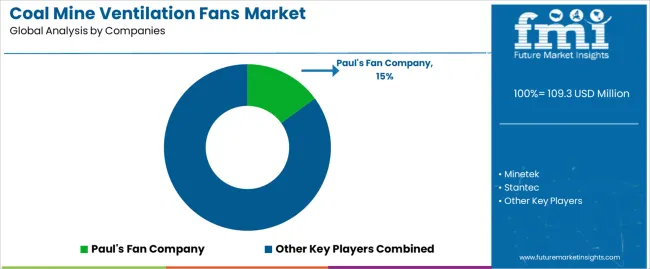
The competitive landscape is defined by the ability to offer integrated "air-on-demand" solutions rather than standalone hardware. Leading players are moving away from selling steel and motors to selling guaranteed airflow and energy savings. This aligns with the operational reality of modern mines, where ventilation is the single largest consumer of electricity. OEMs that can demonstrate lifecycle cost reductions through smart controls and aerodynamic efficiency gain a decisive advantage in procurement tenders.
A secondary competitive variable is the capability to navigate complex regulatory environments. Suppliers that actively participate in safety standard formulations or offer pre-certified compliance packages are preferred partners. For instance, equipment that is pre-validated for MSHA or local heat stress regulations reduces the compliance burden on the mine operator, creating a "sticky" vendor relationship that transcends simple price competition. This is exemplified by Zitrón, which received the XIX Ateneo Jovellanos Award for Economic and Industrial Development in August 2024, recognizing its leadership in underground infrastructure ventilation [11].
Finally, strategic partnerships are reshaping market access. Collaboration between fan manufacturers and automation giants allows for the integration of ventilation data into broader mine management systems. This convergence means that a ventilation fan is no longer an isolated asset but a connected node in the digital mine. A prime example is Maestro Digital Mine, which formed a "virtual triangle" partnership with Clemcorp and Ventsim in 2024 to deliver Ventilation on Demand (VOD) solutions in South Africa, proving that software integration is now a key differentiator [12].
Recent Developments:
The report includes full coverage of key trends from competitive benchmarking. Some of the recent developments covered in the reports:
- In January 2025, Epiroc and ABB signed a Memorandum of Understanding to collaborate on underground electrification, directly impacting ventilation system planning [6].
- In December 2024, Vale signed an agreement to expand its autonomous fleet to 90 trucks by 2028, influencing ventilation design in Brazilian operations [10].
Key Players in Coal Mine Ventilation Fans Market
- Epiroc
- Sandvik
- Caterpillar
- Komatsu
- J.H. Fletcher
- Howden
- TLT-Turbo
- Zitrón
- ABC Ventilation
- Twin City Fan
Scope of the Report
| Metric | Value |
|---|---|
| Quantitative Units | USD 112.3 million (2026) to USD 142.7 million (2036), at a CAGR of 2.70% |
| Market Definition | The coal mine ventilation fans market comprises the global trade and deployment of heavy-duty industrial fans designed specifically to supply fresh air, remove hazardous gases like methane, and regulate temperature in underground and surface coal mining operations. |
| By Type Segmentation | Axial Type, Centrifugal Type, Mixed Flow |
| By Application Segmentation | Underground Coal Mines, Above-Ground Coal Mines, Processing Plants |
| Application Coverage | Main Fans, Booster Fans, Auxiliary Fans |
| Regions Covered | Asia Pacific, Europe, North America, Latin America, Middle East & Africa |
| Countries Covered | China, India, Germany, United States, Brazil |
| Key Companies Profiled | Epiroc, Sandvik, Caterpillar, Komatsu, J.H. Fletcher |
| Forecast Period | 2026 to 2036 |
| Approach | Hybrid bottom-up model validating mine-level production data against regulatory safety mandates and ventilation power coefficients. |
Coal Mine Ventilation Fans Market Analysis by Segments
By Type
- Axial Type
- Centrifugal Type
- Mixed Flow
By Application
- Underground Coal Mines
- Above-Ground Coal Mines
- Processing Plants
Region
- Asia Pacific
- India
- China
- Japan
- South Korea
- Indonesia
- Australia & New Zealand
- ASEAN
- Rest of Asia Pacific
- Europe
- Germany
- Italy
- France
- United Kingdom
- Spain
- Benelux
- Nordics
- Central & Eastern Europe
- Rest of Europe
- North America
- United States
- Canada
- Mexico
- Latin America
- Brazil
- Argentina
- Chile
- Rest of Latin America
- Middle East & Africa
- Kingdom of Saudi Arabia
- United Arab Emirates
- South Africa
- Turkey
- Rest of Middle East & Africa
Bibliography
- [1] DGMS. (2024). Technical Circular No. 1 of 2024 regarding heat waves and precautions. Directorate General of Mines Safety.
- [2] Enterprise Africa. (2025). Howden Projects: Cooling Deep Zambian Mines. Enterprise Africa.
- [3] Mining Review. (2024). TLT-Turbo redefines mining ventilation with Eastern Limb Project. Mining Review.
- [4] Clean Air Metals Inc. (2024). Technical filing regarding Thunder Bay North Project ventilation specs. SEC Filing.
- [5] Coal India Limited. (2024). Production and Supplies Performance Report FY 2024. Coal India Limited.
- [6] Epiroc. (2025). Epiroc and ABB advance collaboration on underground trolley solutions. Epiroc Press Release.
- [7] CREA. (2025). China Coal Power and Renewable Energy Analysis H2 2024. Centre for Research on Energy and Clean Air.
- [8] Tunnel Online. (2024). Ibbenbüren mine water drainage tunnel project presentation. Tunnel Online.
- [9] Ramaco Resources. (2025). 2024 Annual Report and Cost Curve Analysis. Ramaco Resources.
- [10] Vale S.A. (2024). Vale, Caterpillar and Sotreq sign agreement to expand fleet of autonomous trucks. Vale Press Release.
This Report Addresses
- Market intelligence to enable structured strategic decision-making across mature and emerging mining economies.
- Market size estimation and 10-year revenue forecasts from 2026 to 2036, supported by validated production capacity and ventilation power density benchmarks.
- Growth opportunity mapping across axial, centrifugal, and mixed-flow fan types with an emphasis on high-pressure and VOD (Ventilation on Demand) transitions.
- Segment and regional revenue forecasts covering underground mines, above-ground processing, and post-mining environmental management applications.
- Competition strategy assessment including integration models, cost survivability positioning, and compliance capability benchmarking for key OEMs like Epiroc and Sandvik.
- Product reformulation and emission compliance tracking including ATEX, MSHA, and heat stress management aligned grades.
- Regulatory impact analysis covering DGMS heat circulars, OSHA/MSHA air quality thresholds, and export-driven specification upgrades.
- Market report delivery in PDF, Excel, PPT, and interactive dashboard formats for executive and operational use.
Frequently Asked Questions
How large is the demand for Coal Mine Ventilation Fans in the global market in 2026?
Demand for Coal Mine Ventilation Fans is estimated to be valued at USD 112.3 million in 2026.
What will be the size of Coal Mine Ventilation Fans in the global market by 2036?
The market size for Coal Mine Ventilation Fans is projected to reach USD 142.7 million by 2036.
What is the expected demand growth for Coal Mine Ventilation Fans in the global market between 2026 and 2036?
Demand is expected to grow at a CAGR of 2.70% between 2026 and 2036.
Which Axial Type fan is poised to lead global sales by 2026?
Axial Type fans are expected to lead with 55.00% market share due to their efficiency in main shaft ventilation.
How significant is the role of Underground Coal Mines in driving Coal Mine Ventilation Fans adoption in 2026?
Underground Coal Mines are projected to hold a substantial 60.00% share as deep extraction requires mechanical air support.
What is driving demand in China?
Demand is driven by continued reliance on coal power which accounted for 40% of generation growth in late 2024.
What compliance standards or regulations are referenced for China?
National energy security mandates and high-output longwall operational standards are key references.
What is the China growth outlook in this report?
China is projected to grow at a CAGR of 3.60% during 2026 to 2036.
Why is Europe described as a priority region in this report?
Europe is prioritizing efficiency retrofits and post-mining water management projects like the Ibbenbüren drainage tunnel.
What type of demand dominates in Europe?
Replacement demand for energy-efficient units in decommissioning and drainage applications dominates.
What is India growth outlook in this report?
India is projected to expand at a CAGR of 3.40% during 2026 to 2036.
Does the report cover Germany in its regional analysis?
Yes, Germany is included within Europe under the regional scope of analysis.
What are the sources referred to for analyzing Germany?
Technical reports on mine water drainage projects and energy consumption data are used.
What is the main demand theme linked to Germany in its region coverage?
Post-mining environmental management and energy efficiency in drainage systems.
Does the report cover Brazil in its regional analysis?
Yes, Brazil is included within Latin America under the regional coverage framework.
What is the main Brazil related demand theme in its region coverage?
Automation of haulage fleets reducing human-centric ventilation requirements.
Which product formats or configurations are strategically important for Asia Pacific supply chains?
High-pressure axial fans capable of supporting deep-shaft operations are critical.
What is Coal Mine Ventilation Fans and what is it mainly used for?
It refers to heavy-duty fans used to supply fresh air and remove gases in coal mines.
What does Coal Mine Ventilation Fans mean in this report?
It refers to the global trade of powered air-moving machinery for coal extraction.
What is included in the scope of this Coal Mine Ventilation Fans report?
Scope covers main, booster, and auxiliary fans for underground and surface coal mines.
What is excluded from the scope of this report?
General HVAC not rated for explosive atmospheres and passive ventilation aids are excluded.
What does market forecast mean on this page?
Market forecast represents a model-based projection built on production and regulatory assumptions.
How does FMI build and validate the Coal Mine Ventilation Fans forecast?
Forecasts are built using bottom-up modeling of mine production data validated against regulatory mandates.
What does zero reliance on speculative third party market research mean here?
It means the report uses primary interviews and verified corporate/government data points only.
Preview the report firsthand - request a free sample
Get SampleGet the brochure for pricing and purchase details.
Get PDFTable of Content
- Executive Summary
- Global Market Outlook
- Demand-side Trends
- Supply-side Trends
- Technology Roadmap Analysis
- Analysis and Recommendations
- Market Overview
- Market Coverage / Taxonomy
- Market Definition / Scope / Limitations
- Research Methodology
- Chapter Orientation
- Analytical Lens and Working Hypotheses
- Market Structure, Signals, and Trend Drivers
- Benchmarking and Cross-market Comparability
- Market Sizing, Forecasting, and Opportunity Mapping
- Research Design and Evidence Framework
- Desk Research Programme (Secondary Evidence)
- Company Annual and Sustainability Reports
- Peer-reviewed Journals and Academic Literature
- Corporate Websites, Product Literature, and Technical Notes
- Earnings Decks and Investor Briefings
- Statutory Filings and Regulatory Disclosures
- Technical White Papers and Standards Notes
- Trade Journals, Industry Magazines, and Analyst Briefs
- Conference Proceedings, Webinars, and Seminar Materials
- Government Statistics Portals and Public Data Releases
- Press Releases and Reputable Media Coverage
- Specialist Newsletters and Curated Briefings
- Sector Databases and Reference Repositories
- FMI Internal Proprietary Databases and Historical Market Datasets
- Subscription Datasets and Paid Sources
- Social Channels, Communities, and Digital Listening Inputs
- Additional Desk Sources
- Expert Input and Fieldwork (Primary Evidence)
- Primary Modes
- Qualitative Interviews and Expert Elicitation
- Quantitative Surveys and Structured Data Capture
- Blended Approach
- Why Primary Evidence is Used
- Field Techniques
- Interviews
- Surveys
- Focus Groups
- Observational and In-context Research
- Social and Community Interactions
- Stakeholder Universe Engaged
- C-suite Leaders
- Board Members
- Presidents and Vice Presidents
- R&D and Innovation Heads
- Technical Specialists
- Domain Subject-matter Experts
- Scientists
- Physicians and Other Healthcare Professionals
- Governance, Ethics, and Data Stewardship
- Research Ethics
- Data Integrity and Handling
- Primary Modes
- Tooling, Models, and Reference Databases
- Desk Research Programme (Secondary Evidence)
- Data Engineering and Model Build
- Data Acquisition and Ingestion
- Cleaning, Normalisation, and Verification
- Synthesis, Triangulation, and Analysis
- Quality Assurance and Audit Trail
- Market Background
- Market Dynamics
- Drivers
- Restraints
- Opportunity
- Trends
- Scenario Forecast
- Demand in Optimistic Scenario
- Demand in Likely Scenario
- Demand in Conservative Scenario
- Opportunity Map Analysis
- Product Life Cycle Analysis
- Supply Chain Analysis
- Investment Feasibility Matrix
- Value Chain Analysis
- PESTLE and Porter’s Analysis
- Regulatory Landscape
- Regional Parent Market Outlook
- Production and Consumption Statistics
- Import and Export Statistics
- Market Dynamics
- Global Market Analysis 2021 to 2025 and Forecast, 2026 to 2036
- Historical Market Size Value (USD Million) Analysis, 2021 to 2025
- Current and Future Market Size Value (USD Million) Projections, 2026 to 2036
- Y-o-Y Growth Trend Analysis
- Absolute $ Opportunity Analysis
- Global Market Pricing Analysis 2021 to 2025 and Forecast 2026 to 2036
- Global Market Analysis 2021 to 2025 and Forecast 2026 to 2036, By Type
- Introduction / Key Findings
- Historical Market Size Value (USD Million) Analysis By Type , 2021 to 2025
- Current and Future Market Size Value (USD Million) Analysis and Forecast By Type , 2026 to 2036
- Axial
- Centrifugal
- Mixed Flow
- Axial
- Y-o-Y Growth Trend Analysis By Type , 2021 to 2025
- Absolute $ Opportunity Analysis By Type , 2026 to 2036
- Global Market Analysis 2021 to 2025 and Forecast 2026 to 2036, By Application
- Introduction / Key Findings
- Historical Market Size Value (USD Million) Analysis By Application, 2021 to 2025
- Current and Future Market Size Value (USD Million) Analysis and Forecast By Application, 2026 to 2036
- Underground Coal Mines
- Above-Ground Coal Mines
- Processing Plants
- Underground Coal Mines
- Y-o-Y Growth Trend Analysis By Application, 2021 to 2025
- Absolute $ Opportunity Analysis By Application, 2026 to 2036
- Global Market Analysis 2021 to 2025 and Forecast 2026 to 2036, By Region
- Introduction
- Historical Market Size Value (USD Million) Analysis By Region, 2021 to 2025
- Current Market Size Value (USD Million) Analysis and Forecast By Region, 2026 to 2036
- North America
- Latin America
- Western Europe
- Eastern Europe
- East Asia
- South Asia and Pacific
- Middle East & Africa
- Market Attractiveness Analysis By Region
- North America Market Analysis 2021 to 2025 and Forecast 2026 to 2036, By Country
- Historical Market Size Value (USD Million) Trend Analysis By Market Taxonomy, 2021 to 2025
- Market Size Value (USD Million) Forecast By Market Taxonomy, 2026 to 2036
- By Country
- USA
- Canada
- Mexico
- By Type
- By Application
- By Country
- Market Attractiveness Analysis
- By Country
- By Type
- By Application
- Key Takeaways
- Latin America Market Analysis 2021 to 2025 and Forecast 2026 to 2036, By Country
- Historical Market Size Value (USD Million) Trend Analysis By Market Taxonomy, 2021 to 2025
- Market Size Value (USD Million) Forecast By Market Taxonomy, 2026 to 2036
- By Country
- Brazil
- Chile
- Rest of Latin America
- By Type
- By Application
- By Country
- Market Attractiveness Analysis
- By Country
- By Type
- By Application
- Key Takeaways
- Western Europe Market Analysis 2021 to 2025 and Forecast 2026 to 2036, By Country
- Historical Market Size Value (USD Million) Trend Analysis By Market Taxonomy, 2021 to 2025
- Market Size Value (USD Million) Forecast By Market Taxonomy, 2026 to 2036
- By Country
- Germany
- UK
- Italy
- Spain
- France
- Nordic
- BENELUX
- Rest of Western Europe
- By Type
- By Application
- By Country
- Market Attractiveness Analysis
- By Country
- By Type
- By Application
- Key Takeaways
- Eastern Europe Market Analysis 2021 to 2025 and Forecast 2026 to 2036, By Country
- Historical Market Size Value (USD Million) Trend Analysis By Market Taxonomy, 2021 to 2025
- Market Size Value (USD Million) Forecast By Market Taxonomy, 2026 to 2036
- By Country
- Russia
- Poland
- Hungary
- Balkan & Baltic
- Rest of Eastern Europe
- By Type
- By Application
- By Country
- Market Attractiveness Analysis
- By Country
- By Type
- By Application
- Key Takeaways
- East Asia Market Analysis 2021 to 2025 and Forecast 2026 to 2036, By Country
- Historical Market Size Value (USD Million) Trend Analysis By Market Taxonomy, 2021 to 2025
- Market Size Value (USD Million) Forecast By Market Taxonomy, 2026 to 2036
- By Country
- China
- Japan
- South Korea
- By Type
- By Application
- By Country
- Market Attractiveness Analysis
- By Country
- By Type
- By Application
- Key Takeaways
- South Asia and Pacific Market Analysis 2021 to 2025 and Forecast 2026 to 2036, By Country
- Historical Market Size Value (USD Million) Trend Analysis By Market Taxonomy, 2021 to 2025
- Market Size Value (USD Million) Forecast By Market Taxonomy, 2026 to 2036
- By Country
- India
- ASEAN
- Australia & New Zealand
- Rest of South Asia and Pacific
- By Type
- By Application
- By Country
- Market Attractiveness Analysis
- By Country
- By Type
- By Application
- Key Takeaways
- Middle East & Africa Market Analysis 2021 to 2025 and Forecast 2026 to 2036, By Country
- Historical Market Size Value (USD Million) Trend Analysis By Market Taxonomy, 2021 to 2025
- Market Size Value (USD Million) Forecast By Market Taxonomy, 2026 to 2036
- By Country
- Kingdom of Saudi Arabia
- Other GCC Countries
- Turkiye
- South Africa
- Other African Union
- Rest of Middle East & Africa
- By Type
- By Application
- By Country
- Market Attractiveness Analysis
- By Country
- By Type
- By Application
- Key Takeaways
- Key Countries Market Analysis
- USA
- Pricing Analysis
- Market Share Analysis, 2025
- By Type
- By Application
- Canada
- Pricing Analysis
- Market Share Analysis, 2025
- By Type
- By Application
- Mexico
- Pricing Analysis
- Market Share Analysis, 2025
- By Type
- By Application
- Brazil
- Pricing Analysis
- Market Share Analysis, 2025
- By Type
- By Application
- Chile
- Pricing Analysis
- Market Share Analysis, 2025
- By Type
- By Application
- Germany
- Pricing Analysis
- Market Share Analysis, 2025
- By Type
- By Application
- UK
- Pricing Analysis
- Market Share Analysis, 2025
- By Type
- By Application
- Italy
- Pricing Analysis
- Market Share Analysis, 2025
- By Type
- By Application
- Spain
- Pricing Analysis
- Market Share Analysis, 2025
- By Type
- By Application
- France
- Pricing Analysis
- Market Share Analysis, 2025
- By Type
- By Application
- India
- Pricing Analysis
- Market Share Analysis, 2025
- By Type
- By Application
- ASEAN
- Pricing Analysis
- Market Share Analysis, 2025
- By Type
- By Application
- Australia & New Zealand
- Pricing Analysis
- Market Share Analysis, 2025
- By Type
- By Application
- China
- Pricing Analysis
- Market Share Analysis, 2025
- By Type
- By Application
- Japan
- Pricing Analysis
- Market Share Analysis, 2025
- By Type
- By Application
- South Korea
- Pricing Analysis
- Market Share Analysis, 2025
- By Type
- By Application
- Russia
- Pricing Analysis
- Market Share Analysis, 2025
- By Type
- By Application
- Poland
- Pricing Analysis
- Market Share Analysis, 2025
- By Type
- By Application
- Hungary
- Pricing Analysis
- Market Share Analysis, 2025
- By Type
- By Application
- Kingdom of Saudi Arabia
- Pricing Analysis
- Market Share Analysis, 2025
- By Type
- By Application
- Turkiye
- Pricing Analysis
- Market Share Analysis, 2025
- By Type
- By Application
- South Africa
- Pricing Analysis
- Market Share Analysis, 2025
- By Type
- By Application
- USA
- Market Structure Analysis
- Competition Dashboard
- Competition Benchmarking
- Market Share Analysis of Top Players
- By Regional
- By Type
- By Application
- Competition Analysis
- Competition Deep Dive
- Epiroc
- Overview
- Product Portfolio
- Profitability by Market Segments (Product/Age /Sales Channel/Region)
- Sales Footprint
- Strategy Overview
- Marketing Strategy
- Product Strategy
- Channel Strategy
- Sandvik
- Caterpillar
- Komatsu
- J.H. Fletcher
- Howden
- TLT-Turbo
- Epiroc
- Competition Deep Dive
- Assumptions & Acronyms Used


