

- Industry Size (2026)
- USD 1.3 Bn
- Forecast (2036)
- USD 2.7 Bn
- CAGR (2026 to 2036)
- 7.5%
Cleanroom Stainless Steel Furniture Market Forecast and Outlook 2026 to 2036
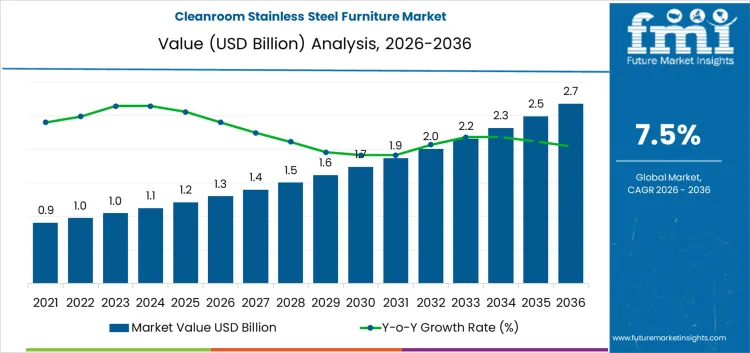
Facility fit out cycles in pharmaceutical, biotech, and electronics plants places the cleanroom stainless steel furniture market at USD 1.3 billion in 2026 and extend it to USD 2.7 billion by 2036 at a 7.50% CAGR. Selection starts from room classification, cleaning regime, and load ratings rather than from catalog aesthetics. Designers lock bench types, shelving, and cabinets into layouts that must pass particulate and wipe down protocols. Once a room qualifies, changes disrupt revalidation schedules. Buyers look for weld finish quality, corner radii, and drainage behavior. Installation planning coordinates anchoring, leveling, and clearance for cleaning equipment.
Commercial outcomes in this category depend on project timing, customization capability, and documentation discipline. Fabricators schedule sheet forming, welding, and passivation around inspection slots. Release gates include surface roughness checks and dimensional verification. Integrators influence orders through turnkey room packages. Spare parts list focus on hinges, feet, and adjustable frames. Service teams handle modifications during reconfiguration projects. Warehousing stages modules near active build sites. Profit formation follows fabrication yield, rework control, and steady project flow rather than price led spot orders or broad catalog expansion.
Quick Stats for Cleanroom Stainless Steel Furniture Market
- Cleanroom Stainless Steel Furniture Market Value (2026): USD 1.3 billion
- Cleanroom Stainless Steel Furniture Market Forecast Value (2036): USD 2.7 billion
- Cleanroom Stainless Steel Furniture Market Forecast CAGR 2026 to 2036: 7.5%
- Leading Product Type in Cleanroom Stainless Steel Furniture Market: Workstations
- Leading End Use Industry in Cleanroom Stainless Steel Furniture Market: Pharmaceutical and biotech cleanrooms
- Key Growth Regions in Cleanroom Stainless Steel Furniture Market: Asia Pacific, Europe, North America
- Top Players in Cleanroom Stainless Steel Furniture Market: AirClean Systems, Cleanrooms International, Terra Universal, GKE Corporation, Esco Technologies
What Is the Growth Forecast for the Cleanroom Stainless Steel Furniture Market through 2036?
Facility validation standards and workflow layout decisions set purchasing patterns in the cleanroom stainless steel furniture market more than overall cleanroom construction volume. In 2026, at about USD 1.3 billion, demand is concentrated in pharmaceutical plants, biotechnology facilities, and medical device factories where furniture selection is written into room qualification documents. Once a layout is approved, tables, cabinets, and transfer carts remain in service across long operating cycles, which ties replacement demand to major refurbishments rather than routine maintenance. Expansion comes from capacity additions, room reconfiguration, and tighter segregation of process steps. The steady rise reflects gradual build out of controlled spaces and more complex production flows rather than rapid turnover of installed assets.
Compliance burden and operational durability shape the later phase of the cleanroom stainless steel furniture market. As value approaches roughly USD 2.7 billion by 2036, buyers focus on surface finish quality, cleanability, and resistance to repeated chemical exposure. Product ranges extend toward modular systems that support frequent layout changes without full replacement. Manufacturing effort increases as documentation, factory inspection, and site acceptance requirements become more detailed. The move from the low one billions into the high two billion reflects accumulated installations across many regulated facilities rather than a single investment cycle. Suppliers that combine fabrication consistency, dependable delivery schedules, and responsive service support tend to secure repeat orders across long running production sites.
Cleanroom Stainless Steel Furniture Market Key Takeaways
| Metric | Value |
|---|---|
| Market Value (2026) | USD 1.3 billion |
| Forecast Value (2036) | USD 2.7 billion |
| Forecast CAGR 2026 to 2036 | 7.5% |
How Is the Cleanroom Stainless Steel Furniture Market Supporting Controlled Production Environments?
Cleanroom stainless steel furniture includes tables, racks, cabinets, and trolleys used in pharmaceuticals, biotechnology, electronics, and medical device plants. Earlier facilities relied on painted steel or laminated surfaces, which degraded under frequent cleaning and shed particles at joints and edges. Stainless designs address this through welded seams, smooth radii, and corrosion resistant grades that tolerate repeated exposure to disinfectants. Engineers specify these items by load rating, surface finish, cleanability, and compatibility with room classification. Layout planning treats furniture as part of the airflow and cleaning strategy, not as movable accessories. Adoption rises when rooms move to higher cleanliness classes or when audit findings require replacement of legacy fixtures. Buyers also consider mobility and modular sizing because frequent line changes demand predictable repositioning without creating contamination risk.
Procurement is usually led by quality, validation, and facility engineering teams rather than by general purchasing. Earlier buying patterns allowed varied local designs, which increased spare parts range and complicated cleaning procedures. Current programs aim to standardize dimensions, finishes, and accessory interfaces across entire sites. Manufacturers compete on weld quality, surface consistency, and documentation support rather than sheet thickness alone. Users evaluate total cost through cleaning time, downtime during room changes, and inspection outcomes, not purchase price. Distributors add value through site surveys, installation, and rapid replacement stock. Over time, demand follows expansion of regulated production capacity and tighter inspection regimes, where furniture becomes a fixed part of the process envelope. Suppliers that maintain consistent specifications and stable supply positions remain on approved lists across long facility programs.
What Factors Are Shaping Segment-Wise Demand for Cleanroom Stainless Steel Furniture in 2026?
Specification in Cleanroom Stainless Steel Furniture Market is determined by contamination control strategy, room classification, and inspection regimes rather than by routine facility refurbishment cycles. Furniture layouts are approved as part of cleanroom qualification and become embedded in material flow, personnel movement, and cleaning procedures. Once a room is validated, furniture type, surface finish, and placement are fixed within the compliance file. This links demand to new cleanroom builds, capacity expansions, and major requalification projects. Segment structure reflects differences in functional role, cleanability, and integration with process equipment. Buyers prioritize surface integrity, cleanability, load stability, and documentation because furniture is treated as part of the controlled environment, not as generic fixtures.
How Does Product Type Selection Influence Workflow Control and Validation Effort in the Cleanroom Stainless Steel Furniture Market?
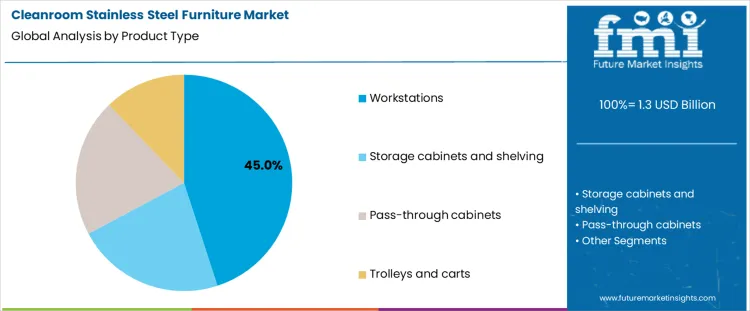
Workstations represent about 45% of demand in the Cleanroom Stainless Steel Furniture Market because most cleanrooms require fixed points for assembly, inspection, or material handling under controlled conditions. These units define operator posture, tool placement, and cleaning routines, which makes them central to room layout approval. Storage cabinets and shelving serve organized material staging, though they introduce additional surfaces and access points that must be included in cleaning validation. Pass through cabinets are specified where material transfer between rooms of different grades must be controlled, increasing design and testing requirements. Trolleys and carts support internal logistics, yet require wheel, joint, and surface design that meets cleaning and particle control standards.
From a compliance perspective, product type choice establishes inspection scope and maintenance discipline. Fixed workstations and cabinets are included in routine surface integrity checks and cleaning validation. Pass through systems add interlock, seal, and interface verification into qualification protocols. Mobile carts introduce additional wear points that must be monitored for surface damage and particle generation. Once a room is qualified with a specific furniture set, changes are avoided because revalidation affects room classification and operating approval. Demand by product type therefore follows cleanroom design standards and process layout decisions rather than short term facility refurnishing budgets.
Why Does End Use Industry Define Volume Concentration and Specification Strictness in the Cleanroom Stainless Steel Furniture Market?
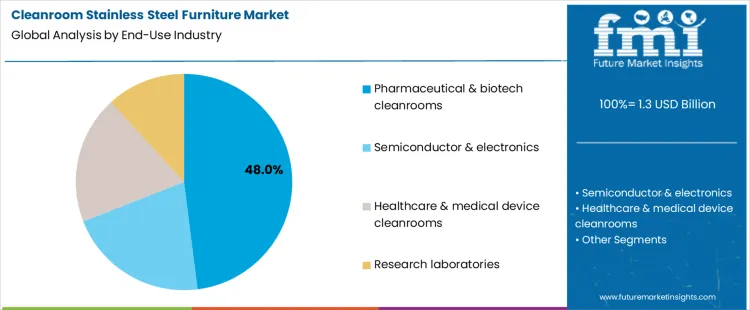
Pharmaceutical and biotech cleanrooms account for about 48% of demand in the Cleanroom Stainless Steel Furniture Market because these facilities operate under strict regulatory oversight and require extensive controlled surfaces for compounding, filling, and inspection. Semiconductor and electronics cleanrooms also require controlled furniture, though layouts are more tool centric and customized. Healthcare and medical device cleanrooms focus on hygiene, traceability, and ease of cleaning, which shapes furniture design and approval processes. Research laboratories operate at smaller scale and with more varied layouts, resulting in lower volumes and higher customization. These differences explain why volume concentrates in regulated life science manufacturing environments.
End use industry also shapes procurement and qualification practice. Pharmaceutical manufacturers purchase through capital projects with formal user requirement specifications and validation plans. Semiconductor facilities integrate furniture into tool installation and facility upgrade programs. Medical device producers align purchases with regulatory audits and line changes. Research institutions acquire furniture on a project basis with flexible specifications. The resulting demand structure concentrates volume where regulatory compliance and standardized layouts coincide, while other sectors contribute smaller, specification driven orders. Segment shares therefore move with cleanroom capacity expansion, regulatory inspection cycles, and laboratory infrastructure investment rather than with short term facility maintenance activity.
How Is the Cleanroom Stainless Steel Furniture Market Being Defined by Contamination Control and Facility Standardization?
The Cleanroom Stainless Steel Furniture Market is shaped by how regulated manufacturing environments manage cleanliness, durability, and audit readiness. In pharmaceutical, biotechnology, electronics, and medical device facilities, furniture becomes part of the controlled environment rather than a simple utility asset. Buyers focus on surface finish, cleanability, corrosion resistance, and compatibility with cleaning protocols. Selection decisions involve quality, validation, and facility engineering teams. This positions cleanroom furniture as a compliance and process support element, not as a discretionary purchase, which makes documentation, material traceability, and build quality central to supplier evaluation.
How Is Modular Room Design Changing Equipment Expectations in The Cleanroom Stainless Steel Furniture Market?
Many facilities are designed around repeatable room layouts and standardized process cells. This is changing expectations in the Cleanroom Stainless Steel Furniture Market toward furniture systems that fit predefined footprints and workflows. Buyers prefer consistent dimensions, shared accessories, and interchangeable components to simplify layout planning and future modifications. This also reduces training and maintenance complexity. As a result, suppliers are evaluated on product family consistency and long-term availability rather than on custom one-off pieces. Furniture selection is increasingly tied to room design templates and equipment placement standards used across multiple production lines.
Where Is Repeat Procurement Being Created in The Cleanroom Stainless Steel Furniture Market?
Repeat procurement is being created through phased facility expansions, line additions, and internal layout reconfigurations. Each new cleanroom, process area, or packaging suite requires benches, tables, storage units, and transfer furniture built to controlled standards. The Cleanroom Stainless Steel Furniture Market also benefits from refurbishment cycles where older or damaged items are replaced to maintain audit readiness. There is opportunity for suppliers that become part of standard facility equipment lists used by engineering contractors and internal project teams, securing recurring orders across multi-year build and upgrade programs.
Why Do Capital Budget Priorities and Long Replacement Cycles Limit Faster Turnover in The Cleanroom Stainless Steel Furniture Market?
Stainless steel cleanroom furniture is durable and often remains in service for many years. This reduces replacement frequency and slows volume growth from existing sites. The Cleanroom Stainless Steel Furniture Market also competes for capital budgets with core production equipment, which often receives priority. In some projects, furniture upgrades are postponed if existing items still pass inspection. Custom sizing and room-specific design constraints also limit reuse across sites. These factors keep purchasing activity tied mainly to new builds and major refurbishments rather than to continuous replacement cycles.
What is the Demand for Cleanroom Stainless Steel Furniture by Country?
| Country | CAGR |
|---|---|
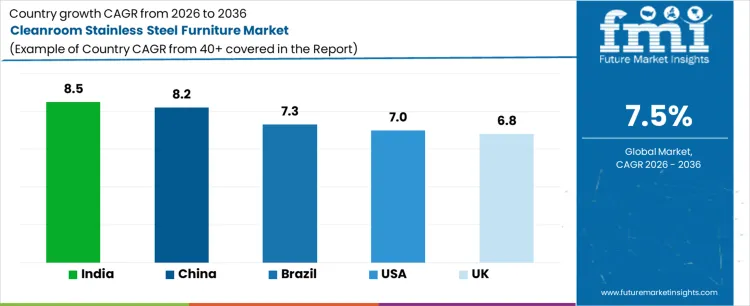
| USA | 7.0% |
| UK | 6.8% |
| China | 8.2% |
| India | 8.5% |
| Brazil | 7.3% |
Demand for cleanroom stainless steel furniture is rising as pharmaceutical, biotechnology, medical device, and electronics manufacturers expand controlled environment production and laboratory space. India leads with an 8.5% CAGR, supported by new drug manufacturing plants, vaccine facilities, and contract manufacturing cleanrooms. China follows at 8.2%, driven by growth in biologics, semiconductor, and medical device production requiring contamination controlled environments. Brazil records 7.3%, reflecting gradual expansion of regulated manufacturing and hospital pharmacy cleanrooms. The USA grows at 7.0%, shaped by replacement of aging cleanroom infrastructure and capacity additions in life sciences. The UK, at 6.8%, reflects steady investment in regulated laboratories and production facilities.
How Do Facility Expansion and GMP Audits Shape Demand in the United States?
Controlled environment buildouts keep the cleanroom stainless steel furniture market in the United States on a 7.0% CAGR path. Pharmaceutical plants, biotech suites, medical device lines, and compounding pharmacies represent core buyers. Engineering teams specify benches, cabinets, racks, and carts based on cleanability, weld quality, and load ratings. Procurement follows turnkey cleanroom projects rather than ad hoc purchases. Surface finish documentation and material certificates remain part of acceptance files. Maintenance teams track seal condition, caster wear, and corrosion resistance. Replacement demand appears after audit findings or layout changes. Distributors manage regional installation and service coverage. Inventory planning aligns with project schedules. Training programs support correct handling and cleaning procedures. Budget cycles follow capacity expansion plans. Commercial position depends on specification inclusion and dependable service support across multi-site operators.
Why Do Validation Protocols and Framework Purchasing Guide Adoption in the United Kingdom?
Regulated manufacturing investment places the cleanroom stainless steel furniture market in the United Kingdom on a 6.8% CAGR trajectory. Hospital pharmacies, aseptic suites, and life science plants account for most demand. Design teams define furniture layouts to support workflow separation and cleaning access. Procurement flows through framework agreements managed by integrators. Acceptance relies on surface finish checks, weld inspection, and load testing records. Maintenance contractors schedule routine inspection and adjustment visits. Replacement occurs after audit observations or room reconfiguration projects. Storage and staging plans influence order timing. Distributors keep standard items near major clusters. Documentation remains part of quality files. Training programs influence correct use and cleaning discipline. Capital planning follows refurbishment cycles. Commercial access depends on framework inclusion and audit performance rather than competition for small departmental orders.
What Role Do High Volume Construction Programs Play in China?
Large scale facility programs place the cleanroom stainless steel furniture market in China on an 8.2% growth path. Pharmaceutical campuses, electronics cleanrooms, and vaccine plants drive most installations. Design institutes publish standard room modules and furniture layouts. Domestic manufacturing supports volume output and delivery stability. Procurement aggregates demand through project packages. Installation teams coordinate placement during room fit out stages. Quality groups verify surface finish, joint integrity, and dimensional tolerance. Replacement activity follows room expansion or process changes. Regional warehouses stage standard items for rapid deployment. Payment schedules align with project milestones. Training programs support correct handling and cleaning methods. Documentation supports inspections and acceptance. Commercial success depends on inclusion in national construction programs and consistent execution across contractors rather than fragmented sales to small workshops.
How Do Capacity Expansion and Contract Manufacturing Shape Demand in India?
Manufacturing growth fixes the cleanroom stainless steel furniture market in India at an 8.5% CAGR. Pharmaceutical plants, biologics sites, and medical device units represent core customers. Project consultants specify furniture based on workflow, cleanability, and corrosion resistance. Procurement often occurs within turnkey cleanroom contracts. Local fabricators supply frames while fittings arrive through approved suppliers. Installation aligns with room qualification schedules. Maintenance teams focus on fastener integrity and surface condition. Replacement demand follows audit findings or line modifications. Distributor networks manage spares and service support. Training programs guide cleaning and handling practices. Inventory planning follows project pipelines. Documentation remains part of validation files. Commercial results depend on inclusion in approved vendor lists and dependable execution rather than competition for one time room level purchases.
How Do Compliance Programs and Industrial Investment Shape Spending in Brazil?
Facility modernization keeps the cleanroom stainless steel furniture market in Brazil near a 7.3% CAGR. Pharmaceutical sites, cosmetics plants, and hospital compounding rooms form the main client base. Engineering firms define layouts based on cleaning access and material flow. Procurement follows capital projects rather than incremental buying. Import procedures influence lead times for specialized items. Local workshops supply standard benches and racks. Acceptance relies on finish checks and dimensional verification. Maintenance planning covers caster condition and fastener security. Replacement appears after audit findings or room changes. Distributors stock common items near urban centers. Training supports correct cleaning practice. Documentation remains part of inspection records. Commercial position depends on approved supplier status and reliable delivery rather than competition for small single room orders.
How Do Suppliers Secure Standardization Roles in the Cleanroom Stainless Steel Furniture Market?
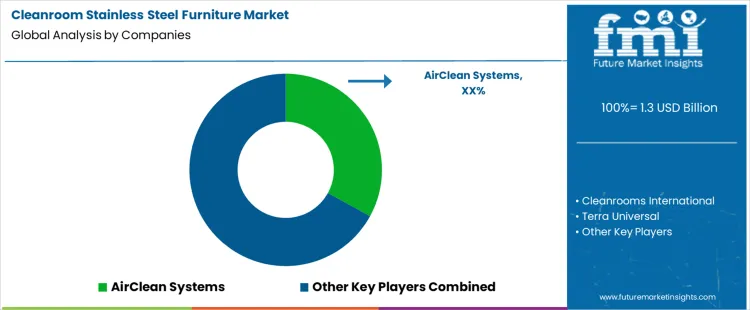
Cleanroom stainless steel furniture selection begins during facility layout and contamination control planning rather than during furnishing budgets. Process engineers map material flow, gowning steps, cleaning access, and equipment interfaces before approving any supplier. AirClean Systems, Cleanrooms International, Terra Universal, GKE Corporation, Esco compete inside those layout approvals. Once drawings include benches, carts, cabinets, and sinks, validation protocols and cleaning procedures lock those items in place. Terra Universal supplies high specification furniture for semiconductor and advanced life science sites. GKE Corporation supports pharmaceutical rooms that require documented finishes and weld quality. Cleanrooms International links furniture with wall and ceiling systems in turnkey builds. AirClean Systems focuses on laboratory environments with standardized modules. Esco serves biosafety and containment driven spaces with integrated workstations.
Competitive outcomes reflect fabrication discipline, delivery coordination, and validation support rather than headline pricing. Project teams review surface finish, weld consistency, corner radii, load ratings, and drainability during technical evaluation. Construction schedules favor suppliers that deliver furniture aligned with wall panels and service rough ins. Maintenance teams value designs that allow full access for cleaning and gasket replacement. Terra Universal benefits from acceptance in tightly controlled manufacturing environments. GKE Corporation relies on pharmaceutical references and regional service presence. Cleanrooms International secures orders where furniture forms part of full room contracts. AirClean Systems gains repeat business in laboratory networks that standardize layouts. Esco competes where containment equipment and furniture require coordinated installation. Market positions vary by cleanliness class, regulatory oversight, and build strategy chosen by facility owners.
Key Players of Cleanroom Stainless Steel Furniture Market
- AirClean Systems
- Cleanrooms International
- Terra Universal
- GKE Corporation
- Esco Technologies
Scope of the Report
| Items | Values |
|---|---|
| Quantitative Units (2026) | USD billion |
| Product Type | Workstations, Storage cabinets and shelving, Pass-through cabinets, Trolleys and carts |
| End-Use Industry | Pharmaceutical & biotech cleanrooms, Semiconductor & electronics, Healthcare & medical device cleanrooms, Research laboratories |
| Region | Asia Pacific, Europe, North America, Latin America, Middle East & Africa |
| Countries Covered | China, Japan, South Korea, India, Australia & New Zealand, ASEAN, Germany, United Kingdom, France, Italy, Spain, Nordic, BENELUX, United States, Canada, Mexico, Brazil, Chile, Saudi Arabia, Turkey, South Africa, and other regional markets |
| Key Companies Profiled | AirClean Systems, Cleanrooms International, Terra Universal, GKE Corporation, Esco Technologies |
| Additional Attributes | Dollar by sales by product type and end-use; demand linked to cleanroom builds and requalification projects; selection based on surface finish, weld quality, cleanability, and load ratings; procurement via turnkey projects; focus on validation documentation, installation coordination, rework control, and long service life in regulated environments. |
Cleanroom Stainless Steel Furniture Market Segmentation
Product Type:
- Workstations
- Storage cabinets and shelving
- Pass-through cabinets
- Trolleys and carts
End-Use Industry:
- Pharmaceutical & biotech cleanrooms
- Semiconductor & electronics
- Healthcare & medical device cleanrooms
- Research laboratories
Region:
- Asia Pacific
- China
- Japan
- South Korea
- India
- Australia & New Zealand
- ASEAN
- Rest of Asia Pacific
- Europe
- Germany
- United Kingdom
- France
- Italy
- Spain
- Nordic
- BENELUX
- Rest of Europe
- North America
- United States
- Canada
- Mexico
- Latin America
- Brazil
- Chile
- Rest of Latin America
- Middle East & Africa
- Kingdom of Saudi Arabia
- Other GCC Countries
- Turkey
- South Africa
- Other African Union
- Rest of Middle East & Africa
Bibliography
- USA Food and Drug Administration. (2023). Guidance for industry: Sterile drug products produced by aseptic processing - Current good manufacturing practice.
- Institute of Environmental Sciences and Technology. (2023). IEST-RP-CC001: HEPA and ULPA filters.
- International Organization for Standardization. (2023). ISO 14644-5: Cleanrooms and associated controlled environments - Part 5: Operations. ISO.
Frequently Asked Questions
How big is the cleanroom stainless steel furniture market in 2026?
The global cleanroom stainless steel furniture market is estimated to be valued at USD 1.3 billion in 2026.
What will be the size of cleanroom stainless steel furniture market in 2036?
The market size for the cleanroom stainless steel furniture market is projected to reach USD 2.7 billion by 2036.
How much will be the cleanroom stainless steel furniture market growth between 2026 and 2036?
The cleanroom stainless steel furniture market is expected to grow at a 7.5% CAGR between 2026 and 2036.
What are the key product types in the cleanroom stainless steel furniture market?
The key product types in cleanroom stainless steel furniture market are workstations , storage cabinets and shelving, pass‑through cabinets and trolleys and carts.
Which end‑use industry segment to contribute significant share in the cleanroom stainless steel furniture market in 2026?
In terms of end‑use industry, pharmaceutical & biotech cleanrooms segment to command 48.0% share in the cleanroom stainless steel furniture market in 2026.
Preview the report firsthand - request a free sample
Get SampleGet the brochure for pricing and purchase details.
Get PDFTable of Content
- Executive Summary
- Global Market Outlook
- Demand-side Trends
- Supply-side Trends
- Technology Roadmap Analysis
- Analysis and Recommendations
- Market Overview
- Market Coverage / Taxonomy
- Market Definition / Scope / Limitations
- Market Background
- Market Dynamics
- Drivers
- Restraints
- Opportunity
- Trends
- Scenario Forecast
- Demand in Optimistic Scenario
- Demand in Likely Scenario
- Demand in Conservative Scenario
- Opportunity Map Analysis
- Product Life Cycle Analysis
- Supply Chain Analysis
- Investment Feasibility Matrix
- Value Chain Analysis
- PESTLE and Porter’s Analysis
- Regulatory Landscape
- Regional Parent Market Outlook
- Production and Consumption Statistics
- Import and Export Statistics
- Market Dynamics
- Global Market Analysis 2021 to 2025 and Forecast, 2026 to 2036
- Historical Market Size Value (USD Million) Analysis, 2021 to 2025
- Current and Future Market Size Value (USD Million) Projections, 2026 to 2036
- Y-o-Y Growth Trend Analysis
- Absolute $ Opportunity Analysis
- Global Market Pricing Analysis 2021 to 2025 and Forecast 2026 to 2036
- Global Market Analysis 2021 to 2025 and Forecast 2026 to 2036, By Product Type
- Introduction / Key Findings
- Historical Market Size Value (USD Million) Analysis By Product Type , 2021 to 2025
- Current and Future Market Size Value (USD Million) Analysis and Forecast By Product Type , 2026 to 2036
- Workstations
- Storage cabinets and shelving
- Pass‑through cabinets
- Trolleys and carts
- Workstations
- Y-o-Y Growth Trend Analysis By Product Type , 2021 to 2025
- Absolute $ Opportunity Analysis By Product Type , 2026 to 2036
- Global Market Analysis 2021 to 2025 and Forecast 2026 to 2036, By End‑Use Industry
- Introduction / Key Findings
- Historical Market Size Value (USD Million) Analysis By End‑Use Industry, 2021 to 2025
- Current and Future Market Size Value (USD Million) Analysis and Forecast By End‑Use Industry, 2026 to 2036
- Pharmaceutical & biotech cleanrooms
- Semiconductor & electronics
- Healthcare & medical device cleanrooms
- Research laboratories
- Pharmaceutical & biotech cleanrooms
- Y-o-Y Growth Trend Analysis By End‑Use Industry, 2021 to 2025
- Absolute $ Opportunity Analysis By End‑Use Industry, 2026 to 2036
- Global Market Analysis 2021 to 2025 and Forecast 2026 to 2036, By Region
- Introduction
- Historical Market Size Value (USD Million) Analysis By Region, 2021 to 2025
- Current Market Size Value (USD Million) Analysis and Forecast By Region, 2026 to 2036
- North America
- Latin America
- Western Europe
- Eastern Europe
- East Asia
- South Asia and Pacific
- Middle East & Africa
- Market Attractiveness Analysis By Region
- North America Market Analysis 2021 to 2025 and Forecast 2026 to 2036, By Country
- Historical Market Size Value (USD Million) Trend Analysis By Market Taxonomy, 2021 to 2025
- Market Size Value (USD Million) Forecast By Market Taxonomy, 2026 to 2036
- By Country
- USA
- Canada
- Mexico
- By Product Type
- By End‑Use Industry
- By Country
- Market Attractiveness Analysis
- By Country
- By Product Type
- By End‑Use Industry
- Key Takeaways
- Latin America Market Analysis 2021 to 2025 and Forecast 2026 to 2036, By Country
- Historical Market Size Value (USD Million) Trend Analysis By Market Taxonomy, 2021 to 2025
- Market Size Value (USD Million) Forecast By Market Taxonomy, 2026 to 2036
- By Country
- Brazil
- Chile
- Rest of Latin America
- By Product Type
- By End‑Use Industry
- By Country
- Market Attractiveness Analysis
- By Country
- By Product Type
- By End‑Use Industry
- Key Takeaways
- Western Europe Market Analysis 2021 to 2025 and Forecast 2026 to 2036, By Country
- Historical Market Size Value (USD Million) Trend Analysis By Market Taxonomy, 2021 to 2025
- Market Size Value (USD Million) Forecast By Market Taxonomy, 2026 to 2036
- By Country
- Germany
- UK
- Italy
- Spain
- France
- Nordic
- BENELUX
- Rest of Western Europe
- By Product Type
- By End‑Use Industry
- By Country
- Market Attractiveness Analysis
- By Country
- By Product Type
- By End‑Use Industry
- Key Takeaways
- Eastern Europe Market Analysis 2021 to 2025 and Forecast 2026 to 2036, By Country
- Historical Market Size Value (USD Million) Trend Analysis By Market Taxonomy, 2021 to 2025
- Market Size Value (USD Million) Forecast By Market Taxonomy, 2026 to 2036
- By Country
- Russia
- Poland
- Hungary
- Balkan & Baltic
- Rest of Eastern Europe
- By Product Type
- By End‑Use Industry
- By Country
- Market Attractiveness Analysis
- By Country
- By Product Type
- By End‑Use Industry
- Key Takeaways
- East Asia Market Analysis 2021 to 2025 and Forecast 2026 to 2036, By Country
- Historical Market Size Value (USD Million) Trend Analysis By Market Taxonomy, 2021 to 2025
- Market Size Value (USD Million) Forecast By Market Taxonomy, 2026 to 2036
- By Country
- China
- Japan
- South Korea
- By Product Type
- By End‑Use Industry
- By Country
- Market Attractiveness Analysis
- By Country
- By Product Type
- By End‑Use Industry
- Key Takeaways
- South Asia and Pacific Market Analysis 2021 to 2025 and Forecast 2026 to 2036, By Country
- Historical Market Size Value (USD Million) Trend Analysis By Market Taxonomy, 2021 to 2025
- Market Size Value (USD Million) Forecast By Market Taxonomy, 2026 to 2036
- By Country
- India
- ASEAN
- Australia & New Zealand
- Rest of South Asia and Pacific
- By Product Type
- By End‑Use Industry
- By Country
- Market Attractiveness Analysis
- By Country
- By Product Type
- By End‑Use Industry
- Key Takeaways
- Middle East & Africa Market Analysis 2021 to 2025 and Forecast 2026 to 2036, By Country
- Historical Market Size Value (USD Million) Trend Analysis By Market Taxonomy, 2021 to 2025
- Market Size Value (USD Million) Forecast By Market Taxonomy, 2026 to 2036
- By Country
- Kingdom of Saudi Arabia
- Other GCC Countries
- Turkiye
- South Africa
- Other African Union
- Rest of Middle East & Africa
- By Product Type
- By End‑Use Industry
- By Country
- Market Attractiveness Analysis
- By Country
- By Product Type
- By End‑Use Industry
- Key Takeaways
- Key Countries Market Analysis
- USA
- Pricing Analysis
- Market Share Analysis, 2025
- By Product Type
- By End‑Use Industry
- Canada
- Pricing Analysis
- Market Share Analysis, 2025
- By Product Type
- By End‑Use Industry
- Mexico
- Pricing Analysis
- Market Share Analysis, 2025
- By Product Type
- By End‑Use Industry
- Brazil
- Pricing Analysis
- Market Share Analysis, 2025
- By Product Type
- By End‑Use Industry
- Chile
- Pricing Analysis
- Market Share Analysis, 2025
- By Product Type
- By End‑Use Industry
- Germany
- Pricing Analysis
- Market Share Analysis, 2025
- By Product Type
- By End‑Use Industry
- UK
- Pricing Analysis
- Market Share Analysis, 2025
- By Product Type
- By End‑Use Industry
- Italy
- Pricing Analysis
- Market Share Analysis, 2025
- By Product Type
- By End‑Use Industry
- Spain
- Pricing Analysis
- Market Share Analysis, 2025
- By Product Type
- By End‑Use Industry
- France
- Pricing Analysis
- Market Share Analysis, 2025
- By Product Type
- By End‑Use Industry
- India
- Pricing Analysis
- Market Share Analysis, 2025
- By Product Type
- By End‑Use Industry
- ASEAN
- Pricing Analysis
- Market Share Analysis, 2025
- By Product Type
- By End‑Use Industry
- Australia & New Zealand
- Pricing Analysis
- Market Share Analysis, 2025
- By Product Type
- By End‑Use Industry
- China
- Pricing Analysis
- Market Share Analysis, 2025
- By Product Type
- By End‑Use Industry
- Japan
- Pricing Analysis
- Market Share Analysis, 2025
- By Product Type
- By End‑Use Industry
- South Korea
- Pricing Analysis
- Market Share Analysis, 2025
- By Product Type
- By End‑Use Industry
- Russia
- Pricing Analysis
- Market Share Analysis, 2025
- By Product Type
- By End‑Use Industry
- Poland
- Pricing Analysis
- Market Share Analysis, 2025
- By Product Type
- By End‑Use Industry
- Hungary
- Pricing Analysis
- Market Share Analysis, 2025
- By Product Type
- By End‑Use Industry
- Kingdom of Saudi Arabia
- Pricing Analysis
- Market Share Analysis, 2025
- By Product Type
- By End‑Use Industry
- Turkiye
- Pricing Analysis
- Market Share Analysis, 2025
- By Product Type
- By End‑Use Industry
- South Africa
- Pricing Analysis
- Market Share Analysis, 2025
- By Product Type
- By End‑Use Industry
- USA
- Market Structure Analysis
- Competition Dashboard
- Competition Benchmarking
- Market Share Analysis of Top Players
- By Regional
- By Product Type
- By End‑Use Industry
- Competition Analysis
- Competition Deep Dive
- AirClean Systems
- Overview
- Product Portfolio
- Profitability by Market Segments (Product/Age /Sales Channel/Region)
- Sales Footprint
- Strategy Overview
- Marketing Strategy
- Product Strategy
- Channel Strategy
- Cleanrooms International
- Terra Universal
- GKE Corporation
- Esco Technologies
- AirClean Systems
- Competition Deep Dive
- Assumptions & Acronyms Used
- Research Methodology


